City, University of London Institutional Repository
Citation
:
Weissenbrunner, K. (2017). Experimental turntablism - live performances with second hand technology: Analysis and methodological considerations. (Unpublished Doctoral thesis, City, Universtiy of London)This is the accepted version of the paper.
This version of the publication may differ from the final published
version.
Permanent repository link:
http://openaccess.city.ac.uk/19919/Link to published version
:
Copyright and reuse:
City Research Online aims to make research
outputs of City, University of London available to a wider audience.
Copyright and Moral Rights remain with the author(s) and/or copyright
holders. URLs from City Research Online may be freely distributed and
linked to.
Experimental Turntablism
Live Performances with Second Hand Technology
Analysis and Methodological Considerations
Karin Weissenbrunner
PhD
City, University of London (UK)
Music Department
School of Arts and Social Sciences
© 2017 Karin Weissenbrunner
Declaration
Table of Contents
List of Tables V
List of Figures VI
Acknowledgements IX
Abstract X
Introduction 1
Experimental Turntablism – Terminology 6
Precursors and Historical Context 8
Focus and aims of this thesis 15
Structure 19
Part I. Theory & Background
1. The Turntable as an Instrument 25
1.1 Bricolage – Instrument Creation 25
1.2 Sound Production based on Vinyl Records and Record Players 30
1.2.1 Vinyl Records 31
1.2.2 Sound Production based on Record Players 45
1.3 Live bricolage, Improvisation, Indeterminacy and Liveness 51
Conclusion 58
2. Methodology 60
2.1 Discussion of Methodology 60
Research Design/ Framework 64
Part I: External Study 65
Part II: Analysis of the Performance 67
Embodiment 78
Presence & Mediality 87
2.2 Tools/Media of Presentation 92
2.3 Discussion of Problems 102
Conclusion 102
Part II. Case Studies – Performance Analyses
3. Joke Lanz 107
Part I External Study 108
3.1 Artist Portrait 108
3.2 Instrument 112
Part II Performance Analysis 122
3.3 Sample Selection/Content of Vinyl Records 123
3.4 Manipulations 125
3.5 Abstract Sounds from the Medium 134
3.7 Musical Context/Structure 140
3.8 Presence – Mediality 146
Conclusion 150
4. Vinyl -terror & -horror 155
Part I External Study 155
4.1 Artist Portrait 155
4.2 Instrumentation of Vinyl -terror & -horror 162
Part II Performance Analysis 173
4.3 Sound Possibilities/ Sample Selection 174
4.4 Musical Context/Formal Constructions 175
4.5 ‘Cinematic Soundscapes’ – ‘Visual Sounds’ 183
4.6 ‘Cinematic Soundscapes’ – Backdrop Sounds/Accompaniment 189
4.7 Manipulations 193
4.8 Abstract Sounds from the Medium 198
4.9 Presence – Mediality 200
Conclusion 203
5. Graham Dunning 205
Part I External Study 206
5.1 Artist Portrait 206
5.2 Instrument 214
Part II Performance Analysis 226
5.3 Structure 226
5.4 Ambiguous Sound Sources 234
5.5 Ambiguous Temporal Patterns 236
5.6 Presence – Mediality 242
Conclusion 244
Conclusion 246
Bibliography 256
Discography 270
Glossary 271
Appendix A 274
Chapter 3 / Case Study 1 – Joke Lanz 274
Chapter 4 / Case Study 2 – Vinyl -terror & -horror 276 Appendix B
List of turntable performers/experimental turntablists 281 Appendix C
Attached DVD with the concert videos and graphical representations
List of Tables
Table 2.1 Structural criteria in Bossis, Marclay and Dufeu’s (2013) analytical study. 63 Table 2.2 Research Design/Framework of this study adapted after Bossis, Marclay and Dufeu (2013). 64 Table 3.1 Row A shows a transcription of the rhythm pattern of the vowel samples, Row B is an
excerpt of the graphical representation showing the repeating organ chords from the sampler (grey) and the vowel fragments from the right turntable (black signs) starting at 1:51 min.
The bar lines indicate the metrical structure. 126 Table 3.2 Graphical representations of the manipulated and abstract sounds in the accompanying
movie file created in the software EAnalysis (see Appendix C). 138
Table 3.3 Structural overview. 154
Table 4.1 Overview of similar sound elements in Section I and II forming an isotopy of sharp high-pitched sounds. The graphical signs are excerpts of the concert’s graphical representation
(see Appendix C, Video Case Study 2 Vinyl -terror & -horror). 182 Table 5.1 16th note patterns created using the pegs on the Stack 5 record and piezo microphones
(see also Fig. 5.7). 221
Table 5.2 Overview of Graham Dunning’s field of possibilities for creating basic sound elements with
various forms of sound production. 225
Table 5.3 Sections in relation to the physical stacks of the construction. 229 Table 5.4 Modular system of rhythmic cells based on the setup for the concert. The coloured
graphical signs on the right are taken from the graphical representation. The patterned circles on the left represent the modified discs. The repetition circle of one rotation is equivalent to the duration of |
w
| in a 4/4 time signature. Dub techniques and mechanicalirregularities vary the patterns. 233
Table 8.1 Samples of vinyl discs used during the performance. TL = Turntable left; TR = Turntable
right from the audience’s perspective. 274
Table 8.2 Samples of vinyl discs used during the performance. G: Greta Christensen; C: Camilla Sørensen; TL = Turntables left; TR = Turntables right from the audience’s perspective;
List of Figures
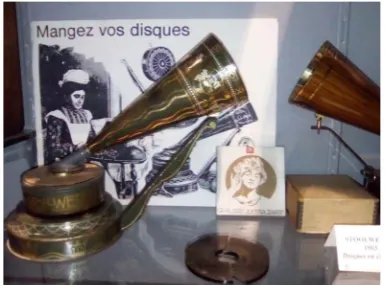
Figure 1.1 Stollwerck’s toy record player and chocolate record in the Phono Muséum Paris. Photo
© K. Weissenbrunner. Published with the permission of the Phono Muséum Paris. 28 Figure 1.2 Examples of Joke Lanz’s records with stickers to mark a sample and to notate
performance instructions. 34
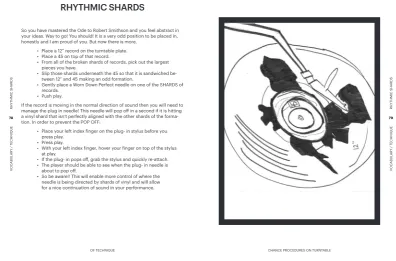
Figure 1.3 Cut-up records of Camilla Sørensen’s (Vinyl -terror & -horror) collection. 40 Figure 1.4 Explanation of ‘Rhythmic Shards’, an experimental turntable technique in Chavez (2012,
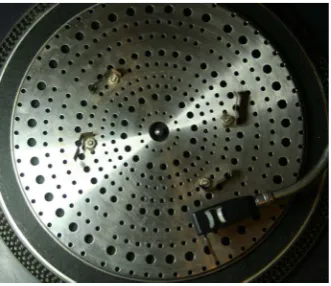
p. 79). Published with Maria Chavez’s permission. 42 Figure 1.5 Ian Andrews’ perforated stainless steel disc (2009). Photo © I. Andrews. Published with
Ian Andrews’ permission. 43
Figure 1.6 Illustrations of a patterned disc in relation to the resulting rhythm after one complete
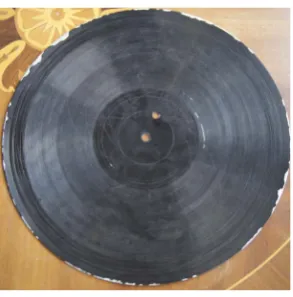
disc rotation, which can be interpreted as a 4/4 rhythm. 43 Figure 1.7 Record with off-centred hole by Vinyl -terror & -horror. 45 Figure 1.8 Ian Andrews’ prepared ‘stereo piezo spring cartridge’ (2010). Photo © I. Andrews.
Published with Ian Andrews’ permission. 47
Figure 1.9 Ian Andrews’ four-arm turntable constructed by John Jacobs (mid-1990s) with
headphone and piezo cartridges. Photo © I. Andrews. Published with Ian Andrews’ permission. 48 Figure 1.10 Ignaz Schick playing ‘rotating surfaces’ in a concert (Berlin, 2009). 49 Figure 1.11 Examples of the Drop Needle Technique in Chavez (2012, p. 66). Published with Maria
Chavez’s permission. 54
Figure 2.1 Schematic overview of the criteria developed along the framework for the analysis. This
figure summarises the possible interactions between artist, instrument and venue/audience. 72 Figure 2.2 Excerpt of the software EAnalysis with a draft of graphical annotation in the top layer,
spectrogram in middle layer, and waveform on lowest layer (audio excerpt of a Vinyl -terror
& -horror recording). 97
Figure 2.3 Example for the transcription of a chain of scratch sounds in the software EAnalysis. 98 Figure 2.4 Score for Radiorgasm (2009) by Joke Lanz. 101 Figure 3.1 Technical draft of the setup. The turntables are rotated 90° counter clockwise. 113 Figure 3.2 Joke Lanz in concert. The records are arranged in a record holder to his left. 114 Figure 3.3 Lanz’s 7-inch record series called Medical English for German Doctors. 116
Figure 3.4 Lanz’s 7-inch cut-up records. 117
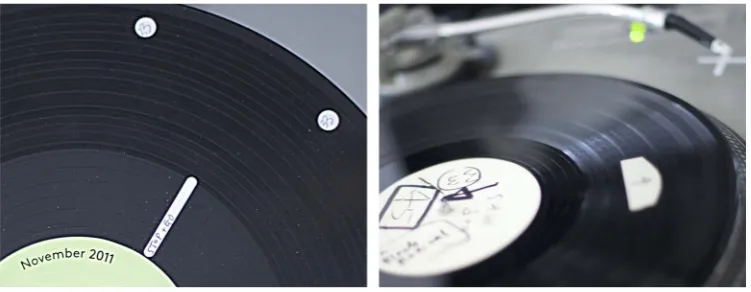
Figure 3.5 Left: Disc with a sticker pattern. Right: Disc with a sticker marking a sample and
creating a loop. 118
Figure 3.6 Examples of records with sticker notes and notes on the labels. 118 Figure 3.7 Sampler Boss SP-202 Dr. Sample with personal notes of the artist. 120 Figure 3.8 The sonic fragments from the right turntable (black signs) create syncopated
accentuations over the clear metrical beats of the music sample from the sampler (grey signs). 128 Figure 3.9 Excerpt of software EAnalysis at 17:40 min with several interactive layers: video of the
passage shows the scratched sample of a child’s voice that ends in a pure phoneme (in the layer under the video, see the red signs for the sample from the right turntable contrasting
with the black icons for the noises from the left turntable). 132 Figure 3.10 On the left, plotted spectrum (in the software Audacity) of the child’s voice fragment
without manipulations, showing a fundamental frequency at around 389 Hz (G4) and the next four harmonic partials (excerpt length 470 ms at around 17:53 min). On the right, the spectrum of this sample as a chain of scratches, showing a dense spectrum of non-periodic
partials (excerpt at 17:50 min for around 500 ms). 132 Figure 3.11 Lanz creating an imitative rhythm with a sticker pattern on an LP (black signs). 135 Figure 3.12 Joke Lanz’s needle drops, carried out by shaking the table with both turntables at 25:30
- 25:40 min. 136
Figure 3.13 Overview of alternating signal and noise-based sections in the performance. 143 Figure 3.14 Opposing vocal layers of a child’s voice, singing the tune ‘Over the Rainbow’ (red signs),
and a male singer’s melismatic chant (black signs); recorded and looped to function as a
unity (grey signs, right). 145
Figure 3.15 Lanz in concert at around 1:21 min. 150 Figure 4.1 Left: ‘Spiral cut-up record’ and split record player in the installation Worst Case
Scenario. Right: Example of Vinyl -terror & -horror’s concert setup (picture by Vinyl -terror
& -horror, published in Vinyl -terror & -horror, 2013a). 159 Figure 4.2 Schematic overview of Vinyl -terror & -horror’s concert setup as used in the performance
in London, 8 March, 2014 (see Part II). 162
Figure 4.3 Vinyl -terror & -horror’s concert setup as used in the performance in London, 8 March,
2014 (see Part II). Numbering of pickup cartridges as in the schematic overview. 163 Figure 4.4 Left: Greta Christensen steering the centre spindle in concert. Right: Headshell with two
styli. 165
Figure 4.5 Left: Camilla Sørensen’s 1960s automatic record player. Right: A potentiometer attached
to the control motor. 167
Figure 4.6 Disasters (BBC Sound Effects No. 16, LP, 1977) and Drehorgeln, Automaten &
Orchestrions (AMIGA, East Germany, GDR, 1980). 168
Figure 4.7 To be continued… (2007), picturedisc by Vinyl -terror & -horror. On the left, the original as released; on the right, the disc as a cut-up with the quarters of the record
rearranged and glued back together so that the picture is complete. 169 Figure 4.8 Cut-up records by Vinyl -terror & -horror. 170 Figure 4.9 Portrait of trumpet player Adolf Scherbaum (1976, Werke von Delalande und Mouret,
Germany: ETERNA – 8 26 766) on an LP cover (left) and in the disc (created by drilled
holes) (right). 170
Figure 4.10 A baked 7-inch disc made from vinyl crumbs (from cutting up other vinyls; see left)
[image:8.595.81.514.48.773.2]Figure 4.13 Cinematic scene at 8:27 - 8:39 min with footstep sounds, clock ticking, call of a cuckoo
clock and low door squeaking. 188
Figure 4.14 Cinematic scene at the end of Section III with a cluster of crow calls (around 16:10 -
16:40 min). 189
Figure 4.15 Left: Tango Cut-up Record with a relocated circular part. Photo © G. Christensen.
Right: Excerpt of graphical representation. 194 Figure 4.16 Transformed crescendi via reversed playback (red signs, left) and glissandi created via
speed manipulations (red signs, right). 195
Figure 4.17 Cut-up (Disc 10) used at 6:19 - 6:37 min by Camilla Sørensen. 196 Figure 4.18 Low-frequency noise texture (irregular squares) produced by the baked record
accompanied by a crescendo and string tremolandi. 199 Figure 5.1 Graham Dunning performing with the ‘Mechanical Techno’ setup in the concert at Power
Lunches, London, 2014. 214
Figure 5.2 Graham Dunning’s turntable setup in the concert at Power Lunches, London, 2014 (see
analysis in Part II). 216
Figure 5.3 Vinyl record of ‘Bad Synths’ (as Dunning labelled the record) featuring a synthesiser melody. The thread preparation forces the stylus to remain in one record groove to create
a loop. 218
Figure 5.4 Blanked-out record, providing a sample from only one quarter of the disc. (Photo by
Graham Dunning). 219
Figure 5.5 Left: Silent record with two scratches separating the disc into halves. (Photo © G.
Dunning). Right: Graham Dunning’s Yamaha CS-5 Synthesiser (in use since 2003). 219 Figure 5.6 Stepped record to let drop beaters on a cowbell (Photo © G. Dunning). 220 Figure 5.7 Left: The pattern of the pins ( ) on the prepared record can be imagined as lying on
three concentric rings. This illustration shows the position of the piezo microphones for the bass drum and hi-hat pattern and is based on a drawing by Graham Dunning, sent in a
personal email to the author, 15 July 2016. 221
Figure 5.8 Graham Dunning’s ‘copper disk sequencer’ (top) and transparent prisms with light beam
and sensor (below). 223
Figure 5.9 Left: Nord drum (red), digital delay (silver), pitch shift device (green).Right:
Reverberation pedal (Cathedral), digital delay (silver). 224 Figure 5.10 Additive structure (Section A) summarised in the graphical representation from the
beginning until 12:31 min. 234
Figure 8.1 Record construction in 2014 (can vary constantly) and mixing desk Allen & Heath. 275 Figure 8.2 Selection of vinyl records of Camilla Sørensen’s collection. 275 Figure 8.3 Selection of vinyl records of Camilla Sørensen’s collection, Stereophonic Test Record,
underlined Track ‘Buzz and Rattle Elimination’ (left), notes on the vinyl record (right). 275 Figure 8.4 Record construction 2014 (can vary constantly) and mixing desk. 276 Figure 8.5 Tools to prepare the vinyl recods (e.g. see following examples of her preparations). 276
Acknowledgements
First, special thanks go to my supervisors Newton Armstrong and Miguel Mera for their supportive advice, guidance and effort throughout the process of writing this thesis. I extend thanks, too, to Diana Salazar, who, although only temporarily a member of the Music Department of City, University of London, shaped the progress of my research with challenging and productive remarks. I also would like to thank the Music Department at City, University of London for honouring me with a University Doctoral Studentship, generously funding my research. Without that support, the proceeding work could not have come into existence.
In the initial stages of the research, I benefited from help in shaping and pursuing my ideas from Volker Straebel, Stefan Weinzierl and Nikolaus Bacht, to each of whom I am grateful.
I am extremely thankful to the artists, Camilla Sørensen and Greta Christensen from Vinyl -terror & -horror, Joke Lanz and Graham Dunning, who agreed for their performances to be documented and published as part of this study. I also received useful information and knowledge from the artists and experimental turntablists Lucas Abela, Ian Andrews, Thomas Brinkmann, Maria Chavez, Christian Marclay, Ignaz Schick and JD Zazie.
I owe sincere gratitude to my colleague Liam Cagney, who offered precious editing and proof-reading help in the process of revising this dissertation.
Abstract
In experimental turntablism, sound artists and musicians encounter not only the pre-recorded sound of the vinyl records, as is common in DJ culture and hip hop turntablism, but also accentuate the materiality of the records and turntables themselves. The thesis shows that the record player is itself the key concept within which each experimental turntablist unfolds an intricate dialogue between mediation and materiality. Through these media-specific practices, these sound artists raise to the surface the fact that our listening habits tend to dissolve the reproduction medium from our awareness. This thesis explores experimental turntablism in live performance and presents an innovative methodology that establishes the ideas and tools for a potentially generalisable approach to performance analysis for concerts using live electronics. The analytical framework, disclosing the medial and sensual significance of experimental turntablism performances in a digital era, broadens the perspective on sound with theories of performativity, materiality, mediality and instrumentality in electronic music. The thesis methodology includes performance analysis, artist interviews, video and audio recordings and interactive graphical transcriptions based on the current music analysis software EAnalysis.
Three case studies examine three distinct artistic approaches: the specific focus of each experimental turntablist varies from playing techniques, to sculptural objects, to mechanical operations. Joke Lanz’s direct and embodied playing negotiates a sound production between signal and noise, musicalises samples, and leads to spontaneous acts with site-specific aspects. Vinyl -terror & -horror destruct playback devices and vinyl records to re-structure samples in chance processes; the duo accompany their sculptural objects with movie soundtracks and ‘unfinished compositions’ from their own records to engender cinematic soundscapes and imaginary scenes. Graham Dunning’s turntable construction sequences patterned discs, which trigger auxiliary instruments through the turntable’s rotary motor operations. These mechanical movements embody rhythmic loop structures with temporal inconsistencies, creating a mechanical techno.
Introduction
Media technology1 is omnipresent in our daily lives. This is reflected in media
technology’s relationship with culture and perception having become a growing research field in musicology, media studies and cultural studies (Katz, 2004;
Saxer, 2016a). As Mark Katz (2004, p. 3) points out in Capturing Sound – How
Technology Has Changed Music, the influence of audio recording technology is partly shaped by the inventions themselves but also by how dependence on these inventions manifests in human actions. Today we primarily listen to music via audio recordings or broadcasts rather than live performances: with reproduction and transmission media, sound has become detached from its time and place of origin (Benjamin, 1936/2008, p. 22; Föllmer, 2004, p. 81). From the 1930s on listeners seem to have dissociated the sound from its reproduction, and with the arrival of the CD around 1982 the medium was considered to have disappeared completely from the listener’s awareness (Straebel, 2009, p. 1). Scholars speak of reproduced sound as a ‘supplanting reality’ (Chion, 1994, p. 103) or ‘media reality’ (Großmann,
1997).2 Musicologist Helga de la Motte-Haber (1998) argues that the products of
electronic media change the coordinates of the subjective ‘present’ and transfer us to a different place and time. As a consequence of these competing realities that have arisen through omnipresent technological mediation, de la Motte-Haber (1998) sees in art responsibilities to reconnect with the here and now:
[T]echnologically defined fictitious worlds make it difficult to determine a here and now in our own existence. The more the events surrounding us can be simulated, the more does art have the task of enabling the perceiving subject to reflect on its own reality. […] i.e. the function of surrounding life artistically, will become less important than the task of creating irritations in order to set off a process of reflection about perception itself, which seems necessary in order to enable us to rediscover our subjective position (p. 93).
De la Motte-Haber (1998) assumes that this task of facilitating reflections on perception is more likely to be realised in ‘one of the technologically determined art forms […] than in traditional concert music’ (p. 93).
Experimental turntablism can be considered as an artistic practice that facilitates reflection on technological mediation. Media are considered to remain
1 Following media theorist and musicologist Rolf Großmann (1997), in this thesis mediation and media
will solely refer to technological media (such as film, photography, audio reproduction and transmission devices) although I do not differentiate between electronic and electro-mechanical media. I also agree with Großmann (1997) that a change of media is not solely the introduction or replacement of a new medium but a ‘re-positioning’ of the old medium.
2 Großmann (1997) understands this secondary reality from a constructivist point of view, in which reality
transparent and unnoticed (Krämer, 2008, p. 68). Yet by exploring the creative potential of turntables and vinyl records, musicians and artists of experimental turntablism interrupt the listener’s focus on the ‘illusion’ – on the reproduced sound from the medium – , which reveals our relationship with the reproduction technology (Barthelmes, 1995, p. 15). Christian Marclay – who, as well as being a visual artist, can be considered one of the first contemporary experimental turntablists – states that his artistic approach generally includes reflection on mediation:
With music, I want to disrupt our listening habits. When a record skips or pops or we hear the surface noise, we try very hard to make an abstraction of it so it doesn’t disrupt the musical flow. I try to make people aware of these imperfections, and accept them as music; the recording is a sort of illusion, while the scratch on the record is more real. I want to question the recording medium itself, or any medium for that matter, be it a sound recording or text (Marclay in Estep, 2001/2014, p. 42).
Marclay’s concept is to foreground the reproduction through imperfections that intentionally interfere in the listening process.
By abusing audio media, sounds of malfunction and distortion occur (for example, with a record player, an impulse noise occurring in the moment of
dropping the tone needle on the disc). Caleb Kelly, in his study Cracked Media
(2009), examines noise and sounds of malfunction in the practices of artists who re-use and hack audio reproduction technology such as turntables and CD-players. Kelly (2009) suggests four main definitions of noise (which are not absolutely distinct from each other): acoustic noise, noise in information theory, subjective noise, and material noise (pp. 69-76). ‘Acoustic noise’ is based on Hermann von Helmholtz’s definition of noise as a sensation produced by the ‘non-periodic motion’ of a ‘sonorous body’ (Helmholtz, 1954, p. 7). In information theory, noise is defined in relation to communication. Noise interferes with the reception of a message but this interruption or extraneous signal itself can create meaning for the receiver (Attali, 2009, p. 27). Kelly (2009) also sees a record disc’s inherent noises and pops as referring to the medium’s heritage in a past era:
In fact we forgive vinyl media for this flaw and even hear these noises with a sense of nostalgia, as they are marks created from listening to the record and remind us of times in the past when we played the music (p. 72).
and annoying. However, in the noise music genre, Kelly (2009) argues, noise is not considered in terms of information theory or subjective noise; instead, ‘these noises are quite simply noise no matter what the subject feels about the sound he or she hears’ (p. 73). Material noise, Kelly’s (2009) last category, is based on Michel Serres’ understanding of noise as the backdrop to all communication (pp. 74-76). Describing noise in the practices of cracked and broken media, Kelly (2009) states:
Noise has been brought forward to become the actual content of much recent work in the area of cracked media. However, this practice need not be seen as transgressive, excessive, or even chaotic, contrary to much of the theoretical discourse around it. Although at times noise utilized in this way certainly is excessive, it is just as often quiet, gentle, low, and almost inaudible. […] Noise is the backdrop to all communication, but in those instances when the backdrop is brought to the fore it is simply not disturbing or blotting out any information; it is not a break in communication, but instead becomes the content of communication itself (p. 82).
These theories and notions mainly oppose noise to a signal (or message); whereas, as a salient feature of experimental turntable practices, I see in noise a reference to the specificity of a medium. Noise and destruction are not the only focus of experimental turntablists but can be combined with individual artistic ideas and strategies. In order to obtain a broader perspective than would be provided by the focus on noise and ‘failed’ mediation, I here diverge from Kelly by taking the media’s specificity into account. The medium’s specificity is not only revealed by a disruption or noise that fails in transmitting a signal or message; the medium’s specific materiality and the development of distinct actions create medium-specific
transformations.3 This perspective will guide my considerations on experimental
turntablism.
The media-specificity of music within modernity has been recognised since the early twentieth century. In the early 1920s, through his gramophone experiments, the Hungarian Bauhaus artist László Moholy-Nagy aimed for an ‘authentic record-music’ (‘authentische Schallplatten-Musik’) (Stuckenschmidt, 1985, p. 410). He used the gramophone to produce rather than reproduce sound by directly incising grooves into the disc with needles (Stuckenschmidt, 1985, p. 410). In 1930 Austrian composer Ernst Toch together with composer Paul Hindemith performed with gramophones a ‘characteristic music of its own’ (Toch cited in and translated by
Katz 2001, p. 164),4 which, in the programme of the Neue Musik Berlin Festival,
they entitled Original Works for Disc (‘Originalwerke für Schallplatte’) (Katz,
2001, p. 162; Elste, 2016, p. 360). Toch and Hindemith manipulated the playback
of their records presumably by playing them at various speed and blending several discs (Katz, 2001, p. 163), producing media-specific sounds (Elste, 2016, p. 364). Theodor W. Adorno (1928/1990a) observed a process of transformation of the reproduced sound when, due to a worn-out mechanical spring, a gramophone’s rotation slows down; this ‘breakdown’ causes the reproduced sound to drop ‘in chromatic weakness’ (p. 55). In the 1930s Adorno also discussed ‘radio-specific’ and
‘gramophone-specific music’ (Adorno, 1934/1990b, p. 57).5 He saw in the record’s
second characteristic – its ‘thingness’ – the potential for creating ‘gramophone-specific music’:
Nevertheless, as an article, the record is already too old not to present us with riddles, once one forgoes considering it as an art object and explores instead the contours of its thingness. For it is not in the play of the gramophone as a surrogate for music but rather in the phonograph record as a thing that its potential
significance – and also its aesthetic significance – resides. As an artistic product of decline, it is the first means of musical presentation that can be possessed as a thing (Adorno, 1934/1990b, p. 58).
The noise of a scratched record surface reveals the record as a material thing, and the changed pitch as a result of the playback speed alteration refers to a record player’s idiosyncrasies. Either of these modifications is ‘gramophone-specific’ and draws the focus on the technological medium itself. These particles inscribed in the produced sound provide the medium with a presence or voice (Wilkins, 2011, p. 62). Film sound theorist Michel Chion (1994) describes such acoustic particles, indicating the idiosyncrasies of the sound production, using the concept of
‘materializing sound indices’:
Materializing sound indices frequently consist of unevennesses in the course of a sound that denote a resistance, breach, or hitch in the movement or the mechanical process producing the sound. [… They] return the sound to the sender, so to speak, in accentuating the work of the sound’s emitter and its faults instead of allowing us to forget the emitter in favor of the sound or the note itself (pp. 115-116).
After Chion, materialising sound indices can initiate an awareness of ‘the sender’ – in this case the reproduction device itself – and therefore interrupt the illusionary process of listening to the reproduction of an audio recording. In playback devices, the materialising sound indices, linked to the resistances and materiality of the medium, are therefore medium-specific.
5 ‘German original version: ‘rundfunkeigene’ and ‘grammophoneigene Musik’, from the essay ‘Die Form der
As Christian Marclay says, the materiality of the medium also creates specific conditions in the performance:
One doesn’t think of music as a physical reality, but it has physical manifestations. It can also be an illustration, a painting, a drawing. In a performance you have the visual presence of someone producing sound. In my work I’m constantly dealing with the contradiction between the material reality of the art object as a thing and its potential immateriality (Marclay in Curiger 1997/2014, p. 23).
Marclay highlights a general dichotomy apparent in the performances by experimental turntable artists using the specificity of the medium. By working with records reproducing sound (from a different place and time) and the material features of the turntables and records as physical things in the live performance, a contrast emerges between ‘material reality’ (Marclay) and ‘media reality’
(understood as simulated event, after de la Motte-Haber, 1998). In the more general practices of ‘cracked media’, Kelly in this regard observes a ‘dialogue between these material objects and the nonmaterial nature of data’ (Kelly, 2009, p. 218).
As Marclay indicates, the ‘visual presence’ of the performer producing the sound in a performance additionally plays a key role in this dialogue between media and material reality. Musicologist Volker Straebel (2009) describes ‘performative’ qualities in media-specific music for gramophone record and compact disc:
It becomes obvious that the concept of gramophone-specific music is determined as much by the record’s use as by its design. […T]he performative aspect of any gramophone-specific music is hard to deny. For, when not being played, the
gramophone record remains utterly silent, even more so as it lacks the possibility of being read and imagined like a score (p. 24).
The specificities and idiosyncrasies of the phonographic medium are related to the medium’s materiality and use in the playback. Artists encounter the reproduced sounds from vinyl records, as well as the playback devices and objects themselves. The media-specificity can be recognised in the acoustic dimension as ‘materialising sound indices’ (Chion, 1994) and as distinct ‘performative aspects’ in the
performance.
art (Sanio, 2013, p. 237), its significances in performance have scarcely been investigated. Creative practices using record players and vinyl discs appear in various and individualistic performances, and in engaging with the medium’s specificity they are guided by diverse artistic perspectives. My thesis takes off from the angle of media-specificity outlined up until now to study the multiple directions of experimental turntablism practices.
Experimental Turntablism – Terminology
In 1995 DJ Babu introduced the term ‘turntablism’ retrospectively to describe the
creative use of turntables as instruments in hip hop music.6 Although this term
does not serve as a description of a distinct musical style, a majority of the DJ community would agree that ‘a turntablist is a DJ that has moved beyond the ordinary role and become a musician playing the turntable (typically the instrument consists of two turntables and mixer)’ (Hansen, 2013, pp. 44-45). From the late 1970s onwards, in parallel to hip hop turntablism, an ‘experimental turntablism’ began to grow. These artistic practices incorporate a broad range of approaches and forms of presentation; drawing clear lines is difficult in regard to such self-taught creative practices. As pointed out in Kelly’s description of ‘cracked media’, experimental turntablism is not limited to the manipulation of the recorded audio content of the vinyl record. Experimental turntablists modify the recorded sound and extend their assemblage to the materiality of record players and vinyl records. This duality becomes the basis for developing an individual approach and personal instrument setup. By experimenting with individual approaches, each of these sound artists develops personal strategies and concepts for music generation and interaction with the instrument (Lippit, 2006, para. 2.1). The experimental turntablists at times also move away from using vinyl records and their sound production might entirely rely on the materiality of the phonographic medium. Although Christoph Cox and Daniel Warner gather hip hop turntablists as well as experimental turntablists such as Marclay under the term ‘DJ Culture’, their scenes are generally considered as being completely separate (Kelly, 2009, p. 168; Lippit, 2006, para. 2.1). Asked in an interview by Daniel Neumann about the provenance of turntablism, turntablist Maria Chavez – who has been involved in both popular and experimental music scenes – highlights this separation:
The history of the turntable is a known series of events, peppered with names of sound artists that used it in their works. It’s just the later half of this history that is
6 See Katz (2004, pp. 115f) and the documentary by Pray, D. (Director), Blondheim, B. (Producer), &
most celebrated and capitalized on. As far as positioning my work goes, I really don’t feel that my turntablism has anything to do with the DJ hip-hop culture, except for the fact that my first experience with the turntable was under a DJ context. As time went on and I pursued a DJ career, I began to get bored with the parameters that this culture was enforcing (Chavez, 2012, p. 10).
Approaching the technological medium in a nonconformist way sees the sound reproduction objects reinterpreted as physical materials, as is conveyed in distorted and manipulated sounds (Kelly, 2009). Yet there is no single agreed term to denote these heterogeneous practices. The term ‘experimental turntablism’ is used in
Kelly’s study Cracked Media (Kelly, 2009, p. 151) and in Thom Holmes’ historical
study Electronic and Experimental Music (Holmes, 2008, p. 421). Other terms in
use are ‘abstract turntablism’ (Chavez, 2012, p. 17; Holmes, 2008, p. 425; Ody,
2009) and ‘avant-garde turntablism’ (Katz, 2004, p. 45). In Capturing Sound (2004),
Katz analyses contemporary practices in hip hop turntablism and briefly mentions ‘avant-garde turntablism’ in regard to Christian Marclay. Katz’s term might emphasise similarities between artists such as Marclay and earlier predecessors in the avant-gardes of the twentieth century. However, the self-taught contemporary turntablists share disparate historical influences without following any agreed manifesto.
My choice of the term ‘experimental turntablism’ is informed by the turntablists’ being associated more with sound artists in the experimental and improvisational music scene than with performers for popular music audiences (Holmes, 2008, p.
422; Lippit, 2006, para. 2.1).The agents of experimental turntablism are composers,
Kelly’s (2009) general description of cracked media is also appropriate for experimental turntablism practices:
Cracked media slides across disciplines, between music, sound, and noise. It is part of the wider project of sound in the arts, an area that has recently been receiving attention from a range of different disciplines (p. 13).
The term ‘experimental turntablism’ should therefore be understood as a loose designation, acknowledging the openness of the practice. It should also be
considered in respect of Cox and Warner’s notion in Audio Culture, that ‘the
lines between improvised music, experimental music, and electronic music are increasingly blurry’ (Cox & Warner, 2013, p. 252). Nonetheless, experimental turntablism’s historical lineage and concepts seem linked to John Cage and, through Cage, to certain related experiments before him. The subtitle of
this thesis – Performances with Second Hand Technology – alludes to a key
characteristic of the turntablists of today: the re-use and recycling of outdated and found objects as instruments, which puts an emphasis on the technological objects’ materiality and secondary qualities (as will be explored in Chapter 1).
Precursors and Historical Context
The historical lineage of composers, artists and experimenters using the record player artistically can be traced back to the beginning of the twentieth century. Contemporary turntablists might not have been aware of any of these historical forebears before starting their own projects, although single works might on the other hand have served as inspiration. An extensive historical overview of early ideas and experiments going back to the invention of the phonograph can be found in Mark Katz’s ‘Hindemith, Toch, and Grammophonmusik’ (2001) and his
later book Capturing Sound (2004). Kelly’s study Cracked Media (2009) follows
in particular the historical steps from John Cage to Milan Knížák, Marclay and contemporary sound artists such as Lucas Abela. Although Kelly (2009, p. 81) acknowledges the unique ways of producing sound using turntables, his study does
not give a detailed account of the resulting music. Thom Holmes’ Electronic and
precursors and their approaches will now provide a useful contextual background for comparisons with contemporary practices and the discussion of methodology and case studies later in this thesis.
Hungarian artist László Moholy-Nagy was one of the earliest experimenters to explore the creative potential of gramophones, from 1923 on (Stuckenschmidt, 1985, p. 410). Together with Hans Heinz Stuckenschmidt, Moholy-Nagy played records backwards (particularly records with piano for ‘surprising effects’), drilled excentric holes into the discs for a de-centred and wobbling playback (to create ‘grotesque glissandi’) and scratched the surface with needles to create ‘rhythmic figures and
noises’ (Stuckenschmidt, 1985, p. 410). In an article of the Musikblätter des Anbruch
(1926), published earlier in Der Sturm (1923), Moholy-Nagy lists a series of ideas
on how to study the gramophone. One of his ideas, the one most discussed, is his suggestion for developing and applying a ‘groove-script alphabet’ (transl. in Katz, 2001, p. 167). By cutting graphical signs directly into the wax plate Moholy-Nagy saw the possibility of a compositional tool for the production of new sounds. To create further incitements through unexpected results he also advocated
gramophone improvisations (Moholy-Nagy, 1926, p. 366). Moholy-Nagy’s approach included the use of the medium’s materiality to manifest compositional elements whilst embracing chance and improvisation, and this makes his early gramophone experiments comparable to contemporary practices in experimental turntablism, as will be shown in the course of this study.
The impulse for Moholy-Nagy’s study of the gramophone for sound production rather than reproduction appears to originate in an intention to pursue and extend the Bruitists’ sound explorations (Moholy-Nagy, 1926, p. 364). In this respect Luigi Russolo’s 1913 Futurist manifesto ‘L’arte dei rumori’ (‘The Art of Noises’) and Russolo’s performances with his intonarumori as ‘noise intoners’ (Kahn, 2001, p. 56) might have directly encouraged experiments with record players. The Dadaists’ work with assemblages, collages, cut-up and ‘sampling’ ideas in literature might have provided further inspiration (Feuerstein, 2004, p. 257). The Dadaists also included chance and improvisation techniques (Livet, 1977, p. 8) while questioning the established performance forms, challenging the viewer’s perception and the experience of performer/audience roles (Feuerstein, 2004, p. 257). Next to Moholy-Nagy, other composers and performers, such as Darius Milhaud, Stefan Wolpe and Edgard Varèse, experimented with record players in the 1920 and 1930s (Davies, 1996, p. 9). By contrast with Moholy-Nagy’s inclusion of the medium’s materiality, though, these composers’ use of the turntable was mainly based on the use of pre-recorded sound from records (Katz, 2001, p. 168).
2016, p. 360), ‘original music for the radio’ or other concerts using unconventional instruments were also shown in a series of annual contemporary music festivals in Germany (Katz, 2001, p. 162). Although the original discs for Toch and Hindemith’s composition have disappeared and their form of presentation cannot be reconstructed, there are indications that in the performance several discs were blended in a mix and records were played at varied speed to produce pitch and timbre alterations (Katz, 2001, p. 163). Already in 1926, Toch published an article
alongside Stuckenschmidt and Moholy-Nagy in the special edition of Musikblätter
des Anbruch on mechanical music, in which he considers the potential and
specificity of music for mechanical instruments. Hansjörg Dammert’s (1926) piece in the same edition – suggesting new possibilities for polyphonic compositions by using the gramophone as an orchestral instrument accompanying ‘real’ instruments in concerts (p. 407) – might have spurred Toch to compose a ‘characteristic music of its own’ for gramophone in 1930.
As Katz points out, these early gramophone experiments seem only to link to later works and practices with record players by way of Cage. As a young student from the United States, Cage visited Berlin and attended Hindemith and Toch’s 1930 concert. Yet he only mentioned his admiration for Toch’s gramophone piece later in his career in a conversation with Toch’s grandson (Katz, 2001, p. 176; Weschler, 1996). However, the 1930 performance may well have had an influence
on Cage, as only nine years later his Imaginary Landscape No. 1 used record
players to accompany a muted piano and a large Chinese cymbal (Zeller, 1990, p. 113). Cage used test tone records with sine tones on two turntables and applied pitch alterations by playing the discs at variable speed, a similar technique as Hindemith and Toch applied. Cage continued to write for record players along with other playback and broadcast devices. The record player appears in several
works, such as the series Imaginary Landscapes,7 Credo in Us (1942) and 33
1/3 (1969). Cage also introduces a new way of approaching the record player
without using any pre-recorded sound from records. In Imaginary Landscape
No. 2 (March No. 1) and Imaginary Landscape No. 3, for example, he used the record player’s tone arm to amplify a variety of percussion instruments and objects, such as ‘tin cans, conch shell, ratchet, bass drum, buzzers, water gong, metal wastebasket, and lion’s roar’, and to combine the sounds with oscillators. The record player serves there as an electro-acoustic quasi-percussion instrument.
In the live performances of Cartridge Music (1960) with David Tudor, the duo
Pierre Schaeffer’s early musique concrète pieces from 1948/49, collage works
in the spirit of early surrealist experiments,8 were first realised with fixed sounds
on record discs and several turntables.9 Among these pieces, two ‘experiments in
interruption’, the ‘closed groove’ and the ‘cut bell’, particularly set the bedrock for
the development of musique concrète (Chion, Dack & North, 2009) and were at this
time specific to the use of records. For these manipulations of the recorded sounds, Schaeffer used a direct-to-disc cutting lathe available in the RTF radio broadcasting studio, available to him through his work as a radio technician (Holmes, 2008, p. 49). The recorded ‘concrete’ sounds of trains and engines were cut into a ‘sillon fermé’ – a closed or locked groove – creating the repetition of the groove after one rotation in a loop (Holmes, 2008, p. 50). In Schaeffer’s ‘cut bell’ experiment, the attack of a resonant bell sound was cut away so that the remaining excerpt, in combination with the closed groove, sounded similar to a continuous flute sound (Chion, Dack & North, 2009, p. 13). Today, these modifications used to create isolated excerpts of recorded sound can be realised via tape or digital technology; but in 1948 Schaeffer required a cutting lathe to modify the grooves directly through the groove cutting process of the recorded, concrete sound. Schaeffer’s
methods in his early musique concrète pieces have been inspiring for some
contemporary turntablists, such as turntablist Ignaz Schick (2009). Collage works in general, although not realised with the record player, provided impulses for the
manipulation of recorded sound, as in the early radio play Weekend (1930), realised
with optical sound film by Walter Ruttmann, or Karlheinz Stockhausen’s Gesang
der Jünglinge (1955–6), which unites electronically synthesised and ‘concrete’ sounds. Marclay has in this regard mentioned his fascination at a young age with
the Beatles’ collage work ‘Revolution 9’ (1968) from the White Album (Marclay in
Kahn, 2003/2014, p. 17).
Starting in the 1960s, the Fluxus artists emphasised the specific sculptural and material features of records and record players through destruction and damage, directing the audience’s focus at the same time onto the value of the artefacts.
Fluxus artists Nam June Paik (Random Access or Schallplattenschaschlick,
1963/1979) and Milan Knížák (the Destroyed Music series from the 1960s) in
particular paved the way for this artistic direction. Knížák modified and destroyed vinyl discs by taping, painting, burning, breaking and gluing broken parts back together again to achieve a rich palette of sounds (Kelly, 2009, pp. 142-149). By gluing four quarters of various discs together, Knížák created cut-up records that also create rhythmical structures specific to this restructured disc.
8 Pierre Schaeffer in an interview: ‘Oui, au début c’était des formations, c’était des coupures, c’était des
collages comme lors des premières expériences surréalistes’ (Schaeffer in Fouchet, 1959).
9 See, for example, Pierre Schaeffer’s pieces Cinq études de bruits (1948) and Suite pour 14 instruments
In popular music, the turntable and records also appear with a subversive quality. Katz (2004) considers the instrumental use of the record player in hip hop, starting in the late 1970s, an act of subversion, since scratching techniques reorient the original purpose of playback devices from reproduction to production (p. 132). For post-punk and industrial music bands the nonconformist and destructive use of media devices served more directly as a tool of revolt against commercialism. In the late 1970s and 1980s, artists such as Throbbing Gristle, Psychic TV and Merzbow were strongly inspired by William Burroughs’ (1970/1998) ideas concerning
cut-up methods for tape as described in The Electronic Revolution from 1970 (Kopf,
1997, p. 26).10 These artists’ interests included sparking a revolt with extreme
sounds and visuals and the shock and surprise of audiences through unusual setups (Hegarty, 2013, p. 135). The musicians of Cabaret Voltaire, for example, aimed to use the ‘clichéd sounds and sights of heavy industry’ to oppose pre-designed, mass-produced devices with ‘the more subversive dirt of reality’, as the band’s singer Stephen Mallinder (2013, xi) states. Experiments with vinyl records, by artists such as Boyd Rice of the industrial music band NON, directly inspired the contemporary turntable artists Janek Schaefer (2001, p.75) and Lucas Abela:
In the late ’80s when I first read the Industrial Culture Handbook I read about Boyd Rice and him chopping up records and drilling holes in records.11 Because I couldn’t
buy a NON record [Boyd Rice’s group] I repeated the experiments that I read about: chopping records in half, flipping them around, and drilling holes so they’d play off-axis. That’s the first turntable stuff that I did but it was just to emulate Boyd Rice (Abela in Prescott, 2011).
Starting in the 1970s/1980s, the questioning of the vinyl record’s meaning through the abuse of its media technology also played a role for experimental turntablists. In 1979 visual artist Marclay started his diverse work with turntables and records as a reaction to the abundant consumption of records as corporate commodities of the music industry (Marclay in Gordon & Marclay, 2005/2011, p.
157).12 Particularly influenced by Fluxus, punk and no wave, the Swiss-American
artist includes modified records and record players in sculptural works and
improvised performances. His general concepts seem consistently to emphasise the close relationship between the visual and auditory dimensions (Bossis, Marclay & Dufeu, 2013). Marclay also conceptually explores the medium itself and its imperfections. As the phonographic medium usually takes a backseat, Marclay also
10 See for example ‘TO DISCREDIT OPPONENTS’ in Burroughs (1970/1998, p. 19).
11 See for example NON [Boyd Rice] (1981), Pagan Muzak, [7-inch Vinyl record]. US: Graybeat Records
– GB 3301. (Originally released in 1978 as GB 3000, a record containing locked grooves and two holes for off-axis playing).
foregrounds the medium itself by exploring its materiality and idiosyncrasies. This
concept is particularly evident on his LP Record Without a Cover (1985). Marclay
released this record without a sleeve so that the surface becomes damaged. When this record is played, these surface scratches and imperfections create pops and noises that draw the listener’s attention to the vinyl record’s material surface. Although it is Marclay who is the most well-known performer with record players in experimental turntablism, independently of him in the late 1970s/1980s on several continents various artists started experimenting with turntables, further exploring the specificities of the medium. In the 1980s, turntables were explored by Martin Tétreault in Canada (Fortier, 2013), Gum and Vicky Browne in Australia
(Kelly, 2009, p. 178), Philip Jeck in the UK,13 and Otomo Yoshihide in Japan
(Kelly, 2009, p. 188). In Germany in the early 1970s, Claus van Bebber included the turntable in his repertoire for improvised concerts and focused particularly
on it from the 1990s on.14 Techno music producer Thomas Brinkmann in the late
1970s started an entirely rhythm-focused approach by cutting the record surface with a cutter knife to transform the record player into a sequencer for rhythmic beats (further details in Chapter 5, see also the list of contemporary experimental turntablists in Appendix B).
From the 1990s on, the practices of experimental turntablists can be linked to post-digital movements (Kelly, 2009, p. 320). With the proliferation of digital technology and the increasing use of computers in performances, countermovements started to return to sound production its absent tactility and direct access (Essl, 2007; Richards, 2008). Performances with laptops, despite the universal functions and possibilities of this device, have created some discontent about their lack of
engagement (Armstrong, 2006; Stuart, 2003). In his book Handmade Electronic
Music: The Art of Hardware Hacking (2006), Nicolas Collins emphasises that what ‘the computer offered in the way of power and universality was obtained at the
expense of touch.’15 As a consequence, many sound artists look for possibilities
to treat sound in a direct and intuitive manner. The simple application of the technology’s seemingly limitless possibilities in this way becomes questioned (Bosseur, 1996, p. 245). The ‘post-digital tendencies’ (Cascone, 2000; Richards, 2008) in sub-genres of electronic music, such as ‘lo tech’ and ‘circuit bending’ (Essl, 2007), unearth alternative concepts of music creation by hacking DIY electronic circuit systems or electronic objects (such as speaking dolls and Walkmans). Artists choose and design limitations and manufacture individual equipment, and thereby regain direct control over technological processes. As new technological inventions are easily accepted in society often without reflection
13 See Philip Jeck’s biography (Jeck, P. Biography. Retrieved from http://philipjeck.com).
14 See Claus van Bebber’s biography (Bebber, C. van, Vita. Retrieved from www.cvbebber.de/html/vita.
html).
or critical discussion (Bartmanski & Woodward, 2015, p. 165),16 personalised
DIY instruments challenge conventions in our Western culture with their unconventional practices of re-inventing and recycling electronic technology. In comparison to a sterile and wireless design such as that of laptops, handmade instruments appear imperfect. John Richards (2008), exploring the idea of ‘dirty electronics’, emphasises that this dirtiness determines the interaction with the electronic instruments and links the often unfamiliar sounds with playing techniques. The sound production becomes more comprehensible for the audience. Turntablist Christian Marclay, however, says that, despite these more recent developments, performances with records and turntables have lost their significance:
The reason for not performing so much any more with records and turntables has to do with the relevance of the instruments. In the early 1990s, with the advent of the digital, I started questioning what I was doing, and then there was a revival of the vinyl record through this DJ culture, it started booming just as I was ready to quit. So I got this second wind, but now, even though there’s still a thriving DJ culture, it doesn’t seem to be as relevant as it was, it has become a tired fad (Marclay in Toop, 2008/2014 p. 63).
Due to the numerous lives the vinyl record has had during its history (Bartmanski & Woodward, 2015, p. 1), the meaning of Marclay’s work with records and
turntables has changed (Kelly, 2009, p. 170). As the record has usually been handled with care, in the late 1970s, when Marclay came to the USA, he felt shocked by the overt presence of consumerism he saw there in the abundance of apparently unwanted, cheap records in thrift stores: Marclay started his work with records at that time as a reaction to this experience: ‘Before that, the record was something I was taught to respect and preserve. But in the States everything was about consumption and I was reacting to that as well’ (Marclay in Gordon & Marclay, 2005/2011, p. 157). However, in the 1980s and early 1990s the CD format became the new mass music product of choice and the vinyl record was considered obsolete, before DJ Culture and electronic music underground ‘rejuvenated’ vinyl in the 1990s (Bartmanski & Woodward, 2015, pp. 20-25), which gave Marclay his ‘second wind’ (Marclay in Toop, 2008/2014, p. 63). Within the past ten years, a new upward trend in record sales has helped give the vinyl record another comeback and a third life as a niche product, which may be its remaining position (Bartmanski & Woodward, 2015, p. 28).
16 See, for example, new media formats, mobile and internet-based ways for communication, consistent
The turntable’s attribute of binding sound to the physical material in a specific way, which is hardly found in digital instruments, still appears as an asset for contemporary turntablists, as Joke Lanz states:
What I personally miss nowadays is the organic feeling for a body and the homemade ideas and constructions. Since computer technology found its way into the nursery, many brains have been synchronized. The speed of internet has definitely improved the quantity of outputs but for sure not the quality (Lanz in Sienko, Lanz & Marhaug, 2012, p. 20).
In today’s digital age of ‘bodiless’ audio file formats (such as MP3 or WAV) that are streamed online and stored on computers or physical media players, musicians such as Lanz appreciate sound material that is tangible, malleable and destructible – sound that comes with a physical representation. In comparison to digital data and software, vinyl records and turntables offer something singular through their ‘thingness and unique pragmatic qualities’ and their human qualities as a fragile object, making them ‘cutting-edge’ again (Bartmanski & Woodward, 2015, p. 68). However, the vinyl records’ complex nature can be looked at from many points of view:
In the end it may be hard to put the finger on what it is that makes vinyl special. There is no singularly overpowering ‘cause’ or condition of infatuation with vinyl. Rather, it’s more holistic emergent experience, uniting various senses around a piece of music. It is about entire sensory formation and its histories, not about any one narrative or sentiment, be it nostalgic retromania or hipsterish snobbery (Bartmanski & Woodward, 2015, p. 98)
Beginning with its precursors that were available to a number of composers and performers throughout history, such as the gramophone, the records and record players seem to have remained a playback medium with the potential for conveying multiple meanings. Its use in particular as an instrument to create media-specific music leads to a variety of directions for artistic output, as this study will show.
Focus and aims of this thesis
threefold relationship between the turntable’s and record’s specificity, the artist, and the live performance. A detailed insight about Marclay’s improvised concerts is provided in the study by Bossis, Marclay and Dufeu, 2013; yet it is not extensive enough to draw an accurate picture of how Marclay works within the media and performative specificities, and is only engaged with the artist’s practices without aiming to discuss more generally the salient attributes of this art form.
My thesis has several aims. My individual artist examinations seek to receive deeper insight into how the turntable’s and the record’s specificity permeates individual artistic practices and live performances. As a countermovement in the digital era, it seems that live performances of experimental turntablism convey medial and sensual meanings facilitating reflection on technological mediation; revealing these entanglements will contribute to an understanding of the conditions for that reflection. In order to analyse the interdependent relationships obtaining within the turntable’s and record’s media-specificity, this thesis also aims to develop a thorough and innovative analytic methodology for experimental turntablism, with a particular focus on practice-based concepts and live performances.
The key features in the turntable’s and record’s specificity in performance are the physicality of the mechanical rotation, the plasticity of the record disc, the engraved grooves in the record surface, the needle transducing graphical contours into
vibration, the pickup cartridge transforming and amplifying the needle’s movements into signals for the loudspeakers and the performer’s body halting, manipulating and controlling the device. In performance these features are visible and palpably present. In experimental turntablism the artists use these specific features to create an interplay between material and media realities or else to work solely with the medium’s materiality. This emphasis on materiality foregrounds the device’s and material’s specificity and hence the mechanisms behind the media reproduction. Central to my study are therefore the following research questions:
In what ways are the artists’ strategies and concepts a product of their 1)
encounter with the medium?
In what ways are the artists’ playing techniques the product of their encounter 2)
with the medium?
How do the artists’ strategies, playing techniques and intersections with the 3)
performance environment work together?
How do these synergies allow the audience to reflect on the mediated processes? 4)
the individual artistic practice and the particular performance implement and emphasise the media-specificities. The individual artist’s encounter with the medium and its specificities results in distinct performances. The approach of my study is therefore to explore the role of the turntable in three concerts of experimental turntablism with a focus on the relationship between media and material realities. By analysing three case studies (see Chapter 3-5), the research questions are addressed in due detail. These three analyses also facilitate the formulation of a general theory underpinning these artistic practices.
I chose three different experimental turntablist artists to analyse in three live performances with the intention of representing a wide range of possibilities and individual approaches. Due to the heterogeneity of sound material and musical style in this art form, each of which can change with each concert, the focus on the artists’ practices for the selection of case studies provides a more continuous criterion. Drawing on Straebel’s (2009) differentiation between media-specific approaches in the use of the CD, used either for its performative features or for the creation of sculptural objects, I distinguish between three similar (albeit partly overlapping) approaches or focuses that turntablist artists might emphasise in their practices:
Case Study 1 – Joke Lanz, Interaction and Playing Techniques •
Joke Lanz demonstrates a focus on manual interaction with a standardised DJ setup of two turntables and a DJ mixer to develop distinct playing techniques. In this case study performative aspects can be examined, that relate the performer’s ‘embodied playing’ to the simplistic turntable setup and to his incorporation of spontaneous ideas in the performance situation.
Case Study 2 – Vinyl Terror and Horror, Sculptural Objects •
(Camilla Sørensen and Greta Christensen)
The duo ‘Vinyl -terror and -horror’, who have a background in the visual arts, focus on records and turntables as sculptural objects, which inform the duo’s use of sound effects from horror movies. Vinyl -terror and -horror’s preparations of turntables and records, such as a turntable tower and a baked record, make a strong case for scrutinising the interdependencies between specific material properties and the resulting sounds and structures.
Case Study 3 – Graham Dunning, Mechanical Operations •
Graham Dunning’s ‘Mechanical Techno’17 turntable setup transforms the device into
a modular sequencing apparatus that is joined with additional instruments, such as
17 This title is used by the artist, see for example on his webpage: Dunning, G. Projects – Mechanical
Techno: Ghost in the Machine Music. Retrieved from
synthesisers, and several delay effect devices. By focusing on the turntable’s rotating motor, Dunning explores mechanised sequences, repetitions of rhythmic patterns and superpositions of several modules. The case study allows us therefore to analyse the turntable’s specific cyclic movement in an interplay with prepared ‘patterned discs’ that create imprecise rhythmic figures.
As the artists of experimental turntablism prevalently focus on improvised live performances, a challenge for the analyst is the general lack of written sources and recordings. Experimental turntablism performances require distinct methodological considerations concerning the analytical tools applicable to this eclectic practice. My methodology and analyses aim to provide a bedrock for a better understanding of performances, in which artists focus on the ‘materiality of the sound and its sound producer’ (Nauck, 2012, p. 8). ‘Building the instrument’ is here to be understood as part of composition (Nauck, 2012, p. 8). Studying the artists’ instrument creation provides indices of predetermined and compositional elements, which my thesis will highlight.
The methodological considerations herein encounter general issues concerning materiality, mediality and instrumentality, elucidating this interplay of media and material reality in live performance to reveal the appropriate means and
entanglements. Since experimental turntablism unifies manifold concepts, one of the key outcomes of the study is demonstrating the versatility of musical directions and individual approaches in this practice. My thesis stresses that we should consider not only the specificity of the medium but also the specificity of each performance. My study encompasses interviews with the turntablists, video recordings, and analyses of the live performances, the latter including the preparation of several interactive graphical transcriptions as a type of listening score accompanying each concert analysis (see movie files in Appendix C). These graphical representations, developed with the software EAnalysis, support a listening focus on the sounds in parallel to the concert video of the performing artist. As an illustration, that can be understood intuitively, of distinct sounding events, the graphical representation supports the discussion between analyst and reader around the sound elements. The design of the software allows the allocation of events in the video to the
intensities in the frequency spectrum of the audio recording shown in a spectrogram parallel to the video. The support of this software is crucial to discuss concepts of mediality (liveness) and materiality (embodiment & presence) in dependence on the turntable’s sound possibilities. I differentiate between three main sound possibilities that turntablists can produce via the turntable: mediated sounds (reproduced sound from records, samples), manipulated sounds (reproduced sound that is manipulated live in concert) and abstract sounds from the medium itself (live produced
‘instrumental relationships’ and embodiment in the sound production reveals how experimental turntablists create and accentuate correspondences between material and sonic dimensions, which indicate compositional elements.
One of this study’s main contributions to knowledge is the development of an analytical methodology and theoretical bedrock, tailored to individualistic and improvised turntable performances. The analytical framework, using general points of orientation adapted from theatre studies, provides tools applicable to further studies of performances with live electronics. This set of methods and tools can therefore contribute to musicology’s growing research interest in the area of performance studies. The AHRC Research Centre for Musical Performance as Creative Practice (CMPCP) in the United Kingdom and the ICASP-Projekt in Canada (Improvisation, Community, and Social Practice), for example, have recently been concerned with the study of performance and improvisation as well as with the political, cultural and ethical dialogues between these practices. My methodology and detailed analyses illuminate the relationship between artist, instrument/medium/object, and performance and might be useful for the research of electronic instrument design.
Structure
This thesis on experimental turntablism is organised into two parts. Part I (Chapters 1 and 2) focuses on general theoretical and methodological
considerations. Part II (Chapters 3 - 5) then applies and develops these insights in the individual case studies.
Chapter 1 examines the turntable as an instrument by tracing the experimental turntablists’ motivations and the technical and practical characteristics of the medium. Contemporary practices are discussed mainly in reference to Lévi-Strauss’s concept of bricolage, which shapes the artists’ instrument creation, sound production based on vinyl records and turntables (related to samples and the material objects), and live performances. As the turntablists’ performances implement improvisation and indeterminacy, the last subsection considers issues of liveness in the light of process-product binaries, the tension between freedom, structure and accident, and the aesthetics of imperfection.