ScienceDirect
Available online at www.sciencedirect.com
Procedia Engineering 207 (2017) 2358–2363
1877-7058 © 2017 The Authors. Published by Elsevier Ltd.
Peer-review under responsibility of the scientific committee of the International Conference on the Technology of Plasticity. 10.1016/j.proeng.2017.10.1008
10.1016/j.proeng.2017.10.1008
© 2017 The Authors. Published by Elsevier Ltd.
Peer-review under responsibility of the scientific committee of the International Conference on the Technology of Plasticity.
1877-7058 Available online at www.sciencedirect.com
ScienceDirect
Procedia Engineering 00 (2017) 000–000
www.elsevier.com/locate/procedia
1877-7058 © 2017 The Authors. Published by Elsevier Ltd.
Peer-review under responsibility of
the scientific committee of the International Conference on the Technology of
Plasticity
.International Conference on the Technology of Plasticity, ICTP 2017, 17-22 September 2017,
Cambridge, United Kingdom
Modelling challenges for incremental bulk processes despite
advances in simulation technology: example issues and approaches
O.I. Bylya
a, M. Ward
a*, B.Krishnamurty
a, S.Tamang
b,R.A.Vasin
c aAdvanced Forming Research Centre, University of Strathclyde, 85 Inchinnan Drive, Inchinnan PA49LJ, UK.b Department of . Design, Manufacture and Engineering Management, University of Strathclyde,UK cInstitute of mechanics, Lomonosov Moscow State University, Moscow,117192,Russia
Abstract
Incremental bulk deformation processes have traditionally been difficult to simulate. This paper will argue that, despite advances in computation and software, they remain difficult to model. The main reason for this is the shortage of ideas on what is the real objective of FE modelling for such processes. Even a very detailed model and data obtained in simulation does not give answers to the main question - how to optimise the process parameters? High computational time and volume of information only aggravate the situation. All modern mathematical techniques of dimensionality reduction (such as POD/PGD) lose their power when the priorities and acceptable compromises of modelling are not clear. This paper tries to use a large volume of available experimental and modelling experience to illustrate this problem and look for possible break-through directions.
© 2017 The Authors. Published by Elsevier Ltd.
Peer-review under responsibility of
the scientific committee of the International Conference on the Technology
of Plasticity
.Keywords: Flow forming; rotary forging, process modelling; simplification approaches.Introduction
* Corresponding author. Tel.: 0141 534 5224 E-mail address: [email protected]
1. Introduction
Few categories of manufacturing process illustrate the dilemma that exists between apparent and actual state and application of processing modelling better than incremental bulk forming processes. The processes are inherently complex but, in recent years, appear to be within the reach of commercial of the shelf simulation solutions on standard software platforms. Process design for these techniques is inherently difficult due to their complexity in terms of many process control variables, several of which are time-bound, and this situation makes the use of process models highly
Available online at www.sciencedirect.com
ScienceDirect
Procedia Engineering 00 (2017) 000–000
www.elsevier.com/locate/procedia
1877-7058 © 2017 The Authors. Published by Elsevier Ltd.
Peer-review under responsibility of
the scientific committee of the International Conference on the Technology of
Plasticity
.International Conference on the Technology of Plasticity, ICTP 2017, 17-22 September 2017,
Cambridge, United Kingdom
Modelling challenges for incremental bulk processes despite
advances in simulation technology: example issues and approaches
O.I. Bylya
a, M. Ward
a*, B.Krishnamurty
a, S.Tamang
b,R.A.Vasin
c aAdvanced Forming Research Centre, University of Strathclyde, 85 Inchinnan Drive, Inchinnan PA49LJ, UK.b Department of . Design, Manufacture and Engineering Management, University of Strathclyde,UK cInstitute of mechanics, Lomonosov Moscow State University, Moscow,117192,Russia
Abstract
Incremental bulk deformation processes have traditionally been difficult to simulate. This paper will argue that, despite advances in computation and software, they remain difficult to model. The main reason for this is the shortage of ideas on what is the real objective of FE modelling for such processes. Even a very detailed model and data obtained in simulation does not give answers to the main question - how to optimise the process parameters? High computational time and volume of information only aggravate the situation. All modern mathematical techniques of dimensionality reduction (such as POD/PGD) lose their power when the priorities and acceptable compromises of modelling are not clear. This paper tries to use a large volume of available experimental and modelling experience to illustrate this problem and look for possible break-through directions.
© 2017 The Authors. Published by Elsevier Ltd.
Peer-review under responsibility of
the scientific committee of the International Conference on the Technology
of Plasticity
.Keywords: Flow forming; rotary forging, process modelling; simplification approaches.Introduction
* Corresponding author. Tel.: 0141 534 5224 E-mail address: [email protected]
1. Introduction
O.I. Bylya et al. / Procedia Engineering 207 (2017) 2358–2363 2359
ScienceDirect
Procedia Engineering 00 (2017) 000–000
www.elsevier.com/locate/procedia
1877-7058 © 2017 The Authors. Published by Elsevier Ltd.
Peer-review under responsibility of
the scientific committee of the International Conference on the Technology of
Plasticity
.International Conference on the Technology of Plasticity, ICTP 2017, 17-22 September 2017,
Cambridge, United Kingdom
Modelling challenges for incremental bulk processes despite
advances in simulation technology: example issues and approaches
O.I. Bylya
a, M. Ward
a*, B.Krishnamurty
a, S.Tamang
b,R.A.Vasin
c aAdvanced Forming Research Centre, University of Strathclyde, 85 Inchinnan Drive, Inchinnan PA49LJ, UK.b Department of . Design, Manufacture and Engineering Management, University of Strathclyde,UK cInstitute of mechanics, Lomonosov Moscow State University, Moscow,117192,Russia
Abstract
Incremental bulk deformation processes have traditionally been difficult to simulate. This paper will argue that, despite advances in computation and software, they remain difficult to model. The main reason for this is the shortage of ideas on what is the real objective of FE modelling for such processes. Even a very detailed model and data obtained in simulation does not give answers to the main question - how to optimise the process parameters? High computational time and volume of information only aggravate the situation. All modern mathematical techniques of dimensionality reduction (such as POD/PGD) lose their power when the priorities and acceptable compromises of modelling are not clear. This paper tries to use a large volume of available experimental and modelling experience to illustrate this problem and look for possible break-through directions.
© 2017 The Authors. Published by Elsevier Ltd.
Peer-review under responsibility of
the scientific committee of the International Conference on the Technology
of Plasticity
.Keywords: Flow forming; rotary forging, process modelling; simplification approaches.Introduction
* Corresponding author. Tel.: 0141 534 5224 E-mail address: [email protected]
1. Introduction
Few categories of manufacturing process illustrate the dilemma that exists between apparent and actual state and application of processing modelling better than incremental bulk forming processes. The processes are inherently complex but, in recent years, appear to be within the reach of commercial of the shelf simulation solutions on standard software platforms. Process design for these techniques is inherently difficult due to their complexity in terms of many process control variables, several of which are time-bound, and this situation makes the use of process models highly
Available online at www.sciencedirect.com
ScienceDirect
Procedia Engineering 00 (2017) 000–000
www.elsevier.com/locate/procedia
1877-7058 © 2017 The Authors. Published by Elsevier Ltd.
Peer-review under responsibility of
the scientific committee of the International Conference on the Technology of
Plasticity
.International Conference on the Technology of Plasticity, ICTP 2017, 17-22 September 2017,
Cambridge, United Kingdom
Modelling challenges for incremental bulk processes despite
advances in simulation technology: example issues and approaches
O.I. Bylya
a, M. Ward
a*, B.Krishnamurty
a, S.Tamang
b,R.A.Vasin
c aAdvanced Forming Research Centre, University of Strathclyde, 85 Inchinnan Drive, Inchinnan PA49LJ, UK.b Department of . Design, Manufacture and Engineering Management, University of Strathclyde,UK cInstitute of mechanics, Lomonosov Moscow State University, Moscow,117192,Russia
Abstract
Incremental bulk deformation processes have traditionally been difficult to simulate. This paper will argue that, despite advances in computation and software, they remain difficult to model. The main reason for this is the shortage of ideas on what is the real objective of FE modelling for such processes. Even a very detailed model and data obtained in simulation does not give answers to the main question - how to optimise the process parameters? High computational time and volume of information only aggravate the situation. All modern mathematical techniques of dimensionality reduction (such as POD/PGD) lose their power when the priorities and acceptable compromises of modelling are not clear. This paper tries to use a large volume of available experimental and modelling experience to illustrate this problem and look for possible break-through directions.
© 2017 The Authors. Published by Elsevier Ltd.
Peer-review under responsibility of
the scientific committee of the International Conference on the Technology
of Plasticity
.Keywords: Flow forming; rotary forging, process modelling; simplification approaches.Introduction
* Corresponding author. Tel.: 0141 534 5224 E-mail address: [email protected]
1. Introduction
Few categories of manufacturing process illustrate the dilemma that exists between apparent and actual state and application of processing modelling better than incremental bulk forming processes. The processes are inherently complex but, in recent years, appear to be within the reach of commercial of the shelf simulation solutions on standard software platforms. Process design for these techniques is inherently difficult due to their complexity in terms of many process control variables, several of which are time-bound, and this situation makes the use of process models highly
2 O.I.Bylya/ Procedia Engineering 00 (2017) 000–000
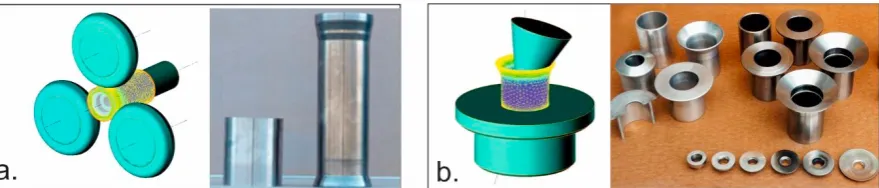
attractive as a means of eliminating the need for trial and error. These processes are promising but under exploited. Several specific methods fall into this category, with some examples shown in the Figure 1. Despite the fact that material thickness is small in the cases shown the stress-strain state of the material during the process is significantly triaxial. This generates different mechanics of the process and also rules out modelling the material as a sheet.
[image:2.544.60.500.228.322.2]Incremental bulk processes have many benefits. The contact zone between the forming tool and material is very limited. This reduces loads providing the ability to deform even high strength materials at room temperature and large parts with relatively small machines. All incremental processes are also highly flexible. In addition to the ability to obtain various geometries with the same set of tools, they provide the potential to tailor processing conditions to the specific material in question. This helps to obtain deformations far beyond tensile limits. In combination these beneficial attributes mean that comparatively low cost equipment can, in principle, be used across a broad range of materials and geometry. Figure 1 shows some example parts formed via flow and rotary forming processes. These parts have various levels of the accumulated plastic deformation from 50 to more than 300% with the tensile ductility of the material of about 10-12% (sometimes even less).
Figure 1. The example of the parts made at room temperature by a) flow forming, high strength steel, tensile ductility 12%, final effective strains >200%; b)rotary forming, various materials (steels, aluminum and nickel alloys), max strains about 60-90%.
These processes are however rather complex in terms of their process physics, control, and incrementally evolving nature. Perhaps for this reason they remain niche and under-exploited, despite their inherent benefits. This is essentially because many alternative techniques have become increasingly predictable and controllable. Incremental rotary processes have become less favoured because process design is relatively too difficult, time consuming, and unreliable. There are a number of reasons for this, but perhaps most generic is the underlying instability and complex material evolution that characterises these processes makes predictive modelling and interpretation of results difficult.
This unique combination of complexity and flexibility makes this family processes potentially excellent candidates for implementation of robotisation and digital manufacturing. Closed loop control could help to decide the optimal location of the forming tools and provide the basis for in situ adjustment to eliminate the risk of failure and obtain the best possible utilization of capabilities of material and process. However, today’s situation with rotary processes remains some way from this future state. Before the end-goal of feedback control can be considered there are essential steps to be taken in providing a systematic basis for process design and control. But the current state of process knowledge means that even the majority of process design is based on experience, and trial and error, rather than on systematic analysis. This paper tries to summarise some experience in the modelling and design of rotary processes to understand key problems and find a route to improvements.
2. Experimental trials and modelling
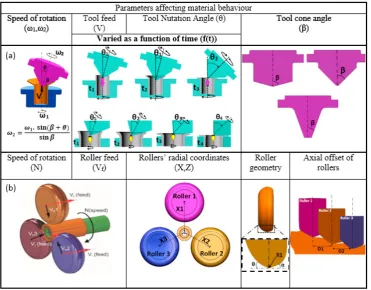
All the experimental results used in this paper are taken from the various trials performed on two state of the art rotary machines at the University of Strathclyde’s Advanced Forming Research Centre (AFRC). Flow forming was done with the WF STR 600-3/6 flow forming machine (principle scheme shown in the Fig. 1a), and rotary forging with a bespoke rotary forging machine specially designed and built by MJC Engineering Ltd. The MJC machine is a spin nutation rotary forge with a maximum capacity of 200T. The nutation angle can be adjusted between 0° – 45° with the capability to apply the maximum load at any point across this range, and with the ability to adjust the angle during the process (principle scheme shown in the Fig. 2a). Overall this is a unique range of capabilities.
2360 O.I.Bylya/ Procedia Engineering 00 (2017) 000O.I. Bylya et al. / Procedia Engineering 207 (2017) 2358–2363–000 3
[image:3.544.86.458.107.397.2]extrapolation was calibrated by analysis of the properties of the deformed material. The results of the simulation were validated using comparison with non-contact dimensional inspection of the geometry of the formed parts via the GOM Atos TripleScan III and records of the loads.
Figure 2. Controlling capabilities of two incremental bulk forming processes: a) rotary forging and b) flow forming.
3. Process modelling and process mechanics
One of the main problems with the utilisation of the process modelling in the development of the complicated metal forming processes is the role which is assigned to it, and the fact that this role can be established without suitable consideration of current limitations. In many cases today, substantial, and very worthy efforts are made to provide more and more detailed models. Such apparent sophistication and visually convincing representation of the manufacturing system can have the undesired consequence that it clouds recognition that models remain approximate due to the natural uncertainty of many boundary conditions as well as material behaviour. This can render modelling effort useless unless it is accompanied by clear thinking on the foundational purpose of the model, and the targeted approach to analysis and interpretation, in the light of this purpose. The alternative, and preferred approach is that modelling should be based on the deep understanding of the process mechanics. This provides the ability to use deliberate compromises, rather than to work around less well understood compromises resulting from default setting. Clear understanding of the kind of model outputs (and necessary level of accuracy) needed for correct selection of process parameters underpins decision making on suitable model simplifications.
3.1. Rotary Forging
extrapolation was calibrated by analysis of the properties of the deformed material. The results of the simulation were validated using comparison with non-contact dimensional inspection of the geometry of the formed parts via the GOM Atos TripleScan III and records of the loads.
Figure 2. Controlling capabilities of two incremental bulk forming processes: a) rotary forging and b) flow forming.
3. Process modelling and process mechanics
One of the main problems with the utilisation of the process modelling in the development of the complicated metal forming processes is the role which is assigned to it, and the fact that this role can be established without suitable consideration of current limitations. In many cases today, substantial, and very worthy efforts are made to provide more and more detailed models. Such apparent sophistication and visually convincing representation of the manufacturing system can have the undesired consequence that it clouds recognition that models remain approximate due to the natural uncertainty of many boundary conditions as well as material behaviour. This can render modelling effort useless unless it is accompanied by clear thinking on the foundational purpose of the model, and the targeted approach to analysis and interpretation, in the light of this purpose. The alternative, and preferred approach is that modelling should be based on the deep understanding of the process mechanics. This provides the ability to use deliberate compromises, rather than to work around less well understood compromises resulting from default setting. Clear understanding of the kind of model outputs (and necessary level of accuracy) needed for correct selection of process parameters underpins decision making on suitable model simplifications.
3.1. Rotary Forging
The main capabilities of process control for rotary forging are shown in the Fig.2. It is easy to see that the process is very flexible and the most exciting part of it is the interplay between simultaneous change of nutation angle and feed, achieving very complex motion of the forming tool. At the same time, it is easy to see from the same figure that the effect of these process parameters on the quality of the forming and the chance of failure is absolutely not evident. Detailed analysis of the mechanics of the rotary forming [6,7] have shown that loading of material during the process is significantly complex (non-uniaxial) with the elements of cyclic nature. This understanding informs the
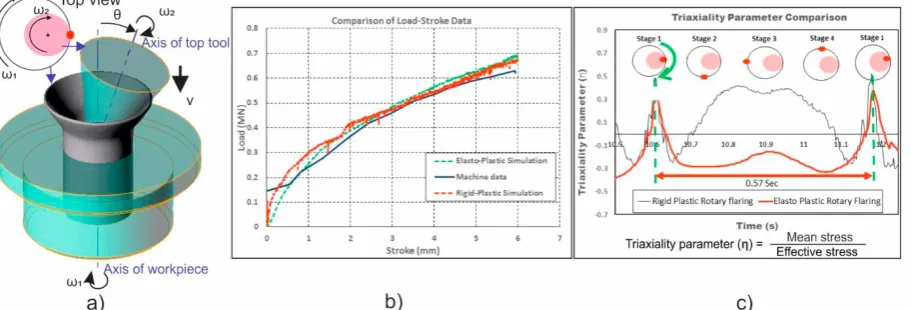
[image:4.544.48.504.191.346.2]important output parameters (i.e., Triaxiality Factor, Lode-Nadai parameter, strain trajectory) which are additional to standard FE outputs. This in-turn immediately indicates inapplicability of some common modelling simplifications, notably the rigid-plastic (RP) model, as illustrated in Figure 3. While estimation of machine load gives good agreement in both models, (Fig.3b), the triaxiality state obtained with the rigid-plastic simulation deviates significantly and illustrates the poor prediction of state variables (Fig.3c). This clearly shows a not very evident fact. FE simulation using RP model does not simply neglect elastic deformations; in many cases of complex loading, it wrongly predicts the distribution and values of stress components as well. Another crucial shortfall of the RP model is its inability to describe unloading. Being not a big loss for the monotonic processes, it becomes critical in cyclic processes. One of the main mechanisms of avoiding flow localization in the incremental processes is based on the interplay of loading and unloading of different parts of the workpiece. Some example of this will be shown further in the Fig. 5a.
Figure 3. Importance of the accounting elastic deformation during FE modelling: a) scheme of the process; b) effect of the model on the prediction of the machine load; c) the effect of the model on the prediction of the triaxiality factor.
3.2. Flow Forming
[image:4.544.57.505.453.534.2]Flow Forming is also very flexible, but has even more control parameters than the rotary forming (Fig.2b). It is also much more sensitive to correct process design. Deviation from the optimal forming strategy can lead to failures of various types. Analysis of the mechanics of flow forming [2, 8-10] has shown that it is most stable and provides highest levels of uniform plastic strain without fracture when the deformation scheme shown in the Fig 4a is provided.
Figure 4. Observations on the mechanics of the flow forming: a) optimal deformation of the high strain hardening material b) deformation of the low hardening ductile material, c) tensile stresses leading to the chevron cracks.
However, the process is very complicated and the linkage between process parameters and the influences on the material flow and triaxiality of the deformed state is still an open question. Unfortunately FE simulation of this process are extremely computationally expensive (especially taking into account the fact that the real process normally has 2-3 passes). This means that selection of suitable simplifications is essential.
4. Simplification of modelling
2362 O.I.Bylya/ Procedia Engineering 00 (2017) 000O.I. Bylya et al. / Procedia Engineering 207 (2017) 2358–2363–000 5
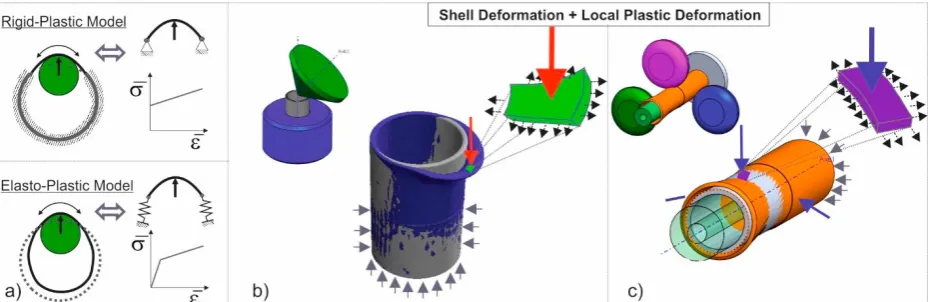
to development of new defects. Figure 5a attempts to give some simplified qualitative illustration of this. Historically, kinematic loading (and all incremental processes are kinematic controlled) was named “hard loading” as it leaves almost no freedom for the material for any accommodation (Fig.5a – top). The main benefit of the incremental processes is that elastic deformation of the preform (taking place in the total volume of the part which is much bigger than the local contact spot) helps to dampen the load, as is shown in the bottom of scheme in Fig.5b. This (when correctly utilized) helps to avoid localized failures. Therefore, it seems that one of the most important steps in the understanding of these processes should be not simply accounting of the elastic deformations, but investigation of the interplay between elastic deformation of the thick walled shell and local plastic deformation of the 3D element with the elastic support, similar ideas were suggested by Polybank and Allwood in the mandrel-free spinning [11]. The principle scheme of this approach is shown in the Figure 5b&c.
Figure 5. (a) Schematic illustrating the difference between the mechanics under Rigid-plastic and Elasto-plastic model formulation. The principle scheme of the splitting the model of incremental bulk metal forming processes into the problem of elastic deformation of the thick-walled shell and local plastic deformation for b) rotary and c) flow forming.
[image:5.544.40.506.195.346.2]The main benefit of this scheme is that the sequence of the elastic states can be in principle solved analytically, albeit subject to simplifying assumptions. Then the results of the elastic solution can be used as boundary conditions for the problem of local plastic deformation. Besides reducing the total computational time, this will allow detection of those combinations of elastically deformed state and local impact which drive the greatest likelihood of component failure.
to development of new defects. Figure 5a attempts to give some simplified qualitative illustration of this. Historically, kinematic loading (and all incremental processes are kinematic controlled) was named “hard loading” as it leaves almost no freedom for the material for any accommodation (Fig.5a – top). The main benefit of the incremental processes is that elastic deformation of the preform (taking place in the total volume of the part which is much bigger than the local contact spot) helps to dampen the load, as is shown in the bottom of scheme in Fig.5b. This (when correctly utilized) helps to avoid localized failures. Therefore, it seems that one of the most important steps in the understanding of these processes should be not simply accounting of the elastic deformations, but investigation of the interplay between elastic deformation of the thick walled shell and local plastic deformation of the 3D element with the elastic support, similar ideas were suggested by Polybank and Allwood in the mandrel-free spinning [11]. The principle scheme of this approach is shown in the Figure 5b&c.
Figure 5. (a) Schematic illustrating the difference between the mechanics under Rigid-plastic and Elasto-plastic model formulation. The principle scheme of the splitting the model of incremental bulk metal forming processes into the problem of elastic deformation of the thick-walled shell and local plastic deformation for b) rotary and c) flow forming.
The main benefit of this scheme is that the sequence of the elastic states can be in principle solved analytically, albeit subject to simplifying assumptions. Then the results of the elastic solution can be used as boundary conditions for the problem of local plastic deformation. Besides reducing the total computational time, this will allow detection of those combinations of elastically deformed state and local impact which drive the greatest likelihood of component failure.
Figure 6. The possible 2D models of the flow forming process: a) wrong model which has lost the incremental nature of the process; b) incremental model for the axial plane; c) incremental model for the transverse plane.
Another rather evident simplification approach is to substitute the 3D model with one or few 2D models. Based on the knowledge that the triaxiality state of the deformed part plays the critical role in these processes this approach requires careful consideration. For example, the simple 2D model with rollers moving continuously along the workpiece (Fig.6a) represents extrusion rather than flow forming. Nevertheless some alternative 2D models can be suggested (Fig 6 b &c). Although they definitely compromise some aspects of the real process, they can be useful in understanding the role of different process parameters. These simulations are especially important in understanding what happens during the second or third forming pass when material of the preform is no longer uniform (its surface is highly hardened while the layer near the mandrel remains almost undeformed).
The examples presented here argue in favour of the general view that simulation of complex incremental processes can play a key role in process design, but only when the models and their underlying simplifications are suitably thought through. The underlying point is that there is a basic need to build models based on clear objectives, and based on a deep fundamental understanding of process mechanics, and of the fundamental limitations of simulation technology. Understanding and considered selection of compromises is central to worthwhile decision making based on process models and there are highly beneficial lessons to be learned from returning to some earlier thinking on process mechanics which predate usable finite element systems.
Conclusions
This paper provides arguments against the trend towards developing complex models to simulate without a clear understanding of the process and proper stating the problem, which has to be solved.
Herein, two incremental bulk deformation processes of rotary forging and flow forming are taken as case studies, as they are excellent examples of complex processes that pose real challenges for both practical process optimization as well as modelling as a supporting tool.
Two specific features of the investigated processes which looks to the authors to be of the first order of importance are following: (i) the loading is significantly traixial and non-monotonous; (ii).elastic deformation in the part plays a crucial role as it determines the mechanics of the whole process. Any attempts towards model simplification should take into account these crucial aspects. This does not
mean that they cannot be sacrificed at all (in many cases it may be unavoidable), but careful assessment of the results of such sacrifice is very important.
Acknowledgements
The work described herein was carried out at the Advanced Forming Research Centre and funded by the University of Strathclyde. The AFRC is a member of the UK High Value Manufacturing Catapult.
References
[1] P P. Groche, D. Fritsche, E.A. Tekkaya, J.M. Allwood, G.Hirt, R.Neugebauer, Incremental bulk metal forming, CIRP Annals-Manufacturing Technology 56(2) (2007) 635–656.
[2] C.C ,Wong, T.A. Dean, J. Lin, A review of spinning, shear forming and flow forming processes, Int. J. Mach. Tool Manu. 43(14) (2003) 1419– 1435.
[3] J. L. Chenot, M. Bernacki, P.O. Bouchard, L. Fourment, E. Hachem, E. Perchat, Recent and future developments in finite element metal forming simulation, Proc. 11th International Conference on Technology of Plasticity, ICTP (2014) 19–24.
[4] H.J. Marczinski, Axial closed-die rolling, an economic hot-forming method due to high precision and flexibility, J Mater. Process. Tech. 34 (1992) 495–502.
[5] P.M. Standring, Characteristics of rotary forging as an advanced manufacturing tool, P. I. Mech. Eng. 935–945.
[6] S.Tamang, O.Bylya, M.Ward, M.Tuffs, S.Halliday, X.Luo, Comparison between rotary and conventional flaring processes. Submitted for publication in 20th International ESAFORM Conference on Material Forming, AIP conference proceedings.
[7] B. Krishnamurthy, O.I. Bylya, L.Muir, A.Conway, P. Blackwell, On the specifics of modelling of rotary forging processes, Computer Methods in Materials Science (2016) 22–29.
[8] S. Kalpakjian, S.Rajgopal, Spinning of Tubes, Journal of Applied Metal Working, 2(3) (1982) 211–233.
[9] M.J. Roy, R.J. Klassen, J.T. Wood, Evolution of plastic strain during a flow forming process, J Mater. Process. Tech 209 (2009) 1018–1025. [10]O.I Bylya, P. Blackwell, T. Khismatullin, R. A. Vasin, The Effect of Elasto-Plastic Properties of Materials on their Formability by Flow
Forming, Manuscript submitted for publication, J Mater. Process. Tech., (2017).