0022-538X/86/020629-09$02.00/0
Copyright © 1986, American SocietyforMicrobiology
The
Terminal
a
Sequence
of
the Herpes
Simplex
Virus
Genome
Contains
the Promoter of
a
Gene Located in the Repeat
Sequences
of the L
Component
JOANY CHOU AND BERNARD ROIZMAN*
The MarjorieB. Kovler Viral Oncology Laboratories, The University of Chicago, Chicago, Illinois 60637 Received 27 August1985/Accepted 25 October 1985
Theherpes simplex virus DNAgenomeconsists of twocovalently linkedcomponents,L and S. Theunique sequences of the L component are flanked by 9-kilobase-pair inverted repeat sequences ab andb'a', whereas thoseof the S component are flanked by
6.5-kilobase-pair
invertedrepeat sequences c a' and ca. We report that the500-base-pair a sequence contains thepromoter-regulatorydomainand thetranscriptioninitiation site of adiploid gene, the codingsequences
of which arelocated in the b sequences of theinverted repeats of the L component. The chimeric gene constructed by fusion of the a sequence to thecoding sequences of thethymidine kinase gene andrecombined into the viral genome was regulated as a-ylgene. The size of the proteinpredicted from its sequence is 358 amino acids; it wasdesignated as infected cellprotein (ICP) 34.5. Thus,the inverted repeats flanking the unique sequences of the Lcomponent contain two genes specifyingICP0 and ICP34.5, respectively. Moreover, in addition to the cis-acting sites for the inversion ofLandScomponents relative to eachother, for cleavage of unitlength DNA molecules from head-to-tail concatemers, and for packaging of the DNA into capsids, the a sequencealso contains the promoter-regulatory domain and transcription initiation sites of agene.Theherpessimplex virustype 1(HSV-1)genome, alinear double-stranded DNAof 150 kilobase pairs (kbp; 14) con-sists oftwocomponents, Land S. Eachcomponentconsists ofuniquesequences, U1 andUs, flankedby invertedrepeats (29).The invertedrepeatsofthe Lcomponent, designatedas ab andb'a',areeachapproximately9kbp,whereasthoseof the S component, c'a' and ca, are each approximately 6.5 kbp (36). An unusualpropertyoftheHSV-1genomeisthat the Land Scomponents caninvertsuch that DNA extracted from infected cells or virions consists of four equimolar
populations
differing solelyintheorientation ofthe LandS componentsrelativetoeachother(10).
Earlierstudies
have shown that the sequence shared by the inverted repeats of the L and Scomponents,designatedthe a sequence (36)and located in thesameorientationat thetermini ofthe DNAand inaninvertedorientationatthejunction betweenthe Land Scomponents,isthecis-acting sitefor the inversion ofthe L and Scomponents (6,24-26,31),cleavageofthe DNAfrom head-to-tailconcatemers, andpackaging of unit-lengthDNA (35). We report here that the a sequence contains the promoter-regulatory sequence and the transcription initia-tionsites foragenelocatedin thebsequenceoftheinverted repeats of the L component. Relevant to the results de-scribed in thisreport are thefollowing.The a sequenceofthe HSV-1strainF[HSV-1(F)] consists of several elements. Starting from the inverted repeat b' sequenceofthe L component tothe invertedc'sequenceof theS component (seeFig. 1A), these elements consistof a terminal 20-base-pair (bp) direct repeat (DR) designated DRlb, a 58-bp unique sequence (Ub), a 12-bp DR (DR2) repeated 19 to 22times, a 37-bp DR (DR4) repeated two to threetimes,a65-bp unique sequence
(UJ),
and theterminal 20-bpDRlc(25,26). Onlyasinglecopy of the asequence is present at the S component terminus of the DNA, but one to more than five directly repeated copies of the a sequence*Corresponding author.
may be present at the L component terminus and at the junctionbetweentheLand Scomponents (16,38). Directly repeatedcopies ofthe asequenceshare theinterveningDR1 (25, 26).
The HSV-1 genes form three groups, the expression of whichis coordinately regulated andsequentially orderedin a cascade fashion(11, 12).The a genes areexpressedfirst, and functionala-geneproductsarerequired fortheexpressionof ,1 genes. The
products
of c genes shut off a-geneexpression
and turn on theexpression of-y genes. The -yproteins, mostly structural components ofthevirion, turnofftheexpression of ,B genes. At least one y protein designated as an a trans-inducing factor and introduced into cells during infec-tionhasrecentlybeenshowntoinducea-genetranscription (1,5, 15, 17-19,27a, 28).The-y genes areheterogeneous; the
lYl
geneexpression
is reduced butnotabolishedby
inhibitors ofDNAsynthesis,
whereas the expression of Y2 genes is stringentlydependentonviralDNAsynthesis (7, 11,30,37). To facilitate analyses and identification of the regulatory groups to which aspecific genebelongs, we introduced the technique offusing the promoter-regulatory domain ofthe specific gene to coding sequences of the thymidine kinase (TK) gene, a fi gene (28). The chimeric gene can be intro-duced into the viral genome by recombination through homologous flanking sequences orintothe cellular genome by transfection and selection of transformed cells thatcarry a suitable marker. The regulation of the chimeric TKgene canbe studiedincellsinfected withtherecombinant virusor by infection of the cells that carry the chimeric gene with TK- virus underappropriate conditions.MATERIALS ANDMETHODS
Cellsandviruses.HSV-1(F)is theprototype HSV-1 strain used in this laboratory (9). Rabbit skin cells, originally obtained fromJ. McLaren,were usedfor transfection with viral DNAs. Theselection forTK+ recombinants was done in human 143TK-
cells
overlaid with HAT medium(8.0puM
629on November 10, 2019 by guest
http://jvi.asm.org/
thymidine, 0.1 mM hypoxanthine, 0.44 ,uM methotrexate). Recombinant virus stocks were prepared, and titers were determined in Vero cells.
Transformationof 143TK- cells with the pSV2-neo vector and its derivatives was done as described previously (32), andthe selection was donein thepresence oftheantibiotic G418 (400 ,ug/ml; GIBCO Laboratories, Grand Island, N.Y.).
Enzymes and cloning. Restrictionenzymes wereobtained from Bethesda Research Laboratories, Inc., Gaithersburg, Md.; Pharmacia Fine Chemicals, Piscataway, N.J.;and New England Biolabs, Inc., Beverly, Mass., and were used accordingtotheinstructions of the suppliers.T4DNAligase and calf intestinal alkaline phosphatase were from Boehr-ingerMannheim Biochemicals, Indianapolis, Ind. After liga-tion, plasmidDNAs weretransformed into Escherichiacoli c600 cells. pSV2-neo vector was obtained from P. Berg, Stanford University. pUC9 and pUC13 vectors and their host JM83 (34) were obtained from J. Messing through Bethesda Research Laboratories. The construction of the plasmids relevanttothese studies is describedwhere appro-priate.
Preparation of probes and hybridizations. Fordetection of mRNAtheplasmid containingtheprobeDNA describedin Resultswasnicktranslatedwith
32p
withtheaidofakitfrom New England Nuclear Corp. (Boston, Mass.) by the speci-fications of the manufacturer. Thepreparation
andlabeling
of the probe for S1 nuclease analyses is also described in Results.
RNA studies. Cytoplasmic RNA extracted from infected Vero cells with 20 PFU ofHSV-1(F) per cell asdescribed previously (13) was electrophoretically separated in an agarosegel, transferredto anitrocellulosesheet,and
hybrid-ized to 100,000 to 500,000 cpm of nick-translated DNA probe. Poly(A)+ RNA was purified by oligo(dT) cellulose chromatography by the procedure of Jenkins and Howett (13). For
Si
nuclease analyses, 150jig
ofcytoplasmic
RNA extracted as described above washybridized
with a DNA probe labeled at one end as described below. The DNA-RNA hybrid was subjected toSi
nucleasedigestion
and electrophoresis along withasequencing
ladderofthe DNA fragmentusedin thishybridization, asdescribedpreviously
(13).
DNA sequencing analysis. The nucleotide sequence of HSV-1(F) gene 34.5 was determined
by
the method of Maxamand Gilbert(20).32p
was obtained from ICN Phar-maceuticals Inc.,Irvine, Calif.T4polynucleotide
kinasewaspurchased from New England Biolabs.
Chemically
treated fragments were subjected toelectrophoresis
on an 8%se-quencing gel.
Assay for TK activity. HSV-1(F)A305 virus contains a
700-bp deletionintheTKgene(28). The
procedures
forthe assay ofTK activity with[3H]thymidine (specific
activity,
71.2 Ci/mmol; New England Nuclear) were as described previously (28).
RESULTS
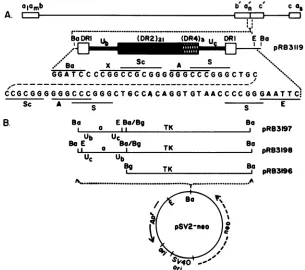
HSV-1 terminal a sequence acts as a promoter-regulatory sequence for expression of HSV-1 genes. Thestructureof the constructs made to test the ability of the a sequence to
function as a promoter-regulator for
expression
of the HSV-1 TK gene is shown in Fig. 1. The key constructpRB3119 (6) contained a BamHI fragment that carried an
intacta sequence flankedby thesequence GGATCCCCGG attheDRlb terminus and the sequenceCACAGGTGTAAC CCCGGAATTCCCCGGATCC at the DRlc terminus. The
purposeofthe EcoRI
cleavage
site outside the a sequence butadjacenttoDRlcwastopermit rapid
identification ofthe relative orientation ofthe a sequence. This construct wasused intwo series of
experiments.
In the first series of
experiments,
the BamHIfragment
frompBR3119 was fused in both orientations to the
BglII-BamHI
subfragment
oftheBamHIQ fragment
ofHSV-1(F).
The
BglII-BamHI
subfragment
ofBamHI-Q
containsa por-tion ofthe5'-transcribednoncoding
andcoding
domainsof the TK genes,extending
downstreamfrom nucleotide +50attheBglII site (21,
28).
Thethreeconstructs showninFig.
1 were cloned into the BamHI site ofthepSV2-neo
plasmid
(32). The
plasmids carrying
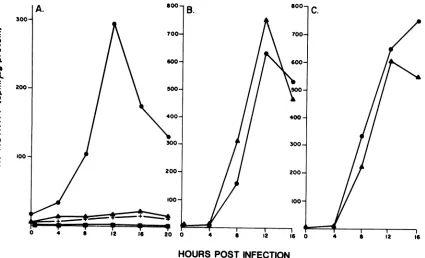
the chimeric a sequence-TK (a-TK)geneswerethenusedtotransform LTK- cellsfrom G418 resistance. Theresulting
G418-resistantcelllineswerethen infected with the mutant
HSV-1(F)A305
containing
a700-bp
deletion in thecoding
sequencesofthe TK gene(28),
and the cell
lysates
were tested for TKactivity.
HSV-1(F)A305
virus induced the resident a-TK inpRB3198
butnottheresidentTK geneintroduced intothe LTK-cellsas
pRB3197
orpRB3196
(Fig. 2A).
Aswould beexpected,
the cells transformedby
the vectorplasmid pSV2-neo
lacked TKactivity. The
induced residentTK genewasfusedtothea sequence oriented such that the DR1 nearest to the b sequence
(DRlb)
wasadjacent
tothe5'-transcribednoncod-ing
domainof
the TK gene. The noninducedTKconstructs eitherhadno asequence inserted(pRB3196)
or werefused such that the DRlc wasadjacent
to the 5'-transcribednoncoding
domainof the TKgene.Inthesecondseries of
experiments,
the BamHIfragment
from
pRB3119
containing
theintactasequencewasinserted into theBglII
site of theBamHIQ fragment
inanorientation such that DRlb wasadjacent
to the5'-noncoding and
-coding
domains of the TK gene. Theresulting
construct(pRB3198)
was cotransfected with intactHSV-1(F)A305
DNA into rabbit skin
cells,
andTK+
virus progeny wasselected and checked for the presence of the intact a
sequence insert
by
BamHIdigestion.
The recombinantse-lected for these studies
(R3383)
has been describedprevi-ously (6).
Specifically,
aphenotypic
propertyofthisrecom-binant is thatthe a sequence insertion mediates additional inversionswithin the genome oftherecombinant.
Figure
2Band C show thetemporal
patternsofexpression
ofthe TK genesofwild-type [HSV-1(F)]
and ofrecombinant virusR3383,
respectively,
in 143TK-cells in the presence and absence ofphosphonoacetate (250
,ug/ml
ofmedium),
which is a potent inhibitor of HSV DNA
synthesis.
The resultsindicate
that thetemporal
patterns ofexpression
of the natural,TK
gene resident inwild-type
virus and the chimerica-TK generesidentin the R3383recombinantvirusare
similar,
exceptthat the TKactivity
ofR3383continuesto increaseaslateas16hpostinfection.
However,
whereas theinduction
oftheexpression
of the a-TK chimeric gene wasslightly
reduced in the presence ofphosphonoacetate,
thatof theITK
genewasactually
increased in thepresence
ofthedrug.
Theslight
decrease inactivity
in the presence of inhibitors of DNAsynthesis
is characteristic of andopera-tionally
defines the geneasbelonging
tothe-Yl
group.Results of theseexperiments
suggest that thea sequencecontainsapromoter-regulatory
sequence andatranscription
initiation site locatedator neartheDRlb
terminus and therefore thata gene
compatible
with-Yl regulation
is located near the asequence in the b inverted repeat sequence
flanking
theunique
sequences of the L component.Mappingof
transcripts
anddemonstration oftranscription
initiation sites in theasequenceby
S1
nucleaseanalysis.
Twoon November 10, 2019 by guest
http://jvi.asm.org/
alamb
A.
=-b
J.an
cIf can C
IIH
:DRIDRI CDR2)ai (D5uDI 'E Ba
Ub pRB3119
/Ba X SC A _ _
GGATCCCCGGCCGCGGGGGGCCCGGGCTGC
CCGCGG G G G GCCC G G G CT 6CCACAG GT GT AAC CCC GG GA AT T C'
SC A E
B. Ba EB/Bg
I a ..
Ub Uc
Be E BO/Bg
I1 0 I
Uc Ub
Ba TK
Ba TK
TK
pRB3197 pRB3198 Ba
I pRB3I96
0o,,
FIG. 1. Sequence arrangements and plasmid constructions. (A) Schematic diagram ofthesequence arrangement in the HSV-1 genomeand inthe a sequence cloned asaBamHIfragment.a,anda,referto theterminalasequence of theLand S components,respectively.The boxes onthe topline represent the reiterated sequences (a,b, and c) flankingtheunique sequences represented byaline. Subscriptnrepresents
one or moreadditional a sequences, andsubscript m represents zero togreater than five additionala sequences. b and c arereiterated sequences that appearbothatthe genometermini and thejunctionregion of theLand S components. Thesecond line showsaschematic representation of the sequencearrangementofthe BamHIfragmentcloned aspRB3119. DR1, Ub,DR2, DR4, andUcarecomponentsof the
a sequencedescribed in the text. Thethird line represents the sequence atthe termini ofthe construct shown in line2; thedashedline represents theremainder of theasequence. Notshownarethe nine bases between theEcoRI and BamHl sitesattheright terminus of the
construct.The dashed line represents theasequence.Abbreviations: X, XmaIII; Sc,SacIl;A,ApaI;S,SmaI;E, EcoRI. (B) Construction of recombinant pSV2-neo plasmids containing the BamHI DNA fragment carrying the a sequence fused in both orientations to the BgIII-BamHIfragment carrying the5'-transcribed noncoding andthecoding sequencesofthqTKgene.Theorientation of theasequence in pRB3197 and pRB3198 was determined by theEcoRIcleavage site markeratthecterminus of theasequence. pRB3196carriedaninsert that lacked the a sequence. Except for the orientation and the absence of the a sequence in pRB3196, all inserts into pSV2-neo vector were isogenic. Abbreviations: Bg,BglII;Ba,BamHI;E,EcoRI.
series ofexperiments were done. The purpose of the first was to determine whether RNA homologous to the reiter-ated b sequences immediately adjacent to the a sequence was presentin infected cells. Experiments involving hybrid-izationof electrophoretically separated RNAtransferred to nitrocellulose sheets with the
32P-labeled
BstEII-SacI subfragment ofthe BamHISfragment (Fig. 3C)revealed the presence of three poly(A)+ RNAs containing sequences homologoustothe labeled DNA probe (Fig. 4). Of the three, two species of 1.3 and 5.2 kilobases (kb) accumulated uniquelyininfectedcells, whereas the third species of 3.2 kb was presentin both infected and uninfected cells (Fig. 4B). It isnoteworthythat theintensity ofthe host RNAspeciesthat hybridized with the viral DNA probe was higher in the infected than in the uninfected cells; this may reflect the extent of purification ofthe poly(A)+ RNA rather than an absolute increase in host mRNAafterinfection.Theobjective ofthe second series ofexperiments was to map the transcription-initiation sites of viral RNA homolo-goustothe DNAinthisregion ofthe HSV-1 genome. In this experiment, pRB143 plasmid DNA (26) carrying the L component terminal BamHI S fragment was cleaved with NcoI and BamHI (Fig. 3C) and 5' end labeled. The
NcoI-BamHI terminal fragment was purified and cleaved with AvaII.The AvaII site islocated in the
Uc
sequenceof thea sequence,whereas the NcoI site islocated in the b-reiterated sequence100bp from the DRlb terminus of thea sequence (Fig. 3B). The fragment was denatured and hybridized to total cytoplasmic RNA extracted from Vero cells at 13 h postinfection with HSV-1(F). The DNA protected from digestionwith Si nucleasewassubjectedtoelectrophoresis undersequencing conditions, as was a sample of the undi-gested hybrid and a sequencing ladder of the NcoI-AvaII fragment usedin theprotection experiment. Twofragments differing by14 nucleotideswereprotected fromSi nuclease digestion (Fig. 5).The results of thisexperiment indicatethat the RNA that accumulatedinthecytoplasm of infected cells is homologous to sequences located at the DRlb and Ub sequencesofthe inverted repeats of the L component. The larger protected DNA fragment (fragment 1) mapped the transcription initiation site inUb, whereas the smallerfrag-ment(fragment2)mappedit inDRlb. Wenotedatthispoint that sequenceanalysesfailedtoshowinvertedrepeatswhich could account for the presence of two DNA fragments protected fromSi nucleasedigestion, asis the casefor the transcriptioninitiation site of the a27 gene (18).
agI
on November 10, 2019 by guest
http://jvi.asm.org/
[image:3.612.152.457.74.344.2]Z
~~~~~~~~~~700-
700-0
CI. 600-
600-E 200- 500 50
0.
I-
4~~~~~~~~~~~00-
400C. 300
300-100
200-
200-~~~~~ 00~~~~10
100-0 4 a 12 16 20 0 4 a 12 16 0 4
la
12 ISHOURS POST INFECTION
FIG. 2. TK activity per microgram of protein as a function of time for postinfection or mock infection. (A) Enzymeactivityin LTK- cell lines converted to resistance to G418 by transfection with the pSV2-neo plasmid carrying the inserts shown in Fig. 1 and infected with 10 PFU ofHSV-1(F)A305 percell. The cell lines were designated according to the plasmid with which they were transfected, i.e.,L3197, L3198, L3196, andLSV2-neo (converted to resistance to G418 with the pSV2-neo plasmid vector). Cytoplasmic extracts were assayed for TK activity
at0,4, 8, 12, 16, and 20 h postinfection. Symbols: 0, L3198 cells; A, L3197 cells; +,L3196 cells; U LSV2 cells. (B) Enzyme activity in 143TK-cells infected with 5 PFU of HSV-1(F) per cell in the presence (A) or absence (0) of phosphonoacetate (250 p.g/ml of medium; Abbott Laboratories, North Chicago, Ill.). (C) Enzyme activity in 143TK- cells infected with5 PFU of recombinant virus R3383 per cell in the presence (A) or absence (A) ofphosphonoacetate (250 ,ug/ml of medium). R3383 carries an a sequence in the BglII site of the TK gene in such orientationthatUbof theasequence is proximal to the TK structural gene.
Sequence of the putative generegulated by the
promoter-regulatory domain of theasequence. Earlier,this laboratory
reported thenucleotidesequencesof theasequence(25)and
thetranscription initiation site and thepromoter-regulatory domain of the otO gene (19) located in its entirety in the b-reiteratedsequenceflanking theuniquesequencesof the L
componentofHSV-1(F) DNA. In this studywe sequenced
the domain of the b sequence located between the a
se-quenceand the aOgene.Thesequencingstrategyis shown in Fig. 3, and the fragments generated by this scheme were
sequenced by the method of Maxam and Gilbert (20). Both strandsweresequenced in each direction, andmostdomains
weresequencedmorethanonce.Codonusageanalyseswere
donetoassist inensuring that theopenreading frameswere
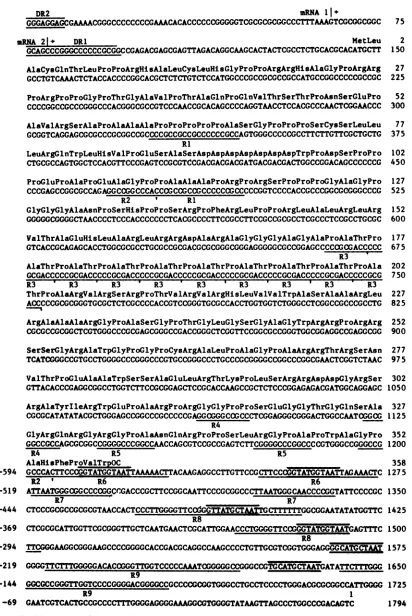
notartifactsof faultysequencing. We sequenced 1,524 bp;to
facilitateanalyses of the results, Fig. 6 shows thesequence
of1,794 bp, i.e., from the last DR2 in the asequencetothe transcription initiation site of the aOgene.The additional 270
bp are thosedescribed by Macken and Roizman (19). The
highlights of the sequence(Fig. 6) are asfollows.
(i) The nearest sequence which remotely resembles a
TATAA box is the sequence TTTAAA located
approxi-mately 15 bpupstreamfrom the secondputative transcrip-tion initiation site. The transcription initiation site of the larger mRNA(fragment 1)maps attheend of theTlTAAA
sequence (Fig. 4 and 5).
(ii) The first reading frame contains methionine codonsat
nucleotides 1215, 1392, and 1419 andatermination codonat
nucleotide 1263. The second reading frame contains six methioninecodonsatnucleotides 191, 209, 421, 1040, 1259,
and 1280.The relevant termination codonsare atnucleotides 275 and 1223;although several termination codons precede thedomain of the aOgene, there are no methionine codons between the last relevant termination codon at nucleotide 1223 and thedomain of the acOgene. Thelargest predicted protein encoded between nucleotides 421 and 1223 would contain267aminoacids. Thethirdreading frame containsan initiation site at nucleotide 145 and termination codons at nucleotides 1219 and 1267, another methionine codon at nucleotide 1327,and atermination codonatnucleotide1366. The largest protein predicted by this reading frame is a proteinof 358 amino acids.
(iii)The significant predictive feature ofthesequence is a 9-bp sequence repeated 10 times, starting with nucleotide 664andterminatingatnucleotide 753. Thisrepeatcodes for Asp-Pro-Arg in frame 1 (although it is not preceded by a methionine codon), Arg-Pro-Proin frame 2, andPro-Ala-Thr in frame 3. A synthetic peptide consisting of the oligomer
Ala-Thr(Pro-Ala-Thr)gPro
induced in rabbits an antibody which reactedwith aninfectedcellproteinwith an apparent molecular weight of 43,500 in denaturingpolyacrylamide
gels (M.Ackermann, J.Chou,M. Sarmiento,R.Lerner, and B. Roizman, manuscript in preparation). This observation supports thehypothesisthat translationbeginsin frame 3at the first AUG codon after the transcription initiation sites andterminates atnucleotide 1219.
(iv)Theapparentmolecularweight oftheprotein (43,500) that reacted with the antibody to the synthetic peptide is larger than the molecular weight (37,054) of the protein predicted tobe encodedbyreading frame 3.This is
on November 10, 2019 by guest
http://jvi.asm.org/
[image:4.612.104.529.68.326.2]A
Lgb
blatl
Sm XSt H Ba Sa Sm BsX
I a a Ln a a* a
4-4-
-x
Bs SmA HXBsBeSnN- SmSm
I a I tI I
e
Si Probe
a ASm
. f4
loft
DR1.UujDR1%DR43- UCDR4 -- * t
** W4*
+ ~ ~ ~*lo
* 4 *
4
-I
L RNA Probe
FIG. 3. Sequencingstrategyandsequencearrangementof theHSV-1(F)genomedomain between theasequenceand the site of initiation
of theaOgenetranscription. (A)Thetopline shows the locationof thesequencedomain in the HSV-1genome. The second line showsthe
restriction endonuclease sites and the domains of thesequenced region.Abbreviations:Sm, SmaI; A, AvaIl; N, NcoI; X, XmaIII; Be, BstII; Bs, BssHII; H, Hinfl; Sa,SacI; Ba, BalI; St,StuI. TheSmaIsiteatthefarleft of themapdesignates position-270of theoaOgenedomain
reported by Mackenand Roizman(19). (B) Sequencing strategyacrosstheregionshown in line 2 ofpartA. Dotsrepresentthe end-labeled
nucleotide locationand thestartof each sequencingrun.Arrowspointinthedirection ofeachrun.The nucleotidesequencetotherightof
the BstEIIcleavage sitewasreported byMocarski and Roizman(25). (C) Thecoding regionofopenreadingframe3,the domain ofthe
NcoI-AvaIl fragment probeused in the S1 nuclease analyses, and theBstEII-SacI fragmentused to probe electrophoretically separated cytoplasmicRNA transferredtoanitrocellulose sheet.
tentwith the observation that theelectrophoretic mobility of the HSV-1proteins thatarerich inproline is that of proteins
with molecular weights 10 to 25% greaterthan those
pre-dicted from the nucleotidesequence.The size of thisprotein is consistent with and could be encoded by the 1.3-kb cytoplasmic RNA detected by hybridization (see above).
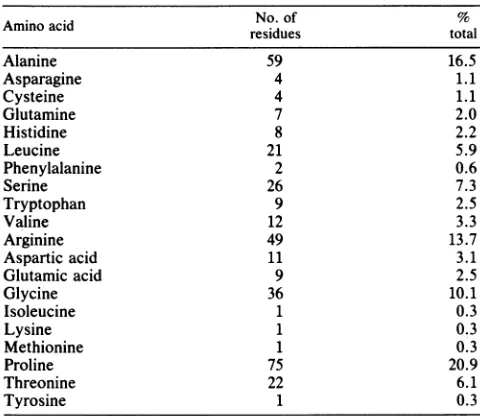
(v) The special features of the protein predicted by the third reading frame, in addition to the Pro-Ala-Thr repeat, include a run of seven aspartic acids. The amino acid
composition of the protein listed in Table 1 indicatesahigh
proline (21%), alanine (17%), and arginine (14%)contentand single methionine, isoleucine, tyrosine, andlysineresidues. (vi) The polyadenylation site available for the mRNA encoded by the third reading frame is the sequence AT-TAAA whichimmediately follows the termination codon of thepredicted sequenceof theprotein.
(vii) An interesting feature of the nucleotide sequence
shown inFig. 5 is the presence ofnumerous directrepeats within the coding sequence of the predicted protein and
downstream, between the coding sequence of this protein
and the coding sequence of the aOgene. In additionto the CCCGCGACC sequence (R3) that is repeated 10 times, the
codingsequencecontain four otherrepeats.These includea
19-bp sequence (R1) that is repeated two times, an 11-bp
sequence(R2) that is repeatedtwotimes,an 11-bpsequence
(R4) that is repeated twotimes, anda 12-bp sequence (R5)
that is repeated two times. Between the 3' terminus of the coding sequence of thisprotein and the transcription
initia-tion site of the aOgenethere arefoursequencescontaining
25 (R6), 17 (R7), 35 (R8), and 41 (R9) bp, each of which is
repeated twice. Mackem and Roizman (19) have reported that thepromoter-regulatory domain of the aOgenebetween nucleotides +1 and -330 contained three homologs of AT-rich sequencesthatwereshownto benecessaryforthe induction ofagenesby the a-trans-inducing factor (15)and
numerous GC-rich inverted repeat sequences. The nucleo-tidesequence(Fig. 6) shows thepresenceof threehomologs
of the sequenceGGTATGGTAAT which containa portion
of the AT-rich sequence. This is followed by nucleotide
sequences that represent variants ofthe AT-rich sequence
reported by Macken and Roizman (19) and Kristie and Roizman (15). The homolog GGTATGGTAAT most distal from the transcription initiation site of the aO gene is at
nucleotide -583 and overlaps with the terminus of the predicted coding sequencesof theprotein.
DISCUSSION
Results of earlier mapping studies have shown that the invertedrepeats ab and b'a' of the L componentand c'a' and ca of the S component contain the a genes 0 and 4,
respectively, in their entirety. The discovery of a new
diploidgene locatedinthe b sequenceof the Lcomponent
wasunanticipated. The following points are relevanttothe resultspresented in this study.
The finding that the a sequence contains the promoter-regulatory domainand thetranscription initiation sites ofa
gene was unexpected, inasmuch as the a sequence has already been shown to contain the cis-acting sites for the inversion of the L and S components (6, 24-26, 31) forthe
0O
B
C
a Coding Region
on November 10, 2019 by guest
http://jvi.asm.org/
[image:5.612.145.472.65.330.2]A total
polyA
m inf m inf
*a .f..
B
[image:6.612.388.492.67.485.2]total
polyA*
m inf m infFIG. 4. Images of cytoplasmic RNA from infected (inf) and mock-infected (m) cells separated by electrophoresis. (A) Photo-graphic images of ethidium bromide-stained 1.4% Formalinagarose
gel. The lanes representing total RNA each contain 8 p.g of total
cytoplasmic RNA extracted from Vero cells at 13 h post-mock infection orpost-infection with 20 PFU of HSV-1(F) percell. The prominent RNA species visualized by ethidium bromide stainingare
28S, 18S, and 5S. The lanes representing poly(A)+ RNA each contain 8 ,ug of RNA purified by chromatography on oligo(dT)
linkedtocellulose from cytoplasmicRNAfrom mock-infected and infected cells. (B) Autoradiographic image of the RNA in part A
after transfer to a nitrocellulose sheet and hybridization with the
32P-labeled BstEII-SacI DNAfragment (Fig. 3C) of pRB143. This fragment contained approximately two-thirds of the total coding
sequenceof thegeneidentified in thisstudy. Kb, kilobases.
cleavage of the unit-length HSV-1 DNA from head-to-tail
concatemersand forpackagingof the DNA intocapsids (35). Preliminary studies suggest that the promoter-regulatory domain of thegeneisin the Uband in the 12-bprepeatDR2
sequences (J. Chou and B. Roizman, manuscriptin
prepa-ration). The nucleotide sequences of these domains are
highlyconserved amonga sequencesderivedfrom different
strains of HSV-1 (8, 23, 25).
Theexistence ofabona fidegenedrivenandregulated by
apromoter-regulatory domainintheasequencerestsonthe
findingof(i) orientation-dependent cis-actingsites that
con-fer transcription initiation and inducibility to an a-TK
chi-meric gene, (ii) cytoplasmic RNAhomologous insequence
to the predicted transcribed domain of the gene, (iii)
se-quencing data indicating an open reading frame consistent withthe size of the protein detectedininfected cell lysates, and (iv) the presence in infected cell lysates ofproteins of predictedapparentmolecular weightreactive withantibody made against the Pro-Ala-Thr repeat unit predicted by the
FIG. 5. Autoradiographic image of the 32P-labeled DNA probe fragments protected from Si nuclease digestion by hybridization
withhomologousRNA from thecytoplasmof infected cells. Lanes 1through 4,DNAsequencingladderof the NcoI-Avall DNAprobe
labeledatthe NcoIsite;lane1,G; lane2,A>C;lane3, C;lane4,
C + T; lane5,DNAfragments protectedfrom S1nuclease diges-tion;lane 6, 32P-labeled DNA-RNAhybrids notdigested withS1
nuclease. In these experiments 150 ,ug ofcytoplasmic RNA
har-vested from HSV-1(F)-infectedVerocellsat13hpostinfectionwas
hybridized to a purified end-labeled NcoI-AvaII fragment from
pRB143 shown inFig. 3. The RNA-DNAhybridwasdigestedwith
S1nuclease andsubjectedtoelectrophoresis.The numbers 1and2
ontherightof thefigurerefertoDNAfragments protectedfromSi
digestion.
sequence. As noted above, the sequence TTTAAA is the nearestequivalenttoaTATAAbox and itmapsclosertothe secondputative transcriptioninitiation site than would have been predicted for a bona fide TATAA sequence. The absenceofabona fidepunctuationsequence isnotunusual
per se; itmay explain the apparent multipleinitiation sites
for the RNA. The polyadenylation signal ATTAAAoccurs
immediatelyafter the terminationcodon rather thanatsome
distancedownstream,but itssequence is theonly observed
1 2 3456
A-w
Kb
28S-
18S--3.5
-1.3 *4.-1
on November 10, 2019 by guest
http://jvi.asm.org/
[image:6.612.76.289.70.373.2]DR2 RNA I
I+
GGGAGGAGCGAAACGGGCCCCCCCCGAMCACACCCCCCGGGGGTCGCGCGCGGCCCTTTAAAGTCGCGGCGGC
75uRNA
21+
DRI MetLeu 2GCAGCCCGGGCCCCCCGCGGCCGAGACGAGCGAGTTAGACAGGCAAGCACTACTCGCCTCTGCACGCACATGCTT 150 AlaCysGlnThrLeuProProArgHisAlaLeuCysLeuHiSGlyProProArgArgHisAlaGlyProArgArg 27
GCCTGTCAAACTCTACCACCCCGGCACGCTCTCTGTCTCCATGGCCCGCCGCGCCGCCATGCCGGCCCCCGCCGC 225
ProArgProProGlyProThrGlyAlaValProThrAlaGlnProGlnValThrSerThrProAsnSerGluPro 52
CCCCGGCCGCCCGGGCCCACGGGCGCCGTCCCAACCGCACAGCCCCAGGTAACCTCCACGCCCAACTCGGAACCC 300 AlaValArgSerAlaProAlaAlaAlaProProProProProAlaSerGlyProProProSerCysSerLeuLeu 77
GCGGTCAGGAGCGCGCCCGCGGCCGCCCCGCCGCCGCCCCCCGCCAGTGGGCCCCCGCCTTCTTGTTCGCTGCTG 375 RI
LeuArgGlnTrpLeuHisValProGluSerAlaSerAspAspAspAspAspAspAspTrpProAspSerProPro 102
CTGCGCCAGTGGCTCCACGTTCCCGAGTCCGCGTCCGACGACGACGATGACGACGACTGGCCGGACAGCCCCCCG 450
ProGluProAlaProGluAlaGlyProProAlaAlaAlaProArgProArgSerProProProGlyAlaGlyPro
127 CCCGAGCCGGCGCCAGAGGCCGGCCCACCCGCCGCCGCCCCCCGCCCCCGGTCCCCACCGCCCGGCGCGGGCCCG 525R2 ' Rl
GlyGlyGlyAlaAsnProSerHisProProSerArgProPheArgLeuProProArgLeuAlaLeuArgLeuArg 152 GGGGGCGGGGCTAACCCCTCCCACCCCCCCTCACGCCCCTTCCGCCTTCCGCCGCGCCTCGCCCTCCGCCTGCGC 600 ValThrAlaGluHisLeuAlaArgLeuArgArgAspAlaArgAlaGlyGlyGlyAlaGlyAlaProAlaThrPro 177
GTCACCGCAGAGCACCTGGCGCGCCTGCGCCGCGACGCGCGGGCGGGAGGGGGCGCCGGAGCCCCCGCGACCCCC 675 R3
AlaThrProAlaThrProAlaThrProAlaThrProAlaThrProAlaThrProAlaThrProAlaThrProAla 202
GCGACCCCCGCGACCCCCGCGACCCCCGCGACCCCCGCGACCCCCGCGACCCCCGCGACCCCCGCGACCCCCGCG 750
R3 R3 R3' R3 R3 I 3 R IR 3
ThrProAlaArgValArgSerArgProThrValArgValArgHisLeuValValTrpAlaSerAlaAlaArgLeu 227
ACCCCCGCGCGGGTGCGCTCTCGCCCCACCGTCCGGGTGCGCCACCTGGTGGTCTGGGCCTCGGCCGCCCGCCTG 825
ArgAlaAlaAlaArgGlyProAlaSerGlyProThrGlyLeuGlySerGlyAlaGlyTrpArgArgProArgArg 252
CGCGCCGCGGCTCGTGGGCCCGCGAGCGGGCCGACCGGGCTCGGTTCCGGCGCCGGGTGGCGGAGGCCGAGGCGG 900
SerSerGlyArgAlaTrpGlyProGlyProCysArgAlaLeuProAlaGlyProAlaArgArgThrArgSerAsn 277 TCATCGGGCCGTGCCTGGGGCCCGGGCCCGTGCCGGGCCCTGCCCGCGGGGCCGGCCCGGCGAACTCGGTCTMC 975
ValThrProGluAlaAlaTrpSerSerAlaGluLeuArgThrLysProLeuSerArgArgAspAspGlyArgSer 302
GTTACACCCGAGGCGGCCTGGTCTTCCGCGGAGCTCCGCACCAAGCCGCTCTCCCGGAGAGACGATGGCAGGAGC 1050
ArgAlaTyrIleArgTrpGluProAlaArgProArgGlyGlyProProSerGluGlyGlyThrGlyGlnSerAla 327
CGCGCATATATACGCTGGGAGCCGGCCCGCCCCCGAGGCGGGCCGCCCTCGGAGGGCGGGACTGGCCAATOGGCG 1125 R4
GlyArgGlnArgGlyArgGlyProAlaAsnGlnArgProProSerLeuArgGlyProAlaProTrpAlaGlyPro 352
GGCCGCCAGCGCGGCCGGGGCCCGGCCAACCAGCGTCCGCCGAGTCTTCGGGGCCCGGCCCCGTGGGCCGGGCCG 1200
R4 R5 R5
AlaHisPheProValTrpOC 358
-594 GCCCACTTCCOGGTATGGTAATTAAAAACTTACAAGAGGCCTTGTTCCGCTTCCCGGTATGGTAATTAGAAACTC 1275
R2 'R6 R6
-519 ATTMTGGGCGGCCCCGGC:CGACCCGCTTCCGGCMTTCCCGCGGCCCTTAATGGGCMCCCCGGTATTCCCCGC 1350
R7 R7
-444 CTCCCGCGCCGCGCGTAACCACTCCCTTGGGGTTC MGGTTATGCTACGGATATATGGTTC 1425
R8
-369 CTCGCGCATTGGTTCGCGGGTTGCTCAATGAACTCGCATTGGAACCCTGGGGTTCCGGGTATGGTMTGAGTTTC 1500
R8
-294 TTCGGGAAGGCGGGAAGCCCCGGGGCACCGACGCAGGCCAAGCCCCTGTTGCGTCGGTGGGAGGGCATGCTAT 1575
-219
GGGGTTCTGGGGGACACCGGGTTGGTCCCCCAATCGGGGGCCGGGCCGTGCATCTTGATATTCTTTGGG
1650R9
-144 GGCGCCGGGTTGGTCCCCGGGGACGGGGCCGCCCCGCGGTGGGCCTGCCTCCCCTGGGACGCGCGGCCATTGGGG 1725
R9 1
-69
GAATCGTCACTGCCGCCCCTTTGGGGAGGGGAAAGGCGTGGGGTATMGTTAGCCCTGGCCCGACAGTC
1794FIG. 6. The nucleotidesequence of the DNA fragment from the far left DR2 shown in Fig. 3 to the transcription initiation site of the aO gene. The amino acidsequence of open reading frame 3 predicted from the nucleotide sequence is designated by the three-letter code.
Reiteratedsequences are underlined. The AT-rich homologs(consensussequenceGGTATGCTAAT)in the promoter regulatory domain of
theaO gene areindicated by heavy lines above and below the sequence.
on November 10, 2019 by guest
http://jvi.asm.org/
[image:7.612.104.516.62.678.2]TABLE 1.Amino acid composition of the protein predicted by reading frame 3
No. of %
residues total
Alanine 59 16.5
Asparagine 4 1.1
Cysteine 4 1.1
Glutamine 7 2.0
Histidine 8 2.2
Leucine 21 5.9
Phenylalanine 2 0.6
Serine 26 7.3
Tryptophan 9 2.5
Valine 12 3.3
Arginine 49 13.7
Aspartic acid 11 3.1
Glutamic acid 9 2.5
Glycine 36 10.1
Isoleucine 1 0.3
Lysine 1 0.3
Methionine 1 0.3
Proline 75 20.9
Threonine 22 6.1
Tyrosine 1 0.3
variant of the consensus AATAAA signal noted by Berget
(2) ina survey of 61 polyadenylation signals.
The smaller 1.3-kb RNA species detected only in the infected cells and homologous to the domain of the gene
demonstrated in this studyareof sufficient sizetoencode the product of the gene predicted in this study. The larger
mRNA is of sufficient size to represent a readthrough
terminating at the 3' terminus of the aO gene. Nothing is
presently known of the host RNA-containing sequences
homologous to the domains of thegenereported here.
It could be predicted that the function of a gene, the
promoter-regulatory domain of which overlaps with
se-quencescarrying cis-acting sites ofglobal significancetothe
genome (e.g., origins of DNA synthesis, cis sites for DNA
packaging into capsids, site-specific DNA recombination sites), would beto actinconjunction with these sites. This is the case for genes involved in site-specific recombination.
Examples of genes mapping next to such sites have been documented in theH2 locus ofSalmonella,in theG loopof phage Mu,neartheintegration site ofphage lambda,andat
the site ofgenomerearrangements of the yeast 2,um circle plasmid (3, 4, 22, 27, 33, 39, 40). Nothing is known of the functionof thisgene, andexperimentstodetermine its role in thereproductive cycle of the virusarein progress. Studies
with the antibody to the synthetic peptide indicate that the 43,500-apparent-molecular-weight protein carrying the anti-genic determinants contained in the
(Ala-Thr-Pro)1o
repeatis soluble, accumulates late in infectionpredominantly in the cytoplasm of the infected cell, andishydrophilic innature,as could be predicted by the Asp and Arg residues. The
antibody did not react with proteins extracted from mock-infectedorHSV-2-infected cells (Ackermannetal.,in
prep-aration). The presence of a single methionine and its
comigration in denaturing polyacrylamide gels with one of
the polypeptide bands of the infected cell polypeptide (ICP35) familymayexplain the failuretodetectedit in earlier studies. We havedesignated this proteinastheICP34.5. The
patterns ofregulation of theexpression of this gene and its
slight sensitivitytophosphonoacetatesuggestthat itbelongs
tothe ylregulatory class.
ACKNOWLEDGMENTS
This study was supported by Public Health Service grants CA-08494 and CA-19264 from the National Cancer Institute and grant MV-2Tfrom the American Cancer Society. J.C. is a U.S. Public HealthService predoctoral trainee(GM 07197).
LITERATURE CITED
1. Batterson, W., and B. Roizman. 1983. Characterization of the herpes simplex virion-associated factor responsible for the
induction of alpha genes. J. Virol. 46:371-377.
2. Berget, S. M. 1984. Are U4 small nuclear ribonucleoproteins involved inpolyadenylation?Nature(London) 309:179-182.
3. Broach, J. R.,V. R.Guarascio,and M.Jayaram. 1982. Recom-bination withintheyeastplasmid 2,um circle issite-specific. Cell 29:227-234.
4. Bukhari, A., andL.Ambrosio.1978.Theinvertible segment of bacteriophageMu DNAdeterminestheadsorptionproperties of
Muparticles. Nature(London)271:575-577.
5. Campbell, M. E. M., J. W. Palfreyman, and C.M. Preston. 1984. Identification of herpes simplex virus DNA sequences which encode atrans-acting polypeptide responsible for stimu-lation of immediateearlytranscription. J.Mol. Biol. 180:1-19.
6. Chou, J.,and B.Roizman. 1985.Theisomerization of theherpes simplex virusIgenome:identification of thecis-acting site and probable recombination site within the domain ofthe a
se-quence.Cell 41:803-811.
7. Conley,A.J.,D. M.Knipe,P. C.Jones,andB.Roizman.1981. Moleculargenetics of herpessimplex virus. VII. Characteriza-tion ofa temperature sensitive mutant produced by in vitro mutagenesisanddefective inDNAsynthesisandaccumulation of ypolypeptides.J. Virol.37:191-206.
8. Davison,A.J.,andN.M. Wilkie. 1981.Nucleotide sequences of thejoint betweenthe LandS segments of herpes simplex virus type1 and 2.J.Gen. Virol. 55:315-331.
9. Ejercito,P.M., E.D.Kieff,and B. Roizman.1968. Character-ization ofherpes simplex virus strains differing in their effects
onsocial behavior of infected cells. J. Gen. Virol. 2:357-364.
10. Hayward,G.S.,R.J. Jacob,S.C.Wadsworth,and B. Roizman.
1975.Anatomy of herpessimplex virus DNA: evidence for four populations ofmolecules thatdiffer intherelative orientations oftheirlongand shortsegments. Proc. Natl. Acad. Sci. USA 72:4243-4247.
11. Honess,R.W.,and B. Roizman.1974.Regulation ofherpesvirus macromolecularsynthesis. I. Cascade regulation of the synthe-sis of three groups of viralproteins. J. Virol. 14:8-19. 12. Honess,R.W.,and B.Roizman.1975.Regulationofherpesvirus
macromolecularsynthesis: sequential transition ofpolypeptide synthesis requires functional viral polypeptides. Proc. Natl. Acad. Sci. USA 72:1276-1280.
13. Jenkins, F. J., and M. K. Howett. 1984. Characterization of mRNAs that map intheBglIINfragment of the herpessimplex virus type2genome.J.Virol. 52:99-107.
14. Kieff,E.D., S. L.Bachenheimer, and B. Roizman. 1971. Size, composition, andstructureof theDNAofherpessimplexvirus subtypes 1and 2. J. Virol.8:125-132.
15. Kristie,T. M.,andB. Roizman.1984.Separationof sequences definingbasalexpressionfrom thoseconferringagene
recogni-tion within theregulatorydomains ofherpes simplexvirus 1 a
genes.Proc. Natl.Acad. Sci.USA 81:4065-4069.
16. Locker, H., and N. Frenkel. 1979. BamHI, KpnI, and Sall
restrictionenzyme maps ofthe DNAs ofherpes simplexvirus strains Justin and F: occurrenceofheterogeneities in defined regions ofthe viral DNA.J. Virol. 32:424 441.
17. Mackem,S.,and B.Roizman.1982.Differentiation betweenthe
promoter andregulator regions ofherpessimplex virus 1: the functional domains and sequence of a movable a regulator. Proc.Natl.Acad. Sci. USA 79:4917-4921.
18. Mackem, S., andB.Roizman. 1982. Regulation of a genes of herpes simplex virus: thea27 promoter-thymidine kinase
chi-mera is positively regulated in converted L cells. J. Virol. 43:1015-1023.
on November 10, 2019 by guest
http://jvi.asm.org/
19. Mackem, S., and B. Roizman. 1982. Structural features of the herpes simplex virus a gene4, 0, and 27 promoter-regulatory
sequences which confer a regulation of chimeric thymidine kinasegenes.J. Virol.44:939-949.
20. Maxam, A. M., and W. Gilbert. 1980. Sequencing end-labeled DNAwith base-specific chemical cleavages. MethodsEnzymol. 65:499-560.
21. McKnight, S. L. 1980. The nucleotide sequenceandtranscript
mapof theherpessimplex virus thymidine kinasegene.Nucleic
Acids Res. 8:5949-5964.
22. Mizuuchi, K., R. Weisberg, L. Enquist, M. Mizuuchi, M. Bunaczynska, C. Foeller, P. L. Hsu, W. Ross, and A. Landy. 1980.Structure and function of thephagelambdaattsite: size, int-binding sites, andlocation ofcrossover point. Cold Spring HarborSymp. Quant. Biol.45:429-437.
23. Mocarski, E.S., L. P. Deiss, and N. Frenkel. 1985. The
nucleo-tide sequenceand structural features ofanovel Us-ajunction
presentin adefective herpes simplex virus genome. J. Virol.
55:140-146.
24. Mocarski, E. S., L. E. Post, and B. Roizman. 1980. Molecular engineering ofthe herpes simplex virus genome: insertion of a
second L-S junction intothe genome causesadditionalgenome
inversions. Cell 22:243-255.
25. Mocarski, E. S., and B. Roizman. 1981. Site specific inversion
sequence ofherpes simplex virus genome: domain and
struc-turalfeatures. Proc.Natl.Acad. Sci. USA 78:7047-7051. 26. Mocarski, E.S.and B. Roizman.1982. Thestructureandrole of
theherpessimplex virus DNAtermini in inversion, circulariza-tion and generacirculariza-tion of virion DNA. Cell 31:89-97.
27. Nash, H. A. 1977. Integration and excision of bacteriophage lambda. Curr. Top. Microbiol. Immunol. 78:171-200.
27a.Pellet,P. E., J. L. C. McKnight, F. J. Jenkins, and B. Roizman.
1985. The nucleotide sequence and predicted amino acid se-quence ofaprotein encoded in a small herpes simplex virus DNAfragment capable of trans-inducing agenes. Proc. Natl. Acad. Sci. USA82:5870-5874.
28. Post, L. E.,S.
Mackemn,
and B. Roizman.1981.Regulation ofa genes of herpes simplex virus: expression of chimeric genes produced by fusion ofthe thymidine kinase with agene pro-moters.Cell 24:555-565.29. Sheldrick,P., and N. Berthelot.1975. Invertedrepetitions in the chromosome of herpes simplex virus. Cold Spring Harbor Symp. Quant. Biol. 39:667-678.
30. Silver, S., and B. Roizman. 1985. Y2-thymidinekinase chimeras
are identically transcribed butregulatedas -Y2genes in herpes simplex virusgenomes andas I genes in cell genomes. Mol.
Cell. Biol. 5:518-528.
31. Smiley, J., B. Fong, and W. C. Leung. 1981. Construction ofa
doublejointed herpes simplex virus DNA molecule: inverted
repeats arerequired for segment inversion and direct repeats promotedeletions.Virology 111:345-362.
32. Southern,P.J.,and P. Berg. 1982.Transformation of
mamma-lian cells to antibiotic resistance with abacterial gene under control oftheSV40earlyregionpromoter.J. Mol.Appi. Genet. 1:327-341.
33. van de Putte, P., S. Cramer, and M. Giphart-Gussler. 1980.
Invertible DNA determines host specificity of bacteriophage
Mu. Nature(London) 286:218-222.
34. Vieira, J., and J. Messing. 1982. The pUC plasmid, an M13
mp7-derivedsystemforinsertion, mutagenesis andsequencing with synthetic universal primers. Gene19:259-268.
35. Vlazny, D. A., A. Kwong, and N. Frenkel. 1982. Site specific cleavage packaging of herpes simplex virus DNA and the selectivematuration of nucleocapsids containingfulllength viral
DNA.Proc. Natl. Acad. Sci. USA79:1423-1427.
36. Wadsworth,S.,R.J. Jacob,and B. Roizman.1975.Anatomy of herpes virus DNA. II. Size, composition and arrangement of invertedterminalrepetitions. J.Virol. 15:1487-1497.
37. Wagner, E. 1985. Individual HSV transcripts: characterization of specific genes, p. 45-105. In B. Roizman (ed.), The
herpesviruses, vol. 3. PlenumPublishing Corp.,NewYork. 38. Wagner,M.M.,and W.C. Summer.1978.Structure of thejoint
region and the termini of theDNAofherpes simplex virustype 1.J. Virol.27:374-387.
39. Zieg, J., M. Silverman, H. Hilmen, and M.I. Simon. 1977.
Recombinational switch for gene expression. Science 196:
170-172.
40. Zieg, J., and M. I. Simon. 1980. Analysis of the nucleotide
sequenceofaninvertiblecontrolling element.Proc. Natl.Acad. Sci. USA 77:4196-4200.