City, University of London Institutional Repository
Citation:
Stephensen, D., Hashem, F., Corbett, K., Bates, A., George, M., Hobbs, R. P.,Hopkins, M., Hutchins, I., Lowery, D. P., Pellatt-Higgins, T., Stavropoulou, C. ORCID: 0000-0003-4307-1848, Swaine, I., Tomlinson, L., Woodward, H. and Ali, H. (2018). Effects of preoperative and postoperative resistance exercise interventions on recovery of physical function in patients undergoing abdominal surgery for cancer: a systematic review of randomised controlled trials. BMJ Open Sport & Exercise Medicine, 4(1), e00031. doi: 10.1136/bmjsem-2017-000331
This is the published version of the paper.
This version of the publication may differ from the final published
version.
Permanent repository link:
http://openaccess.city.ac.uk/19693/Link to published version:
http://dx.doi.org/10.1136/bmjsem-2017-000331Copyright and reuse: City Research Online aims to make research
outputs of City, University of London available to a wider audience.
Copyright and Moral Rights remain with the author(s) and/or copyright
holders. URLs from City Research Online may be freely distributed and
linked to.
City Research Online: http://openaccess.city.ac.uk/ [email protected]
Effects of preoperative and
postoperative resistance exercise
interventions on recovery of physical
function in patients undergoing
abdominal surgery for cancer: a
systematic review of randomised
controlled trials
David Stephensen,1 Ferhana Hashem,2 Kevin Corbett,3 Amanda Bates,2 Michelle George,4 Ralph Peter Hobbs,4 Malcolm Hopkins,4 Irena Hutchins,4 David Peter Lowery,2 Tracy Pellatt-Higgins,2 Charitini Stavropoulou,5 Ian Swaine,6 Lee Tomlinson,4 Hazel Woodward,4 Haythem Ali4
To cite: Stephensen D, Hashem F, Corbett K, et al. Effects of preoperative and postoperative resistance exercise interventions on recovery of physical function in patients undergoing abdominal surgery for cancer: a systematic review of randomised controlled trials. BMJ Open Sport & Exercise Medicine
2018;4:e000331. doi:10.1136/ bmjsem-2017-000331
Accepted 19 February 2018
1Physiotherapy Department,
East Kent Hospitals University Foundation NHS Trust, Canterbury, UK
2Centre for Health Service
Studies, University of Kent, Canterbury, UK
3Centre for Critical Research
in Nursing and Midwifery, Middlesex University, London, UK
4Research and Development,
Maidstone and Tunbridge Wells NHS Trust, Maidstone, UK
5School of Health Sciences, City
University London, London, UK
6Centre for Science and
Medicine in Sport and Exercise, University of Greenwich, Chatham, UK
Correspondence to
Dr David Stephensen; david. stephensen@ nhs. net
AbsTrACT
Objective To systematically review the effects of preoperative and postoperative resistance exercise training on the recovery of physical function in patients undergoing abdominal surgery for cancer.
Data sources A systematic review of English articles using Medline, Physiotherapy Evidence Database, CINAHL and the Cochrane Library electronic databases was undertaken.
Eligibility criteria for selecting studies Studies were included if they used a randomised,
quasi-randomised or controlled trial study design and compared the effects of a muscle-strengthening exercise intervention (±other therapy) with a comparative non-exercise group; involved adult participants (≥18 years) who had elected to undergo abdominal surgery for cancer; and used muscle strength, physical function, self-reported functional ability, range of motion and/or a performance-based test as an outcome measure.
results Following screening of titles and abstracts of the 588 publications retrieved from the initial search, 24 studies met the inclusion criteria and were accessed for review of the full-text version of the article, and 2 eligible studies met the inclusion criteria and were included in the review. One exercise programme was undertaken preoperatively and the other postoperatively, until discharge from hospital. The exercise interventions of the included studies were performed for five and eight sessions, respectively. There were no differences between groups in either study.
Conclusion The only two studies designed to determine whether preoperative or postoperative resistance muscle-strengthening exercise programmes improved or negatively affected physical function outcomes in patients undergoing abdominal surgery for cancer provide inconclusive results.
InTrODuCTIOn background
Abdominal and thoracic cancers affect about 12 000 people annually in the UK. Many of these patients will undergo surgery, after which there is a high risk of postoperative compli-cations and significant decline in physical function. A systematic review of exercise for people with cancer by Stevinson et al1 found
some evidence that those who exercised had better physical function compared with those who did not exercise, but there was insuffi-cient evidence to demonstrate improvement
What is already known?
► Abdominal and thoracic cancers cause debilitating illness, and surgery is associated with significant decline in physical function.
► Exercise initiated after completion of active cancer treatment has a beneficial effect on health-related quality of life.
What are the new findings?
► There is insufficient evidence that preoperative or postoperative resistance muscle-strengthening exercise improves or negatively affects functional outcomes in patients undergoing abdominal surgery for cancer.
Open Access
in quality of life. In addition, they were not able to deter-mine which type of exercise intervention was best or if any had long-term benefit. A more recent Cochrane review of exercise for people with cancer by Mishra et al2 found
that exercise initiated after completion of active cancer treatment (ie, surgery, chemotherapy, radiation therapy or hormone therapy) has a beneficial effect on health-re-lated quality of life, although no parallel improvement in self-reported physical function was found. The exer-cise interventions included in this review varied greatly and included strength training, yoga, walking, cycling, tai chi and qi gong. However, due to the small number of studies available, these authors were not able to evaluate the effect of different modes and intensities of exercise. Furthermore, studies of exercise in the preoperative and early postoperative stages were not included in the review. Therefore, it is not known whether exercise, when commenced before the end of active cancer treatment, would have additional benefit on physical function for those undergoing surgery.
While there is growing evidence on the beneficial effects of aerobic exercise, resistance exercise training has received much less attention.3–6 It is thought that
resistance exercise training could act to aid recovery of muscle function.7 It has long been established that
resis-tance exercise training is effective in stimulating muscle anabolic processes and increasing muscle strength.8 It
may even counteract some of the metabolic pathophys-iology associated with cachexia.9 Furthermore, it can be
performed with very little equipment and space and while patients are bed-bound in hospital or at home. Although there have been previous systematic reviews of the effects of exercise training, there have not been any that have specifically focused on resistance training.
Previous reviews, relating to exercise training for patients with cancer, have mostly focused on specific outcomes such as fatigue and quality of life,4 5 and most
have centred on specific types of cancer.10–17 Galvão and
Newton18 published a review of exercise intervention
studies for all cancers and a meta-analysis of exercise training interventions. However, their review included a heterogeneous group of studies including some that were not randomised or had no control group. Quality systematic reviews require critical appraisal of the quality of the reviewed studies and share accurate descriptions of the design, delivery and interpretation of what was done in the study. In some instances detailed description of these aspects is not available.19
[image:3.595.106.497.395.731.2]One of the main challenges in studying the effects of a resistance exercise programme on physical function in cancer surgery patients is in identifying an appropriate outcome measure. The review by Mishra and colleagues found no significant improvement in physical function as evaluated using self-report questionnaires, but they did
not measure any index of physical performance.2
There-fore, our aim was to undertake a systematic review of the literature on interventional studies investigating the effects of preoperative and postoperative resistance exer-cise training on recovery of physical function in patients undergoing abdominal surgery for cancer. The findings will provide clinicians and investigators a basis to choose exercise interventions for use in clinical practice or for future research.
METhODs
The Preferred Reporting Items for Systematic Reviews and Meta-Analyses guidelines on systematic reviews were followed for this review.20 Figure 1 summarises the review
process.
search strategy
The Cochrane Library, EBSCO (SPORTDiscus and Cumulative Index to Nursing and Allied Health Litera-ture (CINAHL)), PLOS, PubMed (Medline) and Elsevier (Scopus) electronic databases were searched up to and including December 2014. The search strategy used was exercise OR training OR isometric OR static OR isotonic OR concentric OR eccentric OR resistance OR strength-ening exercise OR exercise therapy OR circuit training OR rehabilitation OR physiotherapy; AND neoplasm OR abdominal cancer OR stomach cancer OR gastric cancer OR bowel cancer OR pancreatic cancer OR colorectal cancer OR colon cancer OR rectal cancer OR gastro-intestinal cancer OR ovarian cancer OR endometrial cancer OR cervical cancer OR renal cancer OR kidney cancer OR bladder cancer OR uterine cancer OR gynae-cological cancer OR urological cancer; AND abdominal surgery OR laparotomy OR laparoscopy OR laparoscopic OR anterior resection OR colectomy OR hemicolec-tomy; AND clinical trial OR random controlled trial OR quasi-randomised controlled trial OR controlled trial OR comparative trial.
All titles and abstracts generated by the search were independently screened for inclusion by three authors (DS, FH and KC). Disagreement between authors was discussed and consensus was reached. The search was restricted to English language and were included if the following criteria were met: (1) randomised, quasi-ran-domised or controlled trial study design comparing a muscle-strengthening exercise intervention (ie, exercise using resistance to induce muscular contraction) ± other therapy with a comparative group; (2) included adult participants (≥18 years) who underwent abdominal surgery (ie, surgery pertaining to the contents of the abdominal cavity, its walls and orifices) for cancer; and (3) included muscle strength, physical function, self-re-ported functional ability, range of motion and/or performance-based test as an outcome measure.
Data extraction
Participants’ age, gender, diagnosis, surgical proce-dure and sample size were extracted from the included
studies, along with a description of the exercise inter-vention, including muscle group or groups exercised, contraction effort, number of repetitions and frequency, length of programme, length of follow-up, group or indi-vidual exercise programme, home or supervised exercise programme, and timing of programme (presurgery and/ or postsurgery).
Data synthesis and analysis
The aim of this review was to evaluate the effect of resis-tance muscle strengthening on physical function in people undergoing abdominal surgery for cancer. For each study, means and SD of outcomes focused on phys-ical function were extracted. Outcomes relating directly to surgery, length of stay, infection and other postsurgical complications were not considered in this review.
Assessment was made of the outcome measures for physical function that were used in different studies, before progression to pooling of data for analysis of the most common outcome measure. Treatment effect of individual studies is reported as mean difference and 95% CIs, and the data summarised.
Risk of bias was assessed with the Physiotherapy Evidence Database (PEDro) scale.21 Items assessed
included exclusion criteria, procedures for group alloca-tion and missing data, participant, therapist and assessor blinding, and reporting of results. Studies were then graded using the Cochrane Reviews Grading of Recom-mendations Assessment, Development and Evaluation criteria.21 22
rEsulTs
search strategy and selection of articles
The initial search strategy resulted in 588 publications. Following screening of titles and abstracts, 24 studies met the inclusion criteria and were accessed for review of the full text, of which 2 eligible studies23 24 were included in
the review (see table 1 and figure 1). Full-text studies were excluded for a number of reasons: (1) the study lacked a well-defined muscle-strengthening intervention (n=18); (2) the study did not include patients under-going abdominal surgery for cancer (n=4); and (3) the study did not use a physical function outcome measure (muscle strength, self-report questionnaires or physical performance measures).
Description of included studies
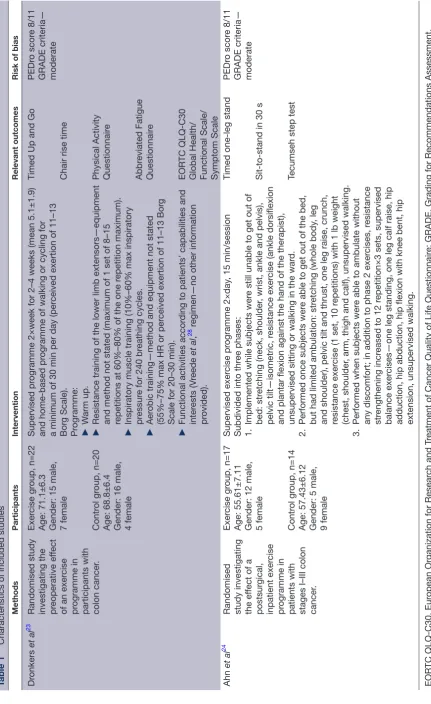
Characteristics of the participants and intervention of the two included studies are presented in table 1. Both were small (n=42 and 31) single-centre studies investigating participants undergoing abdominal surgery for excision of cancer of the colon. Dronkers et al23 investigated the
effect of a preoperative exercise programme on preop-erative outcomes, and Ahn et al24 investigated the effect
Open Access
Table 1
Characteristics of included studies
Methods
Participants
Intervention
Relevant outcomes
Risk of bias
Dr
onkers
et al
23
Randomised study investigating the preoperative ef
fect
of an exer
cise
pr
ogramme in
participants with colon cancer
.
Exer
cise gr
oup, n=22
Age: 71.1±6.3 Gender: 15 male, 7 female Contr
ol gr
oup, n=20
Age: 68.8±6.4 Gender: 16 male, 4 female
Supervised pr
ogramme 2×week for 2–4 weeks (mean 5.1±1.9)
and home-based pr
ogramme of walking or cycling for
a minimum of 30 min per day (per
ceived exertion of 11–13
Bor g Scale). Pr ogramme: ► W arm up. ►
Resistance training of the lower limb extensors—equipment and method not stated (maximum of 1 set of 8–15 repetitions at 60%–80% of the one r
epetition maximum).
►
Inspiratory muscle training (10%–60% max inspiratory pressur
e for 240 br
eathing cycles.
►
Aer
obic training—method and equipment not stated
(55%–75% max HR or per
ceived exertion of 11–13 Bor
g
Scale for 20–30 min).
►
Functional activities accor
ding to patients’ capabilities and
inter
ests (V
reede
et al
,
28 r
egimen—no other information
pr
ovided).
Timed Up and Go Chair rise time Physical Activity Questionnair
e Abbr eviated Fatigue Questionnair e EOR TC QLQ-C30
Global Health/ Functional Scale/ Symptom Scale
PEDr o scor e 8/11 GRADE criteria— moderate Ahn et al 24
Randomised study investigating the ef
fect of a
postsur gical, inpatient exer cise pr ogramme in
patients with stages I–III colon cancer
.
Exer
cise gr
oup, n=17
Age: 55.61±7.11 Gender: 12 male, 5 female Contr
ol gr
oup, n=14
Age: 57.43±6.12 Gender: 5 male, 9 female
Supervised exer
cise pr
ogramme 2×day
, 15 min/session
Subdivided into thr
ee phases:
1.
Implemented while subjects wer
e still unable to get out of
bed: str
etching (neck, shoulder
, wrist, ankle and pelvis),
pelvic tilt—isometric, r
esistance exer
cise (ankle dorsiflexion
and plantar flexion against the hand of the therapist), unsupervised sitting or walking in the war
d.
2.
Performed once subjects wer
e able to get out of the bed,
but had limited ambulation: str
etching (whole body
, leg
and shoulder), pelvic tilt and thrust, one leg raise, crunch, resistance exer
cise (1 set, 10 r
epetitions) with 1 lb weight
(chest, shoulder
, arm, thigh and calf), unsupervised walking.
3.
Performed when subjects wer
e able to ambulate without
any discomfort; in addition to phase 2 exer
cises, r
esistance
str
engthening incr
eased to 12 r
epetition×3 sets, supervised
balance exer
cises—one leg standing, one leg calf raise, hip
adduction, hip abduction, hip flexion with knee bent, hip extension, unsupervised walking. Timed one-leg stand Sit-to-stand in 30 s Tecumseh step test
PEDr
o scor
e 8/11
GRADE criteria— moderate
EOR
TC QLQ-C30, Eur
opean Or
ganization for Resear
ch and T
reatment of Cancer Quality of Life Questionnair
e; GRADE, Grading for Recommendations Assessment,
Development and Evaluation; HR, heart rate; PEDr
those in the postoperative study. In terms of gender, a higher proportion of men participated in both studies.
The preoperative intervention of Dronkers et al23
included a twice-weekly supervised exercise programme and a home-based programme of walking or cycling for a minimum of 30 min per day for 2–4 weeks before admission for surgery. In addition to a single set of resistance strengthening exercises of the leg (8–15 repe-titions at 60%–80% of the one repetition maximum), the programme included inspiratory muscle training, aerobic training at 55%–75% max heart rate (HR) or perceived exertion of 11–13 Borg Scale for 20–30 min, and functional activities. A full description of the resistance exercise was not published. Three of the inter-vention groups (13.6%) did not complete the study with their data analysed as intention to treat.
The postoperative intervention of Ahn et al24 comprised
a twice-daily 15 min supervised exercise programme performed by the participant until discharge from hospital (mean 8.87±2.28 days). In addition to resistance strengthening exercises of the chest, shoulder, arm, thigh and calf leg, the programme included stretching exer-cises for the neck, shoulder, wrist, ankle and pelvis, core trunk exercises and ambulation. In terms of the strength-ening exercises, resistance was applied manually by the therapist initially and then using 1 lb free weights. During phase 2, one set of 10 repetitions was performed, and in phase 3, three sets of 12 repetitions were performed. Because these studies used different outcome measures, it was not possible to pool the data in order to analyse mean changes in physical function outcomes.
risk of bias of included studies
The methodological quality of the two included studies was rated as moderate according to the GRADE criteria, that is, randomised studies with unclear bias or well-de-signed observational studies with large, consistent and
precise estimates of the magnitude of an intervention effect. Difficulty in blinding trial participants and thera-pists to the intervention meant studies were not rated as high. Both studies scored 8 out of 11 on the PEDro scale. Block randomisation using prepared envelopes, stratified by age (60–70 and >70) by someone independent of the study, was used in the preoperative study. Randomisa-tion, at a 1-to-1 ratio, into study groups via minimisation to balance prognostic factors between groups (age and gender) was used in the postoperative study. In the preoperative study the gender distribution was similar in the control and intervention groups; however, in the postoperative study, twice as many men were randomised to the exercise group than the control group despite the minimisation procedures to balance gender between groups. In relation to the description of the intervention, some information was lacking in terms of equipment and methodology with regard to the aerobic and functional activity components of the preoperative intervention.
Effect of strengthening exercise
Preoperative muscle strengthening
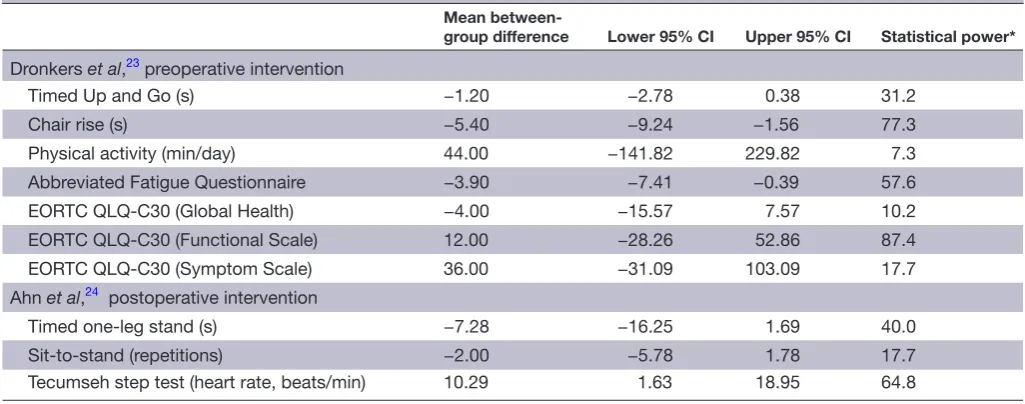
The mean difference and upper and lower 95% CI between the control and intervention group in the study by Dronkers et al23 are shown in table 2. The five-session
preoperative exercise programme had no significant effect on preoperative Timed Up and Go, chair rise time test, self-reported physical activity, quality of life and fatigue. Statistical power for six out of the seven measures was unacceptably low. Effect on postsurgery outcomes was not evaluated.
Postoperative muscle strengthening
The mean difference and upper and lower 95% CI between the control and intervention groups in the study by Ahn et al24 are also shown in table 2. The inpatient
[image:6.595.41.554.527.729.2]post-operative exercise programme had no significant effect
Table 2 Summary of effect of exercise intervention
Mean
between-group difference Lower 95% CI Upper 95% CI Statistical power*
Dronkers et al,23 preoperative intervention
Timed Up and Go (s) −1.20 −2.78 0.38 31.2
Chair rise (s) −5.40 −9.24 −1.56 77.3
Physical activity (min/day) 44.00 −141.82 229.82 7.3
Abbreviated Fatigue Questionnaire −3.90 −7.41 −0.39 57.6
EORTC QLQ-C30 (Global Health) −4.00 −15.57 7.57 10.2
EORTC QLQ-C30 (Functional Scale) 12.00 −28.26 52.86 87.4
EORTC QLQ-C30 (Symptom Scale) 36.00 −31.09 103.09 17.7
Ahn et al,24 postoperative intervention
Timed one-leg stand (s) −7.28 −16.25 1.69 40.0
Sit-to-stand (repetitions) −2.00 −5.78 1.78 17.7
Tecumseh step test (heart rate, beats/min) 10.29 1.63 18.95 64.8
Open Access
at time of discharge from hospital on ability to balance on one leg, number of sit-to-stands in 30 s or aerobic capacity (estimated from performance of the Tecumseh step test). Statistical power was not sufficient to allow any conclusion for or against the preferential use of any of the outcome measures that were used in this trial. Effect on functional recovery postdischarge from hospital was not evaluated.
DIsCussIOn
Our aim was to systematically review the evidence on the effectiveness of preoperative and postoperative strength-ening exercises on short-term and long-term recovery of physical function in patients undergoing abdom-inal surgery for cancer. Two studies were included, which represented 73 patients (48 men and 25 women) undergoing abdominal surgery for cancer. One exer-cise programme was undertaken preoperatively and the other postoperatively until discharge from hospital. This represents insufficient evidence to determine whether this type of preoperative or postoperative resistance muscle-strengthening exercise programme improves or negatively affects functional outcomes in patients under-going abdominal surgery for cancer.
The study by Dronkers et al,23 which investigated a
preoperative exercise programme, was statistically under-powered with the exception of the functional measure derived from the quality of life scale. The programme included resistance strengthening of the lower limb muscle extensors and was performed for a mean of five sessions. This may not be sufficient to provide an adequate training stimulus to significantly increase muscle strength. Indeed, guidelines published by the American College of Sports Medicine recommend resis-tance exercise 2–3 times per week with 2–4 sets of 10–15 repetitions to improve strength in middle-aged and older persons.25
In contrast, the study by Ahn et al24 investigated a
postoperative exercise programme, but this was also statistically underpowered and provides inconclusive evidence in support of the intervention and the use of particular outcome measures. The intervention was different from that of Dronkers et al23 in that it used a
progressive resistance programme involving the upper and lower limbs, together with stretching, functional balance strengthening and walking. Also, isometric strengthening exercises were commenced early post-operatively while the patient was still in bed and then progressed to ‘resistance-through-range’ strengthening as well as balance strengthening exercises, until discharge from hospital. The mean hospital length of stay, for the study of Dronkers et al23 was 7 days for the control group,
and in the exercise group it was 8 days. Similarly, for the study by Ahn et al,24 it was 8 days of exercise, and it is likely
that this will not provide an adequate training stimulus to significantly increase muscle strength and function.
There are some limitations to our review. We limited our inclusion by study design, only including randomised
or quasi-randomised studies where there was a clear resis-tance muscle strengthening component as part of an exercise programme. It is possible that other studies have included muscle-strengthening exercises or functional exercises that will have an effect on muscle strength that have not been included in this review due to our inclu-sion criteria, and we advocate the Consensus on Exercise Reporting Template guidelines for reporting exercise intervention studies.26 The two studies included in the
review recruited almost twice as many men as women, and the results may not reflect the general population. Future studies should focus on detailed descriptions of the exercise intervention, consistent outcome measures and longer intervention and follow-up times.27
Our systematic review suggests that the use of resistance exercise interventions for recovery of physical function in patients undergoing abdominal surgery for cancer must be considered with caution. The small number of included underpowered studies and the inability to pool the results due to the heterogeneity of outcome measures mean that there is a lack of evidence for or against the use of this type of resistance muscle-strengthening exercise programmes to improve functional outcomes in these patients. While the studies give encouraging preliminary evidence that muscle-strengthening programmes may be feasible for abdominal cancer surgery patients, further large-scale, well-designed clinical trials are required to determine whether this type of exercise intervention is beneficial for this group of patients.
Contributors DS, FH, KC performed the systematic review. DS, FH, KC, AB, MG, RPH, MH, IH, DPL, TPH, CS, IS, LT, WH and HA contributed to study design, data analysis and interpretation and preparation of the manuscript.
Funding The study was funded by an NIHR Research for Patient Benefit grant (PB-PG-0613–31107).
Competing interests None declared.
Patient consent Not required.
Provenance and peer review Not commissioned; externally peer reviewed.
Open Access This is an Open Access article distributed in accordance with the terms of the Creative Commons Attribution (CC BY 4.0) license, which permits others to distribute, remix, adapt and build upon this work, for commercial use, provided the original work is properly cited. See: http:// creativecommons. org/ licenses/ by/ 4. 0/
© Article author(s) (or their employer(s) unless otherwise stated in the text of the article) 2018. All rights reserved. No commercial use is permitted unless otherwise expressly granted.
rEFErEnCEs
1. Stevinson C, Lawlor DA, Fox KR. Exercise interventions for cancer
patients: systematic review of controlled trials. Cancer Causes
Control 2004;15:1035–56.
2. Mishra SI, Scherer RW, Geigle PM, et al. Exercise interventions on
health-related quality of life for cancer survivors. Cochrane Database
Syst Rev 2012;8:CD007566.
3. Pinto BM, Maruyama NC. Exercise in the rehabilitation of breast
cancer survivors. Psychooncology 1999;8:191–206.
4. Courneya KS. Exercise in cancer survivors: an overview of research.
Med Sci Sports Exerc 2003;35:1846–52.
5. Dimeo FC. Effects of exercise on cancer-related fatigue. Cancer
2001;92(6 Suppl):1689–93.
6. Fairey AS, Courneya KS, Field CJ, et al. Physical exercise and immune system function in cancer survivors: a comprehensive
7. Komi PV, Viitasalo JT, Rauramaa R, et al. Effect of isometric strength training of mechanical, electrical, and metabolic aspects of muscle
function. Eur J Appl Physiol Occup Physiol 1978;40:45–55.
8. Cheema B, Gaul CA, Lane K, et al. Progressive resistance training
in breast cancer: a systematic review of clinical trials. Breast Cancer
Res Treat 2008;109:9–26.
9. Lenk K, Schuler G, Adams V. Skeletal muscle wasting in cachexia and sarcopenia: molecular pathophysiology and impact of exercise
training. J Cachexia Sarcopenia Muscle 2010;1:9–21.
10. Schwartz AL. Daily fatigue patterns and effect of exercise in women
with breast cancer. Cancer Pract 2000;8:16–24.
11. Schwartz AL. Fatigue mediates the effects of exercise on quality of
life. Qual Life Res 1999;8:529–38.
12. Schwartz AL, Mori M, Gao R, et al. Exercise reduces daily fatigue in
women with breast cancer receiving chemotherapy. Med Sci Sports
Exerc 2001;33:718–23.
13. Courneya KS, Keats MR, Turner AR. Physical exercise and quality of life in cancer patients following high dose chemotherapy
and autologous bone marrow transplantation. Psychooncology
2000;9:127–36.
14. Dimeo F, Rumberger BG, Keul J. Aerobic exercise as therapy for
cancer fatigue. Med Sci Sports Exerc 1998;30:475–8.
15. Courneya KS, Friedenreich CM. Physical exercise and quality of
life following cancer diagnosis: a literature review. Ann Behav Med
1999;21:171–9.
16. Courneya KS. Exercise interventions during cancer treatment:
biopsychosocial outcomes. Exerc Sport Sci Rev 2001;29:60–4.
17. Friendenreich CM, Courneya KS. Exercise as rehabilitation for
cancer patients. Clin J Sport Med 1996;6:237–44.
18. Galvão DA, Newton RU. Review of exercise intervention studies in
cancer patients. J Clin Oncol 2005;23:899–909.
19. Weir A, Rabia S, Ardern C. Trusting systematic reviews and meta-analyses: all that glitters is not gold! Br J Sports Med 2016;50:1100–1.
20. Liberati A, Altman DG, Tetzlaff J, et al. The PRISMA statement for reporting systematic reviews and meta-analyses of studies that
evaluate healthcare interventions: explanation and elaboration. BMJ
2009;339:b2700.
21. Herbert R, Moseley A, Sherrington C. PEDro: a database of
randomised controlled trials in physiotherapy. Health Inf Manag
1998;28:186–8.
22. Cochrane Handbook Chapter 11 (Presenting results and ‘Summary of findings’ tables). http:// handbook. cochrane. org/ chapter_ 11/ 11_ presenting_ results_ and_ summary_ of_ findings_ tables. htm 23. Dronkers JJ, Lamberts H, Reutelingsperger IM, et al. Preoperative
therapeutic programme for elderly patients scheduled for elective abdominal oncological surgery: a randomized controlled pilot study.
Clin Rehabil 2010;24:614–22.
24. Ahn KY, Hur H, Kim DH, et al. The effects of inpatient exercise therapy on the length of hospital stay in stages I-III colon
cancer patients: randomized controlled trial. Int J Colorectal Dis
2013;28:643–51.
25. Garber CE, Blissmer B, Deschenes MR, et al. Quantity and quality of exercise for developing and maintaining cardiorespiratory, musculoskeletal, and neuromotor fitness in apparently healthy
adults: guidance for prescribing exercise. Med Sci Sports Exerc
2011;43:1334–59.
26. Slade SC, Dionne CE, Underwood M, et al. Consensus on Exercise Reporting Template (CERT): explanation and elaboration statement.
Br J Sports Med 2016;50:1428–37.
27. Ardern CL. Systematic review hacks for the sports and exercise
clinician: five essential methodological elements. Br J Sports Med
2016;50:447–9.
28. de Vreede PL, van Meeteren NL, Samson MM, et al. The effect of functional tasks exercise and resistance exercise on health-related quality of life and physical activity. A randomised controlled trial.