0022-538X192/074488-09$02.00/0
Copyright©D 1992,American Society forMicrobiology
Premature
Termination
and
Processing
of Human
Immunodeficiency Virus Type
1-Promoted
Transcripts
MARKKESSLERANDMICHAEL B. MATHEWS* Cold Spring Harbor Laboratory, 1BungtownRoad, P.O. Box 100,
ColdSpring Harbor, New York 11724-2208 Received 10 December 1991/Accepted 10April1992
We haveused transientexpression assays tostudy transcription directedbythe human immunodeficiency virus(HIV)type1 promoter.Aplasmid containinganHIV-reportergenefusion andasimianvirus 40 origin
ofDNA replicationwas transfected into COS-1 cells in the presence orabsence ofaTatexpression vector. HIV-promoted RNA was analyzed by in vivo labeling, by RNase protection mapping, and in run-on
transcription assays. As observed previously, two populations of HIV RNA accumulate in vivo: short,
attenuatedtranscriptsand long,polyadenylated mRNA. The shorttranscriptslabeled in vivowerelongerand moreheterogeneousthanexpectedfrom RNaseprotectionassays.Moreover,comparisonoftranscriptslabeled
in vivo with run-on transcription products revealedthatsimilar, ifnotidentical, short RNAsaccumulate in vitro.Utilizingtherun-onassay, weshow thatfollowing transcriptionaltermination, the attenuatedtranscripts undergo processing togenerate one species of RNA. We also provide evidence that Tat does not act as an
antiterminatortorelieveadiscrete elongationblock but instead modifiestranscriptional complexes, enabling
them toovercomeputative pausesites andcontinue transcriptionof thetemplate. The human immunodeficiency virus (HIV) type 1 Tat
protein is a potent transactivator ofHIVgene expression,
capable ofgreatly stimulating transcription and also impli-cated in regulating translation (7, 19, 27, 40). Tat acts throughthetrans-activatorresponseelement(TAR)situated in the R region ofthe long terminal repeat (LTR) between residues +1 to +59 relative to the transcription start site (residues +14to +44 arerequired for minimal activity [12,
16, 18, 34]). TARfunctions atthe RNA level in a
position-andanorientation-dependent manner (3, 34). RNA
encom-passingthe TARregionfolds intoastem-and-loopstructure (26)ofwhich threepartsarerequiredfortransactivation: an
intactstem anda3-nucleotidepyrimidine-rich bulge at +23
to +25, importantforTat binding,andloop sequences(+30 to +35),whichcanbind cellularproteins(p68 andTRP 185)
(3, 8,11,13, 18, 31, 32, 34, 42).TAR isdispensablewhenTat isbroughttothepromoterby alternative means(2, 35, 37),
suggestingthat TARfunctions,at leastinpart, toprovidea
suitable Tat-bindingsite.
Tatcanmodulatetranscription by increasing the initiation
rate aswell as the efficiency of elongation as measured in
run-ontranscription experiments (10, 20-23). Thedegreeto
which Tat stimulates initiation is determined by the basal rateofLTR-directed transcription: Tatstimulates initiation severalfold when the basal rate of transcription is lowbut has little or no effecton initiation when the basal
transcrip-tion rate is high (21, 23). The basal transcription rate does not significantly influence Tat's effect on elongation, how-ever. In the absence of Tat, the majority of the
transcrip-tional complexes formed at the HIVpromoterdo not
tran-scribebeyondthepromoter-proximalregionsof thetemplate (10, 20-23). In the presence of Tat, although a substantial
fraction of the RNA polymerases still appears to stall or
disengagewithin thepromoter-proximal region of the tran-scription unit, the density of complexes in promoter-distal regionsofthetemplate increases substantially (10, 23).Tat
* Correspondingauthor.
also stimulates the efficiencyoftranscriptional elongation in DNA-dependentinvitrotranscription systems (24).
Regulationatthe leveloftranscriptional elongationis also reflected in the appearance of two populations of HIV-directed RNAs in the cytoplasm (10, 20, 21, 32, 34). Ribo-nucleaseprotection analysisrevealedthe existence ofshort, poly(A)- RNAs terminating at approximately nucleotide +55 to +60, in addition to longer, polyadenylated RNAs representing full-length mRNA (22). The shortspecies
pre-dominate in the absence of Tat, whereas the full-length species predominate in its presence. Apromoter-proximal
element (IST) which induces the generation ofshort tran-scriptshas beenidentified,but it is unclear whether the short RNAsareprecursorstothelongRNAsand whether thetwo populations aresynthesized bysimilaror distinct
transcrip-tion complexes (28). Short transcripts terminating in this vicinity (at approximately nucleotides +58to +61 and +60
to+65)arealsogeneratedincell-freetranscriptionreactions
containingpartiallyfractionated nuclear extractsorpurified
RNApolymerase 11(1, 38).Theseobservationssuggestthat
premature termination is an intrinsic property of
polymer-asesinitiatingonthe HIVLTR,especiallyin theabsenceof
Tat.
Two distinct interpretations of these data have been advanced. In the first, polymerases terminate transcription at or nearnucleotide +60, giving rise directly to the short RNAs (20). As a variant of this model, termination might occur at a site some distance downstream, followed by a
tightly coupled processingstepthatyields thematureshort transcripts (38). These models are consistent with the in
vitro transcription data but are less compatible with other findings, especially with the failure of deletion analysis to
detectatermination signalornegative regulatoryelement in
this region. The second interpretation supposes that
poly-merases terminate at random sites along thegene and that
the short RNAs represent stable, processed remnants of theseheterogeneouslyabortedtranscripts.Thedevelopment ofa cell-free transcription system that responds to Tat by increased elongational efficiency (24) lends support to this
4488
on November 9, 2019 by guest
http://jvi.asm.org/
model. As a variant hypothesis, it is conceivable that the short RNAs might be generated in the cytoplasm as a consequence of mRNA turnover. In either case, the 3' terminus of the short RNAs might be expected to lie near the base of the TAR stem-loop structure at nucleotide +59.
To extend our understanding of HIV-directed transcrip-tional elongation, we have directly characterized the short transcripts formed in the presence and absence of Tat. In prior experiments, their presence was inferred from RNase protection analysis of cytoplasmic RNA from transfected cells or from invitro transcription assays using fractionated nuclear extracts. We demonstrate that the short transcripts that label in vivo are both longer and more heterogeneous than indicated by the RNase protection assays. Moreover, we show that transcripts of a similar size are generated in run-on transcription assays and that the accumulation of at least one of the short transcripts in vivo entails the process-ing of longer RNA. We also find that Tat does not act as an antiterminator to relieve a discrete elongation block but instead functions to enhance the overall processivity of the transcriptional complex.
MATERIALSANDMETHODS
Plasmid and probe construction. The HIV CAT reporter construct, plasmid pSt4, contains the HIVSFII LTR(-643 to +83) driving the chloramphenicol acetyl-transferase
(CAT)gene and adjacenttosimianvirus 40 polyadenylation
and splice signals and a simian virus 40 origin of DNA replication (21). The Tat expression vector pRSVTat
(pBC12/RSV/t23) (5) was provided by B. Cullen. Plasmid
pGEM23, used to synthesize the RNA probe for RNase protection analysis, contains HIV sequences from +83 to -117 under the direction of the SP6 promoter (22).
pM13aoHIVCATwasprepared bycloningthepU3RIII
XbaI-EcoRI fragment (containing HIV sequences from -643 to
+330) into the M13mpl8 vector. HIV sense RNA was synthesized by using pEM7, which contains HIVsequences from +1 to +83 under the control of theT7promoter(15).
Plasmid preparation and transfections. Plasmids were banded twice in CsClgradients and then treated with RNase Aand precipitated with polyethylene glycol. COS-1 cells at 50% confluency (approximately 107 cells per 15-cm plate) were transfected by using the DEAE-dextran method (6), with40,g ofpSt4 reporter plasmid and 30 ,ug of pRSVTator carrier.
Labelingandextraction ofcellular RNA. At48h posttrans-fection, transfected COS-1 cells (two 15-cm plates per assay) werewashed withphosphate-freeDMEM(Dulbecco's mod-ified Eagle's medium) and incubated for 12 h with 20 ml of labeling mix containing 10% fetal bovine serum and 5 mCi
[32P]phosphate
(ICN Radiochemicals) in phosphate-free DMEM. The cells were then washed several times with phosphate-buffered saline (PBS), harvested in 4ml ofPBS, andcollected by centrifugation (2 minat 1,500 rpm at room temperature). The cell pelletwasresuspended in1ml oflysis buffer (50 mM Tris HCl [pH8.0],
100 mM NaCl, 5 mMMgCl2, 0.5%NonidetP-40) andincubated onice for8 min.
After centrifugation for 2 min at 1,500 rpm and 4°C, the nuclearpelletwascarefullyseparated from thecytoplasmic
supernatant. Proteinase K (0.2 mg/ml), sodium dodecyl sulfate (SDS) (1%), and EDTA(25 mM) were addedto the supernatant. Following incubation for 10 min at37°C, RNA was extracted with 2 volumes ofCHCl3-phenol (1:1) and 1 volume ofCHCl3-isoamyl alcohol(24:1) and ethanol
precip-itated. The nuclear pellet was resuspended in 0.6 ml of
CMNT buffer containing 0.3 M NaCl, 30 mM MgCl2, 10 mM Tris-HCl (pH 7.6), 2 mM CaCl2, and 400 U of DNase I (Worthington) and incubated for 5 min at 30°C. Nuclear RNA was isolated by proteinase K treatment and solvent extraction as described above. Both RNA fractions were dissolved in 650 ,ul of DNase buffer (20 mM HEPES [N-2-hydroxyethylpiperazine-N'-2-ethanesulfonic acid]-NaOH [pH 7.5], 5 mM MgCl2, 1 mM CaCl2) and incubated with 300 U of DNaseI(Worthington) for 30 min at 37°C. The samples werethen CHCl3-phenol extracted, CHC13 extracted twice, and ethanolprecipitated.
Run-ontranscription assays. Assays wereconducted at 72 h posttransfection with two 15-cm plates of transfected COS-1 cells per run-on reaction byusing a protocol modified from that of Ucker and Yamamoto (39). Plates of transfected cells were washed three times on ice with 6 ml ofA buffer (300 mM sucrose, 10 mMTris-HCl [pH 8.0], 3 mM CaCl2,
0.5 mMdithiothreitol), permeabilized bytreatmentwith for
2.5 min with 3 mg ofdigitonin (Sigma) per ml inAbuffer, and then washed twice with 6 ml ofA buffer. The cells were collected by scraping in4ml ofAbuffer per plate, pelleted bycentrifugation for 2 min at 1,500 rpm androom tempera-ture,and thensuspended in B buffer (50 mM HEPES-NaOH [pH 7.9], 25% glycerol, 5mM MgCl2, 0.5 mM dithiothreitol) to370,ul(total volume). Transcriptionwasstartedby adding to the cell suspension 400
RI
of transcription mix (0.3 MNH4C1, 0.1 M HEPES-NaOH [pH 8.0], 8 mM creatine
phosphate, 6 mM Mg acetate, 4 mM MgCl2, 4 mM dithio-threitol, 0.8 mM ATP, 0.8 mM CTP, 0.8 mM GTP, 1 FM
UTP) and 330 ,uCi of [a-32P]UTP (3,000 Ci/mM; New En-gland Nuclear). Following 6 min of incubation at 28°C, transcription was stopped by adding ot-amanitin to2 ,ug/ml,
forpulse-labeling, or waschasedbyaddingUTPto400 ,uM and incubated for an additional 30 min at 28°C. RNA was isolatedaccording to the protocol of Greenberg (14)withtwo exceptions: (i) following trichloroacetic acid precipitation, theRNA wastreatedwith 230 U ofDNaseI (Worthington)
for45 minat37°C, and(ii) the alkalitreatment wasomitted. Hybrid selection ofHIV-specificRNA.RNAwasdissolved in 0.7 ml of hybridization buffer (70% formamide, 0.3 M NaCl, 10mM Tris-HCl [pH
7.4],
2 mM EDTA,0.5% SDS) containing 500 ,ug oftRNAperml, heated for 3minat85°C,cooled in an NaCl-ice bath, and then added to scintillation vials containing two nitrocellulose filters saturated with 10
p.g
ofsingle-stranded M13aHIVCATDNA. Following incu-bation for 36 to 48 h at 37°C, the filters were washed in hybridization buffer at 37°C for 4 h, with hourly bufferchanges. The filters were then rinsed twice with 2 ml of 2
mM EDTA, and HIV-specific transcripts were eluted by
heating the filters to 100°C for 1.5 min in 0.8 ml of 2 mM EDTA and coolingthem in an NaCl-ice bath. After extrac-tion withCHCl3-phenoland then with
CHCI3,
theRNA was precipitated with ethanol, suspended in gel loading buffer(90% formamide, 0.5x Tris-borate-EDTA, 0.05%
bro-mophenol blue,0.05%xylenecyanol),denaturedbyheating
to 100°C for1min, and resolved in 6% polyacrylamide-7M urea sequencing gels.
RESULTS
HIVtranscripts of 58 to 70nucleotides are labeled in vivo. Hitherto, the short HIV-derivedtranscripts
accumulating
in vivo have been characterized indirectly, by RNaseprotec-tion analysis (20-23, 28, 32, 34).
Quite
apart from thepotential artifacts, this assay does not
permit
precise
size estimates. Therefore, in order to visualize the short RNAson November 9, 2019 by guest
http://jvi.asm.org/
,;vivo Lcbe: RNaseProlectiorAr:3vss Cytoplasmic Nuclear Cyropaosmc Nuclear
1[ _.- -I
HIVCAT - + + . . + + - + +
RSVTat + + + - + + + +
-- M
404
---i_
238/242-- _
217-
---190
180 __
160. _
'
-I10 --_
2u--
-76-
-Short 67 ---- _ RNAs
34-5
M
B.
-4
ia.~
.-.
q =
2 3 4 5 6 7 8 9 10 11 12 P
Short
U3,IAFulllength
.,2
_~~~~~~~~~.,A
-I17 + +83
Probe
83-r'
59ni
eted
Frjg'.eFIG. 1. Analysis of HIV-specific RNA labeled i
COS-1 cells weretransfected with pSt4 (HIVCAT), both,as indicated atthe topof each lane. Cellswere
[32P]phosphatefrom48to60 hposttransfection andfrac nucleic and cytoplasmic fractions. HIV-specific RNA hybrid selection, was examined directly by gel ele (lanes 1to 6)or subjectedto RNaseprotection anal) loadedontothesamegel(lanes 7to12). Lane Mcont;
HpaII markers, whose sizes (in nucleotides) areindi left. Lane P contains the probe used in the RNaseprote
The positions of the short RNAs labeled in vivo and of short RNase protection fragmentsarenoted.(B) Schen
of theRNaseprotection analysis depicting thefragmei
by the short RNAs (55 to60 nucleotides) and full-len nucleotides).
directly and obtain more accurate estimates of
we labeled cells with [32P]phosphate and isolatt
hybridization to HIV DNA immobilized on ni
filters. Plasmid pSt4, containing the CAT
gene
directionof the HIV LTR, wasintroduced into
by transfection in the presence orabsence ofa
sion vector (pRSVTat). The hybrid-selected I both nuclear and cytoplasmic fractions of the cellsweredisplayed inapolyacrylamide gel (Fi1 1to6). Short transcriptsmigratingnearthe DN~
67 nucleotides were clearly observed in the
cytoplasmic
fraction ofcells transfected with HIV CAT in the presence or absence of Tat(lanes 2and3).Short
transcripts
werealso clearly visible in the nuclei of cellsexpressing
both HIV CATand Tat(lane 6), but fewer short HIV-encoded RNAs were present in thenuclei of cellstransfected with HIV CAT alone (lane 5), suggesting that Tat favors the retention of shorttranscripts in the nucleus. Asexpected,
therewaslittle or no signal in thisregion when the HIV CATplasmid
was omitted (lanes 1 and4). Transcriptsofmorethan about 160 nucleotides were obscured by background in alllanes,
but theregion between the DNAmarkers of 76and 160 nucleo-tides was well resolved. Transcriptsin this size rangewere abundant in the nuclei and cytoplasm of cells transfected with both plasmids (lanes 3 and 6) but were much less abundant in cells thatlacked Tat(lanes2and5)
orcontained neither plasmid (lanes 1 and4). Takingthesetranscripts
as LFocngmPrts
representative of HIV mRNA, these observations arecon-sistent
with previous dataindicating that Tatisrequired
forthe formation of long HIV transcripts and that short tran-Short Prot. scripts are found in the cytoplasm. We also found short
Fragments
transcripts
in thenucleus in the presence of Tat.J Detailedexamination of thebandingpattern ofthe in vivo-labeledshort, HIV-specific RNAs in thegel showed that the distribution of RNAs was influencedby the presence of Tat (compare lanes 2 and 3) but was similar in the nuclei and cytoplasm of cells expressing both HIV CAT and Tat
(lanes
3 and 6). Weemployed a series of
homologous
and heterol-ogous RNAmarkers to define the chainlengths
of the most abundant species. The markers included TAR RNAs 67 and 83 nucleotides long, synthesized in vitroby
T7 RNApoly-merase; capped and 5' monophosphorylated forms of these RNAs; andpartial digests of the 5' end-labeled form of the 67-nucleotide TAR RNA and of adenovirus type 2 VA RNA. By this means we were able to estimate the
lengths
of the RNAspecies to within 1or2nucleotides. In the absence of Tat, several RNAs between 57 and 66nucleotides inlength
accumulated in the cytoplasm (lane 2). Of
these,
species
oftS
58and 59nucleotides (designated TAR58 andTAR59)
were predominant. InTat-expressingcells (lane3),
transcripts
of in vivo. (A) 56 to 70 nucleotides accumulatedcytoplasmically,
with apRSVTat, or predominant 66-nucleotide transcript
(TAR66).
The same labeledwith collection oftranscripts was detected in the nuclear fractions -tionatedinto of these cells with some strengthening of theTAR65
and, isolated
by
TAR66 transcripts (lane 6). Thus, the short HIV-encodedectrophoresis RNAs are distributed over a range of sizes in vivo, and ains
pBR322a
although the population is slightly longer in the presence ofcated
on the Tat than in itsabsence,
it does not differgreatly
between :ction assays. nucleus andcytoplasm.Fthelongand The lengths of these
transcripts exceeded,
by
severalnaticdiagram nucleotides, the size estimates obtained
previously
by
nts protected RNaseprotection analysis ofcytoplasmic RNAs (10, 20, 22, gth RNA (83 28, 31, 34). Toverify the difference, we annealed portions of
thehybrid-selected RNAs tohighlyradioactive
complemen-tary RNA extending from +83 to -117.
Following
RNase digestion, the protected fragmentswereresolved in thesame their sizes, polyacrylamidegel(lanes 7 to12).Aswith unselectedRNA,
ed RNA by twopopulations of protected fragmentswere obtained:
long
itrocellulose fragments of about 83 nucleotides representing
full-length
under the RNA and short fragments of about 55 to 60 nucleotides COS-1 cells representing the truncated RNAs. Thus, the
discrepancy
Tat expres- does not stem from the hybrid selection procedure itself.
PRNAs
from Other possibilities include (i) overdigestion of the RNA transfected duplex in the RNase protection assay, (ii) differentelectro-g.
1A, lanes phoretic mobilities of the sense and antisenseRNAs,
(iii)
A marker of nontemplatedaddition of nucleotides to the short
transcripts
A
I" I1
-WI
sn--_~
on November 9, 2019 by guest
http://jvi.asm.org/
[image:3.612.69.295.75.460.2]+> L) > I :IrCE:0
PCC P C M
_-- 622
SU527
- 400
-309
238/242 217 @-201 -190
/S
- 160q.
d_
-147-123
_... so as_- 110
le.
TAR65
-TAR 64 U..ol
TAR62/
_ - 90
_ - 76
_ - 67
B
AU
AC
GAG C A u
UA
U G
G c
CG
OG
U A
A
GC Gc
m7GpppUG CACUGO'~-UUAAGO'C'-UOAA'AAAGCUU...
FIG. 2. Size fractionationofHIV-specificrun-ontranscripts. (A)
COS-1 cells were transfected with pSt4 (HIVCAT), pRSVTat, or
both, as indicated above the lanes. At 72 h posttransection the
nascent transcripts were pulse-labeled for 6 minwith [a-32p]UTP (lane P),orpulse-labelingfor 6mmnwasfollowedby30mmnof chase
transcription (lane C). HIV-specific RNAwashybrid selected and resolved ina6%polyacrylamide-7Mureasequencing gel. Lane M containspBR322-HpaII markers, whose sizes (in nucleotides) are
indicatedontheright.The locations of theTAR62, TAR64, TAR65,
and TAR66 run-on transcripts are noted. (B) Predicted RNA
sec-ondary structure of the HIV leader sequences. Transcriptional
pausesites, basedonthegelshown in panelA, are designated.
m 34
_
262 3 4 5 6
generatedinvivo,and(iv) shorteningof thetranscriptswith time, such that the 32P-labeled RNAs, which are mainly
recentlysynthesized,will belongerthan thebulk of the short transcripts which give rise to the protected fragments. In reconstructionexperimentswith TAR83synthesizedwithT7 RNA polymerase, protected fragments both longer and shorter than TAR83 were obtained, perhaps reflecting the
distribution and accessibility of the ribonuclease-sensitive sites in the tailed duplex (datanotshown). Moreover, there
appears to beno significantdifference in mobility between
complementary strands (data not shown). Although we
cannot formallyexclude the third possibility, we favor the fourthpossibilityat present.
PausingofHIV-promoted complexesatseveral sites during
run-ontranscription. In transfectedCOS-1 cells, complexes
traversing the HIV CAT cassette of pSt4 are located
pre-dominantlywithin the first83 nucleotides of thetranscription
unit (21). The presence of Tat increases the density of
transcriptional complexesinpromoter-distal regionswithout significantly altering the density of complexes within the promoter-proximal region (21). The preponderance of
pro-moter-proximal complexes suggests that elongation is im-paired beyond this region, especiallyin the absence of Tat. To define the precise location of the transcriptional
com-plexes on the template and to determine whether they are
accumulating as a result ofablockto transcription elonga-tion at a discrete site or sites, we examined the
hybrid-selectedrun-on transcriptsinpolyacrylamide gels following
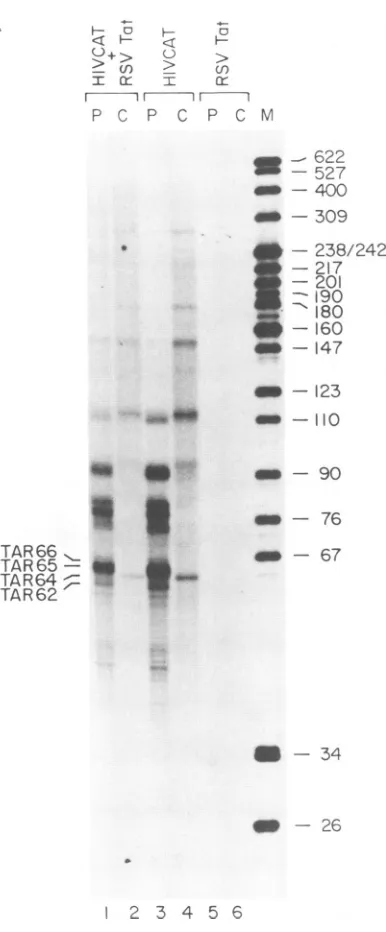
procedures similartothose used for RNA labeled in vivo. Several small RNAs accumulated when nascent HIV-promoted transcriptswerepulse-labeledwith [a-32P]UTPin the absence of Tat(Fig. 2,lane3), reflectingapredisposition
of the transcriptional complexes to stop at specific sites during the run-on transcription reaction. The same small
RNAsaccumulated in thepresenceofTat,aswellaslonger
RNAspeciesrepresented bythesmearofradioactivityin the
upperportion of the gel (lane 1). Whenpulse-labeling was
followedby30minof chasetranscriptionin thepresenceof
excess unlabeled UTP, the small RNAs that had
accumu-latedduringpulse-labelingwereabsent andwerereplaced by
longerRNAspecies (lanes2 and4), suggestingthat theshort transcripts represent transcriptional complexes that have pausedbut notterminated transcription. One 64-nucleotide transcript (designated TAR64) that was not seen in the A
on November 9, 2019 by guest
http://jvi.asm.org/
[image:4.612.84.277.69.535.2]B
M
-- 622
--- 527
-- 404
- -- 309
_ ---238/242
,#0 -- .17
--201
. 190
.- - 180
mo_ - 160
mom -- 147
oO 03/¾
MP)
rl1 F; C P C -v) E) 22 ,
404 -
-309 238/242 217 201 190 180 160 147
--123 -- _ 10 --. - 1
90
-76
67 - I
34 -I-26 -- _
M! 2 3 4 5
M 2 3 4 5 t
FIG. 3. Run-ontranscriptionconditionsinfluencetranscriptionalpausesites.(A)ITPmodulatespausingatnucleotides+62, +65,and+66
andtheprocessingof TAR64. COS-1 cellsweretransfectedwith carrier DNA(lane 1)orwithpSt4 (lanes2 to5).At72 hposttransfection
nascenttranscriptswerepulse-labeledfor6minwith[a-32P]UTP (lanes 1to3),orpulse-labelingfor6minwasfollowedby30minof chase
transcription (lanes4and5). Transcriptionwascarriedoutinthepresenceof 400,uMGTP(lanes 1, 2, and4)or400,uMITP(lanes3 and5). HIV-specific transcriptswereanalyzedasforFig.2.(B) The effectof0.3% Sarkosylontranscription throughthepromoter-proximal regions
of thetemplate.COS-1cellsweretransfected withpSt4 (lanes1to4)orcarrierDNA(lane 5).Pulse(lanes 1, 3,and5)andpulse-chase (lanes
2and4) transcriptionwerecarriedoutin theabsence(lanes 1, 2,and5)orpresence(lanes3and4)of0.3%Sarkosyl. HIV-specificRNAwas
analyzedasdescribedabove. Lanes McontainpBR322-HpaII markers,whose sizes(in nucleotides)areindicated. ThepositionsofTAR62, TAR64, TAR65,and TAR66arenoted.
pulse-labeled RNAs (lanes 1 and3) accumulated during the chasereaction(lanes2 and4), implyingthat itisassociated withcomplexes thatare verystablypausedor,morelikely,
isaterminated product.Noneof theseRNAswereobserved
followingpulse- orpulse-chase-labeling ofnascent RNAin COS cells transfected with onlypRSVTat, confirming that theyareHIV-promoted RNAs.
Carefulsizingof the pausedRNAs indicated thatmostof the short run-on transcripts that accumulated (including
TAR62, TAR65, and TAR66, as well as the longer 70- to
83-nucleotide transcripts) correspond to RNAs whose 3' endsareatU residues within the leaderorneighboringCAT
sequences (Fig. 2B). Since the probe used to hybridselect the HIV-specific transcripts extends well beyond the TAR region inboth directions,itwas necessarytoshow that the short transcripts initiateat theexpected site. The5' and 3' termini of TAR64, TAR65, and TAR66 were mapped by
elutingthetranscriptsfromthesequencing gel and subject-ingthemto RNaseprotection assayswith probes extending from residue +83 to +22 orfrom +83 to -117 but lacking
A
Fl--0
F--MO Q-C A:: Z
rCi lL CL CL.
F-1 CD ._
4m
S.
_s
U
as
la
_- i23
*Fp, - 110
U.
mo : 0
mm0 TAR66.
TAR65 -\ TAR64 2
Ti4AR62
-, TAR66
_- TAR65 -\ TAR64 TAR 62
- 90
67
sm 34
on November 9, 2019 by guest
http://jvi.asm.org/
[image:5.612.81.507.75.514.2]0 + +
M cLa.a
4m
I0
+6
U (Ua- O: 0fM
m
4W
4W
622 527 - 404 - 309
_ 238/242 - 217
201
\ 90
180 - 160
- 147
- 123
0
go
-110o...j'
.p.k
.. so
do
zr
-jz~~ _ U
>f .e
O >C >Q
CR+ z+
>Z ca) ca
c- Er
- 0- >U>
_ E
*
X"
90- 76
- 67
a* 4.4
IAR66 TAR 65 o
TAR 64- -TAR 62
-M 2 3 4 5 6 M
FIG. 4. Effect ofRNA polymerase II inhibition on short
tran-scripts. Run-on transcription assays were conducted at 72 h after transfectionofCOS-1cells withpSt4 (lanes2to6)orcarrierDNA
(lane 1). RNAwas pulse-labeled for6 min (lanes 1, 2, and 4),or
pulse-labelingfor 6minwasfollowedby30minofchase
transcrip-tion (lanes 3, 5, and 6). The inhibitor oa-amanitinwaspresent at a
concentrationof 2 pug/ml throughout transcription (lanes2and3)or
onlyduring chase incubation (lane 6). Lanes M contain pBR322-HpaII markers, whose sizes (in nucleotides) are indicated onthe
right. The positions of TAR62, TAR64, TAR65, and TAR66 are
noted.
residues +35 to +38. Onthe basis of their measured sizes, theprotectedproductsobtained with thesetwoprobeswere
consistent with thesetranscriptsbeinginitiatedatnucleotide +1 and terminating at nucleotides +64, +65, and +66, respectively (data notshown).
Short-transcript formation is modulated by transcription complex and nascent RNA structure. The 3' termini of TAR62, TAR65, andTAR66 mapped to A residues on the
template, raisingthepossibilitythatthese pausesitesmight bedetermined, atleast inpart,bythelimitingconcentration ofUTPpresentwhen [ot-3 P]UTPisused asthe labelin the
run-on assay. Several observations suggest that this is not
34
[image:6.612.64.296.76.477.2]2 P,
FIG. 5. Comparison of HIV-promoted RNA labeled invivoand invitro.COS-1 cellsweretransfectedwithpRSVTat (lanes1and8), pSt4 (lanes2, 4, 5, and 7),orpSt4andpRSVTat(lanes3 and6). Cell labeling and isolation of HIV-specific cytoplasmic (lanes1to3) and
nuclear(lanes6to8) transcriptswerecarriedoutasdescribed in the
legend to Fig. 1. Pulse (lane 4) and pulse-chase (lane 5) run-on
transcription wereconducted as described in thelegendtoFig. 2.
Lane M containspBR322-HpaII markers, whose sizes(in
nucleo-tides) areindicatedontheright. ThepositionsofTAR62, TAR64, TAR65,and TAR66arenoted.
the solecauseoftheirpausing. First,whenrun-on
transcrip-tion reactions were conducted in the presence of a high
concentration of unlabeled UTP and with [ct-32P]GTP in place of
[a-32P]UTP,
the accumulation ofTAR62, TAR65, and TAR66 still occurred, albeit to a lesser extent than in reactionscontaining [a-32P]UTP (datanotshown). Second, short-transcript formation was profoundly influenced by substitutingITP for unlabeled GTP in reactions labeledwith[ct-32P]UTP
(Fig. 3A). In thepresenceofITP,accumulationTAR 66 ^
TAR 65>-TAR 64
-TAR 62
-M
622
-527
- 404
- 309
242 238
- 217
-201
- 190 -180 -160 -147
-123 -110
*- 90
-- 76
--- 67
on November 9, 2019 by guest
http://jvi.asm.org/
[image:6.612.358.519.85.519.2]of TAR62, TAR65, and TAR66 was
suppressed
andtran-scripts of 80 to 83 nucleotides accumulated.
Moreover,
incontrast to the GTP-containing reaction
(lane
4),
the shorttranscriptsformed in the
ITP-containing
reaction wereonly
elongated by 1 or 2 nucleotides
during
a 30-min chase incubation with excess unlabeled UTP(lane 5).
Transcrip-tion on the presence of ITP also suppressed the accumula-tion of TAR64 (comparelanes 4 and
5).
These data suggest that the formation of these shorttranscripts
is influencedby
thefolding of thenascentTAR RNAintoastable stem-and-loop structure, a process which is disfavored
by
the ITP analog becauseI:C basepairsaremuch less stable than G:C pairs.Third, the pattern ofshort-transcript formation was also influenced by the detergent Sarkosyl
(Fig. 3B).
Reduced quantities of TAR62 and TAR65 accumulated in thepres-enceof0.3%Sarkosyl,witha
corresponding
increase intheaccumulation of TAR66 (compare lanes 1 and
3).
Thequantityof TAR66 diminished
only slightly
after 30 min ofchase transcription in the presence of
Sarkosyl
and unla-beled UTP (lane4), suggesting
that thedetergent
strongly
enhances thestabilityof
transcriptional complexes
paused
at this site orinduces thepaused
transcriptional
complexes
to terminate transcription. In contrast to the control chase reaction (lane 2), TAR64 RNA did not accumulate in the chase reactioncontaining
Sarkosyl(lane 4). Thus,
thearrest of thetranscriptional complexesatnucleotides64,65,
and 66 is influenced by TAR RNA secondary structure and byprotein components of the transcription
machinery,
aswellas by the concentration of UTP in the run-on reaction. Involvement ofRNA processingin short-transcript metab-olism. To determine whether the formation of short
tran-scripts includes aprocessing step, we
specifically
inhibitedRNApolymerase II-mediated
transcription
with a lowcon-centration of a-amanitin atvarious times
during
the run-on reaction. Theproductsthat accumulatedpriortoandfollow-ing inhibition were compared by gel
electrophoresis.
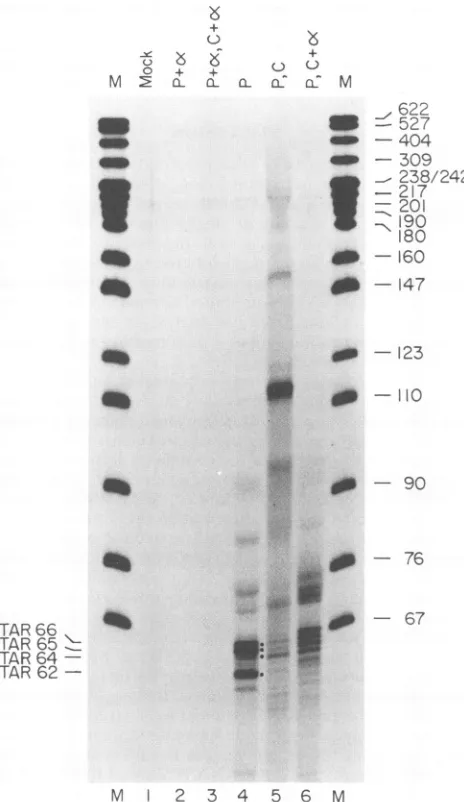
NoHIV-specifictranscriptsweredetected when a-amanitinwas
present throughout the pulse (Fig. 4, lane
2)
orpulse
and chase reactions (lane 3),indicating
that the RNAs aresynthesized by RNA polymerase II. As
previously
ob-served, in the absence ofot-amanitin, TAR62, TAR65, and TAR66accumulatedduring thepulse-labelingreaction (lane 4) and TAR64 accumulated during the chase reaction
(lane
5). Surprisingly, TAR64 alsoaccumulated, and the
quantity
of TAR65 and TAR66 aswell as of otherlonger transcripts
diminished, when a-amanitin was added at the start of the
chase reaction (lane 6). The accumulation of TAR64 in the presence of ot-amanitin in chase
conditions,
but notduring
thepulse, indicates that it isprobably formedbya
posttran-scriptional event. Since TAR64 did notaccumulate in
reac-tions that contained ot-amanitin from the start of run-on
transcription (lanes 2 and 3), it is unlikely to result from
RNA polymerase I or III activity or from an alternative
labeling reaction such as end labeling. This suggests that
TAR64 is derived fromalongertranscript(s)thatwaslabeled
duringthe pulsereaction and underwent processing during
the chaseperiod.
To relate these findings to observations made in vivo,
HIV-specifictranscripts labeled in transfected cells andby
run-ontranscription weredirectly compared by cofraction-ation in sequencing gels. RNA labeled in cells expressing
(Fig. 5, lanes 3 and6)or not expressing (lanes 2 and7)Tat
and RNApulse-labeledin the run-onassay (lanes 4 and 5)
gave patternssimilartothoseseenpreviously (comparewith
Fig. 1 and 2). The TAR62, TAR65, and TAR66 species
labeled in the run-onassay
comigrated
with thoseaccumu-lating
in vivo. Sincebothsetshavebeen showntoinitiateat nucleotide+1,
we conclude that similar short HIV-pro-motedtranscripts
accumulate in vivo and invitro,
consistent with the view thatthey
areformed in the sameway.DISCUSSION
Two mechanisms have been
proposed
to accountfor the enhancementoftranscriptional
elongation
by
Tat.First,
Tatmight
act as an anti-attenuatortorelieve adiscreteelonga-tion block
(20);
second,
itmight
function as ageneral
activator,
toimprove
the overallprocessivity
oftranscrip-tion
(10, 22,
23).
Todistinguish
between thesemodels,
wehave
directly mapped
the distribution oftranscriptional
complexes
along
anHIV-promoted template
in the presence and absence of Tat. From thisanalysis
it appears that Tat functions as ageneral
activator ofelongation
rather thanasa
specific
antiterminator.In the absence of
Tat,
transcriptional
complexes
do not accumulateat asingle
discrete site aswould beexpected
if the firstmodelwerecorrect,butinstead pause at anumberof sites
throughout
thepromoter-proximal regions
of thetemplate.
Thetendency
of thecomplexes
topause at these sites suggests thatthey
lack a component orcomponents
necessary to
elongate
efficiently
or,alternatively,
possess additionalcomponent(s)
that render themsusceptible
topausing.
Theability
ofSarkosyl
to reduceproduction
of someof the shorttranscripts
(TAR62
andTAR65)
inrun-onassays lends support to the latter
possibility.
Although
pausing
seemstobedirectedby
the way thatcomplexes
areformed at the HIV promoter, the pause site is not
HIV-specific
because thetranscriptional complexes
pausewithin CAT as well as within HIV sequences.Suppression
ofpausing by
inosine substitution suggests thatpausing
at ornear nucleotide +60 is due to the
folding
of the nascenttranscript
into the TARstem-and-loop
structure. Similarobservations have been made for other systems
(17,
29, 33,
38),
andpurified
RNApolymerase
II pausesat ornearthissite when the nascentTAR RNAis allowedto fold butnot when
folding
is inhibited(1,
38).
The sequencessurrounding
the downstream pause sites do not share any obvious commonprimary
orsecondary
structure,however,
implying
that
complexes
may pauseforanumber of differentreasons.This view is
strengthened by
the observation that factors such as thelimiting
nucleotide,
the presence ofnucleotideanalogs,
and the presence ofSarkosyl
in the run-on assaymodify pausing
differentially
at the several sites. Asimple
explanation
would bethat,
because oftheir inherentelonga-tional
inefficiency,
thesecomplexes
arepronetostopatsites that"normal,"
elongation-competent
complexes
would by-pass; on thisbasis, changing
thetranscription
conditionsmight simply
enable therecognition
of a different set ofputative
pause sites.The appearance of
long
transcripts
whentranscription
is carried out in the presence of Tat suggests that this viralprotein
modifiestranscriptional complexes,
eitherdirectly
orindirectly, allowing
them to transcribe to the 3' end of thetemplate.
Sincetranscriptional complexes
accumulated at thesamepromoter-proximal
sitesinthe presenceorabsenceof
Tat,
it seems that Tat does not stabilize all of thecomplexes
formed at the promoter.Similarly,
Laspia
et al.(23)
observed that inrun-onassaysTatprincipally
increased thedensity
oftranscriptional complexes
within thefirst 800 nucleotides of thetranscription
unit,
and Marciniak et al.(24)
found that the addition ofpurified
Tat to in vitroon November 9, 2019 by guest
http://jvi.asm.org/
transcription reactions stimulated transcription in a length-dependent manner. One possible interpretation of these results is that Tat does not stabilize the complexes fully, so thatsome still tend to pause. Alternatively, it is possible that twoclasses of complexes are formed in the presence of Tat: one competent in transcriptional elongation and the other incompetent. Consistent with this model, Ratnasabapathy et al. (28) showed that some of the transcription complexes formed on a U2-promoted template containing the TAR region are capable of reading through a Ul 3' termination signal in the presence of Tat, whereas complexes formed in the absence of Tat are not.
What is therelationship between the pausing of transcrip-tion complexes that occurs in run-on transcriptranscrip-tion reactranscrip-tions in vitro, and the accumulation of short transcripts in the cytoplasm of transfected cells? Since most of the short transcripts can be chased in vitro into longer RNAs, it seems that they are paused rather than terminated in the run-on reaction. It is conceivable that this pausing could lead to termination in vivo. TAR64 does appear to be terminated and processed in the run-on reaction: its precursor could be TAR65, TAR66, or something longer. The cytoplasmic RNAs are presumably all terminated, and they appear also to be processed. These RNAs are longer and more hetero-geneous than the corresponding RNase protection frag-ments,suggesting that the transcripts may be shortened with time. Attempts to monitorshort-transcript formation in vivo, by labeling the RNA in transfected cells and isolating the HIV-specific transcripts at increasing times after blocking transcription with ot-amanitin, did not indicate a specific pattern of processing (data not shown). However, it is conceivable that the processing reaction might be inhibited when ot-amanitin is present.
While other interpretations are surely possible, we pro-pose that short-transcript formation is a multistep process. Transcription complexes tend to pause at several sites and
(perhapsbecausethey are stalled) to terminate before
reach-ing the end of the transcription unit. Such attenuated tran-scripts, generated by the premature termination of transcrip-tion at heterogeneous sites, undergo processing to generate RNAs terminating just beyond the 3' base of the TAR stem-and-loop structure (encompassing nucleotides 1 to 59). These RNAs are then processed further to generate the
50-to 55-nucleotide species that are detected in RNase
protec-tion assays. The involvement of 3' processing to generate the short transcripts is consistent with our observation that in
digitonin-treated cells, the TAR64 run-on transcript is the
product of an RNA-processing event and with the observa-tion that theformation of short HIV-2 transcripts in fraction-ated nuclear extracts may involve a cotranscriptional proc-essing event (38).
It has been proposed that the short HIV-promoted tran-scripts accumulating in the cell may serve a biological function. Since theseRNAs can befound in the nucleus, at least under somecircumstances, it is possible that they play a role in this compartment. For example, as suggested by Ratnasabapathy et al. (28), they might sequester Tat and thereby dampen HIV transcription during latent infection. Moreattention has been focused onthepossibility that they function in thecytoplasm. TAR83 RNA transcribed in vitro has been reported to activate the protein kinase double-stranded RNA-activated inhibitor (DAI) of translation (9,
36).DAI, in its active form, inhibits translation by
phosphor-ylatingaproteinsynthesis initiation factor. DAI synthesis is
induced by interferon, and its activation is part of the cellular antiviral defense pathway. In contrast to these reports,
however, we find that purified TAR83 inhibits, rather than activates, DAI (15). If the HIV-promoted short transcripts inhibit DAI activity in the infected cell, they could serve to disarm this cellular antiviral mechanism. Both Epstein-Barr virus and adenovirus express small highly structured RNAs that serve similar roles during viral infection (reviewed in reference 25).
ACKNOWLEDGMENTS
We thank Michael Laspia and Nouria Hernandez for valuable suggestionsand discussionand Ronnie Packer for cell work.
These studiesweresupported byNIHgrantsCA13106,A127270, andAI31802andby NIH fellowship A107877to M.K.
REFERENCES
1. Bengal, E., and Y. Aloni. 1991. Transcriptional elongation by purified RNA polymerase II is blocked atthe trans-activation-responsive region ofhuman immunodeficiency virus type 1 in vitro. J.Virol. 65:4910-4918.
2. Berkhout, B., A. Gatignol, A. B. Rabson, and K.-T. Jeang. 1990. Tar-independent activation of the HIV-1 LTR: evidence that Tatrequires specificregions ofthepromoter. Cell 62:7257-7267. 3. Berkhout, B., and K.-T. Jeang. 1989. trans-activation of human immunodeficiency virus type 1is sequence specific for both the single-stranded bulge and loop of the trans-activating respon-sive hairpin: a quantitative analysis. J. Virol. 63:5501-5504. 4. Berkhout, B., R. H. Silverman, and K.-T. Jeang. 1989. Tat
trans-activates the human immunodeficiency virus through a nascent RNAtarget. Cell59:273-282.
5. Cullen, B. R. 1986. trans-activation of human immunodeficiency virusoccursvia a bimodalmechanism. Cell46:973-982. 6. Cullen, B.R.1987.Useofeukaryotic expression technology in
the functional analysis of cloned genes. Methods Enzymol. 152:684-704.
7. Cullen, B. R. 1990. The HIV-1 tat protein: an RNA sequence-specific processivity factor?Cell 63:655-657.
8. Dingwall, C., I. Ernberg, M. J. Gait, S. M. Green, S. Heaphy, J. Karn, A. D. Lowe, M. Singh, M. A. Skinner, and R. Valerio. 1989. Human immunodeficiencyvirus 1tatproteinbinds trans-activation-responsive region (TAR) RNA in vitro. Proc. Natl. Acad. Sci. USA 86:6925-6929.
9. Edery,I., R. Petryshyn, and N. Sonenberg. 1989. Activation of
double-stranded RNA-dependent kinase (dsl) by the TAR re-gion of HIV-1 mRNA: anoveltranslational control mechanism. Cell56:303-312.
10. Feinberg, M.B.,D.Baltimore,and A.D.Frankel. 1991. The role of Tat in the human immunodeficiency virus life cycleindicates a primaryeffect ontranscriptionalelongation. Proc. Natl. Acad. Sci. USA88:4045-4049.
11. Feng, S., and E. C. Holland. 1988.HIV-1 Tat transactivation requires the loop sequence within TAR. Nature (London) 334:165-167.
12. Garcia, J. A., D. Harrich, R. Mitsuyasu, and R. B. Gaynor. 1988. Functional domains required for tat-induced transcrip-tional activation of the HIV-1 longterminal repeat. EMBO J. 7:3143-3147.
13. Garcia, J. A., D.Harrich,E.Soultanakis, F. Wu, R. Mitsuyasu, and R. C.Gaynor. 1989. Human immunodeficiency virus type 1 LTR TATA and TAR region sequences required for transcrip-tional regulation. EMBOJ. 8:765-778.
14. Greenberg, M. E. 1989. Identification of newly transcribed RNA: nuclear runoff transcription in mammalian cells, p. 4.10.1-4.10.4. In F. M. Ausubel, R. Brent, R. E. Kingston, D. D. Moore, J. G.Seidman, J. A. Smith, and K. Struhl (ed.), Current protocols in molecular biology. Green Publishing and Wiley-Interscience, New York.
15. Gunnery,S.,A. P. Rice,H.D.Robertson, and M. B. Mathews. 1990. HIV-1 TAR RNA can prevent activation of the protein kinase DAI. Proc. Natl. Acad. Sci. USA 87:8687-8691. 16. Hauber, J., and B. R. Cullen. 1988. Mutational analysis of the
trans-activation-responsive region of the human
on November 9, 2019 by guest
http://jvi.asm.org/
ciency virus type 1 longterminal repeat. J. Virol. 62:673-679. 17. Hay, N., and Y.Aloni. 1984. Attenuation in SV40 as a
mecha-nism of transcription-termination by RNA polymerase B. Nu-cleicAcids Res. 12:1401-1414.
18. Jakobovits, A., D. H. Smith, E. B.Jakobovits, and D. J. Capon. 1988. A discrete element 3' of humanimmunodeficiencyvirus (HIV-1) and HIV-2 mRNA initiation sites mediates transcrip-tional activation by an HIV trans-activator. Mol. Cell. Biol. 8:2555-2561.
19. Jones, K. 1990. HIV trans-activation andtranscription control mechanisms. New Biol. 1:127-135.
20. Kao, S.-Y., A. F. Calman, P.A. Luciw, and B. M. Peterlin. 1987. Anti-termination of transcription within the long terminal repeat ofHIV-1by Tat geneproduct. Nature(London)330:489-493. 21. Kessler, M., and M. B. Mathews.1991. Tattranscription of the
human immunodeficiency virus 1 promoter is influenced by basal promoter activity andthesimian virus 40originof DNA replication. Proc. Natl. Acad. Sci. USA 88:10018-10022. 22. Laspia, M. F., A. P. Rice, and M. B. Mathews. 1989. HIV-1 Tat
protein increases transcription initiation and stabilizes elonga-tion. Cell 59:283-292.
23. Laspia, M. F., A. P. Rice, and M. B.Mathews. 1990. Synergy between HIV-1 Tat and adenovirusElAis due tostabilization oftranscriptionalelongation. Genes Dev. 4:2397-2408. 24. Marciniak, R. A., B. J. Calnan, A. D. Frankel, and P. A. Sharp.
1990. HIV-1 Tat protein trans-activates transcription invitro. Cell 63:791-802.
25. Mathews, M. B., and T. Shenk. 1991. Adenovirus virus-associ-ated RNA and translational control. J.Virol. 65:5657-5662. 26. Muesing, M. A., D. H. Smith, and D. J. Capon. 1987.Regulation
of mRNA accumulation by a human immunodeficiency virus trans-activatorprotein. Cell 48:691-701.
27. Pavlakis,G. N., and B. K. Felber. 1990. Regulation of expres-sion of humanimmunodeficiencyvirus. New Biol. 2:20-31. 28. Ratnasabapathy, R., M. Sheldon, L. Johal, and N. Hernandez.
1990. The HIV-1 long terminal repeat contains an unusual element that induces thesynthesisof short RNAs from various mRNAand snRNA promoters. GenesDev.4:2061-2074. 29. Resnekov,O., and Y. Aloni. 1989. RNApolymerase II is capable
ofpausingand prematurely terminating transcription at a pre-ciselocationin vivo and in vitro. Proc. Natl. Acad. Sci. USA 86:12-16.
30. Rosen, C.A., J. G. Sodroski, and W. A. Haseltine. 1985. The location of cis-actingregulatorysequencesin the human Tcell lymphotropicvirus type III(tat-III,trs)of HIV-1. Cell 41:813-823.
31. Roy, S., U. Delling, C.-H. Chen, C. A. Rosen, and N. Sonenberg. 1990. Abulge structure in HIV-1 TAR RNA is required for Tat binding and Tatmediatedtrans-activation. Genes Dev. 4:1365-1373.
32. Roy, S., N. T. Parkin,C. Rosen, J. Itovitch, and N. Sonenberg. 1990. Structural requirements for trans activation of human immunodeficiency virus type 1 long terminal repeat-directed gene expression by tat: importance of base pairing, loop
se-quence, and bulges in the tat-responsive sequence. J. Virol. 64:1402-1406.
33. Seiberg, M., M. Kessler, A. Levine, and Y. Aloni. 1987. Human RNApolymerase II can prematurely terminate transcription of the adenovirus type 2 latetranscription unitat aprecisesite that resembles a prokaryotic termination signal. VirusGenes 1:97-116.
34. Selby, M. J., E. S. Bain, P. A.Luciw, and B. M. Peterlin. 1989. Structure, sequence, and position of the stem-loop in TAR determinetranscriptional elongation byTatthroughthe HIV-1 longterminalrepeat.Genes Dev.3:547-558.
35. Selby, M. J., and B. M. Peterlin. 1990. trans-activation by HIV-1Tat via aheterologousRNAbinding protein.Cell 62:769-776.
36. SenGupta, D. N., and R. H. Silverman. 1989. Activation of interferon-regulateddsRNA-dependent enzymes by human im-munodeficiency virus-1 leader RNA. Nucleic Acids Res. 17: 969-978.
37. Southgate, C.,M. L.Zapp, and M. R. Green. 1990.Activationof transcription byHIV-1 Tat protein tethered to nascent RNA throughanotherprotein. Nature(London) 345:640-642. 38. Toohey, M. G., and K. A. Jones. 1989. In vitro formation of
shortRNApolymerase IItranscripts thatterminate within the HIV-1 and HIV-2 promoter-proximal downstream regions. Genes Dev. 3:265-282.
39. Ucker, D. S.,and K. R. Yamamoto. 1984. Earlyevents in the stimulationof mammarytumorvirus RNAsynthesis by gluco-corticoids. J. Biol.Chem.259:7416-7420.
40. Vaishnav, Y. N., and F. Wong-Staal. 1991. Thebiochemistryof AIDS Annu. Rev. Biochem. 60:577-630.
41. Wright, C. M., B. K. Felber, H. Paskalis, and G. N. Paviakis. 1986.Expression and characterization of the trans-activator of HTLV-III/LAV virus. Science 234:988-992.
42. Wu, F., J. Garcia, D.Sigman, and R. Gaynor. 1991. tatregulates binding of the human immunoefficiencyvirus trans-activating regionRNAloop binding protein TRP-185. GenesDev. 5:2128-2140.