City, University of London Institutional Repository
Citation:
Palacios, M., García-Fanjul, J., Tuya, J. and Spanoudakis, G. (2015). Coverage
Based Testing for Service Level Agreements. IEEE Transactions on Services Computing,
8(2), pp. 299-313. doi: 10.1109/TSC.2014.2300486
This is the accepted version of the paper.
This version of the publication may differ from the final published
version.
Permanent repository link:
http://openaccess.city.ac.uk/5728/
Link to published version:
http://dx.doi.org/10.1109/TSC.2014.2300486
Copyright and reuse: City Research Online aims to make research
outputs of City, University of London available to a wider audience.
Copyright and Moral Rights remain with the author(s) and/or copyright
holders. URLs from City Research Online may be freely distributed and
linked to.
City Research Online:
http://openaccess.city.ac.uk/
[email protected]
Coverage-based testing for Service Level
Agreements
Marcos Palacios, José García-Fanjul, Javier Tuya,
Member, IEEE
, and George Spanoudakis,
Member, IEEE
Abstract—Service Level Agreements (SLAs) are typically used to specify rules regarding the consumption of services that are
agreed between the providers of the Service-Based Applications (SBAs) and their consumers. An SLA includes a list of terms that contain the guarantees that must be fulfilled during the provisioning and consumption of the services. Since the violation of such guarantees may lead to the application of potential penalties, it is important to assure that the SBA behaves as expected. In this article, we propose a proactive approach to test SLA-aware SBAs by means of identifying test requirements, which represent situations that are relevant to be tested. To address this issue, we define a four-valued logic that allows evaluating both the individual guarantee terms and their logical relationships. Grounded in this logic, we devise a test criterion based on the Modified Condition Decision Coverage (MCDC) in order to obtain a cost-effective set of test requirements from the structure of the SLA. Furthermore by analyzing the syntax and semantics of the agreement, we define specific rules to avoid non-feasible test requirements. The whole approach has been automated and applied over an eHealth case study.
Index Terms—Software Testing, Service Based Applications, Service Level Agreements, Coverage Criterion, MCDC.
—————————— ——————————
1 I
NTRODUCTIONERVICE Level Agreements (SLAs) are used in the scope of Service Oriented Architectures (SOA) as a standard formalism to specify the conditions that regulate the trading between the service providers and the con-sumers. These contracts represent a set of guarantee terms that contain the expected Quality of Service (QoS) that must be delivered during the provision and consumption of the services. Generally, the violation of a term of the SLA leads to negative consequences for the stakeholders, for example, the payment of penalty fees. Due to this, it is important that both providers and consumers try their utmost to avoid or minimize the SLA violations and their corresponding consequences.
The detection of these SLA violations is typically per-formed by observing the behavior of the Service Based Application (SBA) at runtime, recollecting data from the executions and making a decision about the evaluation of the SLA. To do this, different monitoring techniques have been proposed ([1], [2], [3]) and represent a good
post-mortem solution in the sense that the problems are
detect-ed after they have occurrdetect-ed in the operational environ-ment. Such problems may be therefore analyzed and solved so they are less likely to arise again. However, in specific scenarios where an SLA violation may lead to important consequences for the stakeholders it is not
recommendable to wait until the problems appear at runtime. In these cases, the application of ante morten
approaches allows the providers to reduce or avoid the number of SLA violations and, hence, minimize the pen-alties associated to such violations.
Among the fit-for-purpose tasks involved within the proactive detection of SLAs violations, testing has been identified as a challenge in the context of SOA-based research [4], [5], [6]. The objective of SLA-based testing is, on the one hand, to guarantee that the SBA satisfies the conditions specified in the SLA and, on the other hand, to assure that such SBA is able to behave properly even when some of its constituent services violate the SLA. For example, a service may not be able to fulfill the agreed response time (perhaps because such service is down). As the response time is a condition specified in the SLA, we aim at identifying tests that exercise the situations where the service does not answer or it spends too much time to give the response. With these tests, we check that the application provides appropriate mechanisms to handle the unexpected behavior of the aforementioned service. At this stage, the SLA-based testing aims at anticipating as much as possible the detection of problems in the SBA and thereby avoid the consequences derived when such problems arise at runtime in the operational environment. In a previous work we addressed the identification of test requirements by analyzing the individual guarantee terms of the SLA [7]. These test requirements represent error-prone situations that are interesting to be tested. In this article we provide a further step by means of consid-ering the whole logical structure of the SLA. As the num-ber of test requirements may become unmanageable if the SLA is quite complex, we devise a coverage-based criteri-on with the aim at obtaining a reduced but effective set of test requirements.
xxxx-xxxx/0x/$xx.00 © 200x IEEE Published by the IEEE Computer Society
————————————————
MarcosPalacios is with the Department of Computer Science, University of Oviedo. Campus Universitario de Gijón. 33204. Asturias. Spain. E-mail: [email protected].
José García-Fanjul is with the Department of Computer Science, Universi-ty of Oviedo. Campus Universitario de Gijón. 33204. Asturias. Spain. E-mail: [email protected].
Javier Tuya is with the Department of Computer Science, University of Oviedo. Campus Universitario de Gijón. 33204. Asturias. Spain. E-mail: [email protected].
George Spanoudakis is with the Department of Computing, School of Informatics, City University London. EC1V OHB. London. E-mail: [email protected]
The primary contributions of this article are:
1. Specification of a test criterion based on the MCDC coverage criterion [8] that allows the identification of test requirements by means of analyzing the in-formation represented in both the guarantee terms and their logical combinations. This criterion makes use of a four-valued logic to evaluate SLAs, which is also defined.
2. Definition of specific rules that contribute to avoid the identification of non-feasible situations, con-sidering the context of the SBA as well as the hier-archical structure of the SLA.
3. Automation of the process that identifies the test requirements using the aforementioned criterion. 4. Application of the criterion to a real and critical
eHealth scenario that was proposed in the context of the PLASTIC European Framework [9] and used by other authors to test SLAs [10], [11]. This case study will also be used as a running example along the article.
The structure of the article is as follows. Section 2 pro-vides a background about SLAs and the main concepts about software testing. Section 3 describes the logic to evaluate the elements of the SLA. Section 4 defines the criterion that allows obtaining test requirements from the logical associations of terms contained in the SLA. Section 5 presents the results obtained through the application of the approach in a real scenario. Section 6 outlines related work. Finally, Section 7 provides some conclusions and outlines the future work.
2 B
ACKGROUNDIn this section we describe the most relevant charac-teristics of SLAs, focusing on the WS-Agreement standard language and we introduce relevant concepts that are commonly used in the scope of software testing.
2.1 Service Level Agreements
Service Level Agreements (SLAs) are contracts that specify the rules for the trading between the consumers and the Service Based Applications (SBAs) providers. Typically, these rules specify which the constituent ser-vices of the SBA that will be regulated by the agreement are, and how these services should be offered. Currently, very important companies (including Google, Microsoft, AT&T, Amazon or HP) use SLAs as a guarantee for their clients to assure that their SBAs deliver the expected Quality of Service (QoS). Although the existing SLAs in the industrial domain [12] [13] seem to be quite simple nowadays, they could become more complex by means of establishing relationships between the terms or including information regarding the functional and non-functional features of the services as well as the penalties derived from the violations of the agreed guarantees. In this arti-cle we aim at testing service based applications when the SLA that regulates their behavior is not simple.
In addition to typical tasks involved within the man-agement of the SLAs, including negotiation [14], [15], evaluation [16], optimization [17] [18] monitoring [1] or
testing [19], [20], the specification of the SLAs has been widely studied over the last few years. In many occasions the SLAs are specified in documents without any kind of format or even using natural language. Unfortunately, this lack of formalism when creating an SLA hinders the automatic management of the agreement. In our case, the testing of the SLAs requires using such documents as the test basis so we need to somehow formalize the specifica-tion of the SLA in order to automate as much as possible the obtaining of tests.
Among the languages that have been published in or-der to standardize the content of the SLAs, such as, WSLA, WSLO, SLANG, WS-QoS or WS-Policy, it has been WS-Agreement the one that has received more at-tention regarding the SLA-based testing, at least from the academic scope. WS-Agreement presents a generic syntax that allows extrapolating its derived outcomes to any other existing SLA specification language. In fact, WS-Policy, which is gaining attraction from the industrial space, shares the same notation as WS-Agreement to represent the relationships between the guarantees. Thus, in this work, we focus on the syntax and semantics of WS-Agreement in order to test the conditions represented in the SLA.
WS-Agreement at a glance
WS-Agreement [21] is an XML based language pro-posed by the Open Grid Forum (OGF) that specifies a protocol for the establishment of agreements between two parties. This standard allows defining a hierarchical struc-ture for the specification of an SLA. The specification of an SLA using the WS-Agreement standard language is composed of three main parts. These are:
• Name, i.e., the part specifying an optional name that can be given to the agreement.
• Context, i.e., the part defining the parties involved in the agreement and their role.
• Terms, i.e., the part expressing the negotiated and agreed obligations of each party. These obligations are specified using Service Description Terms (SDT), Service Properties (SP) and Guarantee Terms (GT). The most important information of the SLA is repre-sented by means of the Guarantee Terms, which describe the obligations that must be satisfied by a specific obligat-ed party. A Guarantee Term (GT) contains the following internal elements: (1) the Scope specifies the list of services the term applies to, (2) the Qualifying Condition (QC) represents a precondition or assertion that determines whether the term is relevant and must be considered during the evaluation process, (3) the Service Level
Objec-tive (SLO) specifies the guarantee that must be met.
In WS-Agreement, the terms of the SLA can be logi-cally and hierarchilogi-cally grouped by means of Compositor elements. Specifically, there are three different types of compositor elements, namely: All, OneOrMore and Exact-lyOne. These element types are equivalent to the logical AND, OR and XOR operators, respectively.
2.2 Software Testing
SLA-aware SBAs has been posed as a challenging task [4], [5], [6]. Generally, testing is an activity in which the Software Under Test (SUT) is executed under specified conditions, the results are observed or recorded, and an evaluation is made of some aspect of the system [22]. The execution of the SUT is usually performed through the design and execution of test cases.
A test case is a set of inputs, execution conditions and expected results developed for a particular objective [23]. The detection of faults is addressed by means of execut-ing the SUT and comparexecut-ing the observed results with the expected results, determining whether the behaviour of the software is correct or not. It is therefore imperative that a good design of test cases should allow detecting the highest possible number of faults. The generation and execution of test cases is considered a proactive or ex ante
approach in the sense that it is able to detect problems in the SUT before such problems occur in the operational environment.
Monitoring is also a widely used testing technique that passively observes real time executions with the aim of detecting any deviation from the expected behaviour of the software during its operation [24]. Monitoring based approaches are considered reactive because problems are detected ex post, after they have occurred and, thus, po-tential further consequences cannot always be avoided.
Concerning these two main testing approaches, a test requirement represents a specific feature or situation of the SUT that must be satisfied or covered during testing [25]. Test requirements are typically identified following a specific test strategy, which might be based on different factors such as risks, models of the system, expert advice or heuristics. In this scope, the identification of test re-quirements from logical conditions is not trivial, as the number of combinations can be often huge. Testing all combinations may be unmanageable if not impossible altogether. Hence, it is necessary to decide the expected coverage and, based on this, define test criteria in order to provide a systematic way of selecting the best test re-quirements.
In this article the SUT is any SBA, typically a web ser-vice composition, in which the execution conditions of the constituent services are specified in a SLA using the WS-Agreement language. In our approach, we are dealing with the controllability of the services, which is a well known issue that limit the testability in SOA based sys-tem, by means of proposing a proactive approach. This means that the identification of test requirements allows guiding the generation of test cases and such test cases will be executed in a controlled environment so, in this case, the services are under our control. On the other hand, when the services are deployed in their operational environment and are consequently out of our control, we consider that the identified test requirements could also be used to define a monitoring plan in order to apply a reactive approach [26]. By observing the behavior at runtime and analyzing the exercised test requirements, it is possible to detect whether the SBA has evolved and new tests need to be designed or the SLA has become obsolete and need to be changed accordingly.
3 E
VALUATION OFS
LASThe evaluation of an SLA requires analyzing the informa-tion gathered from the monitors and/or testers, checking the specification of the guarantee terms and, finally, mak-ing a decision about the fulfilment of such terms. We have outlined in Section 2 that an SLA specifies a set of terms that govern the execution of the constituent services of the SBA. Such guarantee terms can be hierarchically structured by means of using specific compositor ele-ments (All, OneOrMore, ExactlyOne).
In this context, we identify two different levels regard-ing the evaluation of the SLAs.
• Level I: Individual Guarantee Terms.
• Level II: Composite Guarantee Terms defined by compositor elements.
The first level involves making a decision about the fulfilment of each individual guarantee term represented in the SLA [20]. The second level involves considering sets of Guarantee Terms logically grouped by the com-positor elements and determining whether the composite terms are fulfilled or not.
In this section we propose a logic that allows evaluat-ing both individual guarantee terms and composite terms, from a testing point of view, including all the po-tential situations derived from the task of assuring whether the SLA is being fulfilled or not.
3.1 Level I: Evaluating Individual Guarantee Terms
We firstly focus on each individual guarantee term in order to address the evaluation of the SLA. The evalua-tion of a guarantee term is usually performed in a di-chotomic way, for example, depicting a two-way traffic light indicator (green/red) that indicates whether the term has been fulfilled or violated respectively. The use of these two classical values is really useful when the behav-iour of the SBA is monitored at runtime in order to decide whether a problem has been detected, disregarding the situation that has caused such problem. However and from a testing point of view, we need to early identify the different potential situations that may derive in problems in the SBA.
Aligning this perspective with the syntax of WS-Agreement, a Guarantee Term is specified by means of the internal elements Scope, Qualifying Condition (QC) and Service Level Objective (SLO). After taking this syn-tax into account, a Guarantee Term can be evaluated as:
• Fulfilled(F) - if and only if the methods of the ser-vices specified in the Scope have been executed, the QC has been met and the SLO has been satisfied. • Violated(V) - if and only if the methods of the
• Not Determined (N) - if and only if there are meth-ods of the services specified in the Scope of the guar-antee term, which have not been executed.
Furthermore, analyzing the internal elements of a Guarantee Term and its semantics according to WS-Agreement, we have to consider another case. This case arises when the Qualifying Condition of the term is not met during the execution of services. In this case, the Guarantee Term becomes irrelevant and it must not be taken into account for the purpose of the evaluation of the SLA so we say that a Guarantee Term is evaluated as:
• Inapplicable (I) - if and only if the methods of the services specified in the Scope have been executed but the Qualifying Condition has not been satisfied. In other disciplines within the software engineering, it has been necessary to extend the typical binary logic (true / false) to deal with similar situations. For example, in the context of Database Management Systems (DBMS) the interpretation of the missing information is considered by means of a special third value (i.e., null), which has also been broadly used in the scope of database applications testing [27], [28], [29]. In our case, the use of these two additional evaluation values (Not Determined and Inap-plicable) could represent an analogous interpretation of the treatment of the null value in DBMS and leads to a four-valued logic to evaluate SLAs.
Hence, a Guarantee Term denoted by t can be evalu-ated with four different evaluation values as output using a function ev(t):
3.2 Level II: Evaluating Compositor Elements
After having provided a systematic way to evaluate the individual guarantee terms, now we focus on the logical combinations of the SLA Guarantee Terms. We have pre-viously outlined that an SLA specified in WS-Agreement represents a hierarchical structure of guarantee terms, logically combined using the specific Compositor Ele-ments All, OneOrMore and ExactlyOne. Thus, we need to complete the logic basis that allows evaluating the indi-vidual Guarantee Terms in order to unequivocally deter-mine the evaluation value of these compositors. The use of a four valued logic in our approach allows us, on the one hand, to obtain the evaluation outcomes of the SLA and, on the other hand, to guide the identification of the test requirements by means of applying a coverage crite-rion.
According to the semantics of each compositor, herein we define the following logic to evaluate the SLA.
Evaluation of All Compositor
An All compositor element with multiple Guarantee Terms is evaluated as follows:
Fulfilled if
Violated if
Not Determined if
Inapplicable if
The interpretation of this logic is that an All composi-tor element with n guarantee terms is evaluated as Ful-filled if at least one of its internal elements has been evaluated as Fulfilled and the rest of such elements have been evaluated as Fulfilled or Inapplicable. The same compositor is evaluated as Violated when there is at least one guarantee term that has been evaluated as Violated. The All compositor is evaluated as Not Determined if there is at least one guarantee term evaluated as Not De-termined and none of its internal elements has been evaluated as Violated. Finally, the All compositor is evaluated as Inapplicable if all its internal guarantee terms have been evaluated as Inapplicable
It is worth mentioning that a WS-Agreement always specifies the content of the whole agreement under an All external compositor element so the evaluation of the SLA would be equivalent to the evaluation of such most exter-nal All element.
Evaluation of OneOrMore Compositor
Likewise, an OneOrMore compositor element with mul-tiple Guarantee Terms is evaluated as follows:
Fulfilled if
Violated if
Not Determined if
Inapplicable if
Evaluation of ExactlyOne Compositor
Finally, an ExactlyOne compositor element with multiple Guarantee Terms is evaluated as follows:
Fulfilled if
Violated if
TABLE1
COMPOSITOR ELEMENTS TRUTH TABLE
GT1 GT2 All OneOrMore ExactlyOne
F F F F V
F V V F F
F N N F N
F I F F F
V F V F F
V V V V V
V N V N N
V I V V V
N F N F N
N V V N N
N N N N N
N I N N N
I F F F F
I V V V V
I N N N N
Not Determined if
Inapplicable if
In order to illustrate the application of this logic, the truth table of these three compositor elements with two Guarantee Terms each one (GT1 and GT2) is represented in Table 1. The first two columns contain all the potential combinations of the evaluation values of both guarantee terms. Each cell of the last three columns specifies the final evaluation value of each compositor element when its internal guarantee terms are evaluated with the values represented in such row (for example, if GT1 is evaluated as Fulfilled and GT2 is evaluated as Inapplicable, the All compositor is evaluated as Fulfilled).
3.3 From Evaluation Values to Test Requirements
The aforementioned logic allows us to obtain the evalua-tion values of both Guarantee Terms and Compositors based on the information gathered from the execution of the services. So from now on:
Definition 1. An evaluation value is the output provided by the mechanism in charge of making a decision about the fulfillment of a guarantee term or a compositor. There are four different evaluation values: (F) Fulfilled, (V) Violated, (I)
Inap-plicable and (N) Not Determined.
These values are used as a cornerstone to identify the test requirements that will be later covered with the test cases. In a previous work we dealt with the identification of test requirements by means of analyzing the informa-tion contained in the individual guarantee terms [7]. In this article, we are providing a further step in the sense that we tackle the testing of the logical combinations of the terms represented through the compositors.
At this stage, we introduce the definition of a test re-quirement based on the evaluation values:
Definition 2.A test requirement represents a situation ex-ercised when executing the SUT in which each Guarantee Term has to take a predetermined and specific evaluation value.
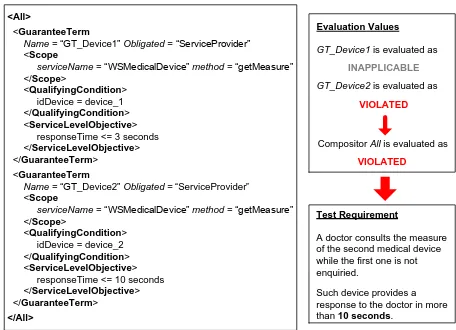
The relation between a test requirement and its con-stituent evaluation values is explained using an example from the eHealth scenario, depicted in Fig. 1. In the left part of the figure an All compositor element with two guarantee terms is represented in WS-Agreement. From the information contained in such compositor we try to identify potential error-prone situations that could be interesting to test. To address this task, we force the first guarantee term (GT_Device1) to take the Inapplicable evaluation value whereas the second guarantee term (GT_Device2) is evaluated as Violated, then the All com-positor will be evaluated as Violated. From these evalua-tion values a test requirement is identified (bottom right part of the figure). To be more specific, we are testing the behaviour of the eHealth system when a doctor is manag-ing an Emergency and one of the devices (device1) is not queried (GT_Device1 = Inapplicable) whereas the other service (device2) is not working properly according to the SLA (GT_Device2= Violated). Despite of the violation of
one guarantee term, the service composition must be able to continue its execution and provide a solution to the patient’s incidence. If there was a problem when dealing with an unexpected behaviour of one medical device as described, the exercitation of the identified test require-ment would allow us to uncover it before deploying the eHealth system in the production environment.
4 C
OVERAGE-B
ASEDT
ESTC
RITERIONThe process of testing SLA-aware SBAs can be improved by identifying test requirements from the specification of the SLAs using a criterion based on the principle of the Modified Condition / Decision Coverage (MCDC) [8] that allows obtaining a cost-effective set of test requirements, representing situations that are interesting to exercise regarding the SLA and the SBA. This set contains a re-duced number of test requirements to be exercised in order to uncover problems in the SBA.
Typically, MCDC is applied to a specification of the SUT. In our case, the specification that says how the SUT must behave is the SLA. In such SLA there are guarantee terms that represent conditions that can be satisfied or not. Hence, it is necessary to design tests that exercise situations in which the guarantee terms are fulfilled and situations in which not. Within this approach, these situa-tions are obtained by means of the application of our MCDC-based criterion.
4.1 Four-valued MCDC Test Criterion
Once the logic to evaluate the compositor elements of an SLA has been defined, we obtain the test requirements by combining the potential evaluation values of the terms included in the compositors. Considering that each term can be evaluated with four different values, the amount of test requirements would grow exponentially with the number of terms if we applied all the possible combina-tions. Hence, our objective is to avoid the exponential growth of test requirements in order to obtain a reduced but cost-effective set of test requirements and we achieve it by using MCDC.
[image:6.567.302.530.61.226.2]Modified Condition Decision Coverage (MCDC), de-fined in the RTCA/DO-178B standard [8], is a broadly studied structural coverage criterion [31], [32]. It has also
Fig. 1. Relation between Evaluation Values & Test Requirement
<All> <GuaranteeTerm
Name = “GT_Device1” Obligated = “ServiceProvider” <Scope
serviceName = “WSMedicalDevice” method = “getMeasure” </Scope>
<QualifyingCondition> idDevice = device_1 </QualifyingCondition> <ServiceLevelObjective> responseTime <= 3 seconds </ServiceLevelObjective> </GuaranteeTerm> <GuaranteeTerm
Name = “GT_Device2” Obligated = “ServiceProvider” <Scope
serviceName = “WSMedicalDevice” method = “getMeasure” </Scope>
<QualifyingCondition> idDevice = device_2 </QualifyingCondition> <ServiceLevelObjective> responseTime <= 10 seconds </ServiceLevelObjective> </GuaranteeTerm> </All>
Test Requirement
A doctor consults the measure of the second medical device while the first one is not enquiried. Evaluation Values
GT_Device1 is evaluated as
INAPPLICABLE
GT_Device2 is evaluated as
VIOLATED
Compositor All is evaluated as
VIOLATED
been used for test suite reduction and prioritization [33] because it provides a linear increase in the number of test requirements [30]. MCDC is a criterion that falls between condition/decision and multiple condition coverage [32]. This criterion has been shown to represent a good balance of test-set size and fault detecting ability simultaneously [34], [35]. MCDC is defined as a conjunction of the follow-ing requirements:
• Every point of entry and exit in the program has been invoked at least once.
• Every condition in a decision in the program has taken all possible outcomes at least once.
• Every decision in the program has taken all possible outcomes at least once.
• Each condition in a decision has been shown to in-dependently affect the decision’s outcome (a condi-tion is shown to independently affect a decision’s outcome by varying just that condition while hold-ing fixed all other possible conditions).
Consider the decision d = (a AND b) where a, b are two boolean conditions. To satisfy MCDC criterion, we need to generate three test cases (0,1) (1,1) (1,0) as de-scribed in Fig. 2.
MCDC criterion is usually defined for a binary logic. However, the application of MCDC when the logic allows four different evaluation values is more complex. So, in our approach:
Definition 3. A set of test requirements satisfies the SLACDC (SLA Condition / Decision Coverage) criterion for a combination of terms grouped within a compositor using the four-valued logic if and only if:
1. Every guarantee term has taken all possible evaluation
values at least once.
2. The compositor has taken all possible evaluation values
as outcome at least once.
3. For each possible evaluation value of a guarantee term,
a variation from a specific evaluation value to a differ-ent value has been shown to independdiffer-ently affect the evaluation of the compositor (this is, when we switch the evaluation value of the guarantee term while hold-ing fixed the evaluation values of the rest of terms, the outcome of the evaluation of the compositor varies).
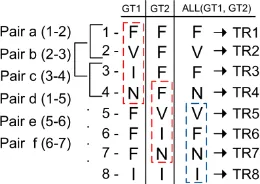
As an example, consider an All compositor element with two guarantee terms (GT1 and GT2) represented in Fig. 3. To address the identification of test requirements, we start from the situation where both guarantee terms are evaluated as Fulfilled and, thus, the All compositor is also evaluated as Fulfilled (row 1 in the figure). Then, we set the second row obtaining the first pair (a), which al-lows us to switch the evaluation value of GT1 from Ful-filled to Violated and this change affects the evaluation value of the compositor, which also changes from Ful-filled to Violated. After this, we set the third row obtain-ing a new pair (b), where the evaluation value of GT1
switches from Violated to Inapplicable and, consequently, the evaluation value of the All compositor changes from Violated to Fulfilled.
This process continues until we obtain six different pairs (a to f) that fulfil the conditions (1) and (3) of SLACDC criterion (Definition 3). However condition (2) is not fulfilled because the All compositor has not been evaluated as Inapplicable yet. In order to satisfy condition (2) we identify a new test requirement (row 8) where both guarantee terms are evaluated as Inapplicable and, thus, the All compositor also takes the Inapplicable evaluation value. At this stage, a final set of 8 test requirements (TR1-TR8) is obtained (Fig. 3) that satisfy the criterion instead of the 16 test requirements that would be obtained using a complete combination.
4.2 Identification of Test Requirements
In this section we present in detail the algorithms that are necessary to automate the elaboration of the test require-ments regarding the logical combinations of terms ex-pressed by means of the compositor elements. For each compositor, we define the algorithm that obtains the test requirements, and we illustrate the process with exam-ples.
All Compositor
While testing the conditions specified in an All composi-tor, we check how the variation of a guarantee term eval-uation affects the evaleval-uation of the compositor while the rest of guarantee terms have been fulfilled. Hence, the algorithm to obtain the set of test requirements for an All compositor that groups n Guarantee Terms is as follows:
1. Initialize the set with an initial test requirement (TR1) where all the guarantee terms are evaluated as Fulfilled. 2. For each GTi in the All_Compositor:
Add a new test requirement by means of switching the evaluation value of GTi from Fulfilled (as it is in TR1)
to (Violated, Inapplicable, Not Determined) while the evaluation of GTj with j ≠ i remains fixed to Fulfilled.
3. Add a new test requirement where all the guarantee terms are evaluated as Inapplicable in order to get the Inapplica-ble evaluation value in the All_Compositor.
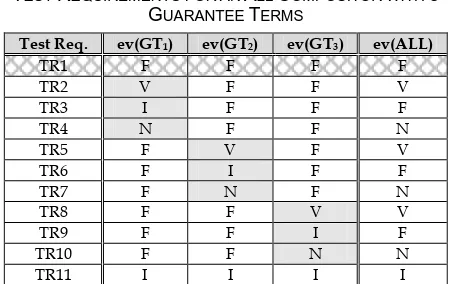
As an example, we partially illustrate the identification process of test requirements for an All compositor with 3 internal Guarantee Terms: ALL (GT1, GT2, GT3,).
Step1:
The set of test requirement is initialized with TR1 where all the terms are evaluated as Fulfilled.
Step2:
[image:7.567.348.478.645.737.2]For each guarantee term we add three test require-ments where the evaluation value of each guarantee term
must be switched from Fulfilled to (Violated, Inapplica-ble, Not Determined) while holding the rest of terms fixed with Fulfilled. The set of test requirements identi-fied in this step is represented in Table 2 (TR2-TR10).
Step3:
We identify a new test requirement where all the guar-antee terms are evaluated with the Inapplicable value.
The final set of test requirements identified for this compositor is represented in Table 2. The first column labels each test requirement and the evaluations of the individual guarantee terms (GT) and the compositor are represented in the rest of the columns. The first row is remarked because it corresponds to the initial test re-quirement and the cells that represent the guarantee terms that switch their evaluation values are grey shaded. The application of SLACDC criterion provides a linear number of combinations related to the number of condi-tions. In general, the number of combinations that satis-fies MCDC for a binary logical decision is (n+1) where n is the number of conditions within the decision, there are two possible truth values (true/false) for each condition and the maximum number of combinations is 2*n [36]. In our case and dealing with a four-valued logic for the evaluation of the guarantee terms, the number of test requirements obtained with SLACDC criterion remains linear regarding the number of guarantee terms and evaluation values and can be obtained according to the following formula:
where n is the number of internal terms within the compositor and v the number of evaluation values of each guarantee term (in this case, v = 4). If we apply a com-plete combination using the four-valued logic, the num-ber of obtained test requirement would be 4^n
OneOrMore Compositor
The algorithm to obtain the set of test requirements from an OneOrMore compositor is similar to the one for All compositor, but in this case we want to exercise the varia-tion of one term while the rest of guarantee terms have been violated. Thus, the algorithm for the identification of test requirements for an OneOrMore compositor is as follows:
1. Initialize the set with an initial test requirement (TR1) where all the guarantee terms are evaluated as Violated. 2. For each GTi in the OneOrMore_Compositor:
Add a new test requirement by means of switching the evalua-tion value of GTi from Violated (as it is in TR1) to (Fulfilled,
Inapplicable, Not Determined) while the evaluation of GTj
with j ≠ i remains fixed to Violated.
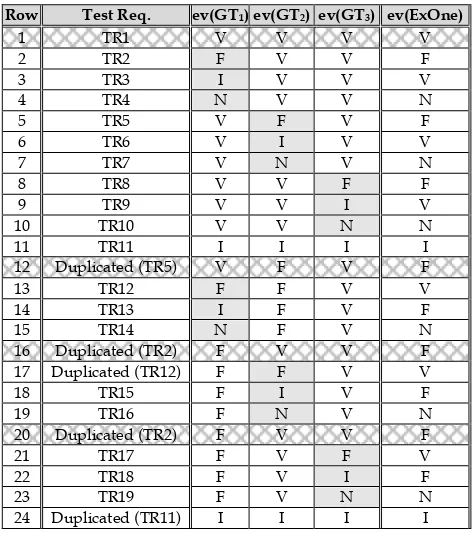
3. Add a new test requirement where all the guarantee terms are evaluated as Inapplicable in order to get the Inapplica-ble evaluation value in the OneOrMore_Compositor. We have omitted the explanation of the steps that per-form the identification of test requirements for this com-positor because the process is the same as for the All compositor. As an example, the test requirements identi-fied for an OneOrMore compositor with 3 guarantee terms can be seen in the first rows of Table 3 (rows 1-11).
The number of test requirements for an OneOrMore compositor is also given by the formula:
ExactlyOne Compositor
The identification of test requirements from an ExactlyOne compositor varies a little regarding the two aforementioned algorithms for compositors All and OneOrMore. The reason is that two different scenarios need to be considered for this compositor:
1. Test the combinations where the evaluation value of the compositor varies due to the flip from none term evaluated as fulfilled to only one term ful-filled.
2. Test the combinations where the evaluation value of the compositor varies to Violated because the flip involves the fulfilment of more than only one guarantee term.
The first scenario exercises the situation where all the guarantee terms are initially evaluated as Violated and we switch the evaluation value of each guarantee term to (Fulfilled, Inapplicable and Not Determined). Hence, it can be seen that this first scenario is exercised using the same set of test requirements that we have described for the OneOrMore compositor. This means that the algo-rithm (A1) to test this first scenario is the same and the test requirements obtained are represented in Table 3 (rows 1-11).
To exercise the second scenario, we have to obtain test requirements where there is already a unique guarantee term evaluated as Fulfilled and we flip the evaluation of another guarantee term between the four possible evalua-tion values. The algorithm (A2) for the identificaevalua-tion of these test requirements is as follows:
1. Initialize an empty set of test requirements. 2. For each GTi in the ExactlyOne_Compositor:
a. Add an initial test requirement where one guarantee term GTj with j ≠ i is evaluated as Fulfilled and the rest of
guarantee terms are evaluated as Violated.
b. Add a new test requirement by means of switching the evaluation value of GTi from Violated (as it is in the
cur-rent initial test requirement) to (Fulfilled, Inapplicable, Not Determined) while the evaluation of GTj with j ≠ i
remains fixed to Fulfilled and the evaluation of the rest of terms remains fixed to Violated.
3. Add a new test requirement where all the guarantee terms are evaluated as Inapplicable in order to get the Inapplica-ble evaluation value in the ExactlyOne_Compositor. The test requirements obtained with this algorithm
TABLE2
TEST REQUIREMENTS FOR AN ALL COMPOSITOR WITH 3 GUARANTEE TERMS
Test Req. ev(GT1) ev(GT2) ev(GT3) ev(ALL)
TR1 F F F F
TR2 V F F V
TR3 I F F F
TR4 N F F N
TR5 F V F V
TR6 F I F F
TR7 F N F N
TR8 F F V V
TR9 F F I F
TR10 F F N N
[image:8.567.45.272.612.754.2](A2) are represented in Table 3 (rows 12-24). The cells that contain the initial test requirement of step 2 for each guarantee term are remarked.
These two aforementioned scenarios may be tested in-dependently and it is the tester who decides whether (s)he wants to exercise both scenarios or just one. In case the tester decides to test both scenarios, it is necessary to apply an additional step that involves the removal of duplicated test requirements that are identified for both algorithms (A1 and A2).
In Table 3 we have joined the set of test requirements obtained through the algorithm A1 and the algorithm A2 and we have marked the duplicated test requirements. In the first column we identify with a number all the test requirements obtained with both algorithms. In the se-cond column we set an identifier to the final test require-ment or a brief description about the reason for removing such test requirement. In the rest of column the evalua-tion values of the guarantee terms and compositor are represented. Furthermore, we have remarked the rows that represent the initial test requirements in each algo-rithm and those cells where the evaluation value of the guarantee term is switched (grey shaded).
After joining both sets and removing the duplicated test requirements, a final number of 19 test requirements are identified. This number is obtained through the for-mula:
where n is the number of guarantee terms included in the ExactlyOne compositor. Thus, even applying these two algorithms to the compositor, we still provide a line-ar growth of test requirements regline-arding the number of guarantee terms included in such compositor.
4.3 Removing Non-feasible Test Requirements
The application of the aforementioned algorithms pro-vides a set of test requirements that satisfies the SLACDC criterion to the logical combinations of terms expressed by means of the compositors. However some of the iden-tified test requirements correspond to situations that may be non-feasible to exercise due to the semantic infor-mation contained in the guarantee terms. Hence, we have to deal with these specific situations in order to refine the tests previously obtained. To address this improvement we define a set of rules that allow modifying the test re-quirements that do not make sense and obtain other test requirements that represent feasible and interesting situa-tions to be tested.
These rules are defined to keep fulfilled, as much as possible, the conditions (1) and (2) of the criterion (Defini-tion 3) whereas the condi(Defini-tion (3) needs to be relaxed. However, it cannot be assured that these conditions will finally be fulfilled in the resultant set of tests require-ments due to the dependencies between the conditions specified in the SLA.
The application of the rules involves identifying the test requirements that are non-feasible in which certain evaluation values will be modified to obtain feasible test requirements. This process requires that more than one evaluation value is switched within the same test
re-quirement so SLACDC criterion is based on a specific form of MCDC named Masking MCDC, investigated by Chilenski [36], which allows more than one condition to vary at once ensuring that only the condition of interest influences the outcome.
Rule 1: Guarantee Terms without Qualifying Condition
This first rule is applied when some of the guarantee terms included in the compositor does not have Qualify-ing Condition. In this case, the test requirements where such term is evaluated as Inapplicable must be removed. This means that:
:
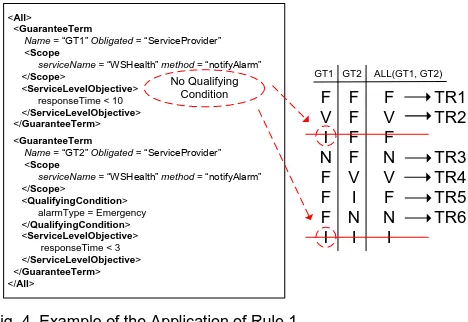
In Fig. 4 an example of the application of this rule over the eHealth scenario is depicted. There is an All composi-tor with two internal guarantee terms. The first of them (GT1) does not have Qualifying Condition so the test requirements where this term is evaluated as Inapplicable are removed. In the right part of the figure all the guaran-tee terms obtained for the All compositor are represented. The test requirements where the current rule is applied are crossed out so we finally obtain a set of six test quirements instead of the original set of eight test re-quirements.
Rule 2: Guarantee Terms with same Scope
This second rule is applied when there are guarantee terms in a compositor that are related to the same method and service (Scope). In this case, the test requirements that include these terms contain coupled conditions (in MCDC conditions that cannot be varied independently are said to be coupled [32]) or, in SLACDC criterion,
bet-TABLE3
TEST REQUIREMENTS FOR AN EXACTLYONE COMPOSITOR WITH 3GUARANTEE TERMS
Row Test Req. ev(GT1) ev(GT2) ev(GT3) ev(ExOne)
1 TR1 V V V V
2 TR2 F V V F
3 TR3 I V V V
4 TR4 N V V N
5 TR5 V F V F
6 TR6 V I V V
7 TR7 V N V N
8 TR8 V V F F
9 TR9 V V I V
10 TR10 V V N N
11 TR11 I I I I
12 Duplicated (TR5) V F V F
13 TR12 F F V V
14 TR13 I F V F
15 TR14 N F V N
16 Duplicated (TR2) F V V F 17 Duplicated (TR12) F F V V
18 TR15 F I V F
19 TR16 F N V N
20 Duplicated (TR2) F V V F
21 TR17 F V F V
22 TR18 F V I F
23 TR19 F V N N
[image:9.567.294.531.99.366.2]ter named as coupled guarantee terms. This implies that if one of these terms is evaluated as Not Determined (the method/service is not invoked), then the other term must also be evaluated as Not Determined. This is:
:
At this stage, if we have identified non-feasible test re-quirements due to dependencies between the scopes of a pair of involved guarantee terms, we have to modify the evaluation value of one of these guarantee terms. The procedure we follow to change this value aims at keep fulfilling as much as possible the condition (1) of Defini-tion 3, bearing in mind that condiDefini-tions (2) and (3) could be then relaxed. Then, the evaluation values Fulfilled / Violated / Inapplicable will be the candidates to be modi-fied because, by construction, they are much more com-mon than the other value Not Determined.
According to this principle, we search the test re-quirements that contain pairs of guarantee terms affecting the same method and service. If one of the terms is evalu-ated as Not Determined and the other is not, we change the evaluation value of this last guarantee term to Not Determined. This process must be repeated for each pair of terms in a test requirement that affect the same method and service. Furthermore, if the resultant test requirement is already duplicated, it is removed.
To illustrate the application of this rule, we consider an example of an All compositor with three guarantee terms (GT3, GT4, GT5), all of them affecting the same method / service (represented in the left part of Fig. 5.). The set of test requirements identified using the All compositor algorithm is represented in the first table within the top of the figure. From this requirements and applying this rule, we modify the specification of the test requirements 4, 7 and 8 in order to modify the non-feasible situations repre-sented in such requirements. In the right part of the fig-ure, we remark the involved guarantee terms in the modi-fication, we underline the evaluation value that has been modified in each change and we cross out the removed test requirements for being duplicated. Finally, the result-ing set of test requirements is represented in the bottom right part of the figure. Despite of having modified the evaluation values in some test requirements, it is
remark-able that, in this example, conditions (1) and (2) of the criterion are still being fulfilled whereas condition (3) has been relaxed for having switched more than one evalua-tion value in the same test requirement.
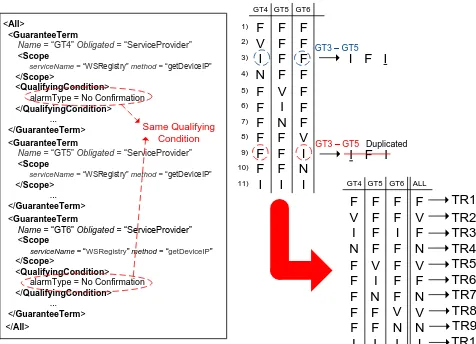
Rule 3: Guarantee Terms that have exactly the same QC
This rule is applied when there are some terms within a compositor that specify exactly the same Qualifying Condition, which is a common situation in a SLA. If such Qualifying Condition is met, the guarantee terms can be evaluated as Fulfilled or Violated or Not Determined but never Inapplicable. If it is not met, the guarantee terms must be evaluated as Inapplicable or Not Determined. Hence, in this case we have again coupled guarantee terms and it does not make sense that some of these terms are evaluated as Inapplicable while the others are Ful-filled or Violated. This is:
:
As we specified for the previous rule, we have to mod-ify the test requirements that contain these non-feasible combinations. Here again, we relax the condition (3) of the SLACDC criterion but trying to respect conditions (1) and (2) as much as possible.
To achieve this, we select the test requirements where this rule needs to be applied. As in the previous rule, the evaluation values Fulfilled and Violated are more usual than the Inapplicable so these are the values that will be modified to Inapplicable. Here again, this variation must be repeated for each pair of terms that contains the same Qualifying Condition within the compositor and resultant duplicated test requirements should be removed.
[image:10.567.297.537.62.261.2]To illustrate the application of this rule, we use an ex-ample of an All compositor with three guarantee terms (represented in the left part of the Fig. 6) that affect differ-ent services. Two of these terms (GT4 and GT6) specify the same condition in the Qualifying Condition element. Once we have identified the set of test requirements by means of applying the algorithm for the All compositor,
Fig. 4. Example of the Application of Rule 1.
Fig. 5. Example of the Application of Rule 2.
<All> <GuaranteeTerm
Name = “GT1” Obligated = “ServiceProvider” <Scope
serviceName = “WSHealth” method = “notifyAlarm” </Scope>
<ServiceLevelObjective> responseTime < 10 </ServiceLevelObjective> </GuaranteeTerm> <GuaranteeTerm
Name = “GT2” Obligated = “ServiceProvider” <Scope
serviceName = “WSHealth” method = “notifyAlarm” </Scope>
<QualifyingCondition> alarmType = Emergency </QualifyingCondition> <ServiceLevelObjective> responseTime < 3 </ServiceLevelObjective> </GuaranteeTerm> </All>
F F V I F F ALL(GT1, GT2) GT1 GT2 N F F F V I F I N I F V F N V F N I TR1 TR2 TR3 TR4 TR6 No Qualifying Condition TR5
<All> <GuaranteeTerm
Name = “GT3” Obligated = “ServiceProvider” <Scope
serviceName = “WSRegistry” method = “getDeviceIP” </Scope>
<QualifyingCondition> alarmType = Emergency </QualifyingCondition> <ServiceLevelObjective> responseTime < 3 </ServiceLevelObjective> </GuaranteeTerm> <GuaranteeTerm
Name = “GT4” Obligated = “ServiceProvider” <Scope
serviceName = “WSRegistry” method = “getDeviceIP” </Scope>
<QualifyingCondition> alarmType = No Confirmation </QualifyingCondition> <ServiceLevelObjective> responseTime < 3 </ServiceLevelObjective> </GuaranteeTerm> <GuaranteeTerm
Name = “GT5” Obligated = “ServiceProvider” <Scope
serviceName = “WSRegistry” method = “getDeviceIP” </Scope>
<ServiceLevelObjective> count (professionals) > 0 </ServiceLevelObjective> </GuaranteeTerm> </All>
Same Method / Service
GT4 GT5 GT3 F V I N F F F F F F F F F F V I N F F F F F F F F F F V I N I I I
N N F N N N
GT1 – GT2 GT1 – GT3
N N F N N N
GT1 – GT2 GT2 – GT3 Duplicated
N F N N N N
GT1 – GT3 GT2 – GT3 Duplicated
GT2 GT3 GT1 F V I N F F F F F F F N V I F F F F F N F F V I I I I
[image:10.567.43.277.65.226.2]we have to select and modify those requirements that contain any of the non-feasible aforementioned combina-tions (test requirements 3 and 9). In the right part of the figure, we perform the modifications, indicating the in-volved guarantee terms and crossing out the removed test requirement for being duplicated.
Rule 4: Guarantee Terms that have mutually disjoint QCs
This rule arises when, in a compositor, there are guar-antee terms that contain Qualifying Conditions that are mutually disjoint. This means that, if the Qualifying Con-dition of one term is met then the Qualifying ConCon-dition of the other term must not be met. Regarding the non-feasible test requirements, if one of these terms is evaluat-ed as Fulfillevaluat-ed or Violatevaluat-ed in a test requirement then the other one term must be evaluated as Inapplicable or Not Determined. This is:
:
* Note that in this context, the operator (!) does not mean that one Qualifying Condition is the opposite to the other. It really means that if the first QC is met then the second QC cannot be met.
In order to avoid the appearance of the non-feasible combinations in the final test suite, we have to modify the test requirements that contain such combinations. The procedure is similar to the one performed in the previous pair of rules (Rule2 and Rule3). In fact, this rule is practi-cally the opposite as Rule3. Here again, we will change from the most common Fulfilled or Violated evaluation values to another appropriate value. This could be both Inapplicable and Not Determined although we decide to switch to Inapplicable because the Not Determined value also affects the application of Rule2 and, in that case, we would have to apply again such rule so this may become an ineffective loop.
According to this principle, we search the involved test requirements. By construction, in each test requirement there is a guarantee term whose evaluation value varied (named pivot GT) while the evaluation values of the other
terms remained fixed. If the pair of terms that have mutu-ally disjoint QC includes the pivot GT, then we always modify the evaluation value of the other term from Ful-filled or Violated to Inapplicable. On the other hand, if the pair of terms does not include the pivot GT, then we could modify the evaluation value of any of the two terms. As always, we have to repeat the process for each pair of terms that appear in the test requirement and re-move the test requirements that become duplicated.
In Fig. 7 we show the application of this rule for an All compositor with two internal guarantee terms that pre-sent two mutually disjoint Qualifying Conditions in their specifications. In the example, the first four test require-ments were obtained by holding fixed the value Fulfilled in the second guarantee term while switching the value of the first guarantee term (so the pivot GT is GT8). Hence, in test requirements 1 and 2 we change the value of the second guarantee term from Fulfilled to Inapplicable as explained before. In test requirements 5 the pivot GT is GT9 so we modify the evaluation value Fulfilled of GT8 to Inapplicable.
4.4 Derivation of Test Cases
A test case specifies a set of steps that involve different executions of the constituent services of the application. These steps are defined by using the information repre-sented in the test requirements that are exercised in such test case. In each of these steps the guarantee terms and compositors need to be evaluated so the expected output regarding the evaluation of the SLA is automatically ob-tained by applying the four-valued logic to the elements that composed the test requirement.
[image:11.567.33.271.62.234.2]The objective of the generation of test cases is to max-imize the trade-off among different factors such as cost, benefit or risks by means of obtaining a reasonable num-ber of test cases that achieve detecting as many defects as possible. In this article, this process is based on the four-valued logic to evaluate SLAs and the proposed criterion to identify the test requirements. Once the set of test re-quirements that represent the situations to be tested is identified, we have to decide how to combine such test requirements in order to achieve an expected degree of coverage in the resulting test suite. To do this, it is also necessary to have some knowledge about the behaviour
Fig. 6. Example of the Application of Rule 3.
Fig. 7. Example of the Application of Rule 4.
<All> <GuaranteeTerm
Name = “GT4” Obligated = “ServiceProvider”
<Scope
serviceName = “WSRegistry” method = “getDeviceIP”
</Scope> <QualifyingCondition> alarmType = No Confirmation </QualifyingCondition>
... </GuaranteeTerm> <GuaranteeTerm
Name = “GT5” Obligated = “ServiceProvider”
<Scope
serviceName = “WSRegistry” method = “getDeviceIP”
</Scope> ... </GuaranteeTerm> <GuaranteeTerm
Name = “GT6” Obligated = “ServiceProvider” <Scope
serviceName = “WSRegistry” method = “getDeviceIP” </Scope>
<QualifyingCondition> alarmType = No Confirmation </QualifyingCondition>
...
</GuaranteeTerm> </All>
Same Qualifying Condition GT5 GT6 GT4 F V I N F F F F F F F F F F V I N F F F F F F F F F F V I N I I I
1) 2) 3) 4) 5) 6) 7) 8) 9) 10) 11)
I F I GT3 – GT5
I F I
GT3 – GT5Duplicated
GT5 GT6 GT4 F V I N F F F F F F F F V I N F F F I F F F F V
I I I
ALL F V F N V F N V I TR1 TR2 TR3 TR4 TR6 TR5 TR7 TR10 TR8 F F N N TR9
<All> <GuaranteeTerm
Name = “GT8” Obligated = “ServiceProvider” <Scope
serviceName = “WSDoctor” method = “receiveAlarm” </Scope>
<QualifyingCondition> deployedOn = mobileNode </QualifyingCondition> <ServiceLevelObjective> responseTime < 6 </ServiceLevelObjective> </GuaranteeTerm> <GuaranteeTerm
Name = “GT9” Obligated = “ServiceProvider” <Scope
serviceName = “WSDoctor” method = “receiveAlarm” </Scope>
<QualifyingCondition> deployedOn = wiredServer </QualifyingCondition> <ServiceLevelObjective> responseTime < 2 </ServiceLevelObjective> </GuaranteeTerm> </All>
F F V I F F GT8 GT9 N F F F V I F I N I Mutually disjoint Qualifying Conditions F I V I I V Duplicated 1) 2) 3) 4) 5) 6) 7) 8) V I I F GT8 GT9 N F I F V I F N All V F N V F N TR1 TR2 TR3 TR4 TR6 TR5
[image:11.567.291.527.62.222.2]of the SBA in order to properly combine the test require-ments and obtain an effective set of test cases.
At this stage, it is the tester who has to combine the test requirements in each test case, bearing in mind that the more test requirements that can be covered in a single test case, the fewer test cases are needed to cover all the test requirements. In each test requirement we have as-sured that there are not non-feasible situations to test by applying the proposed specific rules but this does not mean that any combination of test requirements in a test case makes sense. Typically, there will be test require-ments that are incompatible to be combined within the same test case due to the specification of the SBA so this task of generating the test cases by combining the test requirement is not definitely trivial and must be carefully performed.
4.5 Tool Support
We have implemented a proof-of-concept tool that auto-mates the identification of test requirements from the specification of a SLA in the WS-Agreement language.
This tool receives the xml file of the SLA as input, it parses the content of the agreement and implements the algorithms for each compositor contained in the SLA. Once the initial set of test requirements is obtained, it accordingly modifies or removes the non-feasible combi-nations by means of applying the aforementioned rules.
The output of the tool is the specification of the final set of feasible test requirements, including the evaluation value of each involved Guarantee Term.
5 C
ASES
TUDYIn this section we illustrate the identification of test re-quirements from the logical conditions of a SLA associat-ed to an eHealth service-basassociat-ed application. This scenario has been proposed in the context of the EU FP6 PLASTIC Project [9] and has also been used as case study in previ-ous approaches that tackle the testing of SLAs [10], [11]. The SLA that contains the conditions that must be ful-filled by the stakeholders in this scenario is specified in WS-Agreement standard language and can be publicly downloaded [37]. The whole process has been performed automatically using the tool we have implemented.
5.1 Description
The behaviour of the service-based application that is used as case study in this article is as follows. Basically, the eHealth system is deployed as a composite service (WSHealth), which manages the alarms received from the patients. This service finds the list of professionals to solve the alarm in a registry (WSRegistry). There are two different types of alarms (Emergencies and Not Confir-mation) and two types of professionals to handle the incident (doctors and supervisors), which are connected to the system through wired or mobile devices. If a doctor is contacted, he gets measures from the medical devices (WSMedicalDevice) deployed in the patient’s location. If it is a supervisor who is contacted, he arranges an ap-pointment for the patient in the calendar (WSCalendar). This scenario has a SLA associated, specified in the
WS-Agreement standard language. This SLA contains 14 Guarantee Terms, which are logically grouped using 5 compositors under the most external and mandatory All compositor. In Table 4 we represent the distribution of the guarantee terms in each of these compositors.
5.2 Identification of Test Requirements
The algorithms described in Section 4.2 have been applied in order to obtain the initial set of test requirements. As we have previously stated, many of these test require-ments may be non-feasible so the rules defined in Section 4.3 have also been applied. As a result, Table 5 displays the compositors specified in the SLA (first column), the number of test requirements initially identified using the aforementioned algorithms (second column) and the number of test requirements that have been modified (M) and removed (R) after applying each rule (middle col-umns). Lastly, the last column outlines the final number of test requirements for each compositor.
Initially, a set of 62 test requirements are identified by applying the SLACDCcriterion .These test requirements fulfil the conditions specified in such criterion, which assures that every Guarantee Term and every Compositor take the four potential evaluation values and the variation of any value affects the output of the evaluation. After that, we apply the rules we have defined in Section 4.3in order to avoid the obtaining of non-feasible requirements. The final set contains a total number of 33 test re-quirements, which are represented in Fig. 8. This number is significantly lower than the number of test require-ments we had obtained if we had applied a complete combination using the four-valued logic in each composi-tor. In that case, we had initially obtained a set of 1136 test requirements (4n for each compositor, where n is the
number of involved GTs).
5.3 Derivation of Test Cases
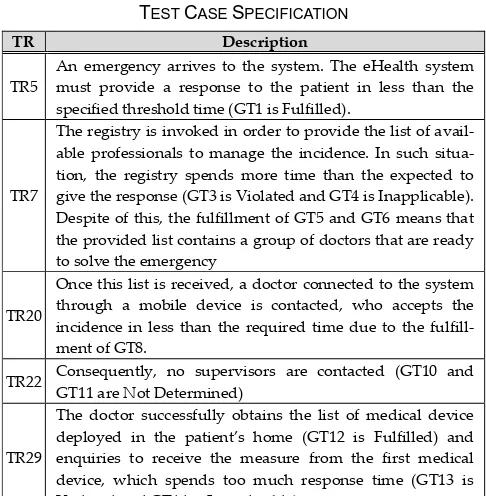
The identified test requirements are the basis to derive the test cases that will be executed in the SBA. In this section we provide an example about how different test require-ments may be combined in order to generate a complex
TABLE4
STRUCTURE OF THE EHEALTH SLA
Compositor Guarantee Terms
All (1) GT1, GT2 All (2) GT3, GT4, GT5, GT6, GT7 ExactlyOne (1) GT8, GT9 ExactlyOne (2) GT10, GT11
All (3) GT12, GT13, GT14
TABLE5
TEST REQUIREMENTS IDENTIFICATION
Compositor Initial Rule1 Rule2 Rule3 Rule4 Total R M R M R M R
All (1) 8 0 2 1 0 0 3 1 6
All (2) 17 2 5 4 4 2 6 1 8
ExOne (1) 13 0 4 3 0 0 4 4 6
ExOne (2) 13 0 4 3 0 0 4 4 6