Prepared for submission to JINST
3rd ELIMEDthWorkshop MEDical and multidisciplinary applications of laser-driven ion beams at ELI-Beamlines
7-10 September 2016
Laboratori Nazionali del Sud of INFN
Time of Flight based diagnostics for high energy laser
driven ion beams
V.Scuderia,b,1, G. Milluzzob,c , A. Alejod , A.G. AmicobN. Boothe , G.A.P. Cirroneb, D. Doriad, J. Greene , S. Kard, G. Larosab, R. Leanzab,c , D. Margaronea, P. McKennaf , H. Paddaf , G. Petringab,c, J. Pipekb, L. Romagnanig, F.Romanob, F. Schillacia,b,c, M. Borghesid, G. Cuttoneb, G. Korna
aInstitute of Physics ASCR, v.v.i (FZU), ELI-Beamlines project, 182 21 Prague, Czech Republic bINFN-Laboratori Nazionali del Sud (LNS-INFN), Via S Sofia 62, Catania, Italy
cPhysics and Astronomy Department, University of Catania, Catania, Italy
dSchool of Mathematics and Physics, Queens University Belfast, Belfast, United Kingdom eCentral Laser Facility, STFC Rutherford Appleton Laboratory, Didcot OX11 0QX, UK fDepartment of Physics, SUPA, University of Strathclyde, Glasgow G4 0NG, UK gLULI, Ecole Polytechnique, CNRS, CEA, UPMC, 91128 Palaiseau, France
E-mail: [email protected]
Abstract: Nowadays the innovative high power laser-based ion acceleration technique is one of the most interesting challenges in particle acceleration field, showing attractive characteristics for future multidisciplinary applications, including medical ones. Nevertheless, peculiarities of optically accelerated ion beams make mandatory the development of proper transport, selection and diagnostics devices in order to deliver stable and controlled ion beams for multidisciplinary applications. This is the main purpose of the ELIMAIA (ELI Multidisciplinary Applications of laser-Ion Acceleration) beamline that will be realized and installed within 2018 at the ELI-Beamlines research center in the Czech Republic, where laser driven high energy ions, up to 60 MeV/n, will be available for users. In particular, a crucial role will be played by the on-line diagnostics system, recently developed in collaboration with INFN-LNS (Italy), consisting of TOF detectors, placed along the beamline (at different detection distances) to provide online monitoring of key characteristics of delivered beams, such as energy, fluence and ion species. In this contribution an overview on the ELIMAIA available ion diagnostics will be briefly given along with the preliminary results obtained during a test performed with high energy laser-driven proton beams accelerated at the VULCAN PW-laser available at RAL facility (UK).
Keywords: Ion diagnostics; high energy laser-driven protons; time of flight.
Contents
1 Introduction 1
2 The ELIMAIA diagnostics system 3
3 Results 4
4 Conclusions 6
5 Acknowledgments 7
1 Introduction
[image:2.595.198.399.540.671.2]The user-oriented ELIMAIA beamline will be installed at the ELI-Beamlines facility in Prague within 2018. The beamline will be dedicated to multidisciplinary and medical applications of ion sources generated by the interaction of 1 PW laser pulse (30 J, 30 fs), with a solid target at high repetition rate, (1-10 Hz). Furthermore, in a second phase, a PW-class, "long-pulse" (150 J, 150 fs, 1 shot/min) will also be available for proof-of-principle experiments in the field of laser plasma acceleration physics. The ELIMAIA beamline is composed of a section dedicated to laser-transport and ion acceleration, consisting of a plasma mirror (PM) chamber and a target interaction chamber (TC) provided with a laser diagnostics system (LD), and a section (an ad hoc "conventional" beamline), named ELIMED, dedicated to transport, selection, diagnostics and dosimetry of the optically accelerated ion beams entirely developed and realized by INFN-LNS in collaboration with ELI-Beamlines. Fig.1shows a technical layout of the ELIMAIA beamline in the so-called E4 experimental hall of the ELI-Beamlines experimental building.
2 The ELIMAIA diagnostics system
Due to the extremely peculiar features of laser-driven ion beams available today, such as the short pulse duration (0.1-1 ns near the source), the peak current (1010 to 1012 p/pulse) and the very high dose-rates in a single pulse (109Gy/min) compared to those of the conventionally accelerated beams [11–13], innovative techniques and devices for beam diagnostics have to be developed since a robust online diagnostics represents one of the crucial steps towards multidisciplinary applications of such beams. Diamond and silicon carbide detectors show interesting characteristics [8–10] in TOF measurements of high energy laser-driven proton beams, such as good time and energy resolution, radiation hardness in order to support fluxes up to 109 p/bunch and low capacitance which makes them particularly attractive for timing measurements of high intensity particle bunch at high repetition rate. The ELIMAIA diagnostics system consists of chemical vapour deposited polycrystalline (pDD) and single crystal diamond (sDD) detectors and SiC detectors with different surface sizes, between 2 mm and 5 mm diameter, and thicknesses, between 20 µm and 500 µm. In particular, a thin (about 100 µm) pDD will be used to measure the TOF signal at about 2 m downstream the source, i.e after the PMQ system, and a thick (about 500 µm) sDD will be used to measure the TOF signal of the proton group selected by the energy selection, downstream the in-vacuum beamline at about 9 m from the source. Indeed, according to ion beam optics studies [4], about 20% of the particles generated at the source, i.e. about 109 in the worse case, will be transmitted through the focusing system with a broad energy distribution, therefore a low capacitance, fast detector suitable for high intensity loss measurements, as a thin pDD, will allow to measure the TOF of the whole proton group with a reasonably good time resolution with a 2 m flight path even for the fastest energy component. On the other hand, downstream the selection system, as an example, for the 60 MeV proton transport and selection a minimum proton number of about 107per bunch with 20% energy spread is expected [5], hence a sDD, thanks to an excellent signal-to-noise ratio, will allow to measure the narrow energy proton distribution selected.
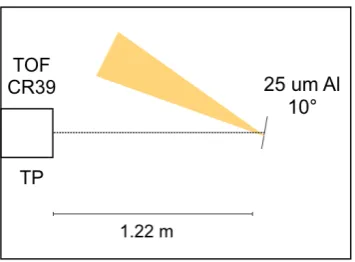
A single crystal diamond detector (sDD), 3×3 mm2and 500µm thick, and polycrystalline diamond detector (pDD), 2×2 mm2and 100 µm thick, both supplied by the CIVIDEC company [14], have been recently tested in TOF measurements of the high energy laser-driven proton beams generated by the Petawatt Vulcan laser at the Rutherford Appleton Laboratory (RAL). The VULCAN laser is a neodymium glass laser operating at a central wavelength of 1053 nm, delivering about 650 J in a time pulse of about 500 fs, able to accelerate protons up to 60 MeV [15]. The goal of the experiment was to measure the temporal evolution signal of the high energy optically accelerated proton beam, test the developed TOF diagnostics with diamond detectors for the first time with high-energy (several tens of MeV) laser-driven proton beam and extract from the TOF signal the energy cut-offs, the energy distribution and the correspondent fluence. The target used for the experiment was a flat 25µm thick Al foil. The detectors were placed both in the forward and in the backward direction at about 10◦with respect to the target normal direction and at different distances, i.e. flight paths, from the target between about 1 m and 4 m. In order to compare the energy distribution and the fluence extracted from the TOF signal a Thomson Parabola (TP) spectrometer coupled with imaging plate detectors and CR39 nuclear track detectors were used in the backward direction measurements. A schematic layout of the experimental setup is shown in fig.2.
Figure 2. A sketch of the experimental setup.
load impedance. Diamond detectors were provided with an integrated HV circuit consisting of a simple RC circuit (R= 2 MΩ, C= 100nF) optimized to compensate possible detector discharges and a stable charge collection. A power supply module has been used to provide a bias voltage of 200 V to the pDD and 500 V to the sDD.
3 Results
A typical TOF signal acquired with the pDD at about 1 m from the target in the backward direction is shown in fig.3. A 50µm Al absorber was used to shield the detector and to stop 2 MeV protons. As one can clearly see in fig.3, three peaks can be identified: the photopeak originating from the
0 10 20 30 40 50 60 70 80 90 100
0 50 100 150 200 250
TOF [ns]
Amplitude [Volt] 16 18 20 22
0 20 40 60
Energy proton [MeV]
Amplitude [Volt]
Ions
Photo−Peak
16 ns Protons
4 ns
Figure 3. A TOF signal acquired with the pDD @ 1.22 m downstream the target. The inset shows the incident kinetic energy calculated in the range corresponding to the faster proton peak.
[image:5.595.158.384.451.587.2]distance travelled from the source to the detector by the UV and X-rays using the formula:
t=TOF + L
c (3.1)
wherecis the speed of light andtis the TOF corrected for the photon flight path. Then, the incident proton kinetic energy can be obtained using the corrected TOF,t, by the well-known definition:
Ekin =(γ−1)Mpc2 γ = 1 p
(1− β2) β =
L
ct (3.2)
TOF signal deconvolution can be carried out coupling the TOF signal with the contribution of the different ion species extracted from the TP parabola spectrometer measurements. Nevertheless, the first diagnostics section along the ELIMAIA beamline is placed downstream the PMQ focusing system, at this stage an ion component might still be transported together with the focused proton beam therefore the TOF spectrum will result in a signal due to the overlap of different ion species. In this case, the TOF signal deconvolution will be improved coupling the TOF measurements with a TP parabola spectrometer designed and developed at ELI-Beamlines. On the other hand, the second diagnostics section is placed downstream the in vacuum beamline after the energy selection system. At the end of the in-vacuum beamline only a selected proton beam component will be transported, therefore, the TOF signal will be only ascribable to protons with the selected energy, thus the analysis procedure to extract the energy spectrum will be more straightforward as shown in fig.3for the spectrum region where only the fast proton contribution is present. In view of the ELIMAIA diagnostics system development, the TOF diagnostics system described in this work will be improved using passive and also thin active absorbers in order to stop the heavier ions, detect only the fast protons and reconstruct the contribution of the stopped ions. Furthermore, an array of diamond detectors will be assembled and tested in order to provide also measurement of the beam energy spectrum as a function of the emission angle from the source.
4 Conclusions
5 Acknowledgments
This work has been performed within the ELIMED activities supported by the V committee of INFN (Italian Institute for Nuclear Physics), by the MIUR (Italian Ministry of Education, Research and University), by the ELI-Beamlines Contract no S14-187 under under CZ.02.1.01/0.0/0.0/15
−008/0000162 through the European Regional Development Fund, by the Ministry of Education, Youth and Sports of the Czech Republic (National Program of Sustainability II Project No. LQ1606) and by the EPSRC (grant n. EP/K022415/1).
References
[1] G.A.P. Cirrone et al.,Transport and dosimetric solutions for the ELIMED laser-driven beam line, Nucl. Instrum. Meth. A 796 (2015) 99.
[2] G.A.P. Cirrone et al.,Design of the prototype of a beam transport line for handling and selection of low energy laser-driven beams,Appl. Sci. 5 (2015) 427.
[3] F. Schillaci et al.,Design of the prototype of a beam transport line for handling and selection of low energy laser-driven beams,Nuclear Instruments and Methods in Physics Research A 837 (2016) 80 [4] F. Schillaci et al.,Design of the ELIMAIA ion collection system,JINST 10 T12001 (2015)
[5] F. Schillaci et al.,Design of a large acceptance, high efficiency energy selection system for the ELIMAIA beam-line,JINST 11 P08022
[6] F. Romano et al.,The ELIMED transport and dosimetry beamline for laser-driven ion beams,Nuclear Instruments and Methods in Physics Research A 829(2016)153-158
[7] D. Margarone et al,Diamond detectors for characterization of laser-generated plasma,Rad Eff Def. Solids 163, 2008, 463
[8] D. Margarone et al.,Full characterization of laser-accelerated ion beams using Faraday cup, silicon carbide, and single-crystal diamond detectors,J. Appl. Phys. 109, 103302 (2011)
[9] M. Marinelli et al.,Analysis of laser-generated plasma ionizing radiation by synthetic single crystal diamond detectors,Applied Surface Science 272 (2013) 104-108.
[10] G. Bertuccio et al.,Silicon carbide detector for laser-generated plasma radiation,Applied Surface Science 272 (2013) 128-131
[11] E.L. Clark et al.,Measurements of Energetic Proton Transport through Magnetized Plasma from Intense Laser Interactions with Solids,Physical Review Letters 84 (2000) 670.
[12] A. Maksimchuk, S. Gu, K. Flippo, D. Umstadter, Y.V. Bychenkov,Forward Ion Acceleration in Thin Films Driven by a High-Intensity Laser,Physical Review Letters (2000) 8.
[13] R.A. Snavely et al.,Intense High-Energy Proton Beams from Petawatt-Laser Irradiation of Solids, Physical Review Letters (2000) 85.
[14] CIVIDEChttps://cividec.at
[15] C.N Danson et al.,Vulcan Petawatt an ultra-high-intensity interaction facility,Nuclear Fusion, Volume 44, Number 12