City, University of London Institutional Repository
Citation
:
White, L. C., Barque-Duran, A. and Pothos, E. M. (2016). An investigation of a quantum probability model for the constructive effect of affective evaluation. Philosophical transactions of the Royal Society of London. Series A: Mathematical and physical sciences, 374(2058), .20150142. doi: 10.1098/rsta.2015.0142This is the supplemental version of the paper.
This version of the publication may differ from the final published
version.
Permanent repository link:
http://openaccess.city.ac.uk/12449/Link to published version
:
http://dx.doi.org/10.1098/rsta.2015.0142Copyright and reuse:
City Research Online aims to make research
outputs of City, University of London available to a wider audience.
Copyright and Moral Rights remain with the author(s) and/or copyright
holders. URLs from City Research Online may be freely distributed and
linked to.
City Research Online: http://openaccess.city.ac.uk/ [email protected]
© The Authors under the terms of the Creative Commons Attribution License http://creativecommons.org/licenses/by/3.0/, which
permits unrestricted use, provided the original author and source are credited. 1
Supporting online material for
An investigation of a quantum probability model for the constructive effect
of affective evaluation
Lee C. White1*, Albert Barque-Duran2 & Emmanuel M. Pothos2
1 Department of Psychology, Swansea University, Singleton Park, Swansea, SA2 8PP, UK; 2 Department of Psychology, City University London, Northampton Square, London, EC1V
0HB, UK
* To whom correspondence should be addressed: [email protected]
Published Phil. Trans. R. Soc. A.
DOI: 10.1098/not yet assigned
This PDF file includes:
Appendix A - A cognitive model based on quantum probability theory for the constructive effect of affective evaluation
© The Authors under the terms of the Creative Commons Attribution License http://creativecommons.org/licenses/by/3.0/, which
permits unrestricted use, provided the original author and source are credited. 2
Appendix A
A cognitive model based on quantum probability theory for
the constructive effect of affective evaluation
1. Introduction
The following is adapted from White, Pothos and Busemeyer [1]. It provides more
detail regarding how Quantum Probability (QP) has been employed to create a cognitive
model for the constructive effect of affective evaluation. An introduction to the basic relevant
ideas (e.g., projection) is in White et al. [1].
2. Applying the QP principles to affective evaluation
We proceed by making minimal assumptions regarding representation and dynamics.
Specifically, we assume that positive and negative affect are represented by rays in a
two-dimensional, real space, in which the state vector represents participants’ opinion state,
regarding the images. The positive and negative affect rays are orthogonal since certainty that
e.g. an image is positive (which means that the state vector aligns with the positive affect ray)
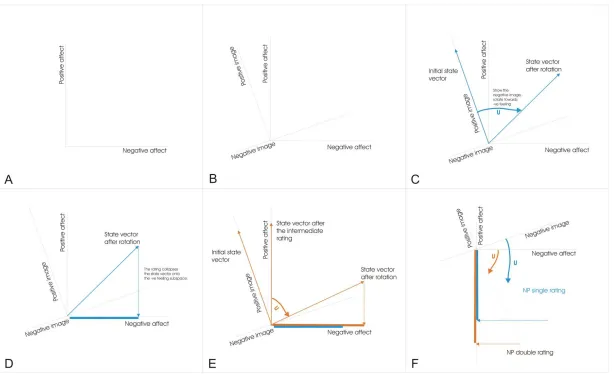
implies zero probability that the image is negative (Figure 1A). There is another set of rays,
corresponding to having a positive image or a negative image. These rays are positioned
close to their respective positive and negative affect rays. Also, the positive and negative
image rays are assumed to be orthogonal, because the images in each pair were selected, so
that they were unrelated (Figure 1B). Note, we are making fairly strong assumptions in
setting the subspaces of all possibilities to be one-dimensional (rays) and coplanar. These
assumptions are assessed indirectly in terms of the model’s ability to capture the observed empirical results.
We assume that when participants see a positive image the state vector is aligned with
the positive image ray (Figure 1C). When they subsequently perceive the negative image, the
impact on the state vector is to rotate by a fixed amount towards the negative affect ray. This
is an important assumption about dynamics (that they are unitary), but which does not impact
on prediction in our case. In more general cases, open system dynamics should be employed
© The Authors under the terms of the Creative Commons Attribution License http://creativecommons.org/licenses/by/3.0/, which
permits unrestricted use, provided the original author and source are credited. 3
projection onto the negative affect ray (Figure 1D). This length squared is the probability of
interpreting the second image negatively and, without loss of generality, we can equate this
probability to the negativity in the rating. In Figure 1E, we consider the impact of the
intermediate rating: as the first image is positive, such a rating is likely to result in a positive
impression (aligning the state vector with the positive affect ray). Then, when introducing the
negative image, the state vector is rotated to the same extent [4,5], which brings the state
vector closer to the negative affect ray. It is clear in Figure 1E that this leads to a longer
projection along the negative affect ray. This is how the prediction that the intermediate
rating amplifies the negative impression of the subsequent image arises in the QP model, in
the PN order. An analogous reasoning predicts that in the NP order an intermediate rating
will amplify the positivity of the subsequent rating (Figure 1F).
Further formalization would be warranted if one were to attempt to provide exact
quantitative fits to the results, though we stress that this is not our objective here. The way
such a formalization would proceed is by noting that, in the PN condition (the situation is
exactly analogous in the NP condition), in the single rating condition:
� � � � � = |���|� |2
where PN= |N N| is the projector to the Negative Affect ray and |ψ is the initial state vector. The matrix U is the unitary matrix quantifying the effect of introducing the
negative image. If we consider clockwise rotations as positive, then we can write |ψ =
R−θ|P , where |P is the positive affect ray, θ is the angle between |ψ , |P , and R−θ is a
rotation (unitary) matrix.
In the double rating condition:
� � � � � = |���|� |2
So, the impact of having the intermediate rating can be quantified as:
|���|� |2− |����−�|� |2
Let us further express U as � = ��, where � is the fixed angle which captures how
much the mental state rotates towards the negative affect ray, as a result of introducing the
negative image. Then, the expression which determines the extra negativity in the second
rating, due to the intermediate rating, is:
© The Authors under the terms of the Creative Commons Attribution License http://creativecommons.org/licenses/by/3.0/, which
permits unrestricted use, provided the original author and source are credited. 4
noting that � + = � � (e.g., [6], p.131). We basically see that the
intermediate rating is equivalent to rotating the initial mental state further towards the
negative affect ray, in relation to the situation where there is no intermediate rating.
As it stands, this expression has two parameters, �and�. If computational fits were
the primary objective of an investigation, it would have to be the case that at least one of
these parameters is determined independently (e.g., through pilot data). As things stand, as
noted, in this demonstration we are interested only in the general, qualitative prediction that,
introducing the intermediate rating, leads to a more negative rating for the second image (in
the PN condition) and, analogously, a more positive rating for the second image (in the NP
condition).
© The Authors under the terms of the Creative Commons Attribution License http://creativecommons.org/licenses/by/3.0/, which
[image:6.842.110.725.69.443.2]permits unrestricted use, provided the original author and source are credited. 5
© The Authors under the terms of the Creative Commons Attribution License http://creativecommons.org/licenses/by/3.0/, which
permits unrestricted use, provided the original author and source are credited. 6 3. References
1. White LC, Pothos EM, Busemeyer, JR. 2014 Sometimes it does hurt to ask: the
constructive role of articulating impressions. Cognition 133, 48-64.
(doi:10.1016/j.cognition.2014.05.015)
2. Asano M, Ohya M, Tanaka Y, Basieva I, Khrennikov A. 2011 Quantum-like model of
brain’s functioning: decision making from decoherence. J Theor Biol 281, 56-64. (doi:10.1016/j.jtbi.2011.04.022)
3. Asano M, Ohya M, Tanaka Y, Khrennikov A, Basieva I. 2011 On application of
Gorini-Kossakowski-Sudarshan-Lindblad equation in cognitive psychology. Open Syst Inf Dyn
18, 55-69. (doi:10.1142/S1230161211000042)
4. Laming DRJ. 1984 The relativity of “absolute” judgments. Brit J Math Stat Psy 37,
152-183. (doi:10.1111/j.2044-8317.1984.tb00798.x)
5. Stewart N, Brown GDA, Chater N. 2005 Absolute Identification by Relative Judgment.
Psychol Rev 112, 881–911. (doi:10.1037/0033-295X.112.4.881)
© The Authors under the terms of the Creative Commons Attribution License http://creativecommons.org/licenses/by/3.0/, which
permits unrestricted use, provided the original author and source are credited. 7
Appendix B
Pilot study to select celebrities for Experiment 3
1. Introduction
The stimuli used in Experiment 3 were the images and names of pairs of celebrities
drawn from various areas of public life e.g. music, politics and sport. The celebrities were
selected on the basis that they were sufficiently related so that one would expect the
trustworthiness of one to change our perspective for the trustworthiness of the other and so
that one celebrity would be regarded as more trustworthy than the other. The purpose of this
pilot study was to validate the trustworthiness of the selected celebrities.
2. Method
2.1.Participants and Design
Seventeen Swansea University students participated for course credit (16 women,
average age 19.7 years).
2.2.Stimuli and procedure
Twenty seven pairs of celebrities were collected from various internet sources as
being likely, in the experimenter’s estimation, to show differential levels of trustworthiness.
Images were selected that showed the celebrity looking directly at the camera and with a
neutral, non-emotional expression (e.g., not smiling). The images, as in other experiments
[e.g., 1,2], were cropped to the celebrity’s head and shoulders, converted to grayscale and
scaled to the same size.
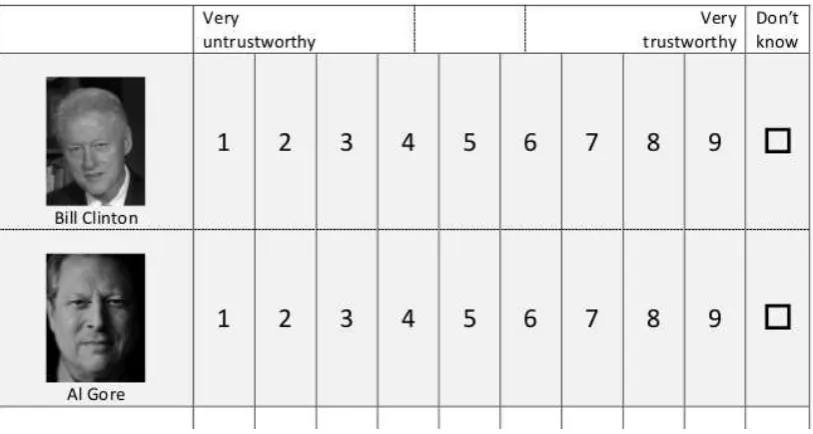
Using these images a questionnaire was constructed (see Figure 1), asking people to
rate the trustworthiness of each celebrity on a 9 point scale (1 is “Very untrustworthy” and 9
is “Very trustworthy”). Images of celebrities were presented in their intended pairings. There
was also an option to say “don’t know”. Participants completed the questionnaire after taking
© The Authors under the terms of the Creative Commons Attribution License http://creativecommons.org/licenses/by/3.0/, which
[image:9.595.75.482.84.301.2]permits unrestricted use, provided the original author and source are credited. 8 Figure 1. Sample page from famous faces pilot questionnaire
3. Results and discussion
The mean rating of trustworthiness for each celebrity and the difference in mean
ratings for pairs was calculated. We also calculated how well recognised a celebrity was by
summing the responses to the “don’t know” question (see Table 1 in main text). The results indicated that five celebrity pairs in particular were not very well-recognised, as compared
with the other celebrity pairs, since the corresponding number of don’t knows was over 1
standard deviations above the mean (M=2, SD=3). These pairs (Condolezza Rice & George
Bush, Yoko Ono & John Lennon, Ed Balls & Gordon Brown, Bill Clinton & Al Gore, and Ed
Milliband & David Milliband) were eliminated. We decided to retain the remainder of
celebrity pairs, in spite of the small degree of difference in trustworthiness between some
pairs, in order to ensure that we had sufficient numbers of stimuli for the study.
4. References
1. Rule NO, Ambady N. 2008 The face of success: Inferences from chief executive officers’
appearance predict company profits. Psychol Sci 19, 109-111.
2. Rule NO, Krendl AC, Ivcevic Z, Ambady N. 2013 Accuracy and consensus in judgments
of trustworthiness from faces: Behavioral and neural correlates. Attitudes and Social