On the General Properties of Steady
Gravitational Thermal Flows of Liquid Metals
in Variable Cross-section Containers
Marcello Lappa
*1, Hermes Ferialdi
11Department of Mechanical and Aerospace Engineering, University of Strathclyde, James Weir Building, 75
Montrose Street, Glasgow, G1 1XJ, UK
*1[email protected] Abstract
The rmogravitational flows of liquid me tals in ope n or close d ducts and containe rs play a re le vant role in a varie ty of applications in mechanical, mate rials and nuclear e ngineering. Such flows are known to be very sensitive to the e ffective shape of the containe r use d to host the fluid and its thermal boundary conditions. For the case of tempe rature gradie nts having the main compone nt dire cte d along the horizontal dire ction, re late d convective phe nome na fall unde r the ge neral heading of
“Hadle y flow”. He re we introduce a ge neral frame work for the de te rmination of the properties of these flows in the case of
domains having converging or diverging top and bottom walls. The frame work is built via a hybrid approach in which typical techniques of CFD are use d in synergy with analytical solutions of the e nergy e quation. The prope r use of initial and boundar y conditions results in algorithm convergence acce le ration. The role playe d by the top and bottom wall inclination with re spect to the horizontal is assessed through parametric inve stigation.
Keywords
Thermal Convection; Liquid Metal Flow; Navier-Stokes Equations; Analytic; Numerical Solutions
Introduction
Thermogravitational flow is classical subject of investigation in nonlinear dynamics. The related various buoyancy mechanisms in cavities and layers (for different heating and boundary conditions) are often used as archetypal systems in the study of complex phenomena because these configurations are highly relevant to a number of engineering applications.
As an example, such flows typically play an important role in the solidification of industrial castings and ingots. They can have remarkable consequences on the quality and mechanical resistance of such products due to the
formation of “defects” such as freckles and channels in the final structure of the material (Ludwig et al., 2004;
Abhilash et al., 2005).
Similar considerations can be applied to the companion field of “crystal growth from the melt”, which is typically
concerned with the production of high quality crystals of metallic (e.g., semiconductor or superconductor) materials starting from the corresponding liquid state (e.g., the horizontal Bridgman (HB), the Czoc hralski (CZ) or the Floating zone (FZ) technique). Though such production methods differ in the shape of the container used to host the liquid and/or the direction of the applied temperature gradient (Lappa, 2005), the presence of convection of gravitational (buoyancy) nature in the melt cannot be avoided. Such flows can adversely affect the perfection and purity of the ordered crystalline structures of the solidified material (bulk convection typically leads to the
formation of “striations” or “segregations”, at the micro or macro scale, respectively; Dupret and Van der Bogaert,
1994; Monberg, 1994).
liquid metals as primary coolants very convenient in situations where limiting the size of the plant is a factor of crucial importance (Zrodnikov et al., 2004).
In all these circumstances, obviously, having the capability to assess in advance the intensity and structure of such flows might be regarded as the necessary basis to improve existing methods developing new optimisation strategies.
As already discussed in Lappa (2012a), determining solutions of the equations governing such flows (Navier-Stokes + energy equations) in analytic form is an extremely challenging task. These exact solutions are known to exist only in very special circumstances (most of which being purely “ideal”) such as domains infinitely extended along the direction of the imposed temperature gradient or flows attaining a purely ”parallel state” (that is a kind
of motion for which only one of the two velocity components in the plane containing the temperature gradient is not zero).
The present investigation proceeds one step further and addresses the specific case in which the extension of the domain along the horizontal direction is finite and the walls bounding the liquid from above and from below are not horizontal, thereby paving the way to a new category of studies devoted to the analysis of the strength and
topology of thermogravitational flows of liquid m etals in “converging or diverging” containers or in geometries
with inclined walls or inclined temperature gradient. Existing studies on such subjects are relatively limited (Hon g et al., 1993; Delgado-Buscalioni and Crespo del Arco., 2001; Lappa, 2009 and 2012b).
Such a new framework is built via a hybrid approach in which typical techniques of CFD are used in synergy with analytical solutions of the energy equation.
Geometry and Mathematical Model
The Geometry
For concreteness, initially we consider a two-dimensional shallow cavity symmetric with respect to the horizontal direction with average depth d, laterally delimited by solid walls at different temperatures (one cooled, the other heated) having height dhot and dcold such that d= (dhot + dcold)/2. The overall system aspect ratio (A) is defined as its length-to-average-depth ratio (A=L/d). Another relevant characteristic geometrical paramet er (refer to Fig. 1) is the expansion (compression) ratio =dhot/dcold, which can be >1 (diverging geometry) or <1 (converging geometry), while for =1 one would recover the classical case with horizontal boundaries originally studied by Hadley (1735).
The top and bottom walls are assumed to be adiabatic (no heat exchange).
FIG.1 S KETCH OF THE CONSIDERED GEOMETRY AND RELATED THERMAL AND KINEMATIC BOUNDARY CONDITIONS:a) <1, b)
[image:2.596.150.451.534.743.2]Governing Equations and Parameters
The Rayleigh number is defined as Ra=GrPr=gTTd3/ where T is the horizontal temperature difference, d is the average distance between the top and bottom boundaries, is the thermal diffusivity, is the kinematic viscosity, T is the thermal expansion coefficient, Pr the ratio between and , and Gr is the Grashof number. Referring velocity and temperature to the scales /d and T, respectively and scaling all distances on d, the governing equations in nondimensional form (incompressible form) read
0
V (1)
V
V
V
Ra
T
i
gp
t
V
Pr
Pr
2
(2)
V
T
T
t
T
2
(3)where V, T and p are the nondimensional velocity, temperature and pressure, respectively, ig is the unit vector along the direction of gravity and the Boussinesq approximation has been used for the buoyancy production term in the momentum equation.
A distinguishing mark of liquid metals with respect to other substances (such as water or oils) is the relatively small value attained by the Prandtl number (Pr>1 for water or oils, Pr<<1 for liquid metals). Her e we concentrate on
a “representative” liquid metal for which Pr=0.01.
Results
Analytic Solutions for Quiescent Conditions
Before starting to deal with the nature and structure of the emerging flow for finite values of the Rayleigh number, it is instructive to consider the behaviour of the temperature field in the limit as Ra0, namely conditions of creeping flow or quiescent state. For such a case, indeed, though the assumption of horizontal parallel top and bottom boundaries is removed, an analytic solution can be still found.
Our interest in such an expression stems from a two-fold purpose. First it can be used to show that the assumption of linear temperature increase along the horizontal (x axis) is no longer valid. This assumption is generally invoked for differentially heated rectangular enclosures with adiabatic top and bottom walls in quiescent (no flow) conditions or even in non-quiescent conditions for liquid metals provided one of the two following conditions (or both) is satisfied: Pr0 or the flow is parallel, i.e. the considered system has an infinite extension along the horizontal direction.
Second, such an analytical expression can be used as a relevant initial condition to accelerate the convergence of the algorithm relating to the numerical solution of the momentum and mass conservation equations in the more general case for which both A, Pr and Ra have finite values and 1.
Most conveniently, we start from the balance of energy cast in its simplest form, that is, the conservation of energy flux along the horizontal direction:
1
)
(
c
dx
dT
x
d
(4)where d(x) is the nondimensional extension of the generic cross section, which in turn can be expressed as:
A
x
d
x
A
d
d
d
x
d
hot cold coldcold
1
1
)
(
(5)Substituting eq. (5) into eq. (4) gives:
x
A
d
c
dx
dT
cold
1
1
/
1
(6)
21
ln
1
1
/
1
)
(
x
A
c
d
A
c
x
T
cold
(7)
The two constants
c
1 andc
2 can be determined forcing eq. (7) to satisfy the boundary conditions at the two sidewalls, namely:x=0 T=0
c
2
0
(8a) x=A T=1
ln
1
1A
d
c
cold
(8b) Accordingly, eq.(7) can be cast in compact form as:
ln
/
1
1
ln
)
(
x
x
A
T
(9)where, obviously:
A
x
A
x
ln
/
1
1
ln
lim
1(10)
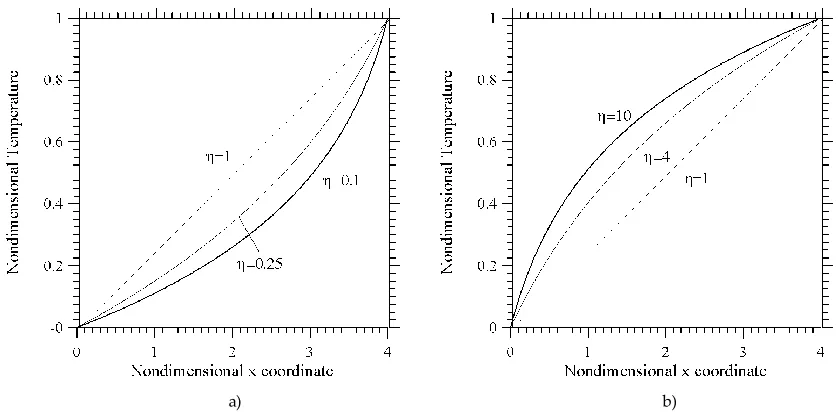
Equation (9) plotted in Fig. 2 for different values of the parameter , clearly shows the departure of the temperature profile from the purely linear distribution theoretically established for =1. The resulting profile is concave or convex for <1 or >1, respectively. As anticipated, such behaviours should be regarded as an evident
difference with respect to past situations in which the flow was assumed to be purely parallel or “purely thermally diffusive” conditions were considered in finite-size rectangular enclosures (for very small values of the Prandtl number such as those which are typical of liquid metals (Pr<<1) and for relatively small values of the control parameter Ra).
[image:4.596.89.508.391.598.2]
a) b)
FIG .2 EXACT S OLUTION FOR THE TEMPERATURE DISTRIBTION FOR A=4 AND Ra=0 (A DASHED LINE IS US ED FOR THE CORRES PONDING IDEAL LINEAR TEMPERATURE PROFILE): a) <1 (CONVERGING WALLS) ; b). >1 (DIVERGING WALLS)
Numerical Results
The governing equations (1-3) have been solved in their complete non-linear and time-dependent form using a projection method, that is an approach by which the computation of the velocity field is articulated into two main macro steps providing separately an intermediate field that has the correct content of vorticity but does not satisfy the continuity equation and a final velocity field, which has both the correct values of divergence and curl. Such a
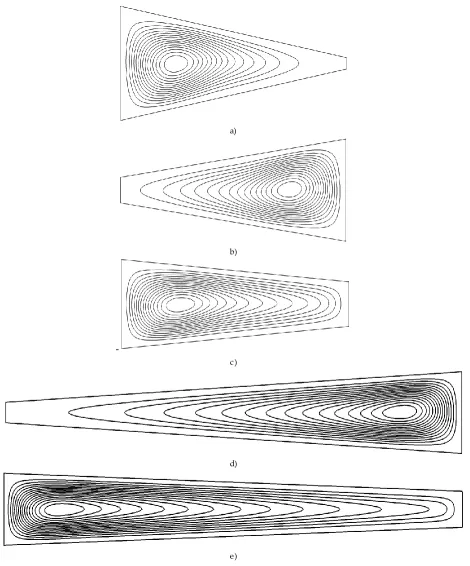
required to get grid-independent solutions in the case of uniform grids (NxxNy=100x30 and 200x30 for A=4 and A=10, respectively). The typical structure of buoyancy flow is shown in Fig. 3 for different values of the aspect ratio and of the parameter . All cases correspond to subcritical conditions, namely circumstances for which the asymptotic state attained by thermogravitational flow is steady. The governing equations have been solved assuming no-slip conditions on the walls, conditions of prescribed temperature at the left and right sidewalls and adiabatic top and bottom (inclined) boundaries.
a)
b)
-c)
d)
e)
[image:5.596.65.535.160.726.2]b)
[image:6.596.62.538.70.292.2]a) b)
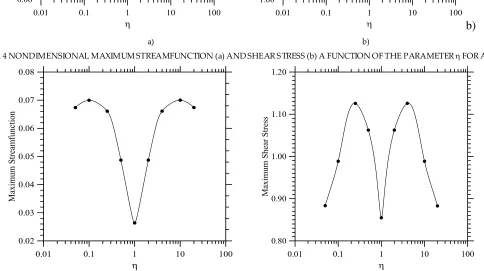
FIG. 4 NONDIMENSIONAL MAXIMUM STREAMFUNCTION (a) AND SHEAR S TRESS (b) A FUNCTION OF THE PARAMETER FOR A=4
[image:6.596.58.542.246.517.2]
c) d)
FIG. 5 NONDIMENSIONAL MAXIMUM STREAMFUNCTION (a) AND SHEAR S TRESS (b)AS A FUNCTION OF THE PARAMETER FOR A=10.
[image:6.596.72.526.545.741.2]Figures 4 and 5 shed some additional light on the problem considered illustrating the non -trivial dependence of the flow strength (in terms of maximum value attained by the streamfunction) and the (maximum) shear stress (u/y where u is the horizontal component of velocity and y the vertical coordinate) on the parameter . As shown in such figures, both the streamfunction and the nondimensional shear stress attain a minimum when the walls are perfectly horizontal, i.e. for =1. This case has been already extensively investigated in the literature (the reader being referred, e.g., to the excellent numerical study by Gelfgat et al., 1999). Any departure from this ideal condition, however, causes an increase in the shear stress and . The related dependence is relatively complex (non-monotone) as witnessed by the existence of two relative maxima. These can be seen in th e shear stress curve for =0.5 and =2 for A=4 and =0.25 and =4 for A=10. Similarly, for the stream function the maxima are located at =0.25 and =4 for A=4 and =0.1 and =10 for A=10. Both quantities display a symmetric distribution with respect to the situation of horizontal top and bottom walls (the plots in logarithmic scale are mirror symmetric with respect to =1).
FIG. 7 S TEADY VELOCITY FIELD (IS OSURFACES U)FOR A=4, Ra=100 AND =1/16 (3D SIMULATION FOR A CONTAINER HAVING THE S HAPE OF A FRUSTUM OF PYRAMID, NxxNyxNz=100x30x30,MAXIMUM SHEAR u/y=1.3) AND U VELOCITY PROFILE AT x=A/2 AND
z=0
Figure 6, provides some information about the existence of “inflection points” in the velocity profile.
Such points are known to play a crucial role in determining the “future” behaviour of the system when the
intensity of the driving force is increased. For purely parallel flow, indeed, it is known that in the limit as Pr0 the
this theorem can be regarded as also a sufficient condition in many situations. For more comprehensive d iscussions the interested readers may consider Lin (1944), Rosenbluth and Simon (1964), Drazin and Howard (1966).
According to Figure 6, though in our case the flow is not parallel, inflection points in the profile of horizontal velocity u can be still identified.
Similar conclusions can be applied to fully three-dimensional (3D) configurations having a frustum-of-pyramid shape (for which we performed a limited set of simulations using yet eq. (9) as initial condition, the parameter appearing there, being this time the ratio between the areas of the two end walls). Such results, shown, e.g., in Fig. 7 for the case A=4 and =1/16, confirm that, though the maximum of the shear stress u/y experiences a decrease with respect to the corresponding 2D case (u/y1.3 for the 3 D case to be compared with u/y1.84 for the 2 D case having the same value of ), the existence of inflection points in the distribution of horizontal velocity u is retained.
Furthermore, inflection points can be also found in the profil e of the other horizontal velocity component pertaining to the 3D simulations, namely the component w along the z axis (Fig. 8).
FIG. 8 S TEDY VELOCITY FIELD (SLICES OF THE VELOCITY COMPONENT W)FOR A=4, Ra=100 and =1/16 (3D SIMULATION FOR A CONTAINER HAVING THE SHAPE OF A FRUS TUM OF PYRAMID, NxxNyxNz=100x30x30) AND W VELOCITY PROFILE AT x=A/2 AND
z=1/4.
[image:8.596.124.485.277.680.2]in rectangular cavities with finite extent, are known to be driven by t he mean shear stress (this is the reason why they are often referred to as "shear instability" and the related disturbances as hydrodynamic ones). As a result, some vortices appear on the frontier of the two opposing (primary and return) horizontal currents characterizing the basic flow. Such disturbances are in general stationary (the general outcome of this instability is the
replacement of the initial “unicellular” Hadley flow with a multicellular convective structure) and become oscillatory when a second threshold in terms of applied temperature gradient is exceeded (Gelfgat et al., 1999; Kaddeche et al., 2003).
Conclusions and Future Directions
The typical structure of the Hadley flow in containers having varying cross -sectional area in the case of liquid metals has been investigated on the basis of a hybrid approach based on the numerical solution of the Navier -Stokes equations in conjunction with analytic solutions of the temperature field (used as initial conditions). The analysis has provided heretofore unseen information about the role played by converging or diverging walls on the fundamental properties of the emerging flow in terms of strength, patterning behaviour and the existence of
“inflection” points in the velocity profile.
The existence of such points and the non-trivial dependence displayed by the intensity of the flow and the related
shear stress on the geometry characteristic parameters call for a “future” analysis specifically conceived to address
the potential onset of disturbances of hydrodynamic nature at larger values of the control parameter Ra. Such disturbances are expected to break the typical initial uni-cellular flow via stationary or oscillatory bifurcations and produce significant asymmetries in the dependence of the maximum s hear stress and streamfunction on the compression (or expansion) ratio.
REFERENCES
[1] Abhilash E., Jose ph M.A. and Krishna P., “Pre diction of De ndritic Paramete rs and Macro Hardness Variation in Pe rmane nt Mould Casting of Al-12%Si Alloys Using Artificial Ne ural Ne tworks”, Fluid Dyn. Mater. Process., 2(3) (2006): 211-220
[2] De lgado-Buscalioni R. and Crespo de l Arco E., “Flow and he at transfer re gimes in incline d diffe re ntially heate d cavitie s”,
Int. J. He at Mass Transfer, 44 (2001): 1947-1962.
[3] Drazin P. and Howard L.N., “Hydrodynamic stability of paralle l flow of inviscid fluid”, Adv. Appl. Me ch., 9 (1966): 1-89. [4] Dupre t F. and Van de r Bogaert N., “Mode lling Bridgman and Czochralski growth”, in Handbook of Crystal Growth (e d. D.
T. J. Hurle ) 2: 877-1010. North-Holland, Amste rdam (1994).
[5] Fle tche r C.A.J.,” Computational te chniques for fluid-dynamics”, (Springe r Verlag, Be rlin, 1991).
[6] Ge lfgat A.Yu., Bar-Yose ph P.Z. and Yarin A.L., “Stability of Multiple Steady States of Convection in Laterally He ated Cavitie s”, J. Fluid Me ch., 388 (1999): 315-334.
[7] Hadle y G., “Conce rning the cause of the general trade winds”, Phil. Trans. Roy. Soc. Lond., 29 (1735): 58-62.
[8] Hong B., Armaly B.F., Che n T.S., ”Laminar mixe d convection in a duct with a backward-facing ste p-the e ffects of inclination angle and prandtl numbe r”, Internat. J. He at Mass Trans. 36 (1993): 3059–3067.
[9] Kaddeche S., He nry D. and Ben Hadid H., "Magne tic stabilization of the buoyant convection betwee n infinite horizontal walls with a horizontal te mperature gradie nt", J . Fluid Me ch., 480 (2003): 185-216.
[10] Ladyzhe nskaya O.A., “The Mathematical Theory of Viscous Incompressible Flow”, Gordon and Breach, 2nd Edition, Ne w York - London, 1969.
[11] Lappa M., “Thermal convection and re late d instabilitie s in mode ls of crystal growth from the me lt on earth and in
microgravity: Past history and current status”, Cryst. Re s. Te chnol., 40(6) (2005): 531-549.
[13] Lappa M., (2012a), “Exact Solutions for The rmal Proble ms: Buoyancy, Marangoni, Vibrational and Magne tic-Fie
ld-Controlle d Flows”, Re vie w of Applie d Physics, 1(1) (2012): 1-14.
[14] Lappa M., (2012b), “Rotating Thermal Flows in Natural and Industrial Processes”, John Wile y & Sons, Ltd (2012, Chiche ster, England).
[15] Lin C.-C., “On the stability of two-dime nsional paralle l flows”, Proc. NAS, 30(10) (1944): 316-324.
[16] Ludwig A., Grube r-Pre tzle r M., Wu M., Kuhn A. and Rie dle J., “About the Formation of Macrose gre gations During Continuous Casting of Sn-Bronze”, Fluid Dyn. Mate r. Process., 1(4) (2005): 285-300.
[17] Monbe rg E., “Bridgman and re late d growth techniques”. In Handbook of Crystal Growth (e d. D. T. J. Hurle ), 2: 53-97. North-Holland, Amste rdam (1994).
[18] Rosenbluth M.N. and Simon A., “Ne cessary and sufficie nt conditions for the stability of plane paralle l inviscid flow”,
Phys. Fluids, 7(4) (1964): 557-558.
[19] Tollmie n W., “Ge ne ral instability criterion of laminar ve locity distributions”, Tech. Me mor. Nat. Adv. Comm. Ae ro.,
Wash. No. 792 (1936).