City, University of London Institutional Repository
Citation
: Hopf, Y. M., Francis, J., Helms, P. J., Haughney, J. and Bond, C. (2016). Core
requirements for successful data linkage: an example of a triangulation method. BMJ Open, 6(10), e011879. doi: 10.1136/bmjopen-2016-011879This is the published version of the paper.
This version of the publication may differ from the final published
version.
Permanent repository link:
http://openaccess.city.ac.uk/15918/Link to published version
: http://dx.doi.org/10.1136/bmjopen-2016-011879
Copyright and reuse:
City Research Online aims to make research
outputs of City, University of London available to a wider audience.
Copyright and Moral Rights remain with the author(s) and/or copyright
holders. URLs from City Research Online may be freely distributed and
linked to.
Core requirements for successful data
linkage: an example of a triangulation
method
Y M Hopf,1J Francis,2P J Helms,3J Haughney,1C Bond1
To cite:Hopf YM, Francis J, Helms PJ,et al. Core requirements for successful data linkage: an example of a triangulation method.BMJ
Open2016;6:e011879. doi:10.1136/bmjopen-2016-011879
▸ Prepublication history for this paper is available online. To view these files please visit the journal online (http://dx.doi.org/10.1136/ bmjopen-2016-011879).
Received 11 March 2016 Revised 24 August 2016 Accepted 12 September 2016
1Centre of Academic Primary Care, University of Aberdeen, Aberdeen, UK
2School of Health Sciences, City University London, London, UK
3Child Health, University of Aberdeen, Royal Aberdeen Children’s Hospital, Aberdeen, UK
Correspondence to
Dr Y M Hopf; [email protected]
ABSTRACT
Objectives:The aim was to explore the views of professional stakeholders and healthcare professionals (HCPs) on the linkage of UK National Health Service (NHS) data for paediatric pharmacovigilance purposes and to make recommendations for such a system. Methods:A mixed methods approach including a literature review, interviews, focus groups and a three-round Delphi survey with HCPs in Scotland was followed by a triangulation process using a systematic protocol. The survey was structured using the Theoretical Domains Framework of behaviour change. Items retained after applying the matrix-based triangulation process were thematically coded. Ethical approval was granted by the North of Scotland Research Ethics Service.
Results:Results from 18 papers, 23 interviewees, 23 participants of focus groups and 61 completed questionnaires in the Delphi survey contributed to the triangulation process. A total of 25 key findings from all four studies were identified during triangulation. There was good convergence; 21 key findings were agreed and remained to inform recommendations. The items were coded as practical/technical (eg, decision about the unique patient identifier to use), mandatory (eg, governed by statute), essential (consistently mentioned in all studies and therefore needed to ensure professional support) or preferable.
Conclusions:The development of a paediatric linked database has support from professional stakeholders and HCPs in Scotland. The triangulation identified three sets of core requirements for a new system of data linkage. An additional fourth set of‘preferable’ requirements might increase engagement of HCPs and their support for the new system.
BACKGROUND AND SIGNIFICANCE
Adverse drug reactions (ADRs) are defined by the WHO1 as noxious and unintended responses to a drug which occur at doses normally used in man. ADRs are more likely to occur when medicines are used off label.2 Off-label use of medication refers to all uses of a marketed drug not detailed in the Summary of Product Characteristics (the legally binding product information in the
UK for medication) including therapeutic indication, use in age-subsets, appropriate strength (dosage), pharmaceutical form and route of administration. This is of particular concern in children, who receive proportion-ately more off-label and unlicensed medi-cines2–4than other patient groups. Reported
figures differ, but it is estimated that five out of eight severe ADRs in paediatric inpatients are related to off-label use of drugs in children.5
Reports of ADRs are collected nationally in many countries, for example, Yellow Card Scheme in the UK or the Food and Drug Administration (FDA) Adverse Event Reporting System (FAERS) Database in the USA. However, it is widely acknowledged that these systems underestimate the true preva-lence of ADRs.6 7 A systematic review of papers published between 1986 and 2006 on the views of healthcare professionals (HCPs) towards ADR reporting found that non-reporting was related to ignorance and lack of knowledge of the reporting system (95%), lack of time or similar reasons (77%), fear of
filing an inappropriate report (72%), indif-ference and uncertainty about causality (67%) and the perception that licensed
Strengths and limitations of this study
▪ The mixed methods approach of this study used several methods to employ the strengths while addressing the inherent weaknesses of each method.
▪ No validated instruments were used; the inter-view and focus group schedules were based on the initial literature review.
▪ The use of a theoretical approach in the form of the Theoretical Domains Framework added robustness to the results of the Delphi, allowed for a systematic exploration of potential problems.
drugs are safe (47%7). New approaches of signal gener-ation to enhance existing systems are required.
There is increasing electronic collection and storage of healthcare data during routine clinical practice for the purposes of more efficient clinical communication and health service administration. However, this con-temporary and comprehensive information resource could also facilitate new methodological approaches in population health research, especially pharmacovigi-lance. Small-scale studies have already shown that iden-tification of suspected ADRs is possible using this routine data.8 It is unclear, however, how stakeholders such as national (Scottish) experts on pharmacovigi-lance, confidentiality or data protection and HCPs would view the secondary use of routinely collected healthcare data, especially if individual datasets were linked. The research reported here was part of the CHIMES (Child Medical Records for Safer Medicines) programme in Scotland. The overall aim of this pro-gramme was to develop a novel paediatric pharmacov-igilance system based on linkage of routinely collected data in primary (general practice (GP) and community pharmacy) and secondary (hospital) care. The aim of this research was to provide recommendations for such a national resource that would allow monitoring for long-term outcomes of exposure to medicines during childhood and adolescence. Adverse reactions to medi-cines could be identified by stop dates, reduction of initial doses or switches of medication. In line with use of other existing datasets derived from routinely col-lected data, our assumption was that access to the data by researchers would only be allowed after review of the application by an internal ethics, or equivalent, committee.
OBJECTIVE
The aim of this study was to explore the views and opi-nions of HCPs on linking routinely collected data and make evidence-based recommendations for a system of pharmacovigilance based on linked data.
METHODS AND MATERIALS
This was a mixed methods study which included data from a literature review,9 an interview study,10 a focus group study11 and a Delphi survey.12 All these studies have been previously reported. In this paper, the results of the four stages of data collection are formally triangu-lated, and recommendations for a new system of phar-macovigilance are made. All studies were approved by the North of Scotland Research Ethics Service and National Health Service (NHS) Research and Development.
Summaries of the methods used in the previously reported papers are presented below.
The systematic literature review of published papers described the views of HCPs to data sharing and linkage. Searches were performed in Medline, EMBASE,
SCOPUS, CINAHL and PsychINFO for papers in English between 2001 and 2011.9
The interviews explored the views of a purposive sample of Scottish stakeholders on pharmacovigilance, confidentiality/patient privacy, data protection, accept-able and non-acceptaccept-able usage of data and dissemin-ation of findings. Interviews were semistructured, were audio-recorded and fully transcribed. A framework approach was used to identify themes inductively, but the analysis approach also allowed for the identification of emergent themes.10
Focus groups were conducted with pharmacists, nurses, general practitioners and paediatricians, from primary and secondary care. Stratified purposive sam-pling was used to ensure inclusion of participants from a range of urban, rural and remote settings and geo-graphic locations across Scotland. Paediatric experience was preferred but not essential. Invitation packs were mailed to potential participants. Building on the inter-views, the focus groups explored views of the proposed linkage and identified perceived barriers. All focus groups were audio-recorded and transcribed verbatim. Themes were identified via a framework approach.11
Based on thefindings of the two qualitative studies, a three-round Delphi survey with HCPs ( pharmacists, nurses and medical doctors with an interest in paediat-ric medicine) in Scotland was conducted to identify consensus on essential system components required for HCPs to support or facilitate the proposed data linkage and continue recording the necessary data.12 A random sample was drawn from national sampling frames of the target populations, using, for example, the NHS Information Service Division workforce lists for general practitioners and practice nurses, a list of registered premises by the Practitioner Service Division for community pharmacists or paediatricians via the Scottish Paediatric Society. The survey was structured using the Theoretical Domains Framework (TDF)13 of behaviour change. A systematic data reduction exercise based on methods proposed by Prior et al14 was applied between Round 1 and 2. Consensus criteria for each round were set a priori at 66.7% for Round 2 and 90% for Round 3.
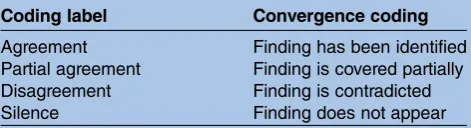
A triangulation protocol based on the methods pro-posed by Farmeret al15was applied to interpret and inte-grate key findings from the literature review and the three empirical studies in order to identify essential system components. These methods proceeded in three steps. First, a matrix was constructed to allow compari-son of key issues against those as represented in the indi-vidual studies. Second, themes were compared to create a single list of issues, barriers and facilitators based on the individual study results. Third, agreement between studies was coded using a convergence coding scheme as presented in table 1. ‘Agreement’ indicates that the key finding was identified in a particular study, ‘partial agreement’means that thefinding was partially covered, and ‘disagreement’ indicates a contradictory finding.
If none of these three codes could be attributed, the label‘silence’was used.
RESULTS
In the literature review, which was conducted in 2011, a total of 2917 titles were screened and 18 papers were included, describing the views of HCPs on linking or sharing healthcare data at an individual patient level.9 These showed that data sharing at a patient identifiable level was more common than population-based data linkage. Data sharing was often described within specific settings, such as an emergency department or a special-ist ward or the pharmacy department of a hospital. HCPs who reported a previous positive experience with such data sharing perceived a positive impact on their work and patient safety and were more likely to support data sharing. However, funding (start-up and mainten-ance), technical problems (compatible Information Technology (IT) systems) and governance issues were identified as potential barriers to successful implementa-tion of data sharing.
Between February and October 2010, 25 participants were interviewed from 11 of the 24 Scottish Health Boards.10 Interviewees had positive views on the pro-posal to use routinely collected data to create a pharma-covigilance resource for children in Scotland. Practical, ethical and legal issues were identified related to the sharing of the data, the ownership of the linked data, consent for data linkage, anonymisation and confi denti-ality. These results were further explored in focus groups with health practitioners.
Between August 2010 and May 2011, six focus groups were conducted with 22 participants from seven differ-ent Scottish Health Boards.11 Participants were recruited from all professional backgrounds and from primary and secondary care. Half of the participants were pharmacists (n=11, 50%) and the majority were female (n=13, 59%). Focus group participants reported that governance problems and relevant legislation should be addressed. They proposed that patients would have issues with the use of their data for research purposes, with key areas of sensitivity including confi -dentiality and third party access to patient identifiable data. Participants supported the proposed linkage, and their range of views was similar to those of the national interviewees. However, more concerns were voiced about funding of such data linkage, particularly if this
meant any diversion of funds from their own area of practice.
The Delphi study was conducted in three rounds from August 2011 to February 2012.12 The first round of the Delphi study generated over 1000 individual statements from 61 participants. After systematic item reduction, 149 items were retained for the second round, in which participants were asked to rate their level of agreement with each item. Items reaching the consensus criterion of 66.7% were entered into the third round. After the third round, the retained consensus items focused on professional standards, requirements for linkage and the use and form of potential feedback. Overall, the results confirmed that participants were generally willing to facilitate the proposed linkage, dependent on adher-ence to professional standards, relevant legislation, ethical approval, secure data sharing agreements and support from their employers.
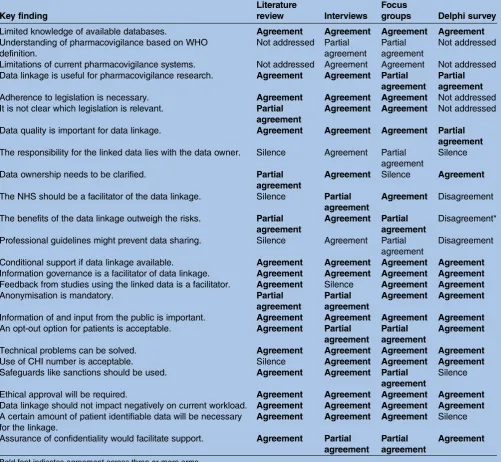
Applying the triangulation protocol, a total of 25 key
findings were identified across all four studies and the interstudy level of agreement is shown in table 2. Findings showed near perfect agreement (full or partial) between the qualitative studies (23/25, 92%). No disagreement on any finding was noted between the qualitative studies, but each of the qualitative studies had one coding of‘silence’: Focus group participants did not discuss whether data ownership would have to be
clari-fied, and interview participants did not identify feedback from linkage studies as a facilitator of future support. Four of the 25 findings (16%) from the qualitative studies were not carried forward in the Delphi survey, that is, the predefined consensus criteria were not reached; of the remainder, three results (3/25, 12%) from the survey findings did not reflect the findings from the qualitative arm, namely, the role of the UK NHS as a facilitator of the data linkage, whether benefits outweighed the risks or if professional guidelines would prevent data sharing.
All but four of thefindings identified in the empirical studies were also identified in the systematic review.9 Understanding of pharmacovigilance and understanding of the current system were not identified in the litera-ture review, nor were the two Scotland-specific findings (NHS as a facilitator or the use of the Community Health Index (CHI) as a unique patient identifier).
Essential system components were deduced from the Delphi analysis plus key findings that showed ( partial) agreement across at least three studies as listed in
[image:4.595.48.284.76.140.2]table 1. Statutory items, such as legislation, were included as following the law would be the basis of any decision. Key findings were sorted into inductively and resulted in four categories: practical/technical, manda-tory, essential or preferable. Practical requirements include the need for meaningful data, the provision of server space for storage and processing the linked data as well as software compatibility across and within the different Health Boards in Scotland. General agreement was that any technical or practical problems could be
Table 1 Convergence coding scheme for triangulation protocol (based on Farmeret al15)
Coding label Convergence coding
Agreement Finding has been identified
Partial agreement Finding is covered partially
Disagreement Finding is contradicted
solved. Mandatory items were those underpinned by regulation or statute/legislation. Literature and partici-pants identified that following ‘relevant’ legislation is important but a definition of relevant was seldom pro-vided or discussed. Focus group participants declined requests to be more specific and referred to legal specia-lists instead. Indeed, the interview partners with legal expertise identified the widest range of legislative acts and non-statutory guidelines that should be observed. Additionally, participants deemed ethical approval to be important. Essential items were those in which there was
[image:5.595.49.551.68.530.2](at least partial) consensus across at least three of the four studies (as listed in table 2), for example, that the planned data linkage should not impact negatively on the current workload or clear information governance structures. Participants stipulated that transparency should include informing the public about the new system. Items coded as ‘preferable’ were those that did not match the above definitions but were deemed to increase the stakeholders’ support and active engage-ment with the system. Clear data sharing agreeengage-ments in place as well as feedback from the linked data resources
Table 2 Overview of identified key issues and how they triangulate across the literature review and the three studies
Key finding
Literature
review Interviews
Focus
groups Delphi survey
Limited knowledge of available databases. Agreement Agreement Agreement Agreement
Understanding of pharmacovigilance based on WHO definition.
Not addressed Partial agreement
Partial agreement
Not addressed
Limitations of current pharmacovigilance systems. Not addressed Agreement Agreement Not addressed Data linkage is useful for pharmacovigilance research. Agreement Agreement Partial
agreement
Partial agreement
Adherence to legislation is necessary. Agreement Agreement Agreement Not addressed
It is not clear which legislation is relevant. Partial agreement
Agreement Agreement Not addressed
Data quality is important for data linkage. Agreement Agreement Agreement Partial
agreement
The responsibility for the linked data lies with the data owner. Silence Agreement Partial agreement
Silence
Data ownership needs to be clarified. Partial
agreement
Agreement Silence Agreement
The NHS should be a facilitator of the data linkage. Silence Partial agreement
Agreement Disagreement The benefits of the data linkage outweigh the risks. Partial
agreement
Agreement Partial agreement
Disagreement*
Professional guidelines might prevent data sharing. Silence Agreement Partial agreement
Disagreement
Conditional support if data linkage available. Agreement Agreement Agreement Agreement
Information governance is a facilitator of data linkage. Agreement Agreement Agreement Agreement
Feedback from studies using the linked data is a facilitator. Agreement Silence Agreement Agreement
Anonymisation is mandatory. Partial
agreement
Partial agreement
Agreement Agreement
Information of and input from the public is important. Agreement Agreement Agreement Agreement
An opt-out option for patients is acceptable. Agreement Partial agreement
Partial agreement
Agreement
Technical problems can be solved. Agreement Agreement Agreement Agreement
Use of CHI number is acceptable. Silence Agreement Agreement Agreement
Safeguards like sanctions should be used. Agreement Agreement Partial
agreement
Silence
Ethical approval will be required. Agreement Agreement Agreement Agreement
Data linkage should not impact negatively on current workload. Agreement Agreement Agreement Agreement
A certain amount of patient identifiable data will be necessary for the linkage.
Agreement Agreement Agreement Silence Assurance of confidentiality would facilitate support. Agreement Partial
agreement
Partial agreement
Agreement
Bold font indicates agreement across three or more arms.
Agreement: key finding has been identified; partial agreement: finding is partially covered; disagreement: contradictory statement; silence: not apparent; not addressed: subject not addressed in study.
*Disagreement only in the way that this was mentioned but dropped across the rounds, indicating that there was no consensus on this item, hence disagreement rather than silence.
CHI, Community Health Index.
and an opt-out possibility for patients was deemed acceptable, but HCPs requested to evaluate patients’ opi-nions prior to the implementation of the new system.
Figure 1 indicates how the findings resulting from the triangulation process are mapped out displaying the conceptual model for the new system implementation.
DISCUSSION Main findings
The triangulation process identified three core sets of requirements necessary for the implementation of a new linked data system for paediatric pharmacovigilance, including ‘practical/technical’ requirements as well as
‘mandatory’ requirements such as ethical approval, and
‘essential’ requirements such as transparency. A fourth set of requirements, labelled‘preferable’, might increase the engagement of HCPs with such a new system.
Strengths and limitations
Triangulation has been described since the 1970s16 and was initially defined as ‘the combination of methodolo-gies in the study of the same phenomenon’ (Denzin, 1978, p. 291, as seen in16 17). The combination can be across different data sources, investigators, theories, methodologies or data collection methods.16 17 O’Cathain et al18 defined triangulation as investigating the same issue using different methods—an approach well suited to mixed methods research. The use of a tri-angulation protocol allowed for a systematic comparison offindings between the different methods used. The use of a mixed methods approach allowed minority issues in the interviews to be carried forward, that is, issues that were only mentioned by one or two participants. The Delphi survey results that were based on those findings confirmed overlapping findings between the different
studies, providing face validity and robustness of thefi nd-ings against method-based variation. The initial Delphi questionnaire was developed based on thefindings from the interview and focus group study in order to present those findings to a larger audience with the aim of gaining consensus on the most important items. Although the questionnaire was not psychometrically validated, it incorporated the use of a tested and vali-dated framework allowing for a systematic assessment of barriers to data linkage, the TDF.13 The TDF accounted for all barriers identified in the qualitative studies, hence confirming good empirical coverage. Using several methods gave the capacity to employ the strengths and address the inherent weaknesses of each method.
The single studies involved in the triangulation took place over a period of 2 years. Some of the opinions from the stakeholders and HCPs might have changed over that time. We did not retest their views and opi-nions a second time. We are, however, confident that this triangulation work does indeed present a good start-ing point of the requirements for such a suggested data linkage project. Once the proposed system has been implemented, surveys among data providers and data users should be performed on a regular basis to ensure that the way the data linkage is performed and analysed is still acceptable for HCPs.
This paper has not considered the opinions of patients/the public towards the secondary use of rou-tinely collected data; these have been explored in a par-allel study which is currently being analysed.
Views towards routinely linked NHS data
The proposed data linkage was perceived to be useful for pharmacovigilance research across all methods used in this study. Small-scale studies have already indicated that it is possible to use linked data for epidemiology research19–22 and that linked data can be used success-fully for signal generation relevant to possible ADRs.8 Participants indicated conditional support for the pro-posed linkage, with conditions ranging from anonymisa-tion of the data to ethical approval as well as adherence to legislation and professional codes of conduct. A range of potentially relevant legal frameworks was
identi-fied during the interviews including the Data Protection Act 1998, the Common Law Duty of Confidentiality, and the Human Rights Act 1998.10In the qualitative studies, there was confusion as to which legislation, which guide-lines and standards were directly relevant to the pro-posed data linkage.10 Several statements included potential regulatory and legislative frameworks but did not discuss any of these in detail as it was assumed that
‘relevant’ laws and guidelines would be followed. Despite probing, participants in focus groups did not provide further information on the term ‘relevant’, referring to experts that would be better suited to answer these questions despite the fact that even those experts interviewed commented that these had rarely been formally tested in a court of law.
Figure 1 Building blocks of recommendations for the proposed data linkage system. Practical requirements
describe practical and technical necessities for the actual data linkage process, mandatory requirements describe
The definition of‘relevant’ is important for the appli-cation of legislation and guidelines, and for the anon-ymisation of data. Participants also used the term
‘adequate’ in the context of anonymisation of data security measures. However, neither the reviewed litera-ture nor the empirical work provided a working defi n-ition of these terms or criteria for ‘adequacy’. It would be necessary to have an agreed definition in order to apply ‘relevant’ and ‘adequate’ measures, and also it would be important to specify who should decide what
‘relevant’and‘adequate’means.
Thefindings suggest that the benefits of the proposed data linkage would outweigh the risks to patient privacy and confidentiality although the concerns about pos-sible risks might have caused participants in all three methods to conclude that‘ethical approval is required’. However, participants did not specify what kind of ethical approval would be expected. The options would be approval by the National Research Ethics Service (NRES) and/or an internal ethics committee specific for the linked data. Some of the data providers in Scotland, such as the Health Information Centre (HIC) in Tayside or the NHS Information Service Division (ISD), already have internal ethics approval boards that assess requests for data access.23 The internal approval board for ISD, the Privacy Advisory Committee (PAC), additionally demands that any requests to access patient identifiable data or data linkage projects are reviewed by an NHS ethics committee prior to submission to PAC.24 In conjunction with the expressed views of HCPs that the NHS should be a facilitator of the data linkage, this could mean that the standards employed by NHS ISD as the biggest data collector of the Scottish NHS would
find widespread HCP approval. However, this and the other two suggestions of an independent user like PAC or the government, for example, the Department of Health, was not endorsed in the Delphi survey. No con-sensus emerged indicating a high level of uncertainty among the HCP community about the governance of linked health data. Thefindings from this work indicate an awareness that a certain amount of patient identifi -able data would be necessary in order for the proposed data linkage system to function. Thisfinding is not new, as a Wellcome Trust report25 has highlighted that the use of clinical data is rarely fully anonymous. Current standards employed by the NHS do recognise this, as approval is required from NHS ethics committees, and requests for patient identifiable data will have to be approved by relevant Caldicott guardians to ensure that only the minimum amount of identifiable data is used to answer the questions being posed.26 A Caldicott guardian is the person responsible within NHS struc-tures in the UK to ensure adherence to a set of princi-ples and processes which provide a framework of quality standards for the management of confidentiality and access to patient information.26 The General Medical Council (UK) would prefer anonymised disclosures of data although it acknowledges that the release of patient
identifiable information might be justified in the public interest.27
Requirements for data linkage
Based on these findings, the following requirements might be appropriate to consider before implementing a system of pharmacovigilance based on linked health-care data:
1. Practical/technical: storage space for data, software compatibility;
2. Mandatory: to comply with law and professional guidance;
3. Essential: to ensure support of HCPs;
4. Preferable: to increase support and active engage-ment with the system.
‘Practical’ requirements include the need for mean-ingful data, in order to have data that are useful and the provision of server space for storage and processing the linked data. A Wellcome Trust report published in 2009 suggested the use of ‘safe havens’ for data linkage pro-jects.25 Software compatibility across and within the dif-ferent Health Boards in Scotland was also questioned by participants. The lack of a single standard system for reporting and recording medical data has been noted previously.28 Despite this, results indicated that any tech-nical or practical problems could be resolved.
Compliance with relevant legislation was seen as‘ man-datory’. The following acts were identified as relevant for the planned project: the Data Protection Act 1998 and the Common Law Duty of Confidentiality. In add-ition to the law, compliance with professional standards and ethical approval were deemed to be important. For all recommendations, clear definitions are required. This would be in addition to the terms ‘relevant’ and
‘adequate’as discussed above.
‘Essential’ requirements describe system options that would ensure the support of HCPs for the planned data linkage. One of these requirements would be that the planned data linkage should not impact negatively on the current workload, which is in line with previousfi nd-ings.29–33 Clear information governance structures were requested across all arms of this study. Concerns about governance including data security, legal restrictions and data quality are not new and have been cited previously as potential barriers to data sharing.31 34–40 Potential governance structures could relate to consent and confi -dentiality structures as well as the use of data sharing agreements. Similar features have been recently described by El Emam et al40 as facilitators for data sharing. Participants also requested transparency about the kind of data used and the research initiated and informing the public about the proposed system.
‘Preferable’ items would increase the support from HCPs, hopefully leading to a more active engagement in the new system design. Feedback from the linked data resources was seen as a strong motivator for HCPs. Frontline HCPs saw feedback as an opportunity to review their own practice. Feedback was requested in an
‘easy-to-digest’ format with the possibility of accessing further information if required. In particular, interview participants saw feedback as a chance to enable data providers to increase data quality and with this the quality of the linked data. In this context, Aylin et al20 found that the quality of the data sent to the Hospital Episodes Statistics in England improved over time as a consequence of regular feedback to participating hospi-tals. The qualitative studies identified the belief that if the feedback provided ultimately benefitted patients, HCPs would become more interested in ensuring high quality data entry. In terms of consent, participants saw a discussion about consent as necessary, although they concluded that requesting explicit consent from all patients in Scotland would be unfeasible. This is in con-trast to Patel’s findings,33 where only a minority of parti-cipants thought the request of individual consent would be too complicated and time-consuming. An opt-out possibility was deemed acceptable for patients, although HCPs requested that this assumption should be
con-firmed with the general public prior to the implementa-tion of the new system. Finally, in particular frontline HCPs would prefer to have clear data sharing agree-ments in place which is in line with previousfindings of El Emamet al.40
Taking all four categories into account, the first three would describe the basis for the proposed new system, with the fourth increasing support from HCPs (as detailed infigure 1).
CONCLUSION
The proposed data linkage was perceived as addressing a gap in current knowledge. Nonetheless, participants did identify a range of problems and concerns that should be addressed prior to implementation of such a system. Adherence to relevant legislation, such as the Data Protection Act, and the application of appropriate gov-ernance, such as adherence to professional standards and the Caldicott principles, were deemed to be import-ant in ensuring confidentiality for patients and prescri-bers. Although no consensus was reached in thefirst two studies on the need for consent, the Delphi study
identi-fied that the offer of an ‘opt-out option’ for patients would have support from HCPs.
The work presented in this paper demonstrates that the development of a paediatric linked database for pharmacovigilance has support from professional stake-holders and HCPs in Scotland together with specific recommendations to inform the design of such a system.
AcknowledgementsThe authors would like to thank all our participants for taking part in the studies.
Contributors PJH was the chief investigator of the overall programme (Child Medical Records for Safer Medicines (CHIMES)), conceived the research and led writing of the proposal for funding. CB and JH were coinvestigators and led the writing of the work package which included the literature review and the empirical studies. YMH was responsible for the draft of the overall study protocol as well as the triangulation protocol, the daily study conduct and
co-ordination, acquisition of data, analysis, producing tables and figures and interpretation of data. YMH drafted/co-led writing of the paper and incorporated feedback from coauthors on successive drafts. CB and JF contributed to study protocol design and subsequent analysis, and co-led the writing of the paper. All authors commented on the initial drafts of the paper and revision of successive drafts. The final version of the manuscript was approved by all authors.
Funding This work was supported by the Chief Scientist Office (CHIMES Applied Research Programme, grant number ARPG/07/4).
Competing interests None declared.
Ethics approval North of Scotland Research Ethics Service and NHS Research and Development.
Provenance and peer review Not commissioned; externally peer reviewed.
Data sharing statement Additional data such as the search strategy of the literature review, the study information sheets and consent forms for all studies, as well as the Delphi questionnaires or the interview and focus group topic guides, example of descriptive chart (interviews/focus groups), and examples for categorisation of statements in Delphi are available by emailing the corresponding author.
Open Access This is an Open Access article distributed in accordance with the Creative Commons Attribution Non Commercial (CC BY-NC 4.0) license, which permits others to distribute, remix, adapt, build upon this work non-commercially, and license their derivative works on different terms, provided the original work is properly cited and the use is non-commercial. See: http:// creativecommons.org/licenses/by-nc/4.0/
REFERENCES
1. World Health Organization. Safety ofmedicines—a guide to detecting and reporting adverse drug reactions. Geneva: Word Health Organiszation, 2002.
2. Impicciatore P, Choonara I, Clarkson A,et al. Incidence of adverse drug reactions in paediatric in/out-patients: a systematic review and meta-analysis of prospective studies.Br J Clin Pharmacol 2001;52:77–83.
3. McIntyre J, Conroy S, Avery A,et al. Unlicensed and off label prescribing of drugs in general practice.Arch Dis Child 2000;83:498–501.
4. Ekins-Daukes S, Helms PJ, Simpson CR,et al. Off-label prescribing to children in primary care: retrospective observational study. Eur J Clin Pharmacol2004;60:349–53.
5. Choonara I, Conroy S. Unlicensed and off-label drug use in children —implications for safety.Drug Saf2002;25:1–5.
6. BMA Board of Science.Reporting adverse drug reactions—a guide for healthcare professionals. London: British Medical Association, 2006.
7. Lopez-Gonzalez E, Herdeiro MT, Figueiras A. Determinants of under-reporting of adverse drug reactions: a systematic review.Drug Saf2009;32:19–31.
8. Sun AP, Kirby B, Black C,et al. Unplanned medication
discontinuation as a potential pharmacovigilance signal: a nested young person cohort study.BMC Pharmacol Toxicol2014;15:11. 9. Hopf YM, Bond C, Francis J,et al. Views of healthcare professionals
to linkage of routinely collected healthcare data: a systematic literature review.J Am Med Inform Assoc2014;21:e6–10. 10. Hopf YM, Bond CB, Francis JJ,et al. Linked health data for
pharmacovigilance in children: perceived legal and ethical issues for stakeholders and data guardians.BMJ Open2014;4:e003875. 11. Hopf YM, Bond C, Francis J,et al.‘The more you link, the more you
risk…’—a focus group study exploring views about data linkage for pharmacovigilance.Br J Clin Pharmacol2014;78:1143–50. 12. Hopf YM, Francis J, Bond C,et al. Linking NHS data for pediatric
pharmacovigilance: results of a Delphi survey.Res Soc Admin Pharm2016;12:267–80.
13. Michie S, Johnston M, Abraham C,et al. Making psychological theory useful for implementing evidence based practice: a consensus approach.Qual Saf Health Care2005;14:26–33. 14. Prior ME, Hamzah JC, Francis JJ,et al. Pre-validation methods for
developing a patient reported outcome instrument.BMC Med Res Methodol2011;11:112.
15. Farmer T, Robinson K, Elliott SJ,et al. Developing and
16. Burke Johnson R, Onwuegbuzie AJ, Turner LA. Towards a definition of mixed methods research.J Mixed Method Res2007;1:112–32. 17. Silverman D.Interpreting Qualitative Data. 3rd edn. London: SAGE
publication, 2006.
18. O’Cathain A, Murphy E, Nicholl J. Three techniques for integrating data in mixed methods studies.Br Med J2010;341:c4587. 19. Helms PJ, Ekins Daukes S, Taylor MW,et al. Utility of routinely
acquired primary care data for paediatric disease epidemiology and pharmacoepidemiology.Br J Clin Pharmacol2005;59: 684–90.
20. Aylin P, Bottle A, Majeed A. Use of administrative data or clinical databases as predictors of risk of death in hospital: comparison of models.Br Med J2007;334:1044.
21. Lewis JD, Schinnar R, Bilker WB,et al. Validation studies of the health improvement network (THIN) database for
pharmacoepidemiology research.Pharmacoepidemiol Drug Saf. 2007;16:393–401.
22. Wettermark B, Hammar N, Fored CM,et al. The new Swedish prescribed drug register—opportunities for pharmacoepidemiological research and experience from the first six months.
Pharmacoepidemiol Drug Saf2007;16:726–35.
23. ISD Scotland. Information Services Division (ISD). http://www. isdscotland.org (accessed 2 Mar 2015).
24. Privacy Advisory Committee. Guidance Notes (for PAC applications). Edinburgh: NHS National Services Scotland, 2009. 25. Wellcome Trust.Towards consensus for best practice: use of patient
records from general practice for research. London: Wellcome Trust, 2009.
26. Department of Health.The Caldicott guardian manual 2010. Leeds: Department of Health (DH/Digital Information Policy), 2010. 27. General Medical Council.Confidentiality. London: General Medical
Council, 2009. http:// http://www.gmc-uk.org/guidance/ethical_ guidance/confidentiality.asp (accessed 2 Mar 2015).
28. de Lusignan S, van Weel C. The use of routinely collected computer data for research in primary care: opportunities and challenges.Fam Pract2006;23:253–63.
29. Earnest MA, Ross SE, Wittevrongel L,et al. Use of a patient-accessible electronic medical record in a practice for
congestive heart failure: Patient and physician experiences.J Am Med Inform Assoc2004;11:410–17.
30. Jaatinen P, Aarnio P, Asikainen P. The foundations for a regional information system based on a reference register.J Inform Technol Healthcare2006;4:154–64.
31. Shapiro JS, Kannry J, Kushniruk AW,et al. Emergency physicians’ perceptions of health information exchange.J Am Med Inform Assoc 2007;14:700–5.
32. Heidebrecht CL, Foisy J, Pereira JA,et alPerceptions of immunization information systems for collecting pandemic H1N1 immunization data within Canada’s public health community: A qualitative study.BMC Public Health2010;10:523.
33. Patel V, Abramson EL, Edwards A,et al. Physicians’potential use and preferences related to health information exchange.Int J Med Inf2011;80:171–80.
34. Porteous T, Bond C, Robertson R,et al. Electronic transfer of prescription-related information: comparing views of patients, general practitioners, and pharmacists.BR J Gen Prac2003;53:204–9. 35. Grossman JM, Bodenheimer TS, McKenzie K. Hospital-physician
portals: the role of competition in driving clinical data exchange. Health Aff (Millwood)2006;25:1629–36.
36. AbdelMalik P, Boulos MN, Jones R. The perceived impact of location privacy: a web-based survey of public health perspectives and requirements in the UK and Canada.BMC Public Health 2008;8:156.
37. Rudin RS, Simon SR, Volk LA,et al. Understanding the decisions and values of stakeholders in health information exchanges: experiences from Massachusetts.Am J Public Health 2009;99:950–5.
38. Fontaine P, Zink T, Boyle RG,et al. Health information exchange: participation by Minnesota primary care practices.Arch Int Med 2010;170:622–9.
39. Wright A, Soran C, Jenter CA,et al. Physician attitudes toward health information exchange: results of a statewide survey.J Am Med Inform Assoc2010;17:66–70.
40. El Emam K, Mercer J, Moreau K,et al. Physician privacy concerns when disclosing patient data for public health purposes during a pandemic influenza outbreak.BMC Public Health2011;11:454.
method
linkage: an example of a triangulation
Core requirements for successful data
Y M Hopf, J Francis, P J Helms, J Haughney and C Bond
doi: 10.1136/bmjopen-2016-011879
2016 6: BMJ Open
http://bmjopen.bmj.com/content/6/10/e011879
Updated information and services can be found at:
These include:
References
#BIBL
http://bmjopen.bmj.com/content/6/10/e011879
This article cites 32 articles, 13 of which you can access for free at:
Open Access
http://creativecommons.org/licenses/by-nc/4.0/ non-commercial. See:
provided the original work is properly cited and the use is
non-commercially, and license their derivative works on different terms, permits others to distribute, remix, adapt, build upon this work
Commons Attribution Non Commercial (CC BY-NC 4.0) license, which This is an Open Access article distributed in accordance with the Creative
service
Email alerting
box at the top right corner of the online article.
Receive free email alerts when new articles cite this article. Sign up in the
Collections
Topic
Articles on similar topics can be found in the following collections(564) Qualitative research
(506) Paediatrics
(1161) Health services research
Notes
http://group.bmj.com/group/rights-licensing/permissions
To request permissions go to:
http://journals.bmj.com/cgi/reprintform
To order reprints go to:
http://group.bmj.com/subscribe/