City, University of London Institutional Repository
Citation
:
Corsi, F., Marmi, S. & Lillo, F (2016). When Micro Prudence Increases Macro Risk: The Destabilizing Effects of Financial Innovation, Leverage, and Diversification. Operations Research, 64(5), pp. 1073-1088. doi: 10.1287/opre.2015.1464This is the accepted version of the paper.
This version of the publication may differ from the final published
version.
Permanent repository link:
http://openaccess.city.ac.uk/19451/Link to published version
:
http://dx.doi.org/10.1287/opre.2015.1464Copyright and reuse:
City Research Online aims to make research
outputs of City, University of London available to a wider audience.
Copyright and Moral Rights remain with the author(s) and/or copyright
holders. URLs from City Research Online may be freely distributed and
linked to.
City Research Online: http://openaccess.city.ac.uk/ [email protected]
When Micro Prudence increases Macro Risk: The Destabilizing
Effects of Financial Innovation, Leverage, and Diversification
Fulvio Corsi
∗Stefano Marmi
†Fabrizio Lillo
‡October 20, 2015
Abstract
By exploiting basic common practice accounting and risk management rules, we
pro-pose a simple analytical dynamical model to investigate the effects of micro-prudential
changes on macro-prudential outcomes. Specifically, we study the consequence of the
introduction of a financial innovation that allow reducing the cost of portfolio
diver-sification in a financial system populated by financial institutions having capital
re-quirements in the form of VaR constraint and following standard mark-to-market and
risk management rules. We provide a full analytical quantification of the multivariate
feedback effects between investment prices and bank behavior induced by portfolio
re-balancing in presence of asset illiquidity and show how changes in the constraints of
the bank portfolio optimization endogenously drive the dynamics of the balance sheet
aggregate of financial institutions and, thereby, the availability of bank liquidity to the
economic system and systemic risk. The model shows that when financial innovation
reduces the cost of diversification below a given threshold, the strength (due to higher
leverage) and coordination (due to similarity of bank portfolios) of feedback effects
increase, triggering a transition from a stationary dynamics of price returns to a non
stationary one characterized by steep growths (bubbles) and plunges (bursts) of market
prices.
JEL classification: E51, G11, G18, G21.
Keywords: Systemic Risk, Diversification, Leverage, Endogenous Risk, Financial Innovation
∗Dipartimento di Scienze Economiche, Universit`a Ca’ Foscari, Venice, [email protected] †Scuola Normale Superiore, Pisa, [email protected]
‡Corresponding author. E-mail [email protected], Scuola Normale Superiore, Piazza dei Cavalieri 7,
1
Introduction
In most standard economic models, financial institutions are viewed as passive players and
credit does not have any macroeconomic effect. Yet, a growing body of empirical literature
consistently finds that an acceleration of credit growth is the single best predictor of future
financial instability (see Gourinchas et al., 2001; Mendoza and Terrones, 2008; Borio and
Drehmann, 2009; Reinhart and Rogoff, 2009, 2011; Schularick and Taylor, 2012). These
empirical results confirm that the balance sheet dynamics of financial intermediaries, far
from being passive and exogenous, is instead the “endogenous engine” that drives the
boom-bust cycles of funding and liquidity and hence the dynamics of systemic risk. As stated by
Adrian and Shin (2010): “balance sheet aggregates such as total assets and leverage are the
relevant financial intermediary variables to incorporate into macroeconomic analysis”. In
fact, a change in the total assets of the financial institutions has important consequences
in driving the financial cycles through their influence on asset pricing, the availability of
credit, and funding of real activities. In this way changes in the total asset and leverage of
financial intermediaries play a key role in determining the level of real activity. However,
while the proximate cause for crises is very often an expansion of the balance sheets of
financial intermediaries the ultimate causes for these dynamics remain unclear.
In this paper, by exploiting basic common practice accounting and risk management
rules, we propose a simple analytical dynamical framework to investigate the effects of
micro-prudential changes on macro-micro-prudential outcomes. Specifically, we study the consequence of
the introduction of a financial innovation that allows reducing the cost of portfolio
diversifi-cation in a financial system populated by financial institutions having capital requirements
in the form of VaR constraint and following standard mark-to-market and risk management
rules. We provide a fully analytical description of the dynamics of the multivariate feedback
induced by portfolio rebalancing and trasmitted over the bipartite network of investment
prices and bank assets. We show quantitatively how changes in the constraints of the bank
portfolio optimization endogenously drive the dynamics of assets prices and that of the
bal-ance sheets of financial institutions and, thereby, the availability of bank liquidity to the
In building our model we try to keep behavioral assumptions at minimum, exploiting
instead the implications of “objective” constraints imposed by regulatory institutions and
standard market practice. We then start from a simple portfolio optimization problem in
presence of cost of diversification and VaR constraint1 showing how a reduction in the costs
of diversification (due, for instance, to financial innovations such as securization) leads to an
increase in both leverage and diversification.
So a first result is that financial innovation which, by increasing the optimal level of
diversification, reduces idiosyncratic risks, actually increases the exposure to undiversifiable
macro risks by increasing the optimal leverage of a VaR constrained investor. Moreover, a
higher level of diversification, by increasing the overlap among bank portfolios, increases the
correlation among them. Thus, the combined increase in risk exposure and correlation of
financial institutions will expose the economy to higher level of systemic risk.
We then link these results to the literature on the portfolio rebalancing induced by the
mark-to-market accounting rules and VaR constraint (see for instance Adrian and Shin
(2010); Greenwood et al. (2012); Duarte and Eisenbach (2013); Adrian and Shin (2014)).
In this balance sheet models an increase in the value of the assets, increases the amount
of equity leading to surplus of capital with respect to the VaR requirements which is
ad-justed by expanding the asset side through borrowing i.e. by raising new debt (typically
done with repos contracts). Hence, VaR capital requirements, induce a perverse demand
function: financial institution will buy more assets if their price rises and (with an
analo-gous mechanism but with reversed sign) sell more assets when their price falls. Therefore,
a VaR constrained financial institution will have positive feedback effect on the prices of
the assets in his portfolio.2 The intensity and coordination (among financial institutions) of
these portfolio rebalancing feedbacks will depend, respectively, on the degree of leverage and
diversification.
In the second part of the paper, we then analyze the multivariate dynamics of the
endoge-1Note that VaR type of constraints arise from the capital requirements contained in Basel I and II bank
regulations but also from margin on collateralized borrowing imposed by creditors (see Brunnermeier and
Pedersen 2008), rating agencies, and internal risk management models.
2This type of active balance sheet management is particularly utilized by investment banks, ABS issuers,
nous asset price determined by the impact of supply and demand generated by the financial
institutions rebalancing their portfolio. The analytical results obtained in this second part of
the paper by applying the multivariate dynamic framework are manifolds: (i) higher overlap
induced by lower diversification costs increases both the variance and correlation of the
in-vestment demands of FIs rebalancing their portfolios; (ii) the feedback between inin-vestment
prices and bank asset induced by the multi-round portafoglio rebalances of VaR constrained
banks, leads to a multivariate VAR process whose maximum eigenvalue depends on the
de-gree of leverage and average illiquidity of the assets; (iii) lower level of diversification costs
or capital requirements can lead to dynamic instability of the system; (iv) the VAR process
can be represented as a combination of many idiosyncratic AR processes around a single
common AR process of the average values (i.e. the market); (v) the endogenous feedback
induced by portfolio rebalancing introduces an additional component to the variance,
covari-ance, and correlation of both the individual investment and the bank portfolios for which we
derive closed–form expressions; (vi) reduction in diversification costs monotonically increase
variance and correlation of individual investments thus acting as a “multiplier” of market
risk; (vii) the variance of portfolios shows, however, a non-monotonic relation with respect to
diversification costs; (viii) the endogenous feedback makes historical estimation of variance
covariance to be overestimated during periods of increasing leverage and underestimated
during periods of deleveraging thus providing a rationale for countercyclical capital
require-ments; (ix) in presence of endogenous feedbacks, an exogenous shock will trigger a sequence
of portfolio rebalances which will amplify its initial impact; (x) reduction in diversification
costs, by increasing the strength and coordination of individual feedbacks, increases the
variability of bank total asset, which governs the supply of credit and liquidity to financial
system
1.1
Related literature
In addition to the literature on the portfolio rebalancing induced by the mark-to-market
ac-counting rules and VaR constraint (Adrian and Shin, 2010; Greenwood et al., 2012; Duarte
and Eisenbach, 2013; Adrian and Shin, 2014) already mentioned, our paper tries to
requirements on the behavior of financial institutions and their possible procyclical effects
(Danıelsson et al., 2004; Danielsson et al., 2009; Adrian and Shin, 2009; Adrian et al., 2011;
Adrian and Boyarchenko, 2012; Tasca and Battiston, 2012); (ii) the literature on distressed
selling and its impact on the market price dynamics (Shleifer and Vishny, 1992; Kyle and
Xiong, 2001; Shleifer and Vishny, 2011; Cont and Wagalath, 2011; Thurner et al., 2012; Cont
and Wagalath, 2012; Caccioli et al., 2012); in particular, it extends the theoretical models
underpinning the systemic risk measure that quantifies the vulnerability of the financial
sys-tem to fire-sale spillover (Greenwood et al., 2012; Duarte and Eisenbach, 2013) to a dynamic
multi-round liquidity spillover framework; (iii) the literature on the effects of diversification
and overlapping portfolios on systemic risk (Wagner, 2011; Tasca and Battiston, 2011;
Cac-cioli et al., 2012; Lillo and Pirino, 2015); Differently from the paper of Wagner (2011) which
also proposes a model where higher level of diversification might increase aggregate risk, we
identify a different mechanism for this effect. In addition to the synchronization of portfolio
rebalancing among banks (as in Wagner 2011), we also consider the impact of diversification
costs on bank leverage and through that on the intensity of those portfolio rebalancing and
provide a fully analytical description of the resulting time series dynamics of assets prices
and bank total assets. (iv) the literature on the risks of financial innovation (Brock et al.,
2009; Caccioli et al., 2009; Haldane and May, 2011); (v) the literature on the determinants
of the dynamics of balance sheet aggregates and credit supply of financial institutions (Stein
1998, Bernanke and Gertler 1989, Bernanke, Gertler and Gilchrist 1996, 1999 and Kiyotaki
and Moore 1997).
Our contribution is to propose a simple model that, by combining these different streams
of literature, provides a fully analytical quantification of the links between micro prudential
rules and macro prudential outcomes in a multivariate context which considers both the
presence of endogenous feedback caused by portfolio rebalancing and the impact of financial
innovations on the cost of diversification.
The paper is organized as follows. Section 2 presents the model set up and the analytical
results by first describing the portfolio decision problem of financial institutions facing VaR
constraints and diversification costs and then analyzing its macroeconomic consequences in
Section 3 analyzes the systemic risk implications of our model both a static setting
with-out feedback and in a dynamic setting with the endogenous feedback generated by portfolio
rebalancing. Based on those analytical results, Section 4 discusses the macro-prudential
con-sequences of the introduction of financial innovations reducing diversification costs. Section
5 summarizes and concludes.
2
The model
2.1
Portfolio decisions
We begin by considering a financial institution endowed with a given amount of initial
equity capital E and we model its portfolio selection across a collection of risky investments
i= 1, ..., M. In general, these might be individual investments or asset classes. In order to keep the subsequent dynamic model fully analytical, we assume that, from the point of view
of the financial institutions, all the risky investments are ex-ante statistically equivalent.
As a consequence, financial institutions adopt a simple investment strategy consisting in
forming an equally weighted portfolio3 by randomly selecting m risky investments from the
whole collection of M available investment assets.
Financial institutions, correctly perceive that risky investment entails both an
idiosyn-cratic (diversifiable) risk component and a systematic (undiversifiable) risk component, i.e.
the expected variance4 of the risky investment i, σ2
i, can be decomposed as σ2i = σs2+σ2d
where σ2s is the perceived systematic risk and σd2 is the perceived diversifiable risk compo-nent. Hence, the expected mean and volatility per dollar invested in the portfolio chosen by
a given institution are µand σp =
q
σ2
s + σ2
d
m, respectively.
Because of the presence of transaction costs, firms specialization and other type of
fric-3Theoretical and empirical advantages of the naive equally weighted strategy are provided in Benartzi and
Thaler (2001); Pflug et al. (2012); DeMiguel et al. (2009); Tu and Zhou (2011). Equally weighted portfolios
are also popular among practitioners as they are robust to specification errors in the dynamics of individual
asset and provides performance in line (if no better) than those from more sophisticated Markowitz-type
approaches.
4Which, in general, might be different from the realized one since we remain agnostic on the process of
tions, we assume the existence of “costs of diversification” (see Constantinides, 1986) which,
in general, can prevent each institution to achieve full diversification of its portfolio (precisely
the existence of these costs in real markets spurred the developments of financial innovation
products as we will discuss in the next sections).
Let rL be the per dollar average interest expense on the liability side, then the Net
Interest Margin (NIM) of the financial institution isµ−rL. The NIM is therefore a measure
of the overall profitability of a financial institution.
In line with the recent theoretical and empirical literature on bank behavior
(Brunner-meier and Pedersen, 2009; Adrian and Shin, 2010, 2014), financial institutions are confronted
with a Value at Risk (VaR) type of constraints. The VaR constraint is typically computed
as some multiple of the standard deviation of the portfolio of assets A.
With σp the expected holding period volatility per dollar of asset A and α a scaling
constant, the VaR constraint faced by the financial institution is
V aR=ασpA≤E. (1)
As empirically shown by Adrian and Shin (2010) financial institutions adjust their asset
side rather than raising or redistributing equity capital. In agreement with these empirical
observations, we will consider the equity capital of the financial institutions to be fixed.
Notice that this does not prevent the value of equity to change over time as in fact happens
as a consequence of the bank profits and losses. It only assumes that, in managing their
VaR capital requirements, financial institutions prefer buying and selling activities in their
asset sides rather than rising new equity or redistributing the one in excess.
Summarizing, given their NIM and level of equity E, financial institutions, facing cost of diversification and VaR constraints, choose the level of total asset A and degree of diversifi-cation m which maximize their returns from the risky investments. That is, assuming cost of diversification proportional to m, financial institutions maximize
max
A,m A(µ−rL)−cm˜ s.t. αA
r
σ2
s +
σ2
d
m ≤E. (2)
λ= AE, max
λ,m λ(µ−rL)−cm s.t. αλ
r
σ2
s +
σ2
d
m ≤1. (3)
Hence, each institution chooses the optimal leverage λ∗ =A∗/E and the optimal number of investments m∗ which maximizes its Return On Equity (ROE) under its VaR constraints. It is convenient to transform the constraint by squaring both sides so that the Lagrangian
can be written as
L=λ(µ−rL)−cm−
1 2γ
α2λ2
σs2+ σ
2 d m −1 . (4)
whereγ is the Lagrange multiplier for the VaR constraint. The first order condition forλ is (µ−rL)−γα2σ2pλ = 0 ⇒ λ =
1
γ
1
α2
µ−rL
σ2
s + σ2d m
(5)
Substituting in the constraint we obtain the Lagrange multiplier or shadow price of the VaR
constraint γ γ = 1
α
µ−rL
q σ2 s + σ2 d m = 1 α
µ−rL
σp
(6)
which is proportional to the Sharpe ratio. The optimal number of investments m∗ is then,
m∗ =
√
γαλσd
√
2c =λσd
s
α
2c
µ−rL
σp
(7)
which shows that, as expected, the level of diversification chosen is inversely related to the
cost of diversificationc. For the leverage we have,
λ∗ = 1
α q σ2 s + σ2 d m = 1 ασp (8)
thus, the optimal leverage is inversely related to the volatility of the asset portfolio. In the
following, we will drop the star symbol on the optimal values for notational convenience, i.e.
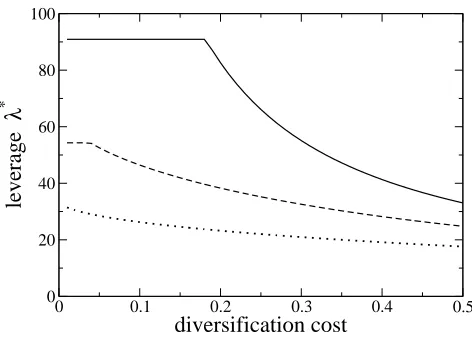
we will denote the target leverageλ∗ and diversificationm∗ simply as λand m, respectively. Figure 1 reports the numerical solutions for the optimal leverage as a function of different
levels of diversification costs (and for a given choice of the set of the remaining parameters
0 0.1 0.2 0.3 0.4 0.5
diversification cost
0 20 40 60 80 100
leverage
λ
[image:10.612.176.412.104.273.2]∗
Figure 1: Relation between the optimal leverage λ∗ and the diversification cost c, obtained by solving numerically Eq.s (7) and (8). The used parameters are: M = 20, α = 1.64 (corresponding to a 5% VaR in a Gaussian setting), µ−rL = 0.08, σd = 0.03. We then
choose σs equal to 0 (solid line), 0.009 (dashed line), and 0.018 (dotted line).
ratio (σs/σd = {0, 0.3, 0.6}). A reduction of diversification costs, by increasing the level
of diversification and hence relaxing the VaR constraint, allows the financial institution to
increase the optimal leverage, especially for lower level of the systematic to idiosyncratic
noise ratio. Note that below a given cost the optimal leverage becomes constant due to the
saturation of diversification reached when the portfolio becomes perfectly diversified across
all the M available investments. The sensitivity of the optimal leverage to diversification costs is higher for lower systematic to idiosyncratic noise ratios.
2.2
Overlapping portfolios
We now assume that our economy is composed by a group ofN financial institutions labeled withj = 1, ..., N and investing in theM risky investments as described above. The portfolio holdings of the N banks can be represented by using a bipartite graph, where the first set of nodes is composed by the N banks and the second set of nodes is composed by the M
Duarte and Eisenbach 2013 and Di Gangi et al. 2015 for the properties of such network in
the US banking system).
As in the standard CAPM framework, we make the conventional assumption that banks
have homogeneous expectation over the investments assets and thus each bank solves a
simi-lar optimization problem identifying the same optimal degree of diversificationm. However, we will assume that each bank chooses randomly and independently the investments across
the set of the M available ones, so that the selected portfolios will be different for different banks. A realization of portfolio choices of all the banks leads to a specific instance of the
bipartite graph characterized by a N ×M matrix of portfolio weights W. In the following we will consider average values for these realizations of the bipartite graph configurations.
The number of banks n having a specific risky investment in their portfolio is a random variable described by the binomial distribution
P(n;N, M, m) =
N n
m
M
n 1− m
M
N−n
(9)
whose mean value is clearly E[n] =mN/M.
Taken two banks, we can define the overlap o of their portfolios as the number of risky investments in common in the two portfolios. Alsoois a random variable and it is distributed as an hypergeometric distribution
P(o;M, m) =
m o
M−m m−o
M m
0≤o≤m. (10) Its mean value is E[o] =m2/M and its variance isV[o] =m(M −m)2/(M2 −M). Finally, the fractional overlap of two portfolios of = o/m is a number between 0 and 1 describing
which fraction of the portfolio is in common between the two banks. Clearly, the mean
fractional overlap is ¯o ≡ E[of] =m/M, therefore the value of the portfolio size m is also a
measure of the average fractional overlap ¯o between portfolios and viceversa.
The left panel of Figure 2 shows the numerical solutions of the fractional overlap, coming
from the optimal portfolio decision, as a function of different levels of diversification costs
(again, each line corresponds to different levels of systematic to idiosyncratic noise ratio,
σs/σd = {0, 0.3, 0.6}). The figure shows how reducing the costs of diversification, by the
introduction of some new form of financial products for example, increases the degree of
0 0.1 0.2 0.3 0.4 0.5
diversification cost
0 0.2 0.4 0.6 0.8 1
portfolio overlap
0 0.5 1 1.5 2
α VaR
0 0.2 0.4 0.6 0.8 1
[image:12.612.94.503.102.242.2]portfolio overlap
Figure 2: The left panel shows the mean fractional overlap ¯o between two portfolios versus the diversification cost c and the right panel shows ¯o versus the α parameter of the VaR constraint. (see Fig. 1 for the parameters). In the the right panel we setc= 0.25.
The fractional overlap resulting from the portfolio choices of financial institutions, can
also be represented as a function of the tightness of the imposed capital requirements. This
relation, depicted in the right panel of Figure 2, implies that regulator could tune the required
capital ratio α so to reach a given level of overlap, and hence correlation, among financial institutions.
2.3
Asset demand from portfolio rebalancing
Having identified their optimal leverage, financial institution periodically rebalance their
portfolios in order to maintain the desired target leverage. The rebalancing of the portfolio
of individual bankj at timet, is given by the difference between the desired amount of asset
A∗j,t =λEj,t and the actual oneAj,t,5 i.e. ∆Rj,t ≡A∗j,t−Aj,t. By defining the realized return
portfolio rj,tp , ∆Rj,t can be written as (see Appendix A)
∆Rj,t = (λ−1)A∗j,t−1r
p
j,t, (11)
that is, any profit or loss from investments in the chosen portfolio (rj,tp A∗j,t−1) will directly result in a change in the asset value amplified by the current degree of leverage (being
5As clearly shown by Adrian and Shin (2010), the balance sheet adjustments are typically performed by
λ > 1). Hence, a VaR constrained financial institution will have a positive feedback effect on the prices of the assets in his portfolio.
The total demand of the risky investment i at time t will be simply the sum of the individual demand of the financial institutions who picked investment i in their portfolio.
Being more convenient to work with matrices and vectors, let us defineRttheM×1 vector
of investment returns andQt−1 =diag[(λ−1)A∗j,t−1] a N ×N diagonal matrix. Finally, let
us consider Wthe N ×M matrix of portfolio weights characterizing the banks-investments bipartite network. Then, the M ×1 vector of demandDt is
Dt =W0Qt−1WRt (12)
From this expression the linear character of the relation between the demand of each
invest-ment and the return of all other investinvest-ments is evident.
2.4
Risky asset dynamics with endogenous feedbacks
In this section we study the dynamics of the model in the case where the return of the
risky investments are endogenously influenced by the former period demands coming from
the portfolio rebalancing of financial institutions. In presence of rebalancing feedbacks, the
return process will now be made of two components:
ri,t =ei,t−1+εi,t (13)
the exogenous component εi,t coming from the external shocks and the endogenous
compo-nentei,t−1coming from the previous period portfolio rebalancing of the financial institutions.
We assume that the exogenous component has a multivariate factor structure
εi,t =ft+i,t, (14)
with the factor ft and the idiosyncratic noise i,t uncorrelated and distributed with mean
zero and constant volatility, respectivelyσf and σ (the same for all investments). Thus, the
variance of the exogenous component of the risky investmenti is V(εi) = σ2f +σ2.
return of investment iat time t becomes6
ei,t =
Di,t γiCi,t
(15)
where Ci,t =
PN
j=1I{i∈j}
A∗j,t−1
m is a proxy for market capitalization of investment i, and γi is
a parameter expressing the market liquidity of the investment i.
Given the homogeneity of investments, we can assume that all have the same market
capitalization which, since on average there are N m/M banks investing ini, is equal to
Ci,t 'Ct=
N M
¯
A∗t−1 (16)
where ¯A∗t−1 ≡N−1PN
j=1A
∗
j,t−1 is the average bank asset size (assumed to exist).
Substituting Equations (12), (13), and (16) in (15) and using matrix notation we
ob-tain the following Vector Autoregressive (VAR) dynamics of the vector of the endogenous
components
et =Φrt =Φ(et−1+εt) (17)
with
Φ≡ M
NA¯∗t−1Γ
−1W0
Qt−1W=
M NΓ
−1W0˜
QW (18)
where Γ is a M × M diagonal matrix with diagonal elements γi,i (the market liquidity
of investment i) and Q˜ = Qt−1/A¯∗t−1 a N ×N diagonal matrix with diagonal elements
˜
Qjj = (λj −1)A∗j,t−1/A¯
∗
t−1. The matrix Q˜ is assumed to be independent from t, since the
leverage is fixed and the fraction of total asset of a bank is assumed not to change in the
investigated period7.
2.4.1 Random matrix approach
In order to proceed with the computation of the dynamical properties of returns, we take
expectations over the ensemble of the random matrices Wand study the model determined
6A stochastic component coming from the exogenous demands of traders not actively rebalancing their
portfolio could be added at the cost of complicating the subsequent computations.
7These assumptions on the constancy of the matrixΓ andQ˜ are invoked in order to obtain a standard
VAR(1) with constant autoregressive matrix. They could be relaxed at the price of obtaining a dynamic
by the expectation of the matrix B≡W0QW˜ . Depending on the quantity of interest, this
approximation is more or less reliable and we later use numerical simulations to investigate
this point.
In order to have analytical tractability of the problem, from now on we assume that the
investment selection process is a series ofM independent Bernoullian draws each with prob-ability Mm. The parameter m represents the average degree of diversification of portfolios8. In other words the number of investments of each bank is a Binomial variable with meanm
and, to keep the model general, we also assume that each bank has a leverage λj (possibly
related to the outcome of the Binomial).
Under these assumptionsWis then a random matrix where each entries is an independent
Bernoullian random variable Xj,i with probability m/M “normalized” by the sum sj =
P
iXj,i, i.e. each generic element of the matrix W is Wj,i= Xj,i
sj . Clearly,
P
iWj,i = 1.
The generic element of B is
Bij = N
X
k=1
˜
Qk,kWk,iWk,j. (19)
Being able to compute (see Appendix B)
E[Wk,i2 ]' 1
mM E[Wk,i, Wk,j]'
1
M2c. (20)
We have,
E[Bii]'
1
mM
X
k
˜
Qkk E[Bij]'
1
M2c
X
k
˜
Qkk, i6=j, (21)
where c≡1 + m1 − 1
M.
In conclusion, the average matrix Φ¯ ≡E[Φ] of the VAR(1) is
¯
Φ'(¯λ−1)Γ−1Ψ with Ψ=
1 m 1
M c . . .
1
M c
1
M c
1
m . . .
1 M c .. . . .. ... 1 M c 1
M c . . .
1 m . (22)
8The choice of treating the diversification as a random variable simplifies the analytical computations. A
model with fixed m can be developed analytically in a simplified and symmetric setting or, via numerical
simulations, in a general setting. It is possible to show that the conclusions of the papers do not depend on
where
¯
λ= PN
j=1λjA∗j,t−1
PN
j=1A
∗
j,t−1
(23)
is the asset weighted average leverage of the financial system. Notice that if all the banks
have the same leverage, the matrix Φ is independent from the bank asset size distribution
(provided the mean exists).
The dynamics of such VAR(1) process is determined by the eigenvalues of the matrix Φ¯.
The maximum eigenvalue ofΦ¯, dictating the dynamics of the VAR(1) process, becomes (see
Appendix C)
Λmax '(¯λ−1)γ−1 (24)
where γ−1 is the average of all the γ−1
i . Hence, the maximum eigenvalue depends on the
degree of leverage and on the average illiquidity of the investments.
When the maximum eigenvalue is greater than one, the return processes become
non-stationary and explosively accelerating. It is important to remark that even a reduction
in the liquidity of only one risky investment (by changing the average illiquidity of the
investments) impacts the dynamics of all the traded investments and can potentially drive
the whole financial system towards instability. In fact, depending on the average of the γ1
i,
the maximum eigenvalue (and thus the dynamical properties of the whole system) will be
highly sensitive to illiquid investments, i.e. to investment having a smallγ.
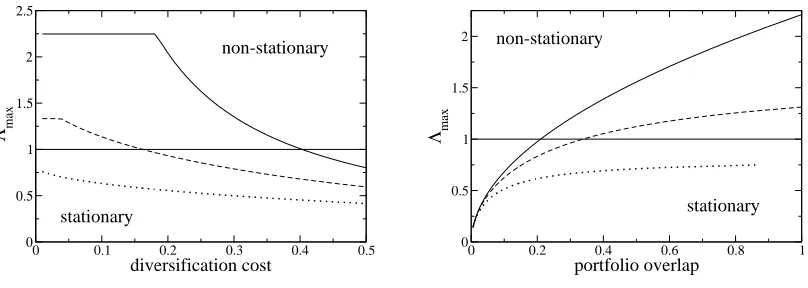
Figure 3 shows the maximum eigenvalue Λmax as a function of the diversification cost c
(left panel) and as a function of the mean portfolio overlap ¯o (right panel). We notice that a reduction of the diversification cost tends to reinforce the feedback induced by portfolio
rebalancing which can lead to dynamic instability of the system (for Λmax > 1) when the
diversification costs decrease below a certain threshold (which is higher for smaller ratio of
systematic to idiosyncratic volatility). Analogously, we can analyze the dependence of the
maximum eigenvalue of the dynamical system from the degree of portfolio overlap among
the financial institutions. A higher level of coordination in portfolio rebalancing, due to
similarities in the portfolio compositions, also reinforces the aggregate feedback between
market prices and balance sheet values pushing the system toward the region of instability
0 0.1 0.2 0.3 0.4 0.5
diversification cost
0 0.5 1 1.5 2 2.5
Λ max
stationary
non-stationary
0 0.2 0.4 0.6 0.8 1
portfolio overlap
0 0.5 1 1.5 2
Λmax
non-stationary
[image:17.612.97.501.100.244.2]stationary
Figure 3: The left panel shows the maximum eigenvalue Λmax as a function of the
diversifi-cation cost, while the right panel shows Λmax as a function of the mean fractional overlap ¯o
between two portfolios (see Fig. 1 for the parameters). We setγ = 40. The horizontal solid line shows the condition Λmax = 1, therefore the return dynamics is stationary below this
line and non stationary above it.
when the portfolio overlap is equal to one, but, depending on the other parameters, also a
moderate value of the portfolio overlap can lead to market instability.
Λmaxis the maximum eigenvalue of the average matrixΦ¯, while the maximum eigenvalue
of Φ is a random variable depending on N and the bank size distribution. It is known (see Boyd and Vandenberghe (2004)) that for a symmetric real matrix the maximum eigenvalue is
a convex function. Because of the Jensen inequality, the expectation of the maximum
eigen-value over the random matrix ensemble is larger than or equal to the maximum eigeneigen-value
of the mean matrix Φ¯. Therefore, the derived value of Λmax is a lower bound of the average
maximum eigenvalue and when Λmax > 1, indicating a non stationary dynamics, also the
average maximum eigenvalue will be larger than one. Morever, since the Jensen correction
is function of the variance of the random variable which in turn is inversely related to N in our case, we expect that this Jensen correction will decrease when the number of banks N
increases. In the next section we investigate numerically how this difference between Λmax
and the average maximum eigenvalue depends on the heterogeneity of bank asset size and
0.2 0.4 0.6 0.8 1.0
0.6
0.8
1.0
1.2
portfolio overlap
max eigen
v
alue
● ●
● ●
● ●
● ●
● ●
● ●
● ●
● ●
● ●
● ●
0.94 0.96 0.98 1.00 1.02
0
50
100
150
200
max eigenvalue
[image:18.612.109.495.101.274.2]probability density function
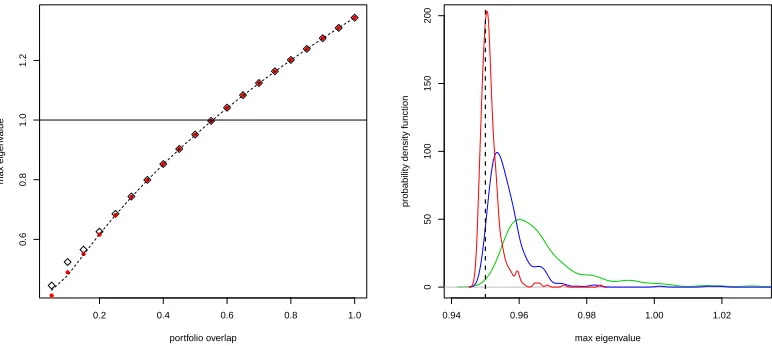
Figure 4: Left panel. Maximum eigenvalue Λmax as a function of the mean fractional overlap
¯
o between two portfolios when N = 1,000. The dashed black line is the result of Eq. 24. Red circles and black diamonds are the mean maximum eigenvalue over 500 simulations
when banks have homogeneous asset size and asset size drawn from lognormal distribution
with µ= 11.7 and σ2 = 1.8 (as in Janicki and Prescott (2006)), respectively. Right panel.
Estimation of the probability density function of the maximum eigenvalue in the case of
lognormal asset size distribution,m = 10, andN = 250 (green), 500 (blue), and 1,000 (red). The vertical dashed line is the theoretical value of Eq. 24.
2.4.2 Numerical simulations and the role of bank size heterogeneity
We investigate numerically the approximations made in the previous calculations considering
the role of bank size heterogeneity and of the number of banks N. For simplicity we will show the results for M = 20 investment assets, α = 1.64, σd = 0.03 σs = 0, and γ = 54.
Similar results are observed for other parameters values.
First we set the number of banks equal toN = 1,000 and we assume that they have all the same asset size. We perform 500 numerical simulations of the matrixWand for each of them
we compute the maximum eigenvalue. We then compare its mean value over the simulations
with the theoretical value (see red circles in the left panel of Figure 4). As a comparison,
we also consider a realistic bank asset size distribution. It is well known that bank size is
the empirical results of Janicki and Prescott (2006) who fitted the asset size of the roughly
10,000 US banks with a lognormal distribution with parameters µ = 11.7 and σ2 = 1.8. Left panel of Figure 4 shows that both in the homogeneous and in the heterogeneous case
the agreement between simulations and the theoretical value is excellent. This fact confirms
that in the largeN limit bank size distribution is irrelevant and the approximations leading to Eq. 24 are very good.
We then consider the role of finite size corrections, investigating the distribution of the
maximum eigenvalue for fixed fractional overlap and variable number of banks N. Specifi-cally, we consider the lognormal distribution of bank size and we fix the value of m = 10. The right panel of Fig. 4 reports the estimation of the probability density function of the
maximum eigenvalue for N = 250,500,1,000. As expected from the convexity argument, form small value ofN the probability density function of the maximum eigenvalue has con-siderable mass above the theoretical (and asymptotic) value of Eq. 24 (vertical dashed line).
Notice however that even for N = 250 the mode of the distribution is only 1% larger than the theoretical value, confirming again that our numerical approximation is very good.
In conclusion this result indicates the asymptotic (in N) nature of our analytical ap-proximation. As suggested above, the finite sample bias is due to the nonlinear and convex
nature of the maximum eigenvalue. In fact, numerical simulations and t-tests confirm that
the mean value ofBij is correctly described by Eq. 21. In any case it is worth noticing that
our numerical simulations indicate that for finite samples, bank size heterogeneity makes the
financial system more unstable as compared to the homogeneous case. In fact, all else being
equal, for finite and smallN the maximum eigenvalue is larger for the heterogenous than for the homogeneous case, making the system closer to the transition between the stationary
and the non-stationary dynamics.
2.5
Properties of risky asset dynamics
Here we give an exact description of the dynamics of investment assets computing in closed
form the variance-covariance matrix of asset returns. In fact, using the average representation
of Eq. 22, we notice that mΨ can be written as
with the scalarb= M cm , identity matrixI, and the column vector of ones ι. Hence, the VAR for the vector of endogenous components in equation (17) can be rewritten as
et = (1−b)A(et−1+εt) +b MAι(¯et−1+ ¯εt) (26)
with matrix A ≡ ¯λ−1
m Γ
−1 and scalars ¯e
t ≡ M1 PMk=1ek,t and ¯εt ≡ M1 PMk=1εk,t. The scalar ¯et
can be interpreted as the endogenous return of the market portfolio. Thus, the endogenous
component of an individual investment becomes
ei,t = (1−b)ai(ei,t−1 +εi,t) +b M ai(¯et−1+ ¯εt) (27)
with scalar ai =
¯
λ−1
mγi.
Therefore, the process for ei,t can be rewritten as a linear combination of a standard
univariate AR(1) process and a dynamic process depending on the averages of previous period
endogenous components and shocks. In this way,ei,t is a mixture of a perfectly idiosyncratic
process (i.e. uncorrelated with the others investment processes) receiving weight 1−b and a perfectly correlated process with weight b. Being b= M cm , the higher is the value ofm, the higher is the weight given to the perfectly correlated component of mixture and, hence, the
higher the correlations among the endogenous components of the different investments.
Moreover, assuming ai =a ∀i (i.e. all investments have the same liquidity), the process
for ¯et becomes:
¯
et = a(1−b+bM)(¯et−1+ ¯εt)≡φ(¯et−1+ ¯εt) (28)
with φ ≡ a(1− b +bM). Therefore, the dynamics of the average process ¯et is also an
autoregressive of order one; its variance, assuming stationarity ofet, is (see Appendix D)
V( ¯et) =
Λ2max 1−Λ2
max
V(¯εt) (29)
with V(¯εt) =
σ2f +σ2
M
.
Finally, defining the distance of the endogenous component of investment i from the average as ∆ei,t ≡ei,t −¯et, we also have that
where ∆εi,t ≡ εi,t−ε¯t. So that the dynamics of the individual distance of the endogenous
component of investment i from the average value ¯et is also an autoregressive process of
order one.
We can then interpret the dynamics of the endogenous components of each individual
investment as an idiosyncratic AR(1) process around a common process for the average value
also following an AR(1) and where the amplitude of the idiosyncratic component is inversely
related to the portfolio diversification. In other words, the dynamics of endogenous returns
can be described as a multivariate “ARs around AR”. When the process is stationary, the
mean market behavior is described by a mean reverting process. In turn, each investment
performs a mean reverting process around the market mean. It can be shown that the time
scale for mean reversion of the market is always larger than the time scale of reversion of
an investment toward the market mean behavior. Moreover, when m increases the time scale of reversion of individual investment declines, which means that investments become
more quickly synchronized with the mean market behavior. Finally, notice that this type of
multivariate “ARs around AR” dynamics is also followed by the endogenous component of
portfolio returns ept ≡ 1
m
Pm
k=1ek,t where the number of assets in portfolio is m < M.
Importantly, this representation clearly shows that, as for the exogenous component, also
the variability of the endogenous component of returns can be decomposed into a systematic
component associated with the volatility of ¯etand an idiosyncratic one. Therefore, both the
exogenous and endogenous components contain a diversifiable and undiversifiable source of
risk, so that also the total risk of the investments return is composed of these two type of
risk, σs and σd, as perceived by the financial institutions.
Thanks to this representation we are able to explicitly compute the variance and
covari-ances of the process for the endogenous components ei,t, which are reported in Appendix
(D). It can be shown that a larger leverage increases both the variances and the covariances
of ei,t, while a greater degree of diversification reduces the variances and increases the
co-variances. Both are positively related with correlations. In particular, it can be shown (see
Appendix D) that the correlations among the endogenous returns tend to one as m→M.9
9Notice that the endogenous correlations would not tend to one in presence of an additional stochastic
component in the price impact function (Eq. 15) coming from the exogenous demand of traders not actively
Taking into account the feedback induced by the portfolio rebalancing introduces a new
endogenous component in the variance of the investment asset given by the variance of the
endogenous component
V(ri,t) =V(ei,t) +V(εi,t) (31)
where the exogenous variance V(εi,t) = σ2f +σ2 and the explicit expression for the
endoge-nous variance V(ei,t) is given in Appendix D. This expression shows that the endogenous
component of return leads to an increase of the volatility of an investment above its “bare”
level V(εi,t). This volatility increase is at the end due to the finite liquidity of the
invest-ments and disappears when γ → ∞ and it can therefore be seen as an “illiquidity induced contribution to volatility”.
Analogously, the covariance between the returns of two investments is enhanced by the
contribution coming from the covariance between the endogenous components (see Appendix
D)
Cov(ri,t, rj,t) =Cov(ei,t, ej,t) +σf2. (32)
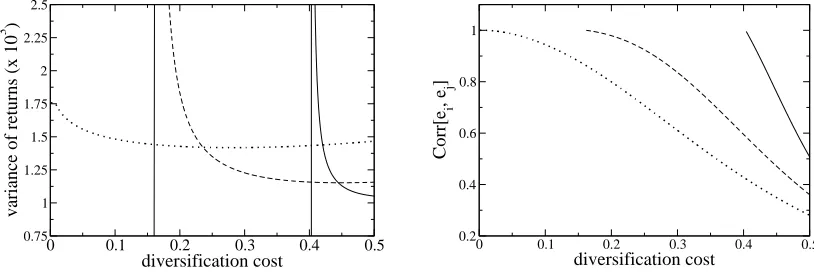
Figure 5 shows the variance of returns and the correlation between the endogenous
com-ponent of returns of two investments as a function of diversification cost c. We see that when cost is high, variance and correlations are low. By decreasing cost, variance of returns
increases as well as correlations. If the market factor is not strong enough, there is a value
of c for which variance diverges, corresponding to the case where the maximum eigenvalue Λmax becomes equal to one. In this limit, correlations become closer and closer to one.
As a consequence the variance of portfolio returns in presence of the rebalancing feedbacks
becomes
V(rpt) = V(ei,t)
m +
m−1
m Cov(ei,t, ej,t) +σ
2
f +
σ2
m
= V(ep) +σf2 +
σ2
m, (33)
which, as for investment returns, means that the endogenous component (and therefore
the illiquidity of the assets) increases the volatility of portfolio by a illiquidity induced
0 0.1 0.2 0.3 0.4 0.5
diversification cost
0.75 1 1.25 1.5 1.75 2 2.25 2.5
variance of returns (x 10
3 )
0 0.1 0.2 0.3 0.4 0.5
diversification cost
0.2 0.4 0.6 0.8 1
Corr[e
i
, e
j
[image:23.612.93.500.103.241.2]]
Figure 5: The left panel shows the variance of investment returns, V(ri,t), of Eq. (31) as
a function of the diversification cost c, while the right panel shows the correlation of the endogenous component of returns between two investments, Corr(ei,t, ej,t) as a function of
c (see Fig. 1 for the parameters). The vertical lines in the left panel indicate where the variance of returns diverges and below these values correlations in the right panel are clearly
not defined.
diversification cost c for different values of the ratio σs/σd. It is important to notice that
by reducing diversification cost, the variance of portfolios initially declines. This means that
in this regime, financial innovation makes portfolios less risky and it is therefore beneficial.
However, the variance of the portfolio reaches a minimum for a given value of c and by reducing further the diversification cost, one gets closer and closer to the critical condition
Λmax = 1 and the variance increases without bounds. In this regime, even small variations
of the cost lead to huge increases of the riskiness of the portfolios.
It is also interesting to note that the variance of the observed market portfolio (the one
containing all the M investments with equal weights) is
V(rMt ) = V(¯e) +σf2 + σ
2
M ≡V(¯e) +σ
2
pM =
Λ2 max
1−Λ2 max
σp2
M +σ
2
pM
= 1
1−Λ2 max
σp2M (34)
with σ2pM ≡ σ2f + σ2
M being the market portfolio return when feedback due to impact is not
can then be termed the “variance multiplier” of the endogenous component. Clearly, for
larger values of the maximum eigenvalue of the VAR process, the variance multiplier will
increase exploding for Λ2
max →1.
0 0.1 0.2 0.3 0.4 0.5
diversification cost
0 0.5 1 1.5 2
variance of portfolios (x 10
3 )
0 0.1 0.2 0.3 0.4 0.5
diversification cost
0.2 0.4 0.6 0.8 1
[image:24.612.92.503.172.313.2]correlation of portfolios
Figure 6: The left panel shows the variance of portfolios, V(rtp), of Eq. (33) as a function of the diversification cost c, while the right panel shows their correlation, ρe
p, of Eq. (36) (see
Fig. 1 for the parameters). The vertical lines in the right panel indicate where the variance
of portfolios diverges and below these values correlations in the right panel are clearly not
defined.
Similarly, the covariance between two portfolios containing m assets becomes
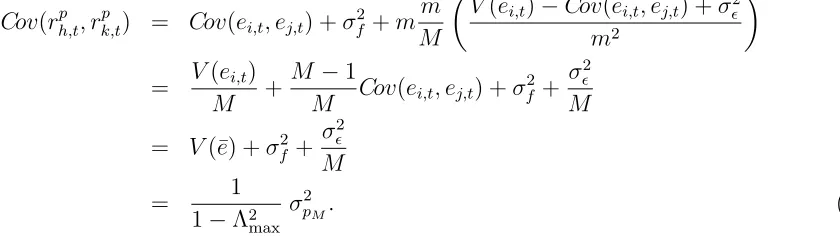
Cov(rh,tp , rk,tp ) = Cov(ei,t, ej,t) +σf2+m
m M
V(ei,t)−Cov(ei,t, ej,t) +σ2
m2
= V(ei,t)
M +
M −1
M Cov(ei,t, ej,t) +σ
2
f +
σ2
M
= V(¯e) +σ2f + σ
2
M
= 1
1−Λ2 max
σp2M. (35)
In fact, given the factor structure of ei,t, with the factor being ¯rt= ¯et−1+ ¯εt, the covariance
Cov(ep,t,¯et) is equal to the variance of the factor V(¯e) (as for the exogenous covariance).
[image:24.612.101.521.499.617.2]be written as
ρp =
V(¯e) +σ2f +σ2
M
V(ep) +σf2+ σ2
m
=
V(ep) V(¯e)
V(ep) +
σf2+ σ2
m
σ2
f+ σ2 M
σ2
f+ σ2
m
V(ep) +σ2f + σ2
m
= σ
2
eρe+σε2ρε
σ2
e +σε2
(36)
where σ2
e ≡ V(ep), σε2 ≡ σf2 + σ2
m, ρe ≡
Cov(ep,t,¯et)
V(ep) =
V(¯e)
V(ep), and ρε ≡
σ2
f+ σ2 M
σ2
f+ σ2
m
. That is,
the portfolio correlation in presence of active asset management is a weighted average of the
endogenous correlations betweenep and ¯e, i.e. ρe, and the correlation between the exogenous
shocks, (i.e. ρε), with weights the respective variancesσe2 andσε2. Since both the endogenous
ρe and exogenous ρε correlations tend to one as m → M, also the total correlation of the
portfolio ρp tends to one as m →M.
The right panel of Figure 6 shows the correlation between portfolios as a function of the
diversification cost c. Correlation between portfolios steadily increases by reducing diversi-fication costs essentially because the overlap between portfolios increases. It is important
to notice that the condition of divergence of the variance does not imply a perfect overlap
between portfolio. For example, with the given parameters the transition to infinite variance
and non stationary portfolios occurs at ¯o = 0.34 when σs/σd = 0.3 and at ¯o = 0.21 when
σs/σd = 0. Thus correlation between portfolios can become very close to one even if the
portfolio overlap is relatively small.
2.6
Bank asset dynamics
The dynamics of the rebalanced bank asset A∗i,t, can be written as
A∗j,t =λjEj,t =λj Ej,t−1+r
p j,tA
∗
j,t−1
=A∗j,t−1+λjr p j,tA
∗
j,t−1 (37)
thus, the relative change of the bank j total asset rA
j,t is simply given as
rAj,t ≡ A ∗
j,t−A
∗
j,t−1
A∗j,t−1 =λjr
p
j,t. (38)
Therefore, the variance and covariance of the relative change of bank assetsrA
j,tare simply
0 0.1 0.2 0.3 0.4 0.5 diversification cost 0 0.1 0.2 0.3 0.4 0.5 0.6 0.7 0.8
variance of total asset (x 10
6 )
0 0.2 0.4 0.6 0.8 1
portfolio overlap 0 0.1 0.2 0.3 0.4 0.5 0.6 0.7 0.8
variance of total asset (x 10
6 )
Figure 7: Variance of the total asset,PN
j=1r
p
j,t, of the whole banking sector as a function of
the diversification costc(left panel) and of the mean fractional overlap ¯o between portfolios (right panel) (see Fig. 1 for the parameters) The vertical lines indicate where the variance
of total asset diverges.
and
Cov(rh,tA, rk,tA) =λhλkCov(rph,t, r p
k,t), (40)
where the expression for V(rj,tp ) and Cov(rph,t, rk,tp ) are given in equation (33) and (35), re-spectively. The properties of the bank assets dynamics are then dictated by those of the
portfolio (with its exogenous and endogenous components) and further amplified by the
degree of leverage.
We can finally compute the variance of the total asset of the whole banking sector
V
N
X
j=1
rj,tA
!
'N V rAj,t+N(N−1)Cov rh,tA, rk,tA'Nλ¯2V rpj,t+N(N−1)¯λ2Cov rph,t, rpk,t
= ¯λ2V
N
X
j=1
rpj,t
!
(41)
where for simplicity we have assumed that all the banks have the same leverage ¯λ. Moreover
V PN
j=1r
p j,t
is explicitly given in terms of the original variables in Appendix D where it is
also shown that form →M it reduces to
V
N
X
j=1
rj,tp
!
−−−→
m→M
N2σ2
pM
1−Λmax
These analytical results allows us to analyze the determinants of the variability of total
asset of the banking sector which governs the expansion and contraction of the supply of
credit and liquidity to financial system.
Figure 7 shows the variance of the total asset of the whole banking sectors as a function
of the diversification cost (left panel) and of the mean fractional overlap between portfolios
(right panel). We observe that the variance of the total asset monotonically increases when
one decreases diversification cost or increases the overlap between portfolios. As one of these
two related variables leads the system close to the critical point, the variance of the total
asset of the banking sector explodes. Moreover, close to the transition point, the variance of
the total asset increases dramatically when one changes slightly the typical overlap between
portfolios.
3
Systemic risk
We now analyze the systemic risk implications of our model first in the static setting without
feedback and then in a setting with the endogenous feedback of investor demands on the
asset dynamics.
3.1
Static analysis
First, as previously shown, when the diversificationm increases, the correlation between the portfolio returns of two financial institutions will increase, with ρp −−−→
m→M 1, which, ceteris
paribus, tends to increase the probability of a systemwide contagion during a crisis event.
Second, given a negative realization of the systematic (exogenous and endogenous)
com-ponent st = ¯et+ft, the portfolio return distribution conditioned on this systematic shock
sshock
t is (considering, for simplicity, a normal distribution for portfolio returns with zero
mean):
rpi,t|sshockt ∼N
sshockt , σ
2
d
m
. (43)
where rpi,t =Pm
j=1
ri,j,t
m is the portfolio return of bank i at timet.
sshock t is
P Di,t−1 = P
rpi,t|sshockt ≤ −α
r
σ2
s +
σ2
d
m
!
(44)
= Φ
−α
q
σ2
s + σ2
d
m −s shock t
q
σ2
d
m
−−−−−−−−→
m→M, M→∞ 1 ∀ s
shock
t <−ασs,
where Φ is the standard normal cdf. Therefore, for any negative shock of the systematic
component larger than its VaR, i.e. ασs, the probability of default increases with the degree
of diversification m.
In summary, higher degree of diversification increases both the probability of default of
single institutions (in case of large systematic shocks) and the correlations among them, thus
exposing the economy to a higher level of systemic risk.
3.2
Dynamic analysis
The results of the previous section show that the endogenous return dynamics adds an
additional component to both the variance and covariance of the risky investments. If such
endogenous components were not accounted for in the evaluation of portfolio volatility for
the VaR, obviously, there would be an underestimation of each agent’s risk, leading to an
under capitalization of the banking sector and, hence, to an higher fragility of the system.
Nevertheless, the practice of empirically estimating variances and covariances of risky assets
from past data, automatically considers both the exogenous and endogenous components of
volatility.
However, contrary to the case without endogeneity, the investments variances and
co-variances now depend on the level of diversification and, in particular, the degree of leverage
(through the dynamics of the endogenous component). Therefore, a change, say, in the
de-gree of leverage will cause a structural shift in the future level of variances and covariances
which will not be captured by the empirical estimation on past data.
In particular, in periods when leverage increases, portfolio volatility estimated on
his-torical past data will tend to underestimate future risk (coming from stronger rebalancing
feedback) leading to an increase of systemic risk. On the contrary, in periods of decreasing
realized volatility will tend to be lower than the historical one. Therefore, the results of
our model provide a theoretical support for countercyclical capital requirements as often
advocated in the aftermath of the recent financial crises.
Moreover, it is important to notice that a given negative realization of the exogenous
factor ft, will trigger a sequence of portfolio rebalances causing the price of all risky assets
to decay for several periods. Within our framework, we can explicitly compute the expected
impact on the future return dynamics triggered by a given common shock.
Being et = Φrt (from equation 17), the vector of investment returns also follows a
VAR(1)
rt = et−1+ιft+t =Φrt−1+ιft+t. (45)
The total future impact of the shocks over the next h periods will be given by the h-period cumulative mean return conditioned on the factor shock fshock
t , which is (for h sufficiently
large)
Ert:t+h|ftshock
'(I−Φ)−1ιftshock. (46) Hence, the larger the maximum eigenvalue of Φthe larger will be the magnitude and
persis-tence of future adjustments leading to a larger cumulative impact that the financial system
will have to absorb. So the larger the maximum eigenvalue the higher will be the probability
that the system, because of capital or liquidity constraints, will not be able to absorb the
initial shock. This also means that systemic risk is positively related to the magnitude of
the eigenvalues of the matrixΦ.
4
Discussion: Introducing financial innovations
The results on the dynamics of the asset prices can be summarized as follows. When the costs
of diversificationcare high, the degree of diversification i.e. the number of assetmrandomly selected and the degree of leverage are small. Thus the portfolio of the financial institutions
are heterogeneous and little leveraged. Therefore, the endogenous feedbacks, coming from
the amplification of individual demands induced by leverage targeting (as illustrated in the
at the aggregate level between asset values and prices of risky investments will not tend to
arise.
We now discuss the effect of the introduction of financial innovation products (such as
securitization of mortgages or ABS products) that permits to reduce the cost of diversification
c. Despite the simplicity of our framework, the introduction of financial innovation has several important consequences. First, a financial innovation which reduces the cost of
diversification c, by increasing the optimal level of diversification m, reduces the volatility of the portfolio which in turns increase the leverage of the institution. In this way, financial
innovation will tend to increase the degree of leverage in the system. By increasing the
leverage, the individual exposition to the undiversifiable macro factor risk increases; i.e.,
although each individual is more resilient to idiosyncratic shocks, they become more sensitive
to the shocks in the macro factor.
Second, by increasingm, the overlap in the portfolios of the different financial institutions will be larger, increasing the ”similarity” of the portfolio choices among the investors and,
thereby, increasing the correlations among portfolio returns and balance sheet dynamics.
Third, an increase in leverage will heavily affect the dynamics of the risky investments
by increasing both their variances, covariances and correlations, through a strengthening of
the endogenous component.
As a consequence of these effects, individual reactions in terms of asset demands will
be more aggressive (due to higher leverage) and more coordinated (because of the larger
correlation in the profits-losses realizations). This rise in the strength and coordination of
the individual reactions will make more likely to have aggregate feedback in which the rise of
the price of some investments leads to an excess of equity (by the realized capital gains) and,
hence, to an expansion of the balance sheets driving new demands for the asset which pushes
the price up and so on. The very same mechanism will operate also in the opposite direction
during market crisis when the aggregate feedback will aggravate price declines and balance
sheet contractions. When the diversification cost falls below a given threshold (implying
the maximum eigenvalue of the vector return process exceeding one) the aggregate feedback
will produce price and balance sheet dynamics that become explosive (see also Corsi and
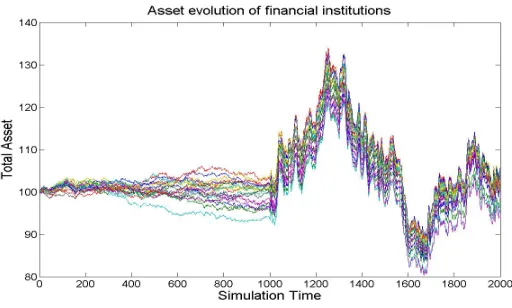
Figure 8: Numerical simulation of the dynamics of individual total asset of financial
insti-tutions before and after a structural break (at simulation time 1000) on the diversification
costs that induces an increase of leverage and diversification. Leverage goes from 10 to 60
and fractional overlap from 0.1 to 0.8 .
These feedbacks could be reinforced even further by endogenizing the dynamics of
finan-cial innovation or, as in Brunnemeier and Pedersen (2008), that of the market liquidity. For
instance, following the intuition of Brunnemeier and Pedersen (2008), the market liquidity
could be assumed to inversely depends on the past realized volatility so that an increase
in the endogenous feedback, by increasing volatility also increase the market impact of the
portfolio rebalancing (through the reduction in market liquidity), thus further reinforcing
the feedback.
Therefore, through these mechanisms reinforcing the endogenous feedback, financial
in-novation can give rise to a steep growth (bubble) and plunge (burst) of market prices and
banking sector total assets. As explained by Adrian and Shin (2010), the total asset of the
banking sector is the relevant variable for the determination of the amount of credit supplied
to the financial and real sector. Hence, an increase in the variability of the total asset of the
banking sector will have major consequences on the availability of funding to the economy
causing the instability to be transmitted from the financial sector to the real one.
To visually illustrate the impact on the dynamics of financial intermediaries total asset
of a shift in the degree of leverage and diversification induced by a reduction in the
sudden increase (at simulation time 1000) in the degree of leverage and diversification (see
Figure 8). Going from a low level of leverage and diversification to a high level we observe:
(i) a dramatic increase in the correlation and amplitude of the changes in the total asset
of individual financial institutions, and (ii) a sudden shift in the total banking sector assets
(i.e. simply the sum of all the individual bank total assets), which will imply going from an
approximately constant supply of credit to a regime with wide swings in the credit supply.
5
Conclusions
In this paper we investigate the determinants of the balance sheet dynamics of financial
intermediaries by modeling the dynamic interaction between asset prices and bank behavior
induced by regulatory constraints and multi-round portafoglio rebalances. Standard capital
requirements, in the form of Value–at–Risk (VaR) constraints, together with the level of
diversification costs (related to the availability of derivatives products), determine bank
decisions on diversification and leverage which, in turns, strongly affect the dynamics of
traded assets through the bank strategies of portfolio rebalances in presence of a finite asset
liquidity. We show how changes in the constraints of the bank portfolio optimization (such
as changes in the prevailing cost of diversification or changes in the micro-prudential policies)
endogenously drive the dynamics of bank balance sheets, asset prices, and systemic risk.
The analytical results obtained by applying our simple framework are manifolds: (i) a
reduction of diversification costs, by increasing the level of diversification and hence relaxing
the VaR constraint, allows the financial institutions to increase the optimal leverage; (ii)
it also increases the degree of overlap, and thereby correlation, between the portfolios of
financial institutions; (iii) even in absence of feedback effects, higher degree of diversification
increases both the probability of default of single institutions (in case of large systematic
shocks) and the correlations among them, thus exposing the economy to a higher level of
systemic risk; (iv) the higher overlap induced by a reduction in diversification costs increases
both the variance and correlation of the investment demands of financial institutions
re-balancing their portfolios; (v) the dynamic interaction between investment prices and bank
max-imum eigenvalue depends on the degree of leverage and on the average illiquidity of the
assets; (vi) higher diversification, by increasing the strength and coordination of individual
feedbacks, can lead to dynamic instability of the system; (vii) the VAR process can be
rep-resented as a combination of many idiosyncratic AR processes around a single common AR
process of the average values; (viii) the endogenous feedback introduces an additional
com-ponent to the variance, covariance and correlation of both the individual investment assets
and the bank portfolios; (ix) both the variance and correlation of individual investments
monotonically increase with a reduction in the diversification costs; (x) a simple variance
multiplier exists for the variance of the observed market portfolio. (xi) the relation between
the variance of the portfolio and diversification costs is non-monotonic as it initially declines
with costs while then rapidly increases when the reduction of diversification costs makes
the system approaching its critical point causing the variance to explode; (xii) the effects
of the endogenous feedback make historical estimation of variances and covariances to be
overestimated during periods of increasing leverage and underestimated during periods of
deleveraging, thus providing a rationale for the adoption of countercyclical capital
require-ments; (xiii) in presence of endogenous feedbacks, a negative realization of the systematic
component will trigger a sequence of portfolio rebalances which will amplify, over time, its
initial impact; (xiv) the variability of total asset of the banking sector, which governs the
expansion and contraction of the supply of credit and liquidity to financial system, is highly
sensitive to variation in the costs of diversification.
Acknowledgements
Authors acknowledge Piero Mazzarisi for useful discussions. The research leading to these
results has received funding from the European Union, Seventh Framework Programme
FP7/2007-2013 under grant agreement n◦ CRISIS-ICT-2011-288501.
References
Adrian, T. and Boyarchenko, N. (2012). Intermediary leverage cycles and financial stability.