INTERNATIONAL CONFERENCE ON ENGINEERING AND PRODUCT DESIGN EDUCATION 8 & 9 SEPTEMBER 2016, AALBORG UNIVERSITY, DENMARK
APPROACHES TO JOINT PROBLEM SOLVING IN
MULTIDISCIPLINARY DISTRIBUTED TEAMS
ABSTRACT
This paper focuses on the different approaches that multidisciplinary teams adopt when solving a design problem. After a literature review on terms regarding work across more than one discipline, the Disciplinarity Matrix merges the terminology present across literature into a single classification, displaying which kind of multidisciplinary work can be expected depending on the project setup, followed an application on an educational Global Design Project across four universities in which students designed an artefact in a distributed, multidisciplinary team. Their approaches are discussed and the design output is taken into account in order to classify and evaluate the teams’ success.
The key findings include that both multidisciplinary and interdisciplinary approaches can be successful, but need sufficient resources, especially time, to unfold their potential. Recommendations for multidisciplinary team work are not limited to the setup, but include requirements such as openness, a common language and moderation skills, which provide avenues to successful work in both educational and industrial multidisciplinary projects.
Keywords: Multidisciplinarity, Interdisciplinarity, Global Design
1 INTRODUCTION
Global Design is a trend emerging from the overlap of companies’ and individuals’ globalisation. While many of the major industrial developments and applications of the 19th and 20th century have
occurred in mono-disciplinary research and development environments, today typical problem-solving teams include engineers from various backgrounds [1]. Teams working together in Global Design projects are a blueprint of diversity in terms of problem solving, the core feature of industrial design. While projects involving more than one discipline become more and more frequent, these are at the same time limited in a number of ways, regarding factors such as time, budget, complexity avoidance or lack of integration [2]. This leaves room to scrutinise ongoing educational projects regarding the environment in which work in multidisciplinary teams can develop while at the same time comparing project setup, characteristics of multi- and interdisciplinary work and the designed artefacts.
The practical experiences are based on an educational Global Design project at Universities in Malta, Hungary, England and Scotland, in which students of various disciplines worked in real Global Design teams. The students’ task was to design a more effective aeroplane seatbelt. The project was run for a duration of eight weeks and students used various means of virtual collaboration, such as videoconferencing, creativity tools and virtual and physical prototyping.
2 CHARACTERISTICS OF MULTIDISCIPLINARY WORKING
This section provides an overview of terms and standards related to working across disciplines. Terms are subsequently discussed with regard to the design task, the transportation industry, its influence on problem-solving and ultimately how to measure work executed in multidisciplinary teams.
2.1 Disciplines, Multidisciplinarity and Interdisciplinarity
on a common task, then splitting apart unchanged, true interdisciplinarity occurs when disciplines actually question their own approach and integrate, forging a new field or discipline (Figure 1 a). Thus, divergence and convergence is a typical symptom of multidisciplinary work, whereas simultaneous and integrative approaches point towards interdisciplinary work [5].
A second distinction is made by Jungert [6], who introduces the terms of “Practical Interdisciplinarity” and “Methodical Interdisciplinarity”. Practical interdisciplinarity occurs when the focus lies on problems and artefacts rather than methodologies. Methodical interdisciplinarity on the other hand occurs when methods are used commonly by several disciplines who thereby share an academic interest to enhance these methods.
2.2 Multidisciplinarity in Design and Engineering for the Transportation Industry It is an open question whether Design is a discipline, a task which is commonly tackled with experts stemming from a number of disciplines or an interdisciplinary field, with an interdisciplinary designer “mastering the (…) multidisciplinary nature of modern products in an integrated fashion”[7]. A key influence on the approach to interdisciplinarity is the consensus level among the disciplines involved. Engineering and science are described as “high-consensus” disciplines, sharing defined values, metrics and measures, as opposed to social sciences, which have “low-consensus” characteristics [8]. Design can be considered to contain characteristics of both – measures such as cost, weight, footprint point towards high consensus between different designers and the engineers involved. It is underlined that teams from a design background share a common language [9]. On the other hand, creative, disruptive aspects to design point more towards low consensus. Nonetheless, “Product design is a natural opening for multidisciplinary team work” [9].
One major claim made by Sussman [10] is the “fundamentally interdisciplinary nature” of transportation. His rationale include the occurrence of “modern engineering systems, characterized by a cross-cutting, interdisciplinary approach” [10]. This view of mechatronic systems as a key driver for interdisciplinary work is supported by Hackenberg et al. [11]. The process for interdisciplinary work in transportation is visualised in Figure 1 b), suggesting to unify and codify knowledge and to identify new applications, which highlights the importance of convergence and divergence in this context.
2.3 The Problem-Solving Process in Multidisciplinary Teams
The distributed and multidisciplinary natures of the teams in the Global Design Project are two drivers for a problem-solving process characterised by divergence and convergence. In multidisciplinary teams, a first step to problem solving is the problem statement. Diverging and converging approaches are discussed in literature, by either decomposing the problem into sub-problems and managing these within each of the disciplines [12,13] or by focusing on an overall interdisciplinary system description with abstraction playing a key role [11]. The common understanding of the problem statement marks the first important convergence point, which is essential for subsequent decision making.
A possible point to diverge is the phase of concept generation, ensuring that a variety of concepts is generated and increasing the probability of generating innovative concepts [14] which are a suitable base for iteration and decision-making. Assuming the presence of a transdisciplinary problem, it is logically impossible for an optimal solution to occur within a purely disciplinary environment. While the hypothesis of the “interdisciplinary designer” [7] does leave the possibility for an ideal solution being presented by a single designer to his multidisciplinary team, most projects iterate around concepts and synthesise the ideal solution from a number of disciplinary elements.
[image:2.595.79.521.173.275.2]The decision-making process is examined in detail by Xiao et al. [12] who suggest to implement one decision body at an interdisciplinary level while others are “only responsible for providing disciplinary analyses when requested” [12]. Drawbacks of this idea are that interdisciplinary iteration among experts is ruled out, limiting the decision space to not accommodate the ideal solution [15], as well as the introduction of power distance by “promoting” some peers to a decision body.
2.4 Metrics for Work in Multidisciplinary Teams
Two major metrologies are available. The first one focuses on the process, thereby raising the question as to whether the task has been executed successfully in a multi- or interdisciplinary way [6,8,11,16]. The second framework attempts to measure the outcome, raising the questions whether the outcome is “good” by any available metric and better than what any single discipline could have reached [5]. When assessing the degree of multi- or interdisciplinarity in a team’s design process, few quantitative measures are available. Jassawalla and Sashittal [16] suggest to measure the degree of collaboration. The integration of systems engineering and requirements management is discussed as a positive measure of interdisciplinary processes [11]. Strictly sequential proceeding by different disciplinary sub-teams on the other hand is mentioned [15] as a danger for finding the optimal solution.
Three common failures are defined by Jungert [6]: “As-if-interdisciplinarity” – occurring when methods of one discipline are unsuitably applied to a mono-disciplinary problem from another discipline, “Nice-to-know-interdisciplinarity” – when other disciplines are included for reference only and are not really involved in the solution process, resulting in a lack of value attributed to their contributions, and “Unfriendly-takeover-interdisciplinarity” – occurring when the actual aim is to integrate one discipline into another, thereby disregarding the methods and findings of this field. It is not to be confounded with the necessary “successive refinement” [11] of the transdisciplinary solution space which might rule out solutions which include all disciplines.
The second framework is the assessment of the outcome from work executed in a multidisciplinary environment and is closely related to the artefact. There is a risk that disciplinary experts tend to measure quality by their own metric, possibly unsuitable for the transdisciplinary artefact. The reliance on “indirect quality indicators” [5] which are not related directly to the artefact, should be avoided – projects must be assessed at the base line. The reflection of several disciplines' knowledge in the artefact is a useful base measure [13]. A design artefact displaying strong modular, disciplinary functions points into the direction of a successful multidisciplinary approach as utilised in the aviation industry [15]. While more interwoven functions point towards an interdisciplinary approach, a purely mechanical artefact might be a sign of monodisciplinary work.
3 JOINT PROBLEM SOLVING IN THE GLOBAL DESIGN PROJECT
Before scrutinising the methods of Joint Problem Solving in the Global Design Project, a systematic approach is presented regarding the types of collaboration in multidisciplinary teams. The “Disciplinarity Matrix” is the first two-dimensional approach to classify work in multidisciplinary teams and plays a key role in the findings of this paper.
3.1 The Global Design Project in the Disciplinarity Matrix
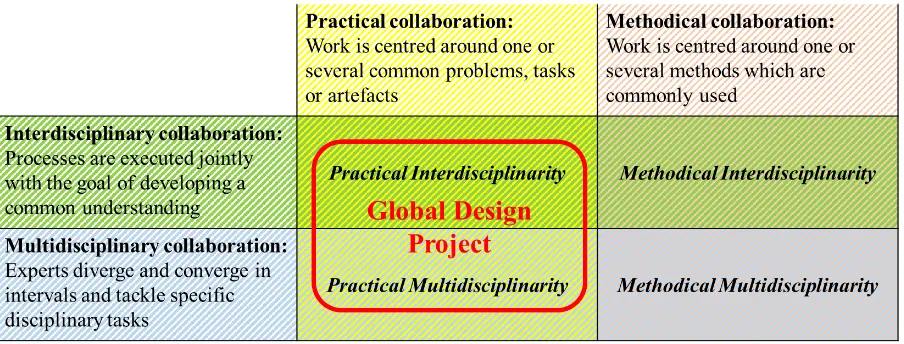
The “Disciplinarity Matrix” combines both dimensions of multidisciplinary work: the type of collaboration among the disciplines over time, leading to the distinction between multi- and interdisciplinarity [8], and the distinction between methodical and practical cooperation [6], thus whether the disciplines will converge solving a problem or rather developing common methods and tools. Common methods do play a role in practical multi- or interdisciplinarity [9], thus the pure existence of common methods is sufficient to rule out a practical approach. The consequence is a four-fold outcome of possible collaboration among multidisciplinary teams (Figure 2).
The application of the Disciplinarity Matrix requires typical project setup examples which are distinctly located in each of the four quadrants and display the diversity of multidisciplinary project setups. Practical Multidisciplinarity would typically be expected when the transdisciplinary artefact can be divided into disciplinary modules, such as in shipbuilding. Practical Interdisciplinarity on the other hand would occur whenever this is not suitable, as is the case in subordinate transdisciplinary artefacts such as the brake system of a car, which is jointly developed by electrical, mechanical and software engineers. Methodical Multidisciplinarity occurs whenever a method is commonly used, but not jointly developed, such as mathematical growth models which are used by insurance mathematicians, biologists and nuclear physicists alike. An example for Methodical Interdisciplinarity is the development of agile methodologies such as lean manufacturing and agile software engineering, a more recent, methodical field jointly developed by manufacturers and software engineers.
3.2 Divergence, Convergence and Outcomes of the Global Design Project
The Global Design Project was executed by students from four universities forming six groups, where each group consisted of students from at least three universities. Four key disciplines (design (DE), industrial (IE), mechanical (ME) and electrical engineering (EE) ) were distinguished.
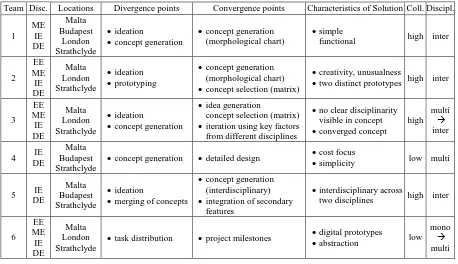
Table 1 suggests that teams used a total of three distinct approaches. The approach of Teams 1, 2, 3 and 5 most remarkably includes distributed ideation, an early convergence in concept selection and later an iteration while striving to include factors of other concepts, pointing towards multidisciplinary elements in early stages which then converge into more interdisciplinary work. The approach used by Team 4 was marked by a late convergence in the detailed design phase, where finished concepts were generated by each discipline. Team 6 on the other hand selected a different and more linear approach, where tasks in different stages were allocated to the (assumed) expert discipline.
The results display that convergence in multidisciplinary problem-solving is facilitated by the use of a commonly accepted tool, such as a morphological chart. The idea of moderation was applied by Team 4, which noticeably moved the phase of “high collaboration” towards the middle of the project phase. An alternative is either to rely on time consuming concept generation workshops with all disciplines, as displayed by Team 5, or to choose a more interdisciplinary approach in late stages with inherent risks for the finalisation of the project as displayed by Team 3.
3.3 Characteristics of Problem Solving in the Global Design Project as displayed in Design Outputs
All teams successfully completed the design and prototyping phase. The degree of creativity was arguably high in Team 2 – resulting in two distinct prototypes. Four teams display characteristics of high-collaboration teams [16] with different approaches to solving the transdisciplinary problem. The linear approach used by Team 6 led to sequential choices, a weakness in solving transdisciplinary problems [15] and underlining the necessity of concurrent, cooperative work.
[image:4.595.73.525.35.207.2]It is remarkable that some artefacts are modular, where modules are then monodisciplinary artefacts. One of these prototypes was a small-scale model with sophisticated electronics and software, whereas the other prototype was a mechanical demonstrator of the seatbelt mechanism. On the other hand, the artefacts presented by Teams 3 and 5 were converged and are transdisciplinary in a single design, a possible sign of quality The two remaining teams had artefacts that displayed simpler, cost-optimised solutions with less functions, a sign that these teams reluctantly chose cost as a common quality
indicator where other common measures were not available [5]. On the other hand, this could also be a sign that some disciplines’ contributions were not included in the final design, an early indicator for “nice-to-know-interdisciplinarity” [6]. The difficulty to measure quality of the own output [5] led to a number of iterations and it remains unclear whether the final solution is best by a common metric of quality or by the metric of the most dominant discipline, sub-team or personality. The question should be raised whether the outcome of these distributed, interdisciplinary teams was better than that of a monodisciplinary product design engineer could have been with the same resources.
Table 1. Work in Multidisciplinary Teams experienced in the Global Design Project.
Team Disc. Locations Divergence points Convergence points Characteristics of Solution Coll. Discipl.
1 ME IE DE Malta Budapest London Strathclyde ideation
concept generation
concept generation (morphological chart)
simple
functional high inter
2 EE ME IE DE Malta London Strathclyde ideation prototyping
concept generation (morphological chart)
concept selection (matrix)
creativity, unusualness
two distinct prototypes high inter
3 EE ME IE DE Malta London Strathclyde ideation
concept generation
idea generation
concept selection (matrix)
iteration using key factors from different disciplines
no clear disciplinarity visible in concept
converged concept
high multi
inter
4 IE
DE
Malta Budapest Strathclyde
concept generation detailed design cost focus
simplicity low multi
5 IE
DE
Malta Budapest Strathclyde
ideation
merging of concepts
concept generation (interdisciplinary)
integration of secondary features
interdisciplinary across
two disciplines high inter
6 EE ME IE DE Malta London Strathclyde
task distribution project milestones digital prototypes
abstraction low
mono multi
4 CONCLUSION
Literature displays that a multi- or interdisciplinary setup, be it in research, education or industry, requires more than just the presence of a multidisciplinary team, a finding which is valid in practical and methodical multi- and interdisciplinarity. The Disciplinarity Matrix developed in this paper distinguishes between a total of four ways of working that could be expected. The Global Design project displayed key divergence and convergence points for problem-solving in multidisciplinary teams: ideation, concept generation, concept selection and most notably for multidisciplinary setups an iteration and a late convergence when integrating disciplinary findings. A conclusion to be drawn from the Global Design project is that the key characteristics of working in multidisciplinary teams do not depend on the pure number of disciplines involved, as teams are distributed among the different approaches. The finding that there is no distinct recipe for a team of 2, 3, 4 or n disciplines underlines the necessity to allow teams sufficient time and space to find their ideal process.
4.1 Implications for the Education of Multi-Disciplinary Global Design Teams
Much of the literature reviewed treats multidisciplinary teams as though they simply existed, which is congruent with the author’s professional experience, yet there are very distinct factors which empower multidisciplinary teams to perform in a desired way. Teams must be aware that integration is a process requiring an active strategy. Some experts will spend time working on strategies for multi- and interdisciplinary work rather than work related to the topic, including considerations whether the group wishes to work in an interdisciplinary or multidisciplinary way, the process of teambuilding and decision making and where key divergence and convergence milestones lie. They communicate on a meta-disciplinary level, where knowledge valid across all disciplines is involved. The three fields of “Flexibility and Transformation”, “Integration and Communication” and “Decision Making” were key factors whose importance teams in the Global Design project tended to underestimate.
monodisciplinary problem is neither realistic nor accommodating to be solved by a multidisciplinary student team. Nonetheless, a key input fostering success in multidisciplinary teams is the definition of metrics both for a good outcome and for good interdisciplinarity, either by putting teams in charge of conceiving a common definition of quality early in their project or by predefining interdisciplinary indicators for. While the indicators of quality may strongly overlap with the parameters used in decision-making processes, they are nevertheless two distinct factors of an environment fertile for multi- and interdisciplinary work.
4.2 Outlook
A field for further research is opened regarding two questions. Firstly, whether concentrated multidisciplinary teams or distributed monodisciplinary teams would display the same characteristics. It is inherent in the project setup that this question must remain unanswered. A second field of research opens for suitable setups for each of the four ways of working in a multidisciplinary team that are highlighted in the Disciplinarity Matrix. This could refer to artefacts, tasks, methods or disciplines involved. While this second task is interesting for design education, it also bears potential for industry, as companies could scrutinise their setup carefully and consequently coach teams to work in the most effective multi- or interdisciplinary way.
REFERENCES
[1] King T. Millwrights to mechatronics: The merits of multi-disciplinary engineering. Mechatronics, 1995, 5(2-3), 95–115.
[2] Klein J. T. Crossing boundaries: knowledge, disciplinarities, and interdisciplinarities, 1996 (University Press of Virginia, Charlottesville).
[3] Klein J. T. Interdisciplinarity: history, theory, and practice, 1990 (Wayne State University Press, Detroit).
[4] Mainzer K. Interdisciplinarity and innovation dynamics. On convergence of research, technology, economy, and society. Poiesis Praxis, 2011, 7(4), 275–289.
[5] Mansilla V. B. Assessing expert interdisciplinary work at the frontier: an empirical exploration. Research Evaluation, 2006, 15(1), 17–29.
[6] Jungert M. (Ed.) Interdisziplinarität: Theorie, Praxis, Probleme, 2010 (Wissenschaftliche Buchgesellschaft, Darmstadt).
[7] Riel A., Draghici A., Draghici G., Grajewski D. and Messnarz R. Process and product innovation needs integrated engineering collaboration skills. Journal of Software: Evolution and Process, 2012, 24(5), 551–560.
[8] Borrego M and Newswander L. K. Characteristics of Successful Cross-disciplinary Engineering Education Collaborations. Journal of Engineering Education, 2008, 97(2), 123–134.
[9] Denton H. G. Multidisciplinary team-based project work: planning factors. Design Studies, 1997, 18(2), 155–170.
[10] Sussman J. M. Perspectives on intelligent transportation systems (ITS), 2005 (Springer Science+Business Media, New York).
[11] Hackenberg G., Richter C. and Zäh M. F. A Multi-disciplinary Modeling Technique for Requirements Management in Mechatronic Systems Engineering. Procedia Technology, 2014, 15, 5–16.
[12] Xiao A., Zeng S., Allen J. K., Rosen D. W. and Mistree, F. Collaborative multidisciplinary decision making using game theory and design capability indices. Research in Engineering Design, 2005, 16(1-2), 57–72.
[13] Karanika-Murray M. (Ed.) Exploring avenues to interdisciplinary research: from cross- to multi- to interdisciplinarity, 2009 (Nottingham Univ. Press, Nottingham).
[14] La Rocca G. and Van Tooren, M. J. L. Enabling distributed multi-disciplinary design of complex products: a knowledge based engineering approach. Journal of Design Research, 2007, 5(9), 333–352.
[15] Kroo I. Distributed multidisciplinary design and collaborative optimization. VKI lecture series on optimization methods and tools for multicriteria/multidisciplinary design, 2004.
![Figure 1. a) Distinction between Multidisciplinarity and Interdisciplinarity. [8] b) Domain Knowledge and its Reapplication to New Domains](https://thumb-us.123doks.com/thumbv2/123dok_us/1522952.104876/2.595.79.521.173.275/figure-distinction-multidisciplinarity-interdisciplinarity-domain-knowledge-reapplication-domains.webp)