Hypercrosslinked Materials
N. Fontanals1,*, R.M. Marcé1, F. Borrull1 and P.A.G. Cormack2
1 Departament of Analytical Chemistry and Organic Chemistry, Universitat Rovira i Virgili, Campus Sescelades, Marcel·lí
Domingo, s/n, 43007 Tarragona, Spain
2 WestCHEM, Department of Pure and Applied Chemistry, University of Strathclyde, Thomas Graham Building. 295
Cathedral Street, Glasgow, G1 1XL, Scotland, UK * Corresponding author: e-mail: [email protected]
This chapter describes the chemistry of hypercrosslinked materials, and presents a description of their synthesis, defining physico-chemical features and their most important applications. The synthesis section will examine the different monomers, precursor polymers, reagents and synthetic strategies used to prepare hypercrosslinked materials. Each synthesis section also details the chemical and morphological properties of the hypercrosslinked materials and the main field of application.
Keywords: hypercrosslinked materials; high specific surface area; retention properties
1. Introduction
Hypercrosslinking is a method which leads to the introduction of a large number of normally very small pores into a wide range of precursor polymers and small molecules. Hypercrosslinked (HXL) polystyrene (PS) polymers were first introduced by Davankov in 1969 [1]. They were synthesised via the extensive post-crosslinking of linear PS chains by
means of Friedel-Crafts reactions involving external electrophiles, a synthetic procedure which installed structural bridges between neighbouring aromatic rings whilst the polymer chains were in a highly swollen state. This procedure produces materials which have HXL structures, high micropore contents and very high specific surface areas (up to ~ 2,000 m2/g), and whose unique properties make these materials much more retentive than conventional crosslinked materials. Another defining feature is that they display affinity for both polar and non-polar solvents irrespective of the fact that they are produced from a hydrophobic (PS) precursor polymer [2]. Later, Jerábek [3] and Sherrington [4] developed further the synthesis of HXL materials via internal electrophile-based chemistry by incorporating vinylbenzyl
chloride (VBC) as a comonomer into the polymer chains and then exploiting the pendent chloromethyl groups in Friedel-Crafts alkylation reactions. If a porous polymer is used as precursor, then the hypercrosslinked product will contain not only the original pores but also those generated during the hypercrosslinking process. In the last decade [5-7], HXL polymers have emerged as interesting materials for exploitation in the field of gas storage, thereby opening up a new field of application for HXL polymers. Recent work [7,8] has revealed that the HXL technology is generic and even small molecules can be hypercrosslinked through self-condensation strategies. In addition, HXL materials have been modified with both polar and ionic moieties to fine-tune their retention properties, as reported in recent publications. Accordingly, these materials combine the defining features disclosed by Davankov with enhanced property/function characteristics.
On the application side, hypercrosslinking technology has been exploited in several fields, including the retention of organic compounds [9-11], as materials for stationary phases [6,12,13] and for gas storage [5,7], inter alia. This range
of applications has been made possible by the progress which has been made in the synthesis of HXL materials in appropriate formats.
2. Preparation of hypercrosslinked materials
HXL materials can be produced via three main procedures: 1) intermolecular crosslinking of preformed polymer chains;
2) intramolecular crosslining via pendent functional groups present in the monomer residues; and, 3) self-condensation
of aromatic monomers with external crosslinkers. In addition, other strategies (on a reduced scope) have been proposed and collected together under a fourth heading in this chapter.
2.1 Hypercrosslinked materials from polystyrene precursors: “Davankov materials”.
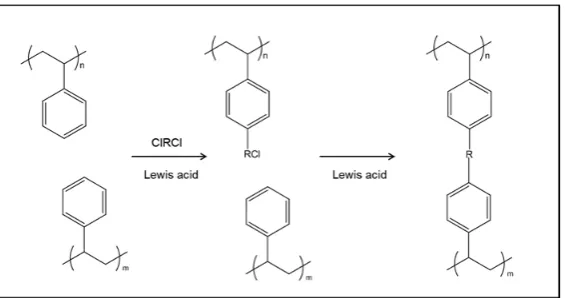
HXL materials were first prepared using linear PS as precursor in solution or in a swollen state with the use of a good solvent and using external crosslinkers [1]. These external crosslinkers establish covalent bonds between adjacent aromatic residues through Friedel-Crafts reactions. Figure 1 outlines the different steps involved during a hypercrosslinking reaction on a PS precursor. This reaction sets in place short and rigid (hyper)crosslinks and provides a rigid and expanded three-dimensional polymer network. The main structural element of this network is a spatially non-planar cycle formed by crosslinking bridges, and very short chain segments confined between the branching points. By using an external crosslinker together with a Friedel-Crafts catalyst almost all of the aromatic rings can be hypercrosslinked resulting in an HXL network which displays a particularly high degree of crosslinking, low packing density due to the number of rigid spacers holding the polymer chains apart, and an extremely high specific surface area (up to ~ 2,000 m2/g) arising from the high micropore content in the network [12].
Over the course of the hypercrosslinking reaction, the initial solution of polymer in solvent is transformed into a gel and eventually in a solid, monolithic block, which can be ground subsequently to produce HXL particles which are irregular in shape and size. To obtain HXL materials in the form of spherical particles rather than irregular particles, gel-type beads of poly(styrene-co-divinylbenzene) (PS-DVB) (containing from 0.3 to 2% of DVB) can be used as
precursor. The low DVB content allows the beads to swell (but not to dissolve) in the presence of good (compatible) solvents, whilst their spherical shape is maintained as the hypercrosslinking reaction proceeds. In a related approach, PS-DVB macroreticular (macroporous) polymers (containing up to 30 % of DVB) were also hypercrosslinked [1,14]. This procedure enabled the installation of crosslinking points additional to those set in place by the crosslinking agent (DVB) during the development of the macroreticular polymer. In these cases, if a macroreticular polymer is used as precursor, then the HXL material will contain not only the original pores (normally macro- and/or mesopores) but also those pore generated during the hypercrosslinking process (normally micropores) and thus a bimodal pore size distribution may be anticipated [14]. It should be noted that the degree of crosslinking realisable from a macroreticular precursor is lower than can be achieved from linear PS or gel-type polymer precursor, due to steric impediments. Chloroalkanes are the most widely used external crosslinkers. The first chloroalkane used was chloromethyl ether (CME) [15-18], but due to its carcinogenic properties it was replaced progressively by other reagents, such as: carbon tetrachloride (CCl4) [19-21], monochlorodimethyl ether (MCDE) [18,22], dichloroxylene (DCX) [23-25],
4,4’-bis(chloromethyl)biphenyl (BCMBP) [24-27] or dichloroethane (DCE) [24,26,27]. It should be mentioned that DCE is
[image:2.595.159.443.501.650.2]one of the most used since it can act as both external crosslinker and solvent. Furthermore, varying the nature of the external crosslinker can be exploited as a means to modify the nature of the bridges in an HXL material, both structurally (variations in the bridge length and rigidity impact on the porous morphology) and chemically (installation of a functional moiety from the external crosslinker). Therefore, in the selection of an external crosslinker one should consider these aspects. Davankov’s group reported [22] that the theoretical amount of external crosslinker required for a 100% degree of crosslinking is 0.5 moles of reagent per mole of repeat units (aromatic rings or structure able to crosslink). They also showed that, under nominally identical conditions, the greater the quantity of external crosslinker used the higher the specific surface area [22].
Fig. 1 Schematic representation of the synthetic approach used to deliver HXL materials from PS precursors and external
crosslinkers.
The Friedel‐Crafts catalyst used in the HXL reaction can be either a Lewis acid or a protonic acid such as hydrofluoric acid. Theoretically, all Lewis acids can potentially catalyse the reaction. Different studies have reported the use of catalysts such as FeCl3 [16,26,28], aluminium chloride (AlCl3) [29,30], tin chloride (SnCl4) [16,23], zinc
chloride (ZnCl2) [18] and boron halides (BCl3 or BBr3) [31]. Nevertheless, FeCl3 is one of the most commonly used.
Another parameter to bear in mind is the reaction kinetics. For instance, CCl4 reacts more slowly and gives a lower
DCE is one of the most commonly used solvents for hypercrosslinking since it is a good solvent for PS [32] but is also compatible with the Friedel-Crafts chemistry, although some other solvent such as nitrobenzene [26] and cyclohexane [26] have also been employed.
2.2 Hypercrosslinked materials from poly(vinylbenzyl chloride-co-DVB precursors): intramolecular
hypercrosslinking
Jerábek [3] and Sherrington [4] developed HXL materials via internal electrophile routes by incorporating vinylbenzyl
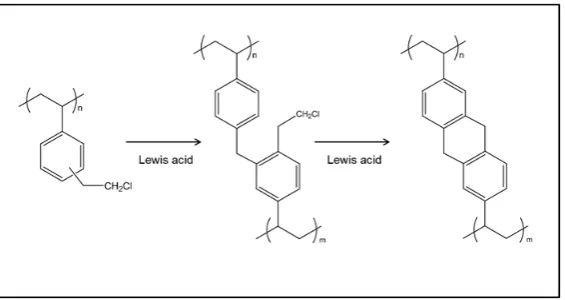
chloride (VBC) residues into polymer chains, where the chloromethyl group acts as internal electrophile in the formation the crosslink. Figure 2 shows the procedure used to obtain HXL materials from poly(vinylbenzyl chloride-co
-DVB precursors) (VBC--DVB) precursors. The final step in the hypercrosslinking process (Figure 2) is extremely favourable since the aromatic ring to be substituted is already doubly alkylated and thus electron-rich. More importantly, formation of the final product is further enhanced as the resultant cyclisation reaction results in the formation of a highly favoured six‐membered ring. Moreover, when VBC-DVB is employed as precursor the crosslinking process is intramolecular, and this leads to extremely efficient reactions. Thus, VBC-DVB has been shown to be another excellent precursor polymer for the synthesis of HXL materials. It was reported [14] that a gel-type VBC-DVB resin prepared by suspension polymerisation could be almost fully hypercrosslinked within 15 minutes only, as evidenced by a considerable decrease in the chlorine content, from ~19 wt% to ~2 wt%, and an associated increase in the specific surface area from ~0 m2/g to ~1,200 m2/g. In general, the specific surface area reported for HXL materials
[image:3.595.159.442.307.457.2]prepared using this intramolecular strategy lies typically in the range 1,000 – 2,000 m2/g.
Fig. 2 Schematic representation of the synthetic approach used to deliver HXL materials from a VBC-DVB precursor using internal
electrophiles.
Similarly, to PS-DVB precursors, gel-type VBC-DVB and macroreticular VBC-DVB with different percentages of crosslinking agent (i.e., DVB) have been used as precursors in the production of HXL resins with different porous sizes.
In this regard, Lu et al. [33] demonstrated that the pore size of the VBC -DVB can be adjusted from macropore to
micropore scale when changing the DVB content from 0–10%. Accordingly, the role which the DVB content plays in controlling the pore structure was also proposed. Usually, hypercrosslinking reactions occur in a compacted polymer chain region. On the one hand, when the DVB content is 0%, the linear, flexible and disordered macromolecular chains dissolve well in solvent, the distance between two neighbouring chains is random and not every –CH2Cl moiety has a
neighbouring aromatic ring with which it can react. This results in a random hypercrosslinking density and the presence of macropores in the resultant HXL material. On the other hand, precursor polymers with a higher degree of crosslinking are more rigid, which means that the hypercrosslinking degree will be more uniform throughout the material.
In another study [34], different isomers of VBC were used in the production of swellable polymer precursors via
suspension polymerisation, and the precursors hypercrosslinked; substantial differences were found when comparing the properties of the hypercrosslinked products. When the precursors were prepared from the pure para-isomer of VBC
(pVBC) or a 70:30 mixture of para- and meta-isomers (mixVBC), differences in the chlorine content of the polymers
Table 1 Examples of HXL materials produced with details of each synthetic procedure, the morphological properties of the products
and the application field.
PS: polystyrene; PS-DVB: poly(styrene-co-divinylbenzene); VBC-DVB: poly(vinylbenzyl chloride-co-divinylbenzene); MCDME: monochlorodimethyl ether; DCX: dichloroxylene; CME: chloromethyl methyl ether; BCMBP: 4,4’-bis(chloromethyl)-1,1’-biphenyl; FDA: formaldehyde dimethyl acetal; BCMA: bis-chloromethylanthracene; DCE: dichloroethane; DCB: dichlorobutene; DCH: dichlorohexane; DMF: N,N-dimethylformamide; DMSO: dimethyl sulfoxide
The low chlorine content of the former was related to preferential hydrolysis of the para-isomer of VBC under the
synthesis conditions used (water was used as continuous phase in the suspension polymerisations). The hydrolysis of benzyl chloride moieties would be expected to proceed via an SN1 mechanism, and thus involve the generation of
stabilised carbocation intermediates followed by nucleophilic attack of water under the typical conditions of the suspension polymerisation used to prepare VBC-DVB precursors. The degree of hydrolysis of VBC-residues in these
Synthetic details Specific surface
area (m2/g)
Application Ref D av ank ov-type PS-DVB CCl4, AlCl3
400-700 LC column packing [19]
PS-DVB
SnCl4 in MCDME
400-700 Retention of compounds [17]
PS-DVB BCMBP, DCX, FDA in DCE
Up to 380 Monolithic column [25]
Int ra m ol ec ul ar crossl inke r VBC-DVB FeCl3 in DCE
1000 - 1800 Retention of compounds [11,36] Fe3O4/VBC-DVB
FeCl3 in DCE
500 Retention of compounds [28]
VBC-DVB + ion-exchange moiety
FeCl3 in DCE
1000 -1500 Retention of compounds [44-46,50] VBC-DVB
FeCl3 in DCE
1300 - 1900 Monolithic column [67] VBC-DVB
FeCl3 in DCE
Up to 600 H2 storage (1.5 wt.% H2 77
K/1 bar) [56]
PS-VBC-DVB FeCl3, AlCl3 or SnCl4
in DCE, DCB or DCH
No data Monolith column [30]
VBC-triphenylbenzene FeCl3 in DCE
~1200 Gas storage (6 wt.% CO2
278 K/1 atm) [68]
Sel f-c on de nsat io n Carbazoles Bromophenylmethanol CuI in DMF
1000 – 1800 Gas storage (1.94 wt.% H2
77 K/1 bar; 0.21 wt. % CO2
273 K/1 atm)
[62]
Carbazoles
DCX, BCMPB or BCMA FeCl3 in DCE
600 - 1900 Gas storage (0.9 -17.7 wt.% H2 77 K/1 bar; 0.016 wt.%
CO2 273 K/1 atm)
[24]
Fluorene and derivatives BCMPB
FeCl3 in DCE
1800 Gas storage (0.099 wt.%
CH4 298 K/35 bar)
[27]
Polypyrroles CH2I2, CHI3 or BI3
in DMSO or DMF
~20 - 700 Gas storage (0.6 – 1.6 wt.% H2 77 K/0.4 MPa)
[55]
Tetraphenylethylene/ 1,1,2,2-tetraphenyl-ethylene-1,2-diol
FDA
FeCl3 in DCE
600 – 1900 Gas storage (0.17 wt.% CO2 273 K/1 bar)
[64]
Carbazoles FDA
FeCl3 in DCE
~1000 Gas storage (2.39 wt.% H2
77 K/1 bar;
16.7 wt.% CO2 273 K/1
atm)
HXL materials depended upon the VBC isomer that was employed in the precursor polymer synthesis. The differences were explained on the basis that the carbocation derived from p-VBC would be expected to be more stabilised than that
derived from m-VBC; the carbocation from p-VBC would therefore form more readily and hence the hydrolysis of
p-VBC would be expected to proceed more rapidly than that of m-VBC [34].
Li et al. [18] reported similar oxygen level contents (6.0 wt%) and specific surface area (900 m2/g) when their
precursor polymers were based on chloromethylated PS-DVB. They suggested that the oxygen content could be ascribed to the formation of ethers and ketones; however, this suggestion still remains to be verified experimentally. It should be stated that,over the past few years, most of the HXL resins prepared were synthesised using VBC-DVB polymers as precursors [3,28-30,35]. Moreover, monodisperse particles can be prepared from using such a hypercrosslinking strategy, with materials of high specific surface areas and a range of diameters linked to the polymerisation approach employed being accessible.
In this way, Sherrington’s group pioneered the application of emulsion polymerisation, which delivered spherical particles of ~420 nm in diameter which had a near monodisperse particle size distribution [35]. Non-aqueous dispersion (NAD) polymerisation (spherical particles with diameters in the 4 - 10 µm range) [36] and precipitation polymerisation (PP) (monodisperse spherical particles with ~ 4 µm) [36] have been employed in an analogous fashion. Magnetic HXL microspheres have been developed as well [37,38]. Gao et al. [37] used the PP approach to obtain magnetic HXL
particles (mean particle size of ~ 800 nm) based on methacrylic acid (MMA); these poly(MAA-co-VBC-co-DVB)
particles had a core-shell architecture, with Fe3O4/SiO2 at the core. Eventually, these magnetic HXL materials were
applied successfully to the extraction of a group of organic contaminants since the polymers had highly retentive properties. Urban et al. [30,39,40] prepared HXL materials from VBC-DVB precursors using solution polymerisation
[40], and later went a step further with the in situ hypercrosslinking of monoliths in capillary columns [30,39].
Apart from differences in the particle shape and size, we have also examined how the properties of PS-based HXL resins varied as a function of the VBC content depending on the type of polymerisation adopted. In this regard, HXL resins derived from different ratios of VBC to DVB in the monomer feed were prepared. For instance, for polymer precursors in particulate form generated from both NAD and PP polymerisations, it was found that the VBC content had to be 50 wt% or higher in order to generate HXL materials with specific surface areas in excess of 1,000 m2/g [36]. In
contrast, precursor polymers generated from suspension polymerisation with 20% of VBC in the monomer feed gave porous, HXL products with specific surface areas over 1,000 m2/g. Nevertheless, the highest specific surface areas were
obtained from gel-type polyVBC precursors crosslinked with 2% DVB under suspension polymerisation conditions, where specific surface area values up to 2,090 m2/g were reported [4] Therefore, the method of polymerisation also
influences in the morphological properties of the hypercrosslinked materials.
With regard to the other reagents employed during hypercrosslinking reactions (Friedel-Crafts catalyst and solvent) there are no substantial differences from those described for the Davankov-type resins (section 3.1). On the one hand, FeCl3 is commonly used since it is more soluble than AlCl3 in the typical solvents used and it does not present steric
impediments as compared to SnCl4. These arguments are described in a study [4] where VBC-DVB precursors were
hypercrosslinked using a range of catalysts and it was found that FeCl3 was consistently more active than both AlCl3
and SnCl4, giving products with higher specific surface areas in all cases. In Figure 2, it can be appreciated how steric
bulk may affect the reactions as the first crosslink formed can potentially prevent larger Lewis acids from accessing the second chloromethyl moiety to form the second crosslink. Since the crosslinking process used is intramolecular in nature, the reaction has been shown to be very efficient. It is possible that this step was the limiting step when the relatively large SnCl4 was used as catalyst. FeCl3 is smaller and seemingly not limited in terms of this reaction; this
observation, coupled with the enhanced reactivity towards second bridge formation, could well be the root cause of the remarkably short reaction times required for HXL reactions involving FeCl3. A similar conclusion was reached when
the effect of using one of these three catalyst (i.e., AlCl3, FeCl3 or SnCl4) in relation to the final properties of the HXL
monolithic materials based on PS-VBC-DVB was studied [30]. It was concluded that the column permeability was similar when FeCl3 andSnCl4 were used as catalyst, but it decreased significantly when AlCl3 (the less reactive
Friedel-Crafts catalyst) was used. Futhermore, diaminoalkanes (1,2-diaminoethane, 1,4-diaminobutane, 1,6-diaminohexane and 1,8-diaminooctane) were also tested as external crosslinkers; these act by nucleophilic substituition reactions in hypercrosslinking the precursor based on PS-VBC-DVB [41]. In such a strategy, the authors concluded that the longer the diaminoalkane precursor, the higher the efficieny of the column.
Concerning the solvent used for hypercrosslinking, since VBC-DVB precursors have a similar styrene-based network, the thermodynamically good solvent employed can be similar to the solvents reported for Davankov-type resins. Accordingly, DCE is one of the preferred solvents for such hypercrosslinking reactions. Nevertheless, some studies [4,30] have been conducted to investigate the effect of different solvents on the final properties of the obtained HXL material. One study [4] tested chlorobenzene, hexane, DCE and DCE/hexane as solvents when the precursor was macroporous 80%VBC – 20%DVB. The results showed that DCE yields the highest specific surface area (~1,200 m2/g), but very interestingly hexane and chlorobenzene (which are bad solvents for PS and so would not be expected to
solvate the polymer resin) also provided respectable specific surface area of ~ 600 m2/g. In another study [30],
alkyl chain of the swelling solvent was increased. Therefore, the solvent may also lead to slightly different properties in the final material.
In conclusion, the morphological properties provided by each polymerisation approach are similar, and this suggests that the hypercrosslinking methodology is generic and can be initiated from precursors derived from distinct polymerisation strategies.
2.2.1 Chemical modification of hypercrosslinked materials
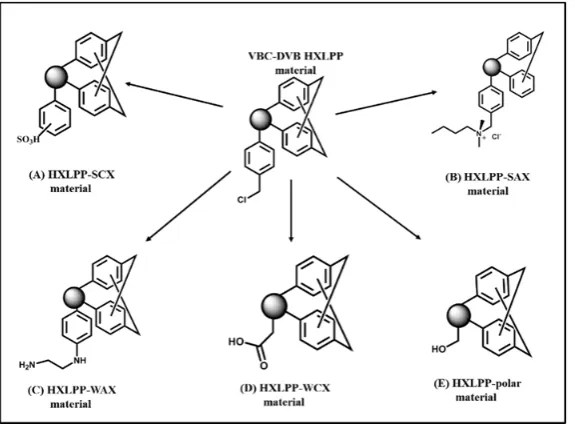
Another characteristic arising in the generation of HXL resins based on VBC-DVB which several authors have taken advantatge of is the incomplete consumption of VBC residues in the hypercrosslinking reaction. A portion of pendent chloromethyl moieties typically remain unreacted after the hypercrosslinking processes and are thus available for post-hypercrosslinking chemical modification reactions [42-46]. Figure 3 presents some examples of resin structures obtained using this strategy. In this way, Li et al. [10,42,47,48] prepared different HXL materials from VBC-DVB
precursors and modified them subsequently with dimethylamine to yield HXL materials with amine functionalities which enhanced the sorption properties of the resins toward polar compounds. In a similar fashion, the same research group prepared HXL resins with carbonyl moieties which displayed enhanced sorption behaviour similar to the amine functional resins [49]. This strategy was also adopted for the preparation of a family of ion-exchange HXL materials [43-46]. Materials were synthesised via post-hypercrosslinking chemical modifications on hypercrosslinked materials to
deliver functionalised hypercrosslinked materials with strong cation-exchange (SCX), strong anion-exchange (SAX), and weak anion-exchange (WAX) characteristics. The ion-exchange materials were prepared from HXL structures, which enhance reversed-phase interactions through their high specific surface area (from 1,000 to 1,500 m2/g).
[image:6.595.156.444.365.577.2]Specifically, the HXL materials were prepared from VBC-DVB precursors obtained by PP, which produced low micron size particles that were eminently well-suited for SPE applications. The precursor particles prepared by PP, named as PP, were hypercrosslinked (to give products named HXLPP) by means of Friedel-Crafts reactions that exploited the chemistry of the VBC residues.
Fig. 3 Examples of the different moieties introduced in HXLPP materials. See the text for the synthetic details.
More specifically for the synthesis of the SCX material, the HXLPP resins were post-functionalised with either acetyl sulfate or lauroyl sulfate, with the latter proving to be the most effective reagent for the sulfonation. After optimising different synthetic variables, three HXLPP-SCX (Figure 3A) materials were prepared with different sulfur contents as governed by the percentage of the sulfonation reagent used in the chemical modification (15%, 20% and 50%). It was found that the HXLPP-SCX sorbent modified with 50% of the sulfonation reagent displayed the highest ion-exchange capacity (IEC) (2.5 mmol/g) and the highest specific surface area (1,370 m2/g) even although the
possibility of sulfone bridge formation could not be excluded [44]. Similar HXL-SCX particles were reported by the same authors. In this case, the swellable precursors used were based on polymers with different VBC-ethylene glycol dimethacrylate (EGDMA) ratios, and were synthesised via NAD polymerisation rather than by PP. Later, these
HXLNAD particles were sulfonated using sulfuric acid. The resulting HXLNAD-SCX materials displayed specific surface areas from 330 up to 1,000 m2/g and IECs from 0.6 to 2.1 mmol/g. Comparing both types of material
(HXLPP-SCX versus HXLNAD-SCX) in terms of retention properties towards ion-exchangeable compounds, both materials
provided similar retention behaviour [50]. Li et al. [51] also prepared a sulfonated HXL resin based on a VBC-DVB
S and displayed a specific surface area of 1,000 m2/g, and was applied successfully as a high capacity adsorbent for the
retention of toxic metal ions [51].
The synthetic procedures used to obtain the HXLPP-SAX (Figure 3B) resins is an example of post-polymerisation chemical modification prior to hypercrosslinking. In this case, dimethylbutylamine (DMBA) with 5% or 10% ratio was first reacted with the VBC-DVB precursor (obtained via PP) to install the SAX character. The quaternised precursors
(PP-SAX) were then hypercrosslinked following the usual procedures and HXLPP-SAX resins obtained. The authors discovered that amination was less efficient after hypercrosslinking due to the bulky nature of the tertiary amine (DMBA) which restricted the access of amine to free chloromethyl groups; therefore, amination was conducted prior to hypercrosslinking [45]. In contrast, post-hypercrosslinking chemical modification reactions were used in order to prepare HXLPP-WAX (modified with piperazine, piperazine, and ethylenediamine, HXLPP-WAX-EDA) (Figure 3C). In these cases, the amine moieties were introduced via chemical modification of the residual
chloromethyl groups in the HXLPP resins. For this, the HXLPP resins were wetted with dried toluene and a 5-fold molar excess of the amine (either EDA or piperazine) relative to the chloromethyl group added and reacted for 18 h at 85 oC [43]. In addition, the functional groups in the final HXL material can be incorporated
via the inclusion of a third
monomer as precursor, as it was previously described in the above section with the magnetic particles [37]. This strategy was also adopted for the synthesis of a WCX (HXLPP-WCX) material (Figure 3D), the carboxylic acid moieties which give rise to the WCX character were introduced by copolymerisation of a functional monomer (methacrylic acid - MAA). In this work, the terpolymer MAA-VBC-DVB (10/50/40 w/w% ratio of monomers in the feed) was the precursor polymer in this hypercrosslinking reaction [46]. In this way, the carboxylic acid moieties were present from the beginning of the synthetic process and their incorporation into the HXLPP-WCX was satisfactory (equivalent to an IEC of 0.72 meq/g).
Another example is for the HXL materials obtained from a hydrophilic monomer (i.e., 2-hydroxyethyl methacrylate -
HEMA) additional to VBC-DVB (i.e., HEMA-VBC-DVB). The HXL materials had a specific surface area of ~ 900
m2/g and ~ 1.5 mmol/g O content derived from hydrophilic HEMA residues (Figure 3E). This blend of properties meant
that they were well suited for the sorption of polar compounds from aqueous samples, since they provided better recovery values than the commercial materials when used for similar purposes [52].
2.3 Hypercrosslinked materials from direct self-condensation
HXL materials can also be prepared by the direct self-condensation of small molecules through Friedel–Crafts alkylation without the need to make a precursor crosslinked polymer. This direct approach is based on the self-condensation of small aromatic monomers such as dichloroxylene (DCX), bis(chloromethyl)biphenyl (BCMBP) and bis(chloromethyl)anthracene (BCMA) [24]. Figure 4 shows the structures of the monomers (a) and the hypothetical p
-DCX network formed after the self-condensation approach proposed (b). Similar to the other hypercrosslinking approaches which have been described (sections 3.1.1 and 3.1.2), these monomers were dissolved in DCE and FeCl3
was used as Friedel–Crafts catalyst. The products obtained displayed typical features of HXL resins with specific surface areas up to 1,900 m2/g and excellent properties of gas storage. In one particular case, the Cooper research group
[24] explored the use of the different isomers of DCX (i.e., o-DCX, m-DCX and p-DCX). The incorporation of o-DCX
was consistently detrimental to the generation of specific surface area in these materials, both when used individually or in combination with the p- and m- isomers. This was associated with the lower degree of condensation (i.e.,
crosslinking) achieved with o-DCX. In general, both m-DCX and p-DCX gave rise to materials with quite similar
[image:7.595.160.437.591.733.2]specific surface areas under comparable reaction conditions. The amount of Lewis acid employed was also studied [24]; when the ratio of monomers related to the reaction feed was 3.75 %(w/v), the optimum ratio should be in the range of 0.5 – 2 mol/mol of monomers. Catalyst ratios below this range led to decreased yields and lower specific surface areas, whereas much higher catalyst concentrations were detrimental to the specific surface areas of the resulting materials.
Rigid, non-functional aromatic precursors such as fluorene and derivatives (9,9’-spirobi fluorine), dibenzofuran and dibenzothiophene) were also used in the generation of microporous copolymer networks obtained via self-condensation
with BCMBP under Friedel-Crafts catalytic conditions [27]. The monomers were incorporated successfully, and showed high CH4 (up to 0.099 wt.% at 298 K/35 bar) and H2 (0.016 wt.% at 77 K/1 bar) uptakes as well as high specific
surface areas (up to 1,800 m2/g). 1,7-Dicarbadodecaborane was also reacted with two chloromethyl functional groups
(DCE or BCMBP) and the resulting monomer subsequently self-condensed under Friedel–Crafts conditions. The resulting HXL materials displayed specific surface areas around 1,000 m2/g and their maximum H
2 up-take at 77 K/1
bar was from 0.021 to 0.028 wt%, depending upon the specific precursor [53].
Polyaniline [54] and polypyrrole [55] precursors were also evaluated in the self-condensation approach. In the hypercrosslinking of polypyrroles [55] using diiodomethane, triiodomethane, and triiodoborane (see Figure 5) to produce porous structures with CH2, CH and B crosslinks, respectively, and specific surface areas up to 732 m2/g. In
spite of these relatively low values of specific surface area, the authors found the use of this strategy and these precursors which contain aryl amines interesting, since it provides smaller crosslinks and the presence of electron donating groups (amines) in the aromatic rings enhanced the H2-material interactions and so increased their ability to
physisorb hydrogen [54]. Similarly, polyaniline was crosslinked using diiodomethane to form networks crosslinked with methylene groups; the HXL microporous polyanilines obtained had specific surface areas up to 632 m2/g [54].
After the synthesis, the most promising HXL materials were tested for H2 adsorption at higher pressures. They found
that the HXL polyaniline material prepared using diiodomethane displayed an adsorption capacity of 2.2 wt% H2 at 77
K/3.0 MPa. Another interesting finding was that protonation of HXL polyaniline severely decreased its ability to physisorb H2. The explanation for this observation arises from the fact that aromatic rings containing electron-donating
functionalities adsorb H2 more easily than those bearing electron-withdrawing groups. Thus, while the aniline
functionality is strongly donating, the ammonium groups formed upon protonation of polyanaline are electron-withdrawing and thus decrease the ability of materials to adsorb H2 [54]. In the case of employing, as crosslinking
precursors, aromatic rings that contain electron-donating groups (i.e., polyanilines, polypyrroles, etc.) di- and
triiodoalkanes such as diiodomethane [54,55], diiodoethane [54], diiodopropane [54] and triiodomethane [55] have been shown to be more reactive compared to dichloro- or dibromoalkanes. This enhanced reactivity also compensates for the limited reactivity of the precursors. Nevertheless, Reich and co-workers [31] prepared different borozine-linked materials through the thermolysis of aryl-amines-boron trihalides by employing 1,4-phenylenediamine or 1,3,5-tri-(4’-aminophenyl)benzene in DCE as solvent with BCl3 or BBr3. The resulting materials had very interesting porosity (up to
1,400 m2/g specific surface area), but moderate low-pressure H
2 storage (0.7 to 1.3 wt.% at 77 K/1 bar).
Later, polyanilines were crosslinked using Ullman and Buchwald coupling reactions, which form networks linked by aromatic rings [56]. However, the HXL resins obtained presented lower specific surface areas (up to 320 m2/g) as
compared to the other HXL resins prepared from polyaniline precursors.
Aromatic precursors, including benzene [57,58], polythiophene, polypyrrole and polyfuran [59], aniline[58] and hydroxylated and bishydroxymethyl monomers [60] were also employed using the self-condensation strategy to deliver
[image:8.595.156.443.544.733.2]HXL materials. These different monomers (aniline [54], pyrrole [55], aminobenzene [56], carbazole [61,62]) containing heteroatoms were used successfully to prepare different HXL materials which were then applied mainly as gas storage materials. In this case, the presence of moieties in the network favours the formation of a narrow pore system and the heteroatom-rich pore surface, which exhibits large gas adsorption capacity and high selectivity [59]. Furthermore, this strategy is claimed to be cost-effective, high yielding, and to use an inexpensive catalyst and a single monomer in its production [61,62].
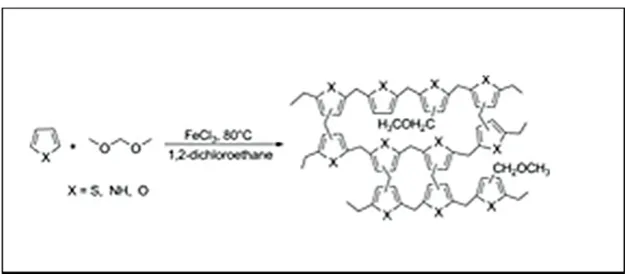
Self-condensation by means of an environmental friendly external crosslinker such as formaldehyde dimethyl actetal (FDA) has been proposed too [57]. Typically, in this one-step approach, the aromatic monomer (including benzene, phenol or chlorobenzene), the crosslinker (FDA) and the catalyst (FeCl3) were dissolved in DCE, and heated at 45 ºC
for 5 h and then at 80 ºC for 19 h to complete the condensation. Figure 6 shows this procedure. It is claimed to be environmentally friendly, since this reaction ends with methanol as by-product instead of the typical chloromethyl functionalities that releases HCl. By adjusting the type of monomer and its molar ratio with FDA, differences in the specific surface areas and H2 and CO2 uptake were observed. The largest values achieved for specific surface areas
(~1,400 m2/g) and H
2 (1.45 wt.% at 77.3 K/1.13 bar) and CO2 (13.5 wt.% at 273.15 K/1 bar) uptake corresponded to
when the molar ratio of FDA with respect to benzene was 3. Similar approaches using FDA as external crosslinker were later shown with different monomers such as aromatic heterocycles [59,63], hydroxymethylated aromatic molecules [60], aniline and benzene [58], polystyrene [63] and tetrahedral monomers [64,65], amongst others. FDA was also evaluated in the hypercrosslinking of different PS-DVB monoliths using Friedel-Crafts reaction with FeCl3 involving
two other external crosslinkers: BCMBP and DXC, apart from FDA. With all three external crosslinkers, the resulting monolith had increased specific surface areas, which gave benefits in column efficiency. Nonetheless, the material with the highest specific surface areas (900 m2/g) were obtained using a precursor monolith hypercrosslinked with BCMBP
[25].
2.4 Hypercrosslinked networks using other strategies
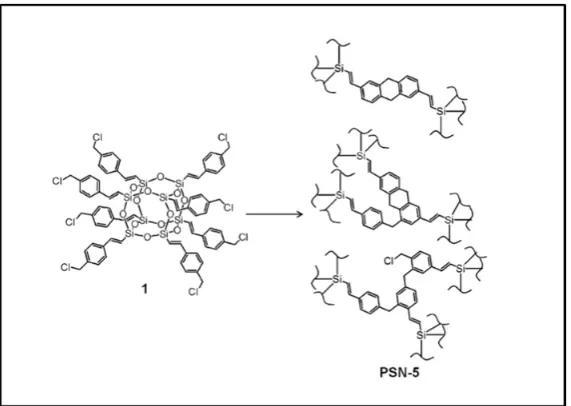
Some other precursors and strategies have been developed in order to tune the final properties of HXL resins according to their expected applications. For instance, benzyl chloride-terminated double-four-ring cubic siloxane cages were tested as suitable precursors since the HXL networks offered extremely high specific surface areas (ca. 2,500 m2/g).
Such high specific surface areas were attributed to the simultaneous polymerisation of the organic functional groups and destruction of the siloxane cages during synthesis [66]. Figure 7 shows the structure of this particular example of an HXL material from siloxane cages through Friedel-Crafts self-condensation. In addition, this porous siloxane-organic hybrid material provided H2 uptake (~1.2 wt.% at 77 K/1 bar) similar to other materials designed for storage
applications (i.e., metal-organic frameworks and covalent organic frameworks). Wu et al. [21] developed a new class of
nanostructured porous network materials, in which the network units were microporous PS nanoparticles crosslinked
via formation of carbonyl (-CO-) bridges between PS chains tethered on silica nanoparticles prepared by
surface-initiated atom transfer radical polymerisation (SI-ATRP) followed by carbonisation.
[image:9.595.141.454.449.588.2]Thus, the list of precursors suitable for HXL reactions seems to be ever-expanding. The exploration of other precursors along with other parameters that control the synthesis might enlarge the features of the HXL materials as well as its field of application.
Fig. 6 Hypercrosslinking of an aromatic heterocyclic monomer using FDA as external crosslinker. Reprinted with permission from
Fig. 7 Structure of the HXL material prepared from siloxane cages (1) through Friedel-Crafts self-condensation. Reprinted with permission from [66]. Copyright 2011. American Chemical Society.
Acknowledgements The support of the Ministry of Economy and Competitiveness, Spain (Project CTQ2014-52617-P) is gratefully acknowledged.
References
[1] Davankov VA, Rogozhin V, Tsjurupa M. 1969. Macronet polystyrene structures for ionites and method of producing same. Patent. US.
[2] Tsyurupa MP, Davankov VA. Porous structure of hypercrosslinked polystyrene: State-of-the-art mini-review. React. Funct. Polym. 2006; 66:768-779.
[3] Veverka P, Jerábek K. Mechanism of hypercrosslinking of choromethylated St-DVB copolymers. React. Funct. Polym. 1999; 41:21-25.
[4] Ahn J-H, Jang J-E, Oh C-G, Ihm S-K, Cortés J, Sherrington DC. Rapid generation and control of microporosity, bimodal pore size distribution, and surface area in Davankov-type hyper-cross-linked resins. Macromolecules. 2006; 39:627-632.
[5] Germain J, Fréchet JMJ, Svec F. Nanoporous Polymers for Hydrogen Storage. Small. 2009; 5:1098-1111.
[6] Xu S, Luo Y, Tan B. Recent Development of Hypercrosslinked Microporous Organic Polymers. Macromol. Rapid Comm. 2013; 34:471-484.
[7] Dawson R, Cooper AI, Adams DJ. Nanoporous organic polymer networks. Progr. Polym. Sci. 2012; 37:530-563.
[8] Fontanals N, Marcé RM, Borrull F, Cormack PAG. Hypercrosslinked materials: preparation, characterisation and applications. Polym. Chem. 2015; 6:7231-7244.
[9] Tsyurupa MP, Davankov VA. Hypercrosslinked polymers: basic principles of preparing the new class of polymeric materials. React. Funct. Polym. 2002; 53:193-203.
[10] Pan BC, Xiong Y, Li AM, Chen JL, Zhang QX, Jin XY. Adsorption of aromatic acids on aminated hypercrosslinked macroporous polymer. React. Funct. Polym. 2002; 53:63-72.
[11] Fontanals N, Galià M, Cormack PAG, Marcé RM, Sherrington DC, Borrull F. Evaluation of a new hypercrosslinked polymer as a sorbent for solid-phase extraction of polar compounds. J. Chromatogr. A. 2005; 1075:51-56.
[12] Davankov VA, Tsyurupa MP. 2011. Hypercrosslinked Polymeric Networks and Adsorbing Materials. Comprehensive Analytical Chemistry. p 1-648.
[13] Urban J, Svec F, Fréchet JMJ. Hypercrosslinking: New approach to porous polymer monolithic capillary columns with large surface area for the highly efficient separation of small molecules. J. Chromatogr. A. 2010; 1217:8212-8221.
[14] Belyakova LD, Schevchenko TI, Davankov VA, Tsyurupa MP. Sorption of vapors of various substances by hypercrosslinked "styrosorb" polystyrenes. Adv. Colloid Interface Sci. 1986; 25:249-266.
[15] Law R, Sherrington DC, Snape C, Ando I, Kurosu H. Solid state 13C MAS NMR studies of hyper cross-linked polystyrene resins. Macromolecules. 1996; 29:6284-6293.
[16] Joseph R, Ford WT, Zhang S, Tsyurupa MP, Pastukhov AV, Davankov VA. Solid-state 13C-NMR analysis of hypercrosslinked polystyrene. J. Polym. Sci. Part A: Polym. Chem. 1997; 35:695-701.
[17] Tsyurupa MP, Ilyin MM, Andreeva AI, Davankov VA. Use of the hyper-crosslinked polystyrene sorbents "Styrosorb" for the solid phase extraction of phenols from water. Fresenius J. Anal. Chem. 1995; 352:672-675.
[18] Li A, Zhang Q, Zhang G, Chen J, Fei Z, Liu F. Adsorption of phenolic compounds from aqueous solutions by a water-compatible hypercrosslinked polymeric adsorbent. Chemosphere. 2002; 47:981-989.
[19] Gawdzik B, Osypiuk J. Modification of porous poly(styrene-divinylbenzene) beads by Friedel-Crafts reaction. Chromatographia. 2001; 54:323-328.
[21] Wu D, Hui CM, Dong H, Pietrasik J, Ryu HJ, Li Z, Zhong M, He H, Kim EK, Jaroniec M, Kowalewski T, Matyjaszewski K. Nanoporous Polystyrene and Carbon Materials with Core–Shell Nanosphere-Interconnected Network Structure. Macromolecules. 2011; 44:5846-5849.
[22] Pastukhov AV, Tsyurupa MP, Davankov VA. Hypercrosslinked polystyrene: a polymer in a non-classical physical state. J. Polym. Sci. Part B: Polym. Phys. 1999; 37:2324-2333.
[23] Davankov VA, Rogoshin SV, Tsyurupa MP. Macronet isoporous gels through crosslinking of dissolved polystyrene. J. Polymer Sci. 1974; 47:95-101.
[24] Wood CD, Tan B, Trewin A, Niu H, Bradshaw D, Rosseinsky MJ, Khimyak YZ, Campbell NL, Kirk R, Stockel E, Cooper AI. Hydrogen Storage in Microporous Hypercrosslinked Organic Polymer Networks. Chem. Mater. 2007; 19:2034-2048.
[25] Maya F, Svec F. A new approach to the preparation of large surface area poly(styrene-co-divinylbenzene) monoliths via knitting of loose chains using external crosslinkers and application of these monolithic columns for separation of small molecules. Polymer. 2014; 55:340-346.
[26] Davankov VA, Tsyurupa MP. Structure and properties of hypercrosslinked polystyrene- the first representative of a new class of polymer networks. React. Polym. 1990; 13:27-42.
[27] Schwab MG, Lennert A, Pahnke J, Jonschker G, Koch M, Senkovska I, Rehahn M, Kaskel S. Nanoporous copolymer networks through multiple Friedel-Crafts-alkylation-studies on hydrogen and methane storage. J. Mater. Chem. 2011; 21:2131-2135. [28] Lee JY, Wood CD, Bradshaw D, Rosseinsky MJ, Cooper AI. Hydrogen adsorption in microporous hypercrosslinked polymers.
Chem. Comm. 2006:2670-2672.
[29] Hradil J, Kralova E. Styrene-divinilbenzene copolymers post-crosslinked with tetrachloromethane. Polymer. 1998; 39:6041-6048.
[30] Urban J, Škeříková V. Effect of hypercrosslinking conditions on pore size distribution and efficiency of monolithic stationary phases. J. Sep. Sci. 2014; 37:3082-3089.
[31] Reich TE, Jackson KT, Li S, Jena P, El-Kaderi HM. Synthesis and characterization of highly porous borazine-linked polymers and their performance in hydrogen storage application. J. Mater. Chem. 2011; 21:10629-10632.
[32] Sherrington DC. Preparation, structure and morphology of polymer supports. Chem. Commun. 1998:2275-2286. [33] Li B, Gong R, Luo Y, Tan B. Tailoring the pore size of hypercrosslinked polymers. Soft Matter. 2011; 7:10910-10916.
[34] Fontanals N, Cortés J, Galià M, Cormack PAG, Marcé RM, Borrull F, Sherrington DC. Synthesis of Davankov-type hypercrosslinked resins using different isomer compositions of vinylbenzyl chloride monomer, and application in the solid-phase extraction of polar compounds. J. Polym. Sci. Part A: Polym. Chem. 2005; 43:1718-1728.
[35] Macintyre FS, Sherrington DC, Tetley L. Synthesis of ultrahigh surface area monodisperse porous polymer nanospheres. Macromolecules. 2006; 39:5381-5384.
[36] Fontanals N, Manesiotis P, Sherrington DC, Cormack PAG. Synthesis of Spherical Ultra-High Surface Area Monodisperse Amphipathic Polymer Sponges in the Low Micron Range. Adv. Mater. 2008; 20:1298-1302.
[37] Gao Q, Lin C-Y, Luo D, Suo L-L, Chen J-L, Feng Y-Q. Magnetic solid-phase extraction using magnetic hypercrosslinked polymer for rapid determination of illegal drugs in urine. J. Sep. Sci. 2011; 34:3083-3091.
[38] Zhou Q, Li Z, Shuang C, Li A, Zhang M, Wang M. Efficient removal of tetracycline by reusable magnetic microspheres with a high surface area. Chem. Eng. J. 2012; 210:350-356.
[39] Urban J. Pore volume accessibility of particulate and monolithic stationary phases. J. Chromatogr. A. 2015; 1396:54-61. [40] Urban J, Svec F, Fréchet JMJ. Efficient Separation of Small Molecules Using a Large Surface Area Hypercrosslinked
Monolithic Polymer Capillary Column. Anal. Chem. 2010; 82:1621-1623.
[41] Janků S, Škeříková V, Urban J. Nucleophilic substitution in preparation and surface modification of hypercrosslinked stationary phases. J. Chromatogr. A. 2015; 1388:151-157.
[42] Liu F, Chen J, Li A, Fei Z, Ge J, Zhang Q. Equilibrium adsorption of single component and binary mixtures of aromatic compounds anto a polyfunctional hypercrosslinked polymeric adsorbent. Adsorpt. Sci. Technol. 2004; 22:13-24.
[43] Fontanals N, Marcé RM, Cormack PAG, Sherrington DC, Borrull F. Monodisperse, hypercrosslinked polymer microspheres as tailor-made sorbents for highly efficient solid-phase extractions of polar pollutants from water samples. J. Chromatogr. A. 2008; 1191:118-124.
[44] Cormack PAG, Davies A, Fontanals N. Synthesis and characterisation of microporous polymers microspheres with strong-cation exchange character. React. Funct. Polym. 2012; 72:939-946.
[45] Bratkowska D, Davies A, Fontanals N, Cormack PAG, Borrull F, Sherrington DC, Marcé RM. Hypercrosslinked strong anion-exchange resin for extraction of acidic pharmaceuticals from environmental water. J. Sep. Sci. 2012; 35:2621-2628.
[46] Bratkowska D, Marcé RM, Cormack PAG, Sherrington DC, Borrull F, Fontanals N. Synthesis and application of hypercrosslinked polymers with weak cation-exchange character for the selective extraction of basic pharmaceuticals from complex environmental samples. J. Chromatogr. A. 2010; 1217:1575-1582.
[47] Li A, Zhang Q, Wu H, Zhai Z, Liu F, Fei Z, Long C, Zhu Z, Chen J. A New Amine-modified Hypercrosslinked Polymeric Adsorbent for Removing Phenolic Compounds from Aqueous Solutions. Adsorpt. Sci. Technol. 2004; 22:807-820.
[48] Xu C, Long C, Li A, Liu F, Yang W, Zhang Q. Adsorption Characteristics of Fumaric Acid onto Weakly Basic Hypercrosslinked Polystyrene Ion-exchangers. Adsorpt. Sci. Technol. 2006; 24:65-77.
[49] Zhenghao F, Jinlong C, Jianguo C, Guandao G, Aimin L, Quanxing Z. Adsorption characteristics of phenolic compounds onto a new hypercrosslinked polyemeric resin containing the 2-carbonylbenzoyl group (ZH-01). Adsorpt. Sci. Technol. 2004; 22:439-449.
[50] Fontanals N, Miralles N, Abdullah N, Davies A, Gilart N, Cormack PAG. Evaluation of strong cation-exchange polymers for the determinationof drugs by solid-phase extraction–liquid chromatography–tandemmass spectrometry. J. Chromatogr. A. 2014; 1343:55-62.
[52] Bratkowska D, Fontanals N, Cormack PAG, Sherrington DC, Borrull F, Marcé RM. Hydrophilic hypercrosslinked sorbents for the solid-phase extraction of polar contaminants from water. J. Chromatogr. A. 2010; 1217:3238-3243.
[53] Yuan S, White D, Mason A, Liu D-J. Porous organic polymers containing carborane for hydrogen storage. Int. J. Energy Res. 2013; 37:732-740.
[54] Germain J, Fréchet JMJ, Svec F. Hypercrosslinked polyanilines with nanoporous structure and high surface area: potential adsorbents for hydrogen storage. J. Mater. Chem. 2007; 17:4989 - 4997.
[55] Germain J, Fréchet JMJ, Svec F. Nanoporous, hypercrosslinked polypyrroles: effect of crosslinking moiety on pore size and selective gas adsorption. Chem. Comm. 2009:1526-1528.
[56] Germain J, Svec F, Fréchet JMJ. Preparation of Size-Selective Nanoporous Polymer Networks of Aromatic Rings: Potential Adsorbents for Hydrogen Storage. Chem. Mater. 2008; 20:7069-7076.
[57] Li B, Gong R, Wang W, Huang X, Zhang W, Li H, Hu C, Tan B. A New Strategy to Microporous Polymers: Knitting Rigid Aromatic Building Blocks by External Cross-Linker. Macromolecules. 2011; 44:2410-2414.
[58] Dawson R, Ratvijitvech T, Corker M, Laybourn A, Khimyak YZ, Cooper AI, Adams DJ. Microporous copolymers for increased gas selectivity. Polym. Chem. 2012; 3:2034-2038.
[59] Luo Y, Li B, Wang W, Wu K, Tan B. Hypercrosslinked Aromatic Heterocyclic Microporous Polymers: A New Class of Highly Selective CO2 Capturing Materials. Adv. Mater. 2012; 24:5703-5707.
[60] Luo Y, Zhang S, Ma Y, Wang W, Tan B. Microporous organic polymers synthesized by self-condensation of aromatic hydroxymethyl monomers. Polym. Chem. 2013; 4:1126-1131.
[61] Yang X, Yu M, Zhao Y, Zhang C, Wang X, Jiang J-X. Hypercrosslinked microporous polymers based on carbazole for gas storage and separation. RSC Advances. 2014; 4:61051-61055.
[62] Pan L, Chen Q, Zhu J-H, Yu J-G, He Y-J, Han B-H. Hypercrosslinked porous polycarbazoles via one-step oxidative coupling reaction and Friedel-Crafts alkylation. Polym. Chem. 2015; 6:2478-2487.
[63] Ratvijitvech T, Barrow M, Cooper AI, Adams DJ. The effect of molecular weight on the porosity of hypercrosslinked polystyrene. Polym. Chem. 2015; 6:7280-7285.
[64] Yao S, Yang X, Yu M, Zhang Y, Jiang J-X. High surface area hypercrosslinked microporous organic polymer networks based on tetraphenylethylene for CO2 capture. J. Mater. Chem. A. 2014; 2:8054-8059.
[65] Dawson R, Stockel E, Holst JR, Adams DJ, Cooper AI. Microporous organic polymers for carbon dioxide capture. Energy Environ. Sci. 2011; 4:4239-4245.
[66] Chaikittisilp W, Kubo M, Moteki T, Sugawara-Narutaki A, Shimojima A, Okubo T. Porous Siloxane–Organic Hybrid with Ultrahigh Surface Area through Simultaneous Polymerization–Destruction of Functionalized Cubic Siloxane Cages. J. Am. Chem. Soc. 2011; 133:13832-13835.
[67] Germain J, Hradil J, Fréchet JMJ, Svec F. High Surface Area Nanoporous Polymers for Reversible Hydrogen Storage. Chem. Mater. 2006; 18:4430-4435.
[68] Vinodh R, Jung EM, Ganesh M, Peng MM, Abidov A, Palanichamy M, Cha WS, Jang HT. Novel microporous hypercrosslinked polymers as sorbent for volatile organic compounds and CO2 adsorption. J. Ind. Engin. Chem. 2015;