Avoiding vincular patterns on alternating words
Alice L.L. Gao1, Sergey Kitaev2, and Philip B. Zhang3 1Center for Combinatorics, LPMC-TJKLC Nankai University, Tianjin 300071, P. R. China 2 Department of Computer and Information Sciences
University of Strathclyde, 26 Richmond Street, Glasgow G1 1XH, UK 3 College of Mathematical Science
Tianjin Normal University, Tianjin 300387, P. R. China
Email: 1[email protected],2[email protected],
Abstract. A word w = w1w2· · ·wn is alternating if either w1 < w2 > w3 < w4 > · · ·
(when the word is up-down) orw1 > w2 < w3 > w4 <· · · (when the word is down-up). The study of alternating words avoiding classical permutation patterns was initiated by the authors in [3], where, in particular, it was shown that 123-avoiding up-down words of even length are counted by the Narayana numbers.
However, not much was understood on the structure of 123-avoiding up-down words. In this paper, we fill in this gap by introducing the notion of a cut-pair that allows us to subdivide the set of words in question into equivalence classes. We provide a combinatorial argument to show that the number of equivalence classes is given by the Catalan numbers, which induces an alternative (combinatorial) proof of the corresponding result in [3].
Further, we extend the enumerative results in [3] to the case of alternating words avoiding a vincular pattern of length 3. We show that it is sufficient to enumerate up-down words of even length avoiding the consecutive pattern 132 and up-up-down words of odd length avoiding the consecutive pattern 312 to answer all of our enumerative questions. The former of the two key cases is enumerated by the Stirling numbers of the second kind.
Keywords: alternating word, up-down word, pattern-avoidance, Narayana number, Catalan number, Stirling number of the second kind, Dyck path
AMS Subject Classifications: 05A05, 05A15
1
Introduction
permutations of 1,2, . . . , n, then ∑
n≥0 En
xn
n! = secx+ tanx.
Some aspects of up-down and down-up permutations1 are surveyed in [9]. Slightly abusing these definitions, we refer toalternating permutationsas the union of up-down and down-up permutations2. The study of alternating permutations was extended to other types of
alternating sequences, for example, to up-down multi-permutations [5]. For other relevant sources see [4] and [6].
In [3] we extended the study of alternating permutations to that ofalternating words. These words, also called zigzag words, are the union of up-down and down-up words, which are defined in a similar way to the definition of up-down and down-up permutations, respectively. Namely, a word w=w1w2· · ·wn is up-down (resp., down-up) if w1 < w2 > w3 < · · · (resp., w1 > w2 < w3 > · · ·)3. For example, 1214, 2413, 2424 and 3434 are examples of up-down words of length 4 over the alphabet {1,2,3,4}. In this paper, we write the entries of an up-down word wasw =b1t1b2t2· · · wherebi < ti > bi+1 fori≥1. We call a letterbi abottom element and ti atop element.
For a word w = w1w2· · ·wn over the alphabet {1,2, . . . , k}, its complement wc is
the word c1c2· · ·cn, where for each i = 1,2, . . . , n, ci = k + 1−wi. For example, the
complement of the word 24265 over the alphabet {1,2, . . . ,6} is 53512. For a word w = w1w2· · ·wn, its reverse wr is the word wnwn−1· · ·w1. For example, if w = 53512 thenwr= 21535.
We say that a permutation π = π1π2· · ·πn contains an occurrence of a pattern τ =
τ1τ2· · ·τk if there are 1 ≤ i1 < i2 < · · · < ik ≤ n such that πi1πi2· · ·πik is order-isomorphic to τ. If π does not contain an occurrence of τ, we say that π avoids τ. For example, the permutation 315267 contains several occurrences of the pattern 123, such as, the subsequences 356 and 157, while this permutation avoids the pattern 321. Such patterns are referred to as “classical patterns” in the theory of patterns in permutations and words (see [7] for a comprehensive introduction to the theory). Occurrences of a pattern in words are defined similarly as subsequences order-isomorphic to a given word called pattern. The only difference between word and permutation patterns is that word patterns can contain repetitive letters, which is not in the scope of this paper.
Another type of patterns of interest to us isvincular patterns, also known asgeneralized patterns[2], in occurrences of which some of the letters may be required to be adjacent in a
1Up-down and down-up permutations are also called in the literature reverse alternating and
alter-nating permutations, respectively.
2The union of up-down and down-up permutations is also known in the literature as the set of zigzag
permutations.
3We note that there are other ways to extend the notion of alternating permutations to words. For
permutation or a word. We underline letters of a given pattern to indicate the letters that must be adjacent in any occurrence of the pattern. For example, the word w= 1244254 contains four occurrences of the pattern 132, namely, the subsequences 142, 154, and 254 twice: in each of these occurrences, the letters in w corresponding to 2 and 3 in the pattern stay next to each other. On the other hand, w contains just one occurrence of the pattern 132 formed by the rightmost three letters inw. If all letters in an occurrence of a pattern are required to stay next to each other, which is indicated by underlying all letters in the pattern, such patterns are called consecutive patterns. Vincular patterns play an important role in the theory of patterns in permutations and words (see Sections 3.3 and 3.4 in [7] for details).
In this paper, [k] ={1,2, . . . , k},Sk,np denotes the set of p-avoiding up-down words of length n over [k], and Nk,np denotes the number of words in Sk,np . Two patterns, p1 and p2, are Wilf-equivalent if Nk,np1 = N
p2
k,n for n ≥ 0 and k ≥ 1. Also, for a word w, {w}+
denotes a word in{w, ww, www, . . .} and {w}∗ denotes a word in{w}+∪ {ϵ}, whereϵ is the empty word. Moreover, recall that then-th Catalan number isCn= n+11
(2n
n
)
and the
Narayana number Nn,m is m1+1
(n
m
)(n−1
m
)
. Also, a Dyck path of semi-length n is a lattice path with steps (1,1) and (1,−1) which begins at (0,0), ends at (2n,0), and never goes below the x-axis.
The content of this paper is as follows. In Section2we not only discuss in more detail the structure of 123-avoiding up-down words of even length, but also give an alternative, combinatorial way to show that the number of these words is given by the Narayana numbers. Originally, this fact was established in [3]. An essential part of our studies here is the notion of acut-pair, which allows us to subdivide the set of words in question into equivalence classes. We prove that the number of equivalence classes is counted by the
Catalan numbers, which is done by establishing a bijection between the classes andDyck pathsof certain length.
Further, in Sections 3 and 4 we extend the enumerative results in [3] to the case of alternating words avoiding a vincular pattern of length 3. This direction of research is also an extension of vincular pattern-avoidance results on all words to alternating words; see [7, Section 7.2] for a survey of the respective results.
Table 1 shows Wilf-equivalent classes, where A is given by Theorem 3.3, B by The-orem 3.4, C by Theorem 3.8, and D by Theorem 3.7. Also, G, H, N are given by Corollary 4.5 and Theorem 4.6, and E and F by Theorems 4.8 and 4.9. Finally, we do not give separate enumeration forK andL, but treat these cases together in Theorem3.1
by providing a recurrence relation for these numbers. In particular, we show that it is sufficient to enumerate up-down words of even length avoiding the consecutive pattern 132 (corresponding toA in Table 1) and up-down words of odd length avoiding the con-secutive pattern 312 (corresponding to D in Table 1) to deduce all of our enumerative results. Note thatAin Table1is given by theStirling numbers of the second kindS(n, m) counting the number of ways to partition a set of n elements intom nonempty subsets.
123 132 213 231 312 321
even length K A A C C K
odd length L B D B D L
123 132 213 231 312 321
even length A A N N C E
odd length F B H G D D
123 132 213 231 312 321
even length A N A C N E
[image:4.612.180.429.112.280.2]odd length D G D B H F
Table 1: Wilf-equivalence for the enumerative results in this paper. The results encoded by A–L are given by Theorems3.1,3.3, 3.4, 3.7, 3.8, 4.6, 4.8,4.9 and Corollary4.5.
can be easily turned into results on down-up pattern-avoiding words by using the com-plement operation.
2
Structure of 123-avoiding up-down words of even
length
Recall that 123-avoiding up-down words were enumerated in [3]. To be more precise, the following theorem was proved in [3].
Theorem 2.1 ([3]). For p∈ {123,132,312,213,231} and i≥1,
Nk,p2i =Nk+i−1,i,
where Nk,j, for 0≤j ≤k−1, is the Narayana number j+11
(k
j
)(k−1
j
)
.
In this section, we give more details on the structure of 123-avoiding up-down words, and provide an alternative, combinatorial proof for their enumeration.
2.1
Cut-pairs and cut-equivalence
We begin with a description of the structure of 123-avoiding up-down words of even length.
Lemma 2.2. An up-down word w = b1t1b2t2· · ·biti is 123-avoiding if and only if the
following two conditions hold:
(b) t1 ≥t2 ≥ · · · ≥ti.
Proof. We first show that if w is a 123-avoiding up-down word, then (a) and (b) hold. (a) is true since if there exist 1≤j1 < j2 ≤i such that bj1 < bj2, then bj1bj2tj2 forms the pattern 123. Similarly, (b) is true since if there exist 1≤j1 < j2 ≤i such that tj1 < tj2, thenbj1tj1tj2 forms the pattern 123.
We next prove that any up-down wordwsatisfying (a) and (b) must be 123-avoiding. Suppose that there is an occurrencexyz of the pattern 123 inw. Then at most one of the three lettersx, y and z can stay in bottom positions, since otherwise it would contradict the condition (a). Similarly, due to (b), at most one of the three letters can stay in top positions. This is impossible and thusw is 123-avoiding, which completes the proof.
Definition 1. Given a word w= b1t1b2t2· · ·biti ∈ Sk,1232i, suppose that all pairs bjtj (1 ≤
j ≤i) in w are distinct. Then bjtj is a cut-pair if
• 1< bj < k−1 and bj > bm for all j+ 1≤m ≤i, and
• 2< tj < k and tj < tm for 1≤m ≤j−1.
Furthermore, if w contains repeated pairs then bjtj is a cut-pair if it is a cut-pair in
the word obtained from w by removing all repetitions of repeated pairs.
For example, given k = 6, the word w = 4645252512 ∈ S123
6,10 has only one cut-pair 45. On the other hand, 25 is a cut-pair in the word 252525 ∈ S6123,10. For yet another example, the word 262626 ∈ S123
6,10 has no cut-pair. The word “cut” in “cut-pair” came in analogy with the notion of a cut-point in a permutation that can be used to define
reducible/irreducible permutations [7]. A cut-point in that context is a place in the per-mutation, where every element to the left of the place is smaller than every element to the right of it.
Combining the definition of cut-pairs with Lemma2.2, it is easy to see that if a 123-avoiding up-down word w= b1t1b2t2· · ·biti has cut-pairs bp1tp1, bp2tp2, . . . , bpjtpj, then we must havek−1> bp1 > bp2 >· · ·> bpj >1 and k > tp1 > tp2 >· · ·> tpj >2.
Definition 2. Two words w1, w2 ∈ Sk,1232i are cut-equivalent if their sets of cut-pairs are the same.
Clearly, “to be cut-equivalent” is an equivalence relation onSk,1232i, and the correspond-ing equivalence classes are uniquely characterized by the cut-pairs. Let F123
k,2i denote the
set of cut-equivalence classes of F123
k,2i. For any cut-equivalence classf inFk,1232i, denote by
Lemma 2.3. The cut-equivalence class in F123
k,2i with cut-pairs bp1tp1, bp2tp2, . . . , bpjtpj,
where p1 < p2 < · · · < pj, consists of the words of length 2i that can be generated from
the expression
{(k−1)k}∗{(k−2)k}∗· · · {bp1k}∗{bp1(k−1)}∗· · · {bp1tp1} +{(b
p1 −1)tp1}∗· · · {bp2tp1}
∗{b
p2(tp1 −1)}
∗· · · {b
pjtpj} +· · · {
1tpj}∗· · · {12}∗, (1)
where the second line is continuation of the first one. Moreover, two different expressions of the form (1) cannot generate the same word.
Proof. All the words of length 2i that can be generated from the expression (1) are clearly 123-avoiding. Moreover, by the definition of cut-pairs, these words have cut-pairs bp1tp1, bp2tp2, . . . , bpjtpj.
Conversely, we shall show that any 123-avoiding wordwwith cut-pairsbp1tp1, bp2tp2, . . . , bpjtpj can be generated from (1). Without loss of generality, suppose that all the pairs bjtj in w are distinct. We first prove the following claim.
Claim: If there is a pair bxtx between bpmtpm and bpm+1tpm+1 (1 ≤ m ≤ j −1), then bpm > bx > bpm+1 and tpm > tx > tpm+1 cannot be satisfied at the same time.
Proof of the Claim. If some pair bxtx between bpmtpm and bpm+1tpm+1 has the property bpm > bx > bpm+1 and tpm > tx > tpm+1, then there are two cases to consider.
Case 1: There exists at least one pair byty between bxtx and bpm+1tpm+1 in w such that by =bx. We list all such pairs as by1ty1, by2ty2, . . . , bystys, wherebx =by1 =by2 =· · ·=bys andtx > ty1 > ty2 >· · ·> tys. But then bystys must be a cut-pair by the definition, which contradicts the assumption that there is no cut-pair betweenbpmtpm and bpm+1tpm+1.
Case 2: There exist no pair byty between bxtx and bpm+1tpm+1 such that by = bx. Then there must exist at least one pair bztz such that tz = tx between bpmtpm and bxtx in w, since otherwise bxtx would be a cut-pair. We list all such pairs as bz1tz1, bz2tz2, . . . , bzstzs, wherebz1 > bz2 >· · ·> bzs > bx and tz1 =tz2 =· · ·=tzs =tx. But then bz1tz1 must be a cut-pair, which also contradicts the assumption that there is no cut-pair between bpmtpm and bpm+1tpm+1.
This completes the proof of the claim.
We next show that the subword of w starting at bpmtpm and ending at bpm+1tpm+1 (1≤m≤j −1) belongs to the set of words generated from the expression
{bpmtpm} +{(b
pm−1)tpm}
∗· · · {b
pm+1tpm}
∗{b
pm+1(tpm−1)}
∗· · · {b
pm+1tpm+1}
tpm ≥ tx > tpm+1. Thus, for any two distinct pairs bxtx and byty between bpmtpm and bpm+1tpm+1 in w, there are three cases to consider.
Case 1: bpm > bx > bpm+1, tx =tpm, and bpm > by > bpm+1, ty =tpm. Then bxtx is to the left ofbyty inw if bx > by and to the right of it otherwise.
Case 2: bpm > bx > bpm+1, tx =tpm, andby =bpm+1,tpm ≥ty > tpm+1. Thenbxtx is to the left ofbyty inw.
Case 3: bx = bpm+1, tpm ≥ tx > tpm+1, and by =bpm+1, tpm ≥ ty > tpm+1. Then bxtx is to the left ofbyty in wif tx > ty and to the right of it otherwise.
Hence, it follows that the subword of w between bpmtpm and bpm+1tpm+1 (1 ≤m ≤ j−1) can be generated by an expression of the form (2).
Similarly, if there is a pair bxtx to the left of bp1tp1 in w, then k > bx > bp1 and k > tx > tp1 can not happen at the same time. That is to say, there isk > bx > bp1 and tx =k, or bx =bp1 and k ≥tx > tp1. The subword of w to the left ofbp1tp1 belongs to the set of words that can be generated by the expression
{(k−1)k}∗· · · {bp1k}
∗{b
p1(k−1)}
∗· · · {b
p1tp1} +.
And similarly, if there is a pair bxtx is to the right of bpjtpj in w, then bpj > bx > 1 and tpj > tx > 1 cannot happen at the same time. That is to say, there is bpj > bx > 1 and tx = tpj, or bx = 1 and tpj ≥ tx > tp1. The subword of w after bpjtpj belongs to the set of words that can be generated by the expression
{bpjtpj} +{(b
pj−1)tpj}
∗· · · {1t
pj}∗· · · {12}∗.
Thus, we obtain that every wordw∈S123
k,2iwith cut-pairsbp1tp1, bp2tp2, . . . , bpjtpj, where p1 < p2 <· · ·< pj, belongs to the set of words that can be generated by the expression (1).
Finally, two different expressions of the form (1) cannot produce the same word since they belong to two different cut-equivalence classes. This completes the proof.
From Lemma 2.3, we see that each cut-equivalence class in S123
k,2i can be represented
by an expression of the form (1). For example, given k = 5, there are five solutions to 4 > bp1 > · · · > bpj > 1 and 5 > tp1 > · · · > tpj > 2 with bps < bps for 1 ≤ s ≤ j. Indeed, it is not difficult to see that 0≤ j ≤ 2. When j = 0, the solution is the empty set; when j = 1, the three solutions are {23}, {24} and {34}; when j = 2, the unique solution is{34,23}. Note that each solution corresponds to a cut-equivalence class with the corresponding cut-pairs. Thus F123
5,2i, the set of cut-equivalence classes for S5123,2i, is as
Class 1: {45}∗{35}∗{25}∗{15}∗{14}∗{13}∗{12}∗;
Class 2: {45}∗{35}∗{25}∗{24}+{14}∗{13}∗{12}∗;
Class 3: {45}∗{35}∗{25}∗{24}∗{23}+{13}∗{12}∗;
Class 4: {45}∗{35}∗{34}+{24}∗{14}∗{13}∗{12}∗;
Class 5: {45}∗{35}∗{34}+{24}∗{23}+{13}∗{12}∗.
2.2
A bijection between Dyck paths and cut-equivalence classes
LetDn denote the set of all Dyck paths of semi-lengthn. It is a well-known fact that thenumber of paths in Dn is given byCn, the n-th Catalan number.
Each Dyck path in Dn can be encoded by a Dyck word π =π1π2· · ·π2n, where πi ∈
{U, D}for 1≤i≤2n, andπsatisfies the condition that for 1≤k ≤2n, the number ofUs inπ1π2· · ·πk is no less than the number of Ds there. Thus, U corresponds to an up-step
(1,1) and D corresponds to a down-step (1,−1). Slightly abusing the terminology, we think of a Dyck path to be the same as the Dyck word encoding it.
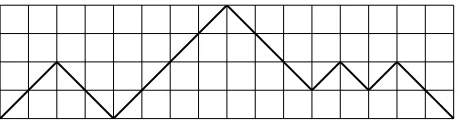
Avalley inπ ∈Dn is an occurrence ofDU, that is, aU inπ immediately preceded by
aD. We letv(π) denote the number of valleys inπ. For example, Figure1shows a Dyck pathπ of semi-length 8 with v(π) = 3. It is a well-known result that the number of Dyck paths of semi-length n with j valleys is given the Narayana number Nn,j = j+11
(n
j
)(n−1
j
) , where 0≤j ≤n−1.
[image:8.612.191.423.462.526.2].
Figure 1: The Dyck path π =U U DDU U U U DDDU DU DD. Given a cut-equivalence class in S123
k,2i, we define a Dyck path as follows: start at the
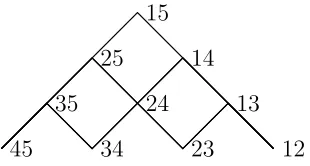
point (0,0) and go along an up-step. Then if the pair immediately after (k−2)kis (k−3)k, go along an up-step, while if it is (k−2)(k−1), go along a down-step. In general, if in the following pair the bottom element is decreased by 1, go along an up-step, while if the top element there is decreased by 1, go along a down-step. See Figure 2 for an example when k = 5. Note that cut-pairs in the correspondence given by Figure 2 correspond to valleys, which is not a coincidence. This correspondence leads to the following theorem, the main result of this subsection.
Theorem 2.4. There is a bijection ϕ from Fk,1232i to Dk−2 such that if f ∈ Fk,1232i and
.. 45 . 34 . 23 . 12 . 35 . 24 . 13 . 25 . 14 . 15
Figure 2: The correspondence between cut-equivalence classes and Dyck paths.
Proof. Let f be the cut-equivalence class in Fk,1232i with cut-pairs bp1tp1, bp2tp2, . . ., bpjtpj. We defineπ =ϕ(f) to be
U· · ·U | {z }
k−1−bp1
D· · ·D | {z }
k−tp1
U· · ·U | {z }
bp1−bp2
D· · ·D | {z }
tp1−tp2
· · · · U| {z }· · ·U
bpj−1−bpj
D· · ·D | {z }
tpj−1−tpj
U· · ·U | {z }
bpj−1
D· · ·D | {z }
tpj−2
. (3)
In particular, iff is the unique cut-equivalence class containing no cut-pairs, then ϕ(f) = U| {z }· · ·U
k−2
D· · ·D | {z }
k−2 .
Clearly, π contains k −2 up-steps and k−2 down-steps. Moreover, since bpℓ < tpℓ for 1 ≤ ℓ ≤ j, we have that k−1−bpℓ ≥ k −tpℓ for 1 ≤ ℓ ≤ j, which implies that the number of up-steps is never less than that of down-steps in any initial part of π. Thus, π∈Dk−2. Finally, note that π contains exactlyj valleys since there are j DUs inπ, and thusn(f) =v(π).
In order to show thatϕis injective, we need to show that for differentf1, f2 ∈ Fk,1232i, we
haveϕ(f1)̸=ϕ(f2). If n(f1)̸=n(f2), then v(ϕ(f1))̸=v(ϕ(f2)) and thusϕ(f1)̸=ϕ(f2). If n(f1) =n(f2) = j, where 1≤j ≤k−3, suppose that the cut-pairs off1 are bp1tp1,bp2tp2, . . .,bpjtpj and the cut-pairs off2 areb
′
p1t ′
p1,b ′
p2t ′
p2,. . .,b ′
pjt ′
pj. Letj
∗ be the smallest index
such thatbpj∗tpj∗ ̸=b ′
pj∗t ′
pj∗, so that for anyj∗∗, 1 ≤j∗∗< j∗, we havebpj∗∗tpj∗∗ =b ′
pj∗∗t ′
pj∗∗. According to the definition ofϕ,ϕ(f1) andϕ(f2) are the same in the firstk−1−bpj∗−1
up-steps and the firstk−tpj∗−1 down-steps. Then inϕ(f1),bpj∗−1−bpj∗ up-steps andtpj∗−1−tpj∗ down-steps follow, and inϕ(f2), bpj∗−1−b
′
pj∗ up-steps andtpj∗−1 −t
′
pj∗ down-steps follow. However, because eitherbpj∗−1−bpj∗ ̸=bpj∗−1−b
′
pj∗ ortpj∗−1−tpj∗ ̸=tpj∗−1−t
′
pj∗, we have that ϕ(f1)̸=ϕ(f2).
To complete the proof, it remains to describe the inverse mapϕ−1. For any Dyck path π∈Dk−2 with v(π) =j,π must be of the form
U· · ·U | {z }
α1
D· · ·D | {z }
β1
U· · ·U | {z }
α2
D· · ·D | {z }
β2
· · · ·U| {z }· · ·U
αj
D· · ·D | {z }
βj
U· · ·U | {z }
αj+1
D· · ·D | {z }
βj+1
, (4)
whereαm >0 andβm >0 for 1≤m≤j+ 1, and
∑j+1
i=1 αi =
∑j+1
i=1 βi =k−2. We define
and
tpm =k−(β1+β2+· · ·+βm).
It is clear that k −1 > bp1 > bp2 > · · · > bpj > 1 and k > tp1 > tp2 > · · · > tpj > 2. By Lemma 2.3, the cut-pairs of a 123-avoiding up-down word uniquely determine the cut-equivalence class that it belongs to. Thus, we can determine the cut-equivalence class f corresponding to the Dyck path π from the sequence of integer pairs {(bpm, tpm)}
j m=1. Clearly, we haven(f) = j.
Moreover, combining forms (3) and (4), we can get that ϕ◦ϕ−1 =ϕ−1◦ϕ=id. This completes the proof.
To illustrate the bijection given in Theorem 2.4, we consider the set S123
5,2i whose five
cut-equivalence classes were listed above. The Dyck paths corresponding to these classes, in the respective order, are given in Figure3. Class 1 is the only class in S5123,2i which has no cut-pair. Classes 2, 3and 4have one cut-pair. The only class in S123
5,2i which has two
cut-pairs isClass 5.
.
[image:10.612.85.522.353.402.2]...
Figure 3: Dyck paths corresponding to cut-equivalenceClasses 1–5inS5123,2i, respectively. The following statement is an immediate corollary to Theorem 2.4 and well-known enumerative properties of Dyck paths.
Corollary 2.5. There are Ck−2 equivalence classes with respect to the cut-equivalence
relation in Sk,1232i. Moreover, the number of cut-equivalence classes with j cut-pairs in Sk,1232i
isNk−2,j, where 0≤j ≤k−3.
2.3
An alternative enumeration of
N
k,1232iCorollary2.5allows us to give an alternative, combinatorial proof of the following theorem appearing in [3].
Theorem 2.6 ([3]). For k≥3, we have
Nk,1232i = 1 i+ 1
(
i+k−2 i
)(
i+k−1 i
) .
Proof. Let f be the cut-equivalence class corresponding to cut-pairs bp1tp1, bp2tp2, . . ., bpjtpj. We first claim that the number of words of length 2i belonging to f is
(2k−4+i−j 2k−4
upper bound on the number of distinct pairs in Pw. For 1 ≤ i ≤ 2k − 3, we let xi
denote the number of times the i-th pair in (1), from left to right, appears in w. Thus the words in f are in 1-to-1 correspondence with nonnegative solutions of the equation x1+x2+· · ·+x2k−3 =i, where j specifiedxms (corresponding to cut-pairs) are forced to
be positive. The number of such solutions is (2k−2k4+−4i−j), as desired. Combining the last statement with Corollary 2.5, we obtain that
Nk,1232i =
k−3 ∑
j=0
Nk−2,j
(
2k−4 +i−j 2k−4
) .
In what follows, we shall give a closed form formula for N123
k,2i. We start with using the
formula for the Narayana numbers Nk−2,j to obtain
Nk,1232i =
k−3 ∑
j=0 1 j+ 1
( k−3
j )(
k−2 j
)(
2k−4 +i−j 2k−4
) .
Since the factor (k−j3) vanishes for j > k−3, we have that
Nk,1232i =
∞
∑
j=0 1 j+ 1
( k−3
j )(
k−2 j
)(
2k−4 +i−j 2k−4
)
. (5)
We next use the approach described in [8, p. 35] to express (5) in terms of a hypergeometric series. Denote (a)n the rising factorial a(a+ 1)· · ·(a+n−1) and let 3F2
[
a1 a2 a3
b1 b2 ;z ]
be
∞
∑
s=0
(a1)s(a2)s(a3)s
(b1)s(b2)ss!
zs.
Since the constant coefficient of (5) is (i+22k−k−44) and the ratio between consecutive coeffi-cients in (5) is
[xj+1]N123
k,2i
[xj]N123
k,2i
= (3−k+j)(2−k+j)(−i+j) (2 +j)(4−i−2k+j)(1 +j), it follows that N123
k,2i can be expressed as
(
i+ 2k−4 2k−4
) ×3F2
[
3−k,2−k,−i 2,4−i−2k ; 1
]
. (6)
The Saalsch¨utz identity [1, p. 9] says that
3F2 [
a, b,−n
c,1 +a+b−c−n; 1 ]
= (c−a)n(c−a)n (c)n(c−a−b)n
By setting a= 3−k, b= 2−k, c= 2 and i=n, we have that
3F2 [
3−k,2−k,−i 2,4−i−2k ; 1
]
= (k−1)i(k)i (2)i(2k−3)i
= (i+k−2)!(i+k−1)!(2k−4)! (k−2)!(k−1)!(i+ 1)!(i+ 2k−4)!. Substituting the last formula into (6), we obtain that
Nk,1232i = 1 i+ 1
(
i+k−2 i
)(
i+k−1 i
) ,
which completes the proof.
To illustrate Theorem 2.6, the words in the five cut-equivalence classess in S123 5,2i are
enumerated by (i+66 ), (i+56 ), (i+56 ), (i+56 ), and (i+46 ), respectively. Hence, the number of words inS123
5,2i is
( i+ 6
6 )
+ 3 (
i+ 5 6
) +
( i+ 4
6 )
= 1
i+ 1 (
i+ 4 4
)( i+ 3
3 )
.
3
Enumeration of length 3 consecutive pattern-avoiding
up-down words
The following theorem is a straightforward corollary to Formula (1) in [3], since the patterns 123 and 321 do not bring any new restrictions on alternating words, and thus Sk,ℓ123 = Sk,ℓ321 is the set of up-down words of length ℓ over [k]. In what follows, δa,b is the
Kronecker delta, which is equal to 1 if a= b and 0 otherwise. Also, χ(a) equals 1 if a is true, and 0 otherwise.
Theorem 3.1. We have
Nk,ℓ123 =Nk,ℓ321 =Mk,ℓ,
where the numbers Mk,ℓ satisfy the following recurrence relation for k≥3 and ℓ ≥2:
Mk,ℓ=Mk−1,ℓ+
⌊ℓ−1 2 ⌋ ∑
i=0
Mk−1,2iMk,ℓ−2i−1−χ(ℓ is even )·Mk−1,ℓ−2 (7)
with the initial conditions Mk,0 = 1, Mk,1 =k for k ≥2, and M2,ℓ = 1 for ℓ≥2.
3.1
132
-avoiding up-down words
k ℓ
0 2 4 6 8
2 1 1 1 1 1
3 1 3 7 15 31
4 1 6 25 90 301
5 1 10 65 350 1701
k ℓ
1 3 5 7 9
2 2 1 1 1 1
3 3 4 8 16 32
4 4 10 33 106 333
[image:13.612.332.502.113.204.2]5 5 20 98 456 2034
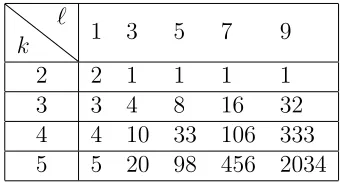
Table 2: Nk,ℓ132 for small values of k and ℓ.
Lemma 3.2. An up-down word w=w1w2· · ·wℓ is132-avoiding if and only if the bottom
elements ofw are weakly decreasing from left to right, i.e.,
b1 ≥b2 ≥ · · · ≥b⌈ℓ 2⌉.
Proof. If there were some j, 1 ≤ j ≤ ⌈ℓ2⌉ −1, such that bj < bj+1, then bjtjbj+1 would form an occurrence of the pattern 132.
Conversely, if there is an occurrence wjwj+1wj+2 of the pattern 132 in w, where 1 ≤ j ≤ℓ−2, then we havewj < wj+2 < wj+1. According to the definition of up-down words, wj+1 must be a top element in w, and wj and wj+2 must be bottom elements in w, and wj < wj+2.
This completes the proof.
LetAk,ℓ =Nk,ℓ132. Next theorem enumerates Ak,2i.
Theorem 3.3. For all k≥2 and i≥0, we have
Ak,2i =S(k+i−1, k−1),
where S(n, m) is a Stirling number of the second kind.
Proof. Note that for k ≥3 andi≥1, any 132-avoiding up-down word wof length 2iover [k], belongs to one of the following two cases:
(a) There are no 1s in w. These words are counted by Ak−1,2i (which can be seen by
subtracting a 1 from each element in w);
(b) There is at least one 1 in w. By Lemma3.2,w2i−1 = 1, since w2i−1 is the minimum element in w. Thus w is of the form w′1w′′, where w′ is a 132-avoiding up-down word of length 2i−2 andw′′ is a letter in {2,3, . . . , k}. Such words are counted by (k−1)Ak,2i−2.
Hence for k≥3 and i≥1, the numbersAk,2i satisfy the recurrence relation
with the initial conditions A2,2i = 1 for all i ≥ 1 and Ak,0 = 1 for all k ≥ 2, which are easy to check.
We have thatAk,2i =S(k+i−1, k−1) since these numbers have the same recurrence
relation and initial conditions. Indeed, from a well-known recurrence relation for the Stirling numbers of the second kind,
S(k+i−1, k−1) =S(k+i−2, k−2) + (k−1)S(k+i−2, k−1),
together with their initial conditions S(i+ 1,1) = 1 for all i≥0 and S(k−1, k−1) = 1 for all k≥2.
We now turn our attention to considering Ak,2i+1.
Theorem 3.4. For all k≥2 and i≥1, we have
Ak,2i+1 =
k
∑
j=2
Aj,2i. (9)
Proof. Let Ajk,ℓ denote the number of those words counted by Ak,ℓ that end withj. It is
easy to see that for k ≥2 and i≥1,
Ak,2i+1 =
k−1 ∑
j=1
Ajk,2i+1.
By Lemma3.2, for any word w ∈Sk,1322i+1 whose last letter isj, the minimum letter of w is alsoj. Thus, we have that
Ajk,2i+1 =Ak1−j+1,2i+1,
where 1≤j ≤k−1, because we can subtract j from each letter of any word counted by Ajk,2i+1. Moreover, for any word in Sk132−j+1,2i+1 ending with 1, we can remove 1 to form a word of length 2i, which is also 132-avoiding. On the other hand, for any word Sk132−j+1,2i, we can adjoin the letter 1 at the end to form a 132-avoiding word of length 2i+ 1. Thus,
A1k−j+1,2i+1 =Ak−j+1,2i.
So, we obtain that
Ak,2i+1 =
k−1 ∑
j=1
Ak−j+1,2i = k
∑
j=2 Aj,2i.
Theorem 3.5. For k ≥2, let Nk132(x) = ∑ℓ≥0Ak,ℓxℓ be the generating function for Nk,ℓ132.
Then we have
Nk132(x) =
k
∑
j=1
x+δj,k
Proof. Let
Ak(x) =
∑
i≥0
Ak,2ixi.
By (8), it follows that Ak(x) =
∑
i≥0
Ak,2ixi
= 1 +∑
i≥1
Ak−1,2ixi + (k−1)
∑
i≥1
Ak,2i−2xi
=Ak−1(x) + (k−1)xAk(x)
for k ≥2 and A1(x) = 1. This leads to the following well-known generating function for Stirling numbers of the second kind, where k≥1:
Ak(x) =
1
(1−x)(1−2x)· · ·(1−(k−1)x).
From the definition ofNk132(x) as well as the fact Ak,1 =k, we have that Nk132(x) =∑
ℓ≥0
Ak,ℓxℓ
=∑
i≥0
Ak,2ix2i +
∑
i≥0
Ak,2i+1x2i+1
=Ak(x2) +
∑
i≥0
k
∑
j=2
Aj,2ix2i+1+x
=Ak(x2) +x k
∑
j=2 ∑
i≥0
Aj,2ix2i+x
=Ak(x2) +x k
∑
j=2
Aj(x2) +x
=
k
∑
j=1
x+δj,k
(1−x2)(1−2x2)· · ·(1−(j−1)x2), as desired. This completes the proof.
3.2
312
-avoiding up-down words
In this subsection, we consider the enumeration of 312-avoiding up-down words, which is similar to the enumeration of 132-avoiding up-down words done in Section 3.1. Table 3
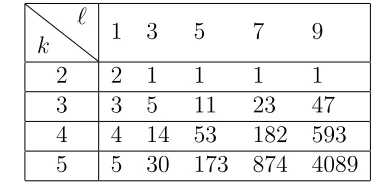
provides the numbersNk,ℓ312 for small values of k and ℓ.
k ℓ
0 2 4 6 8
2 1 1 1 1 1
3 1 3 6 12 24
4 1 6 20 65 206
5 1 10 50 238 1080
k ℓ
1 3 5 7 9
2 2 1 1 1 1
3 3 5 11 23 47
4 4 14 53 182 593
[image:16.612.319.505.113.204.2]5 5 30 173 874 4089 Table 3: Nk,ℓ312 for small values of k and ℓ.
Lemma 3.6. An up-down word w = w1w2· · ·wℓ is 312-avoiding if and only if the top
elements ofw are weakly increasing from left to right, i.e.,
t1 ≤t2 ≤ · · · ≤t⌊ℓ 2⌋.
Proof. For any up-down word w, if there exists 1 ≤j ≤ ⌊ℓ2⌋ −1 such thattj > tj+1, then tjbj+1tj+1 would be an occurrence of the pattern 312.
Conversely, if there is an occurrence wjwj+1wj+2 of the pattern 312 in w, where 1 ≤ j ≤ ℓ −2, we would have wj+1 < wj+2 < wj. By definition of up-down words, wj+1 must be a bottom element in w, and wj and wj+2 must be top elements in w. But then wj > wj+2.
Forℓ ≥2, letBk,ℓ =N
312
k,ℓ denote the number of 312-avoiding up-down words of length
ℓover an alphabet [k]. Also, letBk,0 = 1 and to simplify our calculations, we assume that Bk,1 =k−1.
First, we deal with the enumeration of Bk,2i+1.
Theorem 3.7. For k≥2 and i≥1, the numbers Bk,2i+1 satisfy the recurrence relation Bk,2i+1 =Bk−1,2i+1+ (k−1)Bk,2i−1 (10)
with the initial conditions B1,2i+1 = 0 for all i ≥ 1 and Bk,1 = k −1 for all k ≥ 2.
Furthermore, if
Bk(x) =
∑
i≥0
Bk,2i+1xi,
for k≥1, then
Bk(x) = k−1 ∑
j=1
1
(1−jx)· · ·(1−(k−1)x).
By (10), we have Bk(x) =
∑
i≥0
Bk,2i+1xi
=k−1 +∑
i≥1
Bk−1,2i+1xi+ (k−1) ∑
i≥1
Bk,2i−1xi
= 1 +Bk−1(x) + (k−1)xBk(x)
fork ≥2. Therefore,
Bk(x) =
Bk−1(x) + 1 1−(k−1)x with the initial condition B1(x) = 0.
Hence, for k≥2, we have Bk(x) =
1
(1−x)(1−2x)· · ·(1−(k−1)x)+
1
(1−2x)· · ·(1−(k−1)x) +· · ·+
1 1−(k−1)x =
k−1 ∑
j=1
1
(1−jx)· · ·(1−(k−1)x), which completes the proof.
Now we turn our attention to the words of even length.
Theorem 3.8. For all k≥2 and i≥2, we have
Bk,2i = k
∑
j=2
Bj,2i−1.
Proof. Let Bjk,ℓ denote the number of those words counted by Bk,ℓ that end with j for
ℓ≥2. It is easy to see that fork ≥2 and i≥2,
Bk,2i = k
∑
j=2 Bk,j2i.
For any word w∈Sk,3122i whose last letter is j, by Lemma 3.6, the maximum letter of w is also j. Thus, for 2≤j ≤k, we have that
Bk,j2i =Bj,j2i.
Moreover, for any word in Sj,3122i ending with j, we can remove j to form a word of length 2i−1, which is also 312-avoiding. On the other hand, for any word in Sj,3122i−1, we can adjoin a letterj at the end to form a 312-avoiding word of length 2i. Thus,
So, we obtain that
Bk,2i = k
∑
j=2
Bj,2i−1,
which completes the proof.
Proposition 3.9. For k ≥ 2, let Nk312(x) = x+∑ℓ≥0Bk,ℓxℓ be the generating function
for Nk,ℓ312. Then
Nk312(x) = 1 +x+
k
∑
j=2
j−1 ∑
i=1
x2+xδj,k
(1−ix2)· · ·(1−(j−1)x2).
Proof. From Theorem 3.8 together with the fact Bk,2 = ∑k
j=2Bj,1 = (k
2 )
, we obtain that Nk312(x) = x+∑
ℓ≥0 Bk,ℓxℓ
=x+∑
i≥0
Bk,2ix2i+
∑
i≥0
Bk,2i+1x2i+1
= 1 +x+∑
i≥1
k
∑
j=2
Bj,2i−1x2i+xBk(x2)
= 1 +x+x2
k
∑
j=2
Bj(x2) +xBk(x2)
= 1 +x+
k
∑
j=2
j−1 ∑
i=1
x2+xδ
j,k
(1−ix2)· · ·(1−(j−1)x2). This completes the proof.
3.3
213
-avoiding or
231
-avoiding up-down words
In what follows, we resume using Nk,ℓp for the number of p-avoiding up-down words of lengthℓ over an alphabet [k].
Theorem 3.10. For all k ≥2 and i≥0, we have
Nk,2132i+1 =Nk,3122i+1
and
Proof. The equalities hold by applying the reverse operation to all words, which keeps the property of being an up-down word.
For the case of the even lengths, we have the following result.
Theorem 3.11. For all k ≥2 and i≥1, there is
Nk,2132i =Nk,1322i
and
Nk,2312i =Nk,3122i.
Proof. The statement follows by applying the complement and reverse operations which turn an up-down word into an up-down word.
4
Enumeration of up-down words avoiding a vincular
pattern of length 3
In Section 3, we enumerated up-down words avoiding consecutive patterns of length 3, which are a particular case of vincular patterns. In this section, we consider avoidance of other vincular patterns of length 3 on up-down words. We divide patterns of the form xyz into three subcases; in each subcase the proofs are similar.
4.1
132
-avoiding or
312
-avoiding up-down words
Similarly to our considerations above, we first give a description of 132-avoiding up-down words.
Theorem 4.1. The following two statements hold:
(a) An up-down word w=w1w2· · ·wℓ is132-avoiding if and only if the bottom elements
of w are weakly decreasing from left to right, i.e.,
b1 ≥b2 ≥ · · · ≥b⌈ℓ 2⌉.
(b) An up-down word w is 132-avoiding if and only if w is 132-avoiding, and thus, for
k ≥2 and ℓ ≥0, we have
Nk,ℓ132=Nk,ℓ132,
Proof. (a) If there were some j, 1 ≤ j ≤ ⌈2ℓ⌉ −1, such that bj < bj+1, then bjtjbj+1 would be an occurrence of the pattern 132.
Conversely, if in w there is an occurrence wj∗wjwj+1 of the pattern 132, where 1 ≤ j∗ < j ≤ ℓ−1, we would have wj∗ < wj+1 < wj. According to the definition
of up-down words, wj must be a top element and wj+1 must be a bottom element in w. If wj∗ is a bottom element, then there is wj∗ < wj+1 and the bottom element wj∗ is to the left of the bottom element wj+1. If wj∗ is a top element, then there
is wj∗+1 < wj∗ < wj+1, and the bottom element wj∗+1 is to the left of the bottom element wj+1.
(b) Combining Lemma 3.2 and (a), we get the desired result.
The enumeration of 312-avoiding up-down words is similar to that of 132-avoiding up-down words, and we omit a proof of the following theorem leaving it to the interested Reader.
Theorem 4.2. The following two statements hold:
(a) An up-down word w is312-avoiding if and only if the top elements of w are weakly increasing from left to right, i.e.,
t1 ≤t2 ≤ · · · ≤t⌊ℓ 2⌋.
(b) An up-down word w is 312-avoiding if and only if w is 312-avoiding. Thus, for all
k ≥2 and ℓ ≥0, we have
Nk,ℓ312=Nk,ℓ312.
4.2
231
-avoiding or
213
-avoiding up-down words
Our proof of the following lemma is very similar to the proof of Theorem 4.1 (a), and thus is omitted.
Lemma 4.3. In a 231-avoiding up-down word, the bottom elements are weakly increasing from left to right, i.e.,
b1 ≤b2 ≤ · · · ≤b⌈ℓ 2⌉.
Note that unlike Theorem 4.1 (a), we do not have “if and only if” statement in Lemma4.3 as demonstrated, e.g., by the word 12131.
The following theorem shows that avoidance of the pattern 231 is equivalent to avoid-ance of the classical pattern 231 studied in [3].
Theorem 4.4. An up-down word w = w1w2· · ·wℓ is 231-avoiding if and only if w is
Proof. If w has an occurrence of the pattern 231 then it clearly has an occurrence of the pattern 231. Thus, we just need to show that ifwis 231-avoiding, thenwis 231-avoiding. Suppose that w is 231-avoiding, but there is an occurrence wj1wj2wj3 of the pattern 231 inw, that is, j1 < j2 < j3 and wj3 < wj1 < wj2. Among all such occurrences, we can pick one which hasj3−j1 minimum possible.
(a) If wj2 is a bottom element, then wj3 must be a top element by Lemma 4.3. Since wj3−1 < wj3, we have thatwj2 ̸=wj3−1. But then,wj2 andwj3−1are bottom elements such that wj3−1 is to the right of wj2 and wj3−1 < wj2 contradicting Lemma 4.3. (b) If wj2 is a top element, we have the following cases to consider. If j3 =j2+ 1, then
wj1wj2wj3 is an occurrence of the pattern 231, which is impossible. If j3 ≥ j2 + 2 and wj3 is a bottom element, according to the definition of up-down words and Lemma 4.3, we have wj2+1 ≤ wj3 and thus wj1wj2wj2+1 is an occurrence of the pattern 231; contradiction. Finally, if j3 ≥ j2 + 2 and wj3 is a top element, then wj1wj2wj3−1 is an occurrence of the pattern 231 with wj1 and wj3−1 being closer to each other than wj1 and wj3 contradicting our choice of wj1wj2wj3.
The proof is completed.
The following statement is a direct corollary to Theorem 4.4.
Corollary 4.5. For all k ≥2 and ℓ≥0, we have
Nk,ℓ231=Nk,ℓ231,
which is enumerated in Theorem2.1.
The enumeration of 213-avoiding up-down words is similar to that of 231-avoiding up-down words. Here we list all the results about the former objects, omitting the proofs.
Theorem 4.6. The following two statements hold:
(a) In an up-down 213-avoiding word w, the top elements are weakly increasing from left to right, i.e.,
t1 ≥t2 ≥ · · · ≥t⌊ℓ 2⌋.
(b) An up-down word w is 213-avoiding if and only if w is 213-avoiding. Thus, for all
k ≥2 and ℓ ≥0, we have
Nk,ℓ213=Nk,ℓ213,
which is enumerated in Theorem 2.1.
4.3
123
-avoiding or
321
-avoiding up-down words
A description of 123-avoiding up-down words is as follows.Lemma 4.7. An up-down word w=w1w2· · ·wℓ is 123-avoiding if and only if
b1 ≥b2 ≥ · · · ≥b⌊ℓ 2⌋.
Proof. For any 123-avoiding up-down word w, if there exists 1 ≤j ≤ ⌊2ℓ⌋ −1 such that bj < bj+1, then bjbj+1tj+1 is an occurrence of the pattern 123, which is a contradiction.
Conversely, if there is an occurrence wj∗wjwj+1 of the pattern 123 in w, where 1 ≤ j∗ < j < ℓ, we would have wj∗ < wj < wj+1. According to the definition of up-down words, wj must be a bottom element, and wj+1 must be a top element in w. If wj∗ is a
bottom element, thenwj∗ is to the left of wj and wj∗ < wj. If wj∗ is a top element, then
the bottom element wj∗−1 ̸=wj is to the left of wj and wj∗−1 < wj.
This completes the proof.
We can now obtain the following enumerative result.
Theorem 4.8. The following two statements hold, where Nk,ℓ132 is enumerated in Sec-tion 3.1:
(a) For all k ≥2 and i≥0, we have
Sk,1232i =Sk,1322i.
(b) For all k ≥2 and i≥1, we have
Nk,1232i+1 =Nk,1322i+1+
k−1 ∑
j=1 (
k−j 2
)
Nk132−j+1,2i−2.
Proof. (a) follows immediately from Lemmas 3.2 and 4.7. For (b), there are two cases to consider:
• bi ≥bi+1. These words are counted byNk,1322i+1.
• bi < bi+1. Then, bi is the minimum element in w. Suppose that bi = j, where
1 ≤ j ≤ k −1. Then the word w must be of the form w′jw′′, where w′ is a 123-avoiding up-down word of length 2i−2 over {j, j+ 1, . . . , k}, andw′′ is a down-up word of length 2 over {j + 1, . . . , k}. Thus, the words in question are counted by ∑k−1
j=1 (k−j
2 )
The case of enumeration of 321-avoiding up-down words is similar to that of 123-avoiding up-down words conducted above. Thus, we omit our proof of the following theorem.
Theorem 4.9. The following three statements hold, where Nk,ℓ312 is enumerated in Sec-tion 3.2:
(a) An up-down word w is 321-avoiding if and only if
t1 ≤t2 ≤ · · · ≤t⌊ℓ−1 2 ⌋.
(b) For all k ≥2 and i≥0, we have
Nk,3212i+1=Nk,3122i.
(c) For all k ≥2 and i≥2, we have
Nk,3212i =Nk,3122i+
k
∑
j=2 (
j −1 2
) (
Nj,3122i−3−δi,2 )
.
4.4
The remaining cases
The remaining enumeration cases for vincular pattern-avoiding up-down words are ob-tained by applying the reverse and complement operations to our obob-tained results. We record these cases in the following two theorems.
Theorem 4.10. For all k ≥2 and i≥0, we have
Nk,1232i =Nk,1232i, Nk,2132i =Nk,1322i, Nk,1322i =Nk,2132i
and
Nk,3122i =Nk,2312i, Nk,2312i =Nk,3122i, Nk,3212i =Nk,3212i.
Theorem 4.11. For all k ≥2 and i≥0, we have
Nk,1232i+1 =Nk,3212i+1, Nk,2132i+1 =Nk,3122i+1, Nk,1322i+1 =Nk,2312i+1
and
5
Concluding remarks
In this paper, we not only enumerated all cases of length 3 vincular pattern-avoidance on alternating words providing a link, e.g., to the Stirling numbers of the second kind, but also discussed the structure of 123-avoiding up-down words of even length. As the result, we provided an alternative, combinatorial proof of the fact that these words are counted by the Narayana numbers. However, our combinatorial proof uses a bijection between Dyck paths and certain equivalence classes on words in question, along with a known relation on Narayana numbers. It is still desirable to solve the following problem.
Problem 1. Provide a direct combinatorial proof of the fact that 123-avoiding up-down words of even length are counted by the Narayana numbers, namely, find a bijection send-ing these words to Dyck paths.
Also, it would be interesting to describe the structure of 132-avoiding up-down words of even length, e.g., via the notion of a cut-pair introduced in this paper, and possibly provide an alternative proof of the fact that these words are counted by the Narayana numbers, as was shown in [3]. We leave this as an open research direction.
Finally, there are many other types of patterns studied in the literature (see Chapter 1 in [7]) and one could study occurrences of these patterns on alternating words, which should bring more links to known combinatorial structures.
Acknowledgments
The authors are grateful to an anonymous referee for reading carefully the paper and providing many useful suggestions that improved the presentation. The work of the first and the third authors was supported by the 973 Project, the PCSIRT Project of the Ministry of Education and the National Science Foundation of China. The second author is grateful to the administration of the Center for Combinatorics at Nankai University for their hospitality during the author’s stay in June–July 2015.
References
[1] W. N. Bailey. Generalized hypergeometric series. Cambridge Tracts in Mathematics and Mathematical Physics, No. 32. Stechert-Hafner, Inc., New York, 1964.
[3] A. L.L. Gao, S. Kitaev, and P. B. Zhang. Pattern-avoiding alternating words, arXiv:1505.04078.
[4] L. Carlitz, R. Scoville. Up-down sequences, Duke Math. J. 39 (1972), 583–598. [5] L. Carlitz. Enumeration of up-down sequences, Discrete Math. 4 (1973) 3, 273–286. [6] L. Carlitz. Up-down and down-up partitions. G.-C. Rota (Ed.), Studies in
Founda-tions and Combinatorics, Academic Press, New York (1978).
[7] S. Kitaev. Patterns in permutations and words. Springer-Verlag, 2011.
[8] M. Petkovˇsek, H. S. Wilf, and D. Zeilberger. A = B. A K Peters, Ltd., Wellesley, MA, 1996.