City, University of London Institutional Repository
Citation: Emparanza, J. I., Cabello, J. B. & Burls, A. (2015). Does evidence-based
practice improve patient outcomes. Journal of Evaluation in Clinical Practice, 21(6), pp. 1059-1065. doi: 10.1111/jep.12460/fullThis is the submitted version of the paper.
This version of the publication may differ from the final published
version.
Permanent repository link: http://openaccess.city.ac.uk/12708/
Link to published version: http://dx.doi.org/10.1111/jep.12460/full
Copyright and reuse: City Research Online aims to make research
outputs of City, University of London available to a wider audience.
Copyright and Moral Rights remain with the author(s) and/or copyright
holders. URLs from City Research Online may be freely distributed and
linked to.
City Research Online: http://openaccess.city.ac.uk/ [email protected]
1
Title:
Does evidence-based practice improve patient outcomes? An analysis of a natural experiment in a Spanish hospital.
Suggested running title:
Does evidence-based practice improve patient outcomes?
Authors:
Jose I. Emparanza Juan B. CabelloAmanda J. E. Burls (corresponding author)
Emparanza J.I., Director of the Unidad de Epidemiología Clínica Hospital Universitario Donostia
Doctor Begiristain Kalea 117 20080 Donostia
San Sebastián Gipuzkoa Spain
Email: [email protected]
Cabello J. B., Consultant Cardiologist Hospital General Universitario de Alicante Calle Pintor Baeza
Alicante 03010 Spain
Email: [email protected]
Burls A. J. E., Professor of Public Health School of Health Sciences
City University London London EC1V 0HB UK
Email: [email protected] Telephone: +44 207 0405409 Mobile: +44 7970 271743
Keywords
2
Abstract
Background
Evidence-based practice (EBP) is widely promoted, but does EBP practice produce better patient outcomes? We report a natural experiment when part of the internal medicine service in a hospital was reorganized in 2003 to form an EBP unit, the rest of the service remaining unchanged. The units attended similar patients until 2012 permitting
comparisons of outcomes and activity.
Methods
We used routinely collected statistics (2004-11) to compare the two different methods of practice and test whether patients being seen by the EBP unit differed from standard practice (SP) patients. Data were available by doctor and year. To check for differences between the EBP and SP doctors prior to reorganization, we used statistics from 2000-2003. We looked for changes in patient outcomes or activity following reorganization and whether the EBP unit was achieving significantly different results from SP. Data across the periods were combined and tested using Mann-Whitney.
Results
No statistically significant differences in outcomes were detected between the EBP and the SP doctors prior to reorganization.
Following the unit’s establishment, the mortality of patients being treated by EBP doctors compared to their previous performance dropped from 7.4% to 6.3% (P<0.02) and length of stay from 9.15 to 6.01 days (P=0.002). No statistically significant improvements were seen in SP physicians’ performance.
No differences in the proportion of patients admitted or their complexity between the services were detected. Despite this, EBP patients had a clinically significantly lower risk of death 6.27% vs 7.75% (P<0.001) and a shorter length of stay 6.01 vs 8.46 days (P<0.001) than SP patients. Readmission rates were similar: 14.4% (EBP); 14.5% (SP).
EBP doctors attended twice as many patients/doctor as SP doctors.
Conclusion
3
Background
A wry question sometimes directed at the proponents of evidence-based practice (EBP) is “What is the evidence for evidence-based practice?” The implication being that, without this, proponents are hypocritically promoting a standard to which they do not themselves adhere. This wisecrack bemuses many evidence-based practitioners – surely, healthcare interventions shown to be effective in high quality studies are likely to be effective when used with other similar patients in similar circumstances?
Underlying the jibe is the assumption that there is little evidence that EBP is more effective than standard practice (SP). While there are, to our knowledge, no randomized trials of evidence-based practice against standard practice, the relationship between providing evidence-based treatments and improved patient outcomes has been amply demonstrated. One compelling example is the study by Jernberg et al1 looking at the association between evidence-based treatment and survival for patients with ST-elevation myocardial infarction using the Swedish Register of Information and Knowledge about Swedish Heart Intensive Care Admission. This demonstrates a decline in mortality with adoption of evidence-based treatments. The effect is striking and clinically important - between 1996 and 2007 there was an 8% absolute reduction in deaths and an average increased life expectancy of at least 2.7 years. The benefit was maintained at 12 years.
A typical response by EBP sceptics to such examples is “of course effective treatments improve patient outcomes, but doctors have always adopted new effective treatment – EBP is neither new nor different”.
Since the pioneering work of Wennberg, starting in the 1960s, health service researchers have repeatedly demonstrated systematic and unwarranted variations in care, with underuse, overuse and misuse of interventions.2,3,4,5 Indeed, this has been one of the important drivers of the EBP movement: if there are variations in healthcare, not explained by patient characteristics, values, or resource constraints, not all healthcare practitioners can be doing the best for their patients. A systematic review looking at the adherence to guidelines showed that 2/3 of practitioners do not adhere to recommendations.6 It is simply not the case that doctors, and other healthcare professionals, have always adopted new effective treatments. The failure to get research evidence into practice is illustrated by Jernberg et al, who demonstrate considerable heterogeneity in the adoption of evidence-based treatments. For example, by 2007 in some hospitals nearly 90% of patients received an acute percutaneous coronary intervention or coronary bypass graft for ST-elevation myocardial infarction whilst in others only 40% did.
4
“The challenge for us clinicians is not so much whether to implement evidence, but how. We have to decide the best way to ensure that we routinely incorporate EBM into clinical practice.”
This raises the question: do clinicians who deliberately adopt an evidence-based approach by regularly and systematically trying to identify and implement new research evidence have better patient outcomes than those who do not? Although there are no randomised controlled trials addressing this question, a natural experiment occurred at a hospital in the Basque country when two consultants in internal medicine deliberately adopted the
methods of EBP and reorganized their internal medicine service to facilitate this, while the rest of their internal medicine colleagues continued their standard practice (SP).This
experiment provided us with a unique opportunity to explore whether the change produced any measurable effect on patient outcomes or process measures. This paper reports our findings.
Materials and Methods
The context
In 1998 the University Hospital Donostia produced a strategic plan for improving patient care which noted that promoting clinical epidemiology among clinicians was important for excellence. Clinical epidemiology is the science that underpins EBP. The hospital has a Clinical Epidemiology Unit which, at that time, had two clinical epidemiologists and an administrator who provided support for research and complex individual patient decisions.
The new strategy coincided with the inauguration of the Critical Appraisal Skills Programme in Spain (CASPe)8 and the Spanish Cochrane Centre9 and the hospital directors took the unprecedented step of sending seven consultants, from a variety of specialties, including two from internal medicine, to attend these events.
These clinicians, perceiving the potential benefits of EBP for patients, approached the Clinical Epidemiology Unit for training. Informal training, after working hours, twice monthly was organized. Six to ten doctors attended. Initially activities focused on critically appraising articles using CASP methods. Later, participants were trained in searching, learning to recognize knowledge gaps in clinical practice and how to define and structure uncertainties to construct sensitive and specific search strategies. These are the steps that constitute EBP10.
In 2000 a proposal to create a specific section within internal medicine where EBP was integrated into daily care was put forward. In October 2003 an EBP unit was established. The two internal medicine doctors who had been training in EBP (Dr Artetxe and Dr Aranegui) were assigned to the new 22 bed unit. (The number of beds was determined by the existing ward size.) Details about the new structure and processes of the EBP unit are given below.
5
consultants were previously residents who had trained in the unit and therefore EBP, not consultants being moved across from the SP service. In 2008 the Unit was moved to a different building to increase the ward capacity and in 2009 additional space was made available. The rest of the internal medicine remained unchanged.
In 2012, the EBP unit was again expanded but this time it was given new specific functions such that the patient mix was no longer comparable with the rest of the internal medicine service thereby bringing the natural experiment to a close.
We explore the impact in terms of both patient and process outcomes from 2004 to 2011. Unplanned effects on training and research are reported in the discussion.
Details of the EBP unit changes and working methods
The EBP unit had the same proportion of nurses to residents to consultants as the SP internal medicine service. Nurses allocated to the unit were similar to the nurses remaining in the SP service. However, nurses joining the EBP unit received trained in critical appraisal and EBP. The unit worked as a team and in close collaboration with the Clinical
Epidemiology Unit and medical librarians. Processes were changed – clinicians of all grades now explicitly sought and registered knowledge gaps and shared them with team members. Online computers were placed on the ward with access to the: MEDLINE, Best Evidence (ACP & BMJ), the Cochrane Library, Trip Database (which at that time required a
subscription), Uptodate, and InfoRetriever. The latter three being new resources requested by the Unit and not available in the library.
A structured method was used to search for high quality evidence efficiently. CASPe11 checklists, similar to the UK CASP checklists12, were used to appraise the evidence. Each question answered was summarised as a Critically Appraised Topic (CAT), including the implication for practice, shared with the rest of the team and added to a CAT bank. The team began using problem-oriented medical records and developed a close relationship with the Hospital-at-Home team. In addition to the normal tasks of an internal medicine service (ward rounds, consultations etc.), the EBP unit ran:
1. Weekly sessions in which uncertainties were shared and structured as PICO questions
2. Weekly meeting with primary care teams
3. Multidisciplinary sessions for problem solving of any kind (problems with transport of patients, problems with excessive waiting time for x-ray, etc.)
6 Analyses
Selection bias in patients attended
A natural experiment occurs when the exposure of individuals (or clusters of individuals) to an experimental or control condition is determined by factors outside the control of the investigators but is not thought to systematically select different individuals (in this case patients). Since the new EBP unit took part in the on call rota and admitted patients just like the SP service, there was a priori no reason to think that the patients attended would differ systematically between the two groups. We explored the assumption, required for this to be a natural experiment, that patients attended by the EBP unit were similar to those attended by SP internal medicine teams, by looking for evidence of, or opportunities for, selection bias. Firstly we looked for qualitative reasons that might suggest potential systematic bias, then compared process measures and complexity scores (the higher the more complex the patient condition) to test quantitatively the assumption that there was no systematic differences between the patients attended and admitted.
Selection bias in clinical staff in EBP unit compared to the rest of internal medicine
To explore whether any differences in outcomes observed could be due to pre-existing differences in the effectiveness of the doctors who decided to train in EBP, we compared the process and patient outcomes measures for the consultants involved in setting up the EBP unit with their performance in the preceding three years (the longest period for which data were available). We looked at the numbers, provenance, skills and ability of other clinical staff in the EBP and SP groups to see whether we could identify any systematic differences that could account for any differences in effectiveness or efficiency.
Routine statistics compared
We were able to obtain mortality, length of stay (LOS), re-admission rates and process
measures from routine statistics. Data were only available to us grouped by year and doctor.
We compared the EBP unit consultants’ results to the rest of internal medicine consultants’ results for the period 2004 to 2011. We combined results across the period to produce summary measures. Statistical inference testing was undertaken using Mann-Whitney.
Results
7
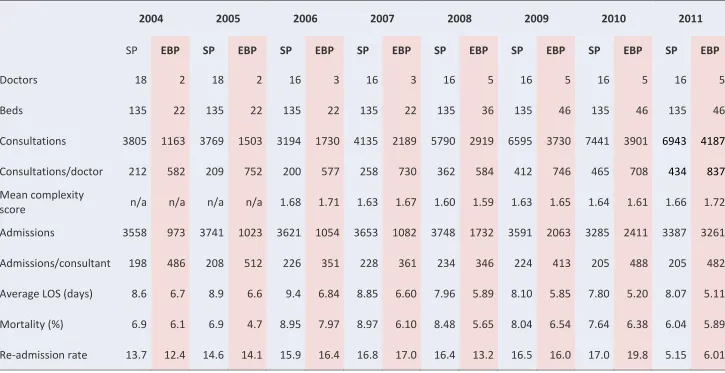
Table 1 Statistics for EBP unit (EBP) compared to standard practice (SP) internal medicine services 2004 to 2011
2004 2005 2006 2007 2008 2009 2010 2011
SP EBP SP EBP SP EBP SP EBP SP EBP SP EBP SP EBP SP EBP
Doctors 18 2 18 2 16 3 16 3 16 5 16 5 16 5 16 5
Beds 135 22 135 22 135 22 135 22 135 36 135 46 135 46 135 46
Consultations 3805 1163 3769 1503 3194 1730 4135 2189 5790 2919 6595 3730 7441 3901 6943 4187
Consultations/doctor 212 582 209 752 200 577 258 730 362 584 412 746 465 708 434 837
Mean complexity
score n/a n/a n/a n/a 1.68 1.71 1.63 1.67 1.60 1.59 1.63 1.65 1.64 1.61 1.66 1.72
Admissions 3558 973 3741 1023 3621 1054 3653 1082 3748 1732 3591 2063 3285 2411 3387 3261
Admissions/consultant 198 486 208 512 226 351 228 361 234 346 224 413 205 488 205 482
Average LOS (days) 8.6 6.7 8.9 6.6 9.4 6.84 8.85 6.60 7.96 5.89 8.10 5.85 7.80 5.20 8.07 5.11
Mortality (%) 6.9 6.1 6.9 4.7 8.95 7.97 8.97 6.10 8.48 5.65 8.04 6.54 7.64 6.38 6.04 5.89
8
Aggregated results for 2004-2011
A summary of the combined results are given in Table 2 Combined results over the 8-year period.
Table 2 Combined results over the 8-year period.
1 in 5 doctors were in EBP unit
EBP doctors attended 1 in 3 of all consultations
~2/3 patients attended were admitted by both the EBP unit (64%) and SP service (68%) The mean complexity score of EBP patients (1.66) was similar to SP patients (1.64) Death rates were significantly lower: 6.27% vs 7.75% (RR 0.79 95%CI 0.73 to 0.86) The readmission rates were similar: 14.4% EBP vs 14.5% SP
The mean LOS for patients on the EBP unit was shorter 6.01 vs 8.5 days for SP wards On average the EBP doctors attended over twice as many patients as SP colleagues
Evidence of selection bias in patients attended
From 2004 to 2011, there was nothing in the hospital processes that would suggest any difference in the type of patients seen by the EBP unit compared to the rest of internal medicine - the usual on call rota was continued and staff attended and treated whichever patients came. We identified no daily or calendar cycle whereby the EBP unit might be attending patients that would differ systematically from those seen by the rest of internal medicine.
There was no clinically significant difference in the complexity score of patients with an average mean complexity score of 1.66 for EBP patients and 1.64 for SP patients, supporting the assumption of the comparability of patients.
A similar proportion of the patients attended were admitted by each group consistent with similar patients and a similar threshold for admission.
Evidence of selection bias in clinical staff in EBP unit compared to SP staff
9
Comparison with previous period
[image:10.595.65.529.203.313.2]Table 3 gives the figures for both mortality and also length of stay (LOS) prior to and after establishment of the EBP unit. There was no statistically significant difference between mortality rates or length of stay between the EBP doctors prior to the start of the EBP unit and their SP colleagues.
Table 3 – Patient-centred outcomes before and after the start of the EBP unit
EBP Doctors
SP Doctors
EBP vs SP
Rate 2000-2003
Rate 2004-2011
Before- After
Rate 2000-2003
Rate 2004-2011
Before- After
2000-2003
2004-2011
Mortality (%)
7.41 6.27 P=0.018 8.34 7.75 NS NS
(P=0.1)
P<0.001
Mean LOS (days)
9.15 6.01 P=0.002 10.2 8.46 NS NS
(P=0.13)
P<0.001
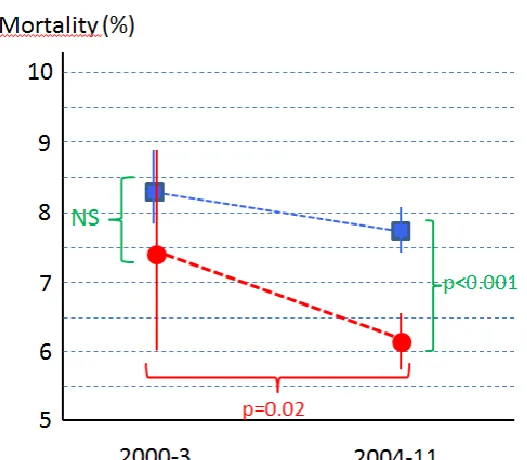
Nonetheless, as illustrated in Figure 1 Comparison of EBP and SP outcomes between time periods 2000-2003 and 2004-2011, the point estimate for mortality, prior to the
reorganization, was about 1.5% less for the EBP doctors than their SP colleagues suggesting that there could have been a difference which the study does not have the power to
[image:10.595.86.350.435.665.2]demonstrate.
10
Change following establishment of EBP unit
There was a statistically and clinically significant drop in the mortality (7.41% to 6.27% P<0.02) and length of stay (9.15 to 6.01 days P=0.002) for patients seen by EBP doctors after the establishment of the EBP unit. A small, not statistically significant, reduction in mortality can be seen in the SP service, consistent with a general trend for improved care.
Importantly, the EBP unit results compared to the SP service were clinically and statistically better for both mortality (6.27% vs 7.75% P<0.001) and LOS (6.01 days vs 8.46 days
P<0.001).
Findings viewed by year
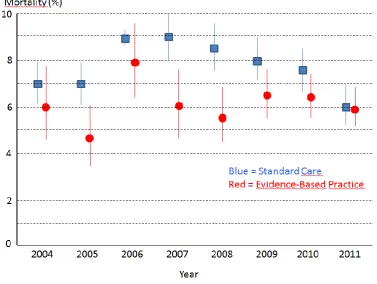
[image:11.595.92.470.387.671.2]The point estimates suggest that the EBP unit had a lower proportion of patients that died in every year but, by individual year, this only reached statistical significance in three years (see Figure 2 % Mortality in EBP and SP groups by year 2004 to 2011). This may not only be a problem of power – there appears to be a convergence of results for mortality and by 2011 there is little clinically significant difference in mortality between the two groups.
Figure 2 % Mortality in EBP and SP groups by year 2004 to 2011
11
Figure 3 Mean Patient Length of Stay by Year
In summary, over the seven year period EBP unit patients had a lower risk of death (6.01% vs 7.75% P<0.001) and a shorter length of stay (6.27 vs 8.46 days P<0.001) than SP patients despite the fact that EBP unit doctors on average attended over twice as many
patients/doctor as their colleagues delivering standard practice.
Discussion
Reconfiguring an internal medicine unit to support EBP was associated with performance indicators suggesting care was more effective (reduced mortality) and efficient (shorter LOS) than the same clinicians previously provided and provided concurrently by their colleagues continuing with standard practice. This is consistent with what we would have predicted but know of no other studies that have looked at the effect of such an organizational change.
The EBP unit doctors began developing their skills in EBP in 2000 to 2003 but no statistically significant difference between their performance and that of their colleagues is
demonstrable during this time. This may be because it takes time to acquire expertise and/or because organizational elements and processes are important facilitators of EBP. It is not possible to conclude definitively which elements of this complex intervention were responsible for the improvements, but the fact that nursing staff were also trained in EBP and the Unit worked as an integrated multi-disciplinary team may well be important. However, as routine data are only available by doctor and year, it was not possible to explore this further in this study.
12
doctors acquiring the attitudes and skills of EBP. We know that some of the doctors from the SP teams attended the additional EBP training that had been requested the EBP unit and residents in SP teams had rotations with the EBP Unit. It is interesting that while mortality outcomes start to converge the LOS difference between the two groups does not. One explanation might be that, while the evidence-based treatments are increasingly
implemented by SP doctors over time, leading to lower mortality, the organization of the SP service and care pathways remain unchanged leading to unchanged process measures.
A limitation of this study is that this is an unplanned, retrospective study and therefore the possibility of selection bias cannot be conclusively excluded. However the data suggest that the doctors that ran the EBP unit did not have the strikingly better outcomes than their colleagues beforehand and the patients seen were similar. The conspicuous improvements exceed the concurrent changes and trends seen in the rest of the service. An additional limitation is that the groups compared were in the same hospital and cross-contamination occurred, however this would act to reduce, not cause, the differences observed and therefore does not account for the observed differences. A strength of the study is that is used contemporaneously collected routine statistics.
The economic cost of the training is hard to calculate - it was provided by existing staff within existing contracts. If the difference in patient outcomes is substantial –there were 836 deaths in the patients attended by EBP unit physicians but, had their patients
experienced the same mortality rates as SP physician patients 1055 deaths would have been expected. If the 219 lives were “saved” due to the differences in practice, whatever the true cost of training, the cost-effectiveness of this training and reorganization is clearly below the Spanish Health Service’s observed Willingness-to-Pay threshold (estimated at 30,000
€/QALY, in 2004,13). When the additional benefit of reduced length of stay and higher numbers of patients attended are taken into account training and reorganization to
promote EBP is clearly cost-saving. Had the rest of internal medicine had the same mortality rates as the EBP unit a further 460 lives might have been saved during this period.
One unplanned result of the establishment of the EBP unit was the stimulation of teaching and research. Previously hospital teaching activities had been mainly limited to medical residents in accordance with standard educational programmes in Spain. However, during the period 2003-12 new educational activities were requested by the EBP unit and run by the Clinical Epidemiology Unit. Activities include:
An annual 10-week EBP course (maximum of 30 participants), using problem-based learning and small groups (5-6 participants and two tutors per group)
Weekly teaching sessions
Five real-time courses in EBP (seven hours/day for one week) run on the EBP unit (two participants/EBP unit doctor)
Three Evidence-Based Nursing courses, similar to that for doctors, but focusing on nursing questions.
13
Four studies on the development and validation of clinical prediction rules: risk of severe events in patients admitted; risk of acute confusional syndrome in aged patients; risk of readmission; and mortality risk after hospital discharge.
Five studies on the effectiveness of interventions: Multi individualized care in
patients with long-term conditions (before and after design), RCT on tele-monitoring in patients with heart failure or COPD; cluster RCT in nursing homes; RCT on self-care in patients with long-term conditions; and an RCT on integrating care among
healthcare levels for chronic conditions.
Participation in CIBER of Epidemiology and Public Health (Spanish Research Network on Epidemiology and Public Health).
Participation in the Basque Research Network on Ageing programme.
The improvements following the introduction of EBP were recognised by the hospital’s managers who responded to the need to increase the number of beds in internal medicine by preferentially expanding the EBP unit. Moreover the increase in teaching and
participation in learning across the hospital contributed to a cultural change in favour of EBP across the hospital and may have contributed to the observed improvements across the service.
Worldwide, most doctors, nurses and other healthcare practitioners have not yet been trained in EBP - an important deficit that urgently needs addressing. While it is difficult to conduct a randomised controlled trial of such a complex intervention, consideration should be given to having a robust evaluation of any educational and organizational intervention. With adequate funding, a step-wedge design or a cluster randomised trial might be possible.
Conclusion
Despite the fact that patient outcomes are improved when the up-to-date research evidence is put into practice, failure to translate research into practice is a refractory
problem. A deliberate commitment to finding and implementing research evidence, coupled with the reorganization of a hospital service to create a multidisciplinary EBP culture, with easily accessible electronic information sources, was associated with important and significant improvements in patient outcomes and more efficient performance indicators than achieved previously by the same physicians or achieved concurrently by other internal medicine physicians who continued with standard practice. It suggests that patient
outcomes could be improved if more clinicians were to be trained in EBP and given easy access to information systems to support this.
14
Conflicts of interest
Dr Emparanza is the Director of the Clinical Epidemiology Unit at theUniversity Hospital Donostia which helped train and support the clinicians involved in the EBP unit. He is also the Coordinator of CASPe in the Basque Region.
Dr Cabello is Director of CASPe
Dr Burls helps people learn the skills for EBP.
Contributions of authors
Dr Emparanza conceived the study
Dr Burls and Dr Emparanza designed the study
Dr Emparanza obtained the hospital data and undertook the initial quantitative analysis Dr Burls wrote the paper
Dr Cabello commented on an early draft and made significant suggestions for improvement All authors edited and approved the final version.
Acknowledgements
We would like to thank Sir Iain Chalmers for encouraging us to publish this data. Any errors that remain are those of the authors alone.
Ethics approval
This study did not require ethics approval.
Transparency declaration
I, Amanda Burls, hereby affirm that the manuscript is an honest, accurate, and transparent account of the study being reported. No important aspects of the study have been omitted and there were no discrepancies from the study as planned.
Funding
15
References
1
Jernberg T et al. (2011) Association Between Adoption of Evidence-Based Treatment and
Survival for Patients With ST-Elevation Myocardial Infarction. JAMA 305(16):1677-84
2
Ham C (ed) (1988) Health Care Variations: Assessing the evidence. London: King’s Fund
Institute. 3
McPherson K, Wennberg JE, Hovind OB, Clifford P (1982). ‘Small-area variations in the use of
common
surgical procedures: an international comparison of New England, England, and Norway’. New
England Journal of Medicine , vol 307, no 21, pp 1310–14
4 Appleby J et al (2011) Variations in healthcare - The good, the bad and the inexplicable.
The Kings Fund
5
Corallo A. et al (2013) A systematic review of medical practice variation in OECD
countries. Health policy (Amsterdam, Netherlands) DOI: 10.1016/j.healthpol.2013.08.002
6
Mickan S, Burls A, Glasziou P. (2011) Patterns of ‘leakage’ in the utilisation of clinical
guidelines: a systematic review. Postgrad Med J 87:670-679
DOI:10.1136/pgmj.2010.116012
7
http://www.medicalobserver.com.au/news/evidencebased-medicine (Access date 27th
August 2015)
8http://www.redcaspe.org/ (Access date 27th August 2015) 9
http://es.cochrane.org/es/inicio (Access date 27th August 2015)
10 Dawes M, Summerskill W, Glasziou P, Cartabellotta A, Martin J, Kervork H, Porszolt F,
Burls A. (2005) Sicily statement on evidence-based practice. BMC Medical Education 2005;
5(1):1-7
11
CASPe http://redcaspe.org/drupal/?q=node/29 (Access date 27th August 2015)
12
Critical Appraisal Skills Programme (CASP)
http://www.casp-uk.net/#!casp-tools-checklists/c18f8 (Access date 27th August 2015)
13