0022-538X/81/080481-09$02.00/0 Vol.39,No.2
Replication of Simian
Virus 40 DNA in Normal Human
Fibroblasts
and in
Fibroblasts
from
Xeroderma
Pigmentosum
HARVEY L. OZER,* MARTINL. SLATER,t JAMES J. DERMODY, AND MORTON MANDEI4
Department of Biological Sciences, Hunter College, City University of New York, New York, New York 10021,* andWorcester Foundation for Experimental Biology, Shrewsbury,Massachusetts01545
Received 10 November 1980/Accepted 29 April 1981
Simian virus40infectionofsemipernissivehumandiploidfibroblasts(HF), at
earlypassagein cell culture,was comparedwith that ofpermissive established monkeycell lines.Viral DNA can bereadily detectedat24 to 48 hpostinfection
at370Cwithahigh multiplicityofinfection, approaching10% ofthat of monkey
cells(TC7). The length of time necessaryforreplicationofan averagemolecule of viral DNA wasfound to be indistinguishable in HF and TC7 cells. Strand
elongation plus terminationwereassessed byfollowingtheaccumulationofDNA
I at40°C from replicative intermediates oftsA30 prelabeled at
330C,
obviating isotope pool problems. Combined initiation and elongation of wild-type viralDNAwasmeasured by densityshiftexperimentsinvolving a5-bromodeoxyuridine chase ofprelabeled [3H]thymidine-labeled viral DNA. Determination of
accu-mulation of viralTandVantigens supports the conclusion that themostlikely basis for the reduced virus yield in HF cellsresults from the inefficiency ofan
earlystage in virus infection, before or during uncoating. Similar results were
obtained in fibroblasts derived from patients with xeroderma pigmentosum, suggesting that enzymes ofUV repair arenot required in unirradiated simian virus40DNAsynthesis.
Papovaviruses, including simian virus 40
(SV40), initiate infection in a wide variety of cells from different species (for a review see
reference 33). Typically, twotypes ofinfection
may occur:permissive ornonpermissive. In the
firstcase,fullvirusreplicationresults in synthe-sis of progeny infectious viral
particles.
In the latter case, there isa partial expression of the viral genome, miniimalor noviral DNA synthe-sis,andnoprogenyvirusproduced.Thiscourse may either be abortive or associated withper-sistence of the viral genome, typically in an
integratedmanner.InthecaseofSV40, permis-sive infection characteristically occursin
mon-key cells andnonpermissiveinfectionoccursin rodentcells.Athirdtype of infection has been terned "semipermissive." In human cells, for example,SV40 infectionresultsinappearanceof virus-encoded early proteins (T
antigens)
and onlylimitedprogenyvirus(2,4,9,21,22).Thereislittleor noinformationontherateandextent
of viralDNAsynthesis. We haveundertakena
detailed study of viral DNA synthesis in early
passage normaldiploidhuman fibroblasts inan
effort to understand better the basis for this
tPresent address: Division of Research Grants, National Institutes ofHealth, Bethesda,MD 20205.
*Present address:DepartmentofBiocheniistry,University ofHawaii School ofMedicine, Honolulu,HI96822.
semipermissivity; most notably, to determine whether such semipermissivity represents a
quantitatively or qualitatively different
virus-cell interaction than the typical permissive
in-fection. Suchastudy takesonadded interestat
the present time for two reasons: first, there
have beenincreasinglymoreinvestigations into the biochemistry of humanpapovaviruses and theirrelationshiptoSV40(27, 33).Second,there
arecurrently available several cell lines of fibro-blasts derived frompatients withhereditary dis-ordersaffecting cellular DNArepairand, possi-bly, DNAreplication (11, 28). The latter
repre-sent apotentialsource ofcellmutants tostudy
theprofound cellular contributiontoviral DNA replication.
We have foundthatSV40efficientlyreplicates
its DNA in human fibroblasts. Moreover, the
rate of viral DNA strand elongation, which is
totallydependentoncellularfunctions,is indis-tinguishable from that of permissive monkey
cells.Finally,weobserved nodifferenceamong
several complementation groups of fibroblasts
derived from patientswith xeroderma
pigmen-tosum(XP),adisorderassociatedwithadefect
inrepairof DNAdamagedbyUVlight,
indicat-ing that such an enzyme(s) defective in this
disorder isnotrequiredforreplicationof
unir-radiatedviralDNA.
481
on November 10, 2019 by guest
http://jvi.asm.org/
MATERIALS AND METHODS
Virus. Wild-type SV40 (strain SV-S) and tsA30 werepropagatedat 37and330C,respectively,at alow multiplicity of infection (MOI) in established green monkey kidney (GMK) cellsaspreviouslydescribed (7,19).Plaque assayswereperformedonTC7or CV-1Pmonolayers.
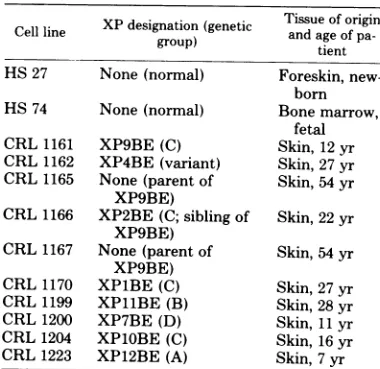
Cell lines. Cell lineswerepropagated in the Dul-becco-Vogt modification of Eagle medium (DME) (Microbiological Associates) with4.5gofglucoseper liter and 10% fetal calf serum (complete medium). GMKcell lineswerepassagedaspreviouslydescribed (13) and were obtained from the following sources: TC7 from J.Robb and J.Kaplan,respectively,CV-1P from D.Jackson, and Vero from the AmericanType Culture Collection(ATCC).Human fibroblast cultures wereobtained at passage3 to 6from cellrepositories andpassagedaminimal number of timesat 1:3 sub-cultures. HS lineswereobtained fromthe Cell Culture Laboratory, University of California School of Public Health.Their propertiesaredescribedby Smithetal. (30) and Zouziasetal. (34). CRL cell lines were ob-tainedfrom theATCC. Theproperties of those from XPpatients are summarized by Robbins etal. (23). Thefamilial relationships ofpatient9 (XP9BE) are reported by Lynch et al. (16). All cell lines were verified to befree of mycoplasma by cultivation pro-cedures, except for CRL 1199and CRL 1200which werepositive asreported by the ATCC. The tissue origins and XP phenotypesaresummarized in Table 1.
Chemicals and solutions. 5-Bromodeoxyuridine (BUdR) and deoxycytidine (CdR)wereobtained from
Sigma Chemical Co. (A grade). Fluorodeoxyuridine
(FUdR), thymidine (TdR), and
cytosine-l-fl-D-arabi-nofuranoside-HCl (araC) were obtained from
Calbi-ochem.Solutionswereprepared in distilled water and filtersterilized.
[image:2.503.57.247.449.634.2]Viral DNAsynthesis. Subconfluentorconfluent TABLE 1. Human fibroblastic celllinesa
Cellline XP designation(genetic Tissueoforigin
group)
~~~tient
HS27 None(normal) Foreskin,
new-born HS74 None (normal) Bonemarrow,
fetal CRL 1161 XP9BE (C) Skin, 12 yr CRL 1162 XP4BE (variant) Skin,27 yr CRL1165 None (parent of Skin,54 yr
XP9BE)
CRL 1166 XP2BE(C;siblingof Skin, 22 yr XP9BE)
CRL1167 None (parent of Skin, 54 yr XP9BE)
CRL 1170 XP1BE(C) Skin,27 yr CRL1199 XPIlBE (B) Skin, 28yr CRL1200 XP7BE (D) Skin, 11 yr
CRL1204 XP1OBE(C) Skin, 16 yr
CRL 1223 XP12BE (A) Skin, 7yr
aOriginsand properties of
cell
lines are describedinthetext.
cultures in 60-mmpetri dishes were infected with 0.5 ml of an unpurified virus preparation as previously described (20). At appropriate times postinfection (p.i.), cultureswereradiolabeled for 1-to4-h periods with [3H]TdR at 10,tCi/ml(specific activity, 50Ci/ mmol, Schwarz/Mann). Viral DNAwasextractedby the Hirtprocedure (12) and quantitated asforms I and II(18to21S) by sedimentationonneutralsucrose gradients (NSG), using purified [14C]DNA I as an internal marker as described previously (29). Incor-porationwasdetermined afterprecipitationwith 5to 10% trichloroacetic acid.
Viral DNA strandelongation. Confluent cultures in T25 flasks were infected with 0.2 ml of virus as described above. After 3to7daysat33°C (depending on the cell line and viruspool),triplicate cultures were radiolabeled with20,uCiof[3H]TdR per ml for 20min (TC7 cells)or30min(human fibroblasts)at33°C and then shifted rapidly to a water bathequilibrated at 40.5°C. Incubations were terminated atthe time of shiftto40.5°Candat10-minintervalsbyplungingthe flask intoice, rapid washing (twice) by cold phosphate-bufferedsaline, and Hirt extraction. Thepooled Hirt supernatantwaslayeredontoNSG, and viral DNA I wasdetermined. In thoseexperimentsinvolving infec-tion of CRL1161and CRL1166bytsA30, the region of the NSG containing DNA Iwasidentifiedonthe basis of the[14C]DNA.Thepeak fractionswerepooled, dialyzed against 0.15 M NaCl-0.01 M EDTA-0.01 M Tris-hydrochloride (pH 7.6), andcentrifugedto equi-librium in CsCl(p =1.56g/cm)containing 100,ugof ethidium bromide perml. Quantitation of[3H]DNA wascorrected for recovery ofadmixed ['4C]DNA I in thiscase.
Kineticsof viral DNA reentry. Theprocedure
usedwas amodification of that employed by Roman and Dulbecco (24, 25) for polyoma virus-infected mousecells. Confluent cells were infected in 60-mm dishes withwild-typeSV40. At 24or40hp.i. [3H]TdR wasaddedat10,uCi/mlfor60min,followed by i05 M TdRforanadditional60min.The medium was then removed, the culturewaswashed once in DME, and BUdR mediumwasadded (5 x 10⁻⁵ M BUdR, 2 x lo-5 M FUdR, 1 x 1i-5 M deoxycytidine [CdR] in complete medium). Viral DNA was extracted after various durations of chase in BUdRby the Hirt pro-cedure. DNA I was isolated from pooled triplicate cultures aftersedimentationonalkaline sucrose gra-dients. After neutralization, HL (DNA substituted withBUdR inonestrand) and LL (no BUdR substi-tution) moleculeswereseparated by equilibrium cen-trifugation in CsCl, p=1.72g/cm. The percentage of 3Hcpm found inHL DNA [HL/(HL+ LL) x 100] wasdetermined.Incorporation of[3H]CdR(1,uCi/ml
in10' M) into DNA Iwaslinearininfected TC7 or HS27 cells over a 6-h period in BUdR medium in control experiments; the rate of incorporation of BUdR into either viral or cellular DNA was approxi-mately60to 70% of that observed for TdR in compa-rable medium.
Virus production in human fibroblasts. Con-fluent60-mmpetri disheswereinfected with 0.2 ml of virus. After adsorption for 2 h, the inoculum was removed, the monolayers were washed five times with DME,5ml ofcomplete medium wasadded, and the
on November 10, 2019 by guest
http://jvi.asm.org/
SV40 REPLICATION IN HUMAN FIBROBLASTS 483 cultureswere harvested by freezing and thawing at
appropriate times.
Serologicalassays.Microcomplement fixationfor SV40-specific antigens were performed as described
previously (20). T antigen(s)wasassayed witha
ham-ster antiserum to a transplantable SV40 tumor. V antigen was assayed with a hyperimmune monkey
antiserum prepared against viralcapsids, which was
nonreactive with T+ V- cells. Infected extractswere
prepared from duplicate or triplicate 100-mm petri
dishesinfectedwith1mlof wild-type virus,undiluted
or after dilution in DME containing 1% fetal calf serum.
RESULTS
Viral DNA synthesis in human
fibro-blasts.Whensubconfluentorconfluentcultures
ofhuman fibroblastsareinfected with SV40 at
multiplicities of infection (MOIs) ofgreaterthan
10 at370C, miniimal cytopathic effects are
ob-served. Virusyield (in PFU) has beenreported
tovaryover awiderangefromminimallyabove
theabsorbed levelto1 to3PFUpercell (4, 22)
incontrast to greaterthan 100PFUpercell(109
to 1010 perculture) commonly observed for
per-missive monkey cell lines (33). A number of
earlypassagehumanfibroblast cell strainswere
tested for viral DNAsynthesisat2days
postin-fection with SV40. The resultsaresummarized
in Table 2. Different cell strains vary in their
susceptibilities, but readily detectible levels of
viral DNAareobserved inthecaseoffibroblasts
from bothpresumablynormal donors and those
frompatients with the hereditary disorder XP.
[image:3.503.260.454.68.219.2]Table 3 showsacomparison between the human
TABLE 2. Synthesis of SV40DNA in human fibroblastsa
Viral DNAC
Celllineb % oftotal
cpm perculture counts
HS 27 40,560 9.4
HS 74 .3,150d c1.4
CRL1161 10,900 4.3
CRL 1162 7,920 2.0
CRL 1199 31,700 6.8
CRL 1200 39,600 7.7
CRL 1223 56,700 7.7
aConfluentmonolayersin60-mmpetridisheswere
infected withwild-type SV40at anMOI of 20to40 PFUpercell andlabeled for 2 h with[3H]TdRat 48 hp.i.asdescribed in thetext.
bCelllinesarelisted in Table1.
cViral DNAwas quantitated byNSG analysis of the supernatant fraction by the Hirt procedure as
described inthe text. Extracts from uninfected cells processed by the same method averaged approxi-mately 2,400cpmand 1.5% ofthetotalcounts.
[image:3.503.57.249.435.551.2]dNodistinctpeakwasobservedonNSG.
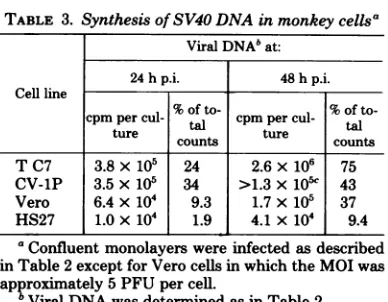
TABLE 3. Synthesis ofSV40DNA inmonkeycellsa
ViralDNA'at: 24 hp.i. 48 hp.i. Cellline
cpmpercul- % ofto- cpm percul %of
to-ture %
ftal
ture %ftal
counts counts
T C7 3.8X 10⁵ 24 2.6X 10⁶ 75 CV-1P 3.5x10⁵ 34 >1.3 x 10⁵c 43 Vero 6.4X10⁴ 9.3 1.7X10⁵ 37
HS27 1.0x10⁴ 1.9 4.1 X10⁴ 9.4
a Confluent monolayers were infected as described inTable 2 except for Vero cells in which the MOI was approximately 5 PFU per cell.
'ViralDNAwasdetermined as in Table 2.
c
Underestimate
of viral DNA due to evident viralcytopathicity.
fibroblasts HS27 and three permissive monkey
cell lines. Dueto the multiplevariables among
thedifferent cultures, these resultscan only be
considered approximations. Nonetheless, it is
clear thatconsiderable viralDNAsynthesiscan
occurin humanfibroblastsat alevel
approach-ing 10% of that of permissive cells. A more
detailed comparison between HS27 and TC7 cellswasundertakenin anefforttounderstand
thebasis for thisapparentreducedrateofviral
DNAsynthesisinhuman fibroblasts.
DNA strand elongation was determined p.i.
withwild-type SV40or atemperature-sensitive
mutant(tsA30) ofSV40 defectiveininitiationof
viral DNAsynthesisattherestrictive
tempera-ture. Cultureswere infected at
330C
andincu-bated until viral DNA synthesis was readily measurable. Tritiated TdRwasadded for20 to 30 min to permit labeling of the intracellular nucleotide andreplicatingviral DNApools.
Cul-tureswerethen shiftedto
400C,
andradioactiv-ity in progeny viral DNA I was determined immediately andat10-min intervals. Wewould
expect accumulation ofradioactivityin DNA I
to be a direct reflection of strand elongation since ithadpreviouslybeenreportedthat initi-ation ofnewrounds of viral DNA synthesis in
monkey cellsisinhibited within 10minforthis
mutant. Figure 1A shows the results for TC7,
andFig. 1Bshowstheresults for HS27.Incells infected withtsA30, radioactivity in DNA I
in-creases in monkey cells for
approximately
20min as expected, which is consistent with the
inactivation of A function (-10 min) and the
timenecessarytocompleteanalready
initiation-replicative intermediate (-15 min) (15, 30). A
similar result was obtained for HS27 cells
in-fectedwith tsA30. The markeddecrease in
ac-cumulation of DNA I after 20 min at
400C
cannotbeattributedtotoxicityassociatedwith
VOL.39,1981
on November 10, 2019 by guest
http://jvi.asm.org/
thevirus infectionorradiolabeling procedureor
both since the parallel cultures infected with wild-type SV40 showprogressiveaccumulation of DNA I foratleast 60minafterashiftto400C. Direct comparison of the level of viral DNA synthesis between thetwocelllines isnot
pos-sibleinview of the different conditions of infec-tion,etc. (seefigure legends).
Wenextinvestigatedthe
efficiency
of reentry of viralDNAinthetwocelllinesbythe method of Roman and Dulbecco(25).Cellswereinfected withwild-type SV40, and the replicatingDNA poolwaslabeled with[3H]TdR.Subsequentrep-lication was determined by incorporation of BUdR. Theproportion ofDNA Iofintermediate density was determined at 24 and 40 h p.i. in
monkey cells and40 hp.i.inhuman cellssince
there was insufficient DNA replication at the
earlier time p.i. to obtain accurate
determina-tions. Aspreviously observed forpolyoma
virus-infectedmousecellsandSV40-infected monkey cells,usingasomewhat different labeling regi-men, reentryof viral DNAmolecules in permis-sivemonkeycellsisincomplete, withaplateau
value of less than 100% (10, 24, 25). Although
theplateau valuecanvaryconsiderably with the time p.i., the period during which reentry is
observed isreasonably constant,being
approxi-mately4h afteraddition ofBUdR(Fig. 2). The results with theinfected human fibroblastsare
similar (e.g., within experimental error consid-ering the number of manipulations involved),
25
I0
x
0
20
15
10
5
6
5
4
0
X 3
aL 0
2
a..
0
Xl a
IL
0 20 40 60 0 20 40 60
MINUTES AT40.5 C
FIG. 1. ViralDNA strandelongation. Confluent cultures wereinfected bytsA30 (0) orwild-typeSV40
(0) at 33°C, pulse-labeled with[3H]TdR, and shifted to40.50C in the continuouspresence of isotopefor quantitationof accumulationof viral DNA IonNSGasdescribedin thetext.(A) Monkey cells(TC7)infected for3days; (B) human cells(HS27) infected for4days.The MOIwascomparableforbothcelllines (20to40
forwildtypeand 10to20fortsA30).
+iV.
sj 0. x
3 4 5 6 7 2 3 4 5 6 7 2 3 4 5 6 7
[image:4.503.135.380.250.422.2]HOURS IN BUDR
FIG. 2. Kineticsofreentry ofviralDNA synthesis. Confluent cultures infectedwith wild-type SV40were
pulse-labeled with[3H]TdR, followedbyachase in BUdRmediumasdescribed in thetext. Theproportion
ofviral[3H]DNA Iconvertedtointermediate HLdensitywascalculated after purificationby Hirt
fraction-ation andalkalinesucrosegradientandcesium chloride-ethidium bromide equilibrium sedimentations. (A) Monkey cells (TC7)at24h p.i.; (B)monkey cells(TC7)at40h p.i.; (C) humancells(HS27) at40h p.i.
A
on November 10, 2019 by guest
http://jvi.asm.org/
[image:4.503.135.377.487.603.2]SV40 REPLICATION IN HUMAN FIBROBLASTS 485
particularlywhen compared with those of
mon-key cells infected for the same length of time
(compare Fig. 2B and C). This procedure
mea-suresall stagesofviral DNA replication.
Inas-muchaswehaveshown inthepreceding section
that thosesteps afterinitiation donotdiffer in
thetwoinfected celllines,we canconclude that
nomajordifference exists in reinitiation of viral
DNAsynthesisaswell.
Accumulation of viral antigens in
in-fectedcells. Theseresultsonthesimilarity in
theratesof viral DNA synthesisbetween
semi-permissivehuman cellsand permissivemonkey
cellssuggestthat thereduced level of viral DNA
inthe former isareflection ofadefect inastep
earlier in infection. Consistent with thismodel,
other investigators have reported that not all
human cells accumulate detectable Tantigen by
fluorescent antibody p.i. by amoderately high
MOI (i.e., sufficient to induce T antigen in
greaterthan 90% ofmonkey cells) (2, 3, 21). We similarly observed that accumulation of T
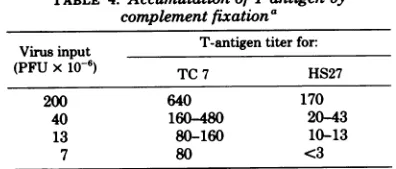
anti-genby complement fixation at 24 h p.i. is
re-ducedin HS27cellsascomparedwith TC7cells
when thesameinoculum is usedtoinfectparallel
cultures (Table 4). Cultures were harvested at
24 h p.i., and an inhibitor of DNA synthesis
(araC,1 x
10'"
M)wasincluded in the mediumtominimize differences secondarytothe
differ-entlevelsof DNAsynthesisin the twocell lines.
(No differencewasobserved inpreliminary
ex-periments withand withoutaraC.)However,as
the virusinputisincreasedfrom 10 to 20 to 50
to100 PFUpercell, there isonlyaslight
incre-ment in Tantigen in monkey cells, whereas T
antigencontinuestoincreaseproportionatelyin
HS27 cells. At lowMOI,there is alsoamarked
differencein Tantigenaccumulation. Theeffect
of this differencebetween the twopopulationsis
[image:5.503.261.452.399.478.2]further indicated by the results in Table 5 in
TABLE 4. AccumulationofTantigen by complement fixationa
Virusinput T-antigentiter for:
(PFUx10-6) TC7 HS27
200 640 170
40 160-480 20-43
13 80-160 10-13
7 80 <3
aConfluent 100-mm petri disheswere infected as
describedformicrocomplementfixation in thetext. A
singlestock ofwild-typeviruswasdiluted in medium with 1%serumforparallelinfections. Two dishes of infected TC7 cellswereextractedin 0.5ml,and three dishes ofinfected HS27cells wereextracted in 0.25 ml for antigen titration. Data are presented as antigen
perinfected petridish. Thereweresimilarcell
num-bersin cultures of bothcelllines.
which accumulationofvirus particles as V
anti-gen was determinedby complement fixation at
a high MOI. There is a fivefold-lower level in
HS27 cellssimilartothe reduction in the level
ofviral DNA. Fluorescent-antibody studiesfor
viral capsidproteinsconfirmthata minority of
human cells are infected at alltime points in
contrastto>90% of themonkeycells (datanot
shown). There is also a comparable reduced
yield of virusatdifferenttimesp.i. (Table 6).A
humanfibroblast(HS74)cell linewhich showed
minimal viral DNAsynthesis in Table 2 has a
stillfurther reduced virus yield.
Viral DNA synthesis in human fibro-blastsfrom XP. The studies described above indicated that thesemipermissive nature of
in-fection ofearlypassagehumanfibroblastswith
SV40 is consistent withareadily detectable level of viral DNAsynthesis in those cells whichare
efficiently infected. Therefore,wesoughtto de-terminewhether viral DNA replication occurred efficiently in cells derived from patients with hereditary defects in DNAsynthesis orrepair.
We chose to examine fibroblasts frompatients withXP,adiseasecharacterizedby skintumors
and defects inrepair ofdamagetoDNAby UV light. Multiple complementation groups have beenreported,someof whichmightlogicallybe expectedtobe defectiveinfunctions associated with synthesis of unirradiated DNA (one or TABLE 5. AccumulationofT and Vantigensby
complement fixationa
TC7 HS 27
Timep.i.
(h) Tanti- Vantigen Tanti- V
anti-gen gen gen
24 320 640 128 128
48 640 6400 256 1280
72 320 12,800 256 640
aMicrocomplementfixation ofinfected
cell
extractswasperformedasdescribedinTable4.2x 108PFUof SV40wereused forinfection inallcases.
TABLE 6. Virusyieldin humanfibroblastsa Timep.i. PFU per ml in:
(h) CV-1P HS27 HS74
2 <1.0 x 108" <1.0 x10⁵b 3.0x10⁵
24 1.0X10⁶ 1.0X10⁵ 1.0X10⁵ 48 6.4x10⁷ 3.6x10⁶ 1.0x 10⁵ 72 1.1xi08 6.2x 10⁶ 3.8x10⁶
120 NTc 1.2x 10⁷ 3.4x10⁶
168 NT 1.5x 10⁷ 3.8x10⁶
a
Infected
cultureswereharvested forvirusasde-scribed in thetextandassayedforplaqueformation onCV-1Pmonolayers.
bNoplaque observedatlowest dilution tested.
cNT,Not tested.
39,1981
on November 10, 2019 by guest
http://jvi.asm.org/
[image:5.503.54.252.487.572.2]morepolymerases, ligase, etc.) aswellasthose
stepsuniquetoUV-damaged DNA,suchas
py-rimidine dimer excision. As shown in Table 2, representatives of three of fivecomplementation
groups synthesize viral DNA comparable to
HS27(CRL 1223, CRL 1199, CRL 1200)at48h p.i. and earlier times (data not shown). CRL
1162hadareducedlevel; however, incorporation intoviralDNA wasconsistent with several other
celllinesinthesameexperimentandappears to
reflectexperimental conditions rather than an
intrinsic defect inthe cellline (see Table7for comparison). CRL 1161,onthe otherhand,
con-sistently showed areduced incorporation rela-tivetoothercell lines tested in thesame
exper-iment under different conditions of infection (e.g., earlier timesp.i.and when confluent
cul-tures were infected and maintained in medium
putatively depletedforgrowthfactors).Further analysis of CRL1161andgeneticallyrelated cell lines indicated that the defect was mostlikely intrinsictothecellline andgeneticinnaturebut probably unrelated to the XP phenotype or a
defect in DNA strand elongation. In Table 7,
viral DNAsynthesisin CRL 1161 is compared with that ofanumber of additional phenotypi-callyorgenotypically related cell lines. Whereas
CRL 1161 and CRL 1166, derived from an
af-fected(XP)sibling,showdiminishedviralDNA synthesis,twootherrepresentatives of thesame
complementationgroup (CRL 1170, CRL 1204)
have considerably higher levels. Both parents
(CRL 1165 and CRL 1167) also show higher levels. DNA strandelongation wasdetermined
TABLE 7. SynthesisofSV40 DNA in human fibroblasts relatedtoCRL1161a
cpm ofDNA perculturec Celllineb
Infected Infected-um-fecteddun
CRL1161 6,420 2,910
CRL 1165 8,720 6,500
CRL 1166 3,055 1,720
CRL 1167 6,945 4,145
CRL1170 12,270 11,050
CRL 1204 11,235 9,865
aConfluent monolayers were infected or the
me-dium waschanged without infection (uninfected) as describedinTable2.
b
Cell
linesandtheir genetic relatednessare as listedinTable 1.
'Viral DNA in the Hirt
supernatant
was quanti-tated asdescribed in Table2.dViral
DNA
was corrected by subtraction ofcom-parableNSG fractionsobtained fromparallelextracts from uninfected cells. Trichloroacetic acid-precipi-tatedcountsperminute in the totalcellextract aver-aged2.9 x 105 for infectedcultures and 2.5 x 10⁵for uninfected cultures.
in CRL 1161 and CRL 1166 p.i. withtsA30 at
330C
and shiftto400C
(Fig. 3). Theresultsaresimilarto those in Fig. 1 formonkeycells and
HS27. Itshould be noted that because of thelow
level ofviral DNAbeing measured,it was
nec-essarytopurifyfurther theappropriatefractions
containing DNA I to free it of contaminating
cellular DNA. Therefore, the data have been
corrected for recovery of added
["4C]DNA
I.Variabilitywasalsoobservedamongtheseveral
experiments performed. It was not possible to
determine rates ofreentryofviralDNA due to
insufficient incorporation. The results suggest
that CRL 1161 and CRL 1166 arelikely to be examples of a reduced efficiency of infection
relatedtoviruspenetrationoruncoatingorboth
aspreviously described (1). Consistent withthis
interpretation,we haveobserved reduced
accu-mulation of Tantigen bycomplementfixation. DISCUSSION
SV40 infection of human fibroblasts has been foundtoresult inreadily detectable replication
ofviral DNA andproduction of infectious prog-eny.We determined therateofviralDNAstrand elongation directly and initiation indirectly through kinetics ofreentryinanormal fibroblast and found no significant difference from simi-larly infected permissivemonkeycells. Compa-rablestrandelongationrateswerealso observed in two cell strains derived from patients with XP. Similarresultswereobtained under condi-tions of varied effectiveMOIs (compareFig.1B, and3AandC). Thesemeasurementsshould best be considered approximations. Our analysis of strandelongationassumesthat the periodbeing measured ispredominantlyareflection of events throughout strandelongation ratherthanthose
at a single step. The distribution of viral repli-cativeintermediates has beenreported as
non-0 20 40 0 20 40 0
MINUTES AT 40.5*C
15
7
10;
[image:6.503.59.249.438.534.2]5
FIG. 3. Viral DNAstrand elongationinXP
fibro-blasts.Cultureswereinfected with tsA30at33°Cand analyzedasinFig. 1. Viral DNA Iwasquantitated
after Hirt extraction andNSG and cesium chloride-ethidium bromide equilibrium sedimentations. (A) CRL1161 cellinfected for 4 daysatanMOI of20to 40; (B) CRL 1166 cell infected for 4 daysatanMOI
of20to40;(C) CRL 1161cellinfected for7daysatan
MOIof 1to5.
X. B C
0
;5
on November 10, 2019 by guest
http://jvi.asm.org/
[image:6.503.262.454.483.570.2]SV40
random with accumulate of late replicative
in-termediates inSV40-infected monkeycellsand
it is unclear to what extent that phenomenon
would distort the expected results (26, 31). It
should also bestressed thatallanalyses on DNA
synthesis disproportionately involve those
in-fected fibroblasts which most efficiently
repli-cateviralDNA since the contribution of others
in the incorporation of radioactive precursors
wouldlogically be insignificant by comparison.
Despite these limitations, the conclusion
ap-pearswarranted thatatleastasubpopulation of
cells in earlypassage line of human fibroblast canperform thestepsofSV40DNAreplication
asefficientlyasmonkeycells. This would imply that thecell factors responsible forpermissivity
thatoperate atthelevel of DNA initiation and
elongation are equivalent. Previous studies on
papovavirus DNA replicationinvitro had shown
that nonpermissive cells could provide one or morefactors (e.g., cytosol fractioncomponents)
whichfacilitatedDNAstrandelongation in
nu-clear or subnuclear systems (6, 8). It has not
been possible thus farto measure initiation of viralreplicons inacell-freesystem.
The basis for the semipermissivity of human fibroblasts appears to reside predominantly at an earlierstageof infection. It has been previ-ously reported that SV40 infection of human cellswaslessefficient than that ofmonkeycells,
asdetermined byaccumulation of Tantigenin
the nucleus(2-4, 21). Cell lines have been iden-tified with varied susceptibility for virus-medi-ated transformation and accumulation of T
an-tigenby immunofluorescenceassay (designated
assusceptible, normal,andresistant) (2).
How-ever, in all cases, there was a relatively low
percentageofpositivecells.
Even at ahigh MOI when the number ofT
antigen-positive cells reached maximal values, less than 30% of themosthighly susceptiblecell strain culture is T antigen positive. Others are
considerably reduced and have notyet shown evidence ofplateauvalues(0.2to
4%).
Theslopes
ofcurvesfor thepercentageofTantigen-positive
cellsas afunction ofinputof virusareconsistent with a single-hit event (2). Our data on
accu-mulation of Tantigen(s)at24hp.i. by
comple-ment fixation show a similar phenomenon. Tantigen levels are reducedas compared with6
monkey cellsat anequallylowtomoderateMOI and approachthe latterat ahighMOI, due to
already maximal levels in monkey cells at a
lower MOI. Wewould assume thatthe human
fibroblast HS27inourstudyis inthenormalor, more likely, susceptible category of Aaronson
and Todaro
(2),
whereas CRL 1161 cells areinthe resistantclass. It appears thattwo
phenom-ena are operative: a reduced efficiency of T
antigen expression and amixedcell population,
although the less likelypossibility that the latter
couldrepresent an extreme case of the former
hasnot been ruled out.
Thebasis for reduced T antigen levels appears
to be areflection of inefficient steps before or
during uncoating of virus. Aaronson (1) found that T antigen induction p.i. with viral DNA
(with DEAE-dextran as facilitator) was as
effi-cient in normal and susceptible fibroblasts.
HS74, whichshows reduced viral DNAsynthesis
orinfectiousvirus as compared with HS27, upon virion infection in this study is capable of highly
efficient viral DNA replication and T antigen
synthesis from intracellular SV40 DNA as we
have previously demonstrated in a clone
trans-formed byafragmentof theSV40genome
bear-ing the early region and the origin of DNA
replication (33). It should be noted, however, thatCarp and Sokol (5)saw norelative
improve-ment in the efficiency of T antigen induction with viral DNA in acomparison between pri-maryAfrican GMK cells and the human fibro-blast cell line W1-38; GMKwasapproximately 50-fold better with virionorDNA.
Therefore, it would appear most likely that semipermissive infection of human fibroblasts with virions containing nondefective viral
ge-nomesispredominantlythe summationof
nor-mal infection in a minority of the cells. Even these cells have alower efficiency of infection, such that the effective MOI being employed is moderately ormarkedly reduced as compared with that of GMK cells which were used to
titrate the virus preparation. ViralDNA
repli-cation andsubsequent eventsappear tofollow
in afashion consistent with those ofpermissive cells. Viral capsids (as V antigen assayed by complement fixation) and infectious virions
ac-cumulateat alevelroughly
proportional
tothe levelof viralDNAsynthesisathighinputMOIasshown in thisstudy.Immunofluorescence as-saysforTand Vantigenhavepreviouslyshown concordance between the number of antigen-positivecellsinsome (2) butnotallstudies(4). In ourexperiments andthe study described in reference 2, conditions were used which have
been shown to minimize accumulation of viral
particles with defective genomes
(wild-type
strainSV-SatlowMOI).
As aninitialefforttowardthepossible
exploi-tationofhereditaryhumandisordersto
identify
hostfunctioninvolved inSV40-cellinteraction,weinvestigatedtheefficiencyof viral DNA
syn-thesis in human fibroblasts derived from XP.
Representatives of multiple
complementation
groups involved in excisionrepair and a
on November 10, 2019 by guest
http://jvi.asm.org/
iant"classpresumablydefective in postreplica-tion repair were included (29). The enzymatic bases for these defects inrepairof UV damage havenotbeenunambiguouslydetermined.
Cur-rentmodels ofrepair basedonprocaryotic sys-tems invoke in large part the involvement of multiple enzymatic functions which could be relevant insome cases tosemiconservative viral
DNAreplication aswell. The data thatwe ob-tainedfailtodemonstrateanydeficiencyin viral
DNA synthesis. In the tworelated cell strains which showed reduced viralsynthesisupon
pre-liminary testing (CRL 1161 and CRL 1166),
DNA strand elongation was not abnormal in
contrast tothe prediction if theputative
enzy-matic defect in the XPphenotypewere
respon-sible. Two incidental positivefindingsare that early passage fibroblasts from adult donors (CRL) support viral DNAsynthesis aswell as
doHS27 cells derived fromanewborn and that
accurateDNAstrandelongationmeasurements
can be perforned even under ratherpoor effi-ciency of infectionasinCRL 1161,emphasizing the possible utility of the approaches to other poorlypermissive virus-cellsystems.
It should be noted that this model for the
basis ofsemipermissive infectioninhuman cells need not apply to othersemipermissive SV40-cellinteractions;mostnotably, with rodentcells
asthose ofthe hamster (14, 22).Alternatively, SV40 infection of human cells has been reported in which extensive viral cytopathic effects are
observed (17). That SV40-cell interaction also hastheunusual property ofaveryhigh propor-tion ofdefective viral genomes,evenafter infec-tionatlow MOI (18).
ACKNOWLEDGMENTS
We thankourcolleaguesforprovidingcelllinesandthe ATCCCellRepositoryand theCell CultureLaboratory at the NavalBiochemicalResearch Laboratory, Oakland, Calif., un-dercontractE-73-2001-NO1withintheSpecial Virus-Cancer Program, National Institutes of Health. This investigation was supportedby Public Health Service research grant CA-23002 from the National Cancer Institute to H.L.O.M.L.S. was supportedby a Public Health Service research fellowship from theNational CancerInstitute.
LITERATURE CMD
1. Aaronson,S. A. 1970.Susceptibility of humancellstrains
totransformation by SV40 and SV40 DNA. J.Virol. 6: 470-475.
2.Aaronson, S. A., and G. J. Todaro. 1968. SV40 T antigen induction and transformation in human fibro-blastcellstrains.Virology 36:254-261.
3. Blattner,W.A., A. S.Lubiniecki,J. J.Mulvihill,P. Lalley, and J.F.Fraumeni, Jr. 1978. Genetics of SV40T-antigen expression: studies of twins, heritable syndromes,and cancerfamilies. Int. J. Cancer 22:231-238, 1978.
4. Carp,R.I., and R. V. Gilden. 1966. Acomparison of the replication cycles of SV40 in human diploid and African greenmonkey kidneycells.Virology 28:150-162.
5. Carp,R.I.,and F.Sokol. 1969. Further studiesonthe differences in the interaction ofSV40withAfrican green monkeykidneyandhumandiploidcells. J. Gen. Virol. 5:433-436.
6. DePamphilis, M. L., and P. Berg. 1975. Requirement of
acytoplasmicfraction forsynthesisofSV40DNA in isolated nuclei. J. Biol. Chem.250:4348-4354. 7.Dooley,D., R. Ryzlak, and H. L. Ozer. 1976.
Endonu-cleases andSV40 virions:originsofavirion-associated endonuclease. J. Virol. 17:352-362.
8.Francke, B., and T. Hunter. 1975. In vitro polyoma DNAsynthesis: requirementforcytoplasmic factors. J. Virol. 15:97-107.
9. Girardi,A.J.,F. C.Jensen,and H.Koprowski. 1965. SV40-induced transformation of human diploid cells: crisis andrecovery. J. Cell.Comp.Physiol.65:69-84. 10.Green,M.H.,andT. L.Brooks. 1978.Recently
repli-catedSV40 DNA isapreferential template for tran-scriptionandreplication.J.Virol.26:325-334.
11.Hand, R.,andJ. German. 1975. A retarded rate of DNA chaingrowth in Bloom's syndrome. Proc. Natl. Acad. Sci. U.S.A.72:758-762.
12.Hirt,B.1967.Selective extraction of polyoma DNA from infectedmousecellcultures. J. Mol. Biol.26:365-369.
13. Kidwell, W., R. Saral, R. G. Martin, and H. L. Ozer. 1972. Characterization ofanendonuclease associated withSV40 virions. J. Virol. 10:410-416.
14. Lavialle, C., H. G. Suarez, A. G.Morris,S.Estrade, J.Stevenet,andR.Cassingena. 1976.SV40-chinese hamsterkidney cell interaction. II. The semipermissiv-ity of the cell system. Arch. Virol. 50:137-146. 15. Levine, A. J., H. S.Kang, and F. E.Billheimer.1970.
DNAreplication inSV40 infected cells. I. Analysis of replicatingSV40 DNA. J. Mol. Biol. 50:549-568. 16.Lynch, H. T., D. E. Anderson, J. L. Smith, J. B.
Howell,and A. J.Krush. 1967.Xeroderma pigmen-tosum,malignantmelonoma,andcongenitalichthyosis. Arch.Dermatol. 96:625-635.
17. O'Neill, F. J. 1976.Propagation of SV40 inahuman cell line.Virology 72:287-289.
18.O'Neill, F. J., and D. Carroll. 1978. Appearance of defective SV40following infection of cultured human glioblastoma cells.Virology87:109-119.
19.Ozer, H. L. 1972. Synthesis andassembly of SV40. I. Differential synthesis of intact and emptyshells. J. Virol. 9:41-51.
20. Ozer, H.L., and K. K. Takemoto. 1969. Site of host restriction of Simian virus 40 mutants in an established African greenmonkeykidneycellline. J. Virol. 4:408-415.
21. Potter, C.E., A. M.Potter,and J. S. Oxford. 1970. Comparison oftransformationand T antigeninduction inhuman cell lines. J. Virol. 5:293-298.
22. Rakusanova, T.,W.P.Smales, J. C. Kaplan, and P. H. Black. 1979. Effects ofmitomycin C and 'Co y-irradiation on the replication of SV40 in cell lines of varyingpermissivity for SV40replication.J.Gen. Virol. 43:235-239.
23. Robbins, J. H., K. H.Kraemer,M. A.Lutzner,B. W. Festoff,and H.G.Coon. 1974. Xeroderma
pigmento-sum: aninherited disease with sun sensitivity, multiple cutaneousneoplasms, andabnormal DNA repair. Ann. Intern. Med. 80:221-248.
24. Roman, A. 1979. Kinetics of reentry of polyomaformI DNA into replication asafunction oftime postinfection. Virology 96:660-663.
25. Roman, A., and R. Dulbecco. 1975. Fate of polyoma formIDNAduringreplication. J. Virol. 16:70-74. 26. Seidman,M.M., and N. Salzman. 1979. Late replicative
intermediates are accumulated during SV40 DNA rep-licationinvivo and invitro. J.Virol. 30:600-609.
27. Seif,I., G.Khoury,andR.Dhar.1979.Thegenomeof
humanpapovavirus BKV.Cell 18:963-977.
on November 10, 2019 by guest
http://jvi.asm.org/
VOL. 39, 1981 SV40 REPLICATION IN HUMAN FIBROBLASTS 489 28. Setlow,R. B. 1978.Repairdeficient human disorders and uousDNAreplication:accumulation ofSV40 DNA at cancer.Nature (London) 271:713-717. specific stages in itsreplication.J. Mol.Biol. 120:401-29. Slater, M. L, and H. L. Ozer. 1976. Temperature-sen- 422.
sitive mutantsofBalb/3T3 cells. II. Description of a 32. Tegtmeyer, P. 1972. SV40 DNA synthesis: the viral mutantaffected incellular and polyoma DNA synthesis. replicon. J. Virol. 10:591-598.
Cell 7:289-295. 33. Tooze, J. (ed.). 1980. The molecularbiology of tumor 30.Smith,H.S.,R. B.Owens,A. J.Huller,W. A. Nelson- viruses,2nd.ed.,part 2. ColdSpring Harbor Laboratory,
Rees,and J. 0. Johnston. 1976. The biology of human ColdSpring Harbor, N.Y.
cellsin tissueculture I. characterization of cells derived 34. Zouzias, D., K. K. Jha, C. Mulder, C. Basilico, and H. fromosteogenic sarcomas. Int. J. Cancer 17:219-234. L. Ozer. 1980. Transformation of human fibroblasts by 31.Tapper, D.P.,and M.L. DePamphilis. 1978. Discontin- SV40 DNA. Virology 104:439-453.
on November 10, 2019 by guest
http://jvi.asm.org/
![FIG. 1.forforquantitation(0) Viral DNA strand elongation. Confluent cultures were infected by tsA30 (0) or wild-type SV40 at 33°C, pulse-labeled with [3H]TdR, and shifted to 40.50C in the continuous presence of isotope for ofaccumulation of viral DNA I on](https://thumb-us.123doks.com/thumbv2/123dok_us/1475588.100185/4.503.135.377.487.603/forforquantitation-elongation-confluent-cultures-infected-continuous-presence-ofaccumulation.webp)