Title: Working with communities to develop resilience in end of life and bereavement care: hospices, schools and health promoting palliative care
Author: Sally Paul. The University of Strathclyde, School of Social Work and Social Policy, Lord Hope Building, 141 St James Road, Glasgow, G4 0LT. Email: [email protected] Abstract (130 words):
This paper discusses research undertaken to explore and develop practice between a hospice and two primary schools. Action research was used to increase understanding about current practice in, and with, schools and to explore, implement and evaluate models of practice. Seven practice innovations were identified that are in various stages of being piloted. These innovations can be understood as health promoting palliative care activities, as defined by Kellehear (2005), due to the process in which they were designed and their focus on
developing the capacity of communities to respond to death, dying and bereavement. They demonstrate the diverse role that hospices, can play in developing how communities experience death, dying and bereavement and propose that a broader lens is employed to understand and facilitate end of life and bereavement services.
Key words (up to 6): end-of-life and bereavement care, school communities, hospices, public health approaches to palliative care, health promoting palliative care, action research Main paper (4703 words):
Introduction
These are challenging times for palliative care services. Current service provision will not meet the needs of an aging population and this demands consideration about how care and support can best be delivered. Adopting public health approaches to end-of-life care,
2 focusing on health promoting palliative care and its relevance for both hospice and school communities. I go on to discuss action research as a tool for developing practice, describing the practice innovations that arose as a result of this research. I finish by discussing the practice innovations in relation to health promoting palliative care and the potential role that hospices can play in developing the resilience of school communities to support death, dying and bereavement experiences. Because my research was located in Scotland I have drawn primarily on Scottish legislation and policy, however, my discussion on the role of hospices and health promoting palliative care is inevitably broader than Scotland.
Background
In 2007 I began working as a social worker in a hospice. The Hospice with whom I was employed provides specialist palliative care to a catchment area of almost a third of a million people across a rural area of Scotland. Palliative care is ‘an approach that improves the quality of life of patients (adults and children) and their families who are facing problems associated with life-threatening illness […] This includes addressing practical needs and providing bereavement counselling. It offers a support system to help patients live as actively as possible until death’ (WHO 2015). Specialist palliative care thus involves working with individuals and families both during and after the illness.
My initial role was a newly created position that involved coordinating the organisation’s plans for setting up a children’s bereavement service, as well as completing other social work tasks within the setting. It was an exciting opportunity, and my senior and I spent a great deal of time liaising with the local community and service providers to design and facilitate the service. Referrals were much greater than anticipated and, six months after I started, we were already holding bereavement groups for children and their parent/carers two (sometimes three) nights per week. Three years into my post, the Hospice management team invited staff to put forward potential research ideas. The children’s service was beginning to build
occasions when children were referred for specialist bereavement support unnecessarily. This was due to reticence of the adults to communicate with the child about bereavement issues, referring them on to us when sometimes they had not even asked the child how they were feeling. Broad and Fletcher (1993) argue that the right time for practitioner research is when an experienced professional is ready for a new challenge that involves reflecting on their work and moving forward to find out more. I recognised the significance of providing a bereavement service. I was keen, however, to engage with the social work task from a proactive standpoint, seeking to prevent negative bereavement experiences by developing capacity within children’s existing communities to manage death, dying and bereavement. I felt this focus would result in a more positive experience for children, whereby their
experiences of death and bereavement were normalised, not pathologised, acknowledged and supported by people with whom existing relationships exist.
My experiences of the children’s bereavement service happened alongside policy movements in the UK, which called for discourse and education around death, dying and bereavement to be promoted (Scottish Government 2008; Department of Health 2008; Department of Health 2010). Since the introduction of these policies, a variety of advances have since been made that focus on creating more openness around death, dying and bereavement. In 2009, in England and Wales, ‘Dying Matters’, a national coalition to promote greater public
awareness and discussion of issues relating to death, dying and bereavement was developed. This included the introduction of a ‘Dying Matters’ awareness week, which has been
identified as providing end-of-life care services with a defined opportunity to open up
4 approaches are recognised in a report by DEMOS, a British cross-party think-tank, which asks for a ‘‘Big Society’ response to a dying population in which civic, mutual and self-help solutions play a much greater role’ (Leadbeater and Garber 2010, p.16). From this
perspective, end-of-life and bereavement care is everyone’s responsibility, thus situating palliative care as a public health issue and identifying associated approaches as an effective way to improve and develop care.
Public health approaches to palliative care: health promoting palliative care
Issues related to death, dying and bereavement have previously been excluded from public health discourse. Public health activities have historically been referred to as life-affirming, avoiding death and dying by focusing on preventing and controlling illness, disease, injury and premature death (Kellehear and Young 2007; Lupton 1995). Combining public health approaches with palliative care is, however, now recognised as offering a powerful way to achieve meaningful end-of-life care for the majority of people (Stjernswärd et al. 2007; Kellehear 1999; Conway 2007). This involves moving focus from traditional public health models, which concentrate on the cure and treatment of disease, to ‘new’ public health models that focus on equity of care ‘and on attempting to break down barriers between professional groups and lay people’ (Cohen and Deliens, p.11). From a ‘new’ public health perspective, pubic health approaches to palliative care thus involve working to promote openness and challenge stigmas related to death, dying and bereavement as well as
empowering communities to draw on their own resources and community supports to adapt and cope. These principles are equally essential to the role and task of social work and I have argued elsewhere the relevance of a public health approach to palliative care for the social work profession (Paul 2013).
Health promotion is a central feature of the ‘new’ public health. It recognises health as a multidimensional concept involving physical, social and emotional aspects and is a concept ‘premised on the understanding that the behaviours in which we engage and the
principles of health promotion to palliative care (Kellehear 1999). The notion of health promoting palliative care thus emerged, broadening out the remit of palliative care providers from the personal, i.e. supporting individual families, to the community. According to Street (2007), palliative care from a health promotion perspective is
‘not only directed at the care of individuals […] but is also concerned with the social and community environment [and] public policies and community services [which] enable communities to cope with the inevitability of death and consciously support loss, grief, dying and bereavement, especially in the most vulnerable community members.’ (p.105)
Health promoting palliative care is thus a holistic approach that recognises and builds on existing strengths and skills within the wider community. Although it is only one public health approach, health promotion is usable in small settings (Kellhear 2005). This affirms that end-of-life care providers are in a position to initiate and/or provide leadership in health promotion activities through developing community partnerships, which aim to establish sustainable activities addressing issues surrounding death, dying and bereavement (Street 2007, Kellehear and O’Connor 2008).
A survey of UK palliative care services found that public health approaches to palliative care was a priority for the majority of services (Paul and Sallnow 2013). A review of 28 projects in England further revealed interest and commitment to the field (Barry and Patel 2013). In Scotland, schools have been identified as an important target for health promoting palliative care to ensure that children develop the skills and capacity to talk about, and cope with, death, dying and bereavement (Scottish Government 2010). Moreover, schools have been identified as key in supporting and responding to children’s bereavement experiences (Hemmings 1995; Rowling 2003). In the afore mentioned survey of UK palliative care services, working with schools was the most common type of work done in the community, identified by 73% of respondents (Paul and Sallnow 2013). This suggests that working with schools is on the agenda of palliative care services and is deemed to be something
6 organisations lack time, funding and training/understanding of health promotion activities (Kellehear 2005; Rosenberg and Yates 2010). This analysis corresponds with my knowledge and awareness of current UK projects, specifically those working with children, which use the hospice as a ‘specialist’ site from which to facilitate activities for the community (Hartley 2009; Turner 2010). Although these projects are undoubtedly worthwhile they still situate palliative care professionals as central to the activity.
Kellehear (2005 p.156) offers a ‘Big Seven Checklist’ as a guide to understanding ‘genuine’ health promoting palliative care activities . The seven questions are:
1. In what way does the project help prevent social difficulties around death, dying, loss or care?
2. In what way do they harm-minimise difficulties we may not be able to prevent around death, dying, loss or care?
3. In what ways can these activities be understood as early interventions along the journey of death, dying, loss or care?
4. In what ways do these activities alter/change a setting or environment for the better in terms of our present or future responses to death, dying, loss or care?
5. In what way are the proposed activities participatory – borne, partnered and nurtured by community member?
6. How sustainable will the activities or programmes be without your future input? 7. How can we evaluate their success of usefulness so that we can justify their presence,
their funding and their ongoing support?
specifically those with schools, using the checklist to critique the extent to which such activities confirm the fundamental principles of true health promoting palliative care. Action research: a research approach to practice development
I have confirmed that engaging with the social work task to advance practice was important to me. It was also important to my organisation, which was keen to see specific practice innovations developed as a result of funding the research. This prompted me to choose an action research methodology which aims to both increase knowledge, experience and understanding of a current situation and engage in a process of change (Winter and Munn-Giddings 2001; Creswell 2007; Coghlan and Brannick 2001). It is operational field research that deals with everyday issues of practice to increase effectiveness (McKernan 1996) and involves a spiral of steps composed of planning, action and evaluation/critical reflection of the action in order to plan subsequent events. It sits within participatory research paradigm that involves connecting people, subjects, objects and their environments (Hockley and Froggatt 2006). It is a developmental process in which participants resolve the issues in question. Theory in action research thus attempts to ‘bridge theory and practice but also generate new ways of understanding practice’(Noffke in Noffke and Somekh 2009, p.10) The research was undertaken in two primary schools in Scotland, starting in August 2011. Schools were invited to take part due to their proximity to the Hospice, size and
denomination; one non-denominational school (NDS) and one Roman Catholic school (RCS) were selected to see if this impacted on developed practice (in Scotland 14% of all schools are denominational, the bulk of which are Roman Catholic). Participants included anyone who might be involved in potential practice innovations, including hospice and school staff, children and parents/carers. Potential adult participants were given verbal and written
8 research at NDS. Informed consent was sought from all participants. Owing to the duration of the action research, consent was kept a live issue so that participants were aware they could withdraw from the research at any time. Ethical review procedures were completed and approved at The University of Edinburgh, the Hospice and Local Authority (LA) in which the schools and research was based.
The action research was conducted over five phases. Figure One describes the detail of these phases. The interviews and focus groups in phase 2 were piloted prior to this and were facilitated using an interview and focus group guide. The interviews and focus groups each lasted approximately forty minutes to fit in with the school timetable. They were digitally recorded and then transcribed. Data from these initial phases was analysed thematically with themes derived from the data.
Figure One: overview of research phases
Phase 1 (preparation and scoping):
A literature review, visits to other hospices and four focus groups with Hospice staff to determine the extent to which they already engaged with primary schools, the focus of this work and areas for development.
Phase 2 (exploration):
A series of interviews and focus groups with children, parent and school staff participants to explore current practice in relation to death, dying and
bereavement and engage in a process of change.
Phase 3 (planning and developing model(s) for practice):
Dissemination of written reports based on the findings generated in phases one and two and meetings with key stakeholders to discuss, identify and develop possible practice developments.
Phase 4 (pilot developed practice):
Pilot of the identified and developed practice innovations across hospice and/or school settings.
Phase 5 (evaluate developed practice):
This paper reports on the research undertaken in Phases 1,2 and 3. The findings from Phases 4 and 5 are on-going and will be reported elsewhere.
Findings from phase three: the identified practice innovations
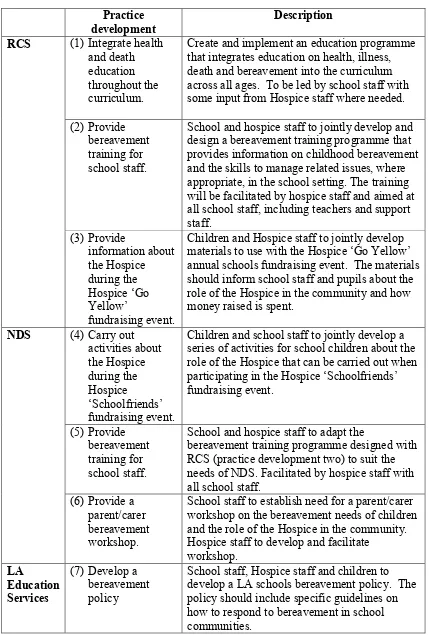
Both research sites identified three practice innovations to take forward. An additional practice idea was also identified by the LA Education Services, as a result of the action research process at one of the schools. The activities are summarised in Table One, which, for ease of discussion, have been numbered from one to seven.
I have discussed elsewhere the main themes deriving from these innovations and what this suggests for the role of Hospices working with schools (forthcoming). Given the scale of this research, and the methodology used, it is hard to draw general conclusions concerning the role of Hospices working with school communities beyond this context. The innovations are site specific and as a result only describe the role of the Hospice working with that particular school.
Regardless there are some interesting characteristics of the innovations worthy of further examination. First, it is apparent that the majority of these practice innovations involve mobilising those already caring for, and interacting with, children to be actively involved in providing support and education around death, dying and bereavement. Second, not all the innovations focus on improving services run by the Hospice. Practice developments (3) and (4) involved improving current services ran by the Hospice, yet, the remaining practice innovations were concerned with transforming practice in school communities to better cope with death, dying and bereavement. Third, the focus of all the activities directly relate to the principles of health promoting palliative care and suggests that Hospices do play a key role in developing related activities.
10 Practice
development
Description RCS (1) Integrate health
and death education throughout the curriculum.
Create and implement an education programme that integrates education on health, illness, death and bereavement into the curriculum across all ages. To be led by school staff with some input from Hospice staff where needed. (2) Provide
bereavement training for school staff.
School and hospice staff to jointly develop and design a bereavement training programme that provides information on childhood bereavement and the skills to manage related issues, where appropriate, in the school setting. The training will be facilitated by hospice staff and aimed at all school staff, including teachers and support staff. (3) Provide information about the Hospice during the Hospice ‘Go Yellow’ fundraising event.
Children and Hospice staff to jointly develop materials to use with the Hospice ‘Go Yellow’ annual schools fundraising event. The materials should inform school staff and pupils about the role of the Hospice in the community and how money raised is spent.
NDS (4) Carry out activities about the Hospice during the Hospice ‘Schoolfriends’ fundraising event.
Children and school staff to jointly develop a series of activities for school children about the role of the Hospice that can be carried out when participating in the Hospice ‘Schoolfriends’ fundraising event.
(5) Provide bereavement training for school staff.
School and hospice staff to adapt the
bereavement training programme designed with RCS (practice development two) to suit the needs of NDS. Facilitated by hospice staff with all school staff.
(6) Provide a parent/carer bereavement workshop.
School staff to establish need for a parent/carer workshop on the bereavement needs of children and the role of the Hospice in the community. Hospice staff to develop and facilitate
workshop. LA
Education Services
(7) Develop a bereavement policy
[image:10.595.65.494.64.699.2]School staff, Hospice staff and children to develop a LA schools bereavement policy. The policy should include specific guidelines on how to respond to bereavement in school communities.
Practice innovations and the ‘Big Seven Checklist’
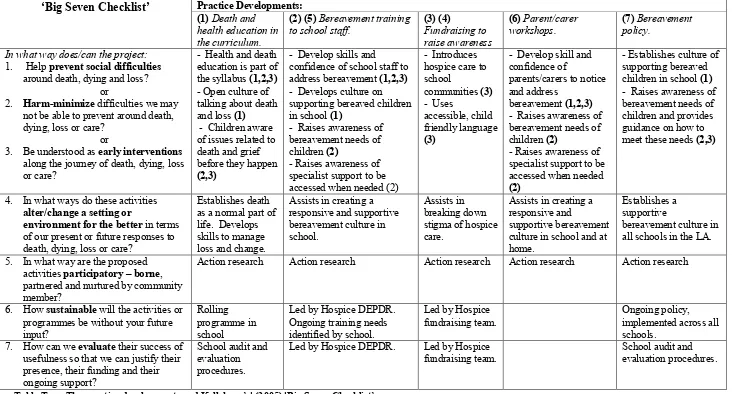
Table Two outlines the ‘Big Seven Checklist’, detailing how I consider each practice
development to meet the specified criteria. With the exception of practice development (6) - provide parent/carer workshops, all of the practice developments are in line with the
12 ‘Big Seven Checklist’ Practice Developments:
(1) Death and health education in the curriculum.
(2) (5) Bereavement training
to school staff. (3) (4) Fundraising to raise awareness
(6) Parent/carer
workshops. (7) Bereavement policy.
In what way does/can the project: 1. Help prevent social difficulties
around death, dying and loss? or
2. Harm-minimize difficulties we may not be able to prevent around death, dying, loss or care?
or
3. Be understood as early interventions along the journey of death, dying, loss or care?
- Health and death education is part of the syllabus (1,2,3) - Open culture of talking about death and loss (1)
- Children aware of issues related to death and grief before they happen (2,3)
- Develop skills and confidence of school staff to address bereavement (1,2,3) - Develops culture on supporting bereaved children in school (1)
- Raises awareness of bereavement needs of children (2)
- Raises awareness of specialist support to be accessed when needed (2)
- Introduces hospice care to school
communities (3) - Uses
accessible, child friendly language (3)
- Develop skill and confidence of
parents/carers to notice andaddress
bereavement (1,2,3) - Raises awareness of bereavement needs of children (2)
- Raises awareness of specialist support to be accessed when needed (2)
- Establishes culture of supporting bereaved children in school (1) - Raises awareness of bereavement needs of children and provides guidance on how to meet these needs (2,3)
4. In what ways do these activities alter/change a setting or
environment for the better in terms of our present or future responses to death, dying, loss or care?
Establishes death as a normal part of life. Develops skills to manage loss and change.
Assists in creating a responsive and supportive bereavement culture in school.
Assists in breaking down stigma of hospice care.
Assists in creating a responsive and
supportive bereavement culture in school and at home.
Establishes a supportive
bereavement culture in all schools in the LA.
5. In what way are the proposed activities participatory – borne, partnered and nurtured by community member?
Action research Action research Action research Action research Action research
6. How sustainable will the activities or programmes be without your future input?
Rolling programme in school
Led by Hospice DEPDR. Ongoing training needs identified by school.
Led by Hospice fundraising team.
Ongoing policy, implemented across all schools.
7. How can we evaluate their success of usefulness so that we can justify their presence, their funding and their ongoing support?
School audit and evaluation procedures.
Led by Hospice DEPDR. Led by Hospice fundraising team.
[image:12.842.58.795.73.467.2]School audit and evaluation procedures.
I have asserted that the majority of the developments meet all of the first three questions on the check-list due to their focus on establishing death and bereavement as a normal human experience, seeking to develop individual and community capacity to cope with such
experiences. Practice developments (3) and (4), use fundraising to raise awareness of hospice care, however, they can only be understood as an early intervention due to their focus on informing as opposed to empowering. Informing and educating are key features of all the innovations. This includes education that raises awareness of end-of-life and bereavement issues as well as developing capacity to support related experiences. For example, practice development (1) (curriculum development), relates to what Rowling (2003) deems as external agencies having a preventative role with school communities. This includes activities
designed to educate and support children so that they are better able to cope with loss and change. Practice development (7) (policy development), includes informing schools
communities on the impact of bereavement on children and their responsibility to ensure that procedures are in place to support such experiences. Education on death, dying and
bereavement experiences has been highlighted as a method of harm reduction as it is associated with a number of benefits that relate to emotional wellbeing. For example,
education on death and dying has been identified as enabling and preparing people to manage individual experiences of, and support those impacted by, death and loss (Kellehear and O'Connor 2008). It has also been asserted as equipping people with the tools and language to address difficult aspects of loss and death (Jackson and Colwell 2001; McGovern and Barry 2000) and providing people with an opportunity to clarify values, meanings and attitudes towards death (Feifel 1977). Providing information and education on end-of-life and bereavement care has been a key feature of the hospice movement since it was first
established (Hockley 1997). These innovations suggest however that education is provided by Hospice staff where needed (such as via fundraising and bereavement training) but is also designed and delivered by school communities.
14 freedom of one individual to benefit the population as a whole’ (p.10). Health promotion is therefore not value free and systemically changing an environment, for example by policy and curriculum development, prioritises one value over another. This demonstrates the significance of question five, that all activities are participatory borne, but also suggests that there is value in the Hospice developing activities that are local and relevant to specific community groups rather than more broadly.
Initially, question five (participatory borne activities) seemed an easy question to fulfil given that the developments were a result of action research which focuses on developing practice which is shaped and owned by communities members. Yet, although research participants identified all of the activities, parents/carers were not involved in choosing practice
development (6) (parent/carer workshop). Instead, this development was identified by school staff whom argued that it would be a beneficial practice development for parents/carers. As no parents/carers were involved in this decision this practice development was therefore not genuinely participatory borne and does not meet the guidelines for health promoting
palliative care. This identifies power within communities that can influence how practice is shaped by determining and responding to need without actually involving the people whom the practice is aimed at. It highlights that in designing and responding to end-of-life care and bereavement issues the Hospice must consider whose views are included and whose are not to ensure that practice is relevant.
It can be argued that all of the activities are sustainable, therefore meeting question six, as it is planned that all of the developments will continue without my on-going involvement. Nevertheless, at the time of writing it is not possible to say if this is the case as the majority of activities are still in the process of being piloted. Moreover, it is planned that the activities will be continued by those best placed to do so, meaning that I will not be in the position of an external facilitator to maintain the momentum of the work. Instead they rely on
motivation, and time available, of the responsible staff. This is potentially in keeping with the multi-disciplinary, focus of health promotion, which places emphasis on cooperative
extent to which such activities can be supported and monitored. Practice developments (1) (curriculum development) and (7) (policy development), will be incorporated into existing school frameworks and because of this is it likely that these two developments will be
sustainable. This, however, is not a feature of all activities. If focus continues to be placed on developing health promoting palliative care activities it is important therefore that systems and procedures are in place for acknowledging, reviewing and sharing these activities. Question seven (evaluate success) was difficult to answer as the practice developments are led by different groups of people and the level to which these groups prioritise evaluation is unknown. It is likely that practice developments (1) (curriculum development), (2) and (5) (bereavement training) and (7) (policy development) will be evaluated because they have pre-existing evaluation procedures. Yet, evaluating their success or usefulness is not necessarily included within these procedures. For example, the Hospice Department of Education, Practice Development and Research (DEPDR) always evaluate participant experience after any training programme, yet it does not always evaluate if and how the training has been put into action. Lupton (1995) criticises health promoting activities for often being short term and below the threshold to make sustainable effects. This suggests that, when developing health promoting palliative care activities, focus should be placed on the purpose and method of evaluation from the beginning so that this can be incorporated effectively, including measuring the impact of such activities.
Conclusion
16 and capacity building were highlighted. This, in turn, identified the significance of designing activities around the needs of school communities, which are led, but not owned by, palliative care professionals. I have argued therefore that the practice innovations can be understood as health promoting palliative care activities due to their focus on developing the resilience of school communities to cope and manage issues relating to death, dying and bereavement experiences. Furthermore, I have suggested that hospices are well placed to engage with and develop health promoting activities. With this focus, school communities are viewed by hospices as an equal partner in providing quality care and education around death, dying and
bereavement for children and integral to providing meaningful support. Engaging with the
social work task from a proactive standpoint was a key focus of this research. The identified activities engage proactively with death, dying and bereavement by concentrating on
developing the education and skills of children, and those around them, to cope with
experiences related to death, dying and bereavement. This highlights the relevance of public health approaches to palliative care for social workers and the important role that social work professionals have in developing practice in this area.
Acknowledgements
The author would like to thank Professor Viviene Cree and Professor Scott Murray for their research supervision and Dr Heather Richardson for her helpful comments on earlier versions of this paper. The author would also like to thank Strathcarron Hospice for funding and supporting the PhD research.
References
Barry, V., and Patel, M. (2013) An overview of compassionate communities in England, London: Murray Hall Community Trust and National Council for Palliative Care Dying Matters.
Bennett, P., and Murphy, S. (1997) Psychology and health promotion, Buckingham: Open University Press.
Broad, B., and Fletcher, C. (1993) Practitioner social work research in action, London: Whiting & Birch.
Coghlan, D., and Brannick, T. (2001) Doing action research in your own organization, London: Sage.
Conway, S. (2007) The changing face of death: implications for public health, Critical Public Health 17 (3):195 - 202.
Creswell, J. W. (2007) Qualitative inquiry and research design: choosing among five approaches. Second edition, Thousand Oaks, CA; London: SAGE.
Department of Health, S. S. a. P. S. (2010) Living matters, dying matters: a palliative and end of life care stategy for adults in Northern Ireland, Belfast: Department of Health, Social Services and Public Safety.
Feifel, H. (1977) Death and dying in modern America, Death Education 6:69 - 174.
goodlifedeathgrief (2012) www.goodlifedeathgrief.org.uk [Last Accessed 17th March 2012]. Hartley, N. (2009) Creating healthier attitudes to death and dying, Hospice Information
Bulletin, Help the Hospices 6 (4):1.
Hemmings, P. (1995) Social work intervention with bereaved children, Journal of Social Work Practice 9 (2):109 -130.
Hockley, J. (1997) The evolution of the hospice approach, in Clark, D., Hockley, J. and Ahmedzai, S. (eds) New themes in palliative care, Buckingham: Open Univeristy Press.
Jackson, M., and Colwell, J. (2001) Talking to children about death, Mortality 6 (3):321 - 325.
Kellehear, A. (1999) Health-promoting palliative care, Melbourne: Oxford University Press. Kellehear, A. (1999) Health-promoting palliative care: developing a social model for
practice, Mortality 4 (1):75 - 82.
Kellehear, A. (2005) Compassionate cities: public health and end-of-life care, London and New York: Routledge.
Kellehear, A., and O'Connor, D. (2008) Health-promoting palliative care: a practice example, Critical Public Health 18 (1):111- 115.
Kellehear, A., and Young, B. (2007) Resilient communities, in Monroe, B. and Oliviere, D. (eds) Resilience in palliative care, Oxford: Oxford University Press.
Leadbeater, C., and Garber, J. (2010) Dying for change, London: DEMOS.
Lupton, D. (1995) The imperative of health: public health and the regulated body, London: Sage.
McGovern, M., and Barry, M. (2000) Death education: knowledge, attitudes and perspectives of Irish parents and teachers, Death Studies 24:325 - 333.
McKernan, J. (1996) Curriculumn action research: a handbook of methods and resources for the reflective practitioner. Second edition, London: Kogan Page Limited.
Noffke, S. E., and Somekh, B. (2009) The SAGE handbook of educational action research, Los Angeles; London: SAGE.
Paul, S. (2013) Public health approaches to palliative care: the role of the hospice social worker working with children experiencing bereavement, British Journal of Social Work 43(2):249 - 263
Paul, S., and Sallnow, L. (2013) Public health approaches to end of life care in the UK: an online survey of palliative care services British Medical Journal: Supportive and Palliative Care 3 (2):196 - 199.
Pomerleau, J., and McKee, M. (2005) Issues in public health, Maidenhead: Open University Press.
Rosenberg, J. P., and Yates, P. M. (2010) Health promotion in palliative care: the case for conceptual congruence, Critical Public Health 20 (2):201-210.
Rowling, L. (2003) Grief in school communities: effective support strategies, Buckingham and Philadelphia: Open University Press.
Rumbold, B. (2011) Health promoting palliative care and dying in old age, in Gott, M. and Ingelton, C. (eds) Living with aging and dying: palliative and end of life care for older people, Oxford: Oxford University Press.
18 Scottish Government. (2010) Short Life Working Group 7: Final Report. Addressing
palliative and end of life care from a public health and health promotion perspective: facilitating wider discussion of death, dying and bereavement across society.
Edinburgh: Scottish Government.
Scottish Government. (2015) Strategic Framework for Action on Palliative Care, Edinburgh: Scottish Government
Stjernswärd, J., Foley, K. M., and Ferris, F. D. (2007) The public health strategy for palliative care, Journal of Pain and Symptom Management 33 (5):486-493.
Street, A. (2007) Leading the way: innovative health-promoting palliative care, Contemporary Nurse 27:104 - 106.
Turner, S. (2010) Conversations about living and dying well, Hospice Information Bulletin, Help the Hospices 8 (1).
WHO. (1986) Ottawa Charter for Health Promotion. Ottawa: World Health Organisation. WHO. (2015) Fact sheet on palliative care, Fact sheet N°402, July 2015.