Copyright© 1976 AmericanSocietyforMicrobiology PrintedinU-SA.
Characterization
of the Oncornavirus Particles in the
Plasma
of Guinea Pigs with L2C
Leukemia
R. MICHALIDES,l J. SCHLOM, J. PEARSON, K. PERK, AND J. DAHLBERG*
MeloyLaboratories, Inc.,Springfield, Virginia 22151,andNational CancerInstitute, Bethesda,
Maryland20014*
Received forpublication 28 November 1975
The inoculation of L2C guinea pig leukemia cells into strain 2 guinea pigs resultsinthe death of the animals within12to 15days.Deathisprecededbythe simultaneous appearance in the plasma of (i) elevated leukocyte levels, (ii) extracellularvirusparticles, and (iii)aparticle-associatedRNA-directed DNA
polymerase.This enzymeactivityhasacationpreferenceidenticaltothat of the
type B bromodeoxyuridine-induced guinea pigvirus, i.e., anMg2+ optimumat 20mMandnoactivityusing Mn2 . Competitive molecularhybridizationstudies also revealed that theplasmaofleukemicguineapigscontainedapproximately2 x 109 genome equivalents permlof anRNA that is homologous to the RNA of
the bromodeoxyuridine-induced guinea pig virus. Morphological observations
indicatethatmost,butnotall, of the extracellularparticles observedin leuke-miaplasmaarederived from the intracisternal particlesseeninthe L2Ctumor cells.Thepossibilities thateithertwoviralpopulationsarepresent orthat thein vivomorphogenesis of the typeBbromodeoxyuridine-inducibleguinea pigvirus ismarkedly differentfromits in vitro morphogenesis arediscussed.
The L2C strain of a transplantable guinea pigleukemia arose spontaneouslyin 1954 (3)in the strain2inbredline of guinea pigs andhas since been serially transferred in this strain. Intracellular and extracellular virus-like parti-cles were later observed in these tumor cells
(21, 23). The intracellularparticlesareformed bybudding through the rough endoplasmic re-ticulum membrane into intracisternal spaces (7). They differ from murine intracisternal A
particlesby being larger, having aclearly
de-fined intermediatelayer (2), and appearing less frequently connected to the cisternal mem-branes (25; Dahlberg and Perk, unpublished
data). Similar intracisternal particles have
been observedinguinea pigfetal germ cells (2),
spleengerminal centers of normal guinea pigs
(14), and in a chemically induced guinea pig hepatoma (6). Extracellular virus particles have been reported in the tissues of leukemic guinea pigs in the absence of any apparent budding from the plasma membrane (7), as well as intheblood plasma of the guinea pigs carry-ing the transplantable leukemia (23). Feldman andGross (7)have hypothesized thataprocess of reverse pinocytosis could account for the release of intracisternal virus from leukemic cellsinlight of the absenceofobserved budding ofvirus from theplasma membrane. Itisalso
IPresent address: Dutch Cancer Institute,
Sarphatis-traat108,Amsterdam,The Netherlands.
possible thatthe extracellular particles in leu-kemicguinea pigs are derived from the intra-cisternal particles after necrobiosis of the leu-kemic cells (Dahlberg and Perk, manuscriptin preparation).
Oncornavirus particles can be induced by halogenated deoxypyrimidines from any nor-mal guinea pigcell (11, 20, 22, 24, 27). These particles sharemost of the morphological fea-tures of the type B mouse mammary tumor virus (MMTV 4). Severalbiochemical parame-ters ofthis induced guinea pig virus (GPV), such as buoyant density in sucrose and CsCl and the cation preference of its RNA-directed DNA polymerase, are identical to those of MMTV (17) and are quite distinct from the comparable properties ofamammalian typeC virus, murineleukemia virus (MuLV).
In this study, the biochemical and morpho-logical features of the extracellular virus parti-clespresent inthe plasmaofguinea pigs carry-ing the transplantable L2C guinea pig leuke-miaarecharacterized and compared with those ofthevirusthatisinducedfrom normal guinea pig cells by treatment with 5-bromo-2'-deoxyu-ridine (BUdR).
MATERIALS AND METHODS
Animals. Strain 2 guinea pigs were obtained
through the Frederick Cancer Research Animal
Farm, Frederick, Md. The animals were kept in
1120
on November 10, 2019 by guest
http://jvi.asm.org/
stainless steel cages and were fed Wayne guinea pig chow and cabbage daily with water ad libitum. Ani-mals of 300 to 500 g were used.
Plasm from leukemic animals. The L2C strain of guinea pig leukemia was passaged by subcuta-neousinoculation of 0.2 ml of a 10% (wt/vol) tumor suspension into strain2 guinea pigs. Under these conditionsasmallnodule forms at the site of inoc-ulation, and a rapidly progressing lymphoblastic leukemia kills the animal within 12 to 15 days. Plasma from leukemic animals with an elevated leukocyte count was obtained by heart puncture. All plasma samples were clarified by centrifugation at 8,000xgfor 10 min and stored at -76 C.
Drug-induced remission. At 11 days after inocula-tionof the L2C strain of guinea pig leukemia,three animals were treated with cyclophosphamide (Cy-toxan), 40 mg/kg, or MeCCNU (1-[2-chlorethyl]-3[trans-4-methylcyclohexyl]-1-nitrosourea), 10 mg/ kg, asdescribed previously (25). Under these condi-tions,cyclophosphamideinduced a remission of 3 to
4 weeks, followed by a reoccurrence of leukemia, whereas MeCCNU cured theanimals of the leuke-mia. Plasma samples (1 to 2 ml per animal) were obtainedbyorbital bleedingatvarious timesafter the administration of thedrugs.
Assays ofRNA-directedDNApolymerase. (i) Re-actions using the synthetic template poly(rA):-oligo(dT) and poly(dA):oligo(dT). Plasma samples
wereconcentrated by centrifugationthrough8mlof 20%sucrose in TNEbuffer (0.01 M
Tris-hydrochlo-ride, pH 8.3, 0.15 M NaCl, and 1 mM EDTA) at 95,000 x g for 1 h at4C inan SW41 rotor (Beck-man).Theresulting pellet was resuspended in 40u.l
of 0.01 MTris-hydrochloride (pH 8.3) and preincu-bated for10min at 0C in1mMdithiothreitol and 1% NP-40 (Shell). Thereafter, the following were addedtotherespectivefinalconcentrations, in 100 ,ul: poly(rA):oligo(dT) orpoly(dA):oligo(dT), 40 ug/ ml;Tris-hydrochloride (pH 8.3), 62.5 mM; KCl, 15
mM; MgCl2, 20mM; TTP, 32 uM; dATP, 200 ,uM;
and400
ACi
of[3H]TTPperml (50.1Ci/mmol,NewEnglandNuclearCorp.). The reaction mixturewas
placedat 37C,andaliquotswerewithdrawnat indi-cated intervals and assayed for trichloroacetic
acid-precipitable radioactivity. The
poly(rA):oligo-(dT)),2-18)
andpoly(dA):oligo(dT) 12-18)templateprim-ersusedwereequimolarmixturesof thepoly-and
oligonucleotide compoundandwerepurchasedfrom P-LBiochemicals, Inc.
(ii) Reactions using the synthetic template poly(rC):oligo(dG). Plasma samples were
concen-trated asdescribed aboveorbysucroseequilibrium centrifugationasindicated.Theplasmaconcentrate
wasresuspendedin 40,ulof0.01 M
Tris-hydrochlo-ride,pH 8.3, andpreincubatedfor 10minat 0Cin 0.1 Mdithiothreitol and2% NP-40. Thereafter, the followingwereaddedtotherespectivefinal
concen-trations, in 100 u.l: poly(rC):oligo(dG), 40 ,ug/ml;
actinomycin D, 50 ug/ml; Tris-hydrochloride (pH
8.3), 62.5 mM; KCl, 15 mM; MgCl2 or MnCl2 at indicated concentrations; and200 ACiof[3H]dGTP
per ml (5.5 mCi/mmol, New England Nuclear Corp.). The reactionmixtureswereplacedat37C,
andaliquotswerewithdrawnatindicatedintervals
and assayed fortrichloroaceticacid-precipitable ra-dioactivity. The
poly(rC):oligo(dG)(12 18)
template primerused was an equimolar mixture of the poly-and oligonucleotide compound and was purchased from P-LBiochemicals, Inc.Viruspurification. Plasma samples were concen-trated as described above. The plasmaconcentrate, inTNE buffer, was layered over either 20 to 60% sucrose(wt/wt) gradients in TNE buffer or over 10 to 30% CsCl (wt/wt) gradients in 0.01 M Tris-hydro-chloride, pH 8.3, and centrifuged in an SW41 (Beck-man)rotor for 3 h(sucrose gradients) or 2 h (CsCl gradients) at 4 C at 100,000 x g. Fractions were collected from below, and the density of certain frac-tions wasdetermined from the refractive index. In-dicated fractions were pooled, diluted with 0.01 M Tris-hydrochloride, pH 8.3, and concentrated by centrifugation at 100,000 x g for 1 h at 4 C in an SW41 rotor.The resulting pellets were suspended in 40 ,l of 0.01 M Tris-hydrochloride, pH 8.3, and assayed for viral DNA polymerase as described above, using the synthetic template
poly(rC):-oligo(dG).
In mixingexperiments, [32P]phosphoricacid- and
[3H]uridine-labeled BUdR-inducedGPVwasmixed witheitherplasmafrom leukemicanimalsortissue culture medium for the indicatedperiodof time and temperatureand thensubjectedtoequilibrium
cen-trifugation as described above. Gradient fractions wereassayed for total radioactivity by countingin
Aquasol (NewEnglandNuclearCorp.). The proce-dures for the preparation of[32p]_ or
[3H]uridine-labeled BUdR-induced GPVaredescribed elsewhere
(17).
Molecular hybridization. DNA was extracted fromspleensofhealthy guinea pigs,NIHstrain,and
processedusingaslightmodificationasdescribedby
Goodman etal. (10). Cellpelletsweredissolved in
five volumes of5% sucrose in TNE, disrupted by
homogenization, andcentrifugedfor10minat4 Cat
3,000 xg. Theresulting pelletwasresuspended in
20volumes of 1% sodium dodecyl sulfateand 1 M sodiumperchlorate inTNE. The mixtureswas
ex-tracted twice withphenol-cresol-chloroform (PCC) and four times with chloroform containing 1% iso-amyl alcohol. One volume of cold ethanolwasadded
totheaqueous phase, and the DNA was thenspooled
outand dissolved in 3 mM EDTA. The DNA was
thenadjustedto 0.4NNaOH andincubatedat 37C for 2 h. Nitrogen was bubbled through the DNA solution, and then the DNAwasfragmented (6-8S asmeasured byalkaline sucrosegradient centrifu-gation)by sonic treatment. The DNA solution was
adjusted to 0.1 M Tris-hydrochloride (pH 8.3) and neutralized using HCl. The DNA was then
reex-tractedwithPCCandprecipitatedwithtwovolumes of cold ethanol. After storage at -20 C, the DNA
was pelleted at 17,000 x g for 30 min at -20 C and then dissolved in 3 mM EDTA and stored at
-70 C until used. RNA from BUdR-induced GPV
and from Rauscher MuLV, released by
MuLV-infected JLSV-9 cells, as well as RNA from the plasma of healthy and leukemic strain2guinea pigs wasisolated. Virusandplasmasampleswere puri-fied by sedimentation and equilibrium
on November 10, 2019 by guest
http://jvi.asm.org/
tion as described above. The fractions from the sucrose gradients corresponding to the density of the viruses (fractions of 1.16 to 1.20 g/ml for the guinea pig plasma samples, 1.14 to 1.18 g/ml for MuLV) were used for RNA extraction by the sodium dodecyl sulfate-Pronase digestion method as previ-ously described (17).
Competitive molecularhybridizations were
per-formed,usingamodification of the method usedby
Wright and Neiman (29). The hybridization mix-tures in 50 or 100 gl contained 200 or 400 ,ug of cellular DNA fragments from guinea pig spleens,
1,000 counts/minof3H-labeled 60-70S RNA from the BUdR-induced GPV, 4x SSC (lx SSC is 0.15 M NaCl plus 0.015 M sodium citrate), 0.1% sodium dodecyl sulfate, 3 ,ug of yeast RNA, and varying
amounts of unlabeled RNA. The samples were
boiled for 3 min and incubated at 70C to a Cot
(corrected for saltconcentration) of 40,000. The
hy-bridization mixturewasthen transferredto 2mlof 2x SSC, and RNase A(Sigma,previouslyheated at 80Cfor 15 min todestroy DNase activity) andT, were added to 50,ug/ml and100U/ml, respectively. The mixtures were incubated at37C for 45 min, after which timetwovolumes of coldtrichloroacetic acidmix (100% acid-saturated
pyrophosphate-satu-ratedorthophosphate, 1:1:1) were added. The
sam-ples werekept in ice foratleast45min, after which time the nucleic acidswerecollected on nitrocellu-lose filters (Gelman, 0.45 ,um). The nitrocellulose filters were extensively washed with 5% cold trichlo-roaceticacid and dried, and theradioactivity of each
samplewascountedto2% accuracywithaBeckman
liquidscintillation counter.
Electron microscopy. Plasma pellets were pre-pared by centrifuging 4.5 ml of plasma samples
through 0.5 ml of 20% sucrose (wt/wt) in0.1M Tris-hydrochloride, pH 8.3, at 30,000 rpm in an SW50L rotor(Beckman). Pellets were fixedfor2h with3%
glutaraldehyde in Millonig buffer (18). The pellets
werethen washed in severalchanges of buffer for2
h, postfixed for 1 h in Dalton chrome osmium (5), washed for1to2h indistilled water, stained en bloc with 2% uranyl acetate in 50% ethanol for 16 h,
dehydrated in ethanol and propylene oxide, and embedded in Epon-Araldite (19). Thin sectionswere
stained with uranyl acetate and lead citrate and examined inaSiemens101electronmicroscope fit-ted with a50-,um objective aperture. For negative staining, virus was absorbed to the grid, and the gridwaspartially blotted, fixed for 30 sin3% glu-taraldehyde, blotted, and stained with 0.5%
phos-photungstic acid, pH 7.0.
RESULTS
Detection of RNA-directed DNA polymer-aseactivity intheplasmaofleukemic guinea pigs. Subcutaneous inoculation ofL2C tumor cells into strain 2 guinea pigs resulted in the formation ofanoduleatthe siteof inoculation and aproliferation of lymphoblasts, with death occurringatday 13 postinoculation. Leukocyte counts showed a sharp increase at approxi-mately day 12 (Fig. 1). The elevated leukocyte
6
oa CS
40q
(o-0 z
5
4
3
2
0
10
x
q
3
3
5
4 8 12
TIME AFTER INOCULATION(days) FIG. 1. Detection of DNA polymerase activity in the blood of leukemic guinea pigs. Three adult guinea pigs were inoculated subcutaneously on day 0 with0.2mlof a 10%(wtlvol)L2C tumor cell suspen-sion.On the indicateddays, 2-mlblood samples were withdrawn by orbital bleeding in the presence of heparin, and the total leukocyte (WBC) count of an
aliquotwasdetermined (A). A 0.5-ml plasma aliquot
ofeach blood sample was concentrated and assayed for the presence of DNA polymerase, using the tem-platepoly(rC):oligo(dG)asdescribed in the text. The counts per minute of[3H]dGMP (specific activity, 3,000counts/min per pmol) incorporated into acid-precipitable counts in a40-minassay are given (0).
Values plotted are average for the three animals.
level atdays 12and 13largelyrepresents lym-phoblasts (tumorcells), whicharepresumably released from metastatically involved tissues (25). A high-speed pellet from 0.5 ml ofeach plasma samplewas assayed for RNA-directed DNApolymerase activity, using the synthetic
templatepoly(rC):oligo(dG)asdescribedabove.
The particles containing the RNA-directed
DNA polymerase activity were concentrated from plasma thatwasfirst clarifiedat8,000 xg for 10 min at4 C. The supernatant was then diluted 10-fold with TNE buffer containing 3 mM EDTA and sedimented through 20% su-crosefor 1 h at 100,000 x g at 4C. The RNA-directed DNA polymerase activity measured increased proportionally with the increase of leukocytecount ineachblood sample(Fig. 1).
Theextracellularvirus-like particles, as ob-served inultrathin sections ofhigh-speed pel-lets, are present in the plasma at maximal levelsjustbefore the animal dies of leukemia and at the same time that peripheral
on November 10, 2019 by guest
http://jvi.asm.org/
[image:3.503.266.457.60.298.2]cyteshave reached their highest level. No ex-tracellular particlesorRNA-directed DNA po-lymerase activity has been observed in su-crose densityfractions of 1.13 to 1.19g/ml or in high-speed pellets from the plasma of healthy guinea pigs (seebelow). There appears, there-fore, to be a correlation between the RNA-di-rected DNA polymerase activity observed in the plasma of leukemic animals and the pres-ence of extracellular virus particles in the plasma.
Treatment of the guinea pigs, inoculated 11 days before with an L2C tumor suspension, with the antitumor drugs cyclophosphamide
and MeCCNU (25; seeabove)resultedina pre-cipitous decline in less than 24hofthe leuko-cytecount tobelow-normallevels. Atthe same time,the RNA-directed DNApolymerase activ-ity dropped to base line levels. Cyclophospha-mide-induced remission was followed by re-lapse, with the animalsdyingin35 to 37 days
due to meningeal leukemia with slight
in-creases in leukocyte number and in
particle-associated RNA-directed DNA polymerase ac-tivityinplasma.Thetreatmentwith MeCCNU resulted in apermanent chemotherapeutically induced remission,asdescribedpreviously(25). RNA-directed DNA polymerase in the plasma of leukemic animals. Attempts to ob-tain anendogenous RNA-directed DNA
polym-eraseactivityortoisolateradioactivelylabeled
60-70S RNA fromequilibrium density gradient
fractions from the plasmaof leukemic guinea
pigswere unsuccessful;oneof several possible
explanations is the presence ofhigh levels of
RNase in this plasma, as tested by the
rapid
degradation of3H-labeled rRNA when mixed
with plasma from leukemic guinea pigs. To
characterize the RNA-directed DNA
polymer-aseinparticlesfromplasmaof leukemicguinea
pigs, its abilityto incorporate [3H]TMP into a
dT polymer, using the synthetic
template
poly(rA):oligo(dT),wascomparedwith that
us-ing the template poly(dA):oligo(dT). Particles
from 20 ml ofplasma from leukemic animals
wereconcentratedbysedimentationand
equi-libriumdensitycentrifugation.Thefractions of the sucrose gradient corresponding to densi-tiesbetween 1.13 and 1.19 g/ml were
concen-trated and used inthe poly(rA):oligo(dT)- and
poly(dA):oligo(dT)-templated DNApolymerase
assays, asdescribed above. As seenin Fig. 2,
the DNA-synthesizing activity
preferred
thetemplate poly(rA):oligo(dT) above poly(dA): oligo(dT); this is one characteristic ofa viral RNA-directed DNApolymerase (12).
Asshown previously (17), the RNA-directed DNApolymerase activity of the BUdR-induced
w0
0
a. polyrA:oligodT
Ir 20 -plyA
0 z a-
I.-10_
o poly dA:oligodT
E
O 10 20 30 45 60
REACTION TIME (MINUTES)
FIG. 2. Characterization of the DNA polymerase activity inthe plasma of leukemic guinea pigs. Parti-cles from 20 ml ofplasma from leukemic guinea pigs
were concentrated afterpooling sucrose equilibrium fractions with densities between 1.13 and1.19 g/ml. The plasma concentrate was then added to DNA polymerase reaction mixtures containing either the synthetic template poly(rA):oligo(dT) (-) or
poly(dA):oligo(dT) (0) asdescribed in the text. Ali-quots(10pi)of a100-plreaction mixture were with-drawn at the indicated times and assayed for trichlo-roacetic acid-precipitable radioactivity. The pico-moles of [3H]TMP (specific activity, 7,000 countsl
min per pmol) incorporated in a trichloroacetic acid-precipitable polymer are given versus reaction time.
GPV preferred Mg2+ over Mn2+ in a
poly(rC):oligo(dG)-templated assay. The
opti-malMgCl2concentration was 20 mM, whereas
no incorporation of [3H]dGMP into an rC:dG
polymer occurred atany of the MnCl2
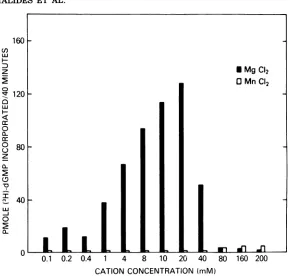
concen-trationstested(from0.1 to 200mM). Theuseof the synthetic template poly(rC):oligo(dG) was shownby others (1, 13)tobe another character-isticofaviral RNA-directed DNA polymerase. The cation preference of the RNA-directed DNA polymerase activity from the plasma of leukemic guinea pigswas determined by con-centrating 50 ml of leukemic plasma by sedi-mentation andequilibrium density
centrifuga-tion. The fractions with densitiesbetween 1.13
and 1.19 g/ml were pooled, concentrated, and
used in poly(rC):oligo(dG)-templated DNA po-lymerase assays, as described above, with the
indicatedMgCl2 orMnCl2 concentrations (Fig.
3). No significant incorporation of [3H]dGTP
into an rC:dGpolymer occurred at any MnCl2 concentrationtested, whereasMgCl2 provedto
be essentialtothereaction mixture. The
on November 10, 2019 by guest
http://jvi.asm.org/
[image:4.503.255.448.64.287.2]1124 MICHALIDES ET AL.
(n
LU
z
0
0
C)
w
H
0cc 0
-z
a-V
Z>
I
a-0
a-160
120 _
80 _
40 _
nv
0.1 0.2 0.4 1 4 8 10 20 40 80 160 200
CATION CONCENTRATION (mM)
FIG. 3. Divalent cation titrationofthe DNApolymerase activityinplasma fromleukemicguinea pigsina
poly(rC):oligo(dG)-templated assay. Particles from200 ml ofbloodplasma ofleukemicguinea pigs were
concentratedandpurified bysucroseequilibrium density centrifugationasdescribedinthetext.Theplasma concentrates were then added to anRNA-directed DNA polymerase assay, using the synthetic template
poly(rC):oligo(dG)(j2.18) with the indicated cation concentrations (see text). Thepicomoles of [3H]dGMP (specific activity, 3,000 counts/min perpmol) incorporated in a trichloroacetic acid-precipitable rC:dG
polymerina40-minreactionaregivenversusthe concentrationofMgCl2orMnCl2inthe reaction mixture.
mal incorporation occurredataMgCl2 concen-tration of 20 mM (Fig. 3). This divalent cation preference is identical to that of the RNA-di-rected DNA polymerase of the BUdR-induced GPV (17). An analogous plasma concentrate
from 30 ml ofplasma from normal guinea pigs didnot showany [3H]dGMPincorporation into anrC:dG polymer ina poly(rC):oligo(dG)-tem-plated assayusing 20 mM MgCl2 (Fig. 4, open
circles). In thesameexperiment,aconcentrate of 15 ml ofplasma from leukemic guinea pigs was added to a reaction mixture containing4
ggofoligo(dT)(l_l8) (Fig. 4, open squares), in-stead of4 ,ug ofpoly(rC):oligo(dG)(l2_18) (Fig. 4, closed circles). The absence of any incorpora-tionof[3H]dGMP, using only oligo(dT) primer, reduced the possibility that, under thereaction
conditionsused, the measured activitywasdue
to an endogenous cellular terminal deoxyribo-nucleotidyl transferase (15).
Density of particles containing the RNA-directed DNA polymerase activity in the leu-kemic guinea pigs. The buoyant density of the particles present in the plasma of leukemic guinea pigs that contain RNA-directed DNA
polymerase was determined by assaying
frac-tions ofanequilibrium density gradientfor the
presence of the enzyme. Samples (100 ml) of
plasma from leukemic guinea pigswere concen-trated andsubjectedtoequilibrium centrifuga-tion insucroseorCsCl,asdescribed above. The fractions with the indicated densities (Fig. 5)
were pooled and concentrated by
centrifuga-tion, and the resulting pelletswereassayed for DNA polymerase activity, using the synthetic template poly(rC):oligo(dG) in the presence of 20 mM MgCl2or0.4 mMMnCl2. The principal RNA-directed DNA polymerase activity was observed in sucrose gradient fractions with a buoyant density of approximately 1.15to1.16g/ ml (Fig. 5A) and in CsCl gradient fractions withabuoyant density of approximately 1.17to
1.18 g/ml (Fig. 5B).
Because of thepresenceof RNase anda con-siderableamountof cellular debris(see below) in the plasma of leukemic guinea pigs, the density of the particles containing the RNA-directed DNA polymerase activity could have been alteredbyvariousproteolyticorother deg-radative enzymes.Totestthis, [32P]phosphoric
*Mg Cl2 O MnCl2
L
I
WI
I
: :M -non November 10, 2019 by guest
http://jvi.asm.org/
[image:5.503.112.403.68.344.2]a
o LQ
0
a-20 1
z
a-I
E
10 20 30 45 60
REACTION TIME (MINUTES)
FIG. 4. Assay for DNA polymerase activities in
the plasma of normaland leukemic guinea pigs. A 15-mlsample ofplasma from leukemic guinea pigs anda30-ml plasma sample from normal guinea pigs wereconcentrated andpurified by equilibrium
cen-trifugation insucrose asdescribed in the text. The
plasma concentrates were then added to a
poly(rC):oligo(dG)-templated reaction mixture. Symbols: *, plasma from leukemic guinea pigs (the
assaycontains20mMMgCl); 0,plasma from
nor-mal guinea pigs (theassaycontains 20 mMMgCl2); El, plasma from leukemic guinea pigs (the assay
contains4 ug ofoligo(dT)(1_18), insteadof4 pgof
poly(rC):oligo(dG), and 20mMMgC12).Atindicated times 10-pl aliquots from100-pl reaction mixtures werewithdrawn and assayed for trichloroacetic
acid-precipitable radioactivity. The picomoles of [3H]dGMP (specific activity, 3,000 counts/minper
pmol) incorporated inatrichloroacetic
acid-precipi-tablepolymeraregiven versusreactiontime.
acid- and [3H]uridine-labeled BUdR-induced GPV (17)was addedto plasma from leukemic guinea pigs and incubated at37 Cfor 1 and 24 h. The buoyant density of the labeled BUdR-induced GPV wasthen determined after equi-librium centrifugation in sucrose for 3 h as described above. Control [32p]_ or [3H]uridine-labeled BUdR-induced GPV, held in cell
cul-turegrowth media at4 C for 24h, bands ata density of1.19 g/ml in a sucrose equilibrium gradient. Incubation of the labeled virus for1h
at 37 C in plasma from leukemic guinea pigs ledtoaloss ofradioactivity in the region of 1.19 g/ml,with ashifttoboththe1.17g/ml and top regions of the gradient, indicating considerable degradation. By24 hthe shift from the 1.19 g/
ml region to the 1.17 g/ml density regionwas
essentially complete, withmostof the radioac-tivityreleasedtothetopofthe gradient. When labeled GPVwasincubated at 37Cfor24hin growth medium, theprofile was similar to that of virus incubated for 1h at 37 C in leukemic plasma. This indicated that the virus is rela-tively thermolabile, since murine mammary tumor virus, in an identical experiment, showed no degradation whatsoever, but the more extensive degradation after 24 h in leu-kemic plasma implies that degradative en-zymes may play an additional role in deter-mining thedensity of any virusparticlepresent in the plasma of leukemic guinea pigs. This experiment illustrates that the density ofthe particle containing the RNA-directed DNA
polymerase activity in the plasma from
leu-kemic guinea pigs could represent a partially degraded oncornavirus with a true density higher than1.16g/ml.
Competitivemolecular hybridization.
Com-petitive molecular hybridization studies were
performedtodetermine whether therewasany
nucleic acid sequence homology between the RNA of the virus particles observed in the plasma of leukemicguinea pigs andthe RNA of the BUdR-inducible GPV. The induction proce-dure, the 3H labeling, and extractionof the
60-70SRNAof the BUdR-induced GPV have been described (17). The competitive hybridization assay wascarriedoutasfollows: 3H-labeled
60-70S RNA from BUdR-induced GPV was an-nealedtoDNAfrom normalguinea pigspleen cells. Unlabeled RNA from BUdR-induced GPV (as a positive control) as well as RNA from other sources was addedto this mixture, and thepercentage of competition of theannealing
reactionbetween the 3H-labeled GPV RNA and guinea pig spleen DNAwasmeasuredby the amount of the [3H]BUdR-induced GPV RNA that is rendered RNase sensitive. Virus parti-cles from 200 ml of plasma from leukemic guineapigswerepurifiedby sedimentation and
equilibrium density gradient centrifugation.
The fractions with densities between 1.13 and 1.19g/ml wereconcentrated and used for RNA isolation using the sodiumdodecyl
sulfate-Pro-nasepredigestionmethod (17). A
65-p,g
amountof RNA was obtained from 200 ml ofplasma
fromleukemicguinea pigs. Less than0.5,ugof RNAwasobtained from200ml ofplasmafrom normalcontrol strain2guinea pigs obtainedin the same manner.
The addition ofincreasing amountsofRNA isolatedfrom the BUdR-induced GPV (Fig. 6,
opencircles)orthe plasmaof leukemicguinea
pigs(Fig.6,closedcircles)displacedthehybrid
formation between 3H-labeled 60-70S RNA of BUdR-induced GPV and guinea pig spleen
on November 10, 2019 by guest
http://jvi.asm.org/
[image:6.503.47.239.57.300.2]1126 MICHALIDES ET AL.
(n :D
z
0
r
a
cr-0 0
u z
(-9
V I
0
0
10
8
6
4
2
1.05 1.10 1.15 1.20 1.10 1.15 1.20 1.25 DENSITY (gr/ml)
FIG. 5. Equilibrium density centrifugation analysis ofparticlesinplasma from leukemic guinea pigs,as
assayed byRNA-directedDNApolymeraseactivity. Plasma samples (100 ml) from leukemic guineapigswere
concentratedandsubjectedtoequilibrium centrifugationinsucrose(A)orCsCI(B)asdescribed in thetext. Fractions were pooled and concentrated by ultracentrifugation. The resulting pellets were used in a
poly(rC):oligo(dG)-templated assay using 20 mM MgCI2 (-) or 0.4 mM MnCl2 (E). The picomoles of [3H]dGMPincorporatedin atrichloroaceticacid-precipitable polymerina40-min assay are given versus the averagedensity valueof thepooled fractions.
o
z C,,
ul
C,)
a
20
-40
-60
_-80
-6 5 4 3 2
[image:7.503.118.409.69.292.2]LOG(CELLULARDNA:ADDEDRNA) FIG. 6.Displacement ofthemolecularhyb
tion betweenpurified3H-labeled60-70SRN, BUdR-inducedGPV and DNAfragments of?
guinea pig spleens by the addition ofcom RNA.CompetitorRNAsaddedwere asfollot labeled RNA from BUdR-induced GPV(0) extracted fromparticlesfrom the 1.13 to1.1
fraction of plasma from leukemia guineapih
andRNAofRauscherMuLV (A). RNAswere
attheindicated levelstocompetewith thehyb
tionof radioactive RNA.Thehybridswereinc toaCatvalueof 40,000and thenassayed for
RNA by at least 90%. This indicated that, in
theplasmaof leukemicguinea pigs, RNA
mole-cules arepresentwith anucleic acid sequence
at least 90% homologous to the RNA of the
BUdR-induced GPV. No displacement (less
than2.5%)of hybrid formationwasobservedby the addition of the small amount of RNA
ob-tainable from 200 ml ofplasma from
normal
guinea pigs. The addition of RNA isolated from Rauscher MuLV also didnotdisplacethe radio-activelabel inthishybridformation. Further-more, neither the RNA of the BUdR-induced
GPVnorthe RNA from the "viral" fraction of
plasma from leukemic guinea pigs competed
with thehybrid formation between 3H-labeled
MMMTV
6070S
RNA and mouse mammary tu-morDNA; thisindicated littleornonucleic acid sequencehomology between MMTV RNA and'ridiza-Afrom normal Lpetitor ws:
un->,RNA
'9gIml gs (0), ?added
~ridiza--ubated RNase
resistanceasdescribed in thetext. Thepercent hy-bridization ofradioactively labeled BUdR-induced
GPV60-70SRNAtoguineaspleenDNA inthe ab-senceofanycompetitor RNA(60%)wasnormalized to100%aftersubtractionof theamounthybridizedto calf thymus DNA under identical conditions
(11.4%). Thepercentdisplacement of the 3H-labeled
BUdR-induced GPV 60-70S RNA in the hybrids
formed withguineapigspleen DNA is givenversus
the ratio ofthe logof the cellularDNA to added
competitorRNA.
A B
SUCROSE CsCI
20
15-10
5
-~~~~~
I
,,
olA 0
0
I
A
n
-0
on November 10, 2019 by guest
http://jvi.asm.org/
[image:7.503.68.260.370.544.2]the RNA in theparticles from guinea pigs and also indicated the absence of any RNase or other substance that would have interfered withthehybridization assay.
Although the extent of competition by the RNA from leukemic plasma RNA was com-plete, as shown inFig. 6, the amount of RNA needed to effect 50% competition, compared
with the control (competition with unlabeled 60-70S viral RNA from the BUdR-induced GPV), indicated thatonlyapproximately5%of the RNAisolatedfrom theplasmaofleukemic guinea pigs contained nucleic acid sequences homologous to the 60-70s RNA of the BUdR-induced GPV. Because ofthe high level of ne-crosis observed by electron microscopy in the tissuesof the leukemic guineapigsatthetime ofcollecting theplasma,ahighlevel of contam-inating cellular RNA could be expected. As shownabove, approximately5%of the65,gof RNA from 200 ml of plasma from leukemic guinea pigsis RNA thatishomologous tothe
BUdR-induced GPV 60-70S RNA. Assuming
that the60-70S genome ofanRNAtumorvirus
weighs approximately 7 x 10-12 ,ug (28), then the frequencyof virusparticlesidentical to the BUdR-induced GPV in the plasma of leukemic guinea pigs is approximately 2.5 x 10⁹ parti-cles/ml. This titer should be taken as a mini-mum valuebecause it assumes 100% recovery of the viral-related RNA.
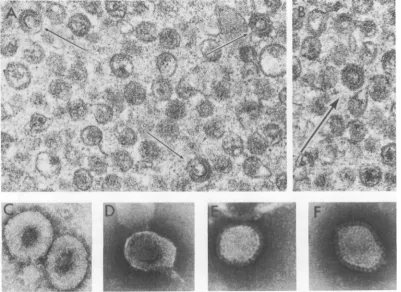
Electron microscopy. Electron microscopyof selected areas of high-speedpellets of leukemic plasma revealed ahigh concentration of virus
particles (Fig. 7A and B). Although most of
theseparticles contained condensed nucleoids, alow percentage was immature and exhibited thedouble-shell structure of the nucleoid typi-cally observed inbuddingor detached but im-mature particles. In most cases(Fig. 7A, small arrows), the nucleoids were not completely
formed and the inner layer was moreelectron dense than the intermediate layer. Occasion-ally, the nucleoidappearedtobecompleteand,
in afraction of these nucleoids, the two layers
appearedtobeofapproximately equalelectron
density (Fig. 7B,large arrow). The latter parti-cle issimilar in appearance to immature forms
/'''
'
':'
it t.;
$~~~~~~~~15i
6,<
t4A
i<4er
Is.,Fwte
*m
~
~
S~-4k14
IL~~~~~~~If
FIG. 7. Electron microscopyofvirusparticlespresent in theplasma ofleukemicguineapigs. (A andB)
Thin sectionofaselectedareaofa high-speed pellet.Mostparticleshave condensed nucleoids, butseveral (arrows) donot.(CandD)Typicalnegativelystainedparticlespresentintheplasma fromleukemicguinea
pigs.(E and F)Lessfrequentlyobservedparticleswithspikes10nminlength.
on November 10, 2019 by guest
http://jvi.asm.org/
[image:8.503.49.450.327.619.2]1128 MICHALIDES ET AL.
ofthe BUdR-induced GPV. Note that many of the matureparticlesappearpartiallydegraded, with the outer membrane broken or partially missing.
Negativelystainedplasmasamplesfrom leu-kemic animalsappeared to contain two types of particles. Themajorityof theparticles (Fig.7C and D) were devoid ofspikes. The core could frequently be observed under these staining conditions (Fig. 7D). Occasionally, particles with spikes could also be observed in plasma preparations (Fig. 7E and F). The spikes are approximately 10 nm in length, and the particles appear similar to negatively stained MMTV and BUdR-induced GPV (4). Electron microscope analysis of plasma samples from leukemic guinea pigs, therefore, indicatesthat twopopulationsofviruses appear to be present. The relative levels cannot be estimated with any accuracy; the majority ofparticles appear to be derived from the intracisternal particles ofthe L2C tumor cells, and a smaller but still significant level of particles appears to be simi-lar to the BUdR-induced GPV obtained from supernatantfluidsofculturesofnormal guinea pigcells (4).
DISCUSSION
Subcutaneous inoculation of L2C guinea pig leukemia cellsintostrain2guineapigsresults, atapproximately day12, in arapid increasein theleukocytecount,the appearanceof extracel-lular virus particles as observed by electron microscopy, and the appearance of particles with anRNA-directedDNApolymeraseinthe plasma of these animals (Fig. 1).Itisclear that the appearance ofthe enzyme activity in the plasma of leukemicguinea pigs (Fig. 1) occurs veryrapidly. This coincides with themaximum level of necrobiosis that would release cellular polymerases but that alsoappears tobe critical for the release of the intracisternal virusfrom the L2Ctumorcells (Dahlberg and Perk, man-uscriptinpreparation). It is, therefore, impor-tant toestablish whether the DNApolymerase activityobservedispresent inplasmaas a con-stituentof a virusor as aconstituentofa cellu-lar substructure. The following data are con-sistentwith theenzymeobserved beingan on-cornavirus RNA-directedDNApolymerase. (i) Thedensity ofthe particle in which the DNA polymerase activityispresent inthe plasma of leukemicguinea pigs isapproximately 1.16 g/ ml insucrose and 1.17 g/ml in CsCl (Fig. 5). In reconstruction experiments, radioactively la-beled BUdR-induced GPV, with a density of 1.19g/ml, underwent ashift in density to 1.17 g/ml when incubated in leukemic plasma at
37C for 24 h. This indicated that the original
densityoftheparticle containingtheDNA po-lymerase activity in the plasma could have
beenhigherthanthe observed values of 1.16g/
ml in sucrose and 1.17 g/ml in CsCl. (ii) The DNA polymerase activity in the plasma from leukemic guinea pigs preferred the synthetic
template poly(rA):oligo(dT) over
poly(dA):-oligo(dT) (Fig. 2). TheonlyDNApolymeraseof cellularoriginthusfarreported(8)thatprefers
the synthetic template poly(rA):oligo(dT) over
poly(dA):oligo(dT)doessowithacation
prefer-encefor Mn2+ (9, 16). TheDNA polymerase of the plasma from leukemic guinea pigs cannot use Mn2+ under any conditions tested (Fig. 2) and is therefore different from that cellular DNA polymerase. (iii) The DNA polymerase activity ofplasma from leukemic guinea pigs utilizes the synthetic template poly(rC):oligo-(dG) only in the presence of Mg2+, with an
optimum at20 mM. The Mg2+ titration result (Fig. 3) is identical to that of the reverse tran-scriptase activity of the BUdR-induced GPV
(17).
When a sample of leukemic plasma was
con-centrated and centrifuged to equilibrium on a
sucrosegradient, the RNA extracted from frac-tions containing maximum levels of RNA-di-rected DNA polymerase completely displaced the annealing reaction between radioactively :TA-labeled 60-70S RNA isolated from BUdR-induced GPV and DNA from normal guinea pig spleens (Fig. 6). No competition of this annealing reaction was observed by the addi-tion of unlabeled RNA from the plasma of normal guineapigs.Becauseofthe deteriorated appearance of mostof the virus particles (Fig. 7A and B) and the presence ofhigh levels of RNase in the plasma ofthe leukemic guinea pigs, ourinability to isolate pure 60-70S RNA from the plasma of leukemic guinea pigs ap-pears due to the RNAbeing partially degraded atthe timeofbloodcollection. Itispossiblethat the RNA extracted from leukemic plasma, which is identical to the RNA of the BUdR-inducedGPV, could represent either one of two ormorepopulationsof viral RNA or viral RNA among an excess of cellular RNA. It is impor-tant to note that negatively stained prepara-tions ofplasmafromleukemicguinea pigs con-tainparticleswithspikes10 nm inlength(Fig. 7E and F)similarinappearance tothe MMTV andtheBUdR-inducedGPV.Thedataobtained from these experiments and electron micro-scopeobservationspermit twoexplanations. (i) The observed population of virus particles in the plasma from leukemicguinea pigs is com-posed oftwodifferentvirusparticles,the
extra-J. VIROL.
on November 10, 2019 by guest
http://jvi.asm.org/
cellular virus particles derived from intracis-temal virusparticlespresentintumorcells and virus particles identical to the BUdR-induced
GPV. (ii) The extracellularvirus particles de-rived from L2C tumor cells are related to or
identicaltotheBUdR-inducedGPV.The RNA-directed DNA polymerase activity and the RNAobservedinthemolecular competition hy-bridization (Fig. 6) would then be ascribed to
one type ofvirus, which exhibits a variety of
morphological states in electron micrographs.
Thehigh level ofRNA-directed DNA
polymer-ase activity observed in the plasma from
leu-kemic guinea pigs and the minimal estimate of
2.5 x 10⁹particles/mlindicatethat theplasma
containsrelatively high levels of particles simi-lar or identical to the BUdR-induced GPV. Thus,itwouldbepossibletoarriveatthe work-inghypothesisthatonlyonevirusispresentin
the plasma and that itexhibits variable
mor-phology, depending onwhetherit isformedin
vivoorinvitro.
Definitive proofthattwodifferentvirusesare
present or only one virus is present in the
plasma ofleukemic pigshasnotbeenobtained fromthestudiesreportedhere.Theappearance
of high levels ofavirusrelatedto, oridentical
to, the type BBUdR-induced GPVduring the
terminal stages of the L2C leukemia is, how-ever, an unusual occurrence and warrants
furtherattention.
ACKNOWLEDGMENTS
WethankA.J.Dalton and D. Colcher formanyfruitful discussions andsuggestions, G.Schirmer and J.Torgersen forexcellenttechnical assistance,and D.Jonesfor photo-graphicservices.
Thisworkwassupported byPublicHealth Service
con-tracts WC1-CP-43223 and 3391 within the Virus Cancer Program of theNational Cancer Institute.
K.PerkisaVisiting Scientistfrom TheHebrew Univer-sityofJerusalem, Rehovot,Israel.
LITERATURE CITED
1. Baltimore, D.,R. McCaffrey, andD.F.Smoler. 1973. Propertiesofreversetranscriptase,p.51-59.InC. F. Fox and W.S.Robinson(ed.), Virus research:Second ICN-UCLASymposiumonMolecular Biology.
Aca-demicPressInc.,NewYork.
2. Black,V.H. 1974.Virusparticlesinprimordialgerm cellsof fetalguinea pigs. J. Natl.Cancer Inst. 52:545-551.
3. Congdon, C. C., and E. Lorenz. 1954. Leukemia in guinea pigs.Am.J.Pathol.30:337-359.
4. Dahlberg, J. E.,K.Perk, andA.J. Dalton. 1974. Virus-likeparticles inducedinguinea pig cells by 5-bromo-2'-deoxyuridine aremorphologically similar to
mu-rineB-typevirus.Nature(London) 249:828-830. 5. Dalton,A.J. 1955. Achrome-osmiumfixative for
elec-tronmicroscopy.Anat.Rec. 121:281.
6. Dunkel,V.C.,R.C.Bast,B. I.Gerwin,U.Heine,M. CottlerFox, andT.Boros. 1974. Presence ofA-type andabsence ofC-typevirusparticlesinachemically
inducedguinea pig hepatoma.J.Natl. Cancer Inst.
53:591-593.
7. Feldman, D. G., and L. Gross. 1970. Electron micro-scopicstudyof the guinea pigleukemia virus. Cancer Res.30:2702-2711.
8. Fridlender, G., M. Bry, A.Bolden, and A. Weisbach. 1972. AnewsyntheticRNA-dependentDNA polymer-ase from human tissue culture cells. Proc. Natl. Acad. Sci. U.S.A.69:452-455.
9. Gallo,R. C., R. E.Gallagher, N. R. Miller, H. Mondal, W. C.Saringer, R. J. Mayer, R. G. Smith, and D.
Gillespie.1975.Relationshipsbetweencomponentsin primate RNA tumor viruses and in the cytoplasm of humanleukemic cells:implicationsto
leukemogene-sis, p.933-961. In Cold Spring HarborSymposium on
Quantitative Biology: Tumor Viruses, vol. 39. Cold SpringHarbor Laboratory, ColdSpring Harbor, N.Y. 10. Goodman, N. C., R. M. Ruprecht, R. W. Sweet, R. Massey, F. Deinhardt, and S. Spiegelman. 1974. Viral related DNAsequences before and after
trans-formation by RNA tumor viruses. Ent. J. Cancer 13:752-760.
11. Hsiung, D. G. 1972. Activation of guinea pig C-type virusincultured spleen cells by
5-bromo-2'-deoxyuri-dine. J.Nat. CancerInst.49:567-570.
12. Kacian, D. L., and S.Spiegelman. 1974. Purification anddetectionofreversetranscriptaseinviruses and cells, p. 150-173. In L. Grossman and K. Moldave
(ed.), Methods in enzymology, vol. 29E Academic Press Inc., New York.
13. Lewis, B. J., J. W. Abreel, R. G. Smith, and R. C.
Gallo. 1974. Human DNA polymerase III (R-DNA
polymerase): distinctionfrom DNApolymeraseIand reversetranscriptase. Science 183:867-869. 14. Ma, B. I., D. C.Swartzendruber,and W. H.Murphy.
1969. Detection ofvirus-like particles in germinal
centersofnormalguinea pigs. Proc. Soc. Exp.Biol. Med.130:586-590.
15. McCaffrey, R., D. F. Smoler, and D. Baltimore. 1973.
Terminaldeoxynucleotidyltransferase in a case of
childhoodacutelymphoblasticleukemia. Proc. Natl.
Acad. Sci. U.S.A.70:.521-525.
16. Matsukage, A., E. W.Bohn, andS.H. Wilson. 1975.
On theDNApolymeraseHIofmousemyeloma: par-tialpurificationandcharacterization. Biochemistry
14:1006-1020.
17. Michalides,R., J.Schlom,J. Dahlberg, and K. Perk. 1975. Biochemical properties ofthe bromodeoxyuri-dine-inducedguinea pig virus. J.Virol.16:1039-1050. 18. Millonig,G.1962.Further observationsonaphosphate bufferfor osmiumsolutionsinfixation, p. P8. In S. Breese, Jr. (ed.), Proceedings of the 5thInternational
Conference for Electron Microscopy, Philadelphia,
vol. 2.AcademicPressInc., NewYork.
19. Mollenhauer, H. H. 1964. Plasticembeddingmixtures foruseinelectron microscopy. StainTechnol. 39:111-114.
20. Murray, P. R., and D. P.Nayak. 1974.
Characteriza-tion of bromodeoxyuridine-induced endogenous guineapig virus. J.Virol.14:679-688.
21. Nadel, E., W. Banfield, S. Burstein, and A. J.
Tou-simis. 1967. Virusparticlesassociated withstrain2 guinea pig leukemia(L2C/NB).J.Natl. Cancer Inst.
38:979-982.
22. Nayak, D. P., and P. R.Murray.1973.Induction of type C viruses in cultured guinea pig cells. J. Virol. 12:177-187.
23. Nayak, D. P., P. Murray, D.Goldblatt,and K.Karpov. 1975.Anendogenous oncornavirus ofguinea pigs:its expression in leukemic cells, p. 545-559. In Y. Ito andR. M.Dutcher (ed.),Comparative leukemia re-search 1973: leukemogenesis. University of Tokyo
Press, Tokyo.
24. Opler, S. R. 1967.Observationson anew virus associ-VOL. 18, 1976
on November 10, 2019 by guest
http://jvi.asm.org/
ated with guinea pig leukemia: preliminarynotes.J. Natl. Cancer Inst. 38:797-798.
25. Pearson, J. W., K. Perk, M. A. Chirigos, and J. A. Torgersen.1975.Drug therapy againsta
transplanta-ble guinea pig leukemia. Cancer Res. 35:1093-1098. 26. Perk, K., and J. E. Dahlberg. 1974. Murine
intracister-nal Atypeparticles failto separatefrom the
mem-brane of the endoplasmic reticulum. J. Virol. 14:1304-1306.
27. Rhim, J. S., F. G. Duh, H. Y. Cho, K. D. Wuu, and M.
L.Vernon.1973. Activation by 5-bromo-2'-deoxyuri-dine of particles resembling guinea pig leukemia
vi-rusfromguinea pig nonproducer cells. J. Natl. Can-cerInst. 51:1327-1331.
28. Vogt, P. K. 1965. Aviantumorviruses. Adv. Virus Res. 11:293-385.
29. Wright, S. E., and P. Neiman. 1974. Base-sequence relationships between avian RNA endogenous and
sarcomaviruses assayed by competitive RNA-DNA hybridization. Biochemistry 13:1549-1554.
J. VIROL.
on November 10, 2019 by guest
http://jvi.asm.org/


![FIG. 4.precipitableplasmapoly(rC):oligo(dG)-templatedpoly(rC):oligo(dG),pmol)[3H]dGMP15-mlSymbols:assaytheandcontainstrifugationtableweremaltimeswereEl, plasma Assay for DNA polymerase activities in plasma of normal and leukemic guinea pigs](https://thumb-us.123doks.com/thumbv2/123dok_us/1558424.108452/6.503.47.239.57.300/precipitableplasmapoly-templatedpoly-mlsymbols-assaytheandcontainstrifugationtableweremaltimeswereel-assay-polymerase-activities-leukemic.webp)
![FIG. 5.poly(rC):oligo(dG)-templatedFractions[3H]dGMPassayedaverageconcentrated Equilibrium density centrifugation analysis ofparticles in plasma from leukemic guinea pigs, as by RNA-directed DNA polymerase activity](https://thumb-us.123doks.com/thumbv2/123dok_us/1558424.108452/7.503.68.260.370.544/templatedfractions-dgmpassayedaverageconcentrated-equilibrium-centrifugation-ofparticles-directed-polymerase-activity.webp)