City, University of London Institutional Repository
Citation
:
Kim, E-S. & Glass, C. (2014). Perfect periodic scheduling for three basic cycles.
Journal of Scheduling, 17(1), pp. 47-55. doi: 10.1007/s10951-013-0331-3
This is the published version of the paper.
This version of the publication may differ from the final published
version.
Permanent repository link: http://openaccess.city.ac.uk/16464/
Link to published version
:
http://dx.doi.org/10.1007/s10951-013-0331-3
Copyright and reuse:
City Research Online aims to make research
outputs of City, University of London available to a wider audience.
Copyright and Moral Rights remain with the author(s) and/or copyright
holders. URLs from City Research Online may be freely distributed and
linked to.
DOI 10.1007/s10951-013-0331-3
Perfect periodic scheduling for three basic cycles
Eun-Seok Kim · Celia A. Glass
Received: 17 January 2012 / Accepted: 17 April 2013 / Published online: 17 May 2013 © Springer Science+Business Media New York 2013
Abstract Periodic scheduling has many attractions for wireless telecommunications. It offers energy saving where equipment can be turned off between transmissions, and high-quality reception through the elimination of jitter, caused by irregularity of reception. However, perfect periodic schedules, in which each (of n) client is serviced at regular, prespecified intervals, are notoriously difficult to construct. The problem is known to be NP-hard even when service times are identical. This paper focuses on cases of up to three dis-tinct periodicities, with unit service times. Our contribution is to derive a O(n4)test for the existence of a feasible sched-ule, and a method of constructing a feasible schedule if one exists, for the given combination of client periodicities. We also indicate why schedules with a higher number of period-icities are unlikely to be useful in practice. This methodology can be used to support perfect periodic scheduling in a wide range in real world settings, including machine maintenance service, wireless mesh networks and various other telecom-munication networks transmitting packet size data.
Keywords Scheduling·Perfect periodicity·Feasibility testing·Wireless mesh networks
E.-S. Kim
International Management and Innovation, Business School, Middlesex University, London NW4 4BT, UK
e-mail: [email protected]
C. A. Glass (
B
)Cass Business School, City University London, 106 Bunhill Row, London EC1Y 8TZ, UK
e-mail: [email protected]
1 Introduction
In this paper, we explore the construction of schedules for clients who are serviced on a periodic basis, where clients receive identical service durations but at different intervals. An immediate practical problem motivates our research, namely local transmission of data in Wireless Mesh Networks (WMN) which is of increasingly importance for commu-nication worldwide (Akyildiz et al. 2005). In wireless net-works, data are transmitted in packets, and this feature can be exploited to extract considerable energy saving of a factor of 5 to 10 through efficient algorithms for packet schedul-ing (Quintas and Friderikos 2012). Wireless Mesh Networks represent a technology that economically increases the geo-graphical area within which mobile clients may access broad-band communication.
paradigms interchangeably throughout. The predictability allows the total power consumption of the network to be minimised and the interference from competing simultane-ous transmissions to be reduced or even eliminated.
Several studies have been undertaken on perfect periodic scheduling problems. The problem of finding a feasible per-fect periodic schedule has been proved by Bar-Noy et al.
(2002a) to be NP-hard in general. However, there are some
special cases for which simple closed form expressions offer a polynomial time solution method. For three products with three distinct periodicities,Glass(1992) derives a simple test for existence of a feasible schedule, and a method of con-structing feasible schedules if one exists. In addition,Glass
(1994) and Glass et al. (1994) study the feasibility prob-lem in the context of the Economic Lot Scheduling Prob-lem where several products with different durations are pro-duced periodically so as to minimise holding and set up costs. For two (three) products with two (three) distinct periodic-ities, they develop a simple necessary and sufficient con-dition for the feasibility test and construction of a feasible schedule.
Due to the difficulty of finding a feasible perfect peri-odic schedule for any given periperi-odicities, called as request
periodicity, heuristics are therefore used to allocated close
values, called as allocated periodicity, using specific crite-ria. Brakerski et al. (2006) study perfect periodic scheduling for multiple servers, with the objective is to minimise the maximum ratio of the allocated periodicity and requested periodicity. They develop some approximation algorithms for the problem. Patil and Garg (2006) propose an adap-tive algorithm, called Adapmin. They find a worst case per-formance bound on the quality of schedules produced by
Adaptmin and compare Adapmin to the algorithm of
Braker-ski et al.. Chen and Huang (2008) propose an efficient algo-rithm of requested periodicities with high density and large variance.
For perfect periodic scheduling with identical processing times, Bar-Noy et al. (2004) consider two objective mea-sures of maximum and weighted average ratios between the allocated periodicity and requested periodicity. They present a few efficient heuristic algorithms using a methodology, called tree scheduling, based on an hierarchical round-robin approach, where the hierarchy is a form of tree. Bar-Noy et al. (2002b) develop tree-based approximation algorithms for perfect periodic scheduling with the objective of minimis-ing weighted average ratios between the allocated periodic-ity and requested periodicperiodic-ity. Brakerski et al. (2003) study the question of dispatching in a perfect periodic schedule, namely how to find the next item to schedule, assuming that the schedule is already given somehow.
All of the above approaches to finding a perfect periodic schedule are limited in the range of schedules which they consider. For example, tree scheduling algorithms (Bar-Noy
et al. 2002b;Brakerski et al. 2003) restrict their solution space to a set of periodicities with a non-trivial greatest common divisor. Moreover, Brakerski et al. (2006), Patil and Garg (2006), and Chen and Huang (2008) constrain solutions to those for which the ratio between any pair of two allocated periodicities is a power of 2. Thus, further improvements in heuristics depend upon being able to establish perfect peri-odic schedules with a wider range of periperi-odicities. Addi-tional motivation for developing our understanding of perfect period scheduling, arises in the context of wireless mesh net-works where the response time variability in transmissions, known as jitter, is an important issue. Jitter relates to quality of reception and is measured by total response time variation as well as the ”bottleneck metric,” of maximum deviation from an ideal interval, identified by Steiner and Yeomans (1993). Corominas et al. (2007) provide effective heuristics for measures which prove to be optimal for the case of two tasks. However, they avoid attempts to find solutions with no interval variation, which are perfectly periodic, because of ”the serious practical disadvantage. . .that there may not be a feasible solution.”
The aim of this paper is to address the issue of feasi-bility for perfect periodic scheduling problem on a single resource. We restrict our attention to problems with identi-cal task durations and at most three distinct periodicities in total. Observe that the focus on tasks with identical durations is generally no limitation in the packet scheduling environ-ment of wireless networks. Current practice is to use a com-mon cycle time to co-ordinate packet scheduling (Quintas
and Friderikos 2012). Thus, any methodology which
facili-tates variety in periodicities infers enhanced flexibility and thus potential additional energy savings for network oper-ators. In the context of a wireless network with homoge-neous link bandwidth, transmission time for a data packet is uniform throughout the network, and time may thus be divided into unit slots accordingly for scheduling purposes. Our dual contributions are to provide a test of feasibility and a method for constructing a feasible schedule (when one exists).
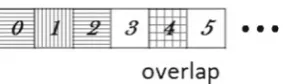
Fig. 1 The only possible, infeasible, schedule for two clients with
peri-odicities 2 and 3, respectively
near-optimal solutions. They additionally explore the poten-tial for increasing throughput in a wireless mesh network by varying transmission rates at individual links, taking account of signal interference.
The remainder of the paper is structured as follows. The problem itself is formulated in purely mathematical terms in the next section. Our results rely only upon classic properties in modulo arithmetic, which are included for completeness. We then analyse the case of two distinct periodicities in Sect.
3. We establish a closed form test for the existence of a perfect periodic schedule, and in doing so indicate the structure of a feasible solution. Section4provides similar results for the case of three periodicities. Various cases are analysed, result-ing in a test for feasibility which runs in O(n4)time, where
n is the total number of clients, in the last subsection. The
construction of a feasible solution itself, where one exists, is presented explicitly in Sect.6. A few concluding remarks are then offered in Sect.7. For convenience, the remainder of the paper is framed in the telecommunications context of “service” to “clients,” and not in the alternative machine scheduling terminology of “processing” of “jobs.”
2 Problem formulation and background results
In order to understand the difficulty of devising perfectly period schedules consider the following small examples with only two clients. First suppose that each client requests a peri-odicity of 2. In this case, their requests can be accommodated by scheduling one client in the odd numbered time slots and the other in even numbered time slots, although there would be no residual capacity for any other client. If, however, one of the clients reduces their demand by a half to periodicity 3, then there would appear to be residual capacity, but in fact the problem becomes impossible to solve rather than easier, as illustrated in Fig.1. By contract, there is no difficulty in scheduling two clients with longer periodicities of 6 and 9 time slots without overlap, as illustrated in Fig.2. It is thus the relationship between the periodicities, and not simply their total effective capacity requirement, which determines whether a feasible schedule can be constructed.
The problem of finding a Perfect Periodic Schedule with unit service (or processing) times is generally formulated as
follows. We use R(a,b)to denote the remainder function of two positive integers, a and b, that is, R(a,b)=a−ba/b.
Given a set of clients with associated service periodicity
qi ∈Nfor i=1, . . . ,n, find time slotτifor which the
following time slots are distinct:
τ(k)
i =R(τi,qi)+(k−1)qi, k∈N
for 1≤i ≤n.
However, as we consider a restricted number of periodic-ities, it is more efficient for us to employ High Multiplicity encoding Brauner et al. (2005).
PPS1: Given a set of ni clients with associated
ser-vice periodicity qi for i=1, . . . ,m (with ni,qi ∈N),
find time slotτi jfor which the following time slots are
distinct:
τ(k)
i j =R(τi j,qi)+(k−1)qi, k∈N
for 0≤ j ≤ni −1 and 1≤i ≤m.
The above high multiplicity formulation has input data:
m,q1, . . . ,qm,n1, . . . ,nm which may be encoded in
O(m log qmax) steps, where qmax = max1≤i≤mqi (since
instances are restricted to having ni <qi to avoid obvious
infeasibility). A drawback of this super-efficient encoding is that it does not afford a polynomial time solution algorithm since describing a solution,τi j, takes more than polynomial
time in the input variables. Thus, PPS cannot belong to P nor NP under high multiplicity encoding. However, the prob-lem in terms of the standard encoding, with input variables
n,q1, . . . ,qn, is known to be NP-hard from Bar-Noy et al.
(2002a) as mentioned above. It is therefore sensible to
evalu-ate the computational complexity of a solution procedure in terms of the standard encoding.
In the PPS1 scenario, any feasible schedule is periodic and the length of the period, T , is the least common multiple of
qifor all i =1, . . . ,m, lcm(q1, . . . ,qm). Service to a client
with periodicity qi is repeated lcm(q1, . . . ,qm)/qi times
within the overall period T , for each i . It is sufficient, there-fore, to find a feasible schedule over T =lcm(q1, . . . ,qm)
time slots instead of over the infinite horizon. Many results relating to PPS1 are based on classic properties of congru-ences from Number Theory. Let gcd(a,b)denote the greatest common divisor of integers a and b.
Chinese Remainder Theorem Let a1 and a2 be positive
integers, and b1 and b2 be any integers. Then, the
taneous congruences t ≡ b1 mod a1 and t ≡ b2 mod a2 have a solution if and only if gcd(a1,a2)divides b1−b2.
The following result follows directly from the Chinese Remainder Theorem as observed by Bar-Noy et al. (2002a, Lemma 12).
Lemma 1 A solution is feasible if and only if τi j ≡
τij mod gcd(qi,qi)for i=ior j= j.
By Lemma1, there is no feasible schedule for any set of periodicities q1, . . . ,qm which contains a pair of
periodic-ities, qi and qi which are coprime, i.e. gcd(qi,qi) = 1.
Congruence results have a direct relationship to the theory of linear Diophantine equations (eg. a1x+a2y=b). In this equation form, the following result was used as long ago as 1st century AD (eg. by Indian mathematician Brahmagupta, around AD 628) Jones and Jones (1998).
Lemma 2
a1x≡b mod a2
has a solution if and only if gcd(a1,a2)divides b.
3 Two distinct periodicities
In this section, we study the case when there are two dis-tinct periodicities. A test of existence of a feasible sched-ule is provided in Theorem 1 and a schedule construc-tion in its proof. Throughout this secconstruc-tion, we use a par-tition of time slots {0, . . . ,lcm(q1,q2)−1} into sets
l = {t|t≡l mod gcd(q1,q2),0≤t ≤lcm(q1,q2)−1} for l = 0, . . . ,gcd(q1,q2)−1. We refer to the time slot l+p·gcd(q1,q2)inl as position p inl.
Note that |l| = lcm(q1,q2)/gcd(q1,q2) for l = 0, . . . ,gcd(q1,q2)−1, and a client with the periodicity of qiis repeated lcm(q1,q2)/qitime in T =lcm(q1,q2), from which the following observation follows.
Lemma 3 Up to qi/gcd(q1,q2)clients with the periodicity
of qi for i =1,2 may be serviced in a single-set, and a
client is serviced in just one-set.
Proof Observe that the difference between any two
consecu-tive time slots in each-set is gcd(q1,q2). Since gcd(q1,q2) divides both q1and q2, each client has to be serviced in only one of-sets. Moreover, the services for a client with the periodicity of qi occur in every qi/gcd(q1,q2)time slots in a single-set. Thus, up to qi/gcd(q1,q2)clients with the periodicity of qican be serviced in a single-set.
Lemma 4 Any two clients whose periodicities differ cannot
be scheduled in the same−set.
Proof Clients j and jwith periodicities q1and q2,
respec-tively, can be scheduled only ifτ1 j ≡τ2 j mod gcd(q1,q2) by Lemma1, and hence any two clients with different peri-odicities cannot be scheduled in the same-set.
Theorem 1 An instance with two distinct periodicities, q1
and q2with n1and n2clients, respectively, is perfect
period-ically schedulable if and only if
n1 q1/gcd(q1,q2)
+
n2 q2/gcd(q1,q2)
≤gcd(q1,q2). (1)
Proof (⇒)From Lemma3, the number of-sets required
for scheduling ni clients with the periodicity of qi is
ni/(qi/gcd(q1,q2))for i=1,2. Thus, by Lemma4, the instance is schedulable only if
n1 q1/gcd(q1,q2)
+
n2 q2/gcd(q1,q2)
≤gcd(q1,q2).
(⇐)We now construct a feasible solution for an instance satisfying the condition (1). We determine the first time slot in which client j with the periodicity of qi is serviced,τi j,
as follows. Let
τ1 j =
j q1/gcd(q1,q2)
+R
j, q1
gcd(q1,q2)
gcd(q1,q2) (2)
for j =0, . . . ,n1−1, and
τ2 j =
n1 q1/gcd(q1,q2)
+
j q2/gcd(q1,q2)
+R
j, q2
gcd(q1,q2)
gcd(q1,q2) (3)
for j =0, . . . ,n2−1.
We now show that the time slots allocated by (2) and (3) provide a feasible solution. From Lemma1, it is sufficient to prove thatτi j ≡τij mod gcd(qi,qi)for i =ior j = j.
Take the case when i = 1, i = 2, 0 ≤ j1 ≤ n1−1 and 0≤ j2≤n2−1, and considerτ1 j1,τ2 j2modulo gcd(q1,q2).
From (2) and (3),
0≤
j1 q1/gcd(q1,q2)
<
n1 q1/gcd(q1,q2)
≤
n1 q1/gcd(q1,q2)
+
j2 q2/gcd(q1,q2)
and
0<
j2 q2/gcd(q1,q2)
≤
n2−1
q2/gcd(q1,q2)
≤
n2 q2/gcd(q1,q2)
Fig. 3 A solution for Example
1 a schedule in [0, T−1], b partition of schedule into-set
Thus,
0≤
j1 q1/gcd(q1,q2)
<
n1 q1/gcd(q1,q2)
+
j2 q2/gcd(q1,q2)
<
n1 q1/gcd(q1,q2)
+
n2 q2/gcd(q1,q2)
−1 ≤gcd(q1,q2)−1
since (1) holds. Thus, τ1 j1 ≡ τ2 j2 mod gcd(q1,q2) as
claimed.
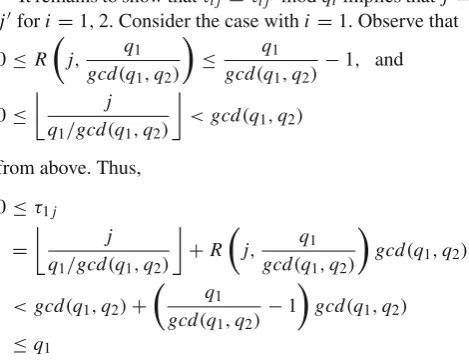
It remains to show thatτi j ≡τi j mod qiimplies that j = jfor i =1,2. Consider the case with i=1. Observe that 0≤ R
j, q1
gcd(q1,q2)
≤ q1
gcd(q1,q2)− 1, and 0≤
j q1/gcd(q1,q2)
<gcd(q1,q2) from above. Thus,
0≤τ1 j
=
j q1/gcd(q1,q2)
+R
j, q1
gcd(q1,q2)
gcd(q1,q2)
<gcd(q1,q2)+
q1 gcd(q1,q2)−
1
gcd(q1,q2)
≤q1
for each j=0, . . . ,n1−1, showing that distinctτi j values
cannot be congruent modulo q1. A similar argument holds for the case with i=2, completing the proof.
In the feasible solution described above, the clients with the periodicity of q1 are scheduled in l for l = 0, . . . ,
n1/(q1/gcd(q1,q2)) − 1, and the clients with period-icity of q2 in l for l = n1/(q1/gcd(q1,q2)), . . . ,
n1/(q1/gcd(q1,q2)) + n2/(q2/gcd(q1,q2)) −1. The following example illustrates the construction of a perfect periodic schedule described in Theorem1.
Example 1 Consider the case of two periodicities q1=6 and
q2=9 with n1=3 and n2=2, respectively. This instance satisfies criterion (1) for the schedulability, since
n1 q1/gcd(q1,q2)
+
n2 q2/gcd(q1,q2)
=
3 2
+
2 3
=3≤3=gcd(q1,q2).
Following the construction of the above proof, we calculate the first time slots in which each client is serviced using (2) and (3) as follows:
τ10= 0/2 +R(0,2)3 = 0
τ11= 1/2 +R(1,2)3 = 3
τ12= 2/2 +R(2,2)3 = 1
τ20= 3/2 + 0/3 +R(0,3)3 = 2
τ21= 3/2 + 1/3 +R(1,3)3 = 5.
Therefore, the first client with the periodicity of q1is ser-viced in the set of time slots{0,6,12}, and the second and third in the set of time slots{3,9,15}and in the set of time slots{1,7,13}, respectively. Similarly, the first client with the periodicity of q2is serviced in the set of time slots{2,11}, and second client with the periodicity of q2in the set of time slots{5,14}. A single complete period of length (T =18) of feasible schedule is depicted in Fig.3a and its partition into
-sets in Fig.3b.
4 Theoretical results for three distinct periodicities
gg10g12g31, q2 = gg20g12g23 and q3 = gg30g23g31. Observe that integers in sets{g10,g20,g30},{g12,g23,g31},
{g10,g23},{g20,g31}and{g30,g12}are coprime within each set but not necessarily coprime to g nor between sets. We first show that any instance can be reduced to one in which
gi 0 =1 for i =1,2,3 in Sect.4.1. Then, we consider the
case when gi 0 =1 for i =1,2,3 and gcd(q1,q2,q3)=1 in Sect.4.2, and we later extend the results to general peri-odicities in Sects.4.3and5.
4.1 Problem reduction
The following theorem shows how an instance can be reduced to an instance with gi 0 = 1 by letting ni = ni/gi 0and qi=qi/gi 0for i=1,2,3. The proof relies on a congruence
relationship given in Lemma5below.
Theorem 2 An instance with n1, n2, n3clients with the peri-odicity of q1, q2, q3, respectively, is feasible if and only if there
is a feasible perfect periodic schedule forni/gi 0clients
with a periodicity of qi/gi 0for i =1,2,3.
Proof (⇒) Take a feasible schedule. If a client with the
peri-odicity of q2or q3is serviced in a time slot t, then it is also serviced in time slots t+hT/g10, for h =0, . . . ,g10−1, since both q2 and q3 divide T/g10. Hence, the subsched-ule consisting of clients with the periodicity of q2or q3has periodicity T/g10and is repeated g10times within the over-all period T of the three periodicities. Now by Lemma5, a client, say j , with the periodicity of q1occupies time slots
τ1 j+hq1/g10for h=0, . . . , (T/q1)−1 within the period T= {0, . . . ,T/g10−1}. Moreover, no client with the peri-odicity of q2or q3can be serviced in these time slots. Thus, up to g10clients with the periodicity of q1can be scheduled in these time slots, i.e.{t |t ≡τ1 j+hq1/g10mod T/g10,0≤ h ≤ T/q1−1}. From this perspective, feasibility depends uponn1/g10, but not on n1itself. Therefore, repeating this argument for i = 1,2,3, any instance can be reduced to an instance with gi 0 = 1 by letting ni = ni/gi 0 and qi=qi/gi 0for i=1, . . . ,3.
(⇐) Given a feasible schedule for the reduced problem, i.e.
τ
i j for i =1,2,3, j=0, . . . ,ni/gi 0 −1,set initial time
slots for clients in the original problem as follows:
τi j =τij/gi 0+R(j,gi 0)(qi/gi 0) (4)
for i = 1,2,3, j = 0, . . . ,ni −1. We now show that the
schedule implied by (4) provides a feasible solution. From Lemma 1, it is sufficient to prove that τi j ≡
τij mod gcd(qi,qi)for i = i or j = j. Suppose
oth-erwise. Then there are non-identical pairs i , j and i, jfor whichτi j ≡τij mod gcd(qi,qi). However, if i =i, then
τi j −τi j ≡
Rj,gi 0 −R(j,gi 0) (qi/gi 0) mod qi
implying thatτi j ≡τi j mod qi, and hence that j = j, by
Lemma1and feasible of schedule i . On the other hand, if
i =i, i =1 and i=2 say, then
τ1j/q10−τ
2j/q20 ≡R
j,g20 g12g23
−R(j,g10)g12g13mod q12 implying thatτ1j/q
10 ≡ τ
2j/q20 mod gcd(q
1,g2)since gcd(q1,g2) = gcd(q1,g2) = g12. This provides the required contradiction, from Lemma1 and feasibility of i .
Lemma 5 The following sets are congruent modulo T/gi 0
{kqi |k=0,. . .,T/qi−1}and{kqi/gi 0|k=0,. . .,T/qi−1} for i =1,2,3.
Proof Consider the expression kq1≡kq1/g10 mod T/g10.
Since g12g31divides q1, q1/g10and T/g10, this is equivalent to kq1/(g12g31) ≡ kq1/(g10g12g31)mod T/(g10g12g31), that is, kg10 ≡ kmod g20g30g23 for 0 ≤ k,k ≤ g20g30g23 −1. Thus, it is sufficient to show that =
{t | t ≡ kg10mod g20g30g23, 0 ≤ k ≤ g20g30g23 − 1} = {0,1, . . . ,g20g30g23 −1}. Suppose otherwise, then
|| < g20g30g23, and there must exist k and k, k = k, such that g10k ≡ g10kmod g20g30g23 where 0 ≤ k,k ≤ g20g30g23 − 1. Then, g10k − g10k = g10(k − k) ≡ 0 mod g20g30g23. Since g10 and g20g30g23 are coprime, this implies that k −k ≡ 0 mod g20g30g23, which can-not hold for the given choice of k and k, giving the required contradiction. A similar argument can be applied for i =2,3.
4.2 Special case of gcd(q1,q2,q3)=1, for the reduced problem
While the analysis in this section focuses of q3, the choice is purely arbitrary. We assume that g =1 and gi 0 = 1 for i =1,2,3, and thus T =lcm(q1,q2,q3)=g12g23g31. Take a partitionof time slots{0,1, . . . ,T −1}into setsl =
{t |t ≡l mod g12,0≤t ≤T −1}for l=0, . . . ,g12−1.
We refer to the time slot l+pg12inlas position p inl.
Observe that|l| =T/g12 =g23g31for l =0, . . . ,g12−1.
Lemma 6 Each client with the periodicity of q1 or q2
receives all its service slots in the same -set. Moreover,
no-set accommodates both a client with the periodicity of
q1and a client with the periodicity of q2.
Proof Observe that g12 is the difference between any two
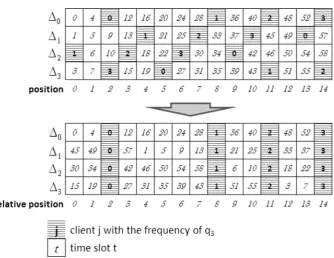
Fig. 4 Rearranging time slots
in eachlwith respect to q3
and hence any two clients with the periodicities of q1and q2 cannot be scheduled in the same-set.
The partitionof time slots thus enable us to view the schedule of service to clients with the periodicities of q1 and q2independently. We now consider the interplay with clients with the periodicity of q3. Observe that there is an integerq¯3, 1 ≤ ¯q3 ≤ g12−1 for which q3q¯3≡1 mod g12, from Lemma2since gcd(q3,g12)=1. Let p3 j[l]denote the first position inl of service to client j with the periodicity
of q3corresponding to time slot l+p[3 jl]g12.
Lemma 7 In a feasible schedule for any instance with three
distinct periodicities, q1, q2and q3, with g=1 and gi 0=1
for i = 1,2,3, any client j with the periodicity of q3 is
serviced exactly once in each setl for l=0, . . . ,g12−1.
Moreover, then its position inlis given by
p[3 jl]=R(τ3 j/g12+l(q3q¯3−1)/g12,q3)
whereq¯3is the integer, 1≤ ¯q3≤g12−1, for which q3q¯3≡ 1 mod g12, andτ3 j≡0 mod g12.
Proof We first show that any client with the periodicity of q3 is serviced exactly once in each -set. To that end, it is sufficient to show that = {τ3 j +q3k mod g12 | k = 0,1, . . . ,g12−1} = {0,1, . . . ,g12−1}. Suppose otherwise, then|| <g12, and there must exist k and k, k =k, 0≤ k,k ≤ g12−1 such thatτ3 j+q3k≡τ3 j+q3kmod g12. Thus, q3(k−k)≡0 mod g12. Since q3and g12are coprime, this implies that k−k ≡0 mod g12, which contradicts the given choice of k and kby|k−k|<g12.
Since service is cyclic and{τ3 j(k) | k = 0, . . . ,g12−1} covers all elements in set{l | l = 0, . . . ,g12 −1}, we
may assume without loss of generality thatτ3 j ≡0 mod g12, and soτ3 j ∈ 0. Thus,τ3 j(k) = τ3 j +kq3 ≡l mod g12 for k ≡ lq¯3mod g12. Then, the position of service to client j with the periodicity of q3in setl is
p3 j[l]= R((τ3 j(k)−l)/g12,q3)
= R((τ3 j+lq3q¯3−l)/g12,q3)
= R(τ3 j/g12+l(q3q¯3−1)/g12,q3) for j =0, . . . ,n3and l=0, . . . ,g12−1.
By Lemma7, we assume without loss of generality that
τ3 j ∈ 0, and hence the position of subsequent services to a client j with the periodicity of q3within a setldepends
only on l and not on k. We therefore introduce the concept of relative position within al set as
p= p−l(q3q¯3−1)/g12
taken modulo q3, where the original position p within the set corresponds to time slot l +pg12. Thus, we can rearrange time slots in each setl, so that any client with the periodicity
of q3appears to be serviced in the same relative position in alll’s by putting time slot R(lq3q¯3,T)in the first position of setl. Figure 4 depicts the procedure when q1 = 12, q2=20 and q3=15 i.e. g12=4, g23=5 and g31=3, and
n3=4.
Corollary 1 Each client with the periodicity of q3occupies
the same single relative position in each of the-sets, i.e.
For any feasible schedule, a relative positionp is referred
to as free if no client with the periodicity of q1or q2is serviced in the pth relative position of any of the-sets. Hence, in a feasible schedule, the number of free relative positions is at least as great as n3because a client with the periodicity of q3is serviced in a particular relative position of each of the-sets by Corollary1. In order to establish the precise condition for accommodating n3clients with the periodicity of q3in Theorem3, we now examine the interplay between (relative) positions occupied by clients with the periodicities of q1or q2.
Lemma 8 In a feasible schedule for any instance with three
distinct periodicities, q1, q2and q3, with g =1 and gi 0 =
1 for i = 1,2,3, for any pair of clients, one with the
periodicity of q1 and the other with the periodicity of q2,
there exist precisely one position in which both clients are serviced.
Proof Take a client j1with the periodicity of q1and a client
j2with the periodicity of q2. If there is no position which serves both clients, then both clients can be serviced in same set, which contradicts to the results of Lemma1.
If there is more than one position within T which serves the two given clients, then there exist integers k1, k1, k2and k2 such thatτ(k1)
1 j1 −l1=τ
(k2)
2 j2 −l2andτ
(k1)
1 j1 −l1=τ
(k2) 2 j2 −l2
where 0≤k1,k1 ≤g23, 0≤k2,k2 ≤g31, k1=k1, k2=k2. Thus,τ(k1)
1 j1 −τ
(k2)
2 j2 = l1−l2 = τ
(k1) 1 j1 −τ
(k2)
2 j2 , and hence
k1q1−k2q2 = k1q1−k2q2, and therefore(k1−k1)q1 =
(k2−k2)q2. Since g12 > 0 and g23 is coprime to g31, g23 divides|k1−k1|and g31divides|k2−k2|, this implies, for the given range of the k variables, that k1=k1and k2=k2 completing the proof.
Corollary 2 Consider an instance of the PPS problem with
three distinct periodicities, q1, q2 and q3, with g = 1 and
gi 0 = 1 for i = 1,2,3. Suppose that α clients with the
periodicity of q1are serviced in a single-set andβclients
with the periodicity of q2in another-set. Then, there exist
precisely αβ positions which serve both a client with the
periodicities q1and a client with the periodicity of q2.
Proof From the result of Lemma8, any pairs of clients with
the periodicities of q1and q2has precisely one position in which both clients are serviced. There areαβdifferent pairs of clients, one with the periodicity of q1and the other with the periodicity of q2. Thus, there areαβpositions in which both clients with the periodicities q1and q2are serviced.
Theorem 3 Consider an instance with clients of each of
three distinct periodicities, q1, q2 and q3, with g = 1 and
gi 0 =1 for i = 1,2,3. The instance is schedulable if and
only if there exists an integer x, 1≤x≤g12−1 such that
n1
x
≤g31−1, (5)
n2
g12−x
≤g23−1, (6)
n3≤
g31−
n
1
x g23−
n2
g12−x
. (7)
Proof (⇒)Take a feasible solution. Let xi denote the
num-ber of sets of serving clients with the periodicity of qi,
respectively, for i =1,2. Letαandβdenote the maximum number of clients with the periodicity of q1and q2, respec-tively, serviced in a single set in. Thus,α≥ n1/x1and
β ≥ n2/x2. Note that|l| =g23g31and that a client with the periodicity of q1and q2occurs exactly g23and g31times, respectively, in a single set in. Hence, from the result of Corollary2, the maximum number of free relative positions inl is
g23g31−(g23α+g31β−αβ)
=(g31−α) (g23−β)
≤
g31−
n1 x1
g23−
n2 x2
.
Now x2≤g12−x1ensures thatn2/x2 ≥ n2/(g12−x1). Since each-set has at least n3time slots to accommodate the n3clients with the periodicity of q3, inequality (7) is sat-isfied by setting x = x1. Moreover, since a client with the periodicity of q3is serviced once in each-set by Lemma
7, the maximum number of clients with the periodicity of q1 (or q2) in a-set,α(orβ), is at most g31−1 (or g23−1), implying conditions (5) and (6).
(⇐)Now suppose that there exists an integer x, 1≤ x ≤ g12−1, satisfying the inequalities, (5), (6) and (7). Letα=
n1/xandβ = n2/(g12−x). We construct a feasible solution as follows. We schedule the first time slots of the clients with the periodicity of q1at
τ1 j =R(q3q¯3j/α +R(j, α)g12, q1) (8)
=
j
α
+
q3q¯3−1 g12
j
α
+R(j, α)
g12mod q1, for j =0, . . . ,n1−1. Observe that client j with the peri-odicity of q1is in position l(q3q¯3−1)/g12+R(j, α)of set
l, for l = j/α. Thus, there areαclients with the
peri-odicity of q1 in each setl for l = 0, . . . ,x−2, and the
remainder, i.e. n1−α(x−1)clients, inx−1. The first time slots of the clients with the periodicity of q2is placed in time slots
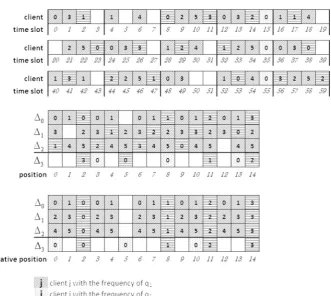
Fig. 5 A solution for Example
2 a schedule in [0, T−1], b partition of schedule into-set
Then each client with the periodicity of q1in0occupies g23 =T/q1positions, and the each client with the periodicity of q2inx occupies g31 = T/q2positions. Moreover, the above construction ensures that all clients with the periodicity of q1 are scheduled in the same relative positions within a set as those in set0, and all clients with the periodicity of q2are in the relative positions used in setx. It thus follows
from Corollary2that g23α+g31β−αβrelative positions are occupied by clients with the periodicities of q1and q2. The remaining g23g31−(g23α+g31β−αβ)=(g31−α)(g23−β) relative positions remain for clients with the periodicity of
q3. From (7), there are at least n3such free relative positions and the clients with the periodicity of q3may therefore be scheduled as follows. Schedule the first time slot of the client
j with the periodicity of q3at
τ3 j =R(pjg12,q3)
for j=0, . . . ,n3−1, wherepjdenote(j+1)th free relative
position in0.
Observe that the conditions for feasibility given in The-orem3 are asymmetric in the three periodicities, which at first sight seems odd. However, the conditions are in fact symmetric in the periodicities as proved in Appendix 1. The following Lemma studies the computational complexity of finding an integer x referred to in Theorem3.
Lemma 9 For an instance with three distinct periodicities
with g =1 and gi 0 = 1 for i = 1,2,3, there is a test for
feasibility whose computational complexity is O(n).
Proof From the result of Theorem 3, the feasibility test
can be done in O(g12) steps by examining each inte-ger x, 1 ≤ x ≤ g12 −1 and testing inequality (7). If g12 ≤ 2 max{n1,n2}, then there are O(n) operations as claimed since max{n1,n2} ≤ n. On the other hand, if g12 > 2 max{n1,n2}, then set x = max{n1,n2}. Then, the inequality (7) reduces to n3 ≤ (g31−1) (g23−1). As a result, the complexity of feasibility test is O(n).
The following example illustrates the construction of a perfect periodic schedule described in Theorem3.
Example 2 Consider the case of three periodicities q1=12,
q2 =20 and q3 =15 (ie. g12 = 4, g23 =5 and g31 =3) with n1=6, n2=1 and n3=4, respectively. This instance is schedulable since taking x =3 satisfies x≤3=g12−1 and conditions (5)–(7) of Theorem3. The construction of the above proof then results in the feasible schedule presented in Fig.5.
maintaining the restriction that gi 0 =1 for i =1,2,3. Our
focus is that of describing the feasible solution space, which forms the theoretical basis of the test for feasibility presented in Sect.5and the algorithm for constructing a feasible solu-tion in Sect.6.
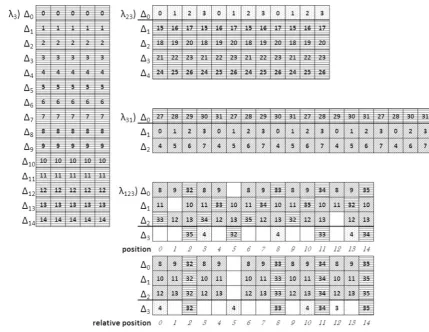
Throughout this section, we use a partition,, of time slots{0,1, . . . ,T −1}into setsl = {t |t ≡l mod g,0≤ t ≤T −1}for l =0, . . . ,g−1. We denote the number of sets serving clients with just one periodicity of qi byλi, the
number serving two separate periodicities, i and i, byλii,
for i = i and i,i ∈ {1,2,3}and the number serving all three periodicities byλ123. The number of clients with the periodicity of q1in setλ1,λ12,λ31,λ123are denoted by n10, n12, n13,μ1, respectively, and similar notation is used for the other periodicities. Observe that n1=n10+n12+n13+μ1, n2=n20+n21+n23+μ2and n3=n30+n31+n32+μ3, and denote the distribution of clients to sets inby n =
(n10,n20,n30,n12,n21,n23,n32,n31,n13, μ1, μ2, μ3). We now analyse the relationship between the number of the sets of each type, theλs, and the number of clients of
each periodicity distributed to these sets, in Lemmas10–12. We will then return to the issue of testing for the existence of a feasible solution in Theorem4.
Lemma 10 A feasible PPS instance with three distinct
peri-odicities, q1, q2 and q3, and gi 0 = 1 for i = 1,2,3
has a solution in whichλ12,λ23 andλ31 are each at most
one.
Proof Take an instance for which any such feasible schedule
has at least one ofλ12,λ23 andλ31 greater than 1. Take a solution with smallest possible max(λ12, λ23, λ31) = λ12 say. Letanddenote two of the sets serving clients with the periodicities of q1and q2.
Suppose that n1and n2clients with the periodicity of q1 and q2, respectively, are serviced together inl, and that n1
and n2clients with the periodicity of q1and q2, respectively, are serviced together inl. The schedule with the setl(or
l) may be viewed as a single schedule for the clients n1 and n2(or n1and n2) alone with the periodicity of q1 =q1/g and q2 =q2/g, respectively. Thus, gcd(q1,q2)= g12, and by Theorem1,
n1 q1/gg12
+
n2 q2/gg12
≤g12 and
n1 q1/gg12
+
n2 q2/gg12
≤g12. If n2/(q2/gg12) ≥
n1/(q1/gg12)
, then let n2 = min{q2/gg12
n1/(q1/gg12)
, n2}, and thus
n1+n1 q1/gg12
+
n2−n2 q2/gg12
≤g12 and
n2+n2 q2/gg12
≤
n2 q2/gg12
+
n2 q2/gg12
≤g12.
Hence, exchangingn2clients of the n2clients with the peri-odicity of q2 inl with all n1clients with the periodicity
of q1inl results in time slots in a set l serving only
clients with the periodicity of q2and12 has been reduced by 1. Ifn2/(q2/gg12)<
n1/(q1/gg12)
, then the same argument applies with clients inl exchanged with clients
inl, providing the required contradiction.
A similar result holds forλ123, as captured in Lemma11 below, but its proof is more lengthy and therefore relegated to Appendix 2.
Lemma 11 A feasible PPS instance with three distinct
peri-odicities, q1, q2and q3, and gi 0 = 1 for i =1,2,3 has a
solution in whichλ123≤1.
Lemma 12 A feasible PPS instance with three distinct
peri-odicities, q1, q2and q3, and gi 0 = 1 for i =1,2,3 has a
solution in whichλ12,λ23,λ31andλ123are each at most one.
Proof The result follows by taking a feasible solution which
satisfies Lemma 11, i.e. with λ123 ≤ 1, and applying the exchange described in the proof of Lemma10. Since no new
-set with three periodicities is created by the exchange,
λ123 is not increased, and the resultant solution satisfies Lemma12.
Theorem 4 For an instance with three distinct periodicities,
q1, q2 and q3, and gi 0 = 1 for i = 1,2,3 which has a
feasible solution, there exist an (non-negative) integer vector n =(n10,n20,n30,n12,n21,n23,n32,n31,n13, μ1, μ2, μ3), and non-negative integers,λ1,λ2,λ3,λ12,λ23,λ31andλ123 for which
3
i=0,i=i
nii+μi =ni for i=1,2,3
(10)
λ1+λ2+λ3+λ12+λ23+λ31+λ123 ≤g (11)
ni 0
qi/g
=λi for i=1,2,3
(12)
λ12, λ23, λ31 ≤1 (13)
n12
q1/(gg12)
+
n21
q2/(gg12)
≤g12λ12 (14)
n23
q2/(gg23)
+
n32
q3/(gg23)
≤g23λ23 (15)
n31
q3/(gg31)
+
n13
q1/(gg31)
≤g31λ31 (16)
and
λ123 ≤1 (17)
(1−λ123)(μ1+μ2+ μ3)=0 (18)
μ1 x
μ
2
g12−x
≤g23−1 (20)
g31−
μ1
x g23−
μ2
g12−x
≥μ3 (21)
for some integer x, 1≤x≤g12−1.
Proof Consider a feasible schedule for an instance of PPS
problem with three distinct periodicities, with the notation of-sets and number of clients, nii, as defined at the
begin-ning of this section. For the solution to be feasible, the total number of-sets required can be no more than g, as cap-tured by (11). We consider each type of-set in turn: those with clients of one, two and then three different periodicities. Without loss of generality, we may assume from Lemma12
that there is no more than one-set for clients with each possible combination of two or three periodicities within the set, implying (13) and (17).
The -sets with just clients of a single periodicity, qi
say, can each service up to qi/g clients by Lemma3. The
number of sets required to schedule the clients associated with ni 0,λi 0, is thereforeni 0/(qi/g)as given by (12) for i =1,2,3.
Consider-sets with clients of two different periodicities. Ifλ12 =0, then (14) holds for n12 =n21 =0. Otherwise,
λ12 =1, and n12 and n21 clients with the periodicity of q1 and q2, respectively, are serviced together in a single-set. From the result of Theorem 1 applied for periodicities of
q1/g and q2/g,
n12 q1/(gg12)
+
n21 q2/(gg12)
≤g12λ12
as given by (14). Similar expressions hold for the other two pairs of periodicities, and are given by (15) and (16), respec-tively.
Finally, consider a-set with clients of three different periodicities. Ifλ123 = 0, then there is no set with clients of each of the three periodicities,μi = 0 for i = 1,2,3,
and inequalities (18), (19), (20) and (21) hold for x = 1. Otherwise,λ123 = 1, (18) holds, and the μ1,μ2 andμ3 clients with the periodicity of q1, q2 and q3, respectively, are serviced in a single-set. From Theorem3applied for periodicities of qi = qi/g for i = 1,2,3, the inequalities
(19), (20) and (21) hold for some integer x, 1≤x≤g12−1, completing the proof.
5 Feasibility test for three distinct periodicities
In this section, we develop a polynomial test for feasibility, based upon the results of Theorems3and4. The feasibility test systematically searches for a vector n to satisfy con-straints (10)–(21) of Theorem4. In doing so, it reveals infor-mation about a feasible solution, where one exists. However,
it is convenient to reserve the lengthy construction of the feasible solution itself for a separate algorithm presented in the next section. The feasibility test, FeasTest, is developed in two parts. We first present a subprocedure, RedFeas, for finding an integer vector n withμ1 = μ2 = μ3 = 0, for reduced instances. Then, we extend this algorithm to cover the general case, where gi 0andμi 0for i =1,2,3 may take
non-zero values.
Algorithm RedFeas: Test for the existence of a feasible schedule with
μ1 = μ2 = μ3 = 0, for the reduced problem with three distinct
periodicities
Input: q1, q2, q3, n1, n2, n3
Output:(λA,nA)=(λA,n
10,n20,n30,n12,n21,n23,n32,n31,n13)
Code:
1. Initialization
g ← gcd(q1,q2,q3), g12 ← gcd(q1,q2)/g, g23 ←
gcd(q2,q3)/g, g31←gcd(q3,q1)/g,
nA←(n1,n2,n3,0,0,0,0,0,0),
λA←3
i=1ni/(qi/g).
2. Establish a solution with minimum number of sets with
clients of one or two periodicities only
Forδ=0,1, . . . ,min{n1/(q1/gg12), g12−1}, 2.1 Set n12,λ12and n21
n12←min{n1, δq1/(gg12)}.
If n12=0, thenλ12←0 and n21←0. Otherwiseλ12←1 and
n21←min{n2, q2/g−
q2/(gg12)n12/(q1/gg12)}. 2.2 Set n23,λ23and n32
n23←R(n2−n21,q2/g).
If n23 =0 orn23/(q2/gg23) = g23or
n3=0, thenλ23←0, and n23←0 and
n32←0.
Otherwiseλ23←1 and
n32←min{n3, q3/g−
q3/(gg23)n23/(q2/gg23)}. 2.3 Set n31,λ31and n13
n31←R(n3−n32,q3/g).
If n31 =0 orn31/(q3/gg31) = g31or
n1=n12, thenλ31←0, and n31←0 and
n13←0.
Otherwiseλ31←1 and
n13←min{n1−n12,q1/g−
q1/(gg31)n31/(q3/gg31)}. 2.4 Set n10, n20and n30
n10←n1−n12−n13.
n20←n2−n21−n23.
n30←n3−n31−n32. 2.5 Identify an improved solution
n←(n10,n20,n30,n12,n21,n23,n32,n31,n13).
λ← n10/(q1/g) + n20/(q2/g) + n30/
(q3/g) +λ12+λ23+λ31. Ifλ < λA, thenλA←λand nA←n.
3. Return(λA,nA)and stop.
Lemma 13 Consider an instance with gi 0 = 1 for i =
1,2,3, for which there exists a feasible solution withλ123= 0. Then, Algorithm RedFeas returns an integer vector n
with μ1 = μ2 = μ3 = 0 corresponding to a feasible solution.
Proof Observe that Algorithm RedFeas produces a solution
of a particular form. It considers all possible values for n12 which satisfies (22). Then, all other values are determined iteratively as follows: nii for i,i =1,2,3,i = i in Step
2.1–2.3 as in (23)–(27) below, followed by n10, n20, n30 in Step 2.4 as in (28)–(30). Therefore, Algorithm RedFeas tests for all solutions of this form.
n12 =n1orδq1/gg12for someδ∈ {0,1, . . . ,g12−1} (22)
n21 =
0 if n12=0
min{n2, q2/g−q2/(gg12)n12/(q1/gg12)} otherwise (23)
n23 =
0 if R(n2−n21,q2/gg23) > (g23−1)q2/(gg23)
R(n2−n21,q2/gg23) otherwise (24)
n32 =
0 if n23=0
min{n3, q3/g−q3/(gg23)n23/(q2/gg23)} otherwise (25)
n31 =
0 if R(n3−n32,q3/gg31) > (g31−1)q3/(gg31)or
n1=n12 R(n3−n32,q3/gg31) otherwise (26)
n13 =
⎧ ⎨ ⎩
0 if n31=0
min{n1−n12,q1/g−q1/(gg31)
n31/(q3/gg31)} otherwise
(27)
n10 =n1−n12−n13 (28)
n20 =n2−n21−n23 (29)
n30 =n3−n31−n32 (30) Now take a feasible solution n = (n10,n20,n30,n12,n21, n23,n32,n31,n13,0,0,0)withλ123=0, for which without loss of generality,λ12 ≤1,λ23 ≤1 andλ31 ≤1 by Lemma
12, and λ23 is as small as possible and for this minimum
λ23value,λ31is as small as possible. We now show that this feasible solution withλ123=0 can be modified to one which satisfies (22)–(30).
We first modify n12 and n21, if required. If λ12 = 0, then n12 and n21 remain unchanged at 0 (i.e. we set
n12 = n21 = 0). Otherwise, λ12 = 1 (and n12 ≥ 1 and n21 ≥ 1). By (14) of Theorem 4, we may increase n12 up to n12 = min{n1, (q1/gg12)n12/(q1/gg12)} and n21 to n21 = min{n2, q2/g −q2/(gg12)n12/(q1/(gg12))}, respectively, without increasingλ. Observe that n12and n21 satisfies (22) and (23), respectively.
We now modify n23and n20, having determined n21. Sup-pose thatλ23 = 0 (and n23 = 0). If R(n2−n21,q2/g) >
(g23−1)q2/(gg23)(andλ23 =0), then n23is left unchanged at 0 and n20 modified to n20 = n2 − n21, satisfying (29) without increasing λ2 (since n21 ≥ n21). If on the other hand R(n2−n21,q2/g) ≤ (g23−1)q2/(gg23), then we modify n23 to n23 = R(n2−n21,q2/g) and n20 to
n20 = n2 −n21 −n23 preserving (29), which results in
λ23 =1 andλ2is decreased by one, leavingλunchanged. Thus, (24) is satisfied for the modified solution in the case whenλ23 =0, for the original solution. Now suppose that
λ23 = 1 (and n23 ≥ 1). Then, by hypothesis, there is no feasible solution for given λ12 value, with λ23 = 0. The λ2 value is unaffected by increasing n20, if neces-sary, to n20 =q2/gn20/(q2/g)from (12) of Theorem4. Thus, n23 may be decreased to n23 = n2−n21−n20 = R(n2−n21,q2/g) > 0 satisfying (24) and reserving (29), without increasingλ.
We now modify n32. Recall that n23 = 0 only in the case when n23 = 0 (and n32 = 0) and we then leave n32 unmodified, i.e. we set n32 =0, without increasingλ. Now suppose that n23 ≥ 1. By (15) of Theorem 4, we modify n32 to n32 =min{n3, q3/g−q3/(gg23)n23/(q2/gg23)} without increasingλ. Thus, n32satisfies (25).
We now modify n31and n30given n32to satisfy (26) and then (30), respectively. The validity of the modification fol-lows by the same argument as used above for n23 and n20, but for the permitted indices, sinceλ31 (as well asλ23) is selected by as small as possible.
Finally, we modify n13 and n10. In the case that n31 = 0, n31 = 0 and n13 = 0 in the original feasible solution, and we set n13 = 0 and n10 = n1−n12 −n13 without increasingλ. Now suppose that n31≥1. By (16) of Theorem
4, we may modify n13 to n13 = min{n1−n12, q1/g − q1/(gg31)n31/(q3/gg31)}and n10to n10 =n1−n12−n13 without increasing λ. Thus, n13 and n10 satisfies (27) and (28), respectively.
We now develop an algorithm allowing a-set with three periodicities. By Lemma11, it is sufficient to explore all com-binations of constructing at most one−set with three peri-odicities. We now give a formal description of the algorithm. Observe thatμ1,μ2andμ3are each bounded by n. By Lemma9, finding an integer x in Step 4 can be done in O(n). Therefore, the overall complexity of FeasTest is O(n4).
Lemma 14 Consider an instance for which there exists a feasible solution. Then, Algorithm FeasTest returns an
inte-ger vector n, for whichλ12,λ23,λ31 and λ123are each at
most one for the corresponding reduced problem.
Proof Taking a feasible solution for any given instance. By
Theorem2, there is a corresponding feasible solution to the reduced problem instance, n say. We make another instance by lettingni = ni −μi for i = 1,2,3. Then, since there
exists a feasible solution for the original (reduced) instance, there must be a feasible solution withλ123 =0 for the new (reduced) instance. By Lemma13, a feasible solution with