Rochester Institute of Technology
RIT Scholar Works
Theses Thesis/Dissertation Collections
11-15-2012
Beyond ology
Denise Anderson
Follow this and additional works at:http://scholarworks.rit.edu/theses
This Thesis is brought to you for free and open access by the Thesis/Dissertation Collections at RIT Scholar Works. It has been accepted for inclusion in Theses by an authorized administrator of RIT Scholar Works. For more information, please [email protected].
Recommended Citation
ROCHESTER INSTITUTE OF TECHNOLOGY
A Thesis Submitted to the Faculty of
The College of Imaging Arts and Sciences
School of Art
In Candidacy for the Degree of
MASTER OF FINE ARTS
BEYOND OLOGY
by
Denise Anderson
Thesis Approval
Thesis Title:
Beyond Ology
Thesis Author:
Denise Anderson
Chief Advisor: Carole Woodlock
Date:
Associate Advisor: Elizabeth Kronfield
Date:
Associate Advisor: Keith Howard
Date:
Associate Advisor: Eileen Feeney-Bushnell
Date:
Department Chairperson: Carole Woodlock
Acknowledgements
Table of Contents
Title Page 1
Acknowledgement 3
Table of Contents 4
Abstract 5
Introduction 6
My History 8
Printmaking 14
Cast Glass 18
Conclusion 22
Abstract
Introduction
This is my story, the story of a collector, a self-imposed score keeper of cause and effect, and of an artist who embraces the act of inventory as a process of making. All of these preoccupations and interests are the framework from which I developed a body of work for my thesis study. The processes of seeking and acquiring, categorizing and sorting, list making and documentation, are intrinsic elements in my work. As a young child I became acutely aware of my environment, my relationship to my surroundings and the reality of reaction to actions. As a practicing artist today this cognitive awareness is the foundation of my studio practice and the perfect bridge to my earlier fascination of environmental concerns. All of these interest and concerns manifest in the creation of the work for this thesis exhibition in which I focused specifically on the issues of global warming and the impact humans have on the environment.
The purpose of this thesis support paper is to provide a written context for the artwork created for my thesis exhibition Beyond ology. The installation was comprised of a series of four-color intaglio type prints and a cast glass sculpture. In seeking out media to best express my visual aesthetic, I explored a wide variety of materials, but the choices of non-toxic printmaking and glass were perfect because I felt that they added additional layers of information to the work. The fact that the printmaking process was an environmentally safe one was something that spoke to my concern for the natural world and the fragility the glass lent itself to the tension and unease I wanted to convey to my viewer.
Spiral Jetty, Robert Smithson, 1970 Floor, Do Ho Suh, 1997 - 2000
Additionally, I was influenced by the work of several environmentalists including John Muir, whose concerns 100 years ago, mirror my own today. His influence helped me to consider the every day issues that may be shared across generations. I also appreciated the social recognition that Al Gore has garnered for environmental causes in his book and film, “An Inconvenient Truth”.
The intent of my thesis was to create a body of work that would visually, artistically and emotionally explore the relationship between humans and the impact we have on the environment. As inhabitants of our planet at this point in history it is easy to turn a blind eye to the consequences of our actions. My goal was to create imagery that draws the viewer in and exposes them to a scientific “truth” that would awaken within them a sense of respect and responsibility to the planet. It is my hope that this experience will help me define the way in which I can continue to have a visual dialog that speaks to memory, mapping and the interaction of humans on the environment.
Most people are on the world, not in it – having no conscious sympathy or relationship to anything about them – undiffused separate, and rigidly alone like marbles of polished stone, touching but separate.
My History
I have always been interested in science, nature and numbers. My father was a strategic planning analyst in the airline business. Math was ever present in our daily lives as well as all the specific accouterments that are required for that profession. My father’s office drawers and briefcase were a constant and rotating source of potential art materials. He had different types and colors of graph papers, specialty pens and pencils, highlighters, and white-out (at that time called Snopake) in pastel colors of yellow, pink, green, blue and the standard white. As a young child I was captivated by all the efforts and details that went into the projects my father worked on after dinner. I found myself endlessly fascinated by all the supplies and the graphs that he filled with different colored numbers and diagrams. These graphic notations seemed like a secret language that only a chosen few were able to comprehend. I realized early on that I saw something different. I remember sneaking into the family room to steal pieces of discarded graph paper and any unattended writing utensils I could get my hands on. I would hide these stolen treasures in my room until the following day when my dad was at work and I could create my very own nonsensical, but in my opinion, important creations.
notably, I remember looking down on the sidewalk and seeing a shoebox filled with dead purple-bellied lizards.
I remember seeing butterfly chrysalis hanging on the chain link fence, wiggling back and forth as the butterfly was ready to make its appearance in the world. It was such a delight to be able to witness the folded up butterfly arduously push and rip its way out of the cocoon, flapping its wings until they were rigid and it was able to take flight safely away from my grimy hands. I remember collecting butterfly cocoons and keeping them in a jar in my room decked out with sticks and an assortment of leaves and grasses for food, waiting for them to hatch. I never got to see a single one hatch in my carefully prepared homemade terrariums and after a few pointless attempts; I traced my problem back to the collection of these potential treasures. I remembered how hard it was to remove them from the fence and how it was so easy crush the crispy and delicate shells when doing so. It was at that time that I began to understand that the reason they would never be “born” was because I was too rough with them. The crushing and killing of the butterflies was happening because I wanted to have something that did not belong to me, rather than allowing them to live outside in nature where they belonged. I was just eight years old when I started to have a very real appreciation for the fragility of nature and recognition of how my selfishness resulted in the death of those butterflies. I realized that I had stolen something from nature and also from everyone else who would not have the opportunity to see the butterflies.
presence of the spilled chemicals. This meant that due to the length of time the area had been exposed to the chemical spill, a new microenvironment had been created. The data that I was wading through was happening on such a microscopic level that I could easily have felt dislocated and distanced from the results. This, however, was not the case, because I realized that the evidence I was seeing in my data would continue up the food chain and affect more and more organisms. This brought back the memory of my backyard hunting days and the sad conclusion that I had arrived upon many years ago while waiting fruitlessly for those butterflies to hatch. It instilled in me a huge amount of guilt and a feeling of responsibility to inform others of the role that we play, both positively and negatively in our changing environment.
I enjoyed the autonomy of the work in research, but the data results left me with an overwhelming sense of dread for our environment. The results of my research revealed that the damage humans had already done was now its own driving force and there was very little that could be done to stop its momentum. I felt that as we humans on this planet continued to make great strides in technology we were at the same time under the mistaken impression that we were better able to manage our impact on the earth than our predecessors. What I realized was that rather then being able to fix the past environmental damage done, my experiences had exposed me to the fact that these “fixes” were creating even more harm. I was disappointed with how callously humans acted and the abuse we doled out, with little to no concerns for other inhabitants with whom our space was shared. Confident in our role as the ‘superior’ species, we were blind to the demise, suffering and loss of hundreds and thousands of living things.
How narrow we selfish conceited creatures are in our sympathies! How blind to the rights of all the rest of creation!
My disenchantment with the research in the lab was contrasted by the lucky fortune to possess an old Cannon AE-1 by way of my grandfather. I quickly set about the task of taking pictures on my first totally manual camera, documenting nature. I had seen my father treat his own camera as a precious and somewhat intimidating contraption. Armed with the insane thought that I could figure it out without instruction, I set about taking pictures. I promptly realized that I was failing miserably, but stubborn as always, I could not let this camera get the best of me. I enrolled in a black and white photography class at the local community college and fell into a groove with the development and printing processes. These came naturally to me. I found it was possible to achieve satisfying results if you followed the formula perfectly. The scientist in me had found a new niche. As my skills improved, so did my images. I began to develop a body of work and publicly exhibit. A whole new world was suddenly awakened in me. The idea of expressing my views through an artistic medium held many new and exciting possibilities.
Emergence to Chaos, D. Anderson, 2002 Hand-made paper, wire inclusions
able to study alternate methods of visual language used. I found a sense of joy in curating the gallery shows; I was making contacts in the community and showing my work. I wanted to continue this path of expression and I decided to go back to graduate school to further my education.
The choice to attend Rochester Institute of Technology for my MFA in Studio Art was an easy one, as it was one of the few programs that could provide me with the flexibility to move between majors. This fluidity allowed me the opportunity to experiment with a variety of media and as the work evolved, I realized that the mediums of glass and non-toxic printmaking were the perfect way for me to illustrate my environmental concerns. I chose to use glass, not simply because it was available, but because the media itself spoke to the delicate and fragile nature I was trying to communicate with my viewer. The execution of the four-color intaglio type print was a non-toxic approach that showed a layering of images where the hand of the artist was clearly evident.
Printmaking
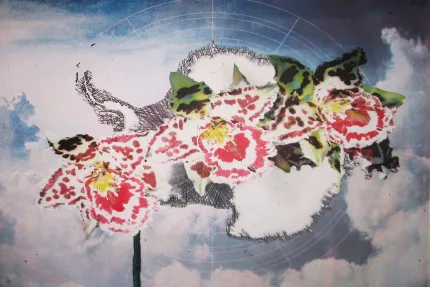
The life and death of my orchids made them a perfect metaphor for my two-dimensional work. The overall goal for the execution of the non-toxic prints was to have photographic images of orchids that I had grown combined with scientific data that spoke to the fragility of nature. I worked digitally in Adobe Photoshop to collage images before settling on a format of orchids in the foreground with scientific data in a circular format centered in the print functioning as a bulls eye and cloud images in the background. This formula spoke to my desire to create a beautiful image that could seduce the viewer and expose them to scientific data relating to global warming. Although abstracted, this information could be further investigated if the viewer desired.
The technique used for the printing of these images is a Non-Toxic Printmaking technique developed by Master Printmaker Keith Howard, which he articulated as the Four-Color Inversion Intaglio-Type. This Intaglio-Type technique is one in which the photo-polymer film ImagOn is used. “Four Color” refers to the CMYK (Cyan, Magenta, Yellow and Black) mode in which most color images are mechanically printed and the term “Inversion” refers to the position of the plate and paper in the printing process.
For this process, digital color images were separated into the four channels, one for each color (cyan, magenta, yellow and black), utilizing Adobe Photoshop. A transparency is created for each channel and is printed on an ink jet printer to be used as a stencil for exposure of each plate. Plates were laminated ahead of time with the ImagOn photo-polymer film and then exposed to a light source using a UV exposure unit. The plates were then developed in a solution of water and sodium carbonate, which is commonly known as soda ash. This development creates the grooves in the film, which change size depending on the values found in the original image and function to hold the ink when printing.
printing process, and rather than using Cyan, Phalo Blue was used and Crimson Red was substituted for the Magenta. These substitutions create a more realistic aesthetic in these prints rather than the digital and offset CMYK prints.
The Four-Color Inversion Intaglio-Type technique is unusual in execution of the printing and registering process. For this process the paper is placed first on the press bed and the plates are then placed on top, facing down to assist in registration. The printmaker is able to see through the transparent plates and line them up with the image previously printed on the paper. The paper is soaked and blotted at the beginning of the printing process using the wet on wet method. The four plates are printed one after the other, in order from lightest to darkest: yellow, red, blue, and black resulting in a final full color image.
Insignificant Populace was the first in the body of prints and it utilized a photograph of one of my own pink Phalionapsis Orchids. The flower is juxtaposed with a stylized and abstracted image of a graph representing the tree of life with another photograph of clouds in the background. Phylogenies are the study of the evolutionary development and history of a species or the higher taxonomic grouping of organisms. I used this idea to speak to the amount of time humans have been on this earth in relation to the huge amount of damage that we have done throughout that same time frame.
Human Demise was the second in the series and depicted a yellow and rust colored Dendrobium Orchid combined with a circular graph of the human genome. The use of part of the human genome functioned to relate the image to each and every person’s individual responsibility in the demise of the environment.
Depletion of Truth was the third piece in the series and used a green and white Paphiopedilum Hybrid Orchid combined with a circular graph representing the hole in the ozone.
For presentation, the Four-Color Inversion Intaglio Type prints were framed with mats and frames that I constructed. They were hung in a small alcove in the gallery with the circular graphs all lined up functioning as portholes into another world. This allowed the viewer to see graphs as an alternative window into a kinder and gentler environment. The photo-collaged images combined with the four-color intaglio process allowed for a natural transition from the computer to the print process. Keenly aware from past experiences as a scientist, gallery director and visual artist I was compelled to ensure that conceptually the images worked as individual pieces and also as a cohesive body. The individuality was achieved by referencing specific ideas of time, human responsibility and aspects of global warming and the cohesive nature was achieved through the repeated use of orchids, clouds, bulls-eye graphs, scale, and medium.
Insignificant Populace, 2006
Human Demise, 2006
Four Color Inversion Intaglio-Type, 24 x 18”
Depletion of Truth, 2006
Delicate Imbalance, 2006
Four Color Inversion Intaglio-Type, 24 x 18
Cast Glass
[image:19.612.74.504.93.380.2]. . . and they stand waiting, (detail) 2006
Cast glass, Sheet glass, Metal and rub-on lettering
. . . and they stand waiting, 2006
The glass casting process has numerous steps. The first step was to create a positive form out of clay, allow it to dry and then spray it with clear spray paint. Once the spray paint was dry, this positive was then used to produce a rubber mold. After the rubber had cured and the positive clay form was removed, this mold could be used to reproduce the original form using hot wax. The new wax forms could be removed from the mold while they were still flexible and be slightly altered. When the wax forms were solid, a plaster silica mold was made over the positive wax form. When the plaster silica molds had cured, they were placed over a steamer to remove the wax from the form leaving a void that glass frit could be placed into. The molds were placed into a kiln to dry, and then filled with a mixture of frit and powdered glass. The kiln temperature was increased to a temperature of 1200 degrees where the glass becomes viscous and can fuse together to fill the entirety of the void. Once this has occurred the kiln temperature is lowered slowly to 900 degrees to anneal for many hours, known as “soaking”. At the completion of the “soaking” time the kiln temperature is slowly brought down to room temperature. This process results in the creation of a kiln-cast glass forms.
The experimentation in glass casting resulted in the ability to control the color, texture and overall feel I was seeking. The gallery alcove was a fitting space for the prints to surround the cast glass sculpture . . . and they stand waiting. The layout of the collection of work caused the viewer to walk or “float” around the iceberg of glass as they moved throughout the space. This type of interaction spoke to the isolation and tension that the forms would have in a potential situation where a portion of an icecap might have slid off of Greenland and was now “floating” them to their unfortunate demise.
. . . and they stand waiting, 2006
Conclusion
The world is big and I want to have a good look at it before it gets dark.
-- John Muir
In conclusion, I was satisfied overall that the work created for this thesis clearly express my original intent of delving into the relationship between humans and the environment they inhabit. I was able to successfully create visual imagery that drew attention to issues of environmental abuse. The integration of scientific data and nature imagery was an effective method to highlight the fragility, beauty and destructiveness of human interaction to the planet. My goal was to create a body of work that was conceptually riveting, visually captivating, and technically sound. Each of the pieces was as important as the next and contributed wholly to the dynamics of a strong and cohesive body of work.
The work expressed a sense of loss for the quality of the environment, each piece drawing the viewer in and exposing them to scientific information while allowing them to question their own responsibility in the cause. I wanted the viewer to be seduced into looking further into the deeper meaning of each piece, realizing what was being visually expressed in a non-confrontational manner. And perhaps most importantly, I want each of the inhabitants of this planet to have an awareness of the current environmental issues that we each cause in our daily lives, motivating them to participate in the steps necessary to break this destructive cycle. If we each do our part, our negative impact can be greatly lessened, leaving a sounder environment for those who follow. Each of the pieces had subtle clues to allow the viewer to absorb the information, and find their own responsibility in the cause.
References
Browing, Peter. John Muir in His Own Words: A Book of Quotations. Great West Books. Lafayette, CA. 1988.
Garrett, Laurie. The Coming Plague. Penguin Books, New York, 1994.
Gore, Al. An Inconvenient Truth. Rodale, New York, 2006.
Howard, Keith. The Contemporary Printmaker: Intaglio-Type and Acrylic Resist Etching. Write-Cross Press: New York. 2003.
Lemonick, Michael D. “Has the Meltdown Begun?”
www.time.com/time/magazine/article/0,9171,1161231,00.html, February 19, 2006.
Mau, Bruce and Leonard, Jennifer and The Institute without Boundaries. Massive Change. Phaidon Press Limited, London, 2004.
Muir, John. http://www.sierraclub.org/john_muir_exhibit/writings/favorite_quotations.aspx Sierra Club: The John Muir Exhibit. San Francisco, CA.
Noronha, Charmaine. “Canadian Artic nearly loses entire ice shelf.”
http://news.yahoo.com/canadian-arctic-nearly-loses-entire-ice-shelf-214311365.html. Toronto, Canada. Associated Press. September 30, 2011.
Smithson, Robert. “Spiral Jetty.” Great Salt Lake, Utah. Dia Art Foundation. www.spiraljetty.org.