City, University of London Institutional Repository
Citation: Bannon, Alisha (2013). Early trauma and the developing mind. (Unpublished
Doctoral thesis, City University London)This is the unspecified version of the paper.
This version of the publication may differ from the final published
version.
Permanent repository link: http://openaccess.city.ac.uk/3021/
Link to published version:
Copyright and reuse: City Research Online aims to make research
outputs of City, University of London available to a wider audience.
Copyright and Moral Rights remain with the author(s) and/or copyright
holders. URLs from City Research Online may be freely distributed and
linked to.
Early trauma and the developing mind
Portfolio for Professional Doctorate in Counselling
Psychology (Dpsych)
Alisha Bannon
City University
Department of Psychology
Table of Contents
Acknowledgements…………...………..………..1
Preface…...……….2
Part 1: The Research………..………..………4
Abstract………...………5
Chapter 1………...………...……….6
Introduction…………...………...6
Childhood sexual abuse (CSA)…..………....………...………..6
The psychological effects of CSA………...………7
CSA and relationships………...………8
The intimate couple relationship………...…...9
Interpersonal victimisation………...……….14
Physical and sexual victimisation………...….16
Relationships with offspring………...……...17
Relationships with other females………...……….20
Theoretical models of CSA……….……….21
Interpersonal Schema Theory………...…………..……..21
Traumagenic Dynamics Theory………...………..22
Contextual Behavioural Perspective………....…………...……...24
Developmental Psychopathological Model………...……..…25
Relationships from a psychodynamic perspective………...……..25
Fairbairn…………...………27
Winnicott………...……….………..28
Miller……….………...29
Bowlby……….………….………...30
Contemporary Relational Theorists……….………31
Summary……….……….35
Aims of research………..……….…………..………….….35
Chapter 2………...………..…..……..37
Methodology and Procedure……….………...37
Methodology………..………....….……….37
Research aims………..……….37
Research question……….…………37
Research Design……….………..…38
Rationale for using a qualitative research paradigm………...……….38
Philosophical underpinnings of IPA………...……….……40
Rationale for selecting IPA……….…….…44
Epistemological considerations………47
Reflexivity……….….………..……49
Epistemological reflexivity………..……49
Personal reflexivity……….….…51
The influence and significance of the psychoanalytical lens………...52
Validity………..…….….……….……54
Procedures………..…….….………58
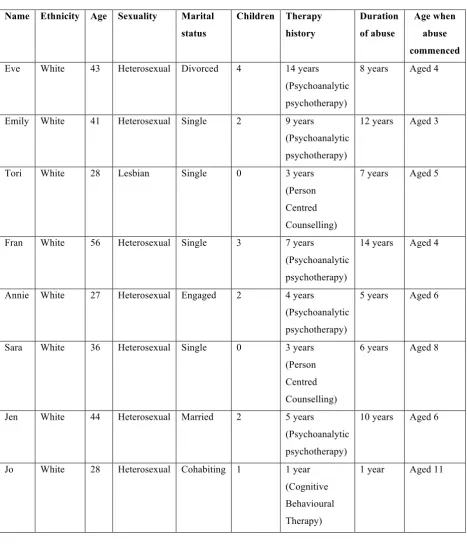
Participants and sampling considerations………58
Participants………….……….……….….………...…60
Demographic information………..………….………….……61
Interview schedule………...……….……62
Recording and transcription……….64
Ethical considerations………..…64
Confidentiality and anonymity……….…65
Adverse effects of participating in research……….…66
Transparency……..……….……….….……..….66
Consent………..……….……….….………..……..…67
Competence of researcher………...……….………67
Analytical strategy………..………….….…67
Analysis……….……….….…………...…..…69
Superordinate theme 1: Protection………..….……71
Subtheme 1: The need for protection……….…………..…71
Subtheme 2: The ways and means of protection………..…76
Subtheme 3: The repercussions of protection………..…81
Superordinate theme 2: Disturbed intercourse……….86
Subtheme 1: Resonance and echoes……….………86
Subtheme 2: Disturbed sexual relating………...…90
Subtheme 3: Communications that become lost in translation……...…..94
Superordinate theme 3: Responsive and unresponsive mothers and others….98 Subtheme 1: A world occupied with unseeing and unresponsive others…….98
Subtheme 2: The mother self………...102
Subtheme 3: A good enough experience………107
Chapter 4……….…………..……….….……..……112
Discussion………..………112
Exploring lived experience………...……….……….……112
The need for protection………..…114
The ways and means of protection……….119
The repercussions of protection………....….…121
Resonance and echoes………..……..……123
Disturbed sexual relating………125
Communications that become lost in translation……….…………..…128
A world occupied with unseeing and unresponsive others………....131
The mother self………...133
Experiencing a good-enough relationship……….……….…...136
Limitations and suggestions for future research………138
Implications for clinical practice of Counselling Psychology…………...142
Personal reflexivity………...………...……….….…146
References………..……….….…………..150
Appendix 1: Information about this research and consent form…….……...173
Appendix 2: Interview schedule………..…….……….….176
Appendix 3: Debrief………...………177
Appendix 4: Extract from transcript of participant 4………...179
Appendix 5: Example table of themes for Annie……...………182
Appendix 6: Example table of master themes………...…….183
Appendix 7: Ethics release form………...…...186
Part 2: Professional Practice……….……...……….193
A psychodynamic case study………...….194
Rationale………....194
Theoretical framework………...……194
Client profile……….……….………...…….196
The context for the work and the referral……….…………..197
The presenting problem……….……….197
Initial assessment and formulation……….198
Contract and therapy plan………..………200
Lead-in to the session……….…201
Transcript and commentary………..…..………202
The therapeutic ending and evaluation of the work………...213
What I learnt about psychotherapeutic practice………...…...215
Learning from the case about myself as a therapist………...…215
References………..………218
Part 3: Publishable article……….……….….220
The case of the attacking heart……….……..221
Abstract………...….………...………..………….221
Theoretical and research basis………221
Case introduction………..………...………..………….224
Assessment and presenting complaints………..……227
Case conceptualisation……….…….………….230
Course of treatment and assessment of progress………....233
The therapeutic plan and main techniques used……….235
The pattern of therapy and the therapeutic process………237
Changes in the formulation………..……….………….238
Complicating factors……….……….…240
Access and barriers to care……….242
Follow-up………...……….…..………….242
Treatment implications of the case……….243
Recommendations to clinicians and students……….…244
Acknowledgements
Preface
This doctoral portfolio is comprised of three separate pieces of work that relate to my training as a Counselling Psychologist; it also reflects my developing interests over the past three years. All three pieces of work are linked to the area of psychological trauma and relationships and all pieces are relevant to Counselling Psychology.
The first part of this portfolio focuses upon how sexual abuse in childhood may contribute to the difficulties experienced within the context of relating in adulthood. The second part takes the form of a clinical case study. It considers how sexual abuse in childhood may contribute to the difficulties experienced within the context of the self, and the self in relation to others. The third part explores how early conditions of growth and formative relationships with primary caregivers may contribute to the difficulties experienced within the context of self and object relating. Whilst each piece is separate, they are tied together with a common thread that ultimately seeks to explore the impact of early trauma on the developing child’s mind. The importance of early maternal/infantile bonds are emphasised throughout and attention is drawn to how experiences with formative caregivers can structure the child’s conscious and unconscious perceptions of the world and impact upon ways of relating.
Part 1: The Research
The qualitative research project explores in depth the lived experience of relating amongst women who have been sexually abused during childhood. More specifically, it offers an appreciation and understanding of the individual’s experience of relating and being in relationships along with the meaning and implications this has for their existence in the world. Data was collected using semi-structured interviews and analysed using Interpretive Phenomenological Analysis (IPA). The findings of the study are discussed in relation to existing literature and psychological theories. Implications for the practice of Counselling Psychology are also considered.
Part 2: Professional Practice
micro view analysis of the therapeutic work in the form of a process report. It explores the way in which traumatic childhood experiences such as sexual abuse and neglect, impact upon the individual’s sense of self and experience of others. It further considers the way in which abuse and neglect experienced at the hands of formative caregivers can shape and pattern the mind of the individual causing deep fear and mistrust. Consideration is given to the impact that wounded trust and damaging attachments can have upon the development of a therapeutic alliance and the implications for the clinical practice of Counselling Psychology are discussed within.
Part 3: Publishable Article
The final piece of work in this portfolio is a clinical case study written in accordance with the guidelines of the journal of ‘Clinical Case Studies’. The case of the attacking heart, documents my experience as a trainee working psychodynamically with a patient who was referred for treatment for hypochondriacal anxiety. The importance of early maternal/infantile bonds are emphasised, drawing attention to how experiences with important caregivers can structure the child’s conscious and unconscious perceptions of the world and impact upon ways of relating. It explores the relationship that exists between the individual’s internal and external worlds and considers how the therapist may be provided with valuable insight through paying close attention to their own countertransference. Implications for the practice of Counselling Psychology are discussed within.
Part 1: The Research
Understanding how women with a childhood sexual abuse
history experience relating and relationships: An Interpretive
Phenomenological Analysis.
Alisha Bannon
City University
Department of Psychology
Supervised by Dr Susan Strauss
Abstract
The area of childhood sexual abuse (CSA) has been the focus of increasing attention over recent years. In particular, research has emphasised that the sexual abuse of children is a major societal problem because of its high prevalence and devastating impact on the victimised child. A growing body of research suggests that the experience of CSA can have a lasting impact on adult interpersonal functioning. The majority of existing research studies have employed quantitative methodologies. This study explored in depth the lived experience of relating amongst women who have experienced CSA. A qualitative methodological approach was employed. Data was collected using semi-structured interviews and analysed using Interpretive Phenomenological Analysis (IPA). The participants were eight women who had experienced sexual abuse during childhood. The three superordinate themes that emerged from the data included: ‘Protection’, ‘Disturbed Intercourse’ and ‘Responsive and unresponsive mothers and others’. The women’s experience of relating was complex and multifaceted. Much of the women’s experience of relating was overwhelmingly negative as they depict worlds occupied with threatening and malevolent others who could invariably cause harm. A resounding communication evident throughout all of the dialogues appeared to suggest that present relating is inextricably bound to past experiences. The narratives revealed the difficulties and disturbance experienced within the context of relating and how the past has in some way formed an invisible template for present day relating causing terror, angst and uncertainty. This study presents rich descriptions of the lived experience of relating amongst this group of women. Implications for the clinical practice of Counselling Psychology are considered within.
Chapter 1
Introduction
Childhood Sexual Abuse
The area of childhood sexual abuse (CSA) has been the focus of increasing attention over recent years. In particular, research has emphasised the sexual abuse of children as a major societal problem because of its high prevalence and devastating impact on the victimised child (King et al., 2000). Briere (1992) defines CSA as a sexual act between an adult and a child in which the child is utilised for the sexual satisfaction of the perpetrator. Putnam (2003) highlights that an array of sexual activities are covered by the term CSA, including: intercourse, attempted intercourse, oral-genital contact, fondling of genitals directly or through clothing, exhibitionism or exposing children to adult sexual activity or pornography, and the use of the child for prostitution or pornography.
It is apparent that definitions in the literature vary according to the types of activities considered to be ‘sexual’ and the circumstances considered to constitute abuse (Draucker, 2000). It is important to take into consideration that this variation could partly explain the range of outcomes with regard to research findings in the area. Putnam (2003) highlights that the age and gender of the child, the age and gender of the perpetrator, and the number, frequency, and duration of the abuse experiences all appear to influence the outcomes. For these reasons, it can be seen that sexually abused children constitute a very diverse group with many degrees of abuse, which makes it difficult to generalise.
contact and non-contact) during childhood. One in six children aged between 11 and 17 years old (16.5%) had experienced sexual abuse, and almost one in ten children aged between 11 and 17 years old (9.4%) had experienced sexual abuse in the past year. Goldman and Padayachi (2000) posit that, despite a variety of methodological problems, most researchers believe that the rates reported in their studies are conservative figures.
The Psychological Effects of Childhood Sexual Abuse
The psychological effects of childhood sexual abuse have received increased attention over the past few years. Studies detailing the impact of childhood sexual abuse report a variety of different findings. Kendall-Tackett, Williams, and Finkelhor (1993) draw attention to the fact that the impact of CSA is highly variable, with some children showing no detectable negative effects whilst others show highly adverse reactions with severe psychiatric symptomatology.
Evidence suggests CSA is highly correlated with other factors, such as family dysfunction and family environment, that are known to place children at risk (McClure, Chavez, Agars, Peacock, & Matosian, 2008; Bhandari, Winter, Messer, & Metcalfe, 2011). Yancey and Hansen (2010) propose that a combination of personal factors (age, gender, attributions regarding the abuse, and treatment following abuse); familial factors (parental history of abuse, parental reaction to the disclosure, parental support of the victim, parental mental health, family stress); and abuse-specific factors (severity of abuse, duration of the abuse, and victim-perpetrator relationship) contribute to the symptoms displayed and experienced by victims.
The vast majority of research indicates that the personal and social costs of child abuse appear large. In particular, research has emphasised that the sexual abuse of children is a major societal problem because of its high prevalence and devastating impact on the victimised child (King et al., 2000). Cohen, Mannarino, and Knudsen (2005) report that child sexual abuse is associated with psychiatric difficulties which can potentially be long lasting and cause significant functional impairment. Saywitz, Mannarino, Berliner, and Choen (2000) found that sexually abused children have increased rates of depression, anxiety, posttraumatic stress disorder (PTSD), externalising symptoms, and substance use disorders. Kendler et al. (2001) report a significant causal relationship between CSA and psychopathology, and Noll, Horowitz, Bonanno, Trickett, and Putnam (2003) found that adults with a history of CSA reported greater incidents of rape, sexual assault, self-injurious behaviour, and subsequent trauma. In addition, Wyatt et al. (2002) found that CSA was associated with greater likelihood of developing a complex pattern of psychological dysfunction, such as higher rates of PTSD, depression, and self-destructive behaviours, including patterns of sexual risk behaviours and substance abuse.
More recently, research has indicated that a history of CSA is associated with higher rates of suicide attempts (Melhem et al., 2007; Roy & Janal, 2006) and that individuals who reported a history of CSA scored higher on measures of body dissatisfaction, eating disorders, suicidal ideation, physical abuse, physical neglect, emotional abuse, and emotional neglect than those who reported no history of CSA (Murray, MacDonald, & Fox, 2008). Furthermore, Draper et al. (2008) report that participants who experienced CSA were at greater risk of poor physical and mental health and that the effects of childhood sexual abuse appear to last a lifetime.
Childhood Sexual Abuse and Relationships
characteristic of a disorder, the clinical picture is more often one of an incomplete syndrome and, as such, we are urged to consider that a complex relationship exists between CSA as a form of ecopathology and the later symptomatology often expressed as a form of psychopathology (Davis & Petretic-Jackson, 2000).
A growing body of research suggests that the experience of CSA can have a lasting impact on adult interpersonal functioning. DiLillo (2001) notes that the parameters defining adult interpersonal functioning are broad as they encompass the survivors' relationships with particular individuals in their lives (spouses and partners, friends, children, and other family members), as well as the dimensions upon which those relationships might thereby be impacted (communication, trust, intimacy). It is suggested that CSA represents a risk factor for a range of interpersonal dysfunction among survivors, including problems with intimate partner relations, disturbed sexual functioning, and difficulties in the parental role (DiLillo, 2001).
The Intimate Couple Relationship
With regard to the intimate couple relationship, evidence does suggest that females who have experienced CSA can experience profound difficulty in areas relating to satisfaction with intimate partner relations, physical and sexual assault by partners, and partner characteristics (DiLillo, 2001).
psychopathology when attachment was controlled for. The authors concluded that preserving the capacity for closeness with attachment figures in adulthood appears to mediate the consequences of CSA on subsequent psychopathological outcomes.
A prospective study of childhood abuse and neglect by Colman and Widom (2004) examined the impact of early CSA on rates of involvement in adult intimate relationships and relationship functioning. This prospective study is particularly interesting and novel in its approach. It involved substantiated cases of child abuse and neglect from 1967 to 1971 matched on gender, age, race, and approximate family class with non-abused and non-neglected children and followed them prospectively into adulthood. In adulthood, 1179 participants (664 abused and 515 controls) (49% female and 51% male) of the original 1,575 participants (908 abused and neglected individuals and 667 controls) took part in a two-hour in-person interview, including a psychiatric assessment and a variety of standardised rating scales. The researchers note that phase two of the research took place approximately 25 years later and was designed to document long-term consequences of childhood victimisation across a number of outcomes. Measures of Child Abuse and Neglect, Family Background, Involvement in Intimate Adult Relationships, and Relationship Functioning were utilised. Results indicated that the intimate relationships of those who had experienced CSA differed from the non-abused participants with regard to relationship stability and quality. Both male and female adults who had been abused in childhood reported significantly higher rates of relationship dysfunction (walking out and divorce) than adults without abuse history. Abused women were also less likely than controls to perceive their current romantic partners as supportive, caring, and open to communication and were less likely than the non-abused women to be sexually faithful to their partners and spouses. Rates of involvement in intimate relationships also differed significantly by group, with abused adults being more likely to have cohabitated with romantic partners, and less likely than controls to be currently involved in a committed romantic relationship. As a general rule, these patterns of relation held true across maltreatment types and were largely unaltered by the introduction of family background variables.
is unique in its contribution in that it demonstrates the long-term effects of CSA on both males’ and females’ intimate relationships. The authors conclude that using a prospective cohort design involving court-documented cases of child abuse and matched controls provides strong support for the hypothesis that early childhood maltreatment negatively impacts upon an individual’s capacity to form and maintain healthy interpersonal relationships.
An interesting study by Walker, Sheffield, Larson, and Holman (2011) examined the relationship between a history of CSA for one or both members of a romantic couple and the level of contempt and defensiveness in their relationship. Using data from the Relationship Evaluation questionnaire (Holman, Busby, Doxey, Klein, & Loyer-Carlson, 1997), they analysed the responses of 10,061 couples. Measures of CSA, Contempt, and Defensiveness were utilised. Findings suggested that levels of contempt and defensiveness were greater when one or both partners had a history of CSA compared to those who did not report a history of CSA. Furthermore, the males' experience of CSA had a greater impact on their perceptions of self and partner's contempt and defensiveness than females' experience of CSA. The researchers concluded that CSA is a risk factor for relational challenges of satisfaction and stability for survivors and partners. Furthermore, they posited that the presence of CSA for either partner increases the likelihood that one will perceive oneself and one's partner as somewhat more contemptuous and defensive. One of the unique contributions of this study is that it involved both members of the relationship. Whilst previous studies have examined the intimate relationships of CSA survivors, most have focused mainly on the female reports of CSA. This study’s unique contribution lies in the fact that it not only included males who have experienced CSA, but, moreover, it examines couples in which both partners have experienced CSA.
Halford (2010) assessed whether CSA can be meaningfully classified into distinct classes and whether these classes are differentially associated with adult relationship problems. They assessed the childhood experiences and adult relationships of 1335 women (18-41 years). Measures of CSA, Family of Origin Dysfunction, and Women’s Adult Relationships were utilised. They identified three separate classes of CSA, including that perpetrated by a family member, a friend, or a stranger. Classes of CSA were further defined by the relationship between the victim and the perpetrator, the severity of the physical intrusiveness of the CSA act, the extent of coercion used in perpetrating the abuse, and whether the occurrence of CSA was disclosed to others. Findings from the study indicated that women who had experienced any class of CSA had higher rates of couple relationship problems than the non-abused participants. Furthermore, findings indicated that CSA perpetrated by a family member was associated with the highest risk for adult relationship problems, such as risk of marital separation and low relationship satisfaction.
According to Davis and Petretic-Jackson (2000), the trauma of CSA has implications in relation to two primary areas of interpersonal functioning, including intimacy and sexuality, within partner relationships. They suggest that, given that trust plays a predominant role in the development of relationships and the fact CSA represents a severe breach of trust, a child who has experienced CSA may continue to experience difficulty in trusting others in later relationships (Davis & Petretic-Jackson, 2000). It has been suggested that the individual’s experience in intimate relationships as an adult will be greatly impacted upon by the inability to form a trusting relationship (Davis & Petretic-Jackson, 2000).
A growing body of evidence has suggested that the experience of CSA can have a profound impact on the adult’s ability to trust in relationships, which subsequently impacts upon the establishment of intimate relationships (Jehu, 1989; James & Meyerding, 1978; Jehu, 1988; Silbert & Pines, 1983). Briere (1992b) notes that a fear, distrust, vulnerability, and ambivalence about interpersonal closeness is indicative of intimacy disturbance. Furthermore, Briere (1992b) notes that the impact CSA has on the individual’s ability to trust in the other can have a direct influence on the development and maintenance of intimate relationships.
Interpersonal Victimisation
Several studies have indicated that women who have experienced CSA are at greater risk of experiencing interpersonal victimisation as adults, particularly within the context of the couple relationship (Banyard, Arnold, & Smith, 2000; Chan, Yan, Brownridge, Tiwari, & Fong, 2011; Arata, 2002; Brownbridge, 2006).
Whilst this study provides additional evidence to support existing literature suggesting that women who have experienced CSA are at increased risk of later IPV, its unique contribution lies in the fact that it examines the directional patterns of aggression. By examining mutually inflicted violence, the study found that a significantly greater number of CSA survivors’ relationships were reported to have involved physical violence that at some point in time had been committed by both members of the couple. Such findings not only add to existing literature but also extend current knowledge and findings.
Similarly, a study by Feerick, Haugaard, and Hien (2002) indicated that a sexual abuse history is positively associated with women’s aggression towards their partners. More specifically, they reported that CSA was associated with both experiencing and perpetrating partner violence. This evidence adds to existing literature that has found that women who have experienced CSA are more likely than non-abused women to both commit (White & Widom, 2003) and receive (Ornduff, Kelsey, & O’Leary, 2001) intimate partner aggression.
Physical and Sexual Victimisation
To date there is much research to suggest that women who have experienced CSA are at greater risk of both physical and sexual victimisation in adult life. Several noteworthy studies have demonstrated such a link between CSA and higher risk of sexual and physical violence (Cohen et al., 2000; DiLillo, Giuffre, Tremblay, & Peterson, 2001; Kendler, Gardner, & Prescott, 2002).
Relationships with Offspring
Another important aspect of interpersonal functioning warranting attention is that of the relationship between adult survivors of CSA and their children. To date, evidence has suggested that a mother’s history of CSA may impact upon her ability to parent, parenting practices, and her interactions with her children (Banyard, 1997; DiLillo, Tremblay, & Peterson, 2000; Dixon, Browne, & Hamilton-Giathritsis, 2005; Dubowitz et al., 2001).
DiLillo, Tremblay, and Peterson (2000) posited that an important realm of interpersonal functioning that has received relatively little attention concerns survivors’ parenting practices and interactions with their own children. They examined whether early sexual trauma is related to heightened physical abuse potential in adulthood. They examined maternal history of sexual abuse, maternal anger, and adult physical abuse potential in a group of low-income mothers with and without a history of CSA. The community sample included 138 sexually abused mothers and a comparison group of 152 non-sexually abused mothers. Measures of Childhood Physical and Sexual Abuse, Interpersonal Functioning, and Parenting were utilised. Measures of parenting assessed the mother’s physical abuse potential, nurturance towards their children, unrealistic developmental expectations of children, and the frequency of smacking and general punishment. Findings from the study indicated that, even after controlling for mothers’ childhood experiences of physical abuse, CSA significantly predicted adult risk of physically abusing one’s own children. Furthermore, maternal anger was shown to be a mediator of the relationship between having been sexually abused during childhood and the potential for physically abusing one’s own children. The researchers concluded that CSA may be a risk factor for subsequent physically abusive parenting, while anger appears to play a significant role in mediating this relationship.
moderated the relationship between sexual abuse and parenting. The sample included 45 mothers who had experienced CSA. The child-rearing practices of the sample of sexually abused mothers were then compared with those reported by a community sample consisting of 717 non-abused mothers. Measures of CSA, Current Economic and Social Resources, Parenting Attitudes, and Parenting Practices were utilised. Findings indicated that those mothers who had been sexually abused as children reported significantly higher rates of permissive parenting practices than the non-abused mothers. Furthermore, findings indicated that high rates of permissive practices, as well as below average rates of authoritarian practices, were unique to those who had experienced CSA. The researchers concluded that, in accordance with their findings, CSA and its adult sequelae may have negative consequences for the parenting practices of survivors. More specifically, it was noted that survivors of CSA may experience difficulty with providing their children with appropriate structure, consistent discipline, and clear behavioural expectations. The authors explain that high permissive/low authoritarian parenting practices evident amongst this group of women could be due to the mother’s conscious effort to not repeat the abusive setting in which she grew up and so she avoids forceful or punitive parenting, or perhaps it could be because they lack confidence in their parenting skills. Nonetheless, the authors conclude that survivors’ high permissive/low authoritarian parenting approach may have considerable negative consequences for their children.
Additional studies have indicated that several other potential variables may mediate how a mother’s childhood sexual abuse experience influences her parenting practices. Findings suggest that potential mediators include social support (Marcenko et al., 2000; Meyers & Battistoni, 2003; Ruscio, 2001), the quality of the relationship with one’s partner (Alexander, Teti, & Anderson, 2000), depression (Roberts, O’Connor, Dunn, & Golding, 2004), anxiety (Roberts et al., 2004), anger (Dilillo, Tremblay, & Peterson, 2000) and overall psychological functioning (Marcenko, Kemp, & Larson, 2000).
sample of 913 mothers and their adolescent daughters, the researchers examined the daughters’ reports of adolescent sexual victimisation and their perceptions of their mothers’ parenting. With regard to parenting, four domains, including Connectedness, Communication Effectiveness, Monitoring, and Approval of Sex, were assessed. Findings indicated that mothers’ experiences of CSA were positively associated with their daughters’ sexual victimisation. The authors concluded that findings from their study appeared to suggest that, even in this highly functional community sample, mothers’ experiences of CSA were significantly associated with aspects of their parenting behaviour (greater permissiveness) and with their daughters’ experiences of adolescent sexual victimisation.
Indeed, a body of evidence does suggest that CSA has long-term repercussions for parenting relationships. Evidence suggests that mothers who have experienced CSA will engage in harsher parenting (Banyard, Williams, & Siegal, 2003; Mapp, 2010; Schuetze & Eiden, 2005), or very permissive parenting (DiLillo & Damashek, 2003) and inconsistent discipline and monitoring of their children (Collin-Vezina, Cyr, Pauze, & McDuff, 2005). Furthermore, previous research has suggested that maternal histories of CSA place offspring at risk for various forms of adversity (Avery, Hutchinson, & Whitaker, 2002; Noll, Trickett, Harris, & Putnam, 2009; Roberts, O’Connor, Dunn, & Golding, 2004).
Relationships with Other Females
Relatively little research has examined the impact of CSA on relationships beyond that of the intimate couple and parent-child. Interpersonal relationships take into account our being with friends, colleagues, and wider family circles. A limited body of research has examined such relationships. When considering CSA survivors’ relationships with female friends, DiLillo (2001) notes that many incest survivors harbour greater animosity towards other women than towards men. Similarly, Herman (1981) reports that incest survivors reported greater feelings of anger and hostility towards women than towards the actual perpetrator. Moreover, it was noted that this particular sample of women tended to idealise the men. Courtois (1988), Goodwin and Talwar (1989), and Herman and Schatzow (1984) all note the apparent absence of friendships in the lives of incest survivors due to anger, mistrust, and a general devaluation of women, including themselves.
Theoretical Models of Childhood Sexual Abuse
“The human condition is far too complex for any single theory to suffice.”
(Scharff & Scharff, 1998, p. 63)
Indeed, it is clear that, throughout the years, several different theoretical conceptualisations have been proposed to attempt to explain the relational difficulties experienced by those who were sexually abused as children. As Counselling Psychologists there is a need to integrate findings and propositions from all theories that have clinical application. Following an in-depth literature review, the author proposes that several different theories and frameworks that take into consideration the relational aspects of CSA have much to offer.
In recent years, several models have been offered which take into consideration the interpersonal nature of CSA, the varied effects experienced, and the implications for subsequent interpersonal functioning. Davis and Petretic-Jackson (2000) suggest that such models draw our attention to the fact that CSA may have a detrimental impact on interpersonal as well as personal functioning.
Interpersonal Schema Theory
Interpersonal Schema theory, as proposed by Cloitre (1998) and developed by other theorists, provides a possible explanation for the causal link between CSA and adult interpersonal dysfunction.
environments in ways that elicit similar deviant patterns, or to find that patterns for relating that were adaptive in an abusive environment are no longer effective in healthier contexts. Findings from several noteworthy studies have suggested that survivors of CSA are at increased risk of experiencing relational difficulties and increased risk of victimisation in adulthood. Jurgens (2005) posits that, in cases of childhood abuse by a trusted caregiver, such as a parent or other close relative, the early schemas of others are tarnished by fear, mistrust, and often guilt.
Several noteworthy studies have suggested that the survivor’s increased risk of experiencing relationship difficulties and re-victimisation may be explained by interpersonal schemas that are developed during the abuse (Janoff-Bulman, 1989; Jurgens, 2005; Cloitre, Cohen, & Scarvalone, 2002).
Cloitre, Cohen, and Koenen (2006) highlight that in line with attachment theory, our capacity for relatedness is modifiable and the presence of “even just one” positive care figure can produce a “protective shield” around a child and mediate negative outcomes (Lieberman & Amaya-Jackson, 2005). They emphasise the importance of the mother or other critical caretakers having a primary role in mediating or contributing to the child’s outcome following abuse.
Traumagenic Dynamics Theory
Finkelhor and Browne (1985) propose that four traumagenic dynamics, including traumatic sexualisation, betrayal, powerlessness, and stigmatisation, are thought to be the cause of the distinctive effects of CSA. They posit that “these dynamics alter children’s cognitive and emotional orientation to the world, and create trauma by distorting children’s self concept, world view, and affective capacities” (Finkelhor & Browne, 1985, p.531).
signifies a betrayal of the child by one or more important early objects” (p.22). Such early experiences are thought to throw the child into a state of uncertainty and unknowing, resulting in poor judgments in relation to who they should or can trust. It is thought that this can result in suspiciousness of intimate relationships, a tendency to isolate and avoidance of intimacy, which, ultimately, will impact negatively upon the individual’s potential to develop healthy intimate relationships (Davis and Petretic-Jackson, 2000).
The traumagenic dynamic of sexualisation takes into consideration that, as a result of sexual abuse, “a child’s sexuality is shaped in a developmentally inappropriate and interpersonally dysfunctional fashion” (Finkelhor & Browne, 1985, p.531). It is suggested that sexualisation can impact upon intimacy functioning in a variety of ways such as a heightened sexual awareness at an early age (Davis & Petretic-Jackson, 2000). Finkelhor and Browne (1985) suggest that one of the results of sexualisation is that it may lead to over-sexualisation of all relationships, may increase vulnerability to later sexual assault, and may also increase the possibility that these adults go on to sexually or physically abuse their own children (Finkelhor & Browne, 1985).
Powerlessness refers to “the process in which the child’s will, desires and sense of efficacy are continually contravened” (Finkelhor & Browne, 1985, p.532). Finkelhor and Browne (1985) note that, whilst the threat of harm can result in a greater sense of powerlessness, threats are not necessary for the dynamic to evolve. It is suggested that the dynamic of powerlessness is closely linked with later victimisation as it renders the individual unable to be assertive in later relationships. Davis and Petretic-Jackson (2000) suggest that it is commonplace for adult survivors of CSA to experience fear and anxiety in relation to lack of control as they may feel they have no control over what happens to them or their bodies.
stigmatisation (Davis & Petretic-Jackson, 2000). Furthermore, it is suggested that stigmatisation can impact heavily upon later interpersonal relationships as the individual may harbour deep feelings of being damaged and unworthy (Davis & Petretic-Jackson, 2000).
A Contextual Behavioural Perspective
Poulsney and Follette (1995) developed a theory of the interpersonal effects of abuse focusing on the role of emotional avoidance. They propose that the individual may employ the use of behavioural strategies as a means of temporarily avoiding or alleviating the distress caused by abuse-related experiences. It is thought that emotional avoidance behaviours such as dissociation, substance abuse, self-mutilation, denial and suppression are commonly used by those who have experienced CSA (Leitenberg, Greenwald, & Cado, 1992). However, it is posited that, whilst such behaviours do provide short-term relief, such coping strategies may interfere with optimum levels of functioning (Follette, 1994; Roth & Newman, 1993). Furthermore, it is suggested that, in an attempt to avoid stimuli associated with memories of abuse that occurred within the context of an interpersonal relationship, individuals engage in emotionally avoidant behaviours such as avoidance of affection (Follette, 1991). Poulsney and Follette (1995) note that, by avoiding relationships and intimacy, the individual may be left feeling socially isolated and dissatisfied within relationships.
Developmental Psychopathological Model
Cole and Putnam (1992) posit that early exposure to stressful life events such as CSA may impinge on internal working models of self and other. They identified two themes that underlie the long-term psychological difficulties associated with CSA. These include: deviations in the intrapsychic processes of defining, regulating, and integrating aspects of self; and deviations in the related ability to experience a sense of trust and confidence in others. Further to this, Cole and Putnam (1992) suggest that these difficulties in self and social functioning are reflected in: disturbances in the phenomenological sense of self, such as identity confusion; poorly modulated affect and impulse control, including a variety of self-critical and self-destructive behaviors; and insecurity in relationships, particularly distrust and suspiciousness.
Relationships from a Psychodynamic Perspective
The author proposes that object relations theory can provide valuable insight when trying to understand the relationship difficulties experienced by many survivors of CSA.
Greenberg and Mitchell (1983) propose that the term object relations refers to an “individuals’ interactions with external and internal (real or imagined) other people, and to the relationship between their internal and external object worlds” (p. 13). It is proposed that “people react to and interact with not only an actual other but also an internal other, a psychic representation of a person which in itself has the power to influence both the individual’s affective states and his overt behavioural reactions” (Greenberg & Mitchell, 1983, p.10).
Within object relations theory it is commonly thought that an interaction exists between our past and present interpersonal experiences. Object relations theory explains the way in which interpersonal experiences (self and object representations) are mentally reflected in images coloured with affect (Kernhof, Kaufhold, & Grabhorn, 2005). Greenberg and Mitchell (1983) state that these representations serve as “a kind of loose anticipatory image of what is to be expected from people in the real world” (p. 11). It is proposed that these representations, or inner working models as they are referred to in attachment theory (Bretherton, 1992), are an expression of the subjective processing of interpersonal experiences and interactions. Kernhof, Kaufhold, and Grabhorn (2005) propose that, depending on the subjective status of a person’s development, conscious and unconscious parts of the representations may fuse, forming conflict-laden internal relational images, and that, ultimately, these influence current relationships and interfere with the internalisation of new interactional experiences.
Various psychoanalytic theorists have contributed to a relational model theory with the aim of providing a rich and detailed account of the origins and development of relations with others. They emphasise how the different aspects of the process of human/infantile development provide frameworks that explain how our early life experiences and relationships come to influence our ways of relating in later life. Theorists such as Fairbairn (1943), Miller (1981, 1984), and Winnicott (1960a, 1960b) consider the relational aspect of development and the importance of early maternal/infant care. When considering the pathogenicity of traumatic events such as CSA, they emphasise that such early trauma signifies the betrayal of the child by one or more important early objects (Davies & Frawley, 1994). Psychodynamically orientated developmental theories, such as attachment theory proposed by Bowlby (1969, 1973), sit closely alongside such object-relations theorists emphasising the importance of early/infantile maternal bonds and bonds with significant caregivers throughout childhood. In relation to CSA, such relational/structural models emphasise that abusive behaviour, particularly by important early caregivers, represents a “psychic abandonment and profound betrayal of the child” (Davies & Frawley, 1994, p. 22).
Fairbairn
Fairbarin (1944) posits that the infant is primarily motivated by its need for relatedness and, as such, all development must be seen as taking place and deriving from this need. According to Fairbairn’s model of psychic organisation, the infant organises its internal world through a process of internalising experience with the outside world. Thus, in the case of actual external trauma such as sexual abuse, in an attempt to control overwhelming fear, anxiety, and disappointment, the child interjects the badness, internalising it and locating it within themselves. This primitive way of relating is the only way of managing the unmanageable that the child has at its disposal, but the result is that the child is left with an internalised bad object.
internal object relations the child attempts to protect what is good and satisfying and control what is not good and not satisfying. According to Fairbairn, the child does this through a process of separating the traumatic experience and relocating it inside (Gomez, 1998). At the heart of Fairbairn’s thinking is the child’s need for relatedness. This calls into question many of the aspects of relating and being of the child who has been sexually abused, as contact with carers or significant others has either been exploitative and abusive in nature or neglectful and rejecting. Given the need for relatedness, the child cannot reject his or her caregivers and so must turn then to the primary defence of splitting. This process of ‘splitting’ offers the child psychic protection and enables the child to continue relating to its external objects. Relocating the traumatic experience inside, or internalisation, offers the child control of what was originally deemed overwhelming and frightening. However, a price must be paid and, indeed, it is huge. Fairbairn (1943) highlights that:
“In attempting to control them in this way, he is internalizing objects which have wielded power over him in the external world; and these objects retain their prestige for power over him in the inner world. In a word, he is ‘possessed’ by them as if by evil spirits.” (p.67)
Winnicott
Winnicott (1952a) famously said:
There is no such thing as a baby…if you show me a baby you certainly show me also someone caring for the baby, or at least a pram with someone’s eyes and ears glued to it. One sees a ‘nursing couple’ (p.99).
In this statement Winnicott urges us to consider the idea that a baby does not exist on its own but in the context of a relationship with its caregiver. Operating within a relational/structural model Winnicott (1952) took as his frame of reference the relationship between the child and its caretakers, noting, “The centre of gravity of the being does not start off in the individual. It is in the total set-up” (p.99). Winnicott (1962a) emphasises the importance of describing babies in the earliest stages in relation to their mothers.
care but to displace it altogether. Winnicott (1958) explains that “the psyche attempts to disown the body which due to maternal neglect is felt to be a persecutor” (p.79). This ‘excessive mental functioning’ is the infant’s solution to ‘erratic mothering’ and part of the function of the pathological split-off mind is to take on responsibility for an environment that failed (Winnicott, 1958). This happens at a preverbal stage and so remains unconscious and unavailable to words or thought.
For Winnicott, relating and all that relating concerns will pose significant difficulty for the child who has not experienced stable and continuous care. Winnicott posits that, only through a continuous personal relationship which offers care and protection with ‘holding’, ‘handling’ and ‘object presenting’ can the ‘true-self’ emerge and develop. The true-self refers to the child’s spontaneous needs and way of being, and it is thought that fostering, protecting, and creating a safe environment for the true-self to grow enables the child to develop coherence and continuity. If the caring environment fails to provide the holding and protection that the child so desperately needs, the child must try to take over the caring environment so as not to become overwhelmed by the fear of ‘annihilation’, and instead of ‘going on being’, the child must hold itself together. However, Winnicott notes that this impinges upon the child’s spontaneous way of being and inhibits his or her ability to exist as a unified alive and authentic child. Furthermore, Winnicott adds that if such deprivation is prolonged and frequent throughout childhood, resulting in the child continuously resorting to such measures to hold and protect his or her self, then the resulting impact will be feelings of inauthenticity, unrealness, and fear of ‘going to pieces’. In the attempt to achieve wholeness, coherence, and continuity of self, the child will resurrect the semblance of a false self that hides the anguish. Winnicott (1965) states that the “development of a ‘False Self’ hides and protects the ‘True Self’ by complying with the environmental demands, taking over the caring environment that has failed” (p.133). It is noted that the false self is not a bad or fake attribute, but rather facilitates relatedness to others and protects the true self by being tuned to outer reality (Scharff & Scharff, 1998).
Miller
of thinking about the lengths a child must go to in order to survive. Miller emphasises the importance of care and protection in the child/parent relationship and highlights that the consequences of sexual abuse in childhood result in impaired development of the self and of an autonomous personality (Miller, 1988). Miller (1988) notes several reasons for this, highlighting that the abuse of a child by an important caregiver produces an ‘interlinking of love and hate’ given the child’s haplessness and dependence on caregivers. She explains how the child unable to rage and anger at caregivers due to fear of losing them interlinks love and hate, becoming ambivalent. As such, this becomes an important characteristic of later object relations. In addition, to survive, the child represses all memories of the abuse, but the repercussion of such repression is an impoverished personality. Furthermore, she highlights that due to repression the child is unable to remember and articulate the trauma. As such, this creates the need to articulate it in ‘the repetition compulsion’, meaning that repression actually reinforces the consequences of the trauma.
Bowlby
Attachment theory lends further support to the object relations literature. Bowlby (1989) notes that attachment theory originally developed out of the object relations tradition in psychoanalysis, and as it evolved it drew on concepts associated with evolution theory, cognitive psychology, ethology, and control theory. Attachment theory (Bowlby, 1973) has provided a framework for understanding how early interactions with primary caregivers can influence our experience of relating in adulthood.
If a child has experienced abuse or neglect, these early attachment bonds can become disrupted, leaving the child to suffer physiological as well as psychological effects (Davies & Frawley, 1994). If the primary caregiver is physically or emotionally unavailable, an anxious attachment may result which predisposes the individual to dependency and anxiety. When considering attachment behaviour, Alexander (1992) posits that it serves the survival function of protection, and is most apparent during periods of stress in early childhood. Ainsworth (1989) suggests that it is actually evident throughout the lifecycle.
Bowlby (1973) introduced the concept of the internal working model to explain how an infant will develop expectations about its own and others’ roles in relationships based on early experiences with the attachment figure. From an attachment perspective it is thought that the young child learns about affect regulation in the context of its early relationships. It is thought through early experiences with important caregivers the child will gradually develop internal representations of the self as worthy of care and attention (or not), and of others as trustworthy and available (or not) depending on the care received (Bowlby, 1969). Alexander (1992) proposes that “the internal working model is both affected by and comes to affect the types of interpersonal experiences that are encoded into the concept of self” (p. 186). Zeanah and Zeanah (1989) explain that the internal working model “governs how interpersonal information is attended to and perceived, determines which affects are experienced, selects the memories that are evoked, and mediates behaviour with others in important relationships” (p.182). Although attachment theory initially focuses on the child’s early relationships with important caregivers, Bowlby (1969) proposes that attachment processes continue “from the cradle to the grave” (p. 129).
Contemporary Relational Theorists
internalised relational bonds in childhood and adulthood (Davies & Frawley, 1994). Scharff and Scharff (1998) note that the degree to which relations between self and object are mutually caring and concerned has an impact on the vitality of the self and the quality of its relationships with others.
When considering the relational nature of CSA and the impact that such a trauma can have on a developing child’s mind, Boulanger (2002) explains that the traumatic experience becomes incorporated into the developing child’s mental structure and, subsequently, dealings with the world bear the trauma’s thumbprint. By defensively dissociating and forming split-off self-states which hold the trauma and the terror, the child is better able to engage in a world that is less threatening (Boulanger, 2002). The embodiment of trauma in different self-states offers protection but subsequently becomes part of self-experience (Boulanger, 2002).
When taking into consideration the relational context of sexual abuse, Mannion (2002) raises a very important question:
“If object relations has taught us that a close relationship is a vital and necessary context for human development and an essential part of a satisfying life, what then of the sexually abused person where trust is wounded, love distorted and closeness dangerous?” (p.146).
The sexual abuse of a child occurs within a relationship. Regardless of whether the perpetrator is known or unknown to the child, the child is experiencing direct contact with another human being. The child must also be viewed as part of a larger relational structure in that they are also experiencing relationships with parents, family, and school teachers who may have either failed to notice or failed to protect. Rolls (1996) highlights that, because of the relational structure in which abuse takes place, the child’s psychological, emotional, and physical sense of self is violated and, as such, bonds of trust are traumatically exploited.
but, ultimately, it results in emotional, physical, cognitive, and relational disturbances (Mannion, 2002).
The external reality of sexual abuse changes the child’s internal world in the deepest possible ways. In order to feel safe in the world and in oneself, the establishment of trust is crucial (Erikson, 1995). However, when a child is sexually abused, physical and emotional boundaries are violated and the child becomes overwhelmed and engulfed. As such, the child’s sense of integrity is damaged and trust is deeply wounded.
Reiker and Carmen (1986) explain how, following sexual abuse, the defensive process of disconfirmation and transformation will enable the child to alter reality and accommodate the family system. In order to survive the child relies on these defensive strategies to help transform his or her experience into something manageable. Whilst defensive strategies such as denial, displacement, and reinterpreting enable the child to navigate the reality of such an experience, the result is a lifetime dependency on mechanisms such as repression and disassociation (Mannion, 2002). Reiker and Carmen (1986) explain that the result of having to rely on defensive mechanisms and strategies in order to accommodate abuse is a completely disordered and fragmented identity. It is thought that disturbed relationships, inability to trust and behave in self-protective ways, and affective instability are expressions of a disordered and fragmented identity, the legacy of trying to accommodate abuse (Reiker & Carmen, 1986). Defensive compartmentalising initially used to accommodate the abuse in childhood poses problems in adulthood as the legacy of the abuse results in involuntary intrusions of the trauma or secondary elaborations (Herman & Van der Kolk, 1987).
maintain an outward sense of security at the price of inward insecurity and conflict” (p.65).
As a result of introjecting the badness, the child is left with intense rage, hate, anger, and anxiety that is unmanageable given that they are shouldering it alone. Without the help of an external other to help contain, process, and manage such feelings, the child must rely on the primitive defence of projection. The child, left with such overwhelming feelings of rage, hate, and anger also has the very real fear of loss of the other on which they rely for survival in the world. The only way to manage this reality is by internalising the anger in an attempt to preserve the other. Mannion (2002) explains how anger and rage must be forfeited for need, which ultimately creates a split. The child left with unmanageable feelings of rage, anger, and frustration fears them to be unacceptable and of a potentially destructive nature, and so compliance is developed. The object-relational perspective on trauma as proposed by Fairbairn (1943) and implied by Winnicott (1960a, 1960b) emphasises that “early trauma signifies a betrayal of the child by one or more important early objects” (Davies & Frawley, 1994, p.22). Fairbairn (1943) suggests that exploitative contact with caretakers has a significant impact on the child’s developing psyche. Davies and Frawley (1994) suggest that survivors “painstakingly erect the semblance of a functioning, adaptive, interpersonally related self around the screaming core of a wounded and abandoned child” (p.67). Winnicott (1965) suggests that, in situations where emotional needs have not been met, a child must develop a ‘False-Self’ with the primary aim of protection and defense of a more vulnerable ‘True-Self’.
and form the template for future experiences” (p.51). As Mannion (2002) so aptly puts it, “It is not just childhood that is lost but adulthood as well” (p.46).
Summary
It is evident from the literature that a childhood experience of sexual abuse can have a profound impact on the developing child’s psychological world, which is often carried forward into adulthood. The literature implies that CSA can have a major impact upon the survivor’s adult relationships. This is not surprising given that as human beings we are always in relation. We are social beings and, as evidence appears to suggest, we thrive and blossom when provided with the best conditions for growing. Love, care, affection, and a nurturing environment are not just an added extra, we need them to grow and to blossom. We need to feel safe in the world and feel safe in relation to the human beings around us. But what if our caretakers were not Care-ful; indeed, what if they caused us harm or failed to protect us from harm? The literature suggests that, for many, this can have a profound impact on our ability to trust, be intimate, and feel safe in relation to others.
Aims of Research
The aim of the current study is to explore in depth the lived experience of relating amongst women who have been sexually abused during childhood. More specifically, the current study aims to gain an appreciation and understanding of the individual’s experience of relating and being in relationships. The very essence is to hear in the women’s own words their experience of being in relationships and the meaning and implications this has for their existence in the world.
responses will be defined more by the participant and not structured around previous knowledge or researcher-led assumptions or topics (Smith, Flowers, & Larkin, 2009).
Research question
How do women who were sexually abused in childhood experience being in relationships with significant others and what are the meanings and implications of this?
Chapter 2
Methodology and Procedures
Methodology1 Research aims
The aim of the current study is to explore in depth the lived experience of relating amongst women who have been sexually abused during childhood. More specifically, the current study aims to gain an appreciation and understanding of the individual’s experience of relating and being in relationships. The very essence is to hear in the women’s own words their experience of being in relationships and the meaning and implications this has for their existence in the world.
I have chosen to use the term ‘significant others’ as opposed to specifically categorising relationships (i.e. parental, sexual, intimate, friends, and family). My reason for doing so is because the very essence of this study is to explore the individual’s experience and, as such, I wanted to remain as impartial as possible at this point. My aim was to pose the question in its simplest form to enable the participants to provide their own meanings and associations without too much direction from me. Smith, Flowers, and Larkin (2009) stipulate that such an approach can facilitate an appreciation of the participant’s priorities and the importance of what the participants talk about and bring to the focus of the interview. As such, the responses will be defined more by the participant and not structured around previous knowledge or researcher-led assumptions or topics (Smith, Flowers, & Larkin, 2009).
Research question
How do women who were sexually abused in childhood experience being in relationships with significant others and what are the meanings and implications of this?
1 This chapter was written in the first person in order to directly address the reader and to underscore the reflexive stance
Research Design
The present study employs a small-scale cross-sectional design. A qualitative methodological approach was employed. Data was collected using semi-structured interviews and analysed using Interpretive Phenomenological Analysis (IPA).
Rationale for using a qualitative research paradigm
A qualitative method of enquiry is proposed to explore the unique, subjective experience of relating amongst a group of women who have been sexually abused in childhood.
To date, there is a growing body of literature to suggest that the experience of CSA can have a lasting impact on relationships (Colman & Wisdom, 2004; Cherlin, Burton, Hurt, & Purvin, 2004; Holman, 2001; Browne & Finkelhor, 1986; Davis & Petretic-Jackson, 2000; Laing, Williams, & Siegel, 2006). A review of the literature demonstrates that research in the area is dominated by the use of quantitative methodologies which hold as their primary aim the identification and establishment of cause-effect relationships and the reduction of psychological phenomena to numerical values (Smith, 2008).
wondered if a qualitative methodology would satisfy such a hunger. I wondered if it could open up new doors and complement the existing literature and provide richness to our understanding. It could enable me to hear the voices, the spoken word, and the individual’s experience and, as such, provide a much deeper appreciation of the lived experience of these women. According to Walsh (1995), qualitative research works within an approach influenced by the researcher’s pursuit of meaning and truth, which is embedded within the topic of enquiry. Indeed, such thinking did appear to offer me a way of getting closer to the lived experience.
As McLeod (2003) highlights, the aim of qualitative research is to illuminate and clarify the meaning of social actions and situations and to gain understanding rather than explanation. Smith (2009) highlights:
“given that we tend to make sense of our social world and express that sense-making to ourselves and others linguistically, qualitative research emphasises the value of analytic strategies that remain as close as possible to the symbolic system in which that sense making occurs” (p.2).