City, University of London Institutional Repository
Citation: Pothos, E. M., Barque-Duran, A., Yearsley, J. and Hampton, J. A. (2016).
Patterns and evolution of moral behavior: moral dynamics in everyday life. Thinking and Reasoning, 22(1), pp. 31-56. doi: 10.1080/13546783.2015.1051585This is the accepted version of the paper.
This version of the publication may differ from the final published
version.
Permanent repository link: http://openaccess.city.ac.uk/id/eprint/11842/
Link to published version: http://dx.doi.org/10.1080/13546783.2015.1051585
Copyright and reuse: City Research Online aims to make research
outputs of City, University of London available to a wider audience.
Copyright and Moral Rights remain with the author(s) and/or copyright
holders. URLs from City Research Online may be freely distributed and
linked to.
For Peer Review Only
Patterns and Evolution of Moral Behavior: Moral Dynamics in Everyday Life
Albert Barque-Duran, Emmanuel M. Pothos, James M. Yearsley and James A. Hampton
Department of Psychology, City University London,
London EC1V 0HB, UK
Author Note
Please address correspondence regarding this article to Albert Barque-Duran, Department of
Psychology, City University London EC1V 0HB, UK. Electronic mail can be sent to
Acknowledgments
EMP was supported by Leverhulme Trust grant RPG-2013-004 and Air Force Office of
Scientific Research (AFOSR), Air Force Material Command, USAF, grant FA 8655-13-1-3044.
The U.S Government is authorized to reproduce and distribute reprints for Governmental purpose
notwithstanding any copyright notation thereon.
For Peer Review Only
Abstract
Recent research on moral dynamics (the processes and phenomena –collective or individual– by
which moral behavior and moral attitudes emerge, evolve, spread, erode or disappear) shows that an
individual’s ethical mind-set (i.e., outcome-based vs. rule-based) moderates the impact of an initial
ethical or unethical act on the likelihood of behaving ethically on a subsequent occasion. More
specifically, an outcome-based mind-set facilitates Moral Balancing (behaving ethically or
unethically decreases the likelihood of engaging in the same type of behavior again later), whereas
a rule-based mind-set facilitates Moral Consistency (engaging in an ethical or unethical behavior
increases the likelihood of engaging in the same type of behavior later on). The objective was to
look at the evolution of moral choice across a series of scenarios, that is, to explore if these moral
patterns (Balancing vs. Consistency) are maintained over time. The results of three studies showed
that Moral Balancing is not maintained over time. On the other hand, Moral Consistency could be
maintained over time, if the mind-set was reinforced before making a new moral judgment (but not
otherwise).
Keywords: prosocial choices, moral behavior, ethical mind-sets, ethical behavior, decision
making.
For Peer Review Only
Introduction
Moral Balancing vs. Moral Consistency
How do individuals deal with the ethical uncertainty in their lives? People are confronted
with a vast amount of moral scenarios to resolve, such as donating to charities, volunteering,
recycling, buying fair trade products, or donating blood. People have to regulate their moral
self-image while pursuing self-interest. Studies on moral self-regulation have convincingly
demonstrated that one’s recent behavioral history is an important factor in shaping one’s current
moral conduct (e.g., Monin & Jordan, 2009; Zhong, Liljenquist, & Cain, 2009) and two different
effects have been reported: Moral Balancing and Moral Consistency.
Moral Balancing (Nisan, 1991) suggests that engaging in an ethical or unethical behavior at
one point in time reduces the likelihood of engaging in that form of behavior again in a subsequent
situation (Merritt, Effron, & Monin, 2010; Sachdeva, Iliev, & Medin, 2009). To explain this type of
behavior, it has been argued that individuals tune their actions in such a way that their moral
self-image (which represents individuals’ moment-to-moment perception of their degree of morality)
fluctuates around a moral-aspiration level or equilibrium (Jordan, Mullen, & Murnighan, 2011;
Merritt et al., 2010). It is said that an individual’s moral-aspiration level does not equate to moral
perfection but rather to a reasonable level of moral behavior for that individual (Nisan, 1991).
Ethical and unethical acts respectively elevate and depress the moral self-image. Moral balancing
researchers argue that when the moral self-image exceeds the moral-aspiration level, the individual
feels “licensed” to engage in more self-interested, immoral, or antisocial behavior (i.e., moral
licensing). When the moral self-image is below the moral-aspiration level, people tend to
experience emotional distress (Higgins, 1987; Klass, 1978) and become motivated to enact some
corrective behavior (i.e., moral compensation). In contrast to Moral Balancing, Moral Consistency
(Foss & Dempsey, 1979; Thomas & Batson, 1981) suggests that after engaging in an ethical or
unethical act, individuals are more likely to behave in the same fashion later on. This pattern is
For Peer Review Only
explained in terms of a psychological need to maintain one’s self-concept (Aronson & Carlsmith,
1962), self-perception effects (Bem, 1972), or the use of behavioral consistency as a decision
heuristic (Albarracín & Wyer, 2000; Cialdini et al., 1995).
Outcome-Based Mind-Sets vs. Rule-Based Mind-Sets
Recent research on moral dynamics addressed an unresolved question, that is, under which
conditions each pattern of moral behavior can occur. Cornelissen et al. (2013) showed that an
individual’s ethical mind-set (Outcome-based vs. Rule-based) moderates the impact of an initial
ethical or unethical act on the likelihood of behaving ethically on a subsequent occasion and, thus,
affects the pattern of moral behavior seen. The idea of ethical mind-sets comes from two
frameworks on moral philosophy: consequentialism and deontology (Singer, 1991). Past work has
demonstrated that this distinction is not exclusively philosophical, but that individuals consider it
meaningful when reflecting on their behavior and are flexible in the use of either type of moral
pattern (Uhlmann, Pizarro, Tannenbaum, & Ditto, 2009).
A consequentialist perspective considers whether an act is or is not morally right, depending
on the consequences of that act (Sinnott-Armstrong, 2008). An individual understands an ethical
behavior “because it benefitted other people” and an unethical behavior “because it hurt other
people”. In other words, when taking a consequentialist perspective, one behaves according to an
Outcome-based mind-set. By contrast, a deontological perspective implies that what makes an act
right is its conformity to a moral norm (Alexander & Moore, 2008), i.e., principles that impose
duties and obligations, such as not to break promises or not to lie. In this vein, an individual
understands a behavior as ethical “because she followed an ethical norm or principle” or a behavior
as unethical “because she did not follow an ethical norm or principle”. In other words, when taking
a deontological perspective, an individual adopts a Rule-based set. An outcome-based
mind-set is thought to facilitate Moral Balancing; on the contrary, a rule-based mind-mind-set facilitates Moral
Consistency (Cornelissen et al. 2013).
For Peer Review Only
Other studies in the literature support this idea of ethical mind-sets and how they affect
moral behavior or under which conditions the mentioned patterns of moral behavior can occur. For
example, Conway and Peetz (2012) previously showed that recalling moral behavior in a particular
manner moderates, in a similar way as individual’s ethical mind-sets, the impact of an initial ethical
or unethical act on the likelihood of behaving ethically on a subsequent occasion. They showed that
recalling prosocial behavior in a concrete fashion (focusing people on the specifics of the action
itself, i.e. the way in which they have helped and supported another person) reminded people that
they have already fulfilled moral obligations and allowed them to relax subsequent efforts. In other
words, recalling past good deeds in a concrete fashion (like in a consequentialism framework,
outcome-based mind-set) might license more selfish, compensatory behavior, and likewise recalling
past selfish behavior in a concrete fashion might motivate people to compensate through more
prosocial behaviors (Moral Balancing).
In contrast, abstract recollections of past moral behavior (activating moral identity concerns,
motivating people to uphold their sense of self by acting in identity-consistent ways, Blasi, 1980,
Reed et al., 2007) induced people to act prosocially, whereas abstractly recalling previous selfish
behavior induced people to act selfishly. In other words, recalling past selfish behavior in an
abstract fashion (like in a deontological framework, rule-based mind-set) might encourage people to
maintain one’s self-concept or self-perception through their moral behaviors (Moral Consistency).
Evolution of Moral Dynamics
One consequence of considering the role of moral self-image in moral behavior is that it
forces one to think of moral choices as a sequence, rather than in temporal isolation. Moral and
immoral actions occur in the context of prior moral and immoral actions and the idea of moral
self-image provides a connecting thread across these instances. All the relevant findings so far have
been produced using an experimental paradigm based on a 2-stage scenario: a manipulation part
For Peer Review Only
and a response part. As our aim was to understand how the Moral Balancing and Moral Consistency
behaviors evolve in time (we call this evolution moral dynamics), we used a novel experimental
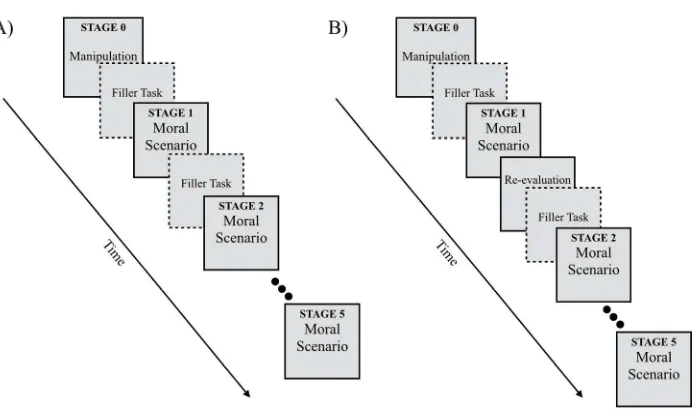
paradigm, involving 5 stages (See Figure 1). The importance of studying the evolution of moral
dynamics is of clear significance. We designed a novel empirical paradigm, based on the previous
successful techniques: participants received two manipulations at the beginning of the experiment:
(a) one to induce them to adopt a specific mind-set (outcome-based vs. rule-based) and (b) another
to recall an action of a particular morality (ethical vs. unethical). Then, they were presented with a
series of moral scenarios (5 stages) that were used to measure the likelihood of engaging in a
prosocial behavior. This is the first study to look at the evolution of moral choice across a series of
scenarios.
---
INSERT FIGURE 1 ABOUT HERE
---
Our objective was to explore the hypothesis that mind-set, Moral Balancing and Moral
Consistency are maintained over time (indeed, otherwise, it would be hard to appreciate their
psychological significance). We know from previous research that mind-set can influence relatively
immediate moral behavior (Cornelissen et al. 2013), but it remains unknown whether mind-sets can
be sustained over time and so have a persistent influence on moral behavior. This experimental
design assumes that participants are in a specific mind-set. That is, it is meaningful to ask about the
sustainability of patterns in moral dynamics, only for those participants who can be said to be
clearly in a particular mind-set at the outset. Without this assumption, the contrast between the
hypotheses of interest cannot be made (i.e., if a participant cannot be said to be in an outcome-based
mindset, it is meaningless to ask whether there is moral balancing which lasts over time). Therefore,
this consideration will need to be taken into account for the statistical analysis.
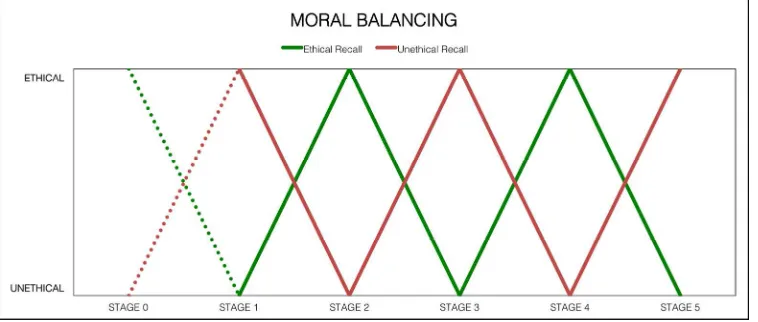
The conflicting hypotheses regarding how moral behavior evolves in time are illustrated in
Figures 2 and 3. Both putative patterns of moral behavior are illustrated over a sequence of moral
For Peer Review Only
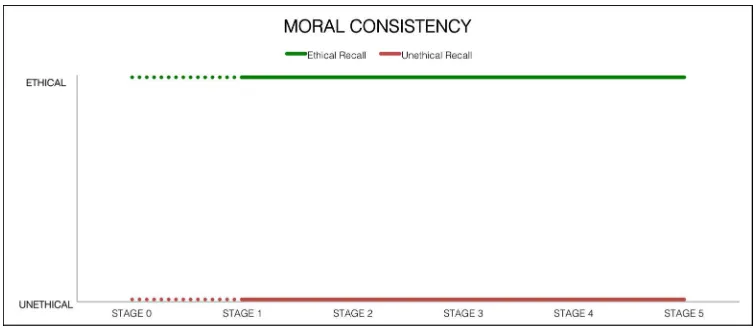
scenarios or stages. We called the ‘Zig-Zag pattern’ the idealized pattern for a Moral Balancing
behavior. By analogy, we called ‘Flat pattern’ the idealized pattern for a Moral Consistency
behavior. We then used these idealized patterns to motivate the analyses for the results obtained in
Experiments 1, 2 and 3. For Moral Balancing, an initial ethical manipulation (such as recall of an
ethical action) at Stage 0 should be followed at the next stage by an unethical choice. However at
the subsequent stage, the previous unethical choice should now promote a more ethical one. The
result is a predicted oscillation between ethical and unethical choices, as the participant tries to
maintain a balance (Figure 2). Alternatively, Moral Consistency should lead to the persistence of an
initial choice, as with each Stage the participant becomes more and more confirmed in the belief of
their consistent moral position, be it either ethical or unethical (Figure 3).
---
INSERT FIGURE 2 ABOUT HERE
---
---
INSERT FIGURE 3 ABOUT HERE
---
In order to study the evolution of moral tendencies and the perseverance of mind-sets we ran
three experiments plus a pilot study. In the pilot study we identified the most suitable moral
scenarios to use in the main experiments. Experiment 1 allowed us to collect baseline data, as a
control group, for comparisons with the results of the subsequent experiments. Experiment 2 was
used to replicate the results in the moral dynamics literature (Cornelissen et al., 2013; Jordan,
Mullen, Murningham, 2011) and to pursue the novel question of how the tendency to behave
morally evolves over time. Finally, in Experiment 3, we aimed to explore again how the two
possible patterns of moral dynamics evolve over time, but in this case, we added a manipulation
before each new moral scenario, to test if ethical mind-sets are maintained if reinforced.
For Peer Review Only
Pilot Study
The objective of the pilot study was to identify suitable moral scenarios for the main
experiments. We were looking for five moral scenarios such that they would (1) be perceived to
have high levels of morality, (2) have a similar frequency of engagement (prosocial behavior) and
(3) be perceived similarly in terms of emotionality, that is, they would produce a similar affective
reaction. Measuring the affective reaction is important, as Szekely and Miu (2014) showed the
existence of an influence of emotional experience on moral choice scenarios.
Participants
Twenty experimentally naïve students at City University London received course credit for
participating in the study.
Materials and Procedure
The experiment, designed in Qualtrics, lasted approximately 15 minutes. Eleven novel
moral scenarios were initially created. For each scenario we tested the perceived morality of the
choice of actions using a 7-point scale: -3=very immoral, 3=very moral (How moral do you think
this behavior is?), and the prosocial behavior measured as the likelihood of engaging in an
(un)ethical behavior on a 7-point scale: 1=very unlikely, 7=very likely; (Jordan, Mullen, et al.,
2011). Participant responses on perceived morality and likelihood of engagement were the main
dependent variables in our pilot. Also, we tested the perceived emotionality of the scenarios
presented, measured with the (SAM) Self-Assessment Manikin (Bradley & Lang 1994). We used
the SAM method as it is a non-verbal pictorial assessment technique that directly measures the
pleasure, arousal, and dominance associated with a person's affective reaction to stimuli presented,
in this case moral scenarios. From the results of this pilot, we then chose five situations for the main
Experiments 1, 2 and 3 (one for each of the five stages in the experiments). To do so, we computed
the average and the variance of our 3 measures: perceived morality, likelihood of engagement and
emotionality, for each of the scenarios. Then we chose the five scenarios with the highest scores in
For Peer Review Only
perceived morality and with similar (intermediate) scores in likelihood of engagement and
perceived emotionality measures (see the Supplemental Material available online for details).
Experiment 1
The aims of the first study were to test the novel experimental paradigm and collect baseline
data. As this was a control condition, there was no manipulation of the participants’ mind-set
(outcome-based vs. rule-based) nor the recall of a moral deed. We used Prosocial Behavior, that is,
the likelihood of engaging in an (un)ethical behavior, as the dependent measure, using an
experimental paradigm involving 5 stages. The experiment lasted approximately 30 minutes. In the
absence of any manipulation, we expected intended behavior not to be biased towards ethical or
unethical choices.
Participants
Atotal of 104 participants, all of them US residents, were recruited on-line and received
$0.90 for doing the task.
Materials and Procedure
The study was designed in Qualtrics and run on Amazon Mechanical Turk. There is some
evidence that data obtained via Mechanical Turk demonstrate psychometric properties similar to
laboratory samples (Buhrmester, Kwang, & Gosling, 2011). First, participants completed a filler
task (10 trivia questions ≈ 1.6min per filler task) before responding to two items, one about their
likelihood of engaging in a prosocial behavior (STAGE 1) and another about their likelihood of
engaging in a leisure activity that simply acted as a distractor. Then, participants completed another
filler task, like the first one, before responding to 2 more items, again, one about their likelihood of
engaging in another prosocial behavior (STAGE 2) and in another leisure activity. Subsequently,
participants completed the same procedure three more times, until STAGE 5. The order of
presentation of the moral scenarios on each stage, as well as the filler tasks, were randomized across
participants.
For Peer Review Only
Results and Discussion
A one-sample t-test was run to determine whether the likelihood of engaging in a prosocial
behavior was biased towards a more ethical or unethical tendency. We defined a score of 4.0 (the
midpoint of the 1-7 scale we used) as neither moral nor immoral behavior. We accepted the null
hypothesis that the population mean was not different from 4.0; (M = 4, SD = 1.96); t(103)=0.00,
p=1.0. The range of means across scenarios was from 3.5 to 5. That is, in the absence of any
manipulation, prosocial choices were not biased towards ethical or unethical behavior, as intended.
Experiment 2
The objectives here were twofold. First, we wanted to replicate the results in the moral
dynamics literature, that an Outcome-based mind-set leads to Moral Balancing, whereas a
Rule-based mind-set leads to Moral Consistency. The motivation to do so was to validate the
experimental approach. Second, Experiment 2 employed a multi-stage procedure, so allowing us to
pursue the novel question of how the tendency to behave morally evolves over time. In contrast to
Experiment 1, we manipulated the participants mind-set (outcome-based vs. rule-based) and the
morality of an action that they were asked to recall, at the beginning of the experiment. The
experiment lasted approximately 35 minutes.
Participants
Atotal of 200 participants, all of them US residents, were recruited on-line and received
$0.90 for doing the task.
Design and Procedure
The experiment was designed in Qualtrics and run on Amazon Mechanical Turk. Ethical
mind-set (outcome-based vs. rule-based) and the ethicality of an initial recalled act (ethical vs.
unethical) were both manipulated between participants. The induction of ethical mind-sets was the
same as used in Cornelissen et al. (2013), so we only briefly summarize it here (see the
Supplemental Material available online for details). To induce the appropriate mind-set, we
For Peer Review Only
provided instructions that defined ethicality as either a function of consequences or in terms of rule
compliance, and then provided three prototypical examples. Subsequently, we asked participants to
provide an example of a behavior—not necessarily their own—that was ethical or unethical,
because of either its consequences or its rule compatibility (depending on condition). This
procedure aimed to induce the intended mind-set in participants, before they finally reflected on
their memory of the last action with moral valence.
There were therefore four conditions: (1)Outcome-Based/Ethical recall,
(2)Outcome-Based/Unethical recall, (3)Rule-Based/Ethical recall and (4)Rule-(2)Outcome-Based/Unethical recall. In the first
one, our participants were instructed to think about a behavior that was ethical (“because it
benefitted other people”). In the second group, participants were instructed to think about a
behavior that was unethical (“because it hurt other people”). In the third group, participants thought
about a behavior that was ethical (“because you followed an ethical norm or principle”) and in the
fourth group, participants were instructed to think about a behavior that was unethical (“because
you did not follow an ethical norm or principle”).
We used Prosocial Behavior, as in all the other experiments, as the dependent measure.
After the manipulation (STAGE 0), participants followed the same experimental paradigm as in
Experiment 1: they completed a filler task before rating their likelihood of engaging in a prosocial
behavior (STAGE 1) and then repeated the same procedure until STAGE 5. The order of
presentation of the moral scenarios on each stage, as well as the filler tasks, were randomized for
each participant.
Results and Discussion
Replication of previous studies. Mean intention to perform the prosocial action at the first
stage of the procedure is shown in Figure 4. As predicted, when given an Outcome-based mindset,
the recall of an unethical act led to Moral Balancing and an increased intention to perform the moral
action. When given a Rule-based mindset, the reverse pattern was observed. This result was
confirmed with an ANOVA, which showed a significant interaction between Type of Mind-set and
For Peer Review Only
Type of Ethical Recall, F(1,44) = 7.12, p < 0.01, but no main effect of Type of Mind-set, nor of
Recall, (both F < 1). Independent samples t-tests were employed to explore the interaction. In the
outcome-based mind-set condition, participants who recalled an unethical act were more likely to
engage in a prosocial behavior (M = 4.54, SD = 1.66), than those who recalled an ethical act (M =
3.82, SD = 1.69), t(91) = −2.06, p = .04. In other words, participants with an Outcome-based
mind-set showed a Moral Balancing effect. By contrast, in the Rule-based mind-mind-set condition,
participants who recalled an ethical act were more likely to engage in a prosocial behavior (M =
4.36, SD = 1.68) than those who recalled an unethical act (M = 3.6, SD = 1.74), t(93) = 2.14, p =
.03. In other words, these participants showed a Moral Consistency effect.
---
INSERT FIGURE 4 ABOUT HERE
---
Evolution of moral dynamics. We first applied some selection criteria to the data in order
to properly examine the hypotheses of interest. A restriction of the sample was needed since, as we
previously mentioned, the mind-set procedure would not be expected to work equally well for every
participant, and our research hypothesis is only meaningful for participants assumed to be in
specific mindsets. The experimental design proposed in this paper assumes that participants behave
in a certain way. That is, it is meaningful to ask about the sustainability of patterns in moral
dynamics only for those participants who can be said to be clearly in a particular mind-set at the
outset. Without this assumption, the contrast between the hypotheses of interest can not be tested.
The issue of the effectiveness of the mind-set procedure is separate from that of whether, given that
the induction of mind-set was effective, the mind-set’s influence on moral decisions perseveres
across stages. So we eliminated the cases that were considered far from the intended behavior in
For Peer Review Only
STAGE 1, i.e., the participants whose behavior did not conform to the expectations associated with
the mind-set manipulation (Cornelissen et al., 2013).
As the scale of our dependent variable was 1-7, we eliminated participants with a prosocial
behavior rating after the mindset manipulation that was in the wrong direction relative to the neutral
midpoint of 4 and the mean of their group. Specifically, for the two conditions which we intended
to use to test the persistence of a prosocial attitude (those with means over 4 in Figure 4), all
participants with a rating of less than 4 were excluded. Thus in these two conditions all remaining
participants had responded as predicted to the combination of mindset and recall manipulations.
Similarly for the two conditions which were to test the persistence of non-prosocial attitudes (those
where the group mean was below 4 in Figure 4), all participants with a rating greater than 4 were
excluded. As a consequence, 19 out of 45 cases were excluded from condition 1, and 15 out of 48,
16 out of 47, 19 out of 48 cases were rejected from conditions 2, 3 and 4 respectively.
While we believe the preselection manipulation to be an essential condition for a meaningful
test of our hypotheses, for completeness we also present an analysis for the whole sample in
Appendix 1. In fact, no conclusions are altered by considering the entire sample.
We examined the levels of Prosocial Behavior throughout all stages, first comparing the two
mind-set conditions within the same analysis and then analyzing the Outcome-based and the
Rule-based conditions separately, in order to study the evolution of moral tendencies across STAGES
[1-5]. We assessed the results against the idealized predictions in Figures 2 and 3.
First, we ran a three-way ANOVA, with Type of Ethical Recall (2 levels: ethical recall and
unethical recall, between participants), Type of Mind-set (2 levels: outcome-based and rule-based,
between participants) and Stage (5 levels: five stages, within participants), on the dependent
variable (likelihood of engaging in a prosocial behavior). There was no main effect of type of Type
of Ethical Recall, no significant effect of Type of Mind-set, and no main effect of Stage, (all F < 1).
There was a significant interaction between Recall and Type of Mind-set, F(1,25) = 20.786, p < .01,
For Peer Review Only
but not between Recall and Stage nor between Type of Mind-set and Stage, (both F < 1). Finally,
there was a significant interaction between the three factors, F(4,100) = 13.9, p < .01.
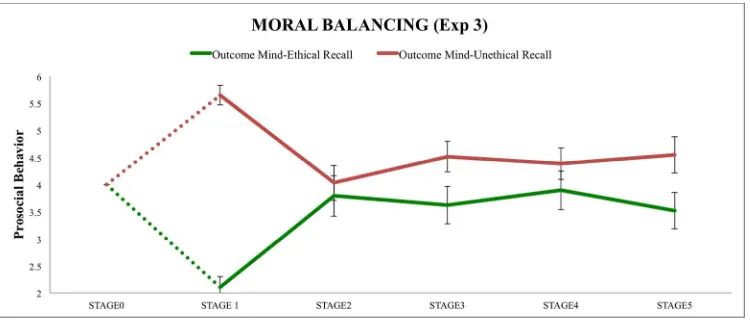
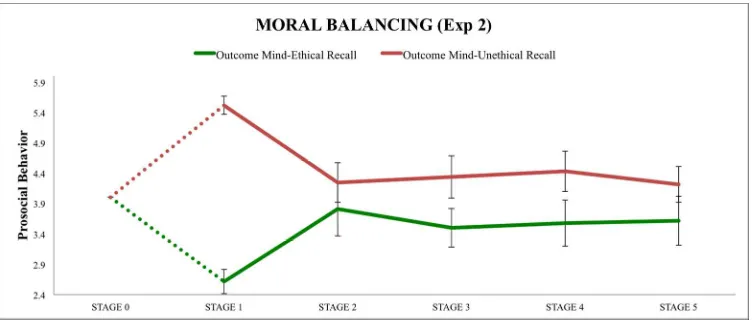
Evidence for Moral Balancing. In Figure 5, we can see how for the Outcome-based
mind-set group, the ‘Zig-Zag pattern’ is broadly evident across STAGES 0 and 1, as we have seen in the
previous section (this finding replicates previous research, Cornelissen et al., 2013; Jordan, Mullen,
Murningham, 2011). (For Stage 0 we have inserted imaginary data points to represent the ethical or
unethical recall manipulation). The pattern across stages [0-1] concerns the initial mind-set
manipulation with an ethical recall (with an assumed initial value of 3 from the 1-7 prosocial
behaviors scale) or an unethical recall (with an assumed initial state of the subject with value 5) and
the first moral scenario. What happened across the rest of stages?
---
INSERT FIGURE 5 ABOUT HERE
---
We ran a mixed two-way ANOVA with Type of Ethical Recall and Stage (1-5), on the
dependent variable (likelihood of engaging in a prosocial behavior). Minimally, Moral Balancing
would be evidenced by no main effect of Recall, but a significant interaction between Recall and
Stage. There was a main effect of Type of Ethical Recall, F(1,25) = 13.1, p < .001, no significant
effect of stage, F < 1, and a significant interaction between the two factors, F(4,100)=5.57, p < .01.
Inspection of Figure 5 makes it clear that the interaction is just a result of prosocial choice
converging towards an average level by Stage 2, after which it flattens out across the two conditions
of ethical recall.
We then analyzed the evolution of prosocial behavior between STAGES [1-2] to see if, at
least, the Moral Balancing pattern was maintained for just one more stage. A two-way analysis of
variance (ANOVA) with Type of Ethical Recall and Stage as independent variables indicated a
main effect of Recall, F(1,25)=23.2, p < .01, and no main effect of Stage, F(1,25) < 1. The results
For Peer Review Only
also revealed a significant interaction between Type of Ethical Recall and Stage, F(1,25) = 12.0, p =
.002. So, as above, there was little evidence for Moral Balancing.
Finally, we wanted to know whether the data at each stage showed any evidence of a
residual effect of Type of Ethical Recall factor after STAGE 1. We ran an ANOVA with STAGES
[2-5] and Recall. The effect of Recall approached significance, F(1,25) = 3.41 p = .077, but there
was no main effect of stage, F < 1, and no significant interaction between the two factors, F(3,75) <
1. Therefore, the interaction seen in the previous analysis, STAGES [1-5], is explained by the
change from STAGE 1 to STAGE 2 and disappears after that.
Overall, the results show that Moral Balancing was not observed in this experiment, beyond
the initial manipulation. The conclusion is that the ‘Zig-Zag pattern’ was only observed throughout
STAGES [0-1], but not further maintained over time, in contrast to the idealized prediction of
Figure 2. Instead, it appears that the evolution of prosocial behavior converged to a neutral level of
morality (Figure 5). The marginal effect of Recall in Stages 2-5 suggests in fact that after the initial
Moral Balancing at Stage 1, participants settle into an approximate state of Moral Consistency for
subsequent decisions.
Evidence for Moral Consistency. We examined the results for Moral Consistency with the
Rule-based mindset conditions. In Figure 6, we can see how the ‘Flat pattern’ was broadly evident
between STAGES [0-1]; recall, this was also demonstrated in the previous section (where we aimed
to replicate previous research). The pattern across stages [0-1] concerns the initial mind-set
manipulation with an ethical or an unethical recall and the first moral scenario. What happened
across the rest of stages?
---
INSERT FIGURE 6 ABOUT HERE
---
Regarding the evolution between STAGES [1-5], we ran a two-way analysis of variance
(ANOVA) with Type of Ethical Recall and Stage on likelihood of Prosocial Behavior. Minimally,
For Peer Review Only
Moral Consistency would be evidenced by a main effect of Recall, no main effect of Stage, and no
interaction between Recall and Stage. There was indeed a main effect of Recall in Prosocial
Behavior, F(1,28) = 7.02, p = .013, but also a significant interaction between Recall and Stage,
F(4,112) = 8.07, p < .01. Note, there was no main effect of stage, F(4,112) = 1.64, p = .170.
Inspection of Figure 6 makes it clear that it was not necessary, as in the previous analysis, to
analyze the evolution of prosocial choice between STAGES [1-2] to see if, at least, the Moral
Consistency pattern was maintained for just one more stage. The pattern converged to a neutral
point and did not remain attached to the low or high levels of (un)ethicality.
Finally, we wanted to know whether the data across stages showed any evidence of a
residual effect of the Type of Ethical Recall factor, after STAGE 1. We ran an ANOVA with
STAGES [2-5] and Recall. There was no main effect of Recall, no significant effect of Stage, and
no interaction between the two factors, (all F < 1). Therefore, the main effect seen in the previous
analysis, STAGES [1-5], is explained by the change from STAGE 1 to STAGE 2 and disappears
after that.
The conclusion is that the ‘Flat pattern’ only remained attached to the low or high levels of
(un)ethicality, as in the idealized pattern (Figure 3), for STAGES [0-1]. The rest of stages
converged to a neutral level of morality; thus, Moral Consistency was not maintained over time
(Figure 6).
Experiment 3
In Experiment 2, after an initial mind-set induction and ethical recall, we found that the
anticipated patterns of moral dynamics were not maintained. There are two possible explanations.
First, the theory linking mind-set, (un)ethical recall, and ethical choice is simply incorrect (or, at
any rate, incomplete). Second, the mind-set induction attenuates rapidly with time, so that, after the
initial stages, participants can no longer be assumed to be in a specific set. Do ethical
mind-sets decay if not manipulated or re-evaluated continuously? Experiment 3 examines this second
For Peer Review Only
possibility. As with Experiment 2, we aimed to explore how the two possible patterns of moral
dynamics evolve over time, but in this case, we added a re-evaluation process (manipulation of the
mind-set + un(ethical) recall), before presenting a new moral scenario at each of the 5 stages. In this
way, having manipulated the type of mind-set and type of recall at the beginning of the task, we
reinforced the manipulation at each subsequent stage of the task. The experiment lasted
approximately 40 minutes.
Participants
A total of 206 participants, all of them US residents, were recruited and received 1$ for
doing the task.
Design and Procedure
The experiment was designed in Qualtrics and run on Amazon Mechanical Turk. The same
procedure was followed as in Experiment 2, with 4 conditions (Outcome-Based/Ethical recall,
Outcome-Based/Unethical recall, Rule-Based/Ethical recall and Rule-Based/Unethical recall). We
manipulated (between participants) the ethical mind-set (outcome-based vs. rule-based) and the
ethicality of an initial act (ethical vs. unethical). We used Prosocial Behavior, as in all the other
experiments, as a dependent measure. After the manipulation, participants followed the same
experimental paradigm as in Experiment 1 and 2: they completed a filler task before responding to
the likelihood of engaging in a prosocial behavior (STAGE 1). Then, we introduced a new
manipulation (the re-evaluation process), in which participants were asked to reflect on their last
moral choice, in order to reinforce their mind-set, in a similar way as in the manipulation at the
beginning of the experiment (manipulation of the mind-set + un(ethical) recall; see the
Supplemental Material available online for details. Afterwards, they completed another filler task,
like the first one, before responding to the likelihood of engaging in a prosocial behavior (STAGE
2). Participants followed the same steps until STAGE 5, as in Experiment 2, but justifying their
choices, after their response, at each stage (Figure 1). The order of presentation of the moral
scenarios on each stage, as well as the filler tasks, were randomized for each participant.
For Peer Review Only
Results and Discussion
Replication of previous studies. Mean intention to perform a prosocial action at the first
stage of the procedure is shown in Figure 7. As predicted, when given an Outcome-based mindset,
the recall of an unethical act led to Moral Balancing and an increased intention to perform the moral
action. When given a Rule-based mindset, the reverse pattern was observed. These results were in
the right direction, but were not confirmed in the ANOVA, which showed no significant interaction
between Type of Mind-set and Type of Recall, F(1,49) = 1.167, p = .285, and no main effect of
Type of Mind-set, nor of Recall (both F < 1).
---
INSERT FIGURE 7 ABOUT HERE
---
Evolution of moral dynamics. We first applied the same selection criteria to our results, as
for Experiment 2. Specifically, 23 out of 52 cases were rejected from condition 1, and 19 out of 50,
20 out of 52, 22 out of 52 cases were rejected from conditions 2, 3 and 4 respectively. An analysis
for the whole sample is presented in Appendix 2; the conclusions derived by focusing on the
restricted sample are equivalent to those in the entire sample for the Moral Balancing case and
different for the Moral Consistency case (but, as argued in Experiment 2, we think that the analyses
in the restricted sample are more valid, since one cannot test the persistence of a state in participants
who are not initially placed into that state).
As in Experiment 2, we examined the levels of Prosocial Behavior throughout all stages,
first examining the two mind-set conditions within the same analysis and then the Outcome-based
and the Rule-based conditions separately, in order to study the evolution of moral tendencies across
STAGES [1-5]. We then compared the results to the idealized predictions (Figures 2 and 3).
First, we ran a three-way ANOVA with Type of Ethical Recall, Type of Mind-set and Stage,
on the dependent variable (likelihood of engaging in a prosocial behavior). There was no main
effect of type of Recall, no significant effect of Type of Mind-set, and no main effect of Stage, (all
For Peer Review Only
F < 1). There was a significant interaction between Recall and Type of Mind-set, F(1,28) = 94.3,
p<.01, but not between Recall and Stage and between Type of Mind-set and Stage, (all F < 1).
Finally there was a significant interaction between the three factors, F(4,112) = 13.9, p<.01.
Evidence for Moral Balancing. First, we considered the evidence for Moral Balancing. We
ran a two-way ANOVA, as in Experiment 2, with Type of Ethical Recall and Stage on the
dependent variable. As before, Moral Balancing would be minimally evidenced by no main effect
of Recall, but a significant interaction. Instead, there was a main effect of Recall, F(1,28) = 40.4,
p<.01, and no effect of Stage, F < 1. The results also indicated a significant interaction between
Recall and Stage, F(4,112) = 7.54, p<.01.
---
INSERT FIGURE 8 ABOUT HERE
---
We then analyzed the evolution between STAGES [1-2] to see if, at least, the Moral
Balancing pattern was maintained for just one more stage. A two-way ANOVA with two within
participant factors, Type of Ethical Recall and Stage, revealed a similar pattern of results: a main
effect of Recall, F(1,28) = 44.5, p<.01, no effect of Stage, F < 1, and a significant interaction
between Recall and Stage, F(1,28) = 30.9, p<.01.
Finally, we wanted to know whether the data at each stage showed any evidence of a
residual effect of Type of Ethical Recall factor after STAGE 1. We ran an ANOVA with STAGES
[2-5] and Recall. There was a main effect of Recall, F(1,28) = 9.37, p<.01, no significant effect of
stage, F < 1, and a non significant interaction between the two factors, F < 1. Therefore, the
interaction seen in the previous analysis, STAGES [1-5], is explained by the change from STAGE 1
to STAGE 2 and disappears after that.
The conclusion is that the ‘Zig-Zag pattern’ was only approximately observed across
STAGES [0-1]. Thus, compared with the idealized pattern (Figure 2), Moral Balancing was not a
behavior maintained over time. Instead, as in Experiment 2, the evolution of the behavior converged
For Peer Review Only
to a neutral level of morality (Figure 8). In fact, as in Experiment 2 there was a tendency (this time
statistically significant) for participants to settle into a Moral Consistency pattern from Stage 1
onwards, regardless of the reminders that had been introduced in the present experiment.
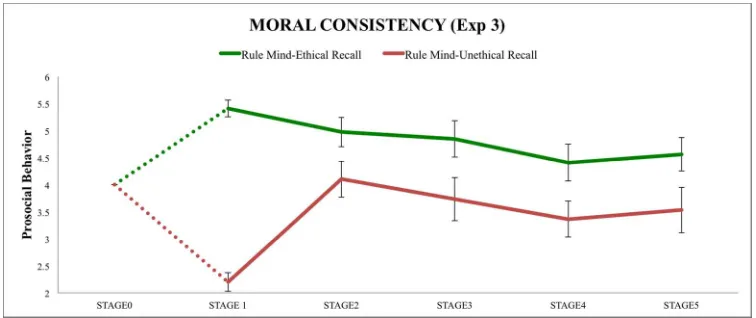
Evidence for Moral Consistency. Regarding the evolution between STAGES [1-5] in the
Moral Consistency case, we ran a two-way ANOVA with two within participant factors, Type of
Ethical Recall and Stage on the dependent variable (likelihood of engaging in a prosocial behavior).
Moral Consistency would be minimally evidenced by a main effect of Recall, but not a significant
interaction. There was a main effect of Recall on Prosocial Behavior, F(1,29) = 53.2, p<.01, but not
on Stage, F(4,116) = 2.02, p=.096. Also, the interaction between Recall and Stage was significant,
F(4,116) = 5.68, p<.01, which is not consistent with a ‘pure’ form of Moral Consistency.
---
INSERT FIGURE 9 ABOUT HERE
---
Then, we ran an ANOVA with STAGES [2-5] and Type of Ethical Recall to see if the
Moral Consistency pattern was maintained over time, as it can be seen that Figure 9 was the one
most similar to the idealized ‘Flat pattern’ (Figure 3), across all experiments. There was a main
effect of Recall, F(1,29) = 18.88, p<.01, no significant effect of Stage, F < 1, and a non significant
interaction between the two factors, F < 1.
Finally, we used Bonferroni corrected t-tests to examine the main effect of Type of Ethical
Recall, to show that Prosocial Behavior elicited by each Type of Ethical Recall differed at each
Stage. In all cases, there was a trend in the expected direction (ethical recall led to more ethical
behavior and unethical recall led to more unethical behavior). For Stage 1: t(60) = 13.749, p <.0005;
for Stage 2: t(60) = 2.057, p =.044; for Stage 3: t(60) = 2.606, p =.012; for Stage 4: t(60) = 2.193, p
=.032; for Stage 5: t(60) = 1.995, p =.051. Note, the Bonferroni corrected p-value for rejecting the
null hypothesis in this family of t-tests is .05/4=.0125, so, we can confidently conclude that
For Peer Review Only
significant differences exist only for stages 1 and 3. Nevertheless, we think that the overall pattern
is indicative enough and supports the view that the Moral Consistency pattern is broadly evident
across the different stages (noting also that the Bonferroni adjustment for multiple t-tests is
considered to be conservative; e.g., Nakagawa, 2004)
The conclusion is that the ‘Flat pattern’ was sustained to the low or high levels of
(un)ethicality throughout STAGES [0-5], but not as much as predicted in the idealized pattern
(Figure 3). Moral Consistency was a behavior broadly maintained over time (with a tendency to
converge to a neutral level of morality), if a re-evaluation process (manipulation of the mind-set
plus un(ethical) recall) was carried out before confronting each new moral scenario (Figure 9).
General Discussion
This is the first study to look at the evolution of moral choice across a series of scenarios.
Five scenarios were tested, embedded in a task with many fillers, to mask the design of the
experiment. In three experiments, we provided new empirical support for the hypothesis that ethical
mind-sets moderate how an individual’s behavioral history shapes his or her ethical behavior. An
outcome-based mind-set is meant to lead to moral-balancing effects, whereas a rule-based mind-set
to moral consistency. Furthermore, the three experiments shed some light on the persistence of
these ethical mind-sets and on the evolution of moral dynamics, exploring whether moral patterns,
such as Moral Balancing and Moral Consistency, can be maintained over time. When the
manipulation of Mind-set and Recall was just made at the start, there was a quick regression to
neutral performance. When the manipulation was reinforced before each moral choice, then one
pattern of behavior was sustained, while the other was not.
Moral Balancing, or as we call it, the ‘Zig-Zag pattern’, was only observed in the first stage
of the experiments. This type of behavior converged to a neutral level of morality over time, even
when the mind-set was reinforced at every stage, before making a new moral judgment (Experiment
3). We conclude that Moral Balancing is not a behavior maintained over time. However, some
For Peer Review Only
would argue that moral licensing effects should not persist in an oscillating pattern over time.
Imagine a less ethical behavior at ݐ that is compensated by a more ethical one at ݐଵ, and vice versa,
an ethical behavior at ݐ that gives the license to an individual to behave less ethically at ݐଵ. At that
point, balance is ‘restored’, and it is difficult to make predictions regarding further effects on
behavior at ݐଶ and beyond, or so some might argue.
On the other hand, participants in the Rule-based condition, approximated the idealized
pattern of Moral Consistency behavior (Figure 3), when a re-evaluation process (manipulation of
the mind-set plus (un)ethical recall) was included, before confronting each new moral scenario. In
other words, there was some evidence that Moral Consistency could be maintained over time, if the
mind-set was reinforced before each moral judgment. Either way, we overall conclude that ethical
mind-sets (and their influence on prosocial choice) decay, unless reinforced continuously.
Moral Consistency is perhaps a more stable pattern of mind-set, since if a person is led into
seeing himself/ herself as consistent, it is perhaps more natural to remain consistent –that is the very
nature of consistency. On the other hand, Moral Balancing would seem to require the keeping of a
running total of one’s positive and negative acts, and once the initial stages are past, this
tally-keeping may prove complex to maintain. It is easier to recall that one has consistently chosen the
prosocial or anti-moral path and so keep that on, than it is to recall that one’s last choice was pro, so
the next one should be anti. This difference in stability might also account for the tendency in both
Experiments 2 and 3 for the Moral Balancing group to show a continuing Moral Consistency after
their initial response at Stage 1. Although all the data trended towards the middle of the scale, there
was a residual difference between the Ethical Recall and Unethical Recall groups that persisted to
the end.
Overall, some would argue that this tendency to converge to a neutral level of morality
might be due to the low personal costs of the scenarios presented. Gneezy et al. (2012) showed that
when recent prosocial behavior is personally costly, people interpret that behavior as a signal of
their prosocial identity and that they are more likely to subsequently behave prosocially. Prosocial
For Peer Review Only
behavior involving lower cost, in contrast, offers a more ambiguous signal: prosocial behavior is
clearly positive, yet because it came at no cost, it is less likely to be judged as diagnostic of one’s
prosocial disposition. Under these circumstances the positive act does not affect individuals’
self-perceptions, presumably resulting in a reduction in subsequent prosocial behavior.
Our results question the importance of the concept of mind-sets in understanding prosocial
choice, since, if such mind-sets cannot be maintained across more than a few choices, what value
could they have in understanding the relevant behaviors? We see three directions for future research
in addressing this important question. First, it is possible that an alternative mind-set induction
procedure will reveal more lasting influences of mind-sets on prosocial choice.
Second, a related possibility is that the measurement of prosocial choice in the present
experiments was inadequate. Perhaps people’s prosocial choices do reflect patterns of consistency
or balancing, across time, but such patterns can be revealed in realistic time scales of days or weeks,
not within the limited duration of a psychology experiment. Also, there are merits and demerits of
the different approaches regarding how we ask participants to respond to scenarios. We used a
7-point scale because it let us explore our hypotheses. Some would say that individuals who want to
establish a balance between moral motives and selfish motives might achieve that by staying safely
in the midrange of the scale. So balance can easily be achieved within each moral scenario,
removing the necessity to balance over time. It may be the case that more interesting results would
emerge with binary answering options (an ethical vs. an unethical alternative). However, the scale
we opted to use did lead us to a particular interesting conclusion, namely that participants do neither
Moral Balancing nor Moral Consistency, but rather want to achieve a middle ground.
Third, it is possible that the idea of manipulating mind-sets directly is flawed. In other
words, perhaps there is a reality to the proposal that there are different sets and these
mind-sets can impact on prosocial choice, but perhaps these are stable individual characteristics. That is,
people can have a particular mind-set, but the mind-set cannot be easily altered experimentally (at
For Peer Review Only
least in an effective way). All these issues reveal considerable challenges (and corresponding
exciting directions) for future work, regarding our current understanding of moral judgments.
References
Albarracín, D., & Wyer, R. S. (2000). The cognitive impact of past behavior: Influences on beliefs,
attitudes, and future behavioral decisions. Journal of Personality and Social Psychology, 79,
5–22.
Alexander, L., & Moore, M. (2008). Deontological ethics. In E. N. Zalta (Ed.), The Stanford
encyclopedia of philosophy. Stan- ford, CA: Metaphysics Research Lab, Center for the
Study of Language and Information, Stanford University. Retrieved from
http://plato.stanford.edu/entries/ethics-deontological/
Aronson, E., & Carlsmith, J. M. (1962). Performance expectancy as a determinant of actual
performance. The Journal of Abnormal and Social Psychology, 65, 178–182.
doi:10.1037/h0042291
Bem, D. J. (1972). Self-perception theory. In L. Berkowitz (Ed.), Advances in experimental social
psychology (Vol. 6, pp. 1–62). New York, NY: Academic Press.
Blasi, A. (1980). Bridging moral cognition and moral action: A critical review of the literature.
Psychological Bulletin, 88, 1-45. doi:10.1037/0033-2909.88.1.1
Bradley, M. M., & Lang, P. J. (1994). Measuring emotion: the self-assessment manikin and the
semantic differential. Journal of behavior therapy and experimental psychiatry, 25(1), 49-59.
Buhrmester, M., Kwang, T., & Gosling, S. D. (2011). Amazon’s Mechanical Turk: A new source of
inexpensive, yet high- quality, data? Perspectives on Psychological Science, 6, 3-5.
doi:10.1177/1745691610393980
Cialdini, R. B., Trost, M. R., & Newsom, J. T. (1995). Preference for consistency: The development
of a valid measure and the discovery of surprising behavioral implications. Journal of
Personality and Social Psychology, 69, 318–328. doi:10.1037/0022- 3514.69.2.318
For Peer Review Only
Conway and Peetz (2012). When Does Feeling Moral Actually Make You a Better Person?
Conceptual Abstraction Moderates Whether Past Moral Deeds Motivate Consistency or
Compensatory Behavior. Personality and social psychology bulletin. DOI: 10.1177 /
0146167212442394
Cornelissen et al. (2013). Rules or Consequences? The Role of Ethical Mind-Sets in Moral
Dynamics. Psychological Science. DOI: 10.1177/0956797612457376.
Foss, R. D., & Dempsey, C. B. (1979). Blood donation and the foot-in-the-door technique: A
limiting case. Journal of Personality and Social Psychology, 37, 580–590.
doi:10.1037/0022- 3514.37.4.580
Gneezy et al. (2012) Paying to Be Nice: Consistency and Costly Prosocial Behavior. Management
Science. ISSN 0025-1909
Higgins, E. T. (1987). Self-discrepancy: A theory relating self and affect. Psychological Review,
94, 319–340. doi:10.1037/0033-295x.94.3.319
Jordan, J., Mullen, E., Murninghan, J.K. (2011). Striving for the Moral Self: The Effects of
Recalling Past Moral Actions on Future Moral Behavior. Personality and
Social Psychology Bulletin. DOI: 10.1177/0146167211400208.
Klass, E. T. (1978). Psychological effects of immoral actions: The experimental evidence.
Psychological Bulletin, 85, 756–771.
Merritt, A., Effron, D., Monin, B. (2010). Moral Self-Licensing: When Being Good Frees Us to Be
Bad. Social and Personality Psychology Compass. 344–357,
10.1111/j.1751-9004.2010.00263.x.
Monin, B., & Jordan, A. H. (2009). The dynamic moral self: A social psychological perspective. In
D. Narvaez & D. K. Lapsley (Eds.), Personality, identity, and character: Explorations in
moral psychology (pp. 341–354). New York, NY: Cambridge University Press.
Nakagawa S. (2004). A farewell to Bonferroni: the problems of low statistical power and
publication bias. Behavioral Ecology, 15, 1044-1045.
For Peer Review Only
Narvaez, D., & Lapsley, D.K. (Eds.) (2009). Personality, Identity, and Character: Explorations in
Moral Psychology. New York: Cambridge University Press.
Nisan, M. (1991). The moral balance model: Theory and research extending our understanding of
moral choice and deviation. In W. M. Kurtines & J. L. Gewirtz (Eds.), Handbook of moral
behavior and development (Vol. 3, 213–250). Hillsdale, NJ: Erlbaum.
Reed, A., II, Aquino, K., & Levy, E. (2007). Moral identity and judgments of charitable behaviors.
Journal of Marketing, 71, 178-193.
Sachdeva, S., Iliev, R., & Medin, D. L. (2009). Sinning saints and saintly sinners. Psychological
Science, 20, 523–528. doi:10.1111/ j.1467-9280.2009.02326.x
Singer, P. (1991). A companion to ethics. Oxford, England: Blackwell Reference.
Sinnott-Armstrong, W. (2008). Consequentialism. In E. N. Zalta (Ed.), The Stanford encyclopedia
of philosophy. Stanford, CA: Metaphysics Research Lab, Center for the Study of Language
and Information, Stanford University. Retrieved from http://plato
.stanford.edu/entries/consequentialism/
Szekely, R. D., & Miu, A. C. (2014). Incidental emotions in moral dilemmas: The influence of
emotion regulation. Cognition & emotion, (ahead-of-print), 1-12.
Thomas, G., & Batson, C. D. (1981). Effect of helping under normative pressure on self-perceived
altruism. Social Psychology Quarterly, 44, 127–131. doi:10.2307/3033708
Uhlmann, E. L., Pizarro, D. A., Tannenbaum, D., & Ditto, P. H. (2009). The motivated use of moral
principles. Judgment and Decision Making, 4, 476–491
Zhong, C.-B., Liljenquist, K., & Cain, D. M. (2009). Moral self-regulation: Licensing and
compensation. In D. De Cremer (Ed.), Psychological perspectives on ethical behavior and
decision making (pp. 75–89). Charlotte, NC: Information Age Publishing.
For Peer Review Only
Appendix 1
Statistical analysis for Experiment 2 without the selection criteria applied.
Evidence for Moral Balancing
First, we considered the evidence for Moral Balancing. No conclusions derived by focusing on the
restricted sample are altered to those in the entire sample. We ran a mixed two-way ANOVA with
Type of Ethical Recall and Stage, on the dependent variable (likelihood of engaging in a prosocial
behavior). There was no significant interaction between Recall and Stage, F < 1. The results also
indicated that there was no main effect of Recall in prosocial behavior, F(1,44)=2.03, p=.161 nor a
significant main effect of Stage, F < 1.
We then analyzed the evolution of Prosocial behaviors between STAGES [1-2] to see if, at
least, the Moral Balancing pattern was maintained for just one more stage. A two-way analysis of
variance (ANOVA) with Type of Ethical Recall and Stage as independent variables indicated that
there was no significant interaction between Recall and Stage, F(1,44)=1.38, p=.246. The results
also indicated that there was no main effect of Recall in prosocial behavior, F(1,44)=2.03, p=.161
nor a significant main effect of stage, F < 1.
---
INSERT FIGURE 10 ABOUT HERE
---
Overall, the results showed that Moral Balancing was not observed in this experiment,
beyond the initial manipulation. The conclusion is that the ‘Zig-Zag pattern’ was only observed
throughout STAGES [0-1], but not further maintained over time, in contrast to the idealized
prediction of Figure 2. Instead, it appears that the evolution of prosocial behavior converged to a
neutral level of morality (Figure 10).
For Peer Review Only
Evidence for Moral Consistency
Again, no conclusions derived by focusing on the restricted sample are altered to those in
the entire sample. Regarding the evolution between STAGES [1-5], we ran a two-way analysis of
variance (ANOVA) with Type of Ethical Recall and Stage on likelihood of Prosocial behavior.
Minimally, Moral Consistency would be evidenced by a main effect of Recall, no main effect of
Stage, and no interaction between Recall and Stage. It indicated that there was not a significant
interaction between Recall and Stage, F < 1. The results also indicated that there was no main effect
of Recall in prosocial behavior, F(1,46)=1.63, p=.208 nor a significant main effect of stage,
F(4,184)=1.37, p=.248.
---
INSERT FIGURE 11 ABOUT HERE
---
Inspection of Figure 11 makes it clear that it was not necessary, as in the previous
exploration, to analyze the evolution of prosocial choice between STAGES [1-2] to see if, at least,
the Moral Consistency pattern was maintained for just one more stage. The pattern converged to a
neutral point and did not remain attached to the low or high levels of (un)ethicality.
The conclusion is that the ‘Flat pattern’ only remained attached to the low or high levels of
(un)ethicality, as in the idealized pattern (Figure 3), for STAGES [0-1]. The rest of stages
converged to a neutral level of morality; thus, Moral Consistency was not maintained over time
(Figure 11).
For Peer Review Only
Appendix 2
Statistical analysis for Experiment 3 without the selection criteria applied.
Evidence for Moral Balancing.
First, we considered the evidence for Moral Balancing. No conclusions derived by focusing on the
restricted sample are altered to those in the entire sample. We ran a two-way ANOVA, as in
Experiment 2, with Type of Ethical Recall and Stage on the dependent variable. It indicated that
there was no significant interaction between Recall and Stage, F < 1. The results also indicated that
there was no main effect of Recall in prosocial behavior and no significant main effect of stage,
both F < 1.
---
INSERT FIGURE 12 ABOUT HERE
---
We then analyzed the evolution between STAGES [1-2] to see if, at least, the Moral
Balancing pattern was maintained for just one more stage. A two-way ANOVA with two within
participant factors, Type of Ethical Recall and Stage, revealed no main effect of Recall, no effect of
Stage, and a no significant interaction between type of Recall and Stage, all F < 1.
The conclusion is that the ‘Zig-Zag pattern’ was only approximately observed across
STAGES [0-1]. Thus, compared with the idealized pattern (Figure 2), Moral Balancing was not a
behavior maintained over time. Instead, as in Experiment 2, the evolution of the behavior converged
to a neutral level of morality (Figure 12).
Evidence for Moral Consistency
The conclusions derived by focusing on the restricted sample are different to those in the
entire sample (but, as argued previously, we think that the analyses in the restricted sample are
more valid).Regarding the evolution between STAGES [1-5] in the Moral Consistency case, we
ran a two-way ANOVA with two within participant factors, Type of Ethical Recall and Stage on the
For Peer Review Only
dependent variable (likelihood of engaging in a prosocial behavior). Recall, Moral Consistency
would be minimally evidenced by a main effect of Recall, but not a significant interaction. There
was no main effect of Recall on prosocial behavior, F(1,51) = 1.73, p=.194, and not of stage,
F(4,204) = 2.15, p=.076. Also, the interaction between Recall and Stage was not significant, F < 1.
---
INSERT FIGURE 13 ABOUT HERE
---
Then, we ran an ANOVA with STAGES [2-5] and Type of Ethical Recall to see if the
Moral Consistency pattern was maintained over time. There was no main effect of Recall, F(1,51) =
1.71, p=.197, no significant effect of Stage, F(3,153) = 1.980, p=.119, and a non significant
interaction between the two factors, F < 1.
The conclusion is that the ‘Flat pattern’ was sustained to the low or high levels of
(un)ethicality throughout STAGES [0-5], but not in a statistically significant way or as much as
predicted in the idealized pattern (Figure 3). That is, in this case, and contrary to the results when
the selection criteria were applied, we cannot say that Moral Consistency was a behavior broadly
maintained over time (with a tendency to converge to a neutral level of morality), if a re-evaluation
process (manipulation of the mind-set + (un)ethical recall) was carried out before confronting each
new moral scenario (Figure 13).
For Peer Review Only
Figure Captions
Figure 1: Experimental paradigm using 5-stages for Experiments 1, 2 and 3. In A, we represent the
manipulation given to participants at the beginning of Experiment 2. In B, we represent the two
manipulations employed in Experiment 3: one at the beginning of the experiment (same as in
Experiment 2) and another presented before confronting a new moral scenario, at each stage.
Figure 2: ZIG-ZAG Pattern. Idealized pattern of behavior according to the balancing view of moral
dynamics. The dashed lines represent the transition from the manipulation phase [STAGE 0] to the
first moral scenario [STAGE 1], given recall of an ethical or unethical action.
Figure 3: FLAT PATTERN. Idealized pattern of behavior according to the consistency view of
moral dynamics. The dashed lines represent the transition from the manipulation phase [STAGE 0]
to the first moral scenario [STAGE 1], given recall of an ethical or unethical action.
Figure 4: Prosocial behaviors [STAGE 1] in Experiment 2; mean likelihood of engaging in a
prosocial behavior, as a function of a participants’ ethical mind-set and the ethicality of the act they
recalled. This pattern replicates the results of Cornelissen et al. (2013). Error bars represent standard
errors.
Figure 5: Evolution of the prosocial behaviors of the Outcome Based Mind-set group (ethical +
unethical recalls) in Experiment 2. The dashed lines represent the transition from the manipulation
phase [STAGE 0] to the first moral scenario [STAGE 1], given an (un)ethical recall. Error bars
represent standard errors.
Figure 6: Evolution of the prosocial behaviors of the Rule Based Mind-set group (ethical +
unethical recalls) in Experiment 2. The dashed lines represent the transition from the manipulation
phase [STAGE 0] to the first moral scenario [STAGE 1], given an (un)ethical recall. Error bars
For Peer Review Only
represent standard errors.Figure 7: Prosocial behaviors [STAGE 1] in Experiment 3; mean likelihood of engaging in a
prosocial behavior, as a function of participants’ ethical mind-set and the ethicality of the act they
recalled. Error bars represent standard errors.
Figure 8: Evolution of the prosocial behaviors of the Outcome Based Mind-set group (ethical +
unethical recalls) in Experiment 3. The dashed lines represent the transition from the manipulation
phase [STAGE 0] to the first moral scenario [STAGE 1], given an (un)ethical recall. Error bars
represent standard errors.
Figure 9: Evolution of the prosocial behaviors of the Rule Based Mind-set group (ethical +
unethical recalls) in Experiment 3. The dashed lines represent the transition from the manipulation
phase [STAGE 0] to the first moral scenario [STAGE 1], given an (un)ethical recall. Error bars
represent standard errors.
Figure 10: Evolution of the prosocial behaviors of the Outcome Based Mind-set group (ethical +
unethical recalls) in Experiment 2. The dashed lines represent the transition from the manipulation
phase [STAGE 0] to the first moral scenario [STAGE 1], given an (un)ethical recall.
Figure 11: Evolution of the prosocial behaviors of the Rule Based Mind-set group (ethical +
unethical recalls) in Experiment 2. The dashed lines represent the transition from the manipulation
phase [STAGE 0] to the first moral scenario [STAGE 1], given an (un)ethical recall.
Figure 12: Evolution of the prosocial behaviors of the Outcome Based Mind-set group (ethical +
unethical recalls) in Experiment 3. The dashed lines represent the transition from the manipulation
phase [STAGE 0] to the first moral scenario [STAGE 1], given an (un)ethical recall.
For Peer Review Only
Figure 13: Evolution of the prosocial behaviors of the Rule Based Mind-set group (ethical +
unethical recalls) in Experiment 3. The dashed lines represent the transition from the manipulation
phase [STAGE 0] to the first moral scenario [STAGE 1], given an (un)ethical recall.
For Peer Review Only
Supplemental Material 1
The 5 Moral Scenarios chosen from the pilot study to be presented in experiments 1, 2 and 3.
• During 2 days of this week, a bus from the National Health Services will be at your
neighborhood asking people to donate blood.
How likely are you going to donate blood?
(7-point scale: -3=very unlikely, 3=very likely)
• You saw an advert saying that some volunteers are needed this weekend in a shelter of your
city to help some poor families.
How likely are you going to volunteer?
• You find a homeless person while going to work.
How likely are you to give him some money?
• You’ve had a party with some friends at home. Now, you are tired and it’s time to clean.
How likely are you going to recycle, putting the rubbish in their corresponding bins?
• You are in the supermarket and you want to buy the coffee you always take. Now, you
realize that in the shelf next to your coffee there’s a new one, $1.5 more expensive, which is
made from fair trade coffee (it helps producers in developing countries to make better
trading conditions and promote sustainability).
How likely are you going to buy the fair trade product? 1
For Peer Review Only
Supplemental Material 2
Instructions-manipulation presented at the beginning of the experiment 2 and 3.
Condition 1: outcome mind-set, ethical recall
Now, this section deals with ethical behavior. Sometimes, we decide to do something for the positive consequences it has for other people. That means that we do something that benefits others, even though it might cause ourselves some inconvenience. For example, someone like you may: ...help another person with some work, even though you have to give up a free night for it.
...give away some money, for example to an NGO, that you could have used to buy something for yourself.
...lend out your scooter to someone who needs it, even though you are worried something may happen to the scooter.
Now please describe another example of something that someone can do that would benefit others, but would cause some inconvenience to him/her:
Describe who benefited from that action:
Describe what the benefit was for the person:
What was the inconvenience or the cost for the person who engaged in the action?
Now we focus on your behavior and, more specifically, your ethical behavior in the recent past. Please think of something you recently did, that benefitted someone else or others and that caused inconvenience or a cost to you.
Describe in detail what you did. Please take at least 5 minutes to do so.
Now specify who benefitted from that action:
What was the benefit for the other person?
What was the inconvenience or cost it caused you?
Condition 2: outcome mind-set, unethical recall
This section deals with ethical behavior. Sometimes, we decide to do something for the positive consequences it has for ourselves. That means that we do something that benefits ourselves, even though it might cause some inconvenience or cost to other people. For example, someone like you may:
![Figure 4: Prosocial behaviors [STAGE 1] in Experiment 2; mean likelihood of engaging in a prosocial For Peer Review Onlybehavior, as a function of a participants’ ethical mind-set and the ethicality of the act they recalled](https://thumb-us.123doks.com/thumbv2/123dok_us/1456601.98355/43.612.120.496.113.324/prosocial-behaviors-experiment-likelihood-prosocial-onlybehavior-participants-ethicality.webp)

![Figure 7: Prosocial behaviors [STAGE 1] in Experiment 3; mean likelihood of engaging in a prosocial For Peer Review Onlybehavior, as a function of participants’ ethical mind-set and the ethicality of the act they recalled](https://thumb-us.123doks.com/thumbv2/123dok_us/1456601.98355/46.612.120.496.113.319/prosocial-behaviors-experiment-likelihood-prosocial-onlybehavior-participants-ethicality.webp)