Rochester Institute of Technology
RIT Scholar Works
Theses Thesis/Dissertation Collections
11-22-2013
Rule-based conditional trust with OpenPGP.
Andrew Jackson
Follow this and additional works at:http://scholarworks.rit.edu/theses
Part of theComputer Security Commons
This Thesis is brought to you for free and open access by the Thesis/Dissertation Collections at RIT Scholar Works. It has been accepted for inclusion
Recommended Citation
Rochester Institute of Technology
B. Thomas Golisano College
of
Computing and Information Sciences
Department of Computing Security
Master of Science in
Computer Security and Information
Assurance
Rule-based conditional trust with OpenPGP.
By
Andrew Jackson
Rochester Institute of Technology
B. Thomas Golisano College
of
Computing and Information Sciences
Department of Computing Security
Master of Science in
Computer Security and Information Assurance
Thesis Approval Form
Student Name: Andrew Jackson
Thesis Title: Rule-based conditional trust with OpenPGP.
Thesis Committee
Name Signature Date
Contents
1 Abstract: 1
2 Introduction: 1
3 History & Terminology: 2
3.1 Public Key Infrastructure: . . . 3
3.2 X.509 Certificates: . . . 4
3.3 Certification Authority: . . . 6
3.4 Certificate Revocation List: . . . 8
3.5 PGP: . . . 9
3.6 OpenPGP Format: . . . 10
3.6.1 Key Material Packet: . . . 12
3.6.2 Signature Packet: . . . 14
3.6.3 Trust Signature: . . . 15
3.6.4 Preferred Key Server: . . . 17
3.6.5 Key revocation: . . . 17
4 Literature Review: 18 4.1 Ease of Use: . . . 19
4.2 Trust Models: . . . 27
4.3 Reputation Systems: . . . 31
4.4 OpenPGP Web of Trust Analysis: . . . 33
4.5 Miscellaneous Research: . . . 36
5 Description of Trust Model: 38 5.1 OpenPGP Integration: . . . 39
5.2 Trust Packets: . . . 40
5.3 Trust Rules: . . . 41
5.3.1 Operators: . . . 43
5.3.2 Functions: . . . 44
5.3.3 Example Trust Rules: . . . 45
5.4 Resistance: . . . 46
5.4.1 Web of Trust: . . . 46
5.4.2 Our Trust Model: . . . 47
5.5 Resilience: . . . 48
5.5.2 Our Trust Model: . . . 49
5.6 Usability: . . . 50
6 Evaluation: 53 6.1 User Case Study: . . . 53
6.1.1 Rochester Institute of Technology: . . . 53
6.1.2 Evaluation of Model: . . . 54
6.1.3 Social Networking: . . . 55
6.1.4 Evaluation of Model: . . . 55
6.2 Quantitative Analysis: . . . 56
6.2.1 Number of Signatures: . . . 56
7 Future Research: 60 7.1 X.509: . . . 60
7.2 Additional Trust Rules: . . . 60
7.3 Email Integration: . . . 61
8 Conclusion: 62 A Appendix 71 A.1 Terminology . . . 71
A.2 Top 50 OpenPGP Keys, 2008 . . . 76
A.3 Top 50 OpenPGP Keys Graph . . . 78
A.4 Top 50 OpenPGP Keys, 2013 . . . 79
A.5 Top 50 OpenPGP Keys Compared . . . 81
A.6 OpenPGP Keys 950-1000 Ranked by MSD . . . 83
A.7 OpenPGP Keys 950-1000 Graph . . . 85
A.8 OpenPGP Keys 99950-100000 Ranked by MSD . . . 86
A.9 OpenPGP Keys 999950-100000 Graph . . . 88
A.10 PGP Web of Trust Key Analysis . . . 89
List of Figures
1 OpenPGP Keys graphed as matrix, sorted by MSD. . . 35
2 Mock-up of adding a Trust Rule. . . 51
3 Mock-up of Key Management using Tags. . . 52
4 Number of Users Versus the Number of Signatures. . . 58
5 Graph of Top 50 OpenPGP Keys ranked by MSD. 2008 . . . . 78
6 Graph of OpenPGP Keys 950-1000 ranked by MSD. . . 85
7 Graph of OpenPGP Keys 999950-100000 ranked by MSD. . . 88
8 Size of Strong Set. . . 89
9 Average Mean Shortest Distance. . . 89
10 Average Degree (Signatures per Key). . . 90
11 Population change of strong set. . . 90
12 Degree distribution over time. . . 91
13 Degree distribution for July 2013. . . 91
14 Distance distribution. . . 92
15 MSD vs rank. . . 92
16 Strong Set ”Footsie” Index. . . 92
17 Original Strong Set ”Footsie” Index. . . 93
1
Abstract:
This thesis describes a new trust model for OpenPGP encryption. This trust model uses conditional rule-based trust to establish key validity and trust. This thesis describes “Trust Rules” that may be used to sort and categorize keys automatically without user interaction. “Trust Rules” are also capable of integrating key revocation status into its calculations so it too is automated. This thesis presents that conditional trust established through “Trust Rules” can enforce stricter security while reducing the burden of use and automating the process of key validity, trust, and revocation.
2
Introduction:
example, a person could establish that a key is only valid if it is signed by two or more keys from a group of 5 keys, which are explicitly chosen by the end user. Many different trust models could be developed if a rule-based con-ditional trust model were established. This model would allow each group or individual to create their own “Trust Rules” to establish trust and key validity.
Additionally, with recent high profile compromises of certification author-ities [40], such as DigiNotar, certification authorauthor-ities issuing certificates for the purpose of man-in-the-middle attacks [40], and the code signing of the Stuxnet virus [7] [32] we can see how any trusted certification authority or their associated registration authority can be a single point of failure in the traditional PKI infrastructure. The use of certification authorities or any single entity to establish key validity or trust would appear to be very prob-lematic potentially leaning towards outright distrust. Add to that recent news reports of National Security Agency (NSA) data collection [18] [19] [17] [43] and one can quickly see the potential need for encryption and potentially even a distrust towards established cloud services, email provides, and social networks.
3
History & Terminology:
establish a base line of terminology. We will try to use already established definitions and terms when and where possible.
3.1
Public Key Infrastructure:
The modern Public Key Infrastructure (PKI) that we know now started out in 1988 with the first edition of standards being published. These were published by the International Organization for Standardization and Inter-national Electrotechnical Commission (ISO/IEC) as ISO/IEC 9594:1990 and also by the International Telegraph and Telephone Consultative Committee (CCITT), now known as the International Telecommunication Union (ITU), published as ITU-T X.500 (1988) Series of Recommendations. These stan-dards set forth an electronic directory service to be used as a general-purpose directory store of information. Employee information such as phone num-bers, office numnum-bers, email, certificates, and other information could be stored within the directory. There have been 5 editions of the standards with the 5th being published as ISO/IEC 9594:2005 and ITU-T X.500 (2005)[27].
cer-tificates within Internet applications for those communities wishing to make use of X.509 technology. Such applications may include WWW, electronic mail, user authentication, and IPsec” [23].
Many people use the Public Key Infrastructure everyday without ever giving it any thought. This lack of thought was a goal of the IETF when they described the respective RFCs. The procedures, protocols, and policies are designed so that the user has minimal interaction with PKI. The general public’s exposure to most PKI is through the utilization of Secure Socket Layer (SSL) communication to buy products online through retail websites or check email. A lesser few use PKI to authenticate and login to VPNs, workstations, and other enterprise systems. These SSL connections and PKI authentications are secured with X.509 Certificates, signed by digital signa-tures and issued by Certificate Authorities (CAs) such as Verisign or other trusted CAs.
This thesis will examine the following X.509 aspects: X.509 Certificates, Certification Authority, and Certificate Revocation Lists.
3.2
X.509 Certificates:
• signatureAlgorithm specifies the algorithm to use in calculating the signature.
• signatureValue is the actual value of the certificate signature.
• versionspecifies what version number of X.509 this certificate belongs.
• serialNumberis the unique number assigned to the certificate by the certificate authority (CA).
• signature specifies the algorithm to use in calculating the signature. MUST be the same as signatureAlorithm.
• issuer is who issued the certificate as a X.501 Name Type.
• validity is the date in which the certificate is valid.
• subject identifies to whom the certificate has been issued.
• subjectPublicKeyInfo holds the public key of the subject.
• uniqueIdentifier is a unique number used to provide uniqueness if a subjects name is reused.
• extensions provide a mechanism to associate additional attributes with certificates.
certificate is possible, because only the issuing CA will have the correspond-ing private key that was used to sign the X.509 Certificate.
3.3
Certification Authority:
A Certification Authority (CA), also referred to as a Certificate Authority, is a trusted source that issues public-key certificates. It does this by digitally signing public keys and relevant identifying information, such as the subject, subjectPublicKeyInfo, and other X.509 Certificate fields. The information held within the certificate is thereby bound to the respective private key of the subject. The digital signature reliably prevents tampering of the public-key certificate because only the CA may alter the data as it alone has the corresponding private key. Once public-key certificates are issued they may be publicly distributed freely or published in an electronic directory service ie: X.500.
There are two important criteria for Certification Authorities to evaluate before issuing a public-key certificate. These have been defined in the X509 Recommendations [29] as follows:
• A certification authority shall be satisfied of the identity of a user before creating a certificate for it.
To facility these requirements the CA must take precautions to prevent fal-sifications of identity, public key information, and resolve duplicate names.
The first requirement can easily be satisfied given enough information can be confirmed by the certification authority. Common forms of identity such as a government issued photo identification card and/or Passport may be used to confirm ones identity. For web based entities, such as a Web Server, ownership of the web servers domain name may be established before issuing a certificate. For both end user and web server certificates the public key information needs to be securely transmitted to the certificate authority. If this is not done the certification authority may end up signing the wrong public key. If this occurs the web server or user might not be able to read any secure communications and it could allow an attacker to read all of the communications that were thought to be secure.
The second requirement ensures that no user can pose as another user by duplicating the name. The name or subject field of a public-key certificate (X.509) holds a distinguished name that identifies the entity. A distinguished name is defined in X.501 [28] as “... that name which consists of the sequence of the relative distinguished name of the entry which represents the object and those of all of its superior entries (in descending order).”
Country, ST= State, L= Location, O= Organization, OU= Organizational Unit, CN= Common Name. The distinguished name (DN) tells us the loca-tion and entity that requested the certificate. The final Common Name must match the domain name or (URl) of the web server that is being visited, in this case ipay.rit.edu.
3.4
Certificate Revocation List:
Certificate Revocation Lists (CRL) provide a way for a Certification Au-thority to revoke a public-key certificates. These CRLs are established as endpoints via http, ldap, or other network communication specifications to update end users of the status of a public-key certificate. Certificates nor-mally have an expiration date after which they are no longer valid, but if a certificate needs to be revoked for another reason the Certification Authority may use the CRL to do so.
3.5
PGP:
“Pretty Good Privacy” (PGP) was written by Philip Zimmermann in 1991 [47] [48]. The history of PGP is well known and can be explored more thor-oughly by the reader in Michael W. Lucas’s book “PGP & GPG: Email for the Practical Paranoid” [33] or from Phil Zimmermann’s direct accounts in “Why I wrote PGP” [47]. The short version of the history is that Mr. Zim-mermann wanted to allow individuals to send communications and exchanges securely via encryption without the possibility of government mandated back doors or key escrows. PGP allows any person the ability to send email or other communications knowing that the only person able to read the com-munique would be the addressed recipient.
For our purposes it is noteworthy to know the differences between PGP, GPG, and OpenPGP. PGP or “Pretty Good Privacy” is the original specifica-tion as developed by Phil Zimmermann, which later established the PGP Cor-poration. Referring to PGP should be taken as talking about PGP the cor-poration, however many use it interchangeably with the RFC or OpenPGP. GPG or “Gnu Privacy Guard” is a software package that reimplements the PGP standard and later, when developed, the OpenPGP standard. Finally, OpenPGP is the RFC standard that GPG and PGP software implement enabling them to be OpenPGP compliant.
The OpenPGP specification differs from the X509 specification in many ways. The key specification, trust model, allowed algorithms all have differ-ent options and specifications. For this thesis the major differences should be noted through the use of different trust models and key verification of trust. OpenPGP uses a “Web of Trust” versus X.509’s hierarchical tree model. OpenPGP more recently has extended its specification to include a hierarchical trust model, but the “Web of Trust” is probably the most used trust model with OpenPGP. The “Web of Trust” consists of every individ-ual who uses the OpenPGP standard regardless of software package. These users make up the web and form connections or edges of the web by digitally signing other users OpenPGP keys. Each user then may elect to trust some other user’s digital signature for verification of the public-key certificate or key of a third user. This OpenPGP trust takes place instead of implementing X.509 Certification Authorities. Each user may act as their own Certifica-tion Authority. A user’s verificaCertifica-tion and certificaCertifica-tion of other’s keys may be extended to others that trust them. With all users certifying OpenPGP keys it creates a graph or web of trust connections between all users.
3.6
OpenPGP Format:
types of OpenPGP packets according to RFC 4880 [4]:
• Public-Key Encrypted Session Key Packets
• Signature Packet
• Symmetric-Key Encrypted Session Key Packets
• One-Pass Signature Packets
• Key Material Packet
• Compressed Data Packet
• Symmetrically Encrypted Data Packet
• Marker Packet
• Literal Data Packet
• Trust Packet
• User ID Packet
• User Attribute Packet
• Symmetric Encrypted Integrity Protected Data Packet
• Modification Detection Code Packet
packets, also known as subpackets, within. Some packets are never to be exchanged with other users, but are only for internal software data stores e.g. Trust Packets. Each packet is made up of a packet header followed by the packet body. Not all combinations of OpenPGP packets form valid objects. Some packets may be included multiple times where as others can only be included once and must be the last packet in the series, e.g. the Modification Detection packet. Finally, some packets may be digitally signed by the private key of the user to bind the packet data held within said packet to the users key, there by establishing a trusted connection to the signed packet.
Next, this thesis will describe a selection of OpenPGP packets that are of particular interest in regards to this thesis and will explore their workings and format.
3.6.1 Key Material Packet:
The Key Material Packet contains the actual key material, private or a public key, depending on the type of Key Material Packet. There are four variants of Key Material Packets which are:
Public-Key Packet: Format Described below.
Public-Subkey Packet: Public-Subkey Packet has the exact same format as a Public-Key packet, but describes a subkey.
described in a Public-Key packet, including the public-key material, but also includes the secret-key material appended at the end of all the public-key fields.
Secret-Subkey Packet: Secret-Subkey Packet has the exact same format as a Secret-Key packet, but describes a subkey.
The preceding Key Material Packets depend on the structure of the Public-Key Packet so, this thesis will explore its format and use. The format of a version 4 Public-Key OpenPGP packet [4], contains :
• A one-octet version number (4).
• A four-octet number denoting the time that the key was created.
• A one-octet number denoting the public-key algorithm of this key.
• A series of multiprecision integers comprising the key material.
in common by the primary key. The user is guaranteed that no adversary can sign keys or establish new subkeys as the primary key would be required. It should be noted that the use of more than one encryption subkey would be problematic as the sender of an encrypted communique would have to pick the correct subkey needed for encryption. For this reason it is advised to only use one encryption subkey at a time, but you may produce new encryption keys at any interval that you wish. If a subkey is ever compromised the user can revoke the subkey and still retain any collected digital signatures on the primary key. Again, despite using different keys the recipient of a message can establish a trust path to the subkey by verifying that the digital signature on the subkey matches with the primary key.
3.6.2 Signature Packet:
A Signature packet associates a public key with some data via a digital signature thereby binding the data to the public key. The most common signature type is a signature on a file, a block of text, or a signature that is used to certify a User ID. The signatures on User IDs are what make up the “Web of Trust” within OpenPGP. Signatures on text are used to verify the sending origin of a message and provide modification protection. The body of a version 4 Signature packet contains:
• One-octet version number (4).
• One-octet public-key algorithm.
• One-octet hash algorithm.
• Two-octet scalar octet count for following hashed subpacket data.
• Hashed subpacket data set (zero or more subpackets).
• Two-octet scalar octet count for the following unhashed subpacket data.
• Unhashed subpacket data set (zero or more subpackets).
• Two-octet field holding the left 16 bits of the signed hash value.
• One or more multiprecision integers comprising the signature.
There are 26 Signature Packet subpackets that assert different informa-tion about an OpenPGP key attribute or the signature packet itself. Sub-packets are made up of objects like Signature Creation Time, Key Expiration Time, Trust Signature, Signer’s User ID, Key Server Preferences, Preferred Key Server, and Reason for Revocation just to name a few. This thesis will next examine a handful of signature subpackets.
3.6.3 Trust Signature:
X.509 Certification Authorities, however, the trusted introducer does not create an X509 Certificate for the entity, but produces an OpenPGP Signa-ture packet with a Trust SignaSigna-ture subpacket. When others encounter an OpenPGP key signed by the trusted entity they assume the OpenPGP key is valid even if they have not verified this to be true themselves.
A Trust Signature packet is very simple, it has one octet which describes the “level” (depth) and one octet which describes the amount of trust. The signer uses the Trust Signature to assert the trustworthiness of another at a specified level. Level 0 has the same meaning as an ordinary validity signature. Level 1 means that the signed key is certified to be a trusted introducer, with the 2nd octet specifying the degree of trust. Level 2 means that the signed key can be trusted to issue level 1 trust signatures. This continues on as higher levels are introduced, with a level N trust signature asserting that a key is trusted to issue level N-1 trust signatures. The trust amount is an integer from 0-255 and is interpreted so that values less than 120 indicate partial trust and values greater than 120 indicate complete trust. In actuality, when implementing the OpenPGP specification most applications produce values of 60 for partial trust and 120 for complete trust.
original OpenPGP key A, they will also accept signatures from B, C, and D as valid and thereby trust any key that B, C, and D have certified.
3.6.4 Preferred Key Server:
Like X.509 Certificates OpenPGP keys may be stored in online directory stores or Key Server as they are called with OpenPGP. There are many key servers throughout the world, so if a user has a particular favorite or preference in which key server they would like to use they may signify this by using a Preferred Key Server sub packet signature. Like other sub packets the Preferred Key Server packet attaches an attribute to the OpenPGP key. The Preferred Key Server contains only one field which is a string in the form of a Uniform Resource Identifier (URI). This URI denotes the key server that the user prefers be used by others for updates. Keys with multiple User IDs may have a preferred key server for each User ID. Other users update a key by introducing Trust Signatures or other types of signature packets upon a key. These new signatures need to be distributed to others via the key server. Without an update mechanism the new signatures could not be distributed and used to recalculate the “Web of Trust” by adding new signatures or edges.
3.6.5 Key revocation:
revoked. This revocation can happen for a number of reasons and is denoted by the “Reason for Revocation” signature subkey. The Reason for Revocation subkey begins with one octet containing the reason for revocation followed by a string specifying the reason. The first field has the following format.
• 0 - No reason specified
• 1 - Key is superseded
• 2 - Key material has been compromised
• 3 - Key is retired and no longer used
• 32 - User ID information is no longer valid
• 100-110 - Private Use
It should also be noted that signatures as well as keys may be revoked. Signatures made on another person’s key may be revoked by the signatory at anytime. Like key revocation revoked signatures carry a reason for revocation as well.
4
Literature Review:
1. Improving End-user software ease of use.
2. Improving protocol mechanisms and architecture.
With our approach this thesis presents a mix of both ease of use and mech-anisms. This thesis has defined a new trust model which would need ap-plication component development and integration. And at the same time this thesis has carefully tried to keep from defining an entire new protocol and have worked within the OpenPGP specifications [4]. Our trust model has incorporated current research and ideas on establishing trust. As well as how trust is involved with software trust calculations, which this thesis will examine in more detail. As stated previously this thesis does not wish to change the OpenPGP message format [4], but only change how the trust is calculated internally in software packages.
4.1
Ease of Use:
standard should be used to prevent end users from entering security config-uration errors. They suggest that security user interface requirements are such that there is a need to develop domain specific standards. The usability standards for normal software are not sufficient for security products. They defined usable security software as usable ”...if the people who are expected to use it:
1. are reliably made aware of the security tasks they need to perform;
2. are able to figure out how to successfully perform those tasks;
3. don’t make dangerous errors;
4. are sufficiently comfortable with the interface to continue using it.”
To evaluate their hypothesis they used two separate evaluation methods. The first was a direct analysis method called cognitive walkthrough, and the second a laboratory user test.
but it confuses novice users.
Whitten and Tygar make the following suggestion for an improvement over current security user interface design. Establish a clear and accurate conceptual model of the security to the user as quickly as possible. They express the need for the model to be as small as possible to allow for quick and accurate integration by the user while maintaining security. They suggest that through the use of appropriate visual metaphors, warning messages, wizards and other interactive tools that one would be able to increase user understanding and use of security software. The exact use and design of such an interface has been left open for future research.
short comings however, they express hope in KCM’s increased likelihood of adoption and its ability to scale to multiple organizations.
Garfinkel & Miller’s study is a continuation on the work done by Whitten and Tygar [45] with what they call a “radical reinterpretation” of the results. Garfinkel & Miller put forth that the key certification model used by PGP was the underlying problem in Whitten and Tygar’s research, not PGP 5.0 or user training. To remedy the problem Garfinkel and Miller used KCM and tried to mimic Whitten and Tygar’s research method for their laboratory user tests. In Garfinkel & Miller’s user tests they introduce attacks on KCM into the scenario to test how the users respond.
With the introduction of KCM the authors also described a new user interface that would allow key continuity to be displayed to the user via different background colors. They described a system that would display a green border around messages that have a good signature from a person known to use signatures. The border would be displayed as gray if an email is received from a person that normally signs their emails. A yellow border is shown when a new signature and a new email are recognized. Lastly, a red border is shown when an email is received from a known sender with a signature that does not match the one recorded.
normal and received an additional briefing. Using the No KCM as a baseline the researchers then show the improvement of KCM against three different kinds of attacks. They were called the “New Key Attack”, the “New Identity Attack” and the “Unsigned Message Attack”. The “New Key Attack” tried to introduce a new key for an already established email identity (Certificate and Email pair). The “New Identity Attack” tried to establish a new iden-tity for a known person using a new email address and subsequently a new certificate. The “Unsigned Message Attack” attempted to entice the user to respond to an unsigned email for a known identity.
both the Color group and the Color+Briefing group. However, in follow-up interviews it was found that most test subjects did not use KCM as much to identify the possible attack, as they did the requested recipient’s email address. The email address for the attack was a Hotmail address. Many of the test subjects did not trust the security of Hotmail, thus the NO KCM group was not as susceptible to this attack as the researchers initially thought. Garfinkel & Miller conclude that KCM could improve security but is not the silver bullet for the email security problem. There remains the open question regarding establishment of identity trust relationships, to which KCM does not provide a solution. However, the authors feel that KCM adds to the development of technologies that could be implemented to secure email and provide for more widespread adoption of S/MIME.
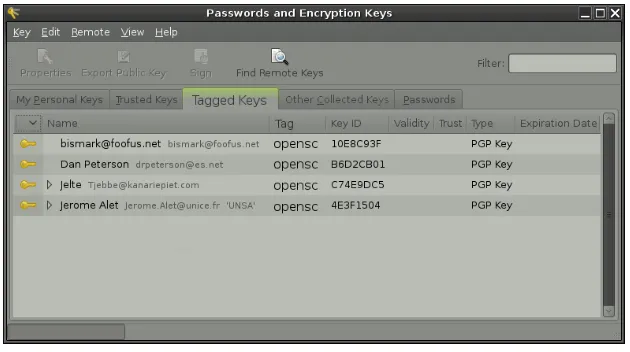
of third party CAs as well as pointing out a possible security flaw. In our system the Tagged keys are separated from the Trusted keys, and Tagged Keys show the Trust Rules that triggered them. These rules should allow our system to not succumb to the attack depicted by Kapadia. The end user should notice that the Trust Rule did not trigger the same rule as the rest of the group/community if even at all. The hope would be that an end user would notice the different tags that were assigned and then inquire as to why key X does not trigger the group’s previously establish Trust Rules.
In another paper by Garfinkel [14] visual references were noted as helping end users and a comparison of different email clients and their interfaces was conducted. Garfinkel showed how users of AOL email can visually identify email sent within the network versus email that originated outside of the AOL network. This difference provides the user with clues that the origin of the email has been authenticated. Garfinkel also identified Outlook’s small certificate and Apple’s Mail Security header as reasons that allow easier use of S/MIME or X.509 Certificates. This thesis will explore further research into the use of Trust Rules in an email client in Section 7 on Future Research.
4.2
Trust Models:
In developing our Trust Model and our associated Trust Rules research on Trust Models was evaluated. The research on Trust Models mainly described new mechanism or protocols to exchange and establish trust.
at least K authentication servers or Certificates Authorities will be truthful out of N servers was described by Chen [6]. In the paper Chen described a situation where you may only minimally trust a group of authentication servers, but you trust that at least N servers will be truthful. Chen then established a protocol to exchange this trust between users and servers. In-stead of establishing new protocols this thesis would use PGP signatures as an exchange mechanism.
“Eigen Group Trust” it reduces the calculations and removes the require-ment that the user have a global view of the network before calculating trust relationships. Our trust model can introduce similar ideas by exchanging Trust Rules between communities and groups. While one can not export the trust or signatures that Trust Rules have established there is nothing that prevents one from distributing the Trust Rules themselves. The Trust Rules can be formed and discussed among a community as to what the best or most secure rule set should be. Once in agreement the Trust Rules could be distributed to the members. These Trust Rules while developed by the group community still rely on the end user to implement. One could conceive of rules being established between different groups and communities that would allow for interchange of keys and trust.
propaga-tion algorithms; Eigen Trust [30] and Weighted linear combinapropaga-tions (WLC). Fourthly, they turn to different types of rounding, since we will establish a boolean outcome from trust graph established utilizing real number value pairs for trust/distrust. From the trust algorithms, the iteration method, distrust propagation, and rounding cases (three each) there results in 34 = 81 experimental schemes to evaluate. Finally, utilizing the Epinion’s website dataset Guha sets about to analyze each of the experimental schemes to see which one best predicts the trust or distrust between nodes in the epionion’s dataset. The best performing results were seen from the one step distrust with Eigen Trust [30] iterations.
4.3
Reputation Systems:
The distribution of trust and delegation of duties can allow for credibility and reputation in a small group to then be extended further as the interconnects to other communities are established. Group dynamics and reputation in an online community have been studied by Resnick [39] in evaluating eBay’s reputation system. Resnick identified three criteria for reputation systems:
1. Provide information that allows participants to distinguish between trustworthy and non-trustworthy agents.
2. Encourage participants to be trustworthy.
3. Discourage participation from those who are not trustworthy.
The first criteria is satisfied with OpenPGP participants recognizing trust-worthy agents through the signatures on the agents key in question. A non trustworthy individual should not be able to obtain key signatures from other people or trusted third parties. The second criteria is enforced by each end user refusing to communicate with a key of unknown trustworthiness or va-lidity. Without manual verification or other signatures on said key the user has no way of knowing the key holders identity is truthful and correct. The third criteria is satisfied when a user revokes their signature from a users key. The possibility of key signature revocation should persuade individuals to continue to act in a trustworthy manner.
certification of reputation. This thesis present the use signatures by group members as a form of reputation or certification, since key validity could have been already established through the use of Trust Rules. If a member of the group has turned out to become untrustworthy members could revoke their signatures, and then if a user re-enters the group members may re-sign that members key.
It would also be permissible to establish a separate revocation mechanism as defined by the group into the Trust Rule. This trust revocation could be by the initial certifying parties, the key holder, or another third-party that is strictly for key revocations. When developing the Trust Rule for the community it can be decided that any user that is found untrustworthy will have their key signed by the communities revocation keys. To prevent undue revocation by the group it is possible to establish a group of keys that must be a part of the signature before complete revocation takes place. The use of
4.4
OpenPGP Web of Trust Analysis:
The original analysis of the Web of Trust was done in 1996 by Neal McBurnett [35] shortly after the creation of OpenPGP. He subsequently updated his findings in 1997 as the Web of Trust grew [34]. In 1996 he found that there were 2047 keys in the ’Strongly Connected’ set of keys or strong set. That is to say, keys which have a path connecting them to every other key in the set. These paths are established by key signatures and do not take into account any type of trust modeling. In 1997 the strong set included 3100 keys. After identifying the largest strong set of OpenPGP keys he analyzed the distance or number of hops which separate each key. This would be the degree in network graph theory terminology. The mean shortest distance (MSD) was calculated to be 5.98188 in 1996 and 6.061 in 1997. The maximum shortest path in 1996 and 1997 was 21. McBurnett also created a listing of keys within the strong set sorted by MSD. An interesting note, is that this analysis only took 30 minutes on a Sun Sparc 1000.
Analysis continued in 2001 by Drew Streib [44] however the website is no longer available, but was able to be accessed by the Internet Archive Wayback Machine [11]. Streib analyzed 1,461,786 keys and found the strong set to be 10,828 keys strong. The average MSD was calculated at 6.6741. Streib continue the analysis until April 2002 when there was 1,945,876,437 keys total and 12,285 keys in the strong set. The source code used to do the analysis, keyanalyze, was released under GPL open source terms.
utilizing the keyanalyze source code, however again the website is offline and this time the Internet Archive does not have any useful records.
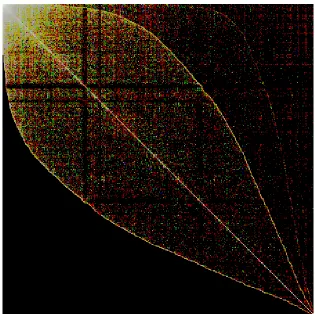
In 2004, Jrgen Cederlf conducted more research and analysis of the web of trust, but this time it was more graphical [?]. Cederlf graphed the web of trust as a group matrix such that, ”A dot in column x, counting from left, and row y, counting from the top, means that key number x has signed key number y. A red dot means a signature of level 0 or 1, a blue dot level 2 and a green level 3. Signatures which are not on the primary User ID are represented by a darker dot.” The image generated appear as a leaf when keys are sorted by MSD and can be seen in figure 1.
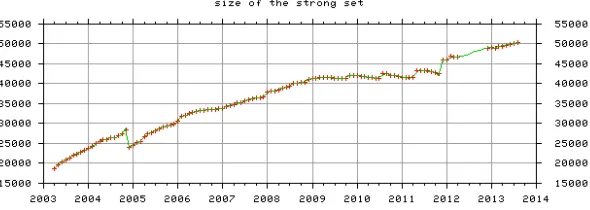
Henk P. Penning continued the analysis, which continues today, and is probably the most complete with many interesting graphs [36]. The most recent graphs have been included in appendix A.10. While unclear when the research began, the graphs present data from 2003 to current. All recent data shows that the strong set is growing and that the MSD to all keys is decreasing. The strong set contains approximately 50,000 keys. The number one ranked key, Peter Palfrader, has a MSD of 3.5832. One interesting piece of data from Penning’s research is the average degree or signatures per key within the strong set is approximately 10. That means that the average user has, on average, 10 signatures. There are of course many users which have hundreds of signatures which then act as trust anchors
Figure 1: OpenPGP Keys graphed as matrix, sorted by MSD.
graphs were similar to a stock index or NASDAQ or if your from the UK, the FTSE 100, commonly called the Footsie. The footsie graphs by Wilcox showed the change in strong set over time and the change in top 50 keys, top 1000 keys to name a few data points. The graphs have been included in appendix A.11. Subsequently penning’s graphs were updated to show the footsie idea and are also included in appendix A.10.
keys are fairly stable, with the following key statistics: 6% No Change, 22% New, 28% Upward Moving, 44% Downward Moving. The downward moving keys are mainly a result of new keys introduced into the top 50. Most of the old top 50 keys remained in the top 50 even though their place may have changed. In analyzing the new keys in the top 50 we find that the keys are vary strongly connected with most keys with over 200 cross signatures.
• AAE6022E, Karlheinz Geyer has 1030 cross signatures.
• BAB58229, Marcus Frings has 526 cross signatures.
• 4743206C, Joachim Breitner has 259 cross signatures.
• 88C7C1F7, Steve McIntyre has 269 cross signatures.
4.5
Miscellaneous Research:
Gutmann [21] conducted a survey in which respondents chose email address, DNS, or IP address as a better identifier than a X.500 Distinguished Name. Respondents to the survey selected a repository presence check versus a more traditional CRL. Respondents also chose HTTP access over LDAP as an access method. For these reasons and possibly easier application development this thesis chose OpenPGP. OpenPGP also does not have the rigid structure associated with its PKI/X.509 counterpart.
along. He outlines the reinvention and alternatives over the years; incorporat-ing XML and JSON into PKI, Simple PKI (SPKI), XML Key Management Specification (XKMS), and DANE (DNS-based Authentication of Named Entities). All of which have yet to replace our X.509 based PKI system. Far-rel then proceeds to outline two new pieces of technology that he speculates will allow clients to use their own PKI. First, he calls for a key-registration service which would register client public keys for authentication to web ser-vices. Second, a strategy to bind different keys from different devices to the same user account to allow for device mobility.
In contrast to Perrin’s paper [37] on the use of “cryptoIDs” this thesis presents that the use of current OpenPGP key fingerprints as a mechanism to key distribution can be used. Perrin also wished to establish a more long-lived identifier or “cryptoID” under which public/private key pairs would be created. This description comes very close to how OpenPGP can create a long lived parent key with shorter lived subkeys used for encryption and signing. The user can establish a long lived key through the parent key and its collected signatures. Perrin used “cryptoIDs” certificates instead of X.509 or OpenPGP and established their own format. Also, in regards to fingerprints and hashing mechanisms the particular implementation can be updated much the same as how the encryption algorithms are updated to prevent attacks.
it as a burden and for the paranoid. By infusing encryption into a com-munity and group dynamics this thesis would hope to make it easier and remove the paranoid stigma attached to using encryption. Through the use of easier-to-use applications this thesis would remove the burden and extra steps associated with encryption. This thesis presents a trust model to re-move some burden in verification of keys through automatic key tagging with the use of Trust Rules.
5
Description of Trust Model:
In developing a new trust model there are a few requirements that this thesis wishes to take into consideration. First, the trust model should work with the current “Web of Trust” OpenPGP model as well as develop its own mechanism for establishing trust. The Web of Trust has been well established in user’s minds and is a good model for securely establishing communications. The end user should maintain their responsibility in establishing how and who they choose to trust. Second, our new trust model should maintain and, in most cases, increase security from the Web of Trust model, while being resilient and resistant to attacks. Third, our new trust model should be easy for end users to use. Crypto-systems have historically been hard to use, so this new trust model should be developed with usability in mind.
1. Trusted Introducer and/or Certification Authorities should not be trusted solely on their own word, but should be confirmed through others as-sertions as well.
2. Any single Trusted Introducers and/or Certification Authorities may make mistakes, can be compromised, or act without regard to a specific user.
3. The only truly trusted party is that of the end user to which the keyring belongs– Only that user’s certifications can be fully trusted.
4. Key material will most likely be exposed, compromised, attacked and will need to be renewed or revoked at some point in the future.
5.1
OpenPGP Integration:
change the OpenPGP specification nor does it think it is needed. Our cur-rent trust model can be implemented without changes to the OpenPGP RFC 4880 Standard [4].
5.2
Trust Packets:
OpenPGP RFC 4880 [4] allows for a “Trust Packet” that is used internally by software implementations. These trust packets should be ignored on input to programs and also should not be exported as output outside of the local keyring by programs. By using these packets this thesis presents a new trust model. This trust model can be developed without fear of users tainting the current Web of Trust. Additional trust models may be developed by end users to fit their security requirements. Because the Trust Packets can not be exported it allows only the current end user to establish trust with them and allows the program to use these packets for management of our trust model. The RFC leaves the format of the Trust Packets to the software package implementation so, this leaves us room to insert our trust model.
not upload or download new or updated keys. Whenever a key update is performed by the program key trust calculations must be preformed again on the updated keys to verify the trust rule corresponding to applied tags are still valid. For example, if the key has been updated its trust calculations must be run again to confirm the validity of the tag or tags associated with it. When keys are updated a key may have been revoked, may contain more signatures, or signatures may have been revoked on that key by their signators, so this recalculation of trust rules must take place.
A tag will consist of a Name Field, formatted as string of 255 bytes in length, plus an ID Field consisting of two octets that will specify the unique identifier. This ID Field will be used to distinguish the tag on keys and in Trust Rules. Keys may be tagged by more than one tag at a time with each tag having its own corresponding Name and ID Fields.
Our Trust Model will use the following format for the The Trust Packet:
• One octet consisting of the version number. (1)
• One octet stating the number, in bytes, of the tag or tags that follow.
• One or more octets consisting of tag IDs.
5.3
Trust Rules:
is different from the trust established in a trusted introducer or a friends signature on other’s key. Our trust model is only used in confirming trust in an identity not for calculating or introducing trust to or through others. All trust calculations using our trust model are kept internal and should not be the basis for signing another’s key. Key signatures should be evaluated the same as if using the Web of Trust, in that you manually confirm a key. The signing of keys should be maintained through the normal methods via manual verification of key IDs, key fingerprints, government IDs, key signing parties, etc.
Trust Rules can be thought of as filters or tags that sort email. The Trust Rules operate on OpenPGP keys and tag them when a rule is satisfied. The criteria for satisfying a rule can be as simple as a key having a particular signature to more complex conditional operations. Conditional Trust Rules may calculate the trust from a group of keys, relative age of key, number of keys, etc.
5.3.1 Operators:
• Equals “=” : Is the comparison operator in which a string or nu-merical comparison is done on the key and its value pair. A successful comparison will result in a true condition.
• Less than “<” : Is the less than operator in which a numerical com-parison is done either integer or date wise comcom-parison. A successful comparison (of lesser value) will result in a true condition.
• More than “>” : Is the more than operator in which a numerical comparison is done either integer or date wise comparison. A successful comparison (of more value) will result in a true condition.
• AND : Is the AND operator which performs a logical conjunction on two expressions which outputs the result. Both expressions are required to be true for a true output.
• NOT : Is the NOT or Negative operator which performs the negation of an operation. Such that the result of an operation is the direct opposite from what it should have been. True becomes false and false becomes true.
5.3.2 Functions:
Functions may be used anywhere an expression would be allowed.
• GROUP: is used to allow the evaluation of a group of values with a threshold for valid (successful) evaluation. It has the format of GROUP(key,threshold){item1, item2, item3, ... itemN}where thresh-old is an integer value that must be met for the evaluation to be true and item1 through itemN are a list of values to compare against.
• CONTAINS: is used to do a sub string comparison search on a field. CONTAINS returns true if a sub string match has been found within the parent search string. Its format is CONTAINS(key,subString) where key is the OpenPGP field name and subString is the search string that if found within key will return true.
• BEGINSWITH: is used to search a key value for a sub string at the beginning of a string. The search is anchored at the beginning of the parent string and only returns true if the parent string starts with and matches the sub string specified. Its format is BEGIN-SWITH(key,subString) where key is the OpenPGP field name and sub-String is the search string that is anchored at the beginning.
sub string specified. Its format is ENDSWITH(key,subString) where key is the OpenPGP field name and subString is the search string and anchored at the end.
5.3.3 Example Trust Rules:
To tag all Version 4 OpenPGP keys it can be written as:
Version 4 Keys: Version Number = 4
To tag all RIT keys within our key ring it can be written as:
RIT Keys: ENDSWITH(User ID, ‘‘rit.edu’’)
To tag all RIT keys signed by 3 signatures out of a group of 5 keys it can be written as:
RIT Group:
GROUP(Issuer,3){4E3F1504,C74E9DC5,B6D2CB01,10E8C93F,E9DC5B6D,194BC24A}
AND
ENDSWITH(User ID, ‘‘rit.edu’’)
5.4
Resistance:
In developing new Trust Rules for use in our new model this thesis makes sure that the rules are resistant against attacks from outsiders and eavesdroppers. It may be possible for an attacker to setup an entire network of Certification Authority Servers, End User Keys, Signatures, etc. so that they could insert their mistaken OpenPGP keys into a good system. To prevent this, the thesis has proposed a system and trust model that is resistant to false claims while still allowing collaboration. Such a system should be setup to verify claims through more than one party and utilize a system that rewards good parties and punishes bad parties.
5.4.1 Web of Trust:
While manual verification can be burdensome, it is vital to maintaining a proper Web of Trust. This verification however, sometimes is impossible given the miles that may exist between communicating entities. So, to forgo this manual verification one can use third-party verifiers or “Trusted Intro-ducers” to perform this verification. This however, has the affect of allowing the Trusted Introducer free reign over what they claim to be valid. Once trusted a Certification Authority or Trusted Introducer is free to sign any key they wish, which in fact could be an attackers key. Our trust model can combat this side affect by requiring, if desired, that more third parties verify the identity and certification claims of these Trusted Introducer or Certification Authorities.
5.4.2 Our Trust Model:
and own personal security requirements. By not allowing the exportation of Trust Signatures and the automatic signing of keys this thesis presents that our trust model can maintain the resistance to attack that the Web of Trust has while increasing the ease of use.
5.5
Resilience:
Any crypto-system or trust model needs to be resilient in the face of attackers. The need to identify and recover from attacks is paramount, since attacks and the possibility of compromise should be expected. The ability to deal with and recover from an attack is as vital as the system’s ability to resist an attack. Our trust model allows for the recovery from an attack the same way as the Web of Trust deals with attacks, through the revocation of signatures and keys.
5.5.1 Web of Trust:
If a user has signed a key with their signature and they no longer believe the key represents or belongs to the certified person claimed by the key the said signature may be revoked by the user. (One should wonder how carefully they verified the identity of the person to begin with before signing the key.) In this case the user has stopped certifying the other users identity and key pairing.
OpenPGP key. The revocation of the key in this case does not state that the key identity is in question only that the person in question no longer maintains a persona with that company. If not revoked it may appear that the person still maintains an email address and works for said company.
If a user feels their own keys may have been compromised they can revoke the entire OpenPGP key. This could be very bad for the user as they will lose all the accumulated signatures on that OpenPGP key and will have to collect them again, that is have others sign the new key. In the case of a key compromise the revocation should state as such with a “Key material has been compromised” signature.
5.5.2 Our Trust Model:
While our model uses the same revocation technique as the Web of Trust it does have some intricacies when a trusted third party has been found to be non-trust worthy. Lets look at what would normally happen if a Trusted Introducer was found not to be so trustworthy. First, the user would revoke their signature and remove the Trusted Introducer from their trusted list. Next, all the trust calculations would need to be recalculated. After these calculations any key that was only verified by the now distrusted party would need to be removed from the trusted section of the keyring.
in our trust model, but can be used to further enhance security, only the inclusion in a Trust Rule is required. Obviously the Trust Rules must be updated to exclude the untrustworthy certifier.
5.6
Usability:
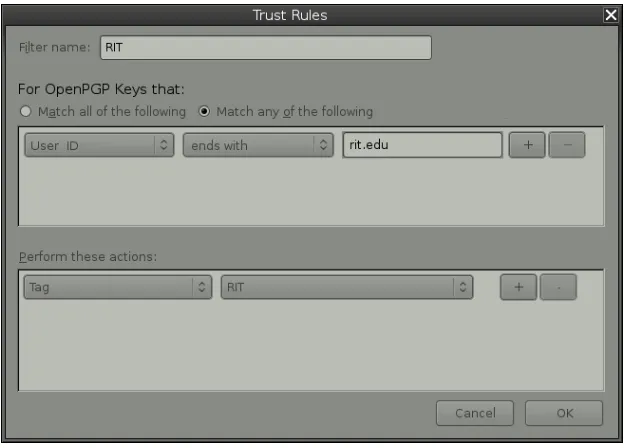
This thesis needs to make sure its new trust model is easy to use. In software testing of PGP version 5.0 Whitten and Tygar [45] found that many users could not create keys and other associated OpenPGP tasks in a respectable time frame. End users can become easily confused and need easy to un-derstand visual clues. In developing our Trust Rules interface this thesis has used a common window type that users should already be familiar with. The window is based on Mozilla Thurderbird’s [9] email filter window. A mock-up of a proposed window for adding tags is shown in Figure 2.
Figure 2: Mock-up of adding a Trust Rule.
be evaluated and the key tagged automatically.
Rule is for security or nearly for sorting and classification. With that in mind this thesis is treating all tagged keys as a separate case from Trusted Keys, but not grouping them in with “Other Collected Keys” as some software packages call non trusted keys. This distinction should be clear after looking at Figure 3 which shows a mock-up of how this thesis see Tagged Keys being integrated with current software packages.
Figure 3: Mock-up of Key Management using Tags.
6
Evaluation:
In this section the thesis will evaluate our new trust model through user case studies and later with some quantitative analysis. This thesis presents where Trust Rules makes sense for the end user and how it can simplify the key verification process.
6.1
User Case Study:
6.1.1 Rochester Institute of Technology:
Using RIT as an example, RIT could automatically sign one PGP key for all authenticated users through an online system that integrates into the campus email system or other online services, such as myRIT. Next, each department could sign a user’s key if certain requirements are met such as: physical presentation of RIT ID, membership in said department, RIT ID Number, RIT username, and OpenPGP key fingerprint. The RIT ID should be used to confirm the persons identity, and also match with the person’s ID picture with the picture on their OpenPGP key. After this all users in the department and the rest of RIT would know that:
1. The user is a current RIT student/faculty/staff.
2. The user is a member of a particular department.
3. The user’s picture is correct.
The key would only be considered valid if two signatures are on the key: one by RIT and one by the department to which the person belongs. The model that this thesis has described above requires two signatures to be valid. This simple model would prevent an attacker at any one department from falsely verifying keys, because they must first be signed by RIT.
6.1.2 Evaluation of Model:
6.1.3 Social Networking:
Using MySpace, Xanga, bebo, flickr, FaceBook, or any other social network-ing site as an example this thesis presents a secure mechanism for key ex-change and verification of identity. The website itself could sign keys of in-dividual users thereby verifying the digital pseudonym. After which friends and associates can verify the information in person. These contacts may be new friends found through the website. Community friends can meet to ver-ify identity and once a threshold of key signatures has been established the group or community Trust Rule would be evaluated and make the person a member in good standing with the community. These networks are already established and can provide a number of contacts with which a user may communicate. By having the community develop the rules and sign keys it provides incentive for new users to join in with secure communications and lowers the bar for new secure pathways to develop. If an individual had to approach each user and verify their key it would be a daunting task, but with the community undertaking this task it distributes the load and allows for quicker keyring creation. This social networking model would mostly verify digital pseudonyms, but can be mixed with other trust models, since the model itself does not prevent multiple rules being run simultaneously.
6.1.4 Evaluation of Model:
this case there is a high barrier to enter, because of cost. The cost of setting up a Certification Authority or other type of structure for each community would be prohibitive. Our trust model, however allows for each group to have their own rules and to operate completely independently of each other.
6.2
Quantitative Analysis:
6.2.1 Number of Signatures:
In analyzing our trust model this thesis has picked a particular Trust Rule to analyze. While other Trust Rules may be developed the best general purpose Trust Rule this thesis presents is the N of K Servers Trust Rule. The thesis will evaluate this Trust Rule with a purposed threshold where N = 10 and
K = 15|20 servers. Thus the Trust Rule will have the following format:
Trusted Keys: GROUP(Issuer,10){keyID1, keyID2, keyID3,
keyID4, keyID5,..., keyID15|20}
This should provide the right amount of servers for there to be competition among the authentication severs while maintaining a small enough number to be feasible. The threshold is chosen so that a large percentage of servers must agree before a key is verified as valid. For increased security one only has to increase the value of N to a larger percentage ofK.
only one as long as an already trusted CA is chosen.
Figure 4: Number of Users Versus the Number of Signatures.
Trust Rules does not require more signatures because this thesis has decided to use fifteen to twenty certification authorities to establish our trust in an end user’s identity. These same CAs will be used regardless of the number of users in the network.
Next, this thesis presents that the slopes and associated number of sig-natures differ between the worst case and best case scenarios of the Web of Trust model. As stated previously, the worst case is S = U and the best case is S =√U where S is the number of signatures and U is the number of users. Any slope that is less than that of the best case scenarios can be considered an improvement by reducing the total number of required signa-tures. That being said, the security of such a system might be questioned if the number of required signatures is substantially lower. There may be a compromise between ease of introduction into the encryption system and sustained security over time as new users are added.
7
Future Research:
7.1
X.509:
More research needs to be done into using X.509 with Trust Rules. This thesis chose OpenPGP because of its lack of rigid structure and reliance in a hierarchical tree and because there was a clear path to implementing our Trust Rules within software packages with minimal specification and applica-tion changes. This does not forgo the X.509 Trust Model from implementing Trust Rules or another type of conditional rule-based system, but it appears at this time that there would be substantial work involved in application, specification, and social change. There is already a widely used system veloped around X.509 certificates, so that would further complicate the de-velopment of a new trust model for that system. The trust model would more likely need to make better business sense economically than it would security wise to be adopted. It still would be possible and interesting to see some type of conditional rule-based trust model implemented in X.509.
7.2
Additional Trust Rules:
counting the number of signatures on a given key. If such a Trust Rule were put into place it could easily be bypassed by an attacker.
Our current Trust Rule has a slope of zero and does not scale as the number of users scales. While this can be a feature it can also be a security weakness, as each Certification Authority is trusted with more and more verifications. To combat this reliance on any one Certification Authority this thesis would need to develop a Trust Rule that scales some, but one that does not have a slope greater than OpenPGP Web of Trust. There could also be a Trust Rule that steps up the threshold when a given number of keys is trusted through that rule. As more keys are trusted through a given rule that rule’s threshold could automatically be increased so that the total amount of trust in any set of Certification Authorities is reduced.
7.3
Email Integration:
8
Conclusion:
References
[1] Alfarez Abdul-Rahman and Stephen Hailes. A distributed trust model.
In NSPW ’97: Proceedings of the 1997 workshop on New security
paradigms, pages 48–60, New York, NY, USA, 1997. ACM.
[2] D. Atkins, W. Stallings, and P. Zimmermann. PGP message exchange formats. RFC 1991, Internet Engineering Task Force, August 1996.
[3] Kemal Bicakci, Bruno Crispo, and Andrew S. Tanenbaum. How to incor-porate revocation status information into the trust metrics for public-key certification. In SAC ’05: Proceedings of the 2005 ACM symposium on
Applied computing, pages 1594–1598, New York, NY, USA, 2005. ACM.
[4] J. Callas, L. Donnerhacke, H. Finney, D. Shaw, and R. Thayer. OpenPGP message format. RFC 4880, Internet Engineering Task Force, November 2007.
[5] J. Callas, L. Donnerhacke, H. Finney, and R. Thayer. OpenPGP message format. RFC 2440, Internet Engineering Task Force, November 1998.
[6] Liqun Chen, Dieter Gollmann, and Chris J. Mitchell. Authentication using minimally trusted servers. SIGOPS Oper. Syst. Rev., 31(3):16–28, 1997.
[8] Alice Cheng and Eric Friedman. Sybilproof reputation mechanisms. In
Proceedings of the 2005 ACM SIGCOMM workshop on Economics of
peer-to-peer systems, P2PECON ’05, pages 128–132, New York, NY,
USA, 2005. ACM.
[9] Contributors. Mozilla thunderbird. http://www.mozilla.com/ thunderbird/, 1998-2008.
[10] Contributors. Seahorse. http://www.gnome.org/projects/ seahorse/, 2002-2008.
[11] Various Contributors. Internet archive, wayback machine. http:// archive.org/web, 1996.
[12] John R. Douceur. The sybil attack. InRevised Papers from the First
In-ternational Workshop on Peer-to-Peer Systems, IPTPS ’01, pages 251–
260, London, UK, UK, 2002. Springer-Verlag.
[13] Stephen Farrell. Not reinventing pki until we have something better.
IEEE Internet Computing, 15(5):95–98, 09 2011.
[14] Simson L. Garfinkel, David Margrave, Jeffrey I. Schiller, Erik Nordlan-der, and Robert C. Miller. How to make secure email easier to use. In
CHI ’05: Proceedings of the SIGCHI conference on Human factors in
computing systems, pages 701–710, New York, NY, USA, 2005. ACM.
’05: Proceedings of the 2005 symposium on Usable privacy and security, pages 13–24, New York, NY, USA, 2005. ACM.
[16] Shirley Gaw, Edward W. Felten, and Patricia Fernandez-Kelly. Secrecy, flagging, and paranoia: adoption criteria in encrypted email. InCHI ’06: Proceedings of the SIGCHI conference on Human Factors in computing
systems, pages 591–600, New York, NY, USA, 2006. ACM.
[17] Glenn Greenwald. Front: Exclusive: How nsa can see ’nearly everything you do online’: Secret tool searches email, chat and social media use, Aug 01 2013. Name - NSA International Inc; Copyright - (Copyright , Guardian Newspapers Limited, Aug 01, 2013; Last updated - 2013-08-01.
[18] Glenn Greenwald. Front: Exclusive: Us orders phone firm to hand over data on millions of calls: Top secret court ruling demands ’ongoing, daily’ data from verizon, Jun 06 2013. Name - National Security Agency; NSA International Inc; Copyright - (Copyright , Guardian Newspapers Limited, Jun 06, 2013; Last updated - 2013-06-06.
Administration; Copyright - (Copyright , Guardian Newspapers Lim-ited, Jun 07, 2013; Last updated - 2013-06-08.
[20] R. Guha, Ravi Kumar, Prabhakar Raghavan, and Andrew Tomkins. Propagation of trust and distrust. In Proceedings of the 13th
interna-tional conference on World Wide Web, WWW ’04, pages 403–412, New
York, NY, USA, 2004. ACM.
[21] Peter Gutmann. Pki design for the real world. InNSPW ’06: Proceedings
of the 2006 workshop on New security paradigms, pages 109–116, New
York, NY, USA, 2007. ACM.
[22] Jason Harris. Keyanalyze statistics. http://keyserver.kjsl.com/ ~jharris/ka/.
[23] R. Housley, W. Polk, W. Ford, and D. Solo. Internet X.509 public key infrastructure certificate and certificate revocation list (CRL) profile. RFC 3280, Internet Engineering Task Force, April 2002.
[24] R. Housley and S. Santesson. Update to DirectoryString Processing in the Internet X.509 Public Key Infrastructure Certificate and Certificate Revocation List (CRL) Profile. RFC 4630, Internet Engineering Task Force, August 2006.
agents and multiagent systems, pages 1217–1224, New York, NY, USA, 2006. ACM.
[26] ISO/IEC / ITU-T. Security architecture for open systems interconnec-tion for ccitt applicainterconnec-tions, March 1991. ISO/IEC ISO 7498-2, ITU-T Rec. X.800.
[27] ISO/IEC / ITU-T. Information technology open systems interconnec-tion the directory: Overview of concepts, models and services, August 2005. ISO/IEC 9594:2005, ITU-T Rec. X.500.
[28] ISO/IEC / ITU-T. Information technology open systems interconnec-tion the directory: Overview of concepts, models and services, August 2005. ISO/IEC 9594-2 , ITU-T Rec. X.501.
[29] ISO/IEC / ITU-T. Information technology open systems interconnec-tion the directory: Public-key and attribute certificate frameworks, August 2005. ISO/IEC 9594:2005-8, ITU-T Rec. X.509.
[30] Sepandar D. Kamvar, Mario T. Schlosser, and Hector Garcia-Molina. The eigentrust algorithm for reputation management in p2p networks.
InWWW ’03: Proceedings of the 12th international conference on World
Wide Web, pages 640–651, New York, NY, USA, 2003. ACM.
[32] R. Langner. Stuxnet: Dissecting a cyberwarfare weapon. Security
Pri-vacy, IEEE, 9(3):49–51, 2011.
[33] Michael W. Lucas. PGP & GPG: Email for the Practical Paranoid. No Starch Press, 2006.
[34] Neal McBurnett. Pgp web of trust statistics. http://bcn.boulder.co. us/~neal/pgpstat/19961206/, 1996.
[35] Neal McBurnett. Pgp web of trust statistics. http://bcn.boulder.co. us/~neal/pgpstat/, 1997.
[36] Henk P. Penning. Analysis of the strong set in the pgp web of trust.
http://pgp.cs.uu.nl/plot/, 2013.
[37] Trevor Perrin. Public key distribution through ”cryptoids”. In NSPW
’03: Proceedings of the 2003 workshop on New security paradigms, pages
87–102, New York, NY, USA, 2003. ACM.
[38] Ajay Ravichandran and Jongpil Yoon. Trust management with delega-tion in grouped peer-to-peer communities. InSACMAT ’06: Proceedings of the eleventh ACM symposium on Access control models and
technolo-gies, pages 71–80, New York, NY, USA, 2006. ACM.
[39] Paul Resnick and Richard Zeckhauser. Trust among strangers in internet transactions: Empirical analysis of ebay’ s reputation system. Advances
[40] S.B. Roosa and S. Schultze. Trust darknet: Control and compromise in the internet’s certificate authority model. Internet Computing, IEEE, 17(3):18–25, 2013.
[41] S. Santesson and R. Housley. Internet X.509 Public Key Infrastructure Authority Information Access Certificate Revocation List (CRL) Exten-sion. RFC 4325, Internet Engineering Task Force, December 2005.
[42] Flora Rheta Schreiber. Sybil. Henry Regnery Company, Washington, DC, USA, 1973.
[43] Mathew J. Schwartz. Nsa prism: Inside the modern surveillance state.
Informationweek - Online, Jun 10 2013. Copyright - Copyright 2013
CMP Media LLC. All rights reserved. No part of the report or the data or information included therein may be reproduced, republished or redistributed without the prior written consent of CMP Media LLC; Last updated - 2013-06-11.
[44] Drew Streib. keyanalyze - analysis of a large openpgp ring. http: //dtype.org/keyanalyze/, 2001.
[45] Alma Whitten and J. D. Tygar. Why johnny can’t encrypt: a usability evaluation of pgp 5.0. InSSYM’99: Proceedings of the 8th conference on
USENIX Security Symposium, pages 14–14, Berkeley, CA, USA, 1999.
[46] Matthew Wilcox. The footsie web of trust analysis. http://www. parisc-linux.org/~willy/wot/footsie/, 2008.
[47] Philip Zimmermann. Why I Wrote PGP. http://www. philzimmermann.com/EN/essays/WhyIWrotePGP.html, 1991.
A
Appendix
A.1
Terminology
The International Telecommunication Union (ITU) Rec. X.800 & Interna-tional Organization for Standardization ISO 7498-2 [26] defines terms which are important to this thesis and are outlined below.
Asymmetric (encipherment): (e.g. public key) encip