Abstract: This study aims to test an interactive pedagogical tool using a computer-based learning approach. The purpose of building Multiple Intelligences Activities Flip Module is to increase students’ potentials through their multiple intelligences. The true-experimental study design is used and the samples are randomly selected as control and treatment groups. Pre and post tests are used to measure the effectiveness of this interactive flip module in relations to multiple intelligences significant differences. The findings of the study reveal that the interactive Multiple Intelligences Activity flip module has a high degree of reliability whereby the average measure for Intra-class Correlation Coefficient is .771 with a 95% confidence interval from .520 to .931 (F(9,486)= 4.644, p<.000). Based on MANCOVA test analysis, the researchers have rejected the null hypothesis. The study has demonstrated that the Multiple Intelligence Activity flip module has increased the scores of multiple intelligences tests for treatment groups.
Index Terms: Multiple Intelligences, MANCOVA, Innovation, Multiple Intelligences Activity Flip Module, Experimental
I. INTRODUCTION
The rapid progress in science and technology has inspired many constructive and practical scientific learning tools that accentuate the significant use of multimedia. Basically, multimedia comprises various elements such as text, graphics, animation, audio, video and inter-activity [2]. The teaching media is defined as the identified, constructed and adapted (innovate) media source or material (software) that supports or acts as catalysts to the teaching and learning process [1]. The teaching media helps to enrich learning contents and teaching methods and also to extend learning paths [1].
2. The Conceptualization of Interactive Multiple Intelligences Activities Flip Module
Multiple Intelligences Activity Flip Module is an interactive pedagogical tool using multimedia elements such as text, graphic, audio, visual and animation. It is developed based on computer-based learning strategies to
Revised Manuscript Received on September 03, 2019
Nurulwahida Azid, School of Education and Modern Languages, Universiti Utara Malaysia, Sintok, Malaysia.
Ridzuan Hashim, Kubang Pasu Science School, Jitra, Malaysia.
Tze Kiong Tee, Department of Professional Education, Faculty of Technical and Vocational Education, Batu Pahat, Malaysia.
Yee Mei Heong, Department of Professional Education, Faculty of Technical and Vocational Education, Batu Pahat, Malaysia.
stimulate seven multiple intelligences. All the seven multiple intelligences are measured through problem solving activities based on the learning outcomes that are clearly stated for each unit. This application contains seven units representing seven multiple intelligence types. Every activity developed is based on Multiple Intelligences Theory [3]. The developed problem-solving activities are based on verbal linguistics intelligence, mathematical logic intelligence, visual spatial intelligence, kinesthetic intelligence, musical intelligence, interpersonal and intrapersonal intelligence. The activities are organized according to the constructive alignment and outcome-based education which measures the learning outcomes, learning activities, materials needed, activity feedback and conclusions. The applications are developed using the Flip PDF Professionals Application based on ADDIE model [4]-[11]. This ADDIE model involves five phases namely analysis, design, development, implementation and evaluation.
II. LITERATUREREVIEW A. Gardner’s Multiple Intelligence Theory
Developing human potential is one of the aspects clearly stated in the National Education Philosophy. Teachers are encouraged to diversify their teaching and learning activities in order to optimize students’ potentials. Several studies have documented the strong relationship between talents and nature. According to [5], [3], potentials can be indicated and measured in degrees of intelligence. Accordingly, multiple intelligences theory founded by [3] aims to explain that mankind has not only one intelligence but at least seven intelligences at different levels. The variety of intelligence expressed by [3] in his book entitled “frames of mind” explains intelligence through various aspects of capability, ability, talent or skill that naturally exists. The types of intelligence identified are verbal linguistic, logic math, visual spatial, kinesthetic, musical, interpersonal and intrapersonal. According to [15] the first type of intelligence is that verbal linguistic are students' ability to communicate and the ability to use language at a high level. The second type of intelligence is logic math. It is a rational, scientific and abstract thinking ability. Next is visual spatial intelligence which is an advantage in terms of understanding and using information in visual and spatial form. Kinesthetic is the fourth type of multiple
intelligences where an
The Effect of Interactive Multiple Intelligences
Activities Flip Module: Its Effects on Students’
Multiple Intelligences
individual has the ability to solve problems or create objects using body movements. Sensitivity to the elements related to sounds and music is musical intelligence. Interpersonal is the ability to communicate, understand and cooperate with others. The last intelligence is intrapersonal, which is the ability to understand aspects of oneself and apply knowledge to succeed in life. Intelligence is an abstract concept. The concept is dynamic and contains many dimensions that are intertwined with each other. Intelligence also refers to the ability of individuals to benefit from new [15]. According to [18], each individual has all the intelligence, however, not all intelligence develops in balance and usually each individual has at least one or more prominent intelligence than any other intelligence. [16], on the other hand, asserted that every human being has a unique intelligence of their own. Computer Based Learning
Computer based learning (CBL) refers to learning programs that use computers as the main basis. The CBL approach offers the use of interactive elements of computer software, along with the computer's ability to present various types of media [2]. There are several potential advantages of computer-based learning programs and this includes home-based learning that promotes self-independent learning. The use of computer-based learning that implements multimedia technology in teaching pedagogy helps teaching and learning process [6]. Interactive teaching materials that use computer-based learning approach can create a fun environment for students [7]. According to [6] the level of learning mastery is improved when interactive multimedia is used as more senses are involved in the learning process [8].
At present, the use of technology is no stranger to our everyday life that this generation is called "Digital Native" [20]. This has led to changes in the ways of teaching and learning [19]. In relation to that, one of the branches of multimedia technology is seen to be able to make a positive impact especially in education based on recent research conducted by [23]. Meanwhile, [19] define multimedia as a combination of various media elements into a tool that generates user benefits. Among the multimedia elements that are often used to create an application are text, pictures, graphics, animations, sound and video [19]-[20]-[21]. The application of this multimedia has helped to create the latest pedagogical tools. According to [17], multimedia is integrated into learning when conventional teaching methods (chalk & talk) are no longer effective in stimulating learning. The application of multimedia produces simulations, animations and visuals to help students get abstract information into real information [21].
B. Hypotheses
Ho: Multiple Intelligences Activity Flip Module is not a factor in the improvement of the post test scores of verbal linguistic intelligences, logic math, visual spatial, kinesthetic, musical, interpersonal and intrapersonal test scores when the pre-tests of the verbal linguistic intelligence, logic math, visual spatial, kinesthetic, musical, interpersonal and intrapersonal are controlled.
III. METHODOLOGY
This study used a true-experimental research design conducted on three schools in the Eastern region of Malaysia. A total of 20 students have been randomly assigned to the control and treatment groups. Data collection was conducted quantitatively and MANCOVA test analysis was used to test the hypothesis [9].
A. Sampling Design
60 students from three schools have been randomly selected as the control and treatment groups. These Form Two students are at the age of 14 years old. Table 1 illustrates the distribution of the selected sample.
TABLE1:SAMPLEOFTHESTUDY School Control
Group
Treatment Group
Total
School A 20 students 20 students 40
School B 20 students 20 students 40
School C 20 students 20 students 40
Total 60 60 120
B. Instrument
The pre and posttests consisted of multiple intelligences tests. The instrument was adapted from [13] and it has been modified and translated into Malay Language. The instrument has a high reliability value of .80 [9].
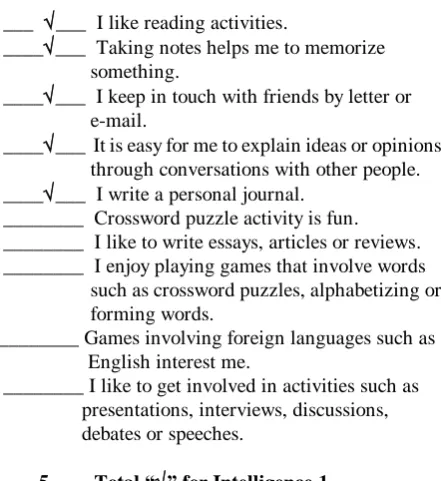
The instrument for multiple intelligences was adapted from [29]. Modified and translated into Malay. Translation of this inventory has been adopted in the study by [30] with high reliability values of .85 and .80. There are eight categories of intelligence in this survey and each category has 10 items. Respondents were to put a “ √ ” mark on the item that
correctly describes them. The number of "√ " marks for each category of intelligence can exceed one. The total score for each category was 100% where each item carries 10%. Scoring was given based on the number of items that respondents agreed to with the “√ ” sign. High scores indicate that respondents have a high level of intelligence for the intelligence. Respondents are likely to have very high levels of intelligence. The linear data transformation process that has been used involved multiplying the number of scores for each intelligence by a value of 10 (Refer to Table 2). The method of data transformation involving the multiplication of value 10 refers to the method proposed by [29]. Meanwhile, the classification of scores by four categories of range was based on modifications to classifications that have been carried out in previous related studies [31]. The respondents' multiple intelligence levels were then categorized according to the following levels of intelligence after summing up all categories of intelligence:
EXAMPLE:
Intelligence 1 (Verbal- Linguistic)
___ ___ I like reading activities.
_______ Taking notes helps me to memorize something.
_______ I keep in touch with friends by letter or e-mail.
_______ It is easy for me to explain ideas or opinions through conversations with other people. _______ I write a personal journal.
________ Crossword puzzle activity is fun. ________ I like to write essays, articles or reviews. ________ I enjoy playing games that involve words
such as crossword puzzles, alphabetizing or forming words.
________ Games involving foreign languages such as English interest me.
________ I like to get involved in activities such as presentations, interviews, discussions, debates or speeches.
___5____ Total “” for Intelligence 1
The above answer shows that this study sample has 5 agreed items on verbal-linguistic intelligence so the total score obtained for verbal-linguistic intelligence is 5 X 10 = 50%. This score shows that the study sample has moderate verbal-linguistic intelligence. Table 2 shows the framework of total scores for each type of sample intelligence.
TABLE2:TOTALMARKSFOREACHTYPEOF INTELLIGENCE
Multiple Intelligences
Total “√” Multiply Score
Verbal-linguistic X10
Logic Math X10
Visual Spatial X10
Kinesthetic X10
Music X10
Interpersonal X10
Intrapersonal X10
Naturalist X10
C. Face and Content Validity
Face validity and content validity have been performed on all pre-test and post-test items. This validation was done by senior lecturers in English and Malay Language to ensure that the meaning of the translated item was consistent with the original item's meaning in English. The purpose of face and content validity is to ensure that each item measures what to measure and is consistent and does not deviate from the original intent of the item in English [14].
D. Data Collection Procedures
A true-experimental research was conducted after the Multiple Intelligences Activity Flip Module had obtained a high value of agreement from the panel of experts. In the first month of the study, all respondents (both in control and treatment groups) were given pre-tests of multiple intelligences. The respondents from the treatment group underwent an enrichment program that utilized the
interactive Multiple Intelligences Activity Flip Module for two months and directly after completing this program, the respondents (both in control and treatment groups) were given post-tests of multiple intelligences.
IV. FINDINGS A. Demographic Data
[image:3.595.69.290.82.323.2]Gender
Table 3 below shows that out of 120 respondents, 40 of them were male (33.33%) and 80 of them were female (66.67%). These statistics show that female respondents outnumbered male respondents by 33.34%.
TABLE3:SAMPELBASEDONGENDER
Gender f %
Male 40 33.33
Female 80 66.67
Total 120 100.00
B. Multiple Intelligences Profile
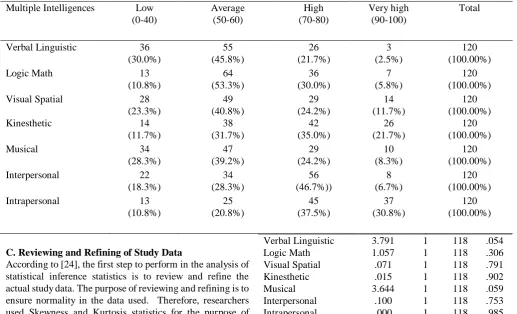
Table 4 below shows the profiles of students for various intelligences prior to treatment. For verbal-linguistic intelligence, 36 people (30.0%) of all respondents achieved a low score of 0 to 40, 55 (45.8%) achieved an average level of 50 to 60, 26 (21.7%) achieved a high score of 70 to 80 and 3 (2.5%) achieved a very high score of 90 to 100. Whereas for logic math intelligence, 13 (10.8%) of the total respondents achieved a low level of 0 to 40, 64 (53.3%) achieved an average level of 50 to 60, 36 (30.0%) achieved a high score of 70 to 80 and 7 (5.8%) achieved a very high score of 90 to 100.
[image:3.595.301.553.225.298.2] [image:3.595.41.296.434.562.2]TABLE 4: STUDENTS’ MULTIPLE INTELLIGENCES PATTERN
C. Reviewing and Refining of Study Data
According to [24], the first step to perform in the analysis of statistical inference statistics is to review and refine the actual study data. The purpose of reviewing and refining is to ensure normality in the data used. Therefore, researchers used Skewness and Kurtosis statistics for the purpose of reviewing and filtering data. The analysis results using Skewness and Kurtosis can be found in Table 5.
The skewness and kurtosis (data distribution) values for the multiple intelligence tests ranged from .052 to 2.37. According to [25] the zero value for Skewness and Kurtosis shows a normal 100 percent distribution of data. In this study the recommended values are within ± 2.0 for Skewness and ± 2.0 for Kurtosis can be accepted [24]-[25]. The above data distribution is considered normal because both values for Skewness and Kurtosis are located within ± 2.0.
TABLE 5: SKEWNESS AND KURTOSIS ANALYSIS Multiple Intelligences Skewness Kurtosis
Verbal Linguistic -.052 -.149
Logic Math -.609 2.370
Visual Spatial -.360 .303
Kinesthetic -.716 .221
Musical -.132 .077
Interpersonal -1.170 1.215
Intrapersonal -1.246 1.687
Finally, for intrapersonal intelligence, 13 (10.8%) of the total respondents achieved a low score of 0 to 40, 25 (20.8%) achieved an average level of 50 to 60, 45 (37.5%) achieved a high score of 70 to 80 and 37 (30.8%) achieved a very high score of 90 to 100.In Table 6 the results of the Levene’s Test begin with multiple intelligence Verbal Linguistic [F(1,118)=3.79,P>.05], Logic Math [F(1,118)=1.05,P>.05], Visual Spatial [F(1,118)=.071,P>.05], Kinesthetic
[F(1,118)=3.645,P>.05], Interpersonal
[F(1,118)=.010,P>.05], and Intrapersonal
[F(1,118)=.010,P>.05].
TABLE6:HOMOGENITYOFVARIANCE
Pretest F df1 df2 Sig.
Verbal Linguistic 3.791 1 118 .054
Logic Math 1.057 1 118 .306
Visual Spatial .071 1 118 .791
Kinesthetic .015 1 118 .902
Musical 3.644 1 118 .059
Interpersonal .100 1 118 .753
Intrapersonal .000 1 118 .985
A. Multiple Intelligences Activity Flip Module Inter Rater Reliability
The Multiple Intelligences Activity Flip Module was rated by 10 experts from various academic fields namely the curriculum and instructions, psychology, measurement and evaluation, instructional technology, language and mathematics. The Multiple Intelligences Activity Flip Module had obtained a high degree of reliability from the raters (Refer to Table 4). The average measure for ICC was .771 with a 95% confidence interval from .520 to .931 (F (9,486) = 4.644, p<.000). This finding indicated that there was an almost perfect agreement among the raters on of the introduction of content, learning activities and assessments of the Multiple Intelligences Activity Flip Module.
B. MANCOVA Test Analysis Findings
Based on Table 8, Multivariate Pillai's Trace test results revealed that there was a significant impact for the independent variable GROUP [F (7,105) = 3.95, p <.05]. However, there was no covariate effect of logic math intelligence pretest [F (7,105) = 3.30, p> .05], kinesthetic intelligence [F (7,105) = 1.20, p> .05], musical intelligence [F (7,105) = 1.57, p> .05], and interpersonal intelligence [F (7,105) = 1.32, p> .05] against dependent variables. On the other hand, there was a covariate effect on verbal linguistic intelligence pretest [F (7,105) = 3.29, p <.05], visual spatial intelligence pretest [F (7,105) = 2.34, p <.05], intrapersonal intelligence pretest [(7,105) = 2.41, p <.05] toward the dependent variable.
Multiple Intelligences Low
(0-40)
Average (50-60)
High (70-80)
Very high (90-100)
Total
Verbal Linguistic 36
(30.0%)
55 (45.8%)
26 (21.7%)
3 (2.5%)
120 (100.00%)
Logic Math 13
(10.8%)
64 (53.3%)
36 (30.0%)
7 (5.8%)
120 (100.00%)
Visual Spatial 28
(23.3%)
49 (40.8%)
29 (24.2%)
14 (11.7%)
120 (100.00%)
Kinesthetic 14
(11.7%)
38 (31.7%)
42 (35.0%)
26 (21.7%)
120 (100.00%)
Musical 34
(28.3%)
47 (39.2%)
29 (24.2%)
10 (8.3%)
120 (100.00%)
Interpersonal 22
(18.3%)
34 (28.3%)
56 (46.7%))
8 (6.7%)
120 (100.00%)
Intrapersonal 13
(10.8%)
25 (20.8%)
45 (37.5%)
37 (30.8%)
Based on the MANCOVA test analysis, the null hypothesis was rejected. Hence, the Multiple Intelligences Activity Flip Module was evidently a factor in the improvement of the
multiple intelligences test scores for the treatment group.
Two-way mixed effects model where people effects are random and measures effects are fixed.
a. The estimator is the same, whether the interaction effect is present or not.
b. Type A intraclass correlation coefficients using an absolute agreement definition.
c. This estimate is computed assuming the interaction effect is absent, because it is not estimable otherwise.
TABLE8: MULTIVARIATETESTRESULTSFORMULTIPLEINTELLIGENCES
Effect Value F Hypothesis df Error df Sig.
Intercept Pillai's Trace .643 27.025b
7.000 105.000 .000
Verbal linguistic Intelligence pre test Pillai's Trace .180 3.292b
7.000 105.000 .003
Wilks' Lambda .820 3.292b
7.000 105.000 .003
Logic Math intelligence pre test Pillai's Trace
.070 1.123b 7.000 105.000 .355
Visual spatial intelligence pre test Pillai's Trace
.135 2.335b 7.000 105.000 .030
Kinesthetic intelligence pre test Pillai's Trace
.073 1.189b 7.000 105.000 .316
Musical intelligence pre test Pillai's Trace
.095 1.566b 7.000 105.000 .154
Interpersonal intelligence pre test Pillai's Trace
.081 1.317b 7.000 105.000 .250
Intrapersonal intelligence pre test Pillai's Trace
.138 2.408b 7.000 105.000 .025
Group Pillai's Trace .209 3.955b
7.000 105.000 .001
The line graph above shows the tests for verbal linguistic intelligence, logic math intelligence, visual spatial intelligence, musical intelligence, interpersonal intelligence and intrapersonal intelligence of the treatment group over control group. On the other hand, for kinesthetic intelligence, the control group overrides the treatment group.
I. DISCUSSIONANDCONCLUSION
The findings of this study have evidently proven that students’ multiple intelligences can be nurtured, stimulated and developed through several computer-based learning enrichment activities [5]-[3]. This study also recommends that vast opportunities should be given to the development of problem-based enrichment
activities that can examine
and support students’
multiple
TABLE7: INTRA-CLASSCORRELATIONCOEFFICIENT Intra-class
Correlationb
95% Confidence Interval F Test with True Value 0
Lower Bound
Upper Bound
Value df1 df2 Sig
Single Measures
.058a .019 .196 4.644 9 486 .000
Average Measures
intelligences [10]-[13]. Creative and innovative computerized multimedia learning materials should be widely used in unfolding and nurturing students’ potentials. The Multiple Intelligences Activity Flip module that integrates multimedia elements of text, video, audio, graphics and animation may be used extensively in the classroom. Integrating multimedia in teaching and learning may also aid the contextual learning. Computer based learning has the potential to totally transform the education process and remarkably improve the efficiency of learning by providing great motivation to students. Through multimedia students can learn the abstract concept more easily. Therefore, the use of technology will be balanced with guidance and supervision by teachers to enhance the transformation of education among students. In conclusion, learning materials that use multimedia and computer-based learning can support teachers to create a good learning activity based on students’ multiple intelligences.The intra-class results indicated that all 10 expert panels had produced high reliability values of .77. This demonstrates that the Multiple Intelligences Activity Flip Module is structured in accordance with the principles of multimedia learning application development that need to be formulated through tests that take into account the evaluation, opinion and expert opinion of building an application for learning purposes [17]-[22]. Findings by the line graph show that treatment groups improved their intelligence scores compared to control groups. Nevertheless, kinesthetic intelligence shows that control group scores precede treatment groups. This suggests that enrichment activities for kinesthetic intelligence need to be further strengthened so that further studies can have a better impact on treatment groups. This can be understood that the enrichment activities in the Multiple Intelligences Activity Flip Module need to emphasize the movement and use of the body to solve problems. This finding is consistent with the findings of the study conducted by [28] which shows that the study conducted show the highest score among financial students is an interpersonal (M=29.54) and lowers score is logic math intelligence (M=22.44)The Multiple Intelligences Activity Flip Module is designed as an interactive module of enrichment activities to unlock the potential of teenagers through problem solving activities based on seven different types of intelligence. This is because multiple intelligences aspects play an important role in giving students the freedom to explore and learn in various ways through the tendency of dominant multiple intelligences in students. While the integration of multiple intelligences enables educators to help students understand and appreciate the power through the variety of intelligences that they have [26]. Therefore, the Multiple Intelligences Activity Flip Module is designed to identify students' potential through real-world activities that will stimulate future learning [26]. Patterns of multiple intelligences showed very high study sample in kinesthetic intelligence (21.7%) and weak in musical intelligence (28.3%). According to [18], there are differences in the types of intelligence among school students. This is in line with the findings of [27] that showed that MARA Junior Science College students' multiple intelligences patterns tend to be excellent in interpersonal, intrapersonal and logic math intelligences.
In conclusion, the diversity of students' multiple intelligences can be enhanced through enrichment activities as contained in the Interactive Multiple Intelligences Activity Flip Module. The results of this study inform teachers that learning through a variety of intelligence can help students enhance their dominant intelligence and at the same time improve their latent intelligence.
ACKNOWLEDGMENT
The authors wished to thank the Universiti Utara Malaysia in funding this study under the Social Innovation Grant Scheme S/0 code 13973 and the Research and Innovation Management Centre, Universiti Utara Malaysia, Kedah for the administration of this study.
REFERENCES
1. A. N. Namli, M. C. Sahin and T. Karatas, “A case study with academicians about using an interactive whiteboard on classrooms,” Education Science (NWSAES), 2016, pp 23-35.
2. M. Jingjit, “The effects of multimedia learning on Thai primary pupils’ achievement in size and depth of vocabulary knowledge,” Journal of Education and Practice, 2015, pp 72-81.
3. H. Gardner, Framed of Mind: The Theory of Multiple Intelligence with A New Introduction By The Author. New York: Basic Books, 2011. 4. M. R. Branch, Instructional Design: The ADDIE Approach. United
Kingdom: Springer Sciences & Business Media, 2009.
5. H. Gardner, 5 Minds for The Future. Boston: Harvard Business Press, 2008.
6. M. L. Rajendra and M. I. Sudana, “The influence of interactive multimedia technology to enhance achievement pupils on practice skills in mechanical technology,” Journal of Physics: Conference Series, 2018, pp 1-15.
7. W. Wiana, “The effectiveness of using interactive multimedia in improving the concept of fashion design and its application in the making of digital fashion design,” IOP Conference Series: Materials Science and Engineering, 2018, pp 21-31.
8. L. K. Gunawardhana and S. Palaniappan, “Possibility of using multimedia application for learning,” GSTF Journal on Computing (JOC), 2016, pp 77-83.
9. W. J. Creswell, Educational Research: Planning, Conducting and Evaluating Quantitative and Qualitative Research. United Kingdom: Pearson Education Limited, 2014.
10.M. Barak, T. Ashkar and Y. J. Dori, “Learning science via animated movies: Its effect on pupils’ thinking and motivation,” Computer & Education, 2011, pp 839-846.
11.T. Trust and E. Pektas, “Using the ADDIE model and universal design for learning principles to develop and open online course for teacher professional development,” Journal of Digital Learning in Teacher Education, 2018, pp 219-233.
12.J. Filgon, J. Filgona and K. L. Sababa, “Mastery learning strategy and learning retention: Effects on senior secondary school students’ achievement in physical geography in Ganye educational zzone, Nigeria,” Asian Research Journal of Arts & Social Sciences, 2017, pp 1-14.
13.M. Yaumi, S. F. S. Sirate, and A. A. Patak, “Investigating multiple intelligence-based instruction approach on performance improvement on Indonesia elementary madrasah teacher,” SAGE Journal, 2018, pp 1-10. 14.J. R. Franekel, N. E. Wallen, & H. H. Hyun, How to Design and Evaluate
Research in Education. New York: McGraw Hill Education, 2015. 15.A. A. Ajam, & O. Hemmatipoor, “The relationship between multiple
intelligences and health literacy in health students in Gonabad UMS,” Journal of Community Health Research, 2017, pp 48-56.
16.E. Herndon. What Are Multiple Intelligences and How Do They Affect
Learning. Available:
Author-3 Photo 17.I. M. Rajendra, & I. M. Sudana, “The influence of interactive multimedia
technology to enhance achievement students on practice skills in medical technology,” Journal of Physics: Conferences Series, 2018, pp 12-22. 18.J. Hanafi, “Multiple intelligences theory, action research and teacher
professional development: The Irish MI project,” Australian Journal of Teacher Education, 2014, pp 126-141.
19.L. K. Gunawardhana, & S. Palaniappan, “Possibility of using multimedia application for learning,” GSTF Journal of Computing, 2016, pp 1-10. 20.Norhana Md. Salleh, Kamila Ghazali & Mariyati Mohd Nor,
“Penceritaan digital dalam pemerolehan leksikal Bahasa Jepun,” GEMA Online Journal of Language Studies, 2017, pp 55-75
21.W. Wiana, “The effectiveness of using interactive multimedia in improving the concept of fashion design and its application in the making of digital fashion design,” IOP Conferences Series, 2018, pp 21-31 22.T. Trust, & E. Pektas, “Using the ADDIE model and universal design for
learning principles to develop and open online course for teacher professional development,” Journal of Digital Learning in Teacher Education, 2018, pp 219-233
23.G. Mothibi, “A meta-analysis of the relationship between e-learning and students’ academic achievement in higher education,” Journal of Educational and Practice, 2015, pp 6-10.
24.A. Field, Discovering Statistic Using SPSS (3rd ed.). London: SAGE Publication Ltd.
25.P. Y. Chua, Statistik Penyelidikan Lanjutan: Ujian univariat dan multivariat. Kuala Lumpur: McGraw Hill.
26.F. E. Gouws, “Teaching and learning through multiple intelligence in the outcomes-based education classroom,” African Education Review, 2007, 60-74
27.N. Azid, A. A. Yaccob, & S. Shaik, “The multiple intelligence based enrichment module on the development of human potential: examining its impact and the views of teachers,” Malaysian Journal of Learning and Instruction, 2016, pp175-200.
28.A. Pehvilan, & M. Durgut, “The effect of logical-mathematical intelligence on financial accounting achievement according to multiple intelligence theory,” Journal of Education and Social Policy, 2017, pp 132-139.
29.W. McKenzie, Multiple Intelligences Survey. Available:
http://surfaquarium.com/MI/inventory.htm.
30.R. A.Yaghoob, & Z. P. Hossein, “The correlation of multiple intelligences for the achievements of secondary students,” Education Research and Review, 2016, pp 141-145.
31. W. R. W. Daud, T. A. Muhammad, & M. M. Yunus, “The relationship between multiple intelligences and attitude towards sports among academically gifted students,” Jurnal Pendidikan Malaysia, 2018, pp 39-47.
AUTHORS PROFILE
Nurulwahida Hj Azid @ Aziz is a senior lecturer at School of Education and Modern Languages. Her field of expertise is curriculum and instruction. Her research mainly focuses on the effectiveness of interactive application, enrichment module and interactive module using psychology elements (multiple intelligences, thinking intelligence, higher order thinking skills, decision making skill, problem solving and case-based learning) across curriculum and instruction. She has received several awards for her research output from International Exhibitions. She has successfully completed 17 research grants since 2011 and is now working on two ongoing research grants. She is at present involved in publication and research using pre-experimental research design, true experimental research design and quasi experimental research design. She is also a member of one International Scopus Journal Language Board. Her current research area is focusing on case-based learning to stimulate higher order thinking among technical and vocational students in the Malaysian education system. She teaches Curriculum and pedagogy, Curriculum studies, Evaluation of teaching, Model of Instruction, Curriculum Design, Development: Theory and Practice and Measurement & evaluation. She is an active researcher and writer. Her research interest: enhancing teaching and learning, curriculum and instruction, curriculum innovation and assessment of learning in school settings. She is also a member of Malaysian Research and Innovation Society (Myris). Email: [email protected].
Ridzuan Hashim is a teacher at Kubang Pasu Science School, one of the secondary schools in Kedah, Malaysia. He teaches Design and Technology subject involving Forms 1 to 3 students. He is also active in research invention and innovation, and has participated in several international invention exhibitions. He is currently a Ph.D candidate at University Sains Malaysia. His research interest is on technical and vocational comprising module in electronic, I-Think
Map and curriculum studies. He is also a member of Malaysian Research and Innovation Society (Myris). Email: [email protected]
Tee Tze Kiong was born in Melaka, Malaysia on the 25th of April, 1979. He obtained his first degree in bachelor of technology with education (civil engineering) at the Faculty of Education, Universiti Teknologi Malaysia, Skudai, Johor, Malaysia in 2002. In 2003, he completed his Master’s degree in technical and vocational education at University Teknologi Malaysia, Skudai, Johor, Malaysia. In 2013, he obtained his Ph.D. in technical and vocational education at Universiti Tun Hussein Onn Malaysia, Batu Pahat, Johor, Malaysia. His Ph.D. research focused on higher order thinking skills and Buzan Mind Mapping. His working experiences include; secondary school teacher, subject matter expert, e-tutor, e-grader, proctor for final examination at Open University Malaysia, industrial practicum supervisor, undergraduate project, master and Ph.D. thesis supervisor, undergraduate, master and Ph.D. examiner, subject matter expert and examiner in Technical and Vocational Education courses, professional consultant for Multiple Intelligent Tests and Learning Styles Inventory, instrument construction workshop, senior lecturer and head of department of Engineering Technology at Sultan Idris Education University. Now, he is a lecturer in the Department of Professional Education, Faculty of Technical and Vocational Education, at Universiti Tun Hussein Onn Malaysia. (Email:
[email protected]). Current and previous research interests are thinking skills, thinking tools, self-instructional modular approach, learning styles and inventive problem-solving skills. Dr. Tee is a member of Universiti Teknologi Malaysia Alumni, Universiti Tun Hussein Onn Malaysia Alumni, Malaysia Technical and Vocational Education Association and TRIZ level I instructor.
Yee Mei Heong was born in Sarawak, Malaysia. She
obtained her first bachelor degree of technology with education (civil engineering) at the Faculty of Education, Universiti Teknologi Malaysia, Skudai, Johor, Malaysia in 2002. She completed her Master’s degree in technical and vocational education at Universiti Teknologi Malaysia, Skudai, Johor, Malaysia in 2003. She obtained her Ph.D. in technical and vocational education from Universiti Tun Hussein Onn Malaysia, Batu Pahat, Johor, Malaysia in 2015. Her Ph.D. research focused on higher order thinking skills and learning styles. Her working experiences include secondary school teacher, subject matter expert and tutor at Open University Malaysia (OUM), industrial practicum supervisor, subject matter expert and examiner in Technical and Vocational Education courses, professional consultant for Multiple Intelligent Tests and Learning Styles Inventory, instrument construction workshop and programme coordinator of Ph.D in Education at Universiti Tun Hussein Onn Malaysia. She is now serving the Department of Engineering Education, Faculty of Technical and Vocational Education, Universiti Tun Hussein Onn Malaysia as senior lecturer (Email:
[email protected]). Her current research interests are thinking skills,