Abstract— The study focused on the design and fabrication of a Gender-responsive Coconut Dehusking Machine (GRCDM). Descriptive and developmental research were employed in the study which involved design, fabrication, and evaluation of the output performance of the machine. A total of thirty (30) respondents operationally tested the machine and evaluated its ergonomics, functionality, adaptability, cost-effectiveness, and level of acceptability. The GRCDM is driven by a gasoline motor engine which drives the dehusking mechanism. It applies a speed reduction principle through the use of a belt and chain-sprocket assembly that links directly to the dehusking unit composed of two cylindrical rollers. The interaction of the rollers with its plurality of spikes and corrugated round bars served as a penetrating means which resulted in the tearing effect of the husk leaving the nut undamaged. The machine meets 95- 100 % of the physical ergonomics requirements, 90-94% functional, 90-94% adaptable, 90-94 % cost effective and 95-100% acceptable with a drawback on the cost of the fabrication. The dehusking machine sets at a moderate speed of 21.40 rpm has a dehusking capacity of 559 nuts per hour and efficiency of 97.04% respectively. The energy requirements in terms of power and torque are 0.3165 kW and torque of 0.1332 kN-m. Dehusking capacity relative to the standard fuel consumption of the machine is 310 nuts/ li. Using the developed gender-responsive coconut dehusking machine, it can help novice farmers particularly women to be involved in the dehusking process to make work easier and safe.
Keywords:—dehusking machine, dehusking efficiency, ergonomics, gender-responsive
I. INTRODUCTION
The Philippines is considered to be one of the world’s largest producers of coconut. It plays a significant role in the national economy which is an important source of economic activity among farmers in the country. Based on statistics, areas planted with coconut covers 3.612 ha(PSA, 2018). In 2015, the recorded number of coconut bearing trees reached 329.9 million with an average production of 14.902 billion nuts in the last three years (PCA, 2017).
About one-third of the country’s arable agricultural land or 3.26 million hectares is planted to coconut representing sixty-eight (68) out of total seventy-nine (79) provinces, and 1,195 out of the 1,554 municipalities in the country. Coconut is one of the two agricultural commodities that earn the country more than a billion dollars in export revenues every year. It provides a sustainable income source for Filipinos by way of employment generation through its many programs.
In Biliran Province, its economy is predominantly fueled by agriculture. Although the half of area of the province is comprised mostly of coconut plantations, the productivity level of the coconut industry are low which may be
Revised Manuscript Received on April 05, 2019.
Analiza B. Calles, Biliran Province University, Biliran, Philippines. ([email protected])
Jamcee B.Aguilar, Cebu Technological University, Cebu, Philippines.
attributed to lack of information on the appropriate technologies used for coconut farming. According to Amongo (2017), the use of mechanized farming technology as a necessary input in improving productivity levels and farming efficiency of major crop producing areas is inherent to R.A. 8435 “ The Agriculture and Fisheries Modernization Act (AFMA) of 1997”. The law serves as a major policy guideline of the country in the pursuit to agricultural modernization and productivity since the transfer of agricultural mechanization technology has been a very slow process in the Philippines (Paras, 2015).
There were a multitude of machinery being imported and adopted by the country, but failed since machines favor’s large hectares of land that were utilized by big farm enterprises leaving behind the small- scale farmers. According to Paras (2015), designing and adapting machinery, equipment, and other technology should suit the farmers’ needs and condition which encourages the increase in its level of machinery use. More so, the use of machines for agriculture should be suitable for use in small farms, easily repairable and maintainable, inexpensive and environmentally friendly.
Salokhe(2003) as cited by Paras (2015), the machine should be appropriate to the farmers in terms of needs and affordability. In addition, proposed appropriate machine designs should consider the ergonomic limitations of individuals since, in developed countries, human labor force comprises as much as 60% of women workers.
Aside from the issues in agricultural mechanization and its appropriate use for farmers, accessibility of locally- made agricultural machines particularly for coconut farming industry are still limited. Poor mechanization in the coconut farming industry is prevalent because of 80% of the farm power is provided by human beings (Paras,2015) and farmer’s attitude of being reluctant to adopt changes and new technologies is imminent.
Even though the coconut industry has an immense contribution to the country’s economy, adopting new trends in the processing of coconuts into its desired products and by products has been a problem of many coconut farmers. One of the major challenges of the coconut industry is the dehusking process of coconut nuts. Dehusking is considered as a tedious and dangerous process using traditional equipment and tools. It is a process of taking out the husk from the coconut shell having an end product of husks that may be used in many industries for ship ropes, doormats, handicrafts, hair brushes, and sacking material.
Gender-Responsive Dehusking Machine:
Utility Model
There are existing manual hand tools to dehusk coconuts such as a machete, crowbar, spike and etc. Using these tools it requires skills and very laborious to dehusks which is more suited for male than female coconut farmers apart from the danger it could bring while doing the process. In fact, dehusking of coconuts in the region has been sole of men’s work taking 15-20 minutes to dehusk the coconut manually. More so, there have been manual and mechanized dehusking machines that exist which are not gender- responsive and partially successful in this development. According to Vargheiser et. al (2014), issues and concerns of some existing mechanized dehusking machines are as follows: difficult to operate and large force is required due to small mechanical advantage; safety issues and can be done by a skilled person; machine is bulky and have high power consumption; incomplete dehusking; and time- consuming.
With the prevalent issues and concerns cited above, the proponent designed and fabricated a gender-responsive coconut dehusking machine that increases farmer’s coconut productivity. The design of GRCDM took consideration on its ergonomics, functionality, adaptability, cost-effectiveness, and level of acceptability. In addition, it accounted for the benefits it could give to coconut farmers especially to women since it is easy to operate and efficient. It also provides less human interaction, reduces the drudgery and less force or exertion needed compared to manual dehusking equipment and other mechanized coconut dehusking machines.
Moreover, with the integration of a gender-responsive concept in the development of the GRCDM, it fosters women inclusion in the dehusking process of coconuts as well as to the coconut farming industry. It will provide an avenue to women farmers to have equal economic opportunities and be empowered in terms of their productive roles.
Conceptual Framework
The study focused on the design, fabrication, testing, and evaluation of the coconut dehusking machine that can be easily operated by both male and female coconut farmers.
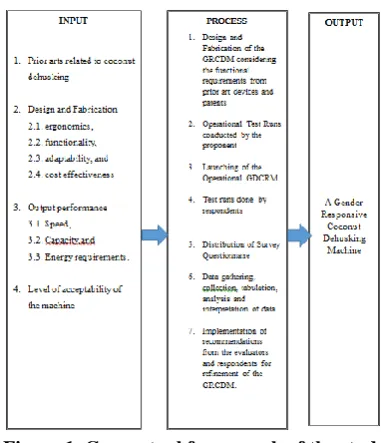
[image:2.595.329.520.47.269.2]The conceptual framework of this study was adopted on the concept of the famous new product development model known as BAH model and System Ergonomic Design (SED). The design and development of the dehusking machine are based on the sequence of stages, beginning with an initial product concept or idea that is evaluated, developed, tested and launched to the consumers or users (Booz, Allen & Hamilton, 1982). The study also integrated System Ergonomics Design (SED) which is a version of a system design adapted to ensure that the human factor is accounted for in the design process and considered part of the system. In fact, it considers worker’s abilities with respect to cognitive, physical and mental aspects, and the method lends itself as an efficient design approach for any technical system where human operators are employed (Singleton,1982).
Figure 1. Conceptual framework of the study
Design of the machine was based on the functional requirements taken from different prior art devices and patents, reports, and journal articles about the development of coconut dehusking machines. The operational efficiency of the fabricated machine was tested based on its output performance in terms of speed, dehusking rate and efficiency, and the energy requirements for the operation. At the time when the machine was operational, it was launched and underwent test runs which were done by the respondents. Evaluation of the machine was rated by the respondents from the survey instrument in order to determine its ergonomics, functionality, adaptability, cost-effectiveness, and its level of acceptability. Taking into account the drawbacks that were considered during the test runs, the machine underwent fine-tuning through adjustments and corrections on the design elements and performance parameters of the machine.
Statement of the Problem
The main objective of the study was to design a gender-responsive coconut dehusking machine at Biliran Province State University, Biliran Province during the Academic year 2018-2019 towards utility model application.
Specifically, it aimed to answer the following:
1. What are the prior arts related to coconut dehusking? 2. What gender-responsive coconut dehusking machine
can be designed and fabricated on the following features:
2.1. ergonomics; 2.2. functionality; 2.3. adaptability; and 2.4. cost-effectiveness?
3. What is the output performance of the machine in the dehusking process in terms of:
3.1. speed; 3.2. capacity; and 3.3. energy requirement?
II. METHODOLOGY
Research Design
The study is developmental research and made use of a descriptive survey. There were two phases in the study namely: Phase I – design and fabrication of the machine; and Phase II – evaluation of the output performance of the machine. Test runs were conducted based on the operational parameters to validate the efficiency of the operation of the machine.
Participants of the study
The main participants of the study were chosen using a purposive sampling technique. Purposive sampling is a non-probability sample that is selected based on the characteristics of a population and the objective of the study. It is valuable and appropriate in this situation because it immediately reaches the targeted sample for proportionality. Thirty (30) participants from the three (3) selected barangays of Almeria, Biliran Province were involved in this study. As to the performance testing of the operational efficiency of the machine, five (5) technical experts were invited to observe the operational test runs and gave feedback to the researcher for any additions or changes in the elements of the design.
Instrumentation
The instrument used in the study was a researcher-made survey questionnaire. It was used for drawing out necessary information and data to determine the ergonomics, functionality, adaptability, cost-effectiveness, and the level of acceptability of the machine. The instrument is composed of two parts: Part I- profile of the respondents and Part II- evaluation of the machine from the respondents who had operated the machine.
In the evaluation of the output performance of the machine, observation and note-taking were done in order to document the results of the test runs. Comments and Recommendations from the technical experts that were invited to do the observation were noted and implemented.
Data Gathering Procedure
Before gathering and collecting the data, the researcher sought proper authorization and permission to conduct research from Biliran Province State University and 3 selected barangays of Almeria, Biliran. The researcher conscripted a letter noted by the research adviser and the Director of Graduate School and asked permission of the researcher’s University President.
Data Analysis
Documentation was taken during the design and development of the machine. A series of test runs were conducted in order to gather operational parameters that determine the output performance of the machine. Upon several test runs, necessary adjustments and corrections were implemented to improve the performance of the machine for operation.
Data were tabulated, organized, analyzed and interpreted and summarized using descriptive statistics.
Frequency counts, mean computation, and ranking were employed in Phase II of the study in order to determine
ergonomics, functionality, adaptability, cost-effectiveness, and level of acceptability of the newly developed gender-responsive coconut dehusking machine.
III. RESULTS AND DISCUSSIONS
The main objective of the study is to design a Gender-responsive Dehusking Machine (GRCDM). Data were gathered, tabulated, analyzed and interpreted based on the statement of the problem.
1. Prior Art
There were mechanized dehusking machines that had been developed by Titmus and Hickish (1929) with a US Patent No. 1,724,739, Celaya (1930) with a US Patent No. 1,781,215, Beeken (1959), Woodproof (1970) and Nijaguna (1988) but have failed due to incapability for the machines to compete with manual labor as cited by Tanco (1998). Several dehusking machines have been invented and patented by Pascua (2018), Nwankwojike (2012), Santhi (2006), and Dinanath (1987) which have similar features of the developed Gender-Responsive Dehusking Machine (GRDM) by the researcher.
2. Design and Fabrication of the GRDCM
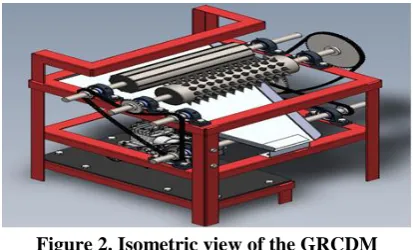
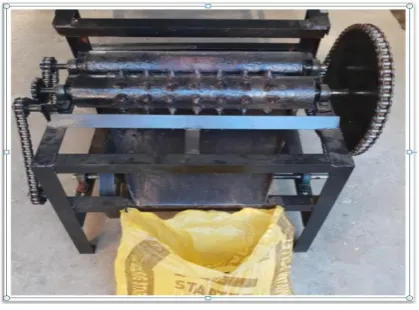
[image:3.595.323.530.516.641.2]Fig.2 and Fig.3. shows the isometric view and top view photo of the GRCDM. The machine is powered by a 7-hp gasoline motor engine. It is attached on the base of the frame structure which uses to drive the mechanism. The motor engine acts as the drive mechanism that is connected through a double V belt transmitted directly a much larger pulley link via the main shaft. The main shaft is then connected directly to a 10- tooth sprocket connected via a chain to a 40-tooth sprocket. A 13-tooth sprocket is connected via a chain parallel to the 40-tooth sprocket and transmits directly to the 60-tooth sprocket which drives the cylindrical rollers. In order to achieve the reverse turn of the cylindrical rollers, a four-way sprocket combination called over loop is applied.
Figure 2. Isometric view of the GRCDM
along on its surface to facilitate a gripping action to the coconut. The interaction of the rollers and its plurality of spikes as a penetrating means resulted in the tearing effect of the husk leaving the nut undamaged.
Figure 3. Top view photo of the GRCDM
3. Ergonomics
One of the domains of ergonomics that is being considered in this study is physical ergonomics. It refers to physical load on the human body when performing physical activities and its responses to physical and physiological work demands.
Table I shows the rate of responses of respondents on the ergonomics of the GRCDM. Based on 10-item statements which determine the ergonomics of the machine, it has a grand weighted mean score of 4.29 with a corresponding descriptive interpretation of “strongly agree”.
[image:4.595.64.274.111.266.2]IV. RESULTS & DISCUSSIONS
Table I. Rate of Responses of Respondents on the Ergonomics of the GRCDM
This implies that upon dehusking using the GRCDM by the respondents, they strongly agree that the GRCDM can be operated without discomfort and agree that there is no need for maintaining concentration over a long period of time. The result shows that GRCDM can be operated without discomfort and no need to maintain concentration over long periods which meets 95-100% of the ergonomics requirements.
4. Functionality
Table II shows the rate of responses of the respondents to the functionality of the GRDM. Level of functionality
pertains to the machine that is purposeful, effective and able to meet the required output of the machine.
Table II. Rate of Responses of the Respondents on the Functionality of the GRCDM
As shown in the table, the responses of the respondents have a grand weighted mean of 4.20 with a descriptive interpretation of “agree”. This indicates that the respondents strongly affirm that the machine functions effectively and less affirm that it can dehusk coconuts neatly. More so, the result shows that GRDM has 90-94 % level of functionality which means that the machine fits effectively as to purpose and functions in dehusking coconuts.
5. Adaptability
Table III reveals the rate of responses of the respondents in terms of the level of adaptability of the machine. It pertains to the level of flexibility of the machine to adapt to any environment or situation, may it be located in a flat terrain or elevated place when in use.
Table III. Rate of Responses of Respondents on the Adaptability of the GRCDM
[image:4.595.54.279.465.622.2]that it needs 4 to 5 persons to load and offload the machine from the utility vehicle.
6. Cost-effectiveness
[image:5.595.49.288.178.315.2]Table 4 below reveals the rate of responses of the respondents in terms of the cost-effectiveness of the machine.Cost-effectiveness refers to the cost of the machine when assembled, parts are can be changed easily and readily available in hardware that is inexpensive.
Table IV. Rate of Responses of Respondents on the Cost-effectiveness of the GRCDM
As revealed in the table, the cost-effectiveness of the machine has a grand weighted mean score of 3.74 with a corresponding descriptive interpretation of “agree”. This implies that the respondents affirm that the materials of the machine last longer in consideration of its wear and tear and the price of the parts and components of the machine is a bit costly. The result reveals that the respondents agreed that the machine is 90-94 % cost effective.
7. Output Performance of the GRCDM
The actual speed of the dehusking unit of the GRCDM based on the 60-tooth sprocket that drives the cylindrical rollers to dehusks coconuts. Based on the test runs, the dehusking unit has average speed of 13.22 rpm, 21.40 rpm, and 25.03rpm setting the machine in low, moderate, and high speed respectively.
[image:5.595.305.550.327.481.2]Table IV shows the dehusking capacity and efficiency of the GRCDM. The dehusking capacity of the machine pertains to the number of dehusked coconut fruit per unit time.
Table IV. Dehusking Capacity and Efficiency of the GRCDM
As shown in the table, the dehusking capacity and efficiency of the machine at varied speed are as follows: 388 nuts per hour with efficiency of 96.62%; 559 nuts per hour
with an efficiency of 97.04%; and 682 nuts per hour with an efficiency of 96 %.
The energy requirement in terms of power and torque at a varied speed of the dehusking machine are as follows: the power of 0.1843kW has a torque of 0.1332 kN-m; the power of 0.3165 kW has a torque of 0.1332 kN-m; and the power of 0.3479 kW has a torque of 0.1332 kN-m. The fuel consumption of the motor is 1.8 liter per hour. Thus, dehusking capacity relative to the fuel consumption of the engine at moderate speed is 310 nuts/ li.
8. Level of Acceptability of the GRCDM
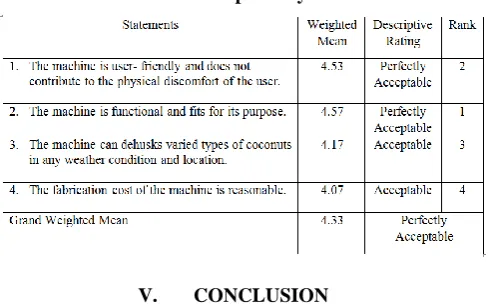
Table V presents the level of acceptability of the GRDM. Level of acceptability pertains to the degree of the machine to be technically and operationally acceptable.
The level acceptability of the machine has a weighted mean score of 4.33 described as “perfectly acceptable”. This implies that the respondents’ answers strongly affirm that the machine is functional and fits for its purpose with a drawback on the cost of the fabrication of the machine. In addition, the result shows that the level of acceptability of the machine is 90-94%acceptable.
Table V. Level of Acceptability of the GRCDM
V. CONCLUSION
A gender perspective is integrated into the design and fabrication of the machine in order to promote gender equality and women inclusion in the coconut dehusking process. With the newly developed GRCDM, it will help men and women in the coconut farming industry to achieve equal social and economic opportunities and benefits.
The developed GRCDM can dehusks coconuts efficiently, eliminates operator’s drudgery and physical discomfort, adaptable to the environment, acceptable to the prospect users, and it can easily be used by unskilled operators.
With this innovative machine, it will help increase the productivity levels of the coconuts farmers in the region. More so, it is user-friendly and eases the work of the farmers though there are drawbacks on the cost of the fabrication and lack of safety features of the machine.
VI. RECOMMENDATIONS
[image:5.595.51.287.579.723.2]1. An alternative material aside from rubber shall be laid on the base of the engine motor to dampen vibration.
2. The belt pulley, chain-sprocket assembly, and four-way sprocket combination shall be metal guarded for precautionary measures and safety reasons. 3. A utility model application shall be applied by the
proponent for intellectual property rights to the Intellectual Property Office of the Philippines in order for the utility model to be recognized and protected.
4. Present the study to concerned government agencies and research conferences in order for the public to be aware of the innovative research about the developed dehusking machine.
5. Further development and study of the dehusking machine in terms of its materials and components used shall be conducted in order to improve the output performance of the machine and level acceptability of the machine.
REFERENCES
1. Amongo, R. V. (2017). Determination of Agricultural Mechanization Level in the Production-Postproduction Systems of Rice and Corn in Selected Regions of the Philippines. UP Los Banos,Industrial of Agriculture and Biosystem Engg. WEbsite.
2. Booz, Allen, & Hamilton. (1982). New product management for the 1980’s. New York: Booz, Allen & Hamilton, Inc.
3. Celaya, G. (1930). Machine for Husking Coconut. US Patent 1,781,215.
4. Dinanath, C. (1987). Coconut dehusking machine. Trinidad and Tobago: US Patent No 4708,056.
5. Nijaguna, B. (1988). Coconut Dehusker. Journal of Food Engineering, 287-301.
6. Nwankwojike, B. N., Onuba, O., and Ogbonna, U. (2012). Development of coconut dehusking machine for rural small scale farm holders. Int. J. of Innovation Technology and Creative Engg., (2)3.
7. Paras, F. J. (2015). Technology Transfer Strategies for Small Farm Mechanization Technologies in the Philippines. UP Los Banos: Agricultural Machinery Division and Agricultural Mechanization Development Program, Institute of Agricultural Engineering.
8. Philippine Coconut Authority. (2017). Retrieved from http://www.pca.da.gov.ph/ index.php /2015-10-26-03-1557/2015-10-26-03-22-41
9. Salokhe, V. A. (2003). Development of appropriate agricultural machinery for Southeast Asian countries. Laboratory of Agricultural Systems Engineering. 10. Singleton, W. T. (2012). The Nature and Aims of
Ergonomics. Retrieved from Encyclopedia of Health and Safety:
http://www.ilocis.org/documents/chpt29e.htm#JD_ 11. Tanco, R. K. (1998). Analysis of the Principles of the
Coconut Dehusking. Undergraduate Thesis. University of the Philippines Los Baños.
12. Vargheiser, A, J.J.(2014). Experimental
Research.Retrieved from
Explorable:http//explorable.com/experimental research. 13. Wood, J. G. 1970. Coconut Production, Processing,
Products. Publishing Company Inc. Westport