THESES SIS/LIBRARY TELEPHONE: +61 2 6125 4631 R.G. MENZIES LIBRARY BUILDING NO:2 FACSIMILE: +61 2 6125 4063
THE AUSTRALIAN NATIONAL UNIVERSITY EMAIL: [email protected] CANBERRA ACT 0200 AUSTRALIA
USE OF THESES
This copy is supplied for purposes
of private study and research only.
Passages from the thesis may not be
copied or closely paraphrased without the
by Colin
s.
Gum.Commonwealth Observatory,
Mt. Stromlo,
CA..NBERHA.
Thesis submitted for the degree of Doctor of
\
(
When Mr. Gum was taken ill in.July, 1953, h<:l had completed a draft of his paper and discussed it with me.
This draft is reproduced here, with the following alterations: (i) a discussion at the beginning of section 6 has
been condensed into the second paragraph of that section.
(ii) the first paragraph in section
7
is new. these changes had been agreed to by Gum.Both (iii) Gum's figure 3 has been withdrawn, Many points
(iv)
(v)
in his figure dtd not agree with the data in table I, and for some I could find no authority at all, The present figure
3
reproduces the data of TableI.
The discrepancies between the data of' Table I andthe notes on individual nebulae in section 6 I have let stand. A note should be added on object 38b, which Oosterhoff found to be very heavily reddened,
the total absorption of the central star being greater than I+ ,magnitudes.
f!'igure lL is patl;!-~ and figure 5 entirely new. The lower half of ~ 1 is missing, In the upper
half I thought that the galactic equator is horizontal, instead of ver.tical as in the other fig r, e~. Most of' the references have had to be located and may
not always be correct. There are still some gaps. A very relevant paper has since appeared by H.F. Weaver, A.J. 58, 177, 1953, whichanticipates some
of' Gum's findings on the inner arm.
This work was done under my formal supervision.
Gum, however, worked largely independently, and all the leading ideas were definitely his own. This applies in particular to the superposition method, and to the ideas on galactifi
structure develoned in section 7. It should also be mentioned that the equipment was extensively damagedmin the fire of'
February 1951, and it was due to Gum's largely aa~teaunqJaf~
efforts that it was put into operation again.
Colin
s.
Gum.Summary.
The results of a photographic survey f'or diff'use H~
emission nebulosities (HII regions) in the Southern
Milky Way f'rom galactic longitude 1"' 190° to 350°
are given. il. catalogue, which includes a number of
new objects, lists positions and dimensions of 85 physically
separate H II regions together with details of the
exciting stars and their distance moduli when available.
The faintest objects detected have n
3 = 1, where n
3 is the number of third level hydrogen atomfs in a
column 1 cm2 in cross-section passing through the nebula
in the direction of the line of sight.
A scheme of classification describing the
large-scale structural features of H II regions is suggested.
T~e main criterion is the radial variation of surface
brightness within the nebula. Most H II regions may
then be arranged in an almost continuous sequence from
those having a very high central surface brightness,
(n
3 up to 200), which decreased with incr•easing distance
f·rom the centre, (Class I), to fainter objects (n
3 ~ 5)
in which most of the emission is concentrated in a ring
or in an incomplete ring (Class IV). One of the
inter-mediate classes (Class III) has a practically uniform
surface brightness over a circular disk with the exciting
star at the geometrical centre. This class corresponds
most closely to Stromgren's idealised H II regions,
which then appear as a special case in a more general
sequence of structural forms. The classification is
also applicable to emission nebulosities in other stellar
systems where only large-scale features may be observed.
-The statistical relation between the apparent
photographic magnitude of the exciting star and the
apparent diameter of the nebulosity is discussed and
compared witp Hubble's original relation derived from
blue-sen~ive plate material.
The spatial distribution of the Southern J:!II regions
can be studied in only a tentative fashion at present.
The results suggest certain details of spiral structure
At the Commonwealth Observatory a survey for
Ha. emission nebulosities in the southern Milky ',Vay was
begun by Dr. C. N. Allen in 1950, and continued and
extended by the author since late in 1951. The original
aim of the project was to obtain material for discussion
on the origin of galactic radio-noise considered as at
least partly due to free-free transitions in the
inter-stellar gas. Although the results from this point of
view have not as yet been very decisive, a considerable
amount of new data on HII regions has been obtained.
Many emission objects are found to be more extensive in
Ha. light than previously catalogued dimenstons, and in
a number of other cases the emission-line character for
known nebulae has been established. The number of
completely new HII regions, discovered) considering
'
those known at the epooh of commencement of the program,
is !tO. A number of these new objects have since been
independently discovered in a southern Ha. survey at
the Boyden station of Harvard College Observatory ( I ) • ...
Recent research reported by Morgan ( 2.. ) has shown
-that studies of the spatial distribution of HII regions
can provide information on the spiral structure of the
galaxy in the neighbourhood of the sun. The distribution
of the southern objects inaccessible to Morgan has been
examined and seems to conform in a general way to the
pattern of spiral structure revealed by the northern
nebulosities. However, the distance moduli at present
available for the exciting stars are based on mean
absolute magnitudes and may be considerably in error,
particularly as the exciting stars in HII regions are
likely to be of higher than average luminosity. A final
discussion on the spatial distribution of the southern
regions must therefore be deferred until accurate luminosity
-classes and.eolour excesses have been obtained for these stars.
l. Instruments and Region surveyed. For most of the program an f:l schmidt camera of lOOmm aperture was used. The film holder of this instrument is loaded with 22mm diameter disks punched from 35mm roll film.
The film disks are held to the curved focal surface by a simple retaining ring,
curvature (R = lOOmm)
the film taking up the slight . - ; t
withitrouble. The field of the camera is 11° in diameter; the focal plane seale is 35 minutes of are per millimetre.
Absorption filters have been used throughout, details of which are shown in Fig. l) together with approximate spectral sensitivity curves for the emulsions. Of the Ha filters used, the Parra-Mantois VR2 glass filter
is the most effective in eliminating the night-sky
radiations at AA 6360, 6364, although the lower trans-mission at Ha means that longer exposures are required with this filter.
region centred on the galactic equator from
l = to and extending to b = ~5° has been
11° in diameter. examined by circular overlapping fields
Two photographs of each field were obtained, one with
the ~combination of l03a-E emulsion and
Parra-Mantois VR2 filter; the other with the combination of Super-:X:X and Chance OYl. The first combination accepts a band of about 250 angstroms effective width centred on
Ha.
The second accepts a b,nd about 600 angstroms wide, between the night-sky line 15577 and Ha, but avoids the prominent nebular lines - it is hereafterreferred to as the "comparison". (See Fig. 1). The Ha exposures with the lOOmm schmidt camera stopped down to 60mm (f:l.7) varied from 20 minutes in the
5-direction of the galactic centre to an hour or more in the weaker parts of the Milky Way in Canis Major and Puppis. The comparison, or "non-H~" photographs, were usually about one hour.
For the region extending to 15° on either of the galactic equator and from 1 = 190° to
side 350°, overlapping H~ photographs, but not comparisons, have been secured with either the VR2 or the chance ORl filters. The emulsion in all cases was 103a-E.
A number of objective-prism photographs were also taken in the early stages of the program. For this purpose a 60° flint glass prism was mounted in front of the camera, giving a dispersion of 600A/mm at H~. An H~ filter was used to limit the spectrum, and the
region surveyed by this method was roughly 190°
<
1<
290°, -15°<
b<
+15°. Although these observations werediscontinued after the introduction of the two-filter method described above, the results have been useful in
confirming the existence of small diffuse patches of emission, tor which duplicate plates are required when working at small plate scales.
In addition, slit spectra of various regions were secured with a 130-toot spec~rograph similar to the 159-foot spectrograph described by Struve ( 3 ).
""'
Completeness of the survey: The faintest objects detected in the present work have n3
=
1, where n3 is the number of excited third-level hydrogen atoms in a column 1 em2 in cross-section and passing taough the nebula in the direction of the line of sightx. ThisX
If the effect of interstellar absorption is neglected, the value of n3 may be computed from the H~ surface
-brightness measured in terms of nebula. The emission measure,
energy/see/cm2 of the
2
11rr
L, where11rr
isthe hydrogen ion density per cubic centimetre, and L
the length of the emitting column in parsecs, can be derived from once the mechanism of excitation and the electron temperature are known. It is therefore preferable to quote observed surface brightnesses in terms of n
3• Stromgren's ease
the emission measure for the values of n
3 must be multiplied by a factor F(Te), where Te is the electron temperature. For
Te = 5000°K the value of F(Te) is 230; for l0,000°K the value is 420. Note that all Ha
intensities measured with filters have the NII lines at A 6548, 6584 as an added impurity. Page ( ! ) has shown that the effect is usually not very serious.
figure gives a rough indication of the surface brightness of a nebulosity just detectable in the fainter parts
of the Milky Way, say in Canis Major and Puppis at 1
=
200°. In the region of the galactic centre from Seorpius to Scutum the corresponding figure isn
3
=
h. or 5, owing to the fact that here the unresolved background is about five times as intense as in CanisMajor and Puppis. It is suspected that this background is due to a general field of Ha emission, because the non-Ha yellow comparison plates show an increase in
background of only two or three times over the same range of galactic longitude.
In the region of the rich star clouds in Sagittarius, the presence of confused masses of stars and faint
nebulosity introduces further difficulties in identification, and only the brighter regions (n3 probably about 10
or more), where the presence of Ha emission is
[image:9.842.155.699.78.850.2]7-definitely established, are included in the catalogue. It is expected that most objects brighter than the above limits between 1 = 190° and 350° and between
0
b = ~15 , and ranging in size from about 3 minutes of are and upwards are included. Of the small diffuse .objects with dimensions less than about 3 minutes of
arc little can be said, except that, since they produce almost stellar images at a plate scale of 35'/mm, their detection will depend on total integrated apparent
magnitude rather than on surface brightnessx.
xA number of small nebulae, not detected in the present work, have been found by Karl G. Henize with the Mt. Wilson and Palomar lOt-inch objective-prism telescope at the southern station of the University of Michigan
(personal Communication).
3. Examination of the material: Positive enlargements of the Ha negativ~s have been made and compared with the comparison photograph for the same field when this was available.
In addition, a method of superposition of Ha and comparison photographs previously described in detail has been useful in locating faint objects, particularly in the important region close to the galactic equator, where the presence of numerous star clouds makes
detection more difficult. In the "superposition" method (See Plates 2 and 3) a glass negative of the
comparison photograph is exactly superposed on a glass positive of the Ha photograp~ of the same field.
On a print made from this new "composite negative" the emission objects appear as dark tones while the stars appear as white spots or disappear into the light
-grey background. What is achieved is essentially the same as in any "blink" technique, although it is thought that fainter objects can be detected owing to the
increase of contrast introduced by the copying process. The example shown in Plates 2 and 3 is the region of M8 and M20, which are among the brightest emission objects in the sky. The central "cores" of both M8 and M20 are sufficiently bright for the
Ha line to record weakly on the Super-XX emulsion used for the comparison photograph. (See Plate 2, below) This accounts for the white patches at the centres of
these objects on the "superposition" print.
(See Plate
3,
above). Also in this field are several objects approaching the faintness limit n3=
4corresponding to this section of the Milky Way. At the bottom of the field part of the large Sagittarius star cloud is visible. The fact that this cloud has not
merged perfectly into the background on the superposition print is due to the difficulty in matching the density and contrast of the stellar background over the whole field covered by the two superposed plates. It is also clear that any emission object immersed within the
boundaries of such a star cloud would escape detection
unless it was considerably brighter than the limits defined in the previous section.
4.
Catalogue: Owing to the strong galactic concentration of emission objects, it is convenient to list them inorder of increasing galactic longitude. In this way complex groups of objects, which may be physically
raated, are kept closer together in the list than would often be the case if the order was by right aseension.
The existence of complex groups of objects, and of single objects with complex structure, raises the tuestion
-of the number -of entries which should be made in any ea. talogue. There seems little point, for our present purposes, in listing numerous knots and wisps of
nebulosity if they clearly belong to one nebulous complex. A study of the stars apparently associated with the
nebulosity has therefore been of assistance in making decisions of this sort: as far as possible only ~ entry has been made for all the nebulous fragments excited by~ star or by one cluster of stars. In some eases subdivisions a, b, c, ••••••• have been used to indicate separate entries which probably a close physical connection. Where any doubt oeeurs, the circumstances are discussed in the notes following the catalogue.
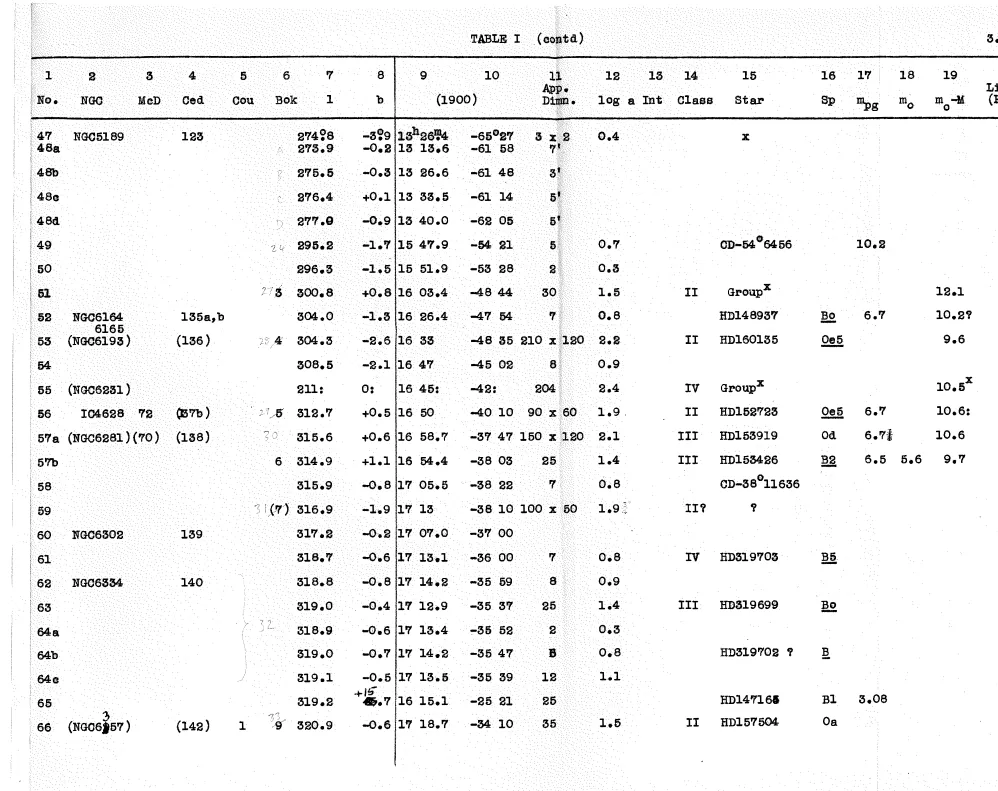
Table I contains the objects studied in the present investigation. Column 1 gives the Stromlo number;
Column 2 gives the NGC or IC number, which has been enclosed in parentheses if it refers to a star cluster within the nebula and not to the nebula itself.
Columns 3, h,
5,
and 6 contain the numbers given to various objectsCederbla.d ( g )
-respectively.
by the MCDonald astronomers (I ) , by
.. - I
by Courtes (
.:1 )
and by Bok (1'-',
Any such number enclosed within brackets indicates that the object concerned represents only a part or a small fragment of the corresponding entry in the present list. Columns7,
8,9
and 10 respectively give the galactic longitude, galactic latitude, right ascension and declination tor 1900. The galactic coordinates are referred to the Lund (to) pole-The positions in R.A. and Dec. are accurate to one or two minutes of arc tor objects smaller than about ten minutes of arc, but with increase in the size and irregularity of the object, the position becomes unavoidably rougher. Nevertheless it was considered preferable to give all positions, except for the very largest objects, to the nearest minute or
[image:12.842.226.690.70.978.2]-two of are, rather than introduce arbitrary amounts of rounding off. The dimensions in column ll are usually the longest and the shortest overall dimension in minutes of are; if only one dimension is given it is a diameter and the object is roughly circular. Column 12 gives log a where a is the mean of the longest
and shortest dimensions in minutes of arc. The
intensities in column 13 are eye estimates on a scale of
5;
the faintest is l and the brightest5.
These values refer to the brightest central portions of the nebulae, and the range from l to 5 corresponds roughly to a range in the value of n3 from 3 up to 200. More precise measurements will be given in a (second paper. Column lb. gives the nebular classon the system of classification discussed in Section 5
following. Columns 15, 16, 17 and 18 contain details of the exciting stars. Spectral types in italics are taken from the Henrz Draper Catalogue; other are from more modern cat,logues. The photographic magnitude is from the ~ or from the Cape Photographic
Durehmusterung. If only the visual magnitude is
available it is given in the same column in parenthesee. The photographic magnitudes corrected for space
absorption have been derived from m0
=
mpg - 8E1, where the colour excess E1 is from the catalogues of Stebbins, Huffer and Whitford (!_l )
or from Oosterhoff ( 12.).-
Most of the distan«:e moduli in column19
are also taken directly from these twocatalogues. Column 20 contains the linear dimensions of each region in parsecs.
5. Classification of HII Regions: (13 ). In Hubble's
-pioneer work on diffuse nebulae (i~) it was considered
-that the whole of the light from the exciting star was re-emitted by the nebula, and th~t the nebular
-illumination obeyed an inverse-square law with respect to the star as a source. These considerations satisfactorily described the form of the majority of the bright emission objects which could be recorded on blue-sensitive plates. However, recent theoretical investigations by Stromgren
( It; ) of the form of HII regions around early-type stars embedded in a uniform interstellar medium require an Ha emission region of fairly uniform intensity over
an apparently circular area. The emission is not concentrated towards the exciting star, but shows a relatively abrupt decrease of intensity at a distance
(:
from the star where all the ioni,ing radiation beyond the Lyman limit has been absorbed by the interstellar
hydrogen. A number of new emission objects which approximate very closely to this description have been found in the present work. They have faint to moderate surface brightnesses, which accounts for the fact that similar objects are missi:J;lg in blue-sensitive surveys. Another type of object, so far not expected on theoretical
grounds, is one in which most of the emission is con-centrated in a faint "ring", which is often incomplete, giving rise to a "loop" of emission. Two newly dis-covered objects (Nos. 12 and 55 in Table I) together with the well-known outer "loop" in Orion are examples of this type (see Plates 8 and
9).
The progression in structural forms from centrally condensed objects to ring-like regions suggests a
classification based simply upon the radial variation of surface brightness in the nebula, without regard, at first, to the linear dimensions of the nebula or to the details concerning the exciting stars. Measurements of the intensity profiles of typical nebulae have been made and are shown in Fig. 2. Each profile gives the variation of surface brightness along a line passing
relative intensities within each object was obtained
by reference to a tube sensitometer exposure. Preliminary values of n
3 are also attached. These were obtained by comparison of the nebular image with the extrafoeal image of a bright star. Slight irregularities in the profiles - due to foreground obscuration, or perhaps
to intrinsic variations in the nebulosity itself - need not concern us here. The main interest lies in the large-scale structural forms which are exhibited. As a preliminary classification the following four classes are suggested.
Class I objects have a high value of central
intensity which falls off with increasing distance from the centre. The shape of the contours of constant intensity are often irregular and dark matter is
frequently associated with the nebula. Many early-type stars, particularly 0 stars,are commonly involved, often in a galactic cluster within the nebula. Central values of n
3 up to 200 or more occur, decreasing to
n
3
=
5 or less in the extreme oute~ parts detectable.Class II objects are also irregular in shape with associated dark matter, but the concentration towards the centre is less marked and the central intensity is much less than in Class
I.
range from 10 to 50.
Central values of n3
Class III objects with a fairly faint, but practically uniform surface brightness over a circular area. There is a relatively abrupt decrease of intensity towards the edge. The number of exciting stars is small- usually one or two - of type 0 or early B, and situated near to the geometrical centre of the nebula. Values of N
3
range from 1 to 100. This class corresponds most closely to Stromgren's idealised HII regions.
-Class IV objects take the form of faint rings which are often incomplete. Wolf-Rayet and 0-type exciting stars are involved, which sometimes occur in a cluster or aggregate of early-type stars situated within the ring. Values of n3 range from 1 to
1e.
The criterion for the selection of these classes was the radial variation of surface brightness within
the nebula, but as a secondary criterion it may be noticed that there is in general a decrease of surface
bright-ness inpassing from Class I to Class IV, as shown by the n
3 values. The corresponding values of the hydrogen ion density are from about 5om-3 in Classes III and IV to 5t or ltt in Class I. The secondary
characteristics noted with regard to the exciting stars may not be quite unique for each class. Thus although the Orion and Scorpius loops (see Plate 9), which show pronounced Class IV structure, are associated with the Orion aggregate of early-type stars and the stellar
association around NGC 6231, respectively, the extended nebula in Vela and Puppis (See Plate S) showing
almost as pronounced Class IV features is excited by at most two stars -
¥'1.
Velorum andS'
Puppis. In theease of l Orionis, one star excites a nebula which shows slight tendencies towards Class IV structure. (Plate 1).
It must be emphasized that the four divisions above are very broad. There are variations within each class and also objects of transitional type producing what appears to be an almost continuous change from one class into the next. Stromgren's idealised HII regions then appear as a special ease in a more general sequence of
these plates have been adjusted to make the linear dimensions of the nebulae comparable according to the moduli of Table I. (For the Orion nebulosities and the
A Orionis nebula, not included in Table I, the moduli have been taken from Sharpless and Osterbrock "(/~)).
-The Class I nebula at ~ Carinae is complicated by the formation of loops reminiscent of Class IV in its faint outer parts, where n3 has values comparable to that found in Class IV objects. This feature seems to be common among Class I objects! The nebula MS has also
xA similar ease is that of the "Tarantula" nebula at
30 Doradus in the Large Magellanic Cloud (See Plate 10). In Ha. light the "legs" of the "Tarantula" can be
traced further than in blue light, and they are seen to form a complex pattern of completed loops. The Great Orion Nebula also shows a tendency towards a loop
formation in ita outer parts. ( 15" ) •
-been included as an example of Class I, although there is so much dark matter in ita vicinity that i might well be
only a smaller part of a larger HII region comprising MS, M2t and surrounding faint nebulosity.
The Class III nebula (No. 67) would be a perfect example of a spherical Stromgren HII region., except that there is a break in one side. That this is due merely to foreground obscuration is strongly suggested by the small number of stars in the break. The nebula
around A Orionis, discovered by Sharpless and Osterbroek ( ), is intermediate between Class III and IV, although this may not be clear in the reproduction owing to the poor quality of the original plate. The tendency towards Class IV structure in this object is shown in a mosaic of photographs by Shajn and Hase {
!.!> ).
To illustrate Class IV we have chosen two objects of large linear-dimensions - the extended neb~la in Vela and Puppis,
and the loop object in Scorpius{.l?) The Orion nebulosities from a photograph by H.A. Lower~A~~ 891 137, 1939)
are included in Plate 9 for the sake of comparison. Although no account was taken of linear dimensions in deciding on the four classes above, certain features related to the dimensions are brought out in Plates 8 and
9,
and in greater detail in Table II. The dimensions in Table II are those of the classified objects from Table I, and it should be remembered that the distance mod~lion which they are based are of low weight. (Unclassified objects in Table I are of small apparent an~lar
dimensions and could not be classified on small-seale plates)
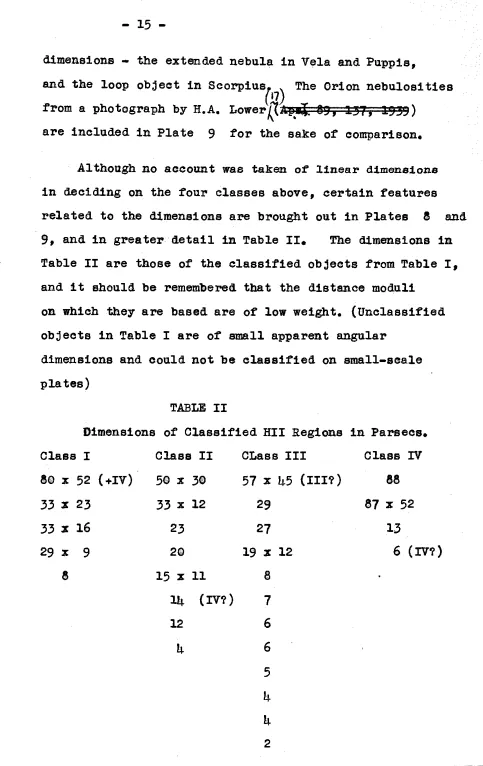
TABLE II
Dimensions of Classified HII Regions in Parsecs.
Class I Class II CLass III Class IV
30 X 52 (+IV) 50 X 30 57 X 45 (III?)
a a
33 X 23 33 X 12 29 87 X 52
33 X 16 23 27 13
29 X 9 20
19
X 12 6 (IV?)a
15 X 11 8l4 (IV?) 7
12 6
4 6
5
4
4
2
The largest objects the giant HII rings or loops
[image:18.842.213.696.55.821.2]occurs. Thus the nebula at ~ Carinae (80 x 52 parsecs overall) in the galaxy (Plate 3) shows some secondary outer loop formations about 12 parsecs in diameter; while the "Tarantula" nebula {140 parsecs overall on the new scale of distances) in the Large Magellanic Cloud (Plate 10) presents an even more complex system of loops which have diameters of the order of 50 to 80 parsecs. Although the overall dimensions of the Tarantula nebula
exeeed~hose of the giant HII rings in the Galaxy, it is probably significant that the dimensions of the
individual loops comprising it are below the upper limit of 90 parsecs for the galactic HII rings. Ignoring all those regions which show Class IV tendencies, the remaining objects have dimensions ranging up to 30 or 40 parsecs. A feature of the pure Class IV objects in Table II is the absence of rings of intermediate size, although this might be due to the small number in the present sample. (Two additional rings ~ included in Table I nor in Table II are the outer loop of Orion {84 parsecs) and the Rosette nebula NGC 2244 in Monoceros (21 parsecs), where dimensions are from Sharpless and Osterbrock (~-)). If there is a real gap in the size distribution of this class it might be expected that the small rings are physically different from the large ones, so that they may later have to be reclassified.
In the classification outlined here, no account has been taken of smell-scale structural features such as
fine filamentary details recently discussed in the Russian _gi terature ( I~).
~ This omission is dne in part to the
inability to observe such features on small-scale plates; but the deliberate omission of all minor features, whether observed or not, results in a classification which can be applied to emission objects in extragalactic systems, where only the coarsest features are observed. Thus
17-the Mt. Wilson and Palomar photograph of the
Ha nebulosities in the spiral arms of portion of the Andromeda nebula show several easily recognisable giant HII rings, and many smaller objects of the other three
classes, although the allocation of these to separate classes would require reference to the original plate. The frequency of occurrence of the readily distinguished giant HII rings in this portion of the Andromeda nebula is 3 rings in a total of 80 emission objects. This may be compared with the galactic sample from our view-point at the sun which included 2 such objects occurring
among the 55 entries of Table I. The dimensions of the giant HII rings in the Andromeda nebula are also found to be very nearly the same as those in the Galaxy when the new seale of extragalactic distances is used ~. In other galaxies of stellar population type I, similar classes of emission nebulosities occur, and the upper limit of size of the HII rings in all systems, whether irregular, spiral, giant or dwarf, is of the same order-about 90 parsecs ('2.0}. ~
6.
Hubble's relation applied to emission nebulae observed in Hg. light. The data of Table I provide a homogenous sample which may be used to examine the statistical relation between the apparent magnitude of the exciting star and the extent of the Hg. nebulosity.In Fig.
3
m0, the apparent photographic magnitude
of the exciting star corrected for interstellar absorption, is plotted against log a, where a is the apparent
radius of the nebulosity in minutes of are. Where several exciting stars are involved the integrated
magnitude is used. The presence of 2~ cases, where the magnitude uncorrected for absorption has been plotted, in the absence of data on 7olour excesses, will not affect the general bo~ of data, which is fairly well represented by the relation m + 5 log a
=
13.0.13-A relation of this type was first found for diffuse emission nebulae by Hubble (
'.!!-),
from observations w1 th blue-sensitive plates, The present observations differ from Hubble's in that they refer to the fluorescentscattering of monochromatic light by atoms; Hubble's
were of light in a broad spectral region scattered by dust.
The effects of gas and dust on the observed relation have been discussed by Greenstein (?~ ).
In spite of the scatter of the points in Fig. 3, such a diagram is of considerable assistance in the practical procedure of selecting ezeiting stars. Once the relation m + 5 log a = constant has been established, it can be used for decisions on doubtful cases, There is a fairly well-defined upper envelope, shown as a dotted line paralled to m + 5 log a
=
13,0 in Fig. 3. Points above this line are probably affected by absorption. Both the magnitude of the exciting star and the apparent diameter of the nebulosity will be affected by absorption ( ),but it is significant that in the case of Class III and IV objects, the effect of absorption on the overall diameter will be quite negligible. The dimensions of Class I and II objects may be more severely affected by absorption. A few points in Fig, 3 which show larger than average
deviations will now be discussed in detail,
lifo. l, If this object is associated with lifo. 2 as
suggested in the notes to Table I, then HD 53367 may not play any part in its excitation, and the point should be removed from Fig.
3.
lifo, 3. Excited by HD 53623 (~ spectral type B9; Hubble gives Bl). Apart from the question of the
spectral type of the star, there seems to be nothing particularly abnormal about this object,
lifo. 11, Excited by CPD -35° 2252, m(uncorrected for absorption)
=
10,2, log a=
o.o.
This object is so small that the measurements are not significant, Henize/','~'"'"·''·'i~
j;;ll}i!fll ·· ...
I
writes (~~) that it consists of two parts, one eon-taining a smaller bright off-centre "core",
it can be studied only on large-seale plates.
Obviously
No, 21, The existence of this nebula is given as doubt-ful in the notes to Table I.
No. 52. Excited by HD lh8937 ?, m(uncorrected for
absorption) = 6,7, log a= 0,5, The symmetrical distribution about the star is reminiscent of an "open armed spiral",
and is so perfect that it would be an extremely rare coincidence if they were only aligned as suggested in the notes to Table I. Perhaps it is a planetary-like object; according to the low weight modulus in Table I its overall diameter is 3 parsecs,
be examined,
Its spectrum should
No. 57a, Excited by HD 153919, m(uncorrected for
absorption) = 6.7, log a= 1,8, It is so much broken up by foreground obscuration that there is no doubt that the correction to the magnitude of the star will be
considerable,
No. 66, Excited by HD 157504, m(uncorrected for
absorption) = 1.1,8, log a = 1,2, This point is no doubt affected by absorption, Further evidence is the fact that the nebulosity appears to be cut up into many small fragments by the overlying obscuration,
No. 80, Excited by HD 165319, m0 = 5.3, log a = 0,9,
This is a small round d> ject of Glass III with the exei ting star near the geometrical centre, It was a
straight-forward ease, and seems quite normal, absorption, ~g = 2,6, may be too high,
The correction for
One further feature of Fig, 3 is the fact that the nebulae of various classes are fairly we/& mixed up in the diagram. There is slight segregation between Glass I and Glass IV objects; the former averaging smaller values of log a than the latter, It might be expected from Stromgren's relation s
-of the HII region that brighter objects with larger values of ~ would have smaller overall dimensions. More detailed comparisons of the various classes with Stromgren's theory require photometric observations of individual nebulae, which are reserved t'or future
discussion.
1.
H II Regions and the sp;fal Structure of the Galaxz. Following Baade's discovery of H II regions in the spiral arms of M 31 (1~), and Morgan's subsequent-identification of similar arms in our galaxy ( 1.. ) ,
-H II regions have assumed considerable importance in the study of galactic structure. In this section we examine the spatial distribution of the southern H II regions from this point of view.
The apparent distribution of the southern HII regions from Table I is shown in Fig. h. The apparent
dis-tribution of the northern and southern regions is shown in Fig. 5~. For Fig. 5a the regions from Table I were
plotted together with those from the lis.ts of Courtes ( 01 )
-for the northern sections of the sky, except that objects given intensities 1 and 2 by Courtes are omitted. Of the many studies of northern diffuse nebulae ( e-)
-that of Courtes has been chosen as being a homogeneous survey very similar to the present one. Comparison of the present survey with the survey by Courtes in the
region of overlap from 1
=
320° to 350° shows that his faintest objects of intensities 1 and 2, which are in some cases uncertain, could not be detected in the present work. Therefore by omission of these we obtain in Fig. 5a the results of a roughly homogeneous Ha survey of the whole MilkY Way.The distribution of the reflection nebulosities shown in Fig. 5b is taken from a diagram by Hubble (1~) •
...
[image:23.842.195.693.90.916.2]-A J;rOminent f'eature of' the apparent distribution of both HII regions and ref'lection nebulosities, f'irst noticed by Hubble (Itt-), is the concentration in two
-regions - one closely f'ollowing the galactic equator and the other f'ollowing the Gould Belt of bright stars
in a plane inclined at 15° or 20° to the galactic
plane. (The inclined plane is shown dotted in Figs 5a,b.) The f'act that the ref'lection nebulae occur mainly in the inclined plane is probably a selection ef'fect, since these objects with their continuous spectra would be more
dif'f'icult to observe amongst the Milky-Way star-clouds than emission-line nebulae. It is in the inclined plane that we also f'ind the nearest HII regions, which
consequently show the largest apparent diameters. The Gould Belt region has of'ten been referred to as the local cluster, and it is clear that some local structural feature of' the galaxy is in evidence. The significance of the irregular distribution along this inclined plane of both HII regions and reflection nebulosities will be discussed below. Returning to the HII regions belonging to the galactic plane it is found that most fall within 5°
~ <~ .w~
c1.
t';.
of the galactic equator, tl 1
JT~luii:
JrUin&" =ttile .,. LtllZ u .l:h:t• fz:n 'fal:l: i l::i=g "the distribution aloE£ the galactic equator is affected by obscuration;
the most conspicuous features are two almost completely vacant regions, one from l = 265° to 300°, and the
other from l = 350° to 30°. Both gaps correspond roughly to obvious rifts on the Milky Way which are due
to strong local obscuration.
The distribution of the HII regions projected on the galactic plane is shown in Fig. 6a. The distances for the southern objects are of a much lower order of accuracy than those for the northern HII regions and
con-centrations of
OB
stars, given by Morgan (L~), which22-are also incorporated in the diagram. Some idea of the tentative character of the distance of the southern regions can be obtained by comparison of the distances obtained here from mean absolute magnitudes with those obtained by Dr. Dorrit Hoffleit (7~) for the Carina -Centaurus nebulosities between l = 250° and 265°. These objects appear in Table I with distances ranging from 700 to 2500 parsecs, while Dr. Hoffleit's distances for the same objects range from 1000 to 1500 parsecs. The latter values have been plotted in Fig.
6a.
In Fig. 6b the data of Fig. 6a is exactly repeated and a tew tentative spiral features have been sketched in. The results represent one possible model for the spiral structure of the galaxy in the vicinity ofthe sun, and correspond closely to the type of structure found in the Whirlpool Nebula,
by a diagrammatical sketch in
M51 (1S), which is shown
~
Fig~ 7. This diagram of M5l is a mirror image of its real appearance, and can be
thereby compared directly with Figures 6a and b. The diagram Fig. 6b can in no way be considered definitive at this stage, but it may help in drawing attention to
certain details of spiral structure which can occur.
The following points have been considered in drawing Fig. 6b. The "arm" A1 passing at about 2000 parsecs from the sun on the anticentre side contains seven
northern objects plotted by Morgan and one southern
region NGC 2359; furthermore it coincides with part of an "arm" found by Oort and Muller from studies of the 11;.20 Mc/s radiation of neutral hydrogen (~b).
-agreement between the location of the emission objects
and the neutral hydrogen is shown by the fact that the line rperesenting the centre line of the armA1 in Fig. 6b was taken directly from Oort's diagram fP~!i 8) without
reference to the emission objects. The Hi arm has of course a width of . . . . several hundred parsecs: only the
[image:25.842.220.698.75.917.2]-centre line is shown in the diagram. The "arm" A 2 passing through the sun is shown with two short "fins"
or "plumes" projecting from it. The fin F
1 which has its base near the sun contains the nearest HII regions
and the reflection nebulae which lie in the Gould Belt;
this fin is therefore inclined to the galactic plane at
about 15°. (The reflection nebulae are not shown in
Fig. 6b). The more thickly populated part of the Gould
Belt in the regi.on of Orion at 1 = 170° would then be
due to the fact that in this direction we are looking
along the length of the fin F1• Since the Gould Belt is very thinly populated from 1 = 330° to 130°, the
sun is near the leading edge of the fin F1• The fin
F2 is not so well established, If it exists, then
the two objects comprising it from IViorgan1s plot
-IC 1396 (1 = 67°, b = + 3°) and NGC 7762 (1 = 85°,
require an inclination of F2 to the galactic
plane of about 10°, but in the opnosite sense to the
fin F1• The features discussed so far comprise most
of the northern objects investigated by Morgan and his
as so cia tes. When we come to the "arms" A2 itself we
have northern objects spread out from the sun towards
1
=
LrO , 0 and southern objects from the sun out towards 1 = .il:30° in almost the opposite direction. Inaccuraciesin the#istance moduli will therefore have little effect
on the general location of this "arm" owing to the sun's
position within it. The last and possibly the most
doubtful feature of Fig. 6b is the "inter-arm" link,
running from A2 to some possible, but unobserved arm nearer to the galactic centre. Our view of this link,
which takes in the Carina - Centaurus complex and many
other objects in Scorpius and Sagittarius, is interupted
by the southern and northern rifts in the Milky Way from
1 = 280° to 300° and from 1
=
280° to 300° and from [image:26.842.139.691.37.956.2]-1 = 350° to 30° as mentioned above. This obscuring
matter probably lies in the concavity of the 11arm11 .A
2 -similar location of dark matter occurs in ~51.
While Fig. 6b strongly suggests that certain details
of spiral structure in the galaxy are evident, it cannot
be concluded that any of the "arms" shown are the main
spiral arms of the Galaxy. Reference to Oort's diagram
of the HI distribution (? g. 5~ suggests that "arm" A1
may be a main arm, but even the radio observations have
been able to trace this over only one quarter of a
revolution from l ~ 200° through decreasing longitudes
to l
=
30° where it is lost. Another arm is traced byOort and Muller from 1 = 60° through decreasing longitudes
to 1 = 350° but no part of it falls within the limits of
Fig. 6. This is the only 11a"!'lll11 which according to the
radio observations, interpreted on Oort's velocity model
for the galaxy, maintains the same distance from the galactic
centre throughout the whole of its course. The remaining
HI "arms", together with the more det~:~iled structure of
"arms", "fins" and "links" revealed by the HII regions
in the vicinity of the sun require rotation of the galaxy
with the spiral arms and other smaller features trailing.
8. Further comparison with Harvard Ha. survey;: When
the present paper was almost ready for publication, Bok
and Wade's mimeographed notes on the Second Interim
Report of an Ha. Survey based on photographs taken by
Bester at the Boyden station was received. This report
and the numbering of objects therein supersedes the
earlier First Interim Report. Identification of Harvard
[image:27.842.157.693.45.957.2]Stromlo Harvard Stromlo Harvard
1,2 7 (inner loop) 56 29
1.L 8 57 a 30
5 9 59 31
6 10 62,63,6!tabc. 32
8 11 66 33
9 12 67 3!.L
10 l!.J. 68 35
12a 13,18 70 36
15 16 71 37
5 17 17 72,7hab,75,76 38
20 19 78 39
lL8a A 79 1J.l
lL8b B 80 42
!L8C
c
8lab 1!385 44
U.8d D 82 [>5
49 2h 83 46
51 27
1 1 2 3 2 NGC IC2177 NGC2327
4 . NGC2359
5 6 7 8 9 10 (NGC2467)
11 NGC2579
' 12a iZb 13 14 15 16 17 18 /19 20 21 22 23 24 3 MeD X X 4 Ced 89 90 94a,b 93 103 106n 106g
5 6
cou
Bok_,
I
f?
List of Emission NebUlosities.
7
1
8
b
9 10
(1900)
11 A;pp. Dimn.
12 13
log a Int
191ll4 -0961 6h5911l6 -10°19' 15' 1.2
192.2 -0.6 7 01 -11 00 150'x 45' 2.0
193.2 195.5 199.0 -1.21 +1.11 I
-3.11
+2.1!7 00.6 . -12 11
7 13.6 -13 04
7 05.3 -18 16
7 26.9 -16 46
202.3 +2.1 7 31.1 -18 30
206.3
210.9
221.3
7 17 .;.25:
7 48.2 -26 11
8 12.4 -35 16
222.4 +1.1 8 17 -35 54
226:
2.:36:
227.7
227.9
-7: 7 55: -43:
·+12.~ "' 45: -36:
-2.51 8 18.5 -42 19
+1.41 8 35.5 -40.04
229.2 +1.6 8 41.0 -40 55
230: 230.6 232.0 -2: +1.91 +0.9
8 29 -43 45
8 46.9 -41 45
8 48.2 -43 29
232.0 +2.1 8 52.8 -42 43
232.9 +2.1 8 55.9 -43 21
235.2 -1.1 8 51.6 -47 13
23 •• 6 -0.5 8 55.7 -47 06
235.7 -0.4 8 56.3 -47 03
236.6 -0.6 8 59.3 -47 56
4
5
8
15
420 X 120
10 X 5
25 X 5
2
1200 X 720
4-'2..0 x. qo
5 100 20 0.6 0.7 0.9 2.4 0.8 0.3 3.0 0.7 2.0 Filaments!!! 240 X 120
100 X 65 1.9
40 X 20 1o5
3 7 50 2 0.5 0.8 1.7
20 X 10 1.8
2 0.3
14 Class III IV II II IV III II III 15 Star HD53367 HD54662 HD53623 X X HD64315 HD69464 (HD68273 (HD66811 HD73882 16 Sp B1ne 07 ~X WC7 05 09
HD74804 ?
M
(HD75759 (HD75724 Anon HD76535 B2
~
Oa 17 m pg 6.8 6.2 8.5 8.9 8.6. 8.8 18 . 5.5 5.6 19 ro-M 0 12.9: 11.6: 9.8 9.4: 8.9 11.8: 20 Lin.Dimn. (Parsecs) 246 X 14
6
15 X 11
87 X 52
27
4
17 X 11
[image:29.1191.74.1191.17.787.2]l 2
No. NGC
25
i 26
27 NGC2899
28 NGC3199
29
30 NGC3293
31 NGC3324) IC2599) 32
33 NGC3372
34a
34b
35
36
i 37
38a x
38b NGC3603
39
40 IC2872
41
42 IC2944, 2948 43 44 45 46 3 McD 4 Ced 107 108 l09a 113 116 115 117 118
5 6
cou BOlt
7 8 9 10
1 b (1900)
236~9 -0~9 8h59~0 -48°18'
241.7 -0.7 9 21.2 -51 32
244.8 -3.6 9 23.7 -55 42
251.3 -0.8 0 13.5 -57 25
252.0 -0.2 0 20.6 -57 13
253.3 +0.2 0 30.2 -57 35
254.0 -0.1 0 33.9 -58 08
255.0 +0.4 0 42.3 -58 07
11
APP•
Dimn.
7 X 6
4 12 6 40 20 7
12 13
log a Int
0.8 0.6 0.2 1.1 0.8 1.6
o.s
-59 20 180xl20 2.2
257.3 257.4 258.1 258.3 258.9 259.3 261.3 261.4 261.8 262.5 268.7 268.8 269.8 270.5
-59 10 15 X 7
+0.5 ilO 59 -59 00
i
I
-1.3 110 54.4 -60 43
+1.6 jll 07.7 -58 15
I
+0.3 !11 05.7 -59 ~'4
l
-0.6 !11 07.8 -60 40
I
-0.5!11 10.8 -60 40
I
-1.4jll 24.4 -62 07
-1.6 l11 24.5 -62 23
I
-2.4111 25.9 -63 16
-1.8111,33.7 -62 48
+0.9!12 29.3 -61 04
!
+0.7il2 30.0 -61 18
I
+0.1112 38.2 -61 56
j
+1.0112 44.5 -61 02
75 X 15
10
10 X 5
20
20
X 1512 X 10
20 X 10
12 X 4
15
75 X 50
1 1 4 1.0 1.7 1.0 0.9 1.2 1.0
o.9
1.2 1.8o.o
o.o
0.6 0.4 14 Class II IV II 15 Star HD89358 X 16 Sp 17Oa 11.1
IV? HD92206 ~
III
III
II (IV)x
CPD-57°3781
X
HD97471 HD303903
HD97151 ?
HD97950
HD99897 ?
HD99898 ?
HD100099
B2 8.6
~3
Oe 9.2
M
8.6 B8 9.3!2.2
7.8CPD-6004312 dGl 11.4
18 19 20
Lin.Dimn.
m
0-M (Parsecs)
12.9: 13
20
10.9 80 X 52
8.0 11.9 7 X 4
10.6
9.8:
6.8 11.2
9.0
8
11 X 3
5 X 3
8
1
No.
2
NGC
• 47 NGC5189 48a
48b
48e
48d
49
r 50
51 52 53 54 NGC6164 6165 (NGC6193)
55 (NGC6231)
3 4
MoD Ced
123
135a,b
(136)
56 IC4628 72 {r37b)
57a (NGC6281){70) (138)
5'7b
• 58
59
• 60 NGC6302
r 61 !
• 62 NGC6334
i 63
. Ma
Mb
Me
65
~
66 (NGC6j57)
139
140
(142}
5 6
oou
Bok 7 1 2'74~8 273.9 275.5 276.4 2'77.0 296.3 304.0 304.3 308.5 211:. . ·:.A> 312.7 315.6
6 314.9
315.9
~, i{7) 316.9
~, •) 31'7.2 318.'7 318.8 319.0 318.9 319.0 8 b
9 10
(1900)
l1
A;pp. Dil!m•
-3~9 13h2~ -65°27 3 X 2 -0.2 13 13.6 -61 58 71
-0.3 13 26.6 -61 48
+0.1 13 33.5 -61 14
-0.9 13 40.0 -62 05
-1.'7 15 47.9 -54 21
-1.5 15 51.9 -53 28
+0.8 16 03.4 -48 44
5
2
30
-1.3 16 26.4 -47 54 7
-2.6 16 33
-2.1 16 4'7
0: 16 45:
-48 35 210 X .120
-45 02
-42:
6
204
12 13
log a Int
0.4 0.7 0.3 1.5 o.8 0.9
+0.5 16 50 -40 10 90 X 60 1.9.
+0.6 16 58.7 -37 47150 xl20 2.1
+1.1 16 54.4 -38 03
-o.s 17 05.5 -38 22
25
7
o.s
-1.9 17 13 -38 10 100 X 50 1.9:-o.2 17 07.0 -37 00
-o.6 17 13.1 -36 00
o.a
-o.8 17 14.2 -35 59 0.9
-0.4 17 12.9 -35 37 1.4
-o.6 17 13.4 -35 52
-o.7 17 14.2 -35 47
319.1 -0.5 17 13.5 -35 39
7 8 25 2 B 12 0.3 o.8 1.1 -+-IG"
319.2 ~.7:16 15.1 -25 21
1
···9''
320.9 -o.6 17 18.7 -34 1025
35 1.5
14 Class I I II 15 Star X HD148937 HD160135
IV Groupx
II HD152723
III HD153919
III HD153426
CD-38°11636
II? '(
IV HD319703
III HD319699
HD319702 'P
HD147166
II HD157504
16 Sp ~ Oe5
-Od!?!
17 10.2B1 3,08
Oa
18 19
12.1
10.2?
20
Lin. Dimn. (Paseos)
23
3
50 X 29
88
34 X 23
57 X 45
[image:31.1191.83.1081.30.821.2]1 3 4
No.
a
NGO McD Oed ~7 (N006383) 69
68
69
70
7l
72 N006523
'73
· 74a
74b NGC6526
75 NGC6559
76 NGC6514
77a
77b
78 (IC1283,4)
79 (IC4701)
80
81a N006618
147 152a (154) 151 (157) (158) 161
81b (IC4706,7) 160a,b
sa N006611
83 (N006601)
84
85
159
5 6 7
1
Cou Bok
4
3
6
7
12 3a'7.5
ji, 326.0
"Z,j
10,12 i3 332.2
8
b
9 10
(1900)
-1!3
1..,a2~
-3a0311+0.2 17 22.7 -31 27
-1.8 17 40.3 -29 16 - ?.:2.
~. 17 42.3 -31 17
-1.1 17 48.7 -24 52 .14 333.7 -2.617 57.5 -24 20
-+
t.'l..l334.1 ~ 16 31.7 -10 2a
334.2 . -1.6 17 54.9 -23 ao
15 15 334.4 -2.5 1'7 58.'7 -23 40
18 17 334.6 -3.6 18 03.2 -24 00 16 334.7 -1.'7 17 56.5 -23 00
11 A;pp. Dillin• 120 35 10 20
1a 13
loga Int
2.1
1.5
1.0
1.3
80 X 50 1.8
95 X 45 1.8
25 30 35 20 1.5 1.5. 1.3 1'7 23
336.4 -1.9 18 00.5 -21 40 90 X 30
338.'7
2'7 l-6 339.4 25 20 342.0
16 342.9
21:'
342.8 342.9!.;,
29 22344.6
28
23"
346.2346.4
-3.2 18 10.5 -20 20 110 X 30
-3.2 18 11.8 -19 43
-1.6 18 11.2 -16 39
+1.7 18 00.'7 -14 09
15
40
15
1.2
1.6
-2.4 18 15.5 -16 16 30
-1.9 18 14.1 -15 59
-o.8 18 13.3 -13 54
+0.4 18 12.4 -11 59
+0.5 18 12.3 -11 46
-1.8 18 16.'7 -14 37
25 X 12 1.3
80 X 25 1.7
70 X 30 1.'7
4
8
14 15
Class Star
III HD159176
III HD158186
X
III HD161853 HD318406
III HD162978
I
HD149757
HD1649'71 HD165132
II HD165921
I HD164492
X
X
III HD16'7815
HD16'7633
III HD165319
I
I
'
'
HD16813 ?
HD168894 ?
16 17 18 19 20
Lia. Dimn.
Sp l'llpg m m0 - M (Parsecs)
08 6.1 5.3 9.6
B3 8.2
i30
9.3:
10.0:
Bo 6.6 5.9 9.6 10.4
5.8
Bo 9.1 7.3 11.4
~ '7.9 7.3 9.6
Bo 7.2 6.1 10.4
07 6.8 X
B2 7.9 6.8 9.6
Bo 10.8
Bo 8.1 6.3 10.6
10.7
B (9.5)
29
7
6
6
19 X 12
33 X 16
12 12 12 4 1'7 4
29 X 9
1. May be associated with No. 2, It is No. 18 in
Strohmeier's list (~1).
-
The identification with IC 2177 is not very certain (See notes for No. 2).2. Contains McDonald emission fields h5, 116, lc8 and 57.
Many fragments of this object are listed by Strohmeier
( 'l.l). Apparently associated with the nebulosity is
- G 1
HD5hb-62, also possibly HD53,67 (Oe5). Sharpless and
Osterbrock (16) give m - M = 10.2 for this HII region.
- 0
The identification with NGC 2327 is not very certain, as
the NGC positions are hardly accurate enough to prevent
confusion with IC 2177. The whole of the region has
been described by Wood (?~).
3. Hubble (I~) gives Bl for the spectrum of HD53623and
-m,
= 8.2, but his statement that the spectrum of thenebula is continuous is apparently erroneous. This
nebula anpears to be almost connected to bright part
of No. 2.
h. Hubble (lit)
-
gives mag. = 11.0 (estim) and spectraltype Od for the exciting star (probably HD 56925).
The presence of several loops reminiscent of type IV
structure on a small scale is shown on a photograph by
Pease ("::tl).
5. Has a central star
6. Faint round nebula. Although distant six degrees
from the northern edge of No. 8 it could be a fragment
of this nebula, or even an isolated outer fragment of
the extended nebula in Vela and Puppis (No. 12).
7. "Stellar" on our scale. ~inkowski lists it as a
diffuse nebula - i t is the fj_fth object in his first
slightly brighter sections at
7h Ut~6 -21° u5'
Dimensions 201
7 20 -25 2.3 50' X 201
7 21 -28: 150 X 30
McDonald emission ~ields within this object are
McD 62 ( ~ ~ CMaj) at the extreme southern edge o~ the
nebula, and McD hh( = 30
-c.
CMa j) nearer the centre.Situated near the centre of the nebula are the possible
exciting stars
HD57060 (29 CMaj)
57061 ( 30 CMaj)
my.
=
h.90 Oe= h.hO Oe5
This nebula does not seem to be connected with the
large nebula No. 12 in Vela and Puppis, but the close
proximity of these two extended objects suggests that a
search should be made, perhaps with inter~erence filters,
for possible fainter linking nebulosity. McDonald
emission field No. 63 nearby at ~hOm, - 28°1+3' (1900)
shows the probable presence o~ very faint emission,
not detected in the present work, which may be related
to No. 8 or to No. 12.
9. Has a ~aint "tail" about 301 long. The exciting star
in the bright "head" is HD6h315 (= -26°5115) given
erroneously by Cederblad ( ~ ) as -26°2115. This nebula
is the eighth object in Minkowski's second list (~o) . ,
.
10. Spectrum of HD69tl_61_, noted as "probably Bo" in HD. It is in the brightest part of the nebula which has a faint
southern extension. About half a degree outside the
nebula is HD69106, mpg = 6.9 (Oe5).
11. Consists of two separate condensations according to
Henize (~).
of the nebula are visible on the Georg~town Charts
C><\).
:l!'aint suggestions of the nebula are also present on theFranklin-Adams Chart Plates
K').
McDonald emissionfield 53 centred on ( Velr is in this region. The
two exciting stars in the Table are
~2.
Velr andr
Pupp. The distance of the nebula may then be obtained via~~ Velr, a normal B3, which is the proper motion companion
1.
of the Wolf-Rayet
Y
Velr. average value for a B3 starAdopting Mv = -2.2 as an
(lf), and neglecting
absorption, a distance of 250 parsecs is obtained. This
agrees with the Yale spectroscopic parallax of O.OOh"
for
f
Pupp. The cor·responding absolute magnitude'1.
both for
l'
Velr and for$
Pupp is Mv = -h. 7. The value of 250 parsecs is probably a better estimate thana previous one ('l.O), ., but luminosity classifications are urgently required.
It is possible that some fragments and masses of
nebulosity in the rather confused region in the vicinity
of 8h h5m, -1t7°, not listed individually in Table I,
might be other HII regions at greater distances than the
main body of the loop denoted here by 12a. Thus
Karl G. Henize (~)writes"··· the stellar background
on my plates emphasizes the presence of the large
cloud of obscuration in Vela. The way this obscuration
so neatly follows the eastern edge of the nebulosity
at 8h30m to 8h50m, -h5° to -h7°, strongly suggests that
the nebulosity in this region is being seen through a
hole in the obscuration. This is also suggested by
the rich star cloud and concentration of Be stars which
coiinci de with the nebulosity. " The nebulosity referred
to by Henize would then be at a distance greater than
the 600 parsecs assigned to the Vela dark nebula by
-of arc overall. These are only the brighter fragments
of a larger mass of loose filaments covering an area
60 by 80 minutes of arc, discovered by Minkowski
and identified by Baade and Minkowski (~}) with the
radio source Puppis-A. The individual fragments
show ,. ; J • glt random velocities
1
up to 161/ Km/sfr
and the object as a whole is considered to be a new
type of galactic nebulosity.
14. Uniform disk-shaped object crossed by many dark
filaments of foreground obscuration. There seems to
be a tendency for clustering of B stars in the nebulosit,w.
15. The spectral type B5 of HD7h80t, is perhaps a little
late for an exciting star. Very pronounced filaments
of foreground obscuration may be hiding other stars.
There seems to be a tendency for clustering of stars
in the nebula, although this could be an effect of
foreground obscuration.
16. Large filamentary object of unusual type. Noted by
L n J as anft Melotte (~..!!-), and by Shapley
Ct').
There is a strong tendency for stars to be struhg along thefilaments like beads on a string. The filaments wander
over a region about four degrees by two degrees. The
location of exciting stars presents a problem not
encountered in other diffuse nebulosities. Here the
question of the connection between the star chains
and the filaments needs to be investigated further
17. Roughly circular object of uniform surface brightness
with one dark lane cutting part way through the nebula.
There is some tendency for clustering of stars in the
a small fragment of the large extended object No. 12.
20. Group of small objects about 7 minutes of arc overall.
21. The individuality of this nebula is doubt:f'ull. It could
be part of No. 12. It occurs in the confused region
•
discussed in the notes relating to No. 12.
22. Small round bright object cut in two by a dark bar.
Has a comet-like tail about 25 minutes of arc in length.
23. Group of small fragments - possibly one object broken
up by foreground obscuration.
very close to No. 22.
These fragments are
26. Near the edge of the nebula is HD298377 (Bo).
27. Henize writes (~~)
-
..
...
it appears not unlike a large irregular planetary".28. Half a ring of nebulosity with HD89358 at the centre
of curvature. Possibly associated with the Carina
complex of nebulosities, although the modulus derived
from average values would place it at a much greater
distance than the ~ Carinae complex.
29. Has faint extensions extending .15 minutes of arc to
the west. No obvious exciting star within the nebula,
but HD90273, mpg
=
9.h, (Bo) is nearby. Possibly an outer fragment of the Carina nebulous complex.NGC321J7 may refer to part of this object.
30. A more or less detached outer condensation of the Carina
complex. There is considerable clustering of B stars
apparently associated with the nebulosity. The cluster
35' h m
NGC3293 whose corrected position (~ is 10 32. 0, -57°t,3'
(1900) is situated towards the edge of the nebula and