UNIVERSITI TEKNIKAL MALAYSIA MELAKA
POTENTIAL OF CARBON BLACK ELECTROSTASTIC FILLER
FOR THE AUTOMOTIVE PAINT COATING APPLICATION
This report submitted in accordance with requirement of the Universiti Teknikal Malaysia Melaka (UTeM) for the Bachelor Degree of Manufacturing Engineering
(Engineering Materials)
by
MOHD AZRIL BIN MOHD AZLI B050810227
UNIVERSITI TEKNIKAL MALAYSIA MELAKA
BORANG PENGESAHAN STATUS LAPORAN PROJEK SARJANA MUDA
TAJUK: POTENTIAL OF CARBON BLACK ELECTROSTATIC FILLER FOR THE AUTOMOTIVE PAINT COATING APPLICATION
SESI PENGAJIAN: 2010/11 Semester 2
Saya MOHD AZRIL BIN MOHD AZLI
Mengaku membenarkan Laporan PSM ini disimpan di Perpustakaan Universiti Teknikal Malaysia Melaka (UTeM) dengan syarat-syarat kegunaan seperti berikut: 1. Laporan PSM adalah hak milik Universiti Teknikal Malaysia Melaka dan penulis. 2. Perpustakaan Universiti Teknikal Malaysia Melaka dibenarkan membuat salinan
untuk tujuan pengajian sahaja dengan izin penulis.
3. Perpustakaan dibenarkan membuat salinan laporan PSM ini sebagai bahan pertukaran antara institusi pengajian tinggi.
4. **Sila tandakan (√)
SULIT
TERHAD
TIDAK TERHAD
(Mengandungi maklumat yang berdarjah keselamatan atau kepentingan Malaysia yang termaktub di dalam AKTA RAHSIA RASMI 1972)
(Mengandungi maklumat TERHAD yang telah ditentukan oleh organisasi/badan di mana penyelidikan dijalankan)
Alamat Tetap:
Bt.21, Jalan Seremban, Kg Batu Serambai, 71600 Jelebu, Negeri Sembilan
Tarikh: _________________________
Disahkan oleh:
PENYELIA PSM
(Tandatangan dan Cop Rasmi)
Tarikh: _______________________
DECLARATION
I hereby, declared this report entitled “Potential of Carbon Black Electrostatic Filler
for the Automotive Paint Coating Application” is the results of my own research
except as cited in references.
Signature : ……….
APPROVAL
This report is submitted to the Faculty of Manufacturing Engineering of UTeM as a partial fulfillment of the requirements for the degree of Bachelor of Manufacturing Engineering (Engineering Materials). The member of the supervisory committee is as follow:
………..………..……… Supervisor
i
ABSTRAK
ii
ABSTRACT
iii
DEDICATION
This report was dedicated to my mother, Zaiton bte Ismail, and all my siblings. Besides
that, this project also dedicated to my grandfather and my grandmother, Ismail bin Itam
and Shamsiah bte Bidin. And not forgotten, thanks to my supervisor Mr. Jeefferie bin
Abd Razak and all my friends who encourage me in knowledge and other.
iv
ACKNOWLEDGEMENT
v
TABLE OF CONTENT
Abstrak i
Abstract ii
Dedication iii
Acknowledgement iv
Table of Content v
List of Tables viii
List of Figures ix
List of Abbreviations xi
1.0 CHAPTER 1 (INTRODUCTION) 1
1.1 Introduction 1
1.2 Problem statement 2
1.3 Objective 2
1.4 Hypothesis 3
1.5 Importance of study 3
1.6 Scope of study 3
1.7 Thesis overview 4
2.0 CHAPTER 2 (LITERATURE REVIEW) 5
2.1 Introduction 5
2.2 Coating technology 5
2.3 Polymer based coating 7
2.4 Emulsion paint 8
2.5 Solvent based coating 9
2.6 Conductive polymer 9
2.7 Conductive paint formulation 10
vi
2.8.1 Carbon black pigment 13
2.9 Binder 14
2.9.1 Polyester binder 15
2.10 Solvent 17
2.10.1 Acetone solvent 18
2.11 Additives 21
2.11.1 Epoxy additives 21
2.12 Test panel 23
2.13 Brushing coating method 23
3.0 CHAPTER 3 (METHODOLOGY) 25
3.1 Introduction 25
3.2 Raw material 25
3.2.1 Carbon Black 25
3.2.2 Polyester 26
3.2.3 Epoxy 27
3.2.4 Acetone 27
3.3 Flow chart of methodology 28
3.4 Preparation of paint at various formulation 28
3.5 Morphological study 30
3.5.1 Scanning Electron Microscope (SEM) 30
3.6 Physical and mechanical study 31
3.6.1 Adhesion testing 31
3.6.2 Ball impact testing 32
3.6.3 Durometer hardness testing 34
3.6.4 Water immersion test 35
3.6.5 Weathering test 36
vii
4.0 CHAPTER 4 (RESULT AND DISCUSSION 38
4.1 Introduction 38
4.2 Characterization of the coated based paint 38
4.2.1 Paint weight study 38
4.2.2 Water absorption testing 40
4.2.3 Weathering study 42
4.3 Durometer hardness testing 44
4.4 Ball impact testing 46
4.5 Adhesion testing 50
4.6 Scanning electron microscopy (SEM) observation to the paint coating 52
4.7 Electrical resistivity testing 55
5.0 CHAPTER 5 (CONCLUSION AND RECOMMENDATION) 59
5.1 Conclusion 59
5.2 Recommendation 60
REFERENCES 62
viii
LIST OF TABLE
2.1 Characteristic of water-based paints by form 8
2.2 General properties of polyester 16
2.3 Properties of solvent 18
2.4 Typical properties of acetone solvent 20
2.5 General properties of epoxy resin 22
3.1 Specification of carbon black 26
3.2 Specification of polyester 26
3.3 Specification of epoxy 27
3.4 Specification of acetone 27
3.5 The formulation of paint coating 30
4.1 Weight loss after two week of the curing process 39 4.2 Daily weight gain for water absorption testing 41 4.3 Daily percentage of weight gain for various compositions 41 4.4 Weight different for weathering test 43 4.5 Coating surface hardness value at various composition of CB 45
Loading
4.6 Potential energy of samples at various CB compositions 47 4.7 Adhesion test result of paint coating samples at various CB 50
Compositions
ix
LIST OF FIGURES
2.1 A wide variety of wavelengths (colors) encounter a pigment 12 2.2 Sunlight encounters the "primary blue" pigment 13
2.3 Carbon black structure 14
2.4 Formation of carbon black 14
2.5 Basic component of polyester resin 17
2.6 Structure of unmodified epoxy prepolymer 22
3.1 Flow chart of methodology 28
3.2 Ultrasonication-mechanical stirrer apparatus set-up 29
3.3 SEM model EVO 50 31
3.4 Impact testing apparatus 33
3.5 Film cracking 34
3.6 Operating principle of the impact technique 34
3.7 Durometer hardness tool 35
3.8 Electrical resistivity test diagram 37
4.1 Percentages of the weight loss during the curing process 39 4.2 Percentage of daily weight gain sample for the various 41
Composition
x
xi
LIST OF ABBREVIATIONS AND SYMBOLS
ASTM - American Standard Testing of Material
CB - Carbon Black
UV - Ultra Violet
ESD - Electrostatic Discharge
SEM - Scanning Electron Microscopy
EDS - Energy Dispersive X-Ray Spectrometry MACT - Maximum Achievable Control Technology wt% - Percent of Weight Fraction
0C - Degree Celsius
σ - Conductivity
ρ - Resistivity
R - Resistant
I - Ampere
V - Voltage
w - Width
h - Height
Ω - Ohm
J - Joule
1
CHAPTER 1
INTRODUCTION
1.1 Introduction
Effective conductive coatings are increasing essential in a broad range of application. A major segment is for the anti-static protection. This includes primers for electrostatic protection, coating and ink that have been used in printed circuits applications. Most of this application end use are satisfied by coating utilizing a conductive filler at various loading level. One of the conductive material is carbon black that is preferred conductive filler in many cases for several important reason such as, readily available, cost effective and readily dispersed and stabilized in liquid (Sichel et al., 1982). Carbon black is a material produced by incomplete combustion of heavy petroleum products such as tar, coal tar, ethylene cracking tar, and a small amount from vegetable oil. Carbon black is a form of amorphous carbon that has a high surface-area-to-volume ratio, although its surface-area-to-volume ratio is low compared to that of activated carbon.
2
1.2 Problem Statement
Coating in automotive application operates in an environment containing electromagnetic emissions such as magnetic generated from the automotive engine, broadcast transmitter and other electrical system. Electromagnetic also can be generated from natural sources such as atmospheric electrical disturbance and static precipitation. This electromagnetic emission can cause a lot of problem such as disruption of the engine performance and others. To provide better performance of the engine, this electromagnetic emission must be controlled in the acceptable limit. Due to the problem, this research was carried out to develop the conductive coating. Great attentions were focused on the carbon black loading to be incorporated in the paint coating for the automotive painting industry. These were due to the advantages of the carbon black in its structure, surface chemistry and size of the carbon black particles. This research will covered the properties of the coatings such as fracture energy, hardness, glass transition, and barrier properties on weathering.
The correct formulation of carbon black based polymeric coating for the automotive application was not based only on the desire final properties of the particular compound, but also on the specific properties of the carbon black itself. The properties were particle size, structure, and their purity. These critical elements of the carbon black were combined with various polymer carrier resins in the compounding process to produce the finished compound. Thus, the potential of the carbon black filler in the paint was the major focus in this research.
1.3 Objectives
The purposes of this project are:
1.3.1 To study the effect of carbon black addition in anti-static paint formulation.
3 1.4 Hypotheses
1.4.1 The carbon black loading will affect the properties of the coating.
1.4.2 The addition of carbon black will enhance the black colour and conductive behavior of the paint.
1.5 Importance of Study
The aim of this research is to develop a new alternative paint formulation for the automotive application. Thus, by conducting this research, it was expected to give an alternative to the automotive industry of better painting formulation with lower cost due to the utilization of waste carbon black provided by CABOT (M) Sdn Bhd.
1.6 Scope of Study
4
1.7 Thesis Overview
5
CHAPTER 2
LITERATURE REVIEW
2.1 Introduction
This chapter presents the literature review that relates to the theories for development of carbon black conductive paint coating. This chapter covers the related material that been used, sample preparation and the manufacturing process that involved in this research. Comprehensive review related to the carbon black conductive coating for automotive application and the theories will be covered extensively.
2.2 Coating Technology
Car painting industry has undergone incredible changes by way of materials and processes development following the general progress of manufacturing technology from the start of the twentieth century until today. Early coating processes, involved the use of air drying paints, sanding of each layer and polishing, all of which needed weeks for completion. All the coating steps were executed manually. The development of better and more efficient processes have brought in dramatic changes over the last 100 years.
6
were corrosion protection for the primers, smoothness and chip resistance for the primer surface, and color and weather resistance for the final top-coat layer (Joachim et al., 2008).
In the 1950s the process of applying the primer changed to dip coating, a more automated process, but a hazardous one owing to the solvent emission of the solvent-borne paints. Explosions and fire hazards forced automotive manufacturers to introduce either waterborne paints or electro-deposition paints. In the 1970s the anodic deposition coatings, mostly based on maleinized polybutadiene resins, quickly gave way to cathodic ones owing to better corrosion protection by their modified epoxy resin backbones and reactive polyurethane-based crosslinkers, increased throwing power, and higher process reliability. At the same time, the single layer top coats were gradually replaced by two-layer top coats consisting of a thin base coat and a thicker clear coat applied wet-on-wet. The base coats are responsible for color and special effects (for example, metallic finish), whereas the clear coats provide improved durability using specially designed resins and formula ingredients like UV-absorber and radical scavengers (Joachim et al., 2008).
Today, most clear coats in Europe are based on two-component formulation consisting of an acrylic resin with OH-functions and a reactive polyurethane crosslinker. The rest of the world still prefers the one-component technology based on acrylic resins and melamine crosslinkers. An interesting one-component technology based on carbamate functionality has been recently introduced in the United States (Green, 2001). All these developments contributed to an improved film performance resulting in better corrosion protection and longer top-coat durability.
7
improvements of the application technology, new polymer based coating were developed to contribute toward the legally enforced environmental compliance of the processes.
2.3 Polymer Based Coating
New polymer coating and barrier technologies are designed to be more resistant to cracking when laminates are stressed and movement occurs. These new technologies have superior toughness and impact resistance in comparison to industry standard gel coats and barrier coats. These new coatings are Maximum Achievable Control Technology (MACT) compliant for both marine market applications, as well as the stricter reinforced market applications. The new coating technologies will require some process modifications, but are applied similarly to conventional gel and barrier coats (Fred, 2007).
In addition to crack resistance these new coating and barrier technologies offer a number of other benefits including gloss retention of the coating after weathering, water resistance, and wear resistance of the coating surface. The surface can be tailored to specific physical, optical, electronic, chemical, and biomedical properties by coating a thin film of material on the surface of interested.
8
2.4 Emulsion Paint
Since the first oil crisis in 1973, the trend of solvent and the requests for no pollution or low pollution paints from users have raised requests for emulsion paints. With the following progress in polymerization technology in synthetic resin emulsion, coating performance and decorative functions have been deployed, raising its position in the painting field. Furthermore, since the synthetic resin emulsion paints have less content of organic solvent compared with not only solvent-based paints but also water-based ones, they are in the advantageous position from the viewpoint of pollution and resource saving. The composition of emulsion paints is complex compared with solution paints because they use dispersion resins (Toshinaga Kaneda
et al., 1988). The formulated components include not only synthetic emulsion and
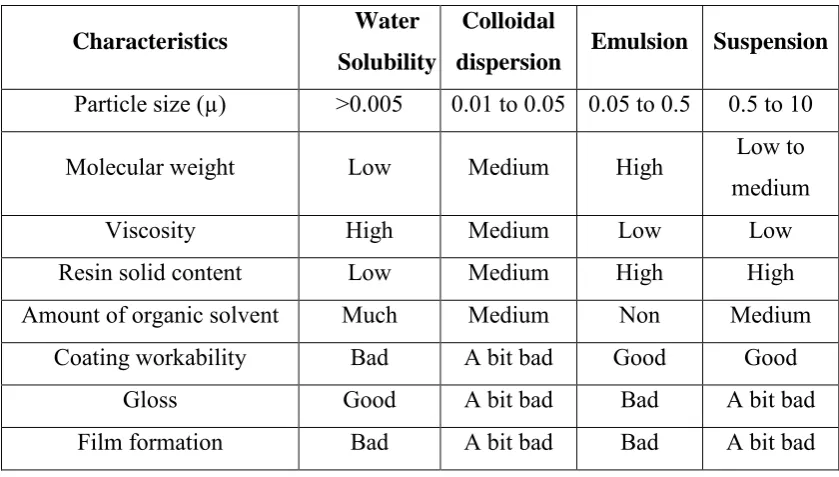
[image:23.595.113.533.501.739.2]pigments but also plasticizing agents, film-formation auxiliary agents, viscosity bodying agents, viscosity adjusters, dispersing agents, wetting agents, antiseptic agents, antifungal agents, anti-foam agents, anti-freezing agents, stabilizes and etc. The form of water dispersion resins are divided into colloidal dispersion, emulsion, and suspension according to the particle size. They are used as vehicles for painting. The characteristics of these dispersion resins and general water-soluble resins are classified in the Table 2.1. (Toshinaga et al.,1988).
Table 2.1: Characteristic of water-based paints (Toshinaga et al.,1988)
Characteristics Water
Solubility
Colloidal
dispersion Emulsion Suspension Particle size (µ) >0.005 0.01 to 0.05 0.05 to 0.5 0.5 to 10
Molecular weight Low Medium High Low to medium
Viscosity High Medium Low Low
Resin solid content Low Medium High High Amount of organic solvent Much Medium Non Medium
Coating workability Bad A bit bad Good Good
Gloss Good A bit bad Bad A bit bad
9
Physical performance Bad A bit bad Good A bit bad Water resistance Bad A bit bad A bit bad A bit bad
2.5 Solvent-based coating
Solvent-borne paint, which consist of polymer as binder, which form films only by evaporation of solvent, are call physical drying paint to achive sufficient properties in films. These polymers have mainly rather high molecular mass. Addition of this polymer may contain molecular structures which support the evaporation of the solvent during the film formation. The film which are form by a chemical crosslinking process, are much better resistance against solvent and other agent than films who are only formed by physical drying (Mueller, 2006).
The reason why solvent evaporates very fast is the tendency of the binder resin molecules to form the molecular associates. Particularly the molecules may form crystalline domains. This tendency may result in negative film properties, such as brittleness. Therefore most of the physical drying polymer needs the additional of plasticizers to form optimal film properties. Additionally, there are other resin component which is combined with the physically drying main resins to improve gloss, leveling and appearance of the coating (Mueller, 2006).
2.6 Conductive Polymer