Automatic 3D Building Footprint Extraction from
High Resolution Satellite Image using OSM
A.
Shyamalaprasanna, V.Vakula, S. Vidhya, S. Hema vikasini
Abstract: Building impression data is fundamental for 3D building demonstrating. Customarily, in remote detecting, building impressions are removed and outlined from ethereal symbolism and LiDAR point cloud. Adopting an alternate strategy, this paper is devoted to the advancement of OpenStreetMap (OSM) building impressions misusing the shape data, which is gotten from profound learning-based semantic division of angled pictures procured by the Unmanned Aerial Vehicle (UAV). Initial, an improved 3D building model of Level of Detail 1 (LoD 1) is instated utilizing the impression data from OSM and the height data from Digital Surface Model (DSM). In parallel, a profound neural system for pixel-wise semantic picture division is prepared so as to extricate the structure limits as shape proof. Thusly, a streamlining incorporating the shape proof from multi-see pictures as a requirement brings about a refined 3D building model with improved impressions and stature. This technique is utilized to advance OSM building impressions for four datasets with various structure types, exhibiting hearty execution for both individual structures and different structures paying little respect to picture goals. At long last, the contrast the outcome and reference information from German Authority Topographic-Cartographic Information System (ATKIS). Quantitative and subjective assessments uncover that the first OSM building impressions have enormous balanced, yet can be fundamentally improved from meter level to decimeter level after enhancement.
Keywords: Building extraction, OpenStreetMap, Very High Spatial Resolution, urban area
I. INTRODUCTION
O
penStreetMap (OSM) is a cooperative task for making a free editable guide of the world dependent on volunteered geographic information [1]. It can give free and refreshed geographic data regardless of confinements on utilization or accessibility of georeferenced information crosswise over a large portion of the world. As of late, OSM has broadly extended its inclusion and increased expanding prominence in numerous applications. One model is the age of 3D building models from OSM building footprints [2]. Hence, the nature of structure recreation and demonstrating firmly depends on the nature of structure impressions.Revised Manuscript Received on October 05, 2019.
Ms.A.Shyamalaprasanna.M.E, Faculty of Electronics and
communication Engineering ,Bannari Amman Institute of Technology, Sathiyamangalam,Erode. Email: [email protected]
Ms.V.Vakula.M.E, Research scholar of computer science and Engineering, Bannari Amman Institute of Technology, Sathiyamangalam, Erode. Email: [email protected]
Ms. S. Vidhya, PG Scholar of Electronics and communication Engineering, Bannari Amman Institute of Technology, Sathiyamangalam, Erode. Email: [email protected]
Ms. S. Hema vikasini, PG Scholar of Electronics and communication Engineering, Bannari Amman Institute of Technology, Sathiyamangalam, Erode. Email: [email protected]
A nitty gritty investigation of OSM building impressions evaluated a high culmination precision and a position exactness of about 4m by and large for these data[3]. Consequently, OSM building impressions can be securely viewed as a harsh estimate of the genuine scene.
Despite the fact that various methodologies for structure impression age have been grown, the vast majority of them misuse data from airborne symbolism or point cloud information, where the structure impressions are spoken to by rooftops and subsequently generally blended with shades. Interestingly, building frontages normally contain basic data about impressions. In this sense, information that presents based data, for example, angled airborne symbolism and earthly point mists, can encourage precise structure impressions' age. Among various information sources, slanted UAV symbolism stands apart as it crosses over any barrier among elevated and earthbound mapping, hence empowering information obtaining of both structure rooftops and façades at the same time.
Given an underlying theory of the structure limit, the refinement with well-planned limitations assumes an indispensable job in improving the exactness of structure footprints [1]. The requirements, for the most part, originate from the 3D highlights installed in DSMs or point mists just as from the 2D includes in pictures. For the instance of sideways UAV pictures, 3D highlights, for example, lines and planes, as a rule, have low geometric precision because of the difference in the survey bearings in angled pictures. Aside from that, picture highlights can likewise be utilized as powerful requirements. Conventional strategies utilized shading highlights in beginning periods, which are powerless against shadows and light.
A few strategies removed structure limits by distinguishing 2D lines or corners. Nonetheless, the distinguished edges or corners have dubious semantic implications and consequently must be utilized as powerless evidence [4]. Conversely, the pixel-wise semantic picture division gives a compelling answer to this issue. Different handmade highlights have been proposed in conventional AI-based characterization undertakings. For example, 2D picture highlights, 2.5D topographic highlights, and 3D geometric highlights are coordinated in for managed arrangement utilizing an SVM classifier. With the fast advancement of profound neural systems, profound learning-based division strategies have exhibited their obvious points of interest in yielding dependable and strong semantic division contrasted with customary AI division techniques. Deconvolution systems are right off the bat connected in for structure extraction from remote detecting pictures and show promising division exactness.
above exchange on past research, there are persuaded to utilize sideways UAV pictures as information hotspots for impression age. Limitations for tackling the improvement issue are characterized by structure limits, i.e., the projection of the 3D building model on pictures, are relied upon to lie on the limit between structure façades and the ground. The shape proof is extricated from the pixel-wise semantic division by means of profound convolution neural networks [5]. The proposed strategy is made out of these means: first, the UAV pictures by coordinating them with high-exactness ethereal pictures; in the meantime, perform semantic division of UAV pictures utilizing a Fully Convolutional Network (FCN) and concentrate the limits between structure frontages, rooftop and ground as shape proof; at that point, the introduce a 3D building model of LoD 1 from the OSM impressions, trailed by an improvement that incorporates the form proof of multi-see pictures as a limitation. At last, the impressions, yet additionally the structure statures get upgraded. The proposed strategy is tried on various datasets. The precision of the streamlined OSM impressions is assessed by examination with the ATKIS information, whose position exactness is around 0.5 m.
The fundamental developments of this paper lie in the accompanying viewpoints:
The impressions tended to in past research are the rooftop
regions with shades. Conversely, our technicians can identify the genuine structure impressions barring rooftop overhangs, i.e., the edges where the structure exteriors meet the ground.
Instead of straightforwardly recognizing structures
in 3D space, the present an advancement plan utilizing the picture proof from pixel-wise division as an imperative, i.e., the picture projection of the structure model is urged to be indistinguishable from the structure zones distinguished through pixel-wise picture division.
The method is able to refine simultaneously the
building footprint and its height.
II. RELATED WORK
Getting precise structure impressions is of vital significance in numerous applications, for example, urban arranging or the land business. Numerous endeavors have been made to naturally concentrate building impressions over the most recent couple of decades. Generally, satellite symbolism, elevated symbolism, and LiDAR information are among the most broadly utilized information sources in this specific circumstance. A portion of the examinations abuse exclusively data from pictures by means of pixel-based or object-based division. Different division descriptors have been created and
other picture highlights, for example, shadows are additionally utilized for this reason. By the by, it is generally hard to remove exact structure diagrams from just pictures because of impediment, shades and low enlightenment. Along these lines, a few investigations investigate the geometric highlights implanted in 3D information, e.g., Digital Surface Model (DSM), point cloud reproduced from pictures and LiDAR information, or incorporate the data from symbolism and 3D information together. Nonetheless, these methodologies are likewise inclined to impediments and experience issues in recognizing exact structure limits. Additionally, as the
structure façades are characteristically barely obvious in nadir-see remote detecting information, the previously mentioned methodologies really concentrate building rooftops as opposed to the genuine impression without shades.
Taking into account that building frontages pass on indispensable data on structure impressions, the information containing facing data, for example, earthbound information or diagonal airborne symbolism, can encourage building impression age. A structure identification technique dependent on slanted airborne pictures is proposed in, while the façade data in the earthly LiDAR point cloud is misused. As a scaffold among earthly and airborne photogrammetry, the UAV stands apart for its capacity to accomplish high spatial and worldly goals contrasted with customary remote detecting stages. Moreover, it has an extraordinary favorable position in the use of structure impression age for its capacity in conveying data on both structure rooftops and façades. The precision of 3D building displaying dependent on both nadir and angled UAV pictures is considered in, exhibiting that the coordination of sideways UAV pictures can generously expand the reachable exactness contrasting with customary demonstrating utilizing the earthly point cloud.
III. APPLICATION CONDITIONS
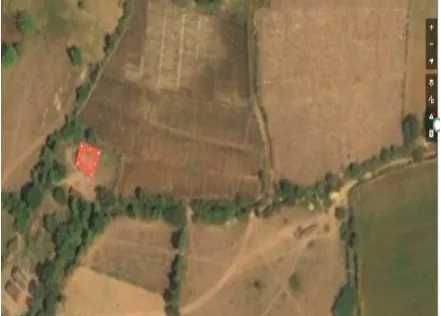
It ought to be called attention to that building impressions must be incompletely improved within the sight of impediments. Figure(3) demonstrates the projection of a unique OSM impression in an aeronautical picture, while Figure (1) features the edges that can be advanced with the proposed strategy. Figure (2) is an aeronautical picture of the studied region with a marginally diagonal view. Given that no extra pictures are accessible, just the obvious structure outskirts (set apart with red lines) can be enhanced. Towards the objective to accomplish a total enhancement of the structure impressions, it is along these lines educated to obtain UAV pictures regarding the structures of enthusiasm from various review bearings with the goal that all the façades are obvious in the pictures.
[image:2.595.316.537.517.675.2]Figure(2) Labelling more building using polygon
IV. DATA DESCRIPTION
A. Image Data
The gather pictures from four situations containing various sorts of structures. The principle attributes of the datasets are recorded in Table 1. Specifically, Scenario An is focused on streamlining of impressions of individual structures. To this end, 375 angled pictures of a separated lodge were caught by a UAV flight. The review site lies on an uncovered horticultural land in Finning, Germany. Here, the structure of intrigue is free from impediments. The normal ground testing separation is 0.96 cm. The dataset additionally serves for the advancement of an impression of an individual structure, yet the scene is progressively intricate with the nearness of impediments and shades. The picture including 32 nadir-see pictures and 110 diagonal view pictures with a pitching edge of about 45◦. The flight stature ranges from 20 m to 45 m over the ground, bringing about a normal Ground Sampling Distance (GSD) of 1.09 cm.
Furthermore, It additionally misuses the likelihood to improve the impressions of different structures. With the expanding ubiquity of UAVs, more individuals can take photographs or recordings utilizing their very own automatons and precipitously share the information on the Internet with free get to. In this specific situation, Scenario C was built up by removing a progression of edges from a YouTube video caught by an automaton. The overview site is situated in an urban local location in Munich, Germany, containing numerous cutting edge structures, and the vast majority of them are somewhat blocked. The flight tallness is assessed to 40m over the ground with a pitching edge of around 40◦. Altogether, 169 pictures with a GSD at picture focuses of 14.33 cm were separated for the trial. Each building can be unmistakable or somewhat noticeable in 24– 86 pictures, contingent upon its area in the review zone. It must be noticed that the low picture goals and the nearness of impediments cause trouble for the consequent enhancement step.
Scenario D is an open dataset given is 37 angled pictures were gathered in a little town in Sathyamangalam, highlighting numerous customary style structures encompassed or blocked by vegetation. Each building can be obvious or somewhat noticeable in 31–37 pictures. The pictures were around 100 m over the ground with a pitching edge of −50◦, and the normal picture GSD is 5.46 cm.
B.OSM Data
The impressions contain just the planar directions of structure impressions however no tallness data. As indicated by the nitty-gritty quality appraisal for OSM building impressions information, the OSM impressions in our study territory (Munich) have a high culmination exactness and a position precision of around 4 m in normal. In this manner, they can be securely embraced to introduce a structure model.
C. Reference Data
For assessment of the test results, take the German ATKIS information as a kind of perspective. ATKINS has been created as a typical venture of the Working Committees of the Survey Administrations of the States of the Federal Republic of Germany (AdV), containing data of objects of 'This present reality' like streets, streams or forest. The position precision of the structure an impression in ATKIS is ±0.5 m. It should be brought up that ATKIS information isn't accessible to people in general in Germany, in this way can just demand the ATKIS impression information for little zones as ground truth. In particular, the ATKIS information utilized in the investigations were distributed on 27 January 2016 and the structure information is organized as LoD1 City GML model, i.e., the benefit of structure stature portrays the distinction in meters between the most elevated purpose of the rooftop and the ground.
D.Geo-Registration Of Uav Image
Because of payload confinements, UAVs are typically outfitted with low-quality GNSS/IMUs and can, hence, accomplish a direct geo-referencing exactness of just 3–5 m. To improve the position precision of OSM building impressions, be that as it may, UAV pictures are required to have higher exactness than OSM. To this end, we made different endeavors at improving the geo-enlistment precision of UAV pictures. Specifically, Scenario A, C, and D are physically geo-enrolled utilizing estimations from geospatial items that have higher exactness than the OSM information, while Scenario B is geo-enlisted to ethereal pictures in a completely mechanized manner.
For Scenario A, The physically settled some GCPs, whose planar directions (x, y) were estimated on Bavaria DOP80 (advanced orthophoto of 80 cm goals, given by Bavarian State Office to Survey and Geoformation in Germany) and the height esteems z were extricated from DTK25 (Digital Topographic Model [DTM] of 25 cm goals, given by Bavarian State Office to Survey and Geoformation in Germany). These GCPs were then used to geo-register the UAV pictures dataset. So also, Scenario B was geo-enlisted utilizing the GCPs estimated from the orthophoto and DTM recreated from the ethereal pictures procured by the DLR 3K camera framework with cm-level precision. In Scenario D, GCPs were estimated on SWISSIMAGE 25 (computerized orthophoto of 25 cm goals) and swissNAMES3D.
Scenario B contains both nadir-view and sideways to see UAV pictures. Here, the comparing nadir-see airborne pictures with cm-level worldwide precision are likewise accessible, in this manner the co-enlisted the low-exactness UAV pictures to the high exactness elevated pictures following the methodology proposed in. All the more explicitly, we initially
Structure From Motion (SFM), and afterward coordinate the nadir UAV pictures with nadir elevated pictures utilizing the proposed coordinating plan, bringing about a large number of solid picture correspondences.
Since the airborne pictures are pre-georeferenced, 3D directions of those basic picture correspondences can be determined by means of picture to-ground projection of the elevated pictures, and these 3D focuses are then embraced to gauge the camera postures of the comparing nadir-see UAV pictures. At last, those UAV pictures with realized camera stances are associated with a worldwide streamlining for camera postures of all UAV pictures. Along these lines, all UAV pictures get geo-enrolled. Utilized the product Pix4Dmapper Pro (rendition 4.0.25) for the procedure and direction of UAV data. The mean reprojection blunders of the four datasets are in the scope of 0.15–0.2 pixels.
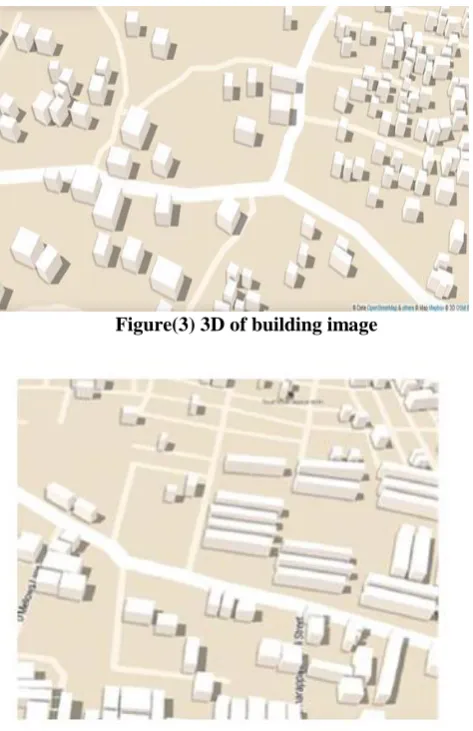
Figure(3) 3D of building image
Figure (4) 3D of building image
V. SIMULATION RESULT
[image:4.595.315.539.50.197.2] [image:4.595.314.538.51.368.2] [image:4.595.310.535.64.659.2]The different shape of buildings shown in the output image. (a)
Figure (5) Square shape building input image
Figure (6) Square shape building output image (b)
Figure (7) Rectangular shape building input image
Figure (8) Rectangular shape building output image
[image:4.595.52.289.249.615.2]Photo
Photo
In this paper misuse the frontages data in diagonal UAV pictures to advance OSM building impressions. The system comprises three primary angles: initial, a rearranged 3D building model of Level of Detail 1 (LoD 1) is instated utilizing the impression data from OSM and the height data from the Digital Surface Model (DSM). In this manner, a profound neural system is prepared for pixel-wise semantic picture division and the structure limits are separated as shape proof. At long last, the underlying structure model is streamlined by coordinating the shape proof from multi-see pictures as a limitation, bringing about a refined 3D building model with upgraded impressions and tallness. The outcome uncovers the incredible capability of sideways UAV pictures in structure recreation and demonstrating.
REFERENCES
1. Du, B., & Zhang, L. 2014. A discriminative metric learning based anomaly detection method. IEEE Transactions on Geoscience and Remote Sensing, 52(11), 6844-6857.
2. Du, S., Zhang, F., & Zhang, X. 2015. Semantic classification of urban buildings combining VHR image and GIS data: An improved random forest approach. ISPRS journal of photogrammetry and remote sensing, 105, 107-119.
3. Fonte, C. C., Minghini, M., Patriarca, J., Antoniou, V., See, L., & Skopeliti, A. 2017. Generating up-to-date and detailed land use and land cover maps using OpenStreetMap and GlobeLand30. ISPRS International Journal of Geo-Information, 6(4), 125.
4. Myint, S. W., Gober, P., Brazel, A., Grossman-Clarke, S., & Weng, Q. 2011. Per-pixel vs. object-based classification of urban land cover extraction using high spatial resolution imagery. Remote sensing of environment, 115(5), 1145-1161.
5. Schultz, M., Voss, J., Auer, M., Carter, S., & Zipf, A. 2017. Open land cover from OpenStreetMap and remote sensing. International Journal of Applied Earth Observation and Geoinformation, 63, 206-213 6. Stefanov, W. L., Ramsey, M. S., & Christensen, P. R. 2001.
Monitoring urban land cover change: An expert system approach to land cover classification of semiarid to arid urban centers. Remote sensing of Environment, 77(2), 173-185.
7. Tan, Q., Wei, Q., & Liang, F. 2010. Building extraction from VHR multi-spectral images using rule-based object-oriented method: A case study. In Geoscience and Remote Sensing Symposium (IGARSS), 2010 IEEE International (pp. 2754- 2756). IEEE.
8. Wu, S. S., Qiu, X., & Wang, L. 2005. Population estimation methods in GIS and remote sensing: a review. GIScience & Remote Sensing, 42(1), 80-96.
9. [9] Zhang, L., Zhang, L., Tao, D., & Huang, X. 2012. On combining multiple features for hyperspectral remote sensing image classification. IEEE Transactions on Geoscience and Remote Sensing, 50(3), 879-893.
10. [10] Zhang, L., Zhang, L., Tao, D., & Huang, X. 2013. Tensor discriminative locality alignment for hyperspectral image spectral–spatial feature extraction. IEEE Transactions on Geoscience and Remote Sensing, 51(1), 242-256.
AUTHORS PROFILE
Ms.A.Shyamalaprasanna. M.E Faculty of Electronics and communication Engineering ,
Bannari Amman Institute of Technology, Sathiyamangalam, Erode.
Email: [email protected]
Ms.V.Vakula. M.E Research scholar of computer science and Engineering, Bannari Amman Institute of Technology, Sathiyamangalam, Erode.
Email: [email protected]
Ms. S. Vidhya, PG Scholar of Electronics and communication Engineering,
Bannari Amman Institute of Technology, Sathiyamangalam, Erode.
Email: [email protected]
Ms. S. Hema vikasini, PG Scholar of Electronics and communication Engineering,
Bannari Amman Institute of Technology, Sathiyamangalam, Erode.