All Online Books
Table of Contents View as Frames
Table of Contents Reviews
Examples Reader Reviews Errata
AI for Game Developers
By David M. Bourg, Glenn Seeman
Publisher: O'Reilly Pub Date: July 2004
ISBN: 0-596-00555-5 Pages: 400
Written for the novice AI programmer, AI for Game Developers introduces you to techniques such as finite state machines, fuzzy logic, neural networks, and many others, in straightforward, easy-to-understand language, supported with code samples throughout the entire book (written in C/C++). From basic techniques such as chasing and evading, pattern movement, and flocking to genetic algorithms, the book presents a mix of
deterministic (traditional) and non-deterministic (newer) AI techniques aimed squarely at beginners AI developers.
All Online Books
Table of Contents
View as Frames
●
AI for Game Developers
●Table of Contents
●
Copyright
●Preface
❍
Assumptions This Book Makes
❍About This Book
❍
Conventions Used in This Book
❍Additional Resources
❍
Using Code Examples
❍How to Contact Us
❍Acknowledgments
●
Chapter 1. Introduction to Game AI
❍
Section 1.1. Deterministic Versus Nondeterministic AI
❍Section 1.2. Established Game AI
❍
Section 1.3. The Future of Game AI
●Chapter 2. Chasing and Evading
❍
Section 2.1. Basic Chasing and Evading
❍Section 2.2. Line-of-Sight Chasing
❍
Section 2.3. Line-of-Sight Chasing in Tiled Environments
❍
Section 2.4. Line-of-Sight Chasing in Continuous Environments
❍Section 2.5. Intercepting
●
Chapter 3. Pattern Movement
❍
Section 3.1. Standard Algorithm
❍
Section 3.2. Pattern Movement in Tiled Environments
❍
Section 3.3. Pattern Movement in Physically Simulated Environments
●Chapter 4. Flocking
❍
Section 4.1. Classic Flocking
❍Section 4.2. Flocking Example
❍Section 4.3. Obstacle Avoidance
❍
Section 4.4. Follow the Leader
●
Chapter 5. Potential Function-Based Movement
❍
Section 5.1. How Can You Use Potential Functions for Game AI?
❍Section 5.2. Chasing/Evading
❍
Section 5.3. Obstacle Avoidance
❍Section 5.4. Swarming
❍
Section 5.5. Optimization Suggestions
●Chapter 6. Basic Pathfinding and Waypoints
❍
Section 6.1. Basic Pathfinding
❍
Section 6.2. Breadcrumb Pathfinding
❍Section 6.3. Path Following
❍
Section 6.4. Wall Tracing
❍
Section 6.5. Waypoint Navigation
●Chapter 7. A* Pathfinding
❍
Section 7.1. Defining the Search Area
❍Section 7.2. Starting the Search
❍
Section 7.3. Scoring
❍
Section 7.4. Finding a Dead End
❍Section 7.5. Terrain Cost
❍
Section 7.6. Influence Mapping
❍Section 7.7. Further Information
●Chapter 8. Scripted AI and Scripting Engines
❍
Section 8.1. Scripting Techniques
❍
Section 8.2. Scripting Opponent Attributes
❍Section 8.3. Basic Script Parsing
❍
Section 8.4. Scripting Opponent Behavior
❍Section 8.5. Scripting Verbal Interaction
❍Section 8.6. Scripting Events
❍
Section 8.7. Further Information
●Chapter 9. Finite State Machines
❍
Section 9.1. Basic State Machine Model
❍Section 9.2. Finite State Machine Design
❍Section 9.3. Ant Example
❍
Section 9.4. Further Information
●Chapter 10. Fuzzy Logic
❍
Section 10.1. How Can You Use Fuzzy Logic in Games?
❍Section 10.2. Fuzzy Logic Basics
❍
Section 10.3. Control Example
❍
Section 10.4. Threat Assessment Example
●Chapter 11. Rule-Based AI
❍
Section 11.1. Rule-Based System Basics
❍Section 11.2. Fighting Game Strike Prediction
❍Section 11.4. Further Information
●
Chapter 12. Basic Probability
❍
Section 12.1. How Do You Use Probability in Games?
❍Section 12.2. What is Probability?
❍
Section 12.3. Probability Rules
❍
Section 12.4. Conditional Probability
●
Chapter 13. Decisions Under UncertaintyBayesian Techniques
❍Section 13.1. What is a Bayesian Network?
❍
Section 13.2. Trapped?
❍Section 13.3. Treasure?
❍Section 13.4. By Air or Land
❍Section 13.5. Kung Fu Fighting
❍Section 13.6. Further Information
●Chapter 14. Neural Networks
❍
Section 14.0.
❍
Section 14.1. Dissecting Neural Networks
❍Section 14.2. Training
❍
Section 14.3. Neural Network Source Code
❍Section 14.4. Chasing and Evading with Brains
❍Section 14.5. Further Information
●
Chapter 15. Genetic Algorithms
❍
Section 15.1. Evolutionary Process
❍Section 15.2. Evolving Plant Life
❍
Section 15.3. Genetics in Game Development
❍Section 15.4. Further Information
●
Vector Operations
❍Vector Class
❍Magnitude
All Online Books
Table of Contents
View as Frames
Preface
Recent advances in 3D visualization and physics-based simulation technology, at both the software and
hardware levels, have enabled game developers to create compelling, visually immersive gaming environments. The next step in creating even more immersive games is improved artificial intelligence (AI). Advances in computing power, and in hardware-accelerated graphics in particular, are helping to free up more CPU cycles that can be devoted to more sophisticated AI engines for games. Further, the large number of resourcesacademic papers, books, game industry articles, and web sitesdevoted to AI are helping to put advanced AI techniques within the grasp of every game developer, not just those professionals who devote their careers to AI.
With that said, wading through volumes of technical papers, text books, and web sites can be a daunting task for upcoming game AI developers. This book pulls together the information novices need so that they can get a jump-start in the field of game AI development. We present relevant theory on a wide range of topics, which we support with code samples throughout the book.
Many general game development books cover AI to some extent, however their treatment of the technology tends to be limited. This is probably because such books have to cover a lot of different topics and cannot go into great depth on any particular one. Although several very good books do focus on game AI (we list many of them in the "Additional Resources" section of this Preface), most of them are geared toward experienced AI developers and they focus on relatively specific and advanced topics. Therefore, novices likely would require companion resources that cover some of the more fundamental aspects of game AI in more detail. Still other books cover some specific game AI techniques in great detail, but are restricted to covering just those
techniques.
Our book covers a wide range of game AI topics at a level appropriate for novice developers. So, if you are new to game programming or if you are an experienced game programmer who needs to get up to speed quickly on AI techniques such as finite state machines, fuzzy logic, and neural networks, among others, this book is for you.
All Online Books
Table of Contents
View as Frames
Assumptions This Book Makes
Because this book is targeted for beginner game AI developers, we don't assume you have any AI background. We do, however, assume you know how to program using C/C++. We also assume you have a working
knowledge of the basic vector math used in games, but we have included a brief vector math refresher in the Appendix in case your skills are a little rusty.
All Online Books
Table of Contents
View as Frames
About This Book
We didn't hope to (nor did we attempt to) cover every aspect of game AI in this book; far too many techniques and variations of techniques are used for an even larger variety of game types, specific game architectures, and in-game scenarios. Instead, we present a mix of both deterministic (traditional) and nondeterministic (newer) AI techniques aimed squarely at beginner AI developers. Here's a summary of what we cover:
Chapter 1, Introduction to Game AI
Here, we define game AI and discuss the current state of the art as well as the future of this technology.
Chapter 2, Chasing and Evading
We cover basic techniques for chasing and evading as well as more advanced techniques for
intercepting. We also cover techniques applicable to both tile-based and continuous game environments.
Chapter 3, Pattern Movement
Pattern movement techniques are common to many video games and developers have been using them since the early days of gaming. You can use these techniques to preprogram certain behaviors such as the patrolling of a guard or the swooping in of a spacecraft.
Chapter 4, Flocking
Chapter 5, Potential Function Based Movement
Potential-based movement is relatively new in game AI applications. The cool thing about this method is that it can handle chasing, evading, swarming, and collision avoidance simultaneously.
Chapter 6, Basic Pathfinding and Waypoints
Game developers use many techniques to find paths in and around game environments. In this chapter, we cover several of these methods, including waypoints.
Chapter 7, A* Pathfinding
No treatment of pathfinding is complete without addressing the workhorse algorithm of pathfinding; therefore, we devote this whole chapter to the A* algorithm.
Chapter 8, Scripted AI and Scripting Engines
Programmers today often write scripting engines and hand off the tools to level designers who are responsible for creating the content and defining the AI. In this chapter, we explore some of the techniques developers use to apply a scripting system in their games, and the benefits they receive.
Chapter 9, Finite State Machines
Finite state machines are the nuts and bolts of game AI. This chapter discusses the fundamentals of finite state machines and how to implement them.
Chapter 10, Fuzzy Logic
Developers use fuzzy logic in conjunction with or as a replacement for finite state machines. In this chapter, you'll learn the advantages fuzzy techniques offer over traditional logic techniques.
Chapter 11, Rule-Based AI
Technically, fuzzy logic and finite state machines fall under the general heading of rules-based methods. In this chapter, we cover these methods as well as other variants.
Chapter 12, Basic Probability
Game developers commonly use basic probability to make their games less predictable. Such cheap unpredictability enables developers to maintain substantial control over their games. Here, we cover
basic probability for this purpose as well as lay the groundwork for more advanced methods.
Chapter 13, Decisions Under UncertaintyBayesian Techniques
Bayesian techniques are probabilistic techniques, and in this chapter we show how you can use them for decision making and for adaptation in games.
Chapter 14, Neural Networks
Game developers use neural networks for learning and adaptation in gamesin fact, for anything from making decisions to predicting the behavior of players. We cover the most widely used neural network architecture, in detail.
Chapter 15, Genetic Algorithms
Genetic algorithms offer opportunities for evolving game AI. Although developers don't often use
genetic algorithms in games, their potential for specific applications is promising, particularly if they are combined with other methods.
Appendix, Vector Operations
This appendix shows you how to implement a C++ class that captures all of the vector operations that you'll need when writing 2D or 3D simulations.
All the chapters in this book are fairly independent of each other. Therefore, you generally can read the chapters in any order you want, without worrying about missing material in earlier chapters. The only exception to this
rule is Chapter 12, on basic probability. If you don't have a background in probability, you should read this
chapter before reading Chapter 13, on Bayesian methods.
Also, we encourage you to try these algorithms for yourself in your own programs. If you're just getting started in game AI, which we assume you are if you're reading this book, you might want to begin by applying some of the techniques we present in simple arcade-style or board games. You also might consider programming a bot using extensible AI tools that are increasingly becoming standard for first-person shooter games. This approach will give you the opportunity to try out your AI ideas without having to program all the other non-AI aspects of your game.
All Online Books
Table of Contents
View as Frames
Conventions Used in This Book
The following typographical conventions are used in this book:
Plain text
Indicates menu titles, menu options, menu buttons, and keyboard accelerators (such as Alt and Ctrl).
Italic
Indicates new terms, URLs, email addresses, filenames, file extensions, pathnames, directories, and Unix utilities.
Constant width
Indicates commands, options, switches, variables, attributes, keys, functions, types, classes, namespaces, methods, modules, properties, parameters, values, objects, events, event handlers, XML tags, HTML tags, macros, the contents of files, or the output from commands.
Constant width bold
Shows commands or other text that should be typed literally by the user.
Constant width italic
Shows text that should be replaced with user-supplied values.
Variables shown in bold are vectors as opposed to scalar variables, which are shown in regular print.
All Online Books
Table of Contents
View as Frames
Additional Resources
Although we attempt to cover a wide range of AI techniques in this book, we realize we can't compress within these pages everything there is to know about AI in game development. Therefore, we've compiled a short list of useful AI web and print resources for you to explore should you decide to pursue game AI further.
Here are some popular web sites related to game development and AI that we find helpful:
● The Game AI Page at http://www.gameai.com
● AI Guru at http://www.aiguru.com
● Gamasutra at http://www.gamasutra.com
● GameDev.net at http://www.gamedev.net
● AI Depot at http://ai-depot.com
● Generation5 at http://www.generation5.org
● The American Association for Artificial Intelligence at http://www.aaai.org
Each web site contains information relevant to game AI as well as additional links to other sources of information on AI.
Here are several print resources that we find helpful (note that these resources include both game and nongame AI books):
● Probabilistic Reasoning in Intelligent Systems: Networks of Plausible Inference by Judea Pearl (Morgan
Kaufmann Publishers, Inc.)
● Bayesian Artificial Intelligence by Kevin Korb and Ann Nicholson (Chapman & Hall/CRC)
● Bayesian Inference and Decision, Second Edition by Robert Winkler (Probabilistic Publishing)
● AI Game Programming Wisdom by Steve Rabin, ed. (Charles River Media)
● AI Techniques for Game Programming by Mat Buckland (Premier Press)
● Neural Networks for Pattern Recognition by Christopher Bishop (Oxford University Press)
● AI Application Programming by M. Tim Jones (Charles River Media)
All Online Books
Table of Contents
View as Frames
Using Code Examples
This book is designed to help you get your job done. In general, you can use the code in this book in your programs and documentation. You do not need to contact us for permission unless you're reproducing a
significant portion of the code. For example, writing a program that uses several chunks of code from this book does not require permission. Selling or distributing a CD-ROM of examples from O'Reilly books does require permission. Answering a question by citing this book and quoting example code does not require permission. Incorporating a significant amount of example code from this book into your product's documentation does require permission.
We appreciate, but do not require, attribution. An attribution usually includes the title, author, publisher, and ISBN. For example: "AI for Game Developers, by David M. Bourg and Glenn Seemann. Copyright 2004 O'Reilly Media, Inc., 0-596-00555-5."
If you feel your use of code examples falls outside fair use or the permission given here, feel free to contact us at [email protected].
All Online Books
Table of Contents
View as Frames
How to Contact Us
Please address comments and questions concerning this book to the publisher:
O'Reilly Media, Inc.
1005 Gravenstein Highway North Sebastopol, CA, 95472
(800) 998-9938 (in the United States or Canada) (707) 829-0515 (international or local)
(707) 829-0104 (fax)
We have a web page for this book, where we list errata, examples, and any additional information. You can access this page at:
http://www.oreilly.com/catalog/ai
To comment or ask technical questions about this book, send email to:
For more information about our books, conferences, Resource Centers, and the O'Reilly Network, see our web site at:
http://www.oreilly.com
All Online Books
Table of Contents
View as Frames
Acknowledgments
We'd like to thank our editors, Nathan Torkington and Tatiana Diaz, for their skill, insight, and patience. We'd also like to express our appreciation to O'Reilly for giving us the opportunity to write this book. Further, special thanks go to all the production and technical staff at O'Reilly, and to the technical reviewers, chromatic, Graham Evans, and Mike Keith, for their thoughtful and expert comments and suggestions. Finally, we'd like to thank our respective wives, Helena and Michelle, for their support and encouragement and for putting up with our repeatedly saying, "I have to work on the book this weekend." We can't forget to thank our respective children, who always remind us that it's OK to play. On that note, remember that the most important goal of good AI in games is to make games more fun. Play on!
All Online Books
Table of Contents
View as Frames
Chapter 1. Introduction to Game AI
In the broadest sense, most games incorporate some form of artificial intelligence (AI). For instance, developers have used AI for years to give seemingly intelligent life to countless game characters, from the ghosts in the classic arcade game Pac Man to the bots in the first-person shooter Unreal, and many others in between. The huge variety of game genres and game characters necessitates a rather broad interpretation as to what is considered game AI. Indeed, this is true of AI in more traditional scientific applications as well.
Some developers consider tasks such as pathfinding as part of game AI. Steven Woodcock reported in his "2003 Game Developer's Conference AI Roundtable Moderator's Report' that some developers even consider collision
detection to be part of game AI[*]. Clearly, some wide-ranging interpretations of game AI exist.
We're going to stick with a broad interpretation of game AI, which includes everything from simple chasing and evading, to pattern movement, to neural networks and genetic algorithms. Game AI probably best fits within the scope of weak AI (see the sidebar "Defining AI"). However, in a sense you can think of game AI in even
broader terms.
Defining AI
The question "what is artificial intelligence?" is not easy to answer. If you look up artificial
intelligence in a dictionary, you'll probably find a definition that reads something like this: "The
ability of a computer or other machine to perform those activities that are normally thought to require intelligence." This definition comes from The American Heritage Dictionary of the
English Language, Fourth Edition (Houghton Mifflin Company). Still other sources define
artificial intelligence as the process or science of creating intelligent machines.
From another perspective it's appropriate to think of AI as the intelligent behavior exhibited by the machine that has been created, or perhaps the artificial brains behind that intelligent behavior. But even this interpretation is not complete. To some folks, the study of AI is not necessarily for the purpose of creating intelligent machines, but for the purpose of gaining better insight into the nature of human intelligence. Still others study AI methods to create machines that exhibit some limited form of intelligence.
This begs the question: "what is intelligence?" To some, the litmus test for AI is how close it is to human intelligence. Others argue that additional requirements must be met for a machine to be considered intelligent. Some people say intelligence requires a conscience and that emotions are integrally tied to intelligence, while others say the ability to solve a problem requiring intelligence if it were to be solved by a human is not enough; AI must also learn and adapt to be considered intelligent.
AI that satisfies all these requirements is considered strong AI. Unlike strong AI, weak AI involves a broader range of purposes and technologies to give machines specialized intelligent qualities. Game AI falls into the category of weak AI.
The bottom line is that the definition of game AI is rather broad and flexible. Anything that gives the illusion of intelligence to an appropriate level, thus making the game more immersive, challenging, and, most importantly, fun, can be considered game AI. Just like the use of real physics in games, good AI adds to the immersiveness of the game, drawing players in and suspending their reality for a time.
[*]
[*]
Steven Woodcock maintains an excellent Web site devoted to game AI at http://www.gameai.com.
All Online Books
Table of Contents
View as Frames
1.1 Deterministic Versus Nondeterministic AI
Game AI techniques generally come in two flavors: deterministic and nondeterministic.
Deterministic
Deterministic behavior or performance is specified and predictable. There's no uncertainty. An example of deterministic behavior is a simple chasing algorithm. You can explicitly code a nonplayer character to move toward some target point by advancing along the x and y coordinate axes until the character's x and y coordinates coincide with the target location.
Nondeterministic
Nondeterministic behavior is the opposite of deterministic behavior. Behavior has a degree of uncertainty and is somewhat unpredictable (the degree of uncertainty depends on the AI method employed and how well that method is understood). An example of nondeterministic behavior is a nonplayer character learning to adapt to the fighting tactics of a player. Such learning could use a neural network, a Bayesian technique, or a genetic algorithm.
Deterministic AI techniques are the bread and butter of game AI. These techniques are predictable, fast, and easy to implement, understand, test, and debug. Although they have a lot going for them, deterministic methods place the burden of anticipating all scenarios and coding all behavior explicitly on the developers' shoulders. Further, deterministic methods do not facilitate learning or evolving. And after a little gameplay, deterministic behaviors tend to become predictable. This limits a game's play-life, so to speak.
Nondeterministic methods facilitate learning and unpredictable gameplay. Further, developers don't have to explicitly code all behaviors in anticipation of all possible scenarios. Nondeterministic methods also can learn and extrapolate on their own, and they can promote so-called emergent behavior, or behavior that emerges without explicit instructions. The flocking and neural network algorithms we'll consider in this book are good
examples of emergent behavior.
Developers traditionally have been a bit wary of AI that is nondeterministic, although this is changing.
Unpredictability is difficult to test and debughow can you test all possible variations of player action to make sure the game doesn't do something silly in some cases? Game developers face an ever-shortening development cycle that makes developing and testing new technology to production-ready standards extremely difficult. Such short development periods make it difficult for developers to understand cutting-edge AI technologies fully and to see their implications in a mass-market commercial game.
At least until recently, another factor that has limited game AI development is the fact that developers have been focusing most of their attention on graphics quality. As it turns out, such focus on developing better and faster graphics techniques, including hardware acceleration, might now afford more resources to be allocated toward developing better, more sophisticated AI. This fact, along with the pressure to produce the next hit game, is encouraging game developers to more thoroughly explore nondeterministic techniques. We'll come back to this point a little later.
All Online Books
Table of Contents
View as Frames
1.2 Established Game AI
Perhaps the most widely used AI technique in games is cheating. For example, in a war simulation game the computer team can have access to all information on its human opponentslocation of their base; the types, number, and location of units, etc.without having to send out scouts to gather such intelligence the way a human player must. Cheating in this manner is common and helps give the computer an edge against intelligent human players. However, cheating can be bad. If it is obvious to the player that the computer is cheating, the player likely will assume his efforts are futile and lose interest in the game. Also, unbalanced cheating can give
computer opponents too much power, making it impossible for the player to beat the computer. Here again, the player is likely to lose interest if he sees his efforts are futile. Cheating must be balanced to create just enough of a challenge for the player to keep the game interesting and fun.
Of course, cheating isn't the only well-established AI technique. Finite state machines are a ubiquitous game AI
technique. We cover them in detail in Chapter 9, but basically the idea is to enumerate a bunch of actions or
states for computer-controlled characters and execute them or transition between them using if-then conditionals that check various conditions and criteria.
Developers commonly use fuzzy logic in fuzzy state machines to make the resulting actions somewhat less predictable and to reduce the burden of having to enumerate huge numbers of if-then rules. Rather than have a rule that states if distance = 10 and health = 100 then attack, as you might in a finite state machine, fuzzy logic enables you to craft rules using less precise conditions, such as if close and healthy then attack aggressively. We
cover fuzzy logic in Chapter 10.
Effective and efficient pathfinding is a fundamental task that nonplayer characters must accomplish in all sorts of games. Nonplayer character units in a war simulation must be able to navigate over terrain and avoid barriers to reach the enemy. Creatures in a first-person shooter must be able to navigate through dungeons or buildings to reach or escape from the player. The scenarios are endless, and it's no wonder that AI developers give
pathfinding tremendous attention. We cover general pathfinding techniques in Chapter 6 and the venerable A*
algorithm in Chapter 7.
These are only a few of the established game AI techniques; others include scripting, rules-based systems, and some artificial life (A-life) techniques, to name a few. A-life techniques are common in robotic applications, and developers have adapted and used them with great success in video games. Basically, an A-life system is a synthetic system that exhibits natural behaviors. These behaviors are emergent and develop as a result of the combined effect of lower-level algorithms. We'll see examples of A-life as well as other techniques throughout this book.
All Online Books
Table of Contents
View as Frames
1.3 The Future of Game AI
The next big thing in game AI is learning. Rather than have all nonplayer character behavior be predestined by the time a game ships, the game should evolve, learn, and adapt the more it's played. This results in a game that grows with the player and is harder for the player to predict, thus extending the play-life of the game. It is precisely this unpredictable nature of learning and evolving games that has traditionally made AI developers approach learning techniques with a healthy dose of trepidation.
The techniques for learning and reacting to character behavior fall under the nondeterministic AI we talked about earlier, and its difficulties apply here too. Specifically, such nondeterministic, learning AI techniques take longer to develop and test. Further, it's more difficult to really understand what the AI is doing, which makes debugging more difficult. These factors have proven to be serious barriers for widespread use of learning AI techniques. All this is changing, though.
Several mainstream games, such as Creatures, Black & White, Battlecruiser 3000AD, Dirt Track Racing, Fields
of Battle, and Heavy Gear, used nondeterministic AI methods. Their success sparked a renewed interest in
learning AI methods such as decision trees, neural networks, genetic algorithms, and probabilistic methods.
These successful games use nondeterministic methods in conjunction with more traditional deterministic methods, and use them only where they are needed and only for problems for which they are best suited. A neural network is not a magic pill that will solve all AI problems in a game; however, you can use it with impressive results for very specific AI tasks within a hybrid AI system. This is the approach we advocate for using these nondeterministic methods. In this way, you can at least isolate the parts of your AI that are unpredictable and more difficult to develop, test, and debug, while ideally keeping the majority of your AI system in traditional form.
Throughout this book we cover both traditional game AI techniques as well as relatively new, up-and-coming AI techniques. We want to arm you with a thorough understanding of what has worked and continues to work for game AI. We also want you to learn several promising new techniques to give you a head start toward the
future of game AI.
All Online Books
Table of Contents
View as Frames
Chapter 2. Chasing and Evading
In this chapter we focus on the ubiquitous problem of chasing and evading. Whether you're developing a spaceship shooter, a strategy simulation, or a role-playing game, chances are you will be faced with trying to make your game's nonplayer characters either chase down or run from your player character. In an action or arcade game the situation might involve having enemy spaceships track and engage the player's ship. In an adventure role-playing game it might involve having a troll or some other lovely creature chase down your player's character. In first-person shooters and flight simulations you might have to make guided missiles track and strike the player or his aircraft. In any case, you need some logic that enables nonplayer character predators to chase, and their prey to run.
The chasing/evading problem consists of two parts. The first part involves the decision to initiate a chase or to evade. The second part involves effecting the chase or evasionthat is, getting your predator to the prey, or having the prey get as far from the predator as possible without getting caught. In a sense, one could argue that the chasing/evading problem contains a third element: obstacle avoidance. Having to avoid obstacles while chasing or evading definitely complicates matters, making the algorithms more difficult to program. Although
we don't cover obstacle avoidance in this chapter, we will come back to it in Chapters 5 and 6. In this chapter
we focus on the second part of the problem: effecting the chase or evasion. We'll discuss the first part of the problemdecision makingin later chapters, when we explore such topics as state machines and neural networks, among others.
The simplest, easiest-to-program, and most common method you can use to make a predator chase its prey involves updating the predator's coordinates through each game loop such that the difference between the
predator's coordinates and the prey's coordinates gets increasingly small. This algorithm pays no attention to the predator and prey's respective headings (the direction in which they're traveling) or their speeds. Although this method is relentlessly effective in that the predator constantly moves toward its prey unless it's impeded by an obstacle, it does have its limitations, as we'll discuss shortly.
In addition to this very basic method, other methods are available to you that might better serve your needs,
depending on your game's requirements. For example, in games that incorporate real-time physics engines you can employ methods that consider the positions and velocities of both the predator and its prey so that the predator can try to intercept its prey instead of relentlessly chasing it. In this case the relative position and velocity information can be used as input to an algorithm that will determine appropriate force actuationsteering forces, for exampleto guide the predator to the target. Yet another method involves using potential functions to influence the behavior of the predator in a manner that makes it chase its prey, or more specifically, makes the prey attract the predator. Similarly, you can use such potential functions to cause the prey to run from or repel a
predator. We cover potential functions in Chapter 5.
In this chapter we explore several chase and evade methods, starting with the most basic method. We also give you example code that implements these methods in the context of tile-based and continuous-movement
environments.
All Online Books
Table of Contents
View as Frames
2.1 Basic Chasing and Evading
As we said earlier, the simplest chase algorithm involves correcting the predator's coordinates based on the prey's coordinates so as to reduce the distance between their positions. This is a very common method for implementing basic chasing and evading. (In this method, evading is virtually the opposite of chasing, whereby instead of trying to decrease the distance between the predator and prey coordinates, you try to increase it.) In
code, the method looks something like that shown in Example 2-1.
Example 2-1. Basic chase algorithm
if (predatorX > preyX)
predatorX--;
else if (predatorX < preyX)
predatorX++;
if (predatorY > preyY)
predatorY--;
else if (predatorY < preyY)
predatorY++;
In this example, the prey is located at coordinates preyX and preyY, while the predator is located at coordinates
predatorX and predatorY. During each cycle through the game loop the predator's coordinates are checked
against the prey's. If the predator's coordinate is greater than the prey's coordinate, the predator's
x-coordinate is decremented, moving it closer to the prey's x-position. Conversely, if the predator's x-x-coordinate is less than the prey's, the predator's x-coordinate is incremented. Similar logic applies to the predator's
y-coordinate based on the prey's y-y-coordinate. The end result is that the predator will move closer and closer to the prey each cycle through the game loop.
Using this same methodology, we can implement evading by simply reversing the logic, as we illustrate in
Example 2-2.
Example 2-2. Basic evade algorithm
if (preyX > predatorX)
preyX++;
else if (preyX < predatorX)
preyX--?>;
if (preyY > predatorY)
preyY++;
else if (preyY < predatorY)
preyY--;
In tile-based games the game domain is divided into discrete tilessquares, hexagons, etc.and the player's position is fixed to a discrete tile. Movement goes tile by tile, and the number of directions in which the player can make headway is limited. In a continuous environment, position is represented by floating-point
coordinates, which can represent any location in the game domain. The player also is free to head in any direction.
You can apply the approach illustrated in these two examples whether your game incorporates tile-based or continuous movement. In tile-based games, the xs and ys can represent columns and rows in a grid that
encompasses the game domain. In this case, the xs and ys would be integers. In a continuous environment, the xs and ysand zs if yours is a 3D gamewould be real numbers representing the coordinates in a Cartesian coordinate system encompassing the game domain.
There's no doubt that although it's simple, this method works. The predator will chase his prey with unrelenting
determination. The sample program AIDemo2-1, available for download from this book's web site (http://www.
oreilly.com/BOOK"), implements the basic chase algorithm in a tile-based environment. The relevant code is
shown in Example 2-3.
Example 2-3. Basic tile-based chase example
if (predatorCol > preyCol)
predatorCol--;
else if (predatorCol < preyCol)
predatorCol++;
if (predatorRow> preyRow)
predatorRow--;
predatorRow++;
Notice the similarities in Examples 2-3 and 2-1. The only difference is that in Example 2-3 rows and columns
are used instead of floating-point xs and ys.
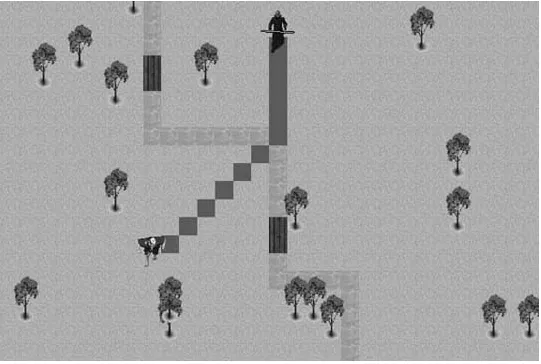
The trouble with this basic method is that often the chasing or evading seems almost too mechanical. Figure 2-1
[image:34.612.37.578.218.582.2]illustrates the path the troll in the sample program takes as he pursues the player.
Figure 2-1. Basic tile-based chase
As you can see, the troll first moves diagonally toward the player until one of the coordinates, the horizontal in
this case, equals that of the player's.[*] Then the troll advances toward the player straight along the other
coordinate axis, the vertical in this case. Clearly this does not look very natural. A better approach is to have the troll move directly toward the player in a straight line. You can implement such an algorithm without too much difficulty, as we discuss in the next section.
[*]
[*]
In square tile-based games, characters appear to move faster when moving along a diagonal path. This is because the length of the diagonal of a square is SQRT(2) times longer than its sides. Thus, for every diagonal step, the character appears to move SQRT(2) times faster than when it moves horizontally or vertically.
All Online Books
Table of Contents
View as Frames
2.2 Line-of-Sight Chasing
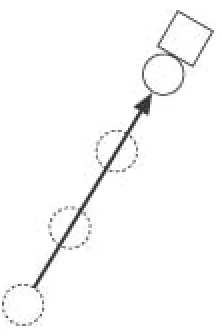
In this section we explain a few chasing and evading algorithms that use a line-of-sight approach. The gist of the line-of-sight approach is to have the predator take a straight-line path toward the prey; the predator always moves directly toward the prey's current position. If the prey is standing still, the predator will take a straight line path. However, if the prey is moving, the path will not necessarily be a straight line. The predator still will attempt to move directly toward the current position of the prey, but by the time he catches up with the moving
[image:36.612.252.363.421.589.2]prey, the path he would have taken might be curved, as illustrated in Figure 2-2.
Figure 2-2. Line-of-sight chasing
In Figure 2-2, the circles represent the predator and the diamonds represent the prey. The dashed lines and shapes indicate starting and intermediate positions. In the scenario on the left, the prey is sitting still; thus the predator makes a straight-line dash toward the prey. In the scenario on the right, the prey is moving along some arbitrary path over time. At each time step, or cycle through the game loop, the predator moves toward the current position of the prey. As the prey moves, the predator traces out a curved path from its starting point.
The results illustrated here look more natural than those resulting from the basic-chase algorithm. Over the remainder of this section, we'll show you two algorithms that implement line-of-sight chasing. One algorithm is
specifically for tiled environments, while the other applies to continuous environments.
All Online Books
Table of Contents
View as Frames
2.3 Line-of-Sight Chasing in Tiled Environments
As we stated earlier, the environment in a tile-based game is divided into discrete tiles. This places certain limitations on movement that don't necessarily apply in a continuous environment. In a continuous environment, positions usually are represented using floating-point variables. Those positions are then mapped to the nearest screen pixel. When changing positions in a continuous environment, you don't always have to limit movement to adjacent screen pixels. Screen pixels typically are small enough so that a small number of them can be skipped between each screen redraw without sacrificing motion fluidity.
In tile-based games, however, changing positions is more restrictive. By its very nature, tile-based movement can appear jaggy because each tile is not mapped to a screen pixel. To minimize the jaggy and sometimes jumpy appearance in tile-based games, it's important to move only to adjacent tiles when changing positions. For
games that use square tiles, such as the example game, this offers only eight possible directions of movement. This limitation leads to an interesting problem when a predator, such as the troll in the example, is chasing its target. The troll is limited to only eight possible directions, but mathematically speaking, none of those
directions can accurately represent the true direction of the target. This dilemma is illustrated in Figure 2-3.
Figure 2-3. Tile-based eight-way movement
As you can see in Figure 2-3, none of the eight possible directions leads directly to the target. What we need is a way to determine which of the eight adjacent tiles to move to so that the troll appears to be moving toward the player in a straight line.
As we showed you earlier, you can use the simple chasing algorithm to make the troll relentlessly chase the player. It will even calculate the shortest possible path to the player. So, what's the disadvantage? One concerns aesthetics. When viewed in a tile-based environment, the simple chase method doesn't always appear to produce
[image:39.612.40.576.28.388.2]a visually straight line. Figure 2-4 illustrates this point.
Another reason to avoid the simple chase method is that it can have undesirable side effects when a group of predators, such as a pack of angry trolls, are converging on the player. Using the simple method, they would all walk diagonally to the nearest axis of their target and then walk along that axis to the target. This could lead to them walking single file to launch their attack. A more sophisticated approach is to have them walk directly toward the target from different directions.
It's interesting to note that both paths shown in Figure 2-4 are the same distance. The line-of-sight method,
however, appears more natural and direct, which in turn makes the troll seem more intelligent. So, the objective for the line-of-sight approach is to calculate a path so that the troll appears to be walking in a straight line toward the player.
The approach we'll take to solve this problem involves using a standard line algorithm that is typically used to draw lines in a pixel environment. We're essentially going to treat the tile-based environment as though each tile was in fact a giant screen pixel. However, instead of coloring the pixels to draw a line on the screen, the line algorithm is going to tell us which tiles the troll should follow so that it will walk in a straight line to its target.
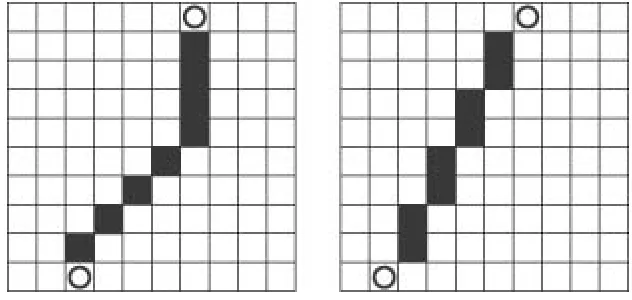
Although you can calculate the points of a line in several ways, in this example we're going to use Bresenham's line algorithm. Bresenham's algorithm is one of the more efficient methods for drawing a line in a pixel-based environment, but that's not the only reason it's useful for pathfinding calculations. Bresenham's algorithm also is attractive because unlike some other line-drawing algorithms, it will never draw two adjacent pixels along a line's shortest axis. For our pathfinding needs, this means the troll will walk along the shortest possible path
between the starting and ending points. Figure 2-5 shows how Bresenham's algorithm, on the left, might
[image:40.612.147.463.25.175.2]compare to other line algorithms that can sometimes draw multiple pixels along the shortest axis. If an algorithm that generated a line such as the one shown on the right is used, the troll would take unnecessary steps. It still would still reach its target, but not in the shortest and most efficient way.
Figure 2-5. Bresenham versus alternate line algorithm
As Figure 2-5 shows, a standard algorithm such as the one shown on the right would mark every tile for
pathfinding that mathematically intersected the line between the starting and ending points. This is not desirable for a pathfinding application because it won't generate the shortest possible path. In this case, Bresenham's algorithm produces a much more desirable result.
The Bresenham algorithm used to calculate the direction of the troll's movement takes the starting point, which is the row and column of the troll's position, and the ending point, which is the row and column of the player's position, and calculates a series of steps the troll will have to take so that it will walk in a straight line to the player. Keep in mind that this function needs to be called each time the troll's target, in this case the player, changes position. Once the target moves, the precalculated path becomes obsolete, and therefore it becomes
necessary to calculate it again. Examples 2-4 through 2-7 show how you can use the Bresenham algorithm to
build a path to the troll's target.
Example 2-4. BuildPathToTarget function
void ai_Entity::BuildPathToTarget (void)
{
int nextCol=col;
int nextRow=row;
int deltaRow=endRow-row;
int deltaCol=endCol-col;
int stepCol, stepRow;
int currentStep, fraction;
points for the path. The values in col and row are the starting points of the path. In the case of the sample program, col and row contain the current position of the troll. The values in endRow and endCol contain the position of the troll's desired location, which in this case is the player's position.
Example 2-5. Path initialization
for (currentStep=0;currentStep<kMaxPathLength; currentStep++)
{
pathRow[currentStep]=-1;
pathCol[currentStep]=-1;
}
currentStep=0;
pathRowTarget=endRow;
pathColTarget=endCol;
In Example 2-5 you can see the row and column path arrays being initialized. This function is called each time the player's position changes, so it's necessary to clear the old path before the new one is calculated.
Upon this function's exit, the two arrays, pathRow and pathCol, will contain the row and column positions along each point in the troll's path to its target. Updating the troll's position then becomes a simple matter of traversing these arrays and assigning their values to the troll's row and column variables each time the troll is ready to take another step.
Had this been an actual line-drawing function, the points stored in the path arrays would be the coordinates of the pixels that make up the line.
The code in Example 2-6 determines the direction of the path by using the previously calculated deltaRow and
deltaCol values.
Example 2-6. Path direction calculation
if (deltaRow < 0) stepRow=-1; else stepRow=1;
if (deltaCol < 0) stepCol=-1; else stepCol=1;
deltaRow=abs(deltaRow*2);
deltaCol=abs(deltaCol*2);
pathRow[currentStep]=nextRow;
pathCol[currentStep]=nextCol;
currentStep++;
It also sets the first values in the path arrays, which in this case is the row and column position of the troll.
Example 2-7 shows the meat of the Bresenham algorithm.
Example 2-7. Bresenham algorithm
if (deltaCol >deltaRow)
{
fraction = deltaRow *2-deltaCol;
while (nextCol != endCol)
{
if (fraction >=0)
{
nextRow =nextRow +stepRow;
fraction =fraction -deltaCol;
} nextCol=nextCol+stepCol; fraction=fraction +deltaRow; pathRow[currentStep]=nextRow; pathCol[currentStep]=nextCol; currentStep++; } } else {
fraction =deltaCol *2-deltaRow;
while (nextRow !=endRow)
{
if (fraction >=0)
{
nextCol=nextCol+stepCol;
fraction=fraction -deltaRow;
}
nextRow =nextRow +stepRow;
fraction=fraction +deltaCol;
pathRow[currentStep]=nextRow;
pathCol[currentStep]=nextCol;
currentStep++;
}
}
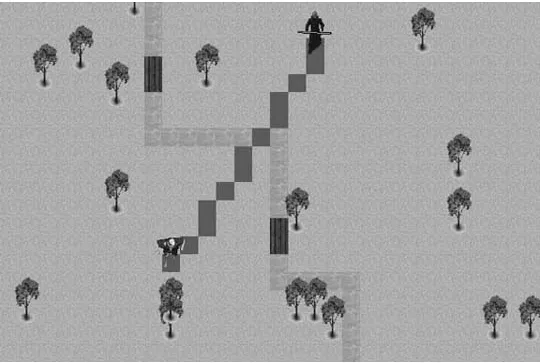
The initial if conditional uses the values in deltaCol and deltaRow to determine which axis is the longest. The first block of code after the if statement will be executed if the column axis is the longest. The else part will be executed if the row axis is the longest. The algorithm will then traverse the longest axis, calculating each point
of the line along the way. Figure 2-6 shows an example of the path the troll would follow using the Bresenham
[image:44.612.36.576.256.619.2]line-of-sight algorithm. In this case, the row axis is the longest, so the else part of the main if conditional would be executed.
Figure 2-6. Bresenham tile-based chase
Figure 2-6 shows the troll's path, but of course this function doesn't actually draw the path. Instead of drawing the line points, this function stores each row and column coordinate in the pathRow and pathCol arrays. These stored values are then used by an outside function to guide the troll along a path that leads to the player.
All Online Books
Table of Contents
View as Frames
2.4 Line-of-Sight Chasing in Continuous Environments
The Bresenham algorithm is an effective method for tiled environments. In this section we discuss a line-of-sight chase algorithm in the context of continuous environments. Specifically, we will show you how to implement a simple chase algorithm that you can use for games that incorporate physics engines where the game entitiesairplanes, spaceships, hovercraft, etc.are driven by applied forces and torques.
The example we'll discuss in this section uses a simple two-dimensional, rigid-body physics engine to calculate the motion of the predator and prey vehicles. You can download the complete source code for this sample program, AIDemo2-2, from this book's web site. We'll cover as much rigid-body physics as necessary to get through the example, but we won't go into great detail. For thorough coverage of this subject, refer to Physics
for Game Developers (O'Reilly).
Here's the scenario. The player controls his vehicle by applying thrust for forward motion and steering forces for turning. The computer-controlled vehicle uses the same mechanics as the player's vehicle does, but the computer controls the thrust and steering forces for its vehicle. We want the computer to chase the player wherever he moves. The player will be the prey while the computer will be the predator. We're assuming that the only information the predator has about the prey is the prey's current position. Knowing this, along with the
predator's current position, enables us to construct a line of sight from the predator to the prey. We will use this line of sight to decide how to steer the predator toward the prey. (In the next section we'll show you another method that assumes knowledge of the player's position and velocity expressed as a vector.)
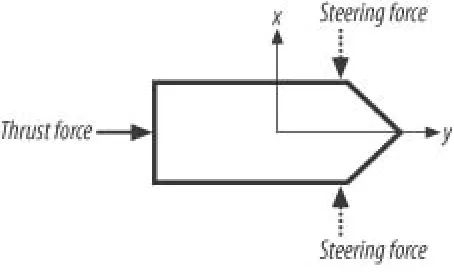
Before getting to the chase algorithm, we want to explain how the predator and prey vehicles will move. The vehicles are identical in that both are pushed about by some applied thrust force and both can turn via activation of steering forces. To turn right, a steering force is applied that will push the nose of the vehicle to the right. Likewise, to turn left, a steering force is applied that will push the nose of the vehicle to the left. For the purposes of this example, we assume that the steering forces are bow thrustersfor example, they could be little jets located on the front end of the vehicle that push the front end to either side. These forces are illustrated in
Figure 2-7.
Figure 2-7. Vehicle forces
The line-of-sight algorithm will control activation of the steering forces for the predator so as to keep it heading toward the prey at all times. The maximum speed and turning rate of each vehicle are limited due to
development of linear and angular drag forces (forces that oppose motion) that are calculated and applied to each vehicle. Also, the vehicles can't always turn on a dime. Their turning radius is a function of their linear speedthe higher their linear speed, the larger the turning radius. This makes the paths taken by each vehicle look smoother and more natural. To turn on a dime, they have to be traveling fairly slowly.
Example 2-8 shows the function that controls the steering for the predator. It gets called every time step through the simulationthat is, every cycle through the physics engine loop. What's happening here is that the predator constantly calculates the prey's location relative to itself and then adjusts its steering to keep itself pointed directly toward the prey.
Example 2-8. Line-of-sight chase function
void DoLineOfSightChase (void)
{
Vector u, v;
bool left = false;
bool right = false;
u = VRotate2D(-Predator.fOrientation,
(Prey.vPosition - Predator.vPosition));
u.Normalize();
if (u.x < -_TOL)
left = true;
else if (u.x > _TOL)
right = true;
Predator.SetThrusters(left, right);
As you can see, the algorithm in Example 2-8 is fairly simple. Upon entering the function, four local variables are defined. u and v are Vector types, where the Vector class is a custom class (see Appendix A) that handles all the basic vector math such as vector addition, subtraction, dot products, and cross products, among other
operations. The two remaining local variables are a couple of boolean variables, left and right. These are flags that indicate which steering force to turn on; both are set to false initially.
The next line of code after the local variable definitions calculates the line of sight from the predator to the prey. Actually, this line does more than calculate the line of site. It also calculates the relative position vector between the predator and prey in global, earth-fixed coordinates via the code (Prey.vPosition - Predator.vPosition), and then it passes the resulting vector to the function VRotate2D to convert it to the predator's local, body-fixed coordinates. VRotate2D performs a standard coordinate-system transform given the body-fixed coordinate
system's orientation with respect to the earth-fixed system (see the sidebar "Global & Local Coordinate
Systems"). The result is stored in u, and then u is normalizedthat is, it is converted to a vector of unit length.
Global & Local Coordinate Systems
A global (earth-fixed) coordinate system is fixed and does not move, whereas a local (body-fixed) coordinate system is locked onto objects that move around within the global, fixed coordinate system. A local coordinate system also rotates with the object to which it is attached.
You can use the following equations to convert coordinates expressed in terms of global coordinates to an object's local coordinate system given the object's orientation relative to the global coordinate system:
Here, (x, y) are the local, body-fixed coordinates of the global point (X, Y).
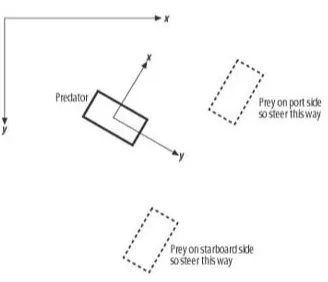
What we have now is a unit vector, u, pointing from the predator directly toward the prey. With this vector the next few lines of code determine whether the prey is to the port side, the starboard side, or directly in front of the predator, and steering adjustments are made accordingly. The local y-axis fixed to the predator points in the positive direction from the back to the front of the vehiclethat is, the vehicle always heads along the positive local y-axis.
So, if the x-position of the prey, in terms of the predator's local coordinate system, is negative, the prey is somewhere to the starboard side of the predator and the port steering force should be activated to correct the predator's heading so that it again points directly toward the prey. Similarly, if the prey's x-coordinate is
positive, it is somewhere on the port side of the predator and the starboard steering force should be activated to
correct the predator's heading. Figure 2-8 illustrates this test to determine which bow thruster to activate. If the
[image:49.612.144.472.396.678.2]prey's x-coordinate is zero, no steering action should be taken.
Figure 2-8. Steering force test
The last line of code calls the SetThrusters member function of the rigid body class for the predator to apply the steering force for the current iteration through the simulation loop. In this example we assume a constant
The results of this algorithm are illustrated in Figure 2-9.
Figure 2-9. Line-of-sight chase in continuous environment
Figure 2-9 shows the paths taken by both the predator and the prey. At the start of the simulation, the predator was located in the lower left corner of the window while the prey was located in the lower right. Over time, the prey traveled in a straight line toward the upper left of the window. The predator's path curved as it continuously adjusted its heading to keep pointing toward the moving prey.
Just like the basic algorithm we discussed earlier in this chapter, this line-of-sight algorithm is relentless. The predator will always head directly toward the prey and most likely end up right behind it, unless it is moving so fast that it overshoots the prey, in which case it will loop around and head toward the prey again. You can prevent overshooting the prey by implementing some sort of speed control logic to allow the predator to slow down as it gets closer to the prey. You can do this by simply calculating the distance between the two vehicles, and if that distance is less than some predefined distance, reduce the forward thrust on the predator. You can calculate the distance between the two vehicles by taking the magnitude of the difference between their position vectors.
If you want the computer-controlled vehicle to evade the player rather than chase him, all you have to do is
reverse the greater-than and less-than signs in Example 2-8.
All Online Books
Table of Contents
View as Frames
2.5 Intercepting
The line-of-sight chase algorithm we discussed in the previous section in the context of continuous movement is effective in that the predator always will head directly toward the prey. The drawback to this algorithm is that heading directly toward the prey is not always the shortest path in terms of range to target or, perhaps, time to target. Further, the line-of-sight algorithm usually ends up with the predator following directly behind the prey unless the predator is faster, in which case it will overshoot the prey. A more desirable solution in many casesfor example, a missile being shot at an aircraftis to have the predator intercept the prey at some point along the prey's trajectory. This allows the predator to take a path that is potentially shorter in terms of range or time. Further, such an algorithm could potentially allow slower predators to intercept faster prey.
To explain how the intercept algorithm works, we'll use as a basis the physics-based game scenario we
described earlier. In fact, all that's required to transform the basic- chase algorithm into an intercept algorithm is the addition of a few lines of code within the chase function. Before getting to the code, though, we want to explain how the intercept algorithm works in principle. (You can apply the same algorithm, building on the line-of-sight example we discussed earlier, in tile-based games too.)
The basic idea of the intercept algorithm is to be able to predict some future position of the prey and to move
toward that position so as to reach it at the same time as the prey. This is illustrated in Figure 2-10.
At first glance it might appear that the predicted interception point is simply the point along the trajectory of the prey that is closest to the location of the predator. This is the shortest-distance-to-the-line problem, whereby the shortest distance from a point to the line is along a line segment that is perpendicular to the line. This is not necessarily the interception point because the shortest-distance problem does not consider the relative velocities between the predator and the prey. It might be that the predator will reach the shortest-distance point on the prey's trajectory before the prey arrives. In this case the predator will have to stop and wait for the prey to arrive if it is to be intercepted. This obviously won't work if the predator is a projectile being fired at a moving target such as an aircraft. If the scenario is a role-playing game, as soon as the player sees that the predator is in his path, he'll simply turn away.
To find the point where the predator and prey will meet at the same time, you must consider their relative
velocities. So, instead of just knowing the prey's current position, the predator also must know the prey's current velocitythat is, its speed and heading. This information will be used to predict where the prey will be at some time in the future. Then, that predicted position will become the target toward which the predator will head to make the interception. The predator must then continuously monitor the prey's position and velocity, along with its own, and update the predicted interception point accordingly. This facilitates the predator changing course to adapt to any evasive maneuvers the prey might make. This, of course, assumes that the predator has some sort of steering capability.
At this point you should be asking how far ahead in time you should try to predict the prey's position. The answer is that it depends on the relative positions and velocities of both the predator and the prey. Let's consider the calculations involved one step at a time.
The first thing the predator must do is to calculate the relative velocity between itself and the prey. This is called the closing velocity and is simply the vector difference between the prey's velocity and the predator's:
Here the relative, or closing, velocity vector is denoted Vr. The second step involves calculating the range to
close. That's the relative distance between the predator and the prey, which is equal to the vector difference
between the prey's current position and the predator's current position:
Here the relative distance, or range, between the predator and prey is denoted Sr. Now there's enough
information to facilitate calculating the time to close.
The time to close is the average time it will take to travel a distance equal to the range to close while traveling at a speed equal to the closing speed, which is the magnitude of the closing velocity, or the relative velocity
between the predator and prey. The time to close is calculated as follows:
The time to close, tc, is equal to the magnitude of the range vector, Sr, divided by the magnitude of the closing
velocity vector, Vr.
Now, knowing the time to close, you can predict where the prey will be tc in the future. The current position of
the prey is Sprey and it is traveling at Vprey. Because speed multiplied by time yields average distance traveled,
you can calculate how far the prey will travel over a time interval tc traveling at Vprey and add it to the current
position to yield the predicted position, as follows:
Here, St is the predicted position of the prey tc in the future. It's this predicted position, St, that now becomes the
target, or aim, point for the predator. To make the interception, the predator should head toward this point in much the same way as it headed toward the prey using the line-of-sight chase algorithm. In fact, all you need to
do is to add a few lines of code to Example 2-8, the line-of-sight chase function, to convert it to an intercepting
function. Example 2-9 shows the new function.
Example 2-9. Intercept function
void DoIntercept(void)
{
Vector u, v;
Bool left = false;
Bool right = false;
Vector Vr, Sr, St; // added this line
Double tc // added this line
Vr = Prey.vVelocity - Predator.vVelocity;
Sr = Prey.vPosition - Predator.vPosition;
tc = Sr.Magnitude() / Vr.Magnitude();
St = Prey.vPosition + (Prey.vVelocity * tc);
// changed this line to use St instead of Prey.vPosition:
u = VRotate2D(-Predator.fOrientation,
(St - Predator.vPosition));
// The remainder of this function is identical to the
// sight chase function:
u.Normalize();
if (u.x < -_TOL)
left = true;
else if (u.x > _TOL)
right = true;
Predator.SetThrusters(left, right);
}
The code in Example 2-9 is commented to highlight where we made changes to adapt the line-of-sight chase
function shown in Example 2-8 to an intercept function. As you can see, we added a few lines of code to
calculate the closing velocity, range, time to close, and predicted position of the prey, as discussed earlier. We also modified the line of code that calculates the target point in the predator's local coordinates to use the predicted position of the prey rather than its current position.
That's all there is to it. This function should be called every time through the game loop or physics engine loop so that the predator constantly updates the predicted interception point and its own trajectory.
The results of this algorithm as incorporated into example AIDemo2-2 are illustrated in Figures 2-11 through
2-14.
Figure 2-11. Intercept scenario 1initial trajectories
figs/ch02_fig11.jpg
Figure 2-12. Intercept scenario 1interception
figs/ch02_fig12.jpg
Figure 2-13. Intercept scenario 2corrective action