Abstract: There are growing agreement in the business today (especially, in the oil and gas or petroleum businesses), supported by increasing empirical evidences, regarding the potentially positive effects of value chain analysis, and activity-based costing on firms’ performance. The present study adopts quantitative research design in its quest to achieve a credible study. As such, questionnaire was developed and used to analysethe viewpoints of the respondents about the effects of strategic cost management in the UAE-based petroleum firms’ competitiveness. 200 usable responses were analysed using SPSS and PLS-SEM-VB was employed to study the effectiveness of the proposed model. Purposive sampling technique was adopted to gather the required quantitative data in which selection procedure which is used for choosing settings or groups that are professional on a specific area of study. The variance explained was 60% and both value chain analysis, and activity-based costing are found significant positive direct predictor of the performance of petroleum firms in the UAE.
Index Terms: Value chain analysis, activity-based costing, Performance; United Arab Emirates (UAE).
I. INTRODUCTION
There are growing agreement in the business today (especially, in the oil and gas or petroleum businesses), supported by increasing empirical evidences, regarding the potentially positive effects of value chain analysis (VCA), and activity-based costing (ABC) on firms‟ performance [1]. Arguably, the continuous increase in the importance of strategic cost management in the petroleum industry is as a result of slowing down in its revenues and sales decline. As a matter of fact, oil companies have experienced several boom and bust since 1859 when oil was first produced in large commercial quantities [2]. However, recent dropped in the oil price in the mid-2014 after averaging more than $100 per barrel – the largest oil price declines in history – has called for the effective use of strategic cost management tools in the petroleum industry to achieve corporate success [3].
Revised Manuscript Received on May 22, 2019.
Sultan Alawadi, Faculty of Business and Accountancy, Lincoln University College (LUC), Selangor, Malaysia.
Ibrahim Alrajawy, Faculty of Business and Accountancy, Lincoln University College (LUC), Selangor, Malaysia
AimyaBhaumik, Faculty of Business and Accountancy, Lincoln University College (LUC), Selangor, Malaysia
Of course, companies could adopt different strategies in order to achieve competitiveness and corporate objective; however, two of the proven techniques in the regard of strategic cost management is the VCA, and ABC[4].
This VC model of analysis can be implemented to identify and develop competitiveness in terms of cost and differentiation. It also aids in apprehending the issues related to the commitments and promises made to customers in an organization, as it basically deals with actions required to protect the company‟s values. More so, using this technique for comparing business model with that of the competitors could give an in-depth apprehension of the strong points as well as the flaws of the firms that are required to be included in the SWOT analysis. Finally the flexibility of this technique has made it possible to be adopted by any kind of firms, including petroleum firm, manufacturing, and big or small firm [5,6].
Furthermore, ABCtechniques is one of the cost management techniques that are considered as essential costs management tools, improving value for the customers, and improve profit for the firms [7]. In addition, the greater use of information technologies, globalization, and mass customization have increased the competitive pressures; the competitive pressures have also created more need for effective cost management techniques [8]. As such, organizations have now aware about the fact that the conventional methods are required to supplement cost system. Moreover, they also know that all these are not possible to execute with the usage of only one system. Therefore, the importance of ABClies in its capacity to support management decisions on issues, such as budgeting, outsourcing, reengineering, and in determining customer profitability [9].
In addition to cost management, Kumar and Kumar [10]note that VCA, and ABCmust extend its concern to revenue increment, improve productivity, achieve customer satisfaction, and improve firms‟ strategic positions. As such, the concern of the present study is to investigate the influence of strategic cost management techniques, such as VCA, and ABCon firms‟ performance in the United Arab Emirate (UAE) petroleum companies. This is done by collecting data on some of the prominent strategic cost management techniques, and witnessing
how they have contributed to
petroleum firms‟
Effect of Value Chain Analysis and
Activity-Based Costing on Performance of Uae
Petroleum Firms
performance in UAE. It is clear that the UAE is trying to become a leading technology centre based on the innovation strategy of the 4th Industrial Revolution [11,12]. It is imperative to carry out study of this nature at the moment since the implication of strategic cost management on firms‟ performance, especially in the petroleum industry, remain in its infancy and have not been sufficiently explored.
Many researchers across the globe have analyzed the stature of UAE in the international market on the basis of a set of measures. Various global indicators will help in understanding the position of UAE according to a set of
[image:2.595.53.536.194.450.2]measures that are recognized internationally [11-16]. In the UAE, the main issues that create problems in expanding the business in UAE include insufficient capacity to innovation, poor work ethics in national labor force, restrictive labor regulations, inadequately educated force, inflation, and access to financing. Thus, these factors can also affect the petroleum firm‟s performance. These factors need to be taken care of. Hence, thepresent study investigates about the constructs influencing the petroleum firms‟ performance in the UAE.
Figure 1: Factors posing as problems in doing business in UAE Source: [17]
II. LITERATUREREVIEW A. Value Chain Analysis (VCA)
VCAcan be defined as the costing related approach or action that is essential for designing, procurement, production, marketing, distribution, and service provision.is an activity based costing approach where costs are allocated to activities required to design, procure, produce, market, distribute, and service a product or service [18]. VCA, as used in this study, is an important concept which highlights the crucial role of information technology in competition; it is a valuable concept that has divided firms‟ activities into economically and technologically distinct activities that firms perform in doing their businesses. It is important for firm to create values so that they can be calculatedby the amount paid by the buyers for a certain commodity or service. . In addition, the value chain management is a crucial tool to acquire success in the world of competitiveness.In this case, a firm can decide to either continuing its business at a lower cost or executing the activities that may lead to generation of more economy has options of either performing its activities at a lower cost or perform them in such a way that leads to premium prices –
more values [7, 19-21].
Strategically, VCA has playing important role in the managers‟ strategic decisions. Since making optimal decisions requires that managers must understand the activities which actually contribute to the firm‟s performance, successful pursuit of such decisions mandate managers to have comprehensive understanding of the firm value chain. As such, VCAis a flexible strategic toll that could be used to look at the business internally, to look at the competitors, as well as the industry‟s value system [5,6,22]
More importantly, VCAhas been identified as one of the most systematic approach to investigate firms‟ performance. In addition, the Institute of Management Accountants [5]notes that VCA is an important tool that could help organization to assess its performance in three main areas; “firstly, through identification of sources of profitability and understanding the cost of their internal processes; secondly, by identifying opportunities for creating and sustaining superior differentiated products; thirdly, understanding the relationships and associated costs among external suppliers and customers.” Aguko [23] also documents that due to the growing integration of the
their VCAin order to achieve organizational performance. As shown shortly in this study, several studies have claimed that VCA is a powerful tool that could help companies to realize their performance; as such, this technique is included in this study to analyze the performance level of the
UAE-based petroleum companies. Hence, the
belowhypothesis was suggested:
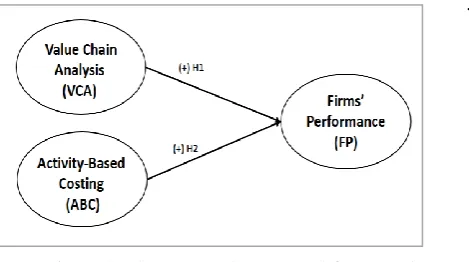
H1: VCAhas a positiveeffect on firms‟ performance
B. Activity-Based Costing (ABC)
ABCis basically the utmost reason that may lead to the indirect costs performed by an organization[24]. What we have today as Activity Based Costing (ABC) has been traced to the studies ofDopuch, Birnberg, &Demski[25] and Staubus[26]. Even with this, the current practices of the ABC can be attributed to the efforts of many companies which have proven the quality of product cost accounting information [27]. As a result of the claim that traditional functional based cost systems are inadequate to offer timely and relevant cost information in helping managers to cope with the changes of business environment, Cooper [28,29]proposed an alternative which has been referred to as revolutionary [27] to a functional based cost system in the 1980s; the alternative proposed was termed as “activity based costing.”
Organization must always strive for improvement on cost. Another important thing to mention before concluding this section is that activity is the heart of ABCtechnique; also that the focus on the performance of each activity and the allocated resources. Similarly, detailed activities managements are key to cost reduction; however, reducing cost is not the only important aspect of ABC, other important areas are quality improvement, services, and flexibility; though this vary from one business to another business [7].
Therefore, ABCis an important strategic cost management technique that could be applied to measure firms‟ costs, objects, resources, activities, relationship between activities and resources, and relationship between activities with objects cost. Using this technique would improve operational efficiency and effectiveness; it can increase competitive advantage, and organizational values. Meanwhile, ABC has been used by various researchers to investigate firms‟ performance from different part of the world [30-34]; following these studies, the researcher has also used this technique as a variable to investigate the UAE petroleum firms‟ performance. Hence,
H2: ABChas a positive effect on firms‟ performance
III. RESEARCHMETHOD A. Conceptual Framework
This study takes an approach to investigate the influence of VCA, ABC technique on the UAE petroleum firms‟ performance. This approach to strategic cost management techniques enable firms to examine their costs patterns and strategic positions based on the firms‟ objectives, the organizational needs and capability, as well as customer requirements (see figure 2)
[image:3.595.310.545.55.186.2].
Figure 2: The proposed conceptual framework
B. Questionnaire creation and information accumulation
The present study adopts quantitative research design in its quest to achieve a credible study. As such, questionnaire was developed and used to elicit the respondents‟ opinion on the effects of strategic cost management on the UAE petroleum firms‟ competitiveness. 200 usable responses were analyzed using SPSS and PLS - SEM-VB was employed to assess the research model. Purposive sampling technique was adopted to gather the required quantitative data in which selection procedure which is used for choosing settings or groups that are professional on a specific area of study. Variables were measured using a Likert Scale which recommended in the previous studies [35-37].
IV. ASSESSMENTOFDATAANDSTUDYFINDINGS
The research model of the current study was assessed by using PLS SEM-VB and SmartPLS 3.0 software [38]. The elaborative evaluation led to the implementation of a two-step of analytical methodology, i.e. structural (to test the relationship hypotheses) and measurement (to test the validity and reliability) models of assessment [39]. This two-step analysis model is superior in comparison to the one-step assessment methodology [40,41]. The first model measures the parameters of the structural model, whereas the later one records each constructs measurement. PLS technique is utilized in the current study for its analytical skills to deduce clear evaluations. On the other hand, SEM is implemented to conduct a coinciding strategical evaluation of the data for precise calculations.
A. Descriptive analysis
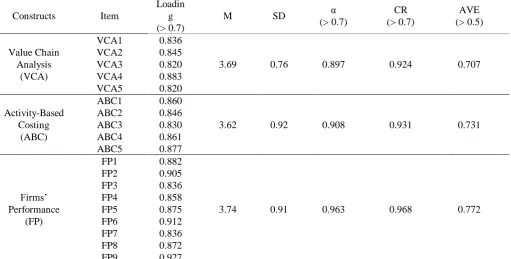
The mean and standard deviation (SD) values for each variable of the current study are presented in Table 1. The respondents shared their opinion about their idea on the online usage as per the Likert Scale. The performance level of the firm was at the highest point with mean value of 3.74 from 5.0 and standard deviation of 0.91for 39.4% of the variance in their Perceived Value of MSD in their future jobs. A significant moderate predictive impact of Habit of Multi-Tasking on Gen Z‟s Perceived Value of MSD was indicated by Regression coefficients (C = 2.210, β = 0.504, t = 16.831, Sig < 0.001). This proves hypothesis H-2 which states, “UAE Generation Z‟s
skill development.”
B. Measurement Model Assessment
The measurement model was examined by implementing the reliability and validity features of the constructs (convergent and discriminant validities). The reliability of each core variable in the measurement model (construct reliability) was evaluated by using the individual Cronbach‟s alpha coefficients. The Cronbach‟s alpha coefficient values were recorded between 0.897 to 0.963 [42]. The composite reliability (CR) values were between 0.924 to 0.968, which
exceeded 0.7 (Table 1).
The factor loadings aided in analyzing the Indicator Reliability. According to Hair et al. [41], values exceeding 0.70 indicate significant factor loadings (Table 1).
[image:4.595.44.556.201.460.2]AVE was assessed to analyze the Convergent Validity. It is reported that this validity shows a positive correlation with the alternate values of the same variables. The AVE values range within 0.707 and 0.772 that is more than 0.50. The convergent validity has been achieved by all the construct variables in this study (Table 1)
Table 1: Mean, standard deviation, loading, cronbach‟s Alpha, CR and AVE
Constructs Item
Loadin g (> 0.7)
M SD α
(> 0.7)
CR (> 0.7)
AVE (> 0.5)
Value Chain Analysis
(VCA)
VCA1 VCA2 VCA3 VCA4 VCA5
0.836 0.845 0.820 0.883 0.820
3.69 0.76 0.897 0.924 0.707
Activity-Based Costing
(ABC)
ABC1 ABC2 ABC3 ABC4 ABC5
0.860 0.846 0.830 0.861 0.877
3.62 0.92 0.908 0.931 0.731
Firms‟ Performance
(FP)
FP1 FP2 FP3 FP4 FP5 FP6 FP7 FP8 FP9
0.882 0.905 0.836 0.858 0.875 0.912 0.836 0.872 0.927
3.74 0.91 0.963 0.968 0.772
Note: M=Mean; SD=Standard Deviation, α= Cronbach‟s alpha; CR = Composite Reliability, AVE = Average Variance Extracted.
Key: VCA: value chain analysis, ABC: activity-based costing, FP: firms‟ performance The degree to which the articles distinguish among concepts
or measure different constructs is demonstrated by discriminant validity. Cross-loadings as well as Fornell-Larcker were employed to analyze the measurement model‟s discriminant validity. Generally, cross-loadings are employed as the initial step in examining discriminant
validity of the markers [43]. In this research, the markers‟ outer loadings on a parameter went beyond all the cross-loadings with other parameters, and thus the cross-loading condition had met the requirements (refer to
Table 2)
Table 2: Results of discriminant validity by the cross loading
VCA ABC FP
VCA1 0.836 0.472 0.601
VCA2 0.845 0.513 0.615
VCA3 0.820 0.452 0.596
VCA4 0.883 0.501 0.689
VCA5 0.820 0.399 0.493
ABC1 0.443 0.860 0.545
ABC2 0.480 0.846 0.578
ABC3 0.508 0.830 0.581
ABC4 0.495 0.861 0.579
ABC5 0.458 0.877 0.507
[image:4.595.39.555.595.776.2]FP2 0.690 0.655 0.905
FP3 0.646 0.566 0.836
FP4 0.576 0.512 0.858
FP5 0.626 0.527 0.875
FP6 0.643 0.584 0.912
FP7 0.599 0.489 0.836
FP8 0.615 0.547 0.872
FP9 0.668 0.659 0.927
Key: VCA: value chain analysis, ABC: activity-based costing, FP: firms‟ performance.
C. Structural Model Assessment
Beta (β), R², and the corresponding t-values were
implemented through the bootstrapping mechanism of 5000
resamples to evaluate the structural model.
Key: VCA: value chain analysis, ABC: activity-based costing, FP: firms‟ performance Figure 3: PLS algorithm results
D. Hypotheses Tests
The structural assessment model depicts the results of the hypothesis tests, with 2 out of the 2 hypotheses are supported. VCA and ABC positively influence firms‟ performance. Hence, H1and H2 are accepted with (tp<0.001)and
(tp <0.001) respectively.
The strength of the relationship between exogenous and endogenous constructs are measured by the standardized path coefficients, which in this case show that the direct
effects of VCAon firms‟ performanceis stronger than the influence of ABCon firms‟ performance.
Sixty-one percent of the variance in firms‟ performance is explained by VCA and ABC. The values of R² have an acceptable level of explanatory power, indicating a substantial model [45,47]
Table 4: Structural path analysis result
Hypothesis Relationshi
p
Std Beta
Std
Error t-value p-value Decision R²
H1 VCA→FP
0.512 0.072 7.098 0.000
Supported 0.6
1
H2 ABC→ FP 0.368 0.070 5.235 0.000 Supported
Key: VCA: value chain analysis, ABC: activity-based costing, FP: firms‟ performance
E. Importance-Performance Map Analysis (IPMA)
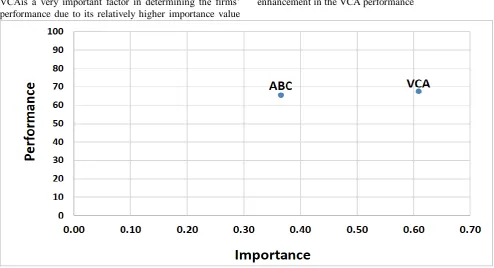
Importance-performance matrix analysis (IPMA) was employed as a post-hoc PLS procedure in this study, with the firms‟ performanceused as the outcome construct. According to Hair et al. [43], the IPMA provides an estimation of the total effects corresponding to the importance of predecessor
constructs in affecting the target construct (firms‟ performance). The average
values of the latent variables are in correspondence with
however, those scores (Index values) are calculated by rearranging the scores from least to highest performance score (0 to 100). The PLS evaluation is enhanced by IMPA as
it focuses on the average value of latent constructs and their indicators (performance) along with the coefficient analysis (importance) (Table 5).
Table 5: IPMA for firms‟ performance
Latent constructs firms‟ performance (Importance) Total effect of the construct Index values (Performance) Value Chain Analysis (VCA)
Activity-Based Costing (ABC)
0.609 0.365
67.376 65.598 The scores for total effects and index values were plotted on
a priority map (refer to Figure 4). It can be observed that VCAis a very important factor in determining the firms‟ performance due to its relatively higher importance value
compared ABC. Hence, the activities and work of the managerial personnel should be developed for better enhancement in the VCA performance
[image:6.595.47.542.176.444.2]Key: VCA: value chain analysis, ABC: activity-based costing Figure 4: IPMA (Priority Map) for firms‟ performance
V. DISCUSSION
The main objective of this research is to examine the impact of VCA, and ABC on the petroleum firm performance in the UAE. Results are promising as they are discussed below:
First, there is a positive significant impact of the VCA with (tp <0.001). Hence, H1 was supported. This result comes in line with prior studies [48-51]. Moreover, this result can be explained by the fact that the application of this value chain value helps the company in costs management improve the quality of the products in the strategic range, leads to maximize the value of the company activities from the purchase of raw materials until the delivery of the product to the customer and leads to an increase the company profits in the strategic range. Therefore it will lead the petroleum company to be able to enhance management development, improve short-term performance, improve on financial performance, improve its ability to evaluate alternatives, improve its ability to avoid mistakes, achieved more return on investment compared to our competitors in other countries.
Second, there is a positive and direct impact of ABC on the
performance of petroleum firms with
(tp <0.001) This is constant with previous studies [52-54]. This result can be explained by the fact that using ABC improve the company performance and achieve the objectives in the strategic range, help to better calculate the costs of production, management to secure more accurate information, helps to provide data for decision-making for all levels of management, and control of costs and reduction in the best manner. Thus, it will lead the petroleum company to be able to enhance management development, improve short-term performance, improve on financial performance, improve its ability to evaluate alternatives, improve its ability to avoid mistakes, achieved more return on investment compared to our competitors in other countries.
Ultimately, the two specific objectives of this research were achieved and results found that VCA and ABC has a positive direct impact on the petroleum firm performance in the UAE, although, VCA has more impact on the
performance, yet
activity-based activity has a
great impact on the
variance explained in this study is 60% which is considered high.
VI. IMPLICATIONS, LIMITATIONS AND FUTURE DIRECTIONS
This Practically, this study has offered substantial benefits to both academicians and practitioners. The present study has exposed the practitioners in the oil sector in UAE to the techniques of VCA, and ABC which have contributed to the performance of petroleum firms in UAE. Moreover, study this in an emerging economic setting like UAE has enriched the understanding of practitioners, teachers, and researchers in term of VCA, and ABC which have contributed to the performance of petroleum firms in UAE.
One of the limitations of the current study, the study has used VCA, and Activity Based Costing (ABC) to investigate the influence of strategic cost management techniques on the United Arab Emirate (UAE) petroleum firms‟ performance, and other potential and relevant variables are ignored. Most of other relevant techniques are not included because adding them may create a very complex model that would not necessarily reveal influence of strategic cost management techniques on the United Arab Emirate (UAE) petroleum
firms‟ performance. As such, the researcher recommends that future studies should seek more techniques to manage cost in petroleum firms in the UAE i.e. competitive advantage analysis, and continuous improvement.
VII. CONCLUSION
The main objective of this study is to examine the influence of VCA, and ABC on the performance of petroleum firms‟ performance in the UAE. The tow supposed hypothesis were supported statistically. The conclusion derived from the present study is that VCA, and Activity Based Costing (ABC) technique positively and significantly contributed to the petroleum firms‟ performance in UAE. These factors are relatively important techniques that contributed to the performance of petroleum firms in UAE, since their explanation of the total variance 60%. Moreover, small and big petroleum firms are significantly different with respect to the responses on the influence of VCA, and activity based costing technique on firm performance. These effects are significantly higher for small firms compared to large firms. Finally, organizations should increase spending on research and development in order to increase the organizational effectiveness.
APPENDIX APPENDIX A
Instrument for varibles
Varible Measure Source
Value Chain Analysis
(VCA)
VCA1: The application of this technique has helped the company in costs management and improve the quality of the products in the strategic range. VCA2: The application of this technique leads to maximize the value of the company activities from the purchase of raw materials until the delivery of the product to the customer.
VA3: The application of this technique has helped management in identifying unnecessary costs in production and the achievement of performance at less cost and higher efficiency.
VCA4: The application of this technique has helped in the development of competitive advantage for the company by reducing costs.
VCA5: The application of this technique leads to an increase the company profits in the strategic range.
[7,23]
Activity-Based Costing (ABC)
ABC1: The application of this technique help to improve the company performance and achieve the objectives in the strategic range.
ABC2: The application of this technique help to better calculate the costs of production.
ABC3: This technique has helped management to secure more accurate information.
ABC4: The application of this technique helps to provide data for decision-making for all levels of management.
ABC5: The application of this technique helps in the control of costs and reduction in the best manner.
Firms‟ Performance
(FP)
FP1: Petroleum company has been able to achieve predicted trends.
FP2: Petroleum company has been able to enhance management development. FP3: Petroleum company has been able to improve short-term performance. FP4: Petroleum company has been able to improve long-term performance. FP5: Petroleum company has been able to improve on financial performance. FP6: Petroleum company has been able to improve its ability to evaluate alternatives.
FP7: Petroleum company has been able to improve its ability to avoid mistakes. FP8: Petroleum company has been able to improve its budget process. FP9: Petroleum company has achieved more return on investment compared to our competitors in other countries.
[48]
REFERENCES
1. V. Berisha, (2016). Strategic Management of Costs: A New Tool to Gain Competitive Advantage. In N. Tsounis& A. Vlachvei (Eds.), Proceedings of the 2016 International Conference on Applied Economics (ICOAE) (pp. 239–254). Springer International Publishing.
2. K. Mohaddes, & M. H. Pesaran, (2016). Oil prices and the Global Economy: Is it different this time around? (No. WP/16/210).
3. C. Lafakis, A. Kamins, E. Friedman, & D. White, (2015). The Economics of Lower Oil Prices.
4. B. Ramljak, & A. Rogošić, (2012). Strategic Management Accounting Practices in Croatia. Journal of International Management Studies, 7(2), pp. 93–100. http://doi.org/10.1108/JAOC-12-2011-0065
5. Institute of Management Accountants. (1996). Statements on management accounting practice: value chain analysis for assessing competitive advantage. Institute of Management Accountants, pp. 1–33.
6. R. Kaplinsky, & M. Morris, (2000). A Handbook for Value Chain Research. Institute of Development Studies, University of Sussex; School of Development Studies, University of Natal.
7. A. M. El-hwaity, (2013). Strategic Cost Management To Maximize The Value Of The Organization And Its Competitive Advantage. The Islamic University Gaza.
8. R. L. Weil, & M. W. Maher, (2005). Handbook of Cost Management. New Jersey, NJ: John Wiley & Sons, Inc.
9. R. S. Kaplan, & R. Cooper, (1998). Cost and Effect: Using Integrated Cost Systems to Drive Profitability and Performance. Boston, MA: Harvard Business School Press. http://doi.org/10.1080/13675569808962056 10.A. Kumar, & S. Kumar, (2011). Strategic cost management -- suggested
framework for 21st Century. Journal of Business & Retail Management Research, 5(2), pp. 118–130.
11.A. S. Alkhateri, A. E. Abuelhassan, G. S. A. Khalifa, M. Nusari, &Ameen, A. (2018). The Impact of perceived supervisor support on employees turnover intention : The Mediating role of job satisfaction and affective organizational commitment. International Business Management, 12(7),
pp. 477–492. http://doi.org/10.3923/ibm.2018.477.492
12.A. Ameen, H. Almari, & O. Isaac, (2019). Determining Underlying Factors that Influence Online Social Network Usage Among Public Sector Employees in the UAE. In Fathey M. Faisal Saeed, NadhmiGazem (Ed.), Recent Trends in Data Science and Soft Computing. IRICT 2018.
Advances in Intelligent Systems and Computing (Recent Tre,843, pp. 945–954). Springer Nature Switzerland AG: Springer International Publishing. http://doi.org/10.1007/978-3-319-99007-1
13.W. Al-Ali, A. Ameen, O. Issac, M. Nusari, & IbrhimAlrajawi. (2018). Investigate the Influence of Underlying Happiness Factors on the Job Performance on the Oil and Gas Industry in UAE. International Journal of Management and Human Science (IJMHS), 2(4), pp. 32.
14.F., Al-Obthani, A. Ameen, M. Nusari, & I. Alrajawy, (2018). Proposing SMART-Government Model: Theoretical Framework. 1st International Journal of Management and Human Science (IJMHS) 2.
15.R. Al-Shamsi, A. Ameen, O. Isaac, A. H. Al-Shibami, & G. SayedKhalifa, (2018). The Impact of Innovation and Smart Government on Happiness: Proposing Conceptual Framework. International Journal of Management and Human Science (IJMHS), 2(2), pp. 10–26.
16.A. Haddad, A. Ameen, & M. Mukred, (2018). The Impact of Intention of Use on the Success of Big Data Adoption Via Organization Readiness Factor. International Journal of Management and Human Science (IJMHS), 2(1), pp. 43–51.
17.Global Competitiveness Report. (2018). Most problematic factors for doing business in UAE, World Economic Forum
18.C. Guilding, K. S. Cravens, & M. Tayles, (2000). An international comparison of strategic management accounting practices. Management
Accounting Research, 11(1), pp. 113–135.
http://doi.org/10.1006/mare.1999.0120
19. A. Ameen, & K. Ahmad, (2011). The Role of Finance Information Systems in anti financial corruptions: A theoretical review. In 11 International Conference on Research and Innovation in Information Systems
(ICRIIS’11 pp. 267–272. Ieee.
http://doi.org/10.1109/ICRIIS.2011.6125725
20. A. Ameen & K. Ahmad, (2012). Towards Harnessing Financial Information Systems in Reducing Corruption : A Review of Strategies.
Australian Journal of Basic and Applied Sciences, 6(8), pp. 500–509. 21. A., Ameen, & K. Ahmad, (2013). A Conceptual Framework of Financial
Information Systems to reduce corruption. Journal of Theoretical and Applied Information Technology, 54(1), pp. 59–72.
22. A. Ameen & K. Ahmad, (2014). A Systematic Strategy for Harnessing Financial Information Systems in Fighting Corruption Electronically. In Knowledge Management International Conference (KMICe) 2014, 12 – 15
August 2014, Malaysia (pp. 12–15). Retrieved from
http://www.kmice.cms.net.my/
23. S. O. Aguko, (2014). Value Chain Analysis and Organisational Performance of Beer Manufacturing Companies in Kenya. University of Nairobi.
24. L. Cinquini & A. Tenucci, (2010). Strategic management accounting and business strategy: a loose coupling? Journal of Accounting & Organizational Change, 6(2), pp. 228–259. http://doi.org/10.1108/18325911011048772
25. N. Dopuch, J. G. Birnberg & J. Demski, (1967). An analysis of standard cost variances. The Accounting Review, 42(3), pp. 526–536.Staubus (1971)
26. Z. Hoque, (2005). Handbook of Cost and Management Accounting. London: SpiramusPress .
27. R. Cooper, (1989). The Rise of Activity‐Based Costing – Part Four: What do Activity‐Based Cost System do Like? Journal of Cost Management for the Manufacturing Industry, pp. 38‐49.
28. R. Cooper, (1993). Cost Classification in Unit‐Based and Activity‐Based Manufacturing Cost Systems. Journal of Cost Management, 4(3), pp. 4–14. http://doi.org/10.1037//0022-3514.80.6.918
29. J. Henri, O. Boiral, & M.-J Roy,. (2016). Strategic cost management and performance: The case of environmental costs. The British Accounting Review, 48(2), pp. 269–282. http://doi.org/10.1016/j.bar.2015.01.001 30. A. Iseri-Say, A. Toker & D. Kantur, (2008). Do popular management
techniques improve performance?: Evidence from large businesses in Turkey. Journal of Management Development, 27(7), pp. 0262-1711. http://doi.org/10.1108/MBE-09-2016-0047
31. [31] Kennedy, T., & Affleck‐Graves, J. (2001). The Impact of Activity‐Based Costing Techniques on Firm Performance. Journal of
Management Accounting Research, 13(1), 19–45.
http://doi.org/10.2308/jmar.2001.13.1.19
32. Krumwiede, K. R., & Charles, S. L. (2014). The Use of Activity-based Costing with Competitive Strategies: Impact on Firm Performance.
Advances in Management Accounting, 23. Emerald Group Publishing Limited. http://doi.org/10.1108/S1474-787120140000023004 33. M. Zaman, (2009). The impact of activity based costing on firm
performance: The Australian experience. International Review of Business Research Papers, 5(4), pp. 200–208.
34. A. H. Aldholay, O. Isaac, Z. Abdullah, & T. Ramayah, (2018). The Role of Transformational Leadership as a Mediating Variable in DeLone and McLean Information System Success Model: The Context of Online Learning usage in Yemen. Telematics and Informatics. http://doi.org/10.1016/j.tele.2018.03.012
35. A. H., Aldholay, Z. Abdullah, T. Ramayah, O. Isaac, & A. M. Mutahar, (2018). Online learning usage and performance among students within public universities in Yemen. Int. J. Services and Standards, 12(2), pp. 163–179.
Author-1 Photo
Author-2 Photo
Author-3 Photo
banking services in Yemen: an integrated perspective of technology acceptance model (TAM) with perceived risk and self-efficacy. Asian Journal of Information Technology, 15(12).
37.C. M. Ringle, S. Wende, & J.-M. Becker, (2015). SmartPLS 3. Bonningstedt: SmartPLS.
38.J. C. Anderson & D. W. Gerbing, (1988). Structural Equation Modeling in Practice: A Review and Recommended Two-Step Approach.
Psychological Bulletin, 103(3), pp. 411–423. http://doi.org/10.1037/0033-2909.103.3.411
39.R. E. Schumacker & R. G. Lomax, (2004). A Beginner‟s Guide to Structural Equation Modeling. New York: Lawrence Erlbaum.
40.J. F. Hair, W. C. Black, B. J. Babin, & R. E. Anderson, (2010). Multivariate Data Analysis. New Jersey.
41.V. R. Kannana, & K. C. Tan, (2005). Just in time, total quality management, and supply chain management: understanding their linkages and impact on business performance. Omega: The International Journal of Management Science, 33(2), pp. 153–162.
42.J. F. J. Hair, G. T. M. Hult, C. Ringle & M. A Sarstedt, Primer on Partial Least Squares Structural Equation Modeling (PLS-SEM), 46 Long Range Planning 328 (2014). London: Thousand Oaks: SAGE. http://doi.org/10.1016/j.lrp.2013.01.002
43.C. Fornell & D. F. Larcker, (1981). Evaluating structural equation models with unobservable variables and measurement error. Journal of Marketing Research, 18(1), pp. 39–50.
44.W. W. Chin, (1998a). Issues and opinion on structural equation modeling. MIS Quarterly, 22(1), pp. 7–16.
45.Z. Awang, (2014). Structural Equation Modeling Using AMOS. Shah Alam.Malaysia: University Teknologi MARA Publication Center. 46.J. Cohen, (1988). Statistical Power Analysis for the Behavioral Sciences
(2nd Editio). LawreAssociatesnce Erlbaum.
47.S. Alsoboa, A. Al-Ghazzawi, & A. Joudeh, (2015). The Impact of Strategic Costing Techniques on the Performance of Jordanian Listed Manufacturing Companies . Research Journal of Finance and Accounting, 6(10).
48.Chenhall, R., &Langfield-Smith, K. (1998). The relationship between strategic priorities, management techniques and management accounting: an empirical investigation using a systems approach. Accounting,
Organizations and Society, 23(3), pp. 243–264. http://doi.org/10.1016/S0361-3682(97)00024-X
49.D. N. Clark, (1997). Strategic management tool usage: a comparative study. Strategic Change, 6(7), pp. 417–427. http://doi.org/10.1002/(SICI)1099-1697(199711)6:7<417::AID-JSC281 >3.0.CO;2-9
50.Z. Y. Fei, & C. R. Isa, (2011). The effect of Activity-Based Costing on firms performance, a study among Chinese manufacturing firms.
Australian Journal of Basic and Applied Sciences, 5(9), pp. 227–237. 51.F. A. Frost, (2003). The use of strategic tools by small and medium-sized
enterprises: an Australasian study. Strategic Change, 12(1), pp. 49–62. http://doi.org/10.1002/jsc.607
52.J. Glova & B. Gavurová, (2008). Performance Indicators As A Part of BSC System With A Company. Economics Journal, 3(9), pp. 11.
53.A. L. Iii, (2006). A constraint-based framework for strategic cost management A constraint-based framework for strategic cost management. http://doi.org/10.1108/02635570310497639.
AUTHORSPROFILE
Sultan Alawadi personal profile which contains their education details, their publications, research work, membership, achievements, with photo that will be maximum 200-400 words.
Ibrahim Alrajawy personal profile which contains their education details, their publications, research work, membership, achievements, with photo that will be maximum 200-400 words.
![Figure 1: Factors posing as problems in doing business in UAE Source: [17]](https://thumb-us.123doks.com/thumbv2/123dok_us/8197620.259860/2.595.53.536.194.450/figure-factors-posing-problems-doing-business-uae-source.webp)