InTrans Project Reports
Institute for Transportation
7-2008
How to Reduce Tire-Pavement Noise: Interim
Better Practices for Constructing and Texturing
Concrete Pavement Surfaces
Robert Otto Rasmussen
Sabrina I. Garber
Gary J. Fick
Theodore R. Ferragut
Paul Wiegand
Iowa State University, [email protected]
Follow this and additional works at:
http://lib.dr.iastate.edu/intrans_reports
Part of the
Civil Engineering Commons
This Report is brought to you for free and open access by the Institute for Transportation at Iowa State University Digital Repository. It has been accepted for inclusion in InTrans Project Reports by an authorized administrator of Iowa State University Digital Repository. For more information, please [email protected].
Recommended Citation
Rasmussen, Robert Otto; Garber, Sabrina I.; Fick, Gary J.; Ferragut, Theodore R.; and Wiegand, Paul, "How to Reduce Tire-Pavement Noise: Interim Better Practices for Constructing and Texturing Concrete Pavement Surfaces" (2008).InTrans Project Reports. 159.
How to Reduce Tire-Pavement Noise: Interim Better Practices for
Constructing and Texturing Concrete Pavement Surfaces
Abstract
This report describes better practices for constructing and texturing quieter concrete pavements; better
practices that answer the question of how we can reduce tire-pavement noise; and better practices that don't
compromise the other things about the pavement that are of equal or greater importance, including safety,
cost, and durability. In developing this document, the National Concrete Pavement Technology Center at
Iowa State University draws from its decades of combined experience working for and alongside concrete
paving contractors. This document also includes the collective experience of various contractors and
equipment manufacturers with a reputation for quality. These guidelines further address the challenges that
are faced in consistently producing a high-quality product in a low-bid environment. This document is
intended to serve as interim guidelines and better practices for texturing. Work under the pooled fund study
that sponsored the development of this document is ongoing. Additional data are being collected on both
existing and new concrete paving projects that will validate the practices described herein. Given the
importance of this issue, however, it is believed that many of these practices can be implemented immediately
without adverse consequences. Refinements to these practices can then be implemented as necessary as
changes to these better practices are made in the near future.
Keywords
Concrete pavements; Construction management; Guidelines; Noise control; Paving; Quality control;
Texture; Tire/pavement noise; Surface characteristics
Disciplines
Civil Engineering
Comments
Pooled Fund TPF-5(139)
PCC Surface Characteristics: Tire-Pavement Noise Program Part 3 – Innovative Solutions/Current Practices
H
OW TO
R
EDUCE
T
IRE
-P
AVEMENT
N
OISE
I
NTERIM
B
ETTER
P
RACTICES FOR
C
ONSTRUCTING AND
T
EXTURING
C
ONCRETE
P
AVEMENT
S
URFACES
:
Robert Otto Rasmussen
Sabrina I. Garber
Gary J. Fick
Theodore R. Ferragut
Paul D. Wiegand
July
2008
Table of Contents
List of Figures ...v
Key Concepts...vi
1
Background ... 1
2
Summary of Better Practices ... 4
3
Overview of Concrete Pavement Texturing ... 7
3.1
Texture Classifications ...7
3.2
Variables affecting Texture ...8
3.3
Nominal Surface Texture...9
3.4
Texture Measurement... 10
4
Controlling Concrete Pavement Surface Texture ...11
4.1
Concrete Materials... 13
4.2
Tining... 14
4.2.1
Concrete Material ...14
4.2.2
Equipment...15
4.2.3
Construction Technique...15
4.2.4
Spacing...15
4.2.5
Width ...16
4.2.6
Depth ...16
4.2.7
Knowledge Gaps ...16
4.3
Drag... 17
4.3.1
Drag Material...17
4.3.2
Construction Technique...18
4.3.3
Knowledge Gaps ...18
4.4
Diamond Grinding ... 19
4.4.1
Project Selection...19
4.4.2
Grinding Head...19
4.4.3
Equipment Operation ...19
4.4.4
Knowledge Gaps ...19
4.5
Making Field Adjustments ... 20
4.6
Other Considerations... 20
4.6.1
Steering and Elevation Controls...20
4.6.2
Crown and Cross-Slope Changes ...20
4.6.3
Workmanship and Ownership ...21
4.6.4
Texturing Speed ...22
4.6.6
Curing Impacts on Texturing...
...
...
...
...
...
...
...
...
...
...
...
...
...
...
...
23
4.6.7
Over Vibration and Segregation
23
4.7
Inspecting Surface Textures
23
5 Equipment Operation and Maintenance
24
5.1
Concrete Paver
24
5.1.1
Frame
25
5.1.2
Sensors
27
5.1.3
Augers / Spreader (Plow)
28
5.1.4
Vibrators
30
5.1.5
Strike Off, Floats, and Forming Pan
31
5.1.6
Tracks
34
5.1.7
Miscellaneous
35
5.1.8
Cleaning Techniques
35
5.2
Texture Equipment
35
5.2.1
Frame and Engine
37
5.2.2
Tracks or Tires
37
5.2.3
Texture Attachments ...
...
...
...
...
...
...
...
...
...
39
5.2.4
Curing Equipment
41
5.2.5
Summary
42
5.3
Diamond Grinder
43
5.3.1
Grinding Heads
43
5.3.2
General Maintenance
45
5.3.3
Hydraulic Systems
45
References
46
Appendix A: Tine Length, Angle, and Height
47
Appendix B: Texturing Better Practices Checklist
49
Appendix C: Definitions ...
...
...
...
51
Appendix D: For More Information
52
Reports
52
List of Figures
Figure 1. Normalized distributions of OBSI noise levels for conventional concrete pavement textures... ... ...
2 Figure 2. Concrete pavement surface properties that affect tire-pavement noise. 4 Figure 3. Summary of better practices to reduce tire-pavement noise 6 Figure 4. Longitudinal and transverse tined concrete pavements. ...
... ... ... . ... ... ... ... ... ... ... ... ... ... ... 7
Figure 5. Drag textured and diamond ground concrete pavements. 8
Figure 6. Longitudinal tining of a newly placed concrete surface. 8 Figure 7. Variables affecting texture and the concept of an optimum texture window 9
Figure 8. CTM and RoboTex test equipment 10
Figure 9. Variability of drag texture surface and its effect on OBSI noise level. 11 Figure 10. Variability of longitudinal tined surface and its effect on OBSI noise level. 12 Figure 11. Variability of transverse tined surface and its effect on OBSI noise level. 12 Figure 12. RoboTex scans of 100×200 mm samples showing variability of transverse tined surface
and its effect on OBSI noise level. 13
Figure 13. Variability in tined texture due to mix segregation/consistency problems. 14 Figure 14. Angle of tines affecting contact with concrete surface 17 Figure 15. Deep striations from burlap drag used on an Autobahn highway in Germany. 18
Figure 16. Pavement cross-slope adjustments. 21
Figure 17. Transverse start/stop point matching 22
Figure 18. Typical components of a slipform paver 25
Figure 19. Two- and four-track pavers... ... . ... ... ... ... ... ... 26
Figure 20. Paving kit for a slipform paver 27
Figure 21. Sensor rods that track alignment and elevation 28
Figure 22. Side forms should be parallel to the stringline. 28
Figure 23. Auger located at the front of a paver 29
Figure 24. Spreader (plow) at the front of a paver. 30
Figure 25. This photo shows a typical line of vibrators mounted to the paver. 31 Figure 26. A difference in vibrator frequency will influence the volume of concrete that is consolidated 31 Figure 27. Forming pan set for a crowned pavement. ...
. ... ...
... 32 Figure 28. Automatic longitudinal float attached to the back of a paver 33 Figure 29. An alternative chevron-type float attachment for a paver. 33 Figure 30. Unintended texture introduced by automatic longitudinal float. 34 Figure 31. Paver tracks...
... ... ... ... ... 35 Figure 32. Texture-cure machine manufactured by Guntert & Zimmerman 36
Figure 33. Texture-cure machine manufactured by GOMACO. 36
Figure 34. Schematic of texture-cure machine. 37
Figure 35. Side view of texture-cure machine on single track 38
Figure 36. Side view schematic of the undercarriage of a four-track texture-cure machine 38
Figure 37. Side view of texture-cure machine on tires 38
Figure 38. Turf drag attachment on a texture machine. ... ... ... ... ... . ... 39
Figure 39. Burlap drag attached to a work bridge. 40
Figure 40. Schematic of longitudinal tining texture equipment 41
Figure 41. Schematic of transverse tining texture equipment 41
Figure 42. Illustration of curing equipment on texture-cure machine 42 Figure 43. A grinding large-scale concrete pavement resurfacing operation 44 Figure 44. Grinder used for large-scale concrete pavement texturing operations...
... ...
... 44 Figure 45. Relationship of texture depth to tine length, angle, and height. 47
Key Concepts
~ Better practices to
Uimprove surface properties
Uand
thus tire-pavement noise are really about establishing
a higher order of
Ucontrol over the texture
Uand other
surface properties. ~
~ It is not about designing or building “innovative”
surfaces, but rather the control of conventional
1 Background
Can concrete pavements be quieter pavements? The answer is most definitely yes.
The question is how can this be done? And how can it be done consistently?
It turns out that constructing a quieter concrete pavement does not require any “new” type of texture. It doesn’t require “new” concrete mixtures or “new” equipment. There are quieter concrete pavements routinely built all across the country using virtually all of the same nominal concrete pavement textures we use today, namely diamond grinding, drag, longitudinal tining, and even transverse tining.
But must quieter concrete pavements be unsafe pavements? The answer is most definitely no. There is simply no relationship between friction and noise. Quieter surfaces vary in friction in the same way that louder surfaces do. Furthermore, quieter concrete pavements can be built to be not only safe, but also durable and cost effective. And, again, this can be done using the same conventional textures that we use today.
That said, how come our concrete pavements aren’t all quiet?
One problem that has been faced until recently is the lack of a collective understanding of what makes some concrete pavements quiet and others not. To address this in recent years, the National Concrete Pavement Technology Center (CP Tech Center) at Iowa State University has amassed the largest database so far of concrete pavement surface characteristics, including measurements of noise, texture, and friction. Nearly 1,500 test sections throughout North America and Europe have been evaluated to date.
From this, and now working under Part 3 of what is termed the Concrete Pavement Surface Characteristics Program (CPSCP), the CP Tech Center has developed an understanding of the fundamental surface properties that affect noise.
Based on this knowledge, better practices that serve to avoid those surface properties are provided herein:
• Better practices for constructing and texturing quieter concrete pavements
• Better practices that answer the question of how we can reduce tire-pavement noise
• Better practices that don’t compromise the other things about the pavement that are of equal or greater importance, including safety, cost, and durability.
Before describing the better practices for constructing and texturing quieter concrete pavements, we should begin by asking some questions:
1. What are the “problems” associated with texturing concrete pavements today? 2. Is the mere use of tining in and of itself the cause of undesirable tire-pavement noise?
3. Is it possible to introduce a degree of control for conventional texturing so that the expectations for noise and other surface characteristics can be met?
The CPSCP and, more specifically, the pooled fund study sponsoring this effort are charged with the mission to help answer these three questions. The guidelines given herein represent one tool to help the industry construct quieter concrete pavements.
[image:10.612.88.521.148.443.2]
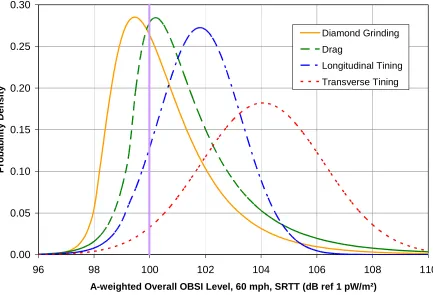
Figure 1. Normalized distributions of OBSI noise levels for conventional concrete pavement textures. With respect to tire-pavement noise, XFigure 1X illustrates the sheer range of noise levels that have been measured on
the pavements to date. The population of pavements is broken down by nominal texture type and shown as normalized distributions of the noise.
0.00 0.05 0.10 0.15 0.20 0.25 0.30 P ro b ab ili ty D e n s it y Diamond Grinding Drag Longitudinal Tining Transverse Tining
96 98 100 102 104 106 108 110
A-weighted Overall OBSI Level, 60 mph, SRTT (dB ref 1 pW/m²)
It is important that the highway community establish rational goals for noise. Based on the work conducted to date, an A-weighted tire-pavement noise level of 100 dB (ref 1pW/m²), measured using On-Board Sound Intensity (OBSI) with the SRTT test tire at 60 mph, appears to be a reasonable target threshold. [18,19] With this in mind, and referring to Figure 1, the following can be concluded:
X XX X
X X
• 50% (half) of all conventionally diamond ground surfaces that were measured already meet this goal
• 25% (1 out of every 4) drag textures meet this goal
• 12% (1 out of every 8) longitudinally tined surfaces meet this goal
• 4% (1 out of every 25) transversely tined surfaces meet this goal (nominal tine spacings are all at or less than 1/2 inch)
It should also be noted that, since this population includes pavements at all different stages of their service lives, newer concrete surfaces—those measured shortly after opening to traffic—will typically measure even quieter, and thus higher percentages of these pavements will meet the target threshold of 100 dBA.
In developing this document, the CP Tech Center draws from its decades of combined experience working for and alongside concrete paving contractors. This document also includes the collective experience of various contractors and equipment manufacturers with a reputation for quality. These guidelines further address the challenges that are faced in consistently producing a high-quality product in a low-bid environment.
2 Summary of Better Practices
To build a quieter concrete pavement, one must do the following:
1. Recognize which properties of a pavement surface make it quiet (and which make it loud) 2. Design the pavement surface in such a way as to avoid those adverse properties
3. Construct the pavement surface, too, to avoid those adverse properties, but also in a manner that is both consistent and cost effective
The first item has been addressed in large part under the CPSCP and through the results of numerous other studies. [19,X20X,X21] XFigure 2X summarizes some of the key relationships and can serve as a reference for those seeking to better
understand the link from the design and construction to the most relevant as-constructed properties affecting tire-pavement noise.
Concrete Pavement Surface Properties that affect Tire-Pavement Noise
• Surface texture (bumps and dips)
o Avoid (flatten) texture that repeats itself at intervals of 1 inch or larger.
o Avoid extremely smooth (e.g., floated or polished) surfaces; instead, some fine texture (that is on the scale of 1/8 to 1/4 inch) should be provided.
o Texture should be “negatively” oriented, meaning that any “deep” texture should point down (e.g., grooves) rather than up (e.g., fins).
o Striations or “grooves” should, if possible, be oriented in the longitudinal direction, as opposed to the transverse direction.
o If grooves are oriented in the transverse direction, they should be closely spaced and randomized whenever possible.
• Concrete properties
o The mortar (at least, near the surface) should be consistently strong, durable, and wear resistant. Mix design is a key factor, but so are proper placement techniques, including finishing and especially curing.
o Siliceous sands should be used whenever possible in order to improve durability and friction.
o For diamond ground pavements, the coarse aggregate in the mixture will constitute the majority of the wearing surface. Ideally, the aggregate should therefore be hard, durable, and polish resistant in order to maintain the intended texture and thus intended noise level over time.
o For tined textures, there should be an adequate and consistent depth of mortar near the surface to hold the intended geometry.
o Given that there may be conflicting objectives between what is required of the concrete near the surface and what is needed both structurally and for economy, two-lift construction may be a consideration.
• Joints
o If joints are present, they can contribute to not only overall noise level, but also annoyance. o Narrow, single-cut joints are preferred over widened (reservoir) cuts.
o Faulted joints should be avoided by providing adequate load transfer.
o Excess joint sealant should be avoided, especially if it protrudes above pavement surface. o Spalled joints should be prevented through proper design, materials selection, and construction.
Figure 2. Concrete pavement surface properties that affect tire-pavement noise.
Better practices to improve surface properties and thus tire-pavement noise are really about establishing a higher order of control over the texture and other surface properties. It is not about designing or building “innovative” surfaces, but rather the control of conventional texturing techniques. There should be a renewed awareness of the impact that some of the subtle operational characteristics can have on the texture as constructed.
Concrete changes from batch-to-batch, and it changes within a batch. The wind and the sun play a major role, as does the timing of the concrete mixing, transport, placement, and (eventually) the texturing and curing (the latter being important for acoustical durability).
Figure 3 summarizes the better practices that will be described in more detail throughout this document. Like Figure 2, this figure can serve as a helpful reference for understanding the numerous issues at play that affect tire-pavement noise.
These are, of course, just a few of the better practices that could be adopted if reducing tire-pavement noise is of concern. Many of these, and those listed in more detail herein, are better practices that will also improve smoothness, durability, and, in some cases, reduce costs.
For today, we can promote better practices that focus our attention on what we should be doing better on today’s concrete spreads. For tomorrow, the solution will likely be automation of the texturing operation. Over the years, slipform concrete paving operations have become more and more automated. Automatic grade control, for example, is now a virtually standard feature for most slipform pavers. Monitoring vibrator functionality and frequency is also common. Maybe the texturing operation is next.
Summary of Better Practices to Reduce Tire-Pavement Noise
• Concrete Materials Selection and Proportioning
oAggregate gradation—for tining and drag surfaces, having adequate mortar concentration near the surface is a critical
variable. Ideally, this could be achieved with a dense mixture along with modified methods of finishing. Alternatively, and while not necessarily ideal for smoothness, durability, or cost, mixtures with high mortar fractions appear potentially better in terms of their ability to “hold” the intended texture. While it is important to have a nominally ideal mixture, consistency of the mixture as batched and placed is paramount. Innovative options such as two-lift concrete paving might be a consideration in the future in order to balance these potentially competing mix objectives.
oAggregate selection—selection of fine aggregate should be made with friction in mind, and thus siliceous sands are
preferred over calcareous sands. Coarse aggregate type is of consequence if the aggregates are expected to become exposed, either through surface wear or diamond grinding. The selection of a hard, durable, and polish resistant aggregate is therefore preferred.
oMortar quality—a high-strength, low permeability, wear resistant mortar fraction will help maintain the intended texture
over time. Measures to lower the w/cm through the use of SCM and/or chemical admixtures should be used when possible. Although they may promote bond for concrete overlays, sticky mortars should be avoided, as they may not hold the texture as intended, and instead deform under action of tining. Mortars that are too fluid could lead to grooves that slump or close-up. Both extremes in mix consistency may lead to unintended or undesirable texture.
• Paving Equipment
oMinimize vibrations—to minimize texture in the pavement surface that repeats itself on the order of 1 inch or longer,
vibrations in the paver should be avoided—at least, vibrations that could potentially be imparted into the slab surface at the profile pan.
oUniform paver motion—ideally, the paver should move as smooth and consistent as possible. In addition to “obvious”
problems with sudden starts and stops, even the impact of the paving tracks can potentially impart undesirable texture features, as can small but rapid adjustments of the paver resulting from improper elevation and lateral control systems (e.g., stringline).
oUniform extraction—heavy paving equipment would be preferred as a means to control variations in the pavement
surface. Maintaining a constant head of uniform concrete at the proper level is also important.
oEquipment maintenance—much of the guidance given in this document relates to equipment maintenance activities that
may be overlooked as a potential source of jerk or vibration that can manifest itself as texture variations in the pavement surface.
• Texture/Cure Equipment
oMinimize vibrations—especially important for tined surfaces where vibrations of the tining rake can potentially impart
undesirable texture.
oCleanliness—for both drag and tined surfaces, the texturing medium will always be contaminated to some degree with
latent mortar. Care should be taken that the buildup of latency is not so significant as to depart from the intended texture.
o Consistent tracking—texture equipment should have a stable and consistent footing and minimize lateral wander.
Track-driven equipment may inadvertently introduce small, repeating texture irregularities, as can wheeled devices due to wheel hop or imperfections. Wheeled devices have a disadvantage in their ability to maintain constant traction.
o Heavy duty curing—curing is paramount to the durability of the pavement surface. While often done immediately after
texturing on the same cart, this process cannot be compromised in terms of the timing or application rate. Multiple pass (or higher concentration) curing application is recommended whenever possible.
o Equipment maintenance—like with the paver, proper and routine maintenance could improve the working condition of
the texture/cure equipment, potentially preventing unwanted jerk or vibrations.
• Grinding Equipment
o Size—larger, heavier grinding equipment is more likely to have the control necessary to impart the texture at the
intended depth and lateral coverage.
o Holidays and overlap—care should be taken that the match line between passes of the grinder does not coincide with
the wheel path, as this can be a source of irregular grinding patterns. Wider grinding heads will minimize the number of match lines and potentially impart better control.
o Bogie wheels—any imperfections in the bogie wheels that support the grinding head can manifest as texture variations
in the ground texture.
o Fins—measures should be taken to minimize the variability in the height of the remaining fins of concrete. While wear
will occur under traffic to improve this, mechanical means of knocking down excess fin height can be done with chopper blades or by dragging the surface with a steel blade or beam.
o Vibrations—excess vibrations should be avoided for the same reasons cited previously.
3 Overview of Concrete Pavement Texturing
3.1 Texture Classifications
By far the most common conventional surface textures for concrete pavements can be categorized as follows:
1. Tined textures a. Transverse
i. Uniformly spaced ii. Randomly spaced b. Longitudinal (uniformly spaced)
2. Drag textures
a. Artificial turf b. Burlap c. Broom
3. Diamond grinding (for both new concrete pavement surfaces and for surface restoration)
X
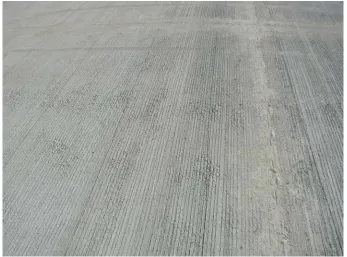
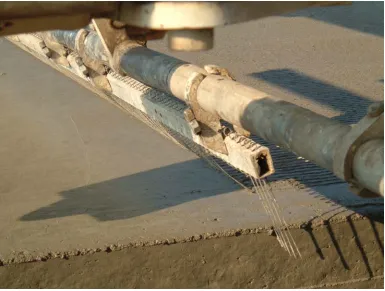
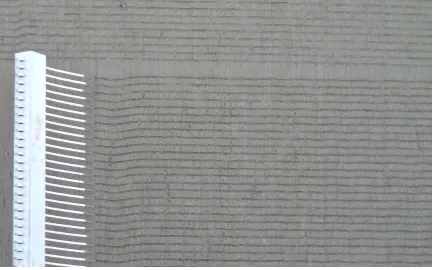
Figure 4X and XFigure 5X illustrate typical results of these various techniques. XFigure 6X shows how one of the more
commonly used techniques—longitudinal tining—is imparted into a fresh concrete surface. While other techniques for concrete pavement texture exist (e.g., exposed aggregate), these guidelines will focus on only those found in conventional practice in the United States.
Figure 5. Drag textured and diamond ground concrete pavements.
Figure 6. Longitudinal tining of a newly placed concrete surface.
3.2 Variables affecting Texture
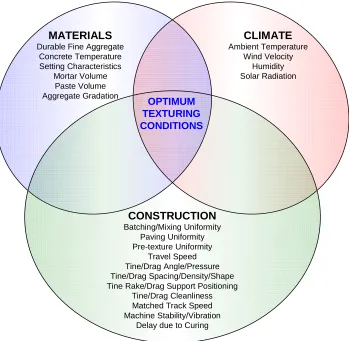
To construct pavement texture, it is necessary to recognize the variables that impact the concrete properties and the texturing process. Some of these variables are illustrated in XFigure 7X, where the “Optimum Texturing Conditions” is
[image:16.612.114.500.286.575.2]
[image:17.612.133.482.82.423.2]
Figure 7. Variables affecting texture and the concept of an optimum texture window.
MATERIALS
Durable Fine AggregateConcrete Temperature Setting Characteristics Mortar Volume Paste Volume Aggregate Gradation
CLIMATE
Ambient Temperature Wind Velocity Humidity Solar RadiationCONSTRUCTION
Batching/Mixing Uniformity Paving Uniformity Pre-texture Uniformity Travel Speed Tine/Drag Angle/Pressure Tine/Drag Spacing/Density/Shape Tine Rake/Drag Support PositioningTine/Drag Cleanliness Matched Track Speed Machine Stability/Vibration
Delay due to Curing
OPTIMUM TEXTURING CONDITIONS
Since the climatic conditions are often beyond the control of the contractor, it is necessary to concentrate on those variables that are more readily changed: materials and construction. Changing materials and construction parameters to respond to climatic changes is desirable. However, to achieve ultimate control, sources of variability in each of the inputs must be both understood and controlled to the greatest extent reasonable. This concept is central to the development of these guidelines, and XFigure 7X will be referred to at various points in this text.
3.3 Nominal Surface Texture
Designers and specifiers often describe nominal texture for a concrete surface in terms of dimensions such as spacing, depth, and width. However, there is an interaction with the concrete materials, construction techniques, and climate that will ultimately define the texture as constructed on the concrete surface. The as-constructed texture often deviates from the nominal dimensions, and furthermore the texture will vary from point to point along the pavement. While these deviations are to be expected, it should be recognized that they will lead to variability in friction, tire-pavement noise, and durability.
Nominal dimensions of spacing, depth, and width are obvious for tined textures—transverse or longitudinal. The rakes used for texturing are manufactured according to these dimensions. For drag surfaces, however, it can be argued that inherent nominal texture dimensions are as a function of “typical” material, condition, weight, and cleanliness of the material used in the drag.
3.4 Texture Measurement
The most common method of characterizing texture is depth using the volumetric or “sand” patch test. [X13X] This test
is simple to perform, but it has many drawbacks as a process control procedure. For example, it can only be performed on a hardened pavement surface. In addition, only a very small area of the pavement is measured by each test, and the test relies on the technician’s judgment to determine if the volume of material (sand or, more typically, glass beads) is uniformly spread.
As an alternative, some practitioners employ quick measurements to check the texture depth during construction. These are often done with a coin, tire tread gauge, or other graduated device that fits inside of the groove left by the tine. Obviously, these techniques prove difficult or impossible on drag or diamond ground surfaces. They are also— like the sand patch—small samples that may or may not be representative of the entire pavement surface. And, again, these techniques are difficult to perform on fresh concrete surfaces.
Overcoming some of these limitations are laser-based texture profilers. XFigure 8X illustrates two such devices,
including the Circular Track Meter (CTM) or RoboTex (based on the RoLine sensor). Devices like these can more accurately measure texture and can more fundamentally define texture in terms of spacing, width, and depth. RoboTex actually measures the surface in three dimensions to provides even more clarity of the subtleties of the pavement surface, since most concrete pavement textures are anisotropic (different in the longitudinal and transverse directions). The drawback of any laser-based device is the relatively high cost. In addition, they don’t serve as “quick” checks for texture during construction unless they happened to be integrated somehow as a real-time monitoring system on the paving equipment.
4 Controlling Concrete Pavement Surface Texture
Today’s methods and practices for imparting and controlling surface textures are often ineffective in meeting a nominal texture pattern, much less meeting it in a consistent manner. Even if tining, drag, and diamond grinding are all done with the “best” equipment, the other variables illustrated in XFigure 7X will ultimately affect the final texture.
X
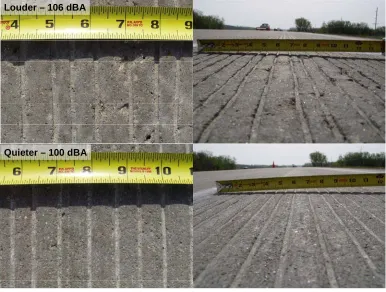
Figures 9X through 1111X illustrate this. These photographs show how variability in the as-constructed texture can, in
turn, lead to very different tire-pavement noise levels (in this case, shown as OBSI measured at 60 mph with the SRTT). These photographs were taken on one of the CPSCP test sites on US 30 in Iowa. [19X] In each figure, the
different appearance of the texture between the louder and quieter areas can be seen. For those sections that are louder, one or more of the texture characteristics noted in XFigure 2X can be observed. XFigure 12X further illustrates the
transverse tining section by way of a texture scan measured with the 3-dimensional texture profiler, RoboTex, illustrated in the center of XFigure 8. [X19] From this, subtle curvature of the lands between the tine grooves can be
noted in the louder section, while the tine grooves are much less aggressive in the quieter section. It should be noted that the texture depth in both cases was very similar; the differences in geometry of the lands was the major contributor to noise—largely due to the land (tine) spacing, which was in excess of 1 inch in many cases.
Louder – 103 dBA
Quieter – 99 dBA
Louder – 106 dBA
[image:20.612.113.499.73.365.2]Quieter – 100 dBA
Figure 10. Variability of longitudinal tined surface and its effect on OBSI noise level.
Louder – 111 dBA
Quieter – 103 dBA
[image:20.612.116.499.403.693.2]
Scale 1:1
Scale 10:1
Scale 1:1
Scale 10:1
Louder – 111 dBA Quieter – 103 dBA
Figure 12. RoboTex scans of 100×200 mm samples showing variability of transverse tined surface and its effect on OBSI noise level.
The differences in the as-constructed variability in texture are the impetus behind these better practices. The techniques described herein are intended to increase the probability of constructing the nominal texture, as well as to increase the consistency in the as-constructed texture. The following sections summarize some of these practices in more detail. However, a decision will ultimately have to be made by the reader about what degree of control is reasonable to ensure that a proper and consistent texture is constructed.
4.1 Concrete Materials
For each of the texturing methods that will be subsequently described, the effect of concrete materials will be touched on. However, in terms of controlling batch variability, the contractor might consider some of the following suggestions: [X1X]
1. Moisture control—monitor aggregate stockpile moisture contents, adjusting the batch proportions as needed. Stockpiles can also be sprinkled to assure a saturated surface dry condition or wetter; this is especially important for highly absorptive aggregates. Consistency in the mix is arguably most affected by the water content. If this varies, then the as-constructed texture as imparted will vary as well. Proper stockpile management can help significantly. This includes not only moisture control, but better practices such as maintaining a minimum three-day supply of each aggregate throughout the paving process.
2. Cementitious material control—there is arguably an increase in the variability of relevant properties of both the cement and other supplementary cementitious materials. The properties of relevance with respect to the pavement surface would be those linked to the concrete set time, plasticity, and durability. Periodic evaluation of the constituent materials should be made, and mix adjustments should be made as appropriate to ensure as consistent of a product as possible.
3. Aggregate control—consistency in the response of the concrete during the slipform process will depend in part on the consistency in the concrete volumetrics. Segregation during batching, transport, or depositing/spreading of the concrete can lead to problems in achieving a uniform surface. Mix designs that minimize the potential for segregation should be sought, along with controls in handling the fresh concrete.
To illustrate how significant of an impact that mix consistency can have, XFigure 13 shows the result of tining a fresh
concrete surface that was constructed with a highly segregated, inconsistent mixture. This is often due to a combination of poor mixture design and/or inadequate batching.
[image:22.612.133.480.71.328.2]
Figure 13. Variability in tined texture due to mix segregation/consistency problems.
4.2 Tining
Tining is the most commonly used texturing method for concrete pavements. Both longitudinal and transverse tining is used, sometimes with other variants such as a skewed or “wave” pattern. The following is guidance to help control texture produced by various tining methods.
4.2.1 Concrete Material
Since tining will result in the mortar fraction as the wearing surface, it is vital that the mortar be durable. A surface of high strength and low permeability is desired, especially on projects that will be subject to heavy traffic and/or winter maintenance activities. Use of siliceous sand will not only increase the durability, but increase friction, all else being equal. Concrete mixes with a low water-cement ratio are ideal. The use of supplementary cementitious materials is also recommended, as this can help increase both the durability and workability of the mixture.
While potentially contradictory to meeting the objective of a durable mixture, it is believed that the concrete in the vicinity of the surface should not possess too many intermediate-size aggregates. A more gap-graded mixture near the surface will allow for the 1/8- to 3/16-inch depth of mortar required for the grooves imparted by the tines to maintain their intended shape. If too much aggregate is present, the tines will constantly work around and displace the particles, resulting in a more aggressive and potentially noisy texture. The fine aggregate particle shape may also be of particular importance, as an overly sticky mixture can lead to displacement and shearing of the surface mortar, which in turn can distort the intended texture.
On the other extreme, too much fluidity in the mortar can also prove problematic, as the tined grooves will tend to “slump,” and, in the worst case, close off pockets being created. To avoid this, the sand type and gradation should be selected for stability in terms of flow under low to moderate levels of vibration.
Finally, segregation of the mixture should be avoided, since not only will the tining process respond differently to concrete of varying volumetrics, but also the wear of a concrete surface will be nonuniform, eventually leading to a “modulation” in the noise level and/or frequency characteristics that can prove annoying to vehicle occupants.
4.2.2 Equipment
Little is known about the particular aspects of paving and texture equipment as they affect the as-constructed texture. Given that variability is undesirable, an automated texture/cure cart with uniform depth and alignment would be recommended. When transverse tining is used, this control should be present along the tining rake to prevent one end of the rake from imparting texture different from the other.
Vibrations of various sorts at both the paver and tining rake should also be avoided. Section X5X of these guidelines
includes very specific guidance on how this might be accomplished through an elevated awareness of the equipment operation and maintenance.
In addition to minimizing vibrations, any alterations to the equipment that will minimize the variability of the concrete that is displaced might be preferred. It should be remembered that the concrete that is displaced by the tines will simply redeposit somewhere on the pavement surface. In many circumstances, these “random” deposits will contribute to additional noise being generated. While such equipment modifications are not readily known, this guidance should serve as a target for innovation.
While these guidelines do not serve to recommend texture type or geometry per se, it is known that when transverse tining is used, small (1/2 inch or less) spacings will most often result in the quietest surfaces. Adding some degree of randomness to this spacing will further minimize annoying “tones” that may develop when driving this pavement.
4.2.3 Construction Technique
A quiet concrete surface is not one that is completely smooth. Some (smaller) texture is necessary to minimize the noise that is generated. Pre-texturing the pavement with a drag texture prior to tining is therefore important. A heavy drag surface is recommended, with specific recommendations on techniques found in Section X4.3X.
Since the durability of the mortar at the surface is so critical to the success of a tined surface, excellent curing techniques become mandatory. The use of multiple applications of conventional curing compound or, in more extreme circumstances, wet curing techniques should be considered for those projects where noise is a particular concern. The timing of the curing application is also important, with the recommendation that it be applied as soon as possible after placement (and texturing).
In terms of constructability, longitudinal tining tends to produce more consistent surfaces than transverse tining. The continuous process of longitudinal tining allows both the texturing and curing to be applied more consistently than during the “start and stop” motion inherent in transverse tining. Furthermore, the advantages of a single texture-cure machine can be realized during longitudinal tining, which in and of itself leads to greater consistency than when two machines perform these operations independently.
4.2.4 Spacing
4.2.5 Width
The width of the tined groove is a function of the tine width dimension. Depending on the concrete mix properties, there may be some change in the width of the groove immediately after tining. Plastic (fluid) concrete can close back together after tining, for example. This can be altered by increasing the hydration time before tining or through mix adjustments.
Alternatively, an increase in the groove width can result from a buildup of dried concrete paste on the tine. This can be remedied by cleaning the tines periodically. A broomstick or similar object can be dragged across the bottom of the tines regularly to break loose concrete paste that is clinging to the tines. It is much easier to clean the tines regularly before the cement paste is hardened than it is to replace tines because the cement paste is too hard to remove.
Finally, worn tines should be replaced as soon as practical when the nominal tine dimension is believed to be critical. Worn tines will result in rounded edges that may differ from those that are specified.
4.2.6 Depth
Tine depth is arguably the most difficult variable to control. It is a function of the following variables:
• Quantity and size of aggregates near the concrete surface that are dislodged by the tines
• Density (stiffness), workability, and combined gradation of the concrete mixture near the surface of the pavement
• Overall mix uniformity
• Downward force applied to the tine
• Surface area of the tine in contact with the concrete—affected by the tine dimension and the angle of the tine with respect to the pavement
As the tine applies pressure to the pavement surface, the slab provides resistance to that pressure, resulting in two springs pushing against each other, one spring being the tine and the other spring being the plastic surface of the slab. For a given mix with consistent stiffness, the pressure of the tine against the concrete surface decreases as the surface area of the tine in contact with the slab increases, and thus the texture depth will decrease. This pressure is a complex function of the elevation of the tine rake and the angle of the tines (see XFigure 14X). It should be noted that as the
mixture changes in consistency, the depth will also change, leading to undesirable variations in texture.
Additionally, the quantity and size of aggregate particles that are dislodged by the tining process will have an impact on the consistency of texture depth. Decreasing the angle between the tine and the pavement surface may reduce this variability, but no field experiments have been conducted to confirm this.
Appendix A contains information pertaining to the hypothesized relationships between tine length, angle, and height. Although each of these variables can be adjusted in an attempt to control the texture depth, little is known about the true correlation of texture depth as a function of field adjustments to these variables. The material in this appendix has been developed as a first step in providing supplementary guidance based on theory.
4.2.7 Knowledge Gaps
With respect to better practices of tining, a number of gaps remain. Probably most pressing is the need to identify nominal tining patterns that are suitable to meet not only low noise demands, but also all of the potentially competing demands of the concrete pavement surface, including comfort, safety, durability, etc.
Figure 14. Angle of tines affecting contact with concrete surface.
A concrete mix design system is also needed that is capable of balancing the demands for the concrete at the surface to hold the intended texture and yet remain smooth and durable.
Finally, to achieve a higher order of control, more automated means to impart and monitor texture on a concrete pavement will likely be necessary.
4.3 Drag
Drag texturing is arguably the least expensive texturing technique that is available. Quite simply, the process involves “dragging” a material through the fresh concrete surface. The material is commonly artificial turf, burlap, or a broom. In practice today, the surface is usually dragged in the direction of travel (longitudinally). Even given the simplicity, there are still better practices that can be followed to produce a more ideal surface.
Like tining, the mortar fraction of the concrete is effectively the wearing course. A durable mortar is therefore vital to the success of a drag texture surface. Specific guidance for this can be found in Section X4.2.1X.
4.3.1 Drag Material
The material that is used for the drag texture will affect the final product. Drag textures using virtually all types of materials have been used successfully for high-speed roadways. The FHWA, as part of the most current Texture Advisory, will approve the use of broom or artificial turf drag for roadways with design speeds of 50 mph or greater when adequate safety performance is demonstrated. [X14] Minnesota, for example, has adopted the use of artificial
4.3.2 Construction Technique
Like with tining, better practices for curing are critical to the success of drag textures. Vibrations of the paver and, in this case, the bridge supporting the drag material should be minimized. More on these can be found in Sections X4.2.2X
and X4.2.3X.
The geometry, weight, saturation, and conditioning of the drag material are all important too, however. In general, drag surfaces that are more “aggressive” (deep) will not only produce lower noise, but will maintain the lower noise levels for a longer period of time as more wear of the surface occurs. The length of the drag material that is in contact with the fresh concrete should be a minimum of 6 feet. When burlap is used, the material should be heavy (AASHTO M 182, Class 3 or 4). [X15] Burlap should also remain visibly damp during the drag process and be frayed
[image:26.612.126.488.232.501.2]along the trailing edge for a length of at least 1 inch. If performed successfully, the burlap will produce deep striations like that illustrated in XFigure 15X.
Figure 15. Deep striations from burlap drag used on an Autobahn highway in Germany.
To maintain a consistent surface, the drag process should proceed at the same rate as the paving process and with minimal time between these operations. The most logical means to do this is to have the bridge with the drag material towed by the paver, with additional emphasis that the paver should advance at a consistent rate.
All drag materials will collect mortar and paste because of the texturing process. Most of this material will be continually redeposited. However, depending on the specific mix and other variables (see XFigure 7X), the drag
material may eventually collect so much mortar/paste that it loses its effectiveness to produce a surface with deep striations. At this point, the material should be replaced and/or cleaned to restore the intended function. At a minimum, the material should be thoroughly washed and/or replaced at the end of a day’s paving.
4.3.3 Knowledge Gaps
The need for an improved concrete mix design process that was identified in Section X4.2.7X also applies for drag
4.4 Diamond Grinding
Diamond grinding is a texturing technique that can be used for both newly placed concrete as well as for rehabilitating existing concrete pavements. The process involves removing the surface of the concrete via a gang-mounted spindle of saw blades (and spacers). The resulting “corduroy” surfaces are among the quietest concrete pavement surfaces that can be constructed. However, not all diamond grinding projects are quiet, and one of the shortcomings of the technique is misapplication on projects (concretes) that wear quickly.
4.4.1 Project Selection
Unlike conventional “wet” textures such as tining and drag, diamond grinding will result in a surface that largely consists of the coarse aggregates in the concrete mixture. As a result, the need for a durable, polish-resistant coarse aggregate is vital to the success of this technique in providing a long-life surface. Candidate projects should be selected that meet these minimum aggregate requirements and/or have the potential for the surface to wear quickly. Of particular relevance to noise is the homogeneity (or lack thereof) of the aggregate. Coarse aggregates that are of the same type (e.g., limestone, granite) will tend to wear in the same manner, in contrast to aggregates that are blends of numerous types (e.g., “river rock”). The latter will result in uneven wear that can introduce additional noise over time.
4.4.2 Grinding Head
Even the most subtle details of the grinding head used will affect the as-constructed texture. On the head, blades and spacers of various size and type are traditionally selected in such a way as to ensure that the target functional standard (e.g., smoothness) is achieved while further considering the potential for wear (of both the grinding head and of the pavement under traffic).
From what is known today, there is no “magic” combination of blades and spacers that will achieve the quietest surface. A number of aspects of the final texture will affect the noise characteristics and the durability of the surface. The “fins” left behind between the sawed grooves, for example, are known to introduce noise if they are not uniform in height (as is often the case). Ongoing work by the ACPA is investigating the use of “chopper” blades in lieu of spacers to even the tops of the fins in order to reduce noise.
4.4.3 Equipment Operation
Section 5.3 of these guidelines identifies some specific operations and maintenance activities that may warrant renewed diligence if noise is a concern. In addition to this, however, significant improvements to control the texturing operation may involve real-time sensing of the as-ground surface. This would provide operators with the information that may allow them to adjust forward speed, power, or other operational characteristics that could reduce unwanted texture features that may contribute to noise.
4.4.4 Knowledge Gaps
Since the durability of the coarse aggregate is critical to the longevity of a diamond ground surface, additional work needs to be done to classify aggregates in terms of their ability to hold texture. While surrogate tests for wear are used today, little has been done to even correlate these results to the performance of diamond ground surfaces. In addition to traffic wear, additional consideration might be given to the effect of winter maintenance activities on the durability of ground surfaces.
training. In the future, clearer links between the changes in operating characteristics of the equipment and the resulting texture should also be better documented.
Finally, while evidence exists that no nominal grinding pattern is quieter, the pattern is known to affect wear rate, and therefore a need exists to optimize the pattern as a function of the project-specific conditions (especially the concrete type). Tolerances on these dimensions should also be investigated in terms of their sensitivity to the resulting noise, other surface characteristics, and durability.
4.5 Making Field Adjustments
Prior to construction, adjustments in the field to control texture can be accomplished in the following steps:
• Verify that the equipment and materials being used are set up to target the nominal texture that will meet the project specifications.
• For tining, verify that the tine width meets project specifications. Furthermore, use the appropriate tine length for expected conditions. Use shorter tines for hot dry weather, firm pavement surface, and deeper texture; use longer tines for cool damp weather, soft pavement surface, and shallower texture.
• For grinding, verify that the correct grinding head is being used for the concrete being textured.
• As appropriate, set the crown and/or slope of the texture equipment to match the pavement cross-section. The tips of the tines should be parallel to the proposed pavement surface. The supports for drag textures should also be at equal heights from the pavement surface across the width.
Recognize that some adjustments to texturing equipment cannot be readily done “on the fly.” Because consistent surface texturing is time dependent, any changes that are made must be done using the parameters under the control of the operator. Changing the tine length or grinding head, for example, cannot be practically done. However, depending on the equipment, it may be possible to adjust the tine angle or grinding pressure in a timely manner without adversely affecting the efficiency of the overall operation.
4.6 Other Considerations
4.6.1 Steering and Elevation Controls
Controlling the steering of the texture machine off of the stringline used for paving is a suggested method for improving the uniformity of a pavement surface texture. Utilizing automated elevation control for longitudinal texturing is not mandatory, but it is highly recommended. If automatic elevation controls are used, the speed of the machine should be kept within a limit that allows the hydraulic system being used to react as intended. A smooth track line for the texture machine is mandatory to reduce the variability of the texture.
Since variability in the texture is a characteristic that should be avoided, it is recommended that equipment be sought that possesses a rigid frame capable of transmitting steering forces from one end to the other, along with a quality propulsion and steering system. The combination of these will increase the probability that the texture-cure machine will steer accurately, resulting in a more uniform texture. In other words, a texture-cure machine being used for longitudinal tining that does not steer accurately will result in “wavy” longitudinal grooves that can contribute to the overall noise level of that surface.
4.6.2 Crown and Cross-Slope Changes
Many pavements have variations in the typical section due to super-elevated curves, matching existing pavement cross-slopes, etc. These cross-section changes must be accounted for in the surface texturing process. For non-crowned pavements, controlling the elevation of the texture machine with the paving stringline should keep the texture rake or drag supports parallel to the width of the slab surface.
pavement cross-section. This is sometimes the case even if automatic elevation controls are being used. Suggested methods for cross-section adjustments are listed below:
• Transverse texturing
o Each time the texture machine is advanced to make the next transverse texturing pass, verify that the texture machine frame is parallel to the pavement cross-section for the full width of the pavement. Since the tine rake travels across the pavement in a carriage that is attached to the machine frame, the crown adjustment in the frame will need to be adjusted for cross-section changes. One simple way to check the frame’s crown relative to the pavement is to possibly hang four plum bobs from the frame on equal-length strings (two on either side of the crown point and two near the pavement edges). A visual check will reveal if the frame is parallel to the pavement surface, or both sides of the machine may be lowered until all four plum bobs are in contact with the pavement at the same time and then raised in unison to maintain a parallel plane. Some texture machines may optionally include or be adapted to have automatic sensors that assist in this process.
• Longitudinal Texturing
o Longitudinal texturing is similar to transverse in the way that cross-section changes are made at stop/start points. Plumb bobs or sensors are not necessary, since the tips of the tines or position of the drag material provide a visual reference across the width of the pavement. Additionally, the crown adjustment of the texture machine may need to be adjusted simultaneously with the texturing process. The degree of this “on-the-go” adjustment will depend on the length of pavement being textured and the rate of pavement cross-slope change. For example, if the texture machine operator is texturing and curing the pavement in 100-foot increments, the outside edge of the pavement could rotate up approximately 2 inches in a 100-foot segment of a super-elevation transition. This degree of change would require a crown adjustment while texturing. This adjustment is completely operator-dependent, and at this time no automatic controls are available for texturing equipment.
• Cross-section changes should be visibly marked with signs on the project so that the texture machine operator is aware of the location and rate of cross-slope changes. These types of changes are illustrated in
X
Figure 16.
tine rake profile/plumb bob reference roadway surface
normal crown super-elevation transition
full super-elevation
Figure 16. Pavement cross-slope adjustments.
To overcome some of the inherent limitations of manual elevation adjustments, it is recommended that automated controls be used whenever possible. Sensors that can gauge the cross-section of the pavement section are particularly useful and will increase the quality as a result. These sensors can include a combination of stringline and height (e.g., sonic) sensors located at strategic points across the width of the pavement.
4.6.3 Workmanship and Ownership
Constructing more uniform surface texture will require equipment operators that are properly trained and skilled in their craft. It will also require a change in some management philosophies to emphasize the importance of having the same operator day-in and day-out to improve texture consistency.
4.6.4 Texturing Speed
Normal ground speed for longitudinal texturing is typically on the order of 25 to 75 feet per minute. Since the texturing process proceeds faster than the paving process (which is typically 5 to 10 feet per minute), it is not necessary to texture at a high speed. The operator should find an operating speed that minimizes machine vibrations and/or oscillations that can possibly be transmitted to the pavement surface. On some equipment, excessively slow speeds can result in “crab-walking” of the texture machine, which results in inaccurate steering. This can be problematic in terms of introducing unwanted texture variability. Ideally, the texture speed should be set so the machine can steer accurately; it should advance in such a way as to maintain alignment with the stringline, as well as to minimize unwanted vibrations.
The speed of transverse texturing across the width of the slab has been observed to be on the order of 30 feet per minute. As with longitudinal texturing, equipment vibration and oscillation transferred to the pavement surface is one concern with determining the optimum speed for transverse texturing. The texture equipment should be set-up and maintained in a condition that will result in a consistently smooth operation of lowering the texturing medium, pulling it across the width of the pavement, and raising it at the end.
4.6.5 Matching Start and Stop Points
Both longitudinal and transverse texturing are interrupted processes. The operator should pay particular attention to matching the texture at start and stop locations. This may be especially critical for transverse texturing with respect to noise. A simple plumb bob on both sides of the texture machine can be used as a reference to gauge both overlap and alignment of the tine rake (XFigure 17). However, equipment with flexible frames and/or lower quality steering
[image:30.612.90.523.357.627.2]mechanisms will find it more difficult to achieve point matching.
Figure 17. Transverse start/stop point matching.
and realigned with the pavement centerline in preparation for the next texturing section. As mentioned above, longitudinal tining is generally preferred over transverse tining in terms of the potential for constructing a more uniform texture that has improved noise characteristics.
4.6.6 Curing Impacts on Texturing
Curing of the pavement is sometimes performed using the same piece of equipment as texturing. As a result, texturing equipment is often referred to as “texture-cure” equipment. The fact that uniform surface texture is time-dependent demands that special attention be given to the curing operation. Specifically, the curing equipment should be maintained to prevent clogging and/or breakdowns, and the refilling of the cure tank should be well planned to minimize delays. Larger cure tank capacities can be beneficial in this regard. When problems occur, curing should always take priority over texturing.
Longitudinal tining typically has an inherent advantage over transverse tining in terms of the ability to provide a high quality curing. During longitudinal tining, the forward motion of the texture-cure equipment can be uninterrupted. This allows the curing compound to be applied concurrently with the tining operation, resulting in a quicker and more consistent curing operation. Most conventional texture-cure equipment used today, when used for transverse tining, requires that the equipment stop periodically and then “back up” in order to apply curing compound.
4.6.7 Over Vibration and Segregation
Segregation of the concrete mix due to over vibration on the paver can lead to inconsistencies in surface texture, among numerous other problems. If the vibrators are not operating properly, a concentration of paste (lack of larger aggregate) can occur at the pavement surface in the path of one or more of the vibrators. The effect on texture results from the variability of the firmness of the pavement surface across the width of the slab.
Segregation due to over vibration is visible as what is commonly referred to as “vibrator trails.” These trails are most easily seen on transversely textured pavements where the texture depth is deeper in the “vibrator trails” because the tines penetrated further into the softer, segregated mix directly over the vibrators. In addition to contributing to inconsistent surface texture, segregation can lead to premature pavement failures. Any time the texture machine operator notices that segregation has occurred, the vibrators on the paver should be checked for proper operation.
Quite often, what is commonly attributed to a “vibration problem” is the result of the concrete mixture being used. Mixtures that are extremely gap-graded will tend to segregate during handling and placing. Any excess vibration of these mixtures will only exacerbate their shortcomings. The mixtures will tend to be inconsistent across the width of the slab and especially in the vicinity of the vibrators. While there is a need for a uniform layer of mortar near the surface in order to retain the intended texture, the mixture should be optimized for this, and the use of poorly graded aggregates in the concrete mixture should be avoided.
4.7 Inspecting Surface Textures
5 Equipment Operation and Maintenance
It is in the best interests of nearly all stakeholders to construct concrete pavements as good as possible with the resources given. The “best” pavement is one that offers the requisite structural capacity while providing a surface that is safe, smooth, and quiet. It has been found that the condition of the equipment used to construct concrete pavements can have a direct effect on the texture and thus noise level as vehicles traverse the road. More specifically, machines that are not properly maintained can introduce unwanted vibrations in the fresh concrete. These vibrations, in turn, often lead to subtle texture that will adversely affect tire-pavement noise and possibly smoothness.
The following guidelines describe better practices for maintaining and operating both the paver and texture-cure cart in such a way as to minimize these unwanted vibrations. Explanations of both the necessity and consequences associated with each maintenance and operation topic are provided herein. It must be emphasized that the following recommendations are generalized. The equipment documentation provided by the manufacturer should be referenced for application of this guidance to specific equipment models.
5.1 Concrete Paver
We begin with some general principles of a concrete paver that can help build a smoother ride with minimal vibration-related texture: [X1X,X2]
1. Weight—the heavier the better, up to a point. During the slipform process, a large mass of concrete is being forced into a specific geometry during the course of a few seconds. The laws of physics require that significant forces be imparted into this mass during this time. As a result, there is an inherent advantage to heavier machines in shaping the concrete to a higher tolerance. Lighter machines can be used and can be just as successful in paving a high-quality product. However, in these situations, careful pre-spreading of the concrete in front of the paver by a placer-spreader or some other effective means is important. This will help avoid overloading the paver and thus should be an integral part of the paving process.
2. Traction—requires weight, power, and friction. With these extreme forces at play, the natural response of a paver will be to resist the concrete being placed and thus resist forward motion. Only with sufficient weight and good traction can the paver advance in a uniform fashion. Traction is enhanced greatly by a stable track line for the paver to operate upon.
3. Uniformity—the more consistent the better. The concrete paver works best when operated in a steady state. Forward motion, vibrator frequency, and other mechanical systems should be operated at a constant rate during placement to the greatest degree possible. Any changes in these due to varying mix, weather, or other factors can inherently introduce changes to the pavement surface. For example, forces acting on a paver are affected by the nature of the concrete mixture. Changes in the mix volumetrics due to segregation, alterations in the batch quantities, admixture dosage (including air), or other factors can change the response of the paver. If these responses are sudden and/or numerous, imperfections in the pavement surface can result.
We now turn to the principal aspects of the equipment that introduce the vibrations. The following three sources are arguably the most significant: [X3X]
1. The Engine—Most concrete pavers operate on a diesel engine that operates on the order of 2,000 rpm. Vibrations from rotating machinery such as an engine cannot be avoided. However, measures are commonly taken to isolate these vibrations using dampening mounts. Still, these mounts are imperfect, and their effectiveness is subject to maintenance.
vibrational energy is, of course, inherently introduced into the concrete, and to some degree it will affect the concrete surface. Keeping the vibrational energy constant across the slab by monitoring individual vibrator operation and limiting variations in the load/concrete head heights is important. Variations in these will lead to inconsistencies across the slab that will be reflected in the subsequent texturing. It is also worth noting that some of the vibrational energy will likely be transferred through the paver and may introduce additional imperfections in the surface. Proper mounting (and dampening) of this vibrational energy should limit this potential.
3. Poor maintenance—A modern concrete paver is very complex. Numerous mechanical systems work simultaneously and thus make maintenance a priority. A poorly maintained paver is likely to adversely affect quality. Excess vibrations can be introduced at a number of locations on the paver. Figure 18X
illustrates some of these locations in a broad sense. [2] The following sections will describe proper maintenance activities in more detail.
X
X X
Subbase
Concrete
Auger or
Spreader Plow
Strike Off
Vibrators
Tamper (optional)
Profile Pan
Side Form
Paving Direction
Figure 18. Typical components of a slipform paver.
5.1.1 Frame
The frame of a concrete paver is the platform upon which the power plant and paving kit are fixed. Its weight and rigidity affect the ability of the paver to handle the large volumes of concrete associated with paving, especially thick sections typical of highway paving.