QUALITATIVE METHODOLOGIES FOR DUMMIES: ENGINEERS IN
INVESTIGATING THE QUALITY OF FINAL YEAR ENGINEERING RESEARCH
PROJECT
ABSTRACT
This paper discusses the methodology and methods used in an associate
learning and teaching fellowship to study the perception, barriers and
approaches of students in their final year engineering project, in particular,
their literature review. There was a scenario that involved a change of
methodologies in research ‘style’ for engineering education. As most of
the research team members are engineers and their respective research
experience is in engineering research and technology innovation, the
original research methodologies adopted was not particularly suited for
engineering education research. It was based on very quantitative approach
used in science-based disciplines though questionnaires were to be used as
one of the data collection method. A methodology change was made as the
research team acknowledged that there will be likely deficiencies and
difficulty in the research validity. This instigated a change to a very
qualitative approach, involving a series of open-ended surveys, focus
groups and intervention workshops. The change in methodology was
inspired mostly by Bloom’s (1984) taxonomy and Biggs’s (1989) 3-P
Model of Learning. Based on the preliminary analysis of the data
collected, it suggest that the intervention workshops have a positive effect
on the learning outcomes of the students but not necessarily in the final
output in the form of the dissertation.
Keywords: engineering education, action-based research, literature review, dissertations, research methodologies.
INTRODUCTION
The final fourth year undergraduate “Research Project”, as a form of project-based learning, is considered a critical course in the Engineering and Surveying bachelor programs. It provides the opportunity for students to draw comprehensively on the breadth and depth of knowledge and technical skills developed over the first three years of their program. It acts as confirmation of the usefulness of this final year research project, as an exercise in tertiary training for the preparation for their respective future careers (Vaezi-Nejad, 1997).
Steven Goh
University of Southern Queensland [email protected]
Harry Ku
The “Literature Review” part of the final dissertation is one of the main platforms for constructing the research question and establishing the framework of the research project; therefore, it is of critical importance to completing the project successfully and addresses relevant learning objectives. A study, Final Project Teaching in Higher education within Civil Engineering: New Perspective (Montes 2007) conducted showed that 60% of students believed that the most difficult aspects of the project were getting started, defining the methods and content, obtaining data, and preparing and analysing the data. The remaining 40% pointed to the viability (12%) and the construction (28%) of the project as being the most difficult aspects to deal with (Montes et al., 2007).
This fellowship project aims to identify and evaluate information literacy practices and strategies to help students to overcome these early difficult steps (literature review), and pave the path to improve their total learning outcomes in the research project. This paper describes how the process of the methodologies of the project was established. At the beginning of the project, the methodologies used were biased towards the natural inclination of the investigators; quantitative methodologies normally used in science-based disciplines. A control group of eight students were recruited as the target group. All the selected students were on-campus students only because off-campus students would not be able to participate in the intervention workshops due to distance and work commitment. The total number of students enrolling in research project in 2009 was 150 with 54 on-campus enrolment.
The investigators were composed of two engineers and the faculty librarian who, by virtue of their experience, are susceptible to falling into the consensus approach as described by Hand (1999). The research methodology was revised and improved after attending a qualitative research methodology workshop conducted by a research methodology expert from the University of Queensland. The title of the one-day of workshop was ‘Getting organized for engineering education research’ in late February 2009. Also, while undertaking a literature review, the investigators came across Biggs (1989) and decided to change the methodology.
LITERATURE REVIEW
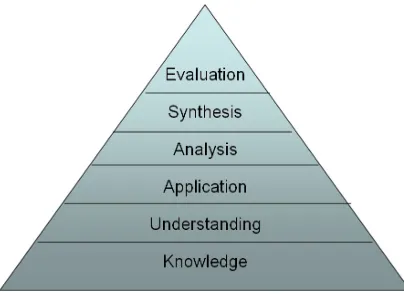
[image:2.595.204.406.486.634.2]Bloom’s (1984) taxanomy of cognitive learning is embedded into modern teaching in every way. It is illustrated by the different levels and types of learning in the form of a pyramid as illustrated in figure 1.
Figure 1: Bloom’s Taxanomy of Learning
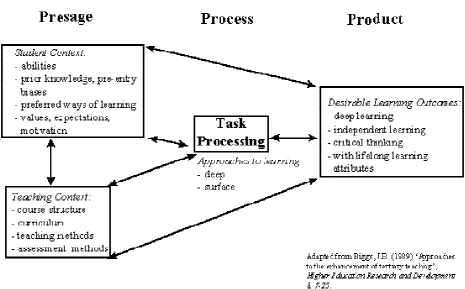
The 3-P Model of Learning (Biggs 1989) provides the description that learning outcomes were a result of the interactions of the teaching and learning contexts with the student approaches to learning. Both student and teaching presage factors interacted to produce an approach to
[image:3.595.88.553.134.423.2]learning, which produced its characteristic outcome. Figure 2 illustrates the 3-P Model of Learning of Biggs (1989).
Figure 2: The 3-P Model of Learning
Presage refers to students bringing into the learning system some predispositions that are learning-related, such as prior knowledge, abilities, values and expectations, ways of learning. These learning-related characteristics are referred to as the student presage factors that have a direct impact on the ways students choose to process academic tasks (Tam, 1999).
Teaching context is the environment set by the teacher and the institution, through the course structure, curriculum content, methods of teaching and assessment. Students perceive and interpret the teaching context and adopt a study approach that they think will help them to meet the demands of the teachers and the courses (Tam, 1999).
Process implies that an approach to learning is not simply a fixed attribute of the learner, but a function of both learner characteristics and the teaching factors (Tam, 1999). The student and teaching contexts when combined will produce a particular approach to learning which is broadly conceptualized as either 'deep' or 'surface' (Entwistle and Ramsden, 1983). The 'Process' phase is the approach that students use to process academic tasks (Tam, 1999). A 'deep' approach is indicated by an intention to understand the material to be learnt, using strategies such as reading widely, combining a variety of resources, discussion, reflection, relating parts to a whole, and applying knowledge in real world situations. An intention to reproduce the material to be learnt and avoid failure through regurgitating information and using rote learning techniques characterizes the 'surface' approach (Tam, 1999).
quality learning outcomes, while a surface approach will result in lower quality outcomes. The 3Ps (Presage, Process and Product) when combined explain what learning is about. It involves the interaction of the student and teaching contexts to produce a particular approach to learning, either deep or surface, which affects the quality of learning outcomes. The message to us is: if we are to encourage the development of quality learning outcomes in our students, such as deep learning, understanding, independent learning, critical and creative thinking, problem solving and other lifelong learning attributes, we may need to create contexts that discourage surface, and encourage deep approaches to learning (Tam, 1999). It can be agued that by understanding ‘Presage’ from the 3-P Model, team members were able to change the ‘Process’, i.e.
methodologies, to acquire the desired output, the ‘Product’.
Bloom’s taxanomy, 3-P Model, and Hand’s work are essential to the educational issues as are issues around entrenched information seeking behaviours (Bloom, 1984; Biggs, 1989; Hand, 1999). Educational issue(s) to be addressed in this study include enabling students to gain skills in:
Information needs analysis: clear articulation of the project’s information needs,
identification of needs met by current knowledge base and identification of needs that will be met through information seeking activities
Information seeking: recognition of main sources of engineering / surveying / GIS information, efficient retrieval of relevant information from these main sources and evaluation of the suitability of “found” information to the project
Synthesis and knowledge development: conscious synthesis of existing knowledge base with newly found information to create broader and deeper knowledge base relevant to the project
Literature review presentation: clear demonstration of the literature review’s role in the project, appropriate use and recording of in-text citations and references.
INTRODUCTION TO THE INVESTIGATION
Four students were selected from each discipline of the four disciples in the Faculty of Engineering and Surveying, University of Southern Queensland. Two out of the four had a grade point
average (GPA) of 5.5 (out of 7) or above; these were considered as high achievers. The other two were average students with GPA of 4.5 or below. A control group were selected from the 2008 year, and their dissertations were compared with the 2009 target group. An identification number was allocated to each student so that individual identity is protected as part of the ethics
clearance. Option to withdrawal from the study was explained as per human ethics clearance requirements. As the investigation progressed throughout the year, the number of students were reduced to 9 active participants.
With the intervened group, four workshops were conducted over lunch period throughout the semester at key milestone for the final-year project. The first one would be a two-hour, introductory workshop during which the elements of a final-year project were presented and explained to students. A consent form and pre-test survey were administered. It should be emphasized that the 3-P Model of Learning mentioned by Biggs (1989) influenced the contents of our pre-test survey greatly.
In workshop 2, again for two hours over the lunch period the following topics would be presented and discussed with students actively participating:
Why Engineers Australia wants graduates to have undertaken a literature review; Typical elements of the research (final-year) project;
What is a literature review; and the Purpose of the literature review.
research activities in their search log. This aims to help them clarify their understanding of the research process.
In workshops 3 and 4, again each for two hours over the lunch period in library’s computer room, practical “skill-based” research activities related to search and evaluating information were carried out. These activities were introduced based on the responses from the initial pre-intervention survey. The use of search logs recording their search results and thoughts were encouraged; A debrief on development of presage elements was completed at the end of the sessions. This debrief reinforced the learning objectives during the workshop but also acts as a focus group to highlight further interventions that may be required. The students’ interim or progress reports (project appreciation) of the intervention group of students were compared with those of the control group to see if the intervention was having any positive effects. There were a total of 5 workshops of which the last workshop involved collecting the post-intervention survey and a final debrief session.
OOPS! REALISATION THAT WE DON’T REALLY KNOW WHAT WE ARE DOING
The original methodology based on surveys with yes/no answers were thrown out very early in the investigation and left the investigator with a void in the research methodology for the associate fellowship. It took a half-day meeting among the investigators to discuss the change of
methodology in week 1 of the investigation (start of semester 1, 2009). After prolonged
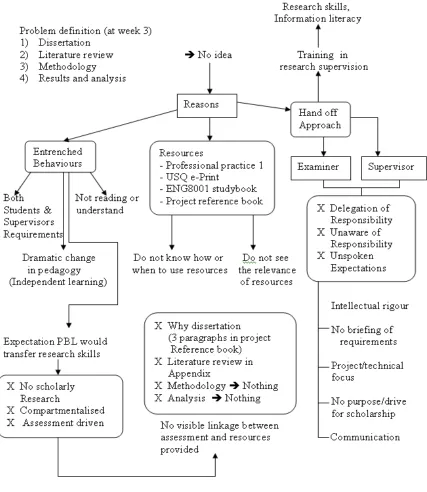
discussions and at times heated debates, the research problems in the fellowship were defined; “Does intervention make any difference in improving the learning experience and outcomes of final-year research project students?” The new methodology based on Biggs (1989) was further refined throughout the investigation. Figure 3 shows how the investigators discussed and navigate through the process of tackling the investigation. It is worth noting that the Research Skill
Development Framework described by Willison and O’Regan (2006) provided a framework to construct standards for the final-year engineering project. It also influenced the methodology adopted. The methods include pre and post intervention surveys, ‘debriefs’ or focus group after each workshop, and the assessment rubric was developed and used on literature review of the progress reports and the final dissertations.
PRESAGE: STUDENTS FLOUDERING THEIR WAY IN THE DARK
From the pre-intervention survey, it was found that almost all students did not know the meaning, purpose, and application of a literature review. Possible reasons for their lack of understanding of were deemed to be: entrenched behaviours of students and supervisors focusing on the technical objectives of the final-year project, students not knowing how and when to use resources in terms of poor information literacy and critiquing skills, and the lack of guidance provided by examiner and supervisors in establishing some literature review competencies in the students. As far as entrenched behaviours are concerned, it can be argued that students and some supervisors may not know exactly what the requirements of a literature review are. Another more probable
explanation is that the supervisors were expecting the same self-direct exploration of literature from the final-year students to that of a PhD level. Both supervisors and students may not have read or understood the project resource book provided to every student and supervisors by the examiner. In a final-year project, independent learning is required more so than with other courses. In saying that, by the fourth year, students should have undertaken and passed four (4) problem-based learning courses which require independent learning. In some ways, these problem-based learning courses still rely somewhat on compartmentalised assessment that does not require scholarly research. These research skills required for the final-year project but have not been encountered or applied during their program.
LIMITATION OF THE COURSE AND RESOURCE MATERIALS
as an elective to enable them to write their project proposals; and information from ENG3902 Professional Practice 1,. They also have access to USQ e-Prints. This open access institutional repository of academic research provides access to preprint and published papers by USQ academics, including previous undergraduate dissertations.
Figure 3: Definition of research problems
use the resources and do not see the relevance of the resources that are available. The project reference book is not the immediate source that students refer to; the information regarding literature review was hiding in one of the section of the appendix in the course reference book. Other critical information about the dissertation were somewhat buried amidst other information; In addition, there were inadequate description of possible research methodologies and analysis.
The detached approach exhibited by the examiner and supervisors may be explained by unclear delegation of responsibility, lack of awareness of responsibility and unspoken expectations. From the students’ perspective they may expect detailed explanations of requirements, a focus on the technical aspects of the projects (after all, they are doing an engineering project!), have no purpose or drive to pursue scholarly outcomes, and often fail to communicate their research skill deficiencies with their examiner and supervisors. Improving professional development for
examiner and supervisors in the areas of information literacy and research skills may improve the quality of supervision.
[image:7.595.101.487.376.698.2]PLANNING THE INTERVENTION
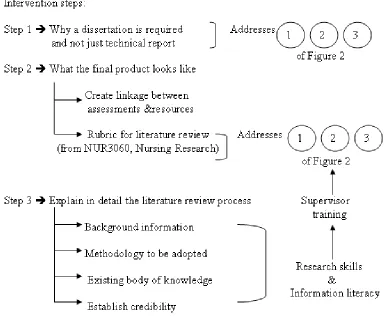
Figure 4 illustrates how the investigators planned the intervention steps to address problems in: 1) Dissertation, 2) Literature review, 3) Methodology and 4) Results and analysis. It was discovered from the initial fellowship discussions that detailed explanation of ‘dissertation’ would address issues 1, 2 and 3. This was step 1 of the intervention process. By explaining the structure and purpose of final product (dissertation), and the linkages between the assessments and the resources that are available, students were able to visualise the objectives and the learning process to be undertaken.
An assessment rubric for the literature review from a USQ course, NUR3060, Nursing Research was used to structure a new assessment rubric for the final-year project. The referenced rubric proved to be influential as it mirrored the abilities and skills of these final-year engineering project students (Reilly, 2009). This was step 2 of the interventions which would again address issues 1, 2 and 3. In step 3 of the intervention, the literature review process was explained in detail, which will consist of background information, methodology to be adopted, and existing body of knowledge and establishment of credibility.
All the steps of intervention may also be suitable for undergraduate research project supervisors as professional development and training; hence, issues 1, 2 and 3 would likely to be addressed and intervened by supervisors.
DESCRIPTION OF WORKSHOP 2 TO 5
During Workshop 2, held on the fifth week of the semester for two hours, the summarised responses to the pre-test were presented to students. This was followed by a presentation of a senior staff member of the Faculty with nearly twenty years of experience of being the examiner and moderator of the course, ENG 4111 and Eng4112 Research Project Parts 1 and 2 were invited to present ‘dissertation’ in details to participating students. The topics of the talks included 1) What is a dissertation, 2) Dissertation versus Final Report, 3) Why a dissertation, 4) Content and Layout, 5) Practicalities, and 6) Getting started. This was intended to develop understanding of the dissertation and its purposes and to develop an understanding of the literature review and its purpose. One of the investigators then spoke and handouts were also given to participants. The investigator explained the ‘fundamentals of finding information’ to students with handouts
dispatched to them. Finally, the investigator explained search log and handouts were also available to guide them in developing their strategies for the literature review research. This was followed by 10-minute debrief, a summary of what was covered, feedback on usefulness on this workshop and how applicable was this intervention. Students were then asked to do their literature search before coming to workshop 3 two weeks later.
Workshop 3 was carried out in the seventh week of the semester in the library computer
laboratory. There were 9 participants. The workshop started with an explanation of the relevancy of a piece of information. A short article, published recently in the monthly journal of Engineers Australia, about legal liability was then given to students. The title of the article was ‘Designers must consider draft codes and standards to safeguard against claims of negligence’, in which a German engineer was sued by an Australian company because he did not refer to other code when the German code he used was under review and the latest edition of it had not been
published (Duthie at al., 2009). As with Australian standards, the German standard he used or not used did not have the force of law in Germany or elsewhere, but professionally it was considered, at least initially as authoritative and reliable. Through this example students were reminded about the relevancy of a piece of information and any negligence would result in being sued in the Court. The rest of the session was used to help students to search the information they needed should they had problem in doing so. Participants seemed to be very happy and satisfied with the session.
Workshop 4, carried out in the eighth week of the semester, a lecturer in learning and teaching enhancement from USQ Learning and Teaching Support Unit (LTSU) were asked to talk and discuss about writing dissertation or thesis. This is hoped to help students writing their project appreciation in weeks 9 and 10 and their thesis better at the end of the year.
REFLECTION OF THE LEARNING JOURNEY
The most obvious change in the improved methodology was to include post-intervention survey as a means of measuring the outcomes of the intervention. This is a social science-based research and the corresponding approach has to be used and a large number of examples can be obtained from the relevant papers published (Tucker and Ferguson, 2007; Pendrill, 2005; Barr et al., 2003). The improvement of the methodology also made the sample size more reasonable. With the current methodology, 9 of the 54 on-campus students would be intervened. The evidence
collected would be more valid and reliable using qualitative methods. In addition, the dissertations of the intervened students can be compared with those of last year students with a similar GPA to see the effects of intervention on their thesis performance.
The invitation of a senior staff from the Faculty of Engineering and Surveying and a lecturer in learning and teaching enhancement from Learning and Teaching Support Unit was critical to the success of the intervention as the two guest speakers were considered experts in their fields respectively. The process of change in methodology was vital in the change of behaviours of the investigators as it eventually led to a more appropriate research methodology being adopted, namely that used for research in social science-based disciplines. This can be seen as an analogy for the behaviours of the students at the start of the projects. There were a lot of useful resources in front of them but they did not know how or when to use them; they needed the ‘light-bulb’ moments for them to start as did for the investigators. It can be argued that a briefing on ‘dissertations’ made by a senior staff of the Faculty of Engineering and Surveying or examiner would do this click. Supervisor training in research project supervision would also be carried out to raise awareness of responsibility, unspoken expectations and somewhat ‘arm’s length’ approach in supervision.
From the results of the pre-intervention survey, it was found that the students’ lack of research skills expected to be acquired in the first three years of their respective engineering programs, and hence, had a significant impact on their ability to carry out their final year project. This study seeks to address the 4th year situation, but before the situation can be addressed, it is important for future investigators to understand Variation Theory (Bowden & Marton, 1998; Runesson, 1999) perspective, which states that to learn is to be aware of critical aspects of what is learned. The way one experiences or understands something depends on what aspects one is aware of and can discern simultaneously. The ability of the learner to discern and focus on these aspects is critical for learning. But one can only discern an aspect if one experiences a variation in that aspect. Thus the possibility of experiencing variation in critical aspects is a necessary condition for learning. Variation theory is proposed to be a powerful means for describing and revealing
conditions critical for learning in a pedagogical setting (Runesson, 2006). In this study, the investigators used the results of the pre-intervention survey to determine the presage of the students and then construct the intervention required as depicted in Figure 1.
CONCLUSION
This paper discussed the methodology and methods used in an associate learning and teaching fellowship to study the perception, barriers and approaches of students in their final year
engineering project, in particular, their literature review. There was a scenario that involved a change of methodologies in research ‘style’ for engineering education. It was an investigation into student learning but it was as much a learning experience for the investigators as well. The investigators’ research experience is mostly in technical research and technology innovation, the original research methodologies adopted was not particularly suited for engineering education research. A methodology change was made as the investigators acknowledged that there will be likely deficiencies and difficulty in the research validity. This instigated a change to a very
investigators involved in the fellowship had a great learning experience of which there were moments of despair as well as exhilaration and learnt to acknowledge when help was required from the experts.
REFERENCES
Barr, R, Cone, J, Roselli, R and Brophy, S, Initial Experiences Using an Interactive Classroom Participation System (CPS) for Presenting the Iron Cross Biomechanics Module, Proceedings of the 2003 ASEE Gulf-Southwest Annual Conference, The University of Texas at Arlington, Copyright 2003, American Society for Engineering Education.
Biggs, J B, Approaches to the Enhancement of Tertiary Teaching, Higher Education Research and Development, Vol. 8, No. 1, 1989, pp. 7-25.
Bloom, B. (1984). Taxonomy of Educational Objectives Boston: Allyn and Bacon, Boston, MA
Bowden, J. & Marton, F. (1998). The University of Learning: Beyond Quality and Competence. London: Kogan Page.
Duthie, L, Murphy, P and Sevenson, A, Designers must consider draft codes and standards to safeguard against claims of negligence, Engineers, Australia, Vol. 81, No. 3, March 2009, pp. 38 – 39.
Entwistle, N J, and Ramsden, P, Understanding Student Learning. London: Croom Helm, 1983.
Hand, R J, Science education: consensus versus critique, Teaching in Higher Education, Vo. 4, No. 9, pp. 501 – 510.
Montes, G M, Gamez, M C, Escobar, B M, Garcia, Final Project Teaching in Higher education within Civil Engineering: New Perspective, J of Prof Issues in Eng Ed and Prac, 2007, pp. 94-98.
Pendrill, A-M, University and Engineering Physics Students' Understanding of Force and Acceleration - Can Amusement Park Physics Help?, Contribution to Physics Teaching in Engineering Education (PTEE) 2005, Brno.
Reilly, R, Nursing Research, NUR3060, Introductory book, USQ, 2009.
Runesson, U. (1999, August 24-28, 1999). Teaching as constituting a space of variation. Paper presented at the 8th EARLI Conference, Goteborg, Sweden
Runesson, U. (2006). What is it Possible to Learn? On Variation as a Necessary Condition for Learning. Scandinavian Journal of Educational Research, Volume 50, Issue 4 September 2006 , pages 397 – 410 Tam, M, Promoting Deep Learning: A Conceptual Model, Learning Matters at Lingnan, 12 April 1999, pp.1-2;
http://www.ln.edu.hk/tlc/info/lm/lm0599.htm <viewed on 14 May 2009>
Tucker, J and Ferguson, D, Incorporating Ethics and Social Responsibility in Undergraduate
Engineering Education, International Conference on Engineering Education – ICEE 2007, Coimbra, Portugal September 3 – 7, 2007.
Vaezi-Nejad, S M, Final Year Project as an Important Component of the Electrical and Electronic Engineering Degree Course at the University of Greenwich, Measurement and Control, Vol. 30, July, 1997, pp.165-166.