,,--clinical update
The articles in this series are independently msearched and compiled by PSA commissioned authors ana peer reviewed.
Hypertension
By
Ian Hesloplearning objectives
After reading this article you should:• Have an understanding of the classification and definitions of hypertension.
• Understand the importance of combining
absolute cardiovascular risk with blood pressure measurements in the diagnosis and assessment of hypertension.
• Be aware of how appropriate first line antihypertensive agents are selected for individual patients and how the patient should be managed with those agents.
• Have an understanding of the new National Heart Foundation of Australia guidelines for the management of hypertension and the recent reappraisal of the current role of beta blockers in the management of hypertension.
Introduction
Hypertension is krlOwn to be a major risk factor for coronary artery disease, heart fai I ure, renal disease and stroke and studies have demonstrated that approximately
20%
of the world's population may be affectedU I n Australia, like otherwestern ised countries, the prevalence of hypertension is higher, with estimates suggesting that
29%
of the Australian population is affected and 15% being untreated.4 In future years, the worldwide incidence of hypertension is expectedto increase, due mainly to the effects of an increasingly ageing population and also the westernisation of lifestyles in developing countries.' It is assumed that this adopted 'westernised lifestyle' will encourage associated increases in obesity, reduced physical exercise and increased dietary salt intake in those countries.5 For many years the diagnosis and management of hypertension has been an important issue for primary healthcare providers1,2 as it is a known modifiable risk factor for cardiovascular disease and the associated morbidity, mortality and economic burden of those diseases.! It is also recognised that hypertension is often poorly or under treated,5.6 and that compliance and persistence with antihypertensive medication is often poor.! Over the past two decades there have been regular reviews and revisions of the management guidelines for this condition with most recent
Ph~-'
""-'
.
~.·· .... QrmaclSt
there are clear associations with hypertension and obesity, salt and alcohol intake.'·"
discussions centring around a reappraisal of the role of beta blockers. New National Heart Foundation of Austra I ia (NHF) guidelinas for the management of hypertension have recently been released, as have National Institute for Health and Clinical Excellence (NICE) guidelines in the UK3j.lO This article is a brief review of the current management guideli nes for hypertension with a discussion of the reasoning behind the recent changes.
Classifi cation
Hypertension is generally classified into either essential (or primary) hypertension or secondary hypertension. Only 5% of cases have easily identifiable causes such as renal disease, Cushing's disease, phaechromocytoma, pregnancy or medications such as corticosteroids, Destrogens, NSAIDs and alcohol and can therefore be classified as secondary hypertension. The vast majority (95%) of cases have no clear identifiable cause and are therefore classified as essential hypertension.1.11.12
Epidemiology and pathophysiology
Key epidemiological factors are age, gender and ethnic background. The prevalence of hypertension increases with age, and men are more likely to develop hypertension at an early age than women,! It is recognised that hypertension is more prevalent in black than white populations, with the prevalence of hypertension being reported as being 50% greater in African-American than Caucasian populations in
"- Su bmit your answers online at www.psa.org.au and receive automatic feedback Continuing Professional Development & Practice Improvement
the USA.1 African-American and Afro-Caribbean populations also have lower renin activity and a poorer response to angiotensin-converting enzyme inhibitors (ACEls).1.13 An in-depth discussion of the causes and pathophysiology of hypertension is outside the scope of this article as they are both multifactorial and complex. But the development of hypertension is believed to be due to a combination of both genetic and environmental factors, and there are clear associations with hypertension and obesity, salt and alcohol intake.l .ll Arterial blood pressure is the product of cardiac
output and peripheral vascular resistance and therefore blood pressure (and hypertension) is affected by factors which have an impact on these paramenters.1.13 These include factors such as stimulation of the sympathetic nervous system, renin-angiotensin-aldosterone system (RAAS) and parasympathetic nervous system as well as an interplay between the vasoactive substances produced by the vascular endothelium and a variety of other vasoactive mediators such as bradykinin, endothelin, endothelia I derived relaxi ng factor (EDRF) and atrial natri uretic peptide (ANP).113
Clinical features
Most cases of essential hypertenSion are asymptomatic, symptoms such as headache being more commonly experienced in secondary or malignant hypertension. 1 The lack of symptoms is often a cause for non-compliance and poor
Table 1: Definitions and classification of blood pressure
levels (mmHgp
Category
Systolic Diastolic Follow up
(mmHg} !mmHg)Normal < 120 <SO Recheck in 2
years"
High-normal 120-139 80-89 Recheck in 1 year*
Grade 1 (mild) 140-159 90-99 Confirm within 2
hypertension months**
Grade 2 (moderate) 160-179 100-109 Reassess or refer
hypertension within 1 month**
Grade 3 (severe) ~180 ~110 Reassess or refer
hypertension within 1-7 days as
necessary*"
Isolated systolic ~140 :;90 As for category
hypertension corresponding to
systolic BP
Isolated systol ic ~160 :;;70 As for grade 3
hypertension with hypertension
widened pulse pressure
N.B. If a patient's systolic and diastolic blood pressures fall into different categories, the higher category is applied
.. or earlier depending on patient's absolute cardiovascular risk
""or see when to intervene
persistence with antihypertensiVe medication, as patients (and sometimes supporters) have poor insight into the long-term health risks associated with untreated hypertension and discontinue therapy if side effects start to impact onto their lifestyle. If hypertension remains untreated, key organs within the body are chronically exposed to persistently high blood pressure resulting in end organ or target organ damage. Most organs are protected from this effect and maintain normal tissue blood flow, but key organs such as the kidney, heart, brain and eye may be affected resulting in hypertensive nephrOSis, left ventricular hypertrophy, increased risk of haemorrhagic strokes, dementia and hypertensive encephalopathyU 4 Hypertension has several effects on the eye and may cause hypertensive retinopathy, occlusion of the retinal vein and artery and ischaemic optic neuropathy.14
Diagnosis and assessment
[image:2.599.28.301.480.776.2]574 )
,clinical update
. /
The articles in this series are independently researched and compiled by PSA commissioned authors and peer reviewed.
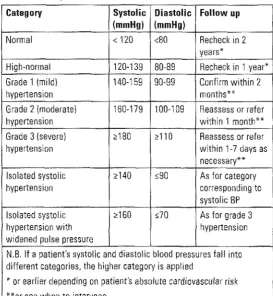
absolute cardiovascular riskuw Internationa I definitions of hypertension vary but the NHF Guidelines use the diagnostic levels and follow up recommendations listed in Table
1
with the recognition that individual cardiovascular risk assessment be used to determine the appropriate management for each patienPAbsolute cardiovascular risk
Absolute cardiovascular risk is the risk of a patient experiencing a cardiovascular event over a pre-defined period (usually five or
10
years)3 Elevated blood pressure is a major determinant of the risk of cardiovascular events such as myocardial infarction or stroke and other key risk factors include diabetes, cigarette smoking, male gender, and dyslipidaemia. Also, in Australia we must be aware of key ethnic risk groups such as Aboriginal and Torres Strait Islanders.3 All patients with confirmed hypertension should be assessed to identify all cardiovascular risk factors, detect end-organ damage and associated clinical conditions (Table 2) and identify possible causes of secondary hypertension. 3 The new NHF guidelines recommend that high cardiovascular risk should be assumed for patients aged 75 years and over,patients with pre-existing cardiovascular disease and patients with associated cl inical conditions and end-organ disease3 All other patients should have their cardiovascular risk estimated using the modified New Zealand cardiovascular risk calculator.3 But it must be recognised that CV risk calculators may significantly underestimate the cardiovascular risk in Aboriginal, Torres Strait Islander, Maori or Pacific Islander peoples.3 Patients with high absolute cardiovascular risk (greater than 15% risk of a cardiovascular event within the next five years) need immediate antihypertensive therapy.3
Management of hypertension
When to initiate therapy
All patients with confirmed hypertension should have a therapeutic plan aimed at reducing both blood pressure and absolute cardiovascular risk and the management strategies used will be related to the patient's absolute cardiovascular risk,u13 Figure 1, taken from the new NHF guidelines, summarises their current recommendations with regard to the stratification of therapy based on blood pressure measurements and absolute cardiovascular risk. The diagram shows that high risk patients should be treated immediately with lifestyle modification and drug treatment whereas moderate and mild risk patients are initially treated with lifestyle modification and undergo an appropriate period of monitoring before drug treatment is commenced,3
Treatment goals
Treatment goals for hypertension have gradually lowered in recent years as the relationship between blood pressure and outcome became better understood and it became evident that lower blood pressures are associated with better
Figure 1: When to initiate blood pressure-lowering drug
treatment
3Are any of the following present:
• Grode 3 hy~.rten.ion ISBP >180mmHg andlor DBP .110mmH~
• Isolated systolic hypertensiQ" wilh widened pulse pressure [SSP >160mmHg and DBP<70mmHgl
• Associated conditio", or end·organ damage
~
c;iJ
Confirmed hy~erten,ion grades !·lIS8P • Start drug treatment immediately plus lifestyle 140·179mmHg or Dap 90·1D9mmHg or modification plus manage associated conditions ,II other adults)
• Assess 5·yaar absolute cardiovascular risk , ,
" 0,
I I I
High 1>15%1
I
Moderate 11 0-15%1 Low 1<10%1'" . 8 V".,""
• Start drug treatment • lifestyle modification • Uiestyle modification immediately plus life,tyle • Monitor SP • Monitor BP modWcation plus mcmage • Reassess abso~ute 5-year CV • Reassess absolute 5-year CV
associated conditions ri'k in 3-0 months risk in 6·12 month.
• ' . " . '"'_"'. U
-
, . - . . ..-,-,,' .+-~ModBrateII0·15%1
~
Low 1<10%1,- " '-' c .. ~-. ••• :J • • y.
sap <140mmHg SSP 140·150mmHg OBP <90mmHg
-
DSP <SDmmHg• Continue monitoring • C:ootinue mon11oring
• Starl drug treatment
immediately piUS lifestyle r - - - S8P >140mmHg
-
SBP ~150mmHgmodification plu, manage oBP ~90mmHg DBp::gOmmHg as,ociated cQnditinns
,~ _, A" ~ 0 0
"«-outcomes.3,16 Table
3
summarises the treatment targets for adults from the current NHF guidelines,3 In most management guidelines it is recognised that targets such as these will be difficult to obtain in many patients, but it is accepted that any improvement in blood pressure and/or cardiovascu lar risk is beneficial.3.9Lifestyle modification
Lifestyle modification is an important intervention and should form an integral part of the management of all patients, as it may abolish the need for medication in some patients and reduce the need in others.3,17.18 NHF recommendations centre around the 'SNAP' risk factors (Smoking cessation, Nutrition, Alcohol and Physical activityf.3
Smoking cessation
Although smoking cessation has little effect on blood pressure reduction, it is the most important lifestyle modification for reducing absolute cardiovascular risk.1.3,17
-"
r
..
[image:3.595.308.564.142.491.2]Submit your answers online at www.psa.org.au and receive automatic feedback
~---Continuing Professional Development & Practice Improvement
Table 2: Associated clinical conditions and
end-organ disease
3Associated clinical End-organ disease conditions (ACe)
• Diabetes • left ventricular
• Cerebrovascular disease hypertrophy
o Ischaemic stroke • Microalbuminuria
o Cerebral haemorrhage • Chronic kidney disease
o Transient ischaemic • Vascular disease
attack o Atherosclerotic
• Coronary heart disease plaque evident
o Myocardial infarction on ultrasound or
o Angina radiology
o Coronary o Hypertensive
revascularisation retinopathy
.. Chronic heart failure • Chronic kidney disease
o Diabetic nephropathy o Glomerulonephritis o Hypertensive kidney
disease • Aortic disease
o Dissecting aneurysm o Fusiform aortic aneurysm • Peripheral arterial disease .. Hypercholesterolaemia • Fami Iy history of:
o Premature cardiovascular disease
o Familial
hypercholesterolaemia
Table 3: NHF treatment targets for adults
3Patient group Blood pressure
target (mmHg)
Adults with proteinuria> 1 g/day (in <125/75 people with/without diabetes)
People with associated condition/s <130/80 or end-organ damage:
• Coronary heart disease .. Diabetes
• Renal insufficiency .. Proteinuria 0.25-1.0g/day • Stroke/TIA
People with none of the following: <140/90
• Coronary heart disease or lower if tolerated
• Diabetes
• Renal insufficiency • Proteinuria (~D.25g/day • Stroke/TIA
!·'h .. ~rn"c"i.:~)"lind S~)~~d·, pf .'\a:,.t:;::}lw
Weight reduction
Obesity is associated with the development of hypertension and weight loss has been proven to reduce blood pressure by an average of 2mmHg per kg of body weight los1.1.3·19 Body mass index (BMI) is often used to define obesity but visceral adiposity appears to be more important in defining the relationship between obesity and blood pressure19 and patients' BMl and waist circumference should be assessed and monitored.3 The NHF recommends management goals of
BMI of less than 25kg/m2 and a waist ci rcumference of 94cm
for males and 8Dcm for females Dr less.3 Patients should be advised that to reach and maintain a healthy weight they must make lifestyle changes that they can enjoy and maintain for a lifetime, which requires both increased physical activity and reduced energy intake.3
Diet
Studies have shown reductions in blood pressure of 5-7mmHg when sodium intake is reduced to 90-100mmol/day,u This may be further reduced if low salt intake is combined with a thiazide diuretic. \ Patients shou ld be encouraged to reduce their salt intake (less than 65mmol/day3) and avoid processed foods with a high salt content.o Potassium chloride may be sometimes used to substitute salt in the diet with no adverse effects' but care may be required in patients taking ACE inhibitors. Patients must also follow a diet low in saturated fat and high in plant-based foodsl
Alcohol
The causal relationship has not been confirmed but there is a clear association between a Icohol intake and blood pressure in both sexes, with binge drinking being associated with the greatest risk.1.17 Abstinence from alcohol in hypertensive patients can reduce systolic blood pressure by 5~8mmHg.1
Patients should be encouraged to reduce alcohol intake to safe drinking levelsu .17 (two standard drinks per day for men and one standard drink per day for women3) and to abstain where possible.
PhYSical exercise
Physical inactivity is a well recognised risk factor for cardiovascular disease and regular aerobic exercise can reduce blood pressure. All patients should be advised to become more active and have at least 30 minutes of moderate intensity physical activity on most if not all days of the week. Regular aerobic exercise can reduce blood pressure and patients should be advised to do at least 30 minutes of moderate intensity exercise on five or mom days per week.3,17
Pharmacological management
Choice of first-line therapy
[image:4.599.70.297.149.506.2] [image:4.599.71.301.557.777.2]~~c_l_in
__
ic_a~1 _u~p_d_a_t_e
______________________________________________
~/
The articles in this series are independently researched and compiled by PSA commissioned authors and peer reviewed.
involving a fairly dogmatic approach of using either beta blockers or low-dose thiazide diuretics as first line agents, followed by the addition of other antihypertensive agents if blood pressure control was not achieved. This was further developed into a more individualised stepped care approach, whereby an appropriate first I ine agent was chosen based on the patient's individual characteristics and factors such as: 3,13
.. The patient's cardiovascular risk profile
.. The presence of target organ disease, clinical cardiovascular diseases, renal disease or diabetes
• Contra indications with concomitant diseases or potential interactions with concomitant therapies
.. Evidence for a reduction in cardiovascular events with the antihypertensive agent
.. Social and lifestyle effects such as side effects and improved quality of life
.. Economic factors such as the cost of therapy to both the patient and the hea Ith care system.
Five common drug groups were recommended for the initial management of hypertension: the low-dose thiazide diuretics, the beta blockers, the angiotensin converting enzyme inhibitors (ACE Is), the angiotensin II receptor antagonists (A2RAs) and the ca Icium channel blockers (CCBs). As all were shown to reduce blood pressure to a similar extent but differed in their adverse effect profiles and COSV8.192U
the selection of first line agent was based on their potential for favourable or unfavourable effects on any concomitant diseases.
For many years beta blockers were widely used for first line treatment in hypertension and are sti II recommended as first line agents in some treatment guidelines.21 .23 One explanation for their popularity was that studies confirmed the value of beta blockers after myocardial infarction (MIL in angina and in heart fai lure and clinicians made assumptions based on their effectiveness in the secondary prevention of coronary heart disease that they should also be effective for primary prevention in hypertension2123 But the use of beta blockers for primary treatment of hypertension has been recently challenged2! as comparisons with other antihypertensive agents showed them to be less effective in preventing major cardiovascular events such as stroke2.21.23 It was unclear Whether these conclusions applied to all beta blockers or on Iy to the drugs commonly used in hypertension trials (mainly atenolol), but researchers recommended that beta blockers should not remain the first choice agents for the treatment of primary hypertension.Z22 •23 Beta blockers were also found to be less effective than ACEls and CCBs at reducing the risk of diabetes, especially when used in combination with thiazide diuretics.V.s
These find ings were incorporated firstly into the 2006 update of the National Institute for Health and Clinical Excellence (NICE) and the British Hypertension Society recommendations
for the pharmacological management of hypertension. The main recommendations were that beta blockers were no longer recommended for fi rst line management of any patient group and that CCBs and thiazides are recommended as first line agents in elderly and black people as they are the most clinically effective agents for lowering blood pressure in these patient groupS.2.7.S The updated NICE treatment recommendations are summarised in Figure 2. The current recommendation is that unless there are contra indications,
Figure 2: Current NICE gu idel i nes for the
treatment of hypertension
7-9Key;
Then add:
55 years or old .... or black
patients of any age
Further diuretic therapy. Or
Alpha blocker. 0' Beta blocker. Consider seeking 'peciali.! advice.
A = AGEl ,conside, A2RA if ACEI intolerantl C: Calcium channel blocker
o = Thiazide diuretic
Figure 3: NHF recommendations for initiating
drug treatment for newly diagnosed
uncompl icated hypertension
3Fi'oICho;co
ACEI (Of A2RAI. Of eea. Of !ow·dose thiazide diurelic (consider for p"ople aged ;,65 ycars only)
,.
1ft. 'get BP nol , •• ched
ACEI t CCB. or AC£I + low·do,. Ihialide diuretic
If '8,g.1 BP not r.ached
ACEI t CeB + low· dose thiazide dl",elic
If IBrgct BP oel roBchmi
If using ACEI. add A2RA in addlli." to olher agents
Seek speciali&t advice
[image:5.597.323.506.259.481.2] [image:5.597.329.505.567.765.2]'-.. Submit your answers online at www,psa,org.au and receive automatic feedback Continuing Professional Development & Practice Improvement
ACEls shou ld be used for initial therapy i rl patients under the
age of 55 years, whereas patients 55 years or older (or black patients) requiring drug treatment should be commenced on either a CCB or thiazide diuretic,)9 But the NICE guidelines do suggest that beta blockers may still be considered for younger patients, particularly women of childbearing potential, patients with evidence of increased sympathetic drive or patients intolerant of or who have contra indications to ACEls or A2RAs,) They also recommend that beta blockers should not be withdrawn if there is a compell ing reason for beta blocker use such as in angina or a previous MI.)
In light of the recent findings regarding beta blockers, the NHF has now also reviewed its guideli nes for the management of hypertension; these are summarised in Figure 3, The new NHF guidelines discuss that ACEls (or A2RAs if the patient suffers from ACEI cough). dihydropyridine CCSs and low-dose thiazide diouretics are equally effective tor first line use for initial or maintenance therapy and the initial drug choice shou Id be based on:3
Figure 4: NHF recommendations for stabilisation,
maintenance and follow-up after initiation of
antihypertensive therapy3
I
Antthypenens~ve drug trf:alment Jr1itialedI
. , , 0 , : ~ .... ".;!:{
I
'c." ."I
1Target SF ildJii!ved Target BP not achie'eo at 3 month. Signific,nt ady.,," effects Ot no BP reduction "
':' . . ~.'1".
'I
,----("" .. ~.!'w""'f"
' .. ,Medium-low risk If monotharapv change to
• Check every 6 months • Intensify lifestyle aDvice Medium-low fisk If 80".r.8 effoct. occur aoother ag""l
l - • Monitor BP and rjsk 1- • If portial response, add J - - with combination therapy.
factors drug flOm another oIa,s .t identify agent responsibl. • Reinforce lifestyle
fa~tOf5 low dose and ,"place with from .nother elass Bn agent ";r,:-. . . ~., '.' <- " x ) ,"
,'," ~,-(:: ,", ,.
.... ' . .J,,_
',.'",., .',-<)'.' ....•. "".Hlgb risk High riok • Chile. every 3 JOO<1liJs • Add ,econd ageot from
• Monitor fiP and risk
'--fa,tors ' - - anolhe, class J
-• Reinforce Iilostyl. • I ncrease doses to factors aohieve target BP
" """ .- ,",.,' ~c oJ,<.;_.
''W
!
II target still not achieved despite Ir""\ment • Consider ,pedali$\ cara and further investigation' adjustm.n;s1--. .-- . " .,' ~ -'''''' ,~c ", :,.fo." ~ _,. ~ ---~
• The patient's age
• The presence of associated clinical conditions and end-organ damage
• The presence of co-morbidities (and the favourable and unfavourable effects of the antihypertensive agent on these conditions)
• Potential drug interactions
• Implications for adherence
• Cost
Thiazide diuretics have been associated with increased risk of diabetes, therefore N HF recommends that the first-I ine use of thiazide diuretics should be limited to elderly patients (;;:65 years of age) in whom the benefits of managing hypertension and reducing the risk of stroke outweigh the risk of diabetes,3 Again for the reasons stated above, beta blockers are no longer recommended as first-line agents in uncomplicated hypertension although the guidelines state that it is reasonable to continue beta blocker therapy in patients with well-controlled hypertension already taking a beta blocker,'
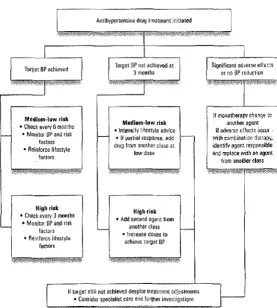
'Achieving target blood pressure3
The aim ot therapy should be to achieve target blood pressure (Table 3) and combination therapy may be required to reach target levels.3 The lowest recommended dose of the first-line agent should be prescribed and the effect monitored. If the patient is unable to tolerate this agent it should be replaced with a drug from a different class, The patient should be monitored (Figure 4) and if target blood pressure is not reached, instead of increaSing the dose of the first agellt, a second agent (tram a different class) should be introduced at a low dose,S This approach is aimed at maximising the antihypertensive effect ot the agents whilst minimising side effects,3 Again the patient is monitored: if the blood pressure continues to be above target, the dose of one agent (but not the thiazide diuretic if being usedl is increased to the maximum recommended dose of the agent before increasing the dose of the second agent3 A stable response to a dose may take
3-4
weeks, Therefore dose increments should be made at six weekly intervals.s Once the regime is stable, combined preparations or the use of long-acting agents that may be administered once daily may help adherence and compliance.s Combination therapy is requiredto reach target levels in 50-75% at patients and occasionally patients may requi re a combination of
3-4
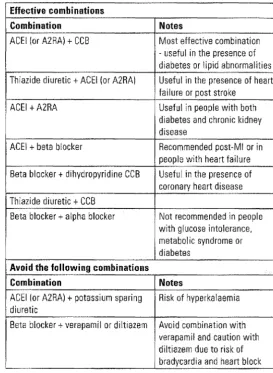
agents, Table4
summarises commonly used combinations recommended in the NHF guidelines.s If the patient fails to respond to initial therapy with at least two agents the patient should be assessed for possible reasons, These may illclude non-compliance, undiagnosed secondary hypertension, 'white coat' hypertension as well as other factors, but in some patients recommended target levels may not be achievable,3 [image:6.597.27.304.461.769.2]-578 )
~~c_l_in
__
ic_a
__
l_u_p_d_a
__
te
______________________________________________
~/
The articles in this series are independently researched a~d compiled by PSA commissioned authors and peer reviewed.
Conclusions
Hypertension is a major risk factor for cardiovascular disease and it is believed that the worldwide prevalence will increase in the future. Recent Australian and international gu idel ines for the management of hypertension recommend the assessment and treatment of patients with the aim of reducing both blood pressure and absolute cardiovascular risk to target levels. When appropriate, drug therapy should be utilised with lifestyle modification, and initial drug therapy will consist of ACE inhibitors, calcium channel blockers or low-dose thiazide diuretics with the choice of agent based on the presence of concomitant disorders and potential adverse effects.3,7·9.20
Ian Heslop (BSc{Honsi MSc GradCertBT MRPharmS AACPA MSHP) is currently a Senior Lecturer at the School of Pharmacy & Molecular Sciences at James Cook University, Queensland teaching in the areas of clinical therapeutics and pharmacy practice. Before moving into acodemia, he was a clinical pharmacist for more thon 16 years in a range of clinical specialties in both Australian and UK hospitals.
References
1. Thomas M. Hypertension -clln~al features and Investigallons. Hasp Pharm. 2007: 14(Apr) 111-6. 2. Williams B. Evolution of hYP€rtenslve disease: a revolution in guidelines. Lantat. 2006;36B(Jul
1):6-8.
3. National Heart Foundallon of Australia (National Blood Pressure and Vascular Disease AdviSOr! COmmittee). Guide to management of hypertension 2008. Quick lafemce guide for health profeSSionals. Deakin: National Heart Foondallon of Au&tralla; 2008,
4. Brigarrtl EM, Shaw JE, Chadban SJ, Zimmel PZ, Welbom lA, McNeil JJ, et al. Untreated hypertenSion among Australian adults: tM 1999-2000 Auslralian Diabetes. Obesity and Ufestyle Siudy IAusDiab). MJA. 2003:179(Aug 4):135-9.
5. Editorial. Don't forget hypertension. Lancet 2007;369(May 26):1764.
6. Simons LA, Ortl, M. calclno G. Persistence with anllhypertens"e medication: Auslralia-wide experience, 2004-2006. MJA. 2008;188Ifeb 18):224-7.
7. National Collaborating Centre for Chronic Condillons. Hypertension: management in adolts In primary-care: pharmacological u)lllate. London: Royal COllege of Physicians; 2000.
B. Garmer B. HypertenSion - pharmacological management Hosp Pharm. 2007;14(Aprl:ll 9-25. 9. Nallonallnsititule for Health and Clinical Ex<:ellence. HYP€rtension: managemenl of hypertenSion In
adults In pnmary care (NICE guideline 34). London: NICE: 2006.
10. National Prescribing Service. NPS News 52: Managing hypertension as a cardioWJ5Cular risk factor. Surry Hills: National Prescribing Service lid; 2007.
11. Bee\lers G, Up GYH, O'Brien E. TM pathophysiology of hypertenSion. BMJ. 2001 ;322(Apr 14),912-6. 12. Hughes J. Hypertension. Ausi Phalm. 1999;18(10):603·13.
13. August P.lnitlal Trealm"nt of Hyp€rtenslon. NEJM. 2003;348(fBb 13):610-7. 14. Wong T, Mllchell P. Tlle eye In hypertensl(lll.lancei. 2007;369{Feb 3):425-35.
15. Pickering TG, Shlmbo D. Haas O. Ambulatory Blood·Pressure Monitoring. NE.lM. 2006:354(Jun 1):2368·74.
t6. Kannal WB, Vasan RS. Aggressive lowenng of blood pressure. Lancel. 2006;368(Aug 19}:627-8 17. Williams B, Poulter NR, Brown MJ, Davis Me Mcinnes GT, Potter JF. et al. British Hypertension Soclew
Guideli~es: Guidelines for rrnmagemenl of hypertension: r€port of Ihe fourth working party of the Bntish HypertenSion Sociel)'. 2004-BHS IV. J of Hum Hypertension. 2004;18:139·85.
18. Williams B, P~ulter NR, Br~w~ MJ. Davis M, Mclnnes G1 Potter JF, el al. British Hypertension Sociel)' guidelines for hypertension management 2004 (BHS-IV): summary BMJ. 2004:32S(Mar 13):634-40. 19. Messerli FH. Williams B, Rilz E. ESS€f1Ual Hypertenslon.lancel. 2007;370{Aug 18}:591-S03. 20. Nalional Prescribing Service. NPS News 52: Managing hypertension as a cardiovascular risk factor.
Surry Hills: NPS Ltd: 2007.
21. cartberg B. Samuelsson 0, Undholm LH. Atenolol in hypertenSion: Is It a wise choice? Lancet. 2004;364(Nov 6):1684-9.
22. Lindholm LH, Carlberg B, Samuelsson O. Should B blockers remain first choice in the Irealment of pnmary hypertension? A meta-analysis. Lancet. 2005;366(OcI29):1545-53.
23. Beevers DG. lhe end of ~ blockers for uncomplicated hypertension? Lancel. 2005;366(Oct 18):t510-2.
CPD
questions on pages
586PliarriJ"acist
Table 4: Recommended and non-recommended antihypertensive combinations from N HF Guidelines'
Effective combinations
Combination
Notes
ACEllor A2RAI
+
CCB Most effective combination- useful in the presence of diabetes or lipid abnormalities
Thiazide diuretic
+
ACEI (or A2RAI Useful in the presence of heartfailure or post stroke
ACEI
+
A2RA Useful in people with bothdiabetes and chronic kidney disease
ACEI
+
beta blocker Recommended post-MI or inpeople with heart failure
Beta blocker
+
dihydropyridine CCB Useful in the presence ofcoronary heart disease
Thiazide diuretic
+
CCBBeta blocker
+
alpha blocker Not recommended in peoplewith glucose intolerance, metabol ic syndrome or diabetes
Avoid the following combinations
Combination
Notes
ACEI (or A2RAI
+
potassium sparing Risk of hyperkalaemiadiuretic
Beta blocker
+
verapamil or diltiazem Avoid combination withverapamil and caution with diltiazem due to risk of bradycardia and heart block
[image:7.600.296.569.135.507.2]