COMPARING THE EFFECTIVENESS OF MAITLAND
MOBILIZATION TECHNIQUE AND MUSCLE ENERGY
TECHNIQUE ON PAIN, RANGE OF MOTION AND
FUNCTIONAL ACTIVITIES IN ADHESIVE CAPSULITIS
Dissertation submitted in
Partial fulfillment
for the degree of
MASTER OF PHYSIOTHERAPY
(ORTHOPAEDICS)
The Tamil Nadu Dr. M.G.R. Medical University
Chennai
May 2018
PSG COLLEGE OF PHYSIOTHERAPY
PSG COLLEGE OF PHYSIOTHERAPY
Coimbatore
CERTIFICATE
This is to certify that the research work entitled
“COMPARING THE
EFFECTIVENESS OF MAITLAND MOBILIZATION TECHNIQUE AND
MUSCLE ENERGY TECHNIQUE ON PAIN, RANGE OF MOTION AND
FUNCTIONAL ACTIVITIES IN ADHESIVE CAPSULITIS”
was carried out
by
Reg. No. 271610245,
P.S.G. College of Physiotherapy, towards the partial
fulfillment for the degree of MASTER
OF PHYSIOTHERAPY (Physiotherapy
in Orthopaedics)
affiliated to The Tamilnadu Dr. M.G.R. Medical University,
Chennai.
Internal Examiner
External Examiner
PSG COLLEGE OF PHYSIOTHERAPY
Coimbatore
CERTIFICATE
This is to certify that the dissertation work entitled
“COMPARING THE
EFFECTIVENESS OF MAITLAND MOBILIZATION TECHNIQUE AND
MUSCLE ENERGY TECHNIQUE ON PAIN, RANGE OF MOTION AND
FUNCTIONAL ACTIVITIES IN ADHESIVE CAPSULITIS”
was carried out
by
Reg. No. 271610245,
P.S.G. College of Physiotherapy, Coimbatore, affiliated
to The Tamilnadu Dr. M.G.R. Medical University Chennai.
Prof.R.MAHESH, MPT.,
Principal,
P.S.G. College of Physiotherapy,
Coimbatore - 641 004.
Place: Coimbatore
PSG COLLEGE OF PHYSIOTHERAPY
Coimbatore
CERTIFICATE
This is to certify that the dissertation work entitled
“COMPARING THE
EFFECTIVENESS OF MAITLAND MOBILIZATION TECHNIQUE AND
MUSCLE ENERGY TECHNIQUE ON PAIN, RANGE OF MOTION AND
FUNCTIONAL ACTIVITIES IN ADHESIVE CAPSULITIS”
was carried out
by
PARTHIBAN.S
of P.S.G. College of Physiotherapy, Coimbatore, affiliated to
The Tamilnadu Dr. M.G.R. Medical University Chennai, under our guidance.
GUIDE
Mrs.Y. ASHRAF, MPT.,
Associate Professor
P.S.G. College of Physiotherapy,
Coimbatore - 641 004.
Place: Coimbatore
ACKNOWLEDGEMENT
First and foremost, I thank
LORD ALMIGHTY
for showering me with his
divine blessing, enriched love and matchless grace which gave me inner strength
and guidance that carried me throughout my study.
I’m deeply indebted to
MY MOTHER, MY BROTHERS,
for their
unconditioned love, sincere prayers, unstinted support and care without which I
would not have accomplished anything.
With due respect, I would like to express my immense gratitude to
R.MAHESH,MPT,
Principal PSG College of Physiotherapy, Coimbatore, for his
encouragement and inspiration during the course of my study.
I am indebted to
Mrs. Ashraf.Y, MPT
for her expert guidance, valuable ideas,
untiring efforts without whom the study would have not been completed.
I will be thankful to my secondary investigator
M. MANIKANDAN
for their
kind support during my study.
My special thanks to
Mrs.V. Mahalakshmi, MPT
, Post graduate Coordinator,
PSG College of physiotherapy who has moulded me in my academics activities and
made my project completion easier
.
I will be thankful to my teachers
Mr.K.Saravanan, Mr.B.Nagaraj,
Mr.J.Rajaregan, Mr.M.Mahendiran, Ms.P.Shanmugapriya, Mrs.P.Sweetysuba,
My special thanks to
Dr. N. RAMKUMAR, MBA., Ph.D, Assistant
Professor
, Faculty of Human Resource, PSG Institute of management, Coimbatore
for his guidance in research and statistical method of data analysis.
My special thanks to
Dr. ANIL MATHEW Ph.D, Professor,
Department
of Biostatistics, PSG Institute of Medical Science and Research who gave me a
helping hand in statistical method of data analysis.
I thank all the member of
Institutional Human Ethics Committee
of PSG
Institute of Medical Science and Research for their recommendation and summation
for ethical clearance and values kind suggestions to complete the dissertation.
And also, I thank to
My Friends, Colleagues
,
Seniors and Juniors
for
sharing their knowledge, love, support and exclusive cooperation.
Finally, it would not be meaningful and complete if I fail to mention those
who were so co-operative and lovable during the entire course of the study,
ABBREVIATIONS
MMT
-
MAITLAND MOBILIZATION TECHNIQUE
MET
-
MUSCLE ENERGY TECHNIQUE
NPRS
-
NUMERICAL PAIN RATING SCALE
ROM
-
RANGE OF MOTION
CONTENTS
CHAPTER TITLE PAGE NO
I
INTRODUCTION
1.1Back Ground of The Study
1.2Need of The Study
1.3Aim of The Study
1.4Objectives of The Study
1.5Hypothesis
1.6Operational Definitions
1-9 10 10 10 11 11-12
II LITERATURE REVIEW 13-15
III
METHODOLOGY
3.1 Study Design
3.2 Study Setting
3.3 Sampling Method
3.4 Selection Criteria
3.5 Study Duration
3.6 Study Materials
3.7 Treatment Duration
3.8 Outcomes Measures
3.9 Participants 3.10 Intervention 16 16 16 16 17 17 17 17 17 17
IV STATISTICAL ANALYSIS AND
INTERPRETATION
18-33
V DISCUSSION 34-35
VI SUMMARY AND CONCLUSION 36
VII LIMITATIONS AND RECOMMENDATIONS 37
REFERENCES
ANNEXURES
ABSTRACT
LIST OF ANNEXURES
Annexure
Content
I Ethical Committee Approval Letter
II Assessment form
III Assessment Tool (NPRS and SPADI)
IV Informed Consent (English and Tamil)
CHAPTER I
INTRODUCTION
1.1.
BACK GROUND OF THE STUDY
ADHESIVE CAPSULITIS:
The term adhesive capsulitis is a well-defined shoulder disorder characterized by
progressive pain and stiffness of shoulder which resolves after 18 months period the cause
remain unknown which is due to fibroblastic proliferation in the rotator interval anterior capsule
and coaraco-humeral ligament (4).
The annual incidence of adhesive capsulitis in the general population in approximately 3
to 5% and upto 20% in people with diabetes. It is most frequently found in patients between the
fourth and sixth decades of life and it is more common in women the men (28).
Duplay in 1896 first described about this condition and named asperiarthritis scapula
humeraleidentifying as the lesion of periarticular structures (23).
Nevasier coined the term adhesive capsulitis to describe a contracted thickened joint
capsule that seemed to be drawn tightly around the humeral head with a relative absence of
synovial fluid and chronic inflammatory changes with the synovial layer of the capsule(3).
The movements will be restricted in all planes without any radiological abnormalities and
both active and passive movements will be painful and restricted with external rotation and
abduction limited to the maximum(23).
ETIOLOGY:
The Etiology remains unclear, adhesive capsulitis can be classified as primary or
secondary. Frozen shoulder is considered primary if the onset is idiopathic while secondary
results from a known causes or surgical event. Three subcategories of secondary frozen shoulder
Extrinsic – cardiopulmonary disease, cervical disc, Cerebrovascular accident, humerus
fractures, Parkinson’s disease. Intrinsic factors rotator cuff pathologies, biceps tendonitis, calcific
tendonitis, Acromioclavicular joint, arthritis (29).
PATHOLOGY:
The disease process affects the anteriosuperior joint capsule, maxillary recess, and the
coracohumeral ligament. It has been show through arthroscopy that patient tend to have a small
joint with loss of the axillary fold, tight anterior capsule and mild or moderated synovitis but no
actual adhesions. Contracture of the rotator cuff interval has also been seen in adhesive capsulitis
patients, and greatly contributes to the decreased range of motion seen in this population.
There is continued disagreement about whether the underlying pathology is an
inflammatory condition, fibrosing condition, or an algoneurodystrophic process, evidence
suggests there is synovial inflammation followed by capsular fibrosis, in which type I and III
collagen is laid down with subsequent tissue contraction. Elevated levels of serum cytokines
have been noted and facilitate tissue repair and remodelling during inflammatory processes. In
primary and some secondary cases of adhesive capsulitis cytokines have shown to be involved in
the cellular mechanism that leads to sustained inflammation and fibrosis. It is proposed that there
is an imbalance between aggressive fibrosis and a loss of normal collagenous remodelling, which
can lead to stiffening of the capsule and ligamentous structures (29).
CONSISTS OF THREE PHASES:
Painful Phase:
Gradual onset of shoulder pain at rest with sharp pain at extremes of motion and pain at
night with sleep interruption which may last anywhere from 3-9 months.
Stiffening Phase:
Pain starts to subside, progressive loss of glenohumeral motion in capsular pattern, pain
is apparent only at extremes of movement. This phase may occur at around 4 months and last till
Thawing Phase:
Spontaneous, progressive improvement in functional range of motion which can last
anywhere from 1 to 3.5 years (29).
In phase II, the contracted capsule does not allow normal free movement of the shoulder
which causes the scapula to move excessively in upward rotation and lateral trunk lean to
compensate for the loss on glenohumeral rotation(3).
The capsular pattern of restricted range of shoulder motion in adhesive capsulitis is
external rotation, abduction and internal rotation. In adhesive capsulitis of shoulder, there will be
proportional limitation in all movements of the glenohumeral joint in all planes (7).
Pain, active movements (External rotation, abduction, internal rotation and flexion) and
functional outcomes were used as primary outcome measures because they are important features
in adhesive capsulitis of shoulder.
Physiotherapy intervention usually used for the management of this specific condition are
heat or cold modalities. Active exercise, Maitland Mobilization Techniques and Muscle Energy
Techniques. Maitland Mobilization Techniques and Muscle Energy Techniques is an important
part of intervention which includes the normal physiological movement and the accessory
MAITLAND MOBILIZATION TECHNIQUES:
Mobilization are passive, skilled manual therapy techniques applied to joint and related
soft tissues at varying speeds and amplitudes using physiologic or accessory motions, for
therapeutic purpose(5).
MAITLAND MOBILIZATION FIVE GRADE:
Grade 1:
Small amplitude rhythmic oscillations are performed at the beginning of range.
Grade 2:
Large amplitude rhythmic oscillations are performed within the range. Not reaching the
limit.
Grade 3:
Large amplitude rhythmic oscillations are performed at the limit of available motion and
stressed into tissue resistance.
Grade 4:
Small amplitude rhythmic oscillations are performed at the end range of motion.
Grade 5:
High velocity thrust technique is performed to snap adhesions at the limit of available
motion.
Usually grades 1 and 2 are used to relax and reduces the pain and spasm.
MUSCLE ENERGY TECHNIQUES:
Muscle Energy Techniques (MET) are a class of soft tissue osteopathic manipulation
methods that incorporate precisely directed and controlled patient initiated, isometric
contractions, designed to improve musculoskeletal function and reduce pain (25).
Muscle Energy Techniques is a manual therapy technique which uses a muscle’s own
energy in the form of gentle isometric contractions to relax the muscles via autogenic or
reciprocal inhibition, and lengthen the muscle.
POST ISOMETRIC RELAXATION:
Post Isometric Relaxation is the effect of the decrease in muscle tone in a single or group
of muscle. After a brief period of submaximal isometric contraction of the same muscle. Post
ANATOMY
GLENOHUMERAL JOINT
The shoulder joint is a synovial joint of the ball and socket variety.
Head of humerus is larger than the glenoid fossa.
ANGLES:
Humeral head and neck angles -130 to 150 degrees.
GLENOID LABRUM:
The glenoidlabrum consists of fibro cartilage and fibrous tissue. The rim of fibro
cartilagenous tissue attaches around the margin of glenoid fossa. Inner surface of the labrum is
covered with synovium and other surface attaches to the capsule.
CAPSULE:
Capsule is a loose fitting which surround the joint and allowing the joint surface to
BLOOD SUPPLY
:
Anterior circumflex humeral vessels
Posterior circumflex humeral vessels
Suprascapular vessels
Subscapular vessels
NERVE SUPPLY:
Axillary nerve
Musculocutaneous nerve
SHOULDER MUSCLES:
SHOULDER FLEXION:
Clavicular head of the pectoralis major
Anterior fibres of deltoid
SHOULDER EXTENSION:
Posterior fibres of deltoid
Latissimusdorsi
SHOULDER ADDUCTION:
Pectoralis major
Latissimusdorsi
Short head of biceps brachii
Long head of triceps brachii
SHOULDER ABDUCTION:
Supraspinatus 0-15 degrees
Deltoid 15-90 degrees
Serratus anterior 90-180 degrees
Upper and lower fibres of trapezius 90-180 degrees
MEDIAL ROTATION:
Pectoralis major
Anterior fibres of deltoid
Latissimusdorsi
LATERAL ROTATION:
Posterior fibres of deltoid
Infraspinatus
Teres minor
NORMAL RANGE OF MOTION:
Flexion 0-180 Degrees
Extension 0-45 Degrees
Abduction 0-180 Degrees
Adduction 180-0 Degrees
External Rotation 0-70 Degrees
1.2. NEED OF THE STUDY:
Adhesive Capsulitis is a common painful syndrome which interferes with a patient’s
ability to participate in self-care and occupational activities.
Primary Adhesive Capsulitis affects 3-5% of the general population and is the main cause
of shoulder pain and dysfunction. In individuals aged 40-65 years. Pain and Range of Motion
impairments associated with primary Adhesive Capsulitis can be impact a patient’s ability to
participate in self-care and occupational activities.
Currently, physical therapists used for the management of this specific condition are heat
and cold modalities, active exercises, PNF techniques.
Maitland Mobilization Technique and Muscle Energy Technique play important part of
intervention in Adhesive Capsulitis of shoulder by reducing pain intensity, improving the
accessory movements, thereby enhancing the functional activities of the shoulder in all planes.
So there is a need to evaluate the effectiveness Maitland Mobilization Technique and Muscle
Energy Technique in pain reduction, improvements in range of motion and functional outcomes
of subjects with Adhesive Capsulitis of shoulder.
1.3. AIM OF THE STUDY:
The aim of the study was to find out the effects of Maitland Mobilization Technique and
Muscle Energy Technique on pain, range of motion and functional activities in Adhesive
Capsulitis.
1.4. OBJECTIVES OF THE STUDY:
To find out the effects of Maitland Mobilization Technique on pain, range of motion and
functional activities in subjects with Adhesive Capsulitis.
To find out the effects of Muscle Energy Technique on pain, range of motion and
functional activities in subjects with Adhesive Capsulitis.
To compare the effects of Maitland Mobilization Technique and Muscle Energy
Technique on pain, range of motion and functional activities in subjects with Adhesive
1.5. HYPOTHESIS:
NULL HYPOTHESIS (Ho)
There will be no significant difference between the effects of Maitland Mobilization
Technique and Muscle Energy Technique on pain, range of motion and functional activities in
Adhesive Capsulitis.
ALTERNATIVE HYPOTHESIS (Ha)
There will be significant difference between the effects of Maitland Mobilization
Technique and Muscle Energy Technique on pain, range of motion and functional activities in
Adhesive Capsulitis.
1.6. OPERATIONAL DEFINITIONS:
ADHESIVE CAPSULITIS:
Adhesive Capsulitis is self-limiting condition of unknown etiology characterized by
painful restriction of active and passive glenohumeral joint motion. (NEVIASER 1983)
PAIN:
An unpleasant sensory and emotional experience associated with actual or potential tissue
damage. (IASP – 2014)
RANGE OF MOTION:
Range of motion the measurement of movement around a specific joint or body part.
Anatomical position to extreme limited of the motion. (ERIN MCLAUGHLIN)
FUNCTIONAL ACTIVITIES:
Activities are required to perform the functional activities included working setting of
MAITLAND MOBILIZATION TECHNIQUE:
It is a passive, skilled manual therapy technique applied to the joints and related soft
tissues at varying speed and amplitudes using physiological or accessory motion for therapeutic
purposes. (D. MAITLAND 1991)
MUSCLE ENERGY TECHNIQUE:
It is a voluntary muscle action can be influenced by Muscle Energy Technique used for
CHAPTER II
LITERATURE REVIEW
Shah Atikaet. al., 2013 done a study on Adhesive Capsulitis with 30 subjects including
both male and females aged between 40-60 years old. Study duration was 2 weeks. All subjects
were measured for pain by VAS, for all shoulder movements by goniometer on first day before
starting treatment and on 15th day after treatment. They conducted that an experimental study and
confirmed that the MET is more effective in reducing pain of an acute or chronic nature, makes
controlled contraction of involved muscles is difficult, the therapeutic use of antagonist by MET
can patently be valve and as soon the pain subsides Maitland Mobilization can be Incorporated to
increase ROM.
Abhay Kumar et.al., 2012 in their study on physical therapy treatment of shoulder. The
study was conducted with 40 subjects including both male and female age between 40-60 years
old. Study duration was 4 weeks. All subjects were measured for VAS and shoulder ROM
(external rotation and abduction) and Shoulder Pain And Disability Index. They concluded that
an experimental study and confirmed that the Maitland Mobilization technique with the
combination of exercise had proved their efficacy in relieving pain and improving ROM and
shoulder function hence should form a part of the treatment plan.
Narayan et.al., 2014 done a study on Adhesive Capsulitis with30 subjects including both
male and female aged between 40-60 years old. Study duration was 5 weeks. All subjects were
measured for Shoulder Pain And Disability Index scoring. Each group was divided into 15
patients, Group A Experimental and group b control. They concluded that an experimental study
and found that MET is very much effective on functional ability of shoulder in Adhesive
Capsulitis.
Pravin P Gawali et.al., 2016 in their study on physical therapy treatment Adhesive
Capsulitis. The study was conducted with 30 subjects including both male and female age. Study
duration was 5 days. All subjects were measured by VAS, ROM Shoulder Pain And Disability
Index. They concluded that an experimental study was capsular stretching and Maitland
reducing pain on VAS and significantly effective in reducing in disability on SPADI. The study
was result Maitland Mobilization was significantly effective in reducing pain on VAS;
improving glenohumeral mobility and disability.
Mohan Kumar.G.et.al., 2016 done a study onAdhesive Capsulitis with 40 subjects
including both male and female age between 40-60 years old. Study duration was 21days. All
subjects were measured for VAS and Shoulder Pain And Disability Index. They concluded that
an experimental study was MET coupled with ultrasound therapy imparts more effective solution
than the mobilization technique coupled with ultrasound. Hence this study has demonstrated a
better combination therapy regimen for the treatment PA shoulder the physiotherapists, similarly,
potential of this combination therapy can be explored on types of ailments demanding
physiotherapy.
Edrish Saifee Contractor.et.al., 2016 in their study on physical therapy treatment
Adhesive Capsulitis. The study was conducted with male and female age between 40-65 years
old. Study duration was 4 weeks 3 days. All subjects were measured for VAS and Shoulder Pain
And Disability Index. They concluded that an experimental study the spencer MET is more
effective increasing functional ability in patient with adhesive capsulitis as compared to
conventional treatment.
Sonakshi Sehagal.et.al., 2016 done a study on Adhesive Capsulitis with 30 subjects aged
between 16-30 years old. Study duration was 2 weeks.They concluded that an experimental
study MET is an effective treatment for increasing the ROM and strength of internal rotation at
the glenohumeral joint in asymptomatic overhead athletes. Therefore application of MET for the
external rotators may be use full for increasing the ROM as well as strength in overhead
althletes.
Breckenridge JD.et.,al 2011 the shoulder pain and disability index (SPADI) was
Anwar Ali Gayasi.et.al., 2014 Most preferred manual therapy technique among
physiotherapist for treating Frozen Shoulder. All the manual therapy techniques have their pool
of research suggesting as effective in treating frozen shoulder but, it is seen that not all of them
are for frozen shoulder. So, this survey was conducted in which 120 questionnaries were
distributed among physiotherapists of pune fulfilling the inclusion criterion to know their
preferred manual therapy technique for treating frozen shoulder. 100 physiotherapists responded,
their responses were documented and calculated.
Henricus M Vermeulem.et.al., 2006 the in their study on physical therapy treatment of
shoulder. The study was conductedwith 100 subjects including both male and females age
between 40-60 years old. Study duration was 12 weeks (24 session). Subjects randomly assigned
to the HGMT group were treated with intensive passive mobilization technique in end-range
positions of GH joint, and subjects in the LGMT group were treated with passive mobilization
techniques within the pain-free zone,all subjects were measured for shoulder rating questionnaire
(SRO) and Shoulder disability questionnaire (SDQ). An analysis of covariance with adjustments
for baseline values and a general linear mixed- effect model for repeated measurements were
used to compare the change scores for the 2 treatment groups at the various time points and over
the total period of 1 year. In subjects with adhesive capsulitis of the shoulder, HGMTs appear to
be more effective in improving GH joint mobility and reducing disability than LGMTs, with the
overall differences between the 2 interventions being small.
Joshua Cleland.et.al., 2002 in their study on systematic review- non-operative
experimental or descriptive research- based outcomes studies of physical therapy. Systematic
reviews suggest that many patients treated with physical therapy benefited from reduced
symptoms, increased mobility, and functional improvement.
Zaki Anwer.et.al., 2017 done a study on Adhesive Capsulitis with 30 subjects including
both male and females age between 40-50 years old. Study duration was 6 weeks. All subjects
were measured for pain by VAS,for all shoulder movements by goniometer and functional
activities measured by SPADI. In study there are improvements in all shoulder parameters after
treatment and in the follow up period compared to before treatment in both group through both
CHAPTER III
METHODOLOGY
3.1. STUDY DESIGN
A Prospective, open labelled, quasi-experimental comparative design
3.2. STUDY SETTING
Department of Orthopaedics& Department of Physical Medicine and Rebhabilitation,
PSG Hospitals, Coimbatore.
3.3. SAMPLING METHOD
Simple random sampling method
3.4. SELECTION CRITERIA
Inclusion Criteria
The age group of 40-65 years
Both male and female
Apley’s scratch test positive
Painful phase and stiffening phase included in adhesive capsulitis
Who will consent to participate in the study
Exclusion Criteria
Shoulder dislocation
Upper limb neurological deficit
Any trauma to the joint structure and soft tissue particular shoulder Thoracic outlet syndrome
Manipulation under anaesthesia Any pathology neck pain
Received physiotherapy for the same problem till 3 months Myocardial infarction
3.5. STUDY DURATION
The period of study was 7 months
3.6. STUDY MATERIALS
Assessment chart
Goniometer ( universal )
Inch tape
Knee hammer
Hot pack
Wand
Treatment couch, Bed sheet, Pillows and towel, Pen, Timer
3.7. TREATMENT DURATION
2 Sets 10 Repetitions, 3 session/ week for 2 weeks
3.8. OUTCOMES MEASURES
shoulder Range of motion (goniometer)
Numerical pain rating scale (NPRS)
Shoulder Pain And Disability Index (SPADI)
3.9. PARTICIPANTS
34 Subjects with Adhesive Capsulitis were recruited from the Orthopaedic department
and PMR department. 28 Subjects accepted to inclusion criteria and were randomly allocated
into 2 groups by simple random sampling method.
3.10. INTERVENTION
GROUP A- 14 Subjects – Received Maitland Mobilization Technique
CHAPTER-IV
STATISTICAL ANALYSIS AND INTERPRETATION
The Mean, Standard deviation and Paired-t- test, Independent-t- test values were used to
find out any significant difference between the two groups. (Group A and B)
Data collected from Group A (Maitland Mobilization Technique) and Group B (Muscle
Energy Technique) were analyzed by using paired t- test to measure the changes between the pre
and post-test values within the group and independent –t test was done to measure the changes
between group analysis. All these statistical analysis were performed through SPSS-20 Version.
Paired ‘t’ test :
= Calculated Mean Difference of pretest and posttest values
SD = Standard Deviation
n = Number of samples
d = Difference between pretest and posttest values d
1 )
( 2
n d d SD
SD
n
d
2 n n 1)SD -(n 1)SD -(n SD Where, n 1 n 1 | x x | t 2 1 2 2 2 2 1 1 2 1 2 1 SD
Independent ‘t’ test
:X1 = Mean difference in Group A
X2 = Mean difference in Group B
SD = Combined standard deviation of Group A and Group B
n1 = Number of patients in Group A
n2 = Number of patients in Group B
SD1 = Standard Deviation of Group A
TABLE: 1
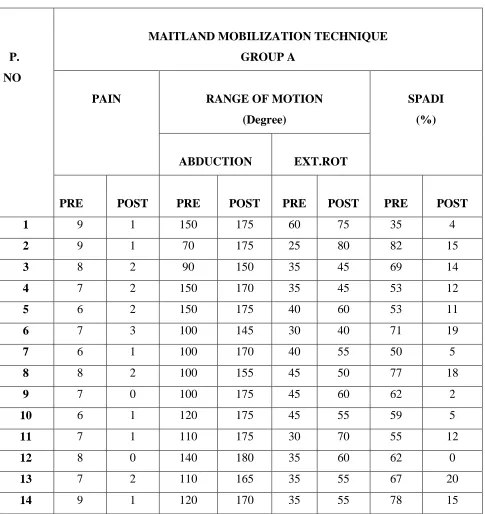
MAITLAND MOBILIZATION TECHNIQUE DATA VALUES
P.
NO
MAITLAND MOBILIZATION TECHNIQUE
GROUP A
PAIN RANGE OF MOTION
(Degree)
SPADI
(%)
ABDUCTION EXT.ROT
PRE POST PRE POST PRE POST PRE POST
1 9 1 150 175 60 75 35 4
2 9 1 70 175 25 80 82 15
3 8 2 90 150 35 45 69 14
4 7 2 150 170 35 45 53 12
5 6 2 150 175 40 60 53 11
6 7 3 100 145 30 40 71 19
7 6 1 100 170 40 55 50 5
8 8 2 100 155 45 50 77 18
9 7 0 100 175 45 60 62 2
10 6 1 120 175 45 55 59 5
11 7 1 110 175 30 70 55 12
12 8 0 140 180 35 60 62 0
13 7 2 110 165 35 55 67 20
TABLE: 2
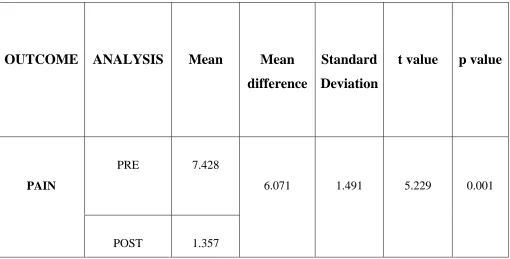
MAITLAND MOBILIZATION TECHNIQUE
PRE AND POST VALUES OF PAIN
(GROUP A)
OUTCOME
ANALYSIS
Mean
Mean
difference
Standard
Deviation
t value
p value
PAIN
PRE 7.428
6.071 1.491 5.229 0.001
TABLE: 3
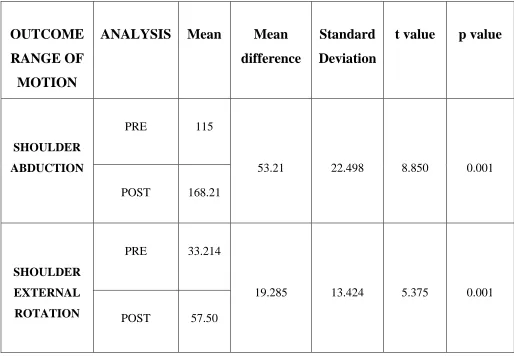
MAITLAND MOBILIZATION TECHNIQUE
PRE AND POST VALUES OF RANGE OF MOTION
(GROUP A)
OUTCOME
RANGE OF
MOTION
ANALYSIS
Mean
Mean
difference
Standard
Deviation
t value
p value
SHOULDER
ABDUCTION
PRE 115
53.21 22.498 8.850 0.001
POST 168.21
SHOULDER
EXTERNAL
ROTATION
PRE 33.214
19.285 13.424 5.375 0.001
TABLE: 4
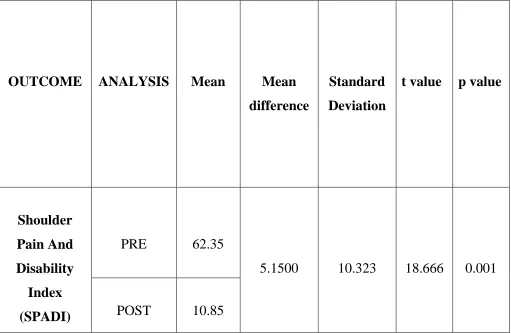
MAITLAND MOBILIZATION TECHNIQUE
PRE AND POST VALUES OF FUNCTIONAL ACTIVITIES
(GROUP A)
OUTCOME
ANALYSIS
Mean
Mean
difference
Standard
Deviation
t value
p value
Shoulder
Pain And
Disability
Index
(SPADI)
PRE
62.35
5.1500
10.323
18.666
0.001
GRAPH: 1
Graphical Representation Maitland Mobilization Technique (Group A)
Within Group Analysis on Pain, Range Of Motion and Functional Activities
7
115
33
62
1
168
57
10
0 20 40 60 80 100 120 140 160 180
PAIN ROM ABDU ROM EXT.RO SPADI
TABLE: 5
MUSCLE ENERGY TECHNIQUE DATA VALUES
P.
NO
MUSCLE ENERGY TECHNIQUE
GROUP B
PAIN RANGE OF MOTION
(Degree)
SPADI
(%)
ABDUCTION EXT.ROT
PRE POST PRE POST PRE POST PRE POST
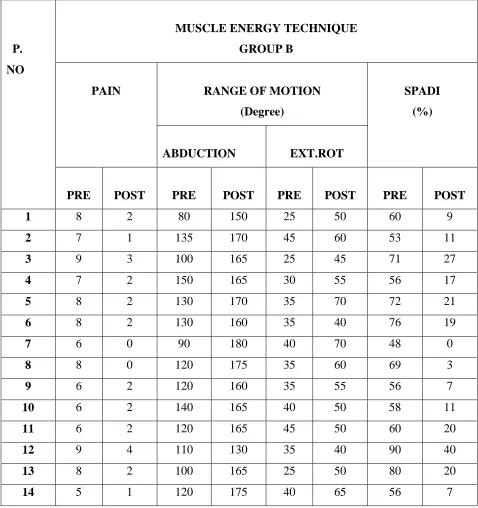
1 8 2 80 150 25 50 60 9
2 7 1 135 170 45 60 53 11
3 9 3 100 165 25 45 71 27
4 7 2 150 165 30 55 56 17
5 8 2 130 170 35 70 72 21
6 8 2 130 160 35 40 76 19
7 6 0 90 180 40 70 48 0
8 8 0 120 175 35 60 69 3
9 6 2 120 160 35 55 56 7
10 6 2 140 165 40 50 58 11
11 6 2 120 165 45 50 60 20
12 9 4 110 130 35 40 90 40
13 8 2 100 165 25 50 80 20
TABLE: 6
MUSCLE ENERGY TECHNIQUE
PRE AND POST VALUES OF PAIN
(GROUP B)
OUTCOME
ANALYSIS
Mean
Mean
difference
Standard
Deviation
t value
p
value
PAIN
PRE
7.214
5.428
1.157
17.542
0.01
TABLE: 7
MUSCLE ENERGY TECHNIQUE
PRE AND POST VALUES OF RANGE OF MOTION
(GROUP B)
OUTCOME
RANGE OF
MOTION
ANALYSIS
Mean
Mean
difference
Standard
Deviation
t value
p value
SHOULDER
ABDUCTION
PRE
117.5
46.42
21.342
8.140
0.001
POST
163.92
SHOULDER
EXTERNAL
ROTATION
PRE
35
19.285
9.777
7.380
0.01
TABLE: 8
MUSCLE ENERGY TECHNIQUE
PRE AND POST VALUES OF FUNCTIONAL ACTIVITIES
(GROUP B)
OUTCOME
ANALYSIS
Mean
Mean
Difference
Standard
Deviation
t value
p value
Shoulder
Pain And
Disability
Index
(SPADI)
PRE
64.642
4.9500
7.5
24.557
0.01
GRAPH: 2
GRAPHICAL PRESENTATION OF WITHIN GROUP B MUSCLE
ENERGY TECHNIQUE ANALYSIS PAIN, ROM AND FUNCTIONAL
ACTIVITIES
Graphical Representation Muscle Energy Technique (Group B) Within
Group Analysis on Pain, Range Of Motion and Functional Activities
7
115
33
62
1
168
57
10
0 20 40 60 80 100 120 140 160 180
PAIN ROM ABDU ROM EXT.RO SPADI
TABLE: 9
PRE AND POST TEST VALUES OF MAITLAND MOBILIZATION
TECHNIQUE AND MUSCLE ENERGY TECHNIQUE BETWEEN GROUP
ANALYSIS
OUTCOMES ANALYSIS GROUP
Mean
t value
p
value
PAIN
PRE
A
7.428
0.483
0.033
PRE
B
7.214
POST
A
1.357
1.191
0.245
POST
B
1.785
ROM
ABDUCTION
PRE
A
115
0.296
0.770
PRE
B
117.5
POST
A
168.21
0.986
0.33
POST
B
163.92
ROM
EXT.
ROTATION
PRE
A
33.214
1.091
0.285
PRE
B
35
POST
A
57.50
0.801
0.43
POST
B
54.285
Shoulder Pain
And Disability
Index
(SPADI)
PRE
A
62.35
0.489
0.629
PRE
B
64.642
POST
A
10.85
1.293
0.210
GRAPH: 3
Graphical Representation on comparison of Maitland Mobilization Technique
and Muscle Energy Technique on Pain, Range of Motion and Functional
Activities
7115
33
62
7
117
35
64
1
168
57
10 1
163
54
15
0 20 40 60 80 100 120 140 160 180
PAIN ROM ABDU ROM EXT.RO SPADI
INTERPRETATION:
The Group A (Maitland Mobilization Technique) for the Pain Pre and Post-test mean
value 77.428 and 1.357, ‘t’ value is 5.229 (p< 0.001). Range of Motion-shoulder abduction the
Pre and Post-test mean value 115 and 168.21,‘t’ value is 8.850 (p< 0.001).Range of
Motion-shoulder external rotation the Pre and Post-test mean value 33.214 and 57.50,‘t’ value 5.375
(P<0 0.001). For SPADI Pre and Post-test mean value 62.35 and 10.85. ‘t’ value is18.666 (P<0
0.001).
The result shows that Maitland Mobilization Technique is an effective technique on
reducing pain, improving ROM and functional activities among Adhesive Capsulitis patients.
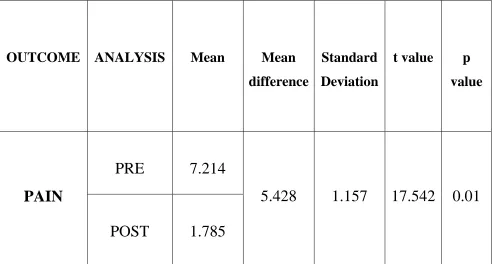
The Group B Muscle Energy Technique for the Pain Pre and Post-test mean value 7.214
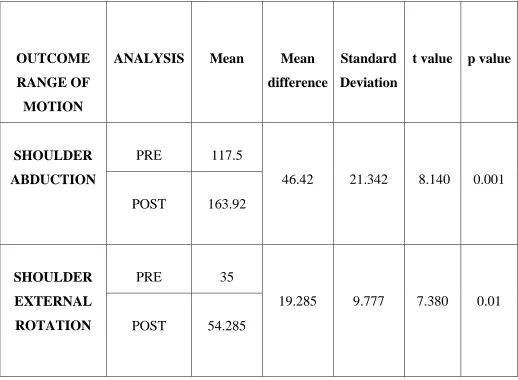
and 1.785, ‘t’ values is 17.542 (p 0.01). Range of Motion- shoulder abduction Pre and Post-test
mean value 117.5 and 163.92,‘t’ value is 8.140 (p<0.001). Range of Motion- shoulder external
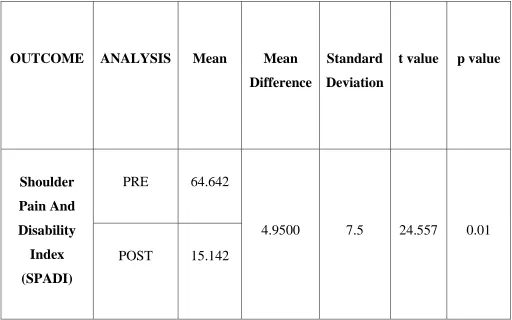
rotation Pre and Post-test mean value 35 and 54.285,‘t’ value is 7.380 (p< 0.01). For SPADI Pre
and Post-test mean value 64.642 and 15.142,‘t’ values is 24.577 and (p<0.01)
The result shows that Muscle Energy Technique is an effective technique on reducing
pain, improving ROM and functional activities among Adhesive Capsulitis patients.
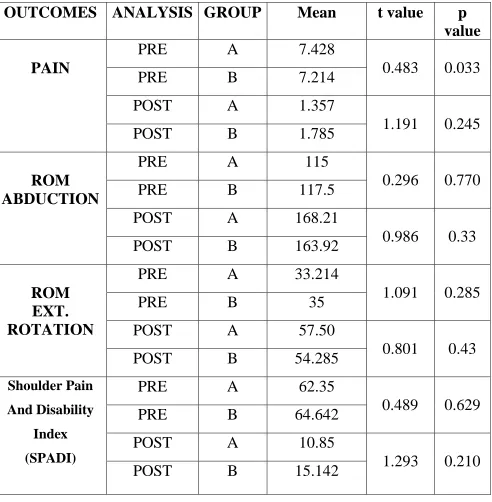
Group A and B Pain Post-test mean value 1.357 and 1.785, the‘t’ value is
1.191(p=0.245). Group A and B Range of motion shoulder abduction post-test mean value
168.21 and 163.92, the ‘t values are0.986 (p=0.33). Group A and B Range of motion shoulder
external rotation post-test mean value 57.50 and 54.285 the‘t’ test values is0.801(p=0.43).Group
A and B SPADI Post-test mean value 10.85 and 15.142, the‘t’ value is 1.293(p=0.210).
The pre and post test results of Group A and Group B shows that there is a statistical and
clinical significant effect of each technique on reducing pain, improving ROM, and functional
activities among Adhesive Capsulitis patients.
When both Group A and Group B where compared on between group analysis, the result
shows that Maitland Mobilization Technique and Muscle Energy Technique insignificant
FLOW CHART OF THE STUDY
EXCLUSION (n=06)
GROUP – B (n=14)
INCLUSION (n=28)
INTERVENTION MUSCLE ENERGY TECHNIQUE
GROUP A RESULT PAIRED T TEST
Pain mean diff=6.071 SD=1.491,t=5.299.,p=0.001 ROM abduction mean diff=53.21, SD=22.49,t=8.850 p=0.001 ROM external rotation mean diff=19.285,SD=13.424,t=5.375,p=0.001
SPADI mean diff=5.15,SD=810.323,t=18.66,p=0.001
Significant
i
GROUP B RESULT PAIRED T TEST
Pain mean diff=5.428 SD=1.157,t=17.542.,p=0.001 ROM abduction mean diff=46.42, SD=21.342,t=8.140 p=0.001 ROM external rotation mean diff=19.285,SD=9.77,t=7.380,p=0.01
SPADI mean diff=4.950,SD=7.5.323,t=24.55,p=0.001
Significant
ADHESIVE CAPSULITIS
(n=34)
STATISTICAL ANALYSIS
INDEPENDENT T TEST
Pain t=1.191, p=0.245
ROM Abduction t=0.986, p=0.33
ROM EXT. ROT t=0.801, p=0.43 SPADI t=01.293,p=0.210
Insignificant PRE– ASSESSMENT
NPRS
RANGE OF MOTION SPADI
PRE – ASSESSMENT NPRS RANGE OF MOTION
SPADI GROUP – A
(n=14)
INTERVENTION MAITLAND MOBILIZATION
TECHNIQUE
POST – ASSESSMENT NPRS
RANGE OF MOTION SPADI
POST – ASSESSMENT NPRS
RANGE OF MOTION SPADI
RANDOMIZATION
CHAPTER V
DISCUSSION
Shah Atika Suri.2013 done a study on physical therapy treatment of Adhesive
Capsulitis. They concluded that a study analysis of the results of this study showed that both
Maitland Mobilization technique and MET are an effective treatment for adhesive capsulitis but
Maitland Mobilization is more effective in increasing both active and passive joint ROM, while
MET is more effective in reducing pain in patients with adhesive capsulitis. The response from
Maitland mobilizations are explained to be different from MET as Maitland mobilization is a
passive technique and MET is active technique.
In my study among 28 subjects, 6 were excluded, the remaining 28 subjects age group
40-65years old, and this study was a Quasi-experimental comparative design. Simple random
sampling method. 14 subjects were selected in each group of intervention. Maitland Mobilization
Technique-Group A and Muscle Energy Technique- Group B are an effective treatment for
Adhesive Capsulitis in relieving pain, improving shoulder range of motion abduction and
external rotation. But between group analysis Group A Maitland Mobilization Technique and
Group B Muscle Energy Technique show ineffective in bring changes in pain and range of
motion.
Abhay Kumar. 2012 in their a study analysis of the results of this study showed
Maitland Mobilization technique an effective in relieving pain, Improving Range of Motion and
shoulder function and hence should form a part of the treatment plan. Significant improvement
for all the parameters. This study consisting of 40 subjects in the age groups of 40-60 years old.
These were recorded before and after the session of the training. Total duration of the study was
four weeks. While analyzing the outcome measures of this study, it was observed that both
groups have shown significant. Reduced pain scores, improved significantly in ROM of external
rotation, abduction and improvement in SPADI. Results of this study after analysis were directed
towards the conclusion that Maitland Mobilization Technique with supervised exercise protocol
In my study Maitland Mobilization Technique-Group A and Muscle Energy Technique-
Group B are an effective treatment for Adhesive Capsulitis in relieving pain, improving shoulder
range of motion abduction and external rotation. But between group analysis Group A Maitland
Mobilization Technique and Group B Muscle Energy Technique show ineffective in bring
changes in pain and range of motion.
Narayan et. al., 2014 conducted an experimental study and found that both groups
showed significant difference and improvement after treatment. There is significant difference in
post-test scoring both the groups with lower SPADI. MET is very much effective on functional
ability of shoulder in Adhesive Capsulitis. The study was consisting of 30 subjects including
both male and female age between 40-60 years old. Study duration was 5 weeks. Group A
Showed significant change may be due to the application of Muscle Energy Technique that
relaxes and improve biomechanics and thus results in improved functional ability. Group B also
showed mild changes due to the relaxation effect of conventional treatment. It was evident from
the mean score that both groups showed improvement in SPADI score because of the treatments
between groups. Analysis relevaled that percentage of improvement in SPADI score was more in
shoulder MET group which their showed more improvement than the conventional treatment
group.
In my study Maitland Mobilization Technique-Group A and Muscle Energy Technique-
Group B are an effective treatment for Adhesive Capsulitis in improving shoulder Pain And
Disability Index (SPADI). But between group analysis Group A Maitland Mobilization
Technique and Group B Muscle Energy Technique show ineffective in bring changes in
Shoulder Pain And Disability Index (SPADI).
It shows that there is a clinical significant improvement of patient’s complaints in both
groups. But the statistical inference shows that there is no significant difference between both
groups. That is both treatments gave equal effectiveness among the outcome measure of
CHAPTER VI
SUMMARY AND CONCLUSION
SUMMARY:
The aim of the study was to assess the changes occurring in the musculoskeletal system
after Maitland Mobilization Technique and Muscle Energy Technique in Adhesive Capsulitis
subjects.
A total number of 34 subjects were selected by Random sampling method after
considering the inclusion and exclusion criteria. The informed contents were obtained from
subjects individually.
Pain, Range of Motion and Shoulder Pain And Disability Index (SPADI) were taken as
the parameters to measure. Pre-test and post-test value of Group A and Group B where obtained
and compared by using Paired ‘t’ test and Independent ‘t’ test.
CONCLUSION:
Maitland Mobilization Technique Group A and Muscle Energy Technique Group B both
are effective in the treatment of Adhesive Capsulitis. These techniques showed clinical and
statistical significant effectiveness on these parameters.
The study is intended to compare the effectiveness between Maitland mobilization
Technique and Muscle Energy Technique in the treatment of patient with Adhesive Capsulitis.
The result of the scores shows that is a pain reduction in both groups, improvement of
ranges of motion both Shoulder abduction and external rotation. There is an improvement in the
functional activities of patients in both groups.
It shows that there is a clinical significant improvement of patient’s complaints in both
groups. But the statistical inference shows that there is no significant difference between both
groups. That is both treatments gave equal effectiveness among the outcome measure of
CHAPTER VII
LIMITATIONS AND RECOMMENDATIONS
This study was done on subjects with age groups 40-65 years old. Can be planned for in
other age group also.
This study was planned for the PG curriculum, planned for 7 months. The future study
can be expanded to under duration and can collect more samples to find out the
effectiveness. May be increasing the samples may show the exact effectiveness of each
technique in a better way.
According to the inclusion criteria with in this short duration of 7 months got 28 patients
totally. If we extend the study duration we might have more samples
The prevalence rate was not find in this study. We can also include this along with other
demographic descriptive analysis.
In this study the intervention duration planned was 2 weeks as per the literature reviews.
REFERENCES
1. Abhay Kumar et al. Effectiveness of Maitland Techniques in Idiopathic shoulder
Adhesive capsulitis. International Scholarly Research Network ISRN Rehabilitation,
volume 2012, Page No: 8.
2. Anwar Ali Gayasi et.al. Most preferred manual therapy technique among
physiotherapist for treating frozen shoulder-issue.0975-6299.Oct-2014.pageno:322-327.
3. Brian J Tovin Bruce H Evaluation and treatment of the shoulder Greenfield.
4. Bunker .D.Timothy and Peter.J.Scharnz. Clinical challenges in Orthopaedics of
shoulder.
5. Carolyn kisner and LymnAlen Colby-2003 Therapeutic exercise foundations and
techniques, 4th edition.
6. Codman- The shoulder, yhomas Told Company, Boston, Mass, USA, 1934
7. David J Magee –Orthopaedics physical assessment text books
8. Erin McLaughlin- Human Anatomy and Physiology: Stuy.com-Range of Motion
9. Fred Mitchell- Text Books of concept of Muscle Energy Technique-1950
10.IASP-International Association for the Study for Pain:2014
11.Jayant Joshi and Prakash Kotwal Essential Orthopaedics and applied Physiotherapy
text books fourth edition-1999.
12.Lisi, Anthony J: Muscle Energy Technique in chiropractic practice. Journal of the
American Chiropractic Association-Oct 2002.
13.Maitland.D- 1991 Text books of Concept of Maitland Mobilization Technique
14.Maheshwari.J. -Essential Orthopaedics text books fourth edition.
15.McMinn. R.M.H-Last’s Anatomy - Regional and applied, 9th edition
16.M.N.Nadarajan-2005 Essential Orthopaedics text books
17.Moore SD et al. A randomized controlled trial of the immediate effects of MET on
posterior shoulder tightness, therapy, Journal Orthopaedics sports physiotherapy, Epub 6
Aprill 2011. Doi 10.2519/ jospt.3239.
18.Narayan et al. Efficacy of Muscle Energy Technique on functional ability of shoulder in
Adhesive Capsulitis’-2014, Journal Exercise & Physiotherapy- 2014Volume 10, Page no:
19.NeviaserJ.S. et.al. Adhesive capsulitis of shoulder the journal of bone and joint surgery,
vol,22, page no: 211-222, 1945
20.Neviaser RJ et.al.The frozen shoulder diagnosis and management. Clinical
Orthopaedices-1987.
21.Nugent.Pam MS-“Professional Standards in Psychology dictionary.org-April 28.2013
22.Poonam Rani et al. Comparative studies of the clinical outcome of Maitland and
conservative treatment in idiopathic Adhesive Capsulitis sports medicine journal no
22.2010.
23.Robert Donatellia-1997& 2000 Physical Therapy of shoulder, 3rd edition.
24.Shah Atika et al. Comparative study on the effectiveness of Maitland Mobilization
Technique Versus Muscle Energy Technique in treatment of shoulder Adhesive
Capsulitis. Indian Journal of Physiotherapy & Occupational Therapy-December 2013,
Volume 7, Page No: 4.
25.Schenk et al.Text books of muscle energy technique-1997
26.Sonakashi Sehgal et.al. Effects of MET in increasing range motion and strength of GH
internal rotator, in athletes with GH internal rotation deficit American Journal of Sports
Science-2016, Vol.4, no-2, page no: 43-48.
27.Susan.L.Edmond Manipulation and Mobilization extremity and spine-1993
28.Vermeulen H.M et.al. Comparison of high grade and low grade Mobilization
Techniques in the management of adhesive capsulitis of the shoulder. Randomized
controlled trial, Physical therapy-2006, and volume 86, No.3.
29.www.physio-pedia.com/ Adhesive Capsulitis
ANNEXURE-II
ASSESSMENT
Subject Number:
DEMOGRAPHIC DATA:
Name : Date of Admission:
Age : Date of Assessment:
Gender: IP/OP Number:
Occupation: Contact number:
Address:
SUBJECTIVE ASSESSMENT:
Chief complaints:
Present medical history:
Past medical history:
Personal history:
PAIN HISTORY:
Site :
Side :
Onset :
Frequency :
Duration :
Type :
Aggravating factors :
Relieving factors :
NPRS Score :( NUMERICAL PAIN RATING SCALE):
OBJECTIVE ASSESSMENT:
ON OBSERVATION:
Body Built: Ectomorphic /Mesomorphic / Endomorphic
Attitude of Limbs:
Posture:
Muscle Wasting:
Deformity:
Gait:
Tropical Changes:
External Appliances:
ON PALPATION:
Muscle tone:
Tenderness:
Muscle spasm:
ON MOTOR EXAMINATION:
RANGE OF MOTION: (GONIOMETER)
Movements
Degrees
Right Left
shoulder flexion Shoulder extension Shoulder abduction Shoulder adduction
Shoulder internal rotation
Shoulder external rotation
Elbow flexion Elbow extension Supination Pronation Wrist flexion Wrist extension Ulnar deviation Radial deviation
MUSCLE POWER :( MANUAL MUSCLE TEST)
Movements
Degrees
Right Left
shoulder flexors Shoulder extensors Shoulder abductors Shoulder adductors
Shoulder internal rotators Shoulder external rotators
Elbow flexors
Elbow extensors Wrist flexors Wrist extensors
MUSCLE GRITH: (INCH TAPE)
AREA Right( Inches) Left( Inches)
ON SENSATION EXAMINATION:
Superficial sensation:
Deep sensation:
Reflex: (Wexlers grading)
Reflex Right Left
Biceps jerk(C5-C6)
Triceps jerk( C7- C8)
Brachioradialis jerk (C6- C7)
SPECIAL TEST:
Apley Scratch / Simple Shoulder Test
Hand to neck test Hand to scapula test
Hand to opposite scapula test
FUNCTIONAL ASSESSMENT:
SPADI SCALE:
PROVISIONAL DIAGNOSIS:
PHYSIOTHERAPY MANAGEMENT:
TREATMENT PLAN:
A) Short term goal:
B) Long term goal:
TREATMENT GIVEN:
FOLLOW UP CHART
Name : Subject Number:
Age : Date of Assessment:
Gender : Data of follow up:
IP/OP Number:
Specific complaints:
RANGE OF MOTION:
Movements
Degrees
Right Left
shoulder flexion Shoulder extension Shoulder abduction Shoulder adduction
Shoulder internal rotation
Shoulder external rotation
TREATMENT PLAN:
Results Pre-test Post-test
NPRS /10 /10
SPADI / /
RANGE OF MOTION
Abduction External rotation
ANNEXURE-III
The Numeric Pain Rating Scale Instructions
GENERAL INFORMATION:
The patient is asked to make three pain ratings, corresponding tocurrent, best and worst pain experienced over the past 24 hours.
ANNEXURE-III
SHOULDER PAIN AND DISABILITY INDEX
Please place a mark on the line that best represents your experience during the last week attributable to your shoulder problem.
PAIN SCALE
How severe is your pain? Circle the number that best describes your pain where: 0 = no pain and 10 = the worst pain imaginable.
Atits worst? 0 1 2 3 4 5 6 7 8 9 10
When lying on the involved side? 0 1 2 3 4 5 6 7 8 9 10
Reaching for something onahigh shelf? 0 1 2 3 4 5 6 7 8 9 10
Touching the back of your neck? 0 1 2 3 4 5 6 7 8 9 10
Pushing with the involved arm? 0 1 2 3 4 5 6 7 8 9 10
Total pain score/50x100 = % (Note: If a person does not answer all questions divide by the total possible score, eg. if 1 question missed divide by 40)
DISABILITY SCALE
How much difficulty do you have?
Circle the number that best describes your experience where: 0 = no pain and 10 = the worst pain imaginable.
Washing your hair? 0 1 2 3 4 5 6 7 8 9 10
Washing your back? 0 1 2 3 4 5 6 7 8 9 10
Putting on an under shirtor jumper? 0 1 2 3 4 5 6 7 8 9 10
Puttingonashirtthatbuttonsdownthefront ?
0 1 2 3 4 5 6 7 8 9 10
Putting on your pants? 0 1 2 3 4 5 6 7 8 9 10
Placing an objecton ahigh shelf? 0 1 2 3 4 5 6 7 8 9 10
Carrying a heavy objectof10 pounds(4.5 kilograms)
0 1 2 3 4 5 6 7 8 9 10
Removing something fromyour backpocket?
0 1 2 3 4 5 6 7 8 9 10
Total disability score/80x100 = % (Note: If a person does not answer all questions divide by the total possible score, eg. if 1 question missed divide by 70)
ANNEXURE-IV
PSG Institute of Medical Science and Research, Coimbatore Institutional Human Ethics Committee
INFORMED CONSENT FORMAT FOR RESEARCH PROJECTS
We Parthiban. S and Manikandan. M carrying out a study on the topic: “Comparing the Effectiveness of Maitland Mobilization Technique and Muscle Energy Technique on Pain, Range of Motion and Functional Activities in Adhesive Capsulitis’’ as part of our research project being carried out under the aegis of the Department of Orthopaedics& Physical Medicine and Rehabilitation.
Our research guide is:Mrs. Ashraf. Y, Associate professor, PSG College of Physiotherapy.
The justification for this study is:
Adhesive Capsulitis is a self-limiting condition of unknown etiology characterized by painful and limited active and passive glenohumeral range of motion. Maitland Mobilization technique and Muscle Energy Technique combined with glenohumeral exercise can relieve the pain, improves range of motion and functional activities.
The objectives of this study:
1. To determine the effects of Maitland Mobilization Technique (MMT) on pain, range of motion and functional activities in subjects with adhesive capsulitis.
2. To determine the effects of Muscle Energy Technique (MET) on pain, range of motion and functional activities in subjects with adhesive capsulitis.
3. To compare the effects of Maitland Mobilization Technique and Muscle Energy Technique on pain, range of motion and functional activities in subjects with adhesive capsulitis.
Sample size: 30
Study participants are Adhesive Capsulitis subjects, age group of 40-65years.
Location: Department of Orthopaedics and Department of Physical Medicine and Rehabilitation, PSG Hospitals, Coimbatore.
We request you to kindly cooperate with us in this study. We propose to collect the background information and other relevant details related to this study. We will be carrying out:
Initial interview: 45-60 minutes.
Final interview: 45-60 minutes.
If Photograph taken, purpose: yes, without revealing the identity of yours we want to publish it in the project book, conferences and journals.
Data collected will be stored for a period of 2 years.We will not use the data as part of another study. Health education sessions: Two sessionseach 45 minutes.
Clinical examination (specify details purpose): Yes Blood sample collection: Not Applicable.
Specify quantity of blood being drawn: ml. No. of times it will be collected: NA
Whether blood sample collection is part of routine procedure or for research (study) purpose: NA
Specify purpose, discomfort likely to be felt and side effects, if any: NA
Whether blood sample collected will be stored after study period: Yes / No, it will be destroyed / NA
Whether blood sample collected will be sold: Yes/ No / NA
Whether blood sample collected will be shared with persons from another institution: Yes/ No / NA Medication given, if any, duration, side effects, purpose, benefits: NA
Whether medication given is part of routine procedure: Yes / No / NA (If not, state reasons for giving this medication)
Whether alternatives are available for medication given: Yes / No / NA (If not, state reasons for giving this particular medication)
Benefits from this study:
Pain will be reduced.
Range of motion will be improved.
Shoulder Functional activities will be improved.
Risks involved by participating in this study: There are minimal risks or discomforts will be experienced during this study. The discomforts are stretch pain and exercise induced pain that will be reduced by applying hot pack
How the results will be used:
The data collected during the study will be used without revealing your identity. Your identity will be confidential even if the results of the study are published in Peer-reviewed scientific journals, Conference presentation and internal report.
If you are uncomfortable in answering any of our questions during the course of the interview, you have the right to withdraw from the interview / study at anytime. You have the freedom to withdraw from the study at any point of time. Kindly be assured that your refusal to participate or withdrawal at any stage, if you so decide, will not result in any form of compromise or discrimination in the services offered nor would it attract any penalty. You will continue to have access to the regular services offered to a patient. You will NOT be paid any remuneration for the time you spend with us for this interview / study. The information provided by you will be kept in strict confidence. Under no circumstances shall we reveal the identity of the respondent or their families to anyone. The information that we collect shall be used for approved research purposes only. You will be informed about any significant new findings - including adverse events, if any, – whether directly related to you or to other participants of this study, developed during the course of this research which may relate to your willingness to continue participation.
Consent: The above information regarding the study, has been read by me/ read to me, and has been explained to me by the investigator/s. Having understood the same, I hereby give my consent to them to interview me. I am affixing my signature / left thumb impression to indicate my consent and willingness to participate in this study (i.e., willingly abide by the project requirements).
Signature / Left thumb impression of the Study Volunteer / Legal Representative:
Signature of the Interviewer with date: Witness:
Contact number of PI: 9442205920
ANNEXURE-VI
TREATMENT PROTOCOL
GROUP A (Maitland Mobilization Technique)
POSITION:
Position of patient: lying position
Examiner position: walk standing position
TECHNIQUE:
POSTERIO-ANTERIOR GLIDING CAUDAL GLIDE
GRADING:
Grading: Grade- III & IV
POSTERIO-ANTERIOR GLIDING:
Mobilization technique to improve shoulder external rotation
POSITION PATIENT:
Prone with the arm supported over thigh the acromion stabilized with padding.
PROCEDURE:
Forward stride position, the participants arm supported against thigh and outside hand. This position provides grading distraction, the ulnar border of the other hand placed just distal to the posterior angle of the acromion process. This proximal hand provides the mobilizing force posterior –anterior for gliding.
CAUDAL GLIDING :
Mobilization technique to improve shoulder abduction
POSITION PATIENT:
Supine position forearm supported between trunk and elbow of examiner
PROCEDURE:
One hand placed in the patient axilla to provide the grading distraction and other hand is placed over the lower arm to provide caudal glide.
(B). Caudal glide
DURATION:
Passive oscillatory movements performed at the rate of 2 set 10 repetitions
GROUP B (Muscle Energy Technique)
POSITION:
Position of patient: Supine position Examiner position: walk standing position
TECHNIQUE:
POST-ISOMETRIC RELAXATION
GlenohumeralJoint horizontal abduction Glenohumeral Joint External rotation
Glenohumeral Joint Horizontal Abduction:
Technique to improve Glenohumeral Joint abduction
PROCEDURE:
The examiner stabilized the scapula at the lateral border with the elbow flexed, the participant shoulder will be horizontally adducted to the first barrier of motion. Against an opposing force provided by the examiner at the distal humerus. Isometric contraction performed 5 seconds.
Glenohumeral Joint External Rotation
Technique to improve Glenohumeral Joint external rotation
PROCEDURE:
Patient in supine position with arm supported and the participant shoulder and elbow in 900 of abduction and flexion.
Examiner passively moved the arm into internal rotation until the first barrier of motion will be reached. Against an opposing force provided by the examiner at the distal forearm.
Isometric contraction performed 5 seconds.
(B). GH Joint External rotation
DURATION:
Movements performed at the rate of 2 set 6repetitions
ANNEXURE-VI
ADHESIVE CAPSULITIS TREATMENT PROTOCOL
(HOME EXERCIS)
PATIENT NAME: ... AGE: ………… OP/IP NO: ………..
A.WAND EXERCISES:
Position of patient: standing position Be certain to start with very light stick or body bar
Duration:10- 20 repetitions / 2 sessions / day
1. FLEXION EXERCISE:
Holing a stickwith both hands and lifting the hand up assisting the normal hand with affected hand until the limit of pain hold it for 10 seconds and lower it down.
2. EXTENSION EXERCISE:
Holing a stick and lifting the hand back of region assisting the normal hand with affected hand until the limit of pain hold it for 10 seconds and lower it down.
3. ABDUCTION AND ADDUCTION
EXERCISE:
Holing a stick and lifting the hand side to the body assisting the normal hand with affected hand until the limit of pain hold it for 10 seconds and lower it down.
4. EXTERNAL ROTATION
EXERCIS:
5.INTERNAL
ROTATION EXERCISE:
Holing a stick behind your back with the affected hand holding down and normal up pull the normal hand upwards and downwards.
B.PENDULAR EXERCISES:
Position of patient: standing
position- lean on a table holding normal hand and affected side arm hanging downward position.
Duration - 10- 20 repetitions / 2 sessions / day.
1. FLEXION&EXTENSION
EXERCISE:
Affected side arm should be relaxed and swing the hand freely forwards and backwards.
2. ABDUCTION
&ADDUCTION EXERCISE:
Affected side arm should be relaxed and swing the hand freely side to side.
3. ROTATION EXERCISE:
Affected side arm should be relaxed swing the hand circular rotation clockwise and anti clockwise
C.WALL CLIMBING EXERCISES:
Position of patient: standi