Mapping Qualifications and Training
for the Children and Young People’s
Workforce
Short Report 1
Developing and maintaining a database of
qualifications for the children and young people’s
workforce
Sylvia Johnson
Karen Dunn
John Coldron
Contents
1. Background and context to the study 2
2. About this report 4
3. How the qualifications database was constructed and developed 4
4. Issues of design 5
5. Defining qualifications: Content and process 6
6. Mapping of Key Qualifications to the Common Core 8
7. Developing and maintaining the qualifications database: costs and
procedures 10
8. Summary of issues and recommendations 13
9. Details of project reports 14
1. Background and context to the study
In December 2004 DfES commissioned Sheffield Hallam University to produce a mapping of qualifications and training developments across the children and young people’s (CYP) workforce to inform the development of an integrated qualifications framework (IQF).
The project was commissioned as part of the Government’s commitment to learn from the Victoria Climbié case and secure the service implementation of the Green Paper Every Child Matters which highlighted the imperative for children and young people’s services to communicate effectively and work in an integrated way.
The DfES has, in consultation with stakeholders, developed an understanding of the skills all staff within the workforce will need to have in common to provide an effective and integrated service. The Children’s Workforce Strategy consultation document (DfES, 2005) provides a vision of the approaches by which a skilled workforce for children and young people’s services can be achieved and maintained. The Common Core of Skills and Knowledge prospectus for the Children’s Workforce, published in April 2005, outlines the basic skills and knowledge needed by people whose work brings them into regular contact with children, young people and their families.
An integrated service depends on an integrated workforce, that is, people who share a common vision of how to provide effective services, share knowledge and information and have a common career structure that provides pathways to move vertically and horizontally so that good practice and expertise can be best shared. An effective qualifications framework is a key part of developing such a workforce.
In working to inform such a framework, the scope of this project has been extensive. The mapping covers all major occupational groups within the children’s workforce, nationally available and approved qualifications from levels 1 to 8 together with a mapping of the detailed content of significant qualifications against the Common Core. A database was constructed which could capture information about job roles linked to workforce clusters, information about relevant qualifications at individual module level, links between modules and the Common Core.
Contextualising studies undertaken in 6 Children’s Trust Pathfinders (CTPs) provided indicators of the range of existing and planned training and development for all occupational groups and identified significant issues arising currently on the ground in implementation of the Children’s Workforce Strategy. The 6 CTPs were Gateshead, Greenwich, North Lincolnshire, Trafford, West Sussex and Wokingham.
The main research questions:
For the CYP workforce
• What is the list of relevant subjects (from QCA framework for sectors and
subjects)?
• How do job roles cluster?
• What is the agreed list of job roles for each sector cluster?
About qualifications
• What is the range of qualifications available in each of the clusters and
occupational groups?
• What is the volume of qualifications and take up of qualifications?
• What are the constituent elements of qualifications, their commonalities and
complementarities?
• What are gaps?
About training and development provision
• What elements of existing training provision meet the skill expectations of
the proposed core competencies?
• Where are the gaps in this 'match' and what would need to be developed to
fill them?
• Are some occupational groups served better than others in respect of
training provision allied to the proposed core competencies?
• Where does good practice in planned training programme development for
the CYP workforce exist and how can this be shared?
• What forms of delivery are most useful?
This report is one of 6, each with a different theme and targeted at different audiences. These are listed below and details can be found at the end of this report.
Report 1 Developing and maintaining a database of qualifications for the children and young people’s workforce
Report 2 Defining the children and young people’s workforce in a changing scenario
Report 3 Qualification issues that inform the design of an integrated qualifications framework (IQF)
Report 4 The Common Core of Skills and Knowledge and its coverage by existing qualifications
Report 5 Training and qualifications issues, needs and gaps, including data from contextualising studies
2. About this report
This report summarises the process of developing and maintaining the database during the project, calls attention to some of the issues and difficulties associated with that process and presents the projected costs for its continued development and maintenance. The intended audience is those in the organisation who will be hosting the database and who will take responsibility for its maintenance and development. At the time of writing this is the CWDC.
The database was intended to capture information about the qualifications associated with job roles and how far the currently most significant qualifications for those roles cover the Common Core of Skills and Knowledge. The audiences envisaged for the information on the database were official bodies that have a remit for the CYP workforce including DfES, CWN, CWDC and the individual SSCs. They would use the information for a further stage which would be an interactive information source on an integrated qualifications framework to be used by workers, managers and other stakeholders to help understand and plan for career pathways. The database described here provides the information for that further stage. There would be much work to be done to develop to the point of being used by the public and this was not the remit of this project.
The database serves three main purposes:
• To capture information about the qualifications associated with a set of agreed
job roles within the CYP workforce.
• To capture how far the most significant qualifications for those roles cover the
Common Core of Skills and Knowledge.
• Allow analysis of the provision to identify, for particular clusters or roles, gaps,
over-provision, and the differentiation in the level of coverage of the Common Core.
The providers offering the qualification are listed and the length of the course in hours where this was available. There are no details about cost or location.
3. How the qualifications database was constructed and developed
The key content that the SHU database was designed to include was:
• the names and providers of all current relevant qualifications for a defined but
reasonably comprehensive set of roles within the CYP workforce;
• the content of these qualifications as given by the titles of all modules
(optional and mandatory) within these qualifications;
• for a subset of key qualifications for each role, how far each key qualification’s
content (analysed at module level) provides training in the skills and knowledge in the six areas of expertise of the Common Core.
This required the entry also of the following information:
• a list of the defined set of roles;
• a list of types of qualification;
• a list of the six areas of expertise of the Common Core and any other
attributes of qualifications that we wished to record;
• the source of the information for each qualification.
Clusters are a group of job titles/roles that have some relevant characteristic in common e.g. the Health Cluster is all those in the health sector; the Education and Training cluster is all those working in schools. The definition of clusters was fairly stable with only partial changes. Largely they mapped to sector skill council boundaries (see Report 2 for a full discussion). There was considerable difficulty in establishing a definitive list of roles (see Report 2 for an extended discussion) and key qualifications for those roles (see Report 5 for an extended discussion). In fact, the definitive list of both was developing throughout the life of the project. This will be a continuing feature of this database if it is to be maintained since new roles continue to emerge. Even where the qualifications for a set of roles are managed by a sector skills council (or comparable body) the qualifications will evolve over time to accommodate new roles and circumstances governing the sector. The final list of Clusters and Roles is provided in Annexe 1.
4. Issues of design
Some entries may be both qualifications in their own right and form part of other qualifications. Some modules may appear in different qualifications. Further, the same qualification may be relevant for more than one of the roles listed. The database needed to allow multiple attachments for individual modules and qualifications.
The roles might usefully be considered as belonging to a number of different clusters. The first steer was to mirror the clusters of roles coming under the remit of the Sector Skills Councils. However, these clusterings are subject to change and, for analytical purposes, we wanted the ability to cluster the roles and qualifications in a variety of ways.
A highly flexible design was therefore developed where entries of qualifications and modules were in a single list from which they could be selected to attach to one or more chosen qualification and roles. Further, roles could be categorised in to different sets of clusters (see Annexe 2 for the conceptual structure of the database).
Implementing the database
In looking to implement the vision of an interactive information source for an integrated qualifications framework to be used by workers themselves, there has been consideration of merging the SHU database with the database that supports the existing Children’s Workforce: Qualifications web site. This currently provides information on qualifications for all Early Years practitioners, managers and others and covers eleven named roles. The aim would be to do the same job for all roles across all sectors of the CYP workforce.
meaning of the data is significantly different in each because they were set up for different purposes. For example, the definition of a ‘qualification’ on the SHU database is an accredited award following a course of study that provides skills and knowledge needed for a role in the CYP workforce. The information on the Children’s Workforce: Qualifications website allows:
• Ofsted Child Care Inspectors (CCIs) to judge whether early years and
playwork providers meet the national standards relating to staff qualifications;
• employers and practitioners to identify which qualifications are suitable for
specific job roles within early years and playwork settings;
• child carers who wish to be approved under the Childcare Approval Scheme
to determine whether the qualifications and/or training held by the child carer meets the requirements.
To this end the criteria to which the qualifications are mapped are the old National Ocupational Standards, while the criteria (or attributes) that SHU qualifcations map to are the Common Core. The decisions as to what meanings to give to the information on the database are, again, dependent on the policy decisions regarding the database’s purpose and its place in bringing about an integrated qualifications framework. It is likely to be possible to find a way for these different sets of data with different meanings to co-exist on a single database, but it is likely that true merging will take considerable further investment and is dependent on policy decisions. There is no reason to suppose at this stage that there will be fundamental problems in arriving at mutually compatible decisions.
In addition to these larger issues, merging the databases will require that the same protocols are adopted for entry of data. This is likely to require the manual changing of the format of data already entered. However once done this is not a recurring cost. The SHU database contains nearly 1000 qualifications and about 4000 modules associated with these qualifications entered to a specific protocol.
5. Defining qualifications: Content and process
To ensure consistency and clarity concerning the inputting of data and its meaning for stakeholders, it was necessary to develop clear definitions of the data categories. Arriving at definitions that capture the necessary characteristics was sometimes difficult, either because stakeholders did not hold to a single use, or there was dispute or confusion as to the meaning of a term (e.g. role). Arriving at a definitive list
of Roles for the purposes of the database poses (and will continue to pose) some
challenges (see Report 2) because:
• it will always be a matter of selection;
• there are differences among stakeholders about the definition and use of the
term ‘role’;
• roles, job names and job functions are subject to constant change.
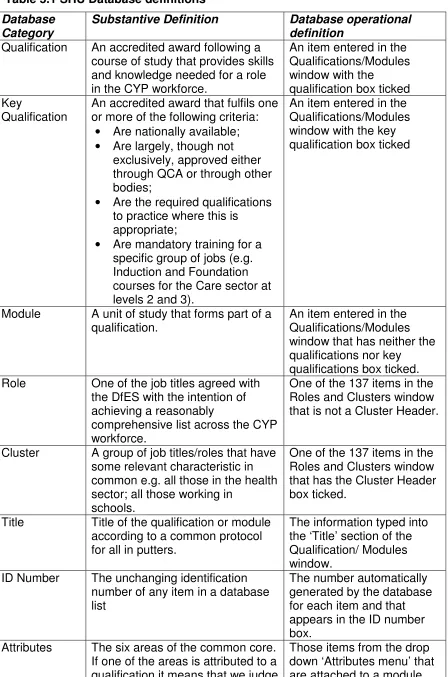
Table 5.1 SHU Database definitions
Database Category
Substantive Definition Database operational
definition Qualification An accredited award following a
course of study that provides skills and knowledge needed for a role in the CYP workforce.
An item entered in the Qualifications/Modules window with the
qualification box ticked Key
Qualification
An accredited award that fulfils one or more of the following criteria:
• Are nationally available; • Are largely, though not
exclusively, approved either through QCA or through other bodies;
• Are the required qualifications
to practice where this is appropriate;
• Are mandatory training for a
specific group of jobs (e.g. Induction and Foundation courses for the Care sector at levels 2 and 3).
An item entered in the Qualifications/Modules window with the key qualification box ticked
Module A unit of study that forms part of a qualification.
An item entered in the Qualifications/Modules window that has neither the qualifications nor key
qualifications box ticked. Role One of the job titles agreed with
the DfES with the intention of achieving a reasonably
comprehensive list across the CYP workforce.
One of the 137 items in the Roles and Clusters window that is not a Cluster Header.
Cluster A group of job titles/roles that have some relevant characteristic in common e.g. all those in the health sector; all those working in
schools.
One of the 137 items in the Roles and Clusters window that has the Cluster Header box ticked.
Title Title of the qualification or module according to a common protocol for all in putters.
The information typed into the ‘Title’ section of the Qualification/ Modules window.
ID Number The unchanging identification number of any item in a database list
The number automatically generated by the database for each item and that appears in the ID number box.
Attributes The six areas of the common core. If one of the areas is attributed to a qualification it means that we judge
that the content is likely to deliver the knowledge and skills identified in that area.
Type A description of a qualification that groups it as NVQ, HE, Modern Apprenticeship etc.
The item entered in the Type box.
Accrediting Body
The accrediting body of the award. The item entered in the Accrediting Body box. Level One of the 8 levels of study/award
from Entry to Doctoral.
The item entered in the Level box.
Learning Hours
The number of hours listed with the official description of the qualification indicating the time needing to be study to gain the qualification.
The item entered in the Learning Hours box.
Pre-Requirements
Lower level qualifications that need to be gained prior to studying for the subsequent qualification.
Those qualifications or modules that are attached to a qualification in the Pre-requirements window. Unit Code An identifying reference number
used by the source organisation (e.g. QCA Quals id number).
The item entered in the Unit Code box.
Notes Information as to the content of the qualification or module.
The information entered into the notes field.
Source The name of the organisation from which the information was
sourced.
The information entered into the Source field
Source Doc The web address of the Source The information entered into the Source Doc field
6. Mapping of Key Qualifications to the Common Core
The DfES Common Core website explains the Common Core as follows: The Green Paper, Every Child Matters, which was published in September 2003 proposed the implementation of a common core of skills, knowledge and competence for "the widest possible range of workers in children's services". The proposal drew on earlier work which suggested that a common core of skills, knowledge and competence would support the development of more effective and integrated services; introduce a common language amongst professionals and support staff, so starting the process of breaking down some of the cultural and practice barriers within the children's workforce: and - allied to a single framework of qualifications - promote more flexible development and career progression within the children's workforce.
Required knowledge and skills are listed concerning the following six categories:
1. Effective communication and engagement with children, young people, their families and carers
3. Safeguarding and promoting the welfare of the child 4. Supporting transitions
5. Multi-agency working 6. Sharing information
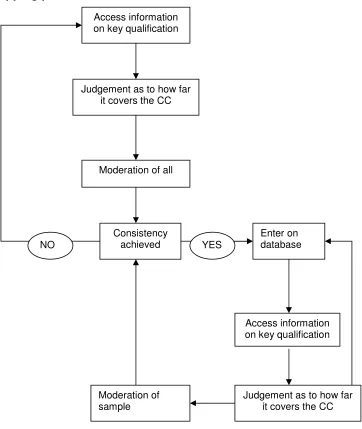
The database records how far each key qualification covers the Common Core. The definition of what was a Key Qualification was not straightforward (see Report 2 for an extended discussion). The method we followed to establish what were key qualifications was as follows:
• To put roles into clusters that mirrored the Sector Skills Council area of
responsibility e.g. Health; Education and Training; Social Care.
• To consult with an initially small group of advisers from each sector to draw up
an initial list of qualifications for each role within each cluster.
• To amend the initial list in light of comments and to send out to a larger group
of stakeholders in the different sectors for comment.
• To draw up a final list taking comments into account.
How the mapping was done
Figure 6.1 Mapping process
Even with this rigorous process the information should be taken as indicative. It cannot be hard and fast because the matching only gives a snapshot of a changing situation; because what constitutes adequate coverage of an area of expertise is open to debate (e.g. should it mean that every one of the area’s sub-items is covered, or three quarters, or half?); and because the Common Core does not require reference to the level or volume of learning. There are about 730 qualifications of which a half (approximately 350) are key qualifications (see Annexe 3).
7. Developing and maintaining the qualifications database: costs and procedures
The context of these qualifications is changing. There will be rationalisation of existing qualifications to reduce duplication and to remove those no longer on offer. But there will also be the creation of new ones to plug gaps in provision. It is extremely difficult to estimate how many qualifications this will affect and how much
Judgement as to how far it covers the CC
Moderation of all
Consistency achieved Access information on key qualification
Enter on database
NO YES
Access information on key qualification
Judgement as to how far it covers the CC Moderation of
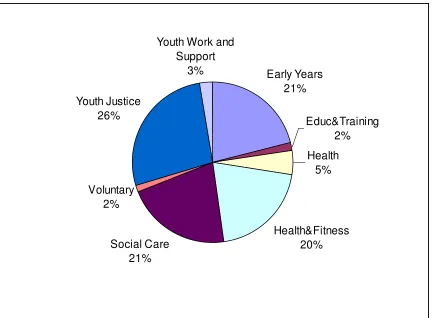
work it will entail for the maintenance of the database. The proportions of qualifications by sector vary considerably (see Figure 7.1).
Figure 7.1 Proportions of qualifications represented on the database (by sector)
Early Years 21%
Educ&Training 2%
Health 5%
Health&Fitness 20% Social Care
21% Voluntary
2% Youth Justice
26%
Youth Work and Support
3%
This needs careful interpretation since the small proportions for Education and Training and Health probably reflects the highly rationalised nature of the qualifications in those sectors while the small proportion of voluntary sector qualifications probably indicates a dearth of qualifications. The small Youth Work and Support sector may be a mixture of rationalisation for the professional level qualifications and gaps in provision at lower levels. It is likely that the large proportion of Early Years qualifications will reduce as they are rationalised.
Below we have tried to estimate costs for each of the major tasks. They are illustrative, and may be higher or lower depending on the developments identified above. For each we identify the scope of the task, the estimated time and the level of the staff required.
Merging the SHU and DfES Children’s Workforce: Qualifications database.
• Migration of one database to the platform of the other. The cost is already
covered in the project budget and therefore is not included.
• As part of the merging there will need to be policy decisions as to the ultimate
[image:12.595.77.510.149.467.2]• Making existing data formats (e.g. the way in which titles are entered)
consistent.
Estimated time: 6 weeks Researcher A or Data Entry Clerk
Mapping to the Common Core.
This task is not part of maintenance and does not affect the usefulness of the database for members of the workforce. It was an analytical tool for DfES done at the same time as the construction of the database. A policy decision is required to determine whether this task should be continued as part of the database entry. If the matching of new qualifications to the Common Core is being taken forward by sector skills councils and monitored by other means this task would duplicate their efforts.. There are two distinct parts to the task.
1) The first is, given the problems with distinguishing a set of key qualifications, it is arguable that, if any then all the qualifications on the database should be matched. This would mean that the content of about 350 qualifications (i.e. those not counted as key) already on the database would need to be mapped. Estimated time is 3 weeks of Research Fellow or Data Entry Clerk plus 1 week of more senior person to train and moderate the work.
2) The second is to map new qualifications. Since new qualifications will be required to take account of the Common Core, and they will be monitored by SSCs and other regulatory bodies it is probable that mapping of new qualifications in the medium to long term will not be necessary. If it is considered that the regulatory arrangements are not yet in place then, in the short term, it may be necessary to map new qualifications. Estimate for mapping for a year would be a Researcher A or Data Entry Clerk for 10 weeks and a Senior Research Fellow or Junior Manager for 3 weeks.
Collection of new qualifications
New qualifications are constantly emerging. These need to be systematically collected and entered.
Senior Personnel
Senior Research Fellow or Project Manager level Role: Project director and manager
Tasks and estimated time:
• Set up and maintain communication with SSCs, QCA, awarding bodies,
professional bodies, LSC and HE so that they provide timely information on new qualifications, training and roles. Estimated time 30 days in first year, slightly less in subsequent years.
• Maintain a list of web based sources for information on new qualifications.
Estimated time 3 days.
• Specify and work with technical support staff to implement changes to design
of database in response to needs identified by sectors. Estimated time 5 days.
• Manage analysis of the database as required e.g. identification of useful
• Manage the database team including recruitment, training and quality
assurance. Estimated time 20 days.
Junior personnel
Researcher Level A/ Data Entry Clerk Role: Data researcher and in putter Tasks and estimated time:
• Training on database and task. Estimated time 1day.
• Find details of new qualifications and qualifications training and input to
database, attach all modules to qualification and attach to roles. Estimated time 60 days.
Technical personnel
Senior Technical manager or consultant:
Role: Designer and technical manager of database Tasks and estimated time:
• Setting up queries identified with the Project Director to aid analysis • Redesigning as required
• Troubleshooting
• Removal of items from database. Estimated time 30 days.
Table 7.1 Estimate of costs for first year
Personnel Estimated
annual income
FTE Estimated
pay cost Senior Research Fellow/Project
Manager
£39,000 0.4 £19200
Technical Officer/Database Design Consultant
£33,000 0.15 £6000
Researcher A/Data Entry Clerk £15,000 0.6 £10980
To this will need to be added overhead charges. Subsequent years are likely to be slightly less.
8. Summary of issues and recommendations
Estimate of costs are difficult to calculate because of the changing context. For example it is difficult to predict how quickly rationalisation of qualifications will take place or how much work this will mean in removing from the database redundant qualifications and adding new ones.
The future management of the database is dependent on what purposes it is intended to fulfil. This means that policy decisions will have to be taken prior to or as part of discussions about the maintenance and technical adaptations of the database.
the host. We would recommend that, unless it serves an essential monitoring role not conducted anywhere else that this task is not maintained.
Information concerning significant or key qualifications is likely to remain contestable and indeterminable and it is important therefore that the hosts and users of the database are clear about the status of the information provided.
The roles that comprise the CYP workforce will continually evolve.
Determining how to enter data into fields is dependent on the end use envisaged. The technical aspects of database maintenance, the meaning of the entries and the needs of the end user need to be considered together.
9. Details of project reports
Report 1
Developing and maintaining a database of qualifications for the children and young people’s workforce
This report is aimed at those who will need to maintain a database of qualifications for the children's workforce. It discusses the issues arising and lessons learned from the construction of the database, updating and resource issues for maintenance.
Report 2
Defining the children and young people’s workforce in a changing scenario
This report is aimed at those who are focussing on the nature and composition of the children's workforce. It discusses issues that have emerged in (a) the identification of roles to include (b) the varying qualification requirements for given roles that have merged and (c) issues on the ground about roles which emerged in the contextualising studies.
Report 3
Qualification issues that inform the design of an integrated qualifications framework (IQF)
This report is aimed at those responsible for the development of an Integrated Qualifications Framework. It discusses the issues that have arisen in the identification of qualifications and training and their inclusion in the database and which could influence any design of an IQF. It also discusses issues emerging from the research on the needs of users in relation to knowledge about qualifications and training.
Report 4
The Common Core of Skills and Knowledge and its coverage by existing qualifications
Report 5
Training and qualifications issues, needs and gaps
This report is for those responsible for the further development of qualifications and training for the children's workforce. It identifies qualification and training needs that emerged from the contextualising studies and provides information from the database and from an analysis of the LSC Individual Learner Record of take up of qualifications within the sector.
Report 6
Research review
SHU Project Team
Project Directors
Sylvia Johnson Karen Dunn John ColdronProject Managers
Ihsan Caillau Michael ColdwellProject Team
Paul Close Helen Finlayson Damien Fitzgerald Ros Garrick Lesley Gornall Anne Hollows Janet Kay Anne MorganDatabase Designer
Dave JefferiesProject Administrator
Brenda BottomleyContact
Brenda Bottomley
Centre for Education Research 33 Collegiate Crescent
Sheffield S10 2BP
Tele: 0114 225 5652
Email: [email protected]
Acknowledgements
Annexe 1: Roles and Clusters used on the database
Early Years Early Years worker Level 3 (e.g. Preschool leaders, full daycare managers, and room supervisors, crèche leaders, out of school club leaders)
Childminder
Level 6 (and above) Early Years Professional Children's Centre Manager
Level 5 Early Years Professional Playgroup leader
Early Years worker Level 1 (e.g. Childminder; Crèche/Playgroup Volunteer; )
Early Years worker Level 2 (e.g. Nursery assistant) Early Years worker Level 4
Nursery Nurse
Education & Training Learning Mentor Level 3 Teaching Assistant Level 3
Primary/Early Years Teacher with QTS SENCO
Headteacher
Secondary Teacher with QTS PCET Tutor/ Lecturer Level 3 PCET Tutor/ Lecturer Level 4 Higher Level Teaching Assistant Behaviour and Attendance Specialist Learning Support Tutor post 16 Educational Psychologist Senior Learning Mentor Level 4 Lunchtime Supervisor
Teaching Assistant Level 2 Health GP
School Nurse
Speech & Language Therapist
Assistant Speech & Language Therapist Community Health Educator
Physiotherapist Health Visitor Paediatrician
Community Nurse (see Registered specialist community public health nurses (RSCPHN))
Psychiatrist Pregnancy Advisor Child Nurse Midwife
Registered specialist community public health nurses (RSCPHN) Occupational Therapist
Child Psychologist Dental Nurse
Health and Fitness Level 1 Assistant Instructor in Health and Fitness Level 2 Instructor in Health and Fitness
Level 3 Advanced Instructor in Health and Fitness Outdoor Activity Leader
Outdoor Education,
Training and Recreation Outdoor Activity Assistant Play work Play worker Level 2
Senior play specialist/Play Coordinators
Play work managers and play work development officers Senior Play worker Level 3
Hospital Play worker
Sport Sports Coach/ Level 6 and above Sports Coach/Trainer Level 5 Sports and Leisure Managers Sports Coach/ trainer Level 4 Sports Coach/ Trainer Level 3
Sport and Leisure Coaches/Tutors Level 2 Social Care Trainee Social Worker
Child Social Worker
Residential Child Care Worker level 3 Residential Care Manager
Family Support Worker Level 3 Care Worker Level 2
Care Worker Level 3
Children and Young People Support Worker Level 3 Assistant/Trainee Social Worker/Higher Level HSC worker Children and Young People Support Worker Level 4 Registered Care Home Manager
Senior Social Worker/Manager Social Worker: Field
Social Worker Family Advisor
Residential Children's Social Worker Leaving Care Support worker Foster Carer
Personal Adviser for those Leaving Care Daycare Supervisor
Residential Family Centre Worker Daycare Manager
Daycare Assistant
Family Support Worker Level 2
Leaving Care Advisor Counsellor
Voluntary Work Community support worker Parent Workers
Community Volunteer Worker Guide Leader
Scout Leader Volunteer Manager Brownie Guide Leader Youth Justice Referral Order Worker
Justice Clerk Magistrate
Restorative Justice Mediator Trainee Probation Officer Bail Support Worker Police Sergeant
Probationer Constables Inspector/ Chief Inspector
Youth Justice Senior Professional Worker (E.g. YOT Coordinator, YISP coordinator)
Prison Officer
Youth Justice Professional Worker (e.g., YOT Worker, YISP worker) Community wardens
Police Constable/ Officer
Police Community Support Officer (PCSO) Probation Officer
Youth Offending Team Officer
Superintendent and Chief Superintendent Youth Work and Support Learning Mentor Level 3
Education Welfare Officer Youth Work Manager Counsellor
Careers Guidance Officer
Children and Young People Support Worker Level 4 Children and Young People Support Worker Level 3 Assistant Youth Worker(JNC Level 2)
Assistant Youth Worker (JNC Level 1)
Qualified Youth Worker Level 4 (Professional Level) Trainee Connexions Personal Adviser
Connexions PA (Including PAYP Worker) Careers Guidance Practitioner
Probationary Connexions Personal Adviser Assistant Careers Guidance Officer
Annexe 3: Clusters with roles and count of qualifications per role and cluster
NB: Accurate at the time of writing and gives an indication of the relative numbers of qualifications. New roles are being added and small changes in the totals are likely
Cluster Role Total
Quals Early Years Children's Centre Manager 1 Early Years Early Years worker Level 1 (e.g. Childminder; Crèche/Playgroup
Volunteer; )
11 Early Years Early Years worker Level 2 (e.g. Nursery assistant) 32 Early Years Early Years worker Level 3 (e.g. Preschool leaders, full daycare
managers, and room supervisors, crèche leaders, out of school club leaders)
85
Early Years Early Years worker Level 4 22 Early Years Level 5 Early Years Professional 2 Early Years Level 6 (and above) Early Years Professional 1
Sub total 154
Education & Training Behaviour and Attendance Specialist 1 Education & Training Educational Psychologist 1 Education & Training Headteacher 1 Education & Training Higher Level Teaching Assistant 2 Education & Training Primary/Early Years Teacher with QTS 3 Education & Training Secondary Teacher with QTS 1 Education & Training SENCO 1 Education & Training Teaching Assistant Level 3 1
Sub total 11
Health Assistant Speech & Language Therapist 3
Health Child Nurse 12
Health Child Psychologist 1 Health Community Health Educator 3 Health Community Nurse (see Registered specialist community public
health nurses (RSCPHN))
1
Health Dental Nurse 5
Health Health Visitor 2
Health Midwife 1
Health Occupational Therapy Support Worker 1 Health Paediatrician 1 Health Registered specialist community public health nurses (RSCPHN) 2
Health School Nurse 1
Health Speech & Language Therapist 1
Sub total 34
Outdoor Education, Training and Recreation
Outdoor Activity Assistant 4 Outdoor Education, Training
and Recreation
Outdoor Activity Leader 4
Sub total 8
Play work Hospital Play worker 42 Play work Play worker Level 2 37 Play work Senior play specialist/Play Coordinators 1 Play work Senior Play worker Level 3 11
Sub total 91
Social Care Care Worker Level 2 48 Social Care Care Worker Level 3 12 Social Care Child Social Worker 3 Social Care Family Support Worker Level 2 6 Social Care Family Support Worker Level 3 10 Social Care Foster Carer 4 Social Care Personal Adviser for those Leaving Care 1 Social Care Registered Care Home Manager 1 Social Care Residential Care Manager 3 Social Care Residential Child Care worker level 2 6 Social Care Residential Child Care Worker level 3 4 Social Care Residential Children's Social Worker 1 Social Care Senior Social Worker/Manager 2 Social Care Social Worker 1 Social Care Social Worker: Field 1 Social Care Trainee Social Worker 16
Sub total 153
Sport Sports and Leisure Managers 1 Sport Sports Coach/ Level 6 and above 1 Sport Sports Coach/ Trainer Level 3 46 Sport Sports Coach/ trainer Level 4 1
Sub total 49
Voluntary Work Brownie Guide Leader 1 Voluntary Work Community support worker 7 Voluntary Work Community Volunteer Worker 2 Voluntary Work Parent Workers 1
Sub total 11
Youth Justice Bail Support Worker 10 Youth Justice Community wardens 5 Youth Justice Inspector/ Chief Inspector 19 Youth Justice Justice Clerk 1 Youth Justice Police Community Support Officer (PCSO) 7 Youth Justice Police Constable/ Officer 31 Youth Justice Police Sergeant 18 Youth Justice Prison Officer 7 Youth Justice Probation Officer 6 Youth Justice Probationer Constables 22 Youth Justice Referral Order Worker 1 Youth Justice Restorative Justice Mediator 5 Youth Justice Superintendent and Chief Superintendent 18 Youth Justice Trainee Probation Officer 12 Youth Justice Youth Justice Professional Worker (e.g., YOT Worker, YISP worker) 7 Youth Justice Youth Justice Senior Professional Worker (E.g. YOT Coordinator,
YISP coordinator)
10 Youth Justice Youth Offending Team Officer 17
Sub total 196
Youth Work and Support Senior Youth Worker/ Manager (Professional Level) 1 Youth Work and Support Youth Work Manager 1