The challenge of ‘Be-learning’ (Blended
Learning) in initial teacher education and a
smorgasbord of effective practice – part of
an ESCalate project
DRAFT COPY
Team members
Peter Cheung
Chris Kynch
Fiona Lawton
Jenny Mackness
Deborah Roberts
Sam Twiselton
Correspondence to
[email protected]
Government e-learning strategy:
For education leaders – how they might turn a traditional educational institution whether school, college or university, into one that blends the best of old and new.
TABLE OF CONTENTS
TABLE OF CONTENTS ... 1
THE TASK …. ... 4
AND THE TEAMWORK …... 4
Some limitations of the case studies ... 4
DIVERSITY: NEW TECHNOLOGY IN HIGHER EDUCATION ... 5
Diverse new technology ... 6
Diverse delivery of new technology mediated learning ... 8
TEACHER EDUCATION ... 9
Resonance with other education programmes... 9
The policy context ... 9
Links between distance learning and initial teacher education programmes ... 11
For initial teacher education, distance learning is small but growing... 11
Websites for staff in higher education and teacher education ... 11
RESOURCES FOR INITIAL TEACHER EDUCATION PROVIDERS AND STUDENT TEACHERS ... 14
WHAT SHAPES THE STUDENT EXPERIENCE?... 15
Part time flexible modular (distance learning) student characteristics... 18
Students for whom distance and e- learning may be challenging ... 19
Technical challenges for students ... 21
Effectiveness of course design: campus based learner experiences ... 22
THE CHALLENGE OF TEACHER EDUCATION ... 22
Features of primary ITE courses with implications for distance and technology mediated learning (student and staff interviews) ... 22
Is technology mediated learning appropriate? Some doubts expressed by very experienced staff... 23
IMPROVING THE STUDENT ITE LEARNING EXPERIENCE A summary from the case studies ... 24
Informal peer assurance and support ... 25
Peer activities as a professional preparation ... 27
Technology mediated feedback ... 28
Enriching learning through enhanced access to a range of resources. .... 28
Enhanced analysis of skills and allocation of time ... 28
Enhanced reflection and preparedness for face to face sessions... 29
Accurate information for students... 30
Enhanced response to students ... 30
Building back personal relationships ... 33
Choice of resources ... 34
PARTNER SCHOOLS ... 34
Technology mediated environment for schools... 35
Understanding the demands and timing of the programme ... 35
Circumventing bureaucracy... 35
Facilitating consistency ... 35
Access to technology mediated environment for schools... 36
Specialists in schools... 37
Nettiquette ... 38
Quality assurance of materials ... 38
Data storage and management... 38
Improving commonly used VLEs ... 38
MANAGING TECHNOLOGY MEDIATED LEARNING ... 39
To progress technology mediated learning successfully there appear to be a range of preconditions: ... 39
Staff and technology mediated learning... 39
Management approaches ... 42
PERSISTENT DIVERSITY AND TECHNOLOGY MEDIATED LEARNING ... 45
WILL COSTS FALL IF TECHNOLOGY MEDIATED LEARNING IS ADOPTED? ... 46
THE VERDICT ON BLENDED LEARNING:... 47
ADDITIONAL REFERENCES ... 47
APPENDIX A... 48
WHATEVER HAPPENED TO VIDEO-CONFERENCING? ... 48
APPENDIX B: NOTES FROM THE ESCALATE VLE CONFERENCE 2004 ... 49
APPENDIX C: SOME QUOTES... 50
THE TASK ….
Our brief was as follows:
‘Flexible routes into teaching signify a key growth area in recent years. One aspect of such routes is that they are often part time and involve elements of e-learning at a distance. This means that lecturers have to find ways of developing knowledge and establishing and maintaining learning
relationships with students. In a discipline traditionally associated with the need for contact due to the socio-cultural nature of education, this brings huge challenges, but also opens up new areas for exploration in
investigating and disseminating effective practice.’
AND THE TEAMWORK …
‘Case studies’ interviews of programme leaders, designers and deliverers in four UK countries
Attended ESCalate VLE conference and meetings with key people working at ‘cutting edge’
Web searches for the latest advice and guidance, resources and research Phone discussion to keep up to speed with the work of government departments and agencies (TTA, BECTA, DfES etc)
Drawn on research findings from SMC projects and research literature Held animated fortnightly discussions
The project has been fitted into a short timescale and the existing work commitments of the team and provides a pilot for larger scale development.
Some limitations of the case studies
The choice of case studies was made after consultation with ESCalate. Case studies may be considered an appropriate method:
Because of the universality and importance of experiential understanding and the compatibility of case studies with that understanding, they can be expected to have an advantage over other enquiry methods (Stake) Case studies provide the potential for readers to generalise in a
naturalistic way, utilising their ‘tacit knowledge’ (Simmons)
‘As readers recognise essential similarities to cases of interest to them, they establish the basis for ‘naturalistic generalisation’. Case studies are ‘a direct and satisfying way of adding to experience and improving
understanding’ (Stake)
Approaches which are held to strengthen he validity of findings include: Case study enquiry should rely on multiple sources of evidence, with data needing to converge in a triangulating fashion, and as another result (Yin)
The demands for typicality and representativeness yield to needs for assurance that the target case is properly described (Stake)
than a single institution, in relation to which the report seeks to enhance understanding of the role of new technology mediated learning.
Between one and four key people involved in designing and delivering programmes were interviewed in each institution. A semi structured interview guide had been prepared by the project team, and was adapted for interviews with a learning technologist and school based partnership manager. Because there were few interviews, the findings remain very tentative even where similar views were expressed. Where possible, the findings of other research projects were drawn on to confirm or interrogate findings. Some relevant research findings may be accessed on websites. Becta have collated abstracts and a list of further sources of some educational research into the ‘use of ICT in initial teacher training’
www.becta.org.uk/research. On the same website there is access to a series called ‘What the Research Says’ – aspects of using Information and
communications technology in schools and colleges; lists of other websites for organisations which carry out research in the field of ICT and advice and case studies. The FERL website (http://ferl.becta.org.uk) provides case studies and ‘evidence of effective practice’. Other related case studies from the TELRI project are at: http://www.telri.ac.uk
The focus of our case studies was on initial teacher education for primary school work. Whereas e-learning elements in initial teacher education appear widespread, distance learning programmes are not. The Northern Ireland case study had to be a secondary PGCE. It may be useful to draw future case studies from secondary programmes, not least because there would be greater choice of providers across the different countries of the UK. In the spring term 2004:
Only in England have distance learning programmes for primary ITE been firmly established
In Scotland there is one pilot 2 year programme entering the second year In Wales and in Northern Ireland we investigated blended learning in campus based programmes
Case studies only investigated views of a few leaders and deliverers of programmes and advisors, although SMC prior research and SOLE project provides some evidence of student perspectives in England
The case studies did not provide evidence relating to the effectiveness of the practices
DIVERSITY: NEW TECHNOLOGY IN HIGHER EDUCATION
2001 and 2003 KISC and UCSA surveys into use of ‘managed’ learning environments:
The main survey findings include: (using survey terminology):
The number of institutions not using a virtual learning environment (VLE) declined between 2001 and 2003 from 19% to 14%
Those consolidating to one VLE has increased from 30% to 36% but this includes students not using any
Enhanced learning and teaching appears the primary driver rising from 43% to 66%
Efficiency, the second driver, declined from 31% to 16% - recognition that online learning not a cost saver
Distance learning was a driver for 25% in 2001 but not at all in 2003
www.ucisa.uk/groups/tlig/vle/VLEsurvey.pdf
VLE characteristic within institutions Pre 1992 % Post 1992 %
Used by all subjects 5 24
Used by all departments 18 32
More than 10,000 students registered 5 37
Used by more than 200 staff 32 45
Used by between 500 - 999 modules 11 24
Used by over 1000 modules 13
VLE- student records automatic linkage 16 45
Stated targets of VLE usage specified 13 53
Efficiency cited as important driver 13 24
Usage promoted using project funding 79 58
Figure 1: Institutions and VLEs
Technology mediated learning appears from the survey to be fast growing but in only a quarter of institutions is it used across all subjects; in a third by all departments; in less than half by all staff. Post, compared to pre 1992 institutions use technology more but are less likely to provide funding, for example for learning technologists. (In relation to initial teacher education, interviews for this and related research projects suggest that much more generous funding is available for schools than for higher education, and that this may impact on capability.) The surveys also suggested that the context of the move to technology mediated learning is likely to shape
developments within a particular programme. Funding, culture and attitudes may inhibit or facilitate developments.
The diversity revealed by these surveys highlights the importance of understanding the transition to technology mediated learning, and the challenges encountered, as well as the potential benefits of ‘cutting edge’ developments.
Diverse new technology
Although the terms ‘virtual learning environment’ (VLE) and ‘e-learning’ are widely used as a proxy for learning associated in some way with relatively recent or ‘new’ technology, this does not capture the potential range of hardware, software or types of delivery of new technology. WebCT and Blackboard are commonly called VLEs, but these are only part of the new technology used. Learning programmes may be designed with the use of digital recording, and audio and visual images, with or without
commentaries, recorded on CD or DVD; using a wide range of broadband or more restricted access to and downloading from websites; with varied equipment for mobile learning including personal digital assistants, tablet PCs, wi-fi connections; data banks as resources; software;
impact on the ‘learning environment’ so that the whole is more
appropriately termed a ‘new technology mediated environment’. The term ‘virtual’ may also appear misleading in that in order for learning to take place there has to be real engagement; and is a ‘learning environment’ where the environment learns?
Finding a satisfactory alternative description is not easy. What we are
looking at is a ‘new technology mediated environment for learning’. But the interface with different aspects of our brief – initial teacher education; distance learning; part time students may generate varied practice. The following were part of - or had been considered for - the design of courses across our case studies:
Blackboard or WebCT (note the development of new designs specifically for use in universities)
Websites
Electronic databanks of resources PCs
Broadband
CDrom and DVD storage of digital video resources Interactive whiteboard
Video streaming
‘Interactive’ software and games
PDAs, tablet pcs, palmtop computers and other ‘mobile learning’ devices Wireless technology
Mobile phones Video-conferencing
Interactive games software, relatively ahead of the field in the fields of behaviour in organisations, and in other management related disciplines, potentially have common ground with teacher education.
Such a listing begs questions about the diversity of staff preparedness within and between institutions, departments, courses. This may include
awareness of and disposition towards different types of new technology, familiarity with how to use it, readiness to integrate it with the design of learning activities, and select an appropriate approach for the context. The pace of development of innovative resources and the access to learning possibilities offered is rapid and uneven. Knowing ‘where to go to find out’ what is happening is important. Use of the internet may be targeted, for example:
Descriptors and examples of applications are usually easily found using a search engine such as ‘google’.
For definitions and research findings on benefits of use of specific
technology for teachers, children, parents and for subjects see the easy-to-use website of the government agency BECTA:
www.becta.org.uk/research
The internet offers easy (though not always free) access to a vast range of resources to enrich learning across diverse subjects. An example is the FILTER project (Focusing Images for Learning and Teaching – an Enriched Resource) – a website which links to databases such as the Visual Arts Data Service; ARTWORLD; Virtual Norfolk; the British Universities Film and Video Council; and a description of ‘metadata initiatives’ as well as major agencies: http://www.filter.ac.uk/resources/
Some websites specialise in specific types of technology. For example for video- streaming there is www.ClickandGoVideo.ac.uk .
JISC offers data collections, for example Education Media Online which offers free to subscribers 300 hours of non-fiction films and videos across many subjects including the performing arts and music and
healthhttp://jisc.ac.uk/coll_emol.html.
Diverse delivery of new technology mediated learning
The surveys above indicate that new technology mediated learning is regarded primarily as a means of enhancing the quality of teaching and learning. However it is not clear how widespread is the recognition of the role of the appropriate pedagogy and the preparedness of staff to use it in the design and delivery of courses. (Education specialists have a potentially valuable facilitating role.)
For most staff in higher education, the first approach to using a ‘virtual learning environment’ has been called ‘shovelling’ in information and notes, for access by students and others. Where suitably structured, easily accessed information may provide benefits, such as saving search time; prompt feedback; shared knowledge.
But the research literature and experiences of technology mediated learning suggest that distinctive pedagogic approaches are required if the potential to enhance teaching and learning is to be realised; and if challenges which may be associated with the use of new technology and distance learning are to be overcome. There are variants of the view:
Distinctive pedagogical approaches are required for effective use of new technology (Salmon’s stages).
Techniques for successful technology mediated learning coincide with constructivist / social constructivist learning (Pilkington).
In relation to professional education, it has been argued that an
experiential, collaborative, interactive, highly structured, tutor moderated, monitored and evaluated, peer assessed learning is preferable for (Sharp), or considered appropriate to, professional preparation to teach (Case studies). Our case studies show diverse planning and delivery of learning activities. But there appears nevertheless to be a consensus about the necessity of constructivist/ social constructivist approaches for new technology mediated learning in ITE.
learning’. However a diversity of practice was accommodated within the pedagogy: ‘There were ‘notable differences in terms of the structure of the tasks and the context within which the task was to be undertaken… and difference of tutor input and tutor support’. http://sole.ilrt.bris.ac.uk/ The implication is that if technology mediated learning for ITE is to be successful, staff should be familiar with using the appropriate pedagogy as well as confident in embedding the new technology in yeaching.
TEACHER EDUCATION
Resonance with other education programmes
Figure 2: Resonance with other education
programmes
Chart 2 shows some differences between types of programme. International MA
programmes have been very successfully
developed but have distinctive
characteristics. In initial
teacher education, quality assured school placements are likely to be especially challenging for dispersed, small and isolated primary schools hosting single students. This may in part explain why primary distance learning flexible modular QTS / PGCE have lagged behind secondary equivalents.
The policy context
Initial teacher education
The government’s e-learning strategy and consultation documentation can be found on the DfES website: www.dfes.gov.uk/elearningstrategy The ‘vision’ is to empower learners; be creative and innovative; offer flexibility; achieve better value; generate a professional workforce and fulfilled
citizens.
The SOLE project points to specific features of the policy context: At the beginning of 2000/2001 seventeen initial teacher education
providers started a new postgraduate route to Qualified Teacher Status – the flexible postgraduate training to meet their individual needs and circumstances.
‘The changing patterns of structure for PGCE courses at UK universities away from campus-based courses and towards school-based programmes of study have been major drivers for Education Departments to focus on
Distance learning part time ITE
Blended learning
Students isolated unless course design to foster peer support Practical, professional preparation
Quality assured geographically dispersed school placements ? International potential
Campus based full time ITE
Blended learning Practical, professional preparation Quality assured local school placements
MA by distance learning
Academic ? Action research Fully e-learning Experienced professionals
new models of communication and learning and in particular on the role that VLEs can play.
‘The requirements for tutor - student and peer to peer dialogue and support, together with the need to study more independently than previously make e-learning an essential element of most Education Departments programme planning and design.’
‘In 2002 new ICT testing is being introduced as part of the QTS (Teacher Training Agency, 2002) requirements which mean ITT providers need to ensure that students have the required level of transferable ICT skills to use in their teaching. LTSN Education needs to support university
departments and academics to use VLE's both as effective tools and as exemplars to help students model good practice and this requires sound evidence to build this support.
http://sole.ilrt.bris.ac.uk
Distance learning
New technology, especially where facilitated by broadband, offers particular new opportunities through distance learning. Although the
emphasis of policies vary in detail across the four countries of the UK, there is commonality in the commitment to promote parity of access for all
individuals to initial teacher training. This includes catering for those who are unable to undertake existing campus based, full time courses because of
Geographically distance from programmes
Lifestyles demanding flexible part time preparation
One programme leader emphasised the success of flexible distance learning not just in attracting a different type of entrant but in meeting local
demand for teachers:
‘(Distance learning) has definitely allowed students to take up initial teacher education while still being based in the home environment and that’s been important for them. People who have not been able to
participate in initial teacher education just because of where they live…... Family life and other commitments make that totally impossible for them… The rationale was that the Highland Council had identified a need for more teachers particularly in the rural areas where it is difficult to attract people. There are a lot of graduates to tap into.’(Case study Scotland)
From national and regional perspectives distance learning provision is likely to fit with other aims:
Adjusting the supply of teachers to meet expected future demand as forecast from demographic trends and other variables.
Reducing shortages associated with particular locations, eg inner cities, some remote areas; subjects, types of school etc.
Improve the quality of newly qualified teachers by attracting qualifiers who are considered to be ‘high quality’.
Links between distance learning and initial teacher education programmes
In the UK as a whole:
Programmes are for graduates based in higher education with school placements including flexible modular Qualified Teacher Status (QTS) and PGCE
There are close links to technology mediated and other learning on campus based full time undergraduate courses
The programmes draw on experience in designing and delivering
technology mediated masters degree programmes which recruit globally In England:
In addition there are some distinctive programmes leading to QTS status in England but not elsewhere in the UK. For some, technology mediated learning resources are coming on-stream. They include:
School based initial teacher education (eg national SCITT; ‘Interactive Classroom Explorer’)
Graduate Teaching Programme (eg Ultralab commissioned for project) Modular Foundation Degrees undertaken by teaching assistants
Useful web sites for new technology mediated learning in higher education and teacher education:
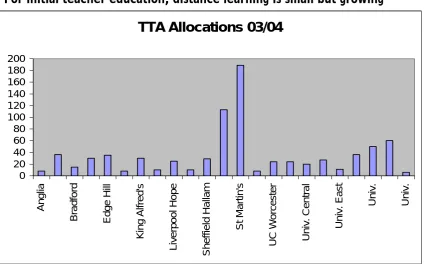
For initial teacher education, distance learning is small but growing
Chart 2: Provision of in ial t che education by dis nce learning by
[image:11.595.86.511.400.664.2]student numbers, 2004 it ea r ta
Figure 3: Primary flexible modular distance learning locations
Websites for staff in higher education and teacher education
The ESCalate (Education Subject Centre Advancing Learning and Teaching in Education) website provides access to presentations from the 2004 VLE conference (in events and past events) and to research findings from the
TTA Allocations 03/04
small grants projects, links to events and the other LTSN sites and many other useful links.
http://www.escalate.ac.uk
The Association for Information Technology in Teacher Education (ITTE) supports ‘teacher training establishments in Britain and disseminates
information regarding ICT in education’. It aims to help colleagues network, promotes continuing professional development, and actively represents members’ views and interests on new and current issues and research at a national level. It is run by ‘enthusiastic volunteers’ from membership. ITTE publishes 2 newsletters a year; a journal ‘Technology, Pedagogy and
Education’ three times annually; conferences and regional meetings. Short versions of presentations for the annual ITTE conference (most recent July 2004) are on the website. ITTE has a national profile and is continuing to develop as an international force. The association claims it is unique in having a central and complete overview of all aspects of ICT in education from an initial teacher education perspective. Links can be found at: http://www.itte.org.uk
NAACE (National Association of Advisors for Computers in Education. NAACE claims to be a key influential professional association for those working in ICT in Education and provides a range of advice on advancing education through the appropriate use of ICT, professional development and
implementing national strategies. It was formed in 2004 from a merger with Microcomputers in Primary Education and the Computer Education Group. Subscription site at: http://www.naace.org/
Association for ICT in Education (ACITT) is aimed at teachers of ICT aged 4-18 but is also useful for tutors in higher education. Resources include lesson plans and assessment sheets and there are forums for discussion of ideas and thoughts and an annual conference. Subscription site at:
http://www.acitt.digitalbrain.com/acitt/index.htm
The Joint Information Systems Committee (JISC), established by the Higher Education Funding Councils for England, gives support in teaching, learning, research and administration. They offer training opportunities through workshops and on-line self-taught tutorials. There are online catalogues so that relevant and high quality internet resources can be quickly located. http://www.Jisc.ac.uk
The Higher Education Academy (formerly Institute for Learning and Teaching in Higher Education), in addition to the accreditation function, organises regional forums and special interest conferences which are usually free of charge.
http://www.ilt.ac.uk/default.asp
distance learning courses. Currently students of affiliated universities have access to courses covering topics such as Chaos Theory, Computer Vision, ICT, Artificial Intelligence and European Literature. Most of the courses are delivered using Web-technology, ISDN-videoconferencing, interactive satellite TV and CD-ROM resources. The EuroPACE website provides information about the organisation's courses, research projects and
conferences, as well as access to a resource catalogue which lists EuroP ACE publications on the use of ICT for education and training. There is also a section about membership and an application form which can be
downloaded as a PDF file or MS Word document. http://www.europace.be/
A very useful website both for seeking advice on any aspect of technology mediated learning and for links to related sites is provided by the
collaborative learning site at Sheffield:
http://www.shef.ac.uk/collaborate/ from where there is access to sections on collaborative e-learning; getting started: issues and examples; learning and teaching online; learning technology; subject resources; research and publications; conferences and events. There is also a discussion list to share ideas and concerns. A full and useful list of electronic journals can be accessed.
Another guide ‘Tips for Online Learning’ is provided by Wolverhampton university:
http://www.wlv.ac.uk/celt/oltips/index.html
The 24 Learning and Teaching Support Networks (LTSN) provide subject oriented resources information and advice. Higher education case studies are linked to:
http://www.lstn.ac.uk
http://www.lstn.ac.uk/genericcentre/ http://www.economics.lstn.a.cuk/
‘Connect’, the ‘Learning and Teaching Portal’ being built and piloted by the generic LTSN will provide ‘the first set of services designed to foster and promote good practice in learning and teaching in further and higher
education in the UK’ through web based ‘gateway information’. There will be access to a funding opportunities database; an organisation database; a resources search facility to draw down directly materials and resources for teaching and learning; a discussion forum with online tools and services; a searchable database of more than 1000 national teaching and learning related projects. The first phase is at www.connect.ac.uk
The e-Learning Centre provides online a comprehensive and easily navigated ‘Guide to e-Learning’. It covers e-learning in the workplace as well as higher and further education. The e-learning ‘solutions’ covered range from
‘blogging’. Each topic contains examples, how to create resources, costs and time, and other resources. It is at:
http://www.e-learningcentre.co.uk/guidetoelearning/contents.htm
An electronic list of many useful research papers presented at the Networked Learning Conference 2004 may be found at
http://www.shef.ac.uk/nlc2004/conference_programme/paper_titles/index.htm
The fourth Annual National VLE Conference in 2004, with the theme ‘Innovative and creative ideas for improving the student experience’, has some useful summaries of keynote presentations etc. For example Andy Ramsden’s presentation on the use of Blackboard links to sections – eg how to deter plagiarism. It is at:
http://www.ltss.bris.ac.uk/events/vle-conf/vleday04/programme.htm
An example of how pedagogic models can underpin learning resources is COSE at:
http://www.staffs.ac.uk/COSE/cose10/welcome10html
M.Paulsen provides an ‘Online Report on Pedagogical Techniques for Computer Mediation’ (1995) is at:
http://home.nettskolen.nki.no/~morten/cmcped/litrev.html
For an institution level approach, N.Pollock and J.Cornford report on a two year research project which investigating the way in which UK universities are attempting to build new technologies into higher education. ‘Theory and Practice of the Virtual University’ (2000) is at:
http://www.ariadne.ac.uk/issue24/virtual-uniersities/
J.Dempster and F.Deepwell report on a study for the LSTN generic centre to draw out lessons learned from a number of national projects over 1998 – 2002 that had shown success in embedding new practices into institutional teaching and learning. These were generic or interdisciplinary, technology related educational development projects working at institutional and multi-institutional levels. It is to be found on the website of ALT
(Association of Learning Technologists) as a chapter entitled ‘Experiences of National Projects in Embedding Learning Technology into Institutional
Practices in UK Higher Education’ in the ALT book ‘From Enthusiasm to Establishment’ edited by J.Seal and G.Conole.
RESOURCES FOR INITIAL TEACHER EDUCATION PROVIDERS AND
STUDENT TEACHERS
A wide range of online and downloadable resources for use by student teachers on school placement (and for teachers) and as coursework
Department for Education and Skills and BECTA. A few examples are given here:
Useful links for student teachers to such sites as TeacherNet and the Teacher Support Line and Just for Teachers is at
http://www.tta.gov.uk/drb/resources_for_trainees/
Through the TTA there is access to networks such as the Professional Resource Network for ‘behaviour’ at:
http://www.behaviour4learning.ac.uk/
The TTA provides free downloadable ‘key publications’ for providers of initial teacher education and student teachers at
http://www.tta.gov.uk/php/read.php?sectionid=1&articleid=881
TeacherNet links to a wide range of primary school resources at Key stages 1 and 2; government strategies; online teaching resources; target setting; over 2000 lesson plans.
http://www.teachernet.gov.uk/teachingandlearning/primary/
http://www.teachernet.gov.uk/teachingandlearning/resourcematerials/Res ources/
Curriculumonline, from the DfES, provides free online and downloadable multimedia resources to support various subjects and needs and shows how ICT can support a range of lessons including practical subjects such as art, music, design and technology and other resources and is at
http://www.curriculumonline.gov.uk/default.htm?cookie%5Ftest=1 Interactive digital resources are provided at
http://www.filmeducation.org/
An example of a specialist site containing very high quality learning resources is
http://www.accessart.org.uk e-learning credits can be spent at http://www.atschool.co.uk
There are many other sources of free resources such as channel 4 at http://channel4.com/learning/
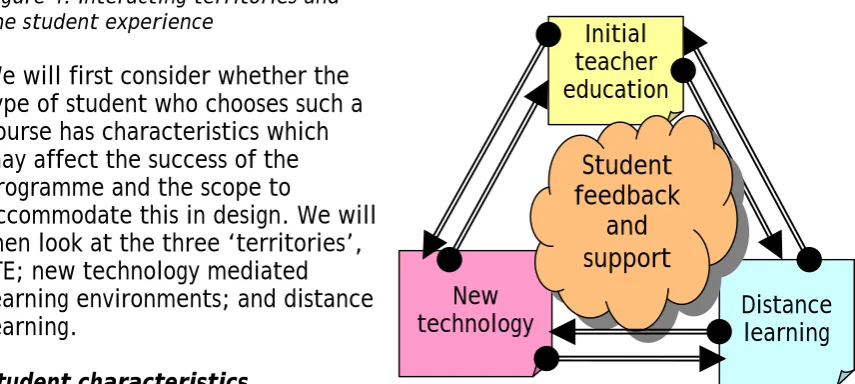
WHAT SHAPES THE STUDENT EXPERIENCE?
Initial teacher education
Distance learning New
technology
Student feedback
[image:16.595.99.527.80.272.2]and support
Figure 4: Interacting territories and the student experience
We will first consider whether the type of student who chooses such a course has characteristics which may affect the success of the programme and the scope to accommodate this in design. We w then look at the three ‘terr
ITE; new technology mediated learning environments; and distanc learning.
ill itories’,
e
Student characteristics
Student characteristics are potentially important because they underpin student ‘demand’ for courses, and the qualifications to which they lead – and for the way programmes are delivered. If a learning environment provides a supply of activities and services which is designed around this demand, there may be positive outcomes for such targets as retention, recruitment and attainment.
Student characteristics are extraneous to the course and many are ‘givens’, which the learning environment has to ‘work around’. These include prior experience, for example of management, professional roles; children; financial imperative to work part time; family commitments; maturity; personality; preferences; commitment to successful completion of the course. Some profiles are likely to be associated with potential success as a student teacher - what is deemed to be a ‘good calibre’ student. How far a learning environment ‘fits’ with student characteristics may be associated with recruitment and retention. An example of ‘sorting’ by student
characteristic is provided by a case study - an observed and moderated ‘needs analysis week’ in school, for those accepted for a flexible modular PGCE / QTS course. The student is allocated to one of four routes on the programme, according to the assessment of the preparedness of each to teach.
Other characteristics may be seen as malleable and the learning
environment may be designed to influence them. One example is the skills, equipment, and internet capacity students bring to the course. IT skills self assessment was part of case study teacher education programmes, and these provided specific examples of how a lack of equipment, internet access and technical support could be remedied for distance learners. Another example of such characteristics is the expectations of students of contact with, and support from their tutors. Examples from the case studies showed how student expectations, in an e-learning context, could be
A number of studies have suggested that student motivation to learn is raised in various ways by the use of a VLE. The SOLE project found case study evidence that ‘students are generally motivated towards using online learning resources and find access to materials that are provided by a VLE motivating’. The use of WebCT appeared to increase motivation towards modules or the course oriented through personal interest or personal goals, rather than to be better than others or gain credit.
http://sole.irlt.bris.ac.uk The case studies revealed some concern that tutors who believed that not using new technology mediated learning, or using it sparingly, was preferable were under pressure as a consequence of student demand to conform, and their views were not being respected. If programmes are to be shaped according to ‘demand’, student
characteristics must be identifiable and predictable over different cohorts. Both conditions are difficult to satisfy. Even if the profile of general
characteristics is known and there are minimal variations between cohorts, characteristics vary within as well as between cohorts. Catering for diversity of student characteristics poses a different set of challenges for course designers. Case study evidence suggests that some set out to cater for every possible anticipated student need in carefully structured distance learning materials through which students are guided (for example a music course for distance learning). Others focused on giving students a choice of approach. A simple example is offering a resource on CD or online. Some diversity is especially challenging to designers, for example how to cater for the very different individual valuation of communication face to face, by phone or e-mail.
The case studies provided limited evidence of some tension between: Very carefully designed - usually very ‘high tech’ - software, very expensive to develop, but catering for diverse levels, specialisms, and student ‘learning’ approaches.
‘Cottage industry’ designs, designed around the local context and student characteristics, and usually ‘lower tech’, evolved from practitioner expertise.
Some tutors suggested that the more carefully structured the design, the more new tutors would have to ‘fit in’, thus losing their autonomy. The project interviews and observations suggested that the different viewpoints may be reflected in varying interests between professional groups, with a bearing on grant funding.
It is not easy to assess why a particular approach appears to work well, for example judging by the proportion of high grades, low grades, qualifying professionals. These might be explained by random variations; or because of student characteristics, the programme they undertake, the design of
learning activities – or the interaction between a number of factors – or some ‘residual’ factor. Even if it were possible to obtain appropriate data to undertake large scale randomised trials, the validity of findings in a
Part time flexible modular (distance learning) student characteristics
Perceptions of programme tutors and school staff, from case studies and other research at St Martin’s College suggest that students who have chosen this route may have characteristics which differ from students on the
campus based undergraduate and postgraduate programmes. Mature with work experience
Highly committed
Motivated to use the new technology
Frantic lifestyles with financial and family responsibilities Very demanding of staff in HE and schools
Strongly value peer support for reassurance and feedback Considered especially ‘high’ calibre by placement schools
An exemplar of the view that the course attracts good recruits is expressed by a programme leader from a relatively new course:
‘We have every reason to believe it (the distance learning course) is
successful, because we have the evidence that the students are performing as well as if not better than on the full time programme’
There is some evidence that the view is endorsed by schools which are especially willing to offer placements to distance learning students, despite the extra demands which mentors suggest are made on schools by such students. (ESCalate funded project, St Martin’s College, 2002). Given the concerns expressed by schools about the cost of supporting less capable students, a good reputation for distance learning students could ease a shortage of school placements.
If claims are made on the basis of such evidence, for certain student characteristics in relation to a particular courses, are these claims trustworthy – can they be triangulated, validated? For example, as
illustrated above, course tutors from two case studies express the opinion that mature distance learning student teachers tend to be ‘high calibre’. If schools have experienced ‘good quality’ students from a particular course they tend to be favourably inclined to offer school placements for the programme. However for a small school placements may be thinly spread or irregular and impressions may depend on experience of one or two students. The findings may be seen as mutually reinforcing. For example, distance learning students are also mature students who may be considered ‘good students’ because of life experience, although negative attributes have also been perceived. The course may have high opportunity cost because
students come from paid employment or value bringing up their own children. This implies that students will only be persuaded to enrol if they are highly committed to becoming qualified. This fits with reports that such students are very ‘committed’. However, there may be variations across other distance learning courses for initial teacher education which do not fit these limited findings. To the extent that such characteristics can be
A different kind of argument for not ignoring limited or tentative evidence about student characteristics is that this is a high risk strategy: the potential costs may be prohibitive. For example if a course is not designed to
accommodate lifestyles and preferences, relatively more problems may be encountered, such as adverse effects on retention, reputation, recruitment, Ofsted inspections, and a reluctance of schools to offer placements. New technology mediated learning offers increased scope for catering to lifestyles, for example through the flexibility of asynchronous online peer learning activities. The most important question may be seen as: Can the programme afford the risk of not taking student characteristics into account?
The investment cost of setting up courses which cater effectively for diverse preferences and individualised learning are said to be substantially greater for new technology mediated than for traditional learning activities.
However the more diverse the capacity, the more likely are the learning activities to be transferable across programmes with very different types of student, reducing unit costs through economies of scale, in addition to over time.
Addressing policy concerns
Policy makers are concerned about student teacher capability. Whether our findings would be confirmed more widely, and if so what are the possible causes, the perceived calibre of these students deserves further
investigation. We note that student characteristics in the UK might not apply to international programmes of teacher education by distance learning.
Distance learning programmes appear successful in widening access. Students overwhelmingly say that without the part time distant learning programme they could not have gained the teaching qualification. (Kynch, 2002). Such provision may be an effective means of ‘tapping into’ demand from potentially capable teachers and a relatively stable future workforce.
Students for whom distance and e- learning may be challenging
Some student attributes indicate potential challenges for distance learning programmes. One case study interviewee described students who were said to enrol to meet colleagues or for social reasons (this related to a master’s course which tended to recruit high ranking professionals):
‘A few of them think they are not getting value for money if they don’t see a person’(Case study)
‘To be left on their own would almost be a frightening experience for them. They need that contact to give them security…They felt that teaching and learning was done face to face’(Case study)
This accords with the strong demand for more one-to-one sessions with tutors which was reported from a large scale survey of final year
undergraduates (Kynch, 2001). The SOLE project found that:
Students clearly saw the tutor as vital in their learning process and as providing an important source of support.
Students valued the possibility of face-to-face help; endorsed their need for a tutor and the VLE as an extension to tutor access possibilities. The project also indicates the value of appropriate course design for student engagement: ‘highly structured activities that link clearly to students’
professional practice and strong tutor support impacts on the extent to which students engage in online collaboration’.
http://sole.irlt.bris.ac.uk
By contrast, students on the undergraduate route in Scotland were said to want more independent learning:
‘The students were saying ‘we don’t get enough time for private study … all this face to face, and here we are able to use these materials in a different way’
A culture of peer collaboration, fostered by schools, may be one factor facilitating peer communication among distance learners. Peer
communication may be used by students as a partial substitute for approaches to tutors, as in the following example:
‘these ones talk (on the VLE) about different teaching strategies and ways of approaching the course. They are talking about websites that they’ve found and exchanging all sorts of information …….I think maybe the way they are coming through their A-level subjects, I think they get more opportunity to discuss things whenever they are at school. They are more confident to begin with and I think it just continues on through their course’. (Case study, Northern Ireland)
Such examples suggest that the culture of students appears integral to how the technology is used by student teachers. Awareness of local profiles of student characteristics, where this is stable, may help select the design of new technology mediated learning activities.
The evidence suggests that there may be critical ‘flashpoints’ for the student experience of distance learning programmes for initial teacher education, around which design is especially important. Certain aspects of their experience were emphasised in 50 interviews of students on one programme in England and some of the case study interviews with staff:
Initial bonding activities face to face are viewed as essential for fostering subsequent peer group support (from staff)
Peer group assurance, presence and support may remain critical for survival at key points such as first placement (from students and staff) Individually tailored feedback is essential, especially at the start of an unfamiliar activity, but so is the benchmarking of ‘standards’ (from students)
Basic conflicts remain between lifestyle demands, for example of job and full time school placement (from students and staff)
Technical difficulties of access to resources (from students, not staff) Reticence to engage in some contexts and roles (from students and staff) (Case studies, and Kynch 2001)
Technical challenges for students
Access to appropriate equipment is a precondition for distance learning courses, and students who cannot acquire it are barred. The Scotland case study offered one solution:
‘Half of those taken on for the programme did not have computers at home. They need a computer to participate. The Highland Council provided them with computers with internet access’
Interviews with distance learning students on an English ITE programme suggested that there were substantially more computer related problems, which could and did cause interruptions to coursework, than staff were aware of. There was a cluster around sending and receiving e-mail
attachments; but many other specific difficulties which students had to deal with in isolation. In the case study in Scotland, however:
‘Technical issues are addressed through the partnership agreement
whereby the sponsoring authority provide the technical support. … There is not much point for us .. having to rush up to somebody in Skye because their computer doesn’t work. Far better that they can go to a local centre and get what assistance is required. That has worked very well I would say. There are some blips where your computer doesn’t work and has to be taken away and that causes you some angst but on the whole it has worked very well.’
Some parts of the technology appeared to be used relatively less than others. This seemed to be the case for discussion boards, although there were notable exceptions. Variations may reflect levels of technical
familiarity, but are more likely to be ascribed to cultural factors, or course design:
‘I think a lot of students are unwilling to put themselves out there. To put their ideas in writing for anyone else to see. There is probably peer
many other things to do. When they try to study every subject in the curriculum at the same time, then it is harder for them to have a genuine interest in that subject at the same time’
Effectiveness of course design: campus based learner experiences
There is widespread research relating to new technology mediated learning, but little of it focusing on initial teacher education. The SOLE project is an exception. It reported on two case studies ‘to explore student online learning experiences, using a holistic approach drawing on both qualitative and quantitative methods of data gathering’. The purpose is ‘to draw out the effectiveness of VLEs in supporting different subject areas, different national agendas (such as widening participation) and student learning in general’. The full report may be found at:
http://sole.irlt.bris.ac.uk
K.Moore and L.Aspden reviewing feedback at Sheffield Hallam University which was ‘ported by the e-learning@shu project’ (‘Update’ April 2001) assess a ‘blended’ approach in which design factors are emphasised. They report that ‘using the VLE raises students’ awareness of the need or opportunity for self directed learning’. They suggest that students do not know what a ‘database’ is, so the interface with the VLE – what it can do for them – plays a central role. They claim that ‘effective provision of online resources allows students to exploit time to their best advantage. Students appear to be planning their on-campus time more effectively and using it as an opportunity for face-to-face interaction with their peers’. It is suggested that how the VLE is be used within courses is more important than ICT skills.
THE CHALLENGE OF TEACHER EDUCATION
There appear to be strongly held views, which emerged both from the team and prior research and case studies, that teacher education is in several ways ‘different’ from other courses and that there are implications for distance and technology mediated learning.
Features of primary ITE courses with implications for distance and technology mediated learning (student and staff interviews)
Intensive and very hard work for students relative to other courses (view of students and staff)
Knowledge of a wide range of subjects has to be acquired for primary teaching (views of students)
Practical nature of much learning (views of students and staff)
Holistic preparation for a complex interactive communications based profession (views of staff)
Emotionally and personally demanding on school placement (views of students and school mentors)
Confidence building on school placement is critical (views of students and staff)
(Case studies, Kynch 2001, Roberts 2002)
Is technology mediated learning appropriate? Some doubts expressed by very experienced staff
Some experienced tutors of initial teacher education considered that the nature of some areas of learning – especially the ‘expressive arts’ and practical subjects, such as physical education – which are inherently unsuited to mediation by technology:
‘In the context of the primary curriculum there are definitely particular subjects that are at a disadvantage if your main source of learning is through the VLE – those are the practical subjects – design technology, music, art, design, PE in particular. It is extremely difficult to set up – there is such a journey of learning that students need to go on in relation to those subjects which is also about building up their own self-confidence and knocking down barriers of fear and all sorts of attitudes towards participation in those subjects for themselves which they then, having worked through, they can take into the classroom as a teacher in a more positive way ’
(Case study, England)
Arguments that face to face activities are more appropriate were provided by staff and students. Examples include:
‘I think that is where the quality of learning happens. Everybody can plan to do good sessions and everyone can plan to do things on multi-media. The real skill is in interacting with the people in front of you and making sure the learning really meets their needs’
‘The on-line environment “…is quite a cumbersome mode of trying to communicate. There is a human element. ..email messages can appear to be curt, quite dismissive, because there is no intimation in the written message. It is the body language and all the rest of it that makes a tutorial effective’
The team noted that there were Masters degree courses which are very successful and entirely online. The distinctiveness of initial teacher education is therefore an issue.
The research literature on the development of distance education of health professionals, notably nursing, suggests that there are close parallels with teacher education. Doubts about replacing face to face learning were, interestingly, expressed by a learning technologist:
‘I think that the online environment can give them more of an opportunity to learn reflectively and in particular the use of asynchronous discussion. I am not sure that it yields advantages over face to face for this kind of course’
IMPROVING THE STUDENT ITE LEARNING EXPERIENCE
A summary from the case studies
Informal peer assurance
and support Peer activities as a professional preparation
Technology mediated feedback
Enriching learning through enhanced access to a range of resources
Enhanced analysis of skills and allocation of time
Enhanced reflection and preparedness for face to face sessions
Accurate information for students
Enhanced response to students
Building back personal
relationships Choice of resources
Enhancing the student experience through new
technology mediated
learning
Informal peer assurance and support
There is an increasing research literature investigating the role of peer support. Practitioners may take the view that people opt for distance learning because they prefer working alone. Our research has shown that the distance learning students on one initial teacher education course had opted for it because of the fit with caring responsibilities and paid work, and isolation - in the absence of an informal peer group - was widely felt. One case study leader suggested that peers provided
‘reassurance and support to keep going …. sometimes it is a struggle to keep going, and not to feel isolated’
In a crisis peer support may be critical. This is possible online. Colin Harrison provided a striking example:
‘Michelle Selinger – now at CISCO systems – did research looking at online chat of PGCE students – at the OU. She gave a paper which recorded the conversation of a bloke who logged on at 6pm and said ‘I’m sorry guys I’m going to pack it in, I’ve had the most horrible experience I’ve ever had in my life and I’ m not going to be a teacher ..’ Somebody said ‘I’m really sorry to hear that, all I can say is that I have felt like you and I am still hanging in there’. Then somebody said, ‘Tell us what your lesson plan was, and tell us about the group’. So he did that. And somebody said ‘You don’t need to feel too bad about that, because a) given what you have told us everything that happened was predictable b) you can do something about it because I made the same mistakes when I started out and things did
change. And gradually over time about 8pm somebody said ‘tell us what classes you have tomorrow, Let us help you plan some lessons’. Around midnight he put a posting that made hard bitten teacher trainers have a lump in their throats - a message ‘guys I want to thank you all out of the bottom of my heart. I am going to teach those lessons tomorrow.
Goodnight’’ (Interview)
But this raises the question of under what conditions would such support be generated? In all the case studies, peer group formation – usually with those living geographically closest – was encouraged at the outset by initial face to face days or weeks for all new recruits. Interactive activities and social events enabled groups to form and almost all continued to support each other, sometimes meeting face to face but also phoning each other and communicating electronically.
‘We set it up so that in the initial stages they can come to (the university) for 3 weeks – 3 days here and then they can go back. The reason for doing that was that we wanted them to feel like a coherent group …… I do believe that bringing them together as a group has helped diminish the feelings of isolation. They are a very strong group. They support each other. They use collaboration in the truest from through webCT, by telephone, they use all the methods available to them. That has been a tremendous thing’
‘We have increased the amount of time in the induction stage and made the focus in the induction days more social – quite explicit in the second day the learning activities are about them learning to work together rather than about content. We facilitate by making sure everybody has the
opportunity to get in contact with each other by email. We allow them to request that they have their own discussion groups within the main group within blackboard’
(Case study)
Induction exercises online were cited for an undergraduate programme: ‘I got half of them to find a quotation which interested them on acquisition of language and post that on the discussion board. And the other half of the group were asked to respond to a quotation that interested them that one of the other students had picked’
Initially, it seems, distance learning ITE students need much support from programme staff, but demands then reduce:
‘In the initial stages they (students) needed a lot of support. They needed a lot of reassurance because their confidence was lacking. They didn’t know what they were supposed to be meant to be doing. They didn’t know if they were doing it correctly. And so what we decided was that we would have a dedicated member of staff who would monitor their progress, they would be the person they would contact if they had any problems, and she was used to a very large extent early on. There was a constant communication between her and the students ‘Are we doing this right, are we doing that right’. What has happened and what I hoped would happen is that very quickly, after their first time in school - because that is the first benchmark, ‘how am I doing in terms of my preparation for going into school’ - once they got the reassurance that they were performing very well, they didn’t use the remote tutor very much. They were able to have the confidence to go and do the work on their own, without constantly having to see ‘am I doing this right’ and all the rest of it. So I think they need a lot of support in the beginning. But I think if it works you can withdraw the support reasonably early and that is what we have managed to do’
(Case study)
Feelings of isolation from peers, after initial relationships are established, are reduced by course design - constructing interactive activities. For example students may have to work with ‘study buddies’:
Peer activities as a professional preparation
Tasks within and between groups, which may be compulsory and include peer assessment.
‘The first half is lesson plans. They work together to produce complete lessons as a group. So they have to decide what content these lessons have, how the lessons are to be constructed, and how to ensure that each lesson makes sense in terms of what goes on in other lessons. They will then get feedback from another group altogether who will look at and give comment on these lesson plans and ideas, maybe highlight things which are
impossible to achieve. They work together to change what they are doing before they submit for the final assessment’
(Case study)
Peer group activities which are structured, collaborative, interactive are said to be appropriate to prepare students for the communication based profession of teaching:
‘There are 3 assignments which you have to pass. One of them is about collaboration and working together as a planning exercise. One part is doing the planning. The other part of the assignment is reviewing the collaborative process and seeing how it worked, how it didn’t work, why it didn’t work. How do you make it work? What are the components you need to put in place for it to be successful? They have to analyse the whole
experience. So in order to do that they have to engage in that process. That was interesting for us because we do exactly the same assignment on
campus but of course collaboration is much easier on campus – you just have to arrange to meet the people you are working with and all the rest of it. We set it up in a way so you are not working with people you already know. Because it is similar to working in a school situation. You have got to work with people you don’t necessarily know or like. But you have to put into place strategies’
(Case study)
The richly varied potential use of the blended environment was described in one case study:
‘There are ways of breaking down tasks they might have done more as a group. So instead of having a group meeting we introduce peer interviews, where one peer interviews another. A drama simulation where there was quite a lot of good work anyway. Where the whole process requiring a lot of group work, we’ve take time to organise before people got back to each other. The main area they have to discuss with each other is the
asynchronous discussion area. Whereas if they are working with a partner they can cut through time difficulties. By just phoning each other,
telephone work too, to have a different way of motivating each other. So the particular example was a press interview which took the place of a related group activity. They had to telephone their study partner – one would be a reporter and they would have a kind of role play. The other would remain in the role they were given for their group. Then they would change over. The reporter would write up a news night and they would take that to the group and that would take the simulation forward again’
Technology mediated feedback
Self assessment online may provide feedback which is embedded in a course:
‘I’ve created self assessment quizzes - multi-choice. When they have done their input and done some study of their own they can quiz their own knowledge. It tells them what they have got wrong and why. And it helps them monitor their own learning’
Enriching learning through enhanced access to a range of resources.
Some subjects are enriched by access to large databanks on which students may draw. These are subject specific, for example electronic archives of artworks; Shakespeare productions by different companies. If case studies are typical of provision elsewhere, ‘home grown’ multi-media resources such as video-clips of drama and music and PE, and of students teaching, appear to be widely used, increasingly within blackboard or WebCT or using CD or DVD. The web provides the richest source of materials:
‘We direct them to suitable websites. Websites they can use in the classroom. Websites they can use for themselves. To develop their knowledge’
Enhanced analysis of skills and allocation of time
The technology enables individual access to analysis in a depth and detail beyond the scope of books. One example is PE skills:
‘The DVD is a demonstration of the skills with teaching points and with some suggested progressions and ways in which it could be applied to lessons. It is not how to teach PE but just these are the skills you may wish to draw on … there are plenty of books that show in still photographs
progressions and skills. But it is not the same as seeing the skill in its actual dynamics. We have put the little clips together so you can see them in slow motion as well as normal speed. Sequencing of skills – for example an
overarm throw is traditionally a very difficult skill for some pupils to learn. You can actually see the sequence of the foot being planted, the body turning, the elbow and then the arm. In fast motion that can be a very difficult thing to watch and understand first time through’
This is especially valuable for students who personally lack confidence in PE: ‘We are not interested in the practical abilities of our students here. If they are going to be a good teacher of PE, the ability to observe, to analyse, to offer the correct feedback are the essential skills. It is not about being able to run faster, throw further than anyone else. This doesn’t necessarily make you a good PE teacher’
The resource enables such students to teach PE effectively:
‘If students aren’t confident in demonstrating a skill in a PE lesson on school placement they can just put in the DVD and because it is DVD and not an old fashioned video you can get straight to the skill you wanted and it is a way of demonstrating skills to children in a PE classroom’
For many subjects in the primary programme, little time is available. Such resources enable face to face time to be dedicated to where it is most effective:
‘We felt that time for PE was very restricted. We needed to find a way of doing some of the subject knowledge input away from the lecture time when we needed to talk more in terms of the principles and ways of
learning and organising learning and that sort of thing One route was to use video as a way of presenting information to the students in a real way…….in lectures we might go through a games lesson ...but really emphasising the way in which we have approached the lesson rather than the skills
themselves. And the students want everything – they want all the
information from the lecture, from different levels, whereas we may not have time to go back and emphasise all the teaching points for the specific skills whereas this particular resource will allow us to concentrate on our principles rather than have to go into specific detail about all the skills we are using
(Case study)
This example came from a campus based full time undergraduate course but addresses the same issues as are faced on a distance blended learning
programme.
Enhanced reflection and preparedness for face to face sessions
The case studies suggests that technology mediated learning may provide stimulation to or a conduit for increased reflection and preparedness for face to face sessions.
‘drama have an online activity whereby they set up a role play situation, and the students start to think about that online. And then they take that further in face to face sessions. So there’s a lot to be done online which will help to enhance and add to activities face to face’
‘It has real potential – moving towards the VLE being a way in which you construct knowledge - which goes on face to face in a normal programme where there is a discussion around an issue. If you construct it properly, through a VLE … it can go much, much further because students start to pull on literature research and theory in a way they don’t do in
conversation… Somehow once people put things down, on paper or on the screen, they seem to be more prepared to base it in theory. But it is very hard to do that, to set it up in a way that will work’
Discussion provides opportunities for reflection and exploration of views: ‘They really enjoy regularly meeting up in the synchronous chat area. My colleague sets activities – reading activities and focused questions - in advance so they come to the session with a lot of preparation’
Case study interviews also suggested that placing lecture notes and other tutor resources online encourages interaction in face to face sessions
because students do not need to take notes. Students who learn more slowly have time to consolidate learning.
‘From observation – students don’t hide behind their pen and paper and sit and scribble when you talk. Instead they have to have eye contact because you can say ‘you don’t need to write this down, it’s on blackboard’. So there is no hiding - in that sense they have to engage a bit more. That’s not learning but it will enhance their learning because they don’t have to worry about keeping notes’
Accurate information for students
The accuracy of information students received appears to be improved through postings or using a calendar facility about activities, events, policies etc. This may be especially appreciated by mature students managing
complex lives.
‘it ensures that they only get one response. It is a bit like Chinese whispers. If I tell them something – by the time it has got to the 24th person it
doesn’t bear any resemblance to what I have actually said. So it is a useful tool for making sure they get the standard response which is the correct response’
Enhanced response to students