GILLIAN FRANKLAND AND NAZIR EBRAHIM
ISBN 1 85338 680 4
The Par t One GNVQ has given Key Stage 4
and post-16 students a high-quality vocational
alternative to academic courses since 1995.
Taking Par t One GNVQ for ward
looks at
the deliver y of the qualification including
assessment, moderation and progression,
but also looks for ward to the implementation
of vocational GCSEs in September 2002.
TAKING
PART ONE
GNVQ
TAKING
PART ONE
GNVQ
Published by the
Learning and Skills Development Agency
Feedback should be sent to Information Services
Learning and Skills Development Agency
3 Citadel Place, Tinwor th Street, London SE11 5EF Tel 020 7962 1066 Fax 020 7840 5401
www.LSagency.org.uk
Registered with the Charity Commissioners
Editor: Jackie Mace Designer: Kevin Ashill
Printer: Blackmore Ltd, Shaftesbur y, Dorset
ISBN 1 85338 680 4
© Learning and Skills Development Agency 2001
You are welcome to copy this book for internal use within your organisation. Other wise, no par t of this publication may be reproduced, stored in a retrieval system, or transmitted in any form or by any means, electronic, electrical, chemical, optical, photocopying, recording or other wise, without prior written permission of the copyright owner.
Note
The Learning and Skills Development Agency was formerly known as FEDA.
Vocational Learning Suppor t Programme
Run by the Learning and Skills Development Agency:
■ we aim to reach all post-16 schools and colleges and all levels of staff
■ we offer suppor t to teachers and managers to deliver high-quality GNVQs and vocational A-levels
■ all our activities are backed by a programme of research and evaluation
Contents
Preface
Introduction 1
Introducing Part One GNVQs 3
Par t One GNVQs – the basics 5
Adding Par t One GNVQ to the curriculum 6
Setting up a Par t One GNVQ course 8
Planning and organising Par t One GNVQ programmes 9
Teaching and learning 11
Which unit to deliver first? 14
Links between foundation and intermediate units 14
Building in work-related learning oppor tunities 17
Active learning styles 18
Assessment 19
Preparing students for tests 22
Moderation 23
Progression 24
Case studies 25
Key Stage 4
Beaumont Leys School 29
Impington Village College 33
Sawston Village College 35
Thurston Community College 39
Wrenn School 43
Post-16
Stroud College 47
Thurston Community College 49
Preface
Education is not just a means to an end of finding a job: it should lead people to a lifetime of interest and exploration and inspire an enquiring mind. Such interests should be broad and fulfilling. We should be offering young people a wide range of options.
David Blunkett MP,
Secretary of State for Education and Employment TES, 23 March 2001
The government is committed to providing vocational education in our schools and colleges. In July 2000, the Secretar y of State for Education and Employment announced his intention to introduce vocational GCSEs from September 2002. His announcement built on earlier government proposals to rationalise the GNVQ framework and to emphasise the equivalence between GNVQs and their academic counterpar ts as a means of encouraging many more young people to combine vocational and general study. Fur ther information on the nature of vocational GCSEs is due, but until then it is anticipated that the new qualification will be based largely on existing Par t One GNVQs. It is also intended that vocational GCSEs will be three-unit
qualifications, equivalent to two GCSEs.
This publication looks primarily at the deliver y of the Par t One GNVQ, but as the vocational GCSE is expected to be based on its structure, it may be relevant to the new qualification, too. In compiling it the Learning and Skills Development Agency’s GNVQ Suppor t Programme (now known as the Vocational Learning Suppor t Programme) worked closely with schools and colleges that deliver Par t One GNVQs and specialist consultants to highlight areas of best practice. Special thanks are due to Gillian Frankland who wrote and managed much of the publication.
Nazir Ebrahim
Introduction
GNVQs were introduced to offer full-time students aged 16–19 a high-quality vocational alternative to academic courses, such as GCSEs and A-levels. The success of the qualifications, in terms of their ability to motivate students, led to the development of the Par t One GNVQ – a GNVQ designed for students at Key Stage 4 and at post-16 level.
How to use this guide
This guide is split into three main sections:
Section 1has been written for centres that are considering introducing Par t One GNVQs into their curriculum.
Section 2provides in-depth information about the distinctive elements of Par t One GNVQs, such as assessment,
moderation and progression.
Section 3features case studies of centres that deliver the qualification at Key Stage 4 and post-16 level.
The future of Intermediate, Foundation
and Par t One GNVQs
In summer 2000, the government announced plans to relaunch Intermediate, Foundation and Par t One GNVQs as vocational GCSEs. This means that current Par t One GNVQs will only be available to students who complete their courses before or during summer 2003.
The vocational GCSE will be based largely on the Par t One GNVQ: it will be a three-unit award, with two units assessed by por tfolio and one unit assessed externally. The qualification will be available for teaching in September 2002.
Introducing
Part One
Par t One GNVQs – the basics
Characteristics of the qualification
The Par t One GNVQ was introduced in September 1995. Par t of the National Qualifications Framework (NQF), the qualification is designed to provide a two-year course for Key Stage 4 students or a 1–2 year course for post-16 students.
Although the qualification requires less teaching time than Foundation and Intermediate GNVQs, it shares many of their characteristics. All three GNVQs:
■ are unit-based qualifications
■ require students to demonstrate their achievements in a variety of ways
■ use internal assessment as well as external assessment
■ encourage students to be actively engaged in planning and carr ying out their work.
Par t One GNVQs are available at two levels – foundation and intermediate – in seven subjects:
■ ar t and design
■ business
■ engineering
■ health and social care
■ information and communications technology (ICT)
■ leisure and tourism
■ manufacturing.
It is planned that vocational GCSEs will be available in all of these subjects, plus science.
The distinctive learning style of GNVQ
Like all GNVQs, Par t One GNVQs are designed to enable students to learn about one par ticular vocational area by:
■ developing work-related skills
■ acquiring relevant knowledge about the vocational area
■ gaining an insight into what working in that vocational area means
■ understanding how organisations in that vocational area operate
Adding Par t One GNVQ to the curriculum
Any centre wishing to introduce Par t One GNVQs into the curriculum needs to have a clear rationale for doing so.
Below are some key questions which centres that have incorporated Par t One GNVQ at Key Stage 4 and at post-16 level had to answer and their responses.
Which students are you aiming to attract?
Theoretically, it is for anyone who wants to take it. In reality, it has to ‘go against’ other courses in the timetable – which means we had to make hard choices about what to offer and where. For example, at Key Stage 4 it was effectively available to students who didn’t want to do two creative/ technology subjects or two languages.
Centres want Par t One courses to appeal to all abilities. However, we know that they place heavy demands on students in terms of course-work, and that weaker students who don’t attend regularly are unlikely to find them attractive.
Those students who we know will be attracted to a vocationally oriented course and the GNVQ style of learning.
Which Part One GNVQs do you want to offer?
The ones we think students are interested in and that we have enough expertise to teach. For us, business is a certainty because it will attract students and we have teachers with that background. ICT for the same reasons – particularly as more students seem to want to do that.
In our college, Par t One GNVQs were offered in subjects that seemed to suppor t the programmes that our post-16 students were on – like our NVQs.
We have kept an eye on where our students go when they leave us at 16–18. Many of them go on to study childcare or take up par t-time jobs in the care sector. So we think Par t One GNVQ Health and Social Care would be attractive to some.
We have strong links with our local engineering company (the managing director is one of our governors) and quite a few students go there for work experience placements and tell us they enjoy it. So engineering is a possibility for us.
In our area, there seemed to be more and more job oppor tunities for young people in the leisure sector. Our students knew that and some of them liked the idea of getting a chance to find out more about it; some see it as giving themselves a head star t when it comes to getting a job.
We are not sure about offering subjects where we already have a success-ful GCSE course running – why offer both? We would look at the subjects where we don’t currently offer work-related learning oppor tunities.
Where will Part One GNVQ fit into the curriculum?
Given our block system at Key Stage 4 and the need for it to span two columns, that is difficult. It has to be accepted that many students (and parents) will want the traditional diet of GCSEs. We will therefore have to be careful.
If we do NVQ Manufacturing or Engineering, it will mean we can offer the post-16 students a full-time programme.
Our star ting point was simple: we wanted the courses to be available to all our students. We saw that as the best way to guarantee success, by getting a mix of students involved.
Case studies showing how centres have integrated Part One GNVQs into the curriculum at Key Stage 4 and post-16 can be found on page 25.
Vocational GCSE
Setting up a Par t One GNVQ course
Par t One GNVQs have been successful in centres where the distinctive features of the qualifications have been recognised and taken into account by the teachers and senior managers responsible for teaching and suppor ting the courses.
Having decided where to put the programme, centres also need to consider:
The timetable
It is vital that Par t One GNVQ courses are allocated sufficient time for teachers and students to carr y out the different learning activities required for the specifications. Most centres allocate the equivalent of two GCSE slots – ie five hours per week.
Staffing
Staff will need to have relevant exper tise and experience of the voca-tional area and be willing to adopt the different styles of learning and assessment involved. Tutors need to be appointed early to the course so they have time to plan, prepare or go on a tutor placement if necessary.
External links
Establishing contacts with local organisations and employers in the vocational area is essential. One common approach has been for a centre to ‘adopt’ a local industr y as the focus for the GNVQ.
Funding
The nature of the course means there may be costs incurred for photocopying, trips, visits and telephone calls. A budget needs to be allocated for these costs.
Staff training
Staff need time to plan and prepare the courses before they star t teaching them. Attending moderation courses is par t of this planning process.
Space
Staff and students benefit from having a ‘baseroom’ where resources can be stored and accessed outside contact time. Coursework needs to be stored in lockable cupboards.
Resources
The Par t One GNVQ makes new demands on resources. As well as traditional written materials, staff need to have access to OHPs, a tele-phone, fax and a PC with a CD-ROM drive and internet access. Teachers should also spend time identifying organisations that might be able to provide documents that give students experience of the ‘world of work’.
Vocational GCSE
If a centre is setting up a vocational GCSE course, it will need to address the same needs and issues as those outlined above.
Planning and organising Par t One GNVQ
programmes
Effective planning before the courses star t is the key to successful implementation of Par t One GNVQs.
The following planning schedule has been devised to help teachers prepare for the introduction of a Par t One GNVQ course. It is based on the experience of a number of centres involved with Par t One GNVQ since 1995. The schedule identifies key issues that need to be addressed, when and by whom. It provides a checklist that tutors and senior managers can use to make sure they are on track as they work towards the star t of their new courses.
Figure 1. Sample planning table
Autumn (year prior to introduction)
Audit current programmes Consult with staff, parents, governors and students
Select Par t One courses
Choose awarding body
Identify staff with an interest and/or experience of vocational education
Select a group of students and identify marketing needs
Research current industr y/ community links and identify
Early spring
Select and appoint staff
Set up liaison with awarding body
Set up and carr y out training
Plan the Par t One programme
Write schemes of work and assessment activities
Make contact with employers, industr y and the community
Set up student recruitment process
Plan/prepare induction activities
Identify and join support networks
Ongoing from September
Keep Part One GNVQ under review
Follow up staff meetings
Remain in contact with the awarding body and liaise with the exams officer
Continue staff training and development oppor tunities
Monitor attendance at moderation meetings
Produce a monthly magazine for parents and students
Teaching
This section is designed to help teachers devise their teaching and learning programmes.
When planning the teaching and learning programme for a GNVQ, the star ting point should be the unit specifications. Teachers should familiarise themselves with the specifications for each of the three units and consider in detail what needs to be taught and learnt, and what evidence students must produce to succeed.
The unit specifications are written for students. Each unit specification has five sections:
About this unit
This section gives an overview of the unit, its links to other units and, where appropriate, links to other qualifications. It states clearly how the unit is assessed.
What you need to learn
This is written for the student and details the content of the unit by topic. It explains what the student needs to know and links directly to the requirements of the assessment evidence grid.
Assessment evidence grid
This sets out what the students need to achieve to gain the Pass/Merit/Distinction grades. It is carefully matched to the ‘What you need to learn’ section.
Essential information for teachers
This section gives teachers guidance on how to teach the unit, including ideas on how to interpret the unit specification, resources needed, possible teaching and learning activities, and approaches to assessment.
Key skills
Which unit to deliver first?
Each Par t One GNVQ course has three units. The entire content of each unit needs to be covered if students are to be successful in both their coursework and tests.
Patterns and styles of deliver y var y between centres depending on the number of teachers, the timetable and the centre calendar for each year. When designing teaching and learning programmes for Par t One GNVQs, teachers should ask themselves the following questions:
■ Is there one unit that could help students’ understanding of subsequent units?
■ Is one unit more practical than another unit?
■ Is one unit clearly related to work experience, and therefore best taken when a block of time is allocated to work experience?
■ Is one unit based more on my personal exper tise as a tutor?
Vocational GCSE
Vocational GCSEs will have three units that will be linked in a similar way to the Par t One GNVQ units.
Links between foundation and intermediate units
The content of the foundation and intermediate unit specifications largely overlaps, so much of the basic knowledge students need to learn is the same, regardless of the level they are studying. It is therefore possible to teach foundation and intermediate students in one group. However, at intermediate level, students are expected to know and understand more information and apply a greater understanding than is required at foundation level.
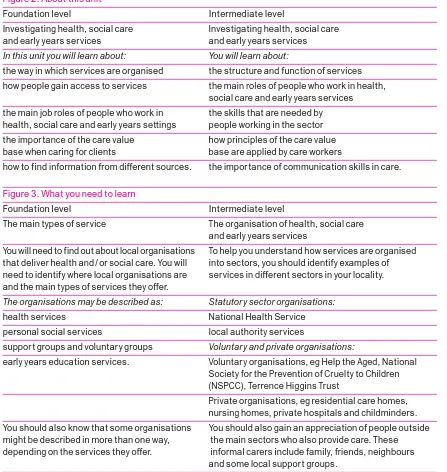
The way that the foundation and intermediate unit specifications overlap is best illustrated using an example.
Figures 2 and 3. Examples of how the unit specifications for Foundation and Intermediate Part One GNVQs overlap
Figure 2. About this unit
Foundation level Intermediate level
Investigating health, social care Investigating health, social care
and early years services and early years services
In this unit you will learn about: You will learn about:
the way in which services are organised the structure and function of services
how people gain access to services the main roles of people who work in health, social care and early years services
the main job roles of people who work in the skills that are needed by health, social care and early years settings people working in the sector
the impor tance of the care value how principles of the care value base when caring for clients base are applied by care workers
how to find information from different sources. the impor tance of communication skills in care.
Figure 3. What you need to learn
Foundation level Intermediate level
The main types of service The organisation of health, social care and early years services
You will need to find out about local organisations To help you understand how services are organised that deliver health and/or social care. You will into sectors, you should identify examples of need to identify where local organisations are services in different sectors in your locality. and the main types of services they offer.
The organisations may be described as: Statutor y sector organisations:
health services National Health Service
personal social services local authority services
suppor t groups and voluntar y groups Voluntar y and private organisations:
early years education services. Voluntar y organisations, eg Help the Aged, National Society for the Prevention of Cruelty to Children (NSPCC), Terrence Higgins Trust
Private organisations, eg residential care homes, nursing homes, private hospitals and childminders.
You should also know that some organisations You should also gain an appreciation of people outside might be described in more than one way, the main sectors who also provide care. These depending on the services they offer. informal carers include family, friends, neighbours
In figures 2 and 3 it is easy to see that the requirements for both levels are very similar. For planning purposes, the unit specification identifies topics that could be studied over a number of weeks. During this period, foundation and intermediate students could be taught together. In subsequent weeks intermediate students could fur ther develop their learning to reach the required level, while foundation students could be given structured worksheets and tasks to reinforce what they have learnt during the teaching inputs.
Many teachers design ‘work logs’ that enable both foundation and intermediate students to plan the time they spend working alone (see figure 4). When students have learnt how to use the work logs, some take on responsibility for writing their own. This way of working is what GNVQ aims for – students taking responsibility for their own learning.
Figure 4. An example of a work log
Vocational GCSE
Details of the content of the units have yet to be published. However, the GNVQ approach to tackling topics with students across the ability range will be just as appropriate on vocational GCSE courses.
16 TAKING PART ONE GNVQ FORWARD
Tasks I have to do
1.
2.
3.
4.
5.
Building in work-related learning oppor tunities
GNVQs are intended to provide students with a genuine vocational experience. Teachers need to examine the units carefully and identify how and where work-related activities can be built into courses.
Work-related learning oppor tunities could be achieved by:
■ finding work placements with employers (possibly half-days)
■ using work experience blocks to visit local industries and companies relevant to the vocational area
■ inviting speakers into centres
■ ‘adopting’ a company to suppor t a Par t One GNVQ course
■ involving governors or other contacts who work in industr y
■ inviting parents to talk about their jobs and work roles
■ using the experiences and interests of other staff (teaching and non-teaching) to provide insights into the world of work in the sector.
Vocational GCSE
Active learning styles
GNVQ students are required to work in different ways in the classroom to their peers studying ‘traditional’ courses. This means that teachers need to build in different approaches to teaching and learning when planning the deliver y of their courses, for example, tutor-led sessions, individual working and group working.
Figure 5 illustrates some of the best practices taken from centres that have set up and successfully delivered Par t One GNVQ courses.
Figure 5. Different approaches to teaching Part One GNVQ
Vocational GCSE
The vocational GCSE will continue to encourage the active learning styles that have been such a successful feature of Par t One GNVQs. Students have enjoyed being given greater responsibility for planning and carr ying out their work. Evidence from Ofsted and FEFC
inspections also shows that students benefit enormously from the active teaching and learning styles promoted by GNVQ qualifications.
18 TAKING PART ONE GNVQ FORWARD
Tutor-led sessions (tutors select aspects of the unit)
The teacher could:
give presentations to the whole class to introduce key aspects of the unit
use video/resource materials with ‘fact-finding’ questions
contact employers to organise visits to companies
develop worksheets that allow students to practice the coursework element
invite speakers from industr y to talk to the class
design in-house tests for students to complete.
Individual working
(students research aspects of the unit on their own)
Working individually, students could:
collect information from employers
read and take notes from set texts/publications, leaflets and newspapers
write letters or telephone
employers to arrange visits to the workplace
write up worksheets
give presentations
visit the librar y/resource centre.
Group working
(students work in groups to research aspects of the unit)
Working in groups, students could:
work on one aspect of the course and repor t back to the whole group
arrange group visits and interview people from industr y
carr y out role play/simulations
Assessment
Par t One GNVQs are assessed internally (through coursework) and externally (using tests). The nature of the tests and coursework varies according to each vocational area.
Internal assessment – the process
Students are required to produce a piece of coursework for each of the three units they are studying.
Each unit is given a grade and a points score.
Teachers review and provide feedback to each student on their achievements. Students can rework their coursework to achieve the best points score possible.
Teachers assess their students’ work.
Teachers internally moderate the work to check the assessment.
The awarding bodies check teachers’ assessment via moderation.
The final points score is allocated.
External assessment – the process
Students are required to sit a test for each of the three units they are studying.
a
a
a
a
a
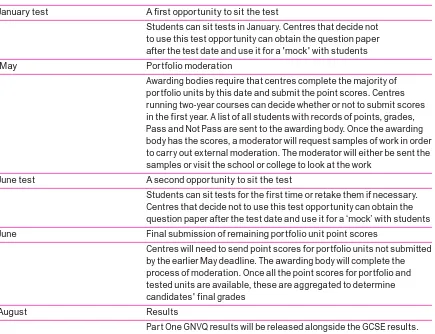
The assessment timetable
Par t One GNVQ centres have found that they need to plan assessment carefully to ensure that students have the best oppor tunity to
demonstrate their achievements.
Figure 6. Key dates in the assessment timetable
January test A first opportunity to sit the test
Students can sit tests in Januar y. Centres that decide not to use this test oppor tunity can obtain the question paper after the test date and use it for a 'mock' with students
May Portfolio moderation
Awarding bodies require that centres complete the majority of por tfolio units by this date and submit the point scores. Centres running two-year courses can decide whether or not to submit scores in the first year. A list of all students with records of points, grades, Pass and Not Pass are sent to the awarding body. Once the awarding body has the scores, a moderator will request samples of work in order to carr y out external moderation. The moderator will either be sent the samples or visit the school or college to look at the work
June test A second opportunity to sit the test
Students can sit tests for the first time or retake them if necessar y. Centres that decide not to use this test oppor tunity can obtain the question paper after the test date and use it for a ‘mock’ with students
June Final submission of remaining portfolio unit point scores
Centres will need to send point scores for por tfolio units not submitted by the earlier May deadline. The awarding body will complete the process of moderation. Once all the point scores for por tfolio and tested units are available, these are aggregated to determine candidates' final grades
August Results
Par t One GNVQ results will be released alongside the GCSE results.
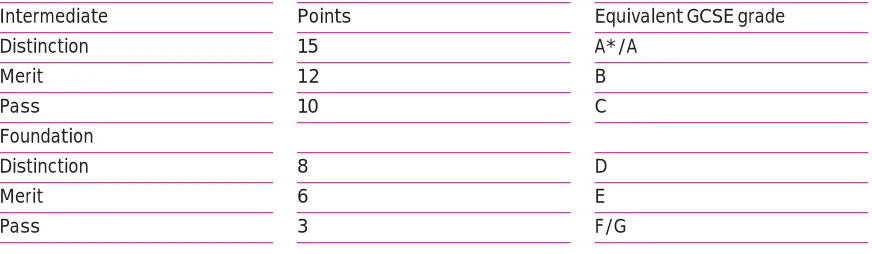
The points grid
Each unit is given a grade and a set of points. Figure 7 indicates the number of points that constitute Not Pass, Pass, Merit or Distinction.
[image:21.595.83.518.139.473.2]Students do not have to pass each test or piece of coursework. Good performance on one unit can compensate for poor performance on another unit. Students are able to build up points over the two years of the course and also have the oppor tunity to improve their marks for both the internally and externally assessed elements. They can rework coursework to improve the points they achieve and also re-sit the test.
Equivalence to GCSEs
The Par t One GNVQ is treated as a double award, equivalent to two GCSEs. The point score equivalencies for Par t One GNVQs are shown in the table below.
Figure 7. Point score equivalencies for Part One GNVQs
Vocational GCSE
Details of the assessment for vocational GCSEs have yet to be worked out. However, the qualifications will be graded as other GCSEs – from A* to G. The vocational GCSE will also be equivalent to two GCSEs.
Intermediate
Distinction
Merit
Pass
Foundation
Distinction
Merit
Pass
Points
15
12
10
8
6
3
Equivalent GCSE grade
A*/A
B
C
D
E
[image:22.595.81.517.236.363.2]Preparing students for tests
Teachers should check the specific details for unit(s) with the awarding body and explain to their students:
■ the conditions under which the test will take place: the length of time allowed for the test, what materials and equipment can be taken into the room, and who, if anyone, the student can communicate with during the test
■ the instructions to the candidate. Make sure that any uncer tainty is cleared up so that students will not be confused on the day of the test. Perhaps show the students a completed sample front sheet and ask them to fill in their own details on a blank version
■ the format of the test. For example, what kinds of questions will they be asked? How many questions does a typical test contain?
■ the way the mark scheme works. Use the sample assessment materials supplied by your awarding body to show how marks are conver ted into grades
■ the nature of the response expected from them. Are the students expected to produce single-word or ver y shor t answers, or are longer, more detailed answers expected?
Build students’ confidence
■ Introduce the notion of tests to students ver y early on in the programme.
■ Use the practice materials provided by the awarding body to familiarise students with the test.
■ Let students practice answering sample test questions in groups and individually. As the test date approaches, increase the number of questions set and hold tests in the same conditions as those specified by the awarding body.
Teach the knowledge
The unit specifications are impor tant here. Teachers will need to teach all of the ‘What you need to learn’ section of each unit if students are to succeed in their tests. The assessment evidence grid tells students what the tests will focus on. Tutors therefore need to base their teaching programmes on both of these sections of the unit specifications.
Fur ther information on preparing students for assessment can be found in two Vocational Learning Suppor t Programme publications:
Get ready – preparing students for assignment writing
Get ready – preparing students for external assessment.
Vocational GCSE
Students taking vocational GCSEs will need to be taught the subject knowledge in the specifications and have the oppor tunity to practice taking the tests.
Moderation
It is impor tant that students are made aware of how their work is assessed and that other people outside their school or college are involved. Knowing that there are external factors, deadlines and procedures will help tutors encourage students to complete work for assessment on time.
There are two stages to the moderation process for GNVQ portfolio work:
Internal moderationinvolves putting in place arrangements to ensure that the assessment decisions made by teachers are consistent for all pieces of coursework in each vocational area and at each level (foundation and intermediate). The purpose is to ensure that all students are treated fairly within the centre and that their work is assessed in the same way, regardless of which tutor assessed it and when that assessment was made.
External moderationinvolves either sending off samples of assessed coursework or having a moderator visit the centre to look at samples of work that have been assessed at the centre. The purpose is to ensure that the standards applied in all centres are the same and that all students for the qualification, across the countr y, have been treated fairly and in the same way. The awarding body will supply the name of the moderator and details of what needs to be sent to that person and by when. If visiting moderation is used, the centre will be told when the visit is to be made and what the moderator will be expecting to be able to see in terms of students’ work.
Vocational GCSE
Progression
Par t One GNVQ teachers need to consider the progression
oppor tunities available to students on completion of their courses. Students who complete the award will have worked through three GNVQ units and may also have achieved cer tain key skills units. Par t One GNVQ will have given them an experience of different learning styles and a good grounding in the vocational area. While Par t One GNVQ has introduced them to one vocational area, for many students it will not be the area they are considering for their next course, training programme or job.
For Key Stage 4 students
For students at Key Stage 4 progression will depend not just on how well they achieve on their Par t One GNVQs but also on how well they achieve on other qualifications they take, such as GCSEs or entr y level awards. If they decide to carr y on in full-time education, there are a number of options they could consider:
■ taking other GNVQ units at the same level as their Par t One to achieve a full award
■ star ting a full award GNVQ at the next level up or a vocational A-level
■ AS-levels.
For post-16 students
For post-16 students progression will also depend on what other courses they have taken alongside their Par t One GNVQ and how well they achieve across all the courses. The options open to post-16 students may also include:
■ a Modern Apprenticeship programme
■ an NVQ programme
■ diploma courses
■ AS-level/vocational A-level
■ looking for a job opportunity in the vocational area of their Part One GNVQ
■ looking for a specialist, occupational training course linked to their career aspirations.
Vocational GCSE
It is likely that the progression oppor tunities available to students (both Key Stage 4 and post-16) will be similar to those currently available to Par t One GNVQ students.
Section 3 contains case studies from schools and colleges that have implemented Par t One GNVQs at either Key Stage 4 or post-16 level. Topics discussed include:
■ the rationale for implementing the course
■ marketing
■ planning the deliver y
■ teaching and learning strategies
■ progression.
Some of the institutions featured also produced sample assignments and schemes of work. These can be downloaded from the Vocational Learning Suppor t Programme website (www.LSagency.org.uk/vlsp).
Par t One GNVQs at Key Stage 4
Beaumont Leys School
Introduction to the school
Beaumont Leys School is located within the city of Leicester. It is a coeducational comprehensive with 1016 students aged 11–16 on roll. Of these, 524 are male and 492 are female. The ethnic contribution to the school population is 20 per cent and 21 per cent of the students are eligible for free school meals.
The school is involved in Leicester Compact, a par tnership between local employers, schools and students. There is a Careers Education and Guidance programme, which is delivered through PSE and tutor time, and all upper-school students under take two weeks’ work experience which is complemented by visits from local firms and the careers services.
Why offer Par t One GNVQ Manufacturing?
Initially, vocational courses were offered to suppor t the school’s links with industr y. The Par t One GNVQ Manufacturing was seen as a natural progression from this. Well-suited to the needs of our students living in the industrial city of Leicester, the course also complemented our Par t One GNVQ qualifications in information technology, business, and health and social care.
Marketing the qualification
The success of Par t One GNVQ Manufacturing to date
Examination results
What do the students think about the course?
A shor t questionnaire was compiled to find out what students think of the course.
Why did you choose Part One GNVQ Manufacturing as one of your options?
The majority of the students enjoyed making things and thought that the course would be interesting. They were also swayed by the fact that a GNVQ is equivalent to two GCSEs.
Having nearly completed Unit C, what do you think of the course so far?
Adjectives used included: excellent, good, hard, difficult and challenging. Students commented that they enjoyed working as a team and had learnt a lot.
Would you consider a job in manufacturing in the future?
A ver y positive response. All students are considering to different degrees a job in the manufacturing industr y.
How does your GNVQ subject compare with your GCSEs?
The general consensus was that while the course was difficult and there was more work to complete, it was more interesting, rewarding and wor th the equivalent of two GCSEs. One student commented that it was a ‘better way of learning’.
30 MANAGING PART ONE GNVQS
Par t One GNVQ Manufacturing – key issues
Attitudes towards the course
■ Preconceptions of teachers and parents towards manufacturing are often misconceived and difficult to change.
■ The manufacturing industr y does not tend to receive a high profile nationally.
■ Students’ aspirations do not favour manufacturing as a vocation.
■ Other GNVQs are more appealing: Business (money), Science (intellect), Health and Social Care (welfare), Leisure and Tourism (holidays), Manufacturing (???).
■ Girls are very reluctant to choose manufacturing as a vocational course.
■ Manufacturing tends to attract less academic and challenging students who are keen on practical work but reluctant to complete the written elements of the course.
Mechanics
■ There is no feedback from examination results regarding marking criteria or students’ performances within a grade.
■ Material is not always for thcoming from examination bodies.
■ Exam papers have had to be faxed to the centre during the examination period.
■ No unit specifications were received from AQA (they had to be downloaded from the internet).
Delivery
■ The new Par t One is much easier to manage.
■ It is less prescribed and offers greater flexibility and scope for deliver y within centres.
Tips for new centres
■ Secure industrial links.
■ Contact centres already offering Par t One GNVQ Manufacturing.
■ Seek help and advice from your moderator and regional and local self-help groups.
■ Include able and talented students in your marketing strategy.
The future of Par t One GNVQ Manufacturing at Beaumont Leys School
GNVQ staff were advised in December 2000 that the existing Par t One GNVQs were to become vocational GCSEs. The school awaits fur ther information on this development, but hopes that the qualification remains general and equivalent to two GCSEs.
One factor that should be considered is that unless people begin to understand the vocational oppor tunities in manufacturing locally and nationally, the future of the new Par t One is challenged. As soon as a high-profile marketing strategy is relaxed, manufacturing fails to attract a cross-section of students – quite the opposite. The 1998 cohor t was poor and in 1999 we only recruited students capable of foundation level. The 2000 cohor t will hopefully reverse this trend and we should achieve some ver y successful results.
Par t One GNVQs at Key Stage 4
Impington Village College
Progression
When students join the Par t One GNVQ course they are made fully aware of the GCSE equivalent in any final results they may achieve. The majority of our students go on to study academic FE courses and the students know that their GNVQ results will help them towards accessing their future options.
We make students aware that their GNVQ qualification, although not necessarily preparing them for work in leisure and tourism or health and social care at 16, will prepare them ver y well for any future course, which may lead directly to employment in these vocational areas. So far, two 16-year-old leisure and tourism students have taken up work-based training in travel agents. Many Par t One GNVQ Engineering students also follow the work-based training route.
Par t One GNVQs at Key Stage 4
Sawston Village College
Sawston Village College is a comprehensive school for 11–16 year olds in South Cambridge with 1085 students on roll. We have technology college status and our aim is to meet the needs of ever y student and to maximise their achievements, whatever their ability. The college does not have a sixth form, but students moving into further education have a choice of sixth form colleges in Cambridge to pursue their studies.
Consequently, as a centre introducing vocational courses, we had no experience of GNVQ whatsoever! Undaunted, we joined the Par t One pilot project in 1997 offering ICT. With only one year’s experience under our belts, but thoroughly convinced of the value of Par t One, we introduced health and social care in 1998.
The rationale for introducing Par t One GNVQ
Par t One GNVQ gave us the oppor tunity we had been waiting for to extend our curriculum at Key Stage 4 and to meet the needs of those students for whom a traditional programme of GCSEs was inappropriate.
Par t One GNVQ has enabled the college to:
■ challenge and motivate both the ver y able and the disaffected, underachieving students
■ create independent learners with confidence and maturity
■ meet the needs of more students, regardless of their ability.
Par t One GNVQ has enabled Sawston Village College to:
■ manage their own learning and achievement
■ experience the world of work and see the relevance of their studies
■ acquire a balanced package of qualifications with a clear progression route.
Management issues
Involving and gaining the support of senior management
It was vital that the Par t One GNVQ course received the status and recognition it required to become established within the curriculum. Senior management recognised this and suppor ted the vocational team wherever possible.
Establishing a viable curriculum model
Deciding where the new course would sit in the curriculum model was a major issue. Would other subject areas be affected by the 20% time requirement? Would it restrict student choice? Would other subjects feel threatened by its introduction? Who will teach it – will they be specialists or recruits from other curriculum areas?
Staffing the courses and defining roles and responsibilities
As a centre new to GNVQ we appointed a GNVQ coordinator who had credibility and was committed to the GNVQ culture and philosophy. We then had to maximise our exper tise as it was not always possible to have total specialists delivering the course.
Addressing new and different teaching and learning styles
It was essential that the team involved in delivering Par t One GNVQ recognised the different approach to learning and the potential it offered to students. The aim was to encourage independent learning by giving the students more autonomy in the planning and deliver y of assignments and to create oppor tunities for the vocational dimension to be included wherever possible.
Assessment and monitoring student progress
The new teaching and learning strategies demand that a ver y clear and manageable assessment structure is in place. At Sawston, we found the following have helped:
■ regular discussions with students in lessons on a one-to-one basis and targets set if necessar y
■ manageable but firm deadlines
■ parameters for revisiting assignments
■ keeping the documentation as simple as possible – awarding bodies have designed templates in most cases that can be adapted and given an ‘in-house style’
■ ensuring that time for moderation is clearly identified in the school calendar and recognised by SMT as essential to the assessment process.
The students
Students who opt for Par t One GNVQ courses at Sawston are largely positive about the course, enjoy the different experience and particularly the freedom and flexibility it offers them in their work. They appreciate being given the chance to show greater responsibility and initiative. The transformation in some students is amazing. Able students can become sophisticated-independent learners who produce outstanding results. Students who do not perform well in other areas of the curriculum adopt a different attitude to their GNVQ work, and if given the oppor-tunity will work to achieve a higher grade than in other subjects.
Obviously not all students cope as well, par ticularly some foundation students who have to work within a more structured framework. It is impor tant that the course is tailored to meet the needs of the ability range and this can be quite demanding on the teacher.
Progression
Establishing sound progression routes is vital to the success of Par t One. At Sawston, we do not have a sixth form but students feed into surrounding sixth form colleges. Communication between the school and the colleges has been taking place and students feel par t of the transition process.
Key issues
■ SMT suppor t
■ resources
■ curriculum planning
Tips for new centres
■ Star t with a manageable number of students, especially if you have no GNVQ experience at all.
■ Insist that all staff involved in GNVQ are trained in delivering and assessing the qualification.
■ Aim for a mixed-ability group if possible. Do not target only foundation students. This reduces the status and credibility of the course.
■ Fight for a vocational base – you will need somewhere to store a variety of resources and to keep students’ por tfolios safe.
■ Ensure that students have some access to IT if the centre is not delivering Par t One ICT.
■ Seek out all available suppor t – network with other schools as much as possible, investigate local and national suppor t mechanisms such as your LEA and the Vocational Learning Suppor t Programme.
■ Tap into all your local contacts. Use parents, governors and friends. Send out an initial questionnaire to local companies explaining the course and asking them to respond to any areas in which they may be able to help.
■ Spend time on your induction. Make it exciting, but ensure that students know exactly what they are letting themselves in for.
Par t One GNVQs at Key Stage 4
Thurston Community College
Thurston Community College is a 13–18 mixed, rural comprehensive school with approximately 350 sixth form students and 300 students in each of the other years.
At Thurston we had a successful histor y of vocational provision within the post-16 curriculum and took the first available oppor tunity to offer GNVQ in the academic year 1993/94. Since that time a major commitment has been made to offer a full range of GNVQ courses alongside A- and AS-levels. Par t One GNVQ suppor ted our wide-ranging pre-16 curriculum and offered a seamless progression route to all students aged 14–19.
Par t One GNVQ gave the school an oppor tunity to:
■ introduce a vocational track throughout the 14–19 curriculum
■ offer an alternative teaching and learning style
■ move away from the GCSE-dominated curriculum
■ increase choice.
Marketing
The marketing of the Par t One programme was our first real priority. Parents and students had to be convinced that these courses were:
■ of equal wor th to the GCSE
■ for students of all abilities
■ going to be recognised as a real qualification by employers and gatekeepers of post-16 programmes in the future.
We took as our target group all year 9 students across the ability range. Par t One programmes were given the same emphasis as GCSE – we were careful not to single out a type of student for whom this programme may be more suitable. The idea of an alternative style of teaching and learning was stressed rather than early specialisation on a vocational pathway. The following quotes are taken from the year 9 pathways booklet.
GNVQ courses are demanding
Planning the deliver y
Like all other courses, a Par t One programme must be effectively managed. We ensured that team members were able to:
■ meet regularly, both formally and informally, to plan, discuss and develop the programme
■ work with a united perspective
■ work with par tners beyond school, eg in business and commerce, and vocational fields
■ develop high-quality assessment and monitoring strategies.
Other whole-school management issues that were considered before the star t of the programme were:
■ the continuity of the 14–19 curriculum
■ student entitlement and access to the courses
■ progression oppor tunities
■ links with other programmes and courses, and the year 9 option system
■ group size.
The table below summarises the differences between Par t One GNVQ and GCSE that the deliver y team considered to be significant and hence shaped the teaching and learning style adopted – the most impor tant of these being the emphasis on student-led involvement in learning. This was highlighted by a quote from one student who when asked about the difference in teaching style between Par t One GNVQ and GCSE replied ‘in GNVQ we do things, in GCSE we read books’.
Students are encouraged from the beginning of the programme to be more responsible and to have ownership of their learning. This does mean that they are encouraged to use resource centres, libraries and the telephone early on in the course. Some degree of walking about the building is to be expected with students ‘out of class’. This may come as a culture shock to others within the school environment. It is therefore impor tant that all staff are aware of new course development in the institution.
40 MANAGING PART ONE GNVQS
Part One GNVQ
Emphasis on skills
Student-led involvement in learning
Internal assessment encourages more cooperative skills between students and assessors
Unit approach and assessment at the end of each unit
GCSE
Emphasis on knowledge acquisition
Teacher/syllabus-led
Syllabus dictates requirements of students
Recruitment into year 10
All courses, with exception of manufacturing, have recruited a wide range of ability. Manufacturing did not and subsequently was removed from the curriculum. A number of reasons have been suggested for this, including the name and the deliver y solely within the technology cur-riculum. The number of students undertaking a Part One programme has grown from a modest 10 per cent of the year group at the beginning to approximately 35 per cent of students.
Results
Student results have secured the future of Par t One GNVQ at Thurston – even after the initial pilot funding ceased. Ninety per cent of students have gained the full award and the A*–C points score has been increased overall by the inclusion of Par t One GNVQ. Seeing their accreditation build up throughout the course has no doubt encouraged students. Students have demonstrated an increased motivation and their research skills have improved. In addition, they have become a more confident cohor t, with a greater responsibility for their own work. The awareness of career needs has also increased, although not nec-essarily within the vocational area in which they were working. The overall effect of Par t One is that more students are taking advanced vocational courses.
Subject area
Business
Ar t and design
Leisure and tourism
Par t One GNVQs at Key Stage 4
Wrenn School
Introduction to Wrenn School
Wrenn School is a mixed 11–18 comprehensive school situated on two sites in Wellingborough, Nor thamptonshire. It currently has 1329 students on roll from wide socio-economic backgrounds.
Why introduce Par t One GNVQ?
GNVQs were offered for the first time in 1995, when students could choose to study a one-year, full-time course in health and social care, leisure and tourism or business.
These post-16 GNVQs proved ver y successful. Given that we had experience in running health and social care and leisure and tourism, and appropriately trained staff, we felt it was a natural progression to offer these two areas at Key Stage 4. We decided not to offer business because our GCSE course has always been, and continues to be, ver y successful.
Par t One GNVQ courses are aimed at students of all abilities.
*This student later transferred to intermediate level
Marketing
The Par t One courses are marketed in a number of ways. Year 9 students all receive an options booklet, which contains detailed information on the qualification generally, and the specific subject areas. Parents and students are then invited to attend an options information evening, where the head of year, deputy head (curriculum) and head of careers discuss options and progression.
The GNVQ coordinator goes into year 9 assemblies to highlight these ‘new’ GNVQ courses and often form groups are visited, too. We have also used various marketing materials produced by the exam boards.
Success so far
Our Par t One students are on line for great success.
CASE STUDY WRENN SCHOOL 43 Take up figures
1999/2001
Leisure and Tourism
Health and Social Care
2000/02
Health and Social Care
1999/ 2001 cohort
Leisure and Tourism 7 1 1 1* 1 1
Health and Social Care 16** 4 3 7
*Two other students may only gain unit accreditation due to special circumstances **Two students out of the original 16 have now left school
The Par t One model
When we first introduced Par t One GNVQ we ran leisure and tourism and health and social care (1999/01). Although both these subject areas were offered in 2000/02, we only had take up for health and social care. Both subject areas are again being offered for 2001/03.
The Par t One GNVQ is allocated 6 x 50-minute lessons per week. Every GCSE subject in school gets 3 x 50-minute lessons, and as a Part One Award is equivalent to two GCSEs the time allocation is doubled.
Staffing
Two members of staff deliver the health and social care course. The same staff teach year 10 and year 11.
The teaching is split according to units:
Health and social care
Unit A Staff member X 2 x 50-minute lessons
Unit B Staff member Y 4 x 50-minute lessons
Unit C Staff member Y 4 x 50-minute lessons
Staff member X has two years’ experience of Par t One, although she had previously taught post-16 GNVQ for a shor t period of time.
No of students Inter
mediate Di s ti n c tio n Inter mediate Me ri t Inter mediate Pa s s
Foundation Dis
Deliver y of the course
The two members of staff deliver the course over five terms. We decided to teach the units as follows:
Year 10 Year 11
Unit A Taught September to May
Unit B This unit is taught over the 5 terms
Unit C Taught September to July
Industr y links
A wide variety of visitors have been used for the health and social care course. They work with the students, give talks, presentations and show videos.
These links are invaluable. The students are exposed to real-life situations and are learning from the exper ts who are in the workplace. Links with industr y improve motivation and put classroom-taught theor y into context.
Examples of links: nurses, care assistants, residential care homes, voluntar y organisations, informal carers, Health Education Authority, area health authority.
The students
The 2000/02 cohort – Part One GNVQ Health and Social Care
There are 16 students in the group: 15 female and one male. (We are concerned about the gender balance this year – last year we had 12 females and four males.)
The group is of mixed ability.
What the students think about Part One
They love it! They like the:
■ styles of teaching
■ variety of activities and approaches
■ fact that it is active
■ teamwork
■ different working relationships
■ fact that it is interesting
■ fact that they can get involved
■ suppor t.
Key issues
■ Marketing is vital:
■
■ to students
■
■ to parents
■
■ to staff.
■ Staff need time to plan and discuss units.
■ Visitors and visits aid motivation immensely but these need writing into your schemes of work early.
■ Find room to store resources and coursework.
■ ICT access again aids motivation and helps break up some of the drier lessons.
Tips for new centres
■ Build up a bank of visitors/speakers/visits.
■ Get visitors and visits booked and planned early.
■ Ensure that staff teaching the course sit, talk and plan together.
■ Try and build up links with other colleagues/schools teaching the units.
■ Get recommendation from colleagues/schools on the usefulness of resources – you can make some expensive mistakes.
■ Write your scheme of work so it nests the foundation and intermediate levels (a good resource is the QCA booklet).
■ An SMT link who has knowledge of vocational courses is a godsend.
The future of Par t One at Wrenn School
Next year we plan to offer health and social care, and leisure and tourism.
Par t One GNVQs at post-16
Stroud College
Stroud College has approximately 8000 students, of whom 600 are full time. The college is made up of five schools: business, ar ts, health care and leisure studies, integrated studies, and technology and engineering. Across college we offer courses from foundation level to first-year degree level in a range of subjects.
The rationale for offering Par t One GNVQ
To quote our Head of Integrated Studies, ‘We are running the course to give students who are ready the oppor tunity to experience a range of vocational areas in the college, to enable them to make a more informed choice about their future. Basically, this is to broaden their experience of college as much as possible and provide them with a progression route.’
At the beginning of 2000/01, I [an engineering lecturer] was asked to run Par t One GNVQ Engineering Foundation for a group of eight Integrated Studies (IS) students – students with special needs.
The Par t One model
Par t One GNVQ Engineering Foundation students are studying the following subjects this year:
■ Unit A – Design and graphical communication
■ Unit B – Application of new technology in engineering
■ Unit C – Make engineered products.
Timetable
The fact that each IS student had a timetable tailored to his/her individual needs made it ver y difficult to find a teaching slot. However, the course was allocated four hours per week, spread evenly over the academic year. The normal college lunch hour is between 12.15 and 1.15pm, but ver y early on in the course the students raised their concerns about working a three-hour afternoon. They felt that this was far too long, so by negotiation we fixed the classes equally each side of a rescheduled lunch hour.
Progress
One student withdrew from the course ver y early on in the year, deciding that engineering was not for him. The remaining seven students have made excellent progress with the practical aspects of Unit C ‘Make engineered products’. Provided they can follow a step-by-step plan they generally produce some good work. I am quite sure that two or three students have the aptitude to follow the Modern Apprenticeship path in the long term.
Key skills
We have a cross-college team of key skills specialists. Ideally, they should look at all vocational and technology assignments and try to find the maths, communication and IT within them. Where there are gaps, they then work out additional exercises to fill them.
Because I have been ver y late in finalising my assignment for the Par t One, the key skills lecturers have written their own assignments. The summer term will be the earliest that we will be able to sit down and compare assignments.
The students
All the students on the course have special needs. One of my keenest students has real problems with number and even with lots of help from the key skills tutor, this remains problem. I have a student who is dyslexic. I have two students who have had, and still do have to a lesser extent, problems with attendance. Three students want to spend their lives playing computer games but are just catching on to how hard it would be to make a living at it. I have one student who lacks a bit of confidence, but will probably end up working in the engineering sector.
What do the students think of the course?
Even at this stage, no one wants to drop out. The students seemed to enjoy the Christmas period when they were making things to a set but fairly relaxed regime. Tr ying to get them to produce written work and drawings on an individual basis has been difficult, to put it mildly.
The future of Par t One at Stroud College
Par t One GNVQs at post-16
Thurston Community College
At Thurston, students unable to cope with the demands of vocational A-levels or AS-levels tended to opt for various courses leading to the GNVQ full award. However, with improved GCSE results the numbers of students enrolling for Intermediate GNVQs decreased, making it difficult for the college to justify running these programmes. This was why we decided to introduce Par t One GNVQs into the post-16 curriculum under the general title of ‘preparation for advanced study’.
Three Par t One subjects were included in each student’s programme with the understanding that they should follow at least two of the courses. The courses were business, health and social care and information technology. The majority of students also followed GCSE Mathematics and GCSE English.
Par t One GNVQ courses at post-16 did not suffer the same timetabling restraints as those at Key Stage 4. Greater blocks of time were available for teaching the course at post-16 and most students were occupied for approximately 22 periods in a 30-period week. A compulsor y period of work experience was included in the course.
The management team responsible for other vocational courses under took responsibility for planning and running the Par t One programme, which was timetabled outside the main sixth form blocking arrangements to allow greater flexibility.
Student response has been encouraging. They have welcomed the oppor tunity to study a broader curriculum as many students in this cohor t have yet to decide their career intentions. It is envisaged that after this programme some students may progress to vocational A-level courses or other courses at this level. Some students will seek employment on completion.
Successful introduction of Par t One GNVQ is dependent on:
■ high-quality staff development, which focuses on management, planning, deliver y and assessment
■ a whole-centre approach towards the programme, involving SMT, pastoral advisers, career advisers, tutors, vocational staff and outside agencies
■ the programme recruiting an ‘all-ability’ cohor t of students
■ governors, parents and local industr y suppor ting the courses.
The future
Par t One has been a success at Thurston because of the significant differences in content, deliver y, assessment and teaching and learning styles compared with GCSE.
Par t One GNVQs at post-16
Wolverhampton College
Wolverhampton College is a large multi-site FE college with approximately 14,000 par t-time and 1800 full-time students. Provision for 16–19 year olds includes a broad range of general and vocational A-levels, GCSEs and intermediate and foundation qualifications in technology, science, motor vehicle, construction, catering, hairdressing, beauty, media, performing ar ts, ICT, health studies, business, and leisure and tourism.
Why offer Par t One GNVQs?
Each year a large number of foundation and intermediate students come to the college. Many do not wish to specialise at this stage and, therefore, they select a broader education, which often leads to GCSE retakes. As in many colleges, the achievement and retention of such groups were not satisfactory. To address this issue, a cross-college work-ing par ty was set up with a view to developwork-ing and replacwork-ing the full-time GCSE re-sit course with a more appropriate vocational programme.
Model
Foundation and Intermediate GNVQs will be available from September 2001. Most options will combine the teaching of both levels. The Par t One GNVQ Intermediate is equal to two GCSEs (A*–C) and the foundation level (D–G). Eight hours per week will be allocated to the deliver y of Par t Ones.
■ GCSE Maths and English will be available in all grid slots and Science in two grid slots.
■ There will be more integration of key skills into the main curriculum area and the wider key skills will be delivered via the tutorial programme.
There will also be a range of NVQ options: business administration, foreign languages, music technology and spor t for life.
GNVQ students will need strong tutorial suppor t, with par ticular attention given to action planning and individual progress reviews. Various tutorial suppor t models are being discussed prior to implementation in September 2001. They include:
■ 1.5-hour tutorial slots weekly
■ caseloading with shor ter weekly sessions
■ introduction of ‘super tutors’, who will spend a considerable par t of their time tutoring
■ use of specialised suppor t staff to deliver the tutorial programme
■ for enrichment: a coordinating group will oversee the events and produce an integrated college-wide calendar of activities. There will be close liaison with the student union and external bodies, eg Millennium Volunteers.
Staff development
A working par ty drawn from the respective GNVQ areas reconvened after Easter to coordinate the programme in preparation for the September 2001 launch. Staff training days have been arranged for college staff to receive current information and work on schemes, assignments, resources and assessments.
Key skills
Marketing
The proposals are currently being publicised in local secondar y schools and initial expressions of interest have been encouraging. A marketing campaign will be launched in the summer term to promote the initiative. This will include:
■ 16–19 college brochures
■ radio interviews
■ taster sessions to be arranged in the summer term
■ mailshots to appropriate external organisations.
The message is clear – students need to be aware of a mix-and-match vocational and academic curriculum customised to their specific needs.
The students
The programme is aimed primarily at the large number of students who come to the college in September having failed to achieve GCSE grades at A*–C. Many of these students are unsure about their future career path and are somewhat reluctant to commit themselves to the full GNVQ Intermediate award – they currently retake their GCSEs. Par t One GNVQs, however, will allow them to pick up a vocational qualification at the same time as GCSE Maths and GCSE English.
The programme is also suitable for students who, for a variety of reasons, have missed substantial periods of schooling in year 10 and year 11 or have not achieved qualifications at 16.
Progression
Many level 2 students do not attain the entr y-level requirements to progress to level 3. The Part One GNVQ initiative should allow students to achieve the equivalent of four GCSEs and thereby progress. On completion of the programme the students may move on to a vocational A-level in the respective GNVQ area. The overall aim and strategy is to improve retention and achievement rates and give students a sense of accomplishment and belonging. The strong tutorial framework will focus on pre-entr y guidance, comprehensive on-programme suppor t and progression routes. The students will see the college as a vehicle of transportation from foundation level to a more advanced programme, and not merely a ‘one-stop’ bus ride.
Conclusion
Many colleges have decided to wait for the arrival of the vocational GCSEs and are continuing with their existing curriculum of either retake GCSEs or GNVQ full awards. Wolverhampton College has decided to initiate the Par t One programme from September 2001 to address the issues of:
■ curriculum innovation
■ retention
■ achievement
■ progression
■ growth
■ potential 14–16 collaboration with local schools.