Providing ongoing just in time professional development in
engineering education
Brodie, L
University of Southern Queensland, Toowoomba, Australia [email protected]
Jolly, L
Strategic Partnerships, Brisbane, Australia
Abstract: Academics who respond to demands for more collaborative teaching practices do so because they place value on the student experience, scholarship and learning. Unfortunately, a barrier to this change is developing skills across the teaching team. Differences in philosophy, practice and personality can have major impacts on the learning experience. In particular it is important that tutors, the front line troops of teaching and the ones that students often relate to most, understand the approach being taken in the course, especially if it is an innovative one. Even where tutors may be experienced academics in their own right, they may not fully understand the rationale and methods being employed and may need skill development. Professional development for staff in practical learning and teaching initiatives is often overlooked by universities. However, it is vital for staff to engage in new learning and teaching practices and for these practices to be sustainable at the Faculty and University level. This paper reports a professional development program for staff in a Faculty of Engineering engaging in cooperative and collaborative classroom activities. Beginning with a one day workshop to enhance staff skills and confidence in engaging students in team based learning activities both in face-to-face and online modes, it also is developing an ongoing monitoring and evaluation framework. This framework allows for regular capture of information about the effectiveness of the course and allows for timely responses to emerging issues and provides a model that can be adapted to many educational initiatives.
Introduction
The Engineering Problem Solving Strand is a core strand of four courses offered in all of the Faculty’s undergraduate programs (Bachelor of Engineering, Bachelor of Technology and Associate Degree programs across all majors). The courses use a Problem/Project Based Learning paradigm and students work in teams to meet a wide range of course objectives. Objectives include both technical skills and knowledge as well as several key graduate attributes e.g. teamwork, communication, problem solving etc. These courses have been recognised through several national awards for innovation in curriculum.
These types of courses have a high staff workload allocation due to the interactive and facilitative nature, and often use a large number of part time (sessional) staff. Full time academic staff are also regularly rotated into the courses to balance workloads. Due to the unique nature of courses of this type and the general flexible learning environment offered at the institution, staff development is critical because each semester sees a new wave of staff who need to be quickly up-skilled in the learning and teaching
been run on an ad hoc basis, with no formal mechanism to monitor staff requirements or evaluate either the workshop or the courses in terms of facilitator training.
PBL courses require high energy maintenance to keep delivering their promised benefits year after year. In developing staff resources it came to our attention that some of the pressure of this maintenance could be relieved by instituting ongoing monitoring and evaluation structures which would let course
controllers know at any point in time how the courses were travelling and make informed decisions about change when necessary.
The role of the tutor in PBL
PBL requires special skills in its teaching staff because it is a form of learning in which the learner constructs their knowledge based on prior skills, knowledge and their overall views (Savery & Duffy 1995). The prompt for the learning is an ill structured problem which is complex and does not have a single correct answer. Students have the opportunity to develop skills in problem solving, critical thinking and self directed learning (Sobral 1997; Das et al. 2002; Hmelo-Silver & Barrows 2006). PBL has three characteristics: the learning is situated in a real life context or problem; students are responsible for their own learning and the direction of their own research; and learning and ideas are elaborated and tested by group discussions (Dahlgren et al. 1998). In this student-centred discourse, students drive the discussion and the teacher serves to guide the learning process (Collins, Brown, & Newman, 1989). Thus tutors or teachers of PBL do not ‘primarily disseminate information’ to students but guide the students to find their own answers, provide feedback, and stimulate student interest and learning (Dolmans et al. 2002). Tutors scaffold student learning.
The effectiveness with which facilitators can do this is influenced by the conceptions the facilitators themselves have about effective teaching and learning (De Grave et al. 1999). Rando and Menges, (1991) propose that these personal theories of teaching and learning are often implicit and may be inaccurate. The theories may be broadly categorised into two main areas: ‘learning facilitation’ and ‘knowledge transmission’ (De Grave et al. 1999). Lecturers who see their role as transmitting knowledge are more focused on content than on learning. They have a didactic approach to teaching, seeing themselves as the content expert and their role is to pass on this content to the students, who passively absorb the knowledge. Many participants in our workshops have expressed concerns about how best to get the information across to students, thus revealing a transmission model. Other lecturers see their role as ‘facilitating’: encouraging students to learn for themselves and explore the content. These two different approaches to teaching may explain the different profiles and effectiveness of PBL tutors (Dahlgren et al. 1998; De Grave et al. 1999).
Dolmans et al (2002) reported on the major trends in studies investigating tutors in PBL. Not
surprisingly perhaps, they concluded that the ‘content expert’ tutor took a more directive approach, using their content knowledge to direct the group discussions, whereas the non-content expert took a more supportive role and used “their process-facilitation expertise more to direct the tutorial group”. In addition, the research concluded that a tutor should “know how to deal with the subject matter expertise”, although not necessarily be an expert, and know how to facilitate the learning process. Professional development for PBL tutors is therefore a matter of encouraging a truly facilitative rather than instructional pedagogic approach.
Recognition of the skill of facilitating and recognition that a tutor’s performance is not a stable
Tutor resources and training
Effective training programs for staff are an essential ingredient in the long term sustainability and success of the PBL course or program (Wetzel 1996). It is critical that these professional development programs are ongoing, so as to support the program after the first flush of enthusiasm is over and that they can be delivered ‘just in time’ to meet the needs of new staff coming into the program or old hands who need to be revisit the rationale and methods of PBL.
In planning the training, several basic elements must be considered (Wetzel 1996):
x The educational goals and outcomes of the course or program, including the curriculum content;
x The resources which can be directed to the training program. This includes the time staff and management may be willing to devote to professional development activities; and
x The evaluation of tutors/facilitators.
Our training program consists of a day-long immersive exercise, a thorough and up-to-date library of reference works to support tutors and an evaluation framework. In developing this program we have tried to tailor material for our specific implementation of PBL and our course objectives, but maintain some generic material which enables it to be used in other courses, in other faculties, with different goals. In time, some of the basic material will be in an online interactive format, enabling staff to undertake at least some preparation in their own time and review material as needed.
Evans and Taylor (1996) describe a professional development training session implemented for a medical faculty, and some elements of our training followed this program. The collected resource materials (papers, articles and books) which facilitators can use for their own self directed learning, provide a condensed overview of the theory and objectives of PBL and include material from past teams illustrating the kind of problems that tutors commonly face, and document our particular implementation of PBL from group formation to the use of the Learning Management System. The materials are
designed to train new tutors as a group in a face to face training session or to allow individuals to work through the process on their own. The material can also be used as a ‘self help’ manual so tutors can find alternative approaches to specific problems, as and when they arise.
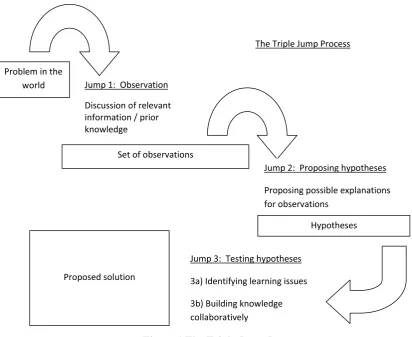
In line with PBL theory the training is presented as PBL exercise using the Triple Jump Process as shown in Figure 1.
The trigger for discussion and exploration of PBL is a video which shows a PBL lesson in a primary school. This is close enough to the participants’ experience to make the connection, but different enough to prompt questions as well as discussion and exploration of the issues. From the video, key concepts of PBL are explored and the participants generate a hypothesis which can be further explored in the available literature. From this exercise misconceptions and misunderstandings about PBL can be addressed and ideas for further self directed learning can be stimulated. This approach has the advantage of putting tutors in comparable situations to those faced by their students in PBL courses, which can include uncertainty about the objectives, the process and the outcome.
The second half of the training elaborates the insights of the PBL session through group discussion, typically of such topics as:
x Developing ‘questioning skills’; task orientated questions and monitoring questions can help students set goals, monitor progress (individually and of the group), activate prior knowledge and focus attention. These are in line with the facilitator’s educational goals for the student (Hmelo-Silver & Barrows 2006);
x Identifying common or recurring problems which arise in student teams and developing strategies and resources to deal effectively with these problems;
x Understanding the need for reflective practice both in students and for an in-depth examination of the tutor’s own practice; and
With the clear need to redefine the tutor’s role from instruction to facilitation, this day of training can hope only to challenge tutors to begin their own learning journey. Although an evaluation of the day is carried out at the end of it, the true outcomes and impact can only be gauged after tutors have had some time to think over the issues presented, practice on their students and use the support materials. Since the courses build on one another from semester to semester there is also the possibility that needs and strategies will change over semesters and years. Our evaluation framework was designed to meet this reality.
Problem in the
world Jump 1: Observation
Discussion of relevant information / prior knowledge
Set of observations
Jump 2: Proposing hypotheses
Proposing possible explanations for observations
Hypotheses
Proposed solution
Jump 3: Testing hypotheses
3a) Identifying learning issues
3b) Building knowledge collaboratively
[image:4.595.74.487.180.517.2]The Triple Jump Process
Figure 1 The Triple Jump Process
Monitoring and evaluation
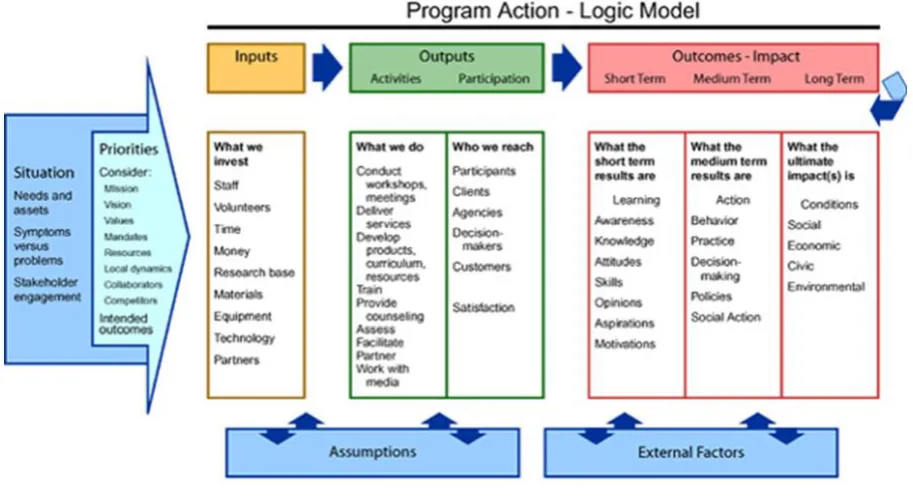
We have followed the lead of major development organisations, the World Bank and government departments in taking a program logic approach to monitoring and evaluation. The approach identifies all relevant inputs, outputs, outcomes and impacts so as to decide what needs to be monitored and evaluated, as shown in Figure 2.
The act of articulating the logic of the program in this way commonly reveals previously hidden and perhaps conflicting assumptions about what the program is designed to achieve and how it will achieve it, which immediately provides a rationale for this approach. However, once all the elements of the program have been articulated, it is then possible to examine what needs to be monitored and how. Monitoring is the systematic and continuous collection and analysis of performance information in order to track the progress of an implementation. It commonly focuses on outputs and outcomes and may include questions about a program’s administration. It provides data which allows us to ask evaluation questions; that is, questions about the worth of the program. Such questions are commonly focussed on the domains of appropriateness, effectiveness, efficiency, impact and sustainability. We do not have room here to explain the whole of the monitoring and evaluation framework, which is just being
Figure 2: The Wisconsin Model for program evaluation
Figure 3 shows part of the matrix we used in planning monitoring activities. For the sake of space we have dealt with only one output, tutor participation in online discussion lists and one outcome from that output. In practice, several outputs and outcomes are usually associated with each goal.
FOCUS PERFORMANCE INDICATORS
DATA SOURCES
DATA
COLLECTION METHODS
RESPONSIBILITY FOR COLLECTION
TIME FRAME
Objective: to encourage tutors to facilitate and scaffold learning through timely, well-placed, supportive guidance
Outputs
Tutor
participation in online discussions
Tutor responds to discussion at least once a week
Tutor identifies and responds to learning process
Online discussion lists
Audit Course controller 2xsemester
Outcomes
Students exchange ideas and identify learning
All students in group participate at least once a fortnight
Students identify what needs to happen next
Online discussion lists
Audit Course controller 2xsemester
Figure 3: Matrix for monitoring activities
[image:5.595.64.534.479.654.2]The plan for the evaluation stage follows a similar pattern (Figure 4) where each of the five domains of appropriateness, effectiveness, efficiency, impact and sustainability is examined using the monitoring data and as well as sometimes collecting extra data where necessary.
DOMAIN SOURCES OF INFORMATION FROM
MONITORING
SOURCES OF INFORMATION FROM
EVALUATION DATA
COLLECTION
DATA ANALYSIS AND
REPORTING METHODS
[image:6.595.65.532.126.207.2]RESPONSIBILITY TIME FRAME
Figure 4: Evaluation stage
We can evaluate how appropriate the format and timing of the program was not only in terms of participants’ responses but also in terms of what the monitoring data tells us about outputs and
outcomes. In making judgements about the effectiveness of our training program, we need to combine what participants told us about it at the time and the outcomes that we can see in the monitoring data. If we were told it was a great training session but we don’t see evidence of the principles being put into practice, or if student behaviour doesn’t change, we need to know why that occurred. This is where we may decide to collect extra data at the evaluation stage, through interviews with staff and other
strategies. In evaluating the sustainability of the training program we would have to take into consideration the inputs needed to produce it, but also forward planning estimates of future budgets. Once future requirements are estimated, this can then be proposed for inclusion in the Faculty’s Learning and Teaching Action Plan with an appropriate budget.
Conclusions
Staff professional development in the learning and teaching area is often neglected both by
academic staff themselves and by management. However, collaborative learning pedagogies
like PBL require skilled staff to effectively engage the students in their learning.
At the University of Southern Queensland, whilst there is a strong emphasis on professional
development, the evaluation of its effectiveness is limited to an evaluation questionnaire at the
end of the PD session. There is little or no follow up as to whether changes have occurred in
teaching practices or in student learning outcomes. At best a review of teaching evaluation
scores might be discussed, but this does not clearly link any PD event with such changes.
To date, the staff training sessions have been delivered twice to two difference cohorts of
staff. The evaluation of the sessions have indicated that staff have found them useful and
informative, but to confirm their true effectiveness further evidence needs to be collected in a
systematic and planned way.
The process outlined in this paper clearly links the perceived effectiveness of staff training
programs to changes in the appropriate domains. This will allow effective use of resources by
providing training as and when needed as well as determining the overall outcomes.
References
Das, M., Mpofu, D.J.S., Hasan, M.Y. & Stewart, T.S. 2002, 'Student perceptions of tutor skills in problem-based learning tutorials', Medical Education, vol. 36, no. 3,pp. 272-278. De Grave, W.S., Dolmans, D.H.J.M., van der Vleuten, C.P.M. & de Grave, W. 1999, 'Profiles of
effective tutors in problem-based learning: scaffolding student learning', Medical Education, vol. 33, no. 12,pp. 901-906.
Dolmans, D.H.J.M., Gijselaers, W.H., Moust, J.H.C., de Grave, W.S., Wolfhagen, I.H.A.P. & van der Vleuten, C.P.M. 2002, 'Trends in research on the tutor in problem-based learning: conclusions and implications for educational practice and research', Medical Teacher, vol. 24, no. 2,pp. 173-180.
Evans, P.A. & Taylor, D.C. 1996, 'Staff development of tutor skills for problem-based learning',
Medical Education, vol. 30, no. 5,pp. 365-366.
Hmelo-Silver, C.E. & Barrows, H.S. 2006, 'Goals and Strategies of a Problem-Based Learning Facilitator', The Interdisciplinary Journal of Problem-based learning, vol. 1, no. 1,pp. 21-39. Rando, W.C. & Menges, R.J. 1991, 'College Teaching: from theory to practice', in R.J. Menges & D.
Svinicky (eds), New Directions for Teaching and Learning, vol. 45, Jossey-Bass, San Fransisco, pp. 7-14.
Savery, J.R. & Duffy, T.M. 1995, 'Problem Based Learning: an instructional model and its constructivist framework', Educational Technology, vol. 35, no. 5,pp. 31-38.
Sobral, D.T. 1997, 'Improving Learning Skills: A Self-Help Group Approach', Higher Education, vol. 33, no. 1,pp. 39-50.
Wetzel, M.S. 1996, 'Developing the role of the tutor/facilitator', Postgraduate Medical Journal, vol. 72, no. 850,pp. 474-477.
Copyright © 2010 Brodie, L and Jolly, L: The authors assign to AaeE and educational non-profit institutions a non-exclusive licence to use this document for personal use and in courses of instruction provided that the article is used in full and this copyright statement is reproduced. The authors also grant a non-exclusive licence to AaeE to publish this document in full on the World Wide Web (prime sites and mirrors) on CD-ROM and in printed form within the AaeE 2010 conference proceedings. Any other usage is prohibited without the express permission of the authors.