This file is part of the following reference:
Kirkman, Noreen Suzanne (2011)
Mount Isa Mines'
social infrastructure programs 1924-1963.
PhD thesis,
James Cook University.
Access to this file is available from:
http://researchonline.jcu.edu.au/39437/
The author has certified to JCU that they have made a reasonable effort to gain
permission and acknowledge the owner of any third party copyright material
included in this document. If you believe that this is not the case, please contact
and quote
http://researchonline.jcu.edu.au/39437/
Mount Isa Mines’
Social Infrastructure Programs
1924-1963
Thesis submitted by
Noreen Suzanne KIRKMAN BA(Hons) JCU,
DipEd Qld, MAppSc(Lib&InfoMgt) CSU, AALIA
In September 2011
for the degree of Doctor of Philosophy
in the School of Arts and Social Sciences
i
Statement of Access
I, the undersigned, the author of this thesis, understand that James Cook University of North
Queensland will make it available for use within the University Library and, by microfilm or
other means, allow access to users in other approved libraries. All users consulting this thesis
will have to sign the following statement:
In consulting this thesis I agree not to copy or closely paraphrase it in whole or in part without the written consent of the author; and to make proper written acknowledgment for any assistance which I have obtained from it.
Beyond this, I do not wish to place any restriction on access to this thesis.
ii
Statement on Sources
Declaration
I declare that this thesis is my own work and has not been submitted in any form for another
degree or diploma at any university or other institution of tertiary education. Information
derived from the published or unpublished work of others has been acknowledged in the text
and a list of references is given.
iii
Electronic Copy
I, the undersigned, author of this work, declare that the electronic copy of this thesis provided to
James Cook University library is an accurate copy of the print thesis submitted, within the limits
of technology available.
iv
Statement on the Contribution of Others
I recognise that this thesis would not have been possible without the following contributions.
Supervision:
Dr Janice Wegner, School of Arts and Social Sciences, James Cook University
Editorial assistance:
Dr Jan Wegner, Katharine Fowler, Vanessa Cavasinni, and Rachel Walls. Stipend assistance:
Australian Postgraduate Award
v
Declaration on Ethics
The research presented and reported in this thesis was conducted within the guidelines for
research ethics outlined in the National Statement on Ethical Conduct in Human Research
(NHMRC, 2007), the Australian Code for the Responsible Conduct of Research
(NHMRC/ARC, 2007), the James Cook University Code for the Responsible Conduct of
Research (2009), and the James Cook University Policy on Experimentation Ethics: Standard Practices and Guidelines (2001).
vi
Acknowledgements
I gratefully acknowledge the role of my principal supervisor, Dr Jan Wegner, whose academic
experience has been invaluable to me.
I am indebted to the assistance of librarians from the Mount Isa City Council, James Cook
University and John Oxley Libraries, as well as archivists from the Queensland State Archives.
I especially thank Katharine Fowler for her editorial assistance in the submission of this thesis.
The informal support and encouragement of friends and colleagues has been indispensable, and
my family have been a constant source of support. It is to my parents, June and Maurice
Kirkman, that I dedicate this thesis.
vii
Abstract
During the twentieth century, social infrastructure programs were provided by mining
companies for their workers for many reasons, such as retaining workers or reducing industrial
discontent. At Mount Isa, the Isa Mines settlement was constructed by the British company
Russo-Asiatic from 1928, providing housing, recreational facilities, a store and butcher’s shop,
bank and post-office, water and electricity supply. The American company ASARCO supplied
the necessary capital to complete facilities, such as the Clubhouse, and added a hospital and a
government resourced school. After 1953 under an Australian manager, George Fisher,
cooperative housing schemes were used to encourage home ownership, and Mount Isa Mines
promoted the business sector of the Townside through an appliance scheme and the closure of
the company stores. The principal reason for all programs was found to be the reduction of
labour turnover by attracting a higher proportion of married men. The home ownership
schemes, in particular, strategically consolidated the local labour market for a mine with
viii
Table of Contents
Chapter 1. Introduction: Concepts, Aims And Research Questions ... 1
Chapter 2. Literature: Twentieth Century Mining Communities ... 7
Chapter 3. Birth Of A Mining Community 1923-1929 ... 30
Chapter 4. Under The Mining Trust 1929-1930 ... 50
Chapter 5. Reactions To Mining Trust Programs 1929-1930 ... 70
Chapter 6. Asarco: Production, Plumbism And Protests 1930-1932 ... 86
Chapter 7. Government Enquiry, Closure And Depression 1933-1938 ... 103
Chapter 8. Manpower, Military And Copper Matte 1939-1946 ... 120
Chapter 9. Post-War Prosperity And Lead Bonus Volatility 1947-1953 ... 137
Chapter 10. Under Australian Management 1953-1956 ... 160
Chapter 11. The Bonus And The Home Ownership Schemes 1957-1963 ... 183
Epilogue ... 211
Conclusion: Findings, Contributions And Recommendations ... 214
Findings To The Research Questions ... 214
Contributions To The Literature And Theoretical Implications ... 218
Recommendations For Future Research ... 221
Limitations Of The Study ... 221
ix
List of Figures
Figure 1.1 Map of north-west Queensland showing the location of Mount Isa. ... 6
Figure 4.1 Plan of Isa Mines settlement showing the South End extension, 1949. ... 52
x
List of Tables
Table 9.1 Mount Isa Mines, Labour Turnover Percentages, July 1947- June 1952 ... 147
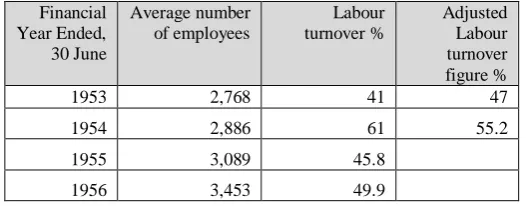
Table 10.1 Mount Isa Mines, Labour Turnover Percentages, July 1953- June 1956 ... 173
Table 11.1 Retail Price Index - Food & Groceries 1957-1964 ... 197
xi
List of Plates
Plate 3.1 John Campbell Miles & Douglas McGillivray c. 1924 ... 31
Plate 3.2 W. H. Corbould, first Managing Director of Mount Isa Mines ... 31
Plate 3.3 Mount Isa Mines’ camp, 1924. ... 35
Plate 3.4 Leslie Urquhart, 1922. ... 41
Plate 3.5 Official opening of the railway into Mount Isa, 6 April 1929... 47
Plate 4.1 Front and rear of C, C1 and C2 houses in 1930, built 1929. ... 53
Plate 4.2 Executive House provided by Mount Isa Mines, 1930. ... 54
Plate 4.3 B & C Dormitories, 1932. ... 55
Plate 4.4 Community buildings within the Isa Mines settlement, 1930s. ... 56
Plate 4.5 Mount Isa Mines Employees Clubhouse built 1930. ... 57
Plate 4.6 Clubhouse counter in 1931... 58
Plate 4.7 Community centre of the Isa Mines settlement during the 1930s. ... 66
Plate 5.1 Interior of a room in one of the dormitories, September 1931. ... 71
Plate 5.2 Group on the verandah of a house at North End, 1930s. ... 72
Plate 5.3 Tin-hut belonging to the Whitaker family c. 1935. ... 73
Plate 5.4 Interior of room within Staff Quarters, 1931. ... 74
Plate 5.5 Rotunda in Central Park. ... 79
Plate 5.6 Clubhouse verandah with newspaper and magazine racks, 1930. ... 80
Plate 6.1 Doctor's house with consulting rooms below & quarters above, 1930. ... 89
Plate 6.2 Maternity ward of the Mount Isa Hospital in 1934. ... 91
Plate 6.3 Mines Hospital, 1930s. ... 96
Plate 6.4 Inspection of the Mount Isa Mines Hospital, 1932. ... 100
Plate 7.1 Crowd waiting for departure of train, 7 November 1933. ... 109
Plate 7.2 Tent-houses rented for 8/6 a week during the 1930s. ... 112
Plate 7.3 Aerial photograph of Mount Isa Mines, 1935. ... 115
Plate 7.4 Funeral of Mikael Ojala, 30 June 1936. ... 116
Plate 8.1 H. Johnson, Employment Officer, & Stuart Tuck, Industrial Officer, 1944. ... 128
Plate 8.2 Convoy of trucks near Mount Isa 1942-1943. ... 130
Plate 8.3 Official party of the Governor General, Mount Isa Airfield, December 1943. ... 135
Plate 9.1 Casa Grande, 1950. ... 140
Plate 9.2 View from Mines Powerhouse, General Office on right, 1958. ... 141
Plate 9.3 Kruttschnitt Park with swimming pool, tennis court and football grounds. ... 143
xii
Plate 9.5 Julius Kruttschnitt farewelled by personnel of the Permanent Mess, 1952. ... 157
Plate 10.1 George Fisher, Chairman of Directors, 1953-1970. ... 161
Plate 10.2 Langer designed suburb of Soldiers Hill c. 1960. ... 167
Plate 10.3 Drapery section of the Community Store, 1950. ... 176
Plate 10.4 Happy Valley Housing Cooperative Area, 1957-1958. ... 180
Plate 11.1 Cooperative housing at Soldiers Hill, 1957... 186
Plate 11.2 Cooperative housing Soldiers Hill, 1960s. ... 187
Plate 11.3 Yachts on Lake Moondarra, 1960. ... 189
Plate 11.4 Beach on the shores of Lake Moondarra, 1960. ... 192
Plate 11.5 Town of Mount Isa, 1962. ... 195
Plate 11.6 Black Rock Open Cut, 1962. ... 205
1
Chapter 1.
Introduction:
Concepts, Aims
and Research Questions
Mount Isa is a small city located in north-west Queensland, Australia. Payable silver-lead ore
was discovered in late 1923, which led to the formation of mining companies, Mount Isa Mines
becoming the sole company two years later. To support the company, the Queensland
government surveyed a town-site on the opposite bank of the Leichhardt River. However once
the British company Russo-Asiatic acquired a controlling interest, Mount Isa Mines built its
own town on a scale and form unprecedented in Australian mining. Isa Mines was a company
town with its own stores, bank and recreational facilities. It was initially named Isa Mines to
distinguish it from the incorporated town of Mount Isa, though over time the two settlements
became known as Mineside and Townside. During the late 1940s and early 1950s with the price
of lead at a record high, the Isa Mines settlement was extended with further housing and
facilities.
The mining of new large reserves of silver-lead and the expansion into copper from the early
1950s required a much larger workforce not only for the construction phase and initial
production but also for the long life of the mine, predicted to last well into the twenty-first
century. Much of the company’s town-building was intended to attract and retain that
workforce. From 1953, there was a marked change in company policy with schemes introduced
to promote home ownership. There was also active lobbying for government support, with the
Queensland Housing Commission and Mount Isa Mines entering a long partnership to build
houses for company employees. To encourage the business sector, the company stores were
closed and the community buildings, which were the centrepiece of the company town, were
either demolished or removed.
Though the major periods of social infrastructure provision saw quite different company
initiatives, the aim of management was the same: to markedly reduce the overall labour turnover
of the workforce. It is the contention of this thesis that, despite the extensive literature on
company towns as anti-union and exploitative, management of Mount Isa Mines used social
infrastructure to attract and keep its most valued employees, mostly married employees,
especially during periods of massive expansion in preparation for increased production. While
the success of the company town of Isa Mines was limited in this respect, it did manage to retain
a core minority of employees, with home ownership, government housing and support for local
2
transforming an outback bush town to the suburban norm of Australian coastal cities. This
intended to stabilise the workforce for a mine which would last many decades.
***
This thesis is about a range of social infrastructure provided by the company, considered in the
international context of mining company social practices at the time. These included rental
housing and barracks, home ownership schemes and government provided housing, both rental
and for purchase. The operation and closure of the company stores, bank, and recreational
facilities are also part of this thesis, as is the operation of recreational areas to be utilised by all
residents. The original aim of this thesis was to investigate the idea that the entire community of
Mount Isa was a company town, built and controlled by one company. However the concept
proved too difficult to sustain over the entire period to 1963 especially with the existence of the
town of Mount Isa (Townside), whose residents and businessmen remained resolutely
independent of the company. The usual concept of a company town also proved difficult to
apply to Mount Isa owing to the existence of home ownership, an anathema in a resource town.
Another difficulty with the company town concept was that Mount Isa Mines was dismantling
its town and embarking upon a completely different strategy before most of the Australian and
Canadian planned company towns of the second half of the twentieth century were built.
The concept of industrial welfare, categorised as an early consent-based labour management
strategy, appeared to provide a better explanation for the various housing and other programs
introduced by Mount Isa Mines. The strategy has been defined as “any facility or service
provided by management that is not strictly necessary for the everyday operation of plant and
machinery.”1 However the arguments in the international literature on industrial welfare, that
accommodation and messing were unnecessary in mining operations and welfarism was
obsolete by the second half of the twentieth century, did not sit easily with the existence of
resource towns built in Australia and Canada from the1950s to the 1970s. In the interest of a
fresh approach, the term “social infrastructure” has been used as the conceptual framework for
this thesis to explain the range of services provided by mining companies for its employees.
In the mining industry, “infrastructure” is used to refer to facilities and services required to
bring the mine into production and includes “industrial infrastructure” such as mine shafts and
headframes, concentrators and smelters, workshops and warehouses. Sometimes “social infrastructure” such as accommodation, recreational facilities and other employee programs are
1Erik Eklund, “Managers, Workers, and Industrial Welfarism: Management Strategies at ER&S and the Sulphide
3
provided.2 Social infrastructure can take several forms such as barracks for single men, an entire
township on company leases, or housing and facilities in an existing town. In some cases social
infrastructure has been provided by governments though the use of public money for this
purpose has been generally controversial. Some industrial infrastructure provided by companies
can also be used for social purposes, especially power stations and dams.
***
The main aims of this thesis are to describe the history of the three main periods of substantial
social infrastructure constructed and sponsored by Mount Isa Mines during the period 1928
to1963 and to verify if the company’s stated rationale for all programs, to reduce labour
turnover, was the case. A further aim is to record the reactions of employees and members of
the wider community to company programs. This thesis will of necessity deliver a narrative of
industrial developments at Mount Isa Mines in response to metal markets and major ore
discoveries as a chronological framework. In addition, it will include descriptions of
employment relations and industrial awards negotiated between Mount Isa Mines and unions, to
identify if there was any union agreement or opposition to above award conditions and if these
caused or contributed to industrial disputes. This is necessary to test the idea, common in the
literature, that social infrastructure was used to control unions and/or diffuse industrial unrest.
While the industrial dispute of 1961 will be included in this study, it was decided that the year
1963 would be the end date for this thesis, just prior to one of the longest industrial disputes in
Australian history. The Mount Isa Dispute of 1964-1965 was a multifaceted event. Like the
earlier dispute, the main issue was a long-standing “lead” bonus no longer tied to the lead price
or negotiated in the Industrial Court, with conflict among unions also playing a major part.
While relations between Mount Isa Mines and unions were important when discussing the
industrial implications of welfarism, this dispute was so involved and long-running that it would
have been a lengthy task to tease out the unions' attitudes to the company's programs. This
thesis could not do justice to this complexity, especially with the absence of in-depth union
histories specific to Mount Isa.
By not going beyond 1963, the collaboration between Mount Isa Mines and the Queensland
Housing Commission was only briefly investigated. However, apart from this collaboration
there were no other major initiatives in the provision of housing for company employees during
the remainder of the 1960s. Both the Mount Isa Dispute of 1964-1965 and the Queensland
Housing Commission’s involvement in Mount Isa are recommended areas for future research.
2Ciaran O’Faircheallaigh, Mine Infrastructure and Economic Development in North Australia (Darwin, NT:
4
Research questions have been formulated to explain the rationale(s) behind Mount Isa Mines’
social infrastructure programs over a period of almost four decades, to identify positive and
negative reactions of employees, unions and the wider community, and to assess if the programs
met company goals. The four research questions are:
1. Did the wide range in the forms and tenures of the social infrastructure provided by
Mount Isa Mines over the entire period under study reflect a changing set of rationales
or was there some commonality, and how effective were the various schemes in
meeting company goals?
2. Did the different forms of social infrastructure constructed and sponsored by Mount Isa
Mines from the late 1920s to the early 1960s reflect Australian and/or international
mining practice?
3. What were the overall reactions of employees and the wider community to the housing
and amenities at Isa Mines and later, the home ownership and appliance schemes?
4. Were unions consulted and did any social schemes provoke serious industrial unrest?
The major findings of this thesis will confirm the main rationales for company social
infrastructure programs, the reactions of employees and the wider community to these
especially if they contributed to industrial disputation, and the relative success of the respective
programs in meeting company goals.
There are eleven chapters in this thesis, Chapter 1 stating the aims of the thesis and the research
questions. As company social infrastructure is the subject of two large bodies of literature,
Chapter 2 entitled Literature: Twentieth Century Mining Communities will provide a timely
review of conflicting interpretations. Chapter 3: Birth of a mining community 1923-1929, will
provide historical context, covering the period from the initial discovery of silver-lead to the
opening of the railway which carried the materials for construction. The remainder of the
chapters outline in detail three main periods of social infrastructure constructed and sponsored
by Mount Isa Mines and the reactions of employees and the wider community to these
initiatives.
Chapter 4: Under the Mining Trust 1929-1930, will look at the impact of Russo-Asiatic and the Mining Trust on Mount Isa Mines’ management and the building of the company town of Isa
Mines. Chapter 5: Reactions to Mining Trust Programs 1929-1930, will explore the reactions of
employees and the wider community to the Isa Mines, its housing, amenities and retail outlets.
Chapter 6: ASARCO: Production, Plumbism and Protests 1930-1932, will describe changes
5
1933-1938, addressing the community’s reactions especially to the controversial Mines Hospital
and medical examinations.
The use of Mount Isa Mines buildings by American and Australian military forces during World
War II will be outlined in Chapter 8: Manpower, Military and Copper Matte 1939-1946 while
Chapter 9: Post-war Prosperity and Lead Bonus Volatility 1947-1953, will describe the renewed and large-scale housing and recreational programs during a period of unprecedented
high lead prices. The marked change in the nature of Mount Isa Mines’ housing schemes
1953-1955 will be described in detail in Chapter 10, Under Australian Management 1953-1956. The
final chapter entitled The Bonus and the Home Ownership Schemes 1957-1963, will investigate
the attitudes towards company programs during a period of low bonuses and during the
industrial dispute of 1961, concluding with the beginning of house building by the Queensland
Housing Commission in 1963.
The standard historical method has been adopted for this study. It has included the collection of
evidence from primary source material including government and private archival records as
well as contemporary print material including newspapers. These resources are housed in the
Queensland State Archives, as well as the John Oxley and the Mount Isa City Libraries, where
resources from MIM Holdings and the former Mount Isa Mines’ Technical Library are located.
Other unpublished material used to research this thesis includes photographs from public and
private collections and unpublished research, particularly theses. Also contributing to the
research was a significant quantity of secondary source material, including books and journal
6
Figure 1.1 Map of north-west Queensland showing the location of Mount Isa.
7
Chapter 2.
Literature:
Twentieth Century Mining Communities
This review will concentrate on two large major bodies of literature which have focused on
mining communities.1 Above-award or non-wage management programs such as housing and
recreational facilities have been the subject of the literature into welfare capitalism, also known
as industrial welfare. One main argument of the literature has been that employee welfare
programs, including company-built towns, were part of a short-lived phenomenon which
declined from the 1930s. However the equally large literature on the comprehensively planned
resource towns of the post-World War II era clearly showed that the phenomenon had not
declined but boomed from the 1950s through to the 1970s. In synthesising these bodies of
literature this review will attempt to provide a greater understanding of the programs
implemented by Mount Isa Mines Limited and hopefully provide a framework for further
research into social infrastructure within the mining industry during the twentieth century.
***
There is a large amount of literature on company towns and what they are. In his seminal work,
The Company Town in the American West, Allen highlighted the problems of definition, the subject of his research being “any community which is owned and controlled by a particular
company.”2
Of these towns, Crawford focused specifically on the “professionally-designed
towns”.3
In Canada, the Central Mortgage and Housing Corporation included “company towns”
as part of the phenomenon of “single enterprise” towns defined as “communities which have
come into being by reason of the decision or action of a single enterprise be it an industry, a
government agency, a defence establishment or a transportation system.”4 Sociologist Rex
Lucas further refined the definition to “communities of single industry” where “at least 75 per
cent of the population had to work for the single industry and its supporting institutional
services.”5
In Australia and Canada, planned company towns of the post-World War II era were
known as resource towns.6 While company towns generally are part of this review, mining
1 For literature on Industry Resource Towns (IRTs) see Roger Hayter, “Single Industry Resource Towns,” in A
Companion to Economic Geography, ed. Eric Sheppard and Trevor J. Barnes (London: Blackwell Publishing, 2002), 290-309.
2 James Allen, Company Town in the American West (Norman: University of Oklahoma Press, 1966), 6.
3 Margaret Lee Crawford, “Designing the Company Town, 1910-1930” (PhD Thesis, University of California, 1991). 4 Queen's University, Institute of Local Government. Single-Enterprise Communities in Canada: A Report to the
Central Mortgage and Housing Corporation (Kingston, Ont.: Queen’s University, 1953), iii, 2-3.
5 Rex A. Lucas, Minetown, Milltown, Railtown: Life in Canadian Communities of Single Industry (Toronto:
University of Toronto Press, 1971), 16-18.
6 Gilbert Stelter and Alan F.J. Artibise, “Canadian Resource Towns in Historical Perspective,” Plan Canada 18, no.
8
company towns and mining company social infrastructure within existing towns will be the
main focus.
According to Stelter and Artibise, the first generation or additive model of the Canadian
resource town was built from the 1880s to 1914 but also included “haphazard ‘sleep camps’.”7
Their “second generation” resource towns were built during the inter-war period, which Robson
described as the Company Era”8
of Canadian resource towns. McCann described these resource
towns as “pre-determined, holistic town[s]”9
with over a hundred built.10 These second
generation Canadian towns coincided with Crawford’s era of planned company towns in the
United States from World War I to 1929.11
According to Crawford the “new” company towns offered opportunities for town planners to
put theory into practice by adapting the decentralised industrial settlement model based on
British garden city principles to designing affordable worker housing for resource industries.
She distinguished these towns as designed by “trained professionals” and not by companies.12
Neuman identified the physical plan as important with the emphasis on concentricity,
boulevards radiating from a central park, and gardens.13 Crawford listed at least forty
holistically planned “new” company towns whichwere erected in the United States between
1910 and 1929. Tyrone was identified by Crawford as the first of a number of American mining
towns designed by using town or garden city planning principles.14
In Australia, Freestone found the same type of planned single-industry town when he identified
the government built coal town of Yallourn as “Australia’s first fully-fledged garden town”15
Alan La Gerche, architect with the State Electricity Commission, planned Yallourn according to
the principles of the English “model city” movement, especially Welwyn Garden City.16
While
Freestone referred to Broken Hill Propriety and Mount Isa Mines’ respective attempts at
7 Stelter & Artibise, “Canadian Resource Towns,” 10. 8 Robson, “Manitoba’s Resource Towns,” 2-16. 9 McCann, “Changing Internal Structure,” 46.
10 One hundred and fifty five single enterprise communities existed in 1953 in Canada. See Queen’s University,
Single-Enterprise Communities in Canada, iii.
11 According to Crawford the first era of United States company towns was associated with agriculture and the
second with industrialisation during the second half of the nineteenth century. Crawford, “Designing the Company Town, 1910-1930,” 13-17.
12 Crawford, “Designing the Company Town,” 49, 73.
13 Michael Neuman, “Does Planning Need a Plan?” American Planning Association Journal 64, no. 20 (1998): 208. 14 Margaret Crawford, “The “New” Company Towns,” Perspecta 30 (1999): 55; Crawford, “Designing the Company
Town,” 210-217, 322. These American mining towns included Ajo (Arizona), Tyrone (New Mexico), Bayview and Westfield (Alabama), Kincaid (Illinois) and Lynch (Kentucky). See Crawford, “Designing the Company Town,” 210-217, 322.
15 Robert Freestone, Model Communities: the Garden City Movement in Australia (Melbourne: Nelson, 1989), 124.
Over 500 houses were built at Yallourn between 1921 and1930.
16 Peter Read, Returning to Nothing: The Meaning of Lost Places (Melbourne: Cambridge University Press, 1996),
9
Whyalla and Mount Isa “to promote some semblance of house-and-garden living”, he dismissed their contribution owing to there being “no master plans or advanced site planning
techniques.”17 To Freestone, Lutana in Tasmania built by Electrolytic Zinc (EZ) was a more
fitting example of the first generation of housing estates built specifically for industrial workers
according to town planning principles. Wright assessed these cases as “larger enterprises with
the financial resources to indulge in experimentation.”18
Meller argued that one of the factors in the success of the garden city ideal was that it grew out
of “experiments at building ideal housing … pioneered by paternalistic employers”19
especially
Quakers. Quaker philosophy continued to influence the London Lead Company well into the
twentieth century as Raistrick recorded.20 Arlene Allen attributed the construction of the model
mining town of Tyrone, New Mexico, to the traditional philanthropy of the American mining
company, Phelps Dodge, commenting that “the idea of the perfect mining camp was just an
extension of the idea.”21 Schwantes agreed that building a model community was also “entirely
consistent with the prevailing social philosophy at Phelps Dodge, particularly the Presbyterian
philanthropic commitment that led four generations of partners to fund schools, churches,
hospitals, and decent affordable housing for their employees”.22
In the building of Claremont in
Tasmania by Cadbury, Barton identified the influence of the Quaker “welfare tradition” in
Australia.23
It was with the employment of welfare officers that the bodies of literature on resource towns
and welfare capitalism shared some commonality. In the United States, Crawford found that
expert welfare workers were also influential in the design of the new company towns.24 She
argued that:
[T]he industrial betterment or welfare capitalism movement, transformed the informal and highly personal paternalism that prevailed in company towns into an institutionalized and professionalized operation. Under “expert” welfare workers,
17 Freestone, Model Communities, 141.
18 Christopher Wright, The Management of Labour: A History of Australian Employers (Melbourne: Oxford
University Press, 1995), 23.
19 Helen Meller, Towns, Plans and Society in Modern Britain (Cambridge: Cambridge University Press, 1997), 38.
See also John Child, British Management Thought: A Critical Analysis (London: George Allen & Unwin Ltd., 1969), 37; Robert Fitzgerald, British Labour Management and Industrial Welfare 1846-1939 (London: Croom Helm, 1989), 48-65.
20 Aarthur Raistrick, Two Centuries of Industrial Welfare: The London (Quaker) Lead Company, 1692-1905, 2nd ed.
(Buxton: Moorland, 1977).
21 Arlene W. Allen, “A Brief History of the Burro Mountain Copper Company” (MA Thesis, Western New Mexico
University, 1990), vii.
22 Carlos A. Schwantes, Vision and Enterprise: Exploring the History of Phelps Dodge Corporation (Tucson:
University of Arizona Press, 2000), 120. See also 393-397.
23 Ruth Barton, “Cooperation and Labour Management at Electrolytic Zinc and Cadbury-Fry-Pascall between 1918
and 1939” (MA Thesis, University of Tasmania, 1989), 210.
10
firms introduced systematic social programs designed to improve workers’ living
and working environments.25
Throughout North America, the United Kingdom and Australia, Jacoby, Hill Licht, Nelson,
Balnave, Barton, Fletcher, Patmore and Mauldon26 identified the rise in welfare officers within
companies, many of whom McCarty and Stone argued were trained or experienced in social
work.27 According to Elibirt, welfare officers’ responsibility was to assist workers and their
families in coping with personal problems associated with accommodation and other matters,28
with Jacoby maintaining that the growth in company welfare departments recognised the “value
of maintaining employee morale”.29
Welfare programs have therefore been categorised as part of the consent-based approach to
labour management, which according to Littler and Salaman were aimed at building worker
consent to management authority.30 To Edwards, welfare programs were implemented to
regulate labour,31 with Brandes maintaining that the purpose was to control the quantity and
quality of the labour supply.32 Bray and Littler maintained that welfare programs increased
worker dependency on companies,33 with Edwards, Brandes, Goltz, Finn and Carsten arguing
that this was increased through conditions and contracts,34 high rents and segregation of
workforces.35 Littler and Salaman maintained that dependency could be reduced only through
alternative sources of need-satisfaction and worker organisation through unionism.36
25 Crawford, “The “New” Company Towns,” 50.
26 Nikola Balnave, “Industrial Welfarism in Australia, 1890-1965” (PhD Thesis, University of Sydney, 2002), 4,
27-32, 59, 65; Meredith Fletcher, “Yallourn the Planned, and the Township of Brown Coal Mine,” Proceedings of the Third Australian Planning History/Urban History Conference, Melbourne 11-14 December 1996 (Clayton, Vic.: Office of Continuing Education, Monash University, 1997), 65-66, 68; Sanford Jacoby, Employing Bureaucracy: Managers, Unions, and the Transformation of Work in American Industry, 1900-1945 (New York: Columbia University, 1985), 60-64, 71-81; Stephen Hill, Competition and Control at Work: the new industrial sociology
(London: Heinemann Educational Books, 1981), 24-28; Walter Licht, “Fringe benefits: a review essay on the American workplace,” International Labor and Working-Class History, no. 53 (1998): 171; Daniel Nelson Managers and Workers: Origins of the Twentieth-Century Factory System in the United States, 2nd ed. (Madison: Wisconsin:
University of Wisconsin Press, 1995), 118-119; Greg Patmore, Australian Labour History (Melbourne: Longman Cheshire, 1991), 149; F. Mauldon, “Cooperation and Welfare in Industry,” The Annals of the American Academy of Political and Social Science (November 1931):183-192.
27 Terence E. McCarthy & Raymond Stone, Personnel Management in Australia (Brisbane: John Wiley, 1986), 11. 28 Henry Eilbirt, “The Development of Personnel Management in the United States,” Business HistoryReview 33, no.
3 (1959): 345-64.
29 Jacoby, Employing Bureaucracy, 64.
30 C. Littler and G. Salaman, “Bravermania and Beyond: Recent Theories of the Labour Process,” Sociology: The
Journal of the British Sociological Association 16, no. 2 (1982): 263.
31 R.C. Edwards, Contested Terrain: The Transformation of the Workforce in the Twentieth Century (London: Basic
Books, 1979), 95.
32 Brandes, American Welfare Capitalism, 44.
33 M. Bray and C. Littler, “The Labour Process and Industrial Relations: Review of the Literature,” Labour and
Industry 1, no. 3 (1988): 568.
34 Edwards, Contested Terrain, 92-93.
35 Eileen Goltz, “The Economics of Housing in a Company Town,” in Municipal Development in Northeastern
11
According to much of the welfare capitalist literature, large-scale employee programs were part
of a movement to provide an alternative or a substitute for unionism. Bernstein in 1960
maintained that the “central purpose of welfare capitalism” was “avoidance of trade
unionism”.37 Ozanne also argued that welfare measures were “substitutes for unionism”38 with
Grant maintaining that programs were introduced to forestall unionism at Imperial Oil.39 Littler
claimed welfarism was in response to union activity40 as did Edwards with respect to
International Harvester,41 with Brandes arguing that labour disputes were more evident in
welfarist companies.42 Crawford and Brandes cited eviction of employees from company
housing as a method of controlling employees43 as did Patmore.44 Brandes also maintained that
the rise and fall of welfarism conversely corresponded with union membership in the United
States.45
Melling argued that geographically remote areas and company towns created the greatest
dependency among employees where companies created and dominated local labour markets.46
J. Douglas Porteous maintained that the provision of company housing in Atacama mining
towns extended the employer-employee relationship beyond the plant and into the home:
Company housing has proved an effective means of worker control where an entire company town is constructed. If the industry [company] is landlord as well as employer, his relationship with his employees extends beyond the plant and into the homes.47
Indeed Balnave maintained that the company town showed the “dual character” of welfarism
with its economic necessity in attracting a stable workforce on one hand and worker dependency
on the other.48 To McCallum, this reinforced the “company’s dominance, making it more
difficult for workers to challenge unilateral management decision.”49 To Brandes the company
36 Littler & Salaman, “Bravermania and Beyond,” 261-262.
37 Irving Bernstein, The Lean Years: A History of the American Worker, 1920-1933 (Boston: Houghton Mifflin,
1960), 187.
38 Robert Ozanne, A Century of Labor-Management Relations at McCormick and International Harvester (Madison:
University of Wisconsin Press, 1967), 245.
39 Hugh M. Grant, “Solving the Labour Problem at Imperial Oil: Welfare Capitalism in the Canadian Petroleum
Industry, 1919-1929,” Labour/Le Travail 41 (1998): 86-95.
40 Edwards, Contested Terrain, 91-4; C.R. Littler, The Development of the Labour Process in Capitalist Societies
(London: Gower, 1982), 90-91
41 Edwards, Contested Terrain, 92-93. 42 Brandes, American Welfare Capitalism, 138.
43 Crawford, “Designing the Company Town,” 214; Brandes, American Welfare Capitalism, 48. 44 Patmore, Australian Labour History, 134-44.
45 Brandes, American Welfare Capitalism, 32.
46 J. Melling, “Employers, Industrial Welfare, and the Struggle for Work-Place Control in British Industry,
1880-1920,” in ManagerialStrategies and Industrial Relations: an Historical and Comparative Study, ed. H. Gospel and C. Littler (London, Heinemann Educational Books, 1983), 57, 60.
47 J. Douglas Porteous, “Social Class in Atacama Company Towns,” Annals of the Association of American
Geographers 64 (1974): 410.
48 Balnave, “Industrial Welfarism in Australia,” 30.
49 Margaret E. McCallum, “Corporate Welfarism in Canada, 1919-39,” Canadian Historical Review 71, no. 1 (1990):
12
store was the “most controversial element of all”50
, employer programs which Seltzer and
Corbin maintained tied employees to the company through the monopoly over goods and
prices.51
Within the literatures of welfare capitalism/industrial welfare and resource towns relating to
Australia, there was consensus that employee programs were implemented to improve industrial
relations. Gardner and Palmer maintained that the rise in interest in welfarism in Australia was
aimed at diffusing worker unrest.52 To Balnave, company based recreation was also a
“significant tool in the hands of the capitalist class, a method of minimising industrial tension
and of securing control.”53 With respect to resource towns, Freestone, Read and Fletcher argued
that Yallourn was constructed to create industrial harmony.54 Burrows argued that EZ reflected
British and Australian management thought whereby:
[I]mprovement of the physical environment, not the political and economic system, was seen to be the answer for greater contentment among the working class, thus increasing efficiency and lessening the likelihood of labour unrest.55
Barton discovered that company schemes at Cadbury and EZ were successful, leading to “an
almost complete absence of industrial conflict for some twenty years.”56 Eklund also found that
the Australian Workers Union (AWU) was supportive of Electrolytic Refining and Smelting Co
of Australia (ER&S) Ltd welfare programs at Port Kembla.57
Eklund noted that employee programs within Australian companies were often accompanied by
companies’ appeals for a “rhetoric of unity and cooperation”58 which he attributed to post-war
British management ideas. Wright also recognised this influence which he claimed was aimed at
gaining workforce loyalty to increase output, disseminating managerial values and promoting an
unitarist workplace culture.59 To Barton, Cadbury-Fry-Pascall and EZ believed it was their
“obligation” to supply employees with “housing and welfare provisions that would enable them
50 Brandes, American Welfare Capitalism, 45-46.
51 Curtis Seltzer, Fire in the Hole: Miners and Managers in the American Coal Industry (Lexington: University Press
of Kentucky, 1985), 19; David Corbin, Life, Work, and Rebellion in the Coal Fields: The Southern West Virginia Miners, 1880-1922 (Urbana: University of Illinois Press, 1981), 10.
52 Margaret Gardner and Gill Palmer, Employment Relations: Industrial Relations and Human Resource Management
in Australia, 2nd ed. (South Melbourne: Macmillan, 1997), 51. For example, the New South Wales Industrial
Arbitration Act in 1918 was amended to allow the introduction of mutual welfare committees and industrial councils
53 Nikola Balnave, “Company-based recreation in Australian industry 1885-1965,” in Work - organisation - struggle:
papers from the seventh National Labour History Conference, held at the Australian National University, Canberra April 19-21, 2001, ed.Rosemary Webb & Phil Griffiths (Canberra: Australian Society for the Study of Labour History, 2001), 246. See also N. Balnave, Company-Sponsored Recreation in Australia: 1890-1965, Labour History
no. 85 (2003: 129-151.
54 Freestone, Model Communities, 124-129; Read, Returning to Nothing, 77; Fletcher, “Yallourn,” 65-66, 68. 55 A. I. Burrows, “An Examination of the Town Planning Idea of the Garden Suburb, and its Application to Industrial
Management within the Co-operative Movement in the early 1920’s at the Electrolytic Zinc Company, Risdon, Tasmania” (BA (Hons) Thesis, University of Tasmania, 1978), 84.
56 Barton, “Cooperation and Labour Management,” 310.
13
to become content, committed and efficient.”60 Burrows and Alexander maintained that the
rationale for Lutana was not only to lower labour conflict but also to further worker loyalty and
a cooperative spirit.61 Balnave argued that the promotion of “a sense of self-betterment,
cooperation and loyalty in workers” increased management’s control over the workforce.62
In
South Africa, Peter Carsten argued that DeBeers used propaganda to achieve “obligated loyalty”.63
Most authors agree that company welfare workers emphasised the family. Jacoby cited
examples in which companies endeavoured to turn the workplace into a “replica of an ideal
middle-class home” while at another level evoking a sense of family life within the firm to
emphasise “team spirit”64
through company picnics, competitions and magazines. In the United
States, Nelson identified the role of the Department of Labor in supporting “family work”
within companies.65 In Australia, Balnave maintained that company welfare programs to the
1960s were aimed at creating “a sense of family within the firm itself” 66 and were also directed
towards the workers’ families, especially through company-based recreation. Barton noted that EZ’s extensive programs were aimed at families and included health, social, and recreational
facilities, along with cooperative stores.67
Indeed a number of researchers have identified recruitment policies which were specifically
aimed at married employees. Fox discovered at Mount Lyell in Tasmania, that the married
worker was being considered “more desirable than the single man because it [the company]
thought single men were more mobile, militant and therefore less susceptible to discipline.”68
Eklund found that the employee programs at Broken Hill Associated Smelters (BHAS) at Port
Pirie in South Australia were aimed at achieving “a more settled community of married
workers, thus reducing the company’s reliance in single itinerant men.”69
Eklund noted ER&S’
offer of financial assistance to encourage home ownership at Port Kembla70 which was similar
to EZ’s Cooperative Building Fund.71 At Broken Hill, Darnell traced the long history of housing
60 Barton, “Cooperation and Labour Management at Electrolytic Zinc,” 310.
61 Burrows, “An Examination of the Town Planning Idea,” 82-83; Alison Alexander, The Zinc Works: Producing
Zinc at Risdon 1916-1991 (Risdon: Pasminco Metals-EZ, 1992), 12-19; 28-37, 47-48, 60-61.
62 Balnave, “Industrial Welfarism in Australia,” 251.
63 Carstens, In the Company of Diamonds, 3-12, 180, 184-187. 64 Jacoby, Employing Bureaucracy, 50.
65 Nelson also identified the promotion of “family work” within a 1905 Department of Commerce and Labor report.
See Nelson Managers and Workers, 165.
66 Balnave, “Industrial Welfarism in Australia,” 249.
67 Barton, “Cooperation and Labour Management at Electrolytic Zinc,” 74-92, 101-112, 271.
68 C. Fox, “Work and Welfare at Mt Lyell 1913-1823,” Journal of Australasian Mining History 1, no. 1 (2003): 72. 69 Erik Eklund, ‘‘ ‘Intelligently Directed Welfare Work’?: Labour Management Strategies in Local Context: Port
Pirie, 1915-29,” Labour History no. 76 (1999): 136. See also125-148.
70 Eklund, “Managers, Workers, and Industrial Welfarism,” 150, 152.
14
cooperatives back to 1898.72 According to Abbott and Dracouliagos, a change in legislation in
1936 resulted in the rapid expansion of cooperative housing societies in New South Wales,73
with Balnave describing that Zinc Corporation and New Broken Hill Consolidated promoted
their first scheme in 1936.74 According to Shields, this was part of the Collins House group’s
labour management style of “industrial cooperation” or “welfare”.75 Mining companies in
Canada and the United States during the interwar years also offered homeownership to married
employees.
Paradoxically, assistance to home ownership could be used for the same purpose as company
housing.In Canada, Robson described how, from the late 1920s, the Hudson Bay Mining and
Smelting Company (HBS&MC) at its Flin Flon mine in Manitoba, pressured for a planned
public town, encouraged private home ownership among employees and promoted private
independent businesses giving HBS&MC the best of both worlds: “a labour force without the
problems of maintaining it.”76
Another Canadian mining company, Noranda Mines, constructed
a planned residential area from 1927 offering home ownership to employees through company
loans, the rationale for which Glenday assessed as two-fold: “to attract a stable and permanent
labour force and, at the same time, build up its equity in the community by the selling of real
estate properties to its employees.”77 Crawford described how the New Cornelia Copper
Company at Ajo in Arizona encouraged stability among its skilled American employees by
encouraging home ownership on non-company land.78
Isolation was a disincentive for labour recruitment. Gitelman argued that in remote areas,
company housing and stores were “strategic responses to problems of work force recruitment
and retention.”79 Licht also maintained that “[g]eographical isolation or tight labor markets have
continually forced firms to develop nonwage incentives to attract and keep their work forces.”80
James Allen argued that company housing was necessary in isolated areas to attract labour.81
72 Maxine Darnell, “Attaining the Australian Dream: the Starr-Bowkett Way,” Labour History no. 91 (2006): 13-30;
Balnave, “Industrial Welfarism in Australia,” 228. Other mining companies in Broken Hill were also involved in proving assistance to hospitals, schools, as well as contributing to the community’s water and power supply.
73 Malcolm Abbott & Chris Doucouliagos, “The Rise and Decline of the New South Wales Cooperative Housing
Societies”, Urban Policy and Research 19, no. 2 (2001): 230.
74 Balnave, “Industrial Welfarism in Australia, 228.
75 Bradon Ellem and John Shields, “The Barrier Industrial Council: A Study in local Peak Union Origins, Purpose,
Power and Decline,” in Peak Unions in Australia: Origin, Power, Purpose, Agency ed. Bradon Ellem, Raymond Markey & John Shields (Leichhardt: Federation Press, 2004), 140.
76 Robert Robson, “Flin Flon: A Single Enterprise Community 1927-1946” (MA Thesis, University of Manitoba,
1980), 185. See also 62-69, 155-169, 179-185.
77 Daniel Glenday, “Dependency, Class Relations and Politics in Rouyn-Noranda” (PhD Thesis, Carleton University,
1981), 102.
78 Crawford, “Designing the Company Town,” 214.
79 H.M. Gitelman, “Welfare Capitalism reconsidered,” Labor History 33, no. 1 (1992): 29. 80 Licht, “Fringe benefits,”166.
81 James B. Allen, The Company Town in the American West (Norman: University of Oklahoma Press, 1967), 6-7,
15
According to architects Ahnlund and Brunnstrom,worker housing in Scandinavian mining
company towns was built as a “matter of necessity, especially in remote areas” in sub-zero
climates to counter high labour turnover.82 To Stelter and Artibise, Canadian single enterprise or
company towns of the inter-war years were built “as adjuncts of an industrial enterprise to
provide a means of attracting and holding a stable work force in the face of a harsh climate, a
rugged terrain, and isolation.” 83
The thesis that social infrastructure provision helped companies to control and exploit workers
has been questioned.Economists Fishback and Lauszus maintained that high labour market
competitiveness within the mining industry kept conditions high and lessened the employers’
ability to exploit their monopoly on services in single industry towns.84 Fishback argued that
subsidised prices at company stores were part of competitive employment packages.85 Boal and
Fishback also questioned whether coal mining towns in the early twentieth century were sources
of labour monopoly, arguing that company housing actually allowed miners to move from mine
to mine which was reflected in high turnover.86
In Australia, McGowan and Eklund have investigated hegemonic relations within industrial
settings.87 Hegemony at Mount Isa was specifically investigated and compared with Corner
Brook, Newfoundland by White who challenged the widespread interpretation of company
towns being “isolated laboratories of capitalist exploitation”.88
He identified localism, labour
history, local space dynamics and residents’ feelings as criteria which either subverted or
reinforced corporate influence in company towns. As these variables led to a great variation
among company towns, White concluded that:
... while inhabitants of Mount Isa and Corner Brook lived with a number of constraining dependencies they were also “citizens” who had agency to influence local development, regional politics, and even trends in the commodities markets they were tied to. Dependency and subordination played out in different
processes from place to place.89
82 Mats Ahnlund & Lasse Brunnstrom, ‘The Company Town in Scandinavia’, in The Company Town, ed. J. Garner,
(New York: Oxford University Press,1992), 104-105.
83 Stelter & Artibise, “Canadian Resource Towns,” 10.
84 Price Fishback & Dieter Lauszus, “The Quality of Services in Company Towns: Sanitation in Coal Towns during
the 1920s,” Journal of Economic History 49 (1989): 140.
85 Price Fishback, “Did Coal Miners “Owe Their Souls to the Company Store”? Theory and Evidence from the Early
1900s,” Journal of Economic History 46 (1986): 1011-1029.
86 Price Fishback, “The Economics of Company Housing: Historical Perspectives from the Coal Fields,” Journal of
Law, Economics and Organization 8, no. 2 (1992): 364.
87 Barry McGowan, “Class, Hegemony and Localism: the Southern Mining Region of New South Wales,
1850-1900,” Labour History 86 (2004): 93-113; Erik Eklund, Steel Town: the Making and Breaking of Port Kembla. (Melbourne: Melbourne University Press, 2002).
88 Neil White, “Corporate Order and Community: the Dynamics of Resource Town Development in Australia and
Canada, 1920-1980” (PhD Thesis, McMaster University, 2007), iii.
16
This was despite “spatially-enforced paternalism” at Mount Isa and Corner Brook because of
“the rapid growth of sprawling unplanned fringe towns beyond the borders of company jurisdiction.” 90
Company influence was also diluted by the existence of alternative communities within or
beside the ‘company town’. Anthropologist Richard Goddard, who investigated the satellite
settlement of Steptoe City and its relationship to the larger model community of McGill,
Nevada, identified groups of miners that for generations followed mining operations and created
their own community.91 Stelter and Artibise identified the importance of businessmen and
promoters associated with the mining industry to the relative stability of settlements such as
Nanaimo, British Columbia, and Sudbury, Ontario.92 In the case of Rouyn which coexisted
along-side the company settlement of Noranda, Glenday recognised the contribution of the
wider community especially the business sector, which became more dominant than labour in
determining the future development of Rouyn-Noranda.93
Gitelman questioned the assumption that workers did not know where their interests lay,94 with
Zahavi accusing the literature of overlooking the “complex ways in which workers translated
and transformed managerial projections”.95 Batch found that the “[g]oals of capital and mining
families were not diametrically opposed” while Jacoby and Fox also noted the appeal of
mutuality and reciprocity of interest between employer and employee.96 Zahavi and Grant
identified the existence of the “square deal”policy adopted by some companies.97 Zahavi
described this offer of better conditions in return for loyalty and industrial peace as “negotiated loyalty”98
suggesting an early attempt at bargaining.
Some of the literature indicated that company programs were either supported by unions or
encouraged unionism. In the United States, Halpern, Street, Cohen and Beik argued that welfare
programs actually contributed to union organisation by raising expectations and bringing
90 White, “Corporate Order,” 5.
91 Richard A. Goddard, “On the Edge: the Historical Ethnology of a Satellite Settlement” (PhD Thesis, University of
Nevada, 1999), 221.
92 Stelter & Artibise, “Canadian Resource Towns,” 9. 93 Glenday, “Dependency,” 133, 212, 300.
94 Gitelman, “Welfare Capitalism Reconsidered,” 6.
95 G. Zahavi, Workers, Managers, and Welfare Capitalism (Urbana: University of Illinois Press, 1988), 103. 96 Batch, “Finding Stability in a Company Town,” 13; Jacoby, Employing Bureaucracy, 50; A. Fox, Man
Mismanagement (London: Hutchinson, 1974), 57.
97 Grant, “Solving the Labour Problem at Imperial Oil, 81, 86; Zahavi, Workers, Managers, and Welfare Capitalism,
38. United States President, Theodore Roosevelt, championed the concept of a "Square Deal" to settle an anthracite coal strike in 1902. Lewis L. Gould, “Roosevelt, Theodore,” in The Oxford Companion to United States History, ed. Paul S. Boyer (Oxford: Oxford University Press, 2001), Oxford Reference Online.
http://www.oxfordreference.com/views/ENTRY.html?subview=Main&entry=t119.e1331 (accessed 10 July 2007)
98 New workers at Endicott Johnson were given a booklet in which the Square Deal policy was outlined encouraging
17
workers together in social activities.99 Unionist Warrian identified the inter-war “corporate
model of the company town” in Canadian mining as one characterised by increased company
responsibility for mining communities, unionisation and collective bargaining agreements.100 In
Australia, Fox found that unions at Mount Lyell did not oppose company housing schemes, and
welcomed company stores and other programs which cut the cost of living and increased the
real value of wages.101 Eklund also noted that at Mount Morgan and Mount Lyell, management
welfare practices went hand in hand with AWU dominance.102
Indeed debate has emerged over whether welfarism was part of an evolutionary or cyclical
process. Jacoby, Licht, and Hill have identified a link to the development of personnel
management, with Wren, Cohen, Rose, Jamrog and Overholt recognising a connection between
“human relations” and the development of industrial sociology and modern human resources
management.103 Child maintained that the term “welfarism” was replaced by “labour
management” by the early 1930s reflecting its new position as a management strategy to
improve labour efficiency and stability.104 Jacoby maintained that welfarist practices returned
during the second half of the twentieth century,105 with Wright arguing that Australian
employers adopted a cyclical approach to the management of their employees with the
promotion of a common-interest culture during the 1990s which “clearly mimic[ked] earlier
strategies of company welfarism.”106
Yet a significant number of historians claimed that welfare capitalism in the United States fell
into permanent decline by the early 1930s.107 To Jacoby, the intrusion of welfare programs into
99 Rick Halpern, “The Iron Fist in the Velvet Glove: Welfare Capitalism in Chicago Packinghouses, 1921-1933,”
Journal of American Studies, 26, no. 2 (1992): 159-83; Paul Street, “The logic and Limits of "plant loyalty": Black Workers, White Labor, and Corporate Racial Paternalism in Chicago's stockyards, 1916-1940,” Journal of Social History 29, no. 3 (1996): 659-681; Lizabeth Cohen, Making a New Deal: Industrial Workers in Chicago, 1919-1939, (New York: Cambridge University Press, 1991), 357, 360; Mildred Beik, The Miners of Windber: The Struggles of New Immigrants for Unionization 1890s-1930s (University Park: Pennsylvania State University, 1996).
100 Peter Warrian, “Four Models of Employer-Employee Relations in the Mining Industry,” in Employee Relations
Initiatives in Canadian Mining: Proceedings of the Fourth CRS Policy Discussion Seminar 22-24 November 1978
(Kingston, Ont.: Centre for Resource Studies, Queens University, 1979), 61-62. Warrian represented the United Steelworkers of America (Toronto), the main mining industry union in Canada.
101 Fox, “Work and Welfare at Mt Lyell,” 18-20.
102 Eklund, ‘‘‘Intelligently Directed Welfare Work’?”147.
103 Daniel Wren, “Industrial Sociology: A Revised View of Its Antecedents,” Journal of the History of the Behavioral
Sciences 21 (1985): 314; Steven H. Cohen, “From Industrial Democracy to Professional Adjustment: the
Development of Industrial Sociology in the United States, 1900-1955,” Theory and Society 12, no.1 (1983): 47-67; Michael Rose, Industrial Behaviour: Research and Control, 2nd ed. (Harmondworth: Penguin, 1988), 87-182; Jay J.
Jamrog & M.H. Overholt, “Building a Strategic HR Function: Continuing the Evolution,” Human Resource Planning
27, no. 1 (2004): 53.
104 Child, British Management Thought, 79-80. For example, the name of the Welfare Workers Institute was changed
to the Labour Management Institute in 1931.
105 Jacoby, Modern Manors, 9, 236-262. 106 Wright, Management of Labour, 214.
107 David Brody, ‘The Rise and Decline of Welfare Capitalism”, in Workers in Industrial America: Essays on the
18
the private lives of workers was the major issue,108 with Edwards arguing that they failed to
“reorient the workers’ allegiance from their peers to the corporation” and reached their peak of
popularity in the mid-1920s.109Brandes concluded that the American workers rejected
welfarism in preference for pecuniary benefits, unions and negotiated terms and conditions.110
In Canada, in his research into welfare capitalism at Imperial Oil’s petroleum refineries during
the period 1919-1929, Grant concluded that company welfare programs were successful at
forestalling unionism at the various plants.111 Brody and Brandes also argued that increased
state welfare in the United States was responsible for the discernible decline in company welfare
programs.112 Batch claimed that the Great Depression ended the “structural representation of a
management ideology” at Slickville113 with Crawford identifying 1929 as the year that “marked
the end” of the new company town in the United States.114
However Zahavi described claims of the decline of welfare programs as greatly exaggerated,115
with Licht being critical of the distortion of the historical record.116 The construction of mining
towns continued in the United States during the second half of the twentieth century. Michael
Amundson recorded the history of two uranium towns in which companies “established order,
constructed comfortable affordable housing, and provided recreation for their residents.”117
According to Schwantes, Phelps Dodge built at least two company towns after 1965, with Phelp
Dodge Mercantile remaining a very successful company store.118 Despite these examples, Allen
in The Company Town in the American West identified the abandonment or sale of entire
company towns from the 1940s,119 with Arlene Allen recording the demolition of Tyrone, the
architect-designed company town of an earlier period, after the company built houses for sale to
employees on the outskirts of Silver City.120 James Allen observed some American companies
taking on the role of developer in the building of “well-planned, model communities” such as
San Manual in Arizona:
108 Jacoby, Employing Bureaucracy, 55. 109 Edwards, Contested Terrain, 95, 97.
110 Brandes, American Welfare Capitalism, 136, 138.
111 Grant, “Solving the Labour Problem at Imperial Oil,” 86-87, 90, 95.
112 Brody, “Rise and Decline of Welfare Capitalism,” 59; Brandes, American Welfare Capitalism,30-37, 135-48. 113 Rachel Batch, “Finding Stability in a Company Town: a Community Study of Slickville Pennsylvannia,
1916-1943” (PhD Thesis, University of Pennsylvania, 2000), 18.
114 Crawford, “Designing the Company Town,” 312, 314. 115 Zahavi, Workers, Managers, and Welfare Capitalism, 211-215. 116 Licht, “Fringe benefits,” 165-166.
117 Michael Amundson, Yellowcake Towns: Uranium Mining Communities in the American West (Boulder:
University Press of Colorado, 2002), 49.
118 Schwantes, Vision & Enterprise, 125, 128-129, 131, 235 & 275. 119 Allen, Company Town in the American West, 140-144.
120 Allen, “A Brief History of the Burro Mountain Copper Company,” 141-142. According to Schwantes, Phelps
Dodge sold several hundred dwellings and shopping plaza in modern Tyrone and Ajo during the 1990s. Schwantes,
19
Development firms are hired to design and build the towns, homes are sold to workers, companies operate no local business, and shopping centers are leased or sold to local,
independent merchants.121
He also noted the transformation of former company towns into communities of home owners
still attached to the original industry, from which companies actively recruited.
In Canada, the 1953 government-sponsored Queen’s University report revealed corporate
reluctance to fund company towns owing to increased building costs and limited
cost-recovery.122 In addition there was a growing view among personnel officers that home owners
were more responsible and less radical, with Miller and Form confirming that some employers
felt that marriage and children made workers “more stable”.123 Yet in marked contrast to
developments in the United States, a new era of Canadian resource towns blossomed during the
post-World War II period encouraged by state and federal governments. Robinson and Newton
calculated over 70 resource towns were constructed in Canada from 1945 to the early 1980s,
mostly in the mining and lumber industries.124
These resource towns or single enterprise communities attracted a vast and divergent
literature,125 being also included within the scope of “new towns” planning.126 To geographer
McCann, the Canadian resource towns of this era were “comprehensively planned” with
“remarkable uniformity in physical and social character” owing to the application of a “common
body of planning theory to community development.” 127 Despite this there are few works which
compare resource or company towns across national boundaries, the exceptions being White
and Mouat.128
In his comparative work into Corner Brook and Mount Isa, White lamented the lack of
academic research into the historical development and/or in-depth treatment of “Aussie
company towns.”129
While admittedly Bell, Blainey and Bolton only make general reference to
121 Allen, Company Town in the American West, 144. See also 140-145. 122 Queen’s University, Single-Enterprise Communities in Canada,121-122
<