Distance Education Platform for Effective Learning
In Computer Networking Courses
David Lai, Vijayakrishnan Venkatakrishnan, Yan Li
Department of Mathematics and Computing Faculty of Sciences,
University of Southern Queensland, Australia [email protected]
[email protected] [email protected]
Abstract
Distance education is not just self-study. A learning community incorporating instructors, students and resources is necessary for the successful delivery of a course via distance education. In particular, for computer networking courses, we need to consider the availability of hands-on experience, interactive feedback and just-in-time information for mastering complex cognitive skills. We need a platform on which we can form learning communities and provide remote access to network topologies using real networking devices. In this paper, we determined our requirements for such a platform based on the findings of current literature. Then we look at some of the existing solutions and decide which platform suits our institutional needs.
Keywords: distance education, hands-on experience, remote networking laboratory
1.
Introduction
Elites in various fields or domains were once believed to be determined by their innate capacity for achievements [1]. However, later researches indicate that the relationship between inborn abilities and job performance is shown to be weak, at least in the science and engineering domains [2]. On the other hand, practice helps students acquire expertise in subject matters [3].
Practice is not only considered as one of the key component and process for education, it is also considered by some researchers as a necessary condition to acquire expertise [3], while others consider it as a necessary and sufficient condition to master excellence [4] [5]. Through practice, one can enhance the transfer of problem solving skill to novel and complex situations [6]. At the same time, through practice, cognitive gains can provide motivation for further learning [7].
The joint task force on computing curricular of Association for Computer Machinery (ACM) and Institute of Electrical and Electronic Engineers (IEEE) Computer Society endorsed the Computing Curriculum 2001 Computer Science in November and December 2001 respectively [10]. The curricular provides guidelines and recommendations for undergraduate programs in computing. In the Net-Centric Computing section under The Body of Knowledge, it strongly recommends hands-on experimentation as the learning experience will reinforce student understanding of concepts and their application to real-world scenarios.
The teaching of computer networking discipline of information technology (IT) differs from the teaching of other IT discipline in that not only theories are to be taught and understood, students have to master a lot of device specific commands, parameters and configurations. Another important distinction is that students are often expected to have acquired an acceptable level of expertise and be able to modify, configure, and debug running networks after completing a course or a program. They are not expected to make mistakes as stoppage is not an option. Any mistake made can be costly and damaging to the running network. That makes hands-on experience an essential part of the learning process. Deliberate practice which repeats the hands-on experimentatihands-on makes learning more effective.
Teaching computer networking courses via distance education posed another challenge. Distance education is by definition, not just self-study. We need to set up a learning community consisting of students, instructors and instructional resources [11] including hands-on experimentation and deliberate practice on demand.
This paper describes the process of selecting and installing a platform for distance education which can facilitate the establishment of learning communities; provides hands-on experience; and deliberate practice for effective learning and teaching of computer networking courses. In Section 2 we review the literature and establish our requirements of the distance education platform for computer networking courses. We evaluate existing platforms in Section 3. In Section 4, we discuss the features and issues regarding the chosen viable platform. Section 5 summarises our work in this paper.
2.
Requirements for the Distance Education Platform
Networking technology has become an essential pedagogical tool [10] [12]. Demand for net-centric professionals is ever increasing. That makes the teaching and learning of computer networking courses increased its prominence.
University of Southern Queensland (USQ) is one of the leading institutions in distance education in Australia. We offer programs to on campus students as well as to external students. One of the challenges for teaching computer networking courses is to provide hands-on experimentation, learning experience to external students who do not have physical access to a traditional computer networking laboratory. The second challenge is to set up a learning community. To learn computer networking courses in distance education mode effectively, we need to have a platform on which we can set up learning communities which are composed of instructors, students and resources [11]. Resources for a learning community include instructional materials, hands-on activities, and prompt feedback.
Hands-on activities are included in the resources as they are important to science learning [9] and equally important if not more, in the computer networking domain [13]. The Computing Curricula 2001 [10] and its interim revision in 2008 [12] reiterates this fact in the section Net-Centric Computing that net-centric computing concepts are best understood with the help of hands-on laboratory experimentation.
Providing hands-on experience to students via remote access seems to be a dilemma. However, hands-on labs are becoming increasingly mediated [14] as we rely more and more on computers for automated data collection and monitoring. Computer networking laboratory environments have amalgamated hands-on and computer-mediated tools to an extent that hands-on and remote lab experiences are quite similar for a student. Real-object hands-on and remote hands-on experimentation is not distinguishable other than physical connections of devices and cabling which are the few aspects which remote access cannot cover.
Effective practice is deliberate [3] so we need a platform which allows, not only hands on experimentation, deliberate practice on the experimentation is desirable. As individual students have different commitments, deliberate practice need to be flexible and schedulable by students to fit into their daily routine.
Simulation is an excellent learning and teaching tool [15]. When properly used, it can engage students in active learning [16] of computer networking courses and facilitates deep learning rather than just surface learning [17]. Nevertheless, it is limited by the feature sets from the actual device being implemented and cannot replace hands-on experimentation which uses real networking devices.
Prompt feedback is one of the seven good practices in undergraduate education is [18]. Coupled with just-in-time information presentation [19] [20], the effect of hands-on can be greatly enhanced. So the resources for a learning community must include prompt feedback and just-in-time information.
are then able to work their way through to the solution of a genuine problems without being pressured to keep systems working without any disruption [21].
2.1 Our Requirements for the Distance Education Platform
University of Southern Queensland (USQ) has a distance education focus. We have to provide hands-on learning experience to external students and set up learning communities among them. We are looking for a platform which facilitates the setting up of learning communities; provides remote networking laboratory using real network devices; and allows assistance with feedback from instructors on demand. The test network should be running on an isolated network. As students come from different parts of the world, they should be able to reserve lab sessions for their preferred time slots.
We examine a few existing solutions based on the above requirements in the following section.
3.
Existing solutions
There are various solutions proposed to tackle the problem. We will take a look at some of them and see if they are suitable platforms for delivering our computer networking courses via distance education.
3.1 VELNET
VELNET is the Virtual Environment for Learning Networking proposed by Kneale et al in 2003 [22][23]. Host machines run VMWare virtual machines and the host machines themselves use Windows operating system. The virtual machines run various operating systems such as OpenBSD and Windows NT workstation and Windows XP.
The setup is good for individual learning and practice. The routing features are limited to what is being offered by OpenBSD. Students cannot get any feedback from instructors via VELNET. Group work and Internet user access interface are identified as a part of the future work [23].
3.2 TinkerNet
TinkerNet is another low cost networking laboratory platform. PCs running a modified version of OSKit developed and distributed by the University of Utah’s Flux Group are linked together to form two separate local area networks. One of the local area network carries all the student test traffic and the other local area network carries the TinkerNet administration traffic [24] [25] [26].
3.3 Virtual Laboratory
Virtual Laboratory [27] was developed by Computer Network Laboratory, Technical University of Košice. It consists of two parts, hardware and software. The hardware part consists of PCs, network devices, a console port switch and a power switch. The console port switch provides access to console ports of all network devices and the power switch. The power switch can be configured through its console port to allow power to a certain network device and thus turning the device on and off.
The original Virtual Laboratory provides console access to networking devices only. It is excellent for learning the software configuration of the network devices. The Edinet-enabled version includes virtual PC access. However, both the original and the Edinet-enabled version [27] do not explicitly incorporate physical connections between network devices which makes setting up of network topologies not feasible.
3.4 Remote Access Laboratory
Remote access lab for internetworking education demonstrated by [28] used an access server to provide Internet user interface to remote users. The network devices are interconnected as in a real network and a link from one of the network devices is connected to the access server to allow Internet access to the network.
The setup is better than Virtual Laboratory because we can set up network topologies rather than examining individual devices alone. However Remote Access Laboratory does not include the use of PCs, virtual or not, which makes some networking concepts, such as switch port security, hard to comprehend. It also does not use power switches as in Virtual Laboratory. That makes some of the features of network devices, such as router password recovery, not accessible.
Some of the above remote hands-on solutions allow group participation, but none of them allow explicit instructor presence and possible feedback. Furthermore scheduling experiments seems to be a problem, not yet resolved.
4.
Chosen Platform
The platform we have chosen is NETLABAE1. NETLABAE is a server appliance with all the
software tools preloaded for academic institutions to host real lab equipment, virtual machines and Cisco computer networking laboratory contents for remote laboratory access. It also allows us to set up NETLAB Communities and learning teams which is essential for successful distance education.
1 NETLAB
AE is the intellectual property of Networking Development Group (NDG; http://www.netdevgroup.com).
The following are the key points considered when choosing NETLABAE.
Learning Communities:
NETLABAE allows us to group students into NETLAB Communities according to certain
criteria such as the time zones in which students reside. Figure 1 shows the form for creating the “USQ Asia” community and Figure 2 shows the information related to the created community.
Figure 1
Figure 2
Students from different parts of the world within a NETLAB Community can schedule laboratory sessions in their respective daytime or in their comfortable timing for acquisition of laboratory experience and deliberate practising as shown in Figure 3.
Within each NETLAB Community, students can be randomly assigned to teams. Each team is a learning community of its own. Within the team, students can interact and share their laboratory experience in real time with other members of the same team. Figure 4 shows the teams and their members.
Figure 4
Resources:
o The Cisco teaching and the learning materials given with the system clearly states the goals of each computer networking experiment. This helps us to align the learning outcomes constructively with the SOLO taxonomy [29].
o The instructors can provide real-time assistance to the students by taking control of an active student laboratory session.
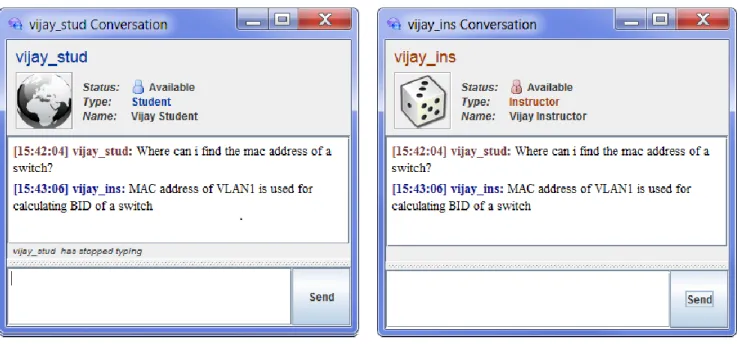
o Instructors can also provide just-in-time information to facilitate the acquisition of complex cognitive skills in computer networking courses by students [19]. Students can also request assistance using a chat facility as shown in Figure 5 and 6.
o Instructors can use the detailed activity log to check the progress of students or use the log for summative assessment.
o The system supports Multipurpose Academy POD which can be used to accommodate various network topologies dynamically. Hardware can now be used more efficiently and effectively to achieve desirable teaching and learning outcomes.
o Switched power outlets allow students to power on and off network devices remotely and make some features of network devices, such as router password recovery accessible.
o The platform stores the system default configurations and makes the default factory configurations always available.
Installation:
Installation is simple and straight forward. The only thing is to watch out for the unprintable characters used in the internal storage access path for VMWare ESXi Server. This server creates virtual machines as hosts in different network topologies used by the platform. Approximately 150 man-hours are required to complete the installation process.
4.1 Issues with the choice
The system uses VMWare ESXi Server to virtualize host devices. Unprintable characters are used in the assess path of the internal storage device. We can only copy and paste the path rather than typing the path manually.
As the interactive graphical user interface of the network topologies requires relatively high data rate, high speed Internet connection is desirable.
When the NETLABAE server is left inactive for a period of more than seven days the server
indefinitely goes into a frozen state and it could not be recovered remotely by the administrators. This could be solved only by physically restarting the server.
If a group of students has terminated a lab session earlier than the scheduled time period, the hardware resources assigned for the specified time session is not available to any user until the session booked gets completed.
5.
Conclusion
After examining various existing solutions, we conclude that NETLABAE is a suitable candidate
for our distance education platform. The platform uses real networking devices for real network topologies rather than simple console access of networking devices. With automated power on-off using power switches, students can explore special device features like password recovery. During a remote laboratory session interactive feedbacks from the instructors and members of the same learning community make the acquisition of knowledge more effective. The simple installation process makes it a viable platform for computer networking courses through distance education.
We will add NETLABAE to our existing distance education platform and compare the change of
performance in learning and teaching of computer networking courses after the introduction of the chosen platform.
Reference
[1] Galton, F, Sir (1979). Heriditary Genius: An inquiry into its laws and consequences. London: Julian Friedman Publishers. (Originally published in 1869.)
[2] Baird, L. L. (1985). Do grades and tests predict adult accomplishment? Research in Higher Education, 23, 3-85.
[3] Gobet, F., and Campitelli, G. (2007). The role of domain-specific practice, handedness, and starting age in chess. Developmental Psychology, 43(1), 159-172.
[4] Ericsson, A.. K., Krampe, R. T., and Tesch-Romer, C. (1993). The role of deliberate practice in the acquisition of expert performance. Psychological Review, 100(3), 363-406.
[5] De Groot, A. D. (1978). Thought and choice in chess. The Hague: Mouton Publishers 1978. Revised translation of De Groot, A. D. (1946), Het denken van den schaker. Amsterdam: NoordHollandsche.
[6] Glover, J. A., Ronning, R. R., and Bruning, R. J. (1990). Cognitive psychology for teachers.
New York: Macmillan.
[7] Kalchman, M., Moss, J., & Case, R. (2001). Psychological models for the development of mathematical understanding: Rational numbers and functions. In S. M. Carver & D. Klahr (Eds.), Cognition and instruction: Twenty-five years of progress (pp. 1-38). Mahwah, NJ: Erlbaum.
[9] Nersessian, N. J. (1991). Conceptual change in science and in science education. In History, Philosophy, and Science Teaching, M. R. Matthews, Ed. OISE Press, Toronto, Canada, 133–148.
[10] The Joint Task Force on Computing Curricula, IEEE Computer Society and Association for Computing Machinery (2001), Computing curricula 2001: Computer science. ACM Journal of Educational Resources in Computing, 1(3).
[11] Simonson, M. (2009). Distance learning. In The 2009 book of the year (p. 231). Chicago: Encyclopaedia Britannica.
[12] Interim Review Task Force (2008). Computer Science Curriculum 2008: An Interim Revision of CS 2001. Report from the Interim Review Task Force. http://www.acm.org//education/curricula/ComputerScience2008.pdf. Accessed 22 September 2011.
[13] Dicerbo, K. E. (2009). Hands-On Instruction in the Cisco Networking Academy. ICNS '09. Fifth International Conference on Networking and Services 2009.
[14] Mann, S. and Fung, J. (2002). Mediated reality. Presence: Teleoper. Virtual Environ. 11, 2, 158–175.
[15] Goldstein, C., Leisten, S., Stark, K. and Tickle, A. (2005). Using a Network Simulation Tool to Engage Students in Active Learning Enhances Their Understanding of Complex Data Communications Concepts.. In Proc. Seventh Australasian Computing Education Conference (ACE2005), Newcastle, Australia. CRPIT, 42. Young, A. and Tolhurst, D., Eds., ACS. 223-228.
[16] Bonwell, C., &Eison, J. (1991). Active learning: Creating excitement in the classroom.
ASHE-ERIC Higher Education Report No. 1. Washington, DC, The George Washington University.
[17] Biggs, J. B. (1999). Teaching for quality learning at university: what the student does. Buckingham England Philadelphia, Society for Research into Higher Education, Open University Press.
[18] Chickering A. W. and GamsonMarch Z. F. (1987). Seven Principles For Good Practice in Undergraduate Education. AAHE Bulletin (American Association for Higher Education) 1987.
[20] Linneman, S., &Plake, T. (2006). Searching for the difference: A controlled test of Just-In-Time Teaching for large-enrollment introductory geology courses. Journal of Geoscience Education, 54(1),18-24.
[21] Hill, J. M. D., et. al. (2001). Using an isolated network laboratory to teach advanced networks and security. In `SIGCSE Bulletin', ACM Press.
[22] Kneale, B. and Box, I. (2003). A virtual learning environment for real-world networking. Informing Science, Pori, Finland, pp:71.
[23] Kneale, B., Horta, A.Y.d. and Box, I. (2004). VELNET (Virtual Environment for Learning Networking). In Proc. Sixth Australasian Computing Education Conference (ACE2004), Dunedin, New Zealand. CRPIT, 30. Lister, R. and Young, A.L., Eds., ACS. 161-168.
[24] Winters, T., Erlinger, M., Ausanka-Crues, R., Kegel, M., Shimshock, E. and Turner, D. (2006). TinkerNet: A Low-Cost and Ready-To-Deploy Networking Laboratory Platform. In Proc. Eighth Australasian Computing Education Conference (ACE2006), Hobart, Australia. CRPIT,
52. Tolhurst, D. and Mann, S., Eds., ACS. 253-259.
[25] Erlinger, M., Molle, M., Winters, T., Shea, R. & Lundberg, C. (2004). Tinkernet: A low-cost networking laboratory. In `Computing Education 2004, Sixth Australasian Computing Education Conference', ACM Press.
[26] TinkerNet is available at http://www.cs.hmc.edu/tinkernet/ Assessed 22 September 2011.
[27] Jakab, F., Janitor, J. and Nagy, M. (2009). Virtual Lab in a Distributed International Environment - SVC EDINET. ICNS '09. Fifth International Conference on Networking and Services, 2009.
[28] Makasiranondh, W., Maj, S. P. and Veal, D. (2011). A Pedagogically Rich Interactive On-line Learning Platform for Network Technology Students in Thailand. In Proc. Australasian Computing Education Conference (ACE 2011), Perth, Australia. CRPIT, 114. John Hamer and Michael de Raadt Eds., ACS. 161-168.