Virtual Teamwork and PBL - Barriers to Participation
and Learning
Lyn Brodie
University of Southern Queensland, Toowoomba, Australia [email protected]
Abstract: This paper identifies and discusses several barriers to student participation and hence student learning in Problem Based Learning (PBL) course which utilises virtual teams. The majority of student teams work entirely in virtual space, having no face-to-face contact with either other team members or the team academic facilitator. The course has run for 7 years, with several offers per year and a comprehensive evaluation has indicated it is successful in meeting key learning objectives and forming learning communities. However the virtual aspect of teamwork and PBL has lead to new and different problems arising with respect to student participation and learning. A model is proposed which maps student engagement and learning in virtual teams. It provides a framework for further investigation, development of resources and facilitator training to support student learning
Introduction
PBL is not new to higher education but its application to distance education with students working in virtual teams has only been sparsely discussed in the literature. There have been numerous references to PBL for distance students in various disciplines, however in nearly every case these student teams are required to meet face-to-face at least once during the course and often team members work entirely in a face-to-face mode. Alternatively the course is not a true interpretation of PBL, but simply uses some form of technology to deliver course content as demonstrated in Virtual Teams
Engineering is a creative, team based, problem solving profession which sits at the interface of the sciences and society, and is recognised as such by Engineers Australia, in their program accreditation documents (Engineers Australia, 2004). Students need the basic tools of engineering science and their applications to make informed decisions, validate, and actually solve problems, but equally fundamental is the need to do this in a team environment meeting ethical, business and organisational needs.
Organisational needs are changing. Globilisation, technology, flexible work practices and a shrinking skilled and experienced work force in the Western world are changing how many organisations operate and this trend is likely to continue. Many organisations remain structured around traditional face-to-face teams but Arnison and Miller (2002) argue that increasingly these conventional face-to-face teams may increase productivity by utilising technology for communication, file sharing and sharing work across offices, time zones and even other organisations.
Table 1 Overview of literature discussing PBL in a virtual environment
Author, Title Notes
King & Mayall (2001). “Asynchronous Distributed Problem Based Learning”
Graduate course on educational psychology using PBL, no teamwork
Wilcznski & Jennings (2003) “Virtual Teams for Engineering Design”
Capstone course on engineering design, does not use PBL, on-campus students utilising electronic communication, document management etc Miao (2000) “Supporting Self directed
Learning Processes in a Virtual
Collaborative Problem Based Learning Environment”
Four day course, “virtual collaborative”
environment refers to use of electronic whiteboard and resource sharing software. Students work entirely face-to-face.
Paja et al (2005) “Platform for Virtual Problem-Based Learning in Control Engineering Education”
Not team based, PBL by presentation of all material in an electronic (virtual) media; remote labs
Kolmos et al (2006) “Design of a virtual PBL Learning environment – Master in Problem Based learning (MPBL)”
Extensive use of video conferencing which does not suit differing time zones; trial program; very small cohort of graduate education students; results of program are ‘inconclusive’.
Typically the literature on “distance PBL” refers to course delivery where students are working away from the main campus on a satellite campus, or normal teamwork is
supplemented by electronic communications with the lecturer, tutor or other team members (Brodie, 2006). Wilczyski & Jennings (2003) note that “a general framework has not yet been presented to guide the formation and management of Internet-based design teams within engineering education”. Also there is a distinct lack of published information on situated learning in virtual teams (Robey, Koo, & Powers, 2000).
The University of Southern Queensland (USQ) has a large distance cohort which forms 75% of the student base. A curriculum review which began in 2000, indicated the need to further strengthen key graduate attributes such as teamwork, communication and problem solving. PBL was the ideal paradigm to deliver these skills whilst utilising the diverse backgrounds and prior knowledge of the students. But in order to facilitate this, students would need to work in virtual teams. At this point in time, PBL for virtual teams was largely
un-documented and the academic team found itself at the forefront of this research and applications. These student (virtual) teams form a learning community which scaffolds individual and team learning goals based on the prior knowledge and experience of the team members (Gibbings & Brodie, 2008b). This paper investigates the interaction of students in virtual teams whilst solving open-ended contextual engineering problems. These students have a diverse range of skills and they are encouraged by the assessment scheme of the course to identify their own learning goals and mentor other students using their existing skills and knowledge (Gibbings & Brodie, 2008a).
Virtual Teams
Engineering is a creative, team based, problem solving profession which sits at the interface of the sciences and society, and is recognised as such by Engineers Australia, in their program accreditation documents (Engineers Australia, 2004). Students need the basic tools of engineering science and their applications to make informed decisions, validate, and actually solve problems, but equally fundamental is the need to do this in a team environment meeting ethical, business and organisational needs.
technology for communication, file sharing and sharing work across offices, time zones and even other organisations.
These changes have been noted as impacting on engineers and engineering education for example by Thorben & Schwesig (2002), National Academy of Engineering (2004) and Jamieson (2007) who predict the need for desirable engineering graduate attributes to be expanded to include:
• working in globally in a multicultural environment; • working in interdisciplinary and multi skilled teams;
• sharing of work tasks on a global and around the clock basis; • working with digital communication tools and
• working in a virtual environment
Thus universities need to equip students with these skills to cope with evolving technology and global demands of the profession (Brodie, 2008b). This leads to engineers working not only in teams, but learning and applying appropriate skills and techniques to virtual teams.
A virtual team is one whose members share a common purpose or goal and work interdependently. They are separated by distance and therefore perhaps time, culture, organisational and international boundaries. Their common theme is that they are linked only by communication technologies (Brodie, 2008a; Lipnack & Stamps, 1997; Noe, 2002; Robey et al., 2000). They are often assembled virtually to work on a specific project and therefore required to produce a ‘deliverable’ product such as a report or to fulfil a specific need (Lipnack & Stamps, 1997), have a finite life span and may never physically meet.
Successful virtual teams often use a variety of technologies to enhance their communication (Lau, Sarker, & Sahay, 2000), but most research agrees that working with electronic communication technologies alone is problematic without having first established personal relationships and trust within the team. If face-to-face meetings are not possible, then at a minimum, more sensory modes of communication such as videoconferencing must be utilised (Furst, Blackburn, & Rosen, 1999; Pauleen & Yoong, 2001; Townsend, DeMarie, & Hendrickson, 1998; Warkentin & Beranek, 1999). However Brodie (2007) and Brodie and Gibbings (2008b) have been able to show that in distance education, virtual teams have been able to develop into high performance teams without videoconferencing using a variety of non sensory communication technologies. This has been achieved through careful and considered use of appropriate technology, scaffolding, pedagogy and assessment. The pedagogy has been developed by incorporating theories on problem solving, reflective practice, traditional face-to-face teamwork, distance education and learning communities.
Virtual teams in education
In the rush to tap into new markets, utilise new technology and cater for changing student demographics many universities around the world have turned to distance and in particular online education (Brodie, 2006). Online students are becoming an entirely new cohort of higher-education learners (Diaz, 2002) with these students generally being older than their traditional counterparts and are interested in learning that can be done at home and fitted around work, family, and social obligations (Bates, 2000 p5).
Mature age students are motivated by professional advancement and external expectations but are nervous about their ability to succeed in distance learning due to rapidly changing technology which they may not have kept abreast of (Diaz, 2002; Dortch, 2003; Howell, Williams, & Lindsay, 2003). Most of these factors are supportive of the virtual team however some areas, such as technology may hinder full involvement.
education. Teamwork and in particular virtual teamwork can use the strengths of this student cohort whilst also supporting individual learning and social needs.
Advantages of virtual teams in higher education, and in particular distance education, can be summarised as:
• Opportunity to create a learning community, particularly for distance education students (Brodie & Gibbings, 2007; Gibbings & Brodie, 2008b)
• Work collaboratively to generate new knowledge (Brodie, 2008c; Hines, Oakes, Corley, & Lindell, 1998)
• Manage own learning (Goold, Augar, & Farmer, 2006; Robey et al., 2000) • Flexibility in work hours and place of work (Goold et al., 2006)
• Increased communication (Brodie, 2006; Brodie, 2008b)
• Faster response times to tasks (Arnison & Miller, 2002; Morris & Marshall, 2003) • Individual participation and contribution to the conventional face-to-face team can be
better measured, with the aid of computer technologies, to determine the effectiveness of the team (Arnison & Miller, 2002; Goold et al., 2006)
• The skills learnt in a virtual team environment are in high demand in most organisations (Black, 2002; Kirkman, Benson, Gibson, Tesluk, & McPherson, 2002)
• Allows students to interact with individuals from many different societies, thus greatly improving their awareness and appreciation of culture in today’s global world (Black, 2002; Brodie & Porter, 2008)
To realize these advantages, careful pedagogy, scaffolding and support systems must be in place as there are also disadvantages to be overcome. These disadvantages include:
• Difficulty in building and maintaining trust
• Loss of communication cues from facial expressions, voice tone and gestures e.g. Cascio (2000)
• Lack of skills in organising, running and facilitating teams ( the recognition that these skills are different from running face-to-face meetings and teams)
• Team problems obscured by technology
Students often complain that they are expected to work in teams at university but are given little assistance in teamwork, conflict resolution and other teamwork issues (Hart & Stone, 2002). These difficulties are exacerbated when working in a virtual team. Other
complicating issues such as communication technologies and different student priorities also affect team and individual performance. These factors all impact on student learning, which in any course is the primary objective. This investigation begins to look barriers to student participation and hence learning in virtual teams.
Method
Brodie (Brodie, 2006; 2008b) describes the implementation of a Learning Management System (LMS) to facilitate communication between team members undertaking a PBL course in engineering. Analysis of the data provided by the LMS on student usage was undertaken and linked to student engagement and learning. In a typical semester the course has an enrolment of between 300 and 350 students with roughly two thirds of the cohort enrolling in the distance mode and hence working in virtual teams. Average statistics for use of the LMS are:
• 15000 to 18000 postings to discussion forums (although this has decreased slightly when team wikis were introduced)
• 10000 to 12000 hours of total student time per semester
on the USQ server, however summaries or ‘meeting minutes’ are usually posted to the team discussion forum for the facilitator and other team members and as a record of the meeting.
The average number of discussion forum postings per student are usually equally shared between on campus and distance students. This is an interesting result as it was assumed that on-campus students would make significantly less use of the ‘virtual’ communication methods. However they like the flexibility offered by electronic communications and virtual teamwork.
In a typical semester (S12008) all postings to discussion boards, including minutes of
synchronous team meetings (using MSN etc) where analysed by content for key themes. The analysis was aimed at discovering critical elements which emerged during team formation and development. Content was initially organised using established models of group interaction but final classification was allowed to emerge from analysis as according to Johnson et al (2002, p. 384).
The interaction and function of the team also impacts on student learning and this theme was also addressed by a content analysis of reflective portfolios where students are asked to reflect on their learning over the semester. These reflections in addition to further information from postings to discussion forums where examined.
Results
Much of the theory of standard face-to-face teams can be applied to virtual teams. An analysis of postings to discussion forums indicates that Tuckman’s 1965 famous model of forming, storming, norming and performing, is evident in virtual teams, but times spent in each stage and strategies to move teams to the next stage, vary from standard face-to-face teams.
There is no significant difference in the overall performance (final grade) of virtual teams compared with on-campus teams (Brodie, 2008b). However virtual team members do have to overcome significant barriers particularly with respect to learning in this medium.
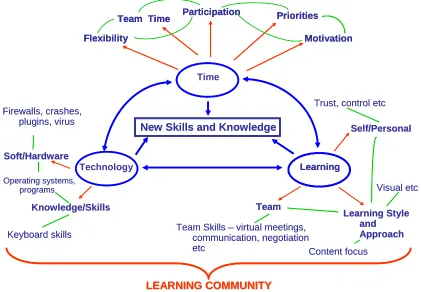
To investigate this aspect interviews and a thematic analysis of unprompted reflections from student portfolios were analysed for key themes and their interrelationship. From this data a model which shows the main themes, interaction between themes, the complexity of student learning and barriers to individual participation was developed. There are three main areas to be addressed if effective student learning is to be obtained. As shown in Figure 1 these are categorised as Time, Technology and Learning.
Self/Personal
Visual etc
Operating systems, programs
New Skills and Knowledge
Time
Learning Technology
Flexibility
Team Time Participation Priorities
Motivation
Team
Learning Style and Approach
Team Skills – virtual meetings, communication, negotiation etc
Trust, control etc
Content focus Soft/Hardware Knowledge/Skills Firewalls, crashes, plugins, virus Keyboard skills LEARNING COMMUNITY LEARNING COMMUNITY Self/Personal Visual etc Operating systems, programs
New Skills and Knowledge
Time Time Learning Learning Technology Flexibility
Team Time Participation Priorities
Motivation Flexibility
Team Time Participation Priorities
Motivation Flexibility
Team Time Participation Priorities
Motivation
Team
Learning Style and Approach
Team Skills – virtual meetings, communication, negotiation etc
Trust, control etc
[image:6.595.90.511.73.365.2]Content focus Soft/Hardware Knowledge/Skills Firewalls, crashes, plugins, virus Keyboard skills LEARNING COMMUNITY LEARNING COMMUNITY
Figure 1 Barriers to student learning in virtual teams
Technology has great impact on a students learning and their ability to learn. If they have do not have the skills and knowledge to readily interact with the team and access other resources it has immediate and sever consequences for them to engage in the learning opportunities available through virtual team interaction. Lack of general keyboard skills to efficiently make postings to discussion boards, reply to emails or contribute to a synchronous chat session in a timely fashion can frustrate the student and in some cases marginalise the student from the team. Similarly inability to navigate firewalls, virus and anti virus software, recover from system crashes and the installation and operation of operating systems and software can impact a students learning even before they have begun. They are sunk at the first hurdle.
The last of the barriers to student learning and participation – Self Learning is more difficult to investigate and quantify and is a significant area of study in its own right. The learning of a student in a tertiary environment is a complex area and is influenced by many factors – learning style and approach, self efficacy, pedagogy and personality to name a few. An added layer of complexity of this is the ‘team’ and the personalities and interaction of the team members and the requirement for the student to be an independent and self directed learner. Some students thrive in this sometimes new situation whilst others seek the normality of a standard classroom or course where the work is individual and directed by the ‘teacher’. Examples can be gained from student comments from a standard course evaluation form.
Analysis of the student reflective portfolios shows a surprising number of students give unprompted comments about own learning style both as an independent learner and as a team player. A random sample of 200 (100 distance students and 100 traditional on-campus students) portfolios showed that:
• 53 distance students made comment about their ability, or inability, to trust members of their virtual team especially in the early part of the course. This compared to just 12 on campus student who meet face to face.
tries to dominate the meeting/everyone etc. Only 24 on-campus students made similar statements.
• 67 distance students made specific comments relating to the differences in working in a virtual team compared to a face-to-face team. Their comments related to the different interactions between team members in the virtual environment; reflected on how the interactions would have been different in the different environment; or reflected on what they had learnt about themselves or team members.
• Distance students appeared to bring more team skills to the course and were able to reflect on the use of these skills in a different (virtual) learning environment.
• On-campus students (generally a younger cohort of students) reported more difficulty or dislike with the self directed nature of the course, whilst the distance students (on average mature age students) made more comments relating to the technical aspects of the
projects. On campus students had more comments believing that the course was not a true representation of the profession of engineering with comments like “we spent lots of time in meetings which is not what happens in an engineering office” and “the project was not what engineers in industry would be doing”. This impacted on their motivation and learning tasks.
• Distance students were more ‘content’ focused and disliked the research aspect of the course e.g. “I believe we should have learnt more discipline specific technical content. I did not learn much from researching [topic] as it was not in an area I am currently working in.” and “if I wanted to learn myself I would not have enrolled in an engineering degree”.
• A different maturity in approach to study was also evident in the portfolios. Whilst the portfolios were not matched for student age, the distance students are, on average, older. More distance students commented on the reflective task itself with comments like “This reflection really started me thinking. It is helping me to examine not only what and how the course is teaching but how I am performing, my shortcomings and what I need to work on.” – (Student comment) and “The idea of reflection has been one of the positives in my list of goals. I have never really reflected on my learning style, or about any of the past subjects that I have completed. I believe that this will definitely help me as I proceed with my degree.” - (Student comment)
Conclusions
Analysis of student surveys, focus groups of facilitators and students, team discussion board postings and student reflections have lead to the development of a framework which
accurately describes three major barriers and their interactions which effect student learning when working in a virtual team.
An understanding of these barriers, their interactions and implications allows appropriate support mechanisms to be developed and implemented. This will assist students in vital areas so they can understand and reflect on their individual perspective and can then focus more on their own learning and performance in a virtual team environment.
Working effectively and efficiently in a virtual team is a likely requirement for future graduates. The global nature of engineering and rapidly evolving technology may significantly change the profession of engineering and engineering education must also evolve to meet these needs. Whilst universities have adopted key graduate attributes such as teamwork, communication, problem solving and life long learning into their curriculums, the concept of a global profession and its implications have not been fully explored. The concept of virtual teamwork and its difference from face-to-face teamwork, especially from a student learning perspective need further investigation.
Recommendations
• Development of strategies and/or materials to support low and non participating team members. Early identification and intervention is crucial.
• Further development and refinement of the model (figure 1) to investigate and situate the learning aspect in appropriate literature i.e. individual approaches to learning and effect on team.
A framework representing three major barriers to student learning in virtual teams has been developed. The model successfully represents the interactions between these barriers and implications for student participation and learning in a virtual team environment. By
understanding such barriers, changes in assessment, resources, student facilitation and support mechanisms can be designed and implemented to support students so that learning is the central focus of the course and is not unduly compromised by other influences.
References
Arnison, L., & Miller, P. (2002). Virtual teams: a virtue for the conventional team. Journal of Workplace Learning, 14(4), 166-173.
Bates, A. W. (2000). Managing Technological Change: Strategies forr University and College Leaders
San Francisco: Jossey Bass
Black, G. (2002). Student Assessment Of Virtual Teams In An Online Management Course. Journal of Business Administration Online, 1(2).
Brodie, L. (2006). Problem Based Learning In The Online Environment – Successfully Using Student Diversity and e-Education. Proceedings of the Internet Research 7.0: Internet Convergences, Hilton Hotel, Brisbane, Qld, Australia.
Brodie, L. (2007). Problem Based Learning for Distance Education Students of Engineering and Surveying. Proceedings of the Connected - International Conference on Design Education, Sydney. Brodie, L. (2008a). Assessment strategy for virtual teams undertaking the EWB Challenge. Paper
presented at the Australasian Association of Engineering Educators.
Brodie, L. (2008b). eProblem Based Learning – Problem Based Learning using virtual teams.
European Journal of Engineering Education, in press.
Brodie, L. (2008c). Problem Based Learning, Virtual Teams and Future Graduate Attributes.
Proceedings of the Keynote presentation delivered to MIT Symposium on Project and Problem Based Learning in Higher Education, Boston.
Brodie, L., & Porter, M. (2008). Engaging distance and on-campus students in Problem Based Learning. European Journal of Engineering Education, 33(4), 433-443.
Brodie, L. M., & Gibbings, P. D. (2007, 9 – 12 JULY 2007). Developing Problem Based Learning Communities in Virtual Space. Proceedings of the Connected 2007 International Conference on Design Education, University of New South Wales, Sydney, Australia.
Cascio, W. F. (2000). Managing a virtual workplace. The Academy of Management Executive, 14(3), 81-90.
Diaz, D. P. (2002). Online Drop Rates Revisited. The Technology Source Archives, May/June. Dortch, K. D., April 13-15) Distance Education and Training Council: Report on the DETC 77th
Annual Conference. (2003). How to get learners to learn. o. Document Number)
Engineers Australia. (2004). Accredation Management System (Vol. December 2004). Melbourne, Aust: Engineers Australia.
Furst, S., Blackburn, R., & Rosen, B. (1999). Virtual team effectiveness: a proposed research agenda.
Information Systems Journal, 9(4), 249-269.
Gibbings, P., & Brodie, L. (2008a). Assessment Strategy for an Engineering Problem Solving Course.
International Journal of Engineering Education, 24(1, Part II), 153-161.
Gibbings, P. D., & Brodie, L. M. (2008b). Team-Based Learning Communities in Virtual Space.
International Journal of Engineering Education, 24(6), 1119-1129.
Goold, A., Augar, N., & Farmer, J. (2006). Learning in Virtual Teams: Exploring the Student Experience. Journal of Information Technology Education, 5, 477-490.
Hart, G., & Stone, T. (2002). Conversations with Students: The outcomes of focus groups with QUT students. Proceedings of the Proceedings of the 2002 Annual International Conference of the Higher Education Research and Development Society of Australasia (HERDSA).
Hines, P., Oakes, P., Corley, D., & Lindell, C. (1998). Crossing Boundaries: Virtual collaboration across disciplines The Internet and Higher Education, 1(2), 131-138.
Jamieson, L. (2007). Engineering Education in a Changing World. Paper presented at the IEC DesignCon Conference. from http://www.designcon.com/infovault/leah_jamieson_keynote.pdf Johnson, S., Suriya, C., Yoon, S., Berrett, J., & La Fleur, J. (2002). Team development and group
processes of virtual learning teams. Computers & Education, 39, 379-393.
King, F., & Mayall, H. (2001, 6-8 Aug). Asychronous Distributed Problem Based learning.
Proceedings of the IEEE International Conference on Advanced Learning Technologies, Madison, Wisconsin, USA.
Kirkman, B. L., Benson, R., Gibson, C. B., Tesluk, P. E., & McPherson, S. O. (2002). Five challenges to virtual team success: Lessons from Sabre, Inc. Academy of Management Executive, 16(3). Kolmos, A., Qvist, P., & Du, X. Y. (2006). Design of a virtual PBL learning environment - Master in
Problem Based Learning (MPBL) [Electronic Version]. Retrieved 6/62007, from http://vbn.aau.dk/fbspretrieve/4474433/AK_PQ_XD_SEFI_2006.pdf
Lau, F., Sarker, S., & Sahay, S. (2000). On Managing Virtual Teams. Healthcare Information Management Communications, 14(2), 46-53.
Lipnack, J., & Stamps, J. (1997). Virtual Teams: Reaching Across Space, Time, and Organizations with Technology. New York: John Wiley and Sons, Inc.
Miao, Y. (2000, August 10-13, 2000). Supporting Self-directed Learning Processes in a Virtual Collaborative Problem Based Learning Environment. Proceedings of the 2000 Americas Conference on Information Systems (AMCIS’2000), Long Beach, California, U.S.A.
Morris, S. A., & Marshall, T. E. (2003). Trust and technology in virtual teams. In R. K. Rainer (Ed.),
Advanced topics in information resources management (pp. 133-159 ). Hershey, PA, USA IGI Publishing.
National Academy of Engineering (2004). The Engineer of 2020: Visions of Engineering in the New Century. Washington, DC: The National Academies Press.
Noe, R. (2002). Emplyee Training and Development (2nd ed.). New York: McGraw-Hill.
Paja, C. A. R., Scarpetta, J. M. R., & Mejia, E. F. (2005, December 12-15, 2005). Platform for Virtual Problem-Based Learning in Control Engineering Education. Proceedings of the Proceedings of the 44th IEEE Conference on Decision and Control, and the European Control Conference, Seville, Spain.
Pauleen, D. J., & Yoong, P. (2001). Facilitating virtual team relationships via Internet and convetional communication channels. Internet Research: Electronic networking Applications and Policy, 11(2), 190-202.
Robey, D., Koo, H., & Powers, C. (2000). Situated learning in cross-functional virtual teams. IEE Transactionf of Professional Communication, 43(1), 51-66.
Thoben, K., & Schwesig, M. (2002). Meeting Globally Changing Industry Needs In Engineering Education. Proceedings of the ASEE/SEFI/TUB Colloquium, Berlin, Germany.
Townsend, A., DeMarie, S., & Hendrickson, A. (1998). Virtual Teams: Technology and the Workplace of the Future. Academy of Management Executive 12, 17-29.
Warkentin, M., & Beranek, P. M. (1999). Training to improve virtual team communication.
Information Systems Journal, 9(4), 271-289.
Wilczynski, V., & Jennings, J. (2003). Creating Virtual Teams for Engineering Design*. International Journal of Engineering Education., 19(2), 316-327.