JOURNAL OFVIROLOGY, July 2006, p. 7260–7264 Vol. 80, No. 14 0022-538X/06/$08.00⫹0 doi:10.1128/JVI.00051-06
Copyright © 2006, American Society for Microbiology. All Rights Reserved.
NOTES
Infection of Naı¨ve Target Cells with Virus-Like Particles: Implications
for the Function of Ebola Virus VP24
Thomas Hoenen,
1,2Allison Groseth,
2,3Larissa Kolesnikova,
1Steven Theriault,
2,3Hideki Ebihara,
4,5Bettina Hartlieb,
1Sandra Bamberg,
1Heinz Feldmann,
2,3Ute Stro
¨her,
2,3and Stephan Becker
1*
Institut fu¨r Virologie, Philipps Universita¨t Marburg, Marburg, Germany1; National Laboratory for Zoonotic Diseases and
Special Pathogens, National Microbiology Laboratory, Public Health Agency of Canada, Manitoba, Canada2;
Department of Medical Microbiology, University of Manitoba, Manitoba, Canada3; Institute of
Medical Science, University of Tokyo, Tokyo, Japan4; and CREST, Japan Science and
Technology Corporation, Saitama, Japan5
Received 9 January 2006/Accepted 8 April 2006
Infectious virus-like particle (iVLP) systems have recently been established for several negative-strand RNA
viruses, including the highly pathogenicZaire ebolavirus(ZEBOV), and allow study of the viral life cycle under
biosafety level 2 conditions. However, current systems depend on the expression of viral helper nucleocapsid proteins in target cells, thus making it impossible to determine whether ribonucleoprotein complexes trans-ferred by iVLPs are able to facilitate initial transcription, an indispensable step in natural infection. Here we describe a ZEBOV iVLP system which overcomes this limitation and show that VP24 is essential for the formation of a functional ribonucleoprotein complex.
Ebola virus (EBOV) causes severe hemorrhagic fever in humans, for which treatment is currently unavailable (6, 8). To study particle morphogenesis, genome packaging, and virion entry into target cells under biosafety level 2 conditions, an infectious virus-like particle (iVLP) system forZaire ebolavirus
(ZEBOV) was established (20). This system extends the orig-inal minigenome systems (4, 7, 14) by including VP24, VP40, and GP to produce iVLPs which resemble wild-type (WT) virions but contain minigenomes instead of full-length viral genomes. These iVLPs can deliver the minigenomes to target cells, where they are transcribed and replicated in the presence of helper ribonucleoprotein (RNP) components (the nucleo-protein [NP], VP35, VP30, and L components). Similar sys-tems are available for other negative-sense RNA viruses, but RNP components must always be provided to target cells in
trans, via either helper virus infection or expression plasmid transfection (12, 15–17, 19–21). Therefore, it is impossible to determine whether iVLPs contain fully functional RNP com-plexes or whether they contain minigenomes but are unable to facilitate initial transcription, as is necessary in virus infection. EBOV VP24 has been described as a minor matrix protein, but its contribution to budding is controversial (10, 13). Elec-tron microscopic studies imply a role in the formation of nu-cleocapsid-like structures (11), while another study suggests that VP24 is unnecessary for the packaging and delivery of minigenomes by iVLPs (20). To better understand the contri-bution of VP24 to morphogenesis, we established an iVLP system with naı¨ve target cells to allow assessment of
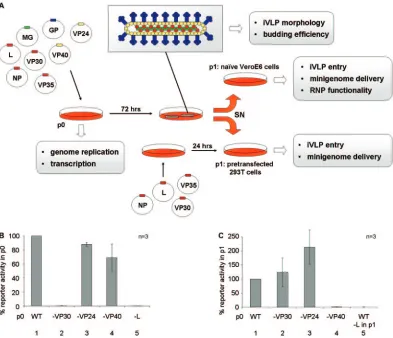
iVLP-asso-ciated RNP complex function. As a first step, an iVLP system based on that previously described (20) was established in our laboratory (Fig. 1A). 293T cells (p0) were transfected using FuGENE (Roche) with plasmids encoding each ZEBOV structural protein (125 ng NP, 125 ng pCAGGS-VP35, 75 ng pCAGGS-VP30, 1,000 ng pCAGGS-L, 250 ng GP, 250 ng VP40, and 60 ng pCAGGS-VP24) and a T7-driven minigenome encoding aRenilla lucif-erase reporter (250 ng), which is detectable in minute amounts (23). Cell supernatant containing released iVLPs was har-vested 3 days posttransfection, cleared of cellular debris, and used to infect target 293T cells (p1) previously transfected with RNP components (125 ng NP, 125 ng pCAGGS-VP35, 75 ng pCAGGS-VP30, and 1,000 ng pCAGGS-L). Re-porter activity in p0, as determined by dual-luciferase assay (Promega), was dependent on VP30 and L but not VP24 or VP40 (Fig. 1B). The infection of 293T cells in p1 resulted in reporter activity 3 days postinfection (p.i.) that was dependent on the presence of L in p1 and VP40 in p0 (Fig. 1C) as previously published (20). Omitting VP24 or VP30 in p0 did not reduce reporter activity in p1, showing that, under these conditions, neither VP24 nor VP30 was necessary for minig-enome replication, iVLP budding, or minigminig-enome delivery and that VP30 in p1 compensates for the absence of VP30 in p0.
To establish an iVLP system with naı¨ve target cells, the above protocol was repeated with naı¨ve VeroE6 as target cells in p1, since among cell lines tested, they showed the highest susceptibility to infection with a recombinant ZEBOV (data not shown). This virus expresses enhanced green fluorescent protein (GFP) from an additional open reading frame and shows growth comparable to that of wild-type ZEBOV in cell culture, similar to another recombinant GFP-ZEBOV recently * Corresponding author. Mailing address: Robert Koch-Institut,
Nordufer 20, 13353 Berlin, Germany. Phone: 49 30 4547-2373. Fax: 49 30 4547-2328. E-mail: [email protected].
7260
on November 8, 2019 by guest
http://jvi.asm.org/
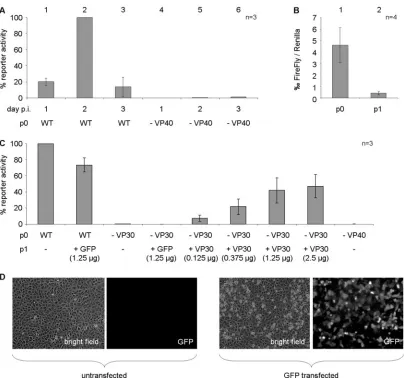
described (18). Reporter activity in iVLP-infected target VeroE6 cells was determined 1 to 3 days p.i. and showed a maximum on day 2 (Fig. 2A), consistent with the need for the transcription/translation of reporter protein prior to detection.
Notably, reporter activity in naı¨ve target cells was⬃100-fold lower than that in pretransfected cells (data not shown). This difference may be due to limited amounts of RNP components being available during the infection of naı¨ve target cells, which makes minigenome replication unlikely (22). Together, limited amounts of both viral proteins and minigenome contribute to a low signal strength, which may explain why, in previously pub-lished iVLP systems which used chloramphenicol acetyltrans-ferase or GFP reporters, infection of naı¨ve target cells was undetectable.
To confirm that activity in p1 was not due to unspecific reporter protein transfer, a plasmid encoding firefly luciferase under the control of an SV40 promoter (250 ng pGL2-Control; Promega) was cotransfected with the other plasmids in p0. The ratio of firefly luciferase activity (control) to minigenome-en-codedRenillaluciferase activity was then determined in p0 and in p1 (Fig. 2B). The ratio decreased ⬃10-fold, with firefly luciferase activity (4 ⫻ 102 relative light units/well/s) in p1
being in the range of the luminometer background (1⫻102
relative light units/well/s). This confirmed specific minigenome transfer, since unspecific packaging ofRenillaand firefly lucif-erase should occur equally.
[image:2.585.96.489.69.407.2]To further demonstrate that reporter activity in p1 was due to transcription by the viral RNP complex, VeroE6 target cells FIG. 1. iVLP assay with pretransfected target cells. (A) Schematic outline of iVLP assays. 293T cells (p0) are transfected with 125 ng pCAGGS-NP, 125 ng pCAGGS-VP35, 75 ng pCAGGS-VP30, 60 ng pCAGGS-VP24, 1,000 ng pCAGGS-L, 250 ng pCAGGS-VP40, 250 ng pCAGGS-GP, 250 ng minigenome (MG), and 250 ng pCAGGS-T7. These plasmids encode the nucleocapsid proteins (red), matrix proteins (yellow), and the glycoprotein (blue) of ZEBOV, a ZEBOV-specific minigenome (green) with aRenillaluciferase reporter, and the T7 polymerase, respectively. Reporter activity in p0 reflects minigenome replication and transcription. Produced iVLPs resemble WT virions but contain a minigenome instead of a full-length viral genome. Each iVLP can be analyzed for its morphology and its budding efficiency. Target cells (p1) are either pretransfected with expression plasmids for NP, VP35, VP30, and L (iVLP assay with pretransfected target cells, lower half) or left untreated (iVLP assay with naı¨ve target cells, upper half). After transfer of the supernatant from p0 to p1, these target cells become infected by the iVLPs. The reporter activity in p1 reflects iVLP entry and delivery and, in the case of naı¨ve target cells, also initial transcription of the minigenome solely by the viral proteins transported in the iVLPs and, thus, RNP complex functionality. (B) 293T cells (p0) were transfected with all of the plasmids necessary to produce iVLPs (WT, bar 1) or with all of these plasmids except those indicated (bars 2 to 5). Seventy-two hours posttransfection, the cells were harvested and luciferase activity, reflecting minigenome replication and transcription, was determined. The supernatant of these cells was used to infect target cells. (C) Pretransfected 293T cells serving as target cells (p1) were infected with WT iVLPs (bars 1 and 5) or single-protein-deficient iVLPs (bars 2 to 4). Three days p.i., the luciferase activity, reflecting iVLP entry and minigenome delivery, was determined. Target cells transfected with all of the RNP components except L served as a negative control (bar 5). Error bars indicate standard deviations.
on November 8, 2019 by guest
http://jvi.asm.org/
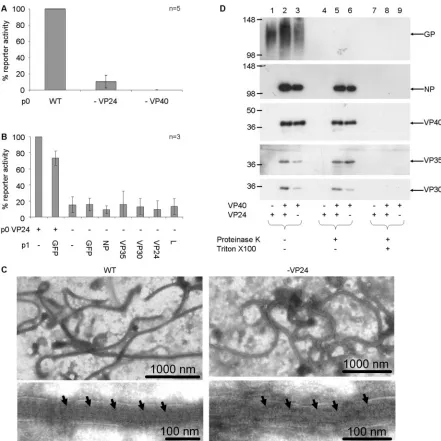
were infected with VP30-deficient iVLPs and VP30 was pro-vided in trans by electroporation (2) of 0.125 to 2.5 g pCAGGS-VP30/well or 1.25g pCAGGS-GFP/well (control) 1 day before infection. When VP30 was not provided intrans, reporter activity was undetectable in p1 (Fig. 2C). However, when VP30-pretransfected cells were infected, we observed recovery of reporter activity (Fig. 2C) correlating with trans-fection efficiency (Fig. 2D). This indicates that viral RNP com-ponents are responsible for transcription in p1 and demon-strates the possibility of providing VP30 to target cells intrans. We then reevaluated the role of ZEBOV VP24 using this newly established system by omitting VP24 from the transfection of p0. Surprisingly, in contrast to the results with pretransfected target cells, reporter signals were decreased in p1 by 90% after infection with VP24-deficient iVLPs (Fig. 3A). When target VeroE6 cells were pretransfected with all RNP components,
re-porter activity was independent of VP24 in iVLPs (data not shown). However, neither pretransfection of target cells with any single RNP component nor that with VP24 resulted in the recov-ery of reporter activity (Fig. 3B). Also, combinations of RNP components (VP35/L and NP/VP35/VP30) could not restore re-porter activity (data not shown). This suggests that VP24 does not simply recruit a single RNP component into particles and makes a direct role of VP24 in target cells (e.g., interaction with host factors) unlikely. However, since VeroE6 cells do not produce type I interferon (5), any effects of VP24 on the interferon cas-cade (3, 9) may not be detectable.
[image:3.585.90.494.66.444.2]Electron microscopic analysis of negative-stained wild-type and VP24-deficient iVLPs revealed no obvious size differences, and RNP-like structures were found in both types of particles (Fig. 3C). We further analyzed iVLPs for their protein com-positions by purifying them by ultracentrifugation over a 20% FIG. 2. iVLP assay with naı¨ve VeroE6 target cells. (A) Time course of reporter activity in p1. VeroE6 cells were infected with iVLPs, and the reporter activity was determined at days 1 to 3 p.i. (bars 1 to 3). As a negative control, VeroE6 cells were infected with supernatant of iVLP-producing cells that were transfected with all of the plasmids necessary to produce iVLPs with the exception of VP40 (bars 4 to 6). (B) The ratio of firefly luciferase, expressed from a control plasmid that was cotransfected in p0, toRenillaluciferase, expressed from the minigenome, was determined in both p0 (bar 1) and p1 (bar 2), showing that luciferase is not unspecifically transferred. (C) Recovery of VP30-deficient iVLPs by pretransfecting VP30 in p1. WT or VP30-deficient iVLPs were produced and used to infect VeroE6 cells that had been pretransfected by electroporation with the indicated amounts of pCAGGS-VP30 or pCAGGS-GFP. Reporter activity was determined 2 days p.i. (D) Transfection efficiency of electroporation. VeroE6 cells were transfected with 1.25g of pCAGGS-GFP. GFP-expressing cells were visualized 24 h posttrans-fection by fluorescence microscopy. Error bars indicate standard deviations.
7262 NOTES J. VIROL.
on November 8, 2019 by guest
http://jvi.asm.org/
sucrose cushion and performing proteinase K digestion and Western blotting (1). Most obvious, VP30 levels were dimin-ished in VP24-deficient particles (Fig. 3D, lanes 5 and 6), indicating changes in the composition of the RNP com-plexes.
A possible explanation for the observed results is that VP24 is necessary for the correct assembly of fully functional nucleo-capsids. According to this hypothesis, minigenomes are not
[image:4.585.70.511.67.508.2]properly encapsidated in VP24-deficient cells, preventing cor-rect processing by the polymerase complex in target cells. With excessive amounts of all nucleocapsid proteins present in p1, due to pretransfection, the processing of transferred minigenome may be possible because it can be replicated and the resulting progeny serves as a template for transcription. Based on the obtained data, we therefore propose that one function of VP24 is to facilitate the assembly of fully functional nucleocapsids.
FIG. 3. iVLP assay with VP24-deficient particles. (A) VeroE6 cells were infected with WT or VP24-deficient iVLPs. The reporter gene activity was determined 2 days p.i. As a negative control, the plasmid encoding VP40 was omitted in p0. Error bars indicate standard deviations. (B) Recovery of infectivity of VP24-deficient iVLPs by pretransfection of p1. VeroE6 cells were pretransfected by electroporation with 1.25g of plasmid encoding the indicated protein. One day posttransfection, the cells were infected with WT or VP24-deficient iVLPs, and 2 days p.i., the reporter activity was measured. Error bars indicate standard deviations. (C) Electron microscopy analysis of iVLPs. WT and VP24-deficient iVLPs were produced and purified by ultracentrifugation over a 20% sucrose cushion. Particles were visualized using electron microscopy after negative staining. Arrows show nucleocapsid-like structures. (D) Analysis of iVLP composition. WT (lanes 2, 5, and 8) or VP24-deficient (lanes 3, 6, and 9) iVLPs were produced and purified over a 20% sucrose cushion. As a control, the plasmid encoding VP40 was omitted in p0 (lanes 1, 4, and 7). The purified iVLPs were either mock treated (lanes 1 to 3), treated with proteinase K (lane 4 to 6), or treated with proteinase K and Triton X-100 (lanes 7 to 9). The samples were then separated by sodium dodecyl sulfate-polyacrylamide gel electrophoresis and detected by Western blotting using specific antibodies. Proteins inside the iVLPs are visible in lanes 4 to 6.
on November 8, 2019 by guest
http://jvi.asm.org/
We thank Victoria Wahl-Jensen for pCAGGS-GP, Elke Mu¨hlberger and Michael Weik for plasmids encoding the EBOV nucleocapsid proteins, Julie Dyall Apath for the 3E5E-luc plasmid, Steven Jones for ZEBOV GP antibodies, and Lisa Fernando and Judie Alimonti for technical assistance.
Financial support came from VCI (T.H.), NSERC (A.G.), DFG (SFB 535 and 593), and PHAC.
REFERENCES
1.Bamberg, S., L. Kolesnikova, P. Moller, H. D. Klenk, and S. Becker.2005. VP24 of Marburg virus influences the formation of infectious particles.
J. Virol.79:13421–13433.
2.Baron, S., J. Poast, D. Rizzo, E. McFarland, and E. Kieff.2000. Electropo-ration of antibodies, DNA, and other macromolecules into cells: a highly
efficient method. J. Immunol. Methods242:115–126.
3.Basler, C. F., and P. Palese.2004. Modulation of innate immunity by
filo-viruses, p. 305–349.InH. D. Klenk and H. Feldmann (ed.), Ebola and
Marburg viruses. Horizon Bioscience, Norfolk, United Kingdom. 4.Boehmann, Y., S. Enterlein, A. Randolf, and E. Muhlberger.2005. A
recon-stituted replication and transcription system for Ebola virus Reston and
comparison with Ebola virus Zaire. Virology332:406–417.
5.Emeny, J. M., and M. J. Morgan.1979. Regulation of the interferon system: evidence that Vero cells have a genetic defect in interferon production.
J. Gen. Virol.43:247–252.
6.Feldmann, H., S. M. Jones, H. J. Schnittler, and T. Geisbert.2005. Therapy and
prophylaxis of Ebola virus infections. Curr. Opin. Investig. Drugs6:823–830.
7.Groseth, A., H. Feldmann, S. Theriault, G. Mehmetoglu, and R. Flick.2005. RNA polymerase I-driven minigenome system for Ebola viruses. J. Virol.
79:4425–4433.
8.Groseth, A., S. Jones, H. Artsob, and H. Feldmann.2005. Hemorrhagic fever
viruses as biological weapons, p. 169–192.InI. W. Fong and K. Alibek (ed.),
Bioterrorism and infectious agents. Springer Science⫹Business Media, New
York, N.Y.
9.Halfmann, P. J., and Y. Kawaoka.2005. Ebola VP24 inhibits type I inter-feron signaling, p. 81. Abstr. XIII Int. Congr. Virol. 2005. American Society for Microbiology, Washington, D.C.
10.Han, Z., H. Boshra, J. O. Sunyer, S. H. Zwiers, J. Paragas, and R. N. Harty.
2003. Biochemical and functional characterization of the Ebola virus VP24 protein: implications for a role in virus assembly and budding. J. Virol.
77:1793–1800.
11.Huang, Y., L. Xu, Y. Sun, and G. J. Nabel.2002. The assembly of Ebola virus nucleocapsid requires virion-associated proteins 35 and 24 and
posttransla-tional modification of nucleoprotein. Mol. Cell10:307–316.
12.Lee, K. J., M. Perez, D. D. Pinschewer, and J. C. de la Torre.2002. Identi-fication of the lymphocytic choriomeningitis virus (LCMV) proteins required
to rescue LCMV RNA analogs into LCMV-like particles. J. Virol.76:6393–
6397.
13.Licata, J. M., R. F. Johnson, Z. Han, and R. N. Harty.2004. Contribution of ebola virus glycoprotein, nucleoprotein, and VP24 to budding of VP40
virus-like particles. J. Virol.78:7344–7351.
14.Muhlberger, E., M. Weik, V. E. Volchkov, H. D. Klenk, and S. Becker.1999. Comparison of the transcription and replication strategies of marburg virus
and Ebola virus by using artificial replication systems. J. Virol.73:2333–2342.
15.Neumann, G., T. Watanabe, and Y. Kawaoka.2000. Plasmid-driven
forma-tion of influenza virus-like particles. J. Virol.74:547–551.
16.Perez, M., and J. C. de la Torre.2005. Identification of the Borna disease virus (BDV) proteins required for the formation of BDV-like particles.
J. Gen. Virol.86:1891–1895.
17.Stillman, E. A., J. K. Rose, and M. A. Whitt.1995. Replication and ampli-fication of novel vesicular stomatitis virus minigenomes encoding viral
struc-tural proteins. J. Virol.69:2946–2953.
18.Towner, J. S., J. Paragas, J. E. Dover, M. Gupta, C. S. Goldsmith, J. W. Huggins, and S. T. Nichol.2005. Generation of eGFP expressing recombi-nant Zaire ebolavirus for analysis of early pathogenesis events and
high-throughput antiviral drug screening. Virology332:20–27.
19.Wagner, E., O. G. Engelhardt, F. Weber, O. Haller, and G. Kochs.2000. Formation of virus-like particles from cloned cDNAs of Thogoto virus.
J. Gen. Virol.81:2849–2853.
20.Watanabe, S., T. Watanabe, T. Noda, A. Takada, H. Feldmann, L. D. Jasenosky, and Y. Kawaoka.2004. Production of novel Ebola virus-like particles from cDNAs: an alternative to Ebola virus generation by reverse genetics. J. Virol.
78:999–1005.
21.Whelan, S. P., L. A. Ball, J. N. Barr, and G. T. Wertz.1995. Efficient recovery of infectious vesicular stomatitis virus entirely from cDNA clones. Proc. Natl.
Acad. Sci. USA92:8388–8392.
22.Whelan, S. P., J. N. Barr, and G. W. Wertz.2004. Transcription and repli-cation of nonsegmented negative-strand RNA viruses. Curr. Top. Microbiol.
Immunol.283:61–119.
23.Zhuang, Y., B. Butler, E. Hawkins, A. Paguio, L. Orr, M. G. Wood, and K. V. Wood.2001. A new age of enlightenment. Promega Notes79:6–11.
7264 NOTES J. VIROL.