Int. J. Electrochem. Sci., 14 (2019) 1997 – 2003, doi: 10.20964/2019.02.58
International Journal of
ELECTROCHEMICAL
SCIENCE
www.electrochemsci.orgShort Communication
Graphite-Doped Polyimide Films for Sensitive Non-Enzymatic
Amperometric Determination of Catechol
Hongbin Zhao1, Yue Wang1,*, Shichang Qian2, CaiFu Xu2, Wen Li1, Xiaoning Li1,
Dandan Su1, Zhizhi Hu1,*
1 School of Chemical Engineering, University of Science and Technology Liaoning, 185 Qianshan
Middle Road, High-tech zone, Anshan, Liaoning, 114051, China.
2 Liyang Huajing Electronic Material Co., Ltd, 8 Huajing Road, DaiBu Town, Liyang, Jiangsu,
213300, China.
*E-mail: [email protected] (Yue Wang), [email protected] (Zhizhi Hu).
Received: 2 October 2018 / Accepted: 26 November 2018 / Published: 5 January 2019
In this study, a novel graphite (GR)-doped polyimide (PI) film was fabricated for the determination of catechol (CC). The electrocatalytic oxidation of CC in a mild aqueous medium was investigated. Under optimized conditions, the linear range of CC is from 0.1 to 10 mM with a detection limit of 11.3 M. The electrode exhibited extremely high stability, and it maintained 95% of its initial activity after six months in storage. In addition, the GR/PI film sensor showed excellent selectivity, good sensitivity and wide linear range. The results show that polyimide film can be used as a suitable sensor for catechol, expanding a new application for polyimide films on flexible electric devices.
Keywords: polyimide film, graphite powder, catechol, nonenzymatic sensor
1. INTRODUCTION
Catechol is a phenolic derivative that is widely used in agricultural chemicals, industry, medicine, pharmaceuticals, dyes, foods, photography, cosmetics, etc. [1, 2]. Because of the high toxicity and low degradability of catechol, it is very harmful to both human health and the environment. For this reason, much research has been performed on the development and exploitation of the rapid and accurate monitoring of phenol derivatives.
target analytes due to its low cost, rapid response and ease of operation [8-11]. Nonenzymatic electrochemical detection is a powerful and effective method for the determination of phenolic compounds due to the ease of denaturation and sensitivity to the environment of the enzyme-based sensor. Numerous materials were applied to fabricate nonenzymatic sensors including carbon nanotubes [12, 13], graphene oxide [14-16], metal and metal oxide [17-19].
Polyimide (PI) is an ideal polymer material because of its excellent chemical and physical stability. It is highly insulating. Usually, PI is widely used in the semiconductor industry for passivation and dielectric layers [20]. With the increasing demand for flexible electric devices, PI is a good candidate among various polymers. In this work, a sensor based on graphite (GR)-doped polyimide film was fabricated for the sensitive detection of catechol in a mild aqueous electrolyte. It showed sufficient long-term stability and maintained 95% of its initial activity after six months in storage. In addition, it also showed excellent selectivity, sufficient sensitivity and good linear range.
2. EXPERIMENTAL
2.1. Reagents and Materials
Catechol (CC), hydroquinone (HQ), p-cresol, phenol, hydrogen peroxide (H2O2), sodium
hydroxide (NaOH), N, N’-dimethylacetamide (DMAc), phosphoric acid, glacial acetic acid and boric acid were purchased from Sinopharm Chemical Reagent Co., Ltd., China. Graphite, diamine, and dianhydride were obtained from Sinosteel Anshan Research Institute of Thermo-energy Co., Ltd., China. The electrolyte was prepared for the acidic solution with 0.1 M Britton-Robinson buffer (BR, prepared by mixing 0.1 M phosphoric acid, 0.1 M glacial acetic acid and 0.1 M boric acid). The neutral and alkaline solutions were adjusted by blending the ternary-acid mixture and 0.1 M NaOH. All other chemicals were of analytical grade and were used without further purification.
2.2. Apparatus
Cyclic voltammograms (CVs) and amperometric i-t curves were performed with a CHI 750D workstation (Shanghai Chenhua, China). A conventional three electrode system with a PI film as the working electrode, a thin Pt wire as the counter electrode and Ag/AgCl (sat. KCl) as the reference electrode was employed in this study. Twenty milliliters of 0.1 M BR buffer was used as the electrolyte solution. All measurements were performed in air at a room temperature of approximately 20°C.
2.3 Preparation of polyimide film
the diluted solution was coated onto a clean, flat glass plate. Furthermore, the glass plate was placed into an oven and roasted from 60˚C to 100˚C at 10˚C /min, and the temperature was maintained at 120˚C for 12 h. Finally, a black conductive polyimide film was made, where graphite powder accounted for 5%-20% of the file quality. The GR/PI film was cut to 10 cm × 0.5 cm in size to use as a working electrode.
3. RESULTS AND DISCUSSION
3.1. Characteristics of graphite doped polyimide film (GR/PI)
Figure 1. Images of PI (A) and GR/PI (B)
Fig. 1 shows the overview images of a PI film (A) and a GR/PI film (B) using a camera. Both images show smooth surfaces. After doping with graphite, the film turned black and still maintained a smooth surface. The high uniformity demonstrates that graphite powder was doped into PI and distributed homogeneously, which is effective for the high electrocatalysis of catechol. The characteristics of the GR/PI film were also checked. The tensile strength of GR/PI is 140-160 Mpa. It shows 40%-60% elongation at the breaking point. The modulus of elasticity is 2.0-2.2 Gpa.
3.2. Electrochemical properties of the GR/PI film
[image:3.596.162.440.238.355.2] [image:3.596.134.470.557.700.2]
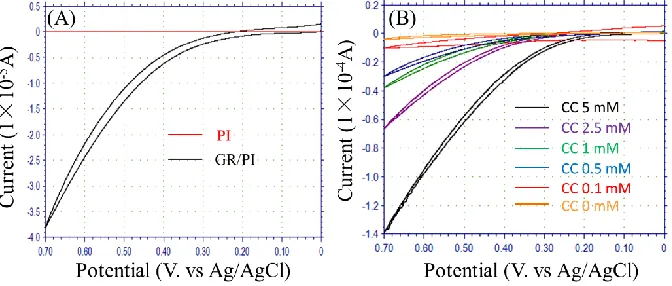
To confirm the electrocatalytic activity of GR/PI film toward CC, we measured CVs in the presence of CC by using 2 electrodes. As Fig. 2A shows, PI shows no response to CC, which is consistent with the insulating characteristic of polyimide, while graphite powder-doped PI (Fig. 2B) shows a good response to CC. Large anodic current appeared from +0.2 V to +0.7 V for GR/PI. With increasing CC concentrations, GR/PI shows a good linear response range.
Figure 3. (A) Effect of pH on anodic current in 0.5 mM CC. The applied potential is +0.6 V. (B) The effect of the applied potential on steady-state anodic current in 0.5 mM CC (blue) and in the background current (red). pH 7.0.
To obtain the best operational conditions for the GR/PI film, the pH dependency of the electrolyte and the applied potential were optimized in aqueous solutions through amperometric curves for the determination of CC. The effects of pH from 3 to 9 on the anodic current were studied and the results are shown in Fig. 3A. The amperometric response toward CC increased gradually from 3 to 8 and reached a plateau at pH 9. The GR/PI electrode can detect CC in the mild pH region. This is a very positive result that indicates environmentally friendly detection is possible. The responses of CC toward the applied potential effect were also checked. The amperometric response of 0.5 mM CC increased with increasing potential from +0.2 V to + 0.6 V (Fig. 3B blue dot). Because the baseline increased substantially by increasing the potential (Fig. 3B red dot), the response current decreased when the applied potential was higher than +0.6 V.
[image:4.596.127.475.171.306.2] [image:4.596.148.455.572.705.2][image:5.596.135.457.190.312.2] [image:5.596.104.491.576.694.2]
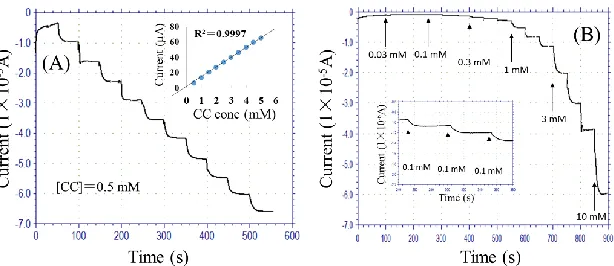
Fig. 4 shows a typical current-time response of GR/PI film to successive additions of CC under air-saturated PBS (pH 7.0) and stirring. It showed a linear range for catechol from 0.1 to 10 mM, with the regression equation I=3.8176C + 0.2971 and a correlation coefficient of 0.9997. The detection limit (LOD) is 11.3 M (S/N=3). Compared with other CC-based sensors shown in Table 1, the present sensor is comparable, especially considering the excellent conductivity and extremely long lifetime [21-25].
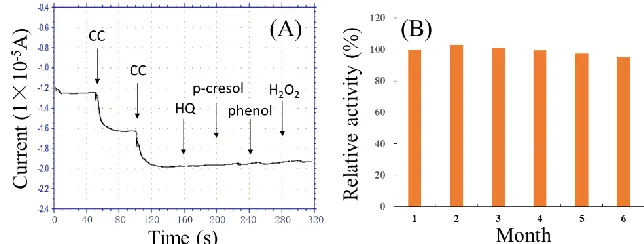
Figure 5. (A) Amperometric currents of the GR/PI film for successive additions of 0.5 mM CC and the same concentration of other interferences. (B) The lifetime length of GR/PI film on the detection of 0.5 mM of CC. (Applied potential +0.6 V vs. Ag/AgCl, pH 7.0)
Selectivity is an important factor for evaluating the performance of sensors [26]. The interferential experiment of GR/PI film was performed to understand the selectivity of the sensor. The typical amperometric responses on successive addition of 0.5 mM of CC and the same concentration of interferences (phenol, HQ, p-cresol, H2O2) under the same operational conditions were measured. As
shown in Fig. 5A, there are no obvious responses from these four compounds. Usually, these species are easily oxidized in the positive potential region. It can be speculated that the permeability of the PI film hindered the pathway for these species. The results are very valuable and encouraging for real sample determination.
Table 1. Summary of the H2O2 sensors reported in the literature.
Electrode material Linear range (mol L-1 )
LOD
(mol L-1) Ref
TiO2/MWCNTs/GCE 2.5-200 0.8 21
GQDs/GCE 4-600 0.4 22
AuNPs/Fe3O4-APTES-GO 2-145 0.8 23
LRG/GCE 3-300 0.4 24
CNCs-RGO/GCE 1-300 0.4 25
GR/PI film 100-10000 11.3 This work
3.3 Reproducibility, repeatability and long-term stability
The reproducibility and repeatability of the GR/PI film was evaluated. The film-based sensor exhibited good repeatability with a relative standard deviation (RSD) of 1.5% for 10 successive measurements of 0.5 mM CC. The polymer sensor has excellent storage stability. Even after six months of storage in air conditioning, the sensor retained 95% of its initial current response. The good stability exhibited by polyimide suggests it can be used as a reliable, and long-term sensor (Fig. 5B).
3.4 Application of the modified electrode
Table 2. GR/PI film applied to drinking water
Detection (M) Added (M) Found (M) RSD (%) Recovery (%)
1 Not found 50.0 52.1 2.8 104.2
2 Not found 100.0 96.5 3.2 96.5
3 Not found 200.0 206.0 3.9 103.0
To evaluate the practical application of GR/PI films, drinking water was checked to determine CC in our lab. The results are shown in Table 2. The film recovers well from 96.5 to 104.2%, with an RSD% less than 3.9. The results identified that the sensor can be used to detect real samples.
4. CONCLUSION
A GR/PI film-based sensor exhibited good electrocatalytic activity for the oxidation determination of catechol. It has an acceptable linear range from 0.1 to 10 mM, with a detection limit of 11.3 M. The presented sensor has the advantages of excellent long-term stability and high conductivity. It maintains 95% of initial activity after six months of storage. In addition, the present sensor also has excellent selectivity for the determination of CC. Further study will be performed on the practical application of polyimide for the detection of other compounds, which would be useful for flexible electric device fabrication methodology.
ACKNOWLEDGEMENTS
The authors are grateful for the financial support from the Natural Science Foundation of Liaoning Province (No. 20170540464), the Department of Education of Liaoning (No. 2017LNQN05) and the Foundation of University of Science and Technology, Liaoning (No. 2016RC12).
References
1. G. Yong, C. Leone and K. G. Strothkamp, Biochemistry, 29 (1990) 9684.
2. G.H. Zhao, M.F. Li, Z.H. Hu, H.X. Li and T.C. Cao, J. Mol. Catal. A, 255 (2006) 86.
4. N. Guan, Z. Zeng, Y. Wang, E. Fu and J. Cheng, Anal. Chim. Acta, 418 (2000) 145.
5. B.G.T. Corominas, M.C. Icardo, L.L. Zamora, J.V.G. Mateo and J.M. Calatayud, Talanta, 64 (2004) 618.
6. J.A. Garcia-Mesa and R. Mateos, J. Agric. Food Chem., 55 (2007) 3863. 7. Y.G. Sun, H. Cui, Y.H. Li and X.Q. Lin, Talanta, 53(3) (2000) 661.
8. Y. Wang, F.G. Zhai, Y. Hasebe, H.M. Jia and Z.Q. Zhang, Bioelectrochemistry, 122 (2018) 174. 9. Y.Z. Yang, Q.X. Wang, W.W. Qiu, H.X. Guo and F. Gao, J. Phys. Chem. C, 120 (2016) 9794. 10.Y. Wang and Y. Hasebe, Anal. Bioanal. Chem., 399 (2011) 1151.
11.W. Huang, T. Zhang, X.Y. Hu, Y. Wang and J.M. Wang, Microchim. Acta, 185 (2018) 37. 12.Y. Shen, D.J. Rao, Q.L. Sheng and J.B. Zheng, Microchim. Acta, 184 (2017) 3591.
13.L.A. Goulart, R. Gonçalves, A. A. Correa, E. C. Pereira and L. H. Mascaro, Microchim. Acta, 185 (2018) 12.
14.M. Velmurugan, N. Karikalan, S.M. Chen, Y.H. Cheng and C. Karuppiah, J Colloid Interf. Sci., 500 (2017) 54.
15.Y.Z. Yang, Q.X. Wang, W.W. Qiu, H.X. Guo and F. Gao, J. Phys. Chem. C, 120 (2016) 9794. 16.Q. Chen, X. Li, X.M. Min, D. Cheng, J. Zhou, Y.G. Li, Z.Z. Xie, P. Liu, W.Q. Cai and C.C. Zhang,
J. Electroanal. Chem., 789 (2017) 114.
17.Z.C. Meng, H.F. Zhang and J.B. Zheng, Res. Chem. Intermed., 41 (2015) 3135.
18.Z.H. Huo, Y.L. Zhou, Q. Liu, X.L. He, Y. Liang and M.T. Xu, Microchim. Acta., 173 (2011) 119. 19.L.A. Goulart, R. Gonçalves, A.A. Correa, E.C. Pereira and L.H. Mascaro, Microchim Acta, 185
(2018) 12.
20.H. Li, G. Cheng, G.W. Xu and L. Luo, J. Mater. Sci: Mater. Electron., 27 (2016) 8325. 21.Z. Meng, H. Zhang and J. Zheng, Res. Chem. Intermediat., 41(5) (2015) 3135.
22.X. Jian, X. Liu, H.M. Yang, M.M. Guo, X.L. Song, H.Y. Dai and Z.H. Liang, Electrochim. Acta, 190 (2016) 455.
23.S. Radhakrishnan, K. Krishnamoorthy, C. Sekar, J. Wilson and S.J. Kim, Chem. Eng. J., 259 (2015) 594.
24.T. Lai, W.H. Cai, W.L. Dai and J.S. Ye, Electrochim. Acta., 138 (2014) 48.
25.Y.H. Huang, J.H. Chen, X. Sun, Z.B. Su, H.T. Xing, S.R. Hu, W. Weng, H. X. Guo, W. B. Wu and Y. S. He, Sensor. Actuat. B-Chem., 212 (2015) 165.
26.L.Y. Chen, T. Fujita, Y. Ding and M.W. Chen, Adv. Funct. Mater., 20 (2010) 2279.