A&A 622, A184 (2019)
https://doi.org/10.1051/0004-6361/201832936 c
ESO 2019
Astronomy
&
Astrophysics
The spatial evolution of young massive clusters
I. A new tool to quantitatively trace stellar clustering
Anne S. M. Buckner
1, Zeinab Khorrami
2, Pouria Khalaj
3, Stuart L. Lumsden
1, Isabelle Joncour
3,5, Estelle Moraux
3,
Paul Clark
2, René D. Oudmaijer
1, José Manuel Blanco
4, Ignacio de la Calle
4, José M. Herrera-Fernandez
4,
Frédérique Motte
3, Jesús J. Salgado
4, and Luis Valero-Martín
41 School of Physics and Astronomy, University of Leeds, Leeds LS2 9JT, UK
e-mail:[email protected]
2 School of Physics and Astronomy, CardiffUniversity, The Parade CF24 3AA, UK 3 Université Grenoble Alpes, CNRS, IPAG, 38000 Grenoble, France
4 Quasar Science Resources, S.L., Edificio Ceudas, Ctra. de La Coruña, Km 22.300, 28232, Las Rozas de Madrid, Madrid, Spain 5 Department of Astronomy, University of Maryland, College Park, MD 20742, USA
Received 2 March 2018/Accepted 8 January 2019
ABSTRACT
Context. There are a number of methods that identify stellar sub-structure in star forming regions, but these do not quantify the degree of association of individual stars – something which is required if we are to better understand the mechanisms and physical processes that dictate structure.
Aims. We present the new novel statistical clustering tool “INDICATE” which assesses and quantifies the degree of spatial clustering of each object in a dataset, discuss its applications as a tracer of morphological stellar features in star forming regions, and to look for these features in the Carina Nebula (NGC 3372).
Methods. We employ a nearest neighbour approach to quantitatively compare the spatial distribution in the local neighbourhood of an object with that expected in an evenly spaced uniform (i.e. definitively non-clustered) field. Each object is assigned a clustering index (“I”) value, which is a quantitative measure of its clustering tendency. We have calibrated our tool against random distributions to aid interpretation and identification of significantIvalues.
Results. Using INDICATE we successfully recover known stellar structure of the Carina Nebula, including the young Trumpler 14-16, Treasure Chest and Bochum 11 clusters. Four sub-clusters contain no, or very few, stars with a degree of association above random which suggests these sub-clusters may be fluctuations in the field rather than real clusters. In addition we find: (1) Stars in the NW and SE regions have significantly different clustering tendencies, which is reflective of differences in the apparent star formation activity in these regions. Further study is required to ascertain the physical origin of the difference; (2) The different clustering properties between the NW and SE regions are also seen for OB stars and are even more pronounced; (3) There are no signatures of classical mass segregation present in the SE region – massive stars here are not spatially concentrated together above random; (4) Stellar concentrations are more frequent around massive stars than typical for the general population, particularly in the Tr14 cluster; (5) There is a relation between the concentration of OB stars and the concentration of (lower mass) stars around OB stars in the centrally concentrated Tr14 and Tr15, but no such relation exists in Tr16. We conclude this is due to the highly sub-structured nature of Tr16. Conclusions. INDICATE is a powerful new tool employing a novel approach to quantify the clustering tendencies of individual objects in a dataset within a user-defined parameter space. As such it can be used in a wide array of data analysis applications. In this paper we have discussed and demonstrated its application to trace morphological features of young massive clusters.
Key words. methods: statistical – stars: statistics – open clusters and associations: general – stars: general – stars: massive – ISM: individual objects: NGC 3372
1. Introduction
Massive stars are fundamental to the evolution of galaxies, profoundly impacting the interstellar medium through chemi-cal enrichment (outflows, supernovae), mixing and turbulence (winds, outflows, supernovae), and heating/cooling (ionising radiation).
Unfortunately while isolated low mass star formation appears to be well described observationally (e.g. Shu et al. 1987,Andre et al. 2000,Luhman 2012), there is still little con-sensus about the formation of massive stars. This is largely due to observational reasons. High mass stars are rare, evolve rapidly, and have shorter lifetimes than low mass stars. They also emerge onto the main sequence still heavily embedded, having
formed almost exclusively in associations, groups and clusters (de Wit et al. 2005). The linked formation and evolution of both massive stars and clusters, and how they interact is clearly part of the “picture” for massive star formation, but much is still unknown (e.g.Zinnecker & Yorke 2007).
To discriminate between different models for cluster and/or massive star formation/evolution requires a multi-pronged anal-ysis of the structure and dynamics of the stars and gas in young massive clusters (YMCs). To this end we created the StarFor-mMapper1(SFM) project.
One of the fundamental analytical techniques required is to study how the stars and gas “cluster” together. Here, we are
whilst still being computationally simple.
Several global methods have been used in the past. The 2-point correlation function is well studied in cosmol-ogy, but has also been used in star forming regions (e.g. Gomez et al. 1993,Scalo & Chappell 1999). The Q parameter by Cartwright & Whitworth(2004) uses a very different technique, which compares the average length from the Minimum Spanning Tree (MST) with the average length from the complete graph of all points, and can distinguish between a smooth overall radial density gradient and multi-scale fractal sub-clustering in a region. It has successfully identified signatures of sub-structure in the Cygnus OB2 (Wright et al. 2014), Serpens, Ophiucius and Perseus star forming regions (Schmeja et al. 2008) and has been applied to assess the dynamical status of star clusters in numerical simulations (e.g. Parker et al. 2014). Similar methods have also been applied to the study of mass segregation (see e.g. Parker & Goodwin 2015). However these methods still suffer if heterogeneous structures are present (e.g. Cartwright & Whitworth 2009). In particular if we wish to compare observations and simulations, great care must be taken in such circumstances.
An alternative possible approach is suggested by the field of geostatistics where interest has also focused on the use of local indicators (e.g.Anselin 1995). In this case, rather than calculat-ing a scalculat-ingle parameter for a group of stars/gas as a whole, every unique point has its own derived value. These can then be used to characterise the distribution. That is the approach we will follow here.
In this paper we present our new statistical clustering tool INDICATE (INdex to Define Inherent Clustering And TEnden-cies) that we are currently implementing in the SFM project. Hopkins & Skellam (1954) established the Hopkins statistic to assess the global clustering tendency of a dataset by testing its spatial randomness through quantitative measurements of its uni-formity. A single global value is calculated through a comparison of the mean k-nearest neighbour distances between objects within the dataset, and between points in the dataset and a similarly con-structed uniform random sample. We propose instead to derive a similar index but foreverypoint in the dataset individually.
This paper is structured as follows. Sect. 2 describes how our tool works and is calibrated. In Sect. 3 we use INDI-CATE to trace stellar morphological features of star formation, demonstrating its ability to cope with the complex, often poorly defined, spatial clusterings expected in young massive star form-ing regions/clusters. Our conclusions are presented in Sect.4. 2. INDICATE: INdex to Define Inherent Clustering
And TEndencies
2.1. General tool description
INDICATE is a tool to quantify the degree of association of each point in a 2+D discrete dataset. It requires no a priori knowledge
tool uses an evenly spaced grid as the comparison it is com-putationally less intensive than a direct implementation of the Hopkins, or similar, statistics. Below we describe step-by-step how this index is derived for a simple 2D distribution. A future paper will deal with the implementation to a full 3D dataset using Gaia parallaxes.
2.1.1. Step I: Define the bounds of the dataset
INDICATE is designed to be applicable to any desired N-dimensional parameter space. However, as outlined here, it assumes that all dimensions have the same scaling (e.g. J2000 sky coordinates should be converted to a local coordinate frame prior to beginning).
The bounds of the dataset parameter space are defined from the density distribution, and the area occupied by the data, A, measured. The shape of the delimited area has a negligible effect on the tool (AppendixB), but for clarity we will use a rectangular parameter space for all our explanatory datasets in the descrip-tion of the tool. In practice, the shape is related to the problem to be studied, and is defined by the user.
The number density, nobs, of the dataset is determined using,
nobs= Ntot
A , (1)
whereNtotis the total number of points in the dataset.
2.1.2. Step II: Generate the control distribution
An adaptive evenly spaced uniform point distribution which we designate thecontrol distributionis generated. The control dis-tribution is rectangular (regardless of dataset shape defined in Step I), populates the bounded parameter space and has the same number density as the dataset i.e.
ncon=nobs (2)
2.1.3. Step III: Measure the mean nearest neighbour distance
The mean Euclidean distance, ¯r, of each point,j, in the dataset to itsNth nearest neighbour in the control distribution is measured using:
¯ r=
Ntot P
j=1 rj
Ntot
, (3)
where, rj=
q
(xj−xconN )2+(yj−yconN )
A. S. M. Buckner et al.: The spatial evolution of young massive clusters. I.
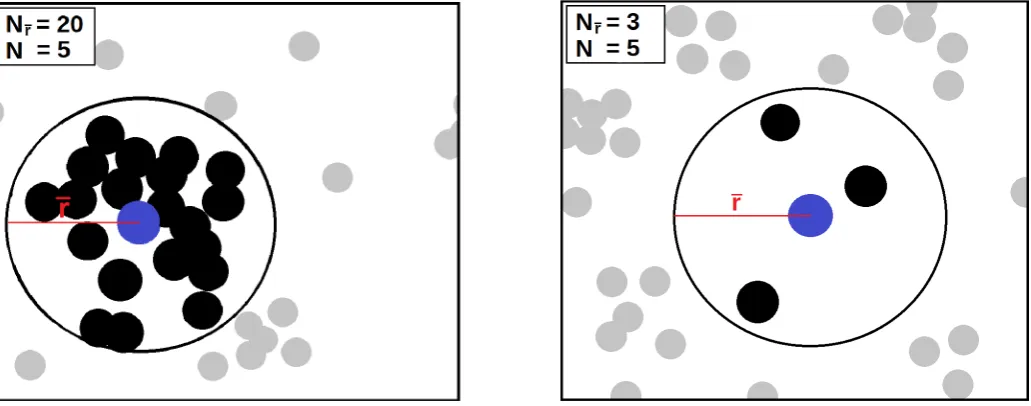
Fig. 1.Demonstration of how INDICATE defines the indexIj,Nfor a point. All points within a radius of ¯rof the selected point (marked in blue)
are counted (N¯r) and compared to the number of points expected within the same radius in an evenly spaced uniform point distribution with
the same number density as the points parent sample (N). The index of the blue point is calculated using Eq. (5) asI5 =4.0 (left panel) and
I5=0.6 (right panel).
and (xj,yj) are the respectivexandyaxis coordinates of point j and (xcon
N ,y con
N ) are the respectivexandyaxis coordinates of the Nth nearest neighbour in the control distribution.
2.1.4. Step IV: Calculate the index,I
The number of points,N¯r, closer than ¯rto each point, j, in the dataset is counted (see Fig.1). The index of point jis then the ratio of the number of neighbours closer than ¯rin the dataset with that expected by a non-clustered distribution i.e.
Ij,N = N¯r
N, (5)
whereN is theNth nearest neighbour number (e.g. if ¯ris mea-sured for the 5th nearest neighbour,N = 5; 6th nearest neigh-bour,N = 6...etc.). The ratioIj,N is unitless and has a range of 0≤Ij,N ≤ NtotN−1, such that the higher its value the more spatially clustered point jis.
It is important to note the index is not a measure of local sur-face density – Eq. (5) describes thelocal spatial distributionof point j. Therefore although the index is proportional to the local point surface density of a dataset, it is possible for two datasets with significantly different densities to have identical index val-ues if their points have the same spatial distribution. For exam-ple, Fig. 2A shows index values derived for Gaussian cluster with 100 members, using a nearest neighbour number ofN=5. On visual inspection the highest values have been assigned to stars with the highest degree of association. Figures2B and2C show the same cluster, but with an observed angular dispersion and surface density the cluster would have if its distance was a factor of 4 and 16 times larger than A respectively. Applying INDICATE under the same conditions as for Fig.2A, the index values for each star remain unchanged in Fig.2B and Fig.2C i.e. for all members∆I5 ≡0 despite the surface density increas-ing by a factor of 256 between Fig.2A and Fig.2C, as the local spatial distribution of members in all three clusters is identical.
Hence the index can be used to directly analyse variation in the spatial distribution of points, in any desired parameter space,
Table 1.Statistics of index values derived for clusters’ D, E, F (Fig.3).
Cluster Mo[I5] max(I5) % starsI5> Imax
D 8.2 10.6 81.2
E 1.6 4.8 17.5
F 3.0 6.4 34.1
Notes.The percentage of members clustered above random (I5>Imax)
is given for each cluster.
(a) within a dataset and/or (b) comparatively between two or more datasets.
We conduct a series of statistical tests on randomly generated samples to calibrate, and investigate edge and field effects on, our index. The methodology and results of these tests are described in detail in AppendicesA–Crespectively. In brief:
1. There is a logarithmic relationship between the maximum index value for a random distribution and sample size. 2. The index is independent of a samples number density. 3. There is a relationship between the typical index value for
a random distribution and the chosenNth nearest neighbour number.
4. The size of the control distribution is essentially arbitrary (but care should be taken when a point in the sample has an index value which is on the boundary of a chosen signifi-cance threshold).
5. Uniformly distributed interloping field stars (e.g. in observa-tional datasets) typically do not significantly affect the index values of true cluster members.
Fig. 2.Panels A–C: index values derived by INDICATE for a synthetic Gaussian cluster with 100 members, using a nearest neighbour number of N=5 in all three instances. In B and C the angular dispersion of the cluster was reduced to simulate how it would be observed if its distance was a factor of 4 and 16 times larger than A, respectively. Despite the significant increase in point surface densities, the index values derived for each star is unchanged because there is no change in the relative spatial distribution of members.
Fig. 3.Index values derived by INDICATE for members of synthetic clusters D, E, F using a nearest neighbour number ofN=5 and a standard
control distribution (CDA – see AppendixB).
2.2. Implementation example
In Sect. 3 we apply our tool on a real stellar catalogue of NGC 3372. Here we demonstrate using synthetic datasets INDI-CATE’s ability to quantify the degree of association for each point in a 2D discrete dataset and suitability as a statistical mea-sure for comparative analysis of the spatial distributions of points in multiple datasets.
Figure 3 shows three clusters (D, E and F) with different degrees of elongation, angular dispersion, sub-structure, surface density and number of members. We apply INDICATE to each using aNth nearest neighbour number ofN =5 and a standard control distribution (CDA – see Appendix B). Table1 shows their mode and maximum index values, and the percentage of members withI5 >Imax(Eq. (A.2)).
Cluster D is the most elongated, and its members have been identified by INDICATE as having the strongest clustering ten-dencies (highest index values) of the three clusters. We find that the greatest degree of association is within its central region (up to 53 neighbours within ¯r) and spatial clustering of members is asymmetrical – stars to the NE of the highest index members have significantly higher index values than those to the SW.
Members of cluster E have a markedly different spatial distri-bution and clustering tendencies to those of cluster D. The spatial distribution of members lacks a strong radial correlation and two concentrations of (relatively) high index stars are identified. Stars with the greatest degree of association have 24 neighbours within ¯
r(a factor of 2 less than D), typically the degree of association of members of E is a factor of 6.6 less than members of cluster D
(i.e. members of E are significantly less tightly clustered than those of D). Of course, as the clusters are being analysed in a 2D parameter space it is conceivable that stars in cluster D and E may have very similar spatial distributions but are being viewed from different rotations around the 3D axis. We therefore advise caution when drawing conclusions from comparisons of the INDICATE values of two or more observational 2D datasets alone.
Cluster F has three concentrations of high index members (marked on Fig.3asR1,R2,R3). Stars that form part ofR1and R3 have similar index values, that is they have similar cluster-ing tendencies, but those of R2 are less spatially clustered. If this were a real dataset, where clustering behaviours are dic-tated by underlying physics, these index values could be used as a starting point to explore the physical causes of the identi-fied discrepancies between the clustering behaviours of the three concentrations (e.g. differences in evolutionary stage, initial con-ditions, stellar mass of members) and also the identified dis-parity of members clustering behaviours between clusters D, E and F. This form of quantitative analysis and comparison of spa-tial behaviours, as achieved here by INDICATE, is not possible with the discussed global methods and/or established clustering algorithms.
3. Tracing morphological features
The Carina Nebula (NGC 3372) is a massive star forming HII complex in the southern sky at a distance of 2.3 kpc, con-taining>105M
A. S. M. Buckner et al.: The spatial evolution of young massive clusters. I.
Fig. 4.Stellar catalogue byKuhn et al.(2014), with stars represented as grey dots. The positions of the Trumpler 14 (Tr14), Trumpler 15 (Tr15),
Trumpler 16 (Tr16), Treasure Chest (TC) and Bochum 11 clusters are overlaid as black ellipses (see text for details).
of the nearest and richest concentrations of OB stars (>130; Kuhn et al. 2014) in the Galaxy and includes some of the most massive and luminous known single and binary stars (e.g. Eta Carinae, HD 93129, W25). The region is well studied and has considerable sub-structure including the Trumpler 14-16, Collinder 228, Collinder 232, Collinder 234, Bochum 10 and Bochum 11 clusters. Triggered star formation is ongoing in the complex, driven by massive star feedback (Smith et al. 2008, 2010;Preibisch et al. 2011b;Gaczkowski et al. 2013). Coupled with its low line of sight extinction, the Carina Nebula is there-fore an ideal laboratory in which to study massive star formation. For a review of the region seeSmith et al.(2008).
3.1. Identification of stellar structure
We apply INDICATE to the stellar catalogue of 2790 stars for the region as described by Kuhn et al. (2014), and plotted in Fig. 4, with a nearest neighbour number of N = 5 and an extended control distribution (CDB – see Appendix B). This catalogue was selected because it covers an inner region of the Carina Complex (∼0.38◦) which is rich in sub-structure,
containing at least 20 sub-clusters (detected by the original authors) and includes the young Trumpler 14 (Tr14), Trum-pler 15 (Tr15), TrumTrum-pler 16 (Tr16), Treasure Chest (TC) and Bochum 11 clusters. The position and radius of the TC cluster in Fig.4is as given byDutra & Bica(2001), and the position and radius of Tr14-16 and Bochum 11 clusters by the MWSC cat-alogue (Kharchenko et al. 2013). On visual inspection, stars in the North West (NW) region of the catalogue have significantly higher degrees of association than those in the South East (SE) region.
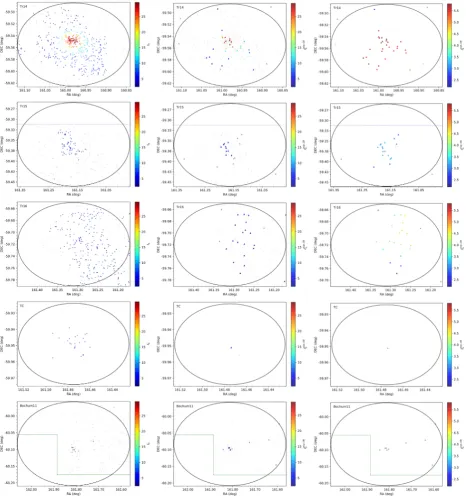
[image:5.595.335.524.454.532.2]The top plot in Fig. 5 and left plots of Fig. 7, show the distribution of stars with their index values and the boundaries
Table 2.Statistics for stars within the radial boundaries of the Tr14,
Tr15, Tr16, TC and Bochum 11 clusters with an index value ofI5>Isig.
Cluster Total I¯5 maxI5 Tr14 470 (85.2%) 12.4 29.6
Tr15 75 (29.1%) 3.9 6.6
Tr16 212 (73.4%) 3.6 5.6
TC 25 (83.3%) 4.3 4.8
Bochum 11 10 (5.8%) 2.7 3.0
of the Tr 14-16, TC, Bochum 11 clusters overlaid. We define a significance threshold – that is the value of I5 above which a star is significantly clustered above random – of three stan-dard deviations above the mean value expected from a ran-dom distribution of the same size evaluated with N = 5 and CDB, such thatIsig = I¯random5 +3σ = 2.3. All five clusters are clearly identified by stars within their radial boundaries hav-ing an index above the defined significance threshold. This is an expected result as by definition the spatial distribution of cluster stars – particularly at their centres – should display a higher degree of clustering than a random (and background) field.
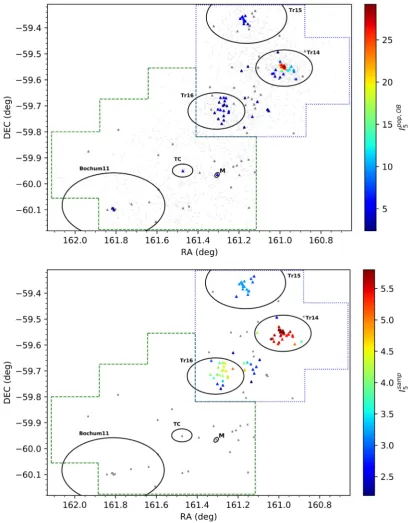
Fig. 5.Index values,I5, calculated by INDICATE for the Carina region with positions of the Tr14, Tr15, Tr16, TC and Bochum 11 clusters overlaid
as black ellipses (top panel) and 19 sub-clusters identified byKuhn et al.(2014) overlaid as red ellipses (bottom panel; see text for details). The borders of our designated NW and SE regions are marked with blue dotted and green dashed lines respectively. Stars with an index value above the significance threshold (I5>2.3) coloured as described by the colour bar. Grey dots are stars withI5<2.3.
the cluster’s structure (e.g.Wolk et al. 2011). Interestingly, stars clustered above random in Tr15, Tr16 and TC have similar mean index values – that is they have similar degrees of association and clustering tendencies. Stars within the bounds of Tr14 display the highest degree of clustering behaviour with a mean index value a factor of 3 larger than those of the Tr15, Tr16 and TC clusters. In addition, Tr14 also contains the most spatially clus-tered stars in the Carina region, centrally concentrated at its core, with stars here having up to an additional 137 stars in their local neighbourhoods above that expected in a spatially random
A. S. M. Buckner et al.: The spatial evolution of young massive clusters. I.
Fig. 6.Index values calculated for the OB population by INDICATE when applied to the entire stellar catalogue,Ipop,OB5 (top panel); and OB
sub-sample,Isamp5 (bottom panel; see text for details). Positions of the Tr14, Tr15, Tr16, TC, Bochum 11 and M (sub-) clusters are overlaid as black ellipses. The borders of our designated NW and SE regions are marked with blue dotted and green dashed lines respectively. Coloured triangles represent OB stars with an index value above the respective significance thresholds. Grey triangles are OB stars below the respective significance thresholds.
The bottom plot in Fig. 5 shows the distribution of stars with their index values and the positions of the 19 sub-clusters2 found byKuhn et al.(2014), as stellar overdensities using finite mixture models, overlaid. Fifteen sub-clusters are clearly iden-tified with a significant number of members that have an index value above the defined threshold. Four sub-clusters (F, P,R,
2 The 20th sub-cluster, their “G” cluster, is ignored in our analysis due
to its large angular extension across the centre of the region.
S) do not contain any (or very few) stars spatially clustered above random, suggesting these sub-clusters may not be real clusterings but instead fluctuations in the dispersed population field.
Fig. 7.Zoomed-in plots of clusters Tr14, Tr15, Tr16, TC and Bochum11 as shown in (Left panel) top of Fig.5, (Middle panel) top of Fig.6and (Right panel) bottom of Fig.6.
significance of this difference between the NW and SE regions we run a 2 sample K–S test of the index values for all stars in the NW region against those for all stars in the SE region, with a strict significance boundary of p < 0.01, finding a value of p0.001 i.e. stars in the NW and SE regions have significantly different clustering tendencies. This result is not entirely unex-pected as the NW region is heavily sub-structured, containing 3/5 of the young clusters, and 12/19 of the sub-clusters detected byKuhn et al.(2014) – whereas the SE region is comparatively sparsely populated and being shaped by radiative winds of the Tr14 and Tr16 clusters (Smith et al. 2008). Therefore the dis-parity of the SE and NW regions clustering tendencies is reflec-tive of differences in the apparent star formation activity in these regions.
3.2. Clustering tendencies of the OB population
We create a sub-sample of the OB stars in the catalogue. To iden-tify OB stars a cross-match search of the catalogue with the SIM-BAD3database was performed, finding 134 stars listed as either O or B spectral type. Thirteen of these have an ambiguous spectral type or are flagged as being higher order systems so are excluded from the sub-sample, leaving a final selection of 121 stars.
The term “mass segregation” is used interchangeably in the literature to describe two quite different realisations. The first definition (hereafterType 1) refers to a system in which the mas-sive stars are concentrated together at its centre; whereas the sec-ond definition (hereafterType 2) refers to a system in which the
A. S. M. Buckner et al.: The spatial evolution of young massive clusters. I.
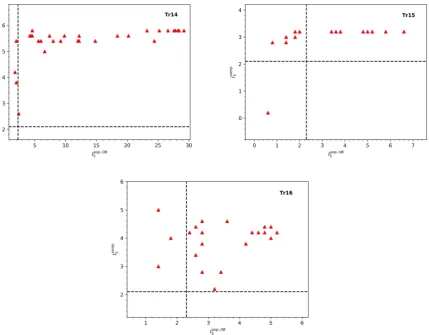
Fig. 8.Index values calculated for the OB population by INDICATE when applied to the entire stellar catalogue,Ipop,OB5 , and the sub-sample,I5samp.
Dashed black lines represent the respective significance thresholds (see text for details). Red Triangles represent OB stars within the radius of Trumpler 14 (top left) Trumpler 15 (top right) Trumpler 16 (bottom panel).
massive stars are in stellar concentrated regions, but are not nec-essarily concentrated together.
As the index quantifies the degree of association of stars, it by definition identifies (and quantitatively measures) Type 2 mass segregation as values are assigned to stars based on the degree of spatial clustering in their local neighbourhood. Figures6and7show the index distribution of the OB stars with the positions of the Tr14-16, TC, Bochum 11 and M (sub) clus-ters overlaid. We find the Tr14, Tr15, Tr16, TC, Bochum 11 and M (sub) clusters have signatures of Type 2 mass segregation. A total of 57.0% of OB stars are clustered above random, which is notably higher than the general populations 35.2% (Sect.3.1) i.e. cluster concentrations are more frequent around massive stars than typical for stars in this region. Massive stars in the NW region have notably different clustering tendencies to those in the SE region, with 68.1% and 18.5% clustered above random respectively. To gauge the significance of this difference we run a 2 sample K–S test of the index values for all sub-sample stars in the NW region against those for all sub-sample stars in the SE region, with a strict significance boundary of p < 0.01, finding a value of p 0.001, which confirms OB stars in the NW and SE regions have significantly different clustering ten-dencies. These results show signatures of Type 2 mass segre-gation are present across Carina but are primarily found in the NW region.
It is also possible to use our tool to find signals of the “classical” Type 1 mass segregation. We apply INDICATE to the sub-sample of OB stars with a nearest neighbour number of
tion an OB star can have w.r.t. other OB stars, stellar concentra-tions around an OB star may continue to increase. We find that Tr16 does not follow this trend, which is consistent with what is known about the structure of the Trumpler clusters. Unlike the Tr14 and Tr15 clusters, Tr16 does not have a strong cen-tral concentration but instead is irregularly shaped and heavily sub-structured with multiple sub-clusters (Ascenso et al. 2007, Wang et al. 2011, Wolk et al. 2011). Thus the index values of Tr16 reflect that the OB stars are not clustered together in a sin-gle concentration with a (near) constant degree of clustering, but are instead scattered across a region with local concentrations of stars and a variable degree of association.
4. Conclusions
We have developed a powerful novel statistical clustering tool called INDICATE (INdex to Define Inherent Clustering And TEndencies) to study the intensity, correlation and spatial distri-bution of point processes in discrete astronomical datasets. The tool assesses the clustering tendency of each object in a dataset and assigns it an index Ij,N (Eq. (5)), using a nearest neigh-bour approach by comparing the spatial distribution of objects in its local neighbourhood with that expected in an evenly spaced uniform (i.e. definitively non-clustered) distribution. INDICATE requires no a priori knowledge of, and makes no assumptions about, the shape of a distribution, presence/number of clusters and/or sub-structure of a dataset.
For any application of INDICATE there are three variable parameters: (1) size and (2) number density of the distribution it is being applied to; and (3) theNth nearest neighbour number used by the tool. We calibrated our tool against random distribu-tions to define statistically significant values of Ij,N (see appen-dices) finding:
1. There is a logarithmic relationship between the maxi-mum Ij,N value for a random distribution and sample size (Eq. (A.2)).
2. Ij,Nis independent of a distributions number density. 3. There is a relationship between the typical modalIj,N value
for a random distribution and the chosenNth nearest neigh-bour number (Eq. (A.3)).
4. The size of the control distribution is essentially arbitrary, as the modal difference betweenIj,N values calculated for a random distribution using the standard size (Sect.2.1) and an expanded size (AppendixB) is inversely proportional the theNth nearest neighbour number (Eq. (B.3)). However, care should be taken when including/excluding points which are on the boundary of a chosen significance threshold value of Ij,N based solely on their index values during an analysis, particularly for indices derived for small sample sizes using large nearest neighbour numbers.
5. Uniformly distributed (interloping) field stars in observa-tional datasets typically do not significantly affect the index
for signals of mass segregation and trace variations in degree of stellar association in star forming regions/clusters.
Arguably the three most popular established methods to identify mass segregation are: (i) Radial Mass Functions (e.g. Sagar et al. 1988), (ii) theΛMSRparameter (Allison et al. 2009), and (iii) the Local Density Ratio (Maschberger & Clarke 2011; Küpper et al. 2011; Parker 2014). Each have their respective strengths and weaknesses (see Parker & Goodwin 2015 for a discussion), but primarily the decision of which method one employs is based upon what type of mass segregation one is searching for. In the literature, “mass segregation” is used inter-changeably to describe two quite different realisations: (1) the concentration of massive stars together at a system’s centre and (2) (lower mass) stellar concentrations around the massive stars in a system but which are not necessarily concentrated together. In our case, we are interested in better understanding the role of local and global environmental conditions in massive star formation. Our aim therefore was to measure the degree of asso-ciation (or lack thereof) of each high mass star with the gen-eral stellar population and with each other, in young (<5 Myr) regions, i.e. look for signatures of both types of mass segrega-tion. For our purpose, it is ideal to employ a single method to search for and quantify signatures of both types in a given region, so that they can be directly compared and a quantitative analy-sis of the impact of local environment formation conditions on spatial structures undertaken. This is possible using INDICATE, as demonstrated in Sect.3.2.
Additional strengths of INDICATE are:
– Our tool does not require a priori knowledge of the centre, and works independently of the shape, of the distribution. – The index has been calibrated against random distributions,
so statistically significant values are easily identified. – AsIj,N is a measure of spatial association (not density), the
clustering behaviour (index values) of massive stars in two or more regions can be directly compared, regardless of dif-ferences in their distances, average angular separation of sources and/or field sizes.
– It can provide both a global and local measure of Type 1 mass segregation. By definitionIj,Nis a local measure, and a global measure can be obtained for the subset by e.g. calcu-lating the mean index value of the massive stars and compar-ing it to that expected by a random distribution (Sect.3.2). – Conclusions on Type 1 mass segregation in a system are
A. S. M. Buckner et al.: The spatial evolution of young massive clusters. I.
– As a local measure, INDICATE is robust against outliers as they (a) will not influence the index values of the other members in a subset, (b) are easily identifiable by their com-parative low index values and as such (c) in an global analy-sis of a system to find signatures of Type 1 mass segregation will have a statistically negligible effect on the overall con-clusions drawn for the subset.
We applied our tool to the stellar catalogue of the Carina Nebula (NGC 3372) byKuhn et al.(2014), a region chosen because of its known high mass stellar content (>130 OB stars) and exten-sive sub-structure:
1. We recover known stellar structure in the region, including the Tr14-16, Treasure Chest and Bochum 11 clusters. 2. We find members of the 4/19 sub-clusters identified by
Kuhn et al. (2014) as stellar overdensities are more clus-tered than typical for the extended distribution of stars in the Carina region, but contain no, or very few, stars with a degree of association above random. This suggests these sub-clusters may be fluctuations in the dispersed population field rather than real clusters.
3. Stars in the NW and SE regions have significantly different clustering tendencies. The NW region is known to be heavily sub-structured, whereas the SE is more sparsely populated and being shaped by radiative winds of the Tr14 and Tr16 clusters (Smith et al. 2008). Therefore this result is reflective of differences in the apparent star formation activity in these regions. Further study is required to ascertain the physical origin of that difference.
4. The different clustering properties between the NW and SE regions are also seen for OB stars and are even more pro-nounced.
5. There are no signatures of classical (Type 1) mass segrega-tion present in the SE region – massive stars here are not concentrated together above random.
6. Stellar concentrations are more frequent around massive stars than typical for the general population, particularly in the young Tr14 cluster.
7. For Tr14 and Tr15 we find a relation between the concen-tration of OB stars and the concenconcen-tration of (lower mass) stars around OB stars. This relation is notably absent from Tr16. Unlike the Tr14 and Tr15 clusters, Tr16 does not have a strong central concentration but instead is irregularly shaped and heavily sub-structured with multiple sub-clusters (Ascenso et al. 2007, Wang et al. 2011, Wolk et al. 2011). Therefore this result reflects the known structure of the
clusters: Tr14 and Tr15 are centrally concentrated, whereas in Tr16 the OB stars are not clustered together in a single concentration with a (near) constant degree of clustering, but are instead scattered across a region with local concentra-tions of stars and a variable degree of association.
Acknowledgements. The Star Form Mapper project has received funding from the European Union’s Horizon 2020 research and innovation programme under grant agreement No 687528. We would like to thank Simon Goodwin and Lee Mundy for suggestions for the improvement of our tool and paper respectively.
References
Allison, R. J., Goodwin, S. P., Parker, R. J., et al. 2009,MNRAS, 395, 1449 Andre, P., Ward-Thompson, D., & Barsony, M. 2000,Protostars and Planets IV,
59
Anselin, L. 1995,Geog. Anal., 27, 93
Ascenso, J., Alves, J., Vicente, S., & Lago, M. T. V. T. 2007,A&A, 476, 199 Cartwright, A., & Whitworth, A. P. 2004,MNRAS, 348, 589
Cartwright, A., & Whitworth, A. P. 2009,A&A, 503, 909
de Wit, W. J., Testi, L., Palla, F., & Zinnecker, H. 2005,A&A, 437, 247 Dutra, C. M., & Bica, E. 2001,A&A, 376, 434
Gaczkowski, B., Preibisch, T., Ratzka, T., et al. 2013,A&A, 549, A67 Gomez, M., Hartmann, L., Kenyon, S. J., & Hewett, R. 1993,AJ, 105, 1927 Hopkins, B., & Skellam, J. 1954,Ann. Bot., 18, 213
Kharchenko, N. V., Piskunov, A. E., Schilbach, E., Röser, S., & Scholz, R.-D. 2013,A&A, 558, A53
Kuhn, M. A., Feigelson, E. D., Getman, K. V., et al. 2014,ApJ, 787, 107 Küpper, A. H. W., Maschberger, T., Kroupa, P., & Baumgardt, H. 2011,MNRAS,
417, 2300
Luhman, K. L. 2012,ARA&A, 50, 65
Maschberger, T., & Clarke, C. J. 2011,MNRAS, 416, 541 Møller, J., & Waagepetersen, R. P. 2007,Scand. J. Stat., 34, 643 Parker, R. J. 2014,MNRAS, 445, 4037
Parker, R. J., & Goodwin, S. P. 2015,MNRAS, 449, 3381
Parker, R., Wright, N., Goodwin, S., & Meyer, M. 2014,MNRAS, 438, 620 Preibisch, T., Schuller, F., Ohlendorf, H., et al. 2011a,A&A, 525, A92 Preibisch, T., Ratzka, T., Kuderna, B., et al. 2011b,A&A, 530, A34
Sagar, R., Miakutin, V. I., Piskunov, A. E., & Dluzhnevskaia, O. B. 1988, MNRAS, 234, 831
Scalo, J., & Chappell, D. 1999,ApJ, 510, 258
Schmeja, S., Kumar, M. S. N., & Ferreira, B. 2008,MNRAS, 389, 1209 Shu, F. H., Adams, F. C., & Lizano, S. 1987,ARA&A, 25, 23
Smith, N., & Brooks, K. J. 2008, in The Carina Nebula: A Laboratory for Feedback and Triggered Star Formation, ed. B. Reipurth, 138
Smith, N., Povich, M. S., Whitney, B. A., et al. 2010,MNRAS, 406, 952 Wang, J., Feigelson, E. D., Townsley, L. K., et al. 2011,ApJS, 194, 11 Wolk, S. J., Broos, P. S., Getman, K. V., et al. 2011,ApJS, 194, 12
Wright, N. J., Parker, R. J., Goodwin, S. P., & Drake, J. J. 2014,MNRAS, 438, 639
We conduct a series of baseline tests to aid interpretation and identification of significant index values. These tests (a) define the threshold at which an index value becomes significant i.e. the value above which it can reasonably be assumed point jwas not drawn from a random distribution and (b) quantify the impact of dataset parameters and the choice of Nth nearest neighbour number on the distribution and range of index values INDICATE generates.
(i) Sample size
We generate random samples of size,S, in the range 50 ≤ S< 100 000. For each sample size 100 realisations are created with a constant number density ofnobs =1 object per unit area and INDICATE is implemented with aNth nearest neighbour num-ber ofN=5. We keep the number density andNth nearest neigh-bour number for every sample constant to ensure any identified trends or patterns in samples’ index values can be attributed to sample size alone.
There is no dependence between the index and the size of a sample, with typical modal and mean values of Mo[I5]=0.8 and ¯I5 = 1.0 for random distributions under the above stated conditions. However, we find there is a logarithmic relationship between the upper range limit4of I
j,N and sample size for ran-dom distributions, i.e.
0.0≤Ij,N≤Imax, (A.1)
where
Imax=C1+C2×log10S, (A.2)
andC1,C2 are constants which are dependant on theNth near-est neighbour number (see TableA.1). Equation (A.2) defines as a function of sample size the threshold value above which we can definitively assume a point does not have a spatially random distribution.
(ii) Field density
We generate random samples of number density, nobs, in the range 10−6 ≤ nobs ≤ 106, in increments of an order of mag-nitude. For each value of number density 100 realisations are created, with a constant sample size of 10 000 and INDICATE is implemented with aNth nearest neighbour number ofN=5. We find there is no dependence ofIj,Non field density.
(iii) Nthnearest neighbour number, N.
We generate a 100 realisations of random samples of sizeS = 10 000 and number density nobs = 1. For each sample INDI-CATE is implemented with a Nth nearest neighbour number of N = 3, 5, 7 and 9. There is a relationship between the
4 Derived as the maximum value over all realisations.
Section 2.1.2 described how the control distribution used by INDICATE is generated. Here we investigate whether the prox-imity of a point in a dataset to its delimited boundaries and/or the total length of each axis of the control distribution influ-ences a sample’s index values. We repeat the calibration tests (AppendixA) using two different types of control distribution:
1. Control distribution A(CDA) – occupies the same bounded parameter space and has the same number density (Eq. (2)) as the test sample;
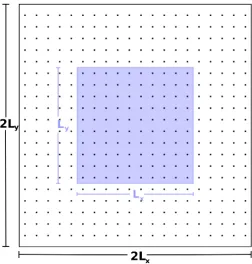
2. Control distribution B (CDB) – occupies the same, and is extended beyond the, bounded parameter space of the test sample; such that area of the control distribution is a fac-tor of four times larger than the test sample (see Fig. B.1). Increasing the area of the control distribution by a factor of four ensures that the rj of edge points in the test sample (Eq. (4)) is not calculated using edge points of the control distribution (which in principle could subsequently increase ¯
r, and decreaseIj,N). It has the same number density as the test sample (Eq. (2)).5
We define an “edge point” as any point in the sample dataset whose (x,y) position is less than that of the second smallest x and/or y positions and/or greater than the second largest x and/or y positions of points in CDA (i.e. where the measured nearest neighbour distance of the sample point to the control distribution points would be affected due to lack of control points in any given direction in the control distribution for point j).
ForN >5 the modal index value of edge points, Mo[IE j,N], deviates from that of the sample as a whole using CDA (Eq. (A.3)), such that
Moh IEj,7 i≡ N−2
N for N=7, (B.1)
Moh IjE,9 i≡ N−3
N for N=9. (B.2)
For a proportion of all (edge and non-edge) points in the test samples’ there is a statistically small discrepancy between the index values calculated using CDA and CDB. The modal diff er-ence between the two sets of indices is inversely proportional to Ni.e.
Moh∆Ij,N i
≡ Moh IjCDA,N −IjCDB,N i ≡ 1
N for N≥3, (B.3) whereICDAj,N andIjCDB,N are the index values calculated for each sample point jusing CDA and CDB respectively. For any given point jif
∆Ij,N > 0 ↔ IjCDA,N >I CDB
j,N . (B.4)
5 For samples with non-rectangular delimited areas this distribution
A. S. M. Buckner et al.: The spatial evolution of young massive clusters. I.
Fig. B.1.Dimensions of control distributions CDA (blue shaded) and
CDB (all visible) as described in AppendixB, whereLxandLyare the
length of a test sample’sxandyaxis respectively; and the black dots are the points of the control distributions.
The proportion of all points with∆Ij,N > 0 increases with decreasing sample size and increasing nearest neighbour num-ber, reaching ∼90% for sample size of S = 50 usingN = 9; it is independent of field density. The number of edge points with∆Ij,N >0 is proportionally lower than non-edge points i.e. expanding the control distribution has less of an effect on edge points than non-edge points. This is because therjmeasured for edge points in CDB is (slightly) smaller than in CDA (as it is no longer artificially increased due a lack of control points in any given direction), which subsequently causes a small decrease in ¯
r (Eq. (3)). In both control distributions a radius of ¯rfrom an edge point can partially encompass an area outside the bounds of the dataset (where there can be no neighbouring points), but for non-edge points a radius of ¯ralways encompasses an area within the bounds of the dataset (neighbouring points can be present in any given direction within ¯r). Thus a small decrease in ¯ris more likely to exclude a nearest neighbour (decrease N¯r, and subse-quentlyIj,N– Eq. (5)) for a non-edge point than an edge point.
To conclude, as the typical∆Ij,Nfor any given point between the two control distributions is very small, choice of control dis-tribution type (CDA or CDB) is essentially arbitrary, but care should be taken when including/excluding points which are on the boundary of a chosen significance threshold value ofIN dur-ing an analysis – particularly indices derived for small sample sizes using large nearest neighbour numbers.
Appendix C: Investigation of field effects
To ascertain the influence of interlopers on the index values of true cluster members we conduct additional calibration tests. A dataset consisting of a Gaussian cluster with 500 members is generated and the index value of each member determined using the steps outlined in Sect.2.1.
Table C.1.Constants of Eqs. (C.2), (C.3) for aNth nearest neighbour
number ofN=3, 5, 7 and 9.
N C3 C4 C5 C6 C7
3 2.549 0.510 4.725 0.830 −6.077 5 2.033 0.438 3.394 2.133 −3.844 7 1.617 0.320 3.715 1.467 −4.140 9 1.421 0.306 3.156 1.867 −3.559
In our first test, field stars are introduced to the dataset with incrementally increasing frequency, such that the number of interloping field stars at any given time is equal to a fraction,F, of total cluster members in the range 0.01≤ F ≤ 1.0. The posi-tions of the field stars are randomly drawn from a uniform distri-bution. For each fraction of field stars 100 realisations are made, and for each realisation the difference,∆Ij,N , between the index values derived for cluster members in the dataset that does not contain field stars and the current level of field star contamina-tion is measured for aNth nearest neighbour number ofN=3, 5, 7 and 9. As we are simulating an observational dataset for which cluster membership is uncertain,Ntot=S =500+(F×500).
We find the modal difference for all combinations of Fand Nis Mo[∆Ij,N]=0, i.e. typically the index values of true cluster members are unaffected by the presence of interloping field stars. The proportion of cluster members with ∆Ij,N , 0 increases with increasing F and N, reaching a maximum of ∼95% for F = 1.0 and N = 9. In observationally obtained datasets the error on the index value derived for true cluster members is therefore
Ij,N+F2 ≤ Ij,N ≤ Ij,N+F1, (C.1) where
F1=maxh∆Ij,N i
=C3+C4 ×log (F), (C.2)
F2=minh∆Ij,N i
=C5 ×exp (C6 × F)+C7, (C.3) andC3−7are constants dependant on theNth nearest neighbour number (see TableC.1).
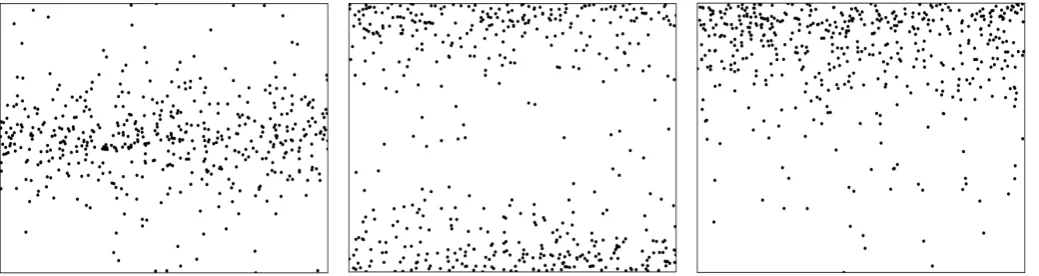
In our second testF=1.0 field stars are distributed in three large scale gradient patterns (Fig.C.1) which are randomly gen-erated in the same parameter space as the Gaussian cluster. For each gradient 100 realisations are made, and for each realisation the difference,∆Ij,N, between the index values derived for clus-ter members in the dataset that does not contain field stars and the current level of field star contamination is measured for aNth nearest neighbour number ofN =3,5,7 and 9. As we are simu-lating an observational dataset for which cluster membership is uncertain,Ntot=S =500+(F×500)=1000.
We find the modal difference for all gradients withN = 3 is Mo[∆Ij,N] = 0, i.e. for small values ofN the index derived for cluster members is independent of gradient shape. This is expected as the index is a local measure, and the value of N essentially defines its resolution (the smallerN, the higher the resolution). Thus index values are more susceptible to the effects of variation in the degree of field star association within the gra-dient when larger values ofNare employed.
[image:13.595.333.530.111.178.2]Fig. C.1.A realisation of the three gradient field population shapes tested in AppendixC.
best efforts, not all field stars will be removed from observa-tionally obtained datasets before analysis, so consideration must be given before drawing conclusions about the clustering ten-dencies of region stars. In particular, when a pronounced large scale 2D spatial distribution gradient of the field population is present, and cluster membership is uncertain, caution must be taken when drawing conclusions about the physical origins of the clustering tendencies of stars – as field stars within the denser