Vichayanan
Rattanawiboonsom,
1Robert Van Der
Meer,
2Terry
Williams
Faculty of Management and Information Sciences, Naresuan University
Abstract
lo response to ever-inerea,ing regional and global competition. automotive manufacturing companies in Thailand are looking to improve the effictcncy and effcctivcnC>> of thctr opcrattons through the adoption of sophisticated manufacturing planning and control ;ystems in general, and Material Requirements Planning (MRP) systems in particular. Despite tts growtng populanty, an ttl depth review of the academic literature has revealed no systematic studies of' how, and how successfully, Thai automotive manufacturers have managed to implement MRP in practice. Indeed, there appears to be general dearth of studies of thts kind, at lcm.t as far as newly-industrialising countries arc concerned.
This study begins this paper by presenting a brief literature review on MRP implementation. fir\t in advanced induMrial economics and then as far as the evidence allow> - 111 newly-industrialising countries. The major part of the paper concerns our empirical investigation of the way in which MRP systems are being implemented in Thai automotive manufactunng companies. The investigation is based on a major questionnaire survey of about 120 companies, of which about 67 companies arc currently using some kind of MRP system. In addition to more general questton\ on the nature of the companies concerned and the production processes used, the survey posed \pecilic questions on the (actual or expected) costs and benefiL\ to be obtained from MRP, as well a' the implementation process U\ed.
The finding~ from the ~urvey suggest that MRP tmplcmentatton in Thai automotive companies is relatively similar to implementation in manufacturing companies in the new!} industriali~ed countries and coumry in the weM, however there is shghtly dissimtlar to MRP implementation in these countries.
Keyword~: Material Requirement Planning, Implementation. Thailand\ automotive industry
Introduction
A new era of transformation is happening in Thailand and is at the core of its economic reform, changing organizations from losing to winning companies. This change increase!. the importance of the function of inventory and production management, where the future holds enormous opportunities and challenges. In additional, at national level, Thailand faces increasing regional and international competition, while at operational level, in most manufacturing companies especially automotive companie!. the following statement would sound all too familiar:
"We have got too much inventory ... , lost market share, high costs of production, deviation from on-time delivery, inconsistent quality, and unresponsiveness to sophisticated production technology". In response, manufacturing companies should make their processes more efficient and effective. To do so, many manufacturing companies. especially automotive industry companies in Thailand, have implemented, are implementing or are considering the implementation of MRP systems.
However, while at present, there is wide acceptance of ERP system in many countries such as the USA, Canada, UK, and Australia. where MRP systems have been in existence for almost 25 years (Aghazadeh, 2003). MRP systems (MRPI/MRPH) are the heart of an ERP system. Studying MRP ((MRPI/MRPII) is the first logical step toward understanding ERP, because the ERP system encompasses MRPII, and the MRPIJ system intum encompasses MRPJ (Scott, 1994). Therefore, in this study focuses on MRP systems issues. Moreover, the current study's evidence shows that Thai automotive companies have implemented MRP (MRPI/MRPII) by 82.1 %, while MRPIIIERP only by 17.9% (see Table 5.9).
This also supports the reason why this study has studied MRP systems rather than ERP.
Motivation and objective
Ever since MRP implementation is relatively new in developing countries such as Thailand, there is relatively little study on MRP implementation research which has seldom been conducted, particular empirical study in developing countries including Thailand. This may stem back from of knowledge about MRP systems in developing countries in general and in Thailand in particular. This research investigates and discusses the state of the art of MRP implementation in Thai automotive organizations. This describes the overall aim with three objectives which are (I) investigate MRPr I] project implementation
in Thai automotive industry, (2) estimate the costs and benefits obtained from MRP implementation. and (3) identify the similarities and dissimilarities of the nature of MRP implementation in Thai automotive compared with other countries.
In pursuit of the above objectives this paper is established as follow: a review of literature, followed by the presentation of the methodology, then the main findings of the survey. and finally some implications of the findings and some suggc&tions for further research.
Literature review
which they must improve the quality of their products and their productivity. It means that making the manufacturing processes more efficient and effective arc vital dimensions to
remaining competitive and a system of management that provides the means of gaining and sustaining this competitive advantage (Farquhar, 1991). An important factor for improving these processes is inventory and production control (Cooper & Zmud, 1989). A variety of information systems to support inventory and production control such as MRPI/MRPll have been developed to replace the traditional reorder point-based information systems. MRPI and its extension, MRPII have both gained the acceptance from academics and practitioners as important factors for improving manufacturing processes (Goh. 1984): (Aggarwal, 1985): (Browne ct al., 1996); (Rabertson, Swan & Newell, 1996): (Lunn. 1996); (John and Charlone, 1996); (Carrie et al., 1997). Well designed and successfully implemented MRP systems can help manufacturing plants reduce inventory, improve customer service and increase operating efficiency. The production management departments within manufacturing companies arc responsible for achieving the successful implementation of such systems, however the MRP implementation systems is not easy (Ang et al., 1995).
Brown et al. ( 1996) suggested that the invel.tigation of the state of practice of MRP systems relates primarily to understanding the effectiveness of such systems for the companies that use them. The review of literature reveals that the implementation of MRP systems may lead to achieving the effectiveness which measured by benefits obtained from MRP
implementation as follows:
• Tangible benefits MRP benefits can be measured by improvement in tangible measures of manufacturing performance. These are inventory turnover, delivery lead rime, percent of time meeting delivery promises. percent of order requiring "splits" because of unavailable material, and number of expediters. However, there is a difficulty in obtaining measures of actual usc (White et al., 1982), because companies usually cannot keep track of the performance measures over time (Sum et al., 1995). Hence, to assess improved
performance the respondents (MRP users) are often asked to provide the experience that they would expect operating in today's economic environment with their pre-MRP production system, then to state the current experience given their stage of MRP development and finally state the future experience that they anticipate given total completion of their MRP development plans as in Anderson et al. (1982) and Laforge & Sturr ( 1986).
• Subjective benefits With regard to the difficulties in obtaining improved performance measures, several studies have decided to measure MRP subjective benefits using user satisfaction only. The data are interpreted as expressing user perceptions
However, the relevant literature reveals many problems still occurring with
MRP implementation (Brown et at.. 1996); (Ploss, 1995), some of these problems arc
• MRP users involved in the implementation process do not have a clear
understanding of the approach to implementation;
• MRP users do not comprehend the main goals for MRP implementation;
• MRP users have not had previous experience in the implementation of complex information systems (Burns, Turnipseed & Riggs, 1991 ); (Sum & Yang, 1993); and
• Inaccurate data records in the supporting files such as Bill of material file, inventory records and Master schedule Master Production Schedules (MPS):
• The issue of schedule instability of MRP systems (i.e. significant changes in master production schedule including changes in quantity or timing of planned orders
or schedules receipts) has been considered as a major concern for MRP practitioners;
• MRP did not attempt to address the design of the manufacturing process. This leads to a situation where activities take place ignored (which are counter productive
to good manufacturing practice and hence to manufacturing system performance). For
example, the BOM concept tended to encourage the development of many process stages,
each with buffers separating them from the next stage. Now, this is not required because
MRP structures seem to guide users in this direction;
• MRP II has grown too large. It has tried to address too many problems in too many domains with the same basic approach. For example, now the shop floor control
module of MRP II is not a viable alternative for complex manufacturing environments.
The BOM concept may have had too much influence on the design of shop floor routings.
and the result is the lack of clarity in representing manufacturing process routings;
• The failure to involve other functions such a<, marketing and purchasing, and
finance (Westbrook, 1995).
The literature review reveals that there are numerous studies that have dealt
with the various aspects of MRP implementation. However, these studies were conducted
either in developed countries such as the USA or in the newly industrialized countries
such as Singapore (Sum & Yang. 1993). Moreover. most of these studies are based on
case studies or personal experience (Duchessi, Schaninger & Hobbs, 1989). The obstacle
with case studies is that the failures arc rarely documented because the authors
are basically employees or consultants to the companies described in the cases
(Burns et at., 1991 ). as such the lessons may not be applicable in other cases (Ang ct a!.. 1995).
In contrast, empirical studies on the state of practice of the MRP systems within manufacturing
companies have been I imitcd (Ang et al.. 1995); (Sum & Yang, 1993). Furthermore,
seldom of these studies has been conducted in developing countries such as Thailand and
gap relating to the scarcity of the empirical studies in the developing countries. It is also provide useful information which may authorize MRP managers and users to get a better understanding on how to implement the MRP systems. This is done by identifying the state of the art of MRP implementation from the perceptions of MRP users within the Thailand's automotive companies.
Meth
o
dolo
gy
As the precise number of companies which having at least basic MRP modules such as inventory control. bill of materials were not known, the primary intention of this study was to collect i11formation from as many companies as possible. Therefore. survey has been the principle methodology in this MRP implementation studies which concerning the survey of both MRP-companies and non MRP-companies in Thai automotive industry. Typical designations of the respondents included the production manager, material manager, inventory control manager, master schedulers and management information system manager
(Sum &Yang, 1993); (Ang et al., 1995); (Sum et al., 1995). Howeve, the position of respondent in each company rrught be called by a different name through they might have the same duty. A pilot questionnaire was tested by academicians, the managers in a small number of companies and practitioner which well-known to the researcher. After relative few amendments the final questionnaire was produced and sent to the companies which were taken from companies' data held by the Thailand Automotive Institution and Federal of Thai industries.
Only one survey questionnaire was sent to each company. to be completed by production manager, material manager, inventory control manager, master schedulers and management information system manager. A total of 120 responses (44.6 percent which was regarded as a good response to mail survey) were received, of which 67 were from MRP companies and 53 were from non-MRP companies. Data from these will be investigated and compared with findings from previous studies elsewhere. such as Sum and Yang (1993) in Singapore (as a newly industrialiLing country), and Anderson et al. ( 1982) and Laforge & Sturr ( 1986) in the US (as a developed country).
Analysis
Comparison
Since there is seldom a publication of a similar nature of material requirement planning systems implementation in developing country such as Thailand, Thai automotive companies in particular, the findings arc compared with those obtained by previous study elsewhere such as Sum and Yang ( 1993) in Singapore as a newly industrializing country, Anderson et at. ( 1982). and Laforge and Sturr ( 1986) in the USA as a developed country.
R
es
ults and Dis
c
u
ss
ion
The main findings of the survey are presented in this section. These wille compared with the previou!> studies whenever possible and meaningful.
Company Profile
Company
characteristics
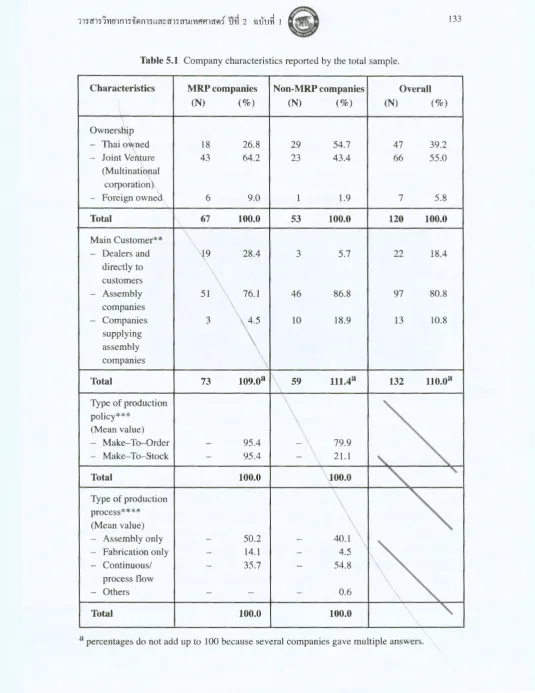
Table 5.1 Company characteristics reported by the total sample.
Characteristics MRP companies Non-MRP companies Overall
(N) (%) (N) (%) (N) (%)
Ownership
- Thai owned 18 26.8 29 54.7 47 39.2
- Joint Venture 43 64.2 23 43.4 66 55.0
(Multinational corporation)
- Foreign owned 6 9.0 I 1.9 7 5.8
Total 67 100.0 53 100.0 120 100.0
Main Customer**
Dealers and 19 28.4 3 5.7 22 18.4
directly to
customers
- Assembly 51 76.1 46 86.8 97 80.8
companies
- Companies 3 4.5 10 18.9 13 10.8
supplying
assembly
companies
Total 73 109.0a 59 111.43 132 110.03
Type of production
policy***
(Mean value)
- Make-To-Order
-
95.4-
79.9- Make-To-Stock
-
95.4-
21.1'
Total 100.0 100.0
'
'
Type of production
~
process****(Mean value)
- Assembly only
-
50.2-
40.1- Fabrication only
-
14.1-
4.5Continuous/
-
35.7-
54.8process flow
- Others
-
-
-
0.6Total 100.0 100.0
"
Company
si;e.
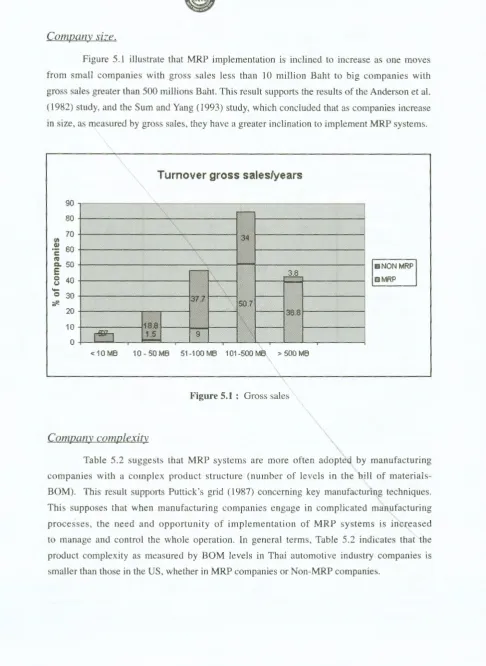
Figure 5.1 illustrate that MRP implementation is inclined to increase as one moves from small companies with gross sales les~ than 10 million Baht to big companies with
gross sales greater than 500 millions Baht. Thi~ result supports the results of the Anderson et al.
(1982) study, and the Sum and Yang (1993) study, which concluded that as companies increase
in size. as measured by gross sales. they have a greater inclination to implement MRP systems.
(/1
Turnover gross sales/yea
r
s
90T-~---~~---~
~+---70
+-
----
---.! c 60
+---
---~
~ ~+---~--~---~
E
8
40+-
---
---t\i<si
.. ;:::..t---
-1
....
Q 30 +---~-·----1
</!.
20
+---10
+---
--
--
-0
<10MB 10-SOMB 51-100MB 101-SOOMB >500MB
Figure 5.1 : Gross sales
Compan,y complexity
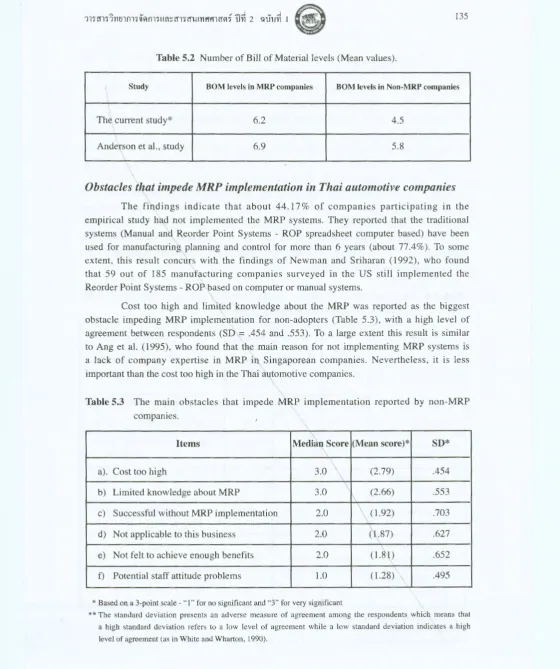
Table 5.2 sugge~ts that MRP ~ystcms arc more often adopted by manufacturing
companies with a complex product structure (number of levels in the bill of
materials-BOM). This result supports Puttick's grid (I 987) concerning key manufacturing techniques. This supposes that when manufacturing companies engage in complicated manufacturing
processes, the need and opportunity of implementation of MRP systems is increased
to manage and control the whole operation. In general terms. Table 5.2 indicates that the
product complexity as measured by HOM levels in Thai automotive industry companies is
Table 5.2 Number of Bill of Material levels (Mean values).
Study BOM levels in MRI' companies UOM levels in Non-MRI' companies
The current study* 6.2 4.5
Anderson et al., study 6.9 5.8
Ob
s
tacl
es
tllat imped
e
MRP
i
mpl
e
mentat
i
on in Thai automotiv
e
companie
s
The findings indicate that about 44.17% of companies participating in the empirical study had not implemented the MRP systems. They reported that the traditional systems (Manual and Reorder Point Systems -ROP spreadsheet computer based) have been u~ed for manufacturing planning and control for more than 6 years (about 77.4%). To some extent, thi~ result concurs with the findings of Newman and Sriharan ( 1992), who found that 59 out of I 85 manufacturing companies surveyed in the US still implemented the Reorder Point Systems-ROP based on computer or manual systems.
Cost too high and limited knowledge about the MRP was reported as the biggest obstacle impeding MRP implementation for non-adopters (Table 5.3), with a high level of agreement between respondents (SD
=
.454 and .553). To a large extent this result is similar to Ang et al. (1995), who found that the main reason for not implementing MRP systems is a lack of company expertise in MRP in Singaporean companies. Nevertheless, it is less important than the cost too high in the Thai automotive companies.Table 5.3 The main obstacles that impede MRP implementation reported by non-MRP companies.
Items Median Score (Mean score)* SD*
a). Cost too high 3.0 (2.79) .454
b) Limited knowledge about MRP 3.0 (2.66) .553
c) Successful without MRP implementation 2.0 ( 1.92) .703
d) Not applicable to this business 2.0 (I .87) .627
e) Not felt to achieve enough benefits 2.0 ( 1.81) .652
f) Potential staff attitude problems 1.0 (I .28) .495
* Ba!.cd on a 3-point scale· "I" for no signilicanl and "3" for very significant
•• The standard deviallon presents an adverse measure of agreement among the respondents which means that
a high <,tandard deviation refer\ to a low level of agreement while a low 'tandard deviation mdicates a high
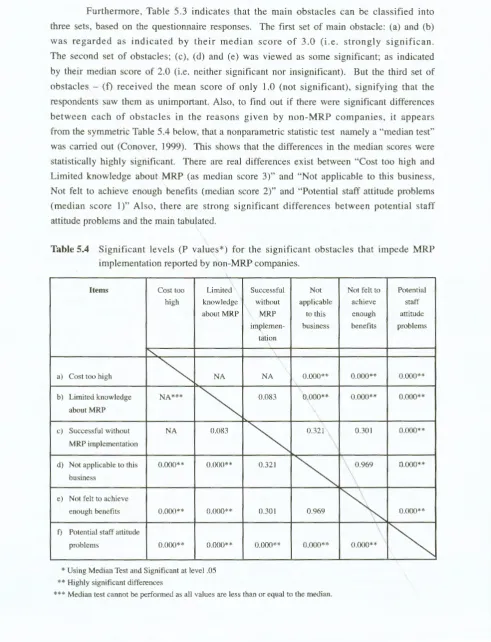
[image:9.595.14.575.36.706.2]Furthermore, Table 5.3 indicates that the main obstacles can be classified into
three sets, based on the questionnaire responses. The first set of main obstacle: (a) and (b)
was regarded as indicated by their median score of 3.0 (i.e. strongly significan.
The second set of obstacles; (c). (d) and (e) was viewed as some significant; as indicated
by their median score of 2.0 (i.e. neither significant nor insignificant). But the third set of
obstacles - (f) received the mean score of only 1.0 (not significant), signifying that the
respondents saw them as unimportant. Also, to find out if there were significant differences
between each of obstacles in the reasons given by non-MRP companies, it appears
from the symmetric Table 5.4 below, that a nonparametric statistic test namely a "median test"
was carried out (Conover, 1999). This shows that the differences in the median scores were
statistically highly significant. There are real differences exist between "Cost too high and
Limited knowledge about MRP (as median score 3)" and "Not applicable to this business,
Not felt to achieve enough benefits (median score 2)" and "Potential staff attitude problems
(median score I)" Also, there are strong significant differences between potential staff
altitude problems and the main tabulated.
Table 5.4 Significant levels (P values*) for the significant obstacles that impede MRP implementation reported by non-MRP companies.
Items Co\ttoo Limited
high knowledge
about MRP
f"..-.
a) Cost too high
~
NAb) Linuted knowledge NA*u
~
about MRP
c) Succc~sful without NA 0.083
MRP implementation
d) Not applicable to this 0.000** 0.()()()U
busine~!l
e) Not felt to achieve
enough benefits 0.000** 0.000**
f) Potential staff anirude
problems 0.000** 0.000**
• Using Median Test and Significant at level .05 '• Highly ~ignificant differences
Succe~sful Not
without applicable
MRP to this implcmen· busincs~
Wtion
NA 0.000** 0.083
o.ooo••
~
0.321 0.321~
0.301 0.969(}.()00** 0.000**
*** Median test cannot be performed as all vulues arc less than or equal to the median.
Not felt to Potential
achieve swff enough atutude benefits problems
0.000** 0.000**
0.000** 0.000**
0.301 0.000**
0.969 0.000**
~~
0.000'* [image:10.595.55.547.82.725.2]Organi
z
ational arrang
e
m
e
nt
s
f
o
r impl
e
mentation
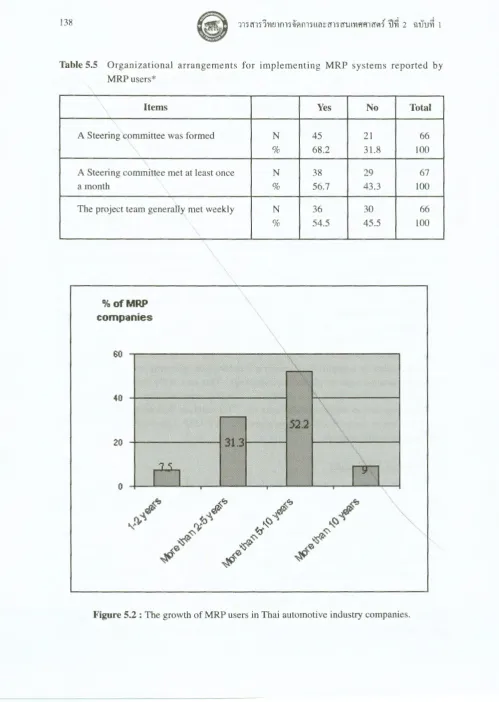
It appears from Table 5.5 that two-thirds of MRP companies set up a formal steering
committee to oversee the implementation of MRP systems, and in half the cases it met at
least once a month and a project team met weekly. MRP companies in the Thai automotive
industry set up a formal steering committee to oversee the implementation of MRP systems more than their peers in Singapore (68.2% in Thailand against 47.4% in Singapore) (Ang et
al., 1995) but these arrangements were less formal than those made by MRP companies
in the US (69.35%) (Duchessi eta!.. 1988).
MRP implem
e
ntation pro
ce
ss
Years in imvlementation
This shows a sharply growing trend in the implementation of MRP systems by
the Thai automotive industry. Implementation has been recent, 38.8% within last five
years and 91.0% within last ten years. There has been increasing Thai government support
for implementing new production technology within the Thai automotive sector, such as incentives, and the provision of education. To a large extent, the previous result ic; similar to
Sum and Yang ( 1993), concerning the degree of growth of MRP systems, and the government's
role in introducing M RP systems in Singapore. Furthermore. the survey findings also
indicate that 83.5% of MRP companies had installed their systems for more than 2 to
10 years. This can be seen to be synchronized with the current version stage of
implementation (according to Table 5.9, 67.2% of MRP companies claimed to be second
version which is computerized materials/production planning and control system
including detailed capacity requirement planning). This may imply that Thai users do just
begin at intermediate level. Voss ( 1986) has said that manufacturing companies need ten
years to learn how to implement MRP systems. This result can be interpreted to suggest that
Thai automotive companies need more experience with MRP implementation in order to be
ensuring successful adoption.
I
nitiator of
MRP
effort
For comparative purposes, the findings in this study are compared with White
ct al. ( 1982) and Sum and Yang ( 1993) studies arc concerning the initiator of MRP systems
in the US and Singapore respectively, as shown in Table 5.6 in the bclowing page:
The Thai automotive and Singaporean top management are more involved in
introducing MRP systems into their companies than their peers in the US companies.
This result can be interpreted in the light of the fact that MRP users in Thailand and
Singapore arc relative beginners compared with the US users. This may mean that the top
managers are more informed about implementing MRP systems in Thailand and Singapore than their peers in US companies. lt is interesting from the results, that Thai and American
production & inventory control (P & IC) managers play more important roles than Singapore. This may imply that the (P & IC) manager is more informed about implementing MRP systems
Table 5.5 Organizational arrangements for implementing MRP systems reported by MRP users*
Items
A Steering committee was formed
A Steering committee met at least once a month
The project team generally met weekly
%ofMRP companies
GO
40
20
0
~I?
~"'
"\~~I?
~"'
'>;~
#"\:'-N
%
N %
N
%
~I?
~
~
~~
$0
.$0
#
"\:'-Yes No Total
45
21
66
68.2
3
1.
8
100
38
2967
56.7
43.3
1
00
36
30
66
54.5
45.5
1
00
~I?
t$>
~
#"\:'-.$'0
Table 5.6 Initiator of MRP effort in different contexts(% of companies).
lnitiatora Thailand (present study) Singapore
a) Top management 64.2 67.8
b) Production and inventory control 3.0 6.8 (P & IC) management
c) Both top management and P & IC 28.4 18.6 management
d) Data processing personnel 0.0 3.4 e) Software/hardware vendors 3.0 5.1
f) Others 1.4 0.0
Total 100.0% l01.7c%
a Results extracted fmm White et al .. ( 1982).
b "NA" means respon~c is not available becau~e option was not reported in White ct al., (1982). c Percentage do not add up to 100 because several companies gave multiple answers.
MRP implementation
strategy
United States3
18.0 31.0
31.0
10.0 NAb
10.0
100.0%
A~:. can be seen in Table 5.7, demonstrates that the majority of MRP companies in Thailand (67.2%) have been following a parallel implementation strategy for implementing
MRP systems. This is a good sign, reflecting that manufacturing companies in Thailand are aware of the importance of introducing new technology based on a parallel approach, not only to know to what extent the people will be familiar with the new system, but also in order to
reduce the results derived from the failure of the implementation. This result does not concur
with Burn et al. ( 1991) findings regarding the implementation of MRP II by 80% of the
American users using a phased strategy.
Table 5.7 The implementation strategy used by the Thai automotive industry companies.
Conversion Strategies N %
Direct II 16.4
Pilot I 1.5
Parallel 45 67.2
Phased 10 14.9
[image:13.595.11.552.32.716.2]MRP
Impl
ementation
Problems
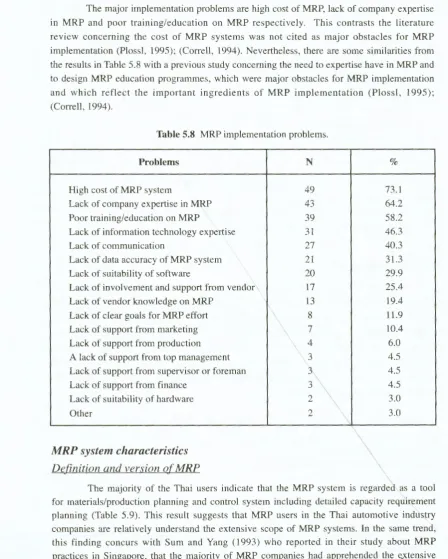
The major implementation problems are high cost of MRP, lack of company expertise
in MRP and poor training/education on MRP respectively. This contrasts the literature
review concerning the cost of MRP systems was not cited as major obstacles for MRP
implementation (Ploss!. 1995): (Correll. 1994). Nevertheless, there are some similarities from
the results in Table 5.8 with a previous study concerning the need to experti~e have in MRP and
to design MRP education programmes, which were major obstacles for MRP implementation and which reflect the important ingredients of MRP implementation (Piossl, 1995):
(Correll, 1994).
Table 5.8 MRP implementation problems.
Problems
High cost ofMRP system
Lack of company expertise in MRP
Poor training/education on MRP
Lack of information technology expertise Lack of communication
Lack of data accuracy of MRP system Lack of suitability of software
Lack of involvement and support from vendor Lack of vendor knowledge on MRP
Lack of clear goals for MRP effort Lack of support from marketing
Lack of support from production
A lack of support from top management
Lack of support from supervisor or foreman
Lack of support from finance
Lack of suitability of hardware
Other
MRP
system
characteristics
Definition and
version ofM
RP
N 49 43 39 31 27 21 20 17 13 8 7 4 3 3 3 2 2 % 73.1 64.2 58.2 46.3 40.3 31.3 29.9 25.4 19.4 11.9 10.4 6.0 4.5 4.5 4.5 3.0 3.0
The majority of the Thai users indicate that the MRP system is regarded as a tool
for materials/production planning and control system including detailed capacity requirement
planning (Table 5.9). This result suggests that MRP users in the Thai automotive industry
companies are relatively understand the extensive scope of MRP systems. In the same trend,
this finding concurs with Sum and Yang ( 1993) who reported in their study about MRP practices in Singapore. that the majority of MRP companies had apprehended the e.xtensive
[image:14.595.48.497.108.668.2]Table 5.9 Definition and version of term "MRP" reported by MRP users in different
contexts.
Definition Thailand Singapore
N % N %
a) Computerized materials/production 10 14.9 10 17.2
planning and control system without
detailed capacity requirement planning
(MRPI)
b) Computerized materials/production 45 67.2 40 67.2
planning and control system including
detailed capacity requirement planning
c) Computerized materials /production 12 17.9 7 12.1
planning and control system including
detailed capacity requirement planning
and integrated with other business
functions (MRPIIIERP)
d) Others 0 0.0 2 3.5
TOTAL
67
100.0 59 100.0H
ardware and software
The findings indicate that 52.2 % and 38.8% of MRP users run their systems on
network PC and minicomputer in respectively while 12% of MRP systems run on mainframe
and microcomputer. Furthermore, a majority of companies (61.2%) indicate that the MRP
user companies in Thai automotive industry prefer to buying-in and customized in-house
against I 0.4% of MRP companies who bought some turnkey systems from vendors. For
comparative proposes, this result to a extent is similar to the finding of the Sum and Yang
( 1993) study, which found that 49.2% of the MRP systems in Singapore run on minicomputers,
on the other hand, there is a linle extent is dissimilar indicated that of 71.1% MRP companies
source their MRP software from vendors, and only 13.6% develop the entire software in house
(Sum & Yang, 1993).
The degree ojcomouterization oj
MRP
modu
l
es
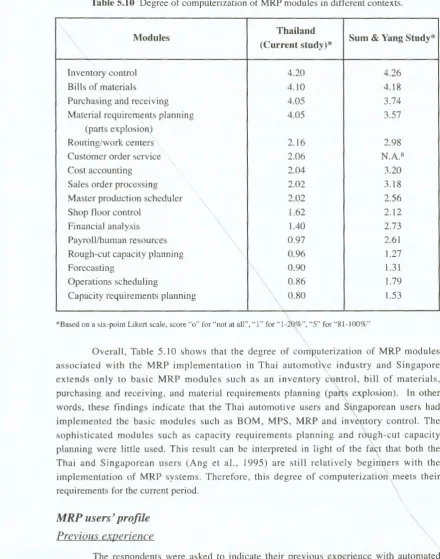
The findings in Sum and Yang ( J 993) are displayed alongside our findings in
Table 5.10 Degree of computerization of MRP modules in different contexts.
Modules Thailand
(Current study)* Sum & Yang Study*
Inventory control 4.20 4.26
Bills of materials 4.10 4.18
Purchasing and receiving 4.05 3.74
Material requirements planning 4.05 3.57
(parts explo~ion)
Routing/work centers 2.16 2.98
Customer order ~ervice 2.06 N.AY
Cost accounting 2.04 3.20
Sales order processing 2.02 3.18
Master production scheduler 2.02 2.56
Shop floor control 1.62 2.12
Financial analysis 1.40 2.73
Payroll/human resources 0.97 2.61
Rough-cut capacity planning 0.96 1.27
Forecasting 0.90 1.31
Operations ~cheduling 0.86 1.79
Capacity requirements planning 0.80 1.53
*Ba,cd on a ~ix. point Ltkcrt scale. score "o" fur "not at all", "I" for "1-20%". "5" for "81-100%"
Overall, Table 5.10 ~hows that the degree of computerization of MRP modules
associated with the MRP implementation in Thai automotive industry and Singapore
extends only to basic MRP modules such as an inventory control, bill of materials,
purchasing and receiving, and material requirements planning (parts explosion). In other
words, these findings indicate that the Thai automotive users and Singaporean users had
implemented the basic modules ~uch as BOM, MPS. MRP and inventory control. The
sophisticated modules such as capacity requirements planning and rough-cut capacity
planning were little used. This result can be interpreted in light of the fact that both the
Thai and Singaporean users (Ang et al., 1995) are ~till relatively beginners with the
implementation of MRP systems. Therefore, this degree of computeriLation meets their
requirements for the current period.
MRP
u
se
r
s'
pr
o
fil
e
Previous experience
The respondents were asked to indicate their previous experience with automated
complex information system base on a five point Likert scale, with I =very little and 5=very high.
l11.11ifl01011iOn11L":•n•umtlffl•Of11~
2uliu~
Ie
143a moderate experience with automated complex information systems before implementing
an MRP system. Nevertheless, this result contrasts with the claim that operation/production
managers responsible for the implementation of MRP systems in US companies have not
had previous experience in the implementation of complex information systems (Burns
et al.. 1991).
MRP
Users support
Gelling people support, whether top management or manager, is a very critical
factor for implementing MRP systems by manufacturing companies (Dilworth, 1993).
Table 5.11 illustrates that 91.0% of MRP users were at least supportive of the decision to
implement an MRP system. This highly level of support from user can also reflect to
highly willingness of user. This result, to a large extent, is very similar to the finding of the
Turnipseed et al. ( 1992) study which found that 90.0% of MRP users in the US were at least
supportive of implementing MRP systems. This is a good sign as the level of users support has often been identified as one of major implementation prerequisites (Callarman and Hey!,
1986); (Dilworth, 1993).
Table 5. U Level of support of MRP implementation by MRP users in different context.
Items
Thailand
us
N % N %
• Total support 21 31.3 28 38.0
•
Very supportive 32 47.8 18 24.0•
Supportive 8 11.9 19 27.0•
Neutral 6 9.0 7 10.0•
Opposed implementation 0 0.0 0 0.0TOTAL
67
100.0 59 100.0The degree of utilizjng the
outvuts
af
M
RP
svstems
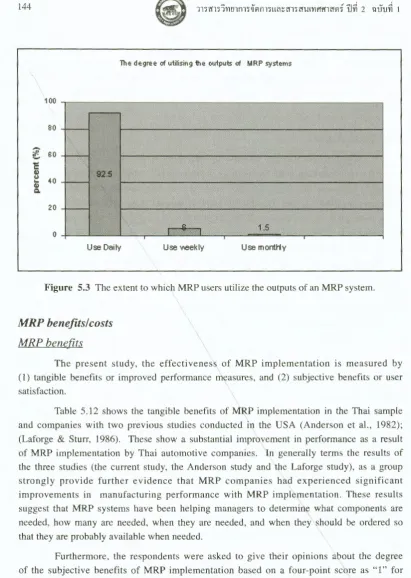
The MRP users were asked about the extent to which they utilized the outputs of
MRP systems.
As can be seen in figure 5.3, show that the majority of MRP users in Thai automotive
industry companies (92.5%) use the MRP system output on at least a daily basis. Similarly,
Turnipseed ct al. ( 1992) found that 75.0% of MRP companies in the US used the MRP system
outputs on at least a daily basis. This result may help explain why a majority of MRP users in
[image:17.595.34.567.46.736.2]The degree of utilising ihe outputs of MRP systems
100
80
~
801
...
408.
20
1.5
0
Use Deity Use V\eekly Use montHy
Figure 5.3 The extent to which MRP users utilize the outputs of an MRP system.
MRP
benefits/costs
MRP
benefits
The present study, the effectiveness of MRP implementation is measured by (I) tangible benefits or improved performance measures, and (2) subjective benefits or user satisfaction.
Table 5.12 shows the tangible benefits of MRP implementation in the Thai sample and companies with two previous studies conducted in the USA (Anderson et at., 1982); (Laforge & Sturr, 1986). These show a substantial improvement in performance as a result of MRP implementation by Thai automotive companies. In generally terms the results of the three studies (the current study, the Anderson study and the Laforge study), as a group l>trongly provide further evidence that MR P companies had experienced significant improvements in manufacturing performance with MRP implementation. These results suggest that MRP systems have been helping managers to determine what components are needed, how many arc needed, when they are needed, and when they should be ordered so that they are probably available when needed.
Furthermore, the respondents were asked to give their opinions about the degree of the subjective benefits of MRP implementation based on a four-point score as "I" for little benefit, "4" for greatest benefit. Table 5.13 concludes these for the Thai automotive sample.
It appears from Table 5. I 3, that reduced inventory costs received the highest rating
[image:18.595.83.495.44.623.2]competitive position was a less commonly recognized outcome of implementing an MRP
system, receiving the next to lowest rating's by MRP users. This means that improved
competitive position was not one of the major reasons for MRP implementation by
Thai automotive companies. To a large extent, this finding is different from Sum and Yang's
findings ( 1993). The highest mean value for Thai automotive companie!> is for reduced
inventory costs. while Sum and Yang's study is for better production scheduling. This
result concurs with the findings of Anonymous ( 1996), who reported that the biggest
benefit obtained from MRPII implementation by the company James Coney was lower
costs for holding stocks of obsolete inventory. However, in general term, researcher can say
that most of the benefits obtained from MRP implementation match the implementation
reasons except for improved competition measure, whereas only s few companies reported
some significant increase in such calculate.
Table 5.12 The comparison of the tangible benefits of MRP systems implementation
in different contexts.
Item Pre- Current Future
MRP Estimate Estimate Estimate
a) Inventory turnover Current 1.5 2.8 6.2 Anderson 3.2 4.3 5.3
Laforge 4.5 7.9 11.2
b) Delivery lead time (days) Current 23.5 11.6 4.9 Anderson 71.4 58.9 44.5 Laforge 55.6 41.7 31.8
c) Percent of time meeting Current 89.3 95.5 98.2
delivery promises(%) Anden.on 61.4 76.6 81D
Laforge 73.9 88.6 94.6
d) Percent of orders requiring Current 17.2 14.4 9.9
'"splitl>" because of unavailable Anderson 32.4 19.4 9.1 maferial (%) Laforge 29.0 13.5 5.5
e) Number of expcditerl> Current 36.4 29.6 24.3
(number of people) Anderson 10.1 6.5 4.6
Laforge 10.8 5.1 2.1
• Improvement= Current improvement= (Current estimate- Pre estimate)/ (Pre estimate)
Current Estimate- "Pre-MRP" Estimate
**
Progrel;~ = - - - -- -Future Estimate-"Pre MRP" EstimateTbe Progre~·· Achieved
Impr
ove-ment*
86.7 27.7
34.4 52.4
75.6 50.7
50.6 64.0
17.5 46.7
25.0 58.4
6.9 69.7
24.8 55.7
19.9 71.0
16.3 38.4 40.1 55.8 53.4 65.9
18.7 56.2
Table 5.13 Comparison of subjective benefit~ of MRP systems implementation in different contexts. (Mean value*).
Items
Current Sum and SchroederStudy Yang Study Study
Reduced inventory costs 3.81 3.65
N/A*
*
Better production scheduling 3.80 3.87 2.7
Increased BOMJinventory!MPS accuracy 3.57
N/A
N/AReduced informal system for material 3.52 3.48 N/A Management /Inventory/Production control
Better cost estimation 3.19 3.69 2.2
Increased throughput 3.14
N/A
2.4Reduced safety stocks 3.03
N/A
N/AImproved productivity 2.89 3.46 2.4
Improved co-ordination with marketing &finance 2.87 3.66 N/A
Improved your ability to perform in job 2.74 3.lB N/A
Better ability to meet volume/product change 2.70 N/A N/A
Improved quality of products 2.46 N/A N/A
Improved competitive position 2.39 3.40 2.1
Increased information on which to base 2.38 N/A N/A decisions since implementation of MRP
The compan~on wa~ bUJII on the mean score for each subjective benefit mea>urc in the three studies and based on four·point scale, score ··1·· for hnle benefit. '"4"" for greatest benefit.
*'
N/A means a rcspon..e is not available because the optton was not reported 111 the other two studies.M
RP
svstem costs
.
• The analysis of the co:,ts of MRP installation
Since it is generally believed that MRP implementation benefits are not without
considerable costs (Schroeder et al., 1981 ); (Laforge & Sturr. 1986); (Sum & Yang, 1993);
(Ang et al., 1995). one question in the survey that related to MRP implementation costs
1.5'~· Less rhan I MB
21-30 MB
1.5"" 6%
11-20MB
1·5 MB Ill Less than I MB
9% 27%
· 1-5MB 06-10 MB
011-20 MB
• 21-30 MB
0 More thnn 30 MB
~5%
Figure 5.4 The current MRP investment (hardware, software and personnel costs). Investment (MB =Million Baht).
According to Figure 5.4, we can categorize MRP users into three groups in terms of
range of how much is spent on MRP system installation. The smaller group who comprised
29% of companies who had !>pent less than 6.000.000 Baht (or approximately £81.081.08 at
an exchange rate of £1 = 74Baht). The Medium group of 63.0% spent between 6,000,000
and 20.000.000 Baht or approximately £270,270.27.08 (£1 = 74 Baht). The larger group
comprised 8% of the total, who had spent more than 20,000,000 Baht.
• The com12arison of the costs of
MRP
systems installation in different comextsThe current average investment of MRP system of the three studies is shown in
Table 5.14. Jt indicates that Thai automotive companies spent less than their peers in the US.
This result may concur with other finding in this study which indicates that the majority
of Thai automotive users (61.2%) selected then source of MRP software package from
buying-in and customited in-house rather than from vendors so that they would have cheaper
costs of MRP sy~tems installation.
However. the Thai investment in MRP is less than their peers in the US, where
[image:21.595.7.566.36.740.2]Table 5.14 The comparison of the costs of MRP systems installation in different
context!> (in US$).
Thai Automotive Companies US. C'ompanie'
(Present study) Andcr~on&Schrocdcr Laforge&Sturr
Mean 200,000* 375,000 623,000
*The average invc,tment mUSS= (The average inve•tmcnt in Thai Baht: Baht 8,000,000/401)
The relationship b
e
tw
ee
n
c
ompany si
ze
factors and MRP installation
c
osts
It was thought to be useful to take a further step and investigate whether or not there
is a correlation between MRP costs and the company size in the MRP companies surveyed.
Company size was measured by total company ~ales, total number of employees, and the
number of employees in production and inventory control. Therefore, the KendaJl's Tau
and Spearman correlation coefficient analysb was employed to state the association between
each of the company size factors and the costs of MRP implementation as it is illustrated in
Table 5.15 belows.
Table 5.15 Correlation between MRP costs and company siLe factors.
Item relationship Kendall's Tau (rk) Spearman (rJ Significant Level
Total company sales 0.240 0.255 .000 (S)
Total number of employees 0.608 0.71 .000 (S)
Number of employees 0.523 0.579 .000 (S)
inP&IC
S : Significant al .05 level
As can be seen from Table 5.15, both techniques showed the same results as the relation -ships between the costs of the MRP system (MRP installation cost+ the additional investment).
The company size factors are strong (rk =0240. 0.608 and 0.523 and rs =0.255, 0.719 and
0.579. and P<0.05). This result is rather predictable, and can indicate that larger companies
are more likely to spend more on implementing MRP systems. This may stem from the fact
that the majority of MRP companies in the survey arc joint venture or multinational (64.2%)
1 For comparative purpo,cs the co\t of MRP implementation in Thailand wa~ calculated in US$ currency. US$ I
[image:22.595.47.540.37.594.2](See Table 5.1 ), with the parent company/ headquarter providing them with huge investment
in the implementation of new technologies.
This result concurs with that of the Sum an Yang study ( 1993). Their results
show a strong relationship between the company size and the costs of MRP implementation
among the Singaporean manufacturing companies.
C
onclu
s
ion
a
nd dir
ec
t
io
n for furth
e
r
rese
ar
c
h
The main contribution of this study is the adoption of a more comprehensive approach than previous studies to investigating the state of the art of MRP implementation,
namely this study has a wider coverage of the vital subjects that embody the state of the art of MRP implementation such as MRP user's profile, MRP benefits and costs in particular
objective and subjective benefits obtained from MRP implementation. This study contributes
to what is currently a very limited amount of empirical research on MRP projects especially
on Thai automotive companies. A very significant contribution of this study is the undertaking of an extensive comparison of results with those obtained by the previous studies elsewhere.
The results of this study suggest that the implementation of MRP systems in Thai automotive companies is relatively similar to those of Sum and Yang ( 1993) and Ang et at., 1995 in Singapore
as a newly industrializing country Anderson et al. (1982) and Laforge and Sturr (1986) in the USA. as a developed country. The current study reveals that most MRP companies in the Thai
automotive industry arc joint ventures (between Thai and foreign company). This is similar
to Singapore and the US, where the majority of MRP companies are multinational owned.
This reflects that the Thai automotive companies arc dominated by overseas countries. Moreover, the survey findings suggested that in Thailand, Singapore and the US, larger and
more complex companies are more likely to implement MRP systems. Their production strategy is a combination of make to order and make to stock products in the three countries.
On the other hand, the interesting differences that emerged can be summarized as follows:
a) The survey findings suggest that high cost of MRP system and lack of expertise can be considered as the most important obstacle that impedes MRP
implementation among Thai users, while lack of MRP training and expertise were
identified as the most critical problems encountered in the implementation process in Singapore and the US.
b) This study reveals that top management support in Thailand and similarly
in Singapore, has had a great impact on the extent and rate of the acceptance of MRP systems, more than their peers in the US.
c) The findings indicated that the formal training from Headquarter/parent Company, software Vendor Company, IT/computer department within
a company, and government institutions plays a vital role in the implementation
of MRP systems. In contrast, in the US, formal training from a college graduates plays a very important part in their MRP implementation. There is no mention of training from any other source such as a software vendor company or government
d) The study reveal-; that the current usage of MRP systems is not very widespread in the Thai automotive industry. Despite the Thai government's support (e.g., grants, incentives) in promoting use of MRP systems, 67 of 120 companies that
participated in the empirical analysis had implemented MRP systems but 53 had not.
e) Additionally, the analysis of the relationship between MRP cost and company sit.e provides evidence that larger companies arc more likely to spend more on
implementing MRP systems.
With the survey result, one of the main implications of the current study is that it
shows that competitive po!>ition was not one of the major reasons and benefits for MRP
implementation by the Thai automotive companies. A majority of MRP companies in Thai automotive industry indicated that the most important reasons for implementing MRP systems were operational and not strategic. Better inventory control, lowering inventory cost and
reduced informal system for material management/inventory/production control were the
kinds of reasons given, suggesting that MRP systems were not viewed as a competitive strategy weapon.
Another implication of the survey empirical study is that the governmental role
area highly salient factor for developing the automotive sector in Thailand. Automotive companies indicated that they rely on the government, not only to promote MRP systems but also to provide support (e.g., grants, incentives through Board of Investment (BOI), Thailand Automotive Institute and etc.), as well as to run the relevant education/training
programmes for achieving successful implementation. This reflects the extent to which the automotive sector still dominates control structures over industry in Thailand.
Very significant implications are that h1gh cost of MRP system and Lack of company expertise in MRP and poor training/ education (people support) on MRP were viewed as be
crucial to implementing MRP systems. Therefore, the need for MRP education and training is highly stressed. Alternately, MRP vendors, and consultants, whether from outside or parent company, educational institutions and government training agencies can meet this need through preparing appropriate programmes and courses for MRP users.
Since the current ~tudy have been relatively little study to investigate the state of the art of MRP implementation in developing countries in general, and in Thailand in particular. there arc several directions in which future research is recommended. I) It should investigate fuller MRP implementation in the manufacturing sector organiLations rather than in only one industry; 2) Further research should be undertuken to monitor the progress and status of
MRP usage in Thailand over time. This may provide useful insights into the current trend
and development in the implementation of MRP systems by the Thai users; 3) Comparative
studies be made with other developing countries which to explore similarities and
dissimilalities concerning MRP implementation; and Finally, there is a trend toward a hybrid MRP with the other new production management such as JIT and OPT systems within the
CIM context and extended MRP such as ERP systems. Future studies can therefore be based
on the evaluation of such systems to identify the state of the art of these implementation
Note:
• The term "MRP" in this research is used as a general term to include all MRP
version, namely MRPJ (i.e. matenals requirements planning). Clmed-loop MRP (with
detailed capacity requirement planning). and MRPIIIERP (with detailed capacity requirement
planning and integrated with other bu!.iness functions).
References
AggarwaL S. ( 1985). MRP, JIT. OPT. FMS. Harvard Business Review,
September-October, 8-16.
AghaLadeh, S. (2003). MRP contributes to a company's profitability. Assembly Automation,
23 (3), 257-265.
Anderson, J. et al. (1982). Material requirement planning systems: The state of the art.
Production and Inventory Management, Fourth Quarter, 51-67.
Ang, J., Sum, C., & Chung, W. (1995). Critical success factors in implementing MRP
and government assistance: A Singapore context. Information Management,
Vol. 29.63-70.
Anonymous. ( 1996). MRPII system trims inventories 20-25%. Modern Materials
Handling (MMH), Vol. 51, 45.
Browne, P. J., llarhen, J., & Shivnan, J. (1996). Product Management Systems:
An Integrated Perspective. Harlow: Addison- Wesley.
Burns, 0., Turnipseed, D., & Riggs. W. ( 199 J ). Critical success factors in Manufacturing
Resource Planning implementation. International Journal of Operations and
Production Mmtagemcnt, II (4),
5
19.Callarman, T., & Heyl, J. (1986) A model for Material Requirements Planning implementation.
In Voss, C. (Eds.). Managing Advanced Manufacturing Technology ([i2lp. 31-43).
UK: IFS.
Carrie, A. et al. ( 1997). The future of CAPM systems. A Research Proposal to EPRSC,
London: UK.
Conover, W. J. ( 1999). Practical non parametric statistics. John Wiley and Sons: New York.
Cooper, R., & Zmud. R. ( J 989). Material Requirements Planning system infu~ion.
International Journal of Management Science: OMEGA, Vol. 17. 471-481.
Correll, J. (1994). How to get top management support for MRPII. Hospital Material
Management Quarterly, 15 (4), 23-28.
Dilworth, J. (1993 ). Production and Operation Management: Manufacturing and Services.
New York: McGraw-Hill.
Duchcssi, P. et al. (1988). Dctermi nants of success in implementing Material Requirements
Duchessi P .. Schaninger, C. & Hobbs. D. ( 1989). Implementing a Manufacturing Planning and Control information system. California Management Review Spring, fi3] . 75-90.
Farquhar, C. R. ( 1991 ). Total quality management: A competitive imperative for the 90s. Optimum, 21 (4), (30-39).
Goh. P. (1984). Manufacturing Resource Planning (MRPII). Engineering Technician, Junc[i41.19-26.
John, 0., & Charlotte, M. ( 1996). MRP rest in peace. Management Accounting-London, Vol. 74. 14-20.
Laforge, R., & Sturr, V. (1986). MRP practices in a random sample of manufacturing firms.
Production and Inventory Management, Third Quarter, 129-137.
Lunn, T. (1996). Six ways to reduce inventory. Hospital Material Management Quarterly, Vol.l7, 54-61.
Newman, W., & Sridharan, V. ( 1992). Manufacturing planning and control: ls there one definitive answer?. Production and inventory Management, First Quarter, 50-54.
Ploss!, G. (1995). Orlicky's Material Requirements Pla1111ing. New York: McGraw-Hill. Puttick, J. ( 1987). Manufacturing Pull-Manufacturing Push, Springboard for Competitive
Advantage. In Toone, R. & Jackson, D. (Eds.), The Management of Manufacturing: the Competitive Edge ( 1 i5]p. 12-27). London: lFS.
Robertson, M., Swan, J., & Newell, S. (1996). The role of networks in the diffusion of technological innovation. Journal of Management Studies, 33:3 (May)fi6 ], 333 359.
Schroeder, R., Anderson. J.. Tupy, S. and White, E. (1981 ), A study of MRP benefit~ and costs, Operations Management, No!i7].2, l-9.
Scott, B. (1994). Manufacturing Planning Systems. London: Mcgraw-Hill International.
Sum, C., & Yang, K. (1993). A study of Material Resource Planning (MRP II) practices in Singapore. International Journal of Management Science (OMEGA), Vol. 21.
187-197.
Sum, C. et al. ( 1995). An analysis of Material Requirements Planning (MRP) benefits using Alternating Conditional Expectation (ACE). Operations Management, Vol.13, 35-58.
Turnipseed. D., Burns, 0. and Rigg. W. ( 1992), An implementation analysis of MRP systems: a focus on the human variable, Production and Inventory Management,
First Quarter, 1-5.
Voss, C. ( 1986). Implementing manufacturing technology- a manufacturing strategy perspective. In Voss, C (Eds.), Managing Advanced Manufacturing Technology ( li8]p. 95-107). UK: TFT.
Westbrook. R. ( 1995). Priority management: new theory for operation management,
Operations and Production Management, Vol. 14, 4-24.
White, E. et a!. ( 1982). A study of MRP implementation process. Operation Management,