This is a repository copy of The Effect of Visual Capture Towards Subjective Embodiment
Within the Full Body Illusion.
White Rose Research Online URL for this paper:
http://eprints.whiterose.ac.uk/141196/
Version: Accepted Version
Article:
Carey, Mark, Crucianelli, Laura, Preston, Catherine orcid.org/0000-0001-7158-5382 et al.
(1 more author) (2019) The Effect of Visual Capture Towards Subjective Embodiment
Within the Full Body Illusion. Scientific Reports. p. 2889. ISSN 2045-2322
https://doi.org/10.1038/s41598-019-39168-4
[email protected] https://eprints.whiterose.ac.uk/ Reuse
Items deposited in White Rose Research Online are protected by copyright, with all rights reserved unless indicated otherwise. They may be downloaded and/or printed for private study, or other acts as permitted by national copyright laws. The publisher or other rights holders may allow further reproduction and re-use of the full text version. This is indicated by the licence information on the White Rose Research Online record for the item.
Takedown
If you consider content in White Rose Research Online to be in breach of UK law, please notify us by
The Effect of Visual Capture Towards Subjective Embodiment Within the Full Body
Illusion
Mark Carey
1*, Laura Crucianelli
2,
Catherine Preston
1✝, and Aikaterini Fotopoulou
2✝1
Department of Psychology, University of York, York, United Kingdom
2
Department of Clinical, Educational and Health Psychology, University College London,
United Kingdom
✝
These authors have shared senior authorship
*Corresponding author:
Mark Carey
Department of Psychology
University of York
Heslington
York, YO10 5DD
United Kingdom
Abstract
1
Typically, multisensory illusion paradigms emphasise the importance of synchronous visuotactile
2
integration to induce subjective embodiment towards another body. However, the extent to which
3
embodiment is due to the ‘visual capture’ of congruent visuoproprioceptive information alone remains
4
unclear. Thus, across two experiments (total N = 80), we investigated how mere visual observation of
5
a mannequin body, viewed from a first-person perspective, influenced subjective embodiment
6
independently from concomitant visuotactile integration. Moreover, we investigated whether slow,
7
affective touch on participants’ own, unseen body (without concomitant touch on the seen mannequin)
8
disrupted visual capture effects to a greater degree than fast, non-affective touch. In total, 40% of
9
participants experienced subjective embodiment towards the mannequin body following mere visual
10
observation, and this effect was significantly higher than conditions which included touch to
11
participants own, unseen body. The velocity of the touch that participants received
(affective/non-12
affective) did not differ in modulating visual capture effects. Furthermore, the effects of visual capture
13
and perceived pleasantness of touch was not modulated by subthreshold eating disorder
14
psychopathology. Overall, this study suggests that congruent visuoproprioceptive cues can be sufficient
15
to induce subjective embodiment of a whole body, in the absence of visuotactile integration and beyond
16
mere confabulatory responses.
1. Introduction
18
19
Body ownership, the feeling that our body belongs to us and is distinct from other people’s bodies,
20
is a fundamental component of our sense of self 1,2. Intuitively, this feeling appears stable and durable 21
amongst humans, yet scientific studies have demonstrated that the sense of body ownership is a fragile
22
outcome of integrating multiple sensory signals. Such signals originate via exteroceptive modalities
23
(i.e. outside the body) such as vision and touch 3,4, specifically within the boundaries of peripersonal 24
space surrounding the body 5,6. Additionally, incoming signals emerge via interoceptive modalities (i.e. 25
within the body) such as proprioception and heart rate 7–9. Together, exteroceptive and interoceptive 26
sensory signals are integrated to create a coherent sense of body ownership through which we interact
27
with our environment 2. 28
29
Experimental paradigms have been successfully used to investigate how body ownership is
30
shaped by the integration of incoming multisensory information. For example, in the Rubber Hand 31
Illusion (RHI)10, individuals experience ownership over a fake (rubber) hand when placed in a congruent 32
anatomical position and stroked in temporal synchrony with their own hand, which is hidden from view.
33
This has been recently extended to ownership over an entire body (Full Body Illusion), of which
34
different variations exist. Participants can perceive a change in self-location which induces an illusory
35
experience of being in a position outside of their physical body 11, or an illusory ownership towards 36
another’s body from a third-person perspective 12 or first-person perspective 13,14. In such illusions, the 37
source of tactile stimulation on one’s own, unseen body (part) is attributed to the location of the visually
38
perceived fake body (part) when the two are stroked synchronously, which is argued to give rise to
39
subjective self-reports of illusory body ownership and a mislocation in one’s own sense of body position
40
(i.e. proprioceptive drift) 4. Importantly, such effects typically occur within the constraints of top-down 41
contextual factors, including the orientation 3,15, visual perspective 16–18, and appearance 13,19,20 of the 42
embodied body (part). Indeed, research has shown that the strength of the illusion is modulated by the
43
distance between the real and fake body (part), with greater spatial discrepancies decreasing the
44
likelihood of integration between visuoproprioceptive signals 21–23. 45
Importantly, it has long been argued that the synchrony of the perceived touch with vision is a
47
necessary condition for illusory ownership to occur, rather than asynchrony which is typically used as
48
a control condition within multisensory illusion paradigms15. However, the role of synchronous 49
visuotactile integration as a necessary component to trigger illusory embodiment remains debated 24,25. 50
Research has shown that illusory embodiment could still be induced based purely on visual information
51
of a fake body (part) in the absence of visuotactile stimulation 25–27, or based on merely expected but 52
not experienced synchronous tactile stimulation 28, and even following asynchronous visuo-tactile 53
stimulation, provided that spatial congruence is adhered to between the real and fake body (part) 29 (see 54
24 for review). Such evidence highlights that synchronous visuotactile input can strengthen illusory 55
embodiment, by contributing to the downregulation in the weighting of proprioceptive signals regarding
56
one’s own limb position in relation to vision 30. However, from a computational perspective, congruent 57
visuoproprioceptive cues may be sufficient to induce such embodiment, suggesting that subsequent
58
visuotactile input may not be a necessary component to trigger this process 25,26,31 (see 32 for review). 59
60
Studies which have investigated illusory body ownership in the absence of tactile stimulation
61
have predominantly investigated this effect during the RHI (e.g. 25,33,34), with little research conducted 62
towards a whole body 16. Among the latter, some have argued that synchronous visuotactile integration 63
is a necessary condition to elicit illusory ownership in the full body illusion 13, while studies using 64
virtual reality have found evidence to the contrary, following illusory ownership towards a virtual body
65
in the absence of visuotactile integration 14,16. Therefore, we wished to investigate whether subjective 66
visual capture of embodiment could occur towards a real mannequin body with a static field of view,
67
from a first-person visual perspective in the ‘physical world’. In this context, ‘visual capture’ is defined
68
as the degree of embodiment due solely to passive, visual perception of the fake body (part) viewed
69
from a first-person perspective, independent from tactile stimulation (hereafter referred to as ‘visual
70
capture of embodiment’) 35,36. 71
72
Interestingly, a tendency to weight visual information over other somatosensory signals has
73
been recently observed in neuropsychological, right hemisphere patients with body representation
74
been implicated within neurodevelopmental disorders such as autism 40,41, and psychiatric disorders 76
such as schizophrenia 42–44, and eating disorders 45,46. Importantly, such alterations are argued to reflect 77
an instability in the bodily self within these populations 47,48. However, whilst ‘pure’ visual capture 78
conditions have been tested in right hemisphere patients, evidence for heightened visual dominance
79
within eating disorder patients derives from multisensory illusion studies finding that both synchronous
80
and asynchronous visuotactile stimulation led to alterations in an individual’s body representation
81
45,46,49,50. Thus, direct investigation of visual capture of embodiment from congruent visuoproprioceptive 82
cues alone (i.e. in the absence of tactile stimulation) has been less studied with regard to eating disorder
83
psychopathology.
84
85
Importantly, greater illusory embodiment in acute eating disorder patients has been shown to
86
persist to some degree amongst recovered patients, suggesting that such heightened sensitivity to visual
87
information pertaining to the body may be a trait phenomenon 49. Therefore, such visual dominance 88
over other sensory information may be independent from a status of malnutrition, and may occur prior 89
to illness onset which could influence an individual’s body perception and body satisfaction 51–53. Thus, 90
it may be that healthy individuals who display an increased visual capture of embodiment towards a
91
fake body (part) show an increased visual dominance over other sensory information, which may link
92
with a greater risk of developing distortions in body image. Consequently, the present study aimed to
93
investigate whether subthreshold eating disorder psychopathology and body concerns may modulate
94
the subjective embodiment shown towards a fake body as a result of mere visual capture.
95
96
In addition to research investigating visuoproprioceptive integration, the importance of
97
interoception in multisensory integration and body ownership has only recently been investigated 9,54,55. 98
Interoception refers to information about the internal states of the body, processing sensations from
99
within the body (e.g. hunger, thirst), but also outside the body (e.g. pleasure, pain), which is conveyed
100
by a particular afferent pathway 8. Affective touch - i.e. slow, caress-like touch – is associated with 101
increased pleasantness and has been found to activate specific C-Tactile (CT) afferents found only in
102
the hairy skin, responding maximally to stroking velocities between 1 and 10 cm/sec 56. Importantly, 103
affective tactile stimulation appears to be dissociable from exteroceptive, discriminatory stimulation
such as non-affective touch 57. Such CT afferents are hypothesised to take a distinct pathway to the 105
posterior insular cortex 58,59, an area associated with the early convergence of interoceptive information 106
with exteroceptive bodily signals 8,60,61. 107
108
Increasing evidence has shown that the velocity of perceived touch during visuotactile
109
integration plays an influential role within the sense of body ownership. Specifically, touch delivered
110
at CT-optimal velocities has been shown to increase embodiment during the RHI paradigm compared
111
with fast, non-affective touch 35,62–64, however, evidence of this effect in the full body illusion remains 112
equivocal 65. Moreover, recent research has shown that individuals with anorexia nervosa (AN) display 113
a reduced subjective pleasantness to touch, relative to healthy controls 60; however, it is yet to be 114
investigated how eating disorder psychopathology may modulate the extent to which individuals show
115
alterations in their experience of touch, or vice versa. Therefore, within our second experiment,
116
individual differences in the perception of touch will be investigated in relation to subthreshold eating
117
disorder psychopathology.
118
119
In addition to enhancement of embodiment via interoceptive signals, evidence from patient
120
populations with chronic pain has shown how feelings of body ownership can be disturbed 66,67 (but see 121
68 for review). Changes in interoceptive information (e.g. increased limb temperature) has been shown 122
to disrupt the feelings of embodiment by decreasing the strength of the effect within multisensory
123
illusions 69. Therefore, in addition to mere visual capture towards subjective embodiment (visual 124
capture condition), the present study aimed to investigate the effects of tactile stimulation administered
125
to participants’ own, unseen arm during visual observation of the mannequin body, as a control
126
condition designed to ‘disrupt’ visual capture by introducing sensory input that is incongruent with
127
participants’ visual information (tactile disruption condition). Furthermore, we aimed to investigate
128
whether CT-optimal, affective touch (i.e. touch administered in CT-optimal velocities) would provide
129
additional interoceptive information on one’s own body which would be expected to disrupt visual
130
capture of embodiment to a greater extent compared with discriminatory, non-affective touch. Previous
131
research has suggested that the perception of interoceptive signals depends on an individual’s ability to
132
Thus, differences in an individual’s sensitivity and balance between these two streams of information
134
may determine the degree of embodiment change shown during tactile disruption conditions.
135
136
In brief, we investigated whether mere visual observation of a mannequin body would lead to
137
subjective embodiment when visuoproprioceptive cues are congruent with one’s own body. Based on
138
previous research 16,25, we predicted that a compatible first-person perspective of a mannequin body 139
would be sufficient to elicit subjective embodiment amongst participants, independent of concomitant
140
tactile stimulation. In addition, we investigated the extent to which subjective embodiment towards the
141
mannequin body was reduced when visual capture of proprioception was disrupted by tactile
142
stimulation to participant’s own, unseen arm. We manipulated the velocity of tactile stimulation that
143
participants received, to investigate whether slow, affective touch had a differential effect on the
144
disruption of embodiment compared with fast, non-affective touch. Specifically, we predicted that the
145
increased interoceptive information associated with affective touch would disrupt the downregulation
146
of proprioceptive signals by visual capture to a greater extent compared to non-affective touch. Finally,
147
we investigated whether subthreshold eating disorder psychopathology modulated any individual
148
differences in subjective embodiment from visual capture. We hypothesized that higher eating disorder
149
vulnerability would be associated with an increased weighting of visual information, and thus increased
150
visual capture of embodiment. The above measures were replicated across two experiments, with the
151
addition of a separate touch task in Experiment 2, designed to investigate the role of subjective
152
pleasantness of touch in relation to subthreshold eating disorder psychopathology. Extending upon
153
findings from clinical populations 60, we expected to observe a negative relationship between the above 154
two measures, such that individuals with higher eating disorder psychopathology were hypothesised to
155
display a reduced pleasantness to both affective touch and non-affective touch.
2.! Methods
157
2.1 Experiment 1
158
2.1.1 Participants
159
Forty-one healthy female participants (Mean age = 20.10, SD ± 2.48, range = 18-31) were
160
recruited via the University of York research participation scheme and received course credit for a
161
single 60-minute testing session. Participants had a mean BMI of 21.48 (SD ± 2.40, range =
18.30-162
28.60), no current or previous neurological or psychological disorders (self-report), and normal or
163
corrected-to-normal vision. Exclusion criteria included any specific skin conditions (e.g. eczema,
164
psoriasis) or any scarring or tattoos on the left arm.All participants gave informed consent to take part
165
in the study. The study received ethical approval from the University of York Departmental Ethics
166
Committee and was conducted in accordance with the Declaration of Helsinki. One participant was
167
later excluded because she self-reported a previous psychological condition, therefore, the final sample
168
consisted of forty participants (Mean age = 20.15, SD ± 2.49, range = 18-31). Post-hoc power analyses
169
using G*Power 3.1.9.2 71 indicated that this number of participants resulted in 99% and 97% power to 170
obtain significant effects following visual capture and tactile disruption conditions, respectively (see
171
Section 2.3).
172
173
2.1.2 Design
174
The experiment employed a within-subjects design to investigate the effects of visual and tactile
175
signals towards the subjective embodiment of a mannequin body. First, during visual capture trials
176
participants visually observed the mannequin body for 30 seconds, from a first-person perspective,
177
independent of any tactile stimulation. Second, participants also undertook trials identical to the visual 178
capture condition, but with the addition of tactile stimulation applied (only) to participant’s own, unseen
179
arm, designed to disrupt such visual capture (tactile disruption condition) for 60 seconds. Stimulation
180
was administered at two different velocities to give rise to affective (3cm/s) and non-affective (18 cm/s)
181
tactile disruption. The dependent variable was the subjective embodiment experienced by participants,
182
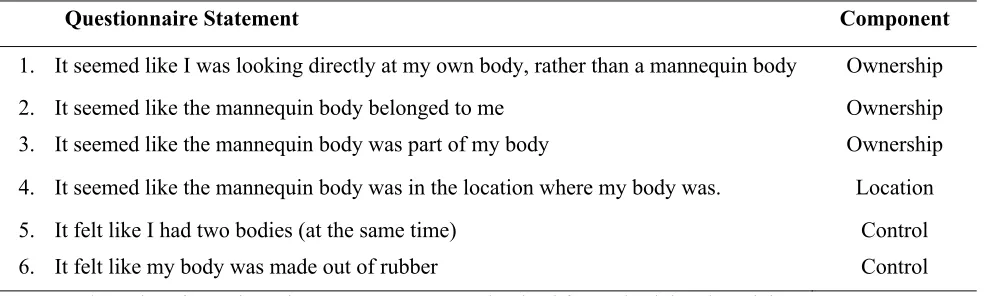
rated after each trial via an embodiment questionnaire (see Measures section and Table 1 for details).
183
The same embodiment questionnaire was completed for both visual capture and tactile disruption 184
conditions. Participants completed two visual capture trials, each followed by an affective or
affective tactile disruption trial in counterbalanced order between participants, resulting in a total of 4
186
trials per participant (see Figure 1).
187
188
INSERT FIGURE 1
189
190
2.1.3 Measures
191
2.1.3.1 Embodiment Questionnaire 192
Following each trial, participants rated their subjective embodiment via an embodiment 193
questionnaire (see Table 1) along a 7-point Likert scale (-3 strongly disagree to +3 strongly agree). This
194
questionnaire (adapted from Longo et al., 2008) was composed of two subcomponents: ownership (i.e.
195
the feeling that the mannequin body belongs to them) and location (i.e. the feeling that the mannequin
196
body was in the position of their own body). An overall embodiment score was calculated by averaging
197
the above two subcomponent scores. The final two statements were control statements, in which an
198
overall control score was similarly calculated by averaging across the two control items. These scores
199
served to control for task compliance, suggestibility, and confabulation within the visual capture
200
condition to compare with embodiment scores. Such control statements are similar, body-related items
201
to those of the embodiment statements, but importantly do not capture the phenomenological experience
202
of embodiment. Consequently, comparisons between embodiment and control scores acted to indicate
203
whether a significant sense of embodiment occurred following the visual capture condition.
204
205
2.1.3.2 Eating Disorder Examination Questionnaire (EDE-Q) 6.0 206
The EDE-Q is a 28-item questionnaire used as a self-report measure of eating disorder
207
psychopathology 72 amongst community populations. The questionnaire assesses frequency of 208
disordered eating behaviours (6 items), as well as eating behaviours and attitudes (22 items) within the
209
past 28 days, along four subscales: Dietary Restraint, Eating Concern, Weight Concern and Shape 210
Concern, which are also averaged for a Global EDE-Q Score. Items are rated along a 7-point (0-6)
211
Likert scale, with higher scores signifying greater eating disorder psychopathology. This measure has
212
The overall global EDE-Q measure in the present study had a Cronbach’s alpha of .95 in both
214
Experiment 1 and Experiment 2.
215
216
217
2.1.4 Materials
218
A life-size female mannequin was used within the experimental set-up. The mannequin was
219
dressed in a white t-shirt, blue jeans and black socks, with the head removed at the neckline to enable
220
correct positioning of the video cameras. The body had a waist circumference of 62cm and was in a
221
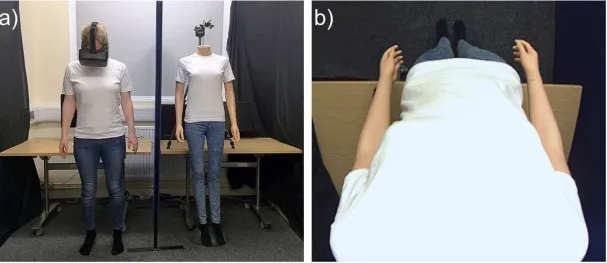
standing position with arms placed by their side (see Figure 2). During all trials, participants wore a set
222
of head-mounted displays (HMDs) (Oculus Rift DK2, Oculus VR, Irvine, CA, USA), with a resolution
223
of 1200 x 1080 pixels per eye, a refresh rate of 75Hz, and a corresponding nominal visual field of 100°.
224
The HMDs were connected to a stereoscopic camera (Ovrvision Pro USB 3.0 VR stereo camera, Japan),
225
presenting a real time, video image to participants. The cameras were mounted and positioned
226
downwards, at the eye line of the mannequin, capturing a first-person perspective of the body,
227
compatible with looking down towards one’s own body. During tactile disruption trials, tactile
228
stimulation was applied using a cosmetic make-up brush (Natural hair Blush Brush, N◦7, The Boots
229
Company). All experimental trials and responses were made using PsychoPy 2 74 on an Apple iMac 230
desktop computer (1.6GHz dual-core Intel Core i5 processor).
231
232
INSERT FIGURE 2
233
234
2.1.5! Experimental Procedure
235
Prior to the experiment, two adjacent 9 cm x 4cm stroking areas were marked on the hairy skin of
236
each participants’ left forearm, using a washable marker pen 62,75. This provided a specific area for 237
which to administer tactile stimulation for participants. Stimulation alternated between these two
238
stroking areas within each tactile disruption trial, to minimise habituation, and provide the experimenter
239
with an assigned area to control the pressure of each stroke. For all experimental trials, participants
240
stood to the right of the mannequin body, separated by an office screen divider (see Figure 2a), whilst
241
wearing the HMDs. Participants were instructed to remain still, place their arms by their side, and look
down as though towards their own body. A live video image (delay ~ 60ms) of the mannequin body,
243
viewed from a first-person perspective, appeared in place of their own body through the HMDs (see
244
Figure 2b).
245
246
For visual capture trials, participants visually observed the mannequin body for a 30-second period,
247
without any tactile stimulation. Immediately after the trial, participants removed the HMDs and rated
248
their subjective embodiment towards the mannequin via the embodiment questionnaire (see Table 1)
249
on a separate computer. Removing the HMDs following each trial also served as a rest period for
250
participants to move freely and dissociate their subjective experience between trials. For tactile 251
disruption trials, participants identically visually observed the mannequin body, with the experimenter
252
stroking participants’ own, unseen arm for a 60-second period. Stroking velocity was manipulated by
253
administering slow, affective touch (3cm/s), and fast, non-affective touch (18cm/s). The experimenter
254
was trained to administer each stroke at the precise speed within the assigned stroking area (9cm x
255
4cm), by counting the number of strokes within a window of 3 seconds per individual stimulation (i.e.
256
one 3s-long stroke for 3 cm/s velocity, and six 0.5s-long strokes for 18 cm/s velocity). Identically,
257
immediately after tactile disruption trials, participants removed the HMDs and rated their subjective
258
embodiment towards the mannequin via the embodiment questionnaire. Individual questionnaire items
259
were presented in a randomized order across all trials.
2.2 Experiment 2
261
2.2.1 Participants
262
Forty-three healthy female participants (Mean age = 18.98, SD ± .74, range = 18 - 20) were
263
recruited via the University of York research participation scheme and received course credit for a
264
single 60-minute testing session. Participants had a mean BMI of 21.89 (SD ± 2.67, range =
16.66-265
28.32), no current or previous neurological or psychological disorders (self-report), and normal or
266
corrected-to-normal vision. Exclusion criteria included any specific skin conditions (e.g. eczema,
267
psoriasis) or any scarring or tattoos on the left arm. All participants gave informed consent to take part
268
in the study. The study received ethical approval from the University of York Departmental Ethics
269
Committee and was conducted in accordance with the Declaration of Helsinki. Three participants were
270
later excluded; one following a self-reported previous psychological condition; one excluded with
271
scarring on their arms, and one excluded following poor comprehension with the experimental
272
procedure. Therefore, the final sample consisted of forty participants (Mean age = 18.98, SD ± .77,
273
range = 18 - 20). Post-hoc power analyses using G*Power 3.1.9.2 71 indicated that this number of 274
participants resulted in 99% power to obtain significant effects following both visual capture and tactile 275
disruption conditions(see Section 2.3).
276
277
2.2.2 Design, Materials, Measures, Procedure
278
Design, Materials, Measures and Procedures were identical to Experiment 1, with the addition
279
of a separate Touch Task completed prior to the Full Body Illusion, which explored subjective
280
pleasantness ratings of affective vs. non-affective touch based solely on tactile input, in relation to
281
subthreshold eating disorder psychopathology amongst healthy females.
282
283
Touch Task
284
Participants were asked to place their left arm on the table with their palm facing down and
285
wore a blindfold over their eyes to prevent any visual feedback to tactile stimulation. Tactile stimulation
286
was administered using an identical cosmetic make-up brush (see Materials above) for 3 seconds per
287
trial, at the same velocities as those in the tactile disruption conditions (affective touch - 3 cm/sec and
288
non-affective touch - 18 cm/sec). There was a total of six trials per velocity condition, for a total of 18
trials, with all trials presented in a randomized order for each participant. Following each trial,
290
participants verbally reported the pleasant of the touch, using the pleasantness rating VAS scale,
291
anchored from 0 (Not at all pleasant) to 100 (Extremely pleasant) 60. An average score across the six 292
trials was calculated to obtain a single score, per participant, for each of the two tactile conditions.
293
294
2.3 Data Analysis
295
All statistical analyses were conducted using SPSS version 23.0 (IBM, Chicago, IL, USA).
296
Data from the embodiment questionnaire were ordinal and found to be non-normal via a Shapiro-Wilk
297
test (p < .05), thus, appropriate non-parametric tests were used for analysis. Data for pleasantness ratings
298
in the Touch Task were normally distributed (p > .05), therefore parametric tests were used to analyse
299
this data. Effect sizes for parametric tests are indicated by Cohen’s d, and non-parametric Wilcoxon
300
signed-rank tests are indicated by r values (r) which are equivalent to Cohen’s d76. 301
302
First, to indicate whether a significant sense of subjective embodiment occurred following mere
303
visual observation of a mannequin body (i.e. visual capture effect), we used a Wilcoxon signed-rank
304
testto compare embodiment scores with control scores within the embodiment questionnaire (see Table
305
1 for embodiment questionnaire items). Such comparisons were made to ensure that positive subjective
306
embodiment was specific to the visual capture effect and not due to task compliance or suggestibility,
307
with control items not expected to score highly, irrespective of illusory experience. Second, to
308
investigate whether subjective embodiment was significantly reduced when visual capture was
309
disrupted by tactile stimulation to participant’s own, unseen arm (tactile disruption), a further Wilcoxon
310
signed-rank test was conducted to compare subjective embodiment scores between visual capture and
311
tactile disruption conditions. Moreover, we assessed whether slow, affective touch on participants own
312
arm led to greater disruption in subjective embodiment within participants compared with fast,
non-313
affective touch, using a Wilcoxon signed-rank test to compare embodiment scores between the two
314
stroking velocities (affective vs. non-affective tactile disruption). The above analyses were also
315
conducted for individual Ownership and Location subcomponents within the embodiment questionnaire 316
(see Supplementary Materials, Sections 1 and 2). In addition, in Experiment 2 we examined the effect
of stroking velocity on pleasantness ratings using a paired-samples t-test, to first establish whether slow,
318
affective touch was indeed perceived as significantly more pleasant that fast, non-affective touch
319
(manipulation check). The perception of touch was then investigated in relation to subthreshold eating
320
disorder psychopathology (as measured by the EDE-Q 6.0), using a non-parametric Spearman’s
321
correlation.
322
323
To establish individual differences in reported visual capture of embodiment, we calculated
324
percentage frequencies across the combined samples of Experiment 1 and 2, of those who reported
325
visual capture of embodiment (average scores of ≥ +1 in response to the embodiment questionnaire 3,77), 326
those who neither affirmed or denied embodiment (average scores of < +1 and > -1 in response to the
327
embodiment questionnaire) and those who denied visual capture (average scores of < -1 in the
328
embodiment questionnaire). Finally, we wished to explore whether such individual differences in
329
subjective embodiment from visual capture related to subthreshold eating disorder psychopathology
330
(EDE-Q 6.0). Therefore, we conducted a non-parametric Spearman’s correlational analysis between the
331
psychometric EDE-Q measure and subjective embodiment scores from visual capture.
3.! Results
333
3.1 Experiment 1
334
3.1.1 Embodiment Questionnaire
335
Preliminary analysis showed that there was no effect of trial order across visual capture trials,
336
with a Wilcoxon signed-rank test revealing no significant difference in embodiment scores between
337
visual capture trial 1 vs. trial 2 (Z = - .084, p = .933). Therefore, embodiment questionnaire scores were
338
collapsed across the two visual capture trials to provide an overall visual capture embodiment score,
339
per participant.
340
341
3.1.1.1 Main effect: Visual Capture
342
To examine the effects of mere visual capture towards subjective embodiment of the mannequin
343
body, we compared embodiment scores with control scores in the embodiment questionnaire. A
344
Wilcoxon signed-rank test revealed a main effect of visual capture, with significantly higher
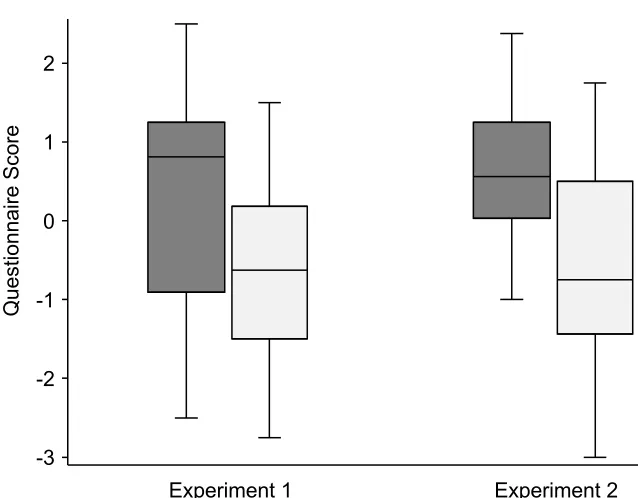
345
embodiment scores compared with control scores (Z = -4.04, p < .001, r = .64) (see Figure 3).
346
347
3.1.1.2 Main effect: Tactile Disruption
348
In order to determine whether tactile disruption to participants’ own unseen arm would disrupt
349
subjective embodiment, we compared embodiment scores between tactile disruption and visual capture 350
conditions. A Wilcoxon signed-rank test revealed a main effect of condition, in which participants
351
showed significantly lower subjective embodiment following tactile disruption trials (median = -.38)
352
compared with visual capture trials (median = .82) (Z = -3.74, p < .001, r = .59).
353
354
3.1.1.3 Main effect: Tactile Velocity
355
Next, we examined whether tactile velocity had an effect in disrupting the subjective
356
embodiment towards the mannequin body within tactile disruption trials. A Wilcoxon signed-rank test
revealed that there was no significant difference in embodiment scores between affective and
non-358
affective tactile disruption trials (Z = -.104, p = .918, r = .02), which suggests that interoceptive affective
359
touch did not disrupt visual capture of embodiment to a greater degree than exteroceptive, non-affective
360
touch.
361
362
3.2 Experiment 2
363
3.2.1 Touch Task (Manipulation Check)
364
A further one participant was later excluded within the Touch Task analysis as an extreme
365
outlier, scoring more than 2 SD below the group mean in pleasantness ratings of affective touch (3cm/s
366
velocity) 34. Therefore, the final sample for this analysis consisted of 39 participants. As expected, a 367
paired samples t-test revealed an effect of stroking velocity within the touch task, with significantly
368
higher subjective pleasantness ratings following affective touch (3cm/s) (mean = 74.27) compared with
369
non-affective touch (18cm/s) (mean = 52.94) (t (38) = 7.93, p < .001, d = 1.27). Moreover, correlational
370
analyses were conducted to investigate the relationship between pleasantness ratings and subthreshold
371
eating disorder psychopathology (measured by the Eating Disorder Examination Questionnaire;
EDE-372
Q 6.0). First, a Spearman’s rank correlation revealed an approaching significant correlation between
373
pleasantness ratings (average affective/non-affective touch) and global EDE-Q score (r = -.316, p =
374
.05). Next, difference scores were calculated between affective and non-affective touch pleasantness
375
ratings to determine whether those with higher subthreshold eating disorder psychopathology were less
376
sensitive to differences in the affectivity of touch. However, a Spearman’s rank correlation revealed no
377
significant correlation between touch difference score and global EDE-Q (r = .014, p = .935). Thus, the
378
results suggest a trend in which those scoring higher in subthreshold eating disorder psychopathology
379
may show a reduced pleasantness to all tactile stimulation, however this may not be further modulated
380
by the affectivity of the touch that they receive.
381
382
383
3.2.2 Embodiment Questionnaire
385
Preliminary analysis showed that there was no effect of trial order across visual capture trials,
386
with a Wilcoxon signed-rank test revealing no significant difference in embodiment scores between
387
visual capture trial 1 vs. trial 2 (Z = - .958, p = .338). Therefore, embodiment questionnaire scores were
388
collapsed across the two visual capture trials to provide an overall visual capture embodiment score,
389
per participant.
390
391
3.2.2.1 Main effect: Visual Capture
392
To examine the effects of mere visual capture towards subjective embodiment of the mannequin
393
body, we compared embodiment scores with control scores in the embodiment questionnaire. A
394
Wilcoxon signed-rank test revealed a main effect of visual capture, with significantly higher
395
embodiment scores compared with control scores (Z = -4.30, p < .001, r = .68) (see Figure 3).
396
397
3.2.2.2 Main effect: Tactile Disruption
398
In order to determine whether tactile disruption to participants’ own unseen arm would disrupt
399
subjective embodiment, we compared embodiment scores between tactile disruption and visual capture 400
conditions. A Wilcoxon signed-rank test revealed a main effect of condition, in which participants
401
showed significantly lower subjective embodiment following tactile disruption trials (median = -.23)
402
compared with visual capture trials (median = .59) (Z = -4.08, p < .001, r = .65).
403
404
3.2.2.3 Main effect: Tactile Velocity
405
Next, we examined whether tactile velocity had an effect in disrupting the subjective
406
embodiment towards the mannequin body within tactile disruption trials. A Wilcoxon signed-rank test
407
revealed that there was no significant difference in embodiment scores between affective and
affective tactile disruption trials (Z = - .354, p = .723, r = .06), which suggests that interoceptive
409
affective touch did not disrupt embodiment to a greater degree than exteroceptive, non-affective touch.
410
411
INSERT FIGURE 3
412
413
3.3 Combined Samples
414
3.3.1 Visual Capture of Embodiment – Individual Differences
415
Across the combined, total sample (N=80), 32 participants (40%) experienced a degree of
416
embodiment over the mannequin from mere visual capture, with average scores of ≥ +1 in response to
417
the embodiment questionnaire (hereafter referred to as ‘visual capture’ (VC) group). To confirm this
418
percentage was not a consequence of participant compliance, a Wilcoxon signed rank test was
419
conducted which revealed a significant difference between embodiment and control scores (Z = -4.71,
420
p < .001, r = .74), with only 4 participants (12.5%) of the VC group scoring ≥ +1 in response to control 421
items. 36 participants (45%) seemed to neither affirm or deny embodiment over the mannequin, with
422
average scores of < +1 and > -1 in response to the embodiment questionnaire (hereafter referred to as
423
‘borderline’ group). 12 participants (15%) of the total sample denied any subjective embodiment from
424
visual capture, with average scores of < -1 in the embodiment questionnaire (hereafter referred to as
425
‘no visual capture’ (no-VC) group).
426
427
3.3.3 Subthreshold Eating Disorder Psychopathology
428
Finally, correlational analyses were conducted to investigate the relationship between visual capture
429
effects and subthreshold eating disorder psychopathology (measured by the EDE-Q 6.0). EDE-Q
430
subscale and global scores across both experiments are presented in Table 2. A Spearman’s rank
431
correlation revealed no significant correlation between visual capture embodiment scores and global
432
EDE-Q scores (r = .030, p = .79), or any EDE-Q subscale scores (all ps > .05). Similarly, no significant
433
correlations were observed when analysing subcomponent (Ownership and Location) scores within the
434
embodiment questionnaire with EDE-Q scores (see Supplementary Materials, Section 3). This suggests
that subthreshold attitudes and behaviours regarding to eating and body image did not relate to the
436
degree of subjective embodiment of a mannequin body due to mere visual capture.
437
438
INSERT TABLE 1
439
440
Data Availability
441
The datasets analysed during the current study are available from the corresponding author on
442
reasonable request.
4.! Discussion
444
445
The present study investigated the extent to which mere visual observation of a mannequin body,
446
viewed from a first-person perspective, influenced subjective embodiment independently from
447
concomitant visuotactile integration. Across two experiments, our results showed that congruent
448
visuoproprioceptive cues between one’s own physical body and a mannequin body was sufficient to
449
induce subjective embodiment in 40% of our total sample. Furthermore, as expected, embodiment was
450
significantly reduced when ‘visual capture’ of embodiment was disrupted by tactile stimulation to
451
participant’s own, unseen arm, confirming that the visual capture effect on embodiment was not due to
452
confabulatory or social desirability responses. Contrary to our secondary hypothesis regarding
453
interoception, this tactile disruption effect was not modulated by stroking velocity, with comparable
454
changes in embodiment following slow, affective (CT-optimal) and fast, non-affective touch. Finally,
455
subthreshold eating disorder psychopathology was not found to modulate the effects of embodiment in
456
visual capture or tactile disruption conditions.
457
458
Our findings support previous research which argues that synchronous visuotactile stimulation is
459
not a necessary condition amongst all individuals in triggering subjective embodiment within bodily
460
illusions. Research has shown that visual capture of proprioception can be sufficient to elicit
461
embodiment towards a fake hand 25,36 and whole body 16 in some individuals. Indeed, whilst Maselli 462
and Slater (2013) have shown this effect using a full body within an immersive, virtual environment,
463
the present study is the first to explore this effect towards a full body in the ‘physical world’. Our results
464
suggest that multisensory illusion paradigms would benefit from a baseline measure based on the mere
465
visual observation of the fake body (part) (i.e. visual capture effect), which is unbiased by concomitant
466
visuotactile stimulation 35,62. Indeed, this is in support of research which argues that asynchronous 467
stimulation in multisensory illusion paradigms is not strictly a neutral, control condition within
468
multisensory body illusions 29,33, with visuotactile asynchrony instead providing somatosensory conflict 469
29,78. 470
The present data showed that a substantial percentage of participants displayed a degree of
472
subjective embodiment towards the mannequin body following mere visual observation. Indeed, it was
473
confirmed that such individuals who did display visual capture of embodiment were not simply
474
complying with all items in the embodiment questionnaire, shown by significantly higher responses in
475
embodiment scores compared with control scores (see Results section). However, congruent
476
visuoproprioceptive signals did not induce subjective embodiment amongst all individuals to the same
477
degree. We speculate that such individual differences may be due to a number of processes; for example,
478
some individuals may have weaker proprioceptive signals which would give rise to greater sensory
479
weighting towards the salient visual cues of the mannequin body within the illusion. Indeed, our own
480
hypothesis that individual differences in visual capture may relate to subthreshold eating disorder
481
psychopathology was not confirmed (see below for further discussion). Thus, further research is
482
required to establish how individual differences in the weighting of distinct sensory cues contribute to
483
modulating body ownership in mere visual capture conditions, and how increased visual weighting may
484
thus influence the perception of visuotactile synchrony within typical multisensory illusion paradigms.
485
486
Furthermore, our results showed that tactile stimulation to participants own, unseen arm
487
significantly disrupted subjective embodiment towards the mannequin body, by delivering
488
somatosensory information that was incongruent with participants visuoproprioceptive cues. This result
489
further highlights that the embodiment shown from visual capture conditions were not due to participant
490
compliance, as disruption to such visual capture resulted in significantly lower embodiment scores.
491
From a computational approach to multisensory integration 25,30,79, such incongruent tactile information 492
is likely to have disrupted the sensory weighting that is occurring between visual and proprioceptive
493
body signals 32. Indeed, predictive coding accounts of multisensory illusions argue that illusory 494
embodiment typically occurs by the brain downregulating the precision of conflicting, bottom-up
495
somatosensory signals, which allows top-down predictions to resolve any sensory ambiguity about the
496
body (i.e. the body (part) I see is mine) 30. Therefore, in the present study, additional tactile input to 497
participants’ own, unseen arm added further somatosensory information which could not be
498
downregulated or “explained away” by top-down predictions, given its incongruency with the visually
499
501
Moreover, it was expected that the interoceptive properties associated with slow, affective touch 35 502
would disrupt subjective embodiment to a greater degree than fast, non-affective touch. This is
503
following evidence that affective touch led to enhanced embodiment during RHI paradigms 62–64, which 504
is argued to be due to the additional interoceptive information conveyed by this CT-optimal touch 81. 505
Further, research has shown that manipulation of interoceptive information (e.g. changes in body
506
temperature) can disrupt feelings of body ownership 69. However, contrary to our predictions and 507
previous findings, our results showed that the interoceptive, affective tactile stimuli did not appear to
508
disrupt visual capture of embodiment to a greater extent than non-affective tactile stimuli. Such findings
509
may be because the salience of incongruent visuotactile information was sufficient in disrupting
510
embodiment towards the mannequin, with the subtlety of increased interoceptive information from the
511
arm following affective touch providing no additional value to multisensory integration in this context.
512
Furthermore, the previously observed effects of affective touch in enhancing body ownership during
513
the RHI (which involves concomitant felt and seen touch on the rubber hand) may also be explained by
514
the vicarious affectivity of the seen touch in addition to the interoceptive nature of the felt touch
515
(Filippetti et al., submitted). Indeed, CT-optimal velocities have been shown to have distinct vicarious
516
touch effects in behavioural 82 and neuroimaging 61 studies. However, visual cues of affective touch 517
were not present in the current study, therefore the felt affectivity of the touch may have been attenuated
518
by participants receiving only tactile stimulation that was not visually observed.
519
520
The present results must be considered in relation to the top-down, cognitive constraints within
521
which illusory ownership is argued to occur. Research has shown that the embodied fake body (part)
522
must be in an anatomically plausible position 3,15,22,23, must represent a corporeal object 13,19,20, and must 523
be viewed from a first-person visual perspective 16–18. Indeed, it has been shown that when these 524
constraints are violated, illusory effects diminish or disappear 24,83,84, suggesting that the perceived fake 525
body (part) is required to fit with a reference model of the body based on top-down information 20. The 526
above conditions were closely adhered to in the present study, which was particularly salient using the
527
HMDs, allowing a high degree of spatial overlap by replacing the first-person perspective of one’s own
528
body with the identical perspective of a mannequin body. This provided a greater congruence of
visuoproprioceptive cues which cannot be as closely matched within the RHI set-up without the use of
530
computer-generated technology. However, further research should investigate the specific boundaries
531
within which mere visual capture is sufficient in inducing embodiment towards a whole body, in the
532
absence of visuotactile stimulation 16,85, by systematically manipulating the above conditions within 533
which the illusion can typically occur.
534
535
Finally, following evidence that acute eating disorder patients display a dominance in weighting to
536
visual information related to the body 45,46, which is shown to persist after recovery 49, we explored 537
whether this trait phenomenon would exist amongst healthy individuals, in relation to subthreshold
538
eating disorder symptomology. However, no significant correlations were observed between EDE-Q
539
scores and subjective embodiment following visual capture. This finding is in line with previous
540
research in which those higher in subthreshold eating disorder symptoms did not experience a stronger
541
subjective embodiment within the full body illusion 53, despite relationships observed between EDE-Q 542
scores and subsequent behavioural measures (e.g. body satisfaction) following the illusion (see also 50 543
for similar effects in AN patients). This suggests that previous findings which highlight differences in
544
subjective embodiment in relation to eating disorder psychopathology may be body part specific 45,46,86. 545
Nevertheless, studying eating disorder characteristics within healthy individuals remains clinically
546
important to identify factors associated with the development of eating disorders without the confounds
547
of physical consequences of the disorder 87,88. 548
549
Taken together, the present findings are in accordance with previous research which highlights the
550
dynamic mechanisms that lead to illusory body ownership 16. First, there exists a two-way interaction 551
between visual information of the fake body (part) and proprioceptive information of one’s own body
552
(part), which is combined to inform an estimate of an individual’s current spatial position. When the
553
fake body (part) is in an anatomically plausible position with one’s own body, sensory information
554
between competing visual and proprioceptive cues is weighted in favour of the salient visual
555
information 79,89, which for many is sufficient to induce feelings of embodiment to occur prior to 556
visuotactile integration 16,25. Subsequently, the addition of synchronous visuotactile information creates 557
a three-way weighted interaction between vision, touch and proprioception, with the visually perceived
touch processed in a common reference frame based on the visuoproprioceptive cues. The subsequent
559
‘visual capture’ of synchronous visuotactile stimulation acts to further weaken one’s own
560
proprioceptive signals, which can lead to increased illusory embodiment 24,84. Thus, future studies which 561
compare the two-way vs. three-way interaction between sensory inputs would be informative in
562
quantifying the additive effect that visuotactile stimulation plays within such paradigms. This could
563
also be used to further investigate individual differences in the susceptibility to integrate
564
visuoproprioceptive information to a greater degree than the additional integration of tactile stimuli
565
during the illusion.
566
567
In conclusion, the present study suggests that mere visual observation of a mannequin body, viewed
568
from a first-person perspective, can elicit subjective embodiment amongst individuals. Congruent
569
visuoproprioceptive cues between one’s own physical body (part) and a fake body (part) was shown to
570
be sufficient to induce subjective embodiment in 40% of our total sample in the absence of concomitant
571
visuotactile stimulation, which is typically used to induce illusory embodiment within multisensory
572
illusion paradigms. In addition, tactile stimulation delivered to participants own, unseen arm acted to
573
disrupt reported subjective embodiment, however, this was not influenced to a greater degree by slow,
574
affective touch compared with fast, non-affective touch. This suggests that interoceptive information
575
about one’s body does not have the potency of discriminatory tactile signals, when the integration of
576
vision and proprioception need to be moderated by touch. Future studies should explore this possibility
577
using other interoceptive modalities such as cardiac awareness, and further investigate how the
578
perception and integration of sensory signals are implicated within a distorted sense of self amongst
579
clinical eating disorder populations.
References:
1. Gallagher, S. Philosophical conceptions of the self: Implications for cognitive science. Trends 581
Cogn. Sci. 4, 14–21 (2000).
582
2. Tsakiris, M. The multisensory basis of the self: from body to identity to others. Q. J. Exp. 583
Psychol. 0218, 1–28 (2016).
584
3. Ehrsson, H. H., Spence, C. & Passingham, R. That’s My Hand! Acriviy in Premotor Cortex
585
Reflects Feelings of Ownership of a Limb. Science (80-. ). 305, 875–877 (2004).
586
4. Tsakiris, M. My body in the brain: A neurocognitive model of body-ownership.
587
Neuropsychologia 48, 703–712 (2010).
588
5. Serino, A. et al. Body part-centered and full body-centered peripersonal space representations.
589
Sci. Rep. 5, 1–14 (2015).
590
6. Salomon, R. et al. Unconscious integration of multisensory bodily inputs in the peripersonal
591
space shapes bodily self-consciousness. Cognition 166, 174–183 (2017).
592
7. Craig, A. D. How do you feel? Interoception: the sense of the physiological condition of the
593
body. Nat. Rev. Neurosci. 3, 655 (2002).
594
8. Craig, A. D. How do you feel — now? The anterior insula and human awareness. Nat. Rev. 595
Neurosci. 10, 59–70 (2009).
596
9. Tsakiris, M., Tajadura-Jiménez, A. & Costantini, M. Just a heartbeat away from one’s body:
597
interoceptive sensitivity predicts malleability of body-representations. Proc. Biol. Sci. 278,
598
2470–2476 (2011).
599
10. Botvinick, M. & Cohen, J. Rubber hand feels touch that eyes see. Nature 391, 756 (1998).
600
11. Ehrsson, H. H. The experimental induction of out-of-body experiences. Science (80-. ). 317,
601
1048 (2007).
602
12. Lenggenhager, B., Tadi, T., Metzinger, T. & Blanke, O. Video ergo sum: manipulating bodily
603
self-consciousness. Science 317, 1096–9 (2007).
604
13. Petkova, V. I. & Ehrsson, H. H. If I were you: perceptual illusion of body swapping. PLoS 605
One 3, e3832 (2008).
606
14. Slater, M., Spanlang, B., Sanchez-Vives, M. V. & Blanke, O. First person experience of body
607
transfer in virtual reality. PLoS One 5, 1–9 (2010).
608
15. Tsakiris, M. & Haggard, P. The rubber hand illusion revisited: visuotactile integration and
609
self-attribution. J Exp Psychol Hum Percept Perform 31, 80–91 (2005).
610
16. Maselli, A. & Slater, M. The building blocks of the full body ownership illusion. Front. Hum. 611
Neurosci. 7, 83 (2013).
612
17. Petkova, V. I., Khoshnevis, M. & Ehrsson, H. H. The Perspective Matters! Multisensory
613
Integration in Ego-Centric Reference Frames Determines Full-Body Ownership. Front. 614
Psychol. 2, 1–7 (2011).
615
18. Preston, C., Kuper-Smith, B. J. & Ehrsson, H. H. Owning the body in the mirror: The effect of
616
visual perspective and mirror view on the full-body illusion. Sci. Rep. 5, 18345 (2015).
617
19. Haans, A., IJsselsteijn, W. A. & de Kort, Y. A. W. The effect of similarities in skin texture and
618
hand shape on perceived ownership of a fake limb. Body Image 5, 389–394 (2008).
619
20. Tsakiris, M., Carpenter, L., James, D. & Fotopoulou, A. Hands only illusion: Multisensory
620
integration elicits sense of ownership for body parts but not for non-corporeal objects. Exp. 621
Brain Res. 204, 343–352 (2010).
21. Bergström, I., Kilteni, K. & Slater, M. First-Person Perspective Virtual Body Posture
623
Influences Stress: A Virtual Reality Body Ownership Study. PLoS One 11, 1–21 (2016).
624
22. Lloyd, D. M. Spatial limits on referred touch to an alien limb may reflect boundaries of
visuo-625
tactile peripersonal space surrounding the hand. Brain Cogn. 64, 104–109 (2007).
626
23. Preston, C. The role of distance from the body and distance from the real hand in ownership
627
and disownership during the rubber hand illusion. Acta Psychol. (Amst). 142, 177–183 (2013).
628
24. Kilteni, K., Maselli, A., Kording, K. P. & Slater, M. Over my fake body: body ownership
629
illusions for studying the multisensory basis of own-body perception. Front. Hum. Neurosci. 9,
630
141 (2015).
631
25. Samad, M., Chung, A. J. & Shams, L. Perception of body ownership is driven by Bayesian
632
sensory inference. PLoS One 10, 1–23 (2015).
633
26. Longo, M. R., Cardozo, S. & Haggard, P. Visual enhancement of touch and the bodily self.
634
Conscious. Cogn. 17, 1181–1191 (2008).
635
27. Pavani, F., Spence, C. & Driver, J. Visual capture of touch: Out-of-the-body experiences with
636
rubber gloves. Psychol. Sci. 11, 353–359 (2000).
637
28. Costantini, M. et al. Temporal limits on rubber hand illusion reflect individuals’ temporal
638
resolution in multisensory perception. Cognition 157, 39–48 (2016).
639
29. Rohde, M., Luca, M. & Ernst, M. O. The rubber hand illusion: Feeling of ownership and
640
proprioceptive drift Do not go hand in hand. PLoS One 6, (2011).
641
30. Zeller, D., Friston, K. J. & Classen, J. Dynamic causal modeling of touch-evoked potentials in
642
the rubber hand illusion. Neuroimage 138, 266–273 (2016).
643
31. Giummarra, M. J., Georgiou-Karistianis, N., Nicholls, M. E. R., Gibson, S. J. & Bradshaw, J.
644
L. The phantom in the mirror: A modified rubber-hand illusion in amputees and normals.
645
Perception 39, 103–118 (2010).
646
32. Noel, J. P., Blanke, O. & Serino, A. From multisensory integration in peripersonal space to
647
bodily self-consciousness: From statistical regularities to statistical inference. Ann. N. Y. Acad. 648
Sci. 1426, 146–165 (2018).
649
33. Perez-Marcos, D. et al. Selective distortion of body image by asynchronous visuotactile
650
stimulation. Body Image 24, 55–61 (2018).
651
34. Ponzo, S., Kirsch, L. P., Fotopoulou, A. & Jenkinson, P. M. Balancing body ownership: Visual
652
capture of proprioception and affectivity during vestibular stimulation. Neuropsychologia 117,
653
311–321 (2018).
654
35. Crucianelli, L., Krahé, C., Jenkinson, P. M. & Fotopoulou, A. (Katerina). Interoceptive
655
ingredients of body ownership: Affective touch and cardiac awareness in the rubber hand
656
illusion. Cortex 1–13 (2017). doi:10.1016/j.cortex.2017.04.018
657
36. Martinaud, O., Besharati, S., Jenkinson, P. M. & Fotopoulou, A. Ownership Illusions in
658
Patients with Body Delusions: Different Neural Profiles of Visual Capture and Disownership.
659
Cortex 174–185 (2017). doi:10.1016/j.cortex.2016.09.025
660
37. Fotopoulou, A. et al. The role of motor intention in motor awareness: An experimental study
661
on anosognosia for hemiplegia. Brain 131, 3432–3442 (2008).
662
38. Tidoni, E., Grisoni, L., Liuzza, M. T. & Aglioti, S. M. Rubber hand illusion highlights massive
663
visual capture and sensorimotor face-hand remapping in a tetraplegic man. Restor. Neurol. 664
Neurosci. 32, 611–622 (2014).
665
39. van Stralen, H. E., van Zandvoort, M. J. E., Kappelle, L. J. & Dijkerman, H. C. The Rubber
666
Hand Illusion in a patient with hand disownership. Perception 42, 991–993 (2013).