Working Paper Research
Back to the basics in banking ?
A micro-analysis of banking system stability
by Olivier De Jonghe
Editorial Director
Jan Smets, Member of the Board of Directors of the National Bank of Belgium
Statement of purpose:
The purpose of these working papers is to promote the circulation of research results (Research Series) and analytical studies (Documents Series) made within the National Bank of Belgium or presented by external economists in seminars, conferences and conventions organised by the Bank. The aim is therefore to provide a platform for discussion. The opinions expressed are strictly those of the authors and do not necessarily reflect the views of the National Bank of Belgium.
Orders
For orders and information on subscriptions and reductions: National Bank of Belgium, Documentation - Publications service, boulevard de Berlaimont 14, 1000 Brussels. Tel +32 2 221 20 33 - Fax +32 2 21 30 42
The Working Papers are available on the website of the Bank: http://www.nbb.be.
© National Bank of Belgium, Brussels All rights reserved.
Reproduction for educational and non-commercial purposes is permitted provided that the source is acknowledged. ISSN: 1375-680X (print)
Abstract
This paper analyzes the relationship between banks’ divergent strategies toward specialization and
diversification of financial activities and their ability to withstand a banking sector crash. We first
generate market-based measures of banks’ systemic risk exposures using extreme value analysis.
Systemic banking risk is measured as the tail beta, which equals the probability of a sharp decline
in a bank’s stock price conditional on a crash in a banking index. Subsequently, the impact of (the
correlation between) interest income and the components of non-interest income on this risk
measure is assessed. The heterogeneity in extreme bank risk is attributed to differences in the
scope of non-traditional banking activities: non-interest generating activities increase banks’ tail
beta. In addition, smaller banks and better-capitalized banks are better able to withstand extremely
adverse conditions. These relationships are stronger during turbulent times compared to normal
economic conditions. Overall, diversifying financial activities under one umbrella institution does not
improve banking system stability, which may explain why financial conglomerates trade at a
discount.
Key Words: diversification, non-interest income, financial conglomerates, banking stability, extreme
value analysis, tail risk.
JEL Classification: G12, G21, G28.
Corresponding author:
Part of the research was undertaken while Olivier De Jonghe was an intern at the European Central Bank (Directorate Financial Stability) and the National Bank of Belgium (Financial Stability Division).
The author would like to thank the members of both departments for helpful comments and discussions. Jan Annaert, Lieven Baele, David Brown, Bertrand Candelon, Ferre De Graeve, Hans Degryse, Joel Houston, Ani Manakyan, Steven Ongena, Richard Rosen, Stefan Straetmans, Rudi Vander Vennet, two anonymous referees, the editor (George G. Pennacchi) and participants in the third European Banking Symposium (Maastricht), the conference on ’Identifying and resolving financial crises’ organized by the Federal Reserve Bank of Cleveland and the FDIC, and the 2008 FMA meeting (Dallas) provided helpful comments.
Olivier De Jonghe gratefully acknowledges the hospitality and financial support of Ente Luigi Einaudi for Monetary, Banking and Financial Studies, Rome, during a visiting appointment as a Targeted Research Fellow, during May-July, 2008. De Jonghe is Postdoctoral Researcher of the Fund for Scientific Research - Flanders (Belgium) (F.W.O.-Vlaanderen) and a Fellow of the Belgian American Educational Foundation (visiting the University of Florida).
e-mail: [email protected].
TABLE OF CONTENTS
1. Introduction ... 1
2. Literature Review ... 4
2.1. Banking regulation and systemic banking risk: selected literature ... 4
2.2. Revenue diversity and bank risk: selected literature ... 4
3. The sample ... 7
4. A stock market-based measure of bank stability ... 8
5. The bank-specific determinants of banking system stability ... 16
5.1. Baesline regression results ... 20
5.2. Tail dependence versus central dependence ... 25
5.3. Support for the baseline equation ... 27
6. Conclusion ... 32
References ... 35
1 Introduction
The subprime crisis reminds us that, notwithstanding a period of disintermediation, the banking sector remains
a particularly important sector for the stability of the nancial system. Moreover, disruptions in the smooth
functioning of the banking industry tend to exacerbate overall uctuations in output. Consequently, banking
crises are associated with signi cant output losses. It follows that preserving banking sector stability is of
the utmost importance to banking supervisors. That is, regulators are especially interested in the frequency
and magnitude of extreme shocks to the system which threaten the smooth functioning (and ultimately the
continuity) of the banking system. Banking sector supervisors and central banks' main interest is to maintain
and protect the value of their portfolio of banks in times of market stress. Thus it is interesting to study the
factors contributing to the riskiness of the portfolio.
In this spirit, an extensive literature1reviews banking crises around the world, examining the developments
leading up to the crises as well as policy responses. Initial research focussed on macro-prudential supervision
and investigates the relationships between macro-economic conditions and banking system stability (see e.g.
Demirgüc-Kunt and Detragiache, 1998; Eichengreen and Rose, 1998). Subsequently, attention shifted towards
the impact of the regulatory and institutional environment on banking crises (see e.g. Barth, Caprio and Levine,
2004; Beck, Demirgüc-Kunt and Levine, 2006; Demirgüc-Kunt and Detragiache, 2002; Houston, Lin, Lin and
Ma, 2008). However, not all banks need to contribute equally to the risk pro le of the supervisor's portfolio
and the stability of the banking system. Nevertheless, research that zooms in at the micro-level and aims to
identify bank-speci c characteristics of banking system stability is limited. Moreover, almost all evidence is
based on analyzing the determinants of outright bank failures in the US (see e.g. Gonzalez-Hermosillo, 1999,
and the references in Appendix 1 of that paper; and Wheelock and Wilson, 2000).
This paper investigates why some banks are better able to shelter themselves from the storm by analyzing
the bank-speci c determinants of individual banks' contribution to systemic banking risk. Our research
con-tributes to the banking literature in a number of ways. First, a crucial addition to the analysis is our measure
of individual bank risk during extremely adverse economic conditions. More precisely, we estimate tail betas
(Hartmann, Straetmans and de Vries, 2006 and Straetmans, Verschoor and Wolff, 2008) rather than analyzing
actual defaults. Tail beta measures the probability of a crash in a bank's stock conditional on a crash in a
pean banking sector stock price index. The choice of this measure is driven by two empirical stylized facts on
banking panics. Historically, banking panics occurred when depositors initiated a bank run. In more recent
pe-riods, banks face a stronger disciplining role by stock market participants. As a consequence, equity and bond
market signals are good leading indicators of bank fragility (Gropp, Vesala and Vulpes, 2006). Therefore, we
employ a market-based measure. In addition, Gorton (1988) and Kaminsky and Reinhart (1999) document that
most banking panics have been related to systemic and macroeconomic uctuations rather than 'mass hysteria'
or self-ful lling prophecies. Therefore, we look at the conditional rather than the unconditional probability of
a crash in a bank's stock price. By measuring the tail beta for all listed European banks over different time
periods we document the presence of substantial cross-sectional heterogeneity and time variation in the tail
betas of European banks.
Second, we contribute to the debate on the scope of nancial rms by analyzing the impact of revenue
diversity on banking system stability. In recent years, one of the major developments in the banking industry
has been the dismantling of the legal barriers to the integration of distinct nancial services and the subsequent
emergence of nancial conglomerates. In Europe, the Second banking Directive of 1989 allowed banks to
combine banking, insurance and other nancial services under a single corporate umbrella. Similar
deregulat-ing initiatives took place in the US by means of the Gramm-Leach-Bliley Act of 1999. These deregulations
resulted in an expansion in the variety of activities and nancial transactions in which banks engaged. Most of
the existing research addressing the issue of the economies of scope in nancial corporations takes an industrial
organization approach and analyzes whether nancial conglomerates create or destroy value (see e.g. Laeven
and Levine, 2007; Schmid and Walter, 2009). Recent studies also analyze whether functional diversi cation
reduces bank risk by investigating functional diversi cation from a portfolio perspective (see e.g. Baele, De
Jonghe and Vander Vennet, 2007; Stiroh, 2006). We contribute to the empirical literature on revenue diversity
of nancial corporations by addressing a third perspective, that of nancial stability. Our results establish that
the shift to non-traditional banking activities, which generate commission, trading and other non-interest
in-come, increases banks' tail betas and thus reduces banking system stability. Interest income is less risky than
all other revenue streams. Other indicators of bank specialization in traditional intermediation, such as a higher
interest margin or higher loans-to-asset ratio, corroborate the nding that traditional banking activities result in
device, at least in times of stock market turmoil. The results are consistent with the theoretical predictions of
Wagner (2008) that even though diversi cation may reduce each bank's probability of default, it makes
sys-temic crises more likely. However, we also document that the extent to which shocks to the various income
shares are correlated matters for overall and extreme bank risk.
Third, we attribute a substantial degree of the time and cross-sectional heterogeneity to other bank-speci c
characteristics. The variables we include capture the constituents of the CAMEL rating methodology, i.e.
Capital adequacy, Asset quality, Management quality, Earnings, Liquidity. Appendix 1 of Gonzalez-Hermosillo
(1999) provides an interesting overview of the variables used in selected empirical studies on US bank failures
and also classi es these according to the constituents of the CAMEL rating. Wheelock and Wilson (2000)
use similar variables to analyze why banks disappear. Smaller banks and well-capitalized banks contribute
signi cantly to a safer banking system. In terms of economic impact, the latter results are somewhat larger
than the gains from focussing on the traditional intermediation activities.
Finally, we show that the focus on extreme bank risk and banking system stability provides insights
supple-mentary to the existing evidence on banks' riskiness in normal economic conditions. The information content
of tail betas differs from measures focussing on central dependence or composite risk measures (such as
long-term debt ratings or equity return volatility). We obtain, for instance, that higher capital buffers work best when
they are needed the most, i.e. in times of stress.
The following section reviews relevant literature on banking system stability, the risk-taking incentives
of nancial conglomerates and the impact of revenue diversity on bank risk. In Section 3, we discuss the
sample composition. The next section describes the methodology to measure banks' tail betas. The subsequent
section, Section 5, is divided into three subsections. The rst subsection introduces the results for the drivers of
heterogeneity in systemic banking risk. In a panel set-up, we relate the tail betas to different types of nancial
revenues and other bank-speci c variables. While these issues are always important, the magnitude of the
recent nancial crisis renews interest in these questions. The second subsection documents that the information
content of the tail beta differs signi cantly from the information contained in central dependence measures
(such as the traditional OLS beta between bank stock returns and returns on a banking index). Subsection 5.3.
deals with re nements on the panel data set-up and robustness of the baseline regression. We show that the
that may create a sample selection bias. Furthermore, we scrutinize the impact of composite risk measures (such
as ratings or volatility) on the tail beta as well as control for the stability of the results in subsamples based on
bank size. Section 6 concludes with policy implications.
2 Literature review
2.1 Banking regulation and systemic banking risk: selected literature
Systemic banking risk can be de ned as an event that affects a considerable number of nancial institutions
in a strong sense, thereby severely impairing the general functioning of the nancial system. This
well-functioning of the nancial system relates to the effectiveness and ef ciency with which savings are channelled
into the real investments promising the highest returns (de Bandt and Hartmann, 2002). Hence, historically,
most of the banking regulation that was put in place was designed to reduce systemic risk.
In many countries, one of the most important measures to reduce systemic risk is currently capital regulation
in the form of the Basel agreements. In all standard models of banking, high capital levels are associated
with a lower bankruptcy risk (Santos, 2001). However, current regulation is based only on a bank's own risk
and ignores the externalities of the bank's actions. Acharya (2009) shows that such regulation may leave the
collective risk-shifting incentive unattended, and can, in fact, accentuate systemic risk. He concludes that
prudential supervision should thus operate at a collective level, and regulate each bank such that the capital
adequacy requirement is increasing in the individual risk of each bank as well as in the correlation of banks'
risks.
Next to capital regulation, deposit insurance schemes are put in place to prevent bank runs by depositors.
Explicit deposit insurance has become increasingly popular, and a growing number of depositors around the
world are now sheltered from the risk of bank failure. However, according to the ndings of Demirgüc-Kunt
and Detragiache (2002), explicit deposit insurance may also be detrimental to bank stability, the more so
where bank interest rates have been deregulated and where the institutional environment is weak. Hence,
where institutions are good, opportunities for moral hazard are more limited, and more effective regulation and
prudential supervision better offset the adverse incentives created by deposit insurance.
crash of 1929 and the Great Depression, the Banking Act of 1933, better known as the Glass-Steagall Act,
sep-arated the activities of commercial banks and investment banks. The idea behind it was twofold: rst, diffuse
excessive concentration of nancial power in a limited number of large institutions, and second, prevent
unso-phisticated investors from being sold risky investments. However, over time there has been some deregulation.
The Glass-Steagall Act was abolished by a series of laws from the 1980s (relaxation of branching restrictions)
until the late 1990s (culminating in the Gramm-Leach-Bliley in 1999). The main effect of this deregulation
was permitting American banks to do what European banks had long been allowed to do, the combination
of various types of nancial activities under one umbrella institution (since the Second Banking Directive of
1989). However, there is little theoretical or empirical guidance as to whether revenue diversity helps or harms
banking system stability.
2.2 Revenue diversity and bank risk: selected literature
Most of the theoretical and empirical literature that studies the effects of combining different activities
un-der one umbrella institution focus on the performance component. This focus on the bene t or discount that
conglomeration creates can be justi ed for non- nancial corporations; however, the risk aspect is at least as
important, if not more so, for nancial corporations. Unfortunately, little theoretical guidance exists on the
impact of diversi ed revenue streams on the risk-taking behavior of nancial institutions. The main sources
of the potential risk-reducing effects of revenue diversity are the less than perfect correlations between
differ-ent activities (Dewatripont and Mitchell, 2005) and the organizational structure of the conglomerate (Freixas,
Loranth and Morrison, 2007). Wagner (2008) documents that diversi cation at nancial institutions entails
a trade-off. Functional diversi cation may reduce idiosyncratic risk, but it also makes systemic crises more
likely.
A number of authors empirically identify the impact of combining different nancial activities on a bank's
risk pro le during normal economic conditions. Evidence for the US2 documents that in the 1990s securities
and insurance activities both had the potential to decrease conglomerate risk, but the effect largely depends
on the type of diversifying activities that bank holding companies undertake. Expanding banks' activities may
2Despite the fact that the scope for functional diversi cation has been deregulated earlier and more completely in Europe, most of the
reduce risk, with the main risk-reduction gains arising from insurance rather than securities activities (see
e.g. Kwan and Laderman, 1999 and Saunders and Walter, 1994). Moreover, diversi cation of non-traditional
banking activities leads to a lower cost of debt (Deng, Elyasani and Mao, 2007). However, these arguments are
contradicted somewhat by more recent ndings (DeYoung and Roland, 2001; Stiroh, 2004a; Stiroh, 2004b and
Stiroh and Rumble, 2006). For the US, studies using accounting data suggest that an increased reliance on
non-interest income raises the volatility of accounting pro ts without signi cantly raising average pro ts. There
are only small diversi cation bene ts for Bank Holding Companies and the gains are offset by the increased
exposure to more volatile non-interest income activities for more diversi ed US banks. Results based on US
equity data (Stiroh, 2006) arrive at a similar conclusion. For a sample of US banks over the period 1997-2004,
no signi cant link between non-interest income exposure and average returns across banks can be established.
On the other hand, the volatility of market returns is signi cantly and positively affected by the reliance on
non-interest income.
European banks that have moved into non-interest income activities present a higher level of risk than banks
which mainly perform traditional intermediation activities (Mercieca, Schaeck and Wolfe, 2007). Moreover,
risk is mainly positively correlated with the share of fee-based activities but not with trading activities (Lepetit,
Nys, Rous and Tarazi, 2008). Recent research linking the effect of diversi cation to market-based measures
of performance and riskiness (and the risk/return trade-off) nds that banks with a higher share of non-interest
income in total income are perceived to perform better in the long run (Baele et al., 2007). However, this better
performance is offset by higher systematic risk. Diversi cation of revenue streams from different nancial
activities increases the systematic risk of banks i.e., the stock prices of diversi ed banks are more sensitive
to normal uctuations in a general stock market index than non-diversi ed banks. Finally, using a worldwide
sample, de Nicolo, Barthlomew, Zaman and Zephirin (2004) report that conglomerates exhibit a higher level
of risk-taking than non-conglomerates.
All of this evidence addresses normal economic conditions, however, regulators are especially interested in
the frequency and magnitude of extreme events. To the best of our knowledge, only Schoenmaker, Slijkerman
and de Vries (2005) take this perspective and analyze the dependence between the downside risk of European
banks and insurers. However, their analysis is limited to ten banks and ten insurers. Schoenmaker et al.
bank-bank combinations. They argue that if the risk pro le of both sectors is different, this should create risk
diversi cation possibilities for nancial conglomerates and increase nancial sector stability.
Most of the available evidence identi es relationships between functional diversi cation and bank risk in
normal economic conditions. However, it is not clear how diversi ed nancial institutions will behave in
adverse economic situations and what the overall impact of revenue diversi cation on banking sector stability
will be under these circumstances. This paper attempts to ll this void.
3 The sample
Since the purpose of the analysis is to investigate how diversity in bank revenue affects European banks'
extreme systemic and systematic risk, we employ both accounting data and stock price information. We extract
information from two data sources. For balance sheet and income statement data, we rely on the Bankscope
database, which provides comparable information across countries. Bankscope does not provide stock price
information on a daily basis; hence we use Datastream to obtain information on daily stock returns and market
capitalization. We match both datasets on the basis of the ISIN-identi er (an identi cation system similar to
the CUSIP number in the US and Canada) for the listed banks. Unfortunately, Bankscope does not provide the
ISIN-number for delisted banks. For the delisted banks, we match the information from the two datasets using
information on some basic accounting data (e.g. total assets, equity,... which are also provided by Datastream).
In a similar fashion, we verify the matching of the listed banks.
We carry out the analysis for the banks that have their headquarters in one of the countries of the European
Union (before enlargement, i.e. with 15 member states). Our sample consists of both commercial banks and
bank holding companies. The sample period is to a large extent xed by the availability of comparable data
over time. While Bankscope contains information from 1987 onwards, the coverage is only substantial from
the early nineties. Therefore, we perform the analysis on the sample period 1992-2007. The time span of the
sample ensures that it contains periods with different business cycle conditions and stock market conditions.
We perform a number of selection criteria. First, we only include banks for which we can obtain at least
six consecutive years of accounting and stock market information. This restriction is imposed because we use
extreme value analysis to model extreme bank risk. In extreme value analysis, large samples are needed since
least 1500 observations, a sample size that is feasible to apply extreme value analysis, though close to the lower
bound3of the existing applications in nance. Second, following common practice in the nance literature, we
impose a liquidity criterion on the stock returns. The rationale is that infrequently traded stocks may not absorb
information accurately. We measure liquidity by the number of daily returns that are zero. However, in this
analysis we can be rather mild on the imposed liquidity criterion. We only disregard stock if more than 60%
of the daily returns are zero returns. Hence, we assume that although these bank stocks are very illiquid, their
non-zero returns most likely re ect important, extreme events that are informative for our purposes. Moreover,
their zero returns will not affect our estimates of extreme risk, since the tail of the distribution will still contain
the extreme movements in banks' stock prices.
Due to delistings, IPOs, and mergers and acquisitions, our dataset is unbalanced. Some banks are only listed
for six years whereas others have been operational and listed for a longer period. Comparing banks' behavior
and risk pro le is only sensible if each bank's characteristics are measured over the same time interval. One
possibility is to consider only those banks that are active (and listed) over the entire period. However, in
this case, useful information on the other banks is neglected and may induce a selection bias. We opt for a
different approach. We measure banks' extreme systemic risk exposures over moving windows of six years.
The rst period covers the years 1992-1997. In each subsequent subsample, we drop the observations of the
initial sample year and add a more recent year of data. Since the sample period spans 16 years, we obtain 11
rolling subsamples of six years. Hence, at each point in time, we can meaningfully compare the cross-sectional
differences in banks' risk pro le. In general, the composition of the bank set will be different in each subperiod.
4 A stock market-based measure of bank stability
As the stock market moves, each individual asset is more or less affected. The extent to which any asset
par-ticipates in such general market moves determines that asset's systematic risk. In general, systematic risk is
measured using a rm's beta and is computed by dividing the covariance between the rm's stock returns and
the market return by the variance of the market returns. However, rms' exposure to systematic risk need not be
constant over time. In particular, systematic risk exposures may vary over the business cycle or can be different
in normal times versus times of market turbulence. While the combination of correlation-based methods and
assuming multivariate normality may yield acceptable results for central dependence measures, there exists
abundant evidence that marginal and joint distributions of stock returns are not normally distributed, especially
in the tail area. This might be solved by modelling the tail behavior with fat-tailed distributions. However,
this requires distributional assumptions or knowledge of the underlying return processes. Choosing the wrong
probability distribution may be problematic since correlations are non-robust to changing the underlying
dis-tributional assumptions of the return processes (Embrechts, Klüppelberg, Mikosch, 1999). Moreover, many
of the multivariate distributions lead to models that are non-nested, which cannot be tested against each other.
Extreme value analysis overcomes these problems. It enables estimation of marginal and joint tail behavior
without imposing a particular distribution on the underlying returns.
In mathematical terms, we are interested in the following expression:P(X > xjY > y). This expression
captures the conditional probability that the return on one asset,X, exceeds a certain thresholdxconditional on
observing that the return on another asset,Y, exceedsy. This conditional probability re ects the dependence
between two return seriesX andY. We adopt the convention to take the negative of the return when outlining
the methodology.xandyare thresholds in the tail of the distributions, such that they correspond with situations
of large losses. In general,xandymay differ across stocks (especially in our analysis whereY is the return on
a portfolio andXis single stock), but we impose that they correspond to outcomes that are equally (un)likely to
occur. That is, the unconditional probability that an asset crashes equalsp=P(X > x) =P(X > Qx(p)) =
P(Y > Qy(p)), whereQxandQyare quantiles.
The conditional co-crash probability can be rewritten as:
P(X > Qx(p)jY > Qy(p)) =
P(X > Qx(p); Y > Qy(p))
P(Y > Qy(p))
(1)
In general,X andY can be the returns generated by any kind of asset. However, if the conditioning asset
Y is a broad market or (banking) sector portfolio, the conditional probability can be seen as a tail extension of
a regression based obtained in classical asset pricing models. The resulting co-crash probabilities provide an
indication of extreme systematic or systemic bank risk. Hence, an asset's co-crash probability with the banking
sector (or market),P(X > Qx(p)jY > Qy(p)), will be labelled tail- (Straetmans et al., 2008).
To obtain the tail- , we only need an estimate of the joint probability in the numerator. The denominator
Hartmann et al. (2006). This approach is semi-parametric and allows both for asymptotic dependence and
as-ymptotic independence4. Hence, we can avoid making (wrong) distributional assumptions on the asset returns.
This approach has recently been used in the nance literature by Hartmann et al. (2006), Poon, Rockinger and
Tawn (2004) and Straetmans et al. (2008).
The joint probability is determined by the dependence between the two assets and their marginal
distribu-tions. In order to extract information on the (tail) dependence, we want to eliminate the impact of the different
marginal distributions. Therefore, we transform the original return seriesX andY to series with a common
marginal distribution. If one transforms the different return series to series with a common marginal
distrib-ution, the impact of marginals on the joint tail probabilities is eliminated. This means that differences in the
conditional crash probabilities of banks are purely due to differences in the tail dependency of extreme returns.
The theoretical (a) and empirical (b) counterpart of transforming the stock returns to unit Pareto marginals5are
based on the following equations:
(a) Xei =1 F1(Xi) and (b) Xei=n+1n+1R
Xi
(2)
wherei= 1; :::; nandRXiis the rank order statistic of returnXi. SinceXeiandYeihave the same marginal
distribution, it follows that the quantilesQex(p)andQye(p)now equalq= 1=p.
The transformation of the return series affects the numerator of the co-crash probability as follows:
P(X > Qx(p); Y > Qy(p)) =P(X > q;e Y > qe ) =P(min(X;e Ye)> q) (3)
Hence, the transformation to unit Pareto marginals reduces the estimation of the multivariate probability
to a univariate set-up. The univariate exceedance probability of the minimum series of the two stock returns,
Z= min(X;e Ye), can now be estimated using techniques that are standard in univariate extreme value analysis6.
The only assumption that has to be made is that the minimum seriesZ = min(X;e Ye)also exhibits fat tails.
4Asymptotic dependence means that the conditional tail probability de ned on(X; Y)does not vanish in the bivariate tail. With asymptotic independence, the co-exceedance probability decreases as we move further into the bivariate tail.
5Other transformations are also feasible. Poon et al. (2004) transform the return series to unit Fréchet marginals. However, the estimates
have a larger bias for Fréchet distributions (Draisma, Drees, Ferreira and De Haan, 2004).
Univariate tail probabilities for fat-tailed random variables can be estimated by the semi-parametric
proba-bility estimator from De Haan, Jansen, Koedijk and de Vries. (1994):
b
pq =P(Z > q) =
m n
Zn m;n
q
b
(4)
Zn m;nis the “tail cut-off point”, which equals the(n m)thascending order statistic, in a sample of sizen,
of the newly created minimum seriesZ. The advantage of this estimator is that one can extend the crash levels
outside the domain of the observed, realized returns. Note that the tail probability estimator is conditional upon
the tail index and a choice of the number of tail observations used,m. This tail index captures the decay in
the probability with which ever more extreme events occur (jointly). A relatively high tail index corresponds
with a relatively low probability of extreme events. The tail index is traditionally estimated using the Hill
estimator (1975):
b(m) = 2 41
m
mX1
j=0
ln Zn j;n
Zn m;n
3 5
1
(5)
In this equation,Zn j;ndenotes the(n j)-th ascending order statistic from the return seriesZ1; :::; Zn.
The parameterm is a threshold that determines the sample fraction on which the estimation is based (i.e.
the number of extreme order statistics that are used). This parameter is crucial. If one setsmtoo low, too
few observations enter and determine the estimation. If one considers a largem, non-tail events may enter the
estimation. Hence, if one includes too many observations, the variance of the estimate is reduced at the expense
of a bias in the tail estimate. This results from including too many observations from the central range. With
too few observations, the bias declines but the variance of the estimate becomes too large. Asymptotically,
there exists an optimalmat which this bias-variance trade-off is minimized.
A number of methods have been proposed to selectm in nite samples. First, a widely used heuristic
procedure in small samples is to plot the tail estimator as a function ofmand selectmin a region wherebis
stable. This procedure is usually referred to as the Hill plot method. Besides being arbitrary, this is dif cult to
implement if one considers many stock returns. A second option is to determine the optimal sample fraction,
m, using a double bootstrap procedure (Danielsson, Haan, Peng and de Vries, 2001). However, this procedure
requires, in general, samples that are longer than the one we observe (and it requires heavy computing power).
trade-off (Huisman, Koedijk, Kool and Palm, 2001). Huisman et al. (2001) note that the bias is a linear function
ofmand that the variance is inversely related tom. The modi ed estimator extracts information from a range
of conventional Hill estimates that differ in the number of tail observations included. Weighted least squares is
then used to t a linear relationship betweenb(m)andm, with the weights proportional tom. The intercept
of that regression yields an unbiased estimate of the tail index. Note that, by using a large number of values of
m, this bias-corrected method is designed to reduce sensitivity to the single choice ofmrequired by the Hill
procedure. A drawback of this method is that it only provides an unbiased measure of the tail index without
specifying the optimal sample fractionm. However, this info is still needed to compute the univariate crash
probabilitiesbpq. Therefore, after estimating the optimalb, we perform an automated grid search to nd a stable
region in the Hill plot that is as close as possible to the optimal tail index.mis then taken as the midpoint from
this region.
Combining equations (1), (4), and (5) allows computing the extreme systematic risk measure, tail- :
T AIL =
m
n (Zn m;n)
p1 (6)
We will estimate this tail- for listed European banks observed over multiple time periods to get an
indica-tion of the time evoluindica-tion and the cross-secindica-tional dispersion in banks' extreme risk sensitivities. The estimated
tail betas provide insights in the dependence of events that happen with a certain probabilityp. In this section
and in the remainder of the paper, we model extreme events that happen with a probability of0:04%. Given
that we are using daily data, a probability of0:04%corresponds to a situation that occurs on average once every
10 years (= (250 p) 1). The probability of the event obviously affects the severity. More likely events are
associated with less severe crashes. How does the level ofpaffect the tail- ? This depends on the estimated
tail dependence coef cient (the tail index of the joint tail). Asymptotic dependence ( = 1) implies that
the conditional tail probability converges to a non-zero constant. However, asymptotic independence ( >1)
results in vanishing co-crash probabilities in the joint tail. In our sample, both asymptotic dependence and
independence are present. Hence, for the latter, the tail- will be larger for less extreme events. For example,
setting the crash probability at p=0:001, a level corresponding to the Basel II guidelines, results in less severe
events but higher tail betas. In the remainder of the paper, we relate tail betas to bank-speci c characteristics.
re-sulting in events that happen as infrequently as once every 100 years to yearly events. All reported results with
respect to the determinants of tail risk are similar (and are available upon request).
Measuring systemic banking risk: results
We are interested in assessing the extent to which individual banks are exposed to an aggregate shock, as
captured by an extreme downturn in a broad European banking sector index. For each bank stock (as well
as the bank index), we calculated daily returns as the percentage changes in the return index. All series are
expressed in local currency to prevent distortion by exchange rate uctuations.
Before showing the estimated tail betas, we provide insight in the severity of the events that we are
mod-elling. That is, we rst report the unconditional Value-at-Risk levels or quantiles associated with probability
p= 0:04%. Doing so, we exploit one of the main bene ts of modelling the entire tail of the (joint)
distrib-ution. We are looking at events that happen less frequently than the observed sample length. We summarize
the ndings on the unconditional Value-at-Risk levels in Table 1. In order to get these crash magnitudes, we
rst estimate the tail index for each individual series using the modi ed Hill estimator, Eq. (5). (Zis now a
simple return series.) The magnitude of the daily loss for a given probability level can then be obtained using
the inverse of Eq. (4); that is,qb=Zn m;n p nm
1
b
. Hence, lower probability events will cause an increase in
the absolute value of the crash level, whereas events that occur more frequently (at least in terms of extreme
value analysis) will lead to lower crash magnitudes.
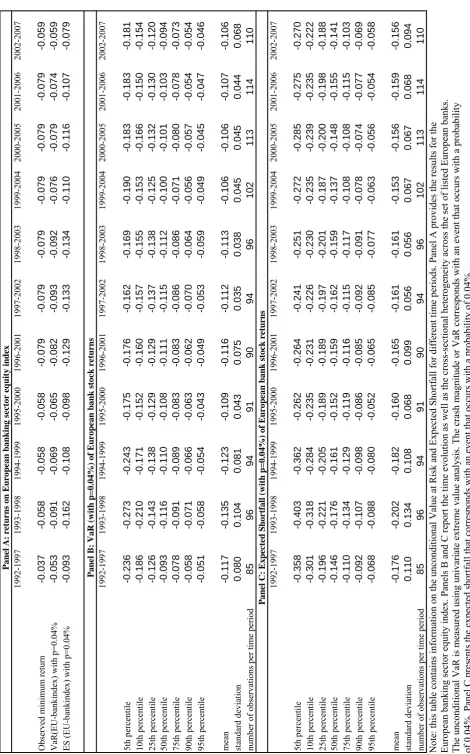
<Insert Table 1 around here>
Table 1 consists of three panels. Panel A contains information on the extreme losses of the European
banking sector index for eleven (overlapping) time periods of six years. The rst block of six years covers the
period 1992-1997, the last period runs from 2002 to 2007. The rst row reports the observed maximum daily
loss in each six-year time period. The second line contains information on the estimated daily loss that happens
with a probability of0:04%. The estimated daily return uctuates in the range of 5:3%and 9:3%. It is
lowest (in absolute value) in the rst period. From the second period onwards, the turbulent year 1998 enters
the moving window. The magnitude of the estimated daily crashes (as well as the observed minimum) increases
extreme losses. As a consequence the expected daily loss associated with an event that happens once every
10 years decreased from 9:1%to 6:5%. However, the (minimal) severity of a crash, which is expect to
occur once every ten years, increases again from 2001 onwards to reach 9:3%in 1997-2002. The periods
1997-2002 and 1998-2003 are the periods with the largest extreme banking sector risk in the sample. In the
last time period (2002-2007), we notice a drop in the observed minimum return as well as the estimated VaR of
the European banking index. Notwithstanding that the turbulent period of 2007 enters the subperiod, the effect
of dropping the returns in the year 2001 (compared to the previous period subsample) dominates. Note that in
all but two periods, the estimated daily crash is worse than the observed minimal daily return. This is due to
looking at events that are less frequent than the moving window of six years.
Panel B contains information on the time evolution as well as the cross-sectional dispersion in the daily
losses of European bank stock returns that happen with a probability of0:04%. The rows in panel B provide
information on the variation in the Value-at-Risk across banks at each time span we consider. We report several
percentiles as well as the mean and the standard deviation. The last row contains the number of banks we
observe in that particular period of 6 years. Again, we report the results in eleven columns, one for each
moving time frame of six years over the period 1992-2007. The median crash magnitude of the bank stocks
exhibits a similar time pattern as the VaR of the European banking sector index. A rst peak is reached over
the period 1993-1998. In this period, the daily loss in market value associated with a0:04%probability event
exceeded11:6%for half of the banks in the sample. In ve of the eleven periods under consideration, the
median daily VaR was also lower or equal to 11%. The mean VaR is almost always larger (in absolute value)
than the median VaR and the gap between the two is larger in the initial sample years. Similar information can
be extracted from the standard deviation. The standard deviation is indicative for the cross-sectional dispersion.
The standard deviation has decreased from values around0:08to less than0:04(though increasing again in the
last period, 2002-2007). This is caused both by a decrease in the crash magnitude of the riskiest banks and an
increase in the riskiness of the (unconditionally) safest banks.
Panel C of Table 1 is constructed in a similar fashion as panel B and presents the expected shortfall. The
expected shortfall is the average amount that is lost in a one-day period, assuming that the loss is lower than
the0:04thpercentile of the return distribution. The median expected shortfall uctuates around daily losses of
The comparison of the estimated VaR (and the expected shortfall) of the European banking sector index
(reported in panel A) and the mean (or median) crash level (expected shortfall) of the bank stock returns shows
that most bank stocks have a higher downside risk potential than the banking index. This need not be surprising
since we are comparing losses on a single asset with losses on a broad portfolio. The mean daily crash level
is often50%higher than the VaR of the European banking sector index. When looking at the percentiles over
the different time periods, we observe that, in almost all time periods,75%of the banks may fear a larger drop
(expected shortfall) in its stock price than the equally unlikely crash (expected shortfall) in the banking sector
portfolio. In the remainder of the paper, we investigate the properties and drivers of tail betas between bank
stock returns and EU banking sector returns. In general, we will be interested in events that are as severe as the
value-at-risk and expected shortfall gures reported in Table 1.
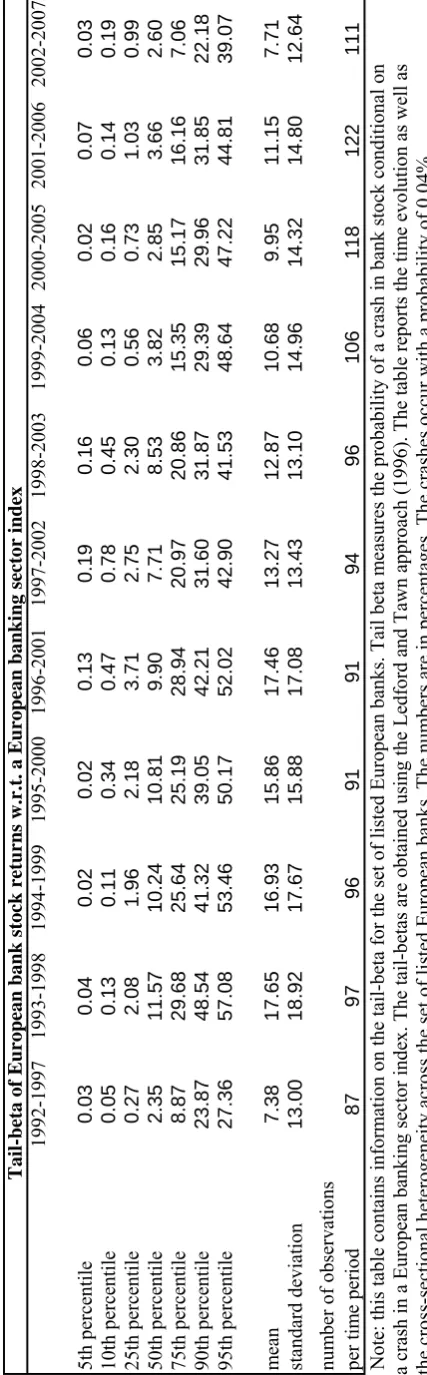
<Insert Table 2 around here>
Table 2 contains information on the estimated tail- . The table is structured in a similar fashion as panel
B of Table 1. The different columns report values for various moving windows of six years. The rst column
covers the period 1992-1997. In subsequent columns, we always drop the rst year of the sample and add
another year at the end. The last subsample we consider is 2002-2007. The different lines in Table 2 provide
an indication of the cross-sectional dispersion in the extreme systemic bank risk of the listed European banks.
For each subsample, we report various percentiles, the mean and the standard deviation. The reported values
are percentages. Hence, the mean of the European banks' tail- in the rst period indicates that there is a7:4%
probability that a European bank's stock price will crash, given that the banking market7 as a whole crashes.
To put it differently, given that there is a large downturn in the EU banking index, on average one out of13
banks will experience an equally unlikely extreme stock price decline on that day. Recall that the level of the
crashes does not need to be the same for the bank stock return and the conditioning asset (the European banking
sector index). We rather look at crashes that have a similar probability of occurrence (set at0:04%). In order to
get some intuition on this number, it is interesting to relate this conditional probability to the results reported
in Table 1. Given that there is a market correction in the European banking index of5:3%, there is a7:4%
probability that the European banks will be confronted with an average fall in their share price of11:7%.
The rst and last column reveal that systemic bank risk is quite similar in both subsamples. Both the mean
and the standard deviation of the tail- s are roughly the same in the periods 1992-1997 and 2002-2007, with
mean tail- s around7:4%. Nevertheless, in the intermediate periods, the dispersion and the level uctuate.
The mean tail- more than doubles in the second subperiod. In four of the 11 subperiods, the tail beta exceeds
15%. Moreover, Table 1 shows that in these four periods, the unconditional VaR was also higher. Hence, not
only is the tail beta higher, the magnitude of the crash would be more severe as well. In the other periods, the
mean value of banks' extreme systemic risk approximates10%or more. In each subsample, there is a lot of
cross-sectional heterogeneity. The inter-quartile range (the difference between the 25th and 75th percentile)
uctuates over time but is often larger than15%. In some subperiods, the range is even 20%. Furthermore,
the mean tail beta exceeds the median at each point in time. This indicates that the distribution of the tail
betas is skewed. It seems that many banks have low probabilities and are thus only moderately vulnerable to
aggregated banking shocks. In fact, in each period, some banks have a tail- (with respect to a broad European
banking index) below0:04%, which is the unconditional crash probability. This means that these bank stocks
crash independently. Finally, Hartmann et al. (2006) report a mean tail- of19:4%for the 25 largest Euro-area
banks. This is substantially higher than the mean tail- we obtain in each subperiod. This is already a rst
indication that larger banks will have higher tail betas.
5 The bank-speci c determinants of banking system stability
Table 2 reveals that the tail- s can be quite different across banks and over time. This observation is of interest
to bank supervisors who care about overall banking sector stability. However, next to knowing the evolution
as well as the dispersion, it is even more interesting to get insight into the potential drivers of banking system
stability. The drivers of cross-sectional heterogeneity in tail betas are analyzed by relating them to bank-speci c
variables. We have to take into account that the dependent variable is a probability. In such a case, the model
E(T AIL jX) = X does not provide the best description ofE(T AIL jX). Since the observations are
constrained within the unit interval,[0;1], the effect ofX onT AIL cannot be constant over the range of
X. Moreover, the predicted values from an OLS regression can never be guaranteed to be bound in the unit
interval. In order to obtain that the tted values after a comparative static analysis also result in probabilities,
2003),
E[T AIL jX ] =g(X ) (7)
whereg(:)is a link function such thatg(X )is constrained within the unit interval. A natural candidate
for the link function is the logistic transformation, g(X ) = 1+exp(exp(XX)), also labelled the log odds ratio8. The independent variables, X, are averages over a six-year interval to match the time interval over which
the dependent variable is estimated. We apply robust regression techniques9 to control for outliers in the
dataset. Moreover, in each regression, we include time dummies as well as country xed effects to control for
unobserved heterogeneity10in a given period or at the country level. Furthermore, the pooling of cross-sectional
and time-series data implies that multiple observations on a given bank are not independent. Therefore, a robust
estimation method that controls for groupwise heteroscedasticity is used. We cluster the standard errors at the
country level11. Finally, for many banks, we obtain observations for several, but not all, subperiods, which
8Next to the logistic transformation, we also consider other appropriate transformations such as the probit and the (complementary)
log-log link functions. The results are largely unaffected. All speci cations yield a similar t and statistical tests cannot discriminate
in favour of a speci c link function. We follow common practice and opt for the logistic link function. This link function is used most
frequently when explaining fractional response variables.
9Robust regression is a form of iterated weighted least squares regression. Two types of weights are used: Huber (1981) weighting and
biweighting. The two different kinds of weight are used because Huber weights can have dif culties with severe outliers, and biweights
can have dif culties converging or may yield multiple solutions (Berk, 1990 and Stata 10, 2007). Using the Huber weights rst helps to
minimize problems with the biweights.
10We could also interact the time and country dummy to absorb the entire impact of variables that equally affect all banks in a country
in a given period (such as: the macro-economic environment, the regulatory framework, the corporate default rate). However, some of
these variables (especially regarding the regulatory framework) are not available over the period 1992-2007. Neglecting them may create
an omitted variable bias. Interacting both dummy variables does not affect the coef cients of interest (or their signi cance).
We did not include bank-speci c xed effects, which correspond to de-meaning the variables at the bank level. However, low variability
in the de-meaned values of the independent variables makes it more dif cult (if not impossible) to estimate the coef cients and establish
signi cant relationships. If the variance is low, these regressions may contain very little information about the parameters of interest, even
if the cross-sectional variation is large (Arellano, 2003).
11The panel data at hand have three dimensions. This may result in residuals that are correlated across observations, which will cause
OLS standard errors to be biased. Following Petersen (2009), we experiment with various cluster options: (i) unclustered, White standard
errors; clustered standard errors at (ii) bank (iii) time or (iv) country level; clustering in two dimensions respectively (v) the bank and time
dimension (vi) and the country and time level.
result in an unbalanced panel.
We are primarily interested in knowing how different nancial activities affect banking system stability.
Since the Second Banking Directive of 1989, banks are allowed to operate broad charters by diversifying
functionally. Diversi ed banks provide a broad array of nancial services, from granting loans, underwriting
and distributing securities and insurance policies, to managing mutual funds and so on. Unfortunately, detailed
data on banks' exposure to each of the aforementioned activities is in general not available. Therefore a
pragmatic de nition of functional diversi cation is used. More speci cally, we will focus our analysis on
the differential impact that different revenue sources may have on banks' tail betas. Total operating income is
divided into four revenue classes. They are: net interest income, net commission and fee income, net trading
income, and net other operating income. These sources of interest income capture all income from
non-traditional intermediation. Moreover, this publicly available information is used by analysts and investors to
assess the long-term performance potential and risk pro le of a bank. We distinguish banks based on their
observed revenue mix. Each type of revenue is expressed as a share of total operating income. As a result,
the shares of net interest income, net commission and fee income, net trading income and net other operating
income sum to one. Therefore, the share of net interest income is left out of the regression equation.
The baseline regression is speci ed as follows:
X = c+ 1N et Commission Income+ 2N et T rading Income
+ 3N et Other Operating Income+ 4HHIREV + 5HHIN ON
+ dlnREV +Xe
(8)
Hence, a signi cant coef cient on any of the other revenue shares ( 1; 2; 3) means that these activities
contribute differently to banks' tail beta than do interest-generating activities. Following Mercieca et al. (2007)
and Stiroh (2004b), we also account for diversi cation between the major activities interest income and non-or almost equal to the standard errnon-ors obtained when clustered at the bank level. The impnon-ortance of the time effect (after including time
dummies) is small in this data set. Standard errors clustered at the time dimension are not higher than unclustered ones. Moreover, when
we cluster the errors in two dimensions (bank-time or country-time), they are almost identical to the standard errors clustered only by the
corresponding cross-section level (bank or country). An alternative way to estimate the regression coef cients and standard errors when
the residuals are not independent is the Fama-MacBeth approach (Fama and MacBeth, 1973). The adjusted Fama-MacBeth standard errors
are higher than the unadjusted. However, in general, they do not exceed the standard errors obtained when we cluster at the country level.
interest income (HHIREV), as well as within non-interest activities (HHIN ON). HHIREV andHHIN ON
are Her ndahl Hirschmann indices of concentration, where higher values of the index corresponds with more
specialization in one of the constituent parts. Next to the speci c source of revenue and the distribution of
the revenue streams, we also examine the impact of the correlation between the various revenue streams and
systemic banking risk. In a similar spirit as Stiroh (2004a), we compute bank-speci c correlations between
the growth rates of each pair of the revenue streams, represented by the vector dlnREV in Eq.(8). Hence, we
include six correlation measures that capture whether a given bank's shocks to one type of income are typically
accompanied by similar shocks to another type of income.
Besides investigating the impact of revenue diversity, we also include a number of other bank-speci c
char-acteristics,Xe, that are similar in spirit to the constituent parts of the CAMELS rating used by US supervisory
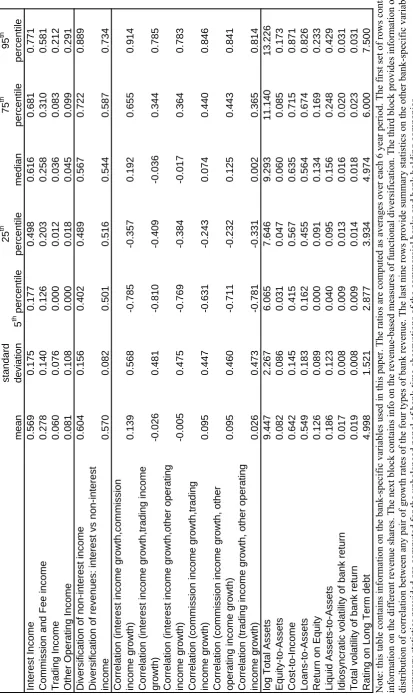
authorities. Summary statistics on the accounting variables are reported in Table 3. These variables capture
strategic choices made by bank managers that may affect a bank's risk pro le.
<Insert Table 3 around here>
The equity capital ratio and the liquid assets-to-total assets ratio are included to incorporate the possibility
that better capitalized and more liquid institutions may be less vulnerable to market-wide events. We also
take into account differences in bank ef ciency by including the cost-to-income ratio. This ratio measures the
overheads or costs of running the bank, the major element of which is normally salaries, as a percentage of
income generated before provisions. Finally, bank size and bank pro tability are also included. We include
(the log of) bank size to allow for the possibility that larger banks may be more exposed to market-wide
events. Bank pro tability is included to control for a risk-return trade-off. Both measures are, to a large extent,
outcomes of strategy choices made by banks and are hence highly correlated with the other control variables,
and, more importantly, with the measures of functional diversi cation. Therefore, we orthogonalize them with
respect to all other variables to derive the pure effects of size and pro ts12. As a result, the coef cients on the
other variables capture the full effect on banks' tail- . We also include two dummy variables in the baseline
12The pro tability measure is regressed on all independent variables, except size. The residuals of this regression are used as a measure
of excess pro ts above what is driven by banks' operational choices and are by de nition orthogonal to these bank-speci c variables. The
natural logarithm of total assets is regressed on all independent variables including return on equity. The idea is to decompose bank size in
regression, one for bank holding companies and one for large and complex banking groups13(LCBGs). LCBGs
are banking groups whose size and nature of business is such that their failure and inability to operate would
most likely have adverse implications for nancial intermediation, the smooth functioning of nancial markets,
or other nancial institutions.
The next subsection presents the estimation results of the general speci cation. In the subsequent
subsec-tion, we explore how the information content of tail-betas differs from that of central dependence measures.
In the last subsection, we verify the appropriateness of the baseline equation from a methodological and an
economic point of view.
5.1 Baseline regression results
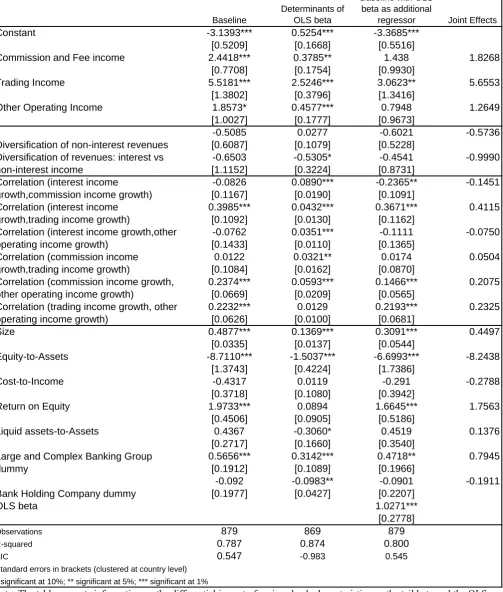
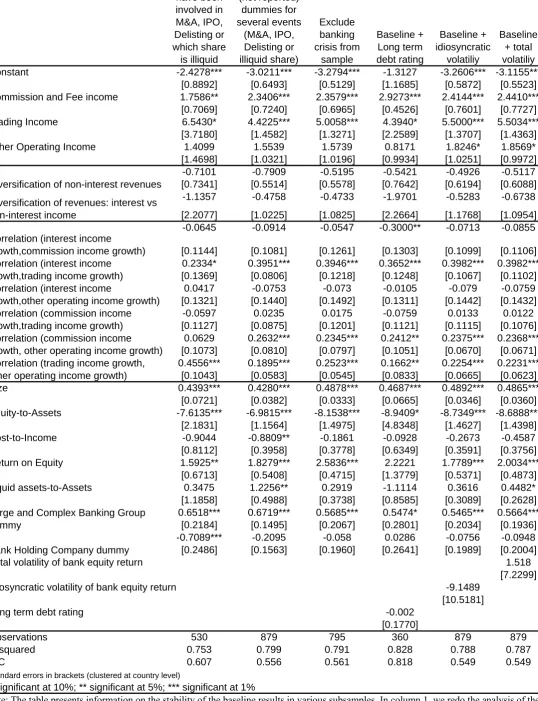
The results14 shown in column 1 of Table 4 re ect the relationships between various bank-speci c variables
and banks' tail beta measure. The tail beta measures the probability of observing a correction in a bank's
equity return conditional on observing a large drop in the European Union banking sector index. From Table
4, it can be seen that interest income is less risky than all other revenue streams. This can be inferred from
the observation that the coef cients of all other revenue shares are positive. This means that the alternative
revenue streams have a bigger impact on banks' extreme risk measures than those originating from traditional
intermediation activities. Put differently, the tail beta of a diversi ed bank is higher than the tail beta of a bank
specialized in interest-generating activities. The coef cient on the share of trading income is the largest of
the non-traditional revenue sources and its impact differs signi cantly from the other shares. The estimation
results reveal that other indicators of bank specialization in traditional intermediation corroborate the nding
that traditional banking activities result in lower systemic risk. Hence, we can conclude that banks that focus
13More information on how to obtain the set of LCBGs can be found in a special feature article of the ECB Financial Stability Review
of December 2006. Based on a multiple indicator approach, i.e. cluster analysis, 33 banking groups are identi ed as LCBGs. 24 of these
are located in the EU15, but not all of them are listed.
14The baseline results are obtained for a restricted sample of commercial banks and bank holding companies. We impose two restrictions
on the sample used in the baseline. First, we eliminated non-diversi ed/specialized banks from the sample. That is, we only include banks
with an interest income share between10%and90%. Furthermore, we also eliminate fast-growing banks. For these banks, the correlation
between each pair of growth rates of the different revenue types may be biased and overstate the true degree of revenue correlation. In the
on lending activities are less exposed to systemic banking risk than diversi ed banks15.
<Insert Table 4 around here>
The diversi cation measures do not enter the equation signi cantly. Apparently, having a more
equally-balanced portfolio of revenue streams (either between interest and non-interest income or within non-interest
income revenue) seems not to reduce or increase a bank's tail beta. On the other hand, the extent to which
the growth rates of the various revenue streams are correlated does play an important role. The signi cant
coef cients are positive, as portfolio theory predicts. Imperfectly correlated revenue streams should reduce
bank risk. A low correlation between shocks to interest income and trading income reduces banks'
tail-signi cantly. Furthermore, a low correlation between shocks of any of the non-interest income types also
contributes positively to overall banking system stability. These results imply that even though banks may have
equal revenue shares, their risk pro le may be substantially different depending on the correlation16 between
the revenue types.
The other bank-speci c variables also reveal interesting relationships. Size is by far the most signi cant
driver of banks' tail betas. Recall that the conditioning event is a crash in the European banking index,
ex-cluding the bank for which we compute the tail beta to avoid spurious results. Larger banks are inherently
more exposed to many sectors in many countries and are hence more tied to European-wide shocks. Large
drops in small banks' stock price are more likely to be idiosyncratic events or are more tied to local factors
since small banks are predominantly active in their home country. In addition to the size effect, the dummy
for Large and Complex Banking Groups is also associated with higher tail betas. In recent years, mergers,
acquisitions and organic growth have meant that some of the largest and most complex nancial groups have
come to transcend national boundaries and traditionally de ned businesslines. As a result, they have become
a potential channel for the cross-border and cross-market transmission of nancial shocks (Hawkesby, Marsh
15This conclusion is con rmed when including measures of market power and specialization in traditional banking markets in the
regression. Banks with a higher interest margin or a higher loans-to-asset ratio are perceived to contribute less to banking system instability
since higher values of these ratios reduce banks' tail betas. However, these variables are strongly correlated with the revenue shares, which
affect both the magnitude and the precision of the estimated coef cients. Therefore we do not include them in the baseline speci cation. 16The correlations might be considered as generated regressors. Consequently, it is important to check whether the other coef cients
and their standard errors are affected by including them. We also do the entire analysis without the correlation measures and observe that
and Stevens, 2007). Apparently, the banks at the heart of the nancial system, which need to be monitored
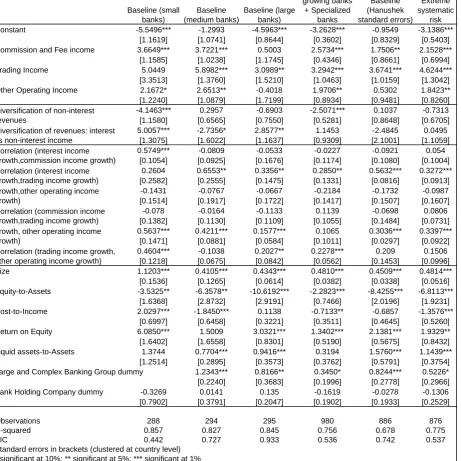
closely, contribute negatively to banking system stability. To check that the main results of the paper are not
just a result of comparing small and large banks, we report in the robustness section results for various equally
large subsamples (based on bank size). The capital-to-asset ratio exhibits the expected sign and is signi cant.
A larger capital buffer increases a bank's contribution to banking system stability. Ef ciency and liquidity do
not enter the equation signi cantly. Banks that generate high pro ts ('in excess of their fundamentals') are
much riskier. This mirrors the common risk-return trade-off. The causality in this relationship may, however,
run in the other direction. Banks may gamble and increase their exposure to risky activities that may yield
higher pro ts. A similar critique may hold for other relationships as well.
Next to return on equity, the equity-to-asset ratio may also suffer from reverse causality if banks' capital
buffers are eroded from unexpected losses due to the more riskier income activity. Some of the relationships
may be plagued by endogeneity. That is, the relationships could occur if riskier banks engage in non-traditional
banking activities, rather than the reverse. Finally, given that the risk measure is based on stock market values,
there might be a spurious relationship between trading income and tail betas. These possibilities can be checked
by looking at the initial values of the ratio at the beginning of that six-year period rather than the average values
over the six years. In Column 3 of Table 4, all accounting variables are measured as initial values. Some
in-teresting conclusions can be drawn from this analysis. First, trading income is still signi cant, which indicates
that trading income causally affects bank risk. The other alternative revenue shares also remain signi cant.
Second, return on equity has a lower impact. This indicates that part of the risk-return relationship is due to
the higher pro ts that risky activities generate. The bank's average pro ts over that period will be higher if
a bank takes on more risk (as measured over a six year period). Nevertheless, the initial pro tability level is
also signi cantly and positively related to a bank's tail beta. Finally, a bank's initial capital ratio signi cantly
reduces its exposure to systemic banking risk. The tail betas of banks that are nancially strong banks at the
beginning of the period are less affected by a crash in the EU banking sector index. In the last subsection, we
document that these results are robust to potential reverse causality or endogeneity created by events such as
mergers and acquisitions, delistings, or systemic crises.
Until now, we focussed the description of the results on the interpretation of the sign and the signi cance.
To assess the magnitude of the coef cients and their economic impact we have to rely on tted marginal
ef-fects. Both the (logistic) link function and the level of the variables affect the estimated effect of a change in
one variable on the tail- . That is:
@E[T AIL jX ]
@Xi
= @g(X )
@Xi
= bi exp(Xb) 1 + exp(Xb)
2 (9)
In column 2 of Table 4, we report the marginal effects of each variable when the expression in Equation
(9) is evaluated at the sample means. The marginal effects of the three non-interest revenue shares vary in the
range of0:13to0:38. The effect is largest if a bank reallocates revenues from Interest activities to Trading
Income activities. To get more insight in this number, consider the following event. Over the sample period,
the average share of net interest income in total income decreased by more than12%. All else equal, this shift
of12%of total revenues from the interest activities to non-traditional banking activities yields an increase in
the average bank's tail- in the range of1:5 4:6basis points. If an expansion into non-traditional banking
is accompanied by a reduction in a bank's outstanding loans and interest margin, this may further increase the
tail- . Depending on the time period, an increase with3:0basis points corresponds to30%of the median
tail-in 1994-1999 and almost100%in 1999-2004.
A bank that keeps its revenue shares unchanged, but would be faced with less correlated interest income
and trading income, will observe a drop in its tail- . If this correlation drops from the sample mean (0:178) to
that of the5thpercentile ( :767), the tail beta will be almost2:6basis points lower. Hence, both the type of
income and their correlation play an important role in increasing banking system stability.
Controlling for non-traditional banking activities, we discover that a larger capital buffer in nancial
institu-tions will exert a mitigating effect on systemic risk. An increase of the equity-to-assets ratio of0:05will result,
all else equal, in a drop in the tail beta of3basis points. Bank size is by far the most important contributor to
heterogeneity in tail risk. Consider two banks that only differ in size, one bank has the average size while the
value of the total assets of the other bank is xed at the75thpercentile. The difference in tail- exceeds0:05. The larger bank will have, all else equal, a5%higher probability of a large drop in its stock return if there is
the average tail- . Depending on the time period, an increase with ve basis points corresponds to30%of the
average tail- in 1994-1999 and50%of the average tail- in 1999-2004. In addition, LCBGs have a tail beta
that is, all else equal,4:6basis points higher.
The marginal effects are not constant; they depend on the values at whichXis evaluated. Hence, although
the argument within the link function is a parsimonious linear model, we are able to capture both non-linear
relationships and interaction effects. On the one hand we can compute the marginal effect of a change in the
variableXifor different values ofXiwhile xing the values of the other variables (at e.g. their sample mean).
We learn that the implied effects differ substantially when they are assessed at other values than the mean.
The marginal effect of a change in one of the revenue shares increases monotonously with the value of that
variable. But the slope differs across the revenue shares. The impact of other operating income only increases
moderately, largely due to the smaller range over which this revenue share is observed. The marginal effect of
an increase in the trading income share on banks' tail beta is0:38at the sample mean (which is6%of total
income). The impact is around0:30, if an otherwise equal bank only derives a small proportion (1%) of its
income from trading activities. On the other hand, a bank with an even greater reliance on trading income,16%
of total operating income, will have a marginal effect of0:60, which is two times larger than the bank in the
latter case.
On the other hand, we are also able to assess the impact of a change inXi for banks that only differ
with respect to another variableXj. Consider again the benchmark values of the average bank (as reported in
column 2 of Table 4). At the mean trading income share, the marginal effect is0:38. Since a larger capital buffer
reduces banks' tail beta, the impact will be larger for less capitalized banks. The differential impact between
the low and high capital ratio banks is0:09at the sample mean of trading income. This impact gap widens
for banks that are more heavily involved in trading income generating activities and is for instance0:13when
the trading income share is16%. Put differently, in order to experience similar marginal effects of an increase
in trading income, a better capitalized bank may already be more involved in this riskier revenue source. This
con rms the presence of an interaction effect between the degree of capitalization and a bank's involvement in
non-interest generating activities. Consequently, one could argue that regulatory capital requirements should
be related to banks' reliance on trading income. Similarly, bank size is an important contributor in explaining