Rochester Institute of Technology
RIT Scholar Works
Theses Thesis/Dissertation Collections
2007
Securing tuple space: secure ad hoc group
communication using PKI
Kyle Morse
Follow this and additional works at:http://scholarworks.rit.edu/theses
This Master's Project is brought to you for free and open access by the Thesis/Dissertation Collections at RIT Scholar Works. It has been accepted for inclusion in Theses by an authorized administrator of RIT Scholar Works. For more information, please [email protected].
Recommended Citation
M.S. Project Report
Securing Tuple Space:
Secure Ad Hoc Group Communication Using PKI
Kyle R. Morse
Rochester Institute of Technology
Department of Computer Science
Committee:
Chair: Professor Alan Kaminsky
Reader: Professor Hans-Peter Bischof
Table of Contents
Overview
……… 4
Related Work
……… 5
Secure TupleBoard API: Design & Implementaion
Generating Randomness………... 6
Public Key Algorithms………. 7
Public Key Infrastructure………. 12
Public Key Encryption in TB………... 14
Digital Signatures in TB………... 16
MusicGroup Application: Design & Implementation
Song Metadata………. 18
Roles & Authorization………. 19
Application Protocols……….. 21
Application Architecture……….. 25
Performance Evaluation
Raw Transfer Time……….. 34
Signature Verification Time………. 35
Encrypted Transfer Time………. 36
Authenticated & Encrypted Transfer Time……….. 37
Summary………. 38
User’s Manual
Create a Certificate Authority………... 40
Generate a Certificate……….. 41
Generate a Music Collection……… 42
Generate a Music Authorization Certificate………. 43
Join a Music Group (Command Line Client)………45
Join a Music Group (Graphical Client)……… 51
Developer’s Guide
Working with Random Numbers………. 58
Working with Digital Signatures………... 60
Working with Certificates……… 61
Working with Secure TupleBoard……… 62
Deliverables
……… 65
Future Work
………... 66
Overview
Secure group communication in an ad hoc network is a largely unexplored research area. While there exist group key exchange protocols, a recent M.S. project [8] showed that various forms of the Group Diffie-Hellman protocol become computationally infeasible quickly as group sizes increase. Moreover, currently available protocols were not designed to be implemented in an ad hoc network where nodes sporadically enter and leave the group. This project explores establishing secure group communication in an ad hoc network through public key infrastructure.
Public key infrastructure (PKI) provides a framework for establishing and authenticating secure communication between devices. A trusted certificate authority (CA) generates an identifying token, or certificate, for an authorized device. The certificate contains the device’s public key and other identifying information and is digitally signed by the CA to prevent forging. This public key may be used to initiate secure communication with a device. In addition, any devices not possessing a valid certificate will be denied from communicating with the rest of the ad hoc group. PKI is often used in traditional
client/server architectures – a browser establishing an SSL session with a secure web server for example. This project migrates the concepts of PKI to the ad hoc arena.
This project uses the tuple space distributed computing paradigm for all ad hoc group communication. A tuple space is a store of tuples, or lists of objects, from which consumers may read tuples matching filter criteria and to which producers may post new tuples [4]. An easily made physical analogy to this concept is that of an announcement board, where people may read flyers and post new ones. While several implementations of tuple spaces in Java exist, (IBM’s TSpaces [5], for example) they employ a client/server architecture which is incompatible with the ad hoc network setting for this project. Professor Kaminsky’s TupleBoard API [7] is an implementation of tuple space designed for developing ad hoc distributed applications in Java. This middleware library is the basis for all work done during this project.
Related Work
In order to establish secure group communication the exchange of encryption keys is required. In the simplest group, consisting of only two users the standard Diffie-Hellman key exchange may be used. In this protocol Alice chooses values a, g and p and sends g, p
and ga mod p to Bob. Bob chooses value b and sends gb mod p back to Alice. Both parties
may now compute the shared key as gab mod p.
The original protocol has some shortcomings. It is vulnerable to man-in-the-middle attacks if authentication is not performed on the exchanges. In addition, it does not scale well when expanded from the simple one-to-one case described above to the many-to-many case found in the group setting. In [8] Kim explores the use of and improves two Group
Diffie-Hellman schemes – Authenticated Group Diffie-Diffie-Hellman (A-GDH) and Strong
Authenticated Group Diffie-Hellman (SA-GDH). Through timing measurements Kim concludes that for small groups these protocols may suffice, but any system designed to support groups larger than 20 – 30 nodes will not be able to use them due to the rapid growth of key exchange time as nodes are added.
In addition to the initial key exchange keys should also be refreshed periodically. If forward and backward secrecy is of concern a refresh must also be performed each time the group membership changes. The sporadic nature of ad hoc group activity creates an environment in which keys must be refreshed quite often. It is therefore even more important that exchanges be performed as quickly as possible.
There also exist tree-based key management schemes which build on the concepts presented but also attempt to minimize the cost of key exchanges and refreshes by aggregating all refreshes in a specific time window into one or limiting the scope of the refresh to subgroups [9]. Examples of these protocols include Tree-based Group Diffie-Hellman (TGDH), Block-Free Tree-based Group Diffie-Hellman (BF-TGDH) and Distributed Scalable Secure Communication (DISEC).
In a PKI based system such as the one developed for this project group symmetric key exchange is trivial. Since the group private key is contained in each user certificate group symmetric keys may be posted encrypted with the group public key. In addition the
Secure TupleBoard API: Design &
Implementation
When this project was started the TupleBoard API included only limited security. Package
edu.rit.crypto.hash provides support for two hashing algorithms, 256 and Double SHA-256, as well as an abstract OneWayHash base class for extensibility. Symmetric key
encryption is supported by package edu.rit.crypto.helix which contains an implementation of the Helix stream cipher[3]. Tuples could be securely transferred over the network through the FixedHelixSecurityContext found in package edu.rit.tb.security which is backed by this cipher, however the symmetric key had to be agreed upon offline prior to the transfer.
The remainder of this section describes the security additions made to the library, namely secure pseudorandom number generation, public key cryptography and digital signatures.
Generating Randomness
A vital part of any cryptographic library is the ability to generate random data. Here, the term ‘random’ is used as a generalization. Truly random data is often hard to obtain and harder to evaluate its quality. Luckily it is easy to obtain pseudorandom data - seemingly random sequences of bytes deterministically generated from an initial seed. Java provides a pseudorandom number generator (PRNG) class java.util.random but this is not sufficient for use in cryptographic protocols.
An obvious application of a PRNG is creation of encryption keys. However a standard PRNG is often predictable, and if broken compromises the integrity of all keys it generates. To combat this problem we need a cryptographically strong PRNG, one that eliminates the predictability factor. While Java also provides a cryptographically strong PRNG in class
java.security.SecureRandom, Professor Kaminsky asked me to create my own implementation for the TupleBoard API.
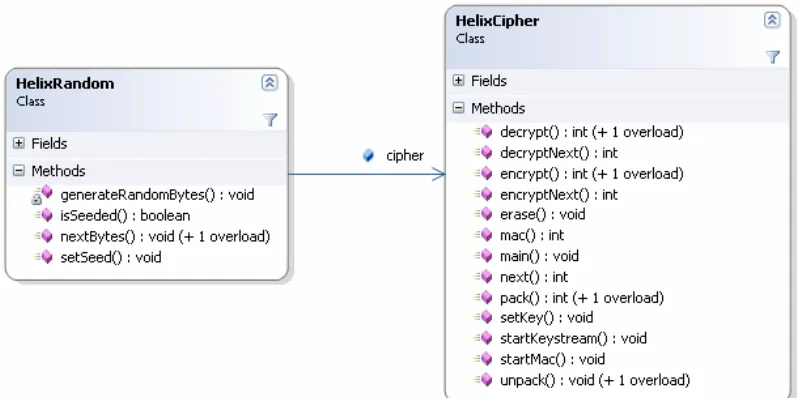
Luckily it is fairly straightforward to create a PRNG from a stream cipher such as Helix. Stream ciphers generally encrypt a plaintext by XORing it with a randomly generated key stream initialized with the encryption key. Here the key is analogous to the seed of a PRNG and the key stream represents the sequence of randomly generated bits. Class
Fig. 1 – A cryptographically strong PRNG based on the Helix stream cipher
The concept for this algorithm was derived by modifying an algorithm found in Practical Cryptography [2] for creating a PRNG using a block cipher such as AES. When the PRNG is seeded it initializes a new instance of Helix using the specified seed. Random data is then retrieved through the nextBytes() method which simply encrypts the value 0 to obtain the XOR of the random key stream. The class is used throughout the TupleBoard library and is mentioned multiple times in this section. Guidelines for its use may be found in the
Developer’s Guide, found later in this document.
Public Key Algorithms
In order to have a public key infrastructure it is first necessary to have public key algorithms to back it. The primary difference of public key encryption algorithms from their symmetric key counterparts such as Helix is that the encryption and decryption keys are different. Also, the security of these algorithms is based on intractable computational problems such as factoring large numbers or solving discrete logarithms. Encrypting and decrypting data using a public key algorithm is much more computationally expensive than the same
operations in a symmetric key system. Because of this the use of public key cryptography is generally limited in practical applications to situations where the amount of data to be encrypted is small. In the TupleBoard library it used for exchanging symmetric keys and digital signatures.
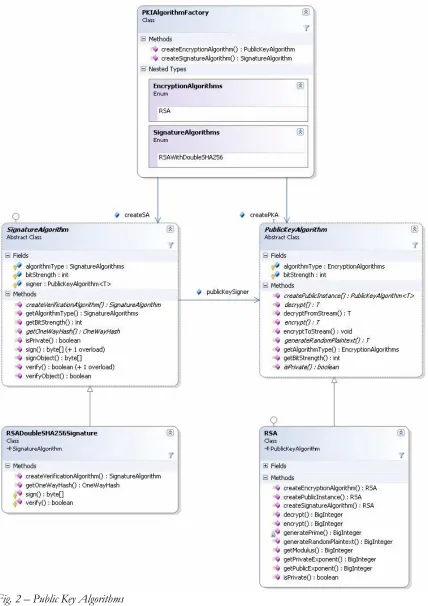
I created a factory class, PKIAlgorithmFactory to specify the available algorithms and simplify the creation of instances of the algorithms in the edu.rit.crypto.pki package. In addition I created abstract base classes for both public key encryption algorithms and digital signature algorithms. Class PublicKeyAlgorithm defines data members common to any algorithm such as the bit strength and provides an interface compatible with the new PublicKeySecurityContext
defined later in this document. This allows any extending algorithm classes to be simply plugged in and used to securely post tuples to the tuple board. Similarly, class
SignatureAlgorithm provides common signature algorithm fields and behaviors and allows for an extending class to compute and verify digital signatures using any combination of
OneWayHash and PublicKeyAlgorithm.
RSA
With the interfaces defined the next step was to develop a concrete implementation of a public key encryption algorithm. RSA is probably the most well known algorithm in this category. It is also quite easy to implement in Java, thanks to the java.math.BigInteger class which already includes methods for performing modular exponentiation, primality testing and modular inverse calculation.
RSA is elegant in its simplicity. The basic parameters of the algorithm include e, the
encryption exponent, d, the decryption exponent and n, the composite modulus. Encryption and decryption are both only a modular exponentiation operation. To encrypt: c = me (mod
n). To decrypt: m = cd (mod n), although this operation can be sped up using additional private parameters and Chinese remaindering.
The first step in implementing the algorithm is to generate the composite modulus, n. The algorithm I implemented for doing so is taken from Practical Cryptography[2]. The modulus is defined to be the product of two large primes, so the first step is to generate two large prime numbers, p and q. Each prime should be approximately b/2 bits in length, where b is the desired length in bits of the binary representation of n.
The private method generatePrime() handles generation of these primes. First, an instance of the HelixRandom PRNG generates b/8 random bytes which are then interpreted as a positive
BigInteger. The resulting number is then verified to not be congruent to 1 modulo e and is tested for primality using the BigInteger’s isProbablePrime() method. If both of these conditions are true the number is returned, otherwise the method loops until a suitable number has been found.
Once both p and q have been generated the instance of RSA may be created. Public
exponents are static in my implementation. Instances of RSA destined for use as encryption algorithms use e = 3, while those used as signature algorithms use e = 5. Public instances are initialized with only the public parameters: the encryption exponent e and the modulus
n = pq. This instance is capable of performing encryption only.
Private instances are initialized with all the parameters: e and n as specified in the public instance as well as the two primes, p and q, the private exponent d = e-1 (mod (p-1)*(q-1)) and
decryption computation. Rather than computing m = cd (mod n), we can compute a = cd
(mod p) and b = cd (mod q) and then use Garner’s Formula, m = (((a-b)/qInvp) mod p)*q+b to
recombine the modular parts and retrieve m. Timing measurements during implementation showed this CRT based implementation to be 2 to 3 times faster than the naïve approach.
For additional information on generating instances of RSA and its use for encrypting data please see the Developer’s Guide found later in this document.
RSAWithDoubleSHA256
Once the implementation of RSA completed it was then possible to create a digital signature algorithm based upon it. Digital signatures offer two main benefits. First, they provide an authentication mechanism. If a message signature verifies correctly it confirms the identity of the sender of the message. Since only the sender would have known the private key used in signing, the signature must have been sent by the expected source. Second, they provide an integrity check on the contents of the message itself. Since the contents of the message are hashed during signing any tampering or loss of data during transmission will cause the verification to fail. If the message signature verifies correctly it confirms that the message itself is intact.
Class RSADoubleSHA256Signature represents a concrete instance of class SignatureAlgorithm. Like the name suggests the algorithm pairs an instance of RSA with an instance of
DoubleSHA256Hash.
Class SignatureAlgorithm provides two methods for computing signatures. The first, sign(), takes any OneWayHash as input and generates a signature as a byte array based on the output of the hash function. The second, signObject() is a convenience method and takes any
Serializable object. This overload simply serializes the object and writes its contents to the
OneWayHash specified by the concrete class and then calls the sign() method to finish the computation.
Similarly, there are also two methods for verifying signatures. These function in exactly the same way as the signing methods. The first, verify() takes a OneWayHash and the signature as a byte array and returns the result of the verification as a boolean. The second, verifyObject(), is a convenience method and takes any Serializable object. This overload simply serializes the object and writes its contents to the OneWayHash specified by the concrete class and then calls the first verify() method to finish the computation.
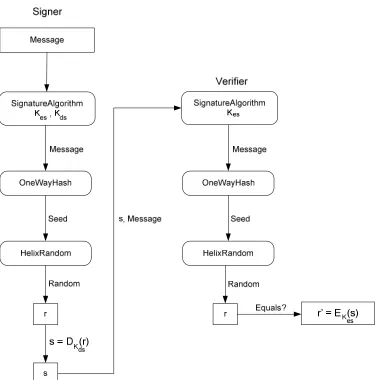
Fig. 3 – Computing & Verifying Signatures
To compute a signature first the sender hashes the message to be sent. The resulting hash is then used to seed a PRNG which is then used to generate a random plaintext element, r in the domain appropriate for the public key algorithm being used. The signature s is
computed by decrypting r with the sender’s private signing key, Kds. The message and
signature can then be sent to its intended recipient.
Once the message is received the signature is verified in much the same manner as it was originally computed. The message is hashed and used to seed a PRNG. From this the random plaintext element r is generated. Then the signature received, s, is encrypted using the signature verification key, Kes to yield r’. The signature is determined to be valid if
Public Key Infrastructure
Public key infrastructure (PKI) provides a framework for establishing and authenticating secure communication between distributed parties. It is a trust based system wherein an empowered third party may create verifiable digital identities for users or devices. This third party is more commonly known as a certificate authority and the digital identities as
certificates. Certificates are digitally signed so their content may be verified as authentic. They also bind public key information to a user or device, enabling secure communications to be initiated.
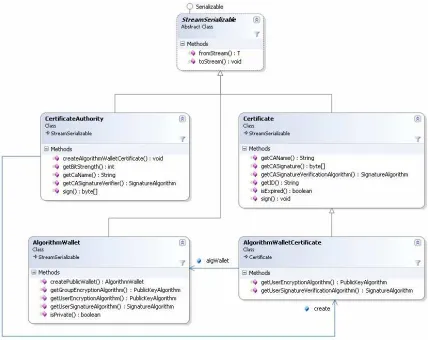
[image:13.612.93.521.308.648.2]With the algorithmic parts of the public key system complete the next step was to define the infrastructure necessary for creating, distributing and using those algorithms for secure group communication. Both the certificate and certificate authority were designed to be flexible and accommodate any type of public key encryption and signature algorithms. Below is a high level design of the certificate authority and certificates added to the TupleBoard library in package edu.rit.tb.security.cert.
The Certificate base class seen above contains the data fields and behavior common to any type of certificate based system. Each certificate contains the ID of the user or device for which it was generated and the name of the CA with generated it. Each certificate also has a start date and an end date, between which it is considered to be valid. The most important feature of the base certificate is its signature and the inclusion of a SignatureAlgorithm capable of verifying this signature. Through these the integrity of the certificate can be verified and the ID of its presenter confirmed authentic. A certificate is accepted as valid if the CA’s verification algorithm matches the well known verification algorithm for the group, its signature verifies correctly using that algorithm, and the current date is after the start date but still before the end date.
While this simple certificate may be sufficient for very basic identification purposes it does not give the possessor the ability to receive encrypted messages or send signed messages in TB. Class AlgorithmWalletCertificate extends the base Certificate class and adds fields for a public key encryption algorithm and a signature algorithm for precisely this reason.
Internally the certificate stores these algorithms in an AlgorithmWallet, which is simply a data holder class for public key algorithms. Instead of keys the wallet contains instances of the algorithms initialized with the necessary keys. The wallet may also be public or private. A private wallet contains public key algorithms capable of both encryption and decryption (and therefore capable of creating and verifying signatures). A public wallet may only encrypt data and verify signatures. In this manner the user may keep the private instance of the wallet but distribute the public instance in an AlgorithmWalletCertificate so other users may verify the user’s signatures and also send encrypted messages capable of being decrypted only by that user.
With the certificates defined there now needs to be a certificate authority to generate them. Class CertificateAuthority provides this capability. The CA is created with a name, public key encryption algorithm and a signature algorithm. The CA’s name serves as the group ID. The public key algorithm is included in all certificates created and allows group users to encrypt messages only other certificate possessing users have the capability of decrypting. The signature algorithm is used to digitally sign each certificate generated. The
createAlgorithmWalletCertificate() method performs the creation of the certificate. Invoking the method results in the creation of two files – one containing the user’s serialized private wallet and the other containing the user’s serialized public certificate.
Finally, there needs to be a method of persistent storage for the certificate authority and certificates between application sessions. Serialization is a good candidate for this requirement, especially since certificates must be serializable to be sent over the network anyway. That is why all classes above derive from the common base class
edu.rit.io.StreamSerializable. This class simply defines convenience methods fromStream() and
toStream() for serializing and deserializing these objects to and from streams.
Public Key Encryption in TB
With all the public key infrastructure pieces now in place a new SecurityContext had to be created to support transferring tuples using public key encryption. Class
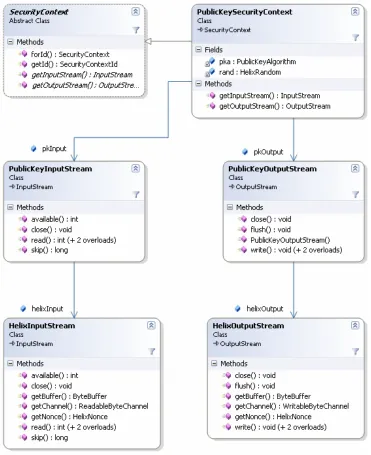
[image:15.612.93.464.225.680.2]PublicKeySecurityContext enables the transfer of a tuple encrypted such that only a user possessing the corresponding private instance of a public key algorithm may decrypt its contents. As mentioned earlier, public key encryption is not used for bulk encryption operations, but is often used to transfer an encrypted symmetric key which the data will actually be encrypted with. Below is the design for the new PublicKeySecurityContext.
A public key security context is initialized with a public key algorithm capable of encrypting data able to be decrypted only by the target user(s) and a PRNG to be used for generating a symmetric data transfer key. The getInputStream() and getOutputStream() methods simply return new instances of the PublicKeyInputStream and PublicKeyOutputStream classes pictured above. These classes handle the generation, encryption and decryption of the symmetric key and then delegate all further I/O to the HelixInputStream and HelixOutputStream classes. The implementation of these two classes is based largely on the protocol established between the two Helix streams.
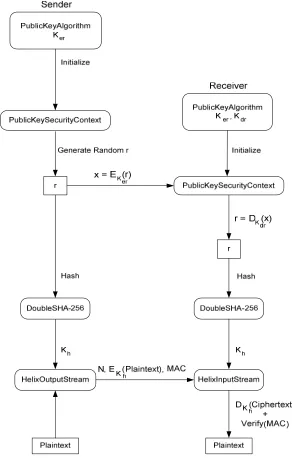
[image:16.612.97.389.238.696.2]The following diagram illustrates the steps performed when transferring a tuple posted to the tuple board using the PublicKeySecurityContext.
First, the sender initializes a new instance of PublicKeySecurityContext with the public key algorithm of the target user and posts a tuple to the board using this context. When the tuple is read by the receiver a new PublicKeyOutputStream is created on the sender side. This object generates a random plaintext element r using the generateRandomPlaintext() method of the public key algorithm. It then computes x by encrypting r with the receiver’s public key
Ker and writes this value onto the stream.
Meanwhile on the receiving side a new instance of PublicKeyInputStream is created by the receivers corresponding PublicKeySecurityContext object. The input stream reads the value x
and decrypts it using the private key Kdrto obtain r.
Now that both parties now have the value r the underlying symmetric key algorithm, Helix, may be initialized. The sender and receiver both hash the value r to obtain the symmetric key Kh
.
A new HelixOutputStream is initialized on the sending side with the symmetric key and a randomly generated nonce, N, which is transferred first. At the same time the receiving side initializes a new HelixKeyInputStream with the same key and reads the nonce value from the stream. From this point on all further I/O operations are delegated through these objects.As an added bonus the Helix algorithm also computes a message authentication code, or MAC while encrypting a plaintext. When all serialized tuple data has been transferred the
HelixOutputStream writes this code to the stream before closing it. The HelixInputStream on the other side can then read this code and compare it to its locally computed MAC to verify the authenticity and integrity of the received tuple.
Digital Signatures in TB
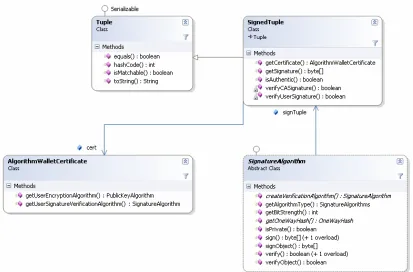
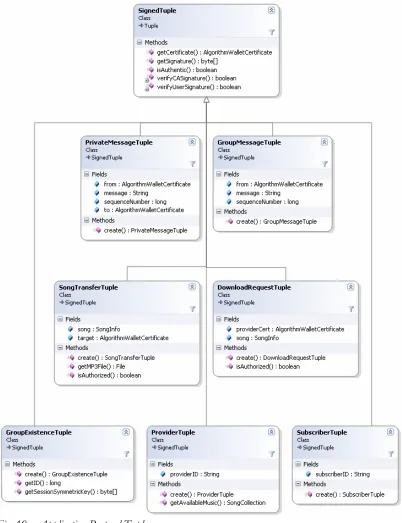
In order to support digital signatures in the TupleBoard library a new SignedTuple type was created. This class extends Tuple and so may be used in the same manner traditional tuples are used. SignedTuple adds fields for an AlgorithmWalletCertificate and a signature. The class may not be directly instantiated, as its constructor is protected. Subclasses should provide a static create() method in which the object is fully initialized and signed before being returned.
Fig. 7 – Digital Signatures in TB
When a SignedTuple is created and its signature initialized as described above it is ready to be posted to the tuple board. This is done no differently than a standard tuple. However, upon reading the signed tuple from the tuple board the receiver has the ability to verify its validity and authenticity. This operation is provided by the isAuthentic() method.
Three separate checks are performed by this method. First, the enclosed
AlgorithmWalletCertificate is checked for expiration. If this test passes the CA’s signature on that certificate is verified. If this check also succeeds then the signature on the tuple itself is verified using the signature verification algorithm found in the certificate. In this manner the authenticity of the tuple may be established.
Additional information regarding how to sign and verify tuples may be found in the
MusicGroup Application: Design &
Implementation
Once the security additions to TupleBoard API were complete the second phase of the project could begin. The goal of this phase was to create an ad hoc music distribution application utilizing the new secure tuple board. In this system role-based certificates would govern access to and permissions within music groups within the application. The system must be resistant to piracy by only permitting song downloads from authorized providers to authorized subscribers. In addition all communication must be encrypted to prevent unauthenticated users from gaining access to the secure group or any data transferred between users.
Song Metadata
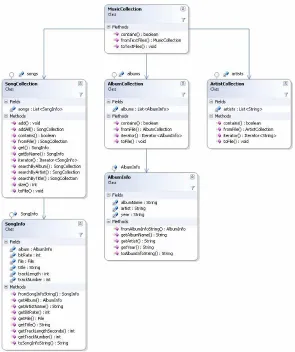
[image:19.612.92.387.339.691.2]The first step in developing the application was to define a set of metadata classes to represent music files.
The metadata classes can be divided into two categories – entity classes and collection classes. Entity classes SongInfo and AlbumInfo contain useful information about songs and albums respectively. The remaining collection classes allow for entity objects to be easily stored, iterated over and queried. All classes are able to be serialized to disk or over the network.
The SongInfo class is the real workhorse of the metadata classes. This class contains a great deal of information about an mp3 file, including physical format data like bit rate and song length as well as data about the song itself, such as the album on which it appears (via an
AlbumInfo object), the track number on that album and obviously the artist and song title. This class also has the ability to initialize its data members directly from an mp3 file by reading its ID3 tags and MPEG header data. This functionality is provided by the open source Java ID3 Tag Library[1].
The SongCollection class represents a collection of songs. This class is used widely in the application, from parsing local media libraries at startup to informing subscribers of available media from providers. Further details on how this is done appear later in this section.
The remaining collection classes were designed mainly for authorization duties. As mentioned previously song transfers in the system are only permitted between authorized users. A user is considered authorized to participate in a transfer if a MusicCollection object containing the requested song is associated with that user. MusicCollection objects are created and associated with users by a newly created music certificate authority discussed in detail a little later.
Roles and Authorizations
The application currently supports two roles, subscriber and provider. In addition to the general group activities supported such as sending and receiving public and private messages, subscribers are permitted to download songs. Providers are allowed to provide songs for download to subscribers.
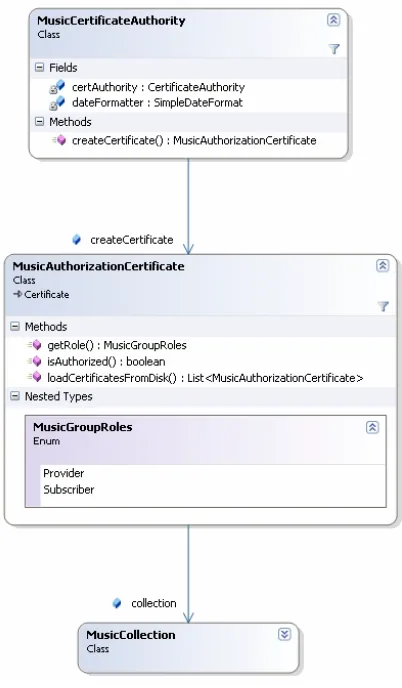
Fig. 9 – Music Authorization Framework
Each MusicAuthorizatinCertificate contains authorizations for one role and one MusicCollection. A group user may have one or more certificates specifying roles and the music
authorizations associated with each. The class contains a static loadCertificatesFromDisk()
method to provide easy support for deserializing these certificates for use in the application. The certificate also contains an isAuthorized() method for determining whether a specific song is authorized according to that certificate. Music authorizations are performed in a multi-tier fashion. A song is considered authorized if any of the following are true: the song’s artist is found in the music collection’s artists list; or the song’s album is found in the music collection’s albums list; or the song is found in the music collection’s songs list.
Class MusicCertificateAuthority provides the ability to generate MusicAuthorizationCertificate
objects. The certificate authority must be initialized with the instance of the group’s certificate authority so that its certificate signatures may be verified by group members.
Application Protocols
[image:22.612.94.496.184.707.2]With the necessary roles and music authorizations defined tuples and protocols could be designed to enable collaboration between group users. Below is a diagram containing all application level tuples used in the system. Note that all tuples extend class SignedTuple, meaning all instances are digitally signed at creation before being posted and verified when read. Any tuples unable to be correctly verified are ignored.
Key Exchange Protocol
The first protocol necessary to facilitate group communication in the application is the establishment of a group symmetric key. Luckily this is trivial because of the public key infrastructure in place. Recall that each user has an AlgorithmWalletCertificate containing the public portions of its encryption and signature algorithms and a corresponding
AlgorithmWallet containing the private portions. The wallet contains an instance of the group public key encryption algorithm. Using this algorithm it is possible to post encrypted tuples only other group members will be capable of decrypting. If this is the case why is it
necessary to create a group symmetric key?
Technically it is not necessary. All communication could be done securely using the group public key algorithm however this is inefficient. Every time a tuple is read the associated
PublicKeySecurityContext would have to decrypt the new random symmetric key and initialize a new Helix cipher. By creating a group symmetric key each user may initialize one instance of
FixedHelixSecurityContext for all groupwide communication.
The establishment of a group symmetric key is done using the GroupExistenceTuple. When a user creates a new tuple board a read is performed for any existing tuples of this type. If the read succeeds the returned GroupExistenceTuple contains the current group symmetric key and the user may initialize an instance of FixedHelixSecurityContext using the read key. If no tuple is currently available, meaning the user is the first one to join, a new GroupExistenceTuple is created with a randomly generated key. This tuple is then posted to the board using a new
PublicKeySecurityContext initialized with the group public key encryption algorithm and an ID of “GroupSymmetricContext” concatenated with the contents of the keyID field in the tuple. This additional ID field is included to prevent accidental reuse of an old security context identifier.
The protocol also allows for periodic refreshes of the group symmetric key. This feature is to prevent attacks which can arise when keys are used too many times. The frequency with which the key is refreshed is controlled by the system property “tb.keyrefresh.interval”,
specified in milliseconds. The default value is 900000, or 15 minutes.
A key refresh is performed the same way as the initial key generation. The original poster of the GroupExistenceTuple withdraws the old tuple, generates a new random key and reposts a new tuple. Meanwhile, all other group users are listening for tuples of this type and are notified of its posting and refresh their respective symmetric security contexts. Any tuples which were posted using the old context are also withdrawn at this time.
User Announcement Protocol
The two tuples involved in this protocol are the ProviderTuple and the SubscriberTuple. These tuples are posted to the board using the newly initialized group FixedHelixSecurityContext
when a user authorized as a provider or subscriber begins participating in the group. Both tuples contain the user’s AlgorithmWalletCertificate, enabling private communications with the user and the ability to verify signatures on tuples received from the user. The ProviderTuple
also contains a SongCollection representing the catalog of songs the provider is authorized to provide and has available for download.
Existing group users are notified of the posting of these tuples through listeners added to the board during application initialization. The listeners also are notified when these tuples are withdrawn, signaling that a user has left the group. Through this protocol a current list of the users online and their roles may be maintained.
Secure Messaging Protocol
The application supports the sending and receiving of encrypted messages between users in the group through the secure messaging protocol. Two types of messages are supported. The first is a group message. This type of message is able to be read by all users currently participating in the group. The second type is a private message. This message is only able to be read by the intended recipient.
The GroupMessageTuple allows for messages to be sent to the entire group. It includes matchable fields for the originator of the message, the message itself, and the sequence number associated with the message. These tuples are posted using the group
FixedHelixSecurityContext so all other group members may decrypt their contents and successfully read the message. Group users are notified of the posting of these tuples through a listener on the tuple board.
The PrivateMessageTuple is very similar to the GroupMessageTuple but allows for messages to be sent to a single user. In addition to the matchable fields of the GroupMessageTuple it also provides a field for the intended recipient. These tuples are posted using a
PublicKeySecurityContext initialized with the public key encryption algorithm of the recipient. Since only this user has the private portion of the algorithm capable of decrypting the message it is unable to be read by anyone but the recipient. Group users are also notified of the posting of these tuples through a listener on the tuple board.
Since group messages are posted using the group symmetric key context, when a key refresh occurs all previously posted group messages are withdrawn. Private messages persist until the target user is found to be offline as described in the user announcement protocol above.
Song Transfer Protocol
The song transfer protocol is probably the most important protocol in the application since its purpose is to enable the secure and authorized distribution of music between group members. It is also the most involved. While all previously defined tuple protocols involve only a single step this protocol consists of a request and a response.
A subscriber initiates the protocol by posting a DownloadRequestTuple. This tuple is initialized with the song wishing to be downloaded, a music authorization certificate which authorizes the download and the target provider that should field the request. Much like the private message protocol described in the previous section this tuple should be posted to the tuple board using a PublicKeySecurityContext initialized with the target provider’s public key
encryption algorithm. While this is not absolutely necessary since no truly sensitive data is contained in the tuple it does protect the privacy of the subscriber. No user but the target provider will be able to discover what song was requested or the collection of songs the subscriber is authorized to download.
The target provider is notified of the posting of any DownloadRequestTuples matching its
providerID through a listener added to the tuple board during application initialization. When a new tuple is received it must be verified that the requesting subscriber is actually
authorized to download the requested song. The tuple contains an isAuthorized() method which delegates to the provider authorization certificate to verify its authorization status as described previously in this section. The provider must also verify that it actually has the requested song and is authorized to provide it. If any of these conditions are not met the request is ignored.
Otherwise the provider creates a new SongTransferTuple. This tuple is initialized with the same SongInfo object specified in the request as well as the target and the java.io.File object containing the requested song in the provider’s file system. In order to actually transfer the contents of the song file over the network some custom serialization must be done. This tuple is based directly on the implementation of the FileTuple found in the edu.rit.tb.tuples
package.
The tuple specifies custom writeObject() and readObject() methods which are automatically invoked when the object is serialized and deserialized. In addition to the serializable fields of the object the contents of the song file are also written to the object output stream during serialization. Similarly, the contents of the song file are read from the object input stream when the tuple is deserialized. Since the signature on the tuple is computed by first
serializing it the signature includes the file contents. Thus when the tuple is received both its authenticity and integrity of the file transfer may be verified. This tuple is posted to the tuple board by the provider using a PublicKeySecurityContext initialized with the subscriber’s public key algorithm so no other users may decrypt and obtain the transferred file data.
When the subscriber reads this response tuple the song file’s contents are written to a temporary file. This file is then copied to the location specified by the subscriber when the download request was first made. For more on how to download tuples using the
Application Architecture
[image:26.612.105.517.178.504.2]With the tuple protocols designed and implemented the remainder of the application could be developed. The application is written in multiple tiers in order to minimize coupling and increase reuse of developed components. The following diagram illustrates the manner in which the application is organized.
Fig. 11 – Application Architecture
The bottom tier consists of instances of TupleListeners which are added to the tuple board during application initialization. These listeners, mentioned in the protocols section above notify the participation manager tier of the posting and withdrawing of protocol tuples.
The participation manager tier responds to events from the listener tier and provides
abstraction from the tuple board for the application manager tier when executing application protocols such as messaging. It also passes notifications of protocol activity up to the application tier through a custom event model.
Listener Tier
The listener tier is responsible for monitoring the tuple board and notifying the participation manager tier when tuples are posted and withdrawn. The implementation of this tier
deviates slightly from the architectural diagram in that the listeners are actually implemented as anonymous inner classes contained within the participation manager tier. Sevendifferent listeners are supported.
The first is a PostListener which listens for GroupExistenceTuples. The template tuple used is simply a blank GroupExistenceTuple. When matching tuples are posted this listener notifies its associated participation manager to initiate a key refresh.
The next two listeners are PostWithdrawListeners and perform the reading portion of the user announcement protocol described earlier. The subscriber listener uses a blank SubscriberTuple
in order be notified when any subscribers come online or go offline. Similarly, the provider listener uses a blank ProviderTuple in order to be notified when any providers come online or go offline.
In order to implement the messaging protocol two additional PostListeners are defined. The group message listener listens for incoming group messages using a blank GroupMessageTuple
template. The private message listener listens for incoming private messages using a
PrivateMessageTuple template initialized with the user’s AlgorithmWalletCertificate as the to field.
All of the listeners defined so far are contained within the GroupParticipationManager, a part of the participation manager tier responsible for all general group protocol activities. The remaining two listeners are unique for each role for which the application user is authorized. Together they implement the song transfer protocol.
The subscriber listener is only enabled if the current user is authorized as a subscriber. This listener listens for any incoming song transfers using a SongTransferTuple template initialized with the user’s AlgorithmWalletCertificate as the target field. Similarly, the provider listener is only enabled if the current user is authorized as a provider. This listener listens for any incoming download requests using a DownloadRequestTuple template initialized with the user’s
AlgorithmWalletCertificate as the providerCert field. These listeners are contained with in role participation managers, the SubscriberParticipationManager and ProviderParticipationManger
respectively.
Participation Manager Tier
Fig. 12 – Participation Manager Tier
The base PartitionManager class provides some functionality common to all types of
participation managers in the tier. It provides members for the instance of TupleBoard being used, a queue of event listeners to notify of manager events and a collection of tuples that have been posted. The methods postTuple() and withdrawTuples() provide an easy way to track and remove tuples from the board for all managers. In addition it provides an isAuthentic()
method which verifies signatures on tuples received from listeners. Since each manager is associated with a particular type of event listener from the model, generic addListener() and
removeListener() methods are provided for modifying the listener queue for each manager.
Within the tier there are two different types of managers. The first type includes the
GroupParticipationManager, which provides functionality common to all group users. The second type is the RoleParticipationManagers, of which there are two concrete implementations – one for subscribers and one for providers. These managers respond to role specific actions and events.
The ability to send messages is provided through the sendGroupMessage() and
sendPrivateMessage() methods. The key exchange protocol is executed behind the scenes without any interaction, although the application is notified through the event model when key refreshes occur. Similarly, user announcements are posted automatically when the manager starts.
The remaining two managers, ProviderParticipationManager and SubscriberParticipationManager
implement the song transfer protocol. Class ProviderParticipationManager manages the operations reserved for those users with the provider role, namely transferring songs to subscribers. Similarly, class SubscriberParticipationManager manages the operations reserved for those users with the subscriber role, namely downloading songs from providers.
[image:29.612.94.484.304.677.2]As mentioned previously the manager classes of this tier relay events received from their enclosed listeners to the rest of the application through a custom event model. Below is the design of the event listener interfaces which make up this model.
When protocol events occur in the manager tier they are relayed to the application through the event interfaces specified in the model. There is a one to one mapping between event listeners and participation managers. Class GroupEventListener specifies the events which are generated by the GroupParticipationManager. Classes implementing this event interface are notified when messages are received, when providers and subscribers come online or go offline, and when other status messages are generated by the manager. Class
ProviderEventListener is a very simple listener, with only one event. This event is fired by the
ProviderParticipationManager when a new incoming download request is received from a subscriber. Class SubscriberEventListener specifies events related to the download of songs by a subscriber. These events are fired by the SubscriberParticipationManager when a download is started, completed, or an error occurs during while executing the protocol.
Application Manager Tier
This tier acts as the controller between the view tier and the manager tier. Actions requested in the view are passed through this tier to the appropriate manager. In addition, events generated through the manager tier’s event model are aggregated in this tier and relayed up to the view. This tier also handles most of the necessary security for the application. Below is a diagram of the classes which make up this tier.
Fig. 14 – Application Manager Tier
Class GroupSecurityManager is implemented as a singleton and serves as a container for all security related processes in the application. This class holds a PRNG and the user’s private algorithm wallet and public certificate as well as numerous security contexts. In addition to the group and user PublicKeySecurityContexts it also maps users to their respective
Class ApplicationManager servers as the main controller between the view and manager tiers. This class initializes all necessary participation managers when started and relays all events generated by them up to the view. The view may register listeners through the provided
add…Listener() methods. In addition it provides methods for initiating all of the protocols supported by the system through the view. This class also represents a single point of storage for current group data.
Current collections of the subscribers and providers currently online are maintained as well as the available music libraries available by each provider and the application user. The manager also exposes music library search functionality, broken down by category and search breadth.
View Tier
[image:31.612.94.497.331.690.2]The final tier in the application is the view. This tier allows interaction with the user, sends collected user actions to the application manager tier and displays events and notifications received from the lower tiers.
Two different views compose this tier. Each view implements all event listener interfaces defined by the participation tier’s event model. Both views also contain an instance of class
ApplicationManager with which it registers itself as the necessary event listeners at startup.
The first view, a simple command line interface, is implemented in class MusicGroupCMD. In this view events received from the lower tiers are simply printed to standard out. Users may interact with the system via a predetermined set of commands. All basic application functionality is supported by this view, including sending and receiving group and private messages, downloading songs and searching.
[image:32.612.94.521.275.641.2]The second view, implemented in class MusicGroupGUI uses Swing to provide a graphical interface. This view is much more involved than the simple command line interface and so requires some additional supporting classes, detailed below.
Class MusicTable provides a specialized extension of JTable suited for the display of song information and is used extensively through out the view. Class TableSorter provides the ability to sort these song information tables by column. It should be noted that this class was obtained from Sun’s Swing Tutorials[6]. This functionality has since been absorbed into the Swing library with the recent release of Java6, but since this application is designed to be run with Java5 had to be manually included.
The final class, SongCollectionTableModel provides a custom data model for the MusicTable class to display. The data model allows the association with of a user with song information and the ability to display this data conveniently in the application.
Performance Evaluation
Good security never comes for free. In order to establish the impact of encryption and authentication on performance in the library I created a small test program,
edu.rit.tb.music.test.PerformanceEval. This program times how long each operation takes during the transfer of a SongTransferTuple from one device to another.
Usage:
%> java edu.rit.tb.music.test.PerformanceEval <certificate> <wallet> \ <file> <-provider | -subscriber> <none | auth | full>
The first two arguments specify the paths to the device’s public AlgorithmWalletCertificate and private AlgorithmWallet respectively. The third argument specifies the path to the file to be transferred. The fourth argument specifies this process as the posting (-provider) or reading (-subscriber) process. Finally, the last argument specifies the security level of the transfer operation. A value of ‘none’ causes the tuple to be posted using the DefaultSecurityContext
and to not be authenticated by the reading process. A value of ‘auth’ causes the tuple to still be posted using the DefaultSecurityContext but the signature is verified by the reading process. A value of ‘full’ causes the tuple to be posted using the PublicKeySecurityContext and the signature to also be verified by the reading process. Note that the posting process will post the SongTransferTuple and wait until killed externally while the reading process will perform one read, print the timing results to standard out and then exit.
All results were gathered running the posting process on newyork and the reading process on
georgia, two machines on the CS network at RIT. Both machines contained one 650MHz SparcV9 processor and 512MB of ram and were running Solaris 10 at the time of testing. The machines were connected via a 100 Mbps Ethernet link. Three different files were transferred in this experiment:
File 1: 11 – the american analog set – aaron and maria.mp3 (3,045,376 bytes) File 2: 04 – explosions in the sky – memorial.mp3 (12,775,424 bytes)
File 3: 03 – mono – yearning.mp3 (23,527,424 bytes)
Raw Transfer Time
This test was performed as a baseline with which to compare results of adding security features to the transfer. Here the song data is transferred in the clear and no authentication is performed by the reading process.
File 1 File 2 File 3 Mean Transfer Time (msec) 2959.19 3840.89 4770.88
Fig. 17 – Mean Raw Transfer Times
Raw Transfer
y = 9E-05x + 2697.3 R2 = 0.9958
0 1000 2000 3000 4000 5000 6000
0 5000000 10000000 15000000 20000000 25000000
File Size (Bytes)
T
im
e
(
M
il
li
s
e
c
o
n
d
s
[image:35.612.91.414.278.529.2])
Signature Verification Time
This test was performed in order to determine how much time signature verification by the reading process contributes to the total transfer time. The signature algorithm used is 2048 bit RSA with Double SHA-256. Here the song data is transferred in the clear but the received SongTranferTuple’s signature is verified. Note that these timing measurements reflect only the time to verify the signature, not the time to transfer the data.
File 1 File 2 File 3 Mean Signature Verification Time (msec) 868.57 3384.25 6144.92
Fig. 19 – Mean Signature Verification Times
Signature Verification
y = 0.0003x + 87.295 R2 = 0.9999
0 1000 2000 3000 4000 5000 6000 7000
0 5000000 10000000 15000000 20000000 25000000
File Size (Bytes)
T
im
e
(
M
il
li
s
e
c
o
n
d
s
[image:36.612.91.416.307.558.2])
Encrypted Transfer Time
This test was performed in order to determine how much time encryption and decryption during tuple transfer contributes to the total transfer time. The public key algorithm used is 2048 bit RSA. The symmetric key algorithm used is 256 bit Helix. No signature verification is performed by the reading process.
File 1 File 2 File 3 Mean Encrypted Transfer Time (msec) 4812.44 7321.86 9920.45
Fig. 21 – Mean Encrypted Transfer Times
Encrypted Transfer
y = 0.0002x + 4082.3 R2 = 0.9891
0 2000 4000 6000 8000 10000 12000
0 5000000 10000000 15000000 20000000 25000000
File Size (Bytes)
T
im
e
(
M
il
li
s
e
c
o
n
d
s
[image:37.612.90.417.295.611.2])
Authenticated & Encrypted Transfer Time
This test was performed in order to compare the total tuple transfer time using both
encryption and authentication to the baseline raw transfer. The public key algorithm used is 2048 bit RSA. The symmetric key algorithm used is 256 bit Helix. The signature algorithm used is 2048 bit RSA with Double SHA-256.
File 1 File 2 File 3 Mean A & E Transfer Time (msec) 5678.76 10756.11 16090.37
Fig. 23 – Mean Authenticated & Encrypted Transfer Times
Authenticated & Encrypted Transfer
y = 0.0005x + 4177.3 R2 = 0.9923
0 2000 4000 6000 8000 10000 12000 14000 16000 18000
0 5000000 10000000 15000000 20000000 25000000
File Size (Bytes)
[image:38.612.92.418.288.611.2]T im e ( M il li s e c o n d s )
Summary
Once all testing data was gathered it could be condensed and analyzed for further performance comparison.
None Auth Full File 1 2959.19 3831.77 5678.76
File 2 3840.89 7261.05 10756.11
File 3 4770.88 11068.69 16090.37
Fig. 25 – Mean Total Transfer Times at Various Security Levels
Summary 0 2000 4000 6000 8000 10000 12000 14000 16000 18000
0 5000000 10000000 15000000 20000000 25000000
File Size (Bytes)
T im e ( M il li s e c o n d s )
None Auth Full
Linear (None) Linear (Auth) Linear (Full)
None: t = 0.00009B + 2697 R2 = 0.9958 Rate: 88.89 Mbps Overhead: 2697 msec
Auth: t = 0.0004B + 2752 R2 = 0.9791 Rate: 20.00 Mbps Overhead: 2752 msec
[image:39.612.93.441.251.604.2]Full: t = 0.0005B + 4177 R2 = 0.9923 Rate: 16.00 Mbps Overhead: 4177 msec
Fig. 26 – Transfer Times & Rates at Various Security Levels
As expected, transfer times at all security levels increase linearly with the size of the file. In addition the rate of increase itself grows as authentication and encryption are added to the transfer. These results clearly illustrate the tradeoff between security and speed. It is
User’s Manual
The software described in this user’s manual expects that certain jar files be on the class path in order to function correctly. Please refer to the Deliverables section found later in this document for more information regarding these required jars.
Required jar files:
• Latest TupleBoard API (tb.jar)
• Latest MusicGroup Application (musicgroup.jar)
• Java ID3 Tab Library (jid3lib-0.5.4.jar)
• NetBeans[11] Swing Absolute Positioning Library (AbsoluteLayout.jar, required only for graphical MusicGroup client)
The first entity which must be present in order to establish public key infrastructure is a certificate authority. In the TupleBoard API this is represented by class
edu.rit.tb.security.cert.CertificateAuthority. This class comes equipped with a main method which enables creation of a CA and generation of certificates for distribution to devices.
Create a Certificate Authority
Before any certificates may be generated a static CA must first be created. The CA must be persistent across usage sessions because the signatures on all certificates must be verifiable by any device in the group regardless of when its certificate was generated. A certificate authority may be created by invoking the following command:
%> java edu.rit.tb.security.cert.CertificateAuthority –create \
<caName> <signatureAlgorithm> <encryptionAlgorithm> <bitStrength> \ <caFile>
Note: ‘\’ denotes a line continuation; there should be no newlines in the argument list.
Argument descriptions:
<caName> - The name of the certificate authority. This should be unique as this name is also used internally as the group identifier during secure communication.
<signatureAlgorithm> - The name of the signature algorithm to use when signing certificates. The value of this parameter must be able to be parsed as an instance of the
edu.rit.tb.pki.PKIAlgorithmFactory.SignatureAlgorithms enumeration. Currently supported values: { RSAWithDoubleSHA256}
<encryptionAlgorithm> - The name of the encryption algorithm to be used for group The value of this parameter must be able to be parsed as an instance of the
<bitStrength> - The bit strength of the algorithms. For the RSA encryption and signature algorithms this is the bit size of the public modulus, n. For RSA based algorithms this argument should be >= 2048.
<caFile> - The file to which the resulting CertificateAuthority object will be serialized for persistent storage.
The program will generate the public/private key pairs required for the signature and encryption algorithms and then serialize the resulting CertificateAuthority object to disk at the location specified. Generation of a 2048 bit RSA/RSAWithDoubleSHA256 certificate authority generally takes 8-10 minutes on a 650MHz SparcV9 CPU or 1 minute on a 1.8GHz Pentium M CPU.
Example:
%> java edu.rit.tb.security.cert.CertificateAuthority –create groupOne RSAWithDoubleSHA256 RSA 2048 groupOne.ca
Creating CA signature public/private key pair... Creating group encryption public private key pair...
Writing CA to /home/stu9/s15/krm4686/courses/msproj/data/groupOne.ca... %>
Generate a Certificate
Once a certificate authority has been created device certificates may begin to be generated. In order to participate in secure group communication a device must have a valid certificate from the group CA. Device certificates are represented in the API by class
AlgorithmWalletCertificate. A device certificate may be generated by invoking the following command:
%> java edu.rit.tb.security.cert.CertificateAuthority –generate \ <caFile> <startDate> <endDate> <id> <walletCertFile> \
<privateWalletFile>
Note: ‘\’ denotes a line continuation; there should be no newlines in the argument list.
Argument descriptions:
<caFile> - The file in which the serialized contents of the certificate authority created in the previous step are stored.
<id> - The ID of the user of device for which the certificate is being generated. This should be unique within the group.
<walletCertFile> - The file to which the resulting AlgorithmWalletCertificate object will be
serialized for persistent storage.
<privateWalletFile> - The file to which the resulting AlgorithmWallet object will be
serialized for persistent storage.
The program will deserialize the specified certificate authority and create a new
AlgorithmWallet. This wallet, containing the private group public key encryption algorithm, user signature algorithm and user public key encryption algorithm, and an
AlgorithmWalletCertificate created from the public instances of its algorithms are then serialized to disk at the locations specified. Generation of a 2048 bit RSA/RSAWithDoubleSHA256 certificate takes approximately 8-10 minutes on a 650MHz SparcV9 CPU or 1 minute on a 1.8GHz Pentium M CPU.
Example:
%> java edu.rit.tb.security.cert.CertificateAuthority –generate groupOne.ca 06/07/2007 07/07/2007 user1 user1.cert user1.wallet Creating user encryption & signature public and private key pairs... Writing certificate to /home/stu9/s15/krm4686/courses/msproj/
data/user1.cert...
Writing wallet to /home/stu9/s15/krm4686/courses/msproj/ data/user1.wallet...
%>
Generate a Music Collection
Once a certificate and wallet have been generated as in the previous step the user is now capable of interacting with an arbitrary group. In order to participate in a music group however some additional certificates are required – that of a provider and subscriber. The first step in generating these is to create a MusicCollection object. This is a list of all artists, albums and songs a provider or subscriber is permitted to upload or download respectively. To generate a music collection:
%> java edu.rit.tb.music.meta.MusicCollection <albumsFile> \ <songsFile> <artistsFile> <outFile>
Argument descriptions:
<albumsFile> - The text file containing authorized albums. Each line should be formatted
so it may be parsed into an AlbumInfo object through the AlbumInfo.fromAlbumInfoString()
method. Format: year;;;artistName;;;albumName
<songsFile> - The text file containing authorized individual songs. Each line should be formatted so it may be parsed into a SongInfo object through the SongInfo.fromSongInfoString()
method. Format: year;;;artistName;;;albumName:::trackNumber:::title
<artistsFile> - The text file containing authorized artists. Each line should contain a single string representing the artist’s name. Format: artistName
<outFile> - The file to which the resulting MusicCollection object will be serialized for persistent storage.
The program will parse the three input files into their appropriate collections
(AlbumCollection, SongCollection and ArtistCollection respectively). A new MusicCollection object created from these collections is then serialized to disk at the specified location.
Example:
%> java edu.rit.tb.music.meta.MusicCollection albums.txt songs.txt artists.txt user1.mc
Parsing album collection... Parsing song collection... Parsing artist collection...
Writing music collection to /home/stu9/s15/krm4686/courses/msproj/ data/user1.mc...
%>
Generate a Music Authorizations Certificate
Now that a music collection has been generated certificates may be created for participation in the music group. Class edu.rit.tb.music.cert.MusicCertificateAuthority contains a main method capable of generating provider and subscriber certificates using the music collection created in the previous step and the certificate authority created a few steps back.
%> java edu.rit.tb.music.cert.MusicCertificateAuthority–<role> \ <caFile> <startDate> <endDate> <id> <musicCollectionFile> \ <ouputCertFile>
Note: ‘\’ denotes a line continuation; there should be no newlines in the argument list.
Argument descriptions:
<role> - The role granted by this certificate. Must be one of ‘provider’ or ‘subscriber’.
<caFile> - The file in which the serialized contents of the CertificateAuthority are stored. <startDate> - The date this certificate becomes valid. Format: mm/dd/yyyy
<endDate> - The date this certificate expires. Format: mm/dd/yyyy
<id> - The ID of the user of device for which the certificate is being generated. This must match the ID contained in the user’s AlgorithmWalletCertificate.
<musicCollectionFile> - The file in which the serialized contents of the MusicCollection
object created in the last step are stored.
<outputCertFile> - The file to which the resulting MusicAuthorizationCertificate object will
be serialized for persistent storage.
The program will deserialize the specified CA and music collection objects from disk and then create and sign a new MusicAuthorizationCertificate for the specified role. The certificate is then serialized to disk at the specified location.
Example:
%> java edu.rit.tb.music.cert.MusicCertificateAuthority -subscriber groupOne.ca 06/07/2007 09/07/2007 user1 user1.mc user1.sub Loading certificate authority...
Loading music collection... Creating certificate...
Writing certificate to /home/stu9/s15/krm4686/courses/msproj/ data/user1.sub...
Join a Music Group (Command Line Client)
Once all the previous steps have been completed it will be possible to run the MusicGroup application. There are two versions of the application – a text based command line client and a Swing based graphical client. This section describes how to use the command line version.
%> java edu.rit.tb.music.MusicGroupCMD <userID> <groupID> <certDir> \ [-provider <musicLibDir>] [-subscriber <musicLibDir>]
Note: ‘\’ denotes a line continuation; there should be no newlines in the argument list.
Argument descriptions:
<userID> - The unique identifier of the user participating in the group.
<groupID> - The identifier of the group to be joined. This corresponds to the name of the CA which generated the specified user’s certificates.
<certDir> - The directory containing all relevant certificate files necessary for group participation.
[-provider <musicLibDir>] – This argument set specifies that the application enable the
provider role. All valid MusicAuthorizationCertificate files located in the certificate directory will be loaded. All authorized song files located in the specified music library directory or any of its subdirectories will be added to the provider’s list of available songs.
[-subscriber <musicLibDir>] – This argument set specifies that the application enable the subscriber role. All valid MusicAuthorizationCertificate files located in the certificate directory will be loaded. All song files located in the specified music library directory or any of its subdirectories will be added to the subscriber’s current media list.
Note: At least one of these role argument sets must be specified. It is also valid to specify both.
On start up the application will search for and deserialize the user’s certificate and wallet files, enable the specified role(s), load each role’s song collection metadata, and join the group. It will then prompt for input and respond to user commands as they are entered. For additional details on the protocol for joining a group and other group interaction
including sending messages and transferring files please refer to the MusicGroup Application Design & Implementation section, found earlier in this document.
Example:
[Initializing application manager...] [Reading existing group data...]
[No existing group data found. Creating new group...] [Subscriber online: user1]
[Provider online: user1] > _
The application is now fully initialized and ready to process user commands.
System Messages
As the command line client is being used various system messages will be displayed to the console. All system messages are contained within square brackets like this:
[system message]
Examples of system messages include provider and subscriber online and offline
notifications, download requests, group key exchange information and incoming private and group messages.
Available Commands:
The list of commands the application responds to may be accessed by typing ‘help’
> help
Available commands: =========================
download <provider> \ Download the specified song "<artist - title>" "<path>"
gm <message> Send a message to all group users
help Print this menu
list <all | my | providerID> View available song library online <providers | subscribers> View users currently online pm <id> <message> Send a message to user 'id'
quit Quit the application
search <all | providerID> \ Search function <artist | album | title> \
Who’s Online?
A good place to start when using the application is to see what other subscribers and providers are online. While system messages are generated each time a new user enters or leaves the group it is sometimes convenient to get the list of all currently participating users. To do so use the ‘online’ command:
> online subscribers Subscribers online: ==================== user1
user2 user3 user4 > _
The same syntax is used to view the list of providers currently online by replacing ‘subscribers’ with ‘providers’.
Providers online: ================== user1
user2 user3 user4 > _
What Songs are Available?
Since this is a music sharing client it is useful to be able to browse