Rochester Institute of Technology
RIT Scholar Works
Theses
Thesis/Dissertation Collections
5-1-1997
A Java based internet file system service
Keith Miller
Follow this and additional works at:
http://scholarworks.rit.edu/theses
This Thesis is brought to you for free and open access by the Thesis/Dissertation Collections at RIT Scholar Works. It has been accepted for inclusion
in Theses by an authorized administrator of RIT Scholar Works. For more information, please contact
Recommended Citation
A JAVA
BASED INTERNET
FILE SYSTEM SERVICE
by
Keith A. Miller
A thesis submitted
in
partial fulfillment
of the requirements for the degree of
Master of Science
in
Computer Engineering
at Rochester Institute of Technology
Approved by:
Dr. l\ndrew Kitchen, Professor, Computer Science, Thesis Committee Chairman
Dr. Muhammad
E. Shaaban, Assistant Professor, Computer Engineering
Dr. Roy S. Czemikowski, Professor, Computer Engineering
A JAVA BASED
INTERNET
FILE SYSTEM SERVICE
I,
Keith _'\.
~IiUer,
hereby
grant permission
to the Wallace Library of the Rochester
Institute of Technology to reproduce my thesis in whole or
in
part.
_-illy
reproduction
will not be for commercial use or profit.
ABSTRACT
A
JAVA
BASED INTERNET
FILE SYSTEM SERVICE
by
Keith
A.
Miller
As
the
Internet
grows and users
become
more
mobile,
they
will
need
to
be
able
to
access
from
remote
locations
all
of
the
same
things
that
they
use
in
their
offices.
Some
users
accomplish
this
by
taking
everything
with
them, in
the
form
of
high-priced,
high-powered
laptop
computers.
Another
solution
is
to
use
Internet-based
services
to
deliver
all
of
these
same
things to the
user.
This
thesis
and
its
related project address
a
Java-based
File System Service
that
uses
a
combination
of
local
and
remote
servers,
as
well
as
LANs
and
WANs
(including
the
Internet)
to
provide
users with
access
to
their
files
regardless of where
the
user
logs
in;
across
the
room,
across
town,
across
the
country
or around
the
world.
In
the
process,
this thesis
will
explore
many
topics
related
to
wide area
file
system
design
TABLE OF
CONTENTS
1. THE LOCATION INDEPENDENT DESKTOP
1
l.l
Background
l
1.2 Software Architecture
1
1.3 Desktop Application
3
1.4 User Name Service
3
1.5 File System Service
4
1.6 Application Service
4
1.7 Key Paradigm
for
Services
5
1.8 Use
of
Java
7
1.9 Network Domains
7
1.10 Thesis
work breakdown
8
2.
DESIGN
PHILOSOPHY
9
2.1 Compatibility
with existing file systems and applications
9
2.2 Authentication
and
Authorization
10
2.3 Global
file naming
12
2.4 Transport Issues
13
2.4.1 LANs
and
WANs
13
2.4.2 UDP
vs.
TCP
13
2.4.3 Transport Independence
14
2.4.4
Efficiency
issues for
long
haul
communications
75
2.4.5 Network failure
and
recovery
16
2.5 Server
issues
16
2.5.1 Stateless
versus
Stateful
servers
17
2.5.2 Idempotent
operations and
detection of
retried requests
18
2.5.3 Effects of
implementing
in
User
spaceversus
kernel
space
18
2.6 Caching
19
2.6.1
Synchronous,
Asynchronous
and
Delayed Writes
19
2.6.2
Cache consistency
21
2.6.3 File locks
and
leases
23
2.6.4
Caching
on
disk
versus
memory
24
2.6.5 Read-aheadfile block caching
25
2.6.6 Cache sharing
25
2.6.7
Directory
andfile
attribute
caching
26
3. DESIGN
27
3.1 Generallayout
27
3.2 Possible
intranet
layout
29
3.3 Logical
architecture
30
3.4 Block
design
31
3.5 FSS Communications
design
32
3.6 FSS API
design
33
3.7 FSS
Server
design
35
3.8 Accessing
a file on the local
FSS Server System
37
4.
PROJECT
EVALUATION
47
4.1 Functionality
47
4.2 Performance
48
5.
CONCLUSION
AND FUTURE DIRECTIONS
50
PREFERENCES
53
APPENDIX
A: INSTALLATION INSTRUCTIONS
A-l
APPENDIX
B: USER'S GUIDE
B-l
APPENDIX
C: PROGRAMMER'S API GUIDE
C-l
APPENDIX
D: PERFORMANCE TIMINGS
D-l
APPENDIX
E: MISC. DESIGN INFORMATION
E-l
LIST OF FIGURES
Number
Page
Figure
1:
Software Architecture for
the
Location
Independent
Desktop
2
Figure 2: Service
and
Channel
Key
Information
Flow
6
Figure 3: General layout
of
FSS Systems
27
Figure 4: Possible
intranet
layout
of
FSS Systems
29
Figure
5:
Logical
architecture
30
Figure 6:
Block Design
31
Figure
7:
FSS Communications design
32
Figure 8: FSS API design
33
Figure
9:
FSS Server design
35
Figure
10:
Opening
a channel
and
file
on
the
local
FSS Server System
37
Figure
11:
Read
or write a
file
on
the
local FSS Server
System
38
Figure
12:
Closing
a
file
and channel on
the
local FSS Server System
39
Figure
13:
Opening
a channel
and
file
on a
remote
FSS
Server System
41
Figure
14:
Read
and write a
file
on a remote
FSS Server
System
43
[image:7.526.66.472.87.294.2]ACKNOWLEDGMENTS
I
wish
to thank
my
wife
Jane
for her
patience
and
support
throughout this
endeavor,
as
well
my daughters
Cheryl
and
Jaclyn
who always
brighten my days.
I
love
you
all,
and
I
hope
to
get
to
know
you
all again soon.
I
would
like
to thank
the
members of
the
Thesis Committee for
their
efforts
during
the
development
of
this
thesis.
Their
insights
and
questions
sparked
some
further
investigations,
yet
allowed some areas
to
be left
as
future
enhancements.
I
would also
like
to thank
Jeff
Harman,
who's enthusiasm and
insightful
ideas have
been refreshing
to
work
with.
Last but
not
least,
I
would
also
like
to
thank
the
Symantec Corporation for
the
donation
of
a
copy
of
their
Visual
Cafe
Java
development
suite.
Without
this
software
package,
the
File
System Service
prototype
could not
have been
implemented in
the time
frame
available
for
GLOSSARY
API
-Application
Progranirning
Interface
AS
-Application
Service:
A
service
that
provides access
to
applications
desired
by
the
user.
Channel Key: An
object
that
identifies
an
ongoing
conversation
between
a
service and
its
client.
The
Channel
Key
is issued
once
the
Service
Key
has been
authenticated
by
the
service.
DNS
-Domain Name
Service: A
standard
naming
convention used
on
the
Internet
to
identify
a
specific
system.
Domain: An
area
of
the
Internet
defined
by
a specific
name,
that
contains one or more
systems.
FSS
-File System Service: A
service
that
provides
access
to
a user's
directories
and
files
from both
local
and remote
locations.
JDK
-Java
Developer's
Kit
LID
-Location Independent
Desktop: A
desktop
that
is
the
same
regardless
of where
it
is
accessed
from
on
the
network.
NFS
-Network File
System
Service Key:
An
object
containing
information
about a specific
service,
and a
license
ID
showing
that the
user
has
a
right
to
use
the
service.
UNS
-User
Name Service: A
1.
The
Location
Independent
Desktop
This
section will
describe
the
general
concept of a
Location
Independent
Desktop,
and
the
software
architecture used
to
provide
it. This
concept
is
being
used
as
the
basis for
two
theses,
one
by
Keith Miller
and
the
other
by
Jeff Harman [Harman97]. (More
about
this
later.)
1.1 Background
The
object
of
the
Location
Independent
Desktop
is
to
supply
a
user's
desktop
environments
regardless of where
he/she logs into
the
network;
across
the
room,
across
town,
across
the
country
or around
the
world.
The
solution
must
support
many
types
of
computer
systems,
as
the
user
may login into
a
different
type
of computer system
from
the
one
normally
used.
The
user's
environment
includes
the
look
and
feel
of
the
user's
desktop
(color
scheme,
background,
toolbar,
etc.), applications,
and access
to the
user's
files.
This
same
scheme
could
be
extended
to
cover access
to
other
services
(such
as stream services
for
on-demand
video,
etc.),
but
are considered
beyond
the
scope of
this thesis
work.
(This
could
be
added
in
the
future.) Also,
this
scheme
assumes
that
the
networks
being
used
are
secure.
Therefore,
the
only
security implemented
will
be
that
required
for
general user
access
to
applications,
accounts and
files.
1.2 Software
Architecture
Remote
Services
nterne
Local Services
User Name
Service
]
User Name
Service
Local Area
Network
File System
Service
File System
Service
Desktop
Application
(FUTURE)
Application
Service
Application
Service
(FUTURE)
Stream
Service
(FUTURE)
Stream
[image:11.526.62.463.30.342.2]Service
Figure 1
:
Software Architecture for
the
Location Independent
Desktop
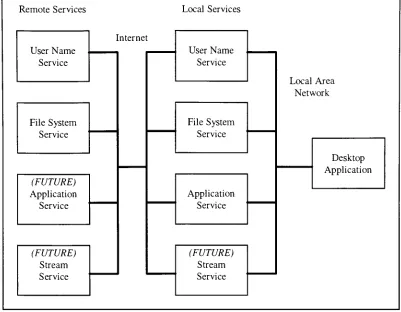
The
architecture
can
be
viewed as
three
sections;
the
desktop,
local
services,
and remote
services.
The
Desktop
Application
provides
users
with
access
to
their
desktops,
applications
and
files
by
contacting
the
local
services.
The
local
services
determine
whether
they
can meet
the
needs of
the
Desktop
Application
directly,
or whether
they
must
contact
some remote service
to
fulfill
the
request.
This is
done
automatically,
without
needing
to
1.3
Desktop
Application
The
Desktop
Application
is
responsible
for providing
the
interface
between
the
user and
the
services.
The
user
interface
prompts
the
user
for
login
name
and
password
information (ex.
MyPassword).
Using
the
UNS API
defined,
the
Desktop
Application
contacts
the
local
User
Name Service
(UNS)
to
validate
the
user.
If
the
user
login
name
specifies
another
DNS
address,
then the
local UNS
contacts
the
UNS
at
the
specified
address
to
validate
the
user.
If
the
user
is
valid,
the
Desktop
Application
will
query
the
UNS for
account
information
such
as
the
setup
of
the
user's
desktop,
color
scheme, etc.,
and use
this
information
to
display
the
user's
desktop
environment.
One
of
the
standard applications
that
is
provided
to
all users
is
a
File Manager
application.
The
File Manager
uses
the
File System Service
(FSS)
to
gain access
to the
user's
directories
and
files,
and
displays lists
of
them
to the
user.
The
File Manager
obtains
a
Service
Key
from
the
Desktop
which
allows
it
to
use
the
FSS. The
user
can use
the
File
Manager
to
traverse
his/her
directory
tree,
create
directories,
copy,
move and rename
files,
etc.
1.4
User
Name
Service
The User Name
Service
(UNS)
is
responsible
for maintaining
the
user
accounts
for
a
specific
domain.
It
is
expected
that
one
of
these
services would
be
available
in
each
domain
where
Location
Independent Desktops
are
supported.
When
contacted
by
a
Desktop
Application,
the
UNS
validates
a
user's
login
information,
and
supplies
basic
account
information.
If
the
user's
account
is
at a
remote
site,
the
local UNS
contacts
the
UNS
at
the
remote site
to
complete
any
requests.
Upon
request
the
UNS
will
supply
a
Service
Key
that
authorizes
the
use of a
particular
service or application
by
a
particular
user
The UNS
will
later be
asked
to
authenticate
this
1.5 File System Service
The File System
Service
(FSS)
is
responsible
for providing
access
to
files
and
directories
owned
by
the
users of
the
system,
and
delivering
them to the
user's current
location
upon
demand.
Authentication
of
the
user
is
performed
by
receipt
of a
Service
Key
that
was
originally
generated
by
the
User
Name
Service
(UNS). The
FSS
contacts
the
UNS
to
authenticate
the
Service
Key,
and
then
uses
the
contents
of
the
Service
Key
to
identify
the
user
and
therefore
determine
his/her
file
access
rights.
The local
FSS
will
hide
any
accesses
to
remote
FSS Servers
that
are
required
to
fulfill
the
user's requests.
When
a remote
FSS
is
being
utilized,
the
local
FSS
will cache
the
directory
and
file data
being
used,
and will attempt
to
anticipate what
the
user will
need next and
obtain
this
information in
advance
so
the
user will
not
have
to
wait
longer
than
necessary.
Sharing
of
files among
multiple
users
will
be
allowed.
A
consistency
method
will
be
chosen,
to
keep
multiple copies of
the
same
file
in
sync.
1.6
Application
Service
The
Application
Service
(AS)
is
responsible
for providing
access
to
applications
and
delivery
of
those
applications
to the
desktop
upon
demand.
Authentication
of
the
user
is
performed
by
request of a
Service
Key
that
was
originally
generated
by
the
User Name Service (UNS).
The
AS
will
contact
the
UNS
to
authenticate
the
Service
Key,
and
then
use
the
contents
of
the
Service
Key
to
identify
the
user
and
determine
the
application
access
rights.
The
AS
will
hide
any
unnecessary
access
information from
the
user
in its
pursuit
of
the
application.
In
addition
the
application
will
have
the
ability
to
obtain
information
or
files
original
provider
is
the
host
that
the
application
was
taken
from. This
will
give
the
application
the
ability
to
load libraries
or
other
dynamic
modules
only
when
needed.
1.7
Key
Paradigm for Services
The
paradigm
that
is
maintained
by
services
in
this
environment
is
that
of
keyed
service.
There
are
two
types
of
keys
that
are referenced
in
this
environment:
Service
Keys
and
Channel
Keys. Service Keys
are used
to
obtain
services
and
Channel
Keys
are
used
to
access active
services.
Service Keys
originate
from
the
UNS.
The UNS
provides
the
Service
Key
for
a user
as
part
of
the
hierarchy
of application
information. Each
application and
file
system
listed in
the
user's
configuration
is
paired
with a
Service
Key.
The
desktop
simply
decodes
what
kind
of service
is
required
by
a user action and
determines
if
the
service
has been initiated
for
that
element.
If
the
service
has
not
been
initiated
then the
Service
Key
is
passed
to the
appropriate
local
server
to
initiate
the
service.
Service Keys
are
not
simply
a
password
for
access
to
a
service,
they
also
contain
information
about
the
user and where
the
service can
be
obtained
if
the
local
services are
unable
to
assist
the
user
themselves.
Service Keys
can
be
verified
by
the
user's
primary
UNS
through
the
standard
UNS API. Service
Keys
contain enough
information
to
identify
the
user,
password
the
service
and
the
identity
of
the
user
(and
his/her primary UNS
Desktop
S\stem
Service Request
Remote Server
(Application
or
File System)
^v
4.
Channel
Key
3. Channel
Key
y^
'y
1 Service
Key
\v
\.
Local Server
(Application
or
File
System)
y^ y^
[image:15.526.56.468.34.197.2]2. Senice
Key
Figure 2: Service
and
Channel
Key
Information
Flow
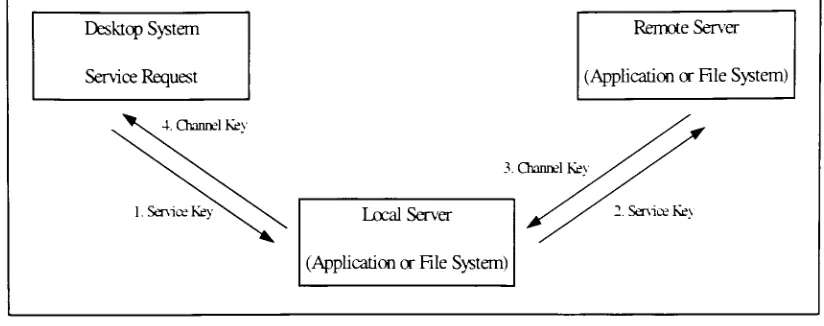
The
general
flow
of
keys is
as
follows:
The
user
initiates
an action
(such
as
initial
access
to
the
file
system or
initial
access
to
an application).
The
desktop
then passes the
Service
Key
that
is
associated with
the
activity
to
the
appropriate
local
server.
The local
server examines
the
Service
Key
to
determine if
the
request can
be
satisfied with
local
information.
If
the
service can not
be
satisfied
locally
then
the
Service
Key
is
given
further
examination
for
information
that
indicates
where
the
key
may
be
used.
The
local
server
then
contacts
the
remote
server
with
the
Service
Key. The
remote
server
should
then
respond
with
a
Channel Key. The local
server
then
sends
a
Channel
Key
to
the
user
desktop
which
indicates
that the
service
has been successfully
initiated. The
desktop
can
then
request
further
information
from
the
established
channel
without
having
to
reinitialize
the
connection.
Any
failure
within
this
chain will cause
the
local
server
to
return an
invalid
Channel
Key
or a value
that
indicates failure (dependent
on
the
particular
server
interface
or
API)
which will
indicate
that the
attempted
senice
request
has failed.
Channel Keys
are
only
valid
for
the
duration
of a single
activity (at minimum)
or user
login
connection
that
has been
established
to
service
that
request.
Channel
Keys
are
local
access
keys
while
Service Keys
are
full
information
keys.
As
an
example
of
the
use
of
keys,
consider
how
the
File
Manager
and
the
File
System
Service
(FSS)
use
keys
to
access
the
user's
directories
and
files from
a remote
domain.
Upon
startup
of
the
File
Manager,
the
Desktop
Application
will
pass
the
FSS
Service
Key
to
the
File Manager.
(The FSS Service
Key
was
originally
supplied
to
the
Desktop
Application
by
the
local
UNS,
which,
in turn,
received
it from
the
remote
UNS.)
The
File
Manager
opens
a
dialog
with
the
local FSS
Server
using
the
FSS Service
Key. The
local FSS
Server
contacts
the
remote
FSS Server
using
the
FSS
Service
Key
to
establish a
dialog.
The
remote
FSS Server
will
contact
the
user's
primary UNS
Server
to
authenticate
the
FSS
Service
Key. If
valid,
the
Service
Key
is
then
examined
locally by
the
remote
FSS Server
to
determine
if it
is
valid
for
access
to the
service.
If
still
valid,
the
remote
FSS
Server
will
generate
and return a
Channel
Key
to the
local FSS
Server,
which
will,
in turn,
return
it
to
the
File
Manager. The File Manager
can
then
use
the
Channel
Key
with
all
further FSS API
calls.
The
local
and
remote
FSS
Servers
can
authenticate
the
Channel
Key
themselves,
without
needing
to
contact
the
remote
UNS
Server.
1.8
Use
of
Java
Java
will
be
used
to
provide
the
basis
upon which
the
Location Independent
Desktop
will
be
created.
Java
was
selected
because any
client machine
that
can run
Java
applications
will
have immediate
access
to
all
functions
without
writing
specialized
code.
1.9
Network
Domains
Rather
than
come
up
with a whole new
naming
convention,
we
decided
to
use
and extend
the
DNS naming
convention
that
is currendy
used
in
the
Internet. This implies
that
each
services
(i.e. User
Name
Service,
File System
Service,
etc.).
These
services
may
all run on
one
server
machine,
or
may be
run
on
separate machines.
1.10 Thesis
work
breakdown
Keeping
the
size
of
this
project
down
to
a workable amount was
not
an
easy
task.
As has
been
mentioned,
several areas were either
left
as
"Future"
functions,
or were not addressed
at
all.
We implemented
prototypes
to
prove
the
major
concepts
described,
and
as
a
platform
to
explore
their
usefulness.
Jeff
Harman
concentrated
on
the
Desktop
Application,
AppKcation Service
and
the
User
Name
Service.
Keith Miller
concentrated on
the
File System Service
and
the
File Manager
Application.
Together
they
explored
the
concepts,
developed
the
architecture and
defined
the
APIs between
the
main modules.
Once
their
respective
areas
had
been developed
and
tested
separately,
they
integrated
them
and experimented with
the
resulting
system.
Separate
thesis
papers
were
delivered,
each
concentrating
on
the
areas
defined
for
the
author,
with
section
1
being
the
only
common content.
However,
references
that
tie
the
2. Design
Philosophy
This
section will
develop
the
design philosophy for
the
File System Service
(FSS). In
the
process,
the
philosophy
will
be
contrasted with
other approaches
that
are
discussed in
the
current
literature.
One overriding
philosophy
is
that the
goal
for
the
FSS is
to
prove
a
concept,
not
to
produce
the
most
efficient
and
powerful
solution
possible.
This
means
that
in
some
instances,
in
the
interest
of
time,
less
than
optimal
solutions
may be
selected.
This
philosophy
will
clearly leave
areas
for further
investigation
by
interested
students,
faculty,
etc.
Another
goal of
the
design is for everything
to
be
written
in Java. This
will
allow
everything
from
applications
to
servers
to
be
transported,
without
modification or
recompilation,
to
any
networked platform capable of
running
Java.
Lasdy,
the
File Manager
application
that
is
being
delivered
with
the
FSS
prototype
is
meant
to
exercise and
test the
FSS
only,
not
to
compete with commercial
File
Manager
products
in
the
market
today.
As
such,
it
is
a
test tool
and example of
how
the
FSS
can
be
used,
and
is
not considered
to
be
a
significant
deliverable for
this
thesis.
(It
will
be documented for
use
by
others,
but
its
design
will
not
be
covered.)
2.1
Compatibility
with
existing
file
systems and applications
The
FSS is
being
designed
to
support
Java
applications
that
need
to
access remote
files
on
behalf
of
their
users.
Just like
most
applications,
the
Java
runtime
environment
uses
the
standard
input/output
(I/O)
system calls
available on
the
platform
where
they
are
being
run
to
open, close,
read and
write
files. In
a
typical
distributed
environment,
if
these
files
trap
these
I/O
system
calls
and
redirect
them to the
remote
server without
needing
to
inform
the
application.
This
is
the
approach
taken
by
WebNFS
[Callaghan96].
The FSS
was
patterned
after
other
distributed file
services
(for
example,
NFS, Sprite),
however
the
FSS
itself
was written
in Java
to
make
it
portable.
Since
the
Java
runtime
environment
is
an application and cannot
trap
I/O
system
calls,
a custom
interface
was
created
for
the
FSS.
Any
Java
application
wishing
to
use
the
FSS
needs
to
use
the
FSS
API
classes
to
access
files,
instead
of
the
Java
I/O
classes.
Making
the
FSS
API
classes
"look
and
feel"as much
like
the
Java
I/O
classes as
possible
was an
important
goal.
This
was
done
to
make
it
easy
for
applications
to
upgrade
to the
FSS
API
classes
from
the
Java I/O
classes.
2.2
Authentication
and
Authorization
Distributed
networks
are
inherendy
vulnerable
to
"illegal"intruders
[SunSoft95].
As
networks
grow
and
their
connections
extend
beyond
the
local
organization,
these
connections
are separated
by
an
"untrusted"
interface
the
network.
Authentication
and
authorization
become
very
important
to
insure
that the
larger
unknown
community
of
strangers cannot gain access
to the
network and
its
resources.
Authentication
for
users of
the
FSS is
handled
through
the
Service
Key
mechanism.
The
Service
Key
identifies
the
user
that
is attempting
to
gain
FSS
service,
as well as
the
specific
FSS
Server
where
the
key
may be
used.
The
Service
Key
contains a
data
area
that
should
be
encrypted
to
prevent
tampering
or
forgery.
(The
data
area
is currendy
not
being
encrypted,
to
simplify
the
prototype.) Authentication
of
the
key,
and
therefore
the
user,
is
performed
by
the
User
Name
Service
(UNS)
server
that
manages
the
user's
account.
Once
the
user
is
authenticated,
a
Channel
Key
is
generated
by
the
FSS Server
and
passed
back
to the
client.
Any
further
requests
from
the
client require
this
Channel
Key
as authentication of
the
user.
(The
Channel
Key
also
contains a
data
area
that
may be
encrypted
to
prevent
tampering
or
Authentication
in
NFS,
by
comparison,
comes
in
three
flavors:
the
default
"UNLX-style"
authentication,
one
based
on
the
Diffie-Hellman
key
exchange
protocol,
and one
that
uses
Kerberos
[SunSoft95],
[Callaghan96],
[McKusick96].
The
standard
"UNLX-style"
authentication
checks
the
network
address of
the
client against a
list
of
trusted
hosts,
while
the
Diffie-Hellman
and
Kerberos
authentication
methods
use
encrypted
keys
to
protect
authentication
information.
The
Echo
file
system also uses a cryptographic protocol
for
authentication
[Mann94]. The
Service
Key
method
used
by
FSS is
clearly
better
than
"UNLX-style"authentication,
but is
not as
sophisticated
as
the
cryptographic methods.
Authorization
in
the
FSS is
necessary
before
access
to
any
files is
supplied.
Ideally,
once
the
user
has been
authenticated,
the
User's ID
(UID)
(which
is
stored
in
the
Channel
Key
provided
with
the
request)
would
be
used with whatever
file
access controls are available
on
the
server
(ex.
UNLX
style permission
bits
or
Access Control
Lists)
to
determine
if
the
user
has
permission
to
access
the
directories
and
files
requested.
This is
what
NFS
servers
do
to
control
file
access
[Callaghan96].
Servers
written
in
C
or
C++
can use a couple of
methods
to
accomplish
this.
One
method
involves changing
the
execution
ownership
of
the
server
to that
of
the
user
and
then
letting
the
operating
system
decide
whether
the
user
should
be
allowed access
to the
resource.
Another
method
involves
determining
the
ownership
and
permissions,
(or
access control
list)
for
a
resource,
and
deciding
from
these
whether
the
user
should
be
allowed
access
to
the
resource.
Both
of
these
methods require
library
calls
to
the
operating
system.
While Java
has
provided
classes
that
hide
some
operating
system
library
calls
(for
things
like file
and
directory
attributes), it
does
not
provide
classes
to
change
a
program's
execution
ownership,
or
to
access
actual
file ownership
and
permissions,
or
access
control
lists,
etc.
To
support
real
authorization,
a
Java
program
would
need
to
use
operating
system
calls.
Rather
than
add
these
calls
and
thus
create a
platform specific
solution,
a
"mock-up"Lasdy,
when
a
file
or
directory
is
cached,
the
Service
Key
that
was
used
to
access
it is
included
in
the
data. Since
the
Service
Key
is essentially
part of
the
"path"
to the
data,
only
the
user
that
owns
that
Service
Key
is
authorized
to
access
that
cached
copy
of
the
data.
If
another
user
desires
the
same
data from
the
server,
his/her Service
Key
and access
rights
are
different,
hence duplicate
cache
entries with
different Service
Keys
and access
rights
will
be
created
for
the
new user.
This may
not
be
the
"ideal"design,
but it
works
very
effectively.
And,
since
file
sharing
is
assumed
to
be
limited,
there
is
very little
loss
in
efficiency.
2.3 Global file naming
Some file
systems,
such as
Alex
[Cate92]
and
AFS
[Reguero92],
attempt
to
create
globally
unique
filenames
for
all of
the
files
in
the
world.
Although
this
is
useful,
it is
overkill
for
the
FSS. Each
FSS
Service
Key
that
a user owns authorizes access
to
a
specific
FSS
Server
and
a
single
(possibly large)
directory
tree
of
files.
File
systems
such
as
BBFS
[HiHyer92]
desire
a
location-transparent
naming
scheme
that
allows
the
application
to
use
the
same name
for
a
file
regardless
of which
nodes
in
the
distributed
system are used
for
access and
data
storage.
This
is
not an
issue
that
FSS
needs
to
solve.
Actually,
the
design
of
the
FSS
depends
on
the
files continuing
to
be
available
from
a specific server and at a
specific
path within
that
server.
Heterogeneous
systems can affect
the
FSS
in
one of
two
ways:
how
file
and
directory
paths
are
specified,
and
the types
of attributes available
for
a
file.
Since
the
FSS is
written
in Java
and
the
FSS API
should
"look
and
feel"as
much
like
the
Java I/O
classes as
possible,
the
file
attributes
supported
are
limited
to those
supported
by
the
Java
File
class.
Since
the
Service
Key
contains
the
base
path
for
the
directory
tree the
user
has
access
to,
any
drive
specifiers
(i.e.,
"C:\",
etc.)
can
be buried in
the
key
where
the
user
rarely if
ever
sees
it.
In
addition,
the
Java File
class supplies
knowledge
of
the
path
separator
(i.e.,
'/'or
API
in
an appropriate
manner.
This
means
that
an application could use
the
path separator
provided
in
the
FSS API
to
build
paths
properly.
In
addition,
an
application
could
completely
hide from
the
user
the
need
for different
path separator characters on
different
platforms.
The File
Manager
application
provided
with
the
prototype
uses
the
path
separator to
build
paths
properly,
but does
not
attempt
to
hide
which character
is
required
by
the platform
being
accessed.
2.4
Transport
Issues
The design
of
the
FSS
uses
both
LAN
and
WAN
services.
If
the transport
protocol
chosen
is
to
be
of
any
use,
the
attributes
of
these
networks must
be
thoroughly
understood.
This
subsection
will
explore
many
of
the
aspects
of
transmitting
information
on
LANs
and
WANs.
2.4.1
LANs
and
WANs
Local
Area
Networks
(LANs)
are
typically high
bandwidth,
low
latency,
highly
reliable
networks.
For
this
reason,
just
about
anything
works
and works well.
However,
when you
start
looking
at
Wide
Area Networks
(WANs),
these
are
typically low bandwidth
and prone
to
errors
requiring data
retransmission
[SunSoft95].
WANs
are also
noted
for
their
high
latency
[Callaghan96].
For
clients and servers
that
are separated
by
great
distances,
as
may
occur with
the
FSS,
these
latency
effects
are
significant
and
must
be
taken
into
account
2.4.2
UDPvs.
TCP
When
looking
at
communications on
LANs,
both
the
User
Datagram Protocol
(UDP)
and
Transmission
Control Protocol
(TCP)
are
\iable
options,
with
each
having
its
own
when
subjected to the
low bandwidth
and
high
latency
of
WANs
like
the
Internet. Since
TCP
provides
reliable
delivery
with congestion
control,
it
avoids
the
problems associated
with
UDP [McKusick96].
Therefore,
it
became
the
preferred
protocol
for
use
on
the
Internet,
despite its
somewhat
inferior
performance.
In
recent
years,
improvements in
hardware
and
TCP implementations have
narrowed
this
performance
gap
enough
that
TCP
can
now
outperform
UDP. For
this
reason,
NFS
Version 3 in Solaris defaults
to the
TCP
implementation
over
the
UDP
implementation.
(Both
are
available,
to
support older clients and
servers.)
Since
the
FSS
will
depend
highly
on
communications
over
the
Internet,
only
TCP
protocols
will
be
acceptable.
Although Java
provides
both TCP
and
UDP implementations
of
socket
classes,
the
FSS
will
use
the
TCP
implementation
to
assure
successful
communications
across
the
Internet.
2.4.3
Transport Independence
Due
to
its
widespread
implementation,
NFS is
considered
a
de
jure
industry
standard
[SunSoft95]. Part
of
NFS's
success
is
due
to the
fact
that
it
was
designed
to
run on
any
available stream-oriented or
datagram
oriented
protocol
[McKusick96]. It
has
versions
that
run
on
UDP
and
TCP (as
mentioned
above),
as well as
being
ported
to
run over numerous
non-IP
based
protocols.
Since
the
FSS is
Java
based
and
uses
Java's
stream
sockets
for
communications
and
information
transfer
on
both LANs
and
WANs,
the
FSS
will
be limited
to
running
on
networks where
Java
can
run,
namely TCP
networks.
In
the
future,
if
Java's
stream
sockets
are supported on other
protocols,
extending
the
FSS
to
use
those
protocols should
be only
2.4.4
Efficiency
issues for
long
haul
communications
When operating
on a
LAN,
protocols
that
are
less
than
efficient can survive
due
to
the
high bandwidth
and
low
latency
of
the
network.
However,
when
latencies
grow
large
and
bandwidth
dwindles,
as
happens
on most
WANs,
protocol
efficiency
becomes
a
critical
issue.
One
method used
to
improve
efficiency
over
long
haul
networks
is for
a
client and server
to
share
a single connection.
Setting
up
and
tearing
down TCP
connections requires a
lot
of overhead
[SunSoft95],
decreasing
efficiency.
NFS
clients
use
one
connection
to
each
server,
regardless
of
the
number
of client
mounts
setup
on
that
server.
In
addition,
persisting
the
connection
even
when
traffic
is low
or
non-existent
avoids
"slow-start"
congestion,
increasing
the
bandwidth
as
the
lifetime
of
the
connection
increases
[Callaghan96].
When
accessing
files,
the
most
frequently
fetched
chunk sizes are
in
the
range
from 1
to
8KBytes
[Spasojevic94].
However,
when
transferring
large
amounts
of
information
over
the
Internet,
larger
transfer
sizes
improve
performance
by
reducing
the
number
of
turnaround
delays
required
during
the transfer.
The
high
latency
on
the
Internet
penalizes
protocols with
large
numbers of
turnarounds
[Callaghan96].
Another
method used
for efficiency is
to
issue
multiple concurrent
requests
over a single
TCP
connection
and
have
the
responses
return
asynchronously.
Since large files
are
transferred
with
multiple
READ
requests
there
is
no
delay
for
the
downloading
of small
files
while
a
large
file is
downloading
[Callaghan96].
This,
of
course,
must
be balanced
with
the
desire
to
increase
transfer
sizes.
In
some
protocols,
certain
sequences
of
requests
are
common.
Rather
than
incur
the
turnaround
delays for
each
request,
it is
more
efficient
to
combine
the
sequence
into
a
single request.
Examples
of
this
are
the
READDIRPLUS RPC in NFS
[Callaghan96]
and
the
Readdir_and_Lookup
RPC
in
NQNFS
[Macklem94].
These
requests
return
file
Last
but
not
least,
when changes need
to
be
written
back
to
the
server,
rather
than
writing
back
an
entire
block
when
only
a
few
bytes have
changed,
sending back
only
the
changed
bytes is
preferable.
This
results
in
less data
being
transferred
over
the
network,
and when
there
are
multiple
writers
non-overlapping
modifications
to
a
file
are
not
lost.
Since
the
FSS depends
on
transfers
over
the
Internet,
it
takes
all
but
one
of
these
performance
improvements
into
account
in
its
communications
design.
Writing
only
the
changed
bytes
in
a
block back
to
the
server was not
included,
to
keep
the
caching design
simple.
2.4.5
Network
failure
and
recovery
The
network
can
fail
in
a number of ways.
The
most
important failures
to
consider are
the
loss
of
packets
and
splitting
of
the
network
topology.
Handling
loss
of
packets means
that
the
protocol
must
be
able
to
detect
that
a packet was
lost
and
recover gracefully.
In
the
FSS,
loss
of
packets
will
be
handled
through the
use
of
TCP.
TCP includes
a guarantee
to
upper
layers
that
packets will
be delivered.
If
re-transmissions
are
necessary,
TCP
handles
them
automatically.
Handling
the
splitting
and
subsequent
recombining
of a split network
involves
avoiding
and/or
resolving
any
conflicts
between
the
client
and
the
server.
In
general,
the
FSS
design does
not
address
failure
recovery.
This
was
left
as
an
area
for
possible
future
enhancement.
2.5
Server
issues
The
next
group
of
issues
to
be
explored
are
those that
affect
the
server
and
its ability
to
2.5.1
Stateless
versus
Stateful
servers
A primary issue
of
interest
when
designing
a
server
is
whether
it
must
save
state
information
about
its
clients
(i.e.
stateful)
or
not
(i.e.
stateless).
The
stateful versus stateless
server
debate is
one of
high interest
and
debate
in
the
literature
and when
comparing
file
system
designs.
NFS
was
designed
to
be
stateless.
The
benefit
of
the
stateless
protocol
is
that there
is
no
need
to
do
state
recovery
after
a client or server
has
crashed
and
rebooted,
or after
the
network
has been
partitioned
and
reconnected
[McKusick96].
Once
the
client
and
the
server can
communicate
again,
they
simply
pick
up
where
they left
off.
It
is
clear
that
several
kinds
of
error
handling
and
failure
recovery
problems
are
much easier
to treat
in
a
stateless environment
[Gloor88].
One
disadvantage
of
the
stateless approach
is
the
lack
of
file
locking. NFS
attempts
to
make
up for
this
by
providing
a separate
advisory
file
locking
daemon.
However,
this
is
not
an
optimal solution.
On
the
other
hand,
file
systems
such as
Sprite
and
AFS
use a stateful approach.
Although
this
requires
a
more
sophisticated
server
[Reguero92],
one
advantage
of
the
stateful
approach
is
that
it
solves
some
of
the
performance problems
of
the
stateless
approach
[Baker91]
On
the
other
hand,
if
a
file
server
crashes
and
reboots,
it
must
recover
its
knowledge
of
which
clients
have
which
files
cached,
so
that
it
can
enforce
cache
consistency
on
future
open requests.
There
are
solutions
to
recovering
state,
however few
are
easy
to
implement. For
instance,
in
Sprite
the
solution
is
to
use
the
state
information
replicated
on
the
client workstations.
When
a client
detects
that
a server
has
rebooted,
it
transfers
its
state
information
to the
server.
Once
the
server
has
received
state
information from
all of
its
clients,
recovery is
complete.
In
practice,
one
problem
is
knowing
when
all
of
the
possible
clients
have
responded.
What if
one
of
them
is down
or
delayed? The
server will never
know,
or
may
2.5.2 Idempotent
operations and
detection
of retried requests
Issues
that
direcdy
effect
the
accuracy
of a
server
are whether
the
server's operations are
idempotent
and
whether
the
server
is
able
to
detect
retried
requests.
An
idempotent
operation
is
one
that
can
be
repeated several
times
without
the
final
result
being
changed
or
an
error
being
caused
|McKusick96].
In
NFS,
most
operations
are
idempotent.
In
addition,
the
NFS
server's cache also
detects
retries of
previously
serviced requests.
This
has
the
added
benefit
of
reducing
the
total
amount of work
that the
server must perform.
The FSS
uses
idempotent
operations
for
all
operations,
however
detection
of
retried
operations
is
not performed.
This
allows
the
FSS
to take the
stateless approach
to
services.
When
a
server
crashes,
there
is
no need
to
recover state
information.
Clients
simply
re
establish connections
to the
server,
re-open
the
files they
were
working
on and continue
where
they
left
off.
Since
all operations
are
idempotent,
if
an operation
is
repeated
the
result
will
still
be
the
same.
The
stateless
approach also means
that
file
locking
cannot
be
supported
by
the
server.
This
provides
a
solution
that
should
be
of sufficient
performance,
yet not
too
sophisticated and still meet
the
needs
for
a proof of concept prototype.
2.5.3
Effects
of
implementing
in User
space
versus
kernel
space
One
issue
that
directly
effects
performance
is
the
level
at
which
the
solution
is
implemented.
User
space
daemons
are
severely
limited by
their
interface
to
the
underlying
operating
system.
Even
the
use
of
threads
within a
single
process
cannot match
the
tight
integration
and
low
overheads
achievable
within
the
operating
system
[Callaghan96]. For
this
reason,
any
service
that
is implemented
in
the
operating
system will
always outperform
a similar service
implemented in
user
space.
Since
the
FSS is implemented in Java
and
the
Java
runtime
environment
is
an application
in
user
space,
its
performance
will
never match
the
performance of
NFS,
for
example.
The
only
exception
to
this
might
be
on
a
native
Java
system where
the
FSS
could
be easily
2.6
Caching
The primary function
of
the
FSS is
to
supply
access
to
a user's
files
and
directories. The
user
does
not
really
care where
the
files
and
directories
are stored.
The
user
simply
wants
to
be
able
to
use
them
and
does
not want
to
wait an
excessive
amount of
time
to
be
able
to
do
so.
The
FSS
attempts
to
meet
this
goal,
regardless
of
the
fact
that
some
files may be
stored
locally
while
others
may be
stored
half-way
around
the
world.
In
the
absence of
fast,
reliable
communications,
the
primary
technology
required
to
provide
this
is
caching.
This
section
will
explore
caching
techniques
in
the
process
of
developing
the
FSS's
caching
philosophy.
2.6.1
Synchronous,
Asynchronous
and
Delayed Writes
A
search
of
the
current
literature
shows
a
wide
variety
of
techniques
used
to
increase
performance
involving
writes
from
caches,
each with
their
own
pros
and cons and
levels
of
success.
Version 2
of
NFS
requires
that
all
data
written
by
a client must
be
written
to
stable storage
on
the
server
(i.e.
a
disk
or
NVRAM)
before responding
affirmatively
to
the
client
[Callaghan96]. Referred
to
as
"synchronous
writes",
this
method
forces
a
performance
penalty
on
the
client while writes
to the
server are completed.
Version 3
of
NFS
supports
the
use
of unstable
"asynchronous
writes"from
the
client,
followed
by
a
COMMIT
request
forcing
all asynchronous writes
to
be
completed
before
responding
affirmatively
to the
client's
COMMIT
request.
This
provides
for
much
faster
writes,
limited
only
by
the
speed
of
the
network.
The
COMMIT
operation
still
provides
a
synchronous
overall
approach,
however
the
clients
must
now
save
the
asynchronously
written
buffers
until
the
COMMIT is
completed
in
case
the
server
crashes
before
completing
one
or
more
of
the
writes
to
stable storage
[McKusick96].
Another
method
described
as
the
"periodic
update
concept"
is discussed in [Carson92].
In