Robertson, Boyd (2001) Gaelic: the Gaelic language in education in the UK.
Other. Mercator-Education, Leeuwarden, The Netherlands.
http://eprints.cdlr.strath.ac.uk/
3233
/
Strathprints is designed to allow users to access the research
output of the University of Strathclyde. Copyright © and Moral
Rights for the papers on this site are retained by the individual
authors and/or other copyright owners. Users may download
and/or print one copy of any article(s) in Strathprints to facilitate
their private study or for non-commercial research. You may not
engage in further distribution of the material or use it for any
profitmaking activities or any commercial gain. You may freely
distribute the url (
http://eprints.cdlr.strath.ac.uk
) of the Strathprints
website.
Akadem y and the Europe an Comm ission (DG: Culture an d Education).
Mercator-Education, 2001
The content of this publication may be reproduced in print, except for commercial purposes, provided that the extract is proceeded by a complete reference to Mercator-Education: European Network for Regional or Minority Languages and Education.
Mercator-Education P.O. Box 54
8900 AB Ljouwert/Leeuwarden The Netherlands
tel: +31-58-2343063 fax: +31-58-2131409 e-mail: [email protected] website: mercator-edu cation.org
This regional dossier was w ritten by Boyd Ro bertson (University of Strathclyde). Unless stated otherwise, the data reflect the situation in 2001-2002.
Acknow ledgem ents
I would like to thank my colleagues, Graham Connelly, Katie Kennedy and Mona Wilson of the University of Strathclyde, Duncan Ferguson, Plockton High School, Margaret MacIver, Comunn na Gàidhlig and M atthew M acIver, Ge neral Teac hing Co uncil for Sco tland for their assistance in the preparation of this dos sier.
ATQ Additional Teaching Qualification
B Ed Bachelor of Education
CERG Community Education Review Group
CNAG Comu nn na G àidhlig
CnES Comh airle nan Eilea n Siar (The Wester n Isles Cou ncil)
CNSA Comh airle nan Sg oiltean Araic h (The G aelic Pre-sch ool Cou ncil)
FE Further Education
G M E Gaelic-medium Education
GTCS General Teaching Council for Scotland
HMIE Her Majesty’s Inspectorate of Education
HNC Higher N ational Certifica te
HND Higher National Diploma
IASG Inter-Authority Standing Group (for Gaelic)
LTS Learning and Teaching Scotland
NQ National Qualification
PDA Professional Deve lopment Aw ard
PGCE(P) Postgraduate Certificate in Education (Primary)
PGCE(S) Postgraduate Certificate in Education (Secondary)
SCCC Scottish Consultative Council on the Curriculum
SCET Scottish Council for Educational Technology
SCRE Scottish Council for Research in Education
SEED Scottish Executive Education Department
SFEFC Scottish Fu rther Educa tion Fund ing Cou ncil
SHEFC Scottish H igher Educ ation Fund ing Cou ncil
S M O Sabhal Mòr Ostaig (The Gaelic College in the Isle of Skye)
SQA Scottish Q ualifications A uthority
SVQ Scottish Vocational Qualification
TEI Teacher Education Institution
Foreword . . . 1
1 Introduction . . . 2
2 Pre-school education . . . 10
3 Primary education . . . 12
4 Secondary education . . . 15
5 Vocational education . . . 19
6 Higher education . . . 20
7 Adult education . . . 24
8 Educational research . . . 25
9 Prospects . . . 27
10 Summary of statistics . . . 28
Education System in Scotland (UK) . . . 30
References and further reading . . . 31
Addresses . . . 34
Other websites on minority languages . . . 40
Foreword
background For several years now , Mercato r-Educatio n has ma de efforts
to achie ve one of its principal goals: to gather, store and distribute information on minority language education in European regions. Regional or minority languages are languages which differ from the official language of the state where they are spoken and which are traditionally used within a given territory by nationals of that state who form a group numerically smaller than the rest of the population. To date, Me rcator-Educ ation has be en succe ssful in establishing a computerised data bank containing biblio-graphic data, information about people and organisations involved with minority language issues. It has published data collected during four inventory studies on pre-school education, primary edu cation, learnin g materials and teacher training. In addition the re is a need fo r docume nts which give a brief outline of the most essential features of the educational system of regions with an autochthonous lesser-used language . With th e establishment of regional dossiers we intend to meet this need.
aim Regional dossiers aim at providing concise descriptive
in-formation and basic educational statistics about m inority language education in a specific region of the European Union. This kind of information, such as features of the educational system, rece nt education al policies, div ision of responsibilities, main actors, legal arrangements, sup port structures and also quantitative informatio n on the number of schools, teachers, pupils and financial investments, can serve several purposes.
target group Policy makers, researc hers, teachers, students and
link with EU R Y D I C E In order to link these regional descriptions with those of national educationa l systems, it was decided to follow the format used by EU R Y D I C E, the European education in-formation network in the Europea n Union . EU R Y D I C E pro-vides information o n the administration and structure of education in member states of the European Union. The information provided in the regional dossiers is focussed on language use at the various levels of education.
contents The remainder of this dossier consists firstly of an
intro-duction to the region being studied, followed by six sections which each deal with a spec ific level of the educational system. These brief descriptions contain factual information presented in a readily acc essible wa y. Secti ons eight to ten cover research, prospects and summary statistics. For detailed information and political discussions about lan-guage use at the various levels of edu cation, the rea der is referred to other sources.
1
Introduction
language Gaelic, or Gàidhlig, is an autochthonous language spoken
mainly in the Highlands and Islands of Scotland. It is a Celtic language closely related to Irish and Man x, and more distantly related to Welsh, Breton and Cornish.
The Gaelic language was introduced into Scotland by settlers from Ireland in the 4th and 5th centuries AD. These settlers were known to the Romans as Sco tti and it is a measure of their influence on the development of the country that it came to be known as Scotland. By the end of the 10th century AD, the Gaelic language had penetrated most areas of the country and was used as the language of the Crown and Government. Anglicising influences from the south began to erode this situation in the 12th century and there began a lo ng period o f attrition of the language and culture.
The interests of the Lordship often conflicted with those of the Government in Edinburgh and numerous efforts were made by the Crown to impose its authority over the western seaboard. Even after the forfeiture of the Lordship of the Isles, there was continuing resentment and intermittent strife between the Highland clans and the authorities in Edinburgh. Many attempts were made to subjugate the clans and the Gaelic language and culture was deliberately targetted by the Cro wn. The Privy Co uncil A ct of 1616, for example, was explicit in its call "that the vulgar English tongue be universally planted, and the Irish language, which is one of the chief and principal causes of the continuance of barbarity and incivility among the inhabitants of the Isles and Highland s, be abolis hed and removed. The targetting of Gaelic language and cu lture became even more pronounced after the failure of th e 18th cen tury Jacob ite Rebellions. The Government, now based in London, was determined to bring the H ighlands in to line with the rest of the country and launched a sustained onslaugh t on all badges of cultural distinctiveness, notably the language, the bagpipes and the kilt. T he 18th and 19th centuries saw mass emigration, much of it enforced, from the Highlands and continuing suppression of the language and culture.
By the late 1800 s, centuries of repressiv e Government policies and massive emigration had reduced the number of Gaelic speakers to around 250,000 or 6% of the Scottish population. Many of these w ere monoglot G aelic speakers but this was disregarded when State education was established in Scotland by the 1872 Education Act. No pro-vision was made in the Act for Gaelic education or for education through the medium of Gaelic despite the fact that many of the previously private schools run by societies and churches, had mad e provision for the language. Thus began another phase in the decline of the language and the culture.
population At the 1991 Census, there were 69,510 Gaelic speakers in
rural areas of the Outer Hebrides and Skye. Two thirds of the inhabita nts of the Outer Hebrides and almost half of those living on the Isle of Skye were Gaelic -speaking in 1991. The main concentrations of Gaelic speakers outside the Highlands and Islands are to be found in the Glasgow conurbation and in Edinburgh. The Census revealed that the Gaelic-speaking population was heavily weighted towards the older age-groups, with a quarter aged 65 or over and 52% aged 45 or over.
status Scotland is part of the United Kingdom but the Scottish
Parliamen t, established in July 1999, has given Scotland a substantial measure of autonomy including legislative and fiscal powers in fields such as ed ucation and health, industry and transport. G aelic does n ot have offic ial status, either within the United Kingdom or within Scotland itself, but the UK Governme nt has recently ratified the Council of Europe Charter for Regional or M inority Lang uages an d is committed to applying 3 9 of the 65 c onditions to G aelic in Scotland. The Labour Government at Westminster created the post of Minister for Gaelic in 1997 and this post has been retained by the Scottish Executive.
There is some provision for the language in legislation on education and broadcasting and the language can be us ed to a limited degre e in civil and lan d courts. Gaelic has official status in one local government area, the Outer Hebrides, where the local council, now called Comhairle nan Eilean Siar, has opera ted a bilingua l policy since it was forme d in 1974.
proceedings. There is bil ingual signage throughout the Parliamentary Chambers, a Gaelic Officer has been ap-pointed, a Dictionary of Parliamentary Terms has been pro-duced and the language has been the subject of parliamen-tary debate.
status of language education
The educational needs of Gaelic speakers were acknowl-edged for the first time when a Gaelic clause was introduced in the 1918 Education (Scotland) Act. This clause has been incorporated in subsequent Acts including the current Education (Scotland) Act of 1980. The clause places an obligation on education authorities to make provision for “he teaching of Gaelic in Gaelic-speaking areas. These areas have not been defined and the clause does not provide for teaching through the medium of Gaelic.Th e Standard s in
Scotland’s Schools etc Act, passed by the Scottish
Parliament in 2000 created a new statutory framework for schools’ education a nd requires local authorities and scho ols to plan, monitor and report on improvement in education. Local authorities have to publish annual statements of local improvement objectives and each school has to produce a school development plan linked to the local authority’s statement of objectives. The local authorities and the schools also have to report on progress and performance. An important element of the Standards Act is that it empowers the Minister for Education to give strategic direction to the educational system by publishing national priorities and measures of performance for education in Scotland. Gae lic education is one of the national priorities identified.
educational system Although part of the United Kingdom, Scotland has its own
educational system which is distinct from that of England, Wales and No rthern Ireland. E ducati on is one of the powers devolved from Westminster to the Scottish Parliament and there is a Minister for Education and an Education Department within the Scottish Executive.
for one or two years beyo nd the sta tutory school-leaving age. 95% of pupils are educated in the public sector and, of these, around 17 % are edu cated in den omination al public schools, almost all Roman Catholic. Most private schools are located in the cities and towns and th e great majority of denominational schools are located in urban areas in Low-land ScotLow-land. Private and denominational schools make only occasional provision for Gaelic and generally as an extra-curricu lar element.
administration The administration of education in Scotland operates at two
levels, state and loca l authority. O verall responsibility for state-funded education lies with the Scottish Executive Education Department (SEED). The Minister for Education is ultimately responsible for educational policy but receives advice and guidance from the Department and from other relevant agencies and major funding decisions are taken by the Minister.
Educational provision at local level is determined by each of the 32 local authorities. Although funded mainly by central government block grant, the local authority determines the configuration and level of local provisio n and is resp onsible for implementing national policies and guidelines w ithin its area. Recruitment of teachers, provision of buildings and resources and inservice teacher training are among the responsibilities of the local auth orities. In recen t years, a number of functions have been devolved from local authority to school level and parents have been given a greater stake in the running of schools through enhancement of the role and powers of School Boards.
inspection Within SEED, Her Majesty’s Inspectors of Education
curriculum and assessment
Scottish schools are expected to follow national guidelines, devised in a largely consensual process by working groups of teachers, ad visers, researc hers, adm inistrators and in-spectors. The guidelines are not prescriptive but they do establish benchmarks for attainment at different stages and set paramete rs for programmes of study. The National Guidelines for Curriculum and Assessment 5-14 resemble the National Curriculum in England and Wales in some respects. Pupils are as sessed at P rimary 4 an d Primary 7 in core curricular areas such as Language (including Gaelic) and Maths. Curriculum advice is offered in these core areas and also in broad areas such as Environmental Studies, Expressive Arts and Religious and Moral Education. The 5-14 curriculum embraces the first two years of secondary school while the third and fou rth years follow syllabus and assessment gu idelines set out in the Standard Grade Develop ment Prog ramme. P upils sit Standard Grade Examinations in chosen subjects, including Gaelic, towards the end of Fou rth Year. T hese exa minati ons are ad-ministered by the Sco ttish Qualifica tions Authority (SQA) which also has responsibility for Higher and Advanced Higher examinations which are normally sat in Fifth and Sixth year respectively. A major overhaul of Post-16 syllabus and assessment has recently been undertaken under the banne r of the High er Still Deve lopment P rogramm e.
support structures At national leve l, Learnin g and Teaching Scotland, an
agency established by the Scottish Executive in 2000 to re-place two previo us organisa tions, the Scottish Consultative Counc il on the Curriculum (SCCC) and the Scottish Co uncil for Educational Technolog y (SCET ), provides S EED w ith advice on curriculum development and produces support materials for schools. A t a more loca l level, schools are supported by teams of local authority advisers and by resource centres.
and to receive 75% funding for approved initiatives. The Scottish Executive allocated £2.834 m illion funding to this scheme in 2001-2002. Authorities have to demonstrate that their bids are for new and additional provision and that they are willing to meet the full costs of projects beyond an initial three-year period. A proportion o f the funding is allocated to collaborative v entures. A n inter-autho rity net-work was form ed to co-ord inate local au thority activ ity and this, together w ith the Specific Grant funding, has resulted in major advances in the provision of Gaelic-medium education and of teaching and learning materials. A national resource centre for Gaelic, Stòrlann, was established on the Isle of Lewis in 1999 and should alleviate the shortage of resources in certain curricular areas.
Gaelic-medium education
Gaelic first became an officially recognised medium of in-struction in schools in 1975 when a Bilingual Education project was set up by the newly constituted local auth ority for the Outer Hebrides, C omhairle nan Eilean. Pri or to this, use of Gaelic as a teaching m edium ha d been info rmal, unofficial and ad hoc. The Bilingual Project, which had Government backing and funding, began as a pilot project and was gradually extended to all schools in th e council area. The Proje ct, which w as highly in novative in terms of its curricular approach as well as its linguistic approach, was well-received by parents in the initial stages but, by the 1980s, doubts had gro wn about the effectiven ess of
bi-lingual teaching in delivering attainment in G aelic
comparable to that in the majority language, English. The Gaelic community became increasingly exercised by the degree and rate of lan guage ero sion amo ngst youn g people and greater use of Gaeli c as a teach ing mediu m was fe lt to be necessary to arrest this decline. Gaelic-medium play-groups were formed and their success led to demands for Gaelic-medium education in primary schools.
Gaelic-medium education. Most of these schools have Gaelic and English streams. The first wholly Gaelic-medium school opened in Glasgow in 1999 and the local authority in the Wes tern Isles has designated 5 of its primary schools as Gaelic schools. All of these schools are public schools. Use of Gaelic as a medium has been gradually extended to secondary education, particularly in subjects such as His-tory, Geography, Maths and Personal and Social Education and, by 2001-2 002, there w ere 14 sch ools and 3 02 pupils engaged in subject study through the medium of Gaelic. National Standard Grade examinations are available through the medium of Gaelic in History, Geography and Maths.
The development of Gaelic-medium education (GME) has been promoted by a number of language agencies. Com-hairle nan Sgoiltean Araich, the national Gaelic Pre-school Counc il, facilitated the growth in pre-school education and stimulated demand for primary school provision. The main Gaelic language agency, C omunn na Gàidhlig, played a central part in the development of GME, often acting as broker between parents and the local authority providers. Local parental orga nisations, now consolidated into a national association, Comann nam Pàrant Nàiseanta, took a leading role in campaigning for provision.
2
Pre-school Education
target group and structure
provided in a separate nursery school. All nursery provision is non-den ominationa l.
legislation Pre-school education is non-statutory but is governed by
child-care legislation inclu ded in the Children’s Act of 1999 and the Children (Scotland) Act of 1995.
language use Most pre-school education in Scotland is delivered through
the medium of English but there is also a significant level of Gaelic-medium provision, thanks to the efforts of Co mhairle nan Sgoiltean Araich (CNSA). CNSA, the Gaelic Pre-school Counc il, was foun ded in 198 2 with 4 affiliated groups and 40 children. CNSA promotes and supports the development of local pre-school activities through th e medium of Gaelic and now has 129 registe red groups attended by 2020 children. Since the introduction of Government funded nursery education for 4 year olds, CNSA concentrates on the provision of playgroups a nd mother and tod dler groups for children a ged 2 and over.
Gaelic-medium nursery education for 4 year-old s is largely provided by local authorities, except in the Outer Hebrides where the local cou ncil works in partnership with CN SA in the provision of pre-school edu cation. In most other are as, nursery units or classes tend to be located in primary schools with Gaelic-medium provision.
teaching materials Teaching and learning materials for the pre-school sector are
produced at local, regional an d national lev el and in accordance with the Curriculum F ramework for C hildren 3-5 published by SCCC in 1999. Local authority curriculum development centres, CNSA and inter-authority working parties have all contributed to the production of Gaelic-medium teaching m aterials and the national resource centre, Stòrlann, is taking on an increasing role in this regard. The onus, howev er, is likely to remain with the individual group or class teache r who curre ntly produc es most of the materials used.
teaching qualification an d many w ill also have a c ertificate in Early Years Edu cation. Nursery assistants and other pre-5 workers are encouraged to take Scottish Vocational Qualifications (SVQs ) in Early Ch ild Care an d Educa tion. Local authorities and agencies such as CNSA organ ise inservice training for pre-school workers including play-leaders and assistants.
statistics Gaelic-medium nursery education 2000-01
Number of schools/classes Num ber of pu pils
36 403
Data supplied by the Gaelic Section, Language Education Depart-ment, University of Strathclyde
Other Gaelic-medium pre-school provision 2000-01
Number of units/groups Num ber of pu pils
129 2020
Data supplied by Comhairle nan Sgoiltean Araich, the Gaelic Pre-school Council
3
Primary Education
target group Primary education begins at age 5 and extends over 7 years
to age 11.
structure Primary school education is divided into three stages
infant, middle and upper. Primaries 1-3 form the infant stage, primary 4 and 5, the middle primary and primary 6 and 7, the upper primary.
com-mittees and working groups representative of the teaching profession and interested parties. The curriculum is divided into five broad are as, Langu age, M athematics, Environ-mental Studies, Expressive Arts and Religious and Moral Education. The Language area includes English, Gaelic and Modern Langua ges, while E xpressive A rts embrace s Art, Music, Drama a nd Phys ical Education. Environmental Studies is a very broad area comprising scientific studies, social and environmental studies and technology. The 5-14 Guidelines recommend that 25% of teaching time be allo-cated to Environmental Studies, with Language, Maths and Expressive A r ts e ac h ha v in g 15 % and Religious and Moral Education, 10%. The remaining 20% is left to the discretion of the schoo l. In schools w ith Gaelic provision, a significant proportion of the 2 0 % can be allocated to language developm ent.
The 5-14 Curriculum extends into the first two years of secondary school and is divided into five levels. These levels define attainment targets in various strands of ac tivity within the curricular area. Levels A-D apply to the primary school as follows.
Level A should be attainable in the course of P1-3 by almost all pupils.
Level B should be attainable by some pupils in P3 or even earlier, but certainly by most in P4.
Level C should be attainable in the course of P4-6 by most pupils.
Level D should be attainable b y some p upils in P5-6 or even earlier, but certainly by most in P7.
legislation Primary school education, in common with other sectors of education, is governed by the 1980 Education (Scotland) Act referred to in Section 1 and by the Standards in Scot-land’s Schools etc Act, passed by the Scottish Pa rliament in 2000. (See Status of Language Education)
language use Gaelic features in prim ary schoo ls, both as a medium of
instruction and as a subject. Education through the medium of Gaelic is available in 6 0 of the 234 5 primary s chools in Scotland. 49 of these schools are located in the Highlands and Islands, with the rest situated in cities and towns in the Lowlands. With the exception of the dedicated medium school in Glasgow and 5 designated Gaelic-medium schools in The Outer Hebrides, Gaelic-Gaelic-medium streams and units form part of local mainly English-medium schools.
Gaelic-medium education is provided by local au thority public schools and is open to anyone. A high proportion of pupils enrolling for Gaelic-medium education in urban areas come from non Gaelic-speaking homes. All pupils follow a two-year immersion programme in the language and, thereafter, Gaelic continues to be the predominant language of instruction. The 5-14 Guidelines specify that Gaelic-medium education s hould aim “to bring pupils to the stage of broadly equal competence in Gaelic an d English, in all skills, by the en d of Primary 7 .
In the Outer Hebrides, there are some schools, not desig-nated as Gaelic-medium schools which provide a form of bilingual education. There are also a few sch ools with Gaelic-medium streams which offe r a measure of bilingual education to pupils in the rest of the school. Gaelic is taught as a second language in schools in parts of the mainland Highlands. This provisio n is restricted to a s hort period of time each week and was largely delivered by itinerant teachers. Increasingly, it is the practice to identify a member of staff in a primary school able and wil ling to undertake tuition in Gaelic.
levels. Schools still have to produce a substantial proportion of their own resou rces but the S cheme o f Specific G rants referred to previously has greatly fa cilitated th e develo pment of materials for all main areas of the primary curriculum, eg reading schemes and mathematics schemes, produced in conjunction with major English language publishers. Local authority curriculum development centres in the Highland Council and Comhairle nan Eilean Siar areas have made major contributions to the production of materials and it is anti cipated that the recently established national resource centre in Lewis will bring about increased co-ordination and a higher level of resource production.
statistics Gaelic-medium primary education 2000-01
Number of schools with Gaelic-medium provision 59
Numb er of pupils 1859
Data supplied by the Gaelic Section, Language Education Department, University of Strathclyde
There are no reli able statistics available for the number of pupils engaged in the study of Gaelic as a second language or in bilingual programmes.
4
Secondary Education
target group Secondary education begins at age 12 and extends to, and
beyond, the statutory school leaving age of 16. Pupils can elect to continue secondary education for a further two years to age 18.
structures The secondary school curriculum is divided into three
arrangements. These three stages of secondary education are called low er school, m iddle schoo l and uppe r school. The curriculum in public, state -sector education is largely derived from guidelines devised by SEED but schools have a measure of latitude in applying guidelines to local circum-stances. The nation al guidelin es emphasise the need for breadth and balance in the curriculum and allocations of time are suggested for each curricular area, eg Language, Maths, Science and Social Subjects. The suggested breakdown of time spent on core subjects is as follows across Years 3 and 4:
Language and Communication Mathematical Studies
Scientific Studies
Social and Environmental Studies Technological Activities
Creative andAesthetic Studies Physical Education
Religious and Moral Education
Core:
360 200 160 160 80 80 80 80
1 2 00 h ou r s ( 7 0% )
legislation The main instrument of legislation governing secondary education is the 1980 Education (Scotland) Act passed by the Westminster Government. The provisions of this Act have been supplemented by pieces of legislation such as the Scottish Parliament’s Standards in Schools etc Act 2000. (See Status of Langu age Education).
language use Gaelic features in the secondary curriculum as a subject of
study and as a m edium of ins truction and there are sep arate courses and examinations for fluent speakers and learners. The first official use of Gae lic as a mediu m of instructio n in secondary education came in 1983 with the extension of the
Bilingual Project in the Western Isles to two small
secondary schools in Lewis. The pilot project involved the teaching of social subjects through the medium of Gaelic in Years 1 and 2 in Lionel and Shawbost Secondary Schools. Followin g a succes sful pilot, both schools have continued to provide instruction through the medium of Gaelic in History, Geography and Personal and Social Education. The establishment of Gaelic-medium education in primary schools in other parts of Scotland created a need for con-tinuity of experience at secondary level. The first such pro-vision was made in 1988 at Hillpark Secondary in Glasgow and, by 2001-2002, there were 14 schools offering some form of Gaelic-m edium ed ucation. I n most schools, this is restricted to two or three subjects. History is the most widely available subject through the medium of Gaelic. Geography, Home E conom ics, M aths, Scienc e, Art, Technical Education and Persona l and Social Education are also taught in G aelic in one, or more, of the 14 schools. Pupils can opt for Gaelic versions of the n ational Standard Grade Examinations in History, Geography and Maths in 4th Year. It is envisaged that other subjects will be add ed to those currently available and that Gaelic versions of 5th and 6th year ex aminations will also be p rovided.
exam in 5th or 6th Year. These numbers include some pupils from Gaelic-speaking homes who have not had access to G aelic-mediu m educa tion in primary school. A Gaelic (Learners) Course, instituted in 1962, is included in the curriculum of 34 of the 389 state schools. The vast majority of these schools are located in the Highlands and Islands. Pupils in the cities and in most areas of the Low-lands do not have the opportunity of studying Scotland’s longest-established language. The G aelic (Learners) Course is similar in design to Modern Language courses and leads to certificate examinations at Standard Grade in 4th Year and to Higher a nd Adv anced H igher in 5th an d 6th Yea r. A handful of schools in the private sector enter pupils for the national Gaelic (Learners) examinations from time to time. In schools in the Outer Hebrides, S kye and the W estern Highlands, all 1st and 2nd Year pupils study Gaelic and another Modern Language. From 3rd Year, they are free to choose which language or languages to study. In othe r parts of Scotland, pupils have to choose between Gaelic and French or German in 1st Year or take Gaeli c as a second language option in 2nd or 3rd Y ear. These curri cular arrangements are prejudicial to Gaelic.
teaching m aterials As in the primary sector, resources fo r secondary schools
are produced at national, regio nal and loc al level. There has been a marked improvement in the prov ision of resou rces in the last decade. Much of this is as a result of collaborative effort by local authorities funded by the Scheme of Specific Grants previously described . There is still, how ever, a substantial onus on sc hools and teachers to p roduce the ir own materials and resources for both Gaelic-medium teaching and Gae lic as a subje ct are still a long way short of provision in cognate curricular areas.
statistics Gaelic-medium secondary education 2000/01
Number of schools with Gaelic-medium provision 14
Numb er of pupils 302
Num ber of sc hools 40
Gàidhlig Course 928
Gaelic (Learners) Course 2131
Data compiled by the Gaelic Section, Language Education Department,University of Strathclyde.
5
Vocational and further education
target group
structure
Vocational education b egins after the school-le aving age of 16.
legislation Vocational educati on lies within the remit of two depart-ments within the Scottish Executive the Department of Educati on and the Department of Enterprise and Lifelong Learning. School ed ucation is the responsibility of the Department of Education, while further education is over-seen by the Department of Enterprise and Lifelong Learn-ing. Vocational education in schools is governed by the 1980 Education (Scotland ) Act and the Scottish Parlia-ment’s Stan dards in Sco tland’s Sch ools etc A ct 2000. Scotland’s 46 further education colleges, most of which used to be run by local authorities, became independent entities following legislation in 1992. The colleges are governed by the 1992 Further and Higher Education Act (Scotland) and are funded by the Scottish Further Education Funding Counc il.
language use Gaelic features in the FE curriculum as a medium of
in-struction, as a subject of study for fluent speakers and as a second language. 10 colleges p rovide full-time or part-time courses for learners of th e languag e, including immersion courses. One of these, Lews Castle College in Stornoway, provides modules in Business and Communication for fluent speakers. It also has some courses taught wholly, or partly, through the medium of Gaelic.
The most sustain ed and w ide-ranging provision fo r Gaelic within Further Ed ucation is m ade by Sa bhal M òr Ostaig (SMO), t he G ae li c C o ll eg e fo u nd e d i n S k ye in 1 97 3 . S M O offers a range of HNC, HND, degree and postg raduate courses, all of which are taught and assessed in Gaelic.
6
Higher education
The Higher Education sector also includes a number of other institutions such as The Royal Scottish Academy of M usic and Drama and Glasgow School of Art. Universities and other HE institutions are funded by the Scottish Higher Education Funding Council (SHEFC) which operates in a similar way to the Higher E ducation F unding C ouncil in England and Wales.
13 FE colleges and institutions in the north of Scotland, including SMO an d Lews Castle, hav e combin ed in a bid to win university status. The proposed University of the High-lands and Island s would b e a federal co llegiate institution with campuses throughout the Highlands and Islands. The project which has won the backing of the Westminster Government and Scottish Executive is now known as the UHI Millenniu m Institute (U HIMI). T he Institute aim s to gain full university status within the next five years.
language use Three of the four traditional universities Aberdeen,
Degrees in these colle ges are conferred by existing universities.
teacher training Teachers in Scotland are trained in Teacher Educatio n
Institutions (TEIs), most of which were fre e-standing col-leges but which now form faculties or sch ools within universities. There are se ven TEIs , the largest of w hich is the Faculty of Education of the Unive rsity of Strathcly de in Glasgow.
Students train to be primary teachers in one of two ways. The majority ente r the profession through a 4 year course leading to a Bache lor of Educ ation (Honours) degree. An increasing number of students train to be p rimary teachers through the postgrad uate route. A fter comple ting their first degree, they undertake a one-year training programme leading to the award of a Postgraduate Certificate in Education (Primary).
There are also two routes into secondary teaching. The vast majority of students train to be secondary teachers through the one-year Postgraduate Certificate in Education (Second-ary) course. To qualify for this course, they must have a minimum three-year period of progressive study in one or more subject discip lines in their first degree. The second entry route into secondary teaching is through a concurrent degree course whereby students engage in professional training while completing their first degree. Entry to the profession by this route is grow ing but rem ains a sma ll percentage.
that students were inadeq uately prepared for the Gaelic-medium classroom. Action is awaited on its recommen-dation that formal qu alifications for tea ching through the mediu m of Gaelic be introduced along with greatly en-hanced pre-service training in the language.
The number o f students training to be primary school teachers in any one year seldom exceeds a total of 15 across the three TEIs. M easures ha ve recently been introd uced to reduce the gap betw een supp ly and dem and but the re is still a serious sho rtage of trained personnel. Pre-service training of secondary teachers is provided at Aberdeen and Strath-clyde. Students taking the PGCE (Secondary) train to be teachers in one or tw o subject areas. Gaelic is one of these specialisms and the Gaelic course prepares students to teach both Gaelic (Learners) and Gàidhlig (Fluent Speakers) courses in schools. As yet, there is no qualification required to teach a subject specialism throug h the med ium of Ga elic but Strathclyde provides a training module fo r Gaelic-medium teaching.
Inservice training is mainly provided at local authority and school level. Teachers are required to undertake inservice training on a certain number of days per year (5) when schools are closed to pupils. Staff can also attend inservice courses at points during the school term. G aelic-medium inservice is offered at national and regional levels and there are specific Ga elic elemen ts to inservic e training pro-grammes for national curriculum development initiatives. Teachers can conv ert from seco ndary to prim ary or qualify to teach another secondary subject through a one-term Additional Teaching Qualification (ATQ) course offered at a TEI.
statistics Students completing teacher training 2001-2002
TEI PGCE(P) BEd PGCE(S)
Aberde en Univ ersity 3 -
-Glasgow University - -
Data supplied by the Gaelic Section, Language Education Department, University of Strathclyde.
7
Adult education
structure Education for adults in Scotland is provided by local
authorities through Community Education Departments, by Higher and Further Education institutions throug h Depa rt-ments of Adult and Continuing Education and by a range of public and private agencies. The sector has been boosted in the recent past by Government promotion of the concept of Lifelong Learning and the creation of a ministry in the Scottish Parliament for Enterprise and Lifelong Learning. This has led to initiative s such as the introductio n of in-dividual learning accounts by which an adult undertaking a training programme receives a contribution (currently £175) towards the cost of the course or class. The emphasis on lifelong learning and the trend tow ards early retirement from work has led to a burgeoning of provision of daytime classes in universities and colleges.
language courses Gaelic rarely features as a medium of instruction in adult
Evenin g classes for Gaelic learners are available in towns and cities in most parts of Scotland and are organised mainly by Com munity Ed ucation D epartmen ts, by uni-versities and by colleges. The Gaelic Coll ege in Skye runs a series of short courses in Gaelic throughout the year and S M O and Lews Castle College are contracted by emplo yers to provide courses for specific groups of employees, eg teachers, local government officials etc. A n umber of other private and public bodies also offer va rious forms of short courses in the language.
Gaelic learning is pro moted by a national org anisation, C lì, and an inter-autho rity Comm unity Education Review Group (CERG) develops resources for adult education classes and organises training events. There are a range of options open to individuals wanting to learn Gaelic including self-instruct courses, videos of a tele vised Lea rners series, a correspondence course, internet facilities and distance learning courses. There is dedicated provision for parents of children engaged in Gaelic-m edium ed ucatio n in certain areas.
8
Educational research
Professor Johnstone also led a team involving Lèirsinn and members of the Scottish Council for Research in Education (SCRE) which produced a report for the SEED on the Attainments of Pupils receiving Gaelic-m edium Primary Education in Scotland. This was the culmination of a three-year research pro ject and the o verall conclusion was that “pupils receiving Gaelic-medium primary education, whether or not Gaelic was the language of their hom e, were not being disad vantaged in compa rison with children educated through English. In many, though not all instances, they out-performed English-medium pupils and, in addition, gained the advantage of having become proficient in two language s. A report by the Schools’ Inspectorate on Provision for Gaelic E ducation in Scotland, p ublished in 1994, also endorse d Gaelic-m edium ed ucation in the pri-mary sector. Some of its conclusions and recommendations in regard to secondary Gaelic-medium education were heavily criticised by the Gaelic community. The conclusion that “the provision of Gaelic-medium secondary in a number of subjects, determined by the vagaries of resource availability, is neither desira ble nor feasib le in the forseeable future was considered particularly ill-judged and inconsiste nt and was expressly rejected by the incoming Labour Government in 1997.
In addition to its partnership with Stirling University, Lèirsinn has undertaken a nu mber of researc h projects on Gaelic-m edium education for individual local authorities and for a body known as the Inter-Authority Standing Group for Gaelic (IASG). These have included reports on Teacher Training for Gaelic-medium Education, published in 1995, and Emergent identities and bilingual education: the teenage years, published in 2000.
9
Prospe cts
the language. The creation of a local authority in the Outer Hebrides, the authority’s adoption of a bilingual policy and its institution of a bilingual education project, the establishment of a Gaelic College in Skye and the formation of a new language promotion agency, Comunn na Gàidhlig, were key developments which spawned numerous language maintenance initiatives. The in troduction o f a specific funding mecha nism for Gaelic educa tion and of a £9 million Television Fund by Conservative Governments were major factors in the growth and enhancement of provision for Gaelic in these sectors.
One of the undoubted success stories of the last 15 years has been the rapid gro wth in Gaelic-medium education, from pre-school through to further education. The development of G M E has been greatly facilitated by the availability of specif ic grant aid. A n ew pha se in GM E began in 1999 w ith the opening o f the first all-Gaeli c school in Glasgow. Similar schools are now planned in other urban locations. These positive developments ha ve, however, to be set with in a stark demo graphic context. The trend in the 20th century and the age pro file of the Gae lic-speaking population in 1991 suggest that the 2001 Census will record another substantial drop in the number of Gaelic speakers. One analyst has estimated that 1,500 new Gaelic speakers are required each year to counter the demise of o lder Gaelic speakers. While the pro gress made in recen t years in Gaelic-medium education has been substantial, this ta rget is far from being realised.
de-cision by the Scottish Executive to make Gaelic education one of the national priorities should help create conditions for growth but deficiencies in tea cher educ ation and a short-fall in teacher recru itment could hamper, or slow down, progress if not addressed and resolved.
The requirement in the national priorities for schools and local authorities to produce development plans should lead to better forward planning at local level. There remains, however, a lack of strategy and policy at national level and it is hoped that the current review of the Gaelic infra-structure commissioned by the Scottish Executive will lead to more coherent and targetted language planning by the Executive. It seems likely that a new Gaelic Development Agency, charged w ith formulating and articulating plans and policies, will be set up some time in 2002 and that it will be modelled on the Welsh Language Board.
The Gaelic community has been pressing the case for official recognition, or ’Secure Status’, for the language with renewed vigour since the establishment of the Scottish Parliament and the Scottish E xecutive is c ommitted to “working towards Secure Status . There is, however, no proposed timetable for legislation on ‘Secure Status’ and there is growing concern about the Executive’s commitment and intent.
10
Summary Statistics
Table 1: Number of Schools and Pupils in Scotland : 2000-01
Sector No. of Scho ols No. of Pup ils
Primary education 2345 436,775
Secondary education 449 335,241
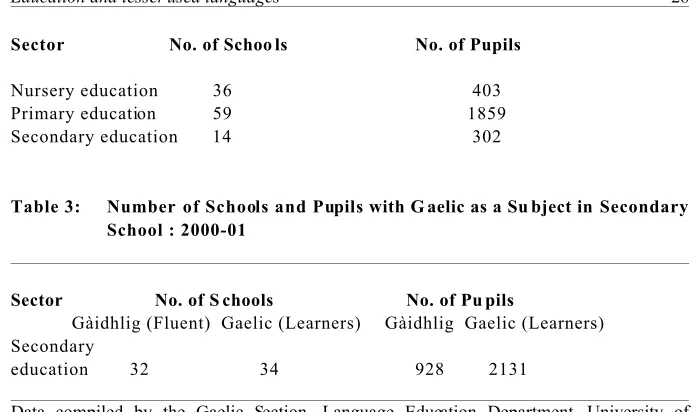
Sector No. of Schoo ls No. of Pupils
Nursery education 36 403
Primary education 59 1859
[image:33.595.122.470.188.394.2]Secondary education 14 302
Table 3: Number of Schools and Pupils with G aelic as a Su bject in Secondary School : 2000-01
Sector No. of S chools No. of Pu pils
Gàidhlig (Fluent) Gaelic (Learners) Gàidhlig Gaelic (Learners) Secondary
education 32 34 928 2131
References and Further Reading
main officia l texts regulating the teaching o f Gaelic
Education (Scotland) Act 1872 : No provision was made for Gaelic in this important piece of legislation whic h established State education in Scotland.
Education (Scotland) Act 1918 : Education authorities were required by this Act to make "adequate provision" for teaching Gaelic as a subject "in Gaelic-speaking areas" at primary, intermediate and secondary levels.
Education (Scotland) Act 1980 : The requir ement to make “adequa te provision fo r teaching G aelic as a sub ject in “Gaelic-speaking areas introduced in the 1918 Act was retained. There was no re ference to the use of Gaelic as a medium of education.
Grants for Gaelic Language Education (Scotland) Regulations 1986 : This legislation enabled education authorities to make bids to the Government, on an individual and on a collaborative basis, for Ga elic educatio n projects which, if approved, would b e granted 75% funding for a fixed and limited period.
Standards in Scotland’s Schools etc Act 2000 : The first substantial item of legislation on educational provision enacted by the Sco ttish Parliame nt established , inter alia, a set of national priorities. Gaelic is one of these priorities.
publications Comunn na Gàidh lig (1997), Framework for Growth - A
national policy for Gaelic education, Inverness : Comunn na Gàidhlig
Comunn na Gàid hlig (1999), Inbhe Thèarainte dhan
Ghàidhlig; Secure sta tus for Gae lic - Draft brief for a Gaelic L anguag e Act, Inverness : Comun n na Gàid hlig
Dunn, Catherine M and Robertson, A G Boyd (1989) Gaelic in Education in Gillies, W (e d.), Gaelic and Scotland, Edinburgh: Edinburgh University Press, pp. 44-55
General Teach ing Council for Scotland (1999), Teaching in Gaelic Medium Education, Edinburgh : General Teaching Council for Scotland
Gillies, W (ed) (1989), Gaelic and Scotland, Edinburgh : Edinburgh University Press
Higher S till Developm ent Unit (19 97),Arrangements for Gaelic (Learners), Edinburgh : Scottish CCC
Higher S till Developm ent Unit (19 97),Arrangements for Gàidhlig, Edinburgh : Scottish CCC
L.M Inspectors of Schools (199 4) Provision for Ga elic
Education in Scotland, Edinburgh: The Scottish Office Education Department
HM Inspectors of Schools (199 7)A Curriculum Framew ork
for Children in their Pre-school Year, Edinburgh : The Scottish Office
Johnston e, R (1994 ),The Imp act of Curr ent Deve lopmen ts to support the Gaelic Language : Review of Research, Stirling : Scottish CILT
Johnston e, R (1999 ),The Attainments of Pupils Receiving Gaelic Medium Primary Education in Scotland, Stirling : Scottish CILT
MacK innon, K (1991), A Past an d Future P rospect, Edinburg h : Saltire Socie ty
MacN eil, M and Stradling, R (1 997), Meeting the Demand for Gaelic in Education : The Availability of
Gaelic-sp eaking Te achers, Skye : Lèirsinn Research
Macp herson, J A (2000), Revitalising Gaelic - A National Asset - Report by the Taskforce on Public Funding of Gaelic, Edinburgh : Scottish Executive
Robertson, B (1995), Provision for Gaelic in Scottish education in Vallen, Birkhoff and Buwalda (eds.), Home Language and school in a European perspective, Tilburg: Tilburg University Press
Robertso n, B (1999), Gaelic Education in Bryce and Humes (ed) Scottish Education, Edinburg h : Edinbu rgh Univ ersity Press
Robertson, B (2001), Gaelic in Scotland in Extra and Gorter
(ed), The Other Languages of Europe, Cleveden :
Multilingual Ma tters
Scottish Consultativ e Coun cil on the Curriculum (199 9), Curriculum Design for the Secon dary Stag es : Guid elines for Schools (second revised edition), Dundee : Scottish CCC
Stradling, R and MacN eil, M (1995), Teacher Training for Gaelic Medium Education, Skye : Lèirsinn Research Centre, Sabhal M òr Ostaig
The Scottish Office Education Department (1993)
Curriculum and Assessment in Scotland : National
Guidelines: Gaelic 5-14, Edinburgh: HMSO
Thomson, D (1994 ), The Companion to Gaelic Scotland :
Glasgow, Gairm
official bodies
Com ataidh C raolaidh Gàidhlig
4 Harbour View Cromwell Street Quay STORNOWAY Isle of Lew is HS1 2DF
Phone: 01851 705550/703612 Fax: 01851 706432
E-mail:
[email protected] Website: www.ccg.org.uk
General Teaching Council for Scotland
Clerwood House 96 Clermiston Road EDINBURGH EH12 6UT
Phone: 0131 314 6000 Fax: 0131 314 6001 E-mail: [email protected] Website: www.gtcs.org.uk
Scottish Executive Education Department
Victoria Quay LEITH EH6 6QQ
Phone: 0131 244 1479 Fax: 0131 244 1475
E-mail: [email protected] Website: www.scotland.gov.uk
Scottish Qualifications A uthority
Ironmills Road DALKEITH Midlothian EH22 1LE
Phone: 0131 663 6601 Fax: 0131 654 2664
E-mail: [email protected] Website: www.sqa.org.uk
Scottish Higher Education Funding Coun cil
97 Haymarket Terrace EDINBURGH EH12 5HD
Phone: 0131 313 6500 Fax:0131 313 6501 E-mail: [email protected] Website:www.shefc.ac.uk
Local Authorities
Sandwick Road STORNOWAY Isle of Lew is HS1 2BW
Fax: 01851 704709
E-mail [email protected] Website: www.cne-siar.gov.uk
The H ighland C ouncil
Council Offices Glenurquhart Road INVERNESS IV3 5NX
Phone:0463 702000 Fax: 01463 702111 E-mail:
[email protected] Website: www.highland.gov.uk
Argyll & Bute C ouncil
Kilmory
LOCHGILPHEAD Argyll
PA13 8RT
Phone:0546 602127 Fax: 01546 604138 E-mail:
[email protected] Website: www.argyll-bute.gov.uk
Glasgo w City C ouncil
Education Services Nye Bevan Ho use 20 India Street GLASGOW G2 4PF
Phone:0141 287 2000 Fax: 0141 287 6786
E-mail:[email protected] Website:
www.glasgow.gov.uk/education
Curriculum Development Agencies
Storlann Nàisean ta na Gà idhlig
Ionad C hearsiadair LOCHS
Isle of Lew is HS2 9QA
Phone: 01851 880441 Fax: 01851 880389
Learning and Teaching Scotland
Gardyne Road Broughty Ferry DUNDEE DD5 1NY
Phone: 01382 443600 Fax: 013 82 4436 45/6
E-mail: [email protected] Website: www.LTScotland.com
Higher Education Institutions
Sabhal Mòr Ostaig (Gaelic College)
Teangue SLEAT Isle of Skye IV44 8RQ
Phone: 01471 888000 Fax: 01471 888001
E-mail: [email protected] Website:www.smo.uhi.ac.uk
UHI M illennium Institute
Caledonia House 63 Academy Street INVERNESS IV1 1BB
Phone: 01463 279000 Fax: 01463 279001 E-mail: [email protected] Website: ww.uhi.ac.uk
Gaelic Section
Language Education Dept University of Strathclyde Jordanhill Campus 76 Southbrae Drive GLASGOW G13 1PP
Phone: 141 950 3445 Fax: 0141 950 3213
E-mail: [email protected] Website: www.strath.ac.uk
Celtic Dept
School of Modern Languages Taylor Building
University of Aberdeen Old Aberdeen
ABERDEEN AB24 3UB
Phone: 01224 272550 Fax: 01224 272562
Celtic Dept
Edinburg h Unive rsity 19-20 Georg e Square EDINBURGH EH8 9LD
Phone: 0131 650 3622 Fax: 0131 650 3626
E-mail: [email protected] Website: www.ed.ac.uk/celtscot
Celtic Dept
Modern Languages Building University of Glasgow 16 University Gardens GLASGOW
G12 8QQ
Phone: 0141 3304222 Fax: 0141 330 4222 E-mail: C.Smith@ celtic.arts.gla.ac.uk
Web site: www .gla.ac.uk/ce ltic
Publishers and Publishing Agencies
Gaelic B ooks Co uncil
22 Mansfield Street GLASGOW G11 5QP
Phone: 0141 337 6211/3555 Fax: 0141 341 0515
E-mail: [email protected] Website: www.gaelicbooks.net
Acair Ltd
7 James Street STORNOWAY Isle of Lew is HS1 2QN
Phone: 01851 703020 Fax: 01851 703294 E-mail: [email protected]
Web site: www .hebrides.co m/acair
Cànan L td
Sabha l Mòr O staig
Teangue SLEAT Isle o Skye IV44 8RQ
Phone: 01471 888500 Fax: 01471 888501
E-mail: [email protected] Website: www.canan.co.uk
Gairm Publications
27 Waterloo Street GLASGOW G2 6BZ
Phone: 0141 221 1971 Fax: 0141 221 1971
Lèirsinn Research Centre
Sabhal M òr Ostaig Teangue
SLEAT Isle of Skye IV44 8RQ
Phone: 01471 888550 Fax: 01471 888551
E-mail: [email protected] Website: www.smo.uhi.ac.uk/leirsinn
Institute of Education
Stirling Univ ersity Pathfoot Building University of Stirling STIRLING
FK9 4LA
Phone: 01786 467600 Fax: 01786 467633 E-mail: [email protected] Website: www.stir.ac.uk
Scottish C ouncil for R esearch in Education(SCRE)
15 St John Street EDINBURGH EH8 8JR
Phone: 0131 557 2944 Fax: 0131 556 9454 E-mail: [email protected] Website: www.scre.ac.uk
Language Development Bodies
Com unn na Gàidhlig
5 Mitchell’s Lane INVERNESS IV2 3HQ
Phone: 01463 234138 Fax: 01463 237470 E-mail: [email protected] Website: www.cnag.org.uk
Comhairle nan Sgoiltean Araich
53 Church Street INVERNESS IV1 1DR
Phone: 01463 225469 Fax: 01463 716943
E-mail: [email protected] Website: www.scotnet.co.uk/cnsa
Clì
62 High Street INVERGORDON
IV18 0DH Website: www.cli.org.uk
Coma nn nam P àrant Nàisean ta
5 Mitchell’s Lane INVERNESS IV2 3HQ
Phone: 01463 234138 Fax: 01463 237470
E-mail: [email protected] Website: www.parant.org.uk
Cultural Bodies
An Comunn G aidhealach
97 Cromwell Street STORNOWAY Isle of Lew is HS1
Other websites on minority languages
Mercator www.mercator-central.org
General site of the Mercator-project. It will lead you to the three specialized centres:
Mercator-Education www.mercator-education.org
Homepage of Mercator-Education: European Network for regional or minority languages and education. The site con-tains the series of reg ional dossie rs, a databas e with orga ni-sations and bibliography and many rated links to m inority languages.
Merca tor-Med ia www.aber.ac.uk/~merc/
Homepage of Mercator-Media. It provides information on media and minority languages in the EU.
Mercator-Legislation
www.troc.es/ciemen/mercator
Homepage of Mercator-Legislation. It provides information on minority language s and legislatio n in the EU .
European Union h t tp : // e ur o pa . eu . in t /c o m m /e d uc a ti o n/ la n gm i n .h t m l
At the website of the Europe an Unio n an expla nation is given of its support for regional or minority languages.
Council of Europe http://conventions.coe. int/
European Charter for Regional or Minority Languages. (1992) and Framework Convention for the Protection of National Minorities (1995) European Treaty Series/Série des traités européens ETS 148 and 157, Strasbourg.
Eurydice www.eurydice.org
Eurydice is the information network on education in Europe. The site provides information on all European education systems a nd educa tion policies.
EBLUL www.eblul.org/
website
What can Mercator-Education offer you?
www.m ercator-education.org
network Mercator-Education is part of an information service and
research network of three centre s. They pro vide reliable and in depth information on regional or minority languages in co-operation with many experts throughout Europe. Mercator-Education is hosted at the Fryske Akademy, Leeuwarden. Mercato r-Media resides at the University of Wales (Aberystwyth) and Mercator-Legislation at Ciemen (Barcelona).
newsletter An electronic or p rinted newsletter with current
develop-ments concerning regional or m inority lanugages in educ-ation is distributed to individuals and organiseduc-ations.
Q&A
publications
Through the Question and A nswer Service w e can inform you about any subject related to education in minority or regional lang uages in the Europea n Union .
Regional dossiers are published on a regular base to pro-vide basic information on schooling in minority language regions in the Europea n Union (also on-line).
The latest Mercator Guide to Organisations (MGO) was published in 1998. It contains some 500 relevant addresses of institutes and s ervices, now also available through our on-line datab ase.
Basque; the Basque Language in Education in France Basque ; the Basqu e Langu age in Edu cation in Spa in Breton; the Breton Language in Education in France Catalan; the Catalan L anguag e in Educa tion in Spain Corsican; the Corsican Language in Education in France Croatian; the Croatian L anguag e in Educa tion in Aus tria
Frisian; the Frisian Language in Education in The Netherlands (3rd) German; the German Language in Education in Alsace, France (2nd) Galician; the Galician L anguag e in Educa tion in Spain
Irish; the Irish Language in Education in Northern Ireland Irish; the Irish Language in Education in the Republic of Ireland Ladin, the L adin Lan guage in E ducation in Ita ly
Meänkili and Sweden Finnish; the Finnic Languages in Education in Sweden North-Frisian; the North Frisian Language in Education in Germany
Occitan; the Occitan Language in Education in France Sami; the Sami Language in Education in Sweden
Slovenian; the Slovenian Language in Education in Austria Sorbian, the Sorbian Language in Education in Germany Swedish; the Swedish Language in Education in Finland Welsh; the Welsh Language in Education in the UK